


Abstract
Background/Objectives: Omnipod 5 is a tubeless automated insulin delivery system integrating continuous glucose monitoring (CGM) with algorithm-driven insulin delivery. Clinical trials and real-world studies have shown improved glycemic control and reduced hypoglycemia in people with type 1 diabetes (T1D) previously treated with multiple daily injections (MDI) or non-automated sensor-augmented pump (SAP) therapy. However, long-term real-world data in young adults remain limited. Methods: We conducted a retrospective, single-centre observational study including adults with T1D who started therapy with a tubeless automated insulin delivery system (Omnipod 5). Participants were previously treated with MDI or SAP therapy. Glycemic outcomes were assessed using CGM metrics at baseline, 1, 3, and 12 months after starting the system. The primary outcome was change in time in range of 70–180 mg/dL (TIR) at 12 months. Secondary outcomes included additional CGM metrics, insulin therapy parameters, and the occurrence of diabetic ketoacidosis (DKA) and severe hypoglycaemia (SH) episodes. Results: Fifty-two patients were included (mean age 23.0 ± 4.3 years; diabetes duration 13.8 ± 5.9 years); 51 completed 12-month follow-up. At 12 months, TIR increased from 56.1 ± 11.4% to 67.4 ± 11.0% (+11.3%; p < 0.001), while time in tight range of 70–140 mg/dL (TITR) increased from 34.5 ± 10.9% to 44.8 ± 8.7% (+10.3%; p < 0.001). Time in hypoglycemia also decreased, with no episodes of DKA or SH reported during the study period. Glycemic improvements were evident at 1 month and maintained at 12 months. The proportion of patients achieving recommended targets improved at 12 months, including TIR > 70% (13.5% to 43.1%). Total daily insulin requirements remained unchanged, while basal insulin proportion increased, and daily boluses decreased (both p < 0.001). Conclusions: In this real-world study, Omnipod 5 therapy was associated with improved glycemic control and reduced hypoglycemia over 12 months in young adults with T1D, without increasing insulin requirements.
1. Introduction
Type 1 diabetes (T1D) is a chronic autoimmune condition characterized by insulin deficiency, requiring lifelong insulin replacement therapy [1]. Achieving and maintaining optimal glycemic control remains challenging, particularly in young adults, a population often exposed to high glycemic variability and suboptimal adherence to therapy [2]. Automated insulin delivery (AID) systems have substantially improved diabetes management by integrating continuous glucose monitoring (CGM) with algorithm-driven insulin delivery, enabling dynamic modulation of insulin administration and reducing both hyperglycemia and hypoglycemia [3]. Early AID systems, while effective, were limited by the need for tubing, which may negatively impact user acceptance, particularly among active individuals and younger populations [4]. The development of tubeless AID systems represents a relevant technological advancement, potentially improving usability, discretion, and treatment adherence [5]. The Omnipod 5 system is a tubeless automated insulin delivery platform currently approved in Italy for individuals with T1D aged ≥2 years. It integrates a wearable insulin delivery pod with a model predictive control (MPC) algorithm, a CGM sensor and a handheld controller (PDM, Personal Diabetes Manager). When automated mode (SmartAdjust) is enabled, insulin delivery is adjusted every 5 min based on real-time glucose data, with insulin-on-board, user-defined parameters such as the glucose target, customizable from 110 to 150 mg/dL [6,7]. Clinical trials and real-world studies have demonstrated the effectiveness of the Omnipod 5 system in improving glycemic outcomes across various age groups. In adults, pilot studies [8,9], randomized trials [10], and observational real-world studies [11,12,13] have reported significant improvements in time in range (TIR), reductions in time spent in hyperglycemia, and lower rates of hypoglycemia, with some studies suggesting sustained benefits up to 12 months [9,13].
In Italy, early real-world studies have also reported favorable glycemic outcomes following initiation of this system. Tinti et al. showed significant improvements in glycemic control at 1 month in adolescents transitioning from sensor-augmented pump therapy to Omnipod 5 [14], while Angelino et al. reported improved glycemic metrics within the first 14 days after initiation in a cohort of adults with T1D [15]. However, these studies primarily focused on short-term outcomes, and data on the long-term effectiveness of tubeless automated insulin delivery systems remain limited, particularly in young adult populations. In this study, we evaluated one-year glycemic outcomes in young adults with T1D initiating a tubeless AID system in routine clinical practice. Specifically, we aimed to evaluate the one-year glycemic effectiveness and safety of the Omnipod 5 system in young adults with T1D in a real-world clinical setting, and to perform an exploratory subgroup analysis according to baseline treatment modality.
2. Materials and Methods
2.1. Study Design and Participants
We conducted a retrospective, single-centre observational study to assess the effectiveness and safety of the Omnipod 5 system (Insulet Corporation®, Acton, MA, USA) in adult patients (≥18 years) with T1D in routine clinical practice. All patients were followed at the Regional Diabetes Centre of IRCCS Istituto Giannina Gaslini, Genoa, Italy.
Eligible participants initiated the Omnipod 5 system between 1 December 2024, and 31 May 2025, as part of standard clinical care. Patients were previously treated with either multiple daily injections combined with continuous glucose monitoring (MDI + CGM) or non-automated sensor-augmented pump therapy (SAP), defined as conventional continuous subcutaneous insulin infusion combined with CGM, without sensor–pump communication or automated insulin modulation. This ensured that all participants were using CGM at baseline. Exclusion criteria included prior use of automated insulin delivery systems, other forms of diabetes, CGM use <85% in the 14 days preceding baseline assessment, or incomplete follow-up data.
During the study period, all participants used Dexcom G6 sensor in accordance with regional procurement policies and started on standardized manufacturer-recommended settings, including a glucose target of 110 mg/dL throughout the 24-h period and an active insulin time of 2 h. Initiation of the system was performed during a structured outpatient visit session lasting approximately 3 h, led by a diabetologist and a diabetes nurse educator. The session included education on the principles of the control algorithm and hands-on training on pod replacement. Based on clinical judgment, patients not previously using carbohydrate counting received an additional dietary consultation (approximately 30 min) focused on carbohydrate counting reinforcement.
The study was approved by the local Ethics Committee (CER Liguria; protocol number 561/2022). All participants provided written informed consent for the use of anonymized clinical data for research purposes.
2.2. Outcomes and Data Collection
The primary outcome was the change in Time in Range of 70–180 mg/dL (TIR) from baseline (T0) to 12 months (T3), evaluated in patients with available 12-month follow-up data.
Secondary outcomes included:
- Additional CGM metrics: Time in Tight Range of 70–140 mg/dL (TITR), Time Above Range of 181–250 mg/dL (TAR), Time above 250 mg/dL (TA250), Average Glucose (AG), Standard Deviation (SD), Coefficient of Variation (CV), glucose management indicator (GMI), Glycemia Risk Index (GRI), sensor usage (CGM use).
- Proportion of patients achieving ADA recommended CGM glycemic targets: TIR > 70%, TITR > 50%, Time below 70 mg/dL < 4%, Time above 180 mg/dL < 25% [16].
- Insulin therapy and system utilization metrics: total daily insulin requirement (U/Kg/day), basal and bolus insulin distribution, number of daily boluses, number of meals per day, and daily carbohydrate intake.
- Safety outcomes, including Time Below Range of 54–69 mg/dL (TBR), Time Below 54 mg/dL (TB54), and episodes of diabetic ketoacidosis (DKA) or severe hypoglycemia (SH).
- Clinical outcomes, including HbA1c and BMI.
- Subgroup analysis according to baseline treatment modality (MDI vs. SAP).
Clinical and CGM data were collected at baseline (T0), and after 1 month (T1), 3 months (T2), and 12 months (T3) of follow-up, using data from the 14 days preceding each timepoint. Baseline data on boluses per day, meals per day, and carbohydrate intake were available only for patients previously treated with SAP therapy, as these variables were extracted from pump download reports. In patients previously treated with MDI + CGM, total daily insulin dose and the distribution between basal and bolus insulin were obtained from clinical records at the time of Omnipod 5 initiation, as routinely collected during outpatient visits. CGM data were extracted from device-specific platforms at baseline and from Glooko at follow-up. Data were recorded in a standardized electronic case report form.
2.3. Statistical Analysis
Data are described as mean and standard deviation (SD) or median and range for continuous variables, and as absolute and relative frequencies for categorical variables. The Kolmogorov–Smirnov statistical test was used to assess the normal data distribution. Comparisons between T0 and T1 to examine continuous nonparametric variables were performed using Paired Wilcoxon test. p values ≤ 0.05 were considered statistically significant, and all p values were based on two tailed tests. Statistical analysis was performed using SPSS for Windows version 29 (SPSS Inc., Chicago, IL, USA).
3. Results
A total of 52 patients were included in the study. Baseline characteristics of the study population are reported in Table 1. The cohort had a mean age of 23.0 ± 4.3 years and a mean diabetes duration of 13.8 ± 5.9 years. The distribution of sex assigned at birth was balanced (50% female) and the majority of participants (96%) were of Caucasian ethnicity. At baseline, most patients were treated with sensor-augmented pump therapy (84.6%), while a minority were on multiple daily injections combined with continuous glucose monitoring (15.4%). HbA1c at baseline was within recommended targets (6.92 ± 0.94%), while mean TIR was 56.6 ± 12.0%. All patients initiated the Omnipod 5 system with a single glucose target, which was set at 110 mg/dL in most participants (98.1%). All devices were paired with Dexcom G6 sensors.
Table 1.
Baseline clinical characteristics and initial device settings of the study population (n = 52). Data are presented as mean ± SD or n (%), as appropriate.
Of the 52 included patients, 51 completed the 12-month follow-up and were included in the primary outcome analysis. One patient discontinued treatment with Omnipod 5 and returned to the previous therapy. Clinical, CGM-derived, and insulin therapy data at baseline and after 12 months are summarized in Table 2.
Table 2.
Mean ± SD of clinical, CGM-derived, and insulin therapy data at baseline (T0) and after 12 months (T3) in patients who completed one-year follow-up (n = 51). Statistically significant p-values are reported in bold.
A significant improvement in glycemic control was observed at 12 months. Mean time in range (TIR) increased from 56.1 ± 11.4% at baseline to 67.4 ± 11.0% at 12 months (+11.3 percentage points). Similarly, time in tight range of 70–140 mg/dL (TITR) increased from 34.5 ± 10.9% to 44.8 ± 8.7%, corresponding to an absolute increase of +10.3 percentage points (p < 0.001 for both).
Improvements were also observed across all other CGM-derived glycemic metrics, as shown in Table 2. HbA1c did not show significant changes over time (p = 0.21), although this parameter was available only in a minority of patients (n = 21).
Regarding safety, hypoglycemia significantly decreased over the study period. Time below range of 54–70 mg/dL (TBR) decreased from 3.39 ± 3.07% to 1.94 ± 1.32%, while time below 54 mg/dL (TB54) was reduced from 1.25 ± 1.69% to 0.55 ± 0.70% (both p = 0.001). No episodes of diabetic ketoacidosis or severe hypoglycemia were recorded during the study period.
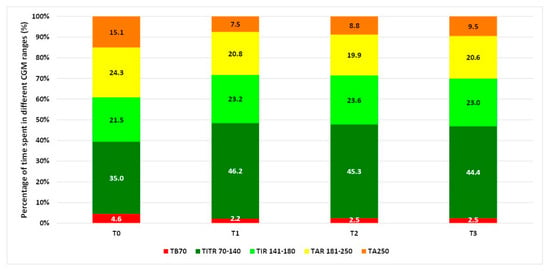
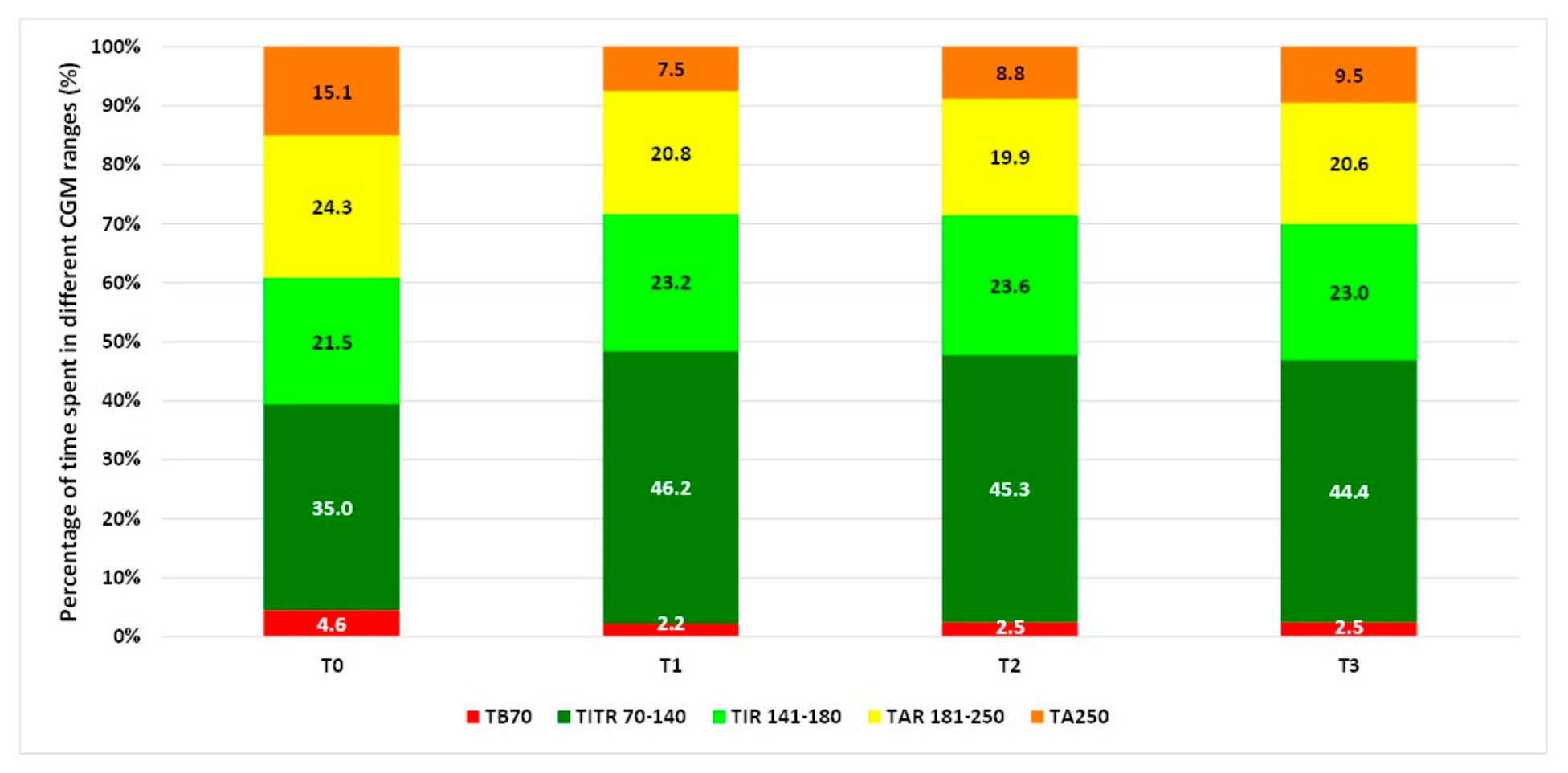
Total daily insulin requirements did not change significantly over the study period (0.69 ± 0.18 vs. 0.68 ± 0.20 U/kg/day, p = 0.48). However, a significant shift in insulin delivery patterns was observed, with an increase in the percentage of insulin delivered as basal insulin (47.4 ± 10.7% vs. 55.2 ± 8.0%, p < 0.001), accompanied by a corresponding reduction in bolus insulin delivery. The number of daily boluses significantly decreased (4.97 ± 1.89 vs. 3.9 ± 1.31, p < 0.001), while no significant changes were observed in patient–system interactions, as reflected by the number of meals announced and daily carbohydrate entries. Improvements in glycemic control were observed as early as 1 month after initiation and remained stable throughout the 12-month follow-up period (Figure 1, Supplementary Tables S1 and S2). Exploratory subgroup analyses according to baseline treatment modality (MDI vs. SAP) are reported in Supplementary Table S3.
Figure 1.
Distribution of time spent in different CGM glycemic ranges across study timepoints (T0–T3). Mean percentages for each range are displayed within the corresponding segments. Abbreviations: TB70, Time below 70 mg/dL; TITR of 70–140, Time in tight range of 70–140 mg/dL; TIR of 141–180, Time in range of 141–180 mg/dL; TAR 181–250, Time above range of 181–250 mg/dL, TA250, Time above 250 mg/dL.
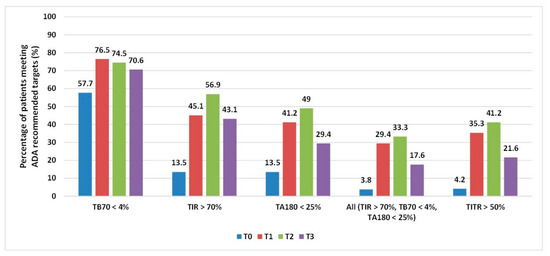
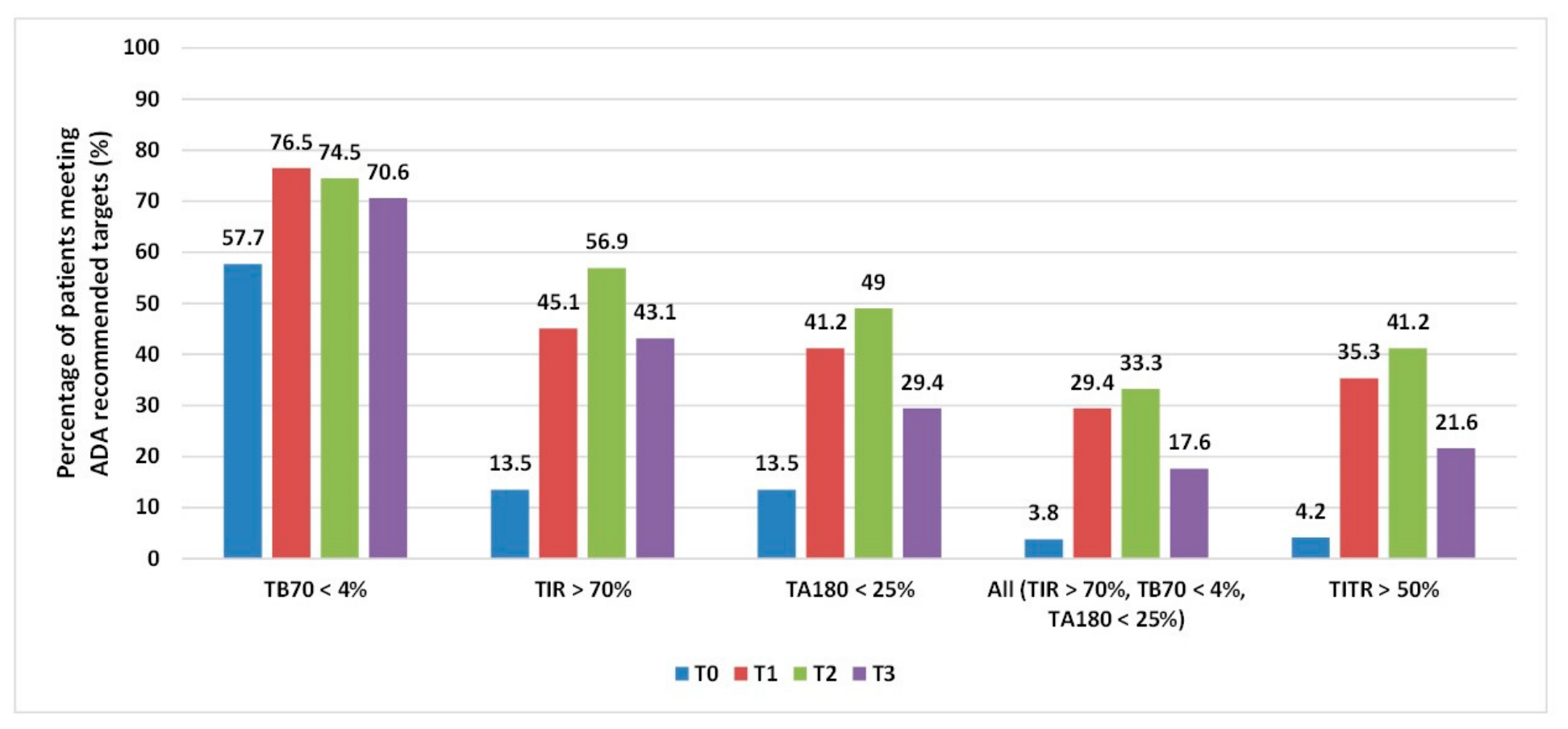
The proportion of patients achieving ADA recommended CGM targets also increased over time (Figure 2). At 12 months, the percentage of patients meeting the target for time below 70 mg/dL (<4%) increased from 57.7% to 70.6% (+12.9 percentage points), those achieving a TIR > 70% from 13.5% to 43.1% (+29.6 percentage points), those achieving a TITR > 50% from 4.2% to 21.6% (+17.4 percentage points), and those meeting the target for time above 180 mg/dL (<25%) increased from 13.5% to 29.4% (+15.9 percentage points). The proportion of patients simultaneously meeting all recommended targets (TIR > 70%, time below 70 mg/dL < 4%, and time above 180 mg/dL < 25%) increased from 3.8% to 17.6% (+13.8 percentage points).
Figure 2.
Proportion of patients achieving ADA recommended CGM targets at baseline (T0), 1 month (T1), 3 months (T2), and 12 months (T3). Values displayed above each column represent the percentage of patients meeting each target at the corresponding timepoint. Abbreviations: TB70, Time below 70 mg/dL; TIR, Time in range of 70–180 mg/dL; TA180, Time above 180 mg/dL; TITR, Time in tight range of 70–140 mg/dL.
All patients who completed follow-up maintained the use of Dexcom G6 sensors in combination with the Omnipod 5 system throughout the study period. At 12 months, the vast majority of patients (90.2%) maintained a glucose target of 110 mg/dL, while only five patients (9.8%) used higher targets (two at 120 mg/dL, two at 130 mg/dL, and one using dual targets: 110 and 130 mg/dL).
4. Discussion
This study demonstrates the effectiveness and safety of a tubeless automated insulin delivery system in a real-world cohort of young adults with type 1 diabetes, showing rapid and sustained improvements in glycemic control over a 12-month follow-up period. The observed increase in time in range of over 11 percentage points corresponds to approximately 2.7 additional hours per day spent within target glucose levels, a clinically meaningful improvement that has been associated with a reduced risk of long-term diabetes complications [17]. Notably, the proportion of patients achieving the recommended TIR > 70% increased markedly from 13.5% to 43.1%, further highlighting the clinical relevance of these findings.
The improvement in glycemic control was also supported by the analysis of two relatively novel CGM-derived metrics, time in tight range (TITR) and glycemic risk index (GRI). TITR reflects the proportion of time spent within a narrower glucose range (70–140 mg/dL), providing a more stringent assessment of optimal glycemic control [18]. GRI is a composite metric that integrates both hypoglycemia and hyperglycemia exposure into a single score, offering a global estimate of glycemic risk [19]. Consistently, glycemic improvement was also reflected by a significant increase in TITR (+10.27% at 12 months), with the proportion of patients achieving TITR > 50% rising by 17.4%, and by a reduction in GRI (−17.18%), corresponding to a shift from risk category 3 to category 2.
Importantly, the observed increase in TIR and TITR was not associated with an increase in total daily insulin requirements, suggesting that enhanced glycemic control was driven by more efficient insulin delivery rather than increased dosing. This is further supported by the observed shift in insulin delivery patterns, with a significant increase in basal insulin proportion and a corresponding reduction in bolus insulin. The reduction in the number of daily boluses reflects decreased need for manual correction of hyperglycemia, likely due to the automated modulation of insulin delivery.
From a clinical perspective, this reduction in user interaction represents a meaningful advantage. Fewer manual boluses translate into reduced treatment burden, lower risk of dosing errors, and potentially improved quality of life. Notably, these improvements were achieved without changes in patient-reported interactions with the system, such as meal announcements or carbohydrate entries, indicating that improved outcomes were not driven by increased user engagement but rather by more effective system performance and insulin distribution.
Hypoglycemia exposure was significantly reduced after Omnipod 5 initiation, addressing one of the main concerns associated with automated insulin delivery systems. Importantly, no episodes of diabetic ketoacidosis or severe hypoglycemia were recorded during the 12-month follow-up, further supporting the safety profile of the system in a real-world setting.
The observed improvements in glycemic control occurred rapidly after system start and were largely maintained over time. However, a modest decline in the proportion of patients achieving recommended glycemic targets at 12 months suggests that long-term effectiveness may depend not only on technology performance but also on sustained patient engagement. This finding may reflect a progressive decline in adherence to the structured education provided at system start, which includes key principles such as pre-meal bolusing, accurate carbohydrate counting, and appropriate correction of hyperglycemia. Periodic reinforcement of these concepts may be required to maintain optimal outcomes over time [20].
Our findings are consistent with previous clinical trials and real-world studies on the Omnipod 5 system, which have reported improvements in glycemic control and reductions in hypoglycemia, although most available data are limited to short-term follow-up [8,9,10,11,12,13,14,15].
The patients included in the study were young adults with long-standing diabetes and suboptimal baseline glycemic control, a group typically considered challenging to treat. A large proportion of participants had previously opted for non-automated patch pump therapy rather than transitioning to conventional AID systems, primarily due to reluctance to use catheter-based infusion sets. In addition, a subset of patients on multiple daily injections had long resisted pump therapy and were only willing to initiate insulin pump treatment with the introduction of a tubeless AID system. These findings highlight the potential of tubeless AID systems to overcome long-standing barriers to technology adoption.
This study has several strengths. Notably, it reflects real-world clinical practice and includes patients who had previously declined automated insulin delivery, either remaining on non-automated pump therapy or on multiple daily injections. This enhances the external validity of the findings and highlights the potential of tubeless systems to overcome barriers to technology adoption. In addition, the relatively long follow-up and the consistent improvements observed across multiple CGM-derived metrics strengthen the robustness of the results. The high degree of homogeneity in system configuration, with all participants using the same CGM system and the vast majority initiating therapy with the lowest available glucose target, further supports the internal consistency of the analysis.
Several limitations should be acknowledged. The retrospective and observational design limits causal inference, and the relatively small sample size, particularly in the MDI subgroup, precluded meaningful subgroup analyses. Importantly, HbA1c data were available only in a minority of patients, as HbA1c testing was performed according to routine clinical practice and was not systematically scheduled within the predefined study time windows. Since CGM-derived metrics were consistently available for all participants, they represented the primary source for glycemic assessment. This limited the evaluation of this traditional marker of glycemic control and prevented a comprehensive comparison with CGM-derived metrics. Baseline bolus, meal, and carbohydrate intake data were available only for patients previously treated with SAP therapy, while insulin dose data in MDI users were obtained from clinical records and may therefore be more susceptible to documentation bias. Moreover, the cohort showed relatively favorable glycemic control at baseline, with widespread CGM use and mean HbA1c values below 7% among patients with available data. This may reflect the characteristics of individuals followed in a specialized diabetes center and willing to initiate a new AID system, who may be more engaged in diabetes self-management than the broader population of adolescents and young adults with T1D. Data on physical activity, dietary habits, and other behavioral characteristics were not systematically collected, preventing us from assessing their potential contribution to the favorable baseline profile. Therefore, although the study reflects routine clinical practice, the generalizability of these findings to less selected populations should be interpreted with caution In addition, patient-reported outcomes were not assessed, precluding evaluation of treatment satisfaction, perceived burden, and quality of life, which are particularly relevant when evaluating advanced diabetes technologies. The absence of a control group and the single-centre setting may limit generalizability. Finally, although follow-up extended to 12 months, longer-term studies are needed to confirm durability of these findings.
5. Conclusions
In this real-world study, a tubeless automated insulin delivery system enabled significant improvements in glycemic control and reduction in hypoglycemia over 12 months in young adults with type 1 diabetes, without increasing insulin requirements. Notably, this technology facilitated the adoption of automated insulin delivery in patients previously unwilling to use conventional pump systems, highlighting its potential to expand access to advanced diabetes care and improve outcomes in a difficult-to-treat population.
Supplementary Materials
The following supporting information can be downloaded at: https://www.mdpi.com/article/10.3390/endocrines7030032/s1. Supplementary Table S1. Mean ± SD of CGM-derived glycemic metrics at baseline (T0) and after 1 month (T1) in patients with available paired data (n = 51). Statistically significant p-values are reported in bold. Supplementary Table S2. Mean ± SD of clinical, CGM-derived, and insulin therapy data at baseline (T0) and after 3 months (T2) in patients with available paired data (n = 51). p-values refer to within-group comparisons. Statistically significant p-values are reported in bold. Supplementary Table S3. Mean ± SD of clinical, CGM-derived, and insulin therapy data at baseline (T0) and after 12 months (T3) according to baseline treatment modality (MDI + CGM vs. SAP) in patients who completed one-year follow-up (n = 51). p-values refer to within-group comparisons. Statistically significant p-values are reported in bold.
Author Contributions
M.B. and N.M. designed the study. G.S. (Giulia Siri), S.M., B.C., B.V. and C.R. collected data. M.G.C. analysed the data. G.S. (Giordano Spacco), S.M. and B.C. wrote the first draft of the manuscript. G.S. (Giordano Spacco), N.M. and M.B. critically discussed the results and wrote the final draft of the manuscript. A.G. and M.M. reviewed the final version of the manuscript and contributed to the conclusions. All authors have read and agreed to the published version of the manuscript.
Funding
There was no formal funding to collect data or design, analyse, discuss, and write the study.
Data Availability Statement
Data are available upon reasonable request from the corresponding author.
Conflicts of Interest
The authors declare no conflicts of interest.
Abbreviations
The following abbreviations are used in this manuscript:
| T1D | Type 1 Diabetes |
| AID | Automated Insulin Delivery |
| MDI | Multiple Daily Injection |
| CGM | Continuous Glucose Monitoring |
| SAP | Sensor Augmented Pump |
| OP5 | Omnipod 5 |
| MPC | Model Predictive Control |
| PDM | Personal Diabetes Manager |
| TIR | Time in Range |
| TITR | Time in Tight Range |
| TAR | Time above Range |
| TBR | Time below Range |
| AG | Average Glucose |
| SD | Standard Deviation |
| CV | Coefficient of Variation |
| GMI | Glucose Management Indicator |
| GRI | Glycemia Risk Index |
| CHO | Carbohydrates |
| BMI | Body mass Index |
| DKA | Diabetic ketoacidosis |
| SH | Severe hypoglycemia |
| HbA1c | Glycated Haemoglobin |
| ADA | American Diabetes Association |
References
- Jacobsen, L.M.; Schatz, D.A. Type 1 Diabetes: A Review. JAMA 2026, 335, 1070–1083. [Google Scholar] [PubMed]
- Khadilkar, A.; Oza, C. Glycaemic Control in Youth and Young Adults: Challenges and Solutions. Diabetes Metab. Syndr. Obes. 2022, 15, 121–129. [Google Scholar] [CrossRef] [Scilit] [PubMed]
- Bassi, M.; Franzone, D.; Dufour, F.; Strati, M.F.; Scalas, M.; Tantari, G.; Aloi, C.; Salina, A.; D’annunzio, G.; Maghnie, M.; et al. Automated Insulin Delivery (AID) Systems: Use and Efficacy in Children and Adults with Type 1 Diabetes and Other Forms of Diabetes in Europe in Early 2023. Life 2023, 13, 783. [Google Scholar] [CrossRef] [Scilit] [PubMed]
- Azar, S.; Maroun Abou Jaoude, N.; Kędzia, A.; Niechciał, E. Barriers to Type 1 Diabetes Adherence in Adolescents. J. Clin. Med. 2024, 13, 5669. [Google Scholar] [CrossRef] [Scilit] [PubMed]
- Kulzer, B.; Freckmann, G.; Heinemann, L.; Schnell, O.; Hinzmann, R.; Ziegler, R. Patch Pumps: What are the advantages for people with diabetes? Diabetes Res. Clin. Pract. 2022, 187, 109858. [Google Scholar] [CrossRef] [Scilit] [PubMed]
- Forlenza, G.P.; Buckingham, B.A.; Brown, S.A.; Bode, B.W.; Levy, C.J.; Criego, A.B.; Wadwa, R.P.; Cobry, E.C.; Slover, R.J.; Messer, L.H.; et al. First Outpatient Evaluation of a Tubeless Automated Insulin Delivery System with Customizable Glucose Targets in Children and Adults with Type 1 Diabetes. Diabetes Technol. Ther. 2021, 23, 410–424. [Google Scholar] [CrossRef] [Scilit] [PubMed]
- Berget, C.; Annan, S.F.; Biester, T.; Choudhary, P.; Forlenza, G.P.; Peters, A.L.; Renard, E.; Deiss, D. Practical considerations for using the Omnipod® 5 Automated Insulin Delivery System: Clinical experience from the United States and Europe. Diabetes Obes. Metab. 2025, 27, 2909–2919. [Google Scholar] [CrossRef] [Scilit] [PubMed]
- Brown, S.A.; Forlenza, G.P.; Bode, B.W.; Pinsker, J.E.; Levy, C.J.; Criego, A.B.; Hansen, D.W.; Hirsch, I.B.; Carlson, A.L.; Bergenstal, R.M.; et al. Multicenter Trial of a Tubeless, On-Body Automated Insulin Delivery System With Customizable Glycemic Targets in Pediatric and Adult Participants With Type 1 Diabetes. Diabetes Care 2021, 44, 1630–1640. [Google Scholar] [CrossRef] [Scilit] [PubMed]
- Criego, A.B.; Carlson, A.L.; Brown, S.A.; Forlenza, G.P.; Bode, B.W.; Levy, C.J.; Hansen, D.W.; Hirsch, I.B.; Bergenstal, R.M.; Sherr, J.L.; et al. Two Years with a Tubeless Automated Insulin Delivery System: A Single-Arm Multicenter Trial in Children, Adolescents, and Adults with Type 1 Diabetes. Diabetes Technol. Ther. 2024, 26, 11–23. [Google Scholar] [CrossRef] [Scilit] [PubMed]
- Renard, E.; Weinstock, R.S.; Aleppo, G.; Bode, B.W.; Brown, S.A.; Castorino, K.; Hirsch, I.B.; Kipnes, M.S.; Laffel, L.M.; Lal, R.A.; et al. Efficacy and Safety of a Tubeless AID System Compared With Pump Therapy With CGM in the Treatment of Type 1 Diabetes in Adults With Suboptimal Glycemia: A Randomized, Parallel-Group Clinical Trial. Diabetes Care 2024, 47, 2248–2257. [Google Scholar] [CrossRef] [Scilit] [PubMed]
- Forlenza, G.P.; DeSalvo, D.J.; Aleppo, G.; Wilmot, E.G.; Berget, C.; Huyett, L.M.; Hadjiyianni, I.; Méndez, J.J.; Conroy, L.R.; Ly, T.T.; et al. Real-World Evidence of Omnipod® 5 Automated Insulin Delivery System Use in 69,902 People with Type 1 Diabetes. Diabetes Technol. Ther. 2024, 26, 514–525. [Google Scholar] [PubMed]
- Aslam, A.; Chapman, A.; Urwin, A.; Ohol, S.; Thomas, S.; Gough, R.; Findlow, L.; Lim, J.; Schofield, J.; Leelarathna, L.; et al. Real-world data from first UK Omnipod 5 users: A single-centre observational study. Diabetes Obes. Metab. 2024, 26, 3462–3465. [Google Scholar] [PubMed]
- Stimson, R.H.; Strachan, M.W.J.; Dover, A.R.; Wright, R.J.; Forbes, S.; McRobert, G.; Gibb, F.W. Outcomes after 1 year in adults using Omnipod 5: Real-world data from a UK diabetes centre. Diabet. Med. 2024, 41, e15453. [Google Scholar] [PubMed]
- Tinti, D.; Castorani, V.; Nobili, C.; Felappi, B.; Prandi, E.; Piccini, B.; Toni, S.; Bassi, M.; Minuto, N.; Bonfanti, R.; et al. Omnipod 5 in children and adolescents with type 1 diabetes: Improved outcomes with fewer boluses. Diabetes Obes. Metab. 2025, 27, 4567–4570. [Google Scholar] [CrossRef] [Scilit] [PubMed]
- Angelino, S.; Maiorino, M.I.; Petrizzo, M.; Di Martino, N.; Caruso, P.; Carbone, C.; Pontillo, A.; Maio, A.; Longo, M.; Scappaticcio, L.; et al. Real-world glycemic outcomes of a tubeless automated insulin delivery system: A single-center observational study in Italy. Front. Endocrinol. 2025, 16, 1717249. [Google Scholar]
- American Diabetes Association Professional Practice Committee. 6. Glycemic Goals and Hypoglycemia: Standards of Care in Diabetes-2025. Diabetes Care 2025, 48, S128–S145. [Google Scholar] [PubMed]
- De Meulemeester, J.; Charleer, S.; Visser, M.M.; De Block, C.; Mathieu, C.; Gillard, P. The association of chronic complications with time in tight range and time in range in people with type 1 diabetes: A retrospective cross-sectional real-world study. Diabetologia 2024, 67, 1527–1535. [Google Scholar] [PubMed]
- Akturk, H.K.; Battelino, T.; Castañeda, J.; Arrieta, A.; van den Heuvel, T.; Cohen, O. Future of Time-in-Range Goals in the Era of Advanced Hybrid Closed-Loop Automated Insulin Delivery Systems. Diabetes Technol. Ther. 2024, 26, 102–106. [Google Scholar] [PubMed]
- Oriot, P.; Prévost, G.; Philips, J.C.; Klipper Dit Kurz, N.; Hermans, M.P. Glycemia risk index (GRI): A metric designed to facilitate the interpretation of continuous glucose monitoring data: A narrative review. J. Endocrinol. Investig. 2025, 48, 1995–2000. [Google Scholar] [CrossRef] [Scilit]
- American Diabetes Association Professional Practice Committee for Diabetes. 7. Diabetes Technology: Standards of Care in Diabetes-2026. Diabetes Care 2026, 49, S150–S165. [Google Scholar] [PubMed]

Disclaimer/Publisher’s Note: The statements, opinions and data contained in all publications are solely those of the individual author(s) and contributor(s) and not of MDPI and/or the editor(s). MDPI and/or the editor(s) disclaim responsibility for any injury to people or property resulting from any ideas, methods, instructions or products referred to in the content. |
© 2026 by the authors. Licensee MDPI, Basel, Switzerland. This article is an open access article distributed under the terms and conditions of the Creative Commons Attribution (CC BY) license.