1. Introduction
Drug shortages are an increasing global challenge and may compromise treatment continuity, particularly in rare diseases relying on a single authorized product. Recently, the Italian market experienced a prolonged shortage of Humatrope
® (recombinant human growth hormone, rhGH) between 2022 and 2023, potentially affecting the management of growth failure associated with SHOX deficiency, for which this formulation was the only approved therapy. SHOX deficiency results from mutations or alterations of the Short Stature Homeobox (SHOX) gene, located in the pseudoautosomal region 1 (PAR1) of the sex chromosomes, and is characterized by impaired bone growth and stature [
1]. The SHOX gene plays a key role in regulating chondrocyte proliferation and differentiation during embryonic development, thereby influencing skeletal growth. Consequently, growth impairment is a common clinical feature in individuals with SHOX deficiency (SHOXD), with variable degrees of height reduction [
2]. Recombinant human GH therapy improves growth outcomes in patients with SHOXD, and current management strategies are largely derived from those used in Turner syndrome [
3], although long-term outcomes, including final height, require further investigation.
Following the unexpected and prolonged national shortage of the on-label rhGH formulation, the Italian Health Authorities (AIFA) authorized the off-label use of alternative rhGH formulations to prevent treatment interruption and ensure continuity of care. At the time of the shortage, the rhGH therapies approved in Italy for short stature included Saizen® (Merck Serono S.p.A.), Norditropin NordiFlex® (Novo Nordisk SpA), Genotropin® (Pfizer Italia S.r.l.), and Omnitrope® (Sandoz S.p.A.). All these products contain somatropin, a recombinant human growth hormone consisting of 191 amino acid residues with a molecular weight of 22,125 daltons and an amino acid sequence identical to endogenous pituitary GH. However, molecular identity does not necessarily imply demonstrated clinical interchangeability in rare pediatric conditions, particularly when treatment switching is mandatory and occurs outside approved indications. In SHOX deficiency, where only one rhGH formulation holds a specific authorization, evidence supporting treatment continuity during regulatory drug shortages is lacking.
Therefore, the present study aimed to assess real-world growth stability and safety after mandatory switching from the only approved rhGH formulation to alternative preparations during a national drug shortage in children with SHOX deficiency.
2. Materials and Methods
2.1. Study Design and Patients
This multicenter retrospective observational real-world study was conducted in several Italian pediatric endocrinology centers involved in the management of SHOX deficiency. The study population included children and adolescents receiving recombinant human growth hormone (rhGH) therapy with Humatrope® for SHOX deficiency. During the national shortage of the authorized rhGH formulation between 2022 and 2023, patients were switched to an alternative rhGH according to usual clinical practice. The decision to switch treatment was not protocol-driven but depended on local drug availability during the shortage, and patients continued routine follow-up visits according to each center’s standard care schedules. Written informed consent was obtained from parents or legal guardians for the off-label use of the alternative rhGH during the shortage. No experimental intervention or deviation from routine clinical care was introduced.
The study did not require approval from the Ethics Committees, as it consisted of a retrospective observational analysis of anonymized clinical data collected during routine care, in accordance with the document approved by the Italian Privacy Authority under EU Regulation No. 679/2016 (General Data Protection Regulation, GDPR).
Fifty pediatric patients (25 females), aged 2–17 years, previously treated with Humatrope® and subsequently switched to an alternative somatropin rhGH during the 2022–2023 shortage, were retrospectively evaluated from March 2023 onward. Exclusion criteria included the presence of systemic diseases or other syndromic conditions eligible for rhGH treatment.
2.2. Procedures
SHOX deficiency was genetically confirmed in all included patients using molecular or cytogenetic techniques, including multiplex ligation-dependent probe amplification (MLPA), Next-Generation Sequencing (NGS), conventional karyotyping, or fluorescence in situ hybridization.
Plasma insulin-like growth factor-1 (IGF-1) levels were measured using a solid-phase, enzyme-labeled chemiluminescent immunometric assay (Immulite 2000, Siemens Healthcare Diagnostics Inc., Tarrytown, NY, USA). In this assay, a murine anti-IGF-1 antibody is coated onto a solid phase (bead; capture antibody) and paired with a polyclonal rabbit anti-IGF-1 antibody conjugated to alkaline phosphatase (detection antibody). According to the manufacturer’s instructions, IGF-binding protein interference was minimized by a pre-dilution and acidification step (pH 3.1) to separate IGF-I from IGFBP-3.
Auxological parameters collected included standing height (measured to the nearest 0.1 cm with a wall stadiometer), weight (measured to the nearest decimal with a mechanical balance), and body mass index (BMI, calculated as weight in kilograms divided by height in meters squared). Standard deviation scores (SDS) for height, weight, and BMI were recorded at 12 and 6 months before the switch (T0, defined as the time of treatment switch) and at 6 and 12 months after T0.
Pubertal stage was assessed using Tanner staging [
4], and testicular volume in males was measured with a Prader orchidometer [
5]. Weight status at the time of treatment switch was classified post hoc using age- and sex-specific International Obesity Task Force (IOTF) BMI cut-offs [
6]. For descriptive analyses, weight status categories were further summarized according to Tanner stage at the time of treatment switch. Recombinant human GH was administered at weight-adjusted doses according to the Summary of Product Characteristics. To explore whether prescribed rhGH dose differed according to pubertal status or weight status, post-switch rhGH dose was analyzed descriptively. The primary dose variable was the weight-adjusted daily dose, expressed as mcg/kg/day, calculated as the mean of the available post-switch doses at 6 and 12 months. Patients were grouped according to pubertal status at the time of switch as prepubertal (Tanner stage I) or pubertal (Tanner stages II–V), and according to weight status as underweight/normal weight or overweight/obese based on age- and sex-specific IOTF BMI cut-offs. Height standard deviation score (HSDS) and height velocity standard deviation score (HVSDS) were collected at each time point to assess growth trends. Plasma IGF-I values were obtained during routine clinical practice, and SDS values were calculated according to published reference standards [
7]. The same reference system was applied across all timepoints to ensure consistency of longitudinal measurements. All adverse events (AEs), serious adverse events (SAEs), adverse drug reactions (ADRs), and serious ADRs were recorded.
2.3. Statistical Analysis
Continuous variables were summarized using descriptive statistics, including number of observations, missing data, mean, standard deviation, median, and range. Comparisons across time points were performed using repeated-measures analysis of variance (ANOVA) to account for within-subject variability. This approach allowed each participant to serve as their own control before and after the treatment switch. HSDS and HVSDS were analyzed before and after the treatment switch. A p-value ≤ 0.05 was considered statistically significant. Statistical analyses were conducted using NCSS statistical software, version 2024. Exploratory descriptive subgroup analyses were performed to assess whether changes in HSDS and HVSDS after treatment switch differed according to pubertal status or weight status. Patients were grouped as prepubertal (Tanner stage I) or pubertal (Tanner stages II–V), and as underweight/normal weight or overweight/obese according to age- and sex-specific IOTF BMI cut-offs. Changes in HSDS and HVSDS between T0 and 12 months after treatment switch were summarized descriptively because of the limited sample size of the subgroups.
Comparisons of post-switch weight-adjusted rhGH dose according to pubertal status and weight status were performed as exploratory descriptive analyses because of the limited sample size of the subgroups.
3. Results
Fifty pediatric patients with SHOX deficiency (25 females), aged 2–17 years, were included in the analysis. The mean age at the time of treatment switch was 12.36 ± 2.90 years, with a median age of 13.01 years and a range of 2.94–17.39 years. At the time of treatment switch, BMI could be calculated in 42 out of 50 patients, and weight status distribution was assessed using age- and sex-specific IOTF BMI cut-offs. According to these cut-offs, 8 patients were classified as underweight, 24 as normal weight, 7 as overweight, and 3 as obese. Pubertal stage was available in 42 out of 50 patients: 13 patients were classified as Tanner stage I, 10 as Tanner stage II, 8 as Tanner stage III, 6 as Tanner stage IV, and 5 as Tanner stage V. The distribution of weight status according to Tanner stage is reported in
Supplementary Table S1. Pubertal stage was missing or not available in 8 patients. Genetic alterations affecting the SHOX gene were heterogeneous: 53.2% had complete or partial deletions (most common alteration), 19.1% had duplications (often partial or involving regulatory regions), 21.3% had point mutations, and 6.4% showed mosaic X chromosome monosomy with a normal cell line or an isodicentric Y chromosome.
All patients were receiving long-term Humatrope® therapy and had at least 12 months of documented follow-up before treatment switch, indicating established treatment rather than therapy initiation. After switching, 50% of patients received Saizen®, while the remaining patients received other rhGH formulations (Norditropin NordiFlex® by Novo Nordisk S.p.A. (Rome, Italy), Genotropin® by Pfizer Italia S.r.l. (Milan, Italy), and Omnitrope® by Sandoz S.p.A. (Milan, Italy)).
Mean rhGH dose was 30.51 ± 9.67 mcg/kg/day at 12 months before the switch, 31.89 ± 7.69 mcg/kg/day at 6 months before the switch, and 31.97 ± 7.89 mcg/kg/day at the time of treatment switch (T0). After the switch, mean dose were 33.45 ± 8.32 mcg/kg/day and 33.40 ± 6.92 mcg/kg/day at 6 and 12 months, respectively. Doses were weight-adjusted, maintaining the initial mg/kg dose established at T0. Although the mean dose was slightly below the upper recommended range (0.045–0.050 mg/kg/day), it was consistent with routine clinical practice and was sufficient to achieve a gradual and sustained increase in height SDS and growth velocity in this cohort.
In exploratory descriptive analyses, post-switch weight-adjusted rhGH dose did not show an evident increase in pubertal patients compared with prepubertal patients, nor in overweight/obese patients compared with underweight/normal-weight patients. Therefore, no clear evidence of higher prescribed rhGH dose per kilogram was observed according to pubertal status or weight status.
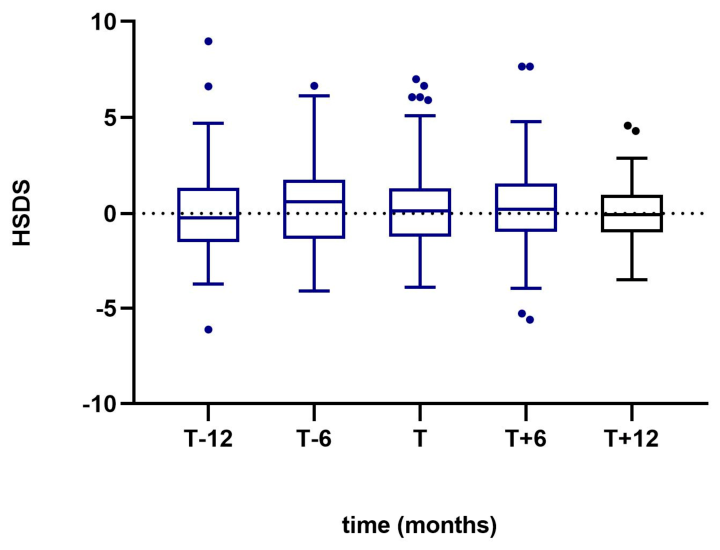
HSDS and HVSDS showed a gradual increase over time, with similar trends observed before and after switching. Mean HSDS values were −1.69 ± 0.81 and −1.52 ± 1.07 at 12 and 6 months before T0, respectively; −1.48 ± 0.83 at T0; and −1.34 ± 0.84 and −1.22 ± 0.88 at 6 and 12 months after T0, respectively. No statistically significant differences were observed over time or between treatments (
p > 0.05), as shown in
Figure 1. (All data in
Supplementary Materials).
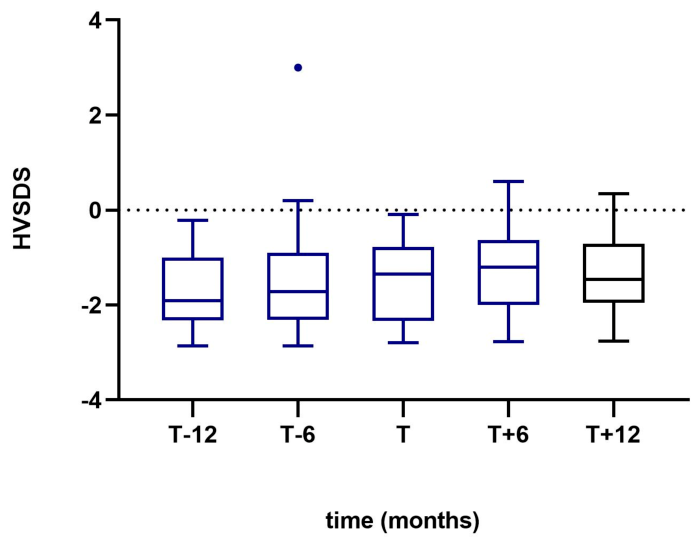
Mean HVSDS values were 0.13 ± 2.69 and 0.56 ± 2.20 at 12 and 6 months before T0, respectively; 0.69 ±2.64 at T0; and 0.36 ± 2.67 and 0.06 ± 1.84 at 6 and 12 months after T0, respectively. No statistically significant differences were observed (
p > 0.05), as shown in
Figure 2.
In exploratory subgroup analyses, changes in HSDS and HVSDS from T0 to 12 months after treatment switch did not show consistent differences according to pubertal status or weight status. Detailed subgroup data are reported in
Supplementary Table S2.
Plasma IGF-I SDS values remained within age- and puberty-related reference ranges throughout the study period. Mean IGF-I SDS values were 0.42 ± 0.36, 0.75 ± 0.63, 0.80 ± 0.58, 0.67 ± 0.63, and 0.86 ± 0.80 at 12 months before the switch, 6 months before the switch, T0, and 6 and 12 months after the switch, respectively.
Only one adverse event (recurrent headache occurring 4–5 times monthly during stressful periods) was reported in a single patient during both Humatrope® and the alternative rhGH treatment. These headaches did not lead to treatment discontinuation, and the patient is currently undergoing psychotherapy. No serious adverse events or treatment discontinuations were observed.
4. Discussion
The present study addresses a clinical management scenario rather than a pharmacological comparison, namely treatment continuity after a mandatory switch caused by a national drug shortage in children with SHOX deficiency. Over the past decades, genetic studies have identified SHOX deficiency as a frequent cause of idiopathic short stature [
1,
2,
8], and the efficacy of GH treatment in this condition has been well documented [
3]. Several rhGH formulations have been approved for pediatric growth disorders over the last 30 years, and both randomized and observational studies have consistently confirmed their efficacy and safety [
9,
10,
11].
In Italy, Humatrope
® is the only rhGH with an approved indication for SHOX deficiency. However, the recent and prolonged shortage required clinicians to prescribe alternative rhGH formulations under AIFA authorization. In this real-world observational setting, the present study evaluated growth outcomes during treatment with Humatrope
® and after switching to alternative off-label rhGH in children and adolescents with SHOX deficiency. The aim was not to demonstrate pharmacological equivalence between somatropin formulations, but to evaluate clinical stability after a mandatory switch imposed by a drug shortage in routine care. Previous studies have demonstrated the efficacy and safety of GH treatment in patients with SHOX deficiency [
3]. However, to our knowledge, no previous study has specifically evaluated a mandatory switch from the only approved rhGH formulation to alternative off-label rhGH preparations in children with SHOX deficiency during a national drug shortage. Therefore, the present study provides real-world evidence on a specific continuity-of-care scenario not directly addressed in previous literature.
Notably, exploratory descriptive analyses did not suggest a higher weight-adjusted prescribed rhGH dose after switching in pubertal or overweight/obese patients, supporting the clinical feasibility of maintaining routine weight-based dosing during the shortage.
HSDS and HVSDS increased over time, with comparable trends before and after switching, and without statistically significant differences. These findings suggest that treatment continuity with alternative rhGH formulations during the shortage did not result in clinically relevant changes in growth response. Moreover, alternative GH treatment was well tolerated, with no serious adverse events. The only reported adverse event was non-organic headaches, likely of psychological origin. Although GH therapy induces an increase in circulating IGF-I levels, which plays a key role in bone growth and exhibits mitogenic and antiapoptotic effects in vitro [
12,
13], published studies indicate that concentrations during GH treatment generally do not reach levels associated with an increased cancer risk [
14,
15]. Nevertheless, regular monitoring of IGF-I remains an important component of follow-up.
Beyond growth impairment, SHOX deficiency may be associated with characteristic skeletal abnormalities, including Madelung deformity, which involves bowing and shortening of the radius, prominence of the ulnar head, and palmar and ulnar deviation [
16,
17]. Other skeletal features include short metacarpals, a high-arched palate, and micrognathia, as described in Turner syndrome. The increasing availability of genetic testing has expanded the number of diagnosed patients eligible for GH therapy.
Although somatropin preparations share the same active molecule and comparable biological activity, evidence addressing clinical management during mandatory switching in SHOX deficiency remains limited. In conditions with a single approved formulation, treatment interruption may have relevant consequences. Therefore, documenting growth stability during a regulatory shortage provides clinically relevant information supporting continuity-of-care decisions rather than pharmacological comparison.
No consistent downward shift in individual growth trajectories was observed after switching. The variability detected across visits was comparable to the expected visit-to-visit fluctuations observed during ongoing rhGH therapy.
Bone age data were not systematically available at all study timepoints, as bone age assessment was performed during routine clinical follow-up according to local practice and was not centrally scheduled or reviewed for the purposes of this retrospective study. Therefore, no formal assessment of the impact of alternative rhGH on bone maturation could be performed.
5. Conclusions
In this real-world pediatric cohort, mandatory switching to alternative rhGH during a drug shortage did not compromise growth trajectory or safety in children with SHOX deficiency. These findings support the feasibility of maintaining treatment continuity when the approved product is temporarily unavailable.
Supplementary Materials
The following supporting information can be downloaded at:
https://www.mdpi.com/article/10.3390/endocrines7030033/s1, Table S1: Distribution of weight status according to Tanner stage at the time of treatment switch; Table S2: Exploratory subgroup analysis of changes in HSDS and HVSDS according to pubertal status and weight status.
Author Contributions
Conceptualization, M.C. and L.G.; Methodology, M.C., L.G., M.F.F., G.P., M.W., M.S., F.G., R.G., M.C.M. and C.M.; Writing—review and editing, M.C., L.G., M.F.F., G.P., M.W. and M.S.; Project administration, M.C. and L.G. All authors have read and agreed to the published version of the manuscript.
Funding
This research received no external funding. The article processing charge (APC) was supported by Sanitanova.
Institutional Review Board Statement
Ethical review and approval were waived for this study because it involved a retrospective observational analysis of anonymized clinical data collected during routine clinical practice, with no additional intervention performed. The study was conducted in accordance with the Declaration of Helsinki and in compliance with the document approved by the Italian Data Protection Authority and EU Regulation No. 679/2016 (GDPR).
Informed Consent Statement
Informed consent was obtained from the parents or legal guardians of all subjects involved in the study.
Data Availability Statement
The datasets used and analyzed during the current study are available from the corresponding author on reasonable request.
Acknowledgments
The authors thank Claudia Cappella and Mirella Biava, freelance medical writers, and Sanitanova for editorial assistance.
Conflicts of Interest
The authors declare that the research was conducted in the absence of any commercial or financial relationships that could be construed as a potential conflict of interest.
Abbreviations
The following abbreviations are used in this manuscript:
| GH | Growth Hormone |
| rhGH | Recombinant Human Growth Hormone |
| SHOX | Short Stature Homeobox |
| SHOXD | SHOX Deficiency |
| PAR1 | Pseudoautosomal Region 1 |
| AIFA | Agenzia Italiana del Farmaco |
| SDS | Standard Deviation Scores |
| IGF-I | Insulin-Like Growth Factor 1 |
| IGFBP | IGF-I Binding Protein |
| HSDS | Height Standard Deviation Score |
| HVSDS | Height Velocity Standard Deviation Score |
| GDPR | General Data Protection Regulation |
| MLPA | Multiplex Ligation-Dependent Probe Amplification |
| NGS | Next Generation Sequencing |
| BMI | Body Mass Index |
| AE | Adverse Event |
| SAE | Serious adverse event |
| ADR | Adverse Drug Reaction |
References
- Rao, E.; Weiss, B.; Fukami, M.; Rump, A.; Niesler, B.; Mertz, A.; Muroya, K.; Binder, G.; Kirsch, S.; Winkelmann, M.; et al. Pseudoautosomal deletions encompassing a novel homeobox gene cause growth failure in idiopathic short stature and Turner syndrome. Nat. Genet. 1997, 16, 54–63. [Google Scholar] [CrossRef]
- Fukami, M.; Seki, A.; Ogata, T. SHOX Haploinsufficiency as a Cause of Syndromic and Nonsyndromic Short Stature. Mol. Syndromol. 2016, 7, 3–11. [Google Scholar] [CrossRef] [PubMed]
- Blum, W.F.; Ross, J.L.; Zimmermann, A.G.; Quigley, C.A.; Child, C.J.; Kalifa, G.; Deal, C.; Drop, S.L.S.; Rappold, G.; Cutler, G.B. GH treatment to final height produces similar height gains in patients with SHOX deficiency and Turner syndrome: Results of a multicenter trial. J. Clin. Endocrinol. Metab. 2013, 98, E1383–E1392. [Google Scholar] [CrossRef] [PubMed]
- Tanner, J.M.; Whitehouse, R.H. Clinical longitudinal standards for height, weight, height velocity, weight velocity, and stages of puberty. Arch. Dis. Child. 1976, 51, 170–179. [Google Scholar] [CrossRef] [PubMed]
- Prader, A. Testicular size: Assessment and clinical importance. Triangle Sandoz J. Med. Sci. 1966, 7, 240–243. [Google Scholar]
- Cole, T.J.; Lobstein, T. Extended international (IOTF) body mass index cut-offs for thinness, overweight and obesity. Pediatr. Obes. 2012, 7, 284–294. [Google Scholar] [CrossRef] [PubMed]
- Bedogni, G.; Giannone, G.; Maghnie, M.; Giacomozzi, C.; Di Iorgi, N.; Pedicelli, S.; Peschiaroli, E.; Melioli, G.; Muraca, M.; Cappa, M.; et al. Serum insulin-like growth factor-I (IGF-I) reference ranges for chemiluminescence assay in childhood and adolescence. Data from a population of in- and out-patients. Growth Horm. IGF Res. 2012, 22, 134–138. [Google Scholar] [CrossRef] [PubMed]
- Marstrand-Joergensen, M.R.; Jensen, R.B.; Aksglaede, L.; Duno, M.; Juul, A. Prevalence of SHOX haploinsufficiency among short statured children. Pediatr. Res. 2017, 81, 335–341. [Google Scholar] [CrossRef] [PubMed]
- Growth Hormone Research Society. Consensus guidelines for the diagnosis and treatment of growth hormone (GH) deficiency in childhood and adolescence: Summary statement of the GH Research Society. J. Clin. Endocrinol. Metab. 2000, 85, 3990–3993. [Google Scholar] [CrossRef] [PubMed]
- Danowitz, M.; Grimberg, A. Clinical Indications for Growth Hormone Therapy. Adv. Pediatr. 2022, 69, 203–217. [Google Scholar] [CrossRef] [PubMed]
- Bamba, V.; Kanakatti Shankar, R. Approach to the Patient: Safety of Growth Hormone Replacement in Children and Adolescents. J. Clin. Endocrinol. Metab. 2022, 107, 847–861. [Google Scholar] [CrossRef] [PubMed]
- Clayton, P.E.; Banerjee, I.; Murray, P.G.; Renehan, A.G. Growth hormone, the insulin-like growth factor axis, insulin and cancer risk. Nat. Rev. Endocrinol. 2011, 7, 11–24. [Google Scholar] [CrossRef] [PubMed]
- Reynolds, C.M.; Perry, J.K.; Vickers, M.H. Manipulation of the Growth Hormone-Insulin-Like Growth Factor (GH-IGF) Axis: A Treatment Strategy to Reverse the Effects of Early Life Developmental Programming. Int. J. Mol. Sci. 2017, 18, 1729. [Google Scholar] [CrossRef] [PubMed]
- Cohen, P.; Clemmons, D.R.; Rosenfeld, R.G. Does the GH-IGF axis play a role in cancer pathogenesis? Growth Horm. IGF Res. 2000, 10, 297–305. [Google Scholar] [CrossRef] [PubMed]
- Liu, H.-J.; Wang, L.-H.; Chen, L. Evaluation of Safety and Efficacy of Growth Hormone Therapy by IGF-1 Z Score in Children with Short Stature. Adv. Ther. 2019, 36, 2374–2383. [Google Scholar] [CrossRef] [PubMed]
- Binder, G.; Fritsch, H.; Schweizer, R.; Ranke, M.B. Radiological signs of Leri-Weill dyschondrosteosis in Turner syndrome. Horm. Res. 2001, 55, 71–76. [Google Scholar] [CrossRef] [PubMed]
- Schmidt-Rohlfing, B.; Schwöbel, B.; Pauschert, R.; Niethard, F.U. Madelung deformity: Clinical features, therapy and results. J. Pediatr. Orthop. Part B 2001, 10, 344–348. [Google Scholar] [CrossRef]
| Disclaimer/Publisher’s Note: The statements, opinions and data contained in all publications are solely those of the individual author(s) and contributor(s) and not of MDPI and/or the editor(s). MDPI and/or the editor(s) disclaim responsibility for any injury to people or property resulting from any ideas, methods, instructions or products referred to in the content. |




 ,
,