Review

Zinc Transporter 8 Autoantibodies in Type 1 Diabetes and Related Diseases: Recent Advancements Towards Future Perspectives


1
Department of Health Sciences, University “Magna Græcia” of Catanzaro, 88100 Catanzaro, Italy
2
Department of Experimental and Clinical Medicine, University “Magna Græcia” of Catanzaro, 88100 Catanzaro, Italy
*
Author to whom correspondence should be addressed.
Endocrines 2026, 7(3), 31; https://doi.org/10.3390/endocrines7030031
Submission received: 29 May 2026 / Revised: 23 June 2026 / Accepted: 25 June 2026 / Published: 30 June 2026
(This article belongs to the Special Issue Recent Advances in Type 1 Diabetes)

Abstract

Type 1 diabetes (T1D) is an autoimmune disease characterized by β-cell destruction as a common trait, in which variability in age at onset, progression rate, and clinical presentation shape heterogeneous phenotypes. Disentangling this heterogeneity is pivotal for a better understanding of clinical risk, evolution and a precision medicine approach to the disease. In this context, circulating islet autoantibodies, including the last discovered Zinc Transporter 8 autoantibodies (ZnT8A), represent crucial tools. This narrative review provides an overview of the current knowledge on ZnT8A in autoimmune diabetes from its structural and pathogenetic basis to its clinical relevance and therapeutic perspectives. A literature search was conducted in PubMed, Scopus, Google Scholar, and ResearchGate up to March 2026, that included preclinical, pediatric, adult, and assay-comparison studies. While the identification of ZnT8-targeted antigenic determinants is still ongoing, we discuss the pathogenic role of a newly identified specific class of antibodies directed against extracellular ZnT8 epitopes (ZnT8ecA). According to this finding, ZnT8ecA could facilitate the identification of an early phase of islet injury process, holding promise to provide a framework for new therapeutic strategies based on masking or modulating surface-exposed ZnT8 epitopes and interfering with the early stages of the disease. Moving from the role of ZnT8A in various clinical settings, we also focus on recent advancements in detection technologies, whose implementation accounts for invaluable contributions to diagnosis, disease risk, and, contextually, to a better understanding of autoimmune diabetes. Finally, we provide future perspectives, in T1D and T1-related diseases, for the potential clinical application of ZnT8A in early diagnosis, risk stratification and profiling, as well as in the development of targeted therapies as part of precision medicine.

1. Introduction

Type 1 diabetes mellitus (T1D) is a chronic autoimmune disease characterized by the selective destruction of pancreatic islet beta cells, leading to an absolute deficiency of insulin and consequent hyperglycemia [1]. With its highest incidence observed during childhood and adolescence, and with an impact of more than 8 million people worldwide [2], the disease represents an important healthcare challenge that implicates serious, life-altering threats, and particularly acute glycemic imbalances, in addition to long-term vascular complications. While an effective treatment for T1D was reached about a century ago with the breakthrough discovery of insulin [3], the pathogenesis of the disease has been understood much later, with the association of insulitis and islet-cell autoantibodies (ICA) first described in 1974 [4]. T1D pathogenesis involves an intricate interplay of environmental triggers and genetic susceptibility, with HLA-DR3/4 (DQ2-DQ8) as the primary HLA-associated risk, ultimately resulting in the activation of autoreactive immune cells targeting pancreatic beta cells.
A distinctive trait of this autoimmune process is the presence of circulating islet autoantibodies, which serve as key serological markers for the diagnosis, prediction, and staging of T1D, being often detected in the serum years before clinical signs and symptoms of the disease, highlighting their role in identifying individuals at risk [5]. These autoantibodies, initially identified in the 1980s through radiobinding assays, include those directed against glutamic acid decarboxylase 65 (GAD65), islet antigen-2 (IA-2), and insulin (IAA) [5,6]. Importantly, they represent markers of β-cell destruction, as they appear because of the antigenic response due to T-cell–mediated damage and antigen leakage. Particularly, IAA and GADA tend to rise in the preclinical phase, whereas IA-2A is typically associated with more advanced β-cell loss and emerges closer to the disease onset. Moreover, IA-2A is strongly linked to pancreatic β-cell destruction, whereas GADA is less disease-specific, and may also be detected in other autoimmune conditions, such as autoimmune thyroid disease (AITD). Although the presence of a single autoantibody may indicate increased risk, the detection of multiple autoantibodies positivity (≥2) represents the predictor of disease progression, even in first-degree relatives.
In recent years, a significant advancement in the field of T1D research has been obtained by microarray mRNA expression strategies for the detection analysis of potential beta cell targets, leading to the identification of zinc transporter 8 (ZnT8) as a major autoantigen [7]. ZnT8 is a protein prevalently expressed in pancreatic beta cells and plays a critical role in the transport of zinc into insulin secretory granules [8]. ZnT8 is now recognized as a target of both humoral (autoantibodies) and cellular (autoreactive T cells) autoimmune responses in individuals with T1D, playing a significant, and complex pathogenetic role [9]. Remarkably, studies have demonstrated that the measurement of autoantibodies to ZnT8 (ZnT8A), when included in the standard panel of islet autoantibody tests, significantly enhances the detection rate of diabetes-related autoimmunity [9]. This finding is particularly important as it enables a more comprehensive identification of individuals with autoimmune diabetes. Indeed, the detection of ZnT8A generally occurs alongside IA-2, although ZnT8A may also be found alone, allowing T1D diagnosis even in patients who might not test positive for the traditionally assessed autoantibodies [5]. Also, the ability to detect autoantibody profiles early offers a potential window for interventions aimed at preventing, delaying the progression to overt diabetes, or being prepared for acute metabolic complications.
More recently, islet autoantibody positivity and their combinations have been the focus of major studies aimed at identifying, in T1D, specific autoantibody profiles to be associated with peculiar clinical patterns. Lines of evidence analysing the variety of autoimmune signatures support the concept of heterogeneous phenotypes within T1D [10], as well as serological differences with related diseases, including the latent autoimmune diabetes in adults (LADA), the more recently described immune check-point inhibitors induced-T1D, and T1D-associated autoimmunity forms. In individuals already positive for other islet autoantibodies, ZnT8A have the potential to improve risk stratification [6]. Also, further contributions in this field may derive from the emerging role of sensitive and high-affinity assays in refining this risk assessment.
This review aims to provide an updated overview of ZnT8A autoantibodies in T1D and to explore their potential relevance for clinicians and researchers, seeking new directions for a more comprehensive understanding of these antibodies in the context of T1D and related diseases.

2. Materials and Methods

A non-systematic, narrative literature search was conducted using PubMed, Scopus, Google Scholar, and ResearchGate, covering articles published up to March 2026, with no lower date restriction to value not only recent but also historically relevant studies. Major importance was given to the search related to the last 10 years. Search terms, used individually and in combination through Boolean operators, were grouped into four conceptual categories: (i) molecular, structural and genetic terms, including “ZnT8A”, “zinc transporter 8”, “SLC30A8” and “extracellular epitope”; (ii) clinical and disease-related terms, including “type 1 diabetes” “latent autoimmune diabetes in adults” OR “LADA”, “islet autoantibodies”, “immune checkpoint inhibitor-induced diabetes”, “fulminant diabetes”; (iii) terms relating to other classical islet autoantibodies, including “GADA”, “IA-2A”, “IAA”, “ICA”, “islet-cell antibodies” OR/AND “multiple autoantibody positivity” used to contextualize ZnT8A within the broader autoantibody panel; (iv) mechanistic and assay-related terms, including “antibody-dependent cellular cytotoxicity” OR “ADCC” “complement-dependent cytotoxicity” “antibody affinity” “radiobinding assay”, “ELISA” and “electrochemiluminescence” OR “ECL assay”; (v) potential therapeutic application, including “Teplizumab”, “monoclonal antibodies”. Eligible sources encompassed preclinical and animal model studies, pediatric cohort studies, adult cohort studies, and assay-comparison studies evaluating analytical performance across different detection technologies, in order to provide a comprehensive, cross-disciplinary perspective covering molecular pathogenesis, clinical application, laboratory methodology and therapeutic implication. As this is a narrative review, no systematic assessment of study quality was performed and articles were instead selected based on relevance, scientific rigor, and contribution to the current understanding of ZnT8A biology and clinical application.

3. The Link Between ZnT8 and T1D Pathogenesis: From Structure to Immunogenesis

ZnT8 belongs to the SLC30 protein family, a group of proteins functioning as zinc transporters. It is highly expressed in pancreatic beta cells, although ZnT8 has also been identified in several extra-pancreatic tissues, including thyroid cells, Leydig cells [11], and gastrointestinal enteroendocrine cells [12,13]. Within the insulin-containing secretory granules, it plays a crucial role in transporting zinc ions (Zn2+) essential for insulin biosynthesis and storage. Acting as a Zn2+/H+ transporter, ZnT8 regulates zinc homeostasis and plays a key role in the processes of insulin preservation, maturation, and release. In fact, the zinc ion Zn2+ transported into the secretory granules is essential for insulin hexamer formation and for the catalytic activity of carboxypeptidase H, an enzyme that converts proinsulin into insulin [14] (Figure 1A). Conversely, the biological and pathogenic significance of ZnT8 distribution outside pancreatic beta cells remains incompletely understood and requires further clarification.
Structurally, ZnT8 is composed of 369 amino acids and contains six transmembrane domains, with both the N- and C-terminal regions located in the cytoplasm. The C-terminal domain functions as a zinc sensor. The gene encoding ZnT8, SLC30A8, is located on chromosome 8q24.11 [8]. Its expression is regulated by the transcription factor Pdx-1 [15]. Studies in murine models have shown that Pdx-1 is downregulated by pro-inflammatory cytokines such as IL-1β, alone or in combination with INF-γ and TNF-α, suggesting that a chronic low-grade inflammatory state may disturb intracellular zinc homeostasis in humans, leading to a functional decline in insulin content and secretion in response to hyperglycemic stimuli [16]. Variants of SLC30A8 have been associated with T1D. In particular, the polymorphic variant rs13266634, one of the most extensively studied, determines the presence of arginine (R-325) or tryptophan (W-325) or glutamine (Q-325) at residue 325, depending on whether the inherited allele is C or T, respectively. This amino acid substitution has been implicated in structural modification that influences ZnT8 functionality and its immunogenicity [8,14].
ZnT8A, first identified in 2007, predominantly reacts with the C-terminal region of the protein, with the primary antigenic epitope comprising amino acids 267–367 [17]. Their affinity varies depending on whether arginine (R) or tryptophan (W) is present at position 325. In general, the R-325 variant is more frequently associated with ZnT8A positivity, suggesting a higher immunogenicity compared to the W variant and contributing to differential susceptibility to the disease, even if antibody against ZnT8W-325 (ZnT8WA) has major affinity [18]. Interestingly, ZnT8A can also recognize epitopes out of residue 325, reacting, for example, with viral proteins or Mycobacterium avium paratuberculosis, suggesting a potential role in the pathogenesis via molecular mimicry [19].
An alternative mechanism by which ZnT8 protein may trigger autoimmunity has been clarified through epitope mapping studies, which demonstrate that the HLA-DQ2/DQ8 variants can bind multiple ZnT8 epitopes [9]. Unquestionably, ZnT8 has been identified as a major CD8+ T-cell autoantigen, with highly immunodominant CD8+ epitopes (e.g., 186–194) in most HLA-A2+ T1D patients. These findings suggest that ZnT8 may activate not only humoral, but also cellular immune responses [20].

4. Pathogenic and Diagnostic Roles of ZnT8A in T1D

Over the past 20 years, ZnT8A has been largely considered only a witness of the lymphocytic attack, with major studies focused on ZnT8A directed against cytoplasmic epitopes on the C-terminal domain of the transporter [17,21]. Current research advancements, however, suggest that the autoimmune process linking ZnT8A to β-pancreatic cells consists of two steps (Figure 1B,C). In the first phase of the autoimmune process, during glucose-induced insulin granule exocytosis, ZnT8 transiently exposes its extracellular loops on the β-cell surface, potentially allowing normally hidden epitopes to become visible to the immune system, and promoting autoantibody formation [22]. Recently, a specific extracellular ZnT8 epitope (ZnT8ec), targeted by a distinct subset of autoantibodies, has been characterized. The unique ability of ZnT8ec autoantibodies (ZnT8ecA) to bind the surfaces of living β-cells suggests a potential direct pathogenic role, as they may trigger antibody-dependent cellular cytotoxicity (ADCC) and complement-dependent cytotoxicity (CDC) [23] (Figure 1B). Moreover, it has been highlighted that, when positive, ZnT8ecA is the earliest detectable autoantibody in T1D, supporting a possible involvement in the early phases of the autoimmune response [23,24]. Consistent with this hypothesis, experimental studies in NOD mice models with autoimmune diabetes have explored the potential therapeutic action of a monoclonal antibody directed against cell-surface ZnT8 (mAb43). This antibody appears to mask ZnT8/insulin exposure and competes with endogenous ZnT8-directed immune responses, ultimately mitigating and even reversing the mouse pathological state [25]. On the other hand, lines of evidence have pointed out that only following β-cell injury, when cellular destruction exposes otherwise sequestered epitopes, ZnT8A primarily targets intracellular antigens that typically become accessible to the immune system [17,23]. These epiphenomenic autoantibodies, secondary to β-cell damage, are expressed later, in the second phase of the autoimmune process, and are those commonly tested in overt T1D (Figure 1C).
Disentangling the diverse immunogenic epitopes of the ZnT8 protein is, indeed, an important challenge to gain further knowledge about T1D autoimmunity. In this regard, preserving the native structure of the antigen is essential for the detection of high-affinity binding of autoantibodies to conformational epitopes, which have proved to be the most clinically relevant. Therefore, while denaturation can impair antibody recognition and potentially lead to false-negative results in immunoassays [21,23,26], advancements in the methodologies may lead to more specific tests, reveal new details on T1D pathogenesis, and, potentially, even provide an identity to the historically described, but never fully characterized, islet-cell surface antibodies (ICSA), reported by Bottazzo and others [4,27]. To sum up, ZnT8A directed against intracellular C-terminal epitopes is a validated biomarker of islet autoimmunity, with robust diagnostic and prognostic value confirmed across multiple independent cohorts [6]. Furthermore, evidence from selected cohorts indicates their potential as risk-prediction biomarkers based on the stratification of ZnT8A by subtype, affinity, and epitope specificity (e.g., ZnT8WA/ZnT8RA, high- versus low-affinity antibodies) [14,18], suggesting that further investigation in this field may be useful to refine and validate this additional role. Finally, the hypothesis that ZnT8ecA directly participates in β-cell injury through ADCC or complement-dependent cytotoxicity is currently supported mainly by in vitro binding studies and indirect evidence from murine models, rather than by direct demonstration of cytotoxicity in human islets or by clinical outcome data [23,24]. Therefore, a possible direct pathogenic role of ZnT8ecA should be interpreted with appropriate caution, pending confirmation in larger, independent human studies. The currently known categories of ZnT8A are recapitulated in Table 1.

5. Role of ZnT8 Autoantibodies in T1D and T1D-Related Clinical Settings

5.1. T1D Heterogeneity and Autoantibody-Based Disease Risk Staging

T1D is a heterogeneous autoimmune disorder whose clinical manifestations represent only the late stage of a complex pathogenic process involving genetic susceptibility, in particular high-risk HLA genotypes, family history, and environmental triggers, such as viral infections [10]. Consistent with this biological background of genetic, immunological, and metabolic variables, every patient will manifest types of disease that differ in age at onset, aggressiveness of the autoimmune response, rate of β-cell destruction, and overall clinical course. Disease heterogeneity manifests in age at onset, intensity of the autoimmune response, rate of β-cell destruction, and overall clinical course, influencing both prognosis and response to disease-modifying therapies.
The staging system for T1D proposed by the American Diabetes Association and Juvenile Diabetes Research Foundation defines the disease as a progressive autoimmune process that begins years before symptoms, and in which three distinct phases can be recognized: stage 1, characterized by normoglycemia with ≥2 islet autoantibodies; stage 2, associated with dysglycemia; and stage 3, corresponding to clinically overt diabetes. Therefore, among available biomarkers, islet autoantibodies, including ZnT8A, play a crucial role not only in diagnosis but also in staging and defining risk stratification [6]. Since their discovery, the presence of multiple autoantibodies has been associated with more rapid β-cell decline and a higher probability of progression to insulin dependence [40,41].
Altogether, the number and combination of islet autoantibodies, including IAA, GADA, IA-2A, ZnT8A, and ICA, define disease stage, with single positivity indicating early autoimmunity and multiple positivity identifying individuals at highest risk of progression from stage 1 to stage 2 and 3 [6]. In particular, the presence of multiple autoantibodies and higher titers of those more specific, such as IAA and IA-2, is associated with an increased risk of progression to clinical disease, while younger age at seroconversion represents one of the main determinants of a more rapid course of the disease [10]. However, single positivity for ZnT8A confers a markedly higher risk of progression to T1D compared with single positivity for IAA, GADA, or IA-2A, with reported odds ratios up to 50 [10]. Longitudinal studies [42,43,44] focused on autoantibody profiles were synthesized and expanded within The Environmental Determinants of Diabetes of the Young (TEDDY) study [45] in which two distinct settings were identified based on whether the first detectable autoantibody was IAA or GAD65. The IAA-first phenotype was more frequent in younger children, peaking within the first year of life and declining by 3–4 years; it was associated with higher genetic risk, earlier onset, and faster progression to clinical disease. In contrast, the GADA-first phenotype was more common at a slightly older age, typically emerging between 2 and 3 years and reaching a plateau around 4 years; this profile was often associated with single autoantibody positivity and a minor and slower risk of progression [10,46]. There was no specific profile in ZnT8A-first individuals [46].

5.2. Diagnostic and Predictive Value of ZnT8 Autoantibodies

ZnT8A has emerged as an important component of the diagnostic evaluation of autoimmune diabetes, including T1D (Table 2). Positivity to ZnT8 in Caucasians with T1D has been reported between 60–80%, and the inclusion of ZnT8A in islet autoantibody panels significantly improves diagnostic sensitivity over 90% [21], particularly in patients who are negative for classical markers such as GAD65, IA-2A, and IAA [35,47]. In some individuals, ZnT8A represents the only detectable marker of β-cell autoimmunity, enabling earlier and more accurate identification of autoimmune diabetes [28,48]. This diagnostic contribution is particularly relevant in adult patients presenting with atypical metabolic phenotypes, where distinguishing autoimmune diabetes from T2D can be challenging [29,49]. Beyond their diagnostic value, ZnT8A also provides important information for predicting the development of autoimmune diabetes. Islet autoantibodies often appear years before the onset of hyperglycaemia, reflecting an ongoing immune-mediated attack against pancreatic β-cells. In this context, the detection of ZnT8A, especially when present alongside other islet autoantibodies, helps identify individuals who are at a higher risk of progressing to overt T1D [30,31]. Longitudinal studies have shown that seroconversion to ZnT8A may occur during the preclinical phase of the disease, offering a potential window for early monitoring and preventive strategies [28,32].
Interestingly, ZnT8A titers tend to decline relatively rapidly after disease onset, suggesting that their presence may be particularly informative in the early stages of β-cell autoimmunity [51]. In this regard, in a study by Wenzlau et al. ZnT8A titers have been shown to decrease exponentially after clinical onset, with a half-life ranging from 26 to 530 weeks, reflecting the marked interindividual variability observed in C-peptide decline [32]. A similar trend between ZnT8A kinetics and C-peptide decline suggests that ZnT8A titers reduction could potentially be considered a marker of a decrease in the β-cell reserve. Consistent with this hypothesis, Steck et al. found that ZnT8A positivity at diagnosis was associated with a faster rate of C-peptide loss in young children with newly diagnosed T1D, together with IA-2A positivity, younger age, and a higher number of autoantibodies [52]. Not surprisingly, a systematic review of six studies concluded that most of the available evidence supports that ZnT8A-positivity is associated with a higher frequency of diabetic ketoacidosis (DKA) and metabolic instability at disease onset, particularly in pediatric patients, likely due to the faster C-peptide decline and more extensive β-cell loss. However, conflicting data exist, and further prospective studies are needed to confirm this association [53]. Similarly, other research confirms that in children with newly diagnosed T1D, ZnT8A positivity is associated with older age at diagnosis, higher presence of multiple antibody positivity, higher presentation at diagnosis with diabetic ketoacidosis [54], more severe β-cell dysfunction [55], and a 3.9-fold increased incidence of severe hypoglycaemia [56]. Finally, ZnT8A is emerging as a predictive biomarker for the response to immunomodulatory therapy. This aspect will be later analyzed in the Future Directions chapter.

5.3. Immunological Characteristics and Temporal Dynamics of ZnT8A

ZnT8A exhibits variable affinity and epitope recognition, reflecting different phases of the autoimmune process. In individuals at risk for T1D, ZnT8A may be detected as either low-affinity or high-affinity antibodies [35]. Low-affinity ZnT8A generally recognizes linear epitopes in the C-terminal domain of ZnT8 and is typically observed in the early or less developed stages of the autoimmune response. These antibodies can be transient and usually show a lower predictive value for the progression of clinical diabetes [18]. Conversely, high-affinity ZnT8A recognizes more complex conformational epitopes, indicating a more advanced autoimmune response, often linked with epitope spreading, a process in which immune reactivity extends to additional epitopes within the same antigen or related proteins [36,38]. The persistent presence of high-affinity ZnT8A is strongly correlated with an increased risk of progressing to full-blown T1D. The clinical relevance of ZnT8A is also supported by its distinct temporal dynamics compared with other islet autoantibodies. While insulin autoantibodies often appear early in the autoimmune cascade, ZnT8A may arise later during the disease process or exhibit different persistence patterns following clinical diagnosis [32,51]. These differences in timing provide additional insight about the stages of β-cell autoimmunity and may reflect differences in the underlying immunopathogenic mechanisms. For this reason, the kinetic profile of ZnT8A contributes to a more comprehensive understanding of autoimmune progression and enhances the interpretation of autoantibody testing in both clinical and research settings [30,42].

5.4. ZnT8A in Risk Stratification and Adult-Onset Autoimmune Diabetes

ZnT8A contributes to the stratification of patients according to their risk of progression and clinical phenotype. Autoantibody profiling that includes ZnT8A improves the ability to distinguish autoimmune diabetes from phenotypic type 2 diabetes (T2D), particularly in adult patients with ambiguous clinical presentations [29,57]. This information is particularly relevant in conditions such as Latent Autoimmune Diabetes of Adults (LADA), a form of diabetes that prevalently occurs in individuals over 35 years of age and shares characteristics of both T1D and T2D. LADA is characterized by autoimmune destruction of pancreatic β-cells, similarly to T1D, but with a slower progression and the absence of acute metabolic manifestations at onset, features that resemble T2D. The rate of disease progression varies considerably among individuals and may significantly influence therapeutic decisions and clinical management [58,59]. The diagnosis of LADA is supported by the presence of islet autoantibodies, including ICA, IAA, GADA, IA-2A, and ZnT8A [60]. However, patients with T1D frequently present with multiple autoantibody positivity during the early stages of the disease. Indeed, it has been reported that approximately 70% of individuals with T1D exhibit positivity for three to four islet autoantibodies, whereas fewer than 10% show positivity for only one [1,35,61]. Conversely, the absence of three or more of these autoantibodies strongly argues against autoimmune diabetes, suggesting instead a possible diagnosis of Maturity-Onset Diabetes of the Young (MODY) [62].
Finally, fulminant T1D, a subtype of T1D, is characterized by rapid destruction of pancreatic β-cells, severe hyperglycemia, and ketoacidosis that, if not rapidly recognized, can become life-threatening. Although its exact pathogenesis remains unclear, a role for genetic susceptibility as well as viral infections has been suggested. A key characteristic of this condition is the general absence of islet autoantibodies, which distinguishes it from classical autoimmune diabetes [5,63].

5.5. Clinical Relevance of ZnT8A

Overall, several features distinguish ZnT8A from other classical diabetes-associated autoantibodies. Notably, ZnT8A may be detected in patients who are negative for traditional markers of β-cell autoimmunity, thereby addressing an important diagnostic gap [47,64]. In addition, the diagnostic specificity of ZnT8A can be affected by genetic variation in the SLC30A8 gene. In particular, the Arg325Trp polymorphism has been shown to influence both the prevalence of ZnT8A and the specific epitopes recognized [33,34]. This genetic modulation of antibody specificity represents a distinctive feature not commonly observed with other islet autoantibodies.
Moreover, ZnT8A has proven useful in distinguishing LADA from phenotypic T2D, contributing to a more refined classification of diabetes and supporting more accurate clinical management [29]. Interestingly, a condition in which transient islet autoantibodies may appear is immune checkpoint inhibitor- induced diabetes [50,65]. This form of autoimmune diabetes accounts for about 1% of adverse events associated with therapeutic use of immune checkpoint inhibitors, such as nivolumab or pembrolizumab, but it is difficult to manage due to abrupt onset, rapid insulin deficiency, and frequent diabetic ketoacidosis. Islet autoantibodies are observed in fewer than half of these patients; when present, they are generally detected as a single positive antibody, with GADA being more frequently identified than ZnT8A, which remains an infrequent finding [50,65]. Taken together, these characteristics highlight the importance of ZnT8A as a complementary biomarker for the diagnosis, prediction, and stratification of autoimmune diabetes (Table 2).

5.6. ZnT8A and Other Autoimmune Diseases

ZnT8A, initially identified as a marker of autoimmune diabetes, has also been investigated in relation to other autoimmune disorders. In patients with T1D and LADA, autoimmune thyroid disease (AITD) represents the most common autoimmune comorbidity [66]. As previously reported for GADA [67], an increased risk of developing autoimmune thyroiditis in individuals with T1D has more recently also been associated with ZnT8A positivity [66]. This relationship may be partially explained by the distribution of the ZnT8 transporter in tissues other than pancreatic islets, including follicular and parafollicular epithelial cells of the thyroid gland [68,69]. For instance, a study conducted in the Sardinian population investigated the potential role of Mycobacterium avium subspecies paratuberculosis (MAP) infection in autoimmune thyroid disease, identifying antibodies capable of reacting both with mycobacterial epitopes and with ZnT8-derived epitopes. Notably, these cross-reactive antibodies were detected in patients with Hashimoto’s thyroiditis, supporting the hypothesis that environmental factors may contribute to the initiation of autoimmune responses in autoimmune thyroiditis through mechanisms of molecular mimicry [69]. Based on these findings, ZnT8A positivity in diabetic patients could be considered a potential indicator of increased risk for AITD. Conversely, in individuals with Hashimoto’s thyroiditis, the presence of ZnT8A may represent a marker of predisposition to the development of diabetes [66].
Other autoimmune conditions, such as Addison’s disease (AD), have also been reported to show ZnT8A positivity [70,71,72,73], reflecting the coexistence of autoimmune diabetes or an increased susceptibility to T1D. However, a recent adult cohort (43 AD Bulgarian patients) found no ZnT8A positivity among those with T1D [74] suggesting ZnT8A may be uncommon in some ethnic adult AD populations. In parallel, experimental studies demonstrated ZnT8 transporter expression in adrenal tissue in animal models, suggesting the possibility, although still unproven, of a direct pathogenetic role for ZnT8-related autoimmunity outside pancreatic beta cells [75,76].
Interestingly, ZnT8A have also shown immunological reactivity with multiple food-derived proteins, including lentil, wheat, and peanut antigens [77]. These findings further support the hypothesis that cross-reactivity and molecular mimicry may contribute to the generation or amplification of ZnT8-directed autoimmune responses.
Overall, although ZnT8 expression remains predominantly restricted to pancreatic beta cells and ZnT8A are therefore considered highly specific markers of T1D, accumulating evidence suggests that their detection in other autoimmune disorders may reflect both the frequent coexistence of autoimmune endocrinopathies and, potentially, shared immune mechanisms involving molecular mimicry or limited extra-pancreatic ZnT8 expression. Nevertheless, the biological and pathogenic significance of ZnT8A outside T1D remains incompletely understood. Further studies are needed to clarify the tissue distribution of ZnT8 and the clinical relevance of these cross-reactive antibodies.

6. Recent Advances in ZnT8 Autoantibody Detection Technologies

The detection of ZnT8A has become a crucial tool for the diagnosis and prediction of type 1 diabetes (T1D). Detection methods have evolved significantly over the years (Table 3), progressing from traditional techniques such as radiobinding assays (RBA) to ELISA and more recent automated platforms that perform chemiluminescence assay (CLIA/ECL) using recombinant autoantigens. These autoantigens are represented by the intracellular C-terminal domain of the protein, including both ZnT8R-325 and ZnT8W-325 variants, often combined into a single dimeric compound to enhance diagnostic sensitivity [38]. Historically, RBA has traditionally been regarded as the reference method for detecting islet autoantibodies. In this assay, radiolabeled antigen is maintained in solution, preserving a relatively native conformation and enabling the detection of antibodies with a wide range of affinities. However, the use of radioactive reagents, specialized laboratory infrastructure, and limited automation have restricted its routine use in clinical laboratories [17,18,35].
With the advent of ELISA for ZnT8A detection, this method gradually replaced RBA, being more accessible in clinical laboratories due to its lower technical complexity, ability to provide quantitative results, and compatibility with automated systems. However, the immobilization of antigens on solid surfaces can alter the conformational epitopes of ZnT8, which are essential for antibody recognition [17]. Consequently, ELISA may detect antibodies of both high and low affinity, including those that are transient or biologically less relevant for T1D [37,39]. Antibody affinity, defined as the strength of interaction between an antibody and its epitope, influences which populations of ZnT8A are ultimately detected: high-affinity antibodies recognize mature conformational epitopes, while low-affinity antibodies may bind linear epitopes or arise from cross-reactive responses, often exhibiting limited predictive value [18,38].
Therefore, isolated ZnT8A positivity by ELISA requires careful interpretation and longitudinal follow-up, as many of these antibodies may disappear over time without progressing to clinical disease [38]. In recent years, significant advances have been made with CLIA and ECL assays, offering high sensitivity and automation. These assays are more effective in detecting high-affinity autoantibodies, thereby improving disease specificity [37]. Indeed, studies involving a large cohort of patients showed that many individuals tested positive for ZnT8A by RBA, particularly those with a single autoantibody seropositivity, had negative results with ECL assays [38]. Affinity analysis confirmed that these discordant antibodies were mainly low-affinity, declined over time, and did not predict progression to T1D [38]. Despite these technological advances, a major limitation remains the absence of an international calibrator for ZnT8A. This hinders standardization across laboratories and platforms, making it difficult to compare quantitative results between studies or clinical implementations.
Finally, in research contexts, an important strategy is to improve, in a diagnostic setting, both analytical sensitivity, as well as the proper folding and structural stability of ZnT8. This latter challenge is particularly cumbersome, as ZnT8 is a transmembrane protein, and the maintenance of its conformational epitopes is crucial. Therefore, techniques such as agglutination polymerase chain reaction-based assays [86], luciferase immunoprecipitation systems, [80] and combined bioengineering and nanotechnology approaches [83], as well as baculovirus-based expression of antigens [84] have emerged and proven to be innovative strategies for autoantibody detection, improving epitope preservation and assay sensitivity, and representing a promising approach for future immunological diagnostics (Table 3).
Briefly, Antibody Detection by Agglutination-PCR (ADAP) is based on DNA-barcoded autoantigens (ZnT8R and ZnT8W) that, in the presence of specific autoantibodies, foresees subsequent PCR amplification steps [78]. Although less accurate than RBA, it can be useful in screening programs because it requires a very small sample volume for multiplex detection, besides being rapid and fully automated [79].
Luciferase immunoprecipitation systems (LIPS) is a liquid-phase assay in which ZnT8 is fused to luciferase with maintenance of native antigen conformation [81,82]. LIPS may be considered a highly sensitive assay with a wide dynamic range, and it can detect autoantibodies at very low concentrations, improving early and accurate identification of autoimmune responses. However, clinical implementation is limited by the need for recombinant constructs and specialized equipment, as well as inadequate standardization [80,81].
Bioengineering and nanotechnology approaches, such as proteoliposome antigen integration, are designed to ensure the integrity of the native structure of the ZnT8 epitopes by simulating the natural membrane environment of the transporter [83]. For instance, full-length ZnT8 may be incorporated into proteoliposomes, which are then immobilized on a plasmonic gold platform [83]. This approach increases analytical sensitivity and specificity, but its clinical implementation is still limited by technical complexity.
Another potential strategy has employed the baculovirus-insect cell system, whose expression preserves eukaryotic native conformational epitopes, combined with an ELISA test. The bridge ELISA is an immunoassay in which IgG autoantibody acts as a molecular bridge between a solid-phase antigen and a biotinylated form of the same antigen used as detection molecule [85]. This principle has been applied using a ZnT8/GAD65 chimeric molecule for the simultaneous detection of ZnT8A and GADA in a single assay, reaching a specificity of 98% and an AUC of 0.95 [84]. However, sensitivity is moderate, and the lack of validation in pre-diabetic populations currently limits its clinical applicability as single test [84].
Overall, even if these techniques have shown high analytical performance in experimental settings, their predictive value in non-diabetic populations has not yet been fully validated, limiting their current clinical utility [38].

7. Future Directions

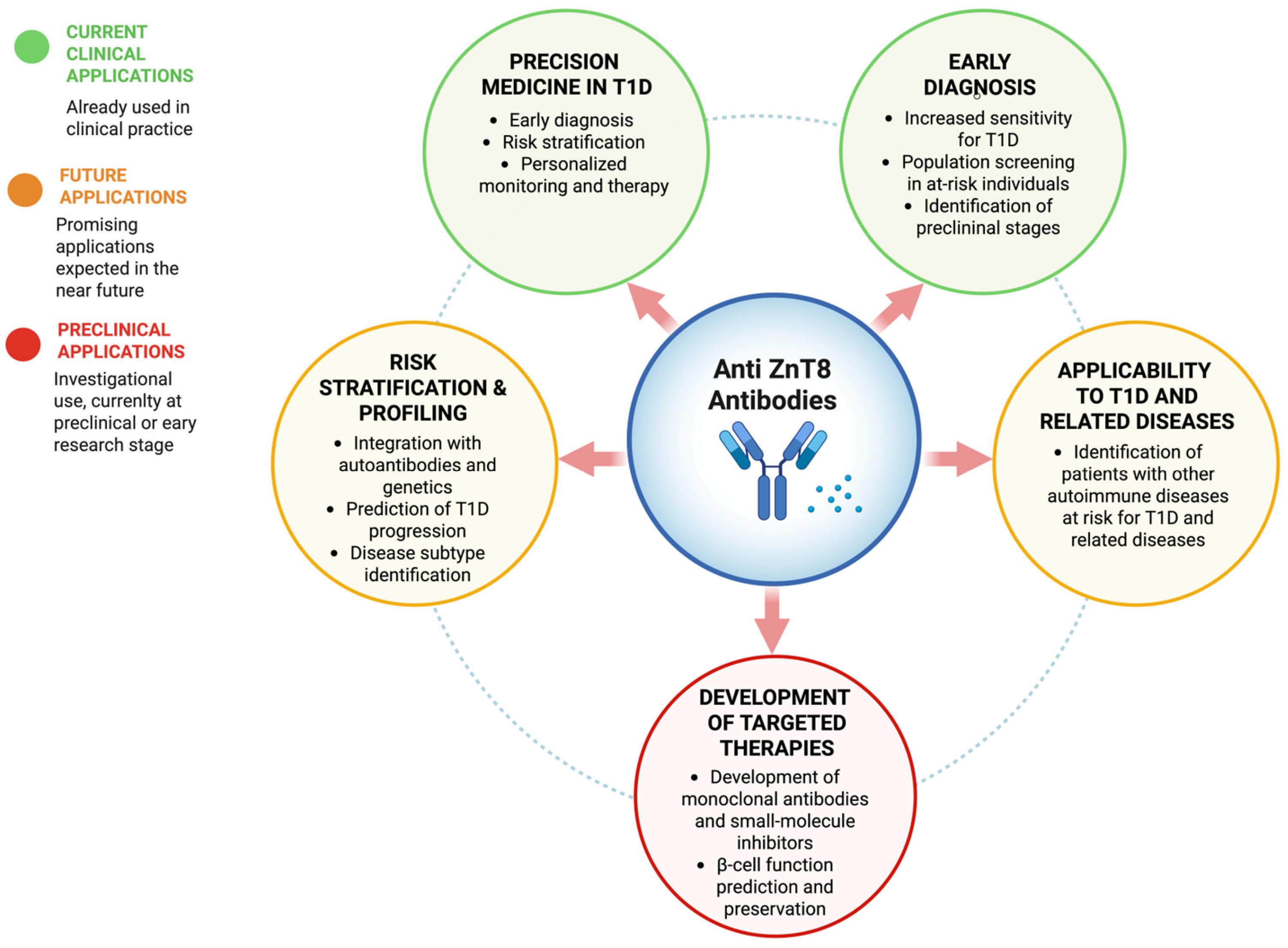
The implementation of early detection strategies for islet autoantibodies in T1D has enabled the identification of the disease during its preclinical stages. In this context, ZnT8A serve as both a diagnostic and prognostic marker of β-cell destruction and may become a potentially important tool in a variety of clinical settings, leading to precision medicine (Figure 2). Alongside this role, a pathogenic impact of ZnT8A has been elucidated, suggesting that the exposure of an extracellular epitope of the ZnT8 protein may be responsible for triggering the autoimmune attack [23]. Masking these molecules during the early phase of β-cell destruction could therefore represent a novel therapeutic intervention method [25].
This approach aligns with modern disease-modifying strategies that combine classic insulin replacement therapy with immunotherapy and cell replacement to achieve long-term remission [87]. For instance, the recent FDA approval of teplizumab, an anti-CD3 monoclonal antibody, represents a significant advance, as it can delay disease onset by preserving β-cell function [88]. Data from the phase III PROTECT trial demonstrated that teplizumab improves β-cell preservation, as reflected by enhanced C-peptide responses; however, it does not significantly reduce the need for exogenous insulin, indicating that, while its effect is meaningful, it is insufficient to restore full functional insulin independence [89].
Indeed, responses to teplizumab may differ based on participants’ characteristics. For instance, in the TrialNet prevention trial, the response to teplizumab versus placebo was greater among ZnT8A negative, with respect to ZnT8A-positive cohorts [90]. Conversely, the presence or absence of other autoantibodies was not associated with clinical response. The authors speculated that ZnT8A positivity may identify a more fulminant or advanced immune phenotype, with T cells less susceptible to teplizumab-induced modulation [90]. These findings have direct implications for patient selection in prevention trials and suggest that ZnT8A status should be systematically considered in the design of future immunotherapy studies.
Furthermore, ZnT8 has been identified as a possible therapeutic target, paving the way for new combined therapeutic strategies that more specifically inhibit the autoimmune response. In this regard, preclinical studies in mice have shown that monoclonal antibodies can block ZnT8 extracellular epitopes, potentially preventing their presentation on the β-cell surface and thereby reducing the initiation of autoimmune responses [25].
Although targeting ZnT8 has raised concerns about interference with its physiological role in insulin secretion, ZnT8 knockout mice do not exhibit significant dysglycaemia under normal conditions, developing metabolic alterations only under metabolic stress, such as a high-fat diet. This suggests that early therapeutic blockade of ZnT8 could slow autoimmune β-cell destruction without major impairment of insulin secretion, particularly if supported by appropriate metabolic management [25]. In this context, integrating the broader T-cell–modulating effect of teplizumab with a ZnT8-targeted monoclonal antibody may provide a more specific mechanism to limit autoimmune activation and potentially preserve insulin secretory capacity. This could represent an example of how different mechanisms of action of distinct immunotherapeutic approaches can be effectively integrated.
ZnT8 represents a particularly attractive immunological target, with several distinctive features compared to others. These include its β-cell specificity, its involvement in the early stages of disease, and its transient exposure during exocytosis, which allows access to monoclonal antibodies. Monoclonal antibodies directed against ZnT8 could act, instead of by systemic immunosuppression, via an antigen-shielding mechanism, thereby promoting localized immunomodulation with fewer systemic side effects. In this context, anti-ZnT8 monoclonal antibodies may have the potential to prevent, and possibly even reverse, the underlying pathogenic mechanisms (Figure 2). ZnT8 targeting, however, is currently limited to preclinical models and remains hypothesis-generating. Translational studies in humans will be essential before developing a specific therapy, particularly to assess safety, effects on normal β-cell physiology, and overall efficacy within the complex pathophysiology of T1D.
Another important perspective is represented by advances in technologies, since improvement in ZnT8A detection methods promotes and inevitably becomes intertwined with the growing knowledge about T1D and related diseases. To this end, it is essential to address some current methodological limitations, particularly the heterogeneity of analytical techniques used over time, as different assays vary in sensitivity and in their ability to detect antibodies with different affinities, thereby limiting comparability across studies. This limitation is further compounded by the absence of a standard ZnT8A calibrator, which hinders the effective harmonization and comparison of results between different laboratories. Moreover, historically, researchers have focused on antibodies targeting well-characterized intracellular epitopes, potentially leaving the pathogenic mechanisms unexplored [17,21]. Therefore, working on these gaps through more standardized approaches and a broader exploration of ZnT8A immune targets may be an essential step to refine its role in prediction, stratification, and therapeutic intervention in T1D.

8. Limitations

It should be acknowledged that, as a narrative rather than a systematic review, this work does not follow a fully reproducible, predefined protocol for study identification, selection, and quality appraisal, and is therefore susceptible to selection bias. Besides, it should be recognized that selection included papers in English text only.

9. Conclusions

This review recapitulates and analyzes current knowledge regarding the immunopathogenic significance of ZnT8A, its clinical applications in autoimmune diabetes, technological advances, and emerging perspectives for targeted immunotherapeutic strategies. Collectively, this body of evidence supports the role of ZnT8A as a major biomarker in T1D. Indeed, although the discovery of ZnT8A has followed that of the other T1D-associated classical autoantibodies, it has provided significant added value to both the diagnosis and prognosis of the disease, improving diagnostic sensitivity and the positive predictive value of islet antibody tests. However, further research in this field could enhance diagnostic performance in T1D and pave the way for methodological and technical advancements, as well as for potential therapeutic applications.

Author Contributions

Conceptualization, R.M., D.P.F., and M.G.; methodology, R.M., L.G., and M.G.; literature search and data collection, R.M., L.G., F.D., and O.T.; data curation and organization of the reviewed material, R.M., L.G., F.D., M.M., D.P.F., and M.G.; writing—original draft preparation, R.M., L.G., F.D., and O.T.; writing—review and editing, R.M., M.M., D.P.F., and M.G. All authors have read and agreed to the published version of the manuscript.

Funding

This research was funded by the Italian Ministry of Health (PNRR POC-2022-12376842).

Institutional Review Board Statement

Not applicable.

Informed Consent Statement

Not applicable.

Data Availability Statement

No new data were created.

Conflicts of Interest

The authors declare no conflicts of interest.

References

  1. Jacobsen, L.M.; Schatz, D.A. Type 1 Diabetes. JAMA 2026, 335, 1070. [Google Scholar] [CrossRef] [PubMed]
  2. Gregory, G.A.; Robinson, T.I.G.; Linklater, S.E.; Wang, F.; Colagiuri, S.; de Beaufort, C.; Donaghue, K.C.; Harding, J.L.; Wander, P.L.; Zhang, X.; et al. Global Incidence, Prevalence, and Mortality of Type 1 Diabetes in 2021 with Projection to 2040: A Modelling Study. Lancet Diabetes Endocrinol. 2022, 10, 741–760. [Google Scholar] [CrossRef] [PubMed]
  3. Vecchio, I.; Tornali, C.; Bragazzi, N.L.; Martini, M. The Discovery of Insulin: An Important Milestone in the History of Medicine. Front. Endocrinol. 2018, 9, 613. [Google Scholar] [CrossRef] [PubMed]
  4. Bottazzo, G.; Florin-Christensen, A.; Doniach, D. Islet-cell antibodies in diabetes mellitus with autoimmune polyendocrine deficiencies. Lancet 1974, 304, 1279–1283. [Google Scholar] [CrossRef] [PubMed]
  5. Kawasaki, E. Anti-Islet Autoantibodies in Type 1 Diabetes. Int. J. Mol. Sci. 2023, 24, 10012. [Google Scholar] [CrossRef] [PubMed]
  6. Felton, J.L.; Redondo, M.J.; Oram, R.A.; Speake, C.; Long, S.A.; Onengut-Gumuscu, S.; Rich, S.S.; Monaco, G.S.F.; Harris-Kawano, A.; Perez, D.; et al. Islet Autoantibodies as Precision Diagnostic Tools to Characterize Heterogeneity in Type 1 Diabetes: A Systematic Review. Commun. Med. 2024, 4, 66. [Google Scholar] [CrossRef] [PubMed]
  7. Davidson, H.W.; Wenzlau, J.M.; O’Brien, R.M. Zinc Transporter 8 (ZnT8) and β Cell Function. Trends Endocrinol. Metab. 2014, 25, 415–424. [Google Scholar] [CrossRef] [PubMed]
  8. Kawasaki, E. ZnT8 and Type 1 Diabetes. Endocr. J. 2012, 59, 531–537. [Google Scholar] [CrossRef] [PubMed]
  9. Dang, M.; Rockell, J.; Wagner, R.; Wenzlau, J.M.; Yu, L.; Hutton, J.C.; Gottlieb, P.A.; Davidson, H.W. Human Type 1 Diabetes Is Associated with T Cell Autoimmunity to Zinc Transporter 8. J. Immunol. 2011, 186, 6056–6063. [Google Scholar] [CrossRef] [PubMed]
  10. Evans-Molina, C.; Dor, Y.; Lernmark, Å.; Mathieu, C.; Millman, J.R.; Mirmira, R.G.; Pociot, F.; Redondo, M.J.; Rich, S.S.; Richardson, S.J.; et al. The Heterogeneity of Type 1 Diabetes: Implications for Pathogenesis, Prevention, and Treatment—2024 Diabetes, Diabetes Care, and Diabetologia Expert Forum. Diabetologia 2025, 68, 1859–1878. [Google Scholar] [CrossRef] [PubMed]
  11. Zhang, X.; Guan, T.; Yang, B.; Chi, Z.; Wang, Z.-Y.; Gu, H.F. A Novel Role for Zinc Transporter 8 in the Facilitation of Zinc Accumulation and Regulation of Testosterone Synthesis in Leydig Cells of Human and Mouse Testicles. Metabolism 2018, 88, 40–50. [Google Scholar] [CrossRef] [PubMed]
  12. Yang, Z.; Kirschke, C.P.; Cai, Y.; Huang, L. A Double Knockout for Zinc Transporter 8 and Somatostatin in Mice Reveals Their Distinct Roles in Regulation of Insulin Secretion and Obesity. Genes Nutr. 2024, 19, 24. [Google Scholar] [CrossRef] [PubMed]
  13. Mao, Z.; Lin, H.; Su, W.; Li, J.; Zhou, M.; Li, Z.; Zhou, B.; Yang, Q.; Zhou, M.; Pan, K.; et al. Deficiency of ZnT8 Promotes Adiposity and Metabolic Dysfunction by Increasing Peripheral Serotonin Production. Diabetes 2019, 68, 1197–1209. [Google Scholar] [CrossRef] [PubMed]
  14. Huang, Q.; Du, J.; Merriman, C.; Gong, Z. Genetic, Functional, and Immunological Study of ZnT8 in Diabetes. Int. J. Endocrinol. 2019, 2019, 1524905. [Google Scholar] [CrossRef] [PubMed]
  15. Pound, L.D.; Hang, Y.; Sarkar, S.A.; Wang, Y.; Milam, L.A.; Oeser, J.K.; Printz, R.L.; Lee, C.E.; Stein, R.; Hutton, J.C.; et al. The Pancreatic Islet β-Cell-Enriched Transcription Factor Pdx-1 Regulates Slc30a8 Gene Transcription through an Intronic Enhancer. Biochem. J. 2011, 433, 95–105. [Google Scholar] [CrossRef] [PubMed]
  16. Egefjord, L.; Jensen, J.L.; Bang-Berthelsen, C.H.; Petersen, A.B.; Smidt, K.; Schmitz, O.; Karlsen, A.E.; Pociot, F.; Chimienti, F.; Rungby, J.; et al. Zinc Transporter Gene Expression Is Regulated by Pro-Inflammatory Cytokines: A Potential Role for Zinc Transporters in Beta-Cell Apoptosis? BMC Endocr. Disord. 2009, 9, 7. [Google Scholar] [CrossRef] [PubMed]
  17. Wenzlau, J.M.; Juhl, K.; Yu, L.; Moua, O.; Sarkar, S.A.; Gottlieb, P.; Rewers, M.; Eisenbarth, G.S.; Jensen, J.; Davidson, H.W.; et al. The Cation Efflux Transporter ZnT8 (Slc30A8) Is a Major Autoantigen in Human Type 1 Diabetes. Proc. Natl. Acad. Sci. USA 2007, 104, 17040–17045. [Google Scholar] [CrossRef] [PubMed]
  18. Skärstrand, H.; Krupinska, E.; Haataja, T.J.K.; Vaziri-Sani, F.; Lagerstedt, J.O.; Lernmark, Å. Zinc Transporter 8 (ZnT8) Autoantibody Epitope Specificity and Affinity Examined with Recombinant ZnT8 Variant Proteins in Specific ZnT8R and ZnT8W Autoantibody-Positive Type 1 Diabetes Patients. Clin. Exp. Immunol. 2015, 179, 220–229. [Google Scholar] [CrossRef] [PubMed]
  19. Niegowska, M.; Rapini, N.; Piccinini, S.; Mameli, G.; Caggiu, E.; Manca Bitti, M.L.; Sechi, L.A. Type 1 Diabetes At-Risk Children Highly Recognize Mycobacterium Avium Subspecies Paratuberculosis Epitopes Homologous to Human Znt8 and Proinsulin. Sci. Rep. 2016, 6, 22266. [Google Scholar] [CrossRef] [PubMed]
  20. Scotto, M.; Afonso, G.; Larger, E.; Raverdy, C.; Lemonnier, F.A.; Carel, J.C.; Dubois-Laforgue, D.; Baz, B.; Levy, D.; Gautier, J.F.; et al. Zinc Transporter (ZnT)8186–194 Is an Immunodominant CD8+ T Cell Epitope in HLA-A2+ Type 1 Diabetic Patients. Diabetologia 2012, 55, 2026–2031. [Google Scholar] [CrossRef] [PubMed]
  21. Wenzlau, J.M.; Frisch, L.M.; Hutton, J.C.; Davidson, H.W. Mapping of Conformational Autoantibody Epitopes in ZNT8. Diabetes Metab. Res. Rev. 2011, 27, 883–886. [Google Scholar] [CrossRef] [PubMed]
  22. Huang, Q.; Merriman, C.; Zhang, H.; Fu, D. Coupling of Insulin Secretion and Display of a Granule-Resident Zinc Transporter ZnT8 on the Surface of Pancreatic Beta Cells. J. Biol. Chem. 2017, 292, 4034–4043. [Google Scholar] [CrossRef] [PubMed]
  23. Gu, Y.; Merriman, C.; Guo, Z.; Jia, X.; Wenzlau, J.; Li, H.; Li, H.; Rewers, M.; Yu, L.; Fu, D. Novel Autoantibodies to the β-Cell Surface Epitopes of ZnT8 in Patients Progressing to Type-1 Diabetes. J. Autoimmun. 2021, 122, 102677. [Google Scholar] [CrossRef] [PubMed]
  24. Jia, X.; Zhang, C.; Dong, F.; Waugh, K.; Rewers, M.; Fu, D.; Yu, L. 17-Or: Novel Autoantibodies Specific to β-Cell Surface Extracellular Epitope of ZnT8 Predict Progression to Type 1 Diabetes. Diabetes 2025, 74, 17-OR. [Google Scholar] [CrossRef]
  25. Kasinathan, D.; Guo, Z.; Sarver, D.C.; Wong, G.W.; Yun, S.; Michels, A.W.; Yu, L.; Sona, C.; Poy, M.N.; Golson, M.L.; et al. Cell-Surface ZnT8 Antibody Prevents and Reverses Autoimmune Diabetes in Mice. Diabetes 2024, 73, 806–818. [Google Scholar] [CrossRef] [PubMed]
  26. Ustinova, J.; Zusinaite, E.; Utt, M.; Metsküla, K.; Reimand, K.; Huchaiah, V.; Merits, A.; Uibo, R. Development of a Luciferase-Based System for the Detection of ZnT8 Autoantibodies. J. Immunol. Methods 2014, 405, 67–73. [Google Scholar] [CrossRef] [PubMed]
  27. Lernmark, Å.; Freedman, Z.R.; Hofmann, C.; Rubenstein, A.H.; Steiner, D.F.; Jackson, R.L.; Winter, R.J.; Traisman, H.S. Islet-Cell-Surface Antibodies in Juvenile Diabetes Mellitus. N. Engl. J. Med. 1978, 299, 375–380. [Google Scholar] [CrossRef] [PubMed]
  28. Garnier, L.; Marchand, L.; Benoit, M.; Nicolino, M.; Bendelac, N.; Wright, C.; Moulin, P.; Lombard, C.; Thivolet, C.; Fabien, N. Screening of ZnT8 Autoantibodies in the Diagnosis of Autoimmune Diabetes in a Large French Cohort. Clin. Chim. Acta 2018, 478, 162–165. [Google Scholar] [CrossRef] [PubMed]
  29. Huang, G.; Xiang, Y.; Pan, L.; Li, X.; Luo, S.; Zhou, Z. Zinc Transporter 8 Autoantibody (ZnT8A) Could Help Differentiate Latent Autoimmune Diabetes in Adults (LADA) from Phenotypic Type 2 Diabetes Mellitus. Diabetes Metab. Res. Rev. 2013, 29, 363–368. [Google Scholar] [CrossRef] [PubMed]
  30. Bingley, P.J.; Bonifacio, E.; Williams, A.J.K.; Genovese, S.; Bottazzo, G.F.; Gale, E.A.M. Prediction of IDDM in the General Population: Strategies Based on Combinations of Autoantibody Markers. Diabetes 1997, 46, 1701–1710. [Google Scholar] [CrossRef] [PubMed]
  31. Ziegler, A.G.; Rewers, M.; Simell, O.; Simell, T.; Lempainen, J.; Steck, A.; Winkler, C.; Ilonen, J.; Veijola, R.; Knip, M.; et al. Seroconversion to Multiple Islet Autoantibodies and Risk of Progression to Diabetes in Children. JAMA 2013, 309, 2473. [Google Scholar] [CrossRef] [PubMed]
  32. Wenzlau, J.M.; Walter, M.; Gardner, T.J.; Frisch, L.M.; Yu, L.; Eisenbarth, G.S.; Ziegler, A.-G.; Davidson, H.W.; Hutton, J.C. Kinetics of the Post-Onset Decline in Zinc Transporter 8 Autoantibodies in Type 1 Diabetic Human Subjects. J. Clin. Endocrinol. Metab. 2010, 95, 4712–4719. [Google Scholar] [CrossRef] [PubMed]
  33. Kawasaki, E.; Uga, M.; Nakamura, K.; Kuriya, G.; Satoh, T.; Fujishima, K.; Ozaki, M.; Abiru, N.; Yamasaki, H.; Wenzlau, J.M.; et al. Association between Anti-ZnT8 Autoantibody Specificities and SLC30A8 Arg325Trp Variant in Japanese Patients with Type 1 Diabetes. Diabetologia 2008, 51, 2299–2302. [Google Scholar] [CrossRef] [PubMed][Green Version]
  34. Wenzlau, J.M.; Liu, Y.; Yu, L.; Moua, O.; Fowler, K.T.; Rangasamy, S.; Walters, J.; Eisenbarth, G.S.; Davidson, H.W.; Hutton, J.C. A Common Nonsynonymous Single Nucleotide Polymorphism in the SLC30A8 Gene Determines ZnT8 Autoantibody Specificity in Type 1 Diabetes. Diabetes 2008, 57, 2693–2697. [Google Scholar] [CrossRef] [PubMed]
  35. Lampasona, V.; Liberati, D. Islet Autoantibodies. Curr. Diab. Rep. 2016, 16, 53. [Google Scholar] [CrossRef] [PubMed]
  36. Roep, B.O. The Role of T-Cells in the Pathogenesis of Type 1 Diabetes: From Cause to Cure. Diabetologia 2003, 46, 305–321. [Google Scholar] [CrossRef] [PubMed]
  37. Danese, E.; Piona, C.; Rizza, M.; Tiziani, E.; Pighi, L.; Morotti, E.; Salvagno, G.L.; Mattiuzzi, C.; Maffeis, C.; Lippi, G. A Comparative Evaluation of the Chemiluminescence Immunoassay and ELISA for the Detection of Islet Autoantibodies in Type 1 Diabetes. Diagnostics 2025, 15, 1695. [Google Scholar] [CrossRef] [PubMed]
  38. Jia, X.; He, L.; Miao, D.; Waugh, K.; Rasmussen, C.G.; Dong, F.; Steck, A.K.; Rewers, M.; Yu, L. High-Affinity ZnT8 Autoantibodies by Electrochemiluminescence Assay Improve Risk Prediction for Type 1 Diabetes. J. Clin. Endocrinol. Metab. 2021, 106, 3455–3463. [Google Scholar] [CrossRef] [PubMed]
  39. Infantino, M.; Manfredi, M.; Garrafa, E.; Pancani, S.; Lechiara, A.; Mobilia, E.M.; Grossi, V.; Lari, B.; Bizzaro, N.; Pesce, G. A Comparison of Current Methods to Measure Antibodies in Type 1 Diabetes. Clin. Chem. Lab. Med. 2025, 63, 2104–2112. [Google Scholar] [CrossRef] [PubMed]
  40. Bingley, P.J. Clinical Applications of Diabetes Antibody Testing. J. Clin. Endocrinol. Metab. 2010, 95, 25–33. [Google Scholar] [CrossRef] [PubMed]
  41. Sabbah, E.; Savola, K.; Ebeling, T.; Kulmala, P.; Vähäsalo, P.; Ilonen, J.; Salmela, P.I.; Knip, M. Genetic, Autoimmune, and Clinical Characteristics of Childhood- and Adult-Onset Type 1 Diabetes. Diabetes Care 2000, 23, 1326–1332. [Google Scholar] [CrossRef] [PubMed]
  42. Ziegler, A.G.; Hummel, M.; Schenker, M.; Bonifacio, E. Autoantibody Appearance and Risk for Development of Childhood Diabetes in Offspring of Parents with Type 1 Diabetes: The 2-Year Analysis of the German BABYDIAB Study. Diabetes 1999, 48, 460–468. [Google Scholar] [CrossRef] [PubMed]
  43. Rewers, M.; Norris, J.M.; Eisenbarth, G.S.; Erlich, H.A.; Beaty, B.; Klingensmith, G.; Hoffman, M.; Yu, L.; Bugawan, T.L.; Blair, A.; et al. Beta-Cell Autoantibodies in Infants and Toddlers without IDDM Relatives: Diabetes Autoimmunity Study in the Young (DAISY). J. Autoimmun. 1996, 9, 405–410. [Google Scholar] [CrossRef] [PubMed]
  44. Lindström, J.; Louheranta, A.; Mannelin, M.; Rastas, M.; Salminen, V.; Eriksson, J.; Uusitupa, M.; Tuomilehto, J. The Finnish Diabetes Prevention Study (DPS). Diabetes Care 2003, 26, 3230–3236. [Google Scholar] [CrossRef] [PubMed]
  45. TEDDY Study Group. The Environmental Determinants of Diabetes in the Young (TEDDY) Study. Ann. N. Y. Acad. Sci. 2008, 1150, 1–13. [Google Scholar] [CrossRef] [PubMed]
  46. Lernmark, Å.; Akolkar, B.; Hagopian, W.; Krischer, J.; McIndoe, R.; Rewers, M.; Toppari, J.; Vehik, K.; Ziegler, A. Possible Heterogeneity of Initial Pancreatic Islet Beta-cell Autoimmunity Heralding Type 1 Diabetes. J. Intern. Med. 2023, 294, 145–158. [Google Scholar] [CrossRef] [PubMed]
  47. Lounici Boudiaf, A.; Bouziane, D.; Smara, M.; Meddour, Y.; Haffaf, E.M.; Oudjit, B.; Chaib Mamouzi, S.; Aouichat Bouguerra, S. Could ZnT8 Antibodies Replace ICA, GAD, IA2 and Insulin Antibodies in the Diagnosis of Type 1 Diabetes? Curr. Res. Transl. Med. 2018, 66, 1–7. [Google Scholar] [CrossRef] [PubMed]
  48. Vermeulen, I.; Weets, I.; Asanghanwa, M.; Ruige, J.; Van Gaal, L.; Mathieu, C.; Keymeulen, B.; Lampasona, V.; Wenzlau, J.M.; Hutton, J.C.; et al. Contribution of Antibodies Against IA-2β and Zinc Transporter 8 to Classification of Diabetes Diagnosed Under 40 Years of Age. Diabetes Care 2011, 34, 1760–1765. [Google Scholar] [CrossRef] [PubMed]
  49. Haller-Kikkatalo, K.; Pruul, K.; Kisand, K.; Nemvalts, V.; Reimand, K.; Uibo, R. GADA and Anti-ZnT8 Complicate the Outcome of Phenotypic Type 2 Diabetes of Adults. Eur. J. Clin. Investig. 2015, 45, 255–262. [Google Scholar] [CrossRef] [PubMed]
  50. Ding, J.-T.; Yang, K.-P.; Lin, K.-L.; Cao, Y.-K.; Zou, F. Mechanisms and Therapeutic Strategies of Immune Checkpoint Molecules and Regulators in Type 1 Diabetes. Front. Endocrinol. 2023, 13, 1090842. [Google Scholar] [CrossRef] [PubMed]
  51. Vaziri-Sani, F.; Oak, S.; Radtke, J.; Lernmark, Å.; Lynch, K.; Agardh, C.-D.; Cilio, C.M.; Lethagen, Å.L.; Örtqvist, E.; Landin-Olsson, M.; et al. ZnT8 Autoantibody Titers in Type 1 Diabetes Patients Decline Rapidly after Clinical Onset. Autoimmunity 2010, 43, 598–606. [Google Scholar] [CrossRef] [PubMed]
  52. Steck, A.K.; Liu, X.; Krischer, J.P.; Haller, M.J.; Veijola, R.; Lundgren, M.; Ahmed, S.; Akolkar, B.; Toppari, J.; Hagopian, W.A.; et al. Factors Associated with the Decline of C-Peptide in a Cohort of Young Children Diagnosed with Type 1 Diabetes. J. Clin. Endocrinol. Metab. 2021, 106, e1380–e1388. [Google Scholar] [CrossRef] [PubMed]
  53. Mohammed, I.M.; Jwaziri, A.K.; Bakr, H.M. A Possible Diagnostic Value of Zinc Transporter-8 Autoantibody for Pediatrics Type 1 Diabetic Ketoacidosis; A Systematic Review. Acad. Int. J. Med. Sci. 2024, 2, 1–8. [Google Scholar] [CrossRef]
  54. Salonen, K.M.; Ryhänen, S.; Härkönen, T.; Ilonen, J.; Knip, M. Autoantibodies against Zinc Transporter 8 Are Related to Age, Metabolic State and HLA DR Genotype in Children with Newly Diagnosed Type 1 Diabetes. Diabetes. Metab. Res. Rev. 2013, 29, 646–654. [Google Scholar] [CrossRef] [PubMed]
  55. Lampasona, V.; Petrone, A.; Tiberti, C.; Capizzi, M.; Spoletini, M.; di Pietro, S.; Songini, M.; Bonicchio, S.; Giorgino, F.; Bonifacio, E.; et al. Zinc Transporter 8 Antibodies Complement GAD and IA-2 Antibodies in the Identification and Characterization of Adult-Onset Autoimmune Diabetes. Diabetes Care 2010, 33, 104–108. [Google Scholar] [CrossRef] [PubMed]
  56. Chow, L.S.; Chen, H.; Miller, M.E.; Marcovina, S.M.; Seaquist, E.R. Biomarkers Related to Severe Hypoglycaemia and Lack of Good Glycaemic Control in ACCORD. Diabetologia 2015, 58, 1160–1166. [Google Scholar] [CrossRef] [PubMed]
  57. Delli, A.J.; Vaziri-Sani, F.; Lindblad, B.; Elding-Larsson, H.; Carlsson, A.; Forsander, G.; Ivarsson, S.A.; Ludvigsson, J.; Kockum, I.; Marcus, C.; et al. Zinc Transporter 8 Autoantibodies and Their Association with SLC30A8 and HLA-DQ Genes Differ Between Immigrant and Swedish Patients with Newly Diagnosed Type 1 Diabetes in the Better Diabetes Diagnosis Study. Diabetes 2012, 61, 2556–2564. [Google Scholar] [CrossRef] [PubMed]
  58. Buzzetti, R.; Tuomi, T.; Mauricio, D.; Pietropaolo, M.; Zhou, Z.; Pozzilli, P.; Leslie, R.D. Management of Latent Autoimmune Diabetes in Adults: A Consensus Statement from an International Expert Panel. Diabetes 2020, 69, 2037–2047. [Google Scholar] [CrossRef] [PubMed]
  59. Holt, R.I.G.; DeVries, J.H.; Hess-Fischl, A.; Hirsch, I.B.; Kirkman, M.S.; Klupa, T.; Ludwig, B.; Nørgaard, K.; Pettus, J.; Renard, E.; et al. The Management of Type 1 Diabetes in Adults. A Consensus Report by the American Diabetes Association (ADA) and the European Association for the Study of Diabetes (EASD). Diabetes Care 2021, 44, 2589–2625. [Google Scholar] [CrossRef] [PubMed]
  60. Hu, J.; Zhang, R.; Zou, H.; Xie, L.; Zhou, Z.; Xiao, Y. Latent Autoimmune Diabetes in Adults (LADA): From Immunopathogenesis to Immunotherapy. Front. Endocrinol. 2022, 13, 917169. [Google Scholar] [CrossRef] [PubMed]
  61. Redondo, M.J.; Sosenko, J.; Libman, I.; McVean, J.J.F.; Tosur, M.; Atkinson, M.A.; Becker, D.; Geyer, S. Single Islet Autoantibody at Diagnosis of Clinical Type 1 Diabetes Is Associated with Older Age and Insulin Resistance. J. Clin. Endocrinol. Metab. 2020, 105, 1629–1640. [Google Scholar] [CrossRef] [PubMed]
  62. Broome, D.T.; Pantalone, K.M.; Kashyap, S.R.; Philipson, L.H. Approach to the Patient with MODY-Monogenic Diabetes. J. Clin. Endocrinol. Metab. 2021, 106, 237–250. [Google Scholar] [CrossRef] [PubMed]
  63. Hanafusa, T.; Imagawa, A. Fulminant Type 1 Diabetes: A Novel Clinical Entity Requiring Special Attention by All Medical Practitioners. Nat. Clin. Pract. Endocrinol. Metab. 2007, 3, 36–45. [Google Scholar] [CrossRef] [PubMed]
  64. Yi, B.; Huang, G.; Zhou, Z.-G. Current and Future Clinical Applications of Zinc Transporter-8 in Type 1 Diabetes Mellitus. Chin. Med. J. 2015, 128, 2387–2394. [Google Scholar] [CrossRef] [PubMed]
  65. Wu, L.; Tsang, V.; Menzies, A.M.; Sasson, S.C.; Carlino, M.S.; Brown, D.A.; Clifton-Bligh, R.; Gunton, J.E. Risk Factors and Characteristics of Checkpoint Inhibitor–Associated Autoimmune Diabetes Mellitus (CIADM): A Systematic Review and Delineation from Type 1 Diabetes. Diabetes Care 2023, 46, 1292–1299. [Google Scholar] [CrossRef] [PubMed]
  66. Cai, Y.; Yan, J.; Gu, Y.; Chen, H.; Chen, Y.; Xu, X.; Zhang, M.; Yu, L.; Zheng, X.; Yang, T. Autoimmune Thyroid Disease Correlates to Islet Autoimmunity on Zinc Transporter 8 Autoantibody. Endocr. Connect. 2021, 10, 534–542. [Google Scholar] [CrossRef] [PubMed]
  67. Rogowicz-Frontczak, A.; Zozulińska-Ziółkiewicz, D.; Litwinowicz, M.; Niedźwiecki, P.; Wyka, K.; Wierusz-Wysocka, B. Are Zinc Transporter Type 8 Antibodies a Marker of Autoimmune Thyroiditis in Non-Obese Adults with New-Onset Diabetes? Eur. J. Endocrinol. 2014, 170, 651–658. [Google Scholar] [CrossRef] [PubMed][Green Version]
  68. Bossowski, A.; Stożek, K.; Rydzewska, M.; Niklińska, W.; Gąsowska, M.; Polnik, D.; Szalecki, M.; Mikłosz, A.; Chabowski, A.; Reszeć, J. Expression of Zinc Transporter 8 in Thyroid Tissues from Patients with Immune and Non-Immune Thyroid Diseases. Autoimmunity 2020, 53, 376–384. [Google Scholar] [CrossRef] [PubMed]
  69. Masala, S.; Cossu, D.; Palermo, M.; Sechi, L.A. Recognition of Zinc Transporter 8 and MAP3865c Homologous Epitopes by Hashimoto’s Thyroiditis Subjects from Sardinia: A Common Target with Type 1 Diabetes? PLoS ONE 2014, 9, e97621. [Google Scholar] [CrossRef] [PubMed][Green Version]
  70. Bost, C.; Jordan, T.; Magali, D.; Françoise, F.; Nicole, F. Anti-ZnT8 Autoantibodies: A New Marker to Be Screened in Patients with Anti-Adrenal Antibodies. Clin. Chim. Acta 2020, 511, 1–6. [Google Scholar] [CrossRef] [PubMed]
  71. Fichna, M.; Rogowicz-Frontczak, A.; Żurawek, M.; Fichna, P.; Gryczyńska, M.; Zozulińska-Ziółkiewicz, D.; Ruchała, M. Positive Autoantibodies to ZnT8 Indicate Elevated Risk for Additional Autoimmune Conditions in Patients with Addison’s Disease. Endocrine 2016, 53, 249–257. [Google Scholar] [CrossRef] [PubMed]
  72. Jonsdottir, B.; Andersson, C.; Carlsson, A.; Delli, A.; Forsander, G.; Ludvigsson, J.; Marcus, C.; Samuelsson, U.; Örtqvist, E.; Lernmark, Å.; et al. Thyroid Autoimmunity in Relation to Islet Autoantibodies and HLA-DQ Genotype in Newly Diagnosed Type 1 Diabetes in Children and Adolescents. Diabetologia 2013, 56, 1735–1742. [Google Scholar] [CrossRef] [PubMed]
  73. Proust-Lemoine, E.; Reynaud, R.; Delemer, B.; Tabarin, A.; Samara-Boustani, D. Group 3: Strategies for Identifying the Cause of Adrenal Insufficiency: Diagnostic Algorithms. Ann. Endocrinol. 2017, 78, 512–524. [Google Scholar] [CrossRef] [PubMed]
  74. Feyzullova, A.; Kirilov, G.; Elenkova, A.; Tanev, D.; Kalinov, K.; Zacharieva, S.; Robeva, R. Prevalence of Various Systemic and Organ-Specific Autoimmune Markers in Addison’s Disease Patients Compared to Healthy Controls. J. Clin. Med. 2025, 14, 3951. [Google Scholar] [CrossRef] [PubMed]
  75. Murgia, C.; Devirgiliis, C.; Mancini, E.; Donadel, G.; Zalewski, P.; Perozzi, G. Diabetes-Linked Zinc Transporter ZnT8 Is a Homodimeric Protein Expressed by Distinct Rodent Endocrine Cell Types in the Pancreas and Other Glands. Nutr. Metab. Cardiovasc. Dis. 2009, 19, 431–439. [Google Scholar] [CrossRef] [PubMed]
  76. Zhong, M.-L.; Chi, Z.-H.; Shan, Z.-Y.; Teng, W.-P.; Wang, Z.-Y. Widespread Expression of Zinc Transporter ZnT (SLC30) Family Members in Mouse Endocrine Cells. Histochem. Cell Biol. 2012, 138, 605–616. [Google Scholar] [CrossRef] [PubMed]
  77. Vojdani, A.; Gushgari, L.R.; Vojdani, E. Interaction between Food Antigens and the Immune System: Association with Autoimmune Disorders. Autoimmun. Rev. 2020, 19, 102459. [Google Scholar] [CrossRef] [PubMed]
  78. Lind, A.; de Jesus Cortez, F.; Ramelius, A.; Bennet, R.; Robinson, P.V.; Seftel, D.; Gebhart, D.; Tandel, D.; Maziarz, M.; Agardh, D.; et al. Multiplex Agglutination-PCR (ADAP) Autoantibody Assays Compared to Radiobinding Autoantibodies in Type 1 Diabetes and Celiac Disease. J. Immunol. Methods 2022, 506, 113265. [Google Scholar] [CrossRef] [PubMed]
  79. Lind, A.; Freyhult, E.; de Jesus Cortez, F.; Ramelius, A.; Bennet, R.; Robinson, P.V.; Seftel, D.; Gebhart, D.; Tandel, D.; Maziarz, M.; et al. Childhood Screening for Type 1 Diabetes Comparing Automated Multiplex Antibody Detection by Agglutination-PCR (ADAP) with Single Plex Islet Autoantibody Radiobinding Assays. eBioMedicine 2024, 104, 105144. [Google Scholar] [CrossRef] [PubMed]
  80. Liberati, D.; Wyatt, R.C.; Brigatti, C.; Marzinotto, I.; Ferrari, M.; Bazzigaluppi, E.; Bosi, E.; Gillard, B.T.; Gillespie, K.M.; Gorus, F.; et al. A Novel LIPS Assay for Insulin Autoantibodies. Acta Diabetol. 2018, 55, 263–270. [Google Scholar] [CrossRef] [PubMed]
  81. Williams, C.L.; Marzinotto, I.; Brigatti, C.; Gillespie, K.M.; Wilson, I.; Aitken, R.; Megson, C.; Ballav, C.; Dutta, A.; Russell-Taylor, M.; et al. A Novel, High-Performance, Low-Volume, Rapid Luciferase Immunoprecipitation System (LIPS) Assay to Detect Autoantibodies to Zinc Transporter 8. Clin. Exp. Immunol. 2024, 215, 215–224. [Google Scholar] [CrossRef] [PubMed]
  82. Burbelo, P.D.; Lebovitz, E.E.; Notkins, A.L. Luciferase Immunoprecipitation Systems for Measuring Antibodies in Autoimmune and Infectious Diseases. Transl. Res. 2015, 165, 325–335. [Google Scholar] [CrossRef] [PubMed]
  83. Wan, H.; Merriman, C.; Atkinson, M.A.; Wasserfall, C.H.; Mcgrail, K.M.; Liang, Y.; Fu, D.; Dai, H. Proteoliposome-Based Full-Length ZnT8 Self-Antigen for Type 1 Diabetes Diagnosis on a Plasmonic Platform. Proc. Natl. Acad. Sci. USA 2017, 114, 10196–10201. [Google Scholar] [CrossRef] [PubMed]
  84. Trabucchi, A.; Bombicino, S.S.; Sabljic, A.V.; Marfía, J.I.; Targovnik, A.M.; Iacono, R.F.; Miranda, M.V.; Valdez, S.N. Development of an Immunoassay for the Simultaneous Detection of GADA and ZnT8A in Autoimmune Diabetes Using a ZnT8/GAD65 Chimeric Molecule. Front. Immunol. 2023, 14, 1219857. [Google Scholar] [CrossRef] [PubMed]
  85. Kikkas, I.; Mallone, R.; Tubiana-Rufi, N.; Chevenne, D.; Carel, J.C.; Créminon, C.; Volland, H.; Boitard, C.; Morel, N. A Simple and Fast Non-Radioactive Bridging Immunoassay for Insulin Autoantibodies. PLoS ONE 2013, 8, e69021. [Google Scholar] [CrossRef] [PubMed][Green Version]
  86. Cortez, F.d.J.; Gebhart, D.; Robinson, P.V.; Seftel, D.; Pourmandi, N.; Owyoung, J.; Bertozzi, C.R.; Wilson, D.M.; Maahs, D.M.; Buckingham, B.A.; et al. Sensitive Detection of Multiple Islet Autoantibodies in Type 1 Diabetes Using Small Sample Volumes by Agglutination-PCR. PLoS ONE 2020, 15, e0242049. [Google Scholar] [CrossRef] [PubMed]
  87. Ziegler, A.-G.; Cengiz, E.; Kay, T.W.H. The Future of Type 1 Diabetes Therapy. Lancet 2025, 406, 1520–1534. [Google Scholar] [CrossRef] [PubMed]
  88. Mathieu, C.; Sims, E.K.; Chatenoud, L.; James, E.A.; Atkinson, M.A.; Herold, K.C. Toward Disease-Modifying Therapies in Type 1 Diabetes: Focus on Teplizumab. Diabetes Care 2026, 49, 365–374. [Google Scholar] [CrossRef] [PubMed]
  89. Ramos, E.L.; Dayan, C.M.; Chatenoud, L.; Sumnik, Z.; Simmons, K.M.; Szypowska, A.; Gitelman, S.E.; Knecht, L.A.; Niemoeller, E.; Tian, W.; et al. Teplizumab and β-Cell Function in Newly Diagnosed Type 1 Diabetes. N. Engl. J. Med. 2023, 389, 2151–2161. [Google Scholar] [CrossRef] [PubMed]
  90. Herold, K.C.; Bundy, B.N.; Long, S.A.; Bluestone, J.A.; DiMeglio, L.A.; Dufort, M.J.; Gitelman, S.E.; Gottlieb, P.A.; Krischer, J.P.; Linsley, P.S.; et al. An Anti-CD3 Antibody, Teplizumab, in Relatives at Risk for Type 1 Diabetes. N. Engl. J. Med. 2019, 381, 603–613. [Google Scholar] [CrossRef] [PubMed]
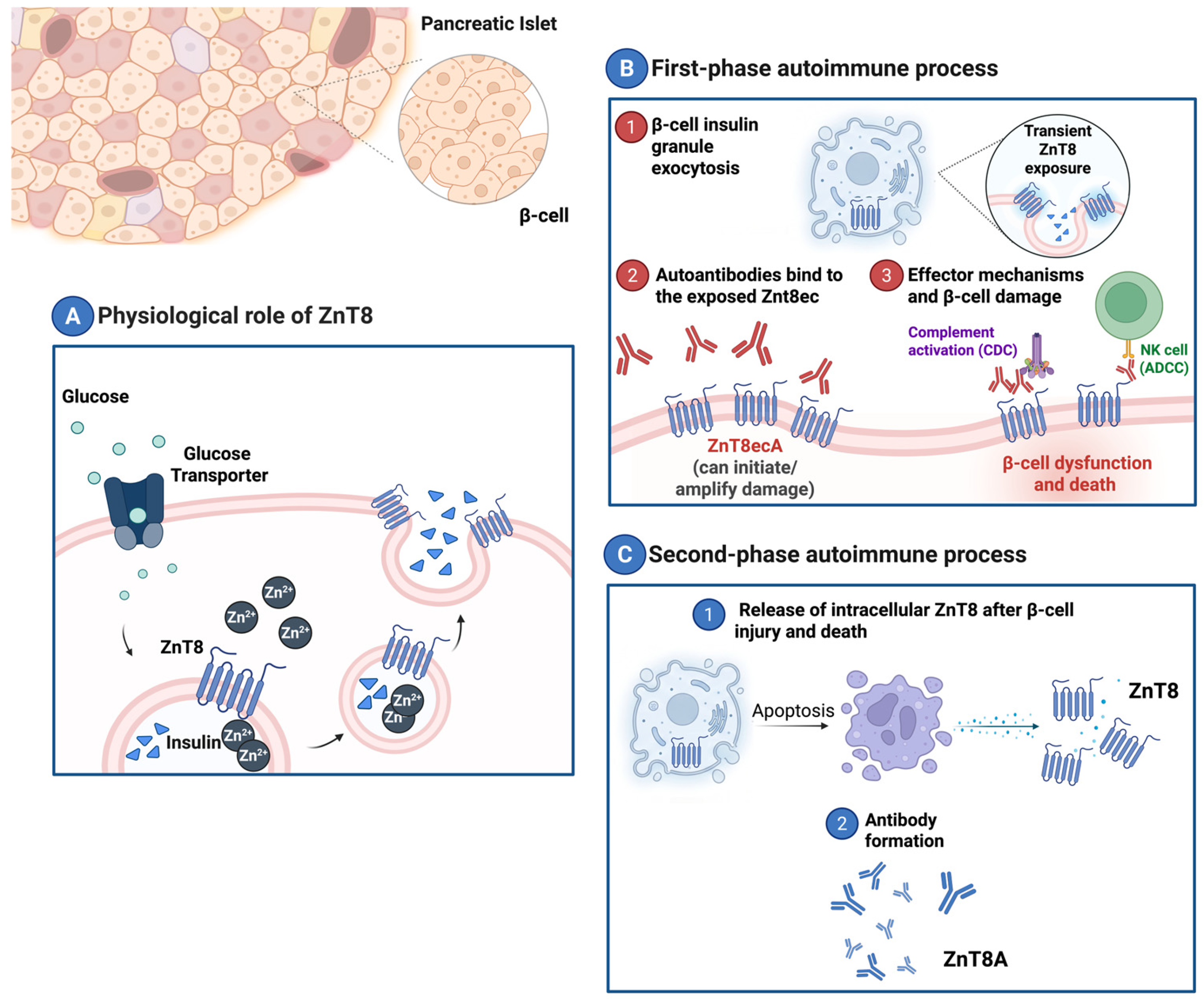
Figure 1. Physiological and pathological roles of ZnT8 in pancreatic β-cells. (A) Physiological role of ZnT8 in pancreatic β cells: ZnT8 (zinc transporter 8) mediates the transport of Zn2+ into insulin secretory granules, where zinc ions are essential for insulin crystallization, storage, and proper secretion following glucose stimulation. In pathological conditions, (B) First-phase autoimmune process: 1. during insulin granule exocytosis, generally hidden extracellular portions of ZnT8 (ZnT8ec), may be transiently exposed on the β-cell surface, causing the generation of pathogenetic autoantibodies against these epitopes. 2. Further exposure of the zinc transporter may lead to binding of specific autoantibodies (ZnT8ecA) to β-cells. 3. Immune-complex formation may contribute to progressive β-cell dysfunction and amplify immune-mediated damage through the activation of effector immune mechanisms, including complement-dependent cytotoxicity (CDC) and antibody-dependent cellular cytotoxicity (ADCC); (C) Second-phase autoimmune process: 1. β-cell injury and apoptosis lead to the release of intracellular ZnT8 into the extracellular space; 2. the recognition of these epitopes by the immune system triggers the production of ZnT8 autoantibodies (ZnT8A). These antibodies are considered epiphenomenic, as they reflect β-cell destruction and therefore serve as biomarkers for T1D diagnosis and staging. Figure was produced with BioRender (biorender.com, https://BioRender.com/4eho115, accessed on 22 June 2026).
Endocrines 07 00031 g001
Figure 2. Schematic illustration of future clinical applications of ZnT8A. Figure was produced with BioRender (biorender.com, https://BioRender.com/4eho115, accessed on 22 June 2026). Arrows point towards its potential use and directions.
Endocrines 07 00031 g002
Table 1. Summary of different types of ZnT8A.
Antibody CategoryTarget/EpitopeStage of
Appearance
Biological SignificanceClinical ApplicationRef.
Established ZnT8A
(intracellular/C-terminal epitopes)
Intracellular and C-terminal epitopes of ZnT8Preclinical and clinical stages of T1D.Epiphenomenic; markers of β-cell autoimmunity and disease burden. Hypothetical pathogenetic contribution via immune amplification (epitope spreading).Clinical use in T1D diagnosis and risk stratification.[6,17,20,21,27,28,29,30,31,32]
ZnT8WA and ZnT8RAConformational epitopes of the ZnT8 C-terminal domain. Main variants linked to W-325 and R-325 polymorphisms.Preclinical and clinical stages of T1D.Inclusion of both antigenic variants in diagnostic kits increases ZnT8A detection sensitivity.Clinical use in T1D diagnosis and risk stratification.[33,34]
High-affinity ZnT8AConformational epitopes of the ZnT8 C-terminal domain (aa 268–369).Reflects a mature stage of autoimmunity; present from the preclinical to the advanced stages of T1D.Marker of active and progressive β-cell autoimmunity.Clinical use in T1D diagnosis and risk stratification. High predictive positive value for T1D progression.[18,24,35,36,37]
Low-affinity ZnT8ALinear or partially conformational epitopes; unstable binding with rapid dissociation.Transient appearance, often in early or pre-autoimmune phases; frequently disappear during follow-up.Originate from immature early immune responses or cross-reactive B-cell clones. Low specificity. Considered a biological false positive.Low predictive value; not sufficient alone to indicate T1D risk. Their detection may occur using standard ELISA kit (antigen denaturation on solid phase) and RBA.[17,18,19,21,26,35,37,38,39]
ZnT8ecA
(antibodies against extracellular epitopes)
Conformational extracellular ZnT8 epitopes.Potentially very early stage of T1D natural history.Possible direct pathogenetic role via ADCC or complement activation on living β-cells; may represent an initiating autoimmune event preceding intracellular antigen release.Research setting.[22,23,24,25]
Table 2. Summary of clinical associations with ZnT8A.
Clinical ContextMain Findings About PrevalenceNotable Clinical AssociationsRef.
Newly Diagnosed T1DPrevalence often 60-80% in Caucasian populations, can be lower in other ethnicities (i.e., Asian).Contributes to increased overall sensitivity of autoantibody testing for T1D.[28]
First-Degree Relatives at RiskCan appear years before clinical onset, often after the appearance of IAA and GADA in younger individuals.Positivity, especially when combined with other autoantibodies, increases the risk of progression to T1D. High-affinity ZnT8A may further refine risk prediction.[6]
Post Clinical Onset of T1DTiters tend to decline over time.Measurement might be useful in cases with long-standing diabetes and unclear classification to confirm autoimmune etiology.[28]
Fulminant type 1 diabetesIslet autoantibodies are detected in a minority of cases; no ZnT8A positivity has been reported to date.In the presence of clinical signs of rapid β-cell destruction, the absence of islet autoantibodies helps distinguish it from classical autoimmune diabetes.[5]
Immune-checkpoint inhibitor-induced diabetesIslet autoantibodies are present in fewer than half of cases (<50%), typically as a single positive antibody; among these, GADA is more commonly detected than ZnT8A, which remains an infrequent finding.Presence and number of autoantibodies contribute to differential diagnosis from other forms of autoimmune diabetes.[5,50]
T2D/LADALow prevalence in youth with T2D, but positivity might be associated with a more T1D-like metabolic profile. Prevalence in LADA can be higher than in typical adult-onset T1D in some studies.May aid in differentiating between autoimmune and non-autoimmune forms of diabetes in adults.[5]
Individuals with Other Autoimmune DiseasesGenerally lower prevalence compared to T1D.Presence might indicate shared autoimmune mechanisms or increased risk of developing T1D.[17]
Table 3. Comparison of ZnT8A detection methods.
MethodPrinciple of AssayMain AdvantagesMain Disadvantages/LimitationsRef.
Radiobinding Assay (RBA)Immunoprecipitation of radiolabeled ZnT8 antigen by autoantibodies in serum.High sensitivity, effective for conformational epitopes.Use of radioactive materials, potential safety concerns, lower throughput.[38]
ELISAEnzyme-linked immunosorbent assay using immobilized ZnT8 antigen to capture antibodies.Accessible, higher throughput than RBA, relatively cost-effective.May have suboptimal performance for certain conformational epitopes.[37,39]
ECL AssayElectrochemiluminescence-based detection of high-affinity ZnT8 autoantibodies.High disease specificity, superior positive predictive value for T1D risk compared to RBA.Specialized equipment is required.[37]
Agglutination-PCR (ADAP)DNA-barcoded ZnT8R and ZnT8W; antibody binding brings DNA tags into proximity, enabling ligation and PCR signal amplification.Small sample volume required; rapid; fully automated; multiplex detection of up to four islet autoantibodies, Non-radioactive.Lower accuracy compared to RBA; PCR-based workflow and specialized equipment are required.[66,78,79]
LIPS AssayZnT8 fused to luciferase; autoantibodies immunoprecipitate the antigen–luciferase complex and light emission is measured.Non-radioactive. Highly sensitive assay. Conformational epitopes preserved. Cheap, quick, high throughput, low blood volume sample.Specific reagents and expertise are required.[80,81,82]
Proteoliposome-basedFull-length ZnT8 are incorporated on nanoparticles/ liposomes to maintain its native quaternary structure; they are immobilized on a platform to be detected by a sensible microarray system.Enhanced sensitivity and specificity due to better protein folding; potential multiplexing applications.More complex preparation of antigen; a specialized platform is required.[83]
Bridge ELISA with baculovirus-expressed chimeric antigen ZnT8/GAD65Immunoassay in which bivalent IgG autoantibodies act as a molecular bridge between a solid-phase-immobilized chimeric antigen (ZnT8/GAD65), expressed via baculovirus-insect cell system.Simultaneous detection of ZnT8A and GADA in a single assay;
no radioactivity.
Eukaryotic expression preserves native conformational epitopes;
high specificity and accuracy.
Moderate sensitivity Incomplete coverage of ZnT8 polymorphic variants (i.e., Q325)
Baculovirus expression requires specialized cell culture expertise.
[84,85]
Disclaimer/Publisher’s Note: The statements, opinions and data contained in all publications are solely those of the individual author(s) and contributor(s) and not of MDPI and/or the editor(s). MDPI and/or the editor(s) disclaim responsibility for any injury to people or property resulting from any ideas, methods, instructions or products referred to in the content.