


Abstract
Background/Objectives: Postpartum hemorrhage (PPH) remains a leading cause of maternal death. This review summarizes clinical evidence on chitosan-covered tamponade (CCT), distinguishing mechanistic rationale from demonstrated clinical benefit. Methods: A structured narrative review following SANRA recommendations used updated PubMed, Scopus, and Web of Science records (publication years 2000–2026; October 2026 update). Results were synthesized descriptively. Results: Twelve clinical publications concerned PPH; two reports of other obstetric hemorrhage were retained separately for context, and six safety publications were catalogued. In a single uncontrolled registry cohort (n = 230), hemorrhage control without further invasive procedures was reported in 210 women (91.3%). Separately, vaginal or vulvar CCT controlled lower genital tract trauma bleeding in 25/26 women; these findings do not establish intrauterine effectiveness. Retrospective balloon comparisons do not establish equivalence or non-inferiority. Historical hysterectomy findings are vulnerable to confounding. Six PPH publications originated from one institution, with possible patient overlap. No direct comparison with conventional gauze was identified, and reports of ocular and audiovestibular inflammation raise safety concerns. Conclusions: A clinical advantage over conventional gauze has not been demonstrated. Current international PPH guidance remains applicable and does not recommend uterine packing with plain or hemostatic-agent-impregnated gauze. Comparative effectiveness and safety require prospective evaluation before routine CCT use can be supported.
1. Introduction
Postpartum hemorrhage (PPH) remains one of the most serious obstetric emergencies and a leading cause of maternal morbidity and mortality worldwide [1,2]. PPH was traditionally defined as blood loss of at least 500 mL after vaginal birth or 1000 mL after caesarean birth [3,4], whereas other definitions have used cumulative blood loss of at least 1000 mL, or any blood loss accompanied by signs of hypovolemia, within 24 h of birth regardless of the mode of delivery [5,6,7]. Because volume thresholds alone recognize clinically significant bleeding late, the 2025 consolidated guideline of the World Health Organization (WHO), the International Federation of Gynecology and Obstetrics (FIGO), and the International Confederation of Midwives (ICM) introduced diagnostic criteria based on objectively measured blood loss of at least 300 mL with any abnormal hemodynamic sign (pulse > 100 bpm, shock index > 1, systolic blood pressure < 100 mmHg, or diastolic blood pressure < 60 mmHg), or at least 500 mL, whichever occurs first within 24 h after birth [1,8]. Visual estimation frequently underestimates blood loss; objective quantification combined with hemodynamic assessment is therefore central to timely recognition [4,8].
PPH accounts for approximately one-quarter of maternal deaths globally, with the greatest burden in low- and middle-income countries, where delayed diagnosis and limited access to advanced interventions persist [2,9]. Rapid hemorrhage control is essential to prevent hypovolemic shock, disseminated intravascular coagulation (DIC), multiorgan failure, peripartum hysterectomy, and maternal death [10]. Management follows a stepwise escalation from uterotonics, tranexamic acid (TXA), and uterine massage to intrauterine tamponade, compression sutures, pelvic devascularization, arterial embolization and, in refractory cases, hysterectomy [11,12,13,14,15].
Intrauterine tamponade is a key uterus-preserving step. Balloon devices are the most widely studied option [12], while uterine gauze packing has been used as an inexpensive alternative, particularly where balloon devices are unavailable [16]. However, the 2025 WHO/FIGO/ICM guideline does not recommend uterine packing with plain or haemostatic-agent-impregnated gauze for PPH because evidence of benefit is insufficient and there are concerns about potential harm [1]. Conventional gauze exerts a purely mechanical effect and may be insufficient when bleeding is diffuse or coagulation is impaired [16,17]. These limitations have stimulated interest in tamponade materials with intrinsic hemostatic activity.
Chitosan is a cationic polysaccharide derived from chitin with hemostatic, mucoadhesive, and antimicrobial properties [18,19]. Chitosan-based dressings promote clot formation through electrostatic interactions with erythrocytes and platelets, a mechanism that is at least partly independent of the classical coagulation cascade [20,21]. Chitosan-covered gauze was first used for PPH in 2012 [22] and was subsequently developed into a dedicated uterovaginal device, Celox™ PPH (Medtrade Products Ltd., Crewe, UK), described as CE-marked for intrauterine use in the published registry cohort [23]. In this review, the term chitosan-covered tamponade (CCT) refers to chitosan-covered gauze applied to the uterine cavity or the lower genital tract. Chitosan-covered gauze describes the material; CCT denotes its tamponade application, while packing describes the placement of gauze. Uterine and vaginal/vulvar applications are distinguished throughout. CCT has been used alone, in combination with intrauterine balloon tamponade [24], and as part of multimodal rescue strategies [25]. Most reports concern Celox formulations, but the chitosan-coated dressings used across studies are not identical; outcomes should not be assumed interchangeable between products.
Despite continued clinical interest, the evidence on CCT remains fragmented and largely observational, and its potential advantages over conventional gauze packing have not been critically appraised. This review therefore (i) summarizes the limitations of conventional gauze tamponade, (ii) outlines the mechanisms of chitosan-mediated hemostasis, (iii) synthesizes the published clinical outcomes of CCT in obstetric hemorrhage, including emerging safety data, and (iv) discusses the evidence needed to establish the role of CCT within stepwise PPH management.
2. Materials and Methods
2.1. Study Design
This structured narrative review was prepared in accordance with the Scale for the Assessment of Narrative Review Articles (SANRA) [26]. A search and publication-selection flow diagram supports transparency but is not presented as a complete PRISMA 2020 flow diagram. No formal risk-of-bias assessment or quantitative synthesis was performed; this is not a systematic review. No review protocol was registered.
2.2. Literature Search
During revision, a new, expanded search was completed in PubMed/MEDLINE, Scopus, and Web of Science Core Collection (publication years 2000–2026). PubMed was searched through NCBI Entrez E-utilities on 13 October 2026, with a publication-date range of 1 January 2000 to 13 October 2026. Scopus and Web of Science obstetric and safety exports received on 13 October 2026 were incorporated. This update supersedes the earlier search and its unverified full-text retrieval counts.
Two complementary strategies combined chitosan-related terms (chitosan, Celox, and combat gauze) with either broad obstetric terms or ocular and audiovestibular safety terms. Neither strategy required tamponade or packing, and the safety strategy did not require an obstetric term. PubMed combined MeSH headings with title/abstract keywords, without language, human, publication-type, or study-design retrieval filters. The supplied Scopus strategies used TITLE-ABS-KEY and publication years 2000–2026; the supplied Web of Science strategies used Topic (TS) and PY = 2000–2026.
2.3. Eligibility Criteria
Clinical reports were eligible if they described hemorrhage control, further intervention, hysterectomy, transfusion, complications, or reproductive outcomes after chitosan-coated gauze or a related chitosan-coated dressing was used as a uterine or genital-tract tamponade in women with PPH or other obstetric hemorrhage. All clinical study designs, including case reports, were eligible. Reports outside the postpartum period were retained only as contextual evidence and excluded from the PPH efficacy synthesis. Vaginal/vulvar trauma applications were considered separately from intrauterine tamponade. English full-text reports, including publisher-provided English translations, were considered. Conference abstracts without an identified corresponding full report, non-obstetric populations, animal or in vitro studies, chitosan powder, anti-adhesion gels, and reports without extractable CCT-specific outcomes were excluded from the clinical synthesis. A separate safety component, broadened during revision, catalogued original publications reporting ocular or audiovestibular symptoms after obstetric CCT regardless of language; full-text, abstract, partial-extract, and bibliographic access were distinguished. Clinical information was restricted to that explicitly reported in accessible material; unavailable case details and outcomes were not inferred. Reviews, commentaries, guidelines, and regulatory notices informed context but were not counted as original clinical or safety reports.
2.4. Study Selection, Data Extraction, and Synthesis
Records were normalized and deduplicated using DOI, PMID, Scopus EID, Web of Science identifier, and normalized title, with identifier conflicts and a near-title duplicate checked individually. Title and available-abstract screening and preparation of the extraction log were assisted by ChatGPT-6 (OpenAI). Full texts or publisher-provided English translations of the added clinical reports were examined; previously included reports were reconciled with the original extraction and the available literature. The extraction documentation identifies the assessment basis, access limitations, exclusion reason, and possible patient overlap. Extracted variables were author, year, design, sample size, hemorrhage cause, formulation, intervention, hemostatic outcome, hysterectomy, transfusion, complications, and follow-up. Distinct reports with overlapping patients were retained as publications, with overlap explicitly noted; patient numbers were not added across reports. Results were synthesized descriptively without pooled estimates because designs, populations, interventions, and outcome definitions differed.
3. Results
3.1. Study Selection
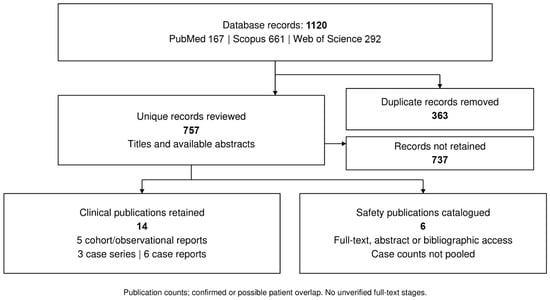
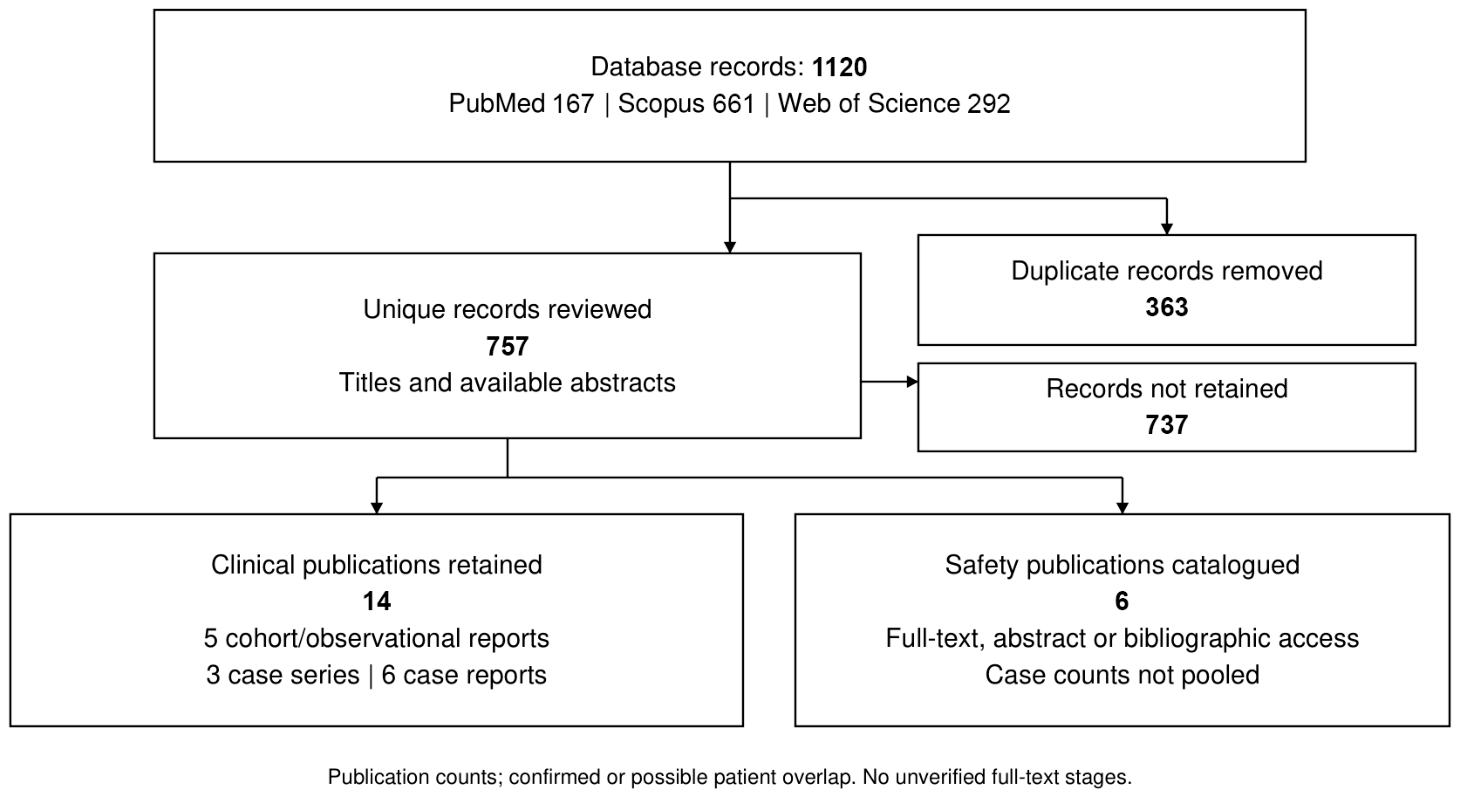
The completed update yielded 1120 source-query records: PubMed, 167 (100 obstetric and 67 safety); Scopus, 661 (484 and 177); and Web of Science, 292 (159 and 133). Removal of 363 duplicate records left 757 unique records. Twelve PPH publications were retained for Table 1, two other obstetric hemorrhage reports were retained separately for context, and six safety publications were catalogued; the remaining 737 records did not enter these components. Counts refer to publications rather than independent patient cohorts. Figure 1 presents the reconciliation and selection for this narrative review; it does not represent a verified full-text retrieval cascade.
Table 1.
Characteristics and main findings of publications concerning postpartum hemorrhage. Vaginal/vulvar trauma application is distinguished from intrauterine tamponade.
Figure 1.
Updated database record reconciliation and publication selection for the structured narrative review. The 14 retained clinical publications comprise 12 concerning PPH and two contextual reports of other obstetric hemorrhage. Counts refer to publications, not independent patient groups. Safety records were assessed from full texts, abstracts, or partial publisher extracts; unverified full-text retrieval stages are not represented.
3.2. Characteristics of the Included Studies
Twelve PPH publications, dated 2012–2026, comprised five cohort or observational reports [23,29,30,31,33], three case series [27,28,34], and four case reports [22,24,25,32] (Table 1). One series was prospective but uncontrolled and used a different chitosan-coated tape [34]. Six reports originated from Charité with overlapping periods [23,24,29,30,31,33]. The Schmid 2012 case is repeated in the 2013 series [22,27]; only the uterine-gauze case in Carles informs CCT outcomes [28]. Two non-PPH reports are described separately in Section 3.7 [35,36]. No eligible full-length randomized trial or direct conventional-gauze comparison was identified; a Celox-versus-Bakri meeting abstract was not counted as a full report.
3.3. Hemorrhage Control
In the uncontrolled registry cohort (n = 230; 2017–2022), hemorrhage control without further invasive procedures was reported in 210/230 women (91.3%); this single-arm result does not estimate comparative benefit [23]. In Dueckelmann 2019, CCT (n = 47) and Bakri (n = 31) groups had mean estimated blood loss of 2017.7 and 1756.6 mL (p = 0.225), mean red cell transfusion of 1.9 and 1.5 units (p = 0.664), and hysterectomy in 0/47 and 3/31 women, respectively [29]. Comparative confidence intervals were not reported for these endpoints. The nonrandomized design, small sample, differing delivery modes, and treatment differences preclude conclusions of equivalence or non-inferiority. PPH case reports described control after other measures failed [22,32] or with combined CCT/balloon treatment [24]. In a refractory case, definitive control required REBOA-assisted uterine artery embolization after CCT and balloon treatment failed [25].
The Schmid 2013 series reported control in 18/19 women, with hysterectomy for uterine rupture in one [27]. The eligible uterine-gauze case in Carles was successful [28]. An uncontrolled prospective series reported control in 21/21 women using a different chitosan-coated tape [34]. These observations do not establish comparative effectiveness. Separately, vaginal or vulvar CCT controlled trauma-related bleeding in 25/26 women (96.2%) after conventional repair failed [33]; this anatomically distinct application is not evidence of intrauterine efficacy.
3.4. Hysterectomy and Further Interventions
Hysterectomy was required in 5 of 230 women (2.2%) in the registry cohort [23]. In the retrospective cohort of Biele et al., 85 of 666 women received CCT, 51 received balloon tamponade, and 530 received medical therapy alone; hysterectomy occurred in 0/85, 4/51, and 1/530 women, respectively [30]. A separate institutional comparison of two 31-month periods found 9 hysterectomies among 9058 births before CCT implementation and 2 among 9167 births afterward, corresponding to 77.8% fewer procedures. This historical association does not establish a causal effect of CCT or a 77.8% patient-level reduction in hysterectomy risk [30]. Schmid et al. also reported an unadjusted institutional comparison of 8 hysterectomies among 3822 births before versus 2 among 4077 afterward [27], with the same limitations of historical comparisons. Uterine preservation during multimodal PPH rescue cannot be attributed to CCT alone [25]. Transfusion reporting and treatment pathways were heterogeneous, preventing a reliable comparative estimate.
3.5. Reproductive and Long-Term Outcomes
In an observational follow-up study of 260 women treated with intrauterine CCT or the Bakri balloon, menstrual recovery, fertility, and subsequent pregnancy rates did not differ between devices, whereas long-term psychological sequelae were common after severe PPH irrespective of the device used [31].
3.6. Adverse Events
No maternal deaths or device-related fatal complications were reported in the included studies. In the lower genital tract trauma cohort, no postpartum fever or clinical signs of infection were observed after gauze application [33]. Schmid et al. reported postpartum fever in one woman and retained gauze material in two [27]. Adverse-event reporting was inconsistent, and absence of reported ocular or audiovestibular events in the efficacy cohorts does not establish their absence when active surveillance was not described.
3.7. Other Obstetric Hemorrhage Outside the PPH Synthesis
Klát et al. reported CCT after evacuation of a cesarean scar pregnancy [35]. Poloczek and Kipp described miscarriage-associated bleeding during warfarin treatment, with recurrent bleeding despite CCT and definitive control by embolization [36]. Neither is PPH. They are retained solely as contextual reports of other obstetric applications and do not contribute to PPH statements on hemostatic effectiveness, hysterectomy, or uterine preservation.
4. Discussion
4.1. Limitations of Conventional Gauze Packing
Gauze packing controls bleeding almost entirely through passive mechanical compression: gauze inserted into the uterine cavity or vagina exerts pressure against bleeding surfaces, reduces local blood flow, and facilitates clot formation [17,37]. Conventional gauze has no intrinsic procoagulant activity; hemostasis therefore depends on external pressure, myometrial contraction, and an intact endogenous coagulation system [17,38]. Its effectiveness may be reduced when bleeding surfaces are diffuse, in severe uterine atony, placental bed bleeding, and genital tract trauma, and in the presence of DIC or dilutional coagulopathy [16,39,40]. On the other hand, gauze packing is inexpensive, universally available, and familiar to most obstetric teams, and its safety and effectiveness in refractory PPH have recently been summarized in a systematic review and meta-analysis [16].
4.2. Mechanisms of Chitosan-Mediated Hemostasis
The protonated amino groups of chitosan confer a positive charge that enables binding to negatively charged erythrocyte and platelet membranes, forming a gel-like clot matrix that adheres to the bleeding tissue [20,41,42]. Because this process occurs largely independently of the classical coagulation cascade, chitosan-based materials have retained procoagulant activity in experimental models of coagulopathy [41,43]. As severe PPH is frequently complicated by consumptive or dilutional coagulopathy, this property provides a biological rationale for CCT precisely in the situations in which passive gauze packing is least effective. Mucoadhesion may also improve the stability of the pack within the uterine cavity, and the practical aspects of application and removal have been described in detail [9]. It should be emphasized, however, that the coagulation-independent mechanism has been demonstrated mainly in preclinical studies, and its clinical relevance in coagulopathic PPH has not been evaluated in comparative trials.
4.3. Interpretation of the Clinical Evidence
The 91.3% registry result describes the observed hemorrhage control in a single uncontrolled cohort and cannot establish superiority over balloon or conventional gauze tamponade [23]. The retrospective CCT/Bakri comparison provides descriptive outcome differences, not evidence of equivalence or non-inferiority [29]. The 2024 follow-up concerns longer-term outcomes and does not independently confirm acute effectiveness [31]. Vaginal/vulvar trauma outcomes must be interpreted within that application [33]. Historical changes in hysterectomy counts remain associations rather than treatment effects [30].
The prospective 21-woman series adds feasibility observations but remains uncontrolled and concerns a different chitosan-coated tape [34]. Published failures requiring hysterectomy or embolization [25,27] also preclude treating reported success in selected series as a reliable estimate for routine care.
These findings must nevertheless be interpreted with caution. Historical before–after comparisons are vulnerable to temporal confounding. Although Biele et al. reported no other changes in institutional PPH treatment during the assessed period [30], nonrandom treatment allocation, case mix, clinical thresholds for surgery, and unmeasured changes over time may still influence the observed association. Potential secular changes in transfusion practice, tranexamic acid use, coagulation-factor replacement, and timing of escalation cannot be excluded or separated from the CCT effect by this design. The small number of hysterectomies further limits precision. Most data derive from a single highly experienced center, which may limit generalizability, and patient overlap between reports from that center may inflate the apparent volume of evidence. Case reports are, in addition, subject to publication bias. Importantly, the proposed advantages of CCT over conventional gauze packing are inferred from mechanistic plausibility and single-arm outcomes rather than demonstrated in head-to-head comparisons. Table 2 therefore presents a conceptual comparison and indicates the type of evidence supporting each characteristic.
Table 2.
Conceptual comparison of chitosan-covered tamponade and conventional gauze packing in postpartum hemorrhage, with the type of evidence supporting each characteristic.
The six Charité publications contribute different endpoints rather than six independent replications: Seidel provides a combined-treatment case [24]; Dueckelmann 2019 provides the retrospective balloon comparison [29]; Biele provides treatment outcomes and historical hysterectomy counts [30]; Dueckelmann 2024 provides longer-term outcomes [31]; Dueckelmann 2025 concerns vaginal or vulvar trauma [33]; and Leichtle provides registry outcomes and failure predictors [23]. Their recruitment periods are specified in Table 1. For the 2024 follow-up, 71/214 CCT-treated and 21/46 balloon-treated women contributed long-term responses, limiting interpretation through nonresponse [31]. Exact patient overlap cannot be quantified from the reports, and findings from shared institutional populations are not treated as independent confirmation. No combined patient denominator or pooled success rate is calculated; vaginal/vulvar findings do not establish intrauterine efficacy.
Although conventional gauze packing is inexpensive and widely available, these practical advantages do not establish its clinical benefit in refractory PPH [16]. The WHO/FIGO/ICM guideline acknowledges a possible temporizing role only when medical treatment has failed and no other interventions are available, with urgent transfer to a facility capable of definitive care [1]. Comparisons with recommended interventions, particularly balloon tamponade, are therefore needed to establish whether CCT offers an acceptable balance of benefit and harm.
4.4. Safety Considerations
Six original publications concerning ocular or audiovestibular symptoms after obstetric CCT were identified in the updated database exports [44,45,46,47,48,49]. Beckers et al. reported bilateral intermediate uveitis in six postpartum women [44]. The available abstracts describe panuveitis with vertigo and hearing loss termed CAVES in an Irish case, with residual visual and audiovestibular deficits [45], and Cogan-like presentations in three women reported by Mala et al. [46]. Haase et al. reported a two-patient series; the accessible extract describes the first patient developing symptoms two hours after caesarean delivery and intrauterine Celox placement, with bilateral ocular inflammation and sensorineural hearing loss [47]. Her subsequent treatment and outcomes and the second case were not available for assessment. The accessible introduction to Wilmes et al. discusses the safety signal but does not provide extractable details of its own patient series [48]. Löw et al. described three women with ocular and audiovestibular manifestations [49]. Full texts were available for Beckers and Löw; the remaining four reports were assessed from abstracts or partial publisher extracts. Overlap between reports, particularly the Cologne publications [48,49], cannot be excluded, so case counts were not pooled. Temporal association does not establish causality, and these reports cannot estimate incidence. The symptoms warrant prompt ophthalmological and, where indicated, otorhinolaryngological assessment and prospective active surveillance.
A manufacturer field safety notice dated 29 October 2025 (FSN 2025:001), published by a medicines regulator, communicated revised instructions for use after reports of visual and auditory disturbances. It stated that a causal relationship had not been established and advised symptom monitoring, prompt medical evaluation, and reporting of suspected events [50]. This device notice is contextual safety information, not an additional clinical study; the term transient used in the notice should not obscure persistent deficits described in clinical reports [45,49].
4.5. Position in Current Guidelines and Proposed Clinical Framework
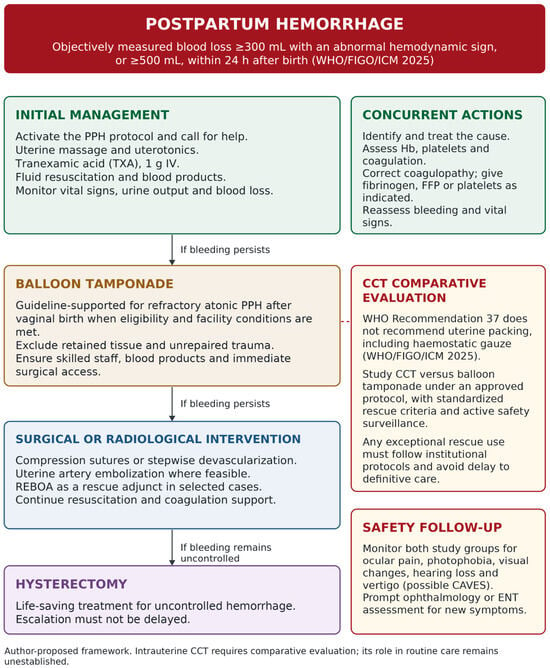
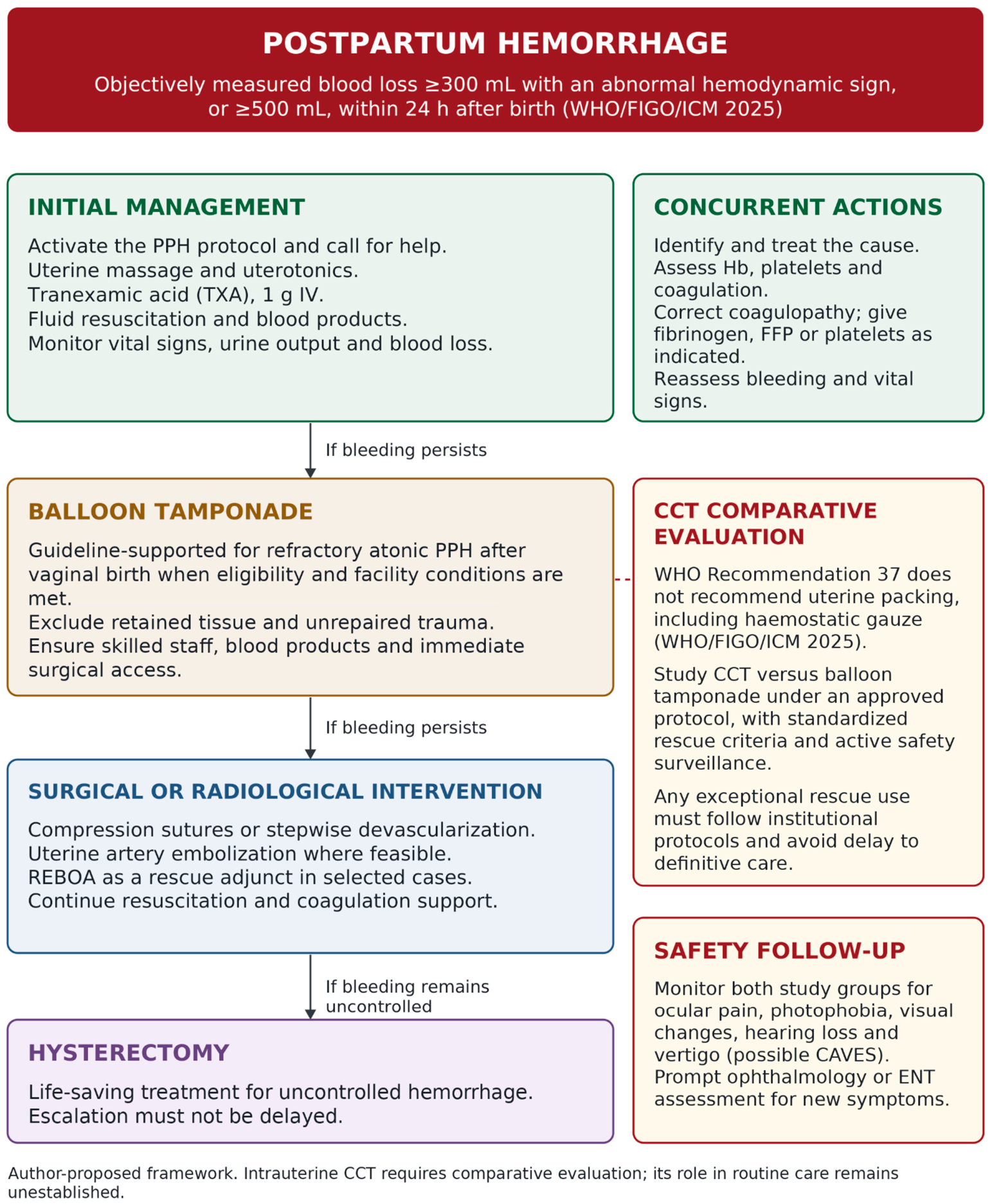
International guidance, including the WHO/FIGO/ICM consolidated guideline, the FIGO recommendations, and the guideline of the Royal College of Obstetricians and Gynaecologists (RCOG), emphasizes uterotonics, TXA, intrauterine balloon tamponade, and surgical or radiological interventions in the stepwise management of refractory PPH [1,14,15]. Recommendation 37 of the 2025 WHO/FIGO/ICM guideline specifically advises against uterine packing with either plain gauze or gauze impregnated with haemostatic agents for PPH [1]. These international recommendations remain valid and applicable; the proposed framework does not replace them. It is not applicable as a tamponade pathway when immediate surgery is required, retained placental tissue or unrepaired trauma is present, uterine rupture is suspected, or monitoring, blood products, and immediate rescue care are unavailable. Although CCT has been adopted at some European centers [23,30], this practice does not establish its suitability for routine care. Further use should be evaluated in ethically approved comparative studies with immediate access to blood products and definitive interventions. Any exceptional rescue use should follow institutional protocols and must not delay escalation for ongoing hemorrhage. Figure 2 presents a conceptual framework that distinguishes guideline-supported management from the proposed research role of intrauterine CCT. This framework is author-proposed, has not been prospectively validated, and should not be treated as an evidence-based clinical algorithm; vaginal CCT for lower genital tract trauma requires separate evaluation.
Figure 2.
Guideline-supported management of postpartum hemorrhage and the proposed research role of chitosan-covered tamponade (Celox™ PPH). The framework is author-proposed and unvalidated. It reflects the 2025 WHO/FIGO/ICM guidance against uterine packing with plain or haemostatic-agent-impregnated gauze [1]. Intrauterine CCT requires comparative evaluation under an approved study protocol; ongoing hemorrhage requires timely escalation. CAVES, chitosan-associated vasculitis with eye and sensorineural symptoms; CCT, chitosan-covered tamponade; ENT, ear, nose, and throat; FFP, fresh frozen plasma; FIGO, International Federation of Gynecology and Obstetrics; Hb, hemoglobin; ICM, International Confederation of Midwives; IV, intravenous; PPH, postpartum hemorrhage; REBOA, resuscitative endovascular balloon occlusion of the aorta; TXA, tranexamic acid; WHO, World Health Organization.
4.6. Future Directions
Subject to a current device-specific risk assessment, regulatory authorization, ethics approval, and confirmation of clinical equipoise, a suitable study would be a prospectively registered, multicenter randomized trial comparing CCT with uterine balloon tamponade in women with refractory atonic PPH despite standardized first-line treatment. Women requiring immediate surgery, or with retained placental tissue, uterine rupture, or unrepaired genital tract trauma, should be excluded. Allocation should be concealed and stratified by center and delivery mode, with baseline blood loss, hemodynamic status, and coagulation parameters recorded. Trained teams should use predefined insertion, removal, transfusion, and rescue protocols, with immediate access to blood products and surgery. The primary endpoint could be sustained hemorrhage control without additional tamponade, embolization, surgery, or maternal death within 24 h; criteria for early hemostasis and recurrent bleeding should be defined in advance. Secondary outcomes should include time to hemostasis, objectively measured blood loss after allocation, transfusion requirements, hysterectomy, intensive care admission, and severe maternal morbidity. Sample size should be calculated for a prespecified clinically meaningful treatment effect, and analysis should follow the intention-to-treat principle, with blinded outcome adjudication where feasible. Coagulopathy should be a prespecified exploratory subgroup.
Safety surveillance should use identical active assessments in both groups, documenting infection, uterine injury, retained material, recurrent hemorrhage, and allergic or systemic inflammatory reactions. Structured screening for ocular pain, photophobia, blurred vision, hearing loss, tinnitus, and vertigo should occur daily during the first 72 h, or by scheduled contact if discharge occurs earlier, with prompt ophthalmological or otorhinolaryngological assessment of new symptoms. This schedule is informed by reports of symptoms beginning during the first postpartum day or within 48–72 h and associated audiovestibular manifestations [44,45,46,47,48,49]; it is a proposed surveillance schedule, not a validated monitoring standard. Further contact at 7–14 days and 6 weeks should evaluate delayed events; follow-up at 6 and 12 months could assess persistent symptoms, menstrual recovery, and reproductive outcomes. The exact product and batch should be recorded. All adverse events should be graded for severity, reported through applicable device-vigilance pathways, and assessed for relatedness by an independent panel. An independent safety committee should review emerging data under prespecified stopping rules. Ethics approval and a consent procedure appropriate for emergency obstetric research are essential, and enrollment must not delay life-saving treatment.
A prospective single-arm post-market investigation of Celox™ PPH was registered in 2023 [51], but a concurrent control group is needed to establish comparative effectiveness. Where randomization is infeasible, a prospective comparative cohort with adjustment for treatment indication and baseline severity could provide additional evidence, while retaining a risk of residual confounding. A larger registry with continued follow-up would be needed to characterize uncommon adverse events. Separate evaluation should address vaginal CCT for genital tract trauma, placental bed bleeding, and cost-effectiveness.
4.7. Strengths and Limitations
The updated review makes database provenance and publication-level selection explicit, incorporates safety records within the repeat database search, and distinguishes mechanistic plausibility from comparative clinical evidence. Limitations remain substantial. The evidence includes retrospective cohorts, one small prospective uncontrolled series, and case reports; no eligible full-length randomized comparison was identified. Populations, formulations, treatment pathways, outcomes, and surveillance differed, and confirmed or possible patient overlap prevents summing denominators. The English full-text clinical criterion may introduce language and access bias; safety publications were considered across languages, but four of the six reports were assessed from abstracts or partial publisher extracts. Incomplete access may introduce selection bias and obscure treatment failures or adverse events; it also limits assessment of alternative explanations, treatment, follow-up, and patient overlap. The direction and magnitude of this bias cannot be determined. The original text and diagram inconsistently distinguished conference abstracts from unavailable full texts. A reference-level list and retrieval histories for the eight reports labelled unavailable could not be reconstructed; these unsupported counts were withdrawn, and the new search does not retrospectively identify them. Embase was unavailable and the Web of Science exports lacked abstracts. Residual gaps in the archived Scopus/Web of Science platform history limit exact reproduction of those searches, although their updated result sets and record counts are available. The earlier search could not be reproduced. The updated strategy retrieved all four previously cited safety reports, but this check does not prove exhaustive sensitivity. AI-assisted screening and extraction require author verification. No formal risk-of-bias assessment or meta-analysis was performed, and the proposed clinical framework and monitoring schedule remain unvalidated.
5. Conclusions
Available PPH evidence comprises observational cohorts, case series, and case reports, with substantial concentration in one institution and possible patient overlap. Reported hemorrhage control does not establish equivalence or non-inferiority to balloon tamponade, and a clinical advantage over conventional gauze packing has not been demonstrated. Historical hysterectomy changes cannot be attributed causally to CCT. Vaginal/vulvar trauma findings are anatomically distinct from intrauterine tamponade, and non-PPH cases do not contribute to these conclusions. Ocular and audiovestibular safety signals require further investigation. WHO/FIGO/ICM guidance remains applicable and does not recommend uterine packing with plain or hemostatic-agent-impregnated gauze for PPH [1]. Prospective multicenter comparisons with systematic safety surveillance are needed before routine intrauterine CCT use can be supported.
Author Contributions
Conceptualization, Z.K. and A.Y.; methodology, Z.K.; formal analysis, Z.K. and A.Y.; investigation, Z.K. and A.Y.; resources, Z.K.; data curation, E.T.; writing—original draft preparation, Z.K.; writing—review and editing, A.Y., V.D. and E.T.; visualization, E.T.; supervision, A.Y. All authors have read and agreed to the published version of the manuscript.
Funding
This research received no external funding.
Institutional Review Board Statement
Not applicable.
Informed Consent Statement
Not applicable.
Data Availability Statement
Clinical data discussed are from the cited publications.
Acknowledgments
During the preparation of this manuscript, the authors used Claude (Opus 5; Anthropic, San Francisco, CA, USA) for language editing. For this revision, ChatGPT-6 (OpenAI) assisted record normalization, deduplication, preliminary screening, preparation of the extraction log, and language editing. The authors retain responsibility for verifying the selection, extracted data, interpretation, and final manuscript.
Conflicts of Interest
The authors declare no conflicts of interest. The authors have no financial or non-financial relationship with Medtrade Products Ltd. or any other manufacturer of chitosan-based hemostatic devices.
Abbreviations
| CAVES | chitosan-associated vasculitis with eye and sensorineural symptoms |
| CCT | chitosan-covered tamponade |
| DIC | disseminated intravascular coagulation |
| FIGO | International Federation of Gynecology and Obstetrics |
| ICM | International Confederation of Midwives |
| PPH | postpartum hemorrhage |
| RCOG | Royal College of Obstetricians and Gynaecologists |
| REBOA | resuscitative endovascular balloon occlusion of the aorta |
| SANRA | Scale for the Assessment of Narrative Review Articles |
| TXA | tranexamic acid |
| WHO | World Health Organization |
References
- World Health Organization; International Federation of Gynecology and Obstetrics; International Confederation of Midwives. Consolidated Guidelines for the Prevention, Diagnosis and Treatment of Postpartum Haemorrhage; World Health Organization: Geneva, Switzerland, 2025. [Google Scholar]
- Wei, J.; Yi, Y.; Li, X.; Xu, Y.; Fan, L.; Huang, H. Global, Regional, and National Burden of Maternal Hemorrhage: A Systematic Analysis from the Global Burden of Disease 2021 and Projections to 2030. BMC Pregnancy Childbirth 2025, 25, 1164. [Google Scholar] [CrossRef] [Scilit] [PubMed]
- Fenn, M.G.; Al Falahi, M.; Al Hannai, T.; Al Shukaili, L.; Al Riyami, N. Postpartum Hemorrhage Following Vaginal and Cesarean Section Deliveries at a Single Tertiary Hospital: A Five-Year Cross-Sectional Study. Oman Med. J. 2024, 39, e695. [Google Scholar] [CrossRef] [Scilit] [PubMed]
- Begum, F.; Nieto-Calvache, A.J.; Schlembach, D.; Hofmyer, J.; Palacios-Jaraquemada, J.; Bhardwaj, A.; Suarez, M.A.; Burgos-Luna, J.M.; Beyeza-Kashesya, J.; Ubom, A.E.; et al. FIGO Recommendations on Objective Measurement of Blood Loss after Birth for Early Detection of Postpartum Hemorrhage. Int. J. Gynaecol. Obstet. 2025, 171, 933–950. [Google Scholar] [CrossRef] [Scilit] [PubMed]
- Bienstock, J.L.; Eke, A.C.; Hueppchen, N.A. Postpartum Hemorrhage. N. Engl. J. Med. 2021, 384, 1635–1645. [Google Scholar] [CrossRef] [Scilit] [PubMed]
- Angarita, A.M.; Cochrane, E.; Bianco, A.; Berghella, V. Prevention of Postpartum Hemorrhage in Vaginal Deliveries. Eur. J. Obstet. Gynecol. Reprod. Biol. 2023, 280, 112–119. [Google Scholar] [CrossRef] [Scilit] [PubMed]
- Abecassis, A.; Wainstock, T.; Sheiner, E.; Miodownik, S.; Pariente, G. Risk Factors for Early Postpartum Hemorrhage: A Retrospective Population-Based Cohort Analysis. Int. J. Gynaecol. Obstet. 2024, 166, 812–818. [Google Scholar] [CrossRef] [Scilit] [PubMed]
- Gallos, I.; Williams, C.R.; Price, M.J.; Tobias, A.; Devall, A.; Allotey, J.; Althabe, F.; A Cresswell, J.; Durocher, J.; Gülmezoglu, A.M.; et al. Prognostic Accuracy of Clinical Markers of Postpartum Bleeding in Predicting Maternal Mortality or Severe Morbidity: A WHO Individual Participant Data Meta-Analysis. Lancet 2025, 406, 1969–1982. [Google Scholar] [CrossRef] [Scilit] [PubMed]
- Henrich, W.; Dückelmann, A.; Braun, T.; Hinkson, L. Uterine Packing with Chitosan-Covered Tamponade to Treat Postpartum Hemorrhage. Am. J. Obstet. Gynecol. 2024, 230, S1061–S1065. [Google Scholar] [CrossRef] [Scilit] [PubMed]
- Bonanno, F.G. Management of Hemorrhagic Shock: Physiology Approach, Timing and Strategies. J. Clin. Med. 2023, 12, 260. [Google Scholar] [CrossRef] [Scilit] [PubMed]
- Liu, L.Y.; Nathan, L.; Sheen, J.J.; Goffman, D. Review of Current Insights and Therapeutic Approaches for the Treatment of Refractory Postpartum Hemorrhage. Int. J. Womens Health 2023, 15, 905–926. [Google Scholar] [CrossRef] [Scilit] [PubMed]
- Suarez, S.; Conde-Agudelo, A.; Borovac-Pinheiro, A.; Suarez-Rebling, D.; Eckardt, M.; Theron, G.; Burke, T.F. Uterine Balloon Tamponade for the Treatment of Postpartum Hemorrhage: A Systematic Review and Meta-Analysis. Am. J. Obstet. Gynecol. 2020, 222, 293.e1–293.e52. [Google Scholar] [CrossRef] [Scilit] [PubMed]
- Sinha, T. Surgical Techniques and Procedures in the Management of Postpartum Haemorrhage. In Surgical Techniques and Procedures; Tsoulfas, G., Ed.; IntechOpen: London, UK, 2025. [Google Scholar] [CrossRef] [Scilit]
- Escobar, M.F.; Nassar, A.H.; Theron, G.; Barnea, E.R.; Nicholson, W.; Ramasauskaite, D.; Lloyd, I.; Chandraharan, E.; Miller, S.; Burke, T.; et al. FIGO Recommendations on the Management of Postpartum Hemorrhage 2022. Int. J. Gynaecol. Obstet. 2022, 157, 3–50. [Google Scholar] [CrossRef] [Scilit] [PubMed]
- Mavrides, E.; Allard, S.; Chandraharan, E.; Collins, P.; Green, L.; Hunt, B.J.; Riris, S.; Thomson, A.J.; on behalf of the Royal College of Obstetricians and Gynaecologists. Prevention and Management of Postpartum Haemorrhage: Green-top Guideline No. 52. BJOG Int. J. Obstet. Gynaecol. 2017, 124, e106–e149. [Google Scholar] [CrossRef] [Scilit] [PubMed]
- Makama, M.; Ferguson, A.; Connolly, M.; Boudova, S.; Aziz, S.; Romero, L.; Vogel, J.P. Safety and Effectiveness of Uterine Gauze Packing for Refractory Postpartum Haemorrhage: A Systematic Review and Meta-Analysis. BJOG Int. J. Obstet. Gynaecol. 2026, 133, 579–589. [Google Scholar] [CrossRef] [Scilit] [PubMed]
- Patriarco, M.; Shenoy, S.; Taylor, N. Biologic Hemostatic Agents in Obstetrics and Gynecology. In Contemporary Applications of Biologic Hemostatic Agents Across Surgical Specialties; IntechOpen: London, UK, 2021. [Google Scholar] [CrossRef] [Scilit]
- Saputra, H.A.; Andreas. Chitosan and Its Biomedical Applications: A Review. Next Mater. 2025, 9, 101270. [Google Scholar] [CrossRef] [Scilit]
- Jin, S.G. Recent Applications of Chitosan-Based Biomaterials as Wound Dressings. Int. J. Mol. Sci. 2026, 27, 1637. [Google Scholar] [CrossRef] [Scilit] [PubMed]
- Cassano, R.; Perri, P.; Scarcello, E.; Piro, P.; Sole, R.; Curcio, F.; Trombino, S. Chitosan Hemostatic Dressings: Properties and Surgical Applications. Polymers 2024, 16, 1770. [Google Scholar] [CrossRef] [Scilit] [PubMed]
- Xia, Y.; Yang, R.; Wang, H.; Li, Y.; Fu, C. Application of Chitosan-Based Materials in Surgical or Postoperative Hemostasis. Front. Mater. 2022, 9, 994265. [Google Scholar] [CrossRef] [Scilit]
- Schmid, B.C.; Rezniczek, G.A.; Rolf, N.; Maul, H. Postpartum Hemorrhage: Use of Hemostatic Combat Gauze. Am. J. Obstet. Gynecol. 2012, 206, e12–e13. [Google Scholar] [CrossRef] [Scilit] [PubMed]
- Leichtle, C.; Aigner, A.; Biele, C.; Hermann, P.; Dangli, T.; Waldner, C.; Braun, T.; Henrich, W.; Dückelmann, A.M. Chitosan-Covered Tamponade for the Treatment of Postpartum Hemorrhage: A Registry-Based Cohort Study Assessing Outcomes and Risk Factors for Treatment Failure. BMC Pregnancy Childbirth 2025, 25, 120. [Google Scholar] [CrossRef] [Scilit] [PubMed]
- Seidel, V.; Braun, T.; Weizsäcker, K.; Henrich, W. Application of Chitosan-Covered Gauze in Combination with Intrauterine Balloon Tamponade for Postpartum Hemorrhage Treatment—Case Report of a Novel “Uterine Sandwich” Approach. Int. J. Surg. Case Rep. 2018, 48, 101–103. [Google Scholar] [CrossRef] [Scilit] [PubMed]
- Brauer, S.-K.; Musy, A.A.; Schneider, S.; Trottmann, F.N.; Kaderli, N.; Vetter, C.; Surbek, D.; Schindewolf, M.; Gerber, A.L.; Stotz, M.; et al. Using Resuscitative Endovascular Balloon Occlusion of the Aorta (REBOA) as a Rescue Strategy in Severe Postpartum Hemorrhage: A Case Report. Diagnostics 2024, 14, 1980. [Google Scholar] [CrossRef] [Scilit] [PubMed]
- Baethge, C.; Goldbeck-Wood, S.; Mertens, S. SANRA—A Scale for the Quality Assessment of Narrative Review Articles. Res. Integr. Peer Rev. 2019, 4, 5. [Google Scholar] [CrossRef] [Scilit] [PubMed]
- Schmid, B.C.; Rezniczek, G.A.; Rolf, N.; Saade, G.; Gebauer, G.; Maul, H. Uterine Packing with Chitosan-Covered Gauze for Control of Postpartum Hemorrhage. Am. J. Obstet. Gynecol. 2013, 209, 225.e1–225.e5. [Google Scholar] [CrossRef] [Scilit] [PubMed]
- Carles, G.; Dabiri, C.; Mchirgui, A.; Saoudi, E.O.; Hcini, N.; Pouget, K.; Seve, B.; de Matteis, B. Uses of Chitosan for Treating Different Forms of Serious Obstetrics Hemorrhages. J. Gynecol. Obstet. Hum. Reprod. 2017, 46, 693–695. [Google Scholar] [CrossRef] [Scilit] [PubMed]
- Dueckelmann, A.M.; Hinkson, L.; Nonnenmacher, A.; Siedentopf, J.P.; Schoenborn, I.; Weizsaecker, K.; Kaufner, L.; Henrich, W.; Braun, T. Uterine Packing with Chitosan-Covered Gauze Compared to Balloon Tamponade for Managing Postpartum Hemorrhage. Eur. J. Obstet. Gynecol. Reprod. Biol. 2019, 240, 151–155. [Google Scholar] [CrossRef] [Scilit] [PubMed]
- Biele, C.; Radtke, L.; Kaufner, L.; Hinkson, L.; Braun, T.; Henrich, W.; Dückelmann, A.M. Does the Use of Chitosan Covered Gauze for Postpartum Hemorrhage Reduce the Need for Surgical Therapy Including Hysterectomy? A Databased Historical Cohort Study. J. Perinat. Med. 2022, 50, 1078–1086. [Google Scholar] [CrossRef] [Scilit] [PubMed]
- Dueckelmann, A.M.; Hermann, P.; Biele, C.; Leichtle, C.; Waldner, C.; Braun, T.; Henrich, W. Short and Long-Term Menstrual, Reproductive, and Mental Health Outcomes after the Intrauterine Use of Chitosan Tamponade or the Bakri Balloon for Severe Postpartum Hemorrhage: An Observational Study. J. Matern. Fetal Neonatal Med. 2024, 37, 2354382. [Google Scholar] [CrossRef] [Scilit] [PubMed]
- Velasco Sordo, R.; López Maldonado, H.; Ramirez Flores, D.A.; Ibarrola Buen Abad, E.; Vilchis Nava, P. Chitosan Gauze in the Management of Acute Postpartum Hemorrhage in a Mexican Third-Level Institution: A Case Report. Cureus 2024, 16, e71079. [Google Scholar] [CrossRef] [Scilit] [PubMed]
- Dueckelmann, A.M.; Hinkson, L.; Guggenberger, M.; Braun, T.; Henrich, W. Safety and Efficacy of the Chitosan-Covered Tamponade for the Management of Lower Genital Tract Trauma during Childbirth. J. Matern. Fetal Neonatal Med. 2025, 38, 2511092. [Google Scholar] [CrossRef] [Scilit] [PubMed]
- Ivanov, D.O.; Rukhliada, N.N.; Mikhailov, A.V.; Rossolko, D.S.; Libova, T.A.; Reznik, V.A.; Prokhorovich, T.I.; Taits, A.N.; Khamidov, V.A.; Kurdynko, L.V.; et al. Use of Intrauterine Application of Chitosan-Coated Tape in the Management of Postpartum Hemorrhage. Akusherstvo Ginekol. 2026, 1, 39–44, (In Russian; publisher-provided English translation). [Google Scholar] [CrossRef] [Scilit]
- Klát, J.; Vigh, O.; Dvořák, V. Chitosan-Coated Hemostatic Gauze as an Adjunct to Control Life-Threatening Hemorrhage in Cesarean Scar Pregnancy: A Case Report. Int. J. Gynaecol. Obstet. 2026, 174, 502–504. [Google Scholar] [CrossRef] [Scilit] [PubMed]
- Poloczek, M.; Kipp, B. Critical Uterine Bleeding after Miscarriage in a Warfarin-Anticoagulated Patient with Mechanical Heart Valve: A Case Report. J. Med. Case Rep. 2026, 20, 159. [Google Scholar] [CrossRef] [Scilit] [PubMed]
- Wei, Q.; Wang, X.; Yang, X.; He, Y.; Hong, X.; Wang, Z. Clinical Efficacy of Gauze Tamponade in Preventing Vaginal Bleeding after Transvaginal Oocyte Retrieval: A Retrospective Analysis. Int. J. Womens Health 2025, 17, 2327–2333. [Google Scholar] [CrossRef] [Scilit] [PubMed]
- Du, J.; Wang, J.; Xu, T.; Yao, H.; Yu, L.; Huang, D. Hemostasis Strategies and Recent Advances in Nanomaterials for Hemostasis. Molecules 2023, 28, 5264. [Google Scholar] [CrossRef] [Scilit] [PubMed]
- Wei, J.; Dai, Y.; Wang, Z.; Gu, N.; Ju, H.; Xu, Y.; Xu, B.; Hu, Y. Intrauterine Double-Balloon Tamponade versus Gauze Packing in the Management of Placenta Previa. Medicine 2020, 99, e19221. [Google Scholar] [CrossRef] [Scilit] [PubMed]
- Abul, A.; Al-Naseem, A.; Althuwaini, A.; Al-Muhanna, A.; Clement, N.S. Safety and Efficacy of Intrauterine Balloon Tamponade versus Uterine Gauze Packing in Managing Postpartum Hemorrhage: A Systematic Review and Meta-Analysis. AJOG Glob. Rep. 2023, 3, 100135. [Google Scholar] [CrossRef] [Scilit] [PubMed]
- Fan, P.; Zeng, Y.; Zaldivar-Silva, D.; Agüero, L.; Wang, S. Chitosan-Based Hemostatic Hydrogels: The Concept, Mechanism, Application, and Prospects. Molecules 2023, 28, 1473. [Google Scholar] [CrossRef] [Scilit] [PubMed]
- Shang, J.; Zhang, W.; Zhang, L.; Li, X.; Wang, Q.; Zhao, P.; Duan, L. Recent Advances in Natural Polysaccharide-Based Materials for Wound Healing: Chitosan, Konjac Glucomannan and Cellulose. J. Renew. Mater. 2026, 14, 3. [Google Scholar] [CrossRef] [Scilit]
- Huang, Z.; Zhang, D.; Tong, L.; Gao, F.; Zhang, S.; Wang, X.; Xie, Y.; Chen, F.; Liu, C. Protonated-Chitosan Sponge with Procoagulation Activity for Hemostasis in Coagulopathy. Bioact. Mater. 2024, 41, 174–192. [Google Scholar] [CrossRef] [Scilit] [PubMed]
- Beckers, D.; Pleyer, U.; Beckers, L.; Maul, H.; Lüder, M.; Schaudig, U.; Stemplewitz, B. Bilateral Acute Intermediate Uveitis Following Intrauterine Chitosan Tamponade: A Case Series. J. Ophthalmic Inflamm. Infect. 2026, 16, 5. [Google Scholar] [CrossRef] [Scilit] [PubMed]
- O’Leary, E.; Conway, M.; Rogers, D.; Burke, T. Chitosan-Associated Vasculitis with Eye and Sensorineural Symptoms Following Postpartum Haemorrhage: A Case-Based Review. Ir. J. Med. Sci. 2026. [Google Scholar] [CrossRef] [Scilit] [PubMed]
- Mala, N.; Zweigart, G.; Fiedler, L.S. Multidisciplinary Unravelling Cogan’s Syndrome Post-C-Section: Insights into Diagnosis, Treatment and a Possible Identified New Trigger. BMJ Case Rep. 2024, 17, e261520. [Google Scholar] [CrossRef] [Scilit] [PubMed]
- Haase, I.; Brockmann, A.; Stuebiger, N.; Fisel, P.; Roehrle, J.; Koetter, I.; Janneck, M.; Verlohren, S.; Krusche, M. Chitosan-Induced Cogan’s-like Syndrome: A Case Series of Two Patients Following Peripartum Haemorrhage. Rheumatology 2026, 65, keag111. [Google Scholar] [CrossRef] [Scilit] [PubMed]
- Wilmes, M.; Lentzsch, A.; Sharaf, K.; Löw, K.; Steinberg, F.; Altay, L.; Münster, T.; Strunk, J.; Oda, H.; Klußmann, J.P.; et al. Postpartales Cogan-Syndrom als Komplikation nach Chitosan Tamponaden Einlage—Eine Fallserie mit Beleuchtung der unerwünschten Ereignisse. Z. Geburtshilfe Neonatol. 2026. (In German) [Google Scholar] [CrossRef] [Scilit] [PubMed]
- Löw, K.; Wilmes, M.; Sharaf, K.; Steinberg, F.; Altay, L.; Theocharidou, C.; Schott, S.; Strunk, J.; Oda, H.; Pleyer, U.; et al. Uveitis, Hörverlust und Schwindel nach Einlage einer Chitosan-Tamponade im Rahmen einer postpartalen Hämorrhagie—„Postpartales Cogan-I-Syndrom”. Ophthalmologie 2026. (In German; English abstract). [Google Scholar] [CrossRef] [Scilit] [PubMed]
- Medtrade Products Ltd. Urgent Field Safety Notice CELOX PPH Uterine Haemostatic Tamponade, FSN 2025:001; Danish Medicines Agency: København, Denmark, 2025; Available online: https://laegemiddelstyrelsen.dk/da/udstyr/sikkerhedsmeddelelser/2025/11/medtrade-products-ltd-informerer-om-opdatering-af-celox-pphs-vejledning/~/media/AB29EBC2ED6844969AC972AB83B0B874.ashx (accessed on 13 October 2026).
- Medtrade Products Ltd. Prospective, Single-Arm Confirmatory Clinical Investigation to Demonstrate the Effectiveness, Performance, and Safety of CELOX™ PPH for Reaching Haemostasis in Patients with Postpartum Hemorrhage. ClinicalTrials.gov Identifier: NCT06033170. Available online: https://clinicaltrials.gov/study/NCT06033170 (accessed on 16 September 2026).

Disclaimer/Publisher’s Note: The statements, opinions and data contained in all publications are solely those of the individual author(s) and contributor(s) and not of MDPI and/or the editor(s). MDPI and/or the editor(s) disclaim responsibility for any injury to people or property resulting from any ideas, methods, instructions or products referred to in the content. |
© 2026 by the authors. Licensee MDPI, Basel, Switzerland. This article is an open access article distributed under the terms and conditions of the Creative Commons Attribution (CC BY) license.