


Abstract
Background/Objectives: To describe clinical phenotypes, assisted reproductive technology (ART) laboratory findings, management pathways, and patient-level reproductive outcomes in women with severe uterine factor infertility managed at a public tertiary referral hospital in Viet Nam. Methods: This retrospective case series included patients with severe uterine factor infertility who underwent ART management between January 2020 and December 2025. Outcomes were reported at the patient level and stratified by management pathway: self-uterine embryo transfer, defined as embryo transfer into the patient’s own uterus, or gestational surrogacy. Descriptive statistics were used. Results: Fourteen patients were included in the descriptive cohort, and 13 were included in the pathway/outcome analysis. Nine patients (64.3%) had an absent or nonfunctional uterus, and five (35.7%) had major congenital uterine anomalies with potential for self-uterine embryo transfer. Median ART laboratory outcomes were 11 retrieved oocytes, 9.5 oocytes used for intracytoplasmic sperm injection, 9 fertilized oocytes, and 4 blastocysts. In the pathway/outcome cohort, five patients were managed through the self-uterine pathway and eight through gestational surrogacy, leading to a total of 11/13 patients (84.6%) who underwent at least one embryo transfer. Clinical pregnancy occurred in 8/13 patients (61.5%), resulting in five live births, two pregnancy losses after ongoing pregnancy, and one ongoing pregnancy at data cutoff. Conclusions: Severe uterine factor infertility required individualized, pathway-specific reproductive management. Patient-level reporting by management pathway and embryo transfer exposure provided a description of outcomes in this rare patient group, including in a setting where gestational surrogacy for humanitarian purposes is restricted to authorized hospitals and ART centers.
1. Introduction
Uterine factor infertility (UFI) includes conditions in which the uterus is absent, nonfunctional, or structurally abnormal to a degree that may impair implantation, pregnancy maintenance, or safe gestation [1,2]. UFI may be classified as congenital or acquired and, according to uterine function, as absolute or non-absolute. Acquired causes may include intrauterine adhesions, uterine fibroids, adenomyosis, and previous hysterectomy or extensive uterine surgery. Absolute UFI includes conditions in which pregnancy cannot be carried in the patient’s own uterus, such as uterine absence, previous hysterectomy, or a nonfunctional uterine cavity, whereas non-absolute UFI includes structural or functional abnormalities in which pregnancy may remain possible with appropriate management. Congenital uterine anomalies are further classified using systems such as the ASRM Müllerian Anomalies Classification 2021, which includes Müllerian agenesis, unicornuate uterus, uterus didelphys, bicornuate uterus, septate uterus, and complex anomalies; while the ESHRE/ESGE 2013 system classifies uterine anatomy from U0 to U6 according to anatomical deviation [3,4].
For reproductive medicine specialists, the main clinical challenge is determining whether a patient can proceed through a self-uterine embryo transfer pathway or requires an alternative reproductive route. Management may involve ovarian stimulation, oocyte retrieval, embryo creation, assessment of the feasibility and safety of transfer into the patient’s own uterus, or gestational surrogacy when carrying a pregnancy is not feasible. Outcomes may also differ according to uterine phenotype and the reproductive pathway followed. Because these conditions are uncommon and heterogeneous, reproductive outcomes may vary across uterine phenotypes and require careful interpretation [5,6].
For patients with an absent or nonfunctional uterus, including Mayer–Rokitansky–Küster–Hauser (MRKH) syndrome, gestational surrogacy may provide a reproductive option when legally and clinically available [6,7]. In Viet Nam, gestational surrogacy for humanitarian purposes is regulated under the Law on Marriage and Family No. 52/2014/QH13 and implementing regulations, including Decree No. 10/2015/ND-CP during most of the study period and Decree No. 207/2025/ND-CP effective from 1 October 2025. These regulations require that the embryo be created from the intended parents’ gametes and that the gestational carrier be a relative of either partner [8,9,10]. Within this framework, identifying an eligible gestational carrier can itself become an important barrier to treatment [11].
Clinic-level data describing assisted reproductive technology (ART) management of severe uterine factor infertility remain limited, particularly in regulated, non-commercial surrogacy settings [11]. Patient-level reporting may therefore provide useful descriptive information when outcomes are interpreted according to uterine phenotype, management pathway, and embryo transfer exposure rather than as comparative treatment effects. This single-center retrospective descriptive case series aimed to describe the clinical phenotypes, ART laboratory outcomes, reproductive management pathways, and patient-level reproductive outcomes of women with severe uterine factor infertility managed at a public tertiary referral hospital in Viet Nam.
2. Materials and Methods
This single-center retrospective descriptive case series was conducted at the Infertility Department of Hung Vuong Hospital, Ho Chi Minh City, Viet Nam, using ART records from January 2020 to December 2025. The study aimed to describe patient characteristics, ART management, and reproductive outcomes rather than estimate disease prevalence or compare treatment effectiveness between pathways.
For this study, severe uterine factor infertility was defined as either (1) an absent or nonfunctional uterus, including prior hysterectomy, that prevented carrying a pregnancy, or (2) a major congenital uterine anomaly with potential for gestation but requiring individualized ART management. This was a study-specific definition, and diagnoses were based on existing clinical records, including hysterosalpingography (HSG) and/or saline infusion sonohysterography (SIS) findings, without retrospective reclassification. Patients with isolated endometrial polyps, mild adenomyosis, non-cavity-distorting leiomyomas, ovarian cysts, cervical findings without major uterine disease, or unconfirmed uterine-factor diagnoses were excluded. Patients were also excluded when essential ART or embryo transfer records could not be verified.
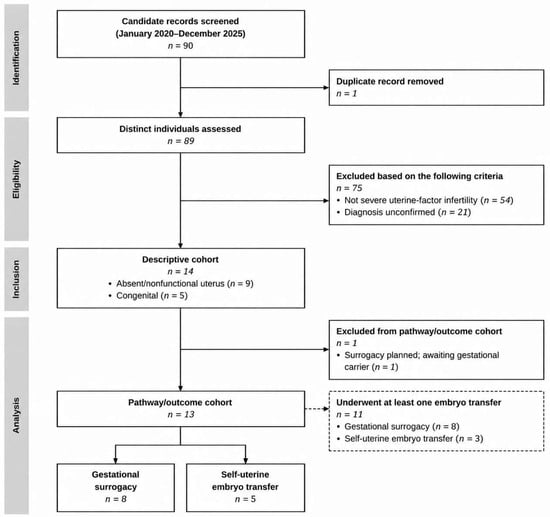
Of 90 records screened, one was a duplicate, leaving 89 unique patients. Seventy-five were excluded: 54 did not meet the study definition, and 21 had an unconfirmed uterine-factor diagnosis. The remaining 14 patients formed the descriptive cohort. Uterine phenotypes and management pathways were independently reviewed by two team members, with disagreements resolved by consensus.
Two reproductive management pathways were identified: self-uterine embryo transfer, defined as transfer into the patient’s own uterus, and gestational surrogacy. Under Vietnamese law, surrogacy is permitted only for humanitarian purposes, using embryos created from the intended mother’s oocytes and intended father’s sperm, with a relative of either partner serving as the gestational carrier [8,9,10]. Thus, embryos in both pathways originated from the intended couples, while pregnancies in the surrogacy pathway were carried by gestational carriers.
Three analytic populations were defined: the descriptive cohort (n = 14), the pathway/outcome cohort with available pathway-specific follow-up (n = 13), and the transfer-exposed subgroup with at least one embryo transfer (n = 11). One patient had completed oocyte retrieval and embryo creation but had not identified an eligible gestational carrier. This patient remained in the descriptive cohort but was excluded from pathway-specific reproductive outcomes. Baseline characteristics and laboratory outcomes were summarized for all 14 patients, while reproductive outcomes were assessed according to management pathway.
Clinical variables included age, body mass index (BMI), anti-Müllerian hormone (AMH), infertility duration, treatment year, uterine phenotype, and management pathway. Laboratory outcomes were summarized from one index IVF cycle per patient, defined as a cycle in which embryos suitable for transfer were obtained. Data from other cycles were not included.
All five patients in the self-uterine pathway underwent a GnRH antagonist protocol. Among nine patients planned for gestational surrogacy, six received an antagonist protocol, one a random-start protocol, and one a progestin-primed ovarian stimulation protocol. The stimulation protocol was unavailable for one patient whose embryos were created at another center and transported to Hung Vuong Hospital. All analyzed cycles used intracytoplasmic sperm injection (ICSI), without conventional IVF or preimplantation genetic testing. The indications for ICSI and the total number of stimulation cycles per patient were not documented.
Laboratory outcomes included retrieved oocytes, fertilization, cleavage-stage embryo development, blastocyst formation, and embryo quality. Embryo morphology was assessed according to the laboratory’s grading criteria informed by the ESHRE/ALPHA Istanbul Consensus 2011 [12]. Good-quality day-3 embryos were defined as Grade I embryos with 7-8 uniformly sized blastomeres and ≤10% fragmentation. Good-quality blastocysts were defined as Grade I blastocysts at expansion stages 3–6, with inner cell mass (ICM) and trophectoderm (TE) grades of AA, AB, or BA. Both day-5 and day-6 blastocysts were included.
All embryo transfers involved frozen blastocysts. For endometrial preparation, oral estradiol was started on cycle day 2 or 3, followed by vaginal progesterone when a trilaminar endometrium of 8–14 mm was achieved. Blastocyst transfer was performed on progesterone day 5 (P + 5).
Clinical pregnancy was defined by the presence of an intrauterine gestational sac, ongoing pregnancy by fetal cardiac activity beyond 12 weeks (according to institutional criteria), and live birth by delivery of a living infant at ≥22 weeks of gestation [13]. Outcomes were assessed up to the data cutoff of 1 September 2026. Patients who had not undergone embryo transfer were not considered treatment failures.
All analyses were descriptive. Continuous variables were summarized as median and interquartile range (IQR), and categorical variables as numbers and percentages with explicit denominators. No inferential testing or comparative effectiveness analysis between pathways was performed. Analyses were conducted using R software (version 4.6.1).
3. Results
3.1. Cohort Identification and Clinical Phenotype
Ninety source rows were screened, corresponding to 89 unique patient-level records after de-duplication. After eligibility review, 14 patients met the inclusion criteria and were included in the descriptive cohort. Thirteen patients were included in the pathway/outcome cohort. One patient with a nonfunctional uterus completed oocyte retrieval and embryo creation but had not initiated gestational surrogacy due to the lack of an eligible carrier by last follow-up. This patient was retained in the descriptive cohort as a relevant management outcome but was excluded from pathway-specific reproductive outcome analysis (Figure 1). Treatment years in the descriptive cohort ranged from 2020 to 2025, with the largest number of cases in 2024 (6/14, 42.9%).
Figure 1.
Flow diagram of cohort identification and analysis cohorts.
Baseline characteristics and phenotype distribution are shown in Table 1. Median age at treatment was 35.5 years (IQR, 32.2 to 37.8), median BMI was 21.55 kg/m2 (IQR, 20.20 to 23.75), median AMH was 3.36 ng/mL (IQR, 1.23 to 4.51), and median infertility duration was 36 months (IQR, 13.5 to 81).
Table 1.
Baseline characteristics and clinical phenotype of the included cohort.
Of the 14 patients, nine (64.3%) had an absent or nonfunctional uterus, including eight with prior hysterectomy and one with an infantile uterus. The remaining five (35.7%) had major congenital uterine anomalies with potential for self-uterine embryo transfer and gestation: one unicornuate uterus with a rudimentary horn, three septate or septate-type anomalies, and one uterus didelphys. Gestational surrogacy was planned for nine patients (64.3%), while five (35.7%) were planned for self-uterine embryo transfer.
3.2. ART Laboratory and Embryo-Development Outcomes
ART laboratory outcomes were summarized in Table 2. The median number of retrieved oocytes was 11 (IQR, 8.2 to 18.2), and the median number of oocytes used for ICSI was 9.5 (IQR, 5.8 to 17). The median number of fertilized oocytes was 9 (IQR, 5.8 to 16). Median embryo-development outcomes were 8.5 day-3 embryos (IQR, 5.8 to 15.2) and 4 blastocysts (IQR, 2 to 9).
Table 2.
ART laboratory and embryo development outcomes in the included cohort.
At the patient level, the median fertilization rate per injected oocyte was 94.8% (IQR, 90.9% to 100%), the median cleavage rate per fertilized oocyte was 100% (IQR, 100% to 100%), and the median blastocyst formation rate per day-3 embryo was 40% (IQR, 25% to 58.6%).
3.3. Reproductive Management Pathways and Patient-Level Outcomes
Patient-level management and reproductive outcomes are summarized in Table 3. Of the 13 patients in the pathway/outcome cohort, eight followed the gestational-surrogacy pathway and five the self-uterine pathway. Eleven patients (84.6%) underwent at least one embryo transfer, including all eight in the surrogacy pathway and three of five in the self-uterine pathway. Three patients did not achieve clinical pregnancy after embryo transfer: two after one transfer and one after two transfers. The remaining two patients in the self-uterine pathway had no documented return for embryo transfer.
Table 3.
Reproductive management and patient-level outcomes by management pathway.
Overall, 8/13 patients (61.5%) achieved clinical pregnancy, including three with one transfer attempt, three with two or three transfer attempts, and two with four or more transfer attempts. All eight reached ongoing pregnancy, resulting in five live births, two pregnancy losses, and one ongoing pregnancy at the 1 September 2026 data cutoff. The five deliveries occurred at 32–39 weeks, resulting in six live-born infants (Supplementary Table S2). Five patients had no documented pregnancy, including three with unsuccessful transfers and two without transfer.
In the self-uterine pathway, all three transfer-exposed patients achieved clinical pregnancy, resulting in two live births in patients with a unicornuate uterus with a rudimentary horn and a septate-type anomaly (twin delivery), and one ongoing pregnancy. In the surrogacy pathway, five of eight intended couples achieved clinical pregnancy, with three live births. All gestational carriers were parous, with a median age of 35 years (range, 28–42). Further details are provided in Supplementary Table S3.
4. Discussion
This retrospective case series describes ART management and reproductive outcomes in a small and heterogeneous cohort of women with severe uterine factor infertility. The findings highlight the importance of interpreting reproductive outcomes according to management pathway and actual embryo transfer exposure. Most patients had an absent or nonfunctional uterus and were managed through gestational surrogacy, whereas a smaller subgroup had major congenital structural uterine anomalies with retained potential for self-uterine embryo transfer. Within this selected cohort, oocyte retrieval and embryo development were generally adequate, providing useful context for distinguishing embryo creation potential from the capacity to carry a pregnancy.
The heterogeneity observed in this cohort is consistent with the broader literature on congenital uterine anomalies. The ASRM 2021 classification emphasizes that Müllerian anomalies comprise anatomically distinct conditions with different clinical implications [3]. Systematic reviews have likewise shown that reproductive and ART outcomes vary according to anomaly type [5,14]. Additional literature has highlighted the heterogeneous reproductive and perinatal implications of congenital uterine anomalies and the importance of appropriate uterine-cavity assessment in infertility [15,16]. Accordingly, the congenital anomalies in our cohort were considered distinct from an absent or nonfunctional uterus rather than different degrees of the same condition. The successful pregnancies observed in the three transfer-exposed, self-uterine patients demonstrate feasibility in selected cases but should not be generalized to congenital uterine anomalies as a whole.
The laboratory findings provide additional clinical context. The number of oocytes retrieved, fertilization, and blastocyst development were achievable in many patients in this cohort, including those with an absent or nonfunctional uterus. For some patients, the principal reproductive barrier may therefore lie in the capacity to carry a pregnancy rather than in embryo creation itself. Similar considerations arise in absolute uterine factor infertility and MRKH syndrome, in which embryo creation is required before gestational surrogacy or uterus transplantation can be considered [2,6]. However, these findings are descriptive and should not be interpreted as evidence that severe uterine factor infertility is associated with preserved ovarian or embryo-development potential.
A distinctive feature of this cohort is the legal and practical context of humanitarian gestational surrogacy in Viet Nam. Vietnamese law requires embryos to be generated from the intended parents’ gametes and the gestational carrier to be a relative of either partner [8,9,10]. Similar difficulties in identifying an eligible relative have been reported among Vietnamese women with MRKH syndrome [11]. In our cohort, one patient had completed oocyte retrieval and embryo creation but had not proceeded to surrogacy by the data cutoff because no eligible carrier had been identified, illustrating how legal and practical constraints may delay treatment despite embryo availability.
The self-uterine findings suggest that embryo transfer may be feasible in selected women who retain the potential to carry a pregnancy. Their interpretation, however, depends on actual transfer exposure, because patients who had not yet undergone embryo transfer should not be grouped with those who underwent transfer without achieving pregnancy. This distinction is particularly important in a small and heterogeneous cohort.
Gestational-surrogacy outcomes require a different interpretation because implantation and gestation occur in the gestational carrier rather than the intended mother. Accordingly, these outcomes reflect the reproductive outcomes of the intended couple and the gestational-surrogacy pathway, not the uterine function of the intended mother. Published data suggest that gestational surrogacy can achieve favorable reproductive outcomes, although these outcomes are influenced by carrier and transfer characteristics [17]. Because treatment exposure varied across patients, reproductive outcomes were interpreted according to actual embryo transfer exposure rather than pathway assignment alone.
Several limitations should be considered. This small, single-center retrospective case series had incomplete records for some diagnostic and treatment details. Previous septal resection could not be verified; therefore, outcomes should not be interpreted as those of untreated septate uteri. Stimulation protocols were heterogeneous, and the total number of ovarian-stimulation cycles could not be reconstructed. Intermittent clinical follow-up prevented reliable estimation of overall follow-up duration. Although gestational-carrier age and parity were available, other carrier and transfer characteristics could not be retrieved. Selecting the index IVF cycle based on the availability of transferable embryos may also have introduced selection bias. Given these limitations, the findings remain descriptive and do not support conclusions about comparative effectiveness between pathways.
Despite the limitations, this case series provides a practical view of ART management in women with severe uterine factor infertility. Reproductive planning should be guided by the patient’s uterine function and the feasibility of carrying a pregnancy. Self-uterine embryo transfer may be considered in selected women with a potentially functional uterus, whereas gestational surrogacy may provide an alternative for women with an absent or nonfunctional uterus where it is legally and clinically available. These findings are descriptive and should not be interpreted as evidence that one management pathway is superior to another.
5. Conclusions
In conclusion, this single-center case series highlights the importance of individualized ART planning for women with severe uterine factor infertility. Although embryo creation was possible in many patients, reproductive outcomes should be interpreted according to the type of uterine abnormality, treatment approach, and whether embryo transfer was performed. Reporting outcomes for individual patients, with clearly defined denominators, may help guide clinical counseling and future multicenter studies in this rare population.
Supplementary Materials
The following supporting information can be downloaded at https://www.mdpi.com/article/10.3390/reprodmed7040066/s1, Supplementary Table S1: Case-level clinical and management profile of the included cohort; Supplementary Table S2: Case-level transfer exposure and reproductive outcomes in the pathway/outcome cohort; Supplementary Table S3: Descriptive outcomes by reproductive management pathway.
Author Contributions
Conceptualization: H.P.T. and N.T.T. Methodology: H.P.T. Data curation: N.T.T., L.Y.T.D., L.T.L. and H.P.T. Formal analysis: H.P.T. Investigation: N.T.T. and L.T.L. Writing—original draft: H.P.T. Writing—review and editing: all authors. All authors have read and agreed to the published version of the manuscript.
Funding
No funding was received for this study.
Institutional Review Board Statement
The study received scientific and ethical approval from the Institutional Review Board of Hung Vuong Hospital (IRB-VN02.020; protocol No. CB/HV/26/01). Approval date: 11 August 2026.
Informed Consent Statement
Patient consent was waived by the Institutional Review Board of Hung Vuong Hospital because of the retrospective nature of the study and the use of existing clinical data. All patient data were de-identified prior to analysis to protect patient confidentiality.
Data Availability Statement
Data analyzed during the study are not publicly available because of the small and rare cohort. De-identified data may be available from the corresponding author upon reasonable request, subject to institutional and privacy requirements.
Acknowledgments
During the preparation of this manuscript, the authors used AI-assisted language editing tool—Chat-GPT (OpenAI, GPT-6), to improve the clarity, grammar, and consistency of the text. The authors reviewed and edited all AI-assisted output and take full responsibility for the content of the final manuscript.
Conflicts of Interest
The authors declare no conflicts of interest.
References
- Hur, C.; Rehmer, J.; Flyckt, R.; Falcone, T. Uterine factor infertility: A clinical review. Clin. Obstet. Gynecol. 2019, 62, 257–270. [Google Scholar] [CrossRef] [Scilit]
- Jones, B.P.; Ranaei-Zamani, N.; Vali, S.; Williams, N.; Saso, S.; Thum, M.; Al-Memar, M.; Dixon, N.; Rose, G.; Testa, G.; et al. Options for acquiring motherhood in absolute uterine factor infertility; adoption, surrogacy and uterine transplantation. Obstet. Gynaecol. 2021, 23, 138–147. [Google Scholar] [CrossRef] [Scilit]
- Pfeifer, S.M.; Attaran, M.; Goldstein, J.; Lindheim, S.R.; Petrozza, J.C.; Rackow, B.W.; Siegelman, E.; Troiano, R.; Winter, T.; Zuckerman, A.; et al. ASRM müllerian anomalies classification 2021. Fertil. Steril. 2021, 116, 1238–1252, Correction in Fertil. Steril. 2023, 119, 1088. [Google Scholar] [CrossRef] [Scilit]
- Grimbizis, G.F.; Gordts, S.; Di Spiezio Sardo, A.; Brucker, S.; De Angelis, C.; Gergolet, M.; Li, T.-C.; Tanos, V.; Brölmann, H.; Gianaroli, L.; et al. The ESHRE/ESGE consensus on the classification of female genital tract congenital anomalies. Hum. Reprod. 2013, 28, 2032–2044. [Google Scholar] [CrossRef] [Scilit]
- Fedele, F.; Bulfoni, A.; Parazzini, F.; Levi-Setti, P.E.; Busnelli, A. Assisted reproductive technology outcomes in women with congenital uterine anomalies: A systematic review. Arch. Gynecol. Obstet. 2024, 310, 2315–2332. [Google Scholar] [CrossRef] [Scilit]
- Friedler, S.; Grin, L.; Liberti, G.; Saar-Ryss, B.; Rabinson, Y.; Meltzer, S. The reproductive potential of patients with Mayer-Rokitansky-Küster-Hauser syndrome using gestational surrogacy: A systematic review. Reprod. BioMed. Online 2016, 32, 54–61. [Google Scholar] [CrossRef] [Scilit]
- Herlin, M.K.; Petersen, M.B.; Brännström, M. Mayer-Rokitansky-Küster-Hauser (MRKH) syndrome: A comprehensive update. Orphanet J. Rare Dis. 2020, 15, 214. [Google Scholar] [CrossRef] [Scilit]
- National Assembly of the Socialist Republic of Vietnam. Law on Marriage and Family; No. 52/2014/QH13; National Assembly: Hanoi, Vietnam, 2014. [Google Scholar]
- Government of the Socialist Republic of Vietnam. Decree No. 10/2015/ND-CP Detailing the Implementation of Childbirth by In Vitro Fertilization and Conditions for Altruistic Gestational Surrogacy; Government of Vietnam: Hanoi, Vietnam, 2015.
- Government of the Socialist Republic of Vietnam. Decree No. 207/2025/ND-CP on Giving Birth with Assisted Reproductive technology and Conditions for Altruistic Gestational Surrogacy; Government of Vietnam: Hanoi, Vietnam, 2025.
- Le, T.T.Q.; Le, N.T.H.; Vu, T.A.; Nguyen, H.H.; Vuong, L.N. Perception of having children through surrogacy in individuals with MRKH in Vietnam: A qualitative study. Front. Psychol. 2024, 15, 1372405. [Google Scholar] [CrossRef] [Scilit]
- Alpha Scientists in Reproductive Medicine and ESHRE Special Interest Group of Embryology. The Istanbul consensus workshop on embryo assessment: Proceedings of an expert meeting. Hum. Reprod. 2011, 26, 1270–1283. [Google Scholar] [CrossRef] [Scilit]
- Zegers-Hochschild, F.; Adamson, G.D.; Dyer, S.; Racowsky, C.; de Mouzon, J.; Sokol, R.; Rienzi, L.; Sunde, A.; Schmidt, L.; Cooke, I.D.; et al. The International Glossary on Infertility and Fertility Care, 2017. Fertil. Steril. 2017, 108, 393–406. [Google Scholar] [CrossRef] [Scilit]
- Chan, Y.Y.; Jayaprakasan, K.; Tan, A.; Thornton, J.G.; Coomarasamy, A.; Raine-Fenning, N.J. Reproductive outcomes in women with congenital uterine anomalies: A systematic review. Ultrasound Obstet. Gynecol. 2011, 38, 371–382. [Google Scholar] [CrossRef] [Scilit]
- Genovese, F.; Di Guardo, F.; Monteleone, M.M.; D’Urso, V.; Colaleo, F.M.; Leanza, V.; Palumbo, M. Hysteroscopy as An Investigational Operative Procedure in Primary and Secondary Infertility: A Systematic Review. Int. J. Fertil. Steril. 2021, 15, 80–87. [Google Scholar] [CrossRef] [Scilit]
- Zambrotta, E.; Di Gregorio, L.M.; Di Guardo, F.; Agliozzo, R.; Maugeri, G.C.; Gulino, F.A.; Cutello, S.; Cerana, M.C.; Palumbo, M. Congenital uterine anomalies and perinatal outcomes: A retrospective single-center cohort study. Clin. Exp. Obstet. Gynecol. 2021, 48, 160–163. [Google Scholar] [CrossRef] [Scilit]
- Perkins, K.M.; Boulet, S.L.; Jamieson, D.J.; Kissin, D.M. National Assisted Reproductive Technology Surveillance System (NASS) Group. Trends and outcomes of gestational surrogacy in the United States. Fertil. Steril. 2016, 106, 435–442.e2. [Google Scholar] [CrossRef] [Scilit]

Disclaimer/Publisher’s Note: The statements, opinions and data contained in all publications are solely those of the individual author(s) and contributor(s) and not of MDPI and/or the editor(s). MDPI and/or the editor(s) disclaim responsibility for any injury to people or property resulting from any ideas, methods, instructions or products referred to in the content. |
© 2026 by the authors. Licensee MDPI, Basel, Switzerland. This article is an open access article distributed under the terms and conditions of the Creative Commons Attribution (CC BY) license.