


Abstract
Background: Unhealthy alcohol use may lead to arrhythmia and cardiomyopathy, but its impact on sudden death is not well understood. Objective: To investigate the association of unhealthy alcohol use with sudden death. Methods: We conducted a case-control study in Wake County, a large (~1 million inhabitants), diverse county in North Carolina. We screened and adjudicated victims of sudden, unexpected, out-of-hospital deaths in adults aged 18–64 years reported by emergency medical services between 2013 and 2015. We randomly selected sex- and age-matched control patients from a university health system from the same county and time period. Characteristics of sudden death victims and controls were ascertained via standardized chart reviews. Unhealthy alcohol use was identified via chart review and was defined as any evidence of excessive alcohol use, such as it being stated in the social history or medical history, alcohol abuse being listed as a possible contributor to death, or alcohol-related diagnoses. We used logistic regression to estimate odds ratios (ORs) for the association of unhealthy alcohol use and sudden death, adjusting for age, sex, race, and other psychiatric diagnoses, including depression, anxiety, schizophrenia, bipolar disorder, and substance use disorders other than tobacco and alcohol. We also calculated the E-value to estimate the impact of any unmeasured confounders. Results: We identified 399 sudden death victims, of whom 374 (94%) had alcohol use data available. Among these 374 included victims, 256 (68%) were male, and 239 (62%) were White, with a median age at death of 55 years (IQR 48, 60). The demographic characteristics of the 1114 matched controls were similar to those of sudden death victims. Unhealthy alcohol use was present in 115 (31%) sudden death victims and 27 (2%) controls. In analyses adjusted for demographics only, unhealthy alcohol use was associated with a higher incidence of sudden death, with an OR of 17.5 (95% CI 11.4, 27.8). When further adjusted for other psychiatric diagnoses, the OR was 11.2 (95% CI 7.1, 18.0). The calculated E-value was 21.8, meaning an unmeasured confounder would need to be associated with both unhealthy alcohol use and sudden death by 21.8-fold to explain away the observed OR. Conclusions: Unhealthy alcohol use was strongly associated with higher sudden death risk in working-age adults. Our calculated E-value indicates it is unlikely that any unmeasured confounders alone would account for the observed association. Our findings suggest that interventions to reduce unhealthy alcohol use may be an effective strategy to prevent sudden death in working-age adults.
1. Introduction
Sudden death is variously defined and poorly understood. Sudden death is defined as an unexpected and nontraumatic death that occurs within an hour of new or worsening symptoms if witnessed and within 24 h of last being seen alive if unwitnessed [1,2]. On the other hand, sudden cardiac death is defined as an unexpected death within an hour of the onset of symptoms from specifically a cardiovascular cause [3]. Factors that have been shown to increase the risk of sudden cardiac death include left ventricular hypertrophy [4], poor diet [5], and tobacco use [6]. Our study focuses on sudden death broadly, not specifically sudden cardiac death.
While it is assumed that sudden death cases are significantly underreported [7], the incidence of sudden death is still an immensely common cause of death worldwide—estimated to be greater than 300,000 annually in the United States alone [8,9]. This syndrome tends to be very difficult to prevent due to victims not having known previous heart disease or meeting high-risk criteria [10,11]. However, with advancements in prevention, treatment, and management, such as implantable cardioverters, the incidence has been decreasing [2]. It has been found that certain diagnoses are associated with a higher incidence of sudden death, such as arrhythmias, hypertension, and cardiomyopathy [2,12]. Due to its unpredictability, it is difficult to fully understand why sudden death occurs and what causes it. The burden of this syndrome is prominent, and yet it is still largely understudied and not well understood.
Unhealthy alcohol use has become increasingly prevalent in the United States [13], with some labeling it as a public health crisis [14]. Binge drinking is becoming a predominant health risk as well [15]. It has been found to be the eighth leading cause of death and the fourth leading cause of decreased quality of life in the United States [16]. For males, heavy drinking is defined as greater than 14 drinks a week, and binge drinking is defined as greater than 5 drinks in one sitting. For females, heavy drinking is defined as greater than eight drinks a week, and binge drinking is defined as greater than four drinks in one sitting [17]. Both heavy drinking and binge drinking are considered detrimental to the heart [15,18,19,20,21,22,23,24,25]. Acutely, alcohol consumption is associated with arrhythmias, most commonly atrial fibrillation [19,20,21,24]. Chronically, unhealthy alcohol use, including both heavy drinking and binge drinking, can lead to hypertension and dilated cardiomyopathy [15,20,21,22,23,24,25,26]. Binge drinking, in particular, has the highest association with hypertension [15], while dilated and hypertrophic cardiomyopathies are the second largest contributors to developing a lethal arrhythmia [24,26]. Interestingly, studies have found that sudden death occurs regardless of ischemic heart disease when alcohol is involved [20]. Furthermore, there is insufficient evidence to show that any alcohol use is cardioprotective; however, unhealthy alcohol use is related to increased cardiovascular risk, including sudden death [27,28]. Unhealthy alcohol use has also been related to other mental health diagnoses, such as anxiety, depression, and other substance use disorders [16,29].
Recognizing that most studies have found that the risk of sudden death is correlated with arrhythmogenic effects, and understanding that unhealthy alcohol use can lead to arrhythmias, it is important to understand and further quantify this association. In this study, we evaluated whether unhealthy alcohol use was associated with sudden death in Wake County, North Carolina (NC).
2. Subjects and Methods
2.1. Study Design and Population
We conducted a case-control study in Wake County, NC. Wake is a large county in NC with approximately 1 million inhabitants and includes the state capital of Raleigh. Our study design and procedures have been previously published [7]. This study was reviewed and approved by the institutional review board of the University of North Carolina at Chapel Hill (IRB no. 14-2036).
Briefly, to identify cases of sudden death, we queried the emergency medical services (EMS) reporting software of Wake County, North Carolina, for EMS-attended cases between 2013 and 2015 that resulted in death. Our initial query was for out-of-hospital deaths that contained an impression of cardiac arrest or obvious death or traumatic circulatory arrest, or if resuscitation was attempted. Of these, we then excluded those who survived; those who were over 65 years or under 18 years of age; expected deaths such as a patient on hospice, a patient who was not free living, such as living in a skilled nursing facility or incarcerated, or death due to an obvious non-cardiac cause such as trauma or suicide; or the patient was not a resident of North Carolina.
Using postmortem medical records from the North Carolina Office of the Chief Medical Examiner, which included the medical examiner’s external examination, toxicology report, and autopsy reports, we further excluded nonnatural deaths, such as trauma, drug overdose, and terminal illnesses. For remaining cases, we contacted local hospitals and health care providers to obtain clinical records up to 5 years before death. Three cardiologists reviewed clinical records and adjudicated sudden unexpected deaths, defined as having circumstances prior to death that suggested an abrupt pulseless condition, in the absence of terminal illnesses, trauma, drug overdose, and other nonnatural deaths. We also excluded cases with positive toxicology, such as a positive drug screen. Overall, 1592 EMS-attended out-of-hospital deaths from 2013 to 2015 in Wake County, North Carolina, were identified, and of those, 399 cases were adjudicated to be sudden deaths.
Controls for this study were selected by randomly sampling patients from the Carolina Data Warehouse for Health (CDW). The CDW contains health records from 18 hospitals within the University of North Carolina (UNC) Health system. Inclusion criteria were adults aged 18 to 65 who had a medical encounter between 2013 and 2015 at UNC hospitals or clinics. Exclusion criteria were if patients lived in or were discharged to an institution, if the primary reason for the visit was due to pregnancy in order to avoid increased numbers of young women, or if they lived outside of Wake County. Controls were frequency-matched by age and gender to cases.
2.2. Study Measures
Variables were preselected and operationally defined prior to chart review. Chart review for both victims and controls was carried out by trained personnel to identify each variable. Adjudication resolved any conflicts between ascertainment of variables, and a ten percent resample was taken to verify consistency with re-abstraction if necessary. Unhealthy alcohol use was defined as having any evidence of excessive alcohol use, such as it being stated in the social history or medical history, or unhealthy alcohol use being listed as a possible contributor to death, or alcohol-related diagnoses within the standardized chart reviews, such as alcohol-induced hepatitis, cirrhosis of the liver, and delirium tremens.
Demographic data, including age, sex, and race, were imported from cross-matched electronic death certificates. Data on chronic medical conditions were ascertained from medical records and medical examiner’s reports, as described elsewhere [7]. Other mental health conditions included depression, anxiety, schizophrenia, bipolar disorder, and substance use disorders other than tobacco or alcohol. Error checking for concordance and accuracy was included in the quality assurance of the abstractions as outlined previously [30].
2.3. Statistical Analysis
Descriptive statistics were calculated for demographic variables, unhealthy alcohol use, and other mental health illness diagnoses. We fitted a multivariable logistic regression to estimate the association between covariates and the binary outcome of sudden death. We used logistic regression to estimate odds ratios (ORs) and 95% confidence intervals (CIs) for the association of unhealthy alcohol use and sudden death, adjusting for age, sex, and race. We then did a further regression analysis to include the presence of any other mental illness diagnoses. In addition, we ran a separate sensitivity analysis adding a quadratic age term to both models due to the age difference found between our two cohorts. Unmeasured confounding was assessed using the E-value [31] for any unmeasured confounders for heart disease that could not be ascertained through standardized chart review. All statistical analyses were performed in R version 4.4.2 [32] with the readxl [33] and epitools [34] packages (Vienna, Austria).
3. Results
Of 399 sudden death victims, 374 (94%) had alcohol use data available and were included in this study. Demographic and lifestyle characteristics are presented in Table 1. Among these 374 included victims, 256 (68%) were male, and 239 (62%) were White, with a median age at death of 55 years (interquartile range [IQR] 48, 60). The demographic characteristics of the 1114 matched controls were similar to those of sudden death victims.
Table 1.
Demographic and clinical characteristics among sudden death victims and controls, Wake County, NC, 2013–2015.
The other psychiatric illnesses included other substance use disorders besides tobacco and alcohol, depression, anxiety, schizophrenia, and bipolar disorder. Of these diagnoses, depression (32%) and other substance use disorder (22%) had the highest prevalence. The majority of this cohort had no other psychiatric diagnosis (51%).
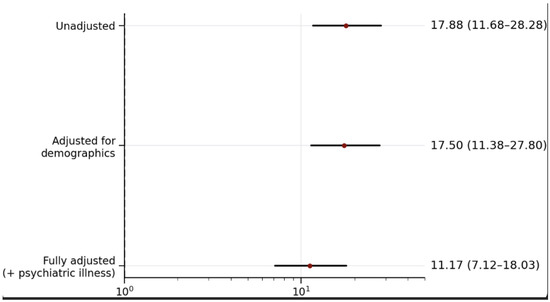
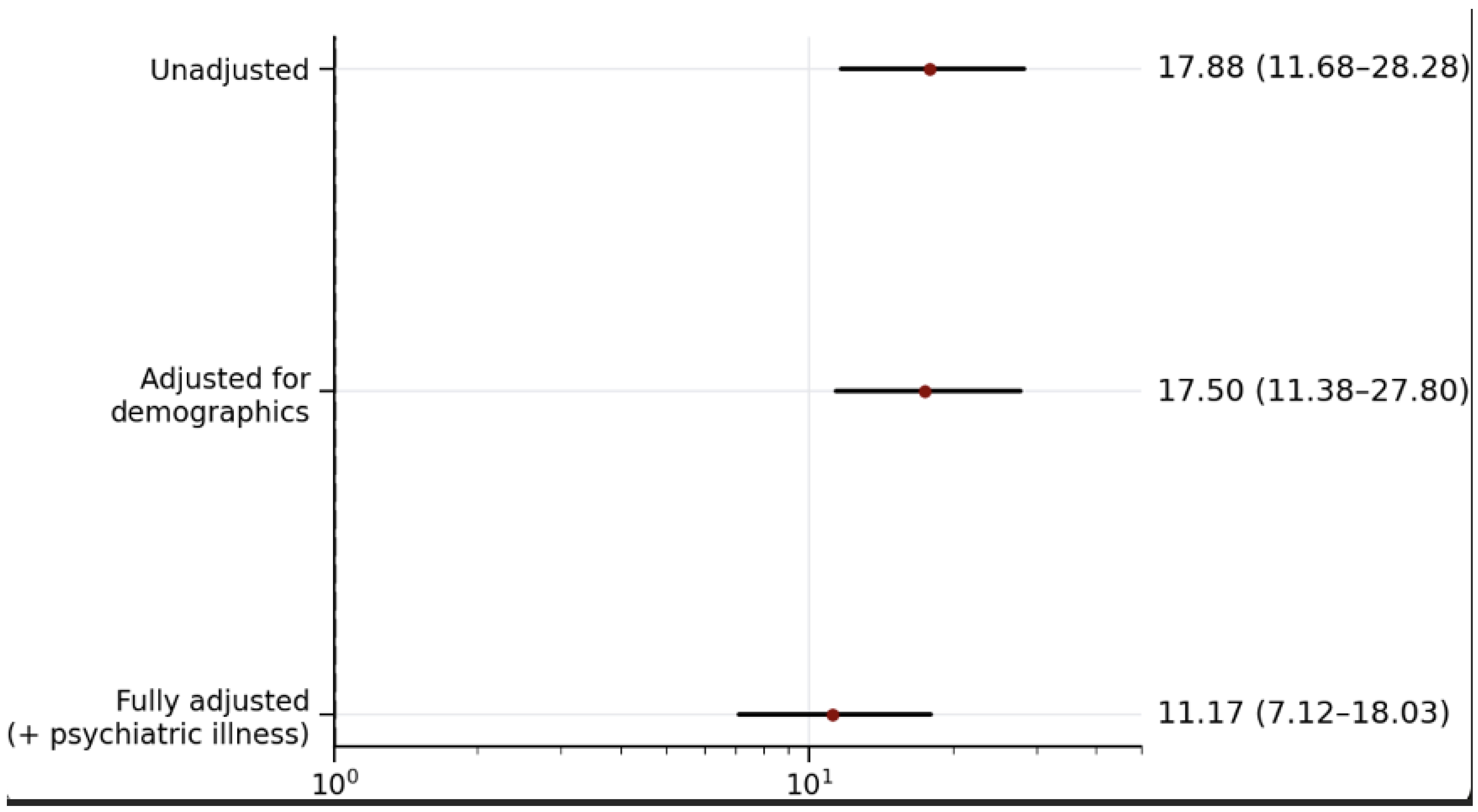
Unhealthy alcohol use was present in 115 (31%) sudden death victims and 27 (2%) controls. Unadjusted and adjusted analyses are shown in Table 2 and Figure 1. In analyses adjusted for demographics only, unhealthy alcohol use was associated with a higher incidence of sudden death, with an OR of 17.5 (95% CI 11.4, 27.8). When further adjusted for other psychiatric diagnoses, the OR was 11.2 (95% CI 7.1, 18.0). For the difference in age between our two cohorts, we ran a separate sensitivity analysis adding a quadratic age term to both models and obtained the following results: the OR for unhealthy alcohol use changed from 17.50 to 16.84 (CI: 10.89, 26.94) in the demographics-only model, and from 11.17 to 10.85 (CI: 6.89, 17.62) in the fully adjusted model. The quadratic term did significantly improve overall model fit, confirming that age has a nonlinear relationship with sudden death risk. Therefore, the nonlinear age effect was not meaningfully confounding the primary association. The calculated E-value was 21.8, meaning an unmeasured confounder would need to be associated with both unhealthy alcohol use and sudden death by 21.8-fold to explain away the observed OR.
Table 2.
Odds ratios and 95% confidence intervals for the association between unhealthy alcohol use and sudden death in Wake County, NC, 2013–2015.
Figure 1.
Odds ratios and 95% confidence intervals for the association between unhealthy alcohol use and sudden death in Wake County, NC, 2013–2015.
4. Discussion
In this case-control study, we found that unhealthy alcohol use is associated with a higher risk of sudden death. This association persisted after controlling for demographic data as well as other mental illness diagnoses. E-value data suggests it is very unlikely that an unmeasured confounder would make our results insignificant; however, we recognize that confounders always have the ability to remove an association, and this remains a possibility. This outcome supports existing evidence that alcohol may contribute to the development or initiation of fatal cardiac events. Whitman et al. found similar results from their study in California that associated unhealthy alcohol use with increased rates of atrial fibrillation, myocardial infarction, and congestive heart failure without a history of cardiac disease [35]. Sutanto et al. investigated the effect of alcohol consumption on arrhythmias. They found acute excessive alcohol consumption has concentration-dependent electrophysiologic effects on the heart, with increased ethanol concentrations leading to more severe and sustained arrhythmias [36]. Severe and sustained arrhythmias can lead to sudden death, so this study further describes a possible pathway between alcohol use and sudden death.
A separate study using this cohort of patients found that most sudden death victims had a mental health diagnosis or a substance-related diagnosis within 5 years of their death [37]. For this reason and with the understanding that unhealthy alcohol use is related to other mental health diagnoses [16,29], we wanted to investigate the possibility that this may be a confounder in our data. Adjusting for other mental health diagnoses within our cohort did not remove our association between unhealthy alcohol use and sudden death, so we do not feel this variable affects our outcomes.
Previous studies have attempted to link sudden death to unhealthy alcohol use, but few, if any, have made this connection using patients from the United States. Similar to our results, other studies investigating the relationship of unhealthy alcohol use and sudden death have found an increased risk of sudden death in this patient cohort. In Europe, studies have shown that heavy alcohol drinkers have a greater than 60% risk of suffering from sudden death when compared with occasional or light drinkers [25] and that sudden death did not have a strong association with ischemic heart disease in unhealthy alcohol use victims [19]. Moreover, in patients with dilated cardiomyopathy, there is a higher prevalence of sudden death [10]. Many European studies have found a connection between unhealthy alcohol use and sudden death [18,19,21,24,25,38,39]. Tonelo et al. found that these effects not only happen in those who chronically drink heavily, but they also happen to non-alcoholics who binge drink, coining the name “holiday heart syndrome”. This is important for patients who have certain risk factors, like known arrhythmias or hypertension, to know so they can understand the increased risk for sudden death [24]. Wu et al. found that in Taiwan, those with unhealthy alcohol use had a substantially higher sudden death mortality than the general population. They further discovered that those with unhealthy alcohol use and abnormal electrocardiograms or elevated aspartate aminotransferase levels, a liver enzyme, also had a significant association with sudden death [40]. Most studies we have found, including our own, demonstrate that unhealthy alcohol use and sudden death likely have a strong association across multiple populations.
It is important to note that studies regarding alcohol use and effects on the heart are observational. However, the American Heart Association (AHA) still notes that unhealthy alcohol use is consistently related to poorer outcomes regarding cardiovascular disease [28], and the AHA/American College of Cardiology (ACC) state that data are insufficient to state alcohol is cardioprotective, and to minimize overall harm, people should minimize alcohol intake [41]. Therefore, anyone who falls into this category should be counseled of this possibility.
Strengths of this study include having a large sample size in a diverse county of NC. Moreover, having case-matched controls for comparison between groups allows us to specifically address risk factors of sudden death. To our knowledge, not many cohorts exist specifically for unhealthy alcohol use in sudden death victims within the United States, which makes this study unique. In such a common yet largely understudied syndrome, addressing and analyzing risk factors is hugely important to increase awareness and decrease its impact.
5. Limitations
For any dataset relying on chart review, there is always the possibility that the medical record does not accurately provide all the information desired. Limitations to this study include being unable to explicitly adjust for smoking data, as well as other possible unmeasured lifestyle factors such as socioeconomic status, sleep, physical activity, and diet, which could potentially alter the association we found between unhealthy alcohol use and sudden death. However, our calculated E-value of 21.8 demonstrates that any unmeasured confounder would need to be associated with both unhealthy alcohol use and sudden death by almost 22-fold in order to explain away our association. Considering this value, we remain confident that our results show a significant association between unhealthy alcohol use and sudden death. Due to the variability in the definition of sudden death, there is potential for some misclassification within our victim cohort. Another limitation is the inherent underreporting of alcohol use in the medical chart. This might be from the variability in the definition of what unhealthy alcohol use is, due to the societal belief that drinking alcohol is normal and therefore not an issue in that person’s life, or perceived shame that would prevent a patient from disclosing accurate alcohol consumption habits. This limitation is one that may make our reported odds ratio stronger but would not take away the association. Therefore, we can possibly assume that the true odds ratio is stronger than the one we have reported in this study. In order to capture all appropriate individuals, we searched for a specific mention of unhealthy alcohol use or alcohol-related diagnoses within the medical chart; however, this variety in diagnosis could potentially be considered a further limitation. In addition, while the SUDDEN project is an age-matched study, our subset of data showed a difference in the ages of those with unhealthy alcohol use compared with those in the control group. However, after running a separate sensitivity analysis adding a quadratic age term to both models, we found that the quadratic term did significantly improve overall model fit, confirming that age has a nonlinear relationship with sudden death risk. Therefore, the nonlinear age effect was not meaningfully confounding the primary association. This study was also completed within one county in North Carolina, and although this county is very diverse, we acknowledge that our results may not be fully generalizable to the general population. Furthermore, our study did not include children, adults above age 64, incarcerated individuals, individuals in nursing homes, and those who were transported to an emergency department. Therefore, our results cannot be extended to these patient populations.
6. Conclusions
Our study shows that unhealthy alcohol use is significantly associated with sudden death. To our knowledge, this study is unique within the United States, and not many studies exist looking at this relationship. Alcohol use is a modifiable risk factor, and therefore the awareness that it has a high association with sudden death is very important. Working-age adults with unhealthy alcohol use, especially those at higher cardiovascular risk, should receive interventions to reduce alcohol use to prevent sudden death.
Author Contributions
Conceptualization, S.P.; methodology, S.P., J.B. and R.S.; software, S.P., J.B., R.S. and S.W.; validation, S.P., J.B., R.S., S.W. and T.D.-M.; formal analysis, S.P., S.W. and T.D.-M.; investigation, S.P., J.B., R.S., S.W., T.D.-M. and A.K.; resources, S.P., J.B. and R.S.; data curation, S.P., S.W. and T.D.-M.; writing—original draft preparation, S.P.; writing—review and editing, S.P., J.B., R.S., T.D.-M., A.K. and R.J.S.J.; visualization, S.P., J.B., R.S. and T.D.-M.; supervision, T.D.-M., A.K. and R.J.S.J.; project administration, S.P. and T.D.-M.; funding acquisition, R.J.S.J. All authors have read and agreed to the published version of the manuscript.
Funding
The SUDDEN project is funded by individual, private donations, the Heart and Vascular Division of the University of North Carolina at Chapel Hill, and the McAllister Heart Institute. The project described was supported by the National Center for Advancing Translational Sciences (NCATS), National Institutes of Health, through Grant Award Number UL1TR002489.
Institutional Review Board Statement
The study was conducted in accordance with the Declaration of Helsinki, approved by the Institutional Review Board of the University of North Carolina and reviewed yearly, IRB no. 14-2036. The Wake County EMS Data System supports, maintains, and monitors EMS service delivery, patient care, and disaster preparedness for the Wake County, NC, community at large. This manuscript has been reviewed by Wake County EMS Data System investigators for scientific content and consistency of data interpretation with previous Wake County EMS Data System publications.
Informed Consent Statement
The SUDDEN project was initially reviewed by the University of North Carolina Institutional Review Board (#13-2445) and was found that no consent was required, as it was deemed to be low risk with appropriate safeguards for confidentiality. A subsequent revision (14-2036) was reviewed and approved with a waiver of consent as the study is observational, involves minimal risk, cannot be done otherwise, and appropriate safeguards to protect confidentiality are in place. The study is reviewed yearly and approved as written, with the most recent review and approval on 26 January 2026.
Data Availability Statement
The data presented in this study are available on request from the corresponding author due to institution-specific IRB and RedCap access.
Acknowledgments
The first author would like to dedicate this work to her father, whose memory continues to motivate her commitment to improving our understanding of sudden death.
Conflicts of Interest
Ross J. Simpson, Jr. has served as a consultant for Amgen, Merck, Pfizer, CEROBS, and ISS. He is currently the UNC site Principal Investigator for an Amgen-sponsored observational research project. All remaining authors declare that they do not have a conflict of interest.
References
- Kuriachan, V.P.; Sumner, G.L.; Mitchell, L.B. Sudden cardiac death. Curr. Probl. Cardiol. 2015, 40, 133–200. [Google Scholar] [CrossRef] [Scilit] [PubMed]
- Kumar, A.; Avishay, D.M.; Jones, C.R.; Shaikh, J.D.; Kaur, R.; Aljadah, M.; Kichloo, A.; Shiwalkar, N.; Keshavamurthy, S. Sudden cardiac death: Epidemiology, pathogenesis and management. Rev. Cardiovasc. Med. 2021, 22, 147–158. [Google Scholar] [CrossRef] [Scilit] [PubMed]
- Jaiswal, V.; Kumar, D.; Mashkoor, Y.; Latif, F.; Kanagala, S.G.; Halder, A.; Jaiswal, A.; Bandyopadhyay, D.; Hajra, A.; Joshi, A.; et al. Demographics and Trends of Sudden Cardiac Death-Related Mortality in the United States, 1999 to 2022. J. Am. Heart Assoc. 2025, 14, e040340. [Google Scholar] [PubMed]
- Rappazzo, K.M.; Egerstrom, N.M.; Wu, J.; Capone, A.B.; Joodi, G.; Keen, S.; Cascio, W.E.; Simpson, R.J., Jr. Fine particulate matter-sudden death association modified by ventricular hypertrophy and inflammation: A case-crossover study. Front. Public Health 2024, 12, 1367416. [Google Scholar] [PubMed]
- Shikany, J.M.; Safford, M.M.; Soroka, O.; Brown, T.M.; Newby, P.K.; Durant, R.W.; Judd, S.E. Mediterranean Diet Score, Dietary Patterns, and Risk of Sudden Cardiac Death in the REGARDS Study. J. Am. Heart Assoc. 2021, 10, e019158. [Google Scholar] [CrossRef] [Scilit] [PubMed]
- Aune, D.; Schlesinger, S.; Norat, T.; Riboli, E. Tobacco smoking and the risk of sudden cardiac death: A systematic review and meta-analysis of prospective studies. Eur. J. Epidemiol. 2018, 33, 509–521. [Google Scholar] [CrossRef] [Scilit] [PubMed]
- Nanavati, P.P.; Mounsey, J.P.; Pursell, I.W.; Simpson, R.J., Jr.; Lewis, M.E.; Mehta, N.D.; Williams, J.G.; Bachman, M.W.; Myers, J.B.; Chung, E.H. Sudden Unexpected Death in North Carolina (SUDDEN): Methodology review and screening results. Open Heart 2014, 1, e000150. [Google Scholar] [CrossRef] [Scilit]
- Sumner, G.L.; Kuriachan, V.P.; Mitchell, L.B. Sudden Cardiac Death. In Encyclopedia of Cardiovascular Research and Medicine; Elsevier: Amsterdam, The Netherlands, 2018; pp. 511–520. [Google Scholar]
- Bayes de Luna, A.; Elosua, R. Sudden death. Rev. Esp. Cardiol. (Engl. Ed.) 2012, 65, 1039–1052. [Google Scholar] [CrossRef] [Scilit] [PubMed]
- Estes, N.A., 3rd. Predicting and preventing sudden cardiac death. Circulation 2011, 124, 651–656. [Google Scholar] [CrossRef] [Scilit] [PubMed]
- Adabag, A.S.; Luepker, R.V.; Roger, V.L.; Gersh, B.J. Sudden cardiac death: Epidemiology and risk factors. Nat. Rev. Cardiol. 2010, 7, 216–225. [Google Scholar] [CrossRef] [Scilit] [PubMed]
- Fomin, D.; Chmieliauskas, S.; Laima, S.; Stasiuniene, J.; Jasulaitis, A.; Serpytis, P. Sudden cardiac death in patients with coronary heart disease and antemortem alcohol intake: A STROBE—Compliant retrospective study. Medicine 2022, 101, e31396. [Google Scholar] [PubMed]
- Keyes, K.M. Alcohol use in the older adult US population: Trends, causes, and consequences. Alcohol 2023, 107, 28–31. [Google Scholar] [PubMed]
- Grant, B.F.; Chou, S.P.; Saha, T.D.; Pickering, R.P.; Kerridge, B.T.; Ruan, W.J.; Huang, B.; Jung, J.; Zhang, H.; Fan, A.; et al. Prevalence of 12-Month Alcohol Use, High-Risk Drinking, and DSM-IV Alcohol Use Disorder in the United States, 2001–2002 to 2012–2013: Results From the National Epidemiologic Survey on Alcohol and Related Conditions. JAMA Psychiatry 2017, 74, 911–923. [Google Scholar] [PubMed]
- Piano, M.R. Alcohol’s Effects on the Cardiovascular System. Alcohol. Res. 2017, 38, 219–241. [Google Scholar]
- Krist, A.H.; Bradley, K.A. Addressing Alcohol Use. N. Engl. J. Med. 2025, 392, 1721–1731. [Google Scholar] [CrossRef] [Scilit] [PubMed]
- Facts About Excessive Drinking. Drink Less, Be Your Best 2024. Available online: https://www.cdc.gov/drink-less-be-your-best/facts-about-excessive-drinking/index.html (accessed on 22 April 2026).
- Foerster, M.; Marques-Vidal, P.; Gmel, G.; Daeppen, J.B.; Cornuz, J.; Hayoz, D.; Pécoud, A.; Mooser, V.; Waeber, G.; Vollenweider, P.; et al. Alcohol drinking and cardiovascular risk in a population with high mean alcohol consumption. Am. J. Cardiol. 2009, 103, 361–368. [Google Scholar] [CrossRef] [Scilit] [PubMed]
- Holmstrom, L.; Kauppila, J.; Vähätalo, J.; Pakanen, L.; Perkiömäki, J.; Huikuri, H.; Junttila, J. Sudden cardiac death after alcohol intake: Classification and autopsy findings. Sci. Rep. 2022, 12, 16771. [Google Scholar] [CrossRef] [Scilit] [PubMed]
- Kauppila, J.P.; Pakanen, L.; Porvari, K.; Vähätalo, J.; Holmström, L.; Perkiömäki, J.S.; Huikuri, H.V.; Junttila, M.J. Blood alcohol levels in Finnish victims of non-ischaemic sudden cardiac death. Ann. Med. 2021, 53, 413–419. [Google Scholar] [CrossRef] [Scilit] [PubMed]
- Larsson, S.C.; Drca, N.; Wolk, A. Alcohol consumption and risk of atrial fibrillation: A prospective study and dose-response meta-analysis. J. Am. Coll. Cardiol. 2014, 64, 281–289. [Google Scholar] [PubMed]
- Laurent, D.; Edwards, J.G. Alcoholic Cardiomyopathy: Multigenic Changes Underlie Cardiovascular Dysfunction. J. Cardiol. Clin. Res. 2014, 2, 1022. [Google Scholar] [PubMed] [PubMed Central]
- Selb Semerl, J.; Selb, K. Coffee and alcohol consumption as triggering factors for sudden cardiac death: Case-crossover study. Croat. Med. J. 2004, 45, 775–780. [Google Scholar] [PubMed]
- Tonelo, D.; Providencia, R.; Goncalves, L. Holiday heart syndrome revisited after 34 years. Arq. Bras. Cardiol. 2013, 101, 183–189. [Google Scholar] [CrossRef] [Scilit]
- Wannamethee, G.; Shaper, A.G. Alcohol and sudden cardiac death. Br. Heart J. 1992, 68, 443–448. [Google Scholar] [CrossRef] [Scilit] [PubMed]
- Huikuri, H.V.; Castellanos, A.; Myerburg, R.J. Sudden death due to cardiac arrhythmias. N. Engl. J. Med. 2001, 345, 1473–1482. [Google Scholar] [CrossRef] [Scilit] [PubMed]
- Tu, S.J.; Gallagher, C.; Elliott, A.D.; Linz, D.; Pitman, B.M.; Hendriks, J.M.L.; Lau, D.H.; Sanders, P.; Wong, C.X. Alcohol consumption and risk of ventricular arrhythmias and sudden cardiac death: An observational study of 408,712 individuals. Heart Rhythm. 2022, 19, 177–184. [Google Scholar] [CrossRef] [Scilit] [PubMed]
- Piano, M.R.; Marcus, G.M.; Aycock, D.M.; Buckman, J.; Hwang, C.L.; Larsson, S.C.; Mukamal, K.J.; Roerecke, M.; on behalf the American Heart Association Council on Lifestyle and Cardiometabolic Health; Council on Cardiovascular and Stroke Nursing; et al. Alcohol Use and Cardiovascular Disease: A Scientific Statement From the American Heart Association. Circulation 2025, 152, e7–e21. [Google Scholar] [PubMed]
- Haber, P.S. Identification and Treatment of Alcohol Use Disorder. N. Engl. J. Med. 2025, 392, 258–266. [Google Scholar] [CrossRef] [Scilit] [PubMed]
- Lewis, M.E.; Lin, F.C.; Nanavati, P.; Mehta, N.; Mounsey, L.; Nwosu, A.; Pursell, I.; Chung, E.H.; Mounsey, J.P.; Simpson, R.J., Jr. Estimated incidence and risk factors of sudden unexpected death. Open Heart 2016, 3, e000321. [Google Scholar] [CrossRef] [Scilit] [PubMed]
- VanderWeele, T.J.; Ding, P. Sensitivity Analysis in Observational Research: Introducing the E-Value. Ann. Intern. Med. 2017, 167, 268–274. [Google Scholar] [CrossRef] [Scilit] [PubMed]
- R Core Team. R: A Language and Environment for Statistical Computing; R Foundation for Statistical Computing: Vienna, Austria, 2024. [Google Scholar]
- Wickham, H.; Bryan, J. readxl: Read Excel Files. R Package Version 1.4.5. 2025. Available online: https://CRAN.R-project.org/package=readxl (accessed on 21 April 2026).
- Aragon, T.J. epitools: Epidemiology Tools. R Package Version 0.5-10.1. 2020. Available online: https://CRAN.R-project.org/package=epitools (accessed on 21 April 2026).
- Whitman, I.R.; Agarwal, V.; Nah, G.; Dukes, J.W.; Vittinghoff, E.; Dewland, T.A.; Marcus, G.M. Alcohol Abuse and Cardiac Disease. J. Am. Coll. Cardiol. 2017, 69, 13–24. [Google Scholar] [CrossRef] [Scilit] [PubMed]
- Sutanto, H.; Cluitmans, M.J.M.; Dobrev, D.; Volders, P.G.A.; Bébarová, M.; Heijman, J. Acute effects of alcohol on cardiac electrophysiology and arrhythmogenesis: Insights from multiscale in silico analyses. J. Mol. Cell. Cardiol. 2020, 146, 69–83. [Google Scholar] [CrossRef] [Scilit] [PubMed]
- Ford, J.; Bushnell, G.; Griffith, A.M.; Joodi, G.; Ashoka, A.; Patel, N.; Husain, M.; Pursell, I.W., Jr.; Sears, S.F.; Mounsey, J.P.; et al. Mental Disorders, Substance Use Disorders, and Psychotropic Medication Use Among Sudden-Death Victims. Psychiatr. Serv. 2021, 72, 378–383. [Google Scholar] [CrossRef] [Scilit] [PubMed]
- Eagle, K. Hypothesis Holiday sudden cardiac death: Food and alcohol inhibition of SULT1A enzymes as a precipitant. J. Appl. Toxicol. 2012, 32, 751–755. [Google Scholar] [CrossRef] [Scilit] [PubMed]
- Hookana, E.; Junttila, M.J.; Puurunen, V.P.; Tikkanen, J.T.; Kaikkonen, K.S.; Kortelainen, M.L.; Myerburg, R.J.; Huikuri, H.V. Causes of nonischemic sudden cardiac death in the current era. Heart Rhythm. 2011, 8, 1570–1575. [Google Scholar] [CrossRef] [Scilit] [PubMed]
- Wu, S.I.; Tsai, S.Y.; Huang, M.C.; Stewart, R.; Kuo, C.J.; Chen, C.C. Risk Factors for Sudden Cardiac Death Among Patients with Alcohol Dependence: A Nested Case-Control Study. Alcohol. Clin. Exp. Res. 2015, 39, 1797–1804. [Google Scholar] [PubMed]
- Writing Committee, M.; Virani, S.S.; Newby, L.K.; Arnold, S.V.; Bittner, V.; Brewer, L.C.; Demeter, S.H.; Dixon, D.L.; Fearon, W.F.; Hess, B.; et al. 2023 AHA/ACC/ACCP/ASPC/NLA/PCNA Guideline for the Management of Patients With Chronic Coronary Disease: A Report of the American Heart Association/American College of Cardiology Joint Committee on Clinical Practice Guidelines. J. Am. Coll. Cardiol. 2023, 82, 833–955. [Google Scholar]

Disclaimer/Publisher’s Note: The statements, opinions and data contained in all publications are solely those of the individual author(s) and contributor(s) and not of MDPI and/or the editor(s). MDPI and/or the editor(s) disclaim responsibility for any injury to people or property resulting from any ideas, methods, instructions or products referred to in the content. |
© 2026 by the authors. Licensee MDPI, Basel, Switzerland. This article is an open access article distributed under the terms and conditions of the Creative Commons Attribution (CC BY) license.