


Abstract
Altermagnets combine compensated magnetic order with momentum-dependent spin splitting, enabling Berry-curvature control without net magnetization. Here we investigate mechanically driven altermagnet–topological-insulator (AM/TI) interfaces in which periodic modulation of the crystalline phase selectively renormalizes the cycle-averaged interfacial exchange harmonics through exact Bessel-function averaging. The resulting harmonic-selective control introduces a new tuning parameter—the drive amplitude—that continuously reshapes the angular mass texture and enables re-entrant transitions between distinct topological sectors. Using continuum Berry-curvature calculations, we show that amplitude-controlled modulation of the twofold and fourfold exchange harmonics produces topological switching, Hall-conductivity suppression near Bessel zeros, and enhanced thermoelectric responses. Cyclic driving protocols further generate nontrivial winding trajectories in the experimentally accessible two-mass control plane, providing a geometric characterization of adiabatic modulation cycles through a winding invariant. To establish the topological character of the predicted phases, the continuum results are independently validated using compact Brillouin-zone lattice regularization, gauge-invariant Fukui–Hatsugai–Suzuki Chern-number calculations, and open-boundary ribbon spectra. The proposed mechanism operates in the adiabatic regime accessible to piezoelectric and surface-acoustic-wave actuation at MHz frequencies and is compatible with strain-tunable AM/TI heterostructures at cryogenic temperatures. These results identify mechanically driven AM/TI interfaces as a platform for programmable topological transport and harmonic-selective Berry-curvature engineering.
1. Introduction
Altermagnets (AMs)—collinear antiferromagnets with momentum-dependent spin splitting but zero net magnetization [1,2]—have recently emerged as a platform for unconventional topological phenomena, including higher-order topological states [3]. Their strong coupling between crystal symmetry and Berry curvature also enables mechanical control of topological transport at MHz frequencies via piezoelectric actuators. Materials such as RuO2, MnTe, and -Fe2O3 display Berry-curvature multipoles locked to lattice symmetry, producing anomalous Hall signals that rotate with crystal axes [4,5,6]. Elastic deformation of ∼1% can reorient these multipoles reversibly without hysteresis [7,8], overcoming the limitations of topological control strategies requiring strong THz optical fields, magnetic doping with hysteresis and dissipation, or large external fields. This mechanical pathway therefore provides a low-frequency, low-dissipation route to topological transport modulation without optical pumping or global magnetization reversal.
An altermagnet–topological-insulator (TI) heterostructure forms a Chern valve: chiral edge channels nucleate when the left (L) and right (R) altermagnetic phases satisfy , where is an angular-dependent Dirac mass parametrized by the polar angle in momentum space, with harmonic decomposition [9,10]. Here, and denote the masses induced by the left and right altermagnetic electrodes, respectively, and values are the harmonic amplitudes. Periodically modulating the crystalline phase—, with static phase , drive amplitude , and angular frequency —via piezoelectric or surface acoustic wave (SAW) actuators [11,12] extends this mechanism to the time domain. In the experimentally relevant slow-driving regime , where is the minimum instantaneous gap, the angular mass harmonics admit an exact cycle average over one mechanical period, yielding the Bessel renormalization through the exact cycle average of the angular harmonics under the modulation . The Bessel factors therefore enter as exact cycle-averaged renormalizations of the angular harmonics rather than through a Floquet–Magnus effective Hamiltonian. Accordingly, all phase diagrams and transport responses presented in this work are obtained from the corresponding cycle-averaged effective Hamiltonian. The full time-dependent adiabatic evolution may, in general, contain additional geometric contributions beyond the scope of the present study.
Experimentally, the drive amplitude is determined by the peak lattice rotation induced by shear or torsional strain. For SAW modulation with peak strain , magneto-elastic coupling yields –1.0 at –100 MHz [11,12]. Strain-tunable RuO2 and MnTe already demonstrate non-hysteretic rotation of magnetic textures [7,8,13,14]. Proximity gaps in RuO2–Bi2Se3 are ∼2 meV [15], so we target , ensuring .
Beyond the amplitude-controlled topological switching enabled by harmonic-selective Bessel renormalization, cyclic modulation of the relative phase defines a winding number in the experimentally accessible two-mass control plane associated with the left and right interfacial masses. This winding provides a geometric topological invariant of the cyclic driving protocol. The primary experimental observables considered below are the Hall conductivity and its thermoelectric counterpart , which directly probe the strain-controlled topological response of the device.
2. Theory and Methods
2.1. Theory
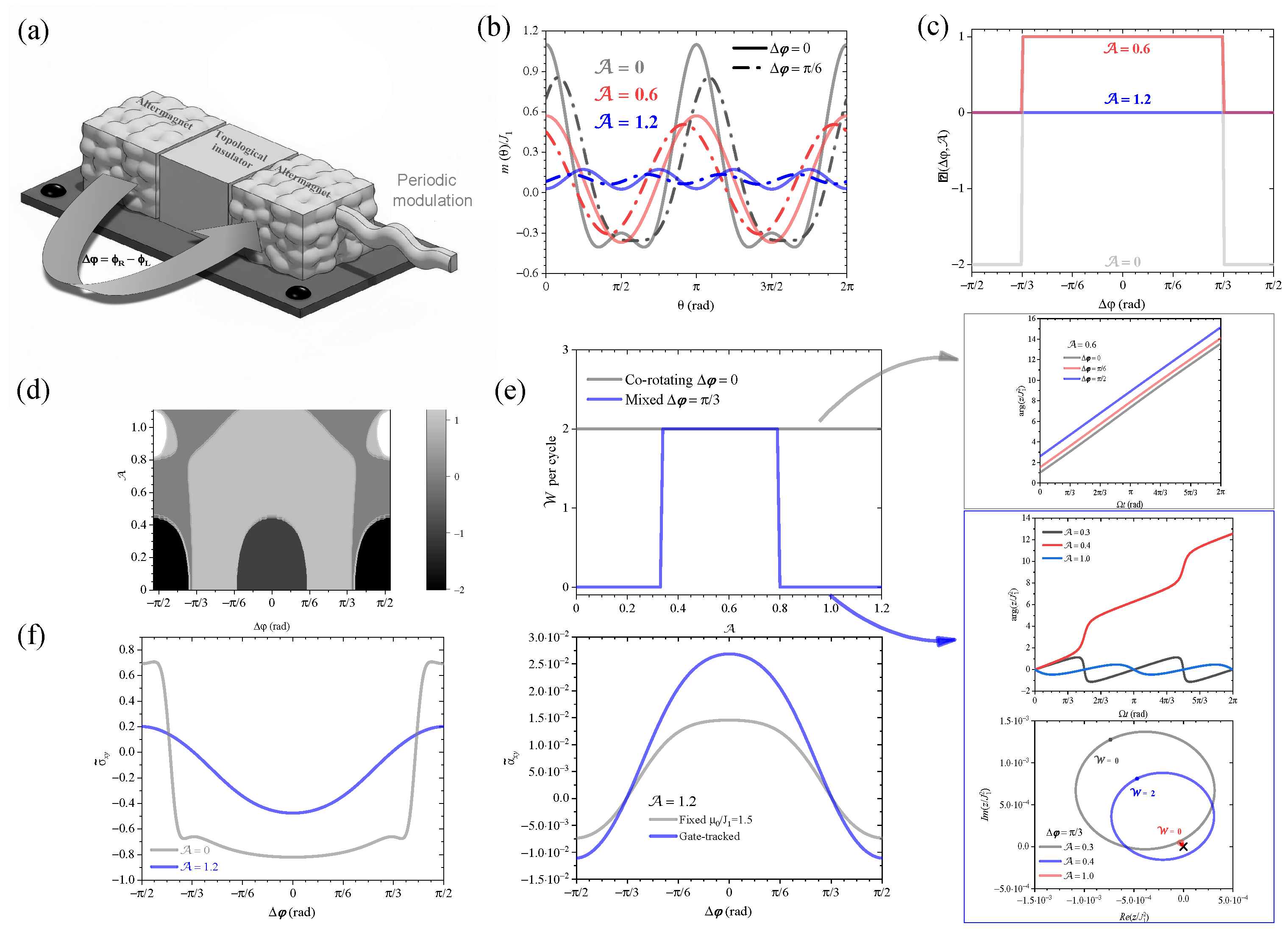
The device (Figure 1a) comprises a topological insulator (TI) film contacted by two altermagnetic electrodes with crystalline phases and . Each electrode induces a momentum-dependent exchange gap on the TI surface states, generating an angular Dirac mass [2,5]
where , , and are the isotropic, twofold, and fourfold harmonic amplitudes, respectively. These coefficients characterize the leading symmetry components of the interfacial exchange texture rather than a bulk spin-group classification [16,17]. In contrast to conventional ferromagnets, whose leading contribution is predominantly isotropic, altermagnets naturally generate even angular harmonics associated with the underlying crystal symmetry. The coexistence of twofold and fourfold harmonics therefore provides the microscopic origin of the multiple angular mass inversions that underlie the topological switching discussed below.
Figure 1.
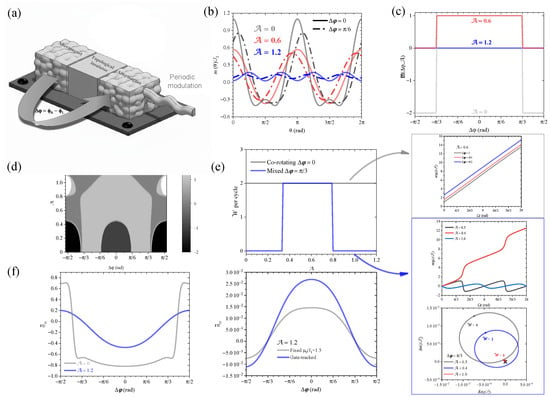
Bessel-tuned Chern valve: mechanically driven topological switching. (a) Device schematic: TI film contacted by altermagnetic electrodes with independent phases and , driven periodically at angular frequency . (b) Angular mass profile (normalized by coupling ) for three drive amplitudes (black), 0.6 (red), 1.2 (blue) at two phase offsets (co-phase, solid) and (phase-offset, dashed). Increasing progressively suppresses harmonics via Bessel renormalization, flattening the mass landscape. (c) The locations of the topological transitions evolve systematically as A approaches successive Bessel zeros. The corresponding transition boundaries are consistent with those obtained from the compact Brillouin-zone FHS calculation, although the latter provides the rigorous integer Chern invariant of the lattice-regularized model. (d) Full two-parameter phase diagram spanning drive amplitude and relative phase . White regions (high ) indicate trivial phases (); regions show topological sectors (). Black contours separate sector boundaries, revealing characteristic phase-amplitude structure. (e) Winding number per cycle: co-rotating phases (, gray) remain trivial with ; mixed-phase rotation (, blue) exhibits a quantized plateau for . Inside the plateau, the control-plane trajectory encircles the critical point twice, producing a net phase accumulation of . Outside the plateau, the trajectory does not enclose the critical point and the winding collapses to zero. Right subpanels: time evolution of for a co-rotating case (top) and a mixed-phase case (middle), and complex-plane trajectories of (bottom) illustrating the winding mechanism. Trajectories outside the plateau (e.g., , gray) do not encircle the origin (marked with “×”) and yield , whereas trajectories inside the plateau (e.g., , blue and , red) form closed loops that encircle the origin twice, giving . (f) (Left): Anomalous Hall conductance (dimensionless) at (gray, robust plateau) and (blue, suppressed by Bessel-zero tuning). (Right): Thermoelectric Hall coefficient at comparing fixed (gray) and gate-tracked (blue), showing 80% peak enhancement via chemical potential optimization.
The TI surface states are described by the Dirac Hamiltonian
with Pauli matrices and Fermi velocity . The angular mass controls the momentum-dependent gap of the surface spectrum; whenever at some angle , the local Dirac gap closes. We define the relative phase , which controls the relative alignment of the left and right mass textures. The occupied bands carry a Berry curvature and are characterized by the Chern sector, obtained by the following integral over the Brillouin zone as which determines the quantized Hall conductance [18,19,20]. The sign structure of provides a useful domain-wall diagnostic for identifying angular regions where mass inversions occur. It is used throughout as an intuitive indicator of topological transitions, but not as a topological invariant. The corresponding topological sectors are established independently through compact Brillouin-zone Chern-number calculations and open-boundary ribbon spectra described below. Topological phase transitions are associated with changes in the corresponding Chern sector, producing the appearance or disappearance of chiral edge channels. Independent control of and therefore enables topological switching without reversing a global magnetization.
Periodic modulation of the crystalline phase, , can be implemented using piezoelectric or surface-acoustic-wave (SAW) actuators operating at MHz frequencies [11,12]. In the experimentally relevant slow-driving regime , where is the minimum instantaneous spectral gap, the angular harmonics can be averaged exactly over one modulation cycle. Using
the cycle-averaged mass texture becomes
where is the zeroth-order Bessel function. The Bessel-renormalized mass should therefore be understood as defining an exact cycle-averaged effective Hamiltonian for the periodically modulated system. All phase diagrams and transport calculations presented below are obtained within this cycle-averaged effective description. By contrast, the full time-dependent adiabatic response is, in general, determined by the evolution through the corresponding instantaneous Hamiltonians and may include additional geometric contributions that are not captured by the present cycle-averaged treatment. For the representative parameters considered here, –, whereas a mechanical drive at corresponds to , yielding –. Tuning to the zeros of the corresponding Bessel functions selectively suppresses individual angular harmonics and reorganizes the cycle-averaged mass texture.
To characterize cyclic driving protocols, we introduce the control-plane variable , where and are the instantaneous masses induced by the left and right electrodes in the selected angular channel. The coordinates define the experimentally controllable parameter space generated by the two independently driven altermagnetic interfaces. The winding of the trajectory around the critical point defines
which counts how many times the trajectory encircles the origin during one modulation cycle. The winding number therefore provides a geometric topological invariant of the cyclic driving protocol in the experimentally accessible two-mass control plane.
2.2. Methods
2.2.1. Continuum Calculations
The Dirac surface Hamiltonian Equation (2) was discretized on a polar momentum-space grid with radial points extending up to and angular points, yielding approximately momentum states for numerical integration [18]. All momentum-space integrals were evaluated using composite trapezoidal quadrature.
For the two-band Hamiltonian with , the Berry curvature of the occupied band was computed from
which is the standard expression for two-band Dirac systems [19,20]. The continuum Chern-sector diagnostic was evaluated as
whereas the quantized topological invariant reported in the manuscript was verified independently using the compact Brillouin-zone regularization.
The anomalous Hall conductivity was obtained from
where denotes the Fermi–Dirac distribution. The thermoelectric Hall coefficient was computed through the Mott relation
with the chemical-potential derivative evaluated numerically using central finite differences with .
Phase diagrams Figure 1d were generated using phase offsets spanning and modulation amplitudes spanning , requiring approximately independent Hamiltonian evaluations.
The winding number was computed from Equation (5) using time points per modulation cycle, the phase was unwrapped, and the winding was obtained from the net accumulated phase over one cycle divided by . Unless otherwise stated, calculations employed , , , , , and , consistent with RuO2–Bi2Se3 heterostructures [5,15]. Convergence tests verified that doubling , , or changed , , , and by less than .
2.2.2. Topological Validation
To verify the topological character of the continuum results on a compact momentum manifold, we constructed a lattice regularization of the same Hamiltonian by replacing and , with . The angular harmonics entering the altermagnetic mass texture were evaluated from , and , through the regularized angular functions
and
together with the corresponding fourth-order harmonics. The regularization parameter was fixed to , which is sufficient to remove the singularity at while preserving the original twofold and fourfold altermagnetic mass structure.
The occupied-band Chern number was independently computed on the compact Brillouin zone using the gauge-invariant Fukui–Hatsugai–Suzuki (FHS) discretization [21], which yields an exactly quantized integer invariant on the discretized Brillouin-zone mesh. All reported topological sectors were confirmed to be integer-valued within numerical precision.
Bulk–boundary correspondence was verified using open-boundary ribbon geometries constructed directly from the same compactified Bloch Hamiltonian [22]. For each conserved momentum , the compactified Bloch Hamiltonian was expanded in Fourier components along the open direction,
where R denotes the lattice displacement. The ribbon Hamiltonian was then assembled as the corresponding Toeplitz matrix
with i and j labeling sites along the open direction. This construction preserves exactly the same compactified bulk Hamiltonian used in the FHS calculations, allowing a direct bulk–boundary comparison without introducing an independent ribbon model. Edge states were identified from their boundary-localized spectral weight and compared with the corresponding bulk Chern sectors.
3. Results
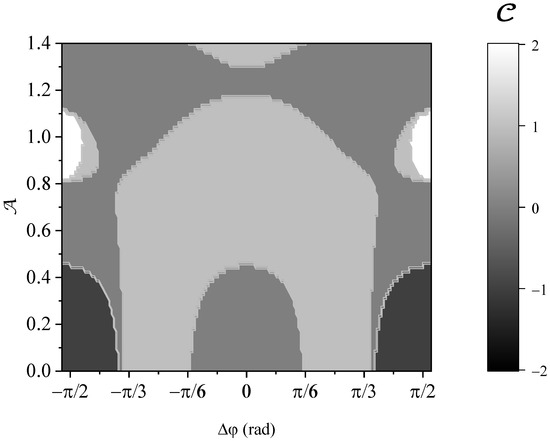
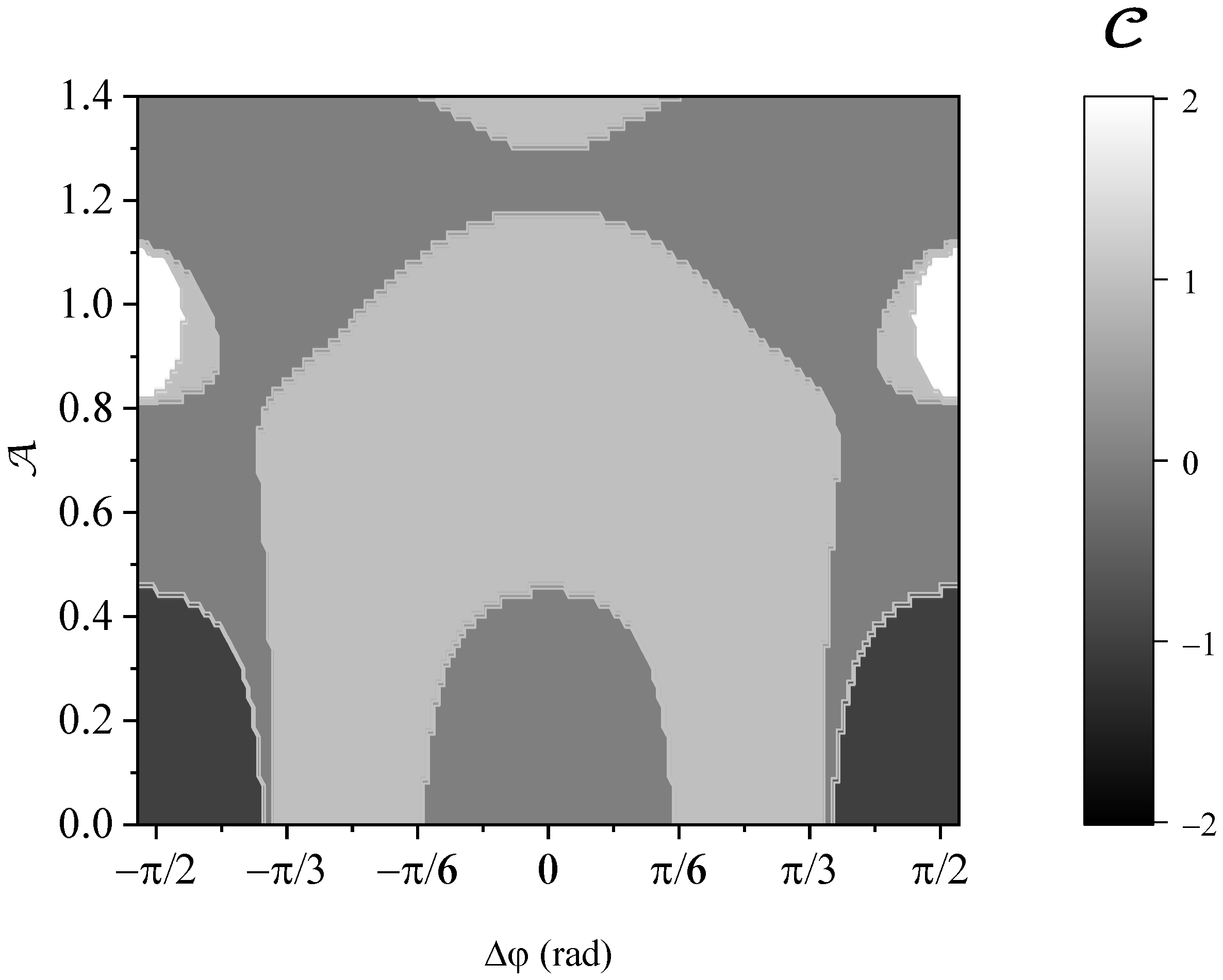
Figure 1b shows (scaled by the magneto-elastic coupling meV [15]) for (black), (red), and (blue), at phase offsets (solid) and (dashed). For the mass exhibits a symmetric double-well angular structure. A finite phase offset shifts the extrema but preserves the overall nodal pattern. Increasing suppresses the and harmonics through the Bessel renormalization, progressively flattening the angular mass profile and reducing the number of sign-change sectors. Figure 1c displays the continuum Chern-sector diagnostic for the same amplitudes. In the undriven case (), a broad plateau with extends over , with sharp transitions at the phase boundaries. At , close to the first zero of , the region narrows significantly. For , near the first zero of , the response becomes predominantly trivial (), consistent with the suppression of the leading harmonic. The sequence illustrates re-entrant topological switching controlled by the drive amplitude at fixed phase offset. The global structure is summarized in Figure 1d, which maps over and . Topological sectors with dominate at small , while intermediate amplitudes stabilize regions. As approaches the Bessel zeros, these sectors contract and eventually give way to an extended trivial phase. The resulting “eye”-shaped structure reflects the coexistence of symmetry-inequivalent and harmonics: tuning renormalizes each component differently and enables transitions such as within the same device. To verify that these transitions are not artifacts of the continuum representation, we independently analyzed a compact Brillouin-zone lattice regularization using the gauge-invariant Fukui–Hatsugai–Suzuki (FHS) construction. The compact Brillouin-zone calculation provides the rigorous integer Chern invariant of the lattice-regularized model, whereas the continuum Chern-sector quantity employed throughout this work serves as a diagnostic of the angular mass topology. Accordingly, the integer values obtained in the two descriptions do not coincide identically. Nevertheless, both approaches consistently identify the same topological transition boundaries and reproduce the same overall organization of the phase diagram. A representative compact Brillouin-zone FHS phase diagram is shown in Figure 2, while the complete set of FHS calculations, together with the corresponding ribbon spectra, is provided in the Supplementary Information.
Figure 2.
Compact Brillouin-zone phase diagram obtained from the gauge-invariant Fukui–Hatsugai–Suzuki (FHS) construction. The continuum angular description was regularized on a compact momentum manifold through the substitutions and . The angular harmonics were reconstructed using the regularized variables and with . The resulting lattice model exhibits well-defined integer topological sectors separated by sharp transition boundaries. The FHS calculation provides the rigorous integer Chern invariant of the lattice-regularized model, whereas the continuum Chern-sector quantity used in the main text serves as a diagnostic of the angular mass topology. Although the integer values obtained in the two descriptions do not coincide identically, both approaches consistently reproduce the same topological transition boundaries and the overall organization of the phase diagram.
Panel (e) shows the winding number for two representative driving protocols. For co-rotating phases (), throughout the explored amplitude range. For mixed-phase driving (), develops a quantized plateau at over a finite interval of , returning to zero outside this window. The right subpanels provide complementary diagnostics of the winding transition. Inside the plateau, the control-plane trajectory encircles the critical point twice, producing a net phase accumulation of and a quantized winding . Outside the plateau the trajectory does not enclose the critical point and the winding collapses to zero. The topological character of these driving protocols is independently confirmed by compact Brillouin-zone Chern-number calculations and open-boundary ribbon spectra. The compact Brillouin-zone calculations yield integer Chern sectors consistent with the continuum topological phase boundaries, while the ribbon spectra exhibit boundary-localized states in the corresponding nontrivial regions. Representative examples are provided in the Supplementary Information, supplying an explicit bulk–boundary validation of the mechanically induced topological transitions. Figure 1f presents the anomalous Hall conductance and the thermoelectric Hall coefficient . The suppression of at large follows the collapse of the corresponding Chern sectors near Bessel zeros. The thermoelectric response, obtained from the Mott relation , is enhanced when the chemical potential is gate-tracked to remain near energies where is maximal. This optimization sharpens the response without altering the underlying topological structure. The locations of the Hall-conductivity suppression and thermoelectric sign changes coincide with the boundaries of the topological sectors identified independently through the continuum, compact-Brillouin-zone, and ribbon calculations [23]. The parameter range used in Figure 1b–f is compatible with strained AM/TI nanoscale heterostructures. A realistic implementation could consist of a few-quintuple-layer Bi2Se3 or Bi2Te3 channel (∼5–10 QL) contacted by thin RuO2 or MnTe altermagnetic electrodes with thicknesses in the ∼5–30 nm range [15,24]. The layer thicknesses play distinct physical roles. The TI should be thick enough to suppress hybridization between the top and bottom surface states while remaining sufficiently thin for electrostatic gating and interfacial transport to dominate over bulk leakage channels; this motivates the few-quintuple-layer regime. If the TI becomes too thin, hybridization opens an additional finite-size gap competing with the altermagnet-induced Dirac mass, whereas excessively thick or bulk-conducting films progressively shunt the surface Hall response through trivial bulk transport. The altermagnetic layer, in turn, must be thick enough to stabilize the compensated ordered phase and maintain a robust exchange coupling at the interface, while remaining thin enough for strain to be transferred coherently from the piezoelectric or surface-acoustic-wave actuator. In this sense, the effective mass should be understood primarily as an interfacial exchange mass controlled by the first few atomic layers adjacent to the TI rather than as a bulk volume-averaged magnetic parameter. Independent strain control of has been demonstrated in RuO2-based and MnTe-based platforms [7,8,13], while integrated piezoelectric or surface-acoustic-wave (SAW) actuators can generate the angular excursions required to reach –1.0 [11,12,25]. Such actuation can be implemented on chip using thin-film AlN, ScAlN, or LiNbO3 platforms compatible with nanoscale Hall-bar geometries and MHz operation [26,27,28,29]. Operating at MHz frequencies places the system deep in the adiabatic regime (–), which is particularly advantageous for thin-film nanoscale devices because it minimizes heating, reduces photon-assisted interband processes, and avoids the strong dissipation typically associated with THz Floquet platforms [25,30,31]. Experimentally, the proposed mechanism could be identified through the strain-amplitude dependence of the anomalous Hall plateau structure, the collapse of topological sectors near Bessel zeros, and the gate dependence of the thermoelectric Hall response. Since the effect originates from interfacial Berry-curvature engineering, the signal is also expected to scale with TI-film thickness and to weaken as bulk transport progressively dominates.
4. Conclusions
These results demonstrate that mechanically driven AM/TI interfaces provide a route toward programmable topological transport through the controlled renormalization of interfacial altermagnetic mass textures. The phase boundaries and topological sectors are consistently reproduced by continuum Berry-curvature calculations, compact Brillouin-zone Chern-number evaluations, and open-boundary ribbon spectra, establishing the robustness of the proposed topological mechanism across complementary theoretical descriptions. The present bilayer geometry enables programmable topological control through independent tuning of the two altermagnetic phases combined with Bessel-function amplitude renormalization. From a device-engineering perspective, this mechanism offers a pathway toward electrically programmable topological functionalities based on integrated strain actuators operating in the MHz regime. Because the control parameter is the mechanical modulation amplitude rather than an external magnetic field, and because the mechanism relies on interfacial Berry-curvature engineering instead of global magnetization reversal or optical pumping, the proposed platform is naturally compatible with low-power, low-dissipation, and scalable nano-spintronic architectures operating in the adiabatic regime. The coexistence of twofold and fourfold exchange harmonics provides an additional control knob through selective Bessel renormalization, allowing topological sectors to be created, suppressed, and re-entered within a single device architecture. Several extensions of the present framework remain open. Multilayer AM–TI heterostructures with repeated interfaces could enable spatially selective Berry-curvature engineering and coupled chiral transport channels. Likewise, multifrequency or noncircular driving protocols may provide a route toward synthetic topological band structures controlled entirely by mechanical phase modulation [32]. Finally, combining the present mechanism with proximitized superconducting interfaces could offer a platform for studying strain-controlled topological superconducting boundaries and related emergent edge states [33,34].
Supplementary Materials
The following supporting information can be downloaded at: https://www.mdpi.com/article/10.3390/applnano7030023/s1, Figure S1: Representative cuts through the compactified phase diagram; Figure S2: Open-boundary ribbon spectrum of the compactified model.
Author Contributions
Conceptualization, C.C. and F.G.; methodology, and F.G.; software, C.C. and F.G.; validation, C.C. and F.G.; formal analysis, C.C. and F.G.; investigation, C.C. and F.G.; resources, C.C. and F.G.; data curation, C.C. and F.G.; writing—original draft preparation, C.C. and F.G.; writing—review and editing, C.C. and F.G. All authors have read and agreed to the published version of the manuscript.
Funding
This research received no external funding.
Institutional Review Board Statement
Not applicable.
Informed Consent Statement
Not applicable.
Data Availability Statement
Data are available from the authors upon request.
Conflicts of Interest
The authors declare no conflicts of interest.
References
- Šmejkal, L.; Sinova, J.; Jungwirth, T. Beyond Conventional Ferromagnetism and Antiferromagnetism: A Phase with Nonrelativistic Spin and Crystal Rotation Symmetry. Phys. Rev. X 2022, 12, 031042. [Google Scholar] [CrossRef] [Scilit]
- Šmejkal, L.; Sinova, J.; Jungwirth, T. Emerging Research Landscape of Altermagnetism. Phys. Rev. X 2022, 12, 040501. [Google Scholar] [CrossRef] [Scilit]
- Li, Y.-X.; Liu, Y.; Liu, C.-C. Creation and manipulation of higher-order topological states by altermagnets. Phys. Rev. B 2024, 109, L201109. [Google Scholar] [CrossRef] [Scilit]
- Reichlova, H.; Seeger, R.L.; González-Hernández, R.; Kounta, I.; Schlitz, R.; Kriegner, D.; Ritzinger, P.; Lammel, M.; Leiviskä, M.; Hellenes, A.B.; et al. Observation of a spontaneous anomalous Hall response in the. Nat. Comm. 2024, 15, 4961. [Google Scholar] [CrossRef] [Scilit] [PubMed]
- Guo, Y.; Zhang, J.; Zhu, Z.; Jiang, Y.; Jiang, L.; Wu, C.; Dong, J.; Xu, X.; He, W.; He, B.; et al. Direct and Inverse Spin Splitting Effects in Altermagnetic. Adv. Sci. 2024, 11, 2400967. [Google Scholar] [CrossRef] [Scilit] [PubMed]
- Zhang, C.-P.; Gao, X.-J.; Xie, Y.-M.; Po, H.C.; Law, K.T. Higher-order Nonlinear Anomalous Hall Effects Induced by Berry Curvature Multipoles. Phys. Rev. B 2023, 107, 115142. [Google Scholar]
- Fu, Z.; Hu, M.; Li, A.; Duan, H.; Liu, J.; Ouyang, F. Multiple Topological Phases Controlled via Strain in Two-Dimensional Altermagnets. Phys. Rev. B 2026, 113, 245404. [Google Scholar] [CrossRef] [Scilit]
- Smolenski, S.; Mao, N.; Zhang, D.; Guo, Y.; Shawon, A.K.M.A.; Xu, M.; Downey, E.; Musall, T.; Yi, M.; Xie, W.; et al. Strain-Tunability of the Multipolar Berry Curvature in Layered Altermagnets. arXiv 2025, arXiv:2509.21481. [Google Scholar]
- Asmar, M.M.; Sheehy, D.E.; Vekhter, I. Interface symmetry and spin control in topological-insulator semiconductor heterostructures. Phys. Rev. B 2017, 95, 241115. [Google Scholar] [CrossRef] [Scilit]
- Caro, C.; Gámez, F. Phase-Rotated Altermagnets as Chern Valves for Topological Transport. Nano Lett. 2026, 26, 2098–2102. [Google Scholar] [CrossRef] [Scilit] [PubMed]
- Cheng, C.; Lu, Z.; Yang, J.; Gong, X.; Ke, Q. Modulating the Performance of the SAW Strain Sensor Based on Dual-Port Resonator Using Finite Element Method. Micromachines 2023, 16, 3269. [Google Scholar] [CrossRef] [Scilit] [PubMed]
- Zhou, T.; Reinhardt, A.; Bousquet, M.; Eymery, J.; Leake, S.; Holt, M.V.; Evans, P.G.; Schüli, T. High-Resolution High-Throughput Spatiotemporal Strain Mapping with Surface Acoustic Wave Resonators. Nat. Commun. 2025, 16, 2822. [Google Scholar] [CrossRef] [Scilit] [PubMed]
- Takahashi, T.; Steward, C.R.W.; Ogata, M.; Fernandes, R.M.; Schmalian, J. Elasto-Hall Conductivity and the Anomalous Hall Effect in Strained Altermagnetic Materials. Phys. Rev. B 2025, 111, 184408. [Google Scholar] [CrossRef] [Scilit]
- Wickramaratne, D.; Currie, M.; Fields, S.S.; Cress, C.D.; Bennett, S.P. Effects of Altermagnetic Order, Strain and Doping in RuO. J. Mater. Chem. C 2026, 14, 1587–1595. [Google Scholar] [CrossRef] [Scilit]
- Grutter, A.J.; He, Q.L. Magnetic Proximity Effects in Topological Insulator Heterostructures: Implementation and Characterization. Phys. Rev. Mater. 2021, 5, 090301. [Google Scholar] [CrossRef] [Scilit]
- Ma, H.-Y.; Jia, J.-F. Altermagnetic topological insulator and the selection rules. Phys. Rev. B 2024, 110, 064426. [Google Scholar] [CrossRef] [Scilit]
- Ezawa, M. Detecting the Néel vector of altermagnets in heterostructures with a topological insulator and a crystalline valley-edge insulator. Phys. Rev. B 2024, 109, 245306. [Google Scholar] [CrossRef] [Scilit]
- Datta, S. Electronic Transport in Mesoscopic Systems; Cambridge University Press: Cambridge, UK, 1995. [Google Scholar]
- Haldane, F.D.M. Berry Curvature on the Fermi Surface: Anomalous Hall Effect as a Topological Fermi-Liquid Property. Phys. Rev. Lett. 2004, 93, 206602. [Google Scholar] [CrossRef] [Scilit] [PubMed]
- Nagaosa, N.; Sinova, J.; Onoda, S.; MacDonald, A.H.; Ong, N.P. Anomalous Hall Effect. Rev. Mod. Phys. 2010, 82, 1539. [Google Scholar] [CrossRef] [Scilit]
- Fukui, T.; Hatsugai, Y.; Suzuki, H. Chern Numbers in Discretized Brillouin Zone: Efficient Method of Computing (Spin) Hall Conductances. J. Phys. Soc. Jpn. 2005, 74, 1674–1677. [Google Scholar] [CrossRef] [Scilit]
- Hatsugai, Y. Chern Number and Edge States in the Integer Quantum Hall Effect. Phys. Rev. Lett. 1993, 71, 3697. [Google Scholar] [CrossRef] [Scilit] [PubMed]
- Singh, J.; Mohanta, N. Interface controlled Berry phase and anisotropic spin–charge conversion in altermagnet–topological insulator bilayers. Mater. Today Quantum 2025, 8, 100058. [Google Scholar] [CrossRef] [Scilit]
- Liu, C.; Wang, Y.; Li, H.; Wu, Y.; Li, Y.; Li, J.; He, K.; Xu, Y.; Zhang, J.; Wang, Y. Robust Axion Insulator and Chern Insulator Phases in a Two-Dimensional Antiferromagnetic Topological Insulator. Nat. Mater. 2020, 19, 522–527. [Google Scholar] [CrossRef] [Scilit] [PubMed]
- Wang, D.; Ghosh, A.K.; Tao, Y.; Ma, F.; Song, C. Emerging of Anomalous Higher-Order Topological Phases in Altermagnet/Topological Insulator Heterostructure by Floquet Engineering. Adv. Sci. 2026, 13, e22203. [Google Scholar] [CrossRef] [Scilit] [PubMed]
- Liu, J.; Tan, H.; Zhou, Z.; Ma, W.; Wang, C.; Tran, N.-M.-A.; Lu, W.; Chen, F.; Wang, J.; Zhang, H. Piezoelectric Thin Films and Their Applications in MEMS: A Review. J. Appl. Phys. 2025, 137, 020702. [Google Scholar] [CrossRef] [Scilit]
- Piazza, G.; Felmetsger, V.; Muralt, P.; Olsson, R.H., III; Ruby, R. Piezoelectric Aluminum Nitride Thin Films for Microelectromechanical Systems. MRS Bull. 2012, 37, 1051–1061. [Google Scholar] [CrossRef] [Scilit]
- Zhu, D.; Shao, L.; Yu, M.; Cheng, R.; Desiatov, B.; Xin, C.J.; Hu, Y.; Holzgrafe, J.; Ghosh, S.; Shams-Ansari, A.; et al. Integrated Photonics on Thin-Film Lithium Niobate. Adv. Opt. Photon. 2021, 13, 242–352. [Google Scholar] [CrossRef] [Scilit]
- Luschmann, T.; Jung, A.; Geprägs, S.; Haslbeck, F.X.; Marx, A.; Filipp, S.; Gröblacher, S.; Gross, R.; Huebl, H. Surface Acoustic Wave Resonators on Thin Film Piezoelectric Substrates in the Quantum Regime. Mater. Quantum. Technol. 2023, 3, 021001. [Google Scholar] [CrossRef] [Scilit]
- Rechtsman, M.C.; Zeuner, J.M.; Plotnik, Y.; Lumer, Y.; Podolsky, D.; Dreisow, F.; Nolte, S.; Segev, M.; Szameit, A. Photonic Floquet Topological Insulators. Nature 2013, 496, 196–200. [Google Scholar] [CrossRef] [Scilit] [PubMed]
- McIver, J.W.; Schulte, B.; Stein, F.U.; Matsuyama, T.; Jotzu, G.; Meier, G.; Cavalleri, A. Light-Induced Anomalous Hall Effect in Graphene. Nat. Phys. 2020, 16, 38–41. [Google Scholar] [CrossRef] [Scilit] [PubMed]
- Kitagawa, T.; Berg, E.; Rudner, M.; Demler, E. Topological Characterization of Periodically Driven Quantum Systems. Phys. Rev. B 2010, 82, 235114. [Google Scholar] [CrossRef] [Scilit]
- Fu, L.; Kane, C.L. Superconducting Proximity Effect and Majorana Fermions at the Surface of a Topological Insulator. Phys. Rev. Lett. 2008, 100, 096407. [Google Scholar] [CrossRef] [Scilit] [PubMed]
- Yi, H.; Zhao, Y.-F.; Chan, Y.-T.; Hu, L.-H.; Zhang, Z.; Shibayev, P.P.; Richardella, A.R.; Lee, I.; Li, P.; Chan, M.H.W.; et al. Interface-induced superconductivity in magnetic topological insulators. Science 2024, 383, 634–639. [Google Scholar] [CrossRef] [Scilit] [PubMed]
Disclaimer/Publisher’s Note: The statements, opinions and data contained in all publications are solely those of the individual author(s) and contributor(s) and not of MDPI and/or the editor(s). MDPI and/or the editor(s) disclaim responsibility for any injury to people or property resulting from any ideas, methods, instructions or products referred to in the content. |
© 2026 by the authors. Licensee MDPI, Basel, Switzerland. This article is an open access article distributed under the terms and conditions of the Creative Commons Attribution (CC BY) license.