

Adsorption of Dimethyl Phthalate and Its Isomers on Nitrogen-Doped Activated Carbon: A DFT Study

 ,
, 

Abstract
1. Introduction
2. Computational Methods
3. Results and Discussion
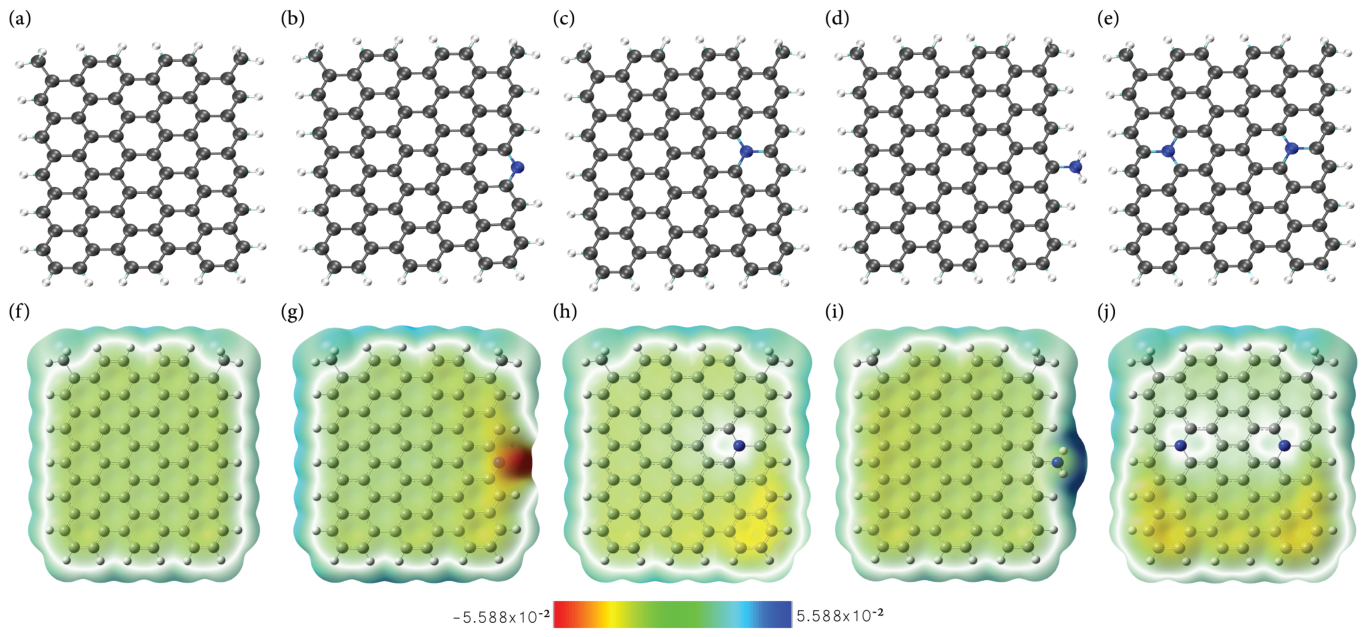
3.1. Geometrical Structures of Pristine AC and Nitrogen-Doped AC
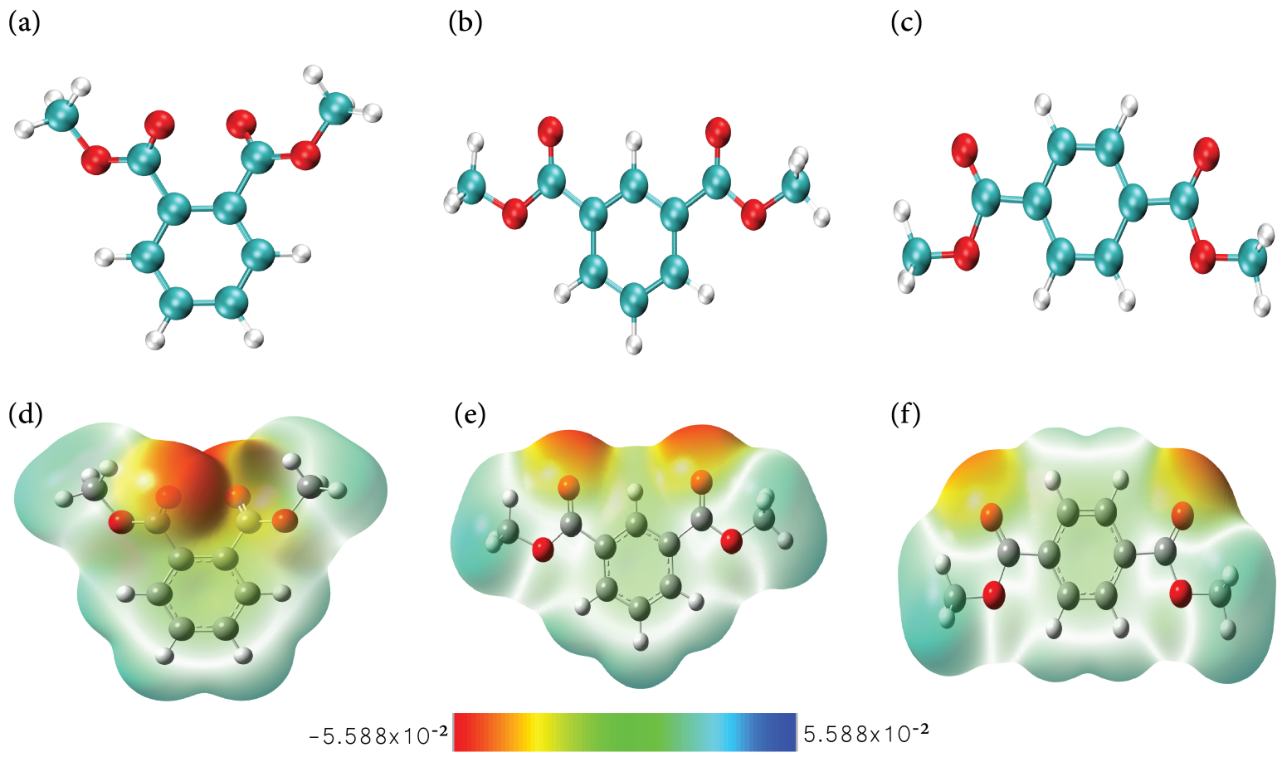
3.2. Geometrical Structures of DMP and Its Isomers (DMI and DMT)
- 1.
- - stacking between the aromatic ring of the molecules and the graphitic aromatic rings of AC.
- 2.
- Electrostatic interactions guide the molecule and nitrogen-doped AC to bind by aligning donor and acceptor electron regions.
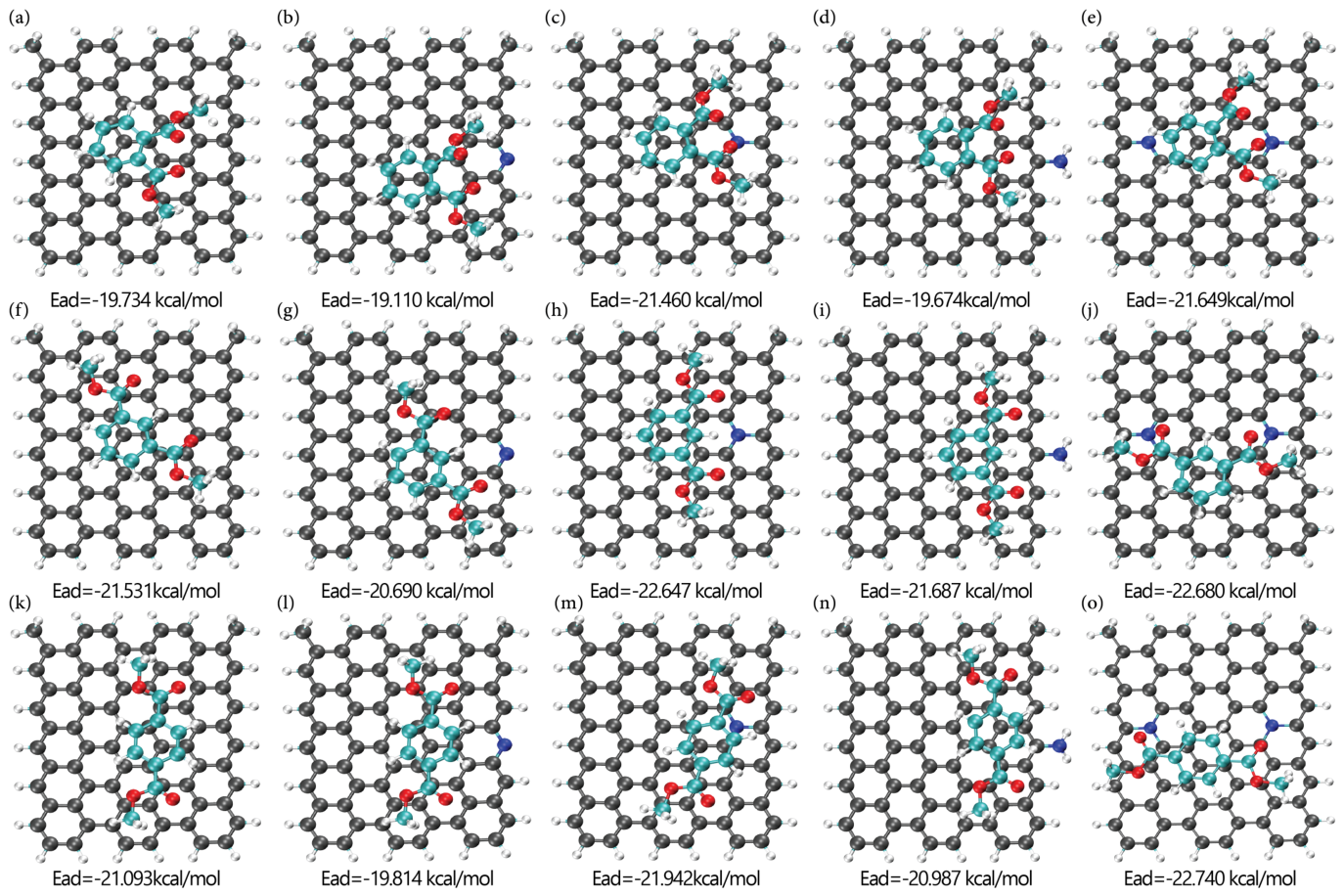
3.3. Geometrical Structures of the DMP Molecule and Its Isomers on Nitrogen-Doped AC
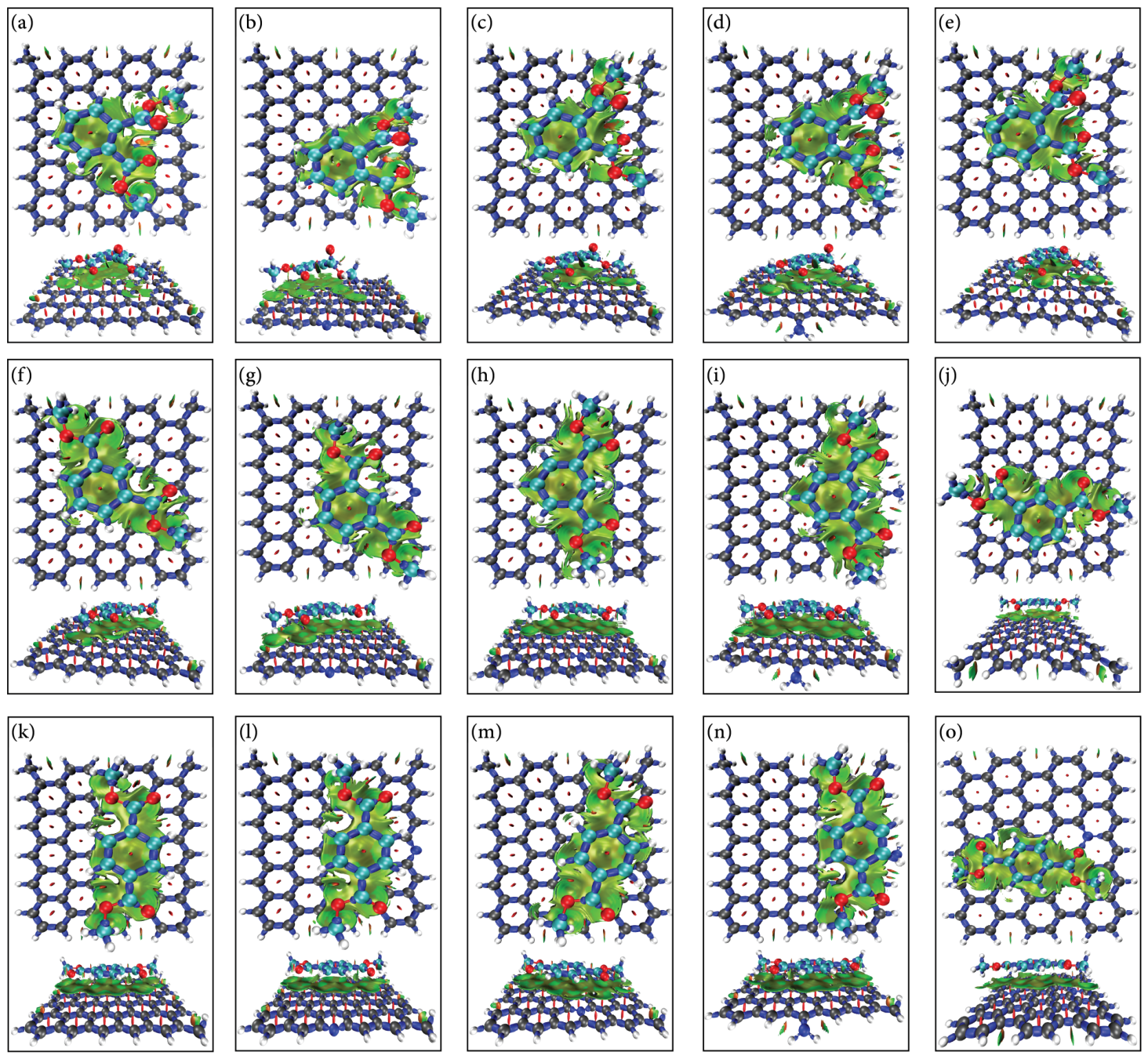
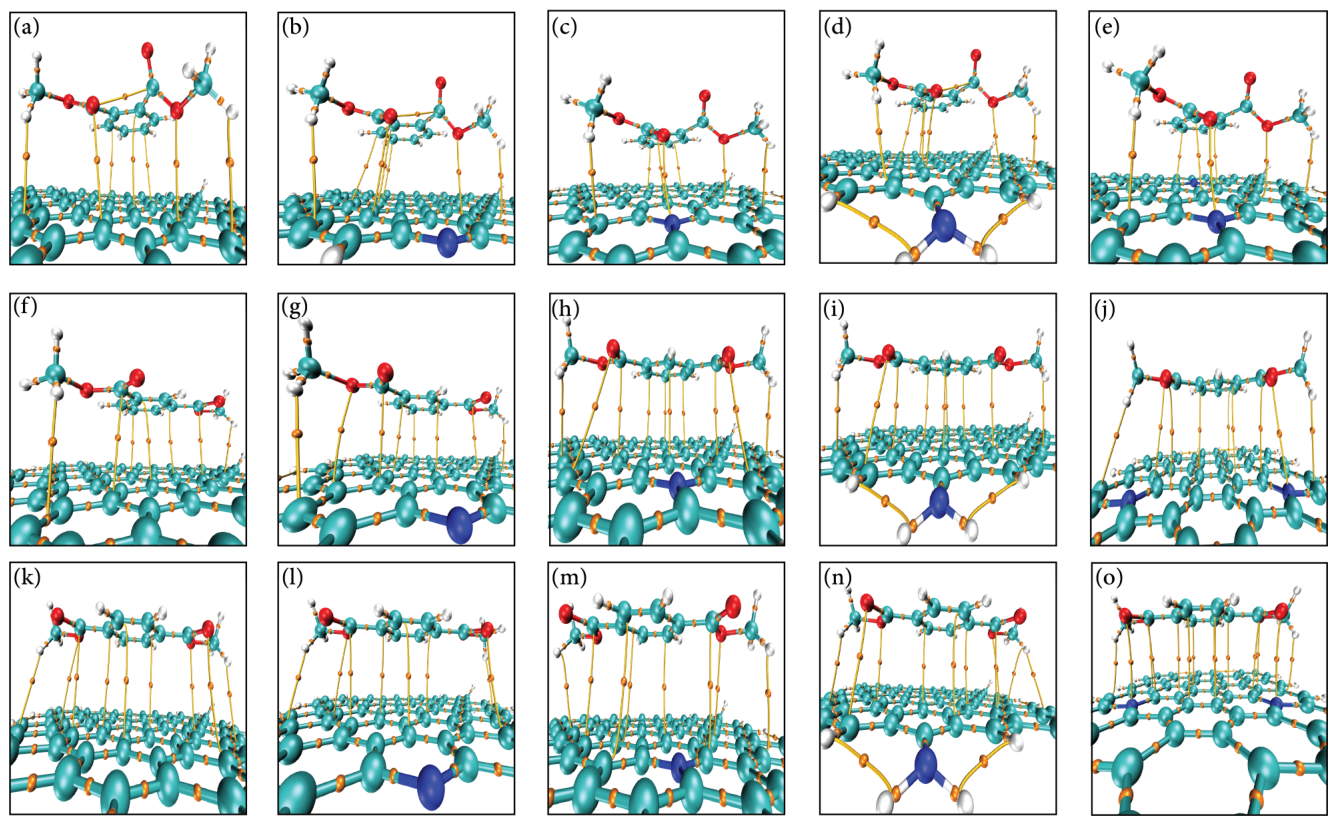
3.4. Analysis of Weak Interactions
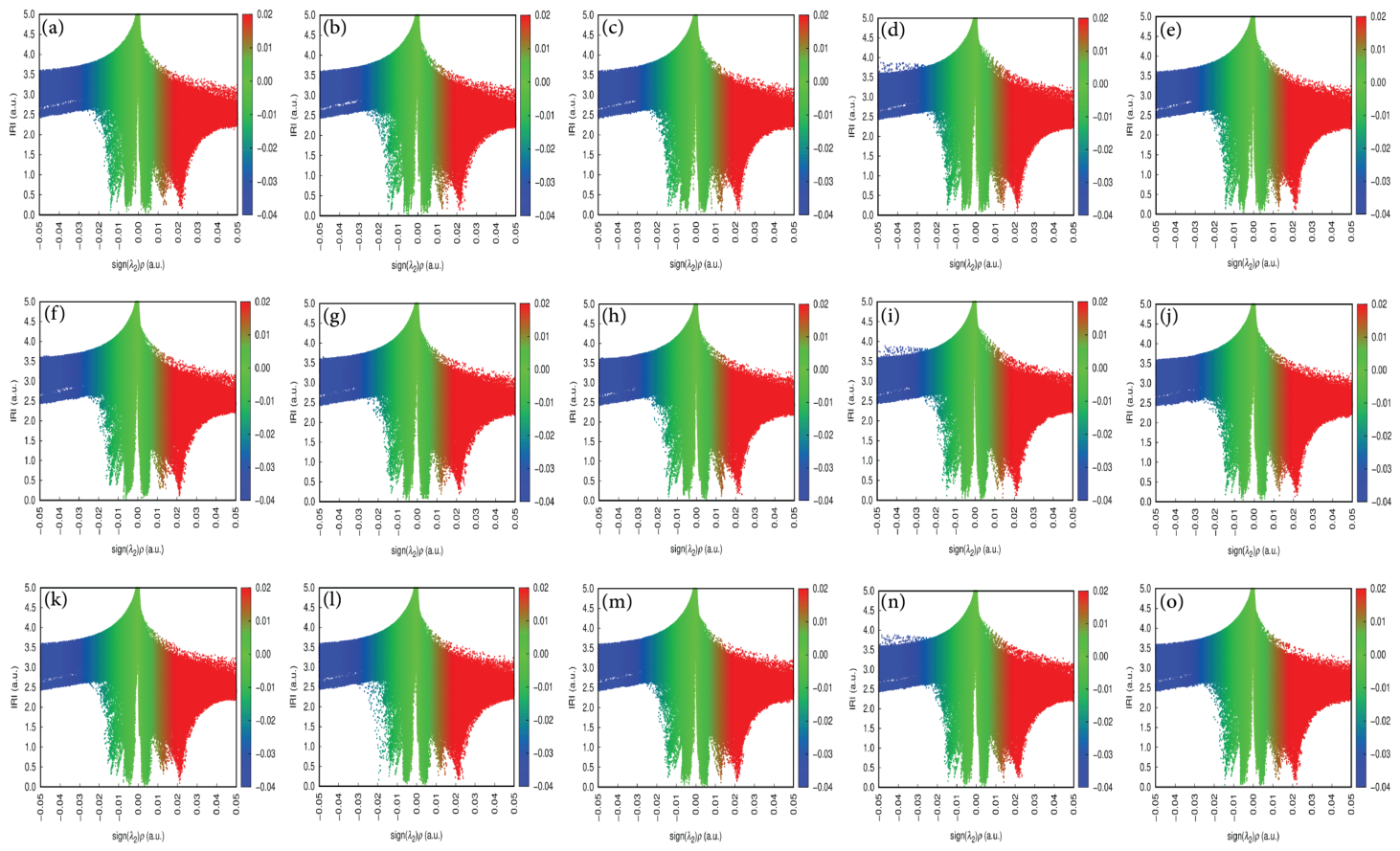
- Covalent bonds: values in the range of −0.050 to −0.025 a.u., corresponding to the blue regions in Figure 4.
- Non-covalent interactions: values in the range of −0.025 to +0.015 a.u., corresponding to the green regions between the molecules and the AC surfaces (- stacking, van der Waals, and electrostatic interactions).
- Steric repulsion: values around +0.022 a.u., corresponding to the red spindle-shaped regions within the aromatic rings.
- For AC-Graphitic-2N, the non-covalent interaction region shows a broader distribution, approximately 10–15% higher integrated intensity compared to pristine AC. This reflects electrostatic interactions between the COOCH3 groups and nitrogen atoms.
- For AC-Graphitic-N, the integrated intensity in the non-covalent region increases by approximately 5–10% compared to pristine AC.
- For AC-Pyridinic-N and AC-NH2, the non-covalent region shows minimal change or a slight decrease in integrated intensity, consistent with the weaker adsorption energies observed for these configurations.
- The covalent bonding region (from −0.050 to −0.02 a.u.) remains essentially unchanged across all systems, as intramolecular bonds and surface bonds on the activated carbon are not significantly affected by adsorption.
3.5. AIM Topological Analysis
4. Conclusions
Author Contributions
Funding
Institutional Review Board Statement
Informed Consent Statement
Data Availability Statement
Conflicts of Interest
Abbreviations
| DMP | dimethyl phthalate |
| DMI | dimethyl isophthalate |
| DMT | dimethyl terephthalate |
| AC | activated carbon |
| DFT | density functional theory |
| NCI | non-covalent interaction |
| vdW | van der Waals |
| PVC | polyvinyl chloride |
| CAHB | charge-assisted hydrogen bond |
| IRI | interaction region indicator |
| ESP | electrostatic potential |
| ESI | electrostatic interaction |
| QTAIM | quantum theory of atoms in molecules |
| AIM | atoms in molecules |
| BCPs | bond critical points |
| VMD | visual molecular dynamics |
| IGM | independent gradient model |
References
- Basso, C.G.; de Araujo-Ramos, A.T.; Martino-Andrade, A.J. Exposure to phthalates and male reproductive health: A systematic review and meta-analysis. Hum. Reprod. Update 2022, 28, 229–254. [Google Scholar]
- Giuliani, A.; Zuccarini, M.; Cichelli, A.; Khan, H.; Reale, M. Critical review on the presence of phthalates in food products and their health effects. Int. J. Environ. Res. Public Health 2020, 17, 5655. [Google Scholar] [CrossRef] [PubMed]
- European Parliament and Council. Directive 2003/53/EC of the European Parliament and of the Council of 18 June 2003 amending for the 26th time Council Directive 76/769/EEC relating to restrictions on the marketing and use of certain dangerous substances and preparations (nonylphenol, nonylphenol ethoxylate and cement). Off. J. Eur. Union 2003, L178, 24–27. Available online: https://eur-lex.europa.eu/legal-content/EN/TXT/?uri=CELEX:32003L0053 (accessed on 1 June 2026).
- Hauser, R.; Calafat, A.M. Phthalates and human health. Occup. Environ. Med. 2005, 62, 806–818. [Google Scholar] [CrossRef] [PubMed]
- Gao, D.W.; Wen, Z.D. Phthalate esters in the environment: A critical review of their occurrence, biodegradation, and removal during wastewater treatment processes. Sci. Total Environ. 2016, 541, 986–1001. [Google Scholar] [CrossRef] [PubMed]
- Chen, X.; Wang, Y.; Sun, Y.; Zhao, X.; Zhang, Y. Occurrence and ecological risk assessment of phthalate esters in surface water and sediment of the Yangtze River Delta, China. Environ. Pollut. 2019, 255, 113297. [Google Scholar]
- Selvaraj, K.K.; Sundaramoorthy, G.; Ravichandran, P.K.; Girijan, G.K.; Sampath, S.; Ramaswamy, B.R. Phthalate esters in water and sediments of the Kaveri River, India: Environmental levels and ecotoxicological evaluations. Environ. Geochem. Health 2015, 37, 83–96. [Google Scholar] [CrossRef] [PubMed]
- Pham, T.L.; Tran, T.T.H.; Nguyen, T.T. Distribution and ecological risk assessment of phthalate esters in surface water and personal care products from municipal wastewater in Vietnam. J. Hazard. Mater. 2024, 465, 133124. [Google Scholar]
- Cotoruelo, L.M.; Marqués, M.D.; Rodríguez, F.J.; Gómez, J. Adsorption of acetaminophen, salicylic acid and benzoic acid on activated carbons from lignin. Chem. Eng. J. 2011, 172, 674–682. [Google Scholar]
- Paredes-Doig, A.L.; Flores, R.; Sun-Kou, M.R. Adsorption of benzoic acid, salicylic acid and phenol on activated carbon prepared from chestnut shell. Rev. Soc. Quím. Perú 2014, 80, 111–123. [Google Scholar]
- Li, X.; Wang, Y.; Zhang, L.; Chen, H. Effect of pH on the adsorption of phthalic and benzoic acids on functionalized carbon nanotubes: The role of charge-assisted hydrogen bonds. Chemosphere 2022, 286, 131789. [Google Scholar]
- Kim, S.; Lee, J.; Park, H. Positional isomer effects on adsorption of benzenedicarboxylic acids on carbon nanotubes: Experimental and computational study. J. Hazard. Mater. 2024, 465, 133456. [Google Scholar]
- Liu, P.; Wu, S.; Chen, Q.; Zhang, L. Nitrogen-doped activated carbon for enhanced adsorption of emerging contaminants: A critical review. J. Environ. Chem. Eng. 2023, 11, 109876. [Google Scholar]
- Grimme, S.; Hansen, A.; Ehlert, S.; Mewes, J.M. r2SCAN-3c: A “Swiss army knife” composite electronic-structure method. J. Chem. Phys. 2021, 154, 064103. [Google Scholar] [CrossRef] [PubMed]
- Neese, F. Software update: The ORCA program system, version 4.0. WIREs Comput. Mol. Sci. 2018, 8, e1327. [Google Scholar]
- Grimme, S.; Ehrlich, S.; Goerigk, L. Effect of the damping function in dispersion corrected density functional theory. J. Comput. Chem. 2011, 32, 1456–1465. [Google Scholar] [CrossRef] [PubMed]
- Weigend, F.; Ahlrichs, R. Balanced basis sets of split valence, triple zeta valence and quadruple zeta valence quality for H to Rn: Design and assessment of accuracy. Phys. Chem. Chem. Phys. 2005, 7, 3297–3305. [Google Scholar] [CrossRef] [PubMed]
- Neese, F. Software update: The ORCA program system, version 5.0. WIREs Comput. Mol. Sci. 2022, 12, e1606. [Google Scholar] [CrossRef]
- Zhang, Y.; Wang, J.; Li, H.; Chen, X. Predicting adsorption of organic pollutants on activated carbon via machine learning. Chem. Eng. J. 2022, 450, 138049. [Google Scholar]
- Chen, X.; Kim, S.H.; Park, J.; Wang, Y. Machine learning-assisted DFT for predicting adsorption of aromatic pollutants on functionalized carbon surfaces. Appl. Surf. Sci. 2024, 642, 158634. [Google Scholar]
- Lefebvre, C.; Rubez, G.; Khartabil, H.; Boisson, J.C.; Contreras-García, J.; Hénon, E. IGM-δg: An Independent Gradient Model based on Hirshfeld partition of molecular density for chemical interactions. Phys. Chem. Chem. Phys. 2017, 19, 17928–17936. [Google Scholar] [PubMed]
- Lu, T.; Chen, F. Multiwfn: A multifunctional wavefunction analyzer. J. Comput. Chem. 2012, 33, 580–592. [Google Scholar] [PubMed]
- Lu, T.; Chen, Q. Interaction Region Indicator (IRI): A simple and efficient real-space function for revealing noncovalent interactions. J. Comput. Chem. 2022, 43, 539–555. [Google Scholar] [PubMed]
- Bader, R.F.W. Atoms in Molecules: A Quantum Theory; Oxford University Press: Oxford, UK, 1990. [Google Scholar]
- Hirshfeld, F.L. Bonded-atom fragments for describing molecular charge densities. Theor. Chim. Acta 1977, 44, 129–138. [Google Scholar] [CrossRef]
- Becke, A.D.; Edgecombe, K.E. A simple measure of electron localization in atomic and molecular systems. J. Chem. Phys. 1990, 92, 5397–5403. [Google Scholar] [CrossRef]
- Mayer, I. Bond orders and valence indices: A personal account. J. Comput. Chem. 2007, 28, 204–221. [Google Scholar] [CrossRef] [PubMed]
- Humphrey, W.; Dalke, A.; Schulten, K. VMD: Visual molecular dynamics. J. Mol. Graph. 1996, 14, 33–38. [Google Scholar] [CrossRef] [PubMed]
- Tournus, F.; Charlier, J.C. Ab initio study of benzene adsorption on carbon nanotubes. Phys. Rev. B 2005, 71, 165421. [Google Scholar] [CrossRef]
- Zhang, L.; Wang, Y.; Li, X. Aromatic ring fragments as models for activated carbon surfaces. Carbon 2018, 130, 456–465. [Google Scholar]
- Fedorov, A.S.; Fedorov, D.A. Modeling of carbon-based nanomaterials. Phys. Chem. Chem. Phys. 2020, 22, 12345–12356. [Google Scholar]
- Chen, J.; Liu, H.; Wei, W. Computational modeling of functionalized carbon surfaces for pollutant adsorption. J. Mater. Chem. A 2019, 7, 23456–23467. [Google Scholar]
- Luo, X.; Wang, J.; Wang, C. Pyridinic nitrogen-doped carbon for enhanced adsorption of aromatic compounds. Carbon 2016, 98, 145–153. [Google Scholar]
- Xing, W.; Li, S.; Yu, Q. Pyrrolic nitrogen-doped carbon materials for pollutant adsorption. J. Mater. Chem. A 2014, 2, 12238–12248. [Google Scholar]
- Chen, X.; Zhang, H.; Wang, Y. Pyrrolic and pyridinic nitrogen effects on carbon surface reactivity. Appl. Surf. Sci. 2020, 512, 145678. [Google Scholar]
- Saleh, M.; Tiwari, J.N.; Kemp, K.C.; Yousuf, M.; Kim, K.S. Effective Approach for Increasing the Heteroatom Doping Levels of Porous Carbons for Superior CO2 Capture and Separation Performance. ACS Appl. Mater. Interfaces 2017, 9, 13449–13456. [Google Scholar] [CrossRef] [PubMed]
- Yan, Q.; Liu, Y.; Zhang, J. Graphitic nitrogen-doped carbon for enhanced catalytic activity. Chem. Commun. 2012, 48, 1234–1236. [Google Scholar] [CrossRef] [PubMed]
- Zhang, L.; Wang, H.; Chen, X. Graphitic nitrogen in carbon materials: Role in adsorption and catalysis. Carbon 2022, 196, 123–134. [Google Scholar]
- Wang, S.; Sun, H.; Ang, H.M.; Tadé, M.O. Amino-functionalized carbon nanotubes for enhanced adsorption. Chem. Eng. J. 2019, 372, 1234–1245. [Google Scholar] [CrossRef]
- Zhang, Y.; Liu, P.; Chen, Q. DFT study of amino-modified carbon surfaces for organic pollutant removal. J. Environ. Chem. Eng. 2021, 9, 105678. [Google Scholar]
- Zeng, Y.; Zhang, X.; Liu, T.; Zhang, T.; Zhu, W.; Guo, J.; Song, J. Self N-doped soybean residue activated carbon with super high trichlorophenol uptake via hierarchical pores and π-π stacking. Chem. Eng. Sci. 2026, 123999. [Google Scholar] [CrossRef]
- Zhang, L.; Zhang, S.; Xu, S.; Ren, X.; Zhang, Y.; Cao, F.; Yang, L. The effect of nitrogen- and oxygen-containing functional groups on C2H6/SO2/NO adsorption: A density functional theory study. Energies 2023, 16, 7537. [Google Scholar] [CrossRef]
- Smayou, Y.; Hasnaoui, N.E.; Benjalal, Y. Coupling Between Br-Hexahelicene Molecules Through Br···H Bonds: A Theoretical Study. ChemPhysChem 2026, 27, e202500840. [Google Scholar] [CrossRef] [PubMed]
- Zhou, Y.; Xie, Q.; Zhou, H.; Gu, S.; Liang, D.; Liu, J. Effect of nitrogen- and oxygen-containing functional groups on adsorption of styrene by activated carbon: A theoretical study by density functional theory. Comput. Theor. Chem. 2024, 1241, 114896. [Google Scholar] [CrossRef]



| Molecules | DMP | DMI | DMT |
|---|---|---|---|
| (kcal/mol) and | |||
| AC-Pristine | −19.73 (—) | −21.53 (—) | −21.09 (—) |
| AC-Pyridinic-N | −19.11 (−3.2%) | −20.69 (−3.9%) | −19.81 (−6.1%) |
| AC-Graphitic-N | −21.46 (+8.7%) | −22.64 (+5.2%) | −21.94 (+4.0%) |
| AC-NH2 | −19.67 (−0.3%) | −21.68 (+0.7%) | −20.98 (−0.5%) |
| AC-Graphitic-2N | −21.64 (+9.7%) | −22.68 (+5.3%) | −22.74 (+7.8%) |
| Distance (Å) | |||
| AC-Pristine | 3.13 | 3.31 | 3.29 |
| AC-Pyridinic-N | 3.37 | 3.27 | 3.21 |
| AC-Graphitic-N | 3.22 | 3.28 | 3.32 |
| AC-NH2 | 3.24 | 3.26 | 3.24 |
| AC-Graphitic-2N | 3.22 | 3.19 | 3.29 |
Disclaimer/Publisher’s Note: The statements, opinions and data contained in all publications are solely those of the individual author(s) and contributor(s) and not of MDPI and/or the editor(s). MDPI and/or the editor(s) disclaim responsibility for any injury to people or property resulting from any ideas, methods, instructions or products referred to in the content. |
© 2026 by the authors. Licensee MDPI, Basel, Switzerland. This article is an open access article distributed under the terms and conditions of the Creative Commons Attribution (CC BY) license.
Share and Cite
Boutkbout Nait Moudou, H.; Essarbout, M.; Abouricha, S.; Benjalal, Y. Adsorption of Dimethyl Phthalate and Its Isomers on Nitrogen-Doped Activated Carbon: A DFT Study. Appl. Nano 2026, 7, 24. https://doi.org/10.3390/applnano7030024
Boutkbout Nait Moudou H, Essarbout M, Abouricha S, Benjalal Y. Adsorption of Dimethyl Phthalate and Its Isomers on Nitrogen-Doped Activated Carbon: A DFT Study. Applied Nano. 2026; 7(3):24. https://doi.org/10.3390/applnano7030024
Chicago/Turabian StyleBoutkbout Nait Moudou, Hetham, Maria Essarbout, Said Abouricha, and Youness Benjalal. 2026. "Adsorption of Dimethyl Phthalate and Its Isomers on Nitrogen-Doped Activated Carbon: A DFT Study" Applied Nano 7, no. 3: 24. https://doi.org/10.3390/applnano7030024
APA StyleBoutkbout Nait Moudou, H., Essarbout, M., Abouricha, S., & Benjalal, Y. (2026). Adsorption of Dimethyl Phthalate and Its Isomers on Nitrogen-Doped Activated Carbon: A DFT Study. Applied Nano, 7(3), 24. https://doi.org/10.3390/applnano7030024