


Abstract
Potassium-selective ionophores with high selectivity and chemical stability are essential for electrochemical sensing in clinical, biological, and environmental analysis. Here, three new silane- and disiloxane-bridged bis(15-crown-5) derivatives—two silane-bridged isomers bearing two octyl groups (1) or two 2-ethylhexyl groups (2), and a disiloxane-bridged derivative bearing four isopropyl groups (3)—were synthesized and evaluated as ionophores for poly(vinyl chloride) membrane ion-selective electrodes (ISEs). The ISEs based on 1–3 exhibited near-Nernstian responses to K+. Electrodes based on silane-bridged 1 and 2 showed higher K+ selectivity over Li+, Na+, Mg2+, and Ca2+ than the commercially available pimelate-bridged bis(benzo-15-crown-5) ionophore 4, and their selectivity was comparable to that of valinomycin for most of the metal cations examined. Notably, compound 2, bearing bulky 2-ethylhexyl groups, showed exceptional tolerance in strongly acidic media and maintained a nearly constant K+/Na+ selectivity (potentiometric selectivity coefficient, log kK,Na ≈ −3.4) for more than 200 days under intermittent dry-storage conditions, whereas the ISE based on 4 showed a marked loss of selectivity after approximately 100 days. Disiloxane-bridged 3 also exhibited high K+ selectivity and acid tolerance. Overall, sterically optimized silane/disiloxane bridging units offer an effective strategy for designing durable, high-performance synthetic K+ ionophores.
1. Introduction
The potassium ion (K+) is an essential electrolyte involved in crucial physiological functions such as neurotransmission, muscle contraction, and osmotic pressure regulation in living bodies [1]. Fluctuations in extracellular K+ concentration are clinically significant and closely associated with renal diseases, cardiovascular disorders, and hypertension [1,2]. Therefore, precise, rapid, and continuous monitoring of K+ levels in blood and urine is of paramount importance in clinical diagnostics [3]. Furthermore, in agricultural and environmental sciences, the determination of K+ in soils and fertilizers is highly demanded to optimize crop yields and manage agricultural resources [4].
Various analytical techniques, including flame photometry [5] and ion chromatography [6], have been traditionally employed for K+ determination. Although these methods provide high accuracy, they often suffer from several drawbacks, such as the requirement of large, expensive, and sophisticated instruments, and relatively long analysis times [5,6]. To overcome these limitations, potentiometric sensors based on ion-selective electrodes (ISEs) have emerged as highly attractive alternatives. Potentiometric ISEs offer distinct advantages, including low cost, simplicity of operation, rapid response, and applicability to direct measurements in aqueous environments without destructive sample pretreatment [7,8].
Among the various types of ISEs, plasticized poly(vinyl chloride) (PVC) membrane electrodes (liquid-membrane type) are highly versatile because their ion selectivity can be easily customized by incorporating appropriate ionophores embedded within the polymeric matrix [9]. For potassium-selective electrodes (K+-ISEs), the natural ionophore valinomycin [10] and synthetic bis(crown ether)s, particularly bis(benzo-15-crown-5) derivatives [11,12], are the most widely used ionophores. Bis(15-crown-5) ionophores are particularly attractive for K+ recognition because the two crown ether moieties can cooperatively coordinate K+ through sandwich-type complexation [11,12]. However, these commercially available ionophores are relatively expensive, which can limit their widespread application. Structural modification and immobilization of bis(crown ether)-type K+ ionophores have also been investigated to improve their selectivity and durability in polymeric membrane electrodes [13,14]. Nevertheless, there remains a demand for alternative K+ ionophores that combine high selectivity and stability with structural simplicity and synthetic accessibility.
Recently, we reported a novel class of sodium (Na+) ionophores based on silane-bridged bis(12-crown-4) ethers as highly effective ionophores for Na+-selective electrodes [15]. These silane-bridged ionophores could be easily prepared in high yields under solvent-free conditions at room temperature [15]. Based on the success of this silane-bridging approach, we envisioned that expanding the crown ether cavity from 12-crown-4 to 15-crown-5 would shift the ion selectivity from Na+ to K+ due to the size-matching effect, while maintaining the synthetic simplicity and structural tunability of the silane-based bridging unit.
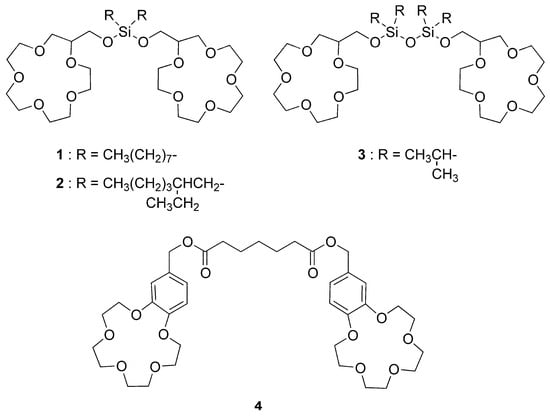
In the present study, we designed and synthesized three new silane- and disiloxane-bridged bis(15-crown-5) derivatives as potential ionophores for K+-ISEs. Unlike our previous solvent-free synthesis of silane-bridged bis(12-crown-4)s [15], the starting material 2-hydroxymethyl-15-crown-5 used in this work is highly viscous, making solvent-free mixing and reaction difficult. Although a solvent such as tetrahydrofuran (THF) is necessary to ensure efficient stirring, a continuous nitrogen stream—previously employed to sweep away the byproduct HCl gas [15]—would cause rapid evaporation of the volatile solvent. To circumvent this problem, we adopted a common solution-phase synthetic approach using THF as the solvent in the presence of imidazole as a base. This allowed the byproduct HCl to be trapped as an insoluble imidazolium chloride precipitate, enabling the reaction to proceed smoothly in a sealed vessel without solvent loss. We prepared silane-bridged bis(15-crown-5)s with octyl (1) and 2-ethylhexyl (2) groups, and a disiloxane-bridged bis(15-crown-5) with isopropyl groups (3). PVC membrane ISEs incorporating these newly synthesized ionophores were fabricated, and their potentiometric performances, including response slopes, pH dependence, and potentiometric selectivity coefficients (log kK,C) for K+ over various interfering cations Cn+ (Li+, Na+, Rb+, Cs+, Mg2+, Ca2+, NH4+, and H+), were evaluated. Furthermore, the effects of the bridging structures and the substituent groups on the electrode selectivity and potentiometric performance in strongly acidic media were compared with those of commercially available pimelate-bridged bis(benzo-15-crown-5) (4) and valinomycin. The principal novelty of this molecular design lies in demonstrating that the ion selectivity of the silicon-bridged bis(crown ether) platform can be tuned by changing the crown ether ring size: together with our previously reported Na+-selective bis(12-crown-4) ionophores, the present bis(15-crown-5) derivatives establish a switch in preferred ion from Na+ to K+ within the same molecular design concept. The structural formulas of ionophores 1–4 are shown in Figure 1.
Figure 1.
Chemical structures of the silane-bridged bis(15-crown-5) ionophores (1 and 2), the disiloxane-bridged bis(15-crown-5) ionophore (3), and the commercially available pimelate-bridged bis(benzo-15-crown-5) ionophore (4).
2. Materials and Methods
2.1. Chemicals and Apparatus
2-Hydroxymethyl-15-crown-5 (15C5-CH2OH) (TCI, Tokyo, Japan; >96.0%) was dried with Molecular Sieves 3A 1/16 for more than 24 h, and further dried under vacuum over P2O5. Imidazole (TCI; >98.0%) was also dried in vacuo over P2O5 before use. Dichlorodioctylsilane (TCI; >96.0%), dichlorobis(2-ethylhexyl)silane (TCI; >95.0%), 1,3-dichloro-1,1,3,3-tetraisopropyldisiloxane (Sigma-Aldrich/Merck, Darmstadt, Germany; 97%), and tetrahydrofuran (Fujifilm Wako Pure Chemical Corp., Osaka, Japan; Super Dehydrated, Stabilizer Free) were used as received for the synthesis of the ionophores. For the preparation of the PVC membranes, bis[(benzo-15-crown-5)-4-methyl]pimelate (Fujifilm Wako; for Cellbiology; >98.0%), valinomycin (Fujifilm Wako; for Cellbiology), and o-nitrophenyl octyl ether (Fujifilm Wako; for Cellbiology; >99.0%) were used as received. Poly(vinyl chloride) (PVC) (Wako Pure Chemical Industries, Osaka, Japan) was purified by dissolving it in tetrahydrofuran, followed by precipitation via the addition of distilled methanol and subsequent filtration; this process was repeated three times, and the PVC was dried under reduced pressure. Potassium tetrakis(4-chlorophenyl)borate (Fujifilm Wako; 98%) was used as a lipophilic anion exchanger. Deionized water was obtained using a Demi-Ace Model DX-15A demineralizer (Kurita Water Industries, Tokyo, Japan) and further purified with a Millipore Simplicity UV System (Merck, Darmstadt, Germany).
All chloride salts (LiCl, NaCl, KCl, RbCl, CsCl, MgCl2∙6H2O, CaCl2∙2H2O, and NH4Cl), as well as HCl, NaOH, and the organic solvents used for extraction and HPLC (toluene and methanol), were of guaranteed reagent grade and used without further purification.
An HPLC system for purification of the products was composed of an LC-10AD pump (Shimadzu, Kyoto, Japan), a CTO-10A column oven (Shimadzu), a DGU-14A degasser (Shimadzu), and an RI-101 refractive index detector (Showa Denko, Tokyo, Japan). Identification of the synthetic products was carried out using a JNM-ECS400 FT-NMR spectrometer (JEOL, Tokyo, Japan) and an Exactive mass spectrometer (Thermo Fisher Scientific, Waltham, MA, USA) at the Center for Analytical Instrumentation, Chiba University. An F-72 pH/ion meter (Horiba, Kyoto, Japan) was used as a potentiometer for the performance testing of the ion-selective electrodes, along with a 2565A double-junction-type reference electrode (Horiba).
2.2. Synthesis of Silane- and Disiloxane-Bridged Bis(15-crown-5) Ionophores
2.2.1. Bis[(15-crown-5)methoxy]dioctylsilane 1
Dichlorodioctylsilane (0.213 g, 0.000655 mol), 2-(hydroxymethyl)-15-crown-5 (0.402 g, 0.00161 mol), imidazole (0.109 g, 0.00161 mol), and tetrahydrofuran (3 mL) were mixed and stirred in a sealed vessel for 15 h. The byproduct HCl reacted with imidazole to form an imidazolium chloride precipitate. After most of the tetrahydrofuran was removed under reduced pressure, water (10 mL) and toluene (10 mL) were added to the residue, and the mixture was shaken for 5 min. After centrifugation, the toluene phase was transferred to another vessel. Another 10 mL of toluene was added to the remaining aqueous phase, and the mixture was shaken for 5 min. The resulting organic phase was separated and combined with the previously collected toluene phase. Water (10 mL) was added to the combined organic phase (approximately 20 mL) and shaken for 5 min for water washing. This water-washing process was repeated three times in total. Toluene was removed under reduced pressure to afford the crude product (0.40 g). A portion of the crude product was purified by preparative HPLC using an ODS column (Mightysil RP-18(L)GP, Kanto Chemical Co., Inc., Tokyo, Japan; I.D.: 20 mm, length: 250 mm, particle size: 5 μm) at 40 °C with methanol as the mobile phase at a flow rate of 5 mL min−1. The fraction corresponding to the product peak (retention time ≈ 19 min) was collected, the solvent was removed under reduced pressure, and the residue was further dried under vacuum over P2O5. The overall yield of the purified product, estimated from the amount recovered from a portion of the crude product subjected to preparative HPLC, was approximately 49% based on the limiting starting material (dichlorodioctylsilane). The purified compound 1 was used for preparation of the PVC membrane electrodes and was characterized by 1H NMR and HRMS (ESI+). 1H NMR (400 MHz, CDCl3) δ (ppm): 0.60 (t, J = 7.8 Hz, 4H, SiCH2 of octyl), 0.88 (t, J = 6.8 Hz, 6H, CH3 of octyl), 1.26–1.32 (m, 24H, CH2 of octyl), 3.63–3.84 (m, 42H, CH and CH2 of (15-crown-5)methoxy). HRMS (ESI+) m/z: calcd for C38H80NO12Si+ [M + NH4]+ 770.5450, found 770.5440; calcd for C38H76O12SiNa+ [M + Na]+ 775.5004, found 775.4967; calcd for C38H76O12SiK+ [M + K]+ 791.4743, found 791.4723.
2.2.2. Bis[(15-crown-5)methoxy]bis(2-ethylhexyl)silane 2
Dichlorobis(2-ethylhexyl)silane (0.444 g, 0.00136 mol), 2-(hydroxymethyl)-15-crown-5 (0.817 g, 0.00326 mol), imidazole (0.232 g, 0.00322 mol), and tetrahydrofuran (6 mL) were mixed and stirred in a sealed vessel for 50 h. The byproduct HCl reacted with imidazole to form an imidazolium chloride precipitate. After most of the tetrahydrofuran was removed under reduced pressure, water (10 mL) and toluene (10 mL) were added to the residue, and the mixture was shaken for 5 min. After centrifugation, the toluene phase was transferred to another vessel, and water (10 mL) was added and shaken for 5 min for water washing. This water-washing process was repeated three times in total. Toluene was removed under reduced pressure to afford the crude product (0.91 g). A portion of the crude product was purified by preparative HPLC (retention time ≈ 22 min) under the same conditions as described for 1. The collected fraction was evaporated under reduced pressure, and the residue was further dried under vacuum over P2O5. The overall yield of the purified product, estimated in the same manner as for 1, was approximately 62% based on the limiting starting material (dichlorobis(2-ethylhexyl)silane). The purified compound 2 was used for preparation of the PVC membrane electrodes and was characterized by 1H NMR and HRMS (ESI+). 1H NMR (400 MHz, CDCl3) δ (ppm): 0.59 (d, J = 7.2 Hz, 4H, SiCH2 of 2-ethylhexyl), 0.83 (t, J = 7.4 Hz, 6H, CH3 of hexyl), 0.89 (t, J = 7.0 Hz, 6H, CH3 of 2-ethyl), 1.19–1.39 (m, 16H, CH2 of 2-ethylhexyl), 1.46–1.51 (m, 2H, CH of 2-ethylhexyl), 3.62–3.81 (m, 42H, CH and CH2 of (15-crown-5)methoxy). HRMS (ESI+) m/z: calcd for C38H80NO12Si+ [M + NH4]+ 770.5450, found 770.5469; calcd for C38H76O12SiNa+ [M + Na]+ 775.5004, found 775.4997; calcd for C38H76O12SiK+ [M + K]+ 791.4743, found 791.4755.
2.2.3. 1,3-Bis[(15-crown-5)methoxy]-1,1,3,3-tetraisopropyldisiloxane 3
1,3-Dichloro-1,1,3,3-tetraisopropyldisiloxane (0.222 g, 0.000704 mol), 2-(hydroxymethyl)-15-crown-5 (0.405 g, 0.00162 mol), imidazole (0.110 g, 0.00162 mol), and tetrahydrofuran (3 mL) were mixed and stirred in a sealed vessel for 15 h. The byproduct HCl reacted with imidazole to form an imidazolium chloride precipitate. After most of the tetrahydrofuran was removed under reduced pressure, water (10 mL) and toluene (10 mL) were added to the residue, and the mixture was shaken for 5 min. After centrifugation, the toluene phase was transferred to another vessel. Another 10 mL of toluene was added to the remaining aqueous phase, and the mixture was shaken for 5 min. The resulting organic phase was separated and combined with the previously collected toluene phase. Water (10 mL) was added to the combined organic phase (approximately 20 mL) and shaken for 5 min for water washing. This water-washing process was repeated three times in total. Toluene was removed under reduced pressure to afford the crude product (0.46 g). A portion of the crude product was purified by preparative HPLC (retention time ≈ 16 min) under the same conditions as described for 1. The collected fraction was evaporated under reduced pressure, and the residue was further dried under vacuum over P2O5. The overall yield of the purified product, estimated in the same manner as for 1, was approximately 70% based on the limiting starting material (1,3-dichloro-1,1,3,3-tetraisopropyldisiloxane). The purified compound 3 was used for preparation of the PVC membrane electrodes and was characterized by 1H NMR and HRMS (ESI+). 1H NMR (400 MHz, CDCl3) δ (ppm): 0.88–1.04 (m, 28H, CH3 and CH of isopropyl), 3.59–3.81 (m, 42H, CH and CH2 of (15-crown-5)methoxy). HRMS (ESI+) m/z: calcd for C34H74NO13Si2+ [M + NH4]+ 760.4699, found 760.4709; calcd for C34H70O13Si2Na+ [M + Na]+ 765.4253, found 765.4222; calcd for C34H70O13Si2K+ [M + K]+ 781.3992, found 781.4003.
2.3. Preparation of PVC Membrane Electrodes and Potentiometric Measurements
The PVC membrane solutions were prepared by dissolving the ionophore (2.5–3.2 mg), a plasticizer (o-nitrophenyl octyl ether, 47.8 mg), a lipophilic anion exchanger (potassium tetrakis(4-chlorophenyl)borate, 0.5 mg), and purified PVC (16.5 mg) in tetrahydrofuran (1 mL). Approximately 10 μL of this solution was dropped onto a PTFE membrane filter (FP-100, Sumitomo Electric Industries, Osaka, Japan; pore diameter 1 μm, thickness 0.1 mm, diameter 9 mm) twice to ensure uniform coverage; this process was performed 6 times every 10 min, followed by air-drying for 24 h. The resulting membrane was attached to the tip of a silver/silver chloride (Ag/AgCl) electrode body filled with an internal filling solution of 0.001 mol L−1 KCl aqueous solution to construct the liquid-membrane-type ISE. The electrode was immersed in a 0.1 mol L−1 KCl solution for more than 12 h for conditioning. A double-junction-type Ag/AgCl electrode with a composition of Ag/AgCl/KCl (3.3 mol L−1)/CH3COOLi (1.0 mol L−1) was generally employed as the reference electrode. The electromotive force between these electrodes was measured at 25 °C by immersing them in KCl aqueous solutions ranging from 10−6 to 10−1 mol L−1. To evaluate the influence of interfering ions, similar potentiometric measurements were also performed in the presence of various coexisting electrolytes, namely LiCl (0.50 mol L−1), NaCl (0.30 mol L−1), RbCl (0.0010 mol L−1), CsCl (0.0010 mol L−1 for valinomycin and 0.050 mol L−1 for others), MgCl2∙6H2O (0.50 mol L−1), CaCl2∙2H2O (0.50 mol L−1), NH4Cl (0.050 mol L−1), and HCl (0.050 or 0.50 mol L−1). The concentration of each interfering ion was selected according to the expected magnitude of its interference. For the HCl system only, a double-junction reference electrode of Ag/AgCl/KCl (3.3 mol L−1)/NaCl (1.0 mol L−1) was used.
To evaluate the pH dependence of the potentiometric responses for the ISEs based on 2 and valinomycin, the KCl concentration was kept constant at 1.0 × 10⁻⁴ mol L−1, while the pH of the test solution was varied from 1.1 to 12.7 by adding HCl or NaOH. The ionic strength of the solution was adjusted to 0.10 mol L−1 by NaCl. For the pH-dependence measurements, a Ag/AgCl/NaCl (1 mol L−1) electrode was utilized as the reference electrode. The pH-dependence measurements for each ionophore were performed sequentially using the same electrode.
3. Results and Discussion
3.1. Potentiometric Response of ISEs and Potentiometric Selectivity Coefficients in the Presence of Interfering Ions
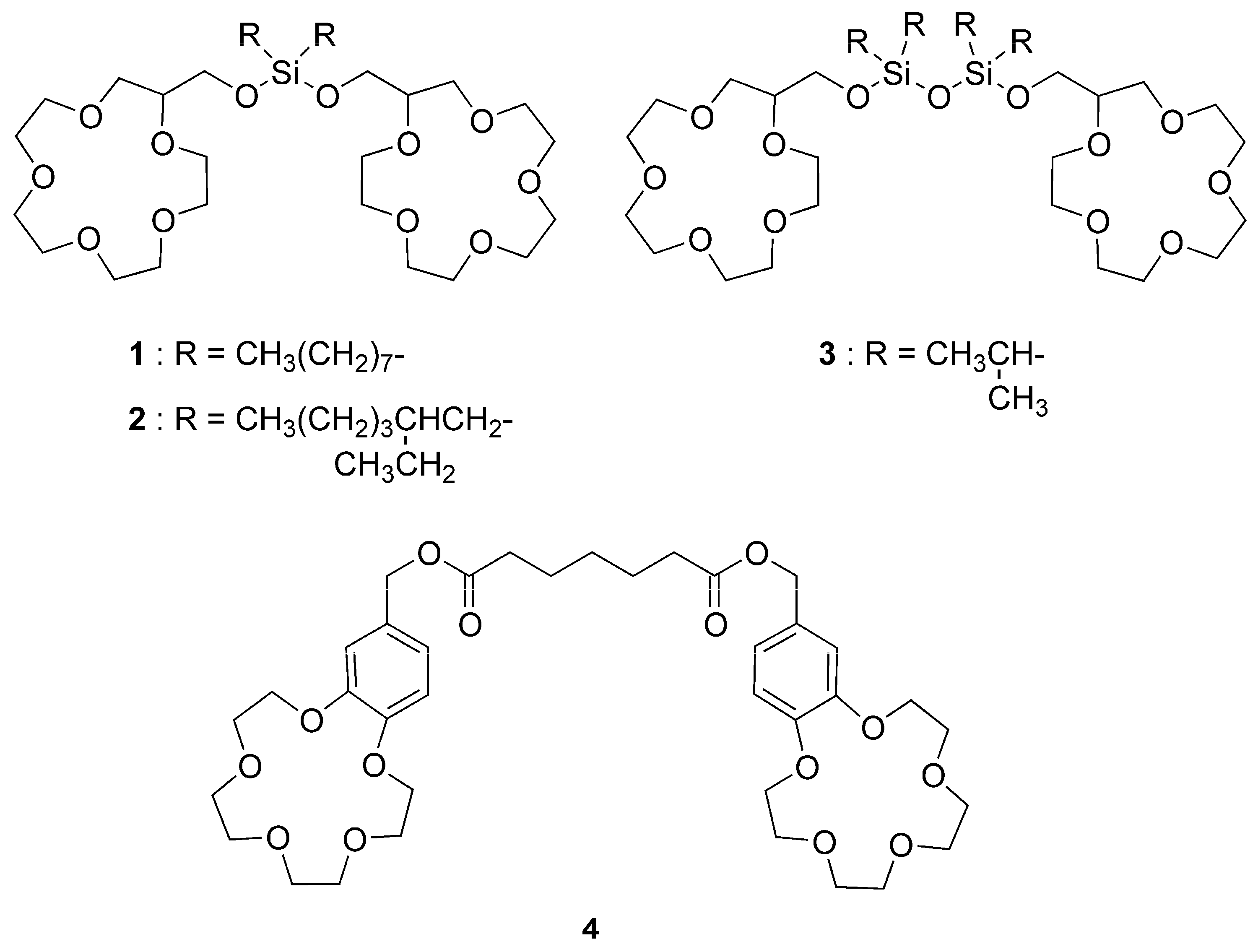
Figure 2 shows the potentiometric response curves, electromotive force (E) vs. logarithm of the K+ activity (log aK), for the liquid-membrane ISEs incorporating ionophores 1, 2, and 3 in aqueous KCl solutions at 25 °C in the absence of interfering salts (black filled circles). The activity coefficients (γ) of ions were estimated using the Davies equation at 25 °C [16]:
where z represents the ionic charge and I is the ionic strength of the solution. For all three ionophores, the ISEs exhibited linear responses with slopes of 55–57 mV/decade in the activity range of aK ≥ 10−5 mol L−1 and 58–59 mV/decade in the range of aK ≥ 10−4 mol L−1, confirming near-Nernstian potentiometric responses (theoretical slope: 59.2 mV/decade at 25 °C).
Figure 2.
Dependence of electromotive force (E) of the ISEs containing 1 (A), 2 (B), and 3 (C) on the logarithmic value of K+ activity (log aK) in aqueous KCl solution at 25 °C in the absence of interfering salt (black filled circles) and in the presence of 0.30 mol L−1 NaCl (red open circles), 0.0010 mol L−1 RbCl (green open circles), 0.050 mol L−1 CsCl (blue open circles), and 0.050 mol L−1 NH4Cl (brown open triangles). The solid curves represent the nonlinear regression fits to the data obtained in the presence of interfering salts using Equation (2).
Figure 2 also overlays the E responses measured in the presence of coexisting salts: 0.30 mol L−1 NaCl, 0.0010 mol L−1 RbCl, 0.050 mol L−1 CsCl, and 0.050 mol L−1 NH4Cl. In these cases, the E value leveled off in the lower log aK region, thereby narrowing the Nernstian response range. The E vs. log aK curves measured in the presence of 0.50 mol L−1 LiCl, MgCl2, or CaCl2 were almost identical to that obtained in the absence of interfering salts (see Tables S1–S3 in Supplementary Materials).
To quantitatively evaluate the preference for K+ over an interfering cation (Cn+), the logarithm of the potentiometric selectivity coefficient, log kK,C, was determined by nonlinear least-squares fitting of the data to the Nikolsky–Eisenman equation at 25 °C [17,18]:
where E is expressed in mV, aC is the activity of Cn+ estimated using Equation (1), n is the charge number of Cn+, and “const” is an adjustable potential term for each response curve. The differences in the absolute potential levels among the electrodes likely originate from differences in the membrane phase-boundary potential and other electrode-specific potential contributions. These contributions are included in the independently fitted constant term in Equation (2); therefore, the absolute potential levels themselves are not directly related to the potentiometric selectivity coefficients. Using the same fixed interference method [18], the log kK,C values were also determined for the ISEs based on the commercially available pimelate-bridged bis(benzo-15-crown-5) 4 and valinomycin. The resulting selectivity coefficients are summarized in Table 1, and the complete potentiometric data used for the nonlinear least-squares analyses are provided in Tables S1–S5.
Table 1.
Potentiometric selectivity coefficients (log kK,C) for K+ over interfering cations Cn+ at 25 °C *.
A smaller kK,C value indicates higher potentiometric selectivity for K+ over the interfering cation Cn+. As shown in Table 1, ISEs incorporating ionophores 1 and 2 exhibited higher K+ selectivity than the commercial bis(benzo-15-crown-5) ionophore 4 over Li+, Na+, Mg2+, and Ca2+, all of which have smaller effective ionic radii than K+ [19]. Specifically, the K+/Na+ selectivity for 1 and 2 was approximately twofold higher (a difference of about 0.3 log unit), and the selectivities over Li+ and Ca2+ were improved by more than one order of magnitude (>1 log unit), while that over Mg2+ was improved by more than sixfold (>0.8 log unit). When compared with valinomycin, 1 and 2 displayed comparable or even superior selectivity toward Li+, Rb+, Cs+, Mg2+, and Ca2+, but lower selectivity toward Na+ and NH4+. For reference, BME-44 (2-dodecyl-2-methyl-1,3-propanediyl bis[N-[5′-nitro(benzo-15-crown-5)-4′-yl]carbamate]), another commercially available bis(benzo-15-crown-5)-type K+ ionophore, has been reported to exhibit a log KpotK,Na value of −3.35 in plasticized PVC membranes [13], which is in a similar range to the log kK,Na values obtained for 1 and 2 in the present study. However, direct quantitative comparison is difficult because different methods and experimental conditions were used.
A comparison among the three newly synthesized ionophores reveals that the silane-bridged isomers 1 and 2 have very similar log kK,C values. Although 1 and 2 differ in the branching of their alkyl substituents (octyl vs. 2-ethylhexyl), this structural difference has negligible influence on their K+ complexation selectivities. On the other hand, compound 3, which possesses a disiloxane bridge and a slightly longer inter-crown distance than 1 and 2, exhibited slightly lower selectivity for K+ over Na+, Mg2+, and Ca2+ relative to 1 and 2. Nevertheless, the selectivity of 3 remained superior or comparable to that of commercial 4.
For the bis(crown ether)-type ionophores (1–4), the overall selectivity sequence for the smaller cations (Li+, Na+, Mg2+, and Ca2+) follows the order: 1 ≈ 2 > 3 > 4. This trend appears to correlate with the structural rigidity and length of the bridging unit connecting the two 15-crown-5 rings. A shorter and more rigid linker may restrict the conformational freedom of the two crown rings and thereby facilitate a spatial arrangement favorable for intramolecular 1:2 (cation:crown) sandwich complexation with K+ (151 pm for coordination number 8 [19]), while disfavoring the binding of smaller cations.
Together with our previous results for Na+-selective silane-bridged bis(12-crown-4) ionophores [15], the present results demonstrate that the ion selectivity of this silane-bridged bis(crown ether) platform can be effectively tuned from Na+ to K+ by changing the crown ether ring size.
3.2. Effect of Hydrogen Ions and pH Dependence
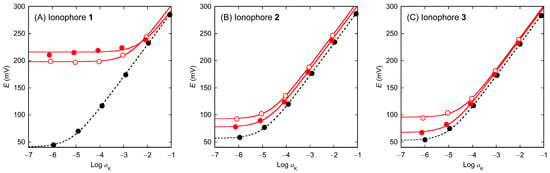
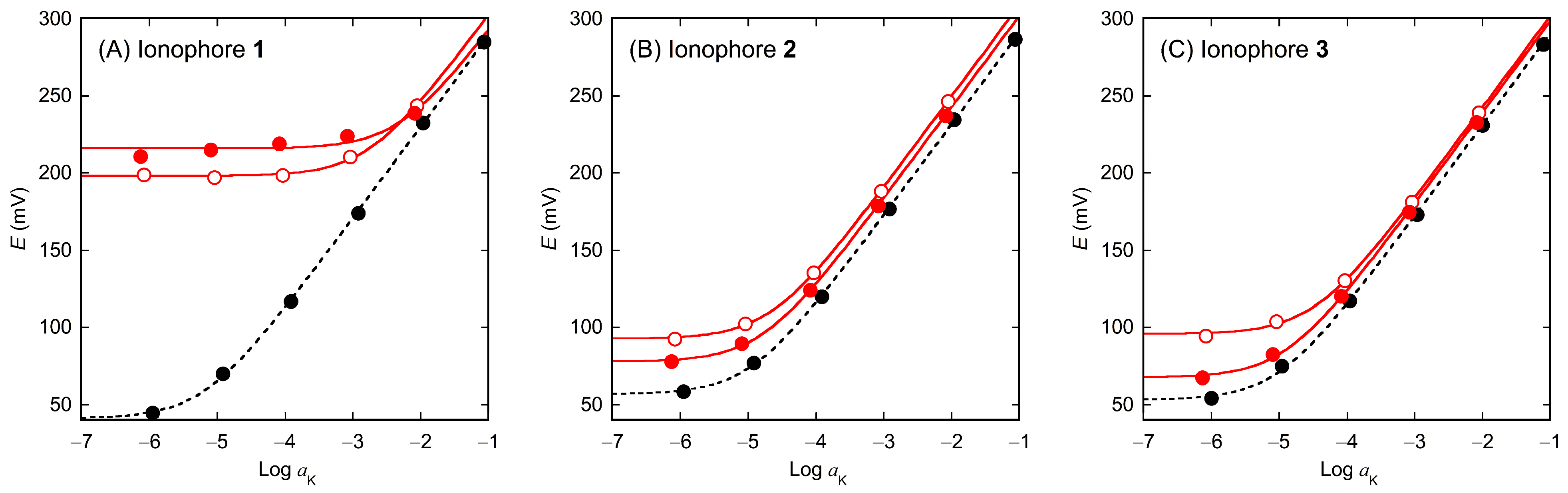
Figure 3 illustrates the E vs. log aK plots for ISEs based on ionophores 1, 2, and 3 in the presence of 0.050 mol L−1 and 0.50 mol L−1 HCl, alongside the response curves in the absence of acid. For ISEs containing 2 and 3, the potentiometric response curves were barely affected even in the presence of a high concentration of acid (0.50 mol L−1 HCl), with 2 showing outstanding acid tolerance. In contrast, for 1, the potentiometric response to K+ was severely degraded even at a lower acid concentration of 0.050 mol L−1 HCl.
Figure 3.
Dependence of E of the ISEs containing 1 (A), 2 (B), and 3 (C) on log aK in aqueous KCl solution at 25 °C in the absence of HCl (black filled circles) and in the presence of 0.050 mol L−1 HCl (red open circles) and 0.50 mol L−1 HCl (red filled circles). The solid curves represent the nonlinear regression fits to the data obtained in the presence of HCl using Equation (2).
The resulting log kK,H values listed in Table 1 show that 2 and 3 (log kK,H < −4.3) exhibit exceptionally high K+/H+ selectivity, exceeding those of commercial ionophore 4 (log kK,H = −2.5) and valinomycin (log kK,H = −3.31). In contrast, ionophore 1 showed substantially lower K+/H+ selectivity (log kK,H = −1.37). While the detailed mechanism remains under investigation, the structural difference of 2 and 3 from 1 lies in the presence or absence of alkyl chain branching. It is plausible that protonation or acid-catalyzed interaction occurs primarily at the electron-dense oxygen atoms adjacent to the silicon unit (Si–O–C linkage); the branched alkyl groups in 2 and 3 may provide steric shielding around the silicon center, thereby suppressing unwanted proton coordination.
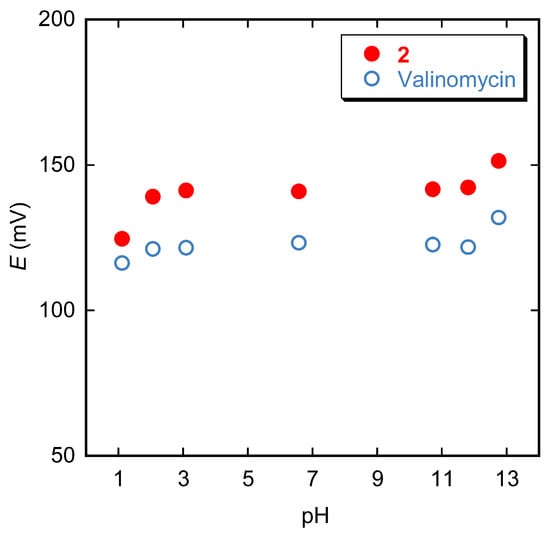
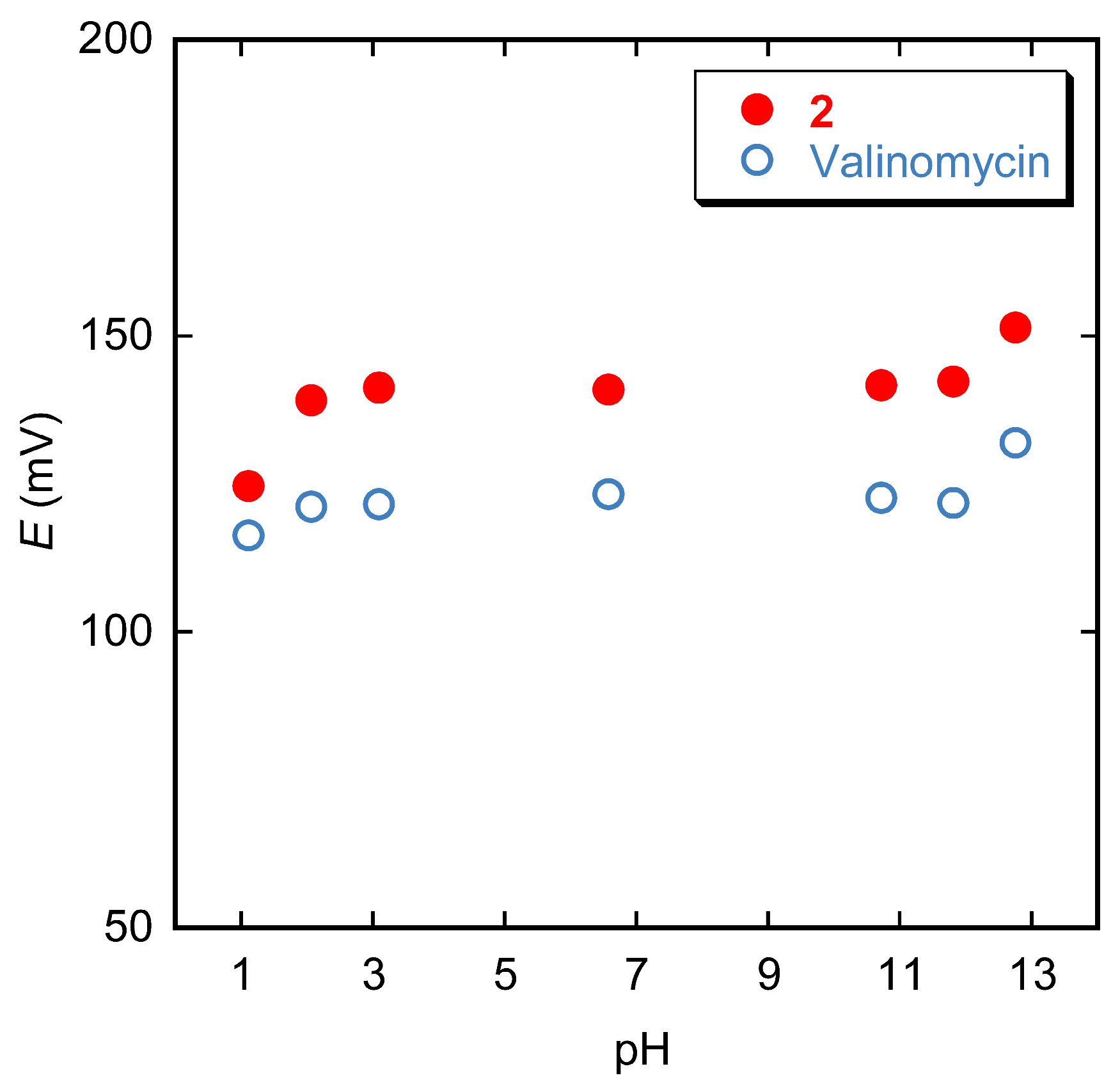
To further evaluate the practical operational pH range, the pH dependences of E for ISEs based on 2 and valinomycin were investigated at a constant K+ concentration (1.0 × 10⁻⁴ mol L−1) and constant ionic strength (0.10 mol L−1), and the results are shown in Figure 4. For each ionophore, all data points were obtained sequentially using the same electrode at the corresponding pH values. Both electrodes exhibited similarly broad pH-independent response regions between approximately pH 2 and 12.
Figure 4.
pH dependence of E of the ISEs containing 2 (red filled circles) and valinomycin (blue open circles) at 25 °C at a constant K+ concentration (1.0 × 10⁻⁴ mol L−1) and constant ionic strength (0.10 mol L−1, adjusted with HCl, NaOH, and NaCl).
3.3. Long-Term Retention of K+/Na+ Selectivity
To evaluate the long-term retention of K+/Na+ selectivity, the log kK,Na values of ISEs containing 2, commercial ionophore 4, and valinomycin were determined repeatedly over an extended period. Between measurements, the electrode membrane caps were detached, air-dried, and stored in a sealed container at room temperature. For each ionophore, the same electrode was repeatedly evaluated throughout the storage period.
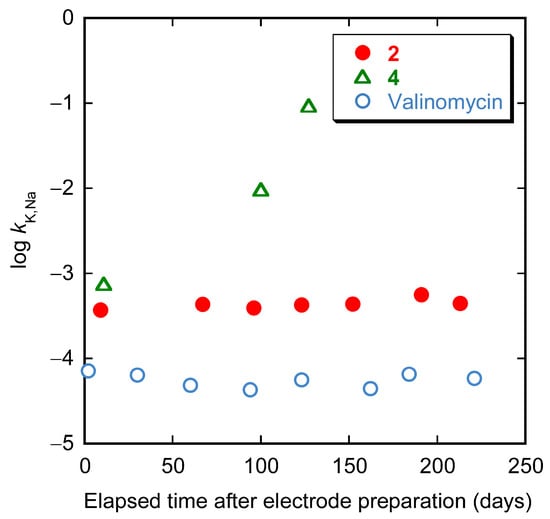
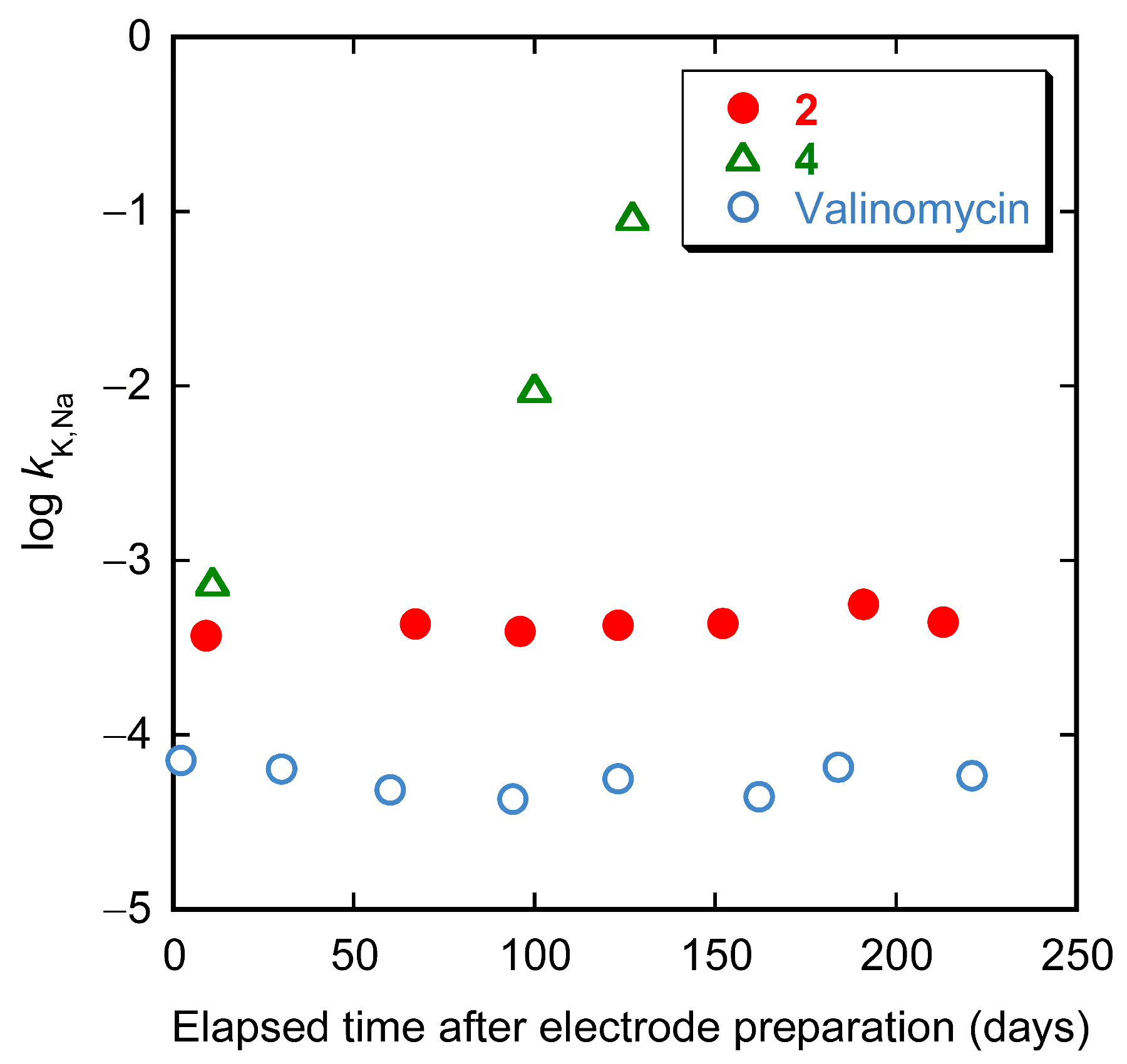
Figure 5 shows the dependence of log kK,Na on the elapsed time after electrode preparation. The ISE incorporating ionophore 2 maintained a nearly constant K+/Na+ selectivity (log kK,Na ≈ −3.4) for more than 200 days under these storage conditions. Its temporal stability was comparable to that of valinomycin, although its absolute K+/Na+ selectivity was lower. In contrast, the ISE based on commercial ionophore 4 showed a marked loss of selectivity after approximately 100 days: its log kK,Na value increased by approximately one log unit and continued to increase thereafter. Because the electrodes based on 2, 4, and valinomycin were prepared using the same membrane formulation except for the ionophore and were stored and measured under the same conditions, the pronounced deterioration observed only for 4 is most reasonably attributed to gradual chemical degradation of ionophore 4 and/or its loss from the membrane by leaching during repeated measurements. These results demonstrate that the ISE based on 2 retains its K+/Na+ selectivity more effectively than the ISE based on 4 under the present storage conditions.
Figure 5.
Changes in the K+/Na+ potentiometric selectivity coefficient (log kK,Na) with elapsed time after electrode preparation for ISEs based on ionophore 2 (red filled circles), commercial ionophore 4 (green open triangles), and valinomycin (blue open circles).
4. Conclusions
In conclusion, new silane-bridged bis(15-crown-5) derivatives (1 and 2) and a disiloxane-bridged bis(15-crown-5) derivative (3) were successfully evaluated as ionophores for K+-selective liquid-membrane electrodes. The ISEs based on compounds 1 and 2 demonstrated near-Nernstian responses and remarkably high K+ selectivity, particularly over Li+, Na+, Mg2+, and Ca2+, outperforming the widely used commercial pimelate-bridged ionophore 4 for these cations and exhibiting selectivity comparable to that of the natural ionophore valinomycin for most of the metal cations examined. In particular, ionophore 2 with branched 2-ethylhexyl groups displayed outstanding tolerance to strongly acidic media and retained its K+/Na+ selectivity for more than 200 days under intermittent dry-storage conditions. These findings demonstrate that the introduction of silane/disiloxane bridges provides a highly effective strategy for designing robust, high-performance synthetic K+ ionophores for potentiometric sensing. Further studies using complex sample matrices, including biological fluids and agricultural samples, will be required to establish their practical analytical applicability.
5. Patents
A patent application related to this research has been filed (Japanese Patent Application No. 2026-031336).
Supplementary Materials
The following supporting information can be downloaded at https://www.mdpi.com/article/10.3390/electrochem7030027/s1, Figure S1: 1H NMR spectrum of 1; Figure S2: High-resolution mass spectrum of 1; Figure S3: 1H NMR spectrum of 2; Figure S4: High-resolution mass spectrum of 2; Figure S5: 1H NMR spectrum of 3; Figure S6: High-resolution mass spectrum of 3; Table S1: Potentiometric data used to determine the selectivity coefficients of the ISE based on 1 at 25 °C; Table S2: Potentiometric data used to determine the selectivity coefficients of the ISE based on 2 at 25 °C; Table S3: Potentiometric data used to determine the selectivity coefficients of the ISE based on 3 at 25 °C; Table S4: Potentiometric data used to determine the selectivity coefficients of the ISE based on 4 at 25 °C; Table S5: Potentiometric data used to determine the selectivity coefficients of the ISE based on valinomycin at 25 °C.
Author Contributions
Conceptualization, S.K.; methodology, S.K.; validation, S.K. and M.S.; formal analysis, S.K. and M.S.; investigation, S.K. and M.S.; resources, S.K.; data curation, S.K. and M.S.; writing—original draft preparation, S.K.; writing—review and editing, S.K.; visualization, S.K. and M.S.; supervision, S.K.; project administration, S.K.; funding acquisition, S.K. All authors have read and agreed to the published version of the manuscript.
Funding
This research was funded by the Japan Society for the Promotion of Science, grant number 22K05151.
Institutional Review Board Statement
Not applicable.
Informed Consent Statement
Not applicable.
Data Availability Statement
The original contributions presented in this study are included in the article/Supplementary Materials. Further inquiries can be directed to the corresponding author.
Acknowledgments
The authors thank M. Sashida for assistance with the NMR measurements and the staff of the Center for Analytical Instrumentation, Chiba University, for their technical assistance with the mass spectrometry analyses.
Conflicts of Interest
The authors declare no conflicts of interest.
References
- Palmer, B.F. Regulation of Potassium Homeostasis. Clin. J. Am. Soc. Nephrol. 2015, 10, 1050–1060. [Google Scholar] [CrossRef] [Scilit] [PubMed]
- Udensi, U.K.; Tchounwou, P.B. Potassium Homeostasis, Oxidative Stress, and Human Disease. Int. J. Clin. Exp. Physiol. 2017, 4, 111–122. [Google Scholar] [CrossRef] [Scilit] [PubMed]
- Bakker, E.; Telting-Diaz, M. Electrochemical Sensors. Anal. Chem. 2002, 74, 2781–2800. [Google Scholar] [CrossRef] [Scilit] [PubMed]
- Zörb, C.; Senbayram, M.; Peiter, E. Potassium in Agriculture—Status and Perspectives. J. Plant Physiol. 2014, 171, 656–669. [Google Scholar] [CrossRef] [Scilit] [PubMed]
- Dean, J.A. Flame Photometry; McGraw-Hill: New York, NY, USA, 1960. [Google Scholar]
- Small, H.; Stevens, T.S.; Bauman, W.C. Novel Ion Exchange Chromatographic Method Using Conductimetric Detection. Anal. Chem. 1975, 47, 1801–1809. [Google Scholar] [CrossRef] [Scilit]
- Bakker, E.; Pretsch, E. Potentiometric Sensors for Trace-Level Analysis. Trends Anal. Chem. 2005, 24, 199–207. [Google Scholar] [CrossRef] [Scilit] [PubMed]
- Bühlmann, P.; Pretsch, E.; Bakker, E. Carrier-Based Ion-Selective Electrodes and Bulk Optodes. 2. Ionophores for Potentiometric and Optical Sensors. Chem. Rev. 1998, 98, 1593–1688. [Google Scholar] [CrossRef] [Scilit] [PubMed]
- Bakker, E.; Bühlmann, P.; Pretsch, E. Carrier-Based Ion-Selective Electrodes and Bulk Optodes. 1. General Characteristics. Chem. Rev. 1997, 97, 3083–3132. [Google Scholar] [CrossRef] [Scilit] [PubMed]
- Pinkerton, M.; Steinrauf, L.K.; Dawkins, P. The Molecular Structure and Some Transport Properties of Valinomycin. Biochem. Biophys. Res. Commun. 1969, 35, 512–518. [Google Scholar] [CrossRef] [Scilit] [PubMed]
- Kimura, K.; Maeda, T.; Tamura, H.; Shono, T. Potassium-Selective PVC Membrane Electrodes Based on Bis- and Poly(crown ether)s. J. Electroanal. Chem. 1979, 95, 91–101. [Google Scholar] [CrossRef]
- Tamura, H.; Kimura, K.; Shono, T. Coated Wire Sodium- and Potassium-Selective Electrodes Based on Bis(crown ether) Compounds. Anal. Chem. 1982, 54, 1224–1227. [Google Scholar] [CrossRef] [Scilit]
- Bereczki, R.; Gyurcsányi, R.E.; Ágai, B.; Tóth, K. Synthesis and Characterization of Covalently Immobilized Bis-Crown Ether Based Potassium Ionophore. Analyst 2005, 130, 63–70. [Google Scholar] [CrossRef] [Scilit] [PubMed]
- Spindler, B.D.; Chen, X.V.; Graf, K.I.; Bühlmann, P.; Stein, A. Potassium Ion-Selective Electrodes with BME-44 Ionophores Covalently Attached to Condensation-Cured Silicone Membranes. Langmuir 2024, 40, 18112–18121. [Google Scholar] [CrossRef] [Scilit] [PubMed]
- Katsuta, S.; Ino, Y.; Wakabayashi, H. Silicon-Bridged Bis(12-crown-4) Ethers as Ionophores for Sodium Ion-Selective Electrodes. Molecules 2025, 30, 925. [Google Scholar] [CrossRef] [Scilit] [PubMed]
- Davies, C.W. Ion Association; Butterworths: London, UK, 1962. [Google Scholar]
- Nikolskii, B.P. Theory of the Glass Electrode. I. Theoretical. Zh. Fiz. Khim. 1937, 10, 495–503. Available online: https://elchi.eu/pdf/ZhurnalFizKhim/ZFKh-1937-v10-p495_Nikolskyi.pdf (accessed on 1 August 2026).
- Umezawa, Y.; Bühlmann, P.; Umezawa, K.; Tohda, K.; Amemiya, S. Potentiometric Selectivity Coefficients of Ion-Selective Electrodes. Part I. Inorganic cations (Technical report). Pure Appl. Chem. 2000, 72, 1851–2082. [Google Scholar] [CrossRef] [Scilit]
- Shannon, R.D.; Prewitt, C.T. Effective Ionic Radii in Oxides and Fluorides. Acta Crystallogr. B 1969, 25, 925–946. [Google Scholar] [CrossRef] [Scilit]

Disclaimer/Publisher’s Note: The statements, opinions and data contained in all publications are solely those of the individual author(s) and contributor(s) and not of MDPI and/or the editor(s). MDPI and/or the editor(s) disclaim responsibility for any injury to people or property resulting from any ideas, methods, instructions or products referred to in the content. |
© 2026 by the authors. Licensee MDPI, Basel, Switzerland. This article is an open access article distributed under the terms and conditions of the Creative Commons Attribution (CC BY) license.