


Abstract
Photoelectrochemical (PEC) energy conversion is a promising approach for solar-to-chemical fuel production, but its practical performance is limited by insufficient visible-light utilization and charge-carrier recombination. Here, poly(3,4-ethylenedioxythiophene) (PEDOT)-centered TiO2 hybrid electrodes were prepared by electropolymerizing PEDOT on FTO substrates, followed by electrochemical doping/dedoping treatment and coating with commercial TiO2 as a model oxide semiconductor. SEM, EDS, and LIBS analyses confirmed the successful deposition of TiO2 onto PEDOT-based films. Four-probe measurements showed that electrochemical doping reduced the apparent resistance of PEDOT-based electrodes, while UV–vis spectroscopy revealed enhanced long-wavelength absorption for doped PEDOT-containing films. PEC measurements using TiO2, PEDOT, and TiO2–PEDOT electrodes showed that PEDOT-containing electrodes exhibited much stronger photoresponses than commercial TiO2 alone under both HER- and OER-relevant conditions. The TiO2–PEDOT electrode showed stable photocurrent responses under chopped illumination and retained photoresponse under illumination transmitted through a 410 nm UV-cut filter, supporting the primary role of PEDOT in visible-light utilization. Long-term chronoamperometry further showed that TiO2–PEDOT retained approximately 99.0% of its cathodic current under HER-relevant conditions and 91.9% of its anodic current under OER-relevant conditions after 5200 s of continuous illumination. The improved response of TiO2–PEDOT compared with PEDOT alone suggests that TiO2/PEDOT physical contact may assist interfacial charge separation and transport. These findings demonstrate that PEDOT-centered metal oxide/conducting polymer hybrids provide a useful model platform for visible-light-responsive PEC energy-conversion applications.
1. Introduction
Photoelectrochemical (PEC) water splitting is a promising approach for converting solar energy into chemical fuels through light-driven hydrogen evolution and oxygen evolution processes [1,2,3]. In PEC systems, the hydrogen evolution reaction (HER) requires efficient transfer of photogenerated electrons to proton-reduction sites, whereas the oxygen evolution reaction (OER) requires effective utilization of photogenerated holes and sufficient stability under oxidative conditions [1,2,3]. Despite extensive progress, practical PEC performance is still limited by rapid charge-carrier recombination, sluggish interfacial charge transfer, and insufficient utilization of the visible region of the solar spectrum [2,3]. Therefore, developing photoelectrode materials that can broaden light absorption while facilitating charge separation and transport remains an important challenge [4,5,6].
Interfacial and heterostructure engineering has been widely used to improve PEC performance by promoting charge separation, regulating carrier transport, and suppressing recombination [2,3]. For example, metal/semiconductor junctions can facilitate carrier extraction through Schottky-type interfaces, while semiconductor/semiconductor heterojunctions can enhance charge separation when favorable band alignment is achieved [7,8]. In addition, sensitization of wide-band-gap oxide semiconductors is an effective strategy for extending the photoresponse into the visible-light region. Recent studies on quantum-dot-sensitized TiO2 photoelectrodes have shown that visible-light-active sensitizers can improve PEC hydrogen-generation performance by enhancing light harvesting and charge transport [9]. These studies highlight the importance of integrating visible-light-absorbing components with stable oxide semiconductors for improved PEC operation.
Organic and π-conjugated semiconductor-based photoelectrodes have also attracted increasing attention for PEC energy conversion because their molecular structures can be tailored to improve visible-light absorption, interfacial charge transport, and device stability [10,11]. In particular, semiconductor/conducting polymer hybrid systems provide flexible platforms for combining the tunable electronic and optical properties of conducting polymers with the chemical stability and well-established photoelectrochemical functionality of inorganic semiconductors [5,12,13,14]. In such hybrid systems, conducting polymers can serve not only as conductive additives or interfacial layers, but also as visible-light-harvesting and charge-transport components [4,14].
Among conducting polymers, poly(3,4-ethylenedioxythiophene) (PEDOT) is particularly attractive for PEC-related applications because of its relatively high electrical conductivity, electrochemical stability, and broad optical absorption extending from the visible to near-infrared region [15,16,17]. PEDOT has been used as a conductive host, interfacial layer, and charge-transport component in electrochemical and photoelectrochemical systems [14,15,18,19]. Importantly, the electronic and optical properties of PEDOT are strongly influenced by its doping state. In the doped state, PEDOT contains mobile charge carriers commonly described as polarons and bipolarons, which enhance electrical conductivity and introduce sub-bandgap optical absorption features [16,17,20,21]. In contrast, dedoped or less-doped PEDOT generally exhibits lower carrier density and reduced charge-transport efficiency. Therefore, controlling and comparing the doping state of PEDOT is important for understanding its role in hybrid photoelectrodes.
TiO2 is one of the most widely studied oxide semiconductors for PEC and photocatalytic applications because of its chemical stability, low cost, and favorable band-edge characteristics [22,23]. However, its wide band gap restricts light absorption mainly to the ultraviolet region, limiting its ability to utilize visible light [22,23]. Various TiO2-based hybrid and sensitized structures have therefore been developed to improve visible-light utilization and charge separation [9,22,23,24,25]. PEDOT/TiO2-based hybrid electrodes have also been reported to enhance photoelectrochemical or photocatalytic performance through improved light harvesting and interfacial charge transport [5,12,13,24,25]. However, in many systems, the role of PEDOT is often discussed mainly as a conductive or interfacial component, while the relationship among PEDOT doping state, optical absorption, apparent electrical resistance, and PEC-relevant photoresponse has not been fully clarified in a simple TiO2-based model system.
In this study, commercial TiO2 was deliberately used as a model oxide semiconductor rather than as an optimized nanostructured photoelectrode. This approach allows the contribution of PEDOT-based functionality to be examined more directly, without the additional complexity introduced by advanced TiO2 morphology, defect engineering, or surface modification. PEDOT-based electrodes were prepared by electropolymerizing PEDOT on FTO substrates, followed by electrochemical doping/dedoping treatment and, where applicable, coating with commercial TiO2 slurry. The structural, optical, and apparent electrical properties of PEDOT, doped PEDOT, TiO2–PEDOT, and TiO2-doped PEDOT electrodes were systematically examined to clarify how the PEDOT doping state affects light absorption and apparent resistance. PEC measurements were then performed using TiO2, PEDOT, and TiO2–PEDOT electrodes under HER- and OER-relevant conditions to evaluate the role of PEDOT incorporation in photoinduced charge utilization.
The novelty of this work lies in treating PEDOT as the central visible-light-harvesting and charge-transport component in a commercial TiO2-based hybrid electrode, rather than merely as an auxiliary conductive layer. By comparing TiO2, PEDOT, and TiO2–PEDOT electrodes, this study clarifies that PEDOT primarily governs visible-light utilization, while the TiO2/PEDOT contact provides an additional interfacial contribution to PEC photoresponse. These results provide insight into the design of conducting-polymer-centered metal oxide hybrid photoelectrodes for visible-light-responsive PEC energy-conversion applications.
2. Materials and Methods
2.1. Materials and Electrode Preparation
3,4-Ethylenedioxythiophene (EDOT, >98.0%, TCI, Tokyo, Japan), lithium perchlorate (LiClO4, 98.0+%, FUJIFILM Wako Pure Chemical Corporation, Osaka, Japan), acetonitrile (CH3CN, HPLC grade, FUJIFILM Wako Pure Chemical Corporation, Japan), titanium dioxide (TiO2, anatase/rutile nanofibers, Sigma-Aldrich, Hong Kong, China), ethanol (C2H5OH, 99.5%, FUJIFILM Wako Pure Chemical Corporation, Japan), sodium sulfate (Na2SO4, ACS reagent, ≥99.0%, anhydrous, Sigma-Aldrich), deionized water, and Nafion® solution (5 wt.% in a mixture of lower aliphatic alcohols and water, Sigma-Aldrich) were used as received. Fluorine-doped tin oxide (FTO)-coated glass substrates with a nominal sheet resistance of approximately 7 Ω sq−1 (AS ONE Corporation, Osaka, Japan) were cut into 1 cm × 1 cm pieces and used as electrode substrates. Unless otherwise stated, the geometric electrode area was controlled at 1 cm2. Commercial TiO2 was used without additional morphology, defect, or surface optimization so that the contribution of PEDOT and its doping state could be evaluated in a simple model oxide semiconductor system.
PEDOT-based films were prepared by electrochemical polymerization in a conventional three-electrode cell using an Autolab PGSTAT204 potentiostat. The FTO substrate, a platinum plate, and an Ag/Ag+ electrode were used as the working electrode, counter electrode, and reference electrode, respectively. The Ag/Ag+ reference electrode contained 0.01 M AgNO3 and 0.1 M tetrabutylammonium perchlorate (TBAP) in acetonitrile. The polymerization electrolyte consisted of 0.01 M EDOT and 0.1 M LiClO4 in acetonitrile. Electropolymerization was carried out potentiostatically at 1.2 V vs. Ag/Ag+ until a total charge of 50 mC was passed. Because electropolymerized PEDOT is formed in an oxidized conducting state, the resulting as-electropolymerized film is referred to as doped PEDOT in this work.
To obtain the dedoped PEDOT film, the as-electropolymerized doped PEDOT film was immersed in 0.1 M TBAP in acetonitrile and held at −0.5 V vs. Ag/Ag+ for 5 min [26]. The resulting dedoped film is referred to as PEDOT hereafter. This electrochemical doping/dedoping procedure was used to examine how the doping state of PEDOT affects the optical and apparent electrical properties of the prepared electrodes.
The TiO2 slurry was prepared by dispersing 4 mg of commercial TiO2 in a mixture of 0.375 mL deionized water, 0.125 mL ethanol, and 50 μL of 5 wt.% Nafion solution. The mixture was thoroughly mixed to obtain a visually homogeneous slurry [27,28]. For the TiO2 electrode, 10 μL of the TiO2 slurry was applied directly onto the FTO substrate. For the hybrid electrodes, the same volume of TiO2 slurry was applied onto either PEDOT or doped PEDOT films to obtain TiO2–PEDOT and TiO2-doped PEDOT, respectively. Thus, the nominal TiO2 loading was controlled by using the same slurry concentration and coating volume for all TiO2-containing electrodes. The coated electrodes were dried at 60 °C for 1 h before further characterization and measurements.
2.2. Characterization
The surface morphology and elemental distribution of the prepared films were examined by a scanning electron microscope (SEM, Hitachi SU4300SE, Tokyo, Japan) equipped with energy-dispersive X-ray spectroscopy (EDS, Horiba EMAX EX-250, Kyoto, Japan). SEM observations were performed for PEDOT, doped PEDOT, TiO2–PEDOT, and TiO2-doped PEDOT films to evaluate the surface morphology and TiO2 dispersion on the PEDOT-based electrodes. EDS elemental mapping was used to qualitatively confirm the spatial distribution of characteristic elements, particularly S from PEDOT and Ti from TiO2, in the hybrid films.
The apparent resistance of the prepared electrodes was evaluated using a four-point probe meter (Loresta-AX, MCP-T370, Mitsubishi Chemical Analytech, Tokyo, Japan). Each sample was measured three times to confirm reproducibility. The measurements were performed for bare FTO, TiO2, PEDOT, doped PEDOT, TiO2–PEDOT, and TiO2-doped PEDOT electrodes to compare the influence of PEDOT doping and TiO2 incorporation on the apparent electrical resistance of the electrode films. Because the films were prepared on conductive FTO substrates, the measured values were treated as apparent resistance values for comparative evaluation rather than intrinsic film conductivity.
Laser-induced breakdown spectroscopy (LIBS, EA-300 VHX series, KEYENCE Corporation, Osaka, Japan) was used to analyze the elemental composition of the prepared films. LIBS measurements were conducted for bare FTO, TiO2, PEDOT, doped PEDOT, TiO2–PEDOT, and TiO2-doped PEDOT samples. The elemental ratios were normalized to the Sn signal from the FTO substrate, which served as an internal reference.
The optical absorption properties of the films were characterized by UV–vis absorption spectroscopy using a UV–vis spectrophotometer (UV-2600, Shimadzu Corporation, Kyoto, Japan). The spectra were recorded over the wavelength range of 300–900 nm. UV–vis measurements were performed for PEDOT, doped PEDOT, TiO2–PEDOT, and TiO2-doped PEDOT films to evaluate the effect of PEDOT doping and TiO2 incorporation on the optical absorption behavior.
2.3. Photoelectrochemical Measurements
PEC measurements were carried out in a conventional three-electrode configuration using an aqueous 0.1 M Na2SO4 solution as the electrolyte. The prepared electrodes were used as the working electrodes, a platinum plate was used as the counter electrode, and an Ag/AgCl electrode immersed in 3 M NaCl was used as the reference electrode. All potentials reported for PEC measurements are referenced to Ag/AgCl. The exposed geometric area of the working electrode was 1 cm2. Illumination was provided by a xenon-lamp-based solar simulator (LCS-100, Newport, RI, USA), and the light intensity was adjusted to 100 mW cm−2 using an AM 1.5G filter.
PEC measurements were focused on TiO2, PEDOT, and TiO2–PEDOT electrodes to evaluate the role of PEDOT incorporation in photoinduced charge utilization using commercial TiO2 as a model oxide semiconductor. The initially doped PEDOT-based electrodes were not used for the main PEC comparison because the doping state of PEDOT can change electrochemically under the applied reductive or oxidative potentials. Therefore, initially doped PEDOT-containing electrodes may not retain their original doping state during PEC operation. Linear sweep voltammetry (LSV) was conducted under chopped illumination to distinguish the photocurrent response from the dark current. For HER-relevant measurements, the potential was scanned from −0.2 to −1.0 V vs. Ag/AgCl at a scan rate of 2 mV s−1. For OER-relevant measurements, the potential was scanned from 0 to 0.8 V vs. Ag/AgCl at the same scan rate. During LSV measurements, the illumination was periodically switched on and off with a 30 s on/30 s off cycle.
Chronoamperometric measurements were further conducted under chopped illumination to evaluate the time-dependent photoresponse of the electrodes. Before chopped chronoamperometric measurements, each electrode was held under dark conditions at the applied potential until the background current became stable. For HER-relevant conditions, chronoamperometry was performed at −0.35 V vs. Ag/AgCl, while for OER-relevant conditions, the applied potential was 0.3 V vs. Ag/AgCl. In these measurements, the illumination was modulated with a 10 s on/10 s off cycle. Additional chronoamperometric measurements were carried out under illumination transmitted through a UV-cut filter (Zéta UV L41, 49 mm, Kenko Tokina, Japan), which suppresses UV light below approximately 410 nm, to evaluate the contribution of longer-wavelength light to the PEC response of the electrodes.
Long-term chronoamperometric measurements were also performed under continuous simulated solar illumination to evaluate the operational photoresponse stability of the TiO2–PEDOT electrode. For HER-relevant conditions, the electrode was held at −0.35 V vs. Ag/AgCl for 5200 s. For OER-relevant conditions, the electrode was held at 0.6 V vs. Ag/AgCl for 5200 s. These long-term measurements were used to examine whether the photocurrent response could be maintained under prolonged irradiation at representative reductive and oxidative potentials.
3. Results and Discussion
3.1. Structural, Compositional, Optical, and Apparent Electrical Properties
Table 1 summarizes the apparent resistance and elemental composition of bare FTO, TiO2, PEDOT, doped PEDOT, TiO2–PEDOT, and TiO2-doped PEDOT electrodes measured by the four-probe method and LIBS. Among the PEDOT-based electrodes, doped PEDOT exhibited a lower apparent resistance of 0.286 Ω than dedoped PEDOT, hereafter referred to as PEDOT, which showed an apparent resistance of 0.325 Ω. A similar tendency was observed for the hybrid electrodes, where TiO2-doped PEDOT showed a lower apparent resistance of 0.281 Ω than TiO2–PEDOT, which showed 0.317 Ω. Because all films were supported on conductive FTO substrates, these values should be interpreted as apparent resistance values reflecting the combined contributions of the FTO substrate, deposited films, and electrode/probe contact conditions, rather than intrinsic film conductivity. Therefore, the resistance change should be interpreted as a comparative trend of the electrode system. Nevertheless, the consistent decrease in apparent resistance for doped PEDOT-based electrodes suggests that the doping treatment improves the apparent charge-transport characteristics of the electrode system. This behavior is consistent with the typical characteristics of PEDOT-based conducting polymers, in which electrochemical doping increases the density of mobile charge carriers and facilitates charge transport [15,16,17].
Table 1.
Apparent resistance and elemental composition of bare FTO, TiO2, PEDOT, doped PEDOT, TiO2–PEDOT, and TiO2-doped PEDOT measured by the four-probe method and LIBS.
The LIBS results further clarify the elemental composition of the prepared electrodes. Ti was detected in TiO2, TiO2–PEDOT, and TiO2-doped PEDOT, whereas no Ti signal was observed in PEDOT or doped PEDOT. This result indicates the successful deposition of TiO2 onto the corresponding electrodes. In this analysis, the elemental ratios were normalized to the Sn signal from the FTO substrate, which served as an internal reference because all samples were prepared on FTO. The Ti/Sn ratio was nearly identical for TiO2, TiO2–PEDOT, and TiO2-doped PEDOT, suggesting that comparable amounts of TiO2 were deposited in these electrodes. This result supports the reproducibility of the TiO2 slurry-coating process.
Sulfur was detected in TiO2- and PEDOT-containing coated samples, whereas no S signal was detected from bare FTO. For PEDOT-containing electrodes, the S signal mainly originates from the thiophene-based PEDOT backbone, whereas for TiO2-containing samples, sulfur may also originate from the Nafion binder used in the TiO2 slurry. Therefore, the S/Sn ratio should be interpreted as a relative elemental signal rather than an absolute measure of PEDOT content. The lower S/Sn ratio observed for doped PEDOT and TiO2-doped PEDOT may be related to changes in the PEDOT film state after doping/dedoping treatment and partial surface coverage by TiO2/Nafion. Nevertheless, the simultaneous detection of Ti and S in the hybrid electrodes supports the successful preparation of TiO2-coated PEDOT-based composite films.
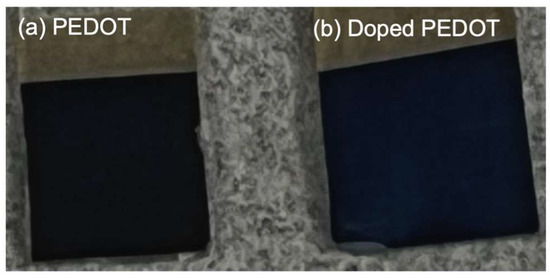
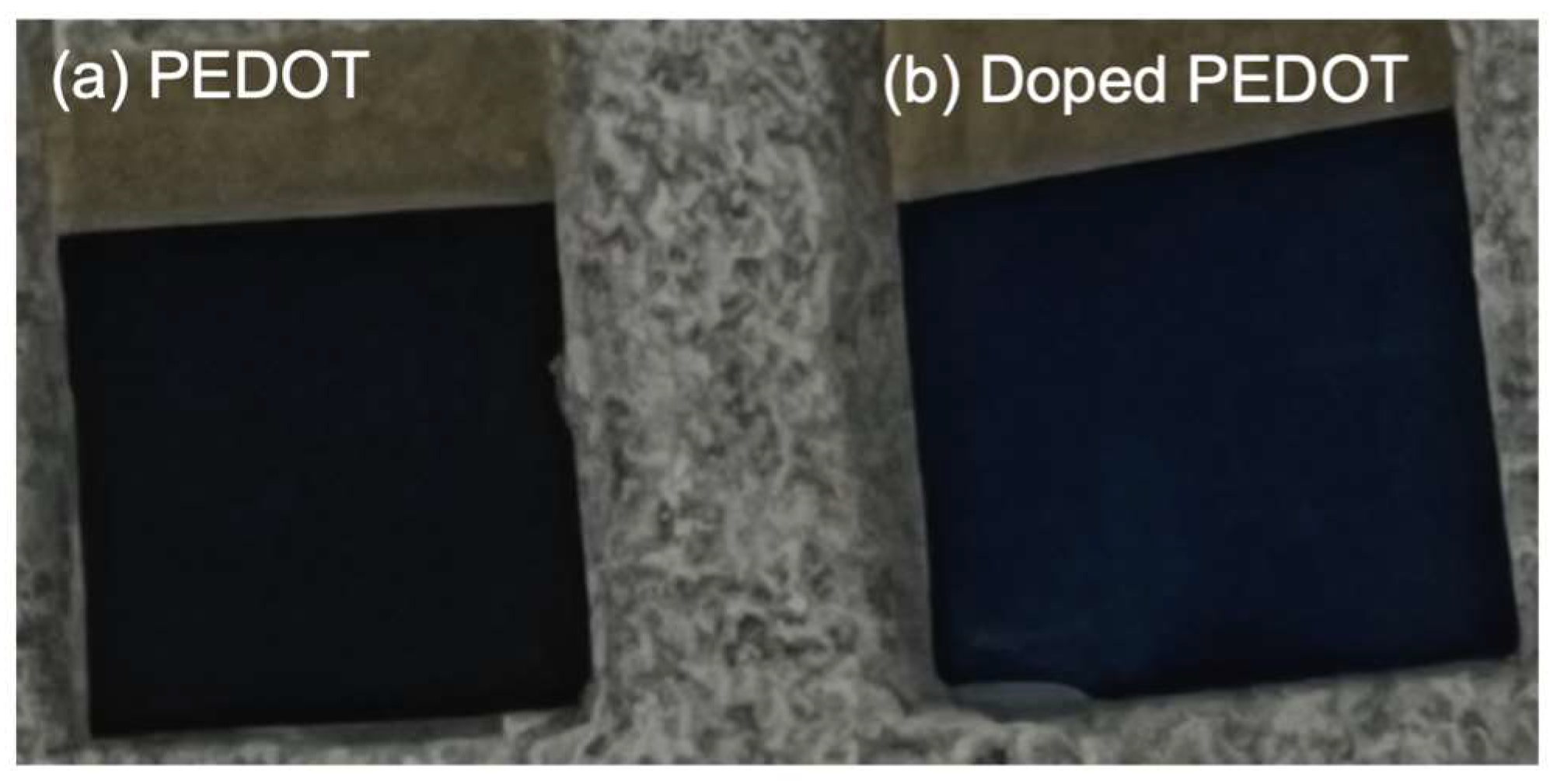
Figure 1 shows photographs of PEDOT and doped PEDOT films prepared on FTO substrates. Both films formed continuous coatings over the deposited area. Compared with PEDOT, doped PEDOT exhibited a lighter color, indicating that the electrochemical doping state alters the optical appearance of the polymer film. This visual change qualitatively reflects changes in the optical properties of PEDOT caused by doping/dedoping, including changes in polaron- and bipolaron-related optical transitions [16,20,21], as further supported by the UV–vis absorption spectra discussed below.
Figure 1.
Images of (a) PEDOT and (b) doped PEDOT films with a deposited area of 1 cm × 1 cm.
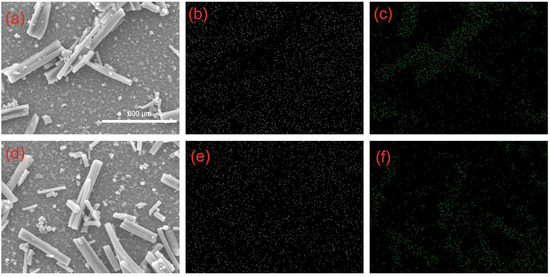
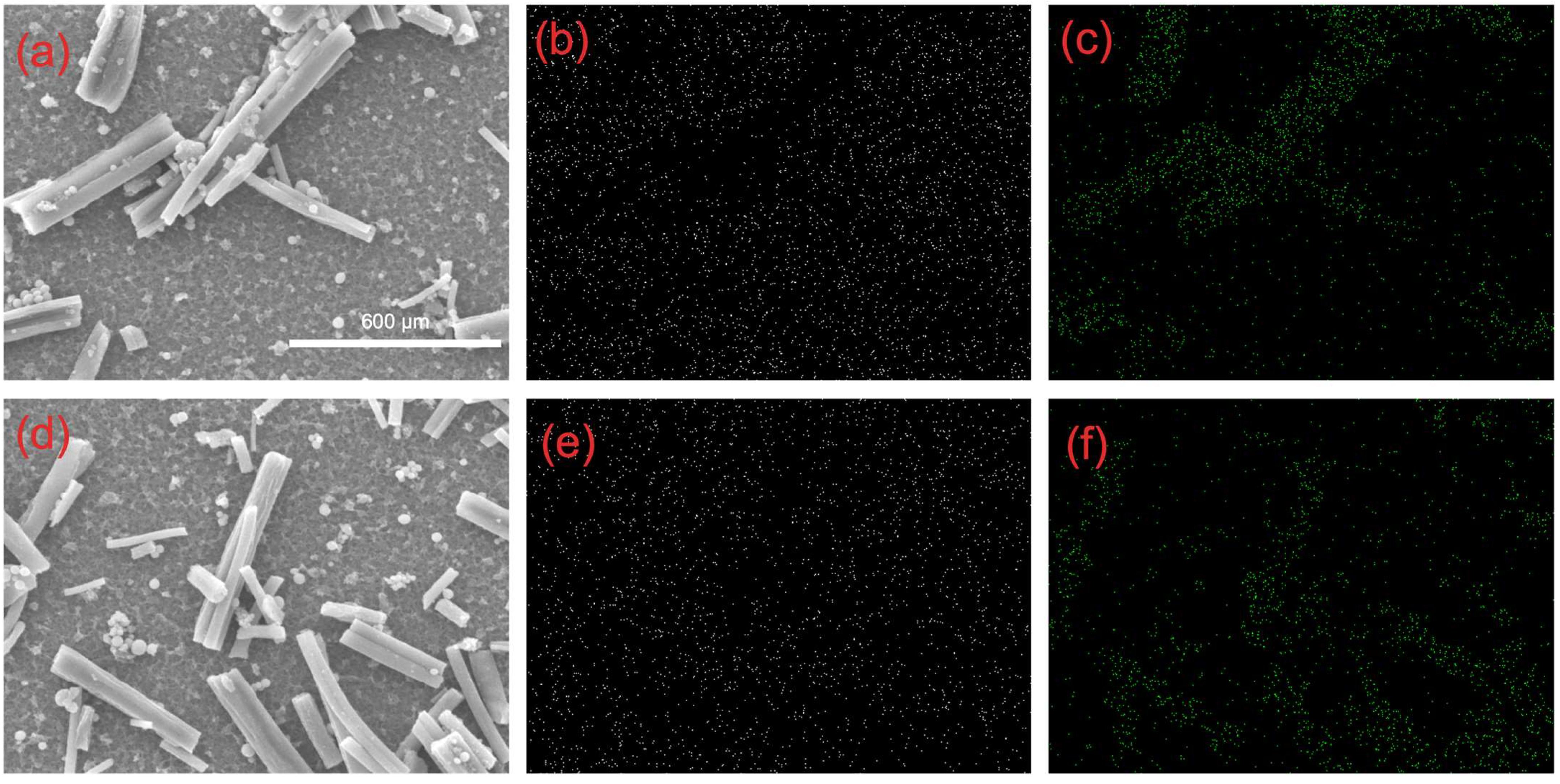
Figure 2 shows SEM images and EDS elemental mapping results of TiO2–PEDOT and TiO2-doped PEDOT electrodes. Distinct rod-like structures were observed on the surfaces of both hybrid films after TiO2 coating, as shown in Figure 2a,d. The S elemental maps in Figure 2b,e show that the PEDOT component remains distributed across the film surface. In contrast, the Ti elemental maps in Figure 2c,f correspond well to the rod-like structures observed in the SEM images, indicating that these features originate from TiO2. The similar surface morphology and Ti distribution observed for TiO2–PEDOT and TiO2-doped PEDOT further indicate that the TiO2 slurry-coating process produced comparable TiO2 distributions on both PEDOT and doped PEDOT films. These results indicate that commercial TiO2 was successfully deposited onto the PEDOT-based electrodes while the PEDOT component remained distributed across the electrode surface. The functional role of PEDOT in light absorption and PEC response is discussed below based on the UV–vis and PEC measurements.
Figure 2.
(a) SEM image of TiO2–PEDOT, (b) S elemental mapping of TiO2–PEDOT, (c) Ti elemental mapping of TiO2–PEDOT, (d) SEM image of TiO2-doped PEDOT, (e) S elemental mapping of TiO2-doped PEDOT, and (f) Ti elemental mapping of TiO2-doped PEDOT.
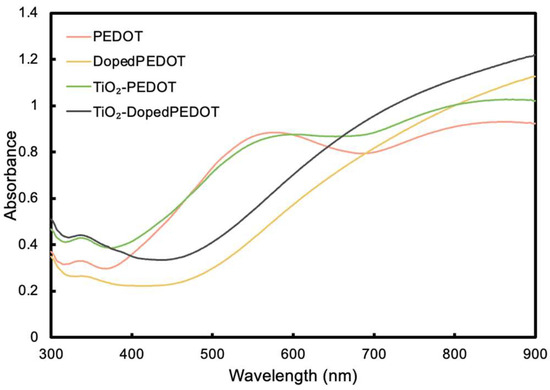
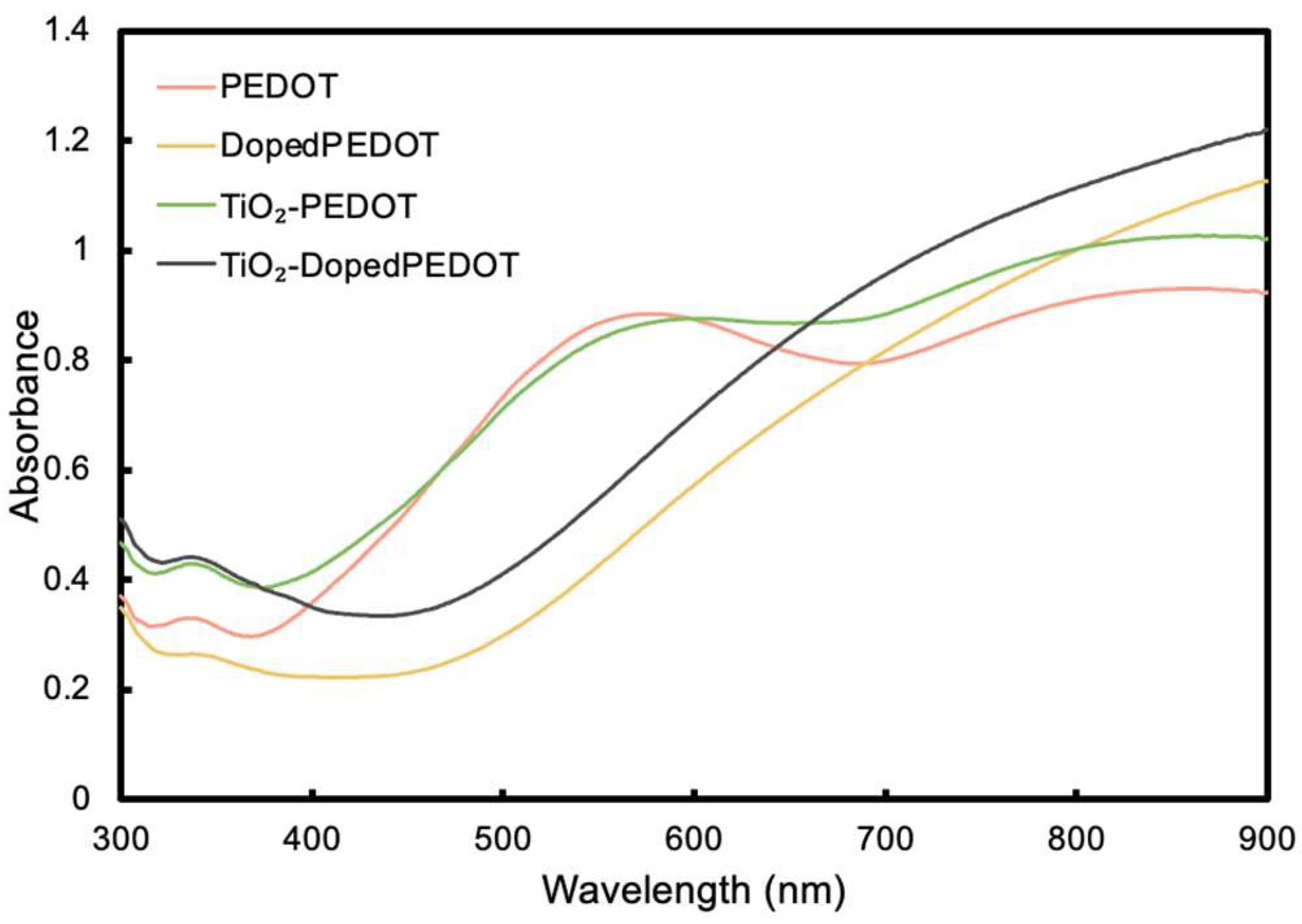
Figure 3 presents the UV–vis absorption spectra of PEDOT, doped PEDOT, TiO2–PEDOT, and TiO2-doped PEDOT films. All PEDOT-based samples exhibited broad absorption over the measured wavelength range, but clear differences were observed depending on the doping state and TiO2 coating. PEDOT showed broad absorption in the visible region, while doped PEDOT exhibited enhanced absorption at longer wavelengths. This behavior is consistent with previous reports that electrochemical doping of PEDOT produces polaron and bipolaron states, which contribute to sub-bandgap optical absorption and extend absorption into the longer-wavelength region [16,20,21].
Figure 3.
UV–vis absorption spectra of PEDOT, doped PEDOT, TiO2–PEDOT, and TiO2-doped PEDOT films.
After TiO2 coating, both TiO2–PEDOT and TiO2-doped PEDOT retained broad absorption, indicating that the PEDOT component dominates the visible-light absorption behavior of the hybrid electrodes. Among the tested films, TiO2-doped PEDOT showed the highest overall absorbance, indicating enhanced optical absorption in the doped PEDOT-containing hybrid film. Because commercial TiO2 generally absorbs mainly in the ultraviolet region owing to its wide band gap [22,23,29,30,31], the visible-light absorption of the TiO2–PEDOT-based electrodes is primarily attributed to the PEDOT component. These results support the central role of PEDOT, especially doped PEDOT, in extending the light-harvesting ability of the hybrid electrode system.
Overall, the characterization results demonstrate that PEDOT doping reduces the apparent resistance of the PEDOT-based electrodes and enhances long-wavelength optical absorption. The SEM, EDS, and LIBS results confirm that commercial TiO2 was successfully deposited onto the PEDOT-based films with comparable TiO2 loading. These findings indicate that the prepared electrodes provide a suitable model system for examining how PEDOT-based light absorption and charge-transport characteristics contribute to the subsequent PEC response. Although doped PEDOT and TiO2-doped PEDOT showed lower apparent resistance and stronger long-wavelength absorption, the PEDOT doping state is not necessarily fixed during PEC measurements because it can change electrochemically under the applied reductive or oxidative potentials. Therefore, the main PEC comparison was focused on TiO2, PEDOT, and TiO2–PEDOT to clarify the contribution of PEDOT incorporation and TiO2/PEDOT contact under representative PEC operation conditions.
3.2. PEC Responses Under HER-Relevant Conditions
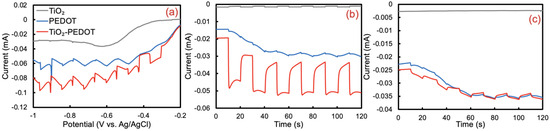
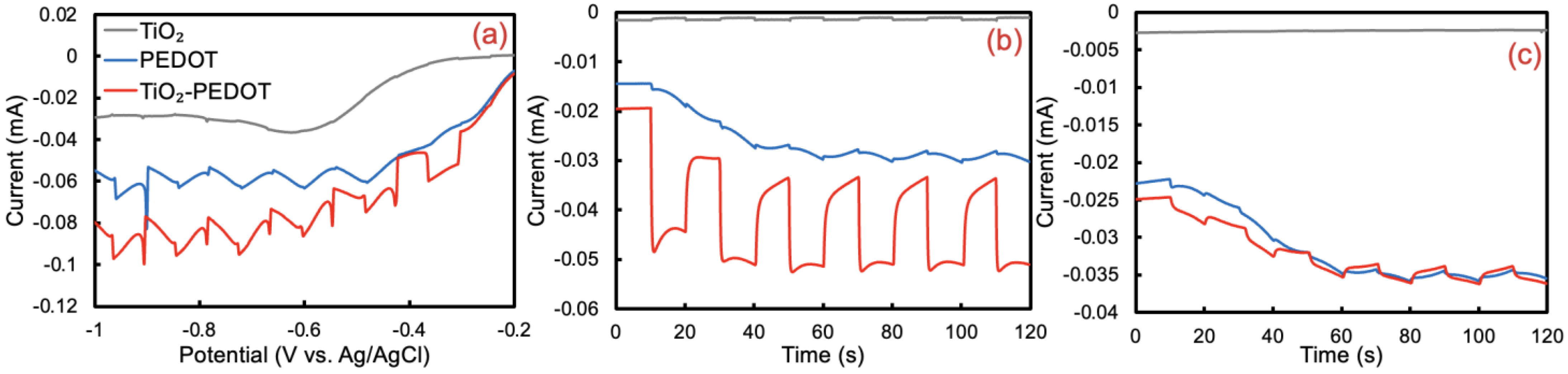
The PEC behavior of TiO2, PEDOT, and TiO2–PEDOT electrodes was first examined under reductive, HER-relevant conditions. Figure 4a shows the LSV curves measured from −0.2 to −1.0 V vs. Ag/AgCl under chopped illumination. TiO2 exhibited only a weak cathodic photoresponse over the measured potential range, indicating that commercial TiO2 alone has limited photoactivity under these conditions. In contrast, PEDOT showed a much larger cathodic current response with clear light-induced modulation, indicating that PEDOT plays a major role in photoinduced charge utilization. Among the tested electrodes, TiO2–PEDOT exhibited the largest cathodic current response, suggesting that the combination of PEDOT with commercial TiO2 provides a beneficial hybrid interface for reductive PEC operation.
Figure 4.
(a) LSV curves of TiO2, PEDOT, and TiO2–PEDOT electrodes measured from −0.2 to −1.0 V vs. Ag/AgCl at a scan rate of 2 mV s−1 under chopped illumination with a 30 s on/off cycle. (b) Chronoamperometric responses measured at −0.35 V vs. Ag/AgCl under chopped illumination with a 10 s on/off cycle. (c) Chronoamperometric responses measured at −0.35 V vs. Ag/AgCl under illumination transmitted through a 410 nm UV-cut filter.
The enhanced response of TiO2–PEDOT compared with TiO2 alone can be mainly attributed to the PEDOT component, which broadens light absorption into the visible region and provides charge-transport pathways. The further improvement relative to PEDOT alone suggests an additional interfacial contribution from the TiO2/PEDOT hybrid structure. Since the TiO2 slurry was coated onto a pre-formed PEDOT film, the interaction between TiO2 and PEDOT is mainly considered to be physical interfacial contact rather than a confirmed chemical reaction or covalent bonding. Because PEDOT is generally regarded as a p-type conducting polymer and TiO2 as an n-type semiconductor, this physical contact may generate a p–n-type interfacial effect or local interfacial electric field that facilitates photogenerated charge separation and suppresses recombination [5,12,13]. However, because direct chemical-bonding and band-alignment measurements were not performed in this study, this interfacial mechanism should be regarded as a plausible explanation rather than definitive proof of a chemically bonded interface or a fully confirmed p–n junction.
Figure 4b shows chronoamperometric responses measured at −0.35 V vs. Ag/AgCl under chopped illumination. TiO2 showed an almost negligible photocurrent response, whereas PEDOT exhibited a clear and reproducible cathodic photocurrent. TiO2–PEDOT showed the largest and most stable periodic cathodic response among the three electrodes. The repeated current modulation upon light on/off cycling confirms that the observed current response is photoinduced rather than arising only from dark electrochemical processes. These results are consistent with the LSV results and further demonstrate that PEDOT incorporation is essential for improving the reductive PEC response in this model TiO2-based electrode system.
Figure 4c shows chronoamperometric responses measured under illumination transmitted through a 410 nm UV-cut filter. Under this condition, TiO2 remained nearly inactive, whereas PEDOT and TiO2–PEDOT retained clear cathodic photocurrent responses. This result supports the interpretation that the longer-wavelength photoresponse originates mainly from PEDOT rather than TiO2. The TiO2–PEDOT electrode showed a slightly larger cathodic response than PEDOT, suggesting that the hybrid interface can still provide a charge-separation or charge-transport advantage even when the light response is primarily governed by PEDOT absorption. Therefore, under HER-relevant conditions, PEDOT acts as the central light-harvesting and charge-transport component, while commercial TiO2 serves as a model oxide component that contributes to interfacial charge management.
3.3. PEC Responses Under OER-Relevant Conditions
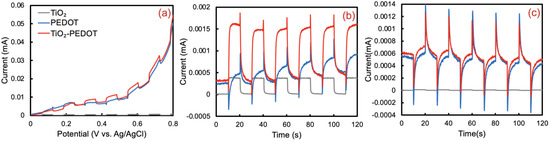
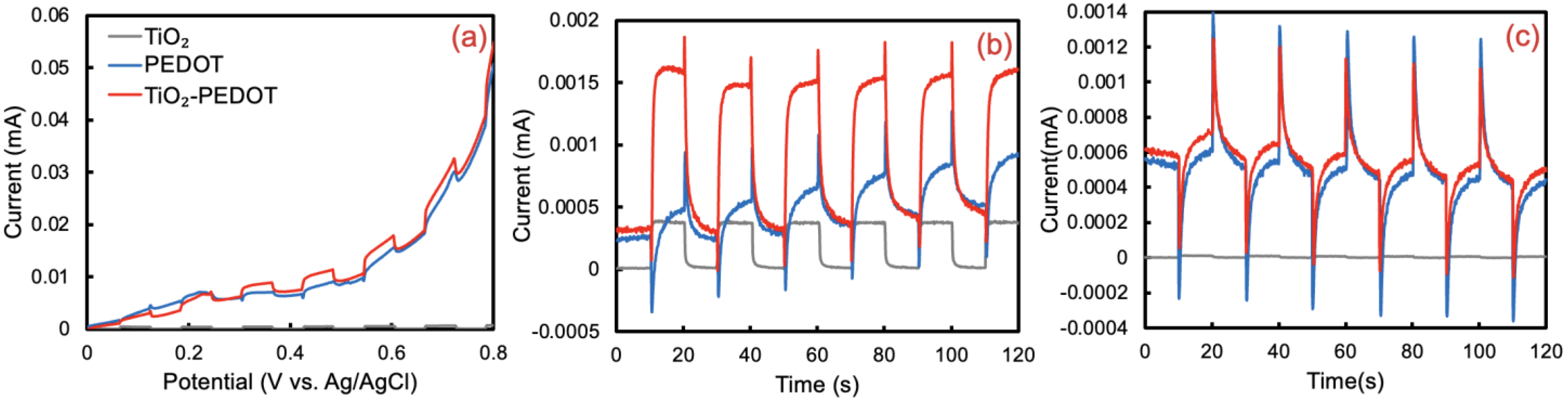
The PEC behavior of TiO2, PEDOT, and TiO2–PEDOT electrodes was also evaluated under oxidative, OER-relevant conditions. Figure 5a shows the LSV curves measured from 0 to 0.8 V vs. Ag/AgCl under chopped illumination. TiO2 exhibited only a small anodic current response, again indicating the limited photoresponse of commercial TiO2 alone under the present measurement conditions. In contrast, PEDOT and TiO2–PEDOT displayed clear anodic photocurrent responses. The larger light-induced response of these PEDOT-containing electrodes indicates that PEDOT contributes significantly to photoinduced charge utilization in the oxidative potential region.
Figure 5.
(a) LSV curves of TiO2, PEDOT, and TiO2–PEDOT electrodes measured from 0 to 0.8 V vs. Ag/AgCl at a scan rate of 2 mV s−1 under chopped illumination with a 30 s on/off cycle. (b) Chronoamperometric responses measured at 0.3 V vs. Ag/AgCl under chopped illumination with a 10 s on/off cycle. (c) Chronoamperometric responses measured at 0.3 V vs. Ag/AgCl under illumination transmitted through a 410 nm UV-cut filter.
Among the three electrodes, TiO2–PEDOT showed the largest anodic response at higher potentials. This suggests that the combination of PEDOT and TiO2 is also beneficial under OER-relevant conditions. Since PEDOT can undergo electrochemical oxidation under anodic bias, its doping state may change during oxidative PEC operation. Oxidized or doped PEDOT contains polaron/bipolaron-derived electronic states, which can enhance charge transport and broaden optical absorption [15,16,17,20,21]. Therefore, the anodic PEC response of TiO2–PEDOT may be influenced not only by the initial PEDOT state but also by bias-induced changes in the electronic structure of PEDOT during measurement. This bias-dependent change also explains why the PEC behavior of initially doped PEDOT-based electrodes cannot be simply predicted from their ex situ optical absorption and apparent resistance alone.
Figure 5b shows chronoamperometric responses measured at 0.3 V vs. Ag/AgCl under chopped illumination. TiO2 exhibited only a weak photoresponse, whereas PEDOT showed a larger and reproducible anodic photocurrent. TiO2–PEDOT displayed the highest steady-state photocurrent and the most pronounced response to light on/off cycling. This behavior indicates that the hybrid electrode provides more efficient photoinduced charge utilization under oxidative conditions than either commercial TiO2 or PEDOT alone. The improvement relative to PEDOT suggests that the TiO2/PEDOT interface contributes to interfacial charge separation and transport, while the much stronger response relative to TiO2 confirms that PEDOT is the dominant functional component for visible-light-driven PEC activity.
Figure 5c shows chronoamperometric responses under illumination transmitted through a 410 nm UV-cut filter. TiO2 again remained nearly inactive, whereas PEDOT and TiO2–PEDOT both retained clear periodic anodic photocurrent responses. This result further supports the interpretation that PEDOT is primarily responsible for extending the photoresponse into the longer-wavelength region. The stable response of TiO2–PEDOT under filtered illumination indicates that the hybrid electrode can utilize PEDOT-derived visible-light absorption while maintaining favorable charge-transfer characteristics at the TiO2/PEDOT interface. Therefore, under OER-relevant conditions, the enhanced PEC response is attributed to the combined effects of PEDOT-based visible-light absorption, bias-dependent PEDOT doping, and interfacial charge management in the TiO2–PEDOT hybrid structure.
3.4. Long-Term Photoresponse Stability
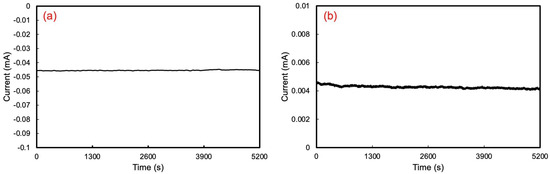
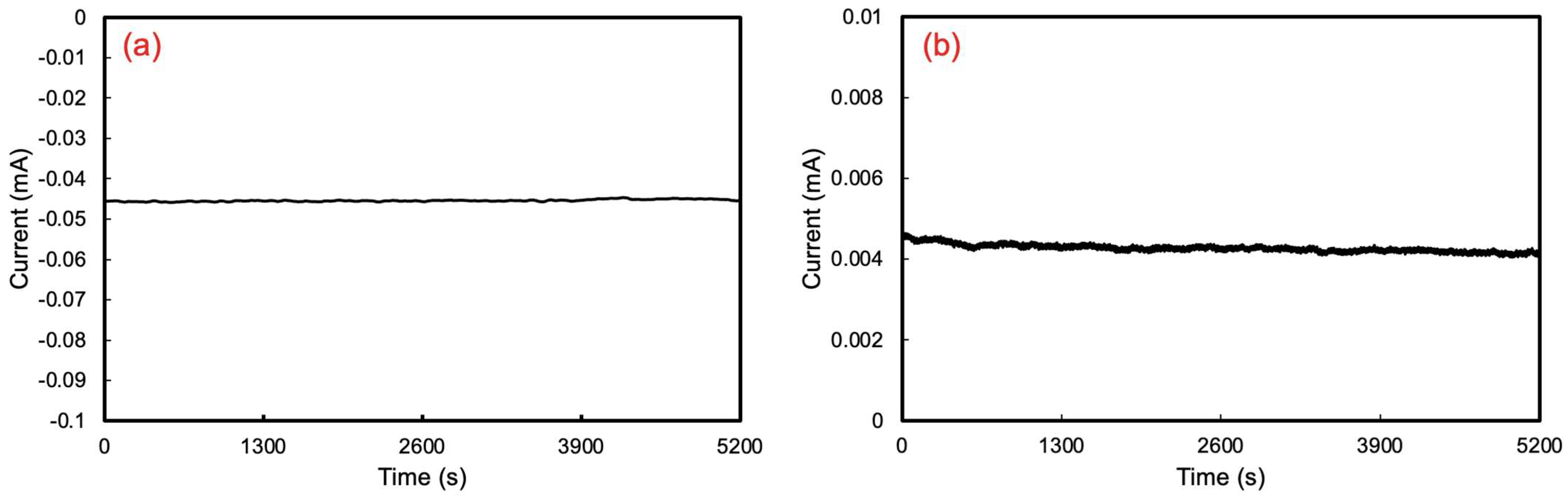
Long-term chronoamperometric measurements were performed to evaluate the photoresponse stability of the TiO2–PEDOT electrode under continuous illumination. Figure 6a shows the current–time response measured at −0.35 V vs. Ag/AgCl under HER-relevant conditions for 5200 s. The cathodic current remained nearly unchanged during prolonged irradiation. Based on the average currents in the initial and final 300 s regions, the current changed only slightly from −45.61 to −45.17 µA, corresponding to a current retention of approximately 99.0%. This result indicates that the TiO2–PEDOT electrode maintained a stable reductive photoresponse under continuous illumination.
Figure 6.
Long-term chronoamperometric responses of the TiO2–PEDOT electrode under continuous illumination for 5200 s: (a) HER-relevant measurement at −0.35 V vs. Ag/AgCl and (b) OER-relevant measurement at 0.6 V vs. Ag/AgCl.
Figure 6b shows the long-term chronoamperometric response measured at 0.6 V vs. Ag/AgCl under OER-relevant conditions for 5200 s. In this case, the anodic current showed a gradual decrease during the initial stage and then remained relatively stable. The average current decreased from 4.51 µA in the initial 300 s to 4.14 µA in the final 300 s, corresponding to a current retention of approximately 91.9%. Although the retention under oxidative conditions was lower than that under reductive conditions, the electrode still maintained more than 90% of its anodic current after 5200 s of continuous illumination.
It should be noted that 0.3 V vs. Ag/AgCl was used for the chopped transient OER-relevant photoresponse measurement, whereas 0.6 V vs. Ag/AgCl was selected for the long-term oxidative operation because it provides a clearer anodic PEC response. Overall, these long-term measurements demonstrate that the TiO2–PEDOT electrode retains its PEC photoresponse under both reductive and oxidative conditions during continuous illumination.
3.5. Role of PEDOT and TiO2/PEDOT Hybridization
The combined characterization and PEC results clarify the functional role of PEDOT in the present commercial TiO2-based model system. First, PEDOT provides broad visible-light absorption, and doped PEDOT further enhances long-wavelength absorption through doping-induced electronic states. Second, electrochemical doping reduces the apparent resistance of PEDOT-based electrodes, suggesting improved apparent charge-transport characteristics. Third, PEDOT-containing electrodes show much stronger light-induced PEC responses than TiO2 alone under both HER- and OER-relevant conditions, indicating that PEDOT is the central functional component governing the photoresponse. This role is conceptually similar to recent quantum-dot-sensitized TiO2 photoelectrodes, where visible-light-active CuInS2 quantum dots were used to enhance PEC hydrogen-generation performance by improving charge transport and reducing trap-related losses [9]. In the present system, PEDOT plays a sensitizer-like role while also providing conducting-polymer-based charge-transport capability.
The role of commercial TiO2 in this study is not to provide an optimized high-performance oxide photoelectrode, but to serve as a simple model semiconductor for evaluating the contribution of PEDOT-based hybridization. Because commercial TiO2 was used without morphology, defect, or surface optimization, the present system should not be directly compared with optimized state-of-the-art PEC photoelectrodes in terms of absolute performance. TiO2 alone showed only limited photoresponse, particularly under illumination transmitted through a 410 nm UV-cut filter, consistent with its mainly ultraviolet absorption. However, when combined with PEDOT, the TiO2–PEDOT electrode showed higher PEC responses than PEDOT alone under both reductive and oxidative conditions. This result suggests that TiO2 contributes to the hybrid electrode mainly through interfacial charge management rather than direct visible-light absorption.
A plausible mechanism for the improved performance of TiO2–PEDOT can be understood from the complementary functions of the two components. PEDOT acts as the primary visible-light absorber and charge-transport medium, while TiO2 provides an oxide semiconductor interface that may assist charge separation and transport. Since the TiO2 slurry was coated onto the pre-formed PEDOT film, the TiO2/PEDOT interaction is mainly regarded as physical interfacial contact rather than a confirmed chemical reaction or covalent bonding. The contact between p-type PEDOT and n-type TiO2 may generate a p–n-type interfacial effect or local interfacial electric field that promotes charge separation and suppresses recombination [5,10,11]. Under anodic conditions, PEDOT may also become more oxidized, producing polaron/bipolaron-derived states that enhance charge transport and optical absorption [13,14,15,18,19]. These effects can explain why TiO2–PEDOT exhibits stronger PEC responses than either TiO2 or PEDOT alone. However, because direct chemical-bonding, band-alignment, and charge-transfer-dynamics measurements were not performed in this study, this mechanism should be regarded as a plausible interpretation rather than definitive proof of a chemically bonded interface or a fully confirmed p–n junction.
It should be noted that the present study evaluates photocurrent responses under HER- and OER-relevant conditions, rather than directly quantifying H2 or O2 evolution. Photocurrent response reflects the generation, separation, and transport of photogenerated charge carriers under illumination, but it cannot be directly regarded as actual water-splitting efficiency without quantitative gas analysis. Therefore, the results should be interpreted as evidence of improved PEC charge utilization and photoresponse, not as direct proof of complete water splitting. Nevertheless, the results demonstrate that PEDOT-centered TiO2 hybridization is an effective strategy for improving visible-light-responsive PEC behavior in a simple commercial oxide model system. Future work should include H2/O2 product quantification, Faradaic efficiency analysis, incident photon-to-current efficiency measurements, wavelength-dependent photocurrent analysis, and further optimization toward efficient overall water splitting.
4. Conclusions
In this study, PEDOT-centered TiO2 hybrid electrodes were prepared by electropolymerizing PEDOT on FTO substrates, followed by electrochemical doping/dedoping treatment and coating with commercial TiO2 as a model oxide semiconductor. Structural and compositional analyses confirmed the successful deposition of TiO2 onto PEDOT-based films. Electrochemical doping of PEDOT reduced the apparent resistance of the electrodes and enhanced long-wavelength optical absorption, indicating that the PEDOT doping state plays an important role in controlling the apparent charge-transport and light-harvesting properties of the electrode system.
PEC measurements using TiO2, PEDOT, and TiO2–PEDOT electrodes showed that PEDOT-containing electrodes exhibited much stronger photoresponses than commercial TiO2 alone under both HER- and OER-relevant conditions. The TiO2–PEDOT electrode showed the most pronounced and stable photocurrent responses under chopped illumination, and its retained response under illumination transmitted through a 410 nm UV-cut filter supports the interpretation that PEDOT is primarily responsible for visible-light utilization. The improved response of TiO2–PEDOT compared with PEDOT alone suggests that the TiO2/PEDOT physical contact may provide an additional interfacial contribution to charge separation and transport. Long-term chronoamperometric measurements further showed that the TiO2–PEDOT electrode retained approximately 99.0% of its cathodic current under HER-relevant conditions and 91.9% of its anodic current under OER-relevant conditions after 5200 s of continuous illumination.
Overall, these findings clarify the central role of PEDOT as a visible-light-harvesting and charge-transport component in commercial TiO2-based hybrid electrodes. Because H2 and O2 evolution were not quantified in this study, the observed photocurrent responses should be interpreted as HER- and OER-relevant PEC photoresponses rather than direct evidence of overall water splitting. Nevertheless, this work provides a useful model platform and design concept for conducting-polymer-centered metal oxide hybrid photoelectrodes for visible-light-responsive PEC energy-conversion applications.
Author Contributions
Conceptualization, Y.Z., T.K. and T.-F.M.C.; methodology, Y.Z. and T.K.; validation, T.K., C.-Y.C., Y.-J.H., M.S. and T.-F.M.C.; formal analysis, Y.Z.; investigation, Y.Z.; resources, T.K., C.-Y.C., M.S. and T.-F.M.C.; data curation, Y.Z.; writing—original draft preparation, Y.Z.; writing—review and editing, T.K. and T.-F.M.C.; visualization, Y.Z.; supervision, M.S. and T.-F.M.C.; project administration, T.K., M.S. and T.-F.M.C.; funding acquisition, T.K., Y.-J.H., M.S. and T.-F.M.C. All authors have read and agreed to the published version of the manuscript.
Funding
This work was supported by JSPS KAKENHI Grant Number JP23K04369 and JP23K13557.
Institutional Review Board Statement
Not applicable.
Informed Consent Statement
Not applicable.
Data Availability Statement
The data presented in this study are available from the corresponding author upon reasonable request.
Conflicts of Interest
The authors declare no conflicts of interest.
References
- Fujishima, A.; Honda, K. Electrochemical photolysis of water at a semiconductor electrode. Nature 1972, 238, 37–38. [Google Scholar] [CrossRef] [Scilit] [PubMed]
- Walter, M.G.; Warren, E.L.; McKone, J.R.; Boettcher, S.W.; Mi, Q.; Santori, E.A.; Lewis, N.S. Solar water splitting cells. Chem. Rev. 2010, 110, 6446–6473. [Google Scholar] [CrossRef] [Scilit] [PubMed]
- Song, K.; Liu, H.; Chen, B.; Gong, C.; Ding, J.; Wang, T.; Liu, E.; Ma, L.; Zhao, N.; He, F. Toward efficient utilization of photogenerated charge carriers in photoelectrochemical systems: Engineering strategies from the atomic level to configuration. Chem. Rev. 2024, 124, 13660–13680. [Google Scholar] [CrossRef] [Scilit] [PubMed]
- Namsheer, K.; Rout, C.S. Conducting polymers: A comprehensive review on recent advances in synthesis, properties and applications. RSC Adv. 2021, 11, 5659–5697. [Google Scholar] [CrossRef] [Scilit] [PubMed]
- Nada, A.A.; Bekheet, M.F.; Samélor, D.; Vergnes, H.; Villeneuve-Faure, C.; Cartier, J.; Charmette, C.; Tingry, S.; Caussat, B.; Vahlas, C.; et al. Photo-electrocatalytic performance of poly(3,4-ethylenedioxythiophene)/TiO nano-tree films deposited by oCVD/CVD for H2 production. Appl. Surf. Sci. 2023, 637, 157919. [Google Scholar] [CrossRef] [Scilit]
- Saianand, G.; Gopalan, A.-I.; Wang, L.; Venkatramanan, K.; Roy, V.A.L.; Sonar, P.; Lee, D.-E.; Naidu, R. Conducting polymer-based visible-light photocatalytic composites for pollutant removal: Progress and prospects. Environ. Technol. Innov. 2022, 28, 102698. [Google Scholar] [CrossRef] [Scilit]
- Digdaya, I.A.; Adhyaksa, G.W.P.; Garnett, E.C. Interfacial engineering of metal–insulator–semiconductor junctions for efficient and stable photoelectrochemical water oxidation. Nat. Commun. 2017, 8, 15968. [Google Scholar] [CrossRef] [Scilit] [PubMed]
- Cheng, X.; Liu, Y.; Wang, L.; Zhang, J.; Li, Y. Fabrication of an efficient BiVO4-TiO2 heterojunction photoanode for photoelectrochemical water oxidation. ACS Appl. Mater. Interfaces 2016, 8, 32403–32411. [Google Scholar] [CrossRef] [Scilit] [PubMed]
- Lee, H.C.; Kim, H.; Kim, K.; Lee, K.; Chung, W.; Ha, S.B.; Kim, M.; Ahn, E.; Li, S.; Ji, S.; et al. Unveiling formation pathways of ternary I–III–VI CuInS2 quantum dots and their effect on photoelectrochemical hydrogen generation. Adv. Sci. 2025, 12, e00829. [Google Scholar] [CrossRef] [Scilit] [PubMed]
- Kim, J.; Ha, J.M.; Lee, Y.; Oh, S.W.; Lee, W.; Kwon, M.; Lee, S.; Kim, J.Y.; Woo, H.Y. Organic photoelectrochemical cells beyond performance: Interface and catalyst engineering for durability. Adv. Energy Mater. 2026, 16, e71031. [Google Scholar] [CrossRef] [Scilit]
- Ahn, H.-J.; Yoon, K.-Y.; Sung, M.; Yoo, H.; Ahn, H.; Lee, B.H.; Lee, J.; Jang, J.-H. Utilizing a siloxane-modified organic semiconductor for photoelectrochemical water splitting. ACS Energy Lett. 2023, 8, 2595–2602. [Google Scholar] [CrossRef] [Scilit]
- Yang, B.; Chen, G.; Tian, H.; Wen, L. Improvement of the photoelectrochemical performance of TiO2 nanorod array by PEDOT and oxygen vacancy co-modification. Catalysts 2019, 9, 407. [Google Scholar] [CrossRef] [Scilit]
- Abdelnasser, S.; Park, G.; Han, H.; Toth, R.; Yoon, H. Enhanced photocatalytic performance of poly(3,4-ethylenedioxythiophene)-coated TiO2 nanotube electrodes. Synth. Met. 2019, 251, 120–126. [Google Scholar] [CrossRef] [Scilit]
- Thangamuthu, M.; Ruan, Q.; Ohemeng, P.O.; Luo, B.; Jing, D.; Godin, R.; Tang, J. Polymer photoelectrodes for solar fuel production: Progress and challenges. Chem. Rev. 2022, 122, 11778–11829. [Google Scholar] [CrossRef] [Scilit] [PubMed]
- Gueye, M.N.; Carella, A.; Faure-Vincent, J.; Demadrille, R.; Simonato, J.-P. Progress in understanding structure and transport properties of PEDOT-based materials: A critical review. Prog. Mater. Sci. 2020, 108, 100616. [Google Scholar] [CrossRef] [Scilit]
- Eun, J.; Kim, D.; Kim, F.S. Electrochemical doping and dedoping behaviors of PEDOT-based ternary conducting polymer composites with binary polymer surfactants. ACS Appl. Polym. Mater. 2023, 5, 5495–5502. [Google Scholar] [CrossRef] [Scilit]
- Shahrim, N.A.A.; Ahmad, Z.; Azman, A.W.; Buys, Y.F.; Sarifuddin, N. Mechanisms for doped PEDOT:PSS electrical conductivity improvement. Mater. Adv. 2021, 2, 7118–7138. [Google Scholar] [CrossRef] [Scilit]
- Kurioka, T.; Higuchi, J.; Zhou, Y.; Hsu, Y.-J.; Chang, T.-F.M.; Sone, M. Electrochemical integration of Au nanoparticles into poly(3,4-ethylenedioxythiophene) for nonenzymatic glucose sensing. ACS Appl. Nano Mater. 2025, 8, 17768–17775. [Google Scholar] [CrossRef] [Scilit]
- Kurioka, T.; Chang, T.-F.M.; Sone, M. Electrochemical hybridization via simultaneous electrochemical doping of poly(3-methoxythiophene) with Au electrodeposition for anodic oxidation of 1-propanol. Adv. Energy Sustain. Res. 2025, 6, 2400420. [Google Scholar] [CrossRef] [Scilit]
- Zozoulenko, I.; Singh, A.; Singh, S.K.; Gueskine, V.; Crispin, X.; Berggren, M. Polarons, bipolarons, and absorption spectroscopy of PEDOT. ACS Appl. Polym. Mater. 2019, 1, 83–94. [Google Scholar] [CrossRef] [Scilit]
- Kalagi, S.S.; Patil, P.S. Secondary electrochemical doping level effects on polaron and bipolaron bands evolution and interband transition energy from absorbance spectra of PEDOT:PSS thin films. Synth. Met. 2016, 220, 661–666. [Google Scholar] [CrossRef] [Scilit]
- Sawal, M.H.; Jalil, A.A.; Khusnun, N.F.; Hassan, N.S.; Bahari, M.B. A review of recent modification strategies of TiO2-based photoanodes for efficient photoelectrochemical water splitting performance. Electrochim. Acta 2023, 467, 143142. [Google Scholar] [CrossRef] [Scilit]
- Arifin, K.; Yunus, R.M.; Minggu, L.J.; Kassim, M.B. Improvement of TiO2 nanotubes for photoelectrochemical water splitting: Review. Int. J. Hydrogen Energy 2021, 46, 4998–5024. [Google Scholar] [CrossRef] [Scilit]
- Chong, B.; Zhu, W.; Hou, X. Epitaxial hetero-structure of CdSe/TiO2 nanotube arrays with PEDOT as a hole transfer layer for photoelectrochemical hydrogen evolution. J. Mater. Chem. A 2017, 5, 6233–6244. [Google Scholar] [CrossRef] [Scilit]
- Vavilapalli, D.S.; Rosén, J.; Singh, S. Immobilization of a TiO2–PEDOT:PSS hybrid heterojunction photocatalyst for degradation of organic effluents. RSC Adv. 2023, 13, 3095–3101. [Google Scholar] [CrossRef] [Scilit] [PubMed]
- Lin, C.-L.; Cheng, T.-L.; Wu, N.-J. Micropatterned poly(3,4-ethylenedioxythiophene) thin films with improved color-switching rates and coloration efficiency. Polymers 2022, 14, 2951. [Google Scholar] [CrossRef] [Scilit] [PubMed]
- Wang, X.; Liu, B.; Ma, S.; Zhang, Y.; Wang, L.; Zhu, G.; Huang, W.; Wang, S. Induced dipole moments in amorphous ZnCdS catalysts facilitate photocatalytic H2 evolution. Nat. Commun. 2024, 15, 2600. [Google Scholar] [CrossRef] [Scilit] [PubMed]
- Xie, G.; Wang, L.; Zhu, Q.; Chu, Z.; Tian, S.; Gui, Z.; Song, K.; Yu, Z. Regulating alkyl chain length on quaternization TiO2 for boosting photocatalytic performance: Synergism of promoting photogenerated charge separation and improving reactant adsorption. ACS Appl. Mater. Interfaces 2022, 14, 57428–57439. [Google Scholar] [CrossRef] [Scilit] [PubMed]
- Wang, W.-K.; Chen, J.-J.; Zhang, X.; Huang, Y.-X.; Li, W.-W.; Yu, H.-Q. Self-induced synthesis of phase-junction TiO2 with a tailored rutile to anatase ratio below phase transition temperature. Sci. Rep. 2016, 6, 20491. [Google Scholar] [CrossRef] [Scilit] [PubMed]
- Sun, B.; Vorontsov, A.V.; Smirniotis, P.G. Role of platinum deposited on TiO2 in phenol photocatalytic oxidation. Langmuir 2003, 19, 3151–3156. [Google Scholar] [CrossRef] [Scilit]
- Duan, Z.; Huang, Y.; Zhang, D.; Chen, S. Electrospinning fabricating Au/TiO2 network-like nanofibers as visible-light-activated photocatalyst. Sci. Rep. 2019, 9, 8008. [Google Scholar] [CrossRef] [Scilit] [PubMed]

Disclaimer/Publisher’s Note: The statements, opinions and data contained in all publications are solely those of the individual author(s) and contributor(s) and not of MDPI and/or the editor(s). MDPI and/or the editor(s) disclaim responsibility for any injury to people or property resulting from any ideas, methods, instructions or products referred to in the content. |
© 2026 by the authors. Licensee MDPI, Basel, Switzerland. This article is an open access article distributed under the terms and conditions of the Creative Commons Attribution (CC BY) license.