


Abstract
The production of sustainable polymer-based composites from agricultural waste has gained great attention due to the growing demand for lighter and stronger materials. In this study, alkali-treated CLSF (30 wt.%) was used as reinforcement in vinyl ester composites containing 0, 5, 10 and 15 wt.% cashew nutshell biochar, fabricated by hand lay-up followed by compression molding. The effect of biochar content on the tensile strength, flexural strength, impact strength, Shore D hardness, erosion resistance and microstructure of the vinyl ester composites was systematically evaluated by mechanical testing, erosion testing, scanning electron microscopy (SEM) and X-Ray Diffraction (XRD). Biochar inclusion remarkably enhanced the properties of the composites when compared to the unfilled composite, depending on the optimum filler content. The composite containing 10 wt.% biochar showed the best flexural strength (31.88 MPa) and Shore D hardness (83.22), coupled with minimum erosion loss (0.021%), hence high stiffness and abrasion resistance. However, 5 wt.% biochar showed the best impact resistance, indicating effective energy absorption ability. SEM study showed enhanced filler distribution and fiber–matrix interface interaction for lower levels of biochar content, but higher amounts (15 wt.%) caused agglomeration of particles with the appearance of microvoids, resulting in reduced mechanical properties. X-ray diffraction showed that biochar addition leads to better structural ordering. In general, the obtained results clearly show that using 5–10 wt.% of cashew nutshell biochar increases multifunctional properties of coconut sheath fiber/vinyl ester composites.
1. Introduction
The environmental and sustainability problems associated with conventional composite materials have led to increased focus on bio-based and eco-friendly composite materials. These include natural fibers and agricultural wastes that have several advantages over man-made fibers due to renewability, biodegradability, low density, and low cost [1,2]. The production and functionality of cellulosic fibers, including jute, flax, hemp, wool, and silk, have been studied extensively by Ahmed et al. [3]. Mohanty et al. [4] have discussed various treatment methods of natural fibers for improving the mechanical and thermal properties. Mostovoy et al. [5] investigated oil sorbents prepared from secondary cellulose-containing residues of buckwheat cereal production, highlighting an alternative route for valorizing agricultural processing waste into functional materials.
Among the new natural reinforcement materials, the use of coconut leaf sheath fiber (CLSF) has been explored owing to its high specific strength, low density, biodegradability, and ready availability as an agricultural waste product. The coconut sheath is a natural fabric that can be derived from the upper portion of the coconut tree. In the past, the coconut sheaths served the purpose of filtering contaminants out of the coconut palm toddy [6]. The coconut sheath comprises both the inner core and the outer fiber that are naturally bound together. The inner fiber tends to be thicker compared to the outer fiber. Smaller-diameter fibers are naturally woven around the thick fiber [7]. CLSF is composed of 59.39% α-cellulose, 27.97% lignin, and 8.45% hemicellulose, as well as waxes, pectins and other minor components. CLSF’s significant cellulose content gives it tensile strength, while its abundant lignin content makes it rigid and durable [8]. These inherent properties make CLSF a suitable reinforcement for polymer composites [9,10]. Nevertheless, like other lignocellulosic fibers, CLSF has the drawback of poor adhesion between the fiber and the polymer matrix, leading to inefficient property transfer.
To overcome interfacial weaknesses, chemical methods like NaOH treatments are employed to remove amorphous components like hemicellulose and lignin. These treatments increase surface roughness and improve stress transfer. Pratama et al. [11] showed that NaOH treatment of banana fibers increased the tensile strength of polyester composites by as much as 92.13%, while Mahesh et al. [12] found significant improvements in the impact strength of NaOH-treated jute–epoxy composites. Studies by Widodo et al. [13] highlight that NaOH treatments have been shown to improve wettability and composite properties for Sansevieria trifasciata fiber.
When coconut sheath fiber is used solely for reinforcing purposes, it suffers from drawbacks such as excessive water absorption capacity, poor fiber/matrix bonding properties, and creation of air voids that impact the physical and mechanical behavior of the composite material [10]. To address these issues, filler incorporation has been widely reported as an effective strategy to enhance the mechanical performance [14,15]. In this context, biochar has been identified as a sustainable functional filler in polymer composites because of its high carbon content, large surface area, porosity, and chemical stability [16]. Several research studies have shown that production of biochar from pyrolysis leads to carbon sequestration and thus helps mitigate the effects of climate change and achieve carbon neutrality [17,18]. Biochar does not release greenhouse gases instantly like burning since it incorporates a considerable amount of carbon into its structure in an unreactive manner that persists in soil for decades or even hundreds of years [17]. Thus, it also promotes environmental sustainability by waste valorization and decreased air pollution due to biomass burning [17,18].
Chinmoyee Das et al. [16] conducted an extensive study and reported the use of biochar-filled polymer composites, showing improvements in mechanical, thermal, and electrical properties over the corresponding properties of unfilled polymers and traditional fillers. Several studies on biochar derived from different biomass materials have been conducted. Noori et al. [19] found that the use of tea leaf biochar in a polypropylene matrix improved the mechanical properties and pressure-sensitive conductive property. Zhang et al. [20] found that rice husk biochar improved the mechanical strength and thermal stability of HDPE composites considerably. According to Om Prakash Minugu et al. [21], epoxy-based composites containing biochar made from Arhar stalks and Bael shells exhibited considerable enhancements in terms of mechanical and thermal properties. The study by Justin George et al. [22] revealed that the inclusion of coconut shell biochar in PLA/PBAT composite enhances mechanical and electrical properties, where biochar acts as an antistatic agent because of its low surface resistivity. Additionally, biochar also improved the thermal stability and crystallization of the composite by acting as a nucleating agent. However, the majority of the studies were conducted on single-filler systems without considering hybrid reinforcement materials along with biochar.
Among the bio-based materials available for the generation of biochar, cashew nutshell (CNS) has tremendous potential for the generation of biochar. CNS is one of the by-products of agriculture, especially in India, Vietnam, Ivory Coast, and Nigeria. Cashew processing produces nutshell residues that can serve as feedstock for biochar production. CNS has the potential for the generation of biochar by the pyrolysis process. The biochar produced generally has a high surface area and is chemically inert, making it a potential candidate for the reinforcement of composites [23].
While natural-fiber-reinforced composite materials and biochar-filled composite materials have been well researched individually, only a little research has been done on the hybrid composite materials using natural fibers and biochar. Research done on composite materials, using hybrid reinforcement materials like sisal and banana fibers [24] and coir, glass, and char [25], suggests that there can be considerable improvement in the properties of composite materials using hybrid reinforcement materials. The study by Nasimudeen et al. [26] revealed that vinyl ester hybrid natural fiber composite has improved strength properties whereby the tensile strength could go as high as 34.12 MPa, while the impact strength was found to be around 12.3 kJ/m2 based on the sequence of the fiber stack. The flexural strength could also be significantly enhanced to 80 MPa in some optimized laminates. Parashar and Chawla [27] also showed that the use of kenaf coir and TiC nanoparticles have enhanced mechanical properties of a composite using epoxy matrix. Chaudhary et al. [14] found that adding pistachio and walnut shell fillers enhanced the performance of flax/epoxy composites, as tensile strength was found to increase up to 73.26%. According to the study by Rajendran et al. [28], the incorporation of cashew nutshell biochar in hemp/vinyl ester composites increased their mechanical properties, which was evidenced by an increase in tensile strength of approximately 94% with a content of 10 wt.%. Flexural strength was about 71 MPa when 15 wt.% was used, with a reduction in water absorption in the range of 32–63%. Related vinyl ester composites incorporating coconut-shell-derived nanoparticles have also been investigated [29].
Taking into account the above-discussed research background, the present study aims to develop sustainable and high-performing vinyl ester composites by using NaOH-treated CLSF and cashew nutshell (CNS) biochar. Although considerable attention is paid nowadays to natural-fiber-reinforced polymer composites, a relatively small number of scientific papers can be found concerning the effects of alkaline-treated CLSF in conjunction with CNS biochar on the properties of vinyl ester composites. Specifically, the impacts of biochar content on mechanical properties, surface properties, and erosion resistance have not been explored enough so far. Thus, the objective of this paper is to fabricate and characterize the developed vinyl ester composites with the incorporation of NaOH-treated CLSF and CNS biochar prepared by means of pyrolysis. It is believed that the expected results from the study will provide useful information on the structure–property relationship of the developed composites and promote the development of high-performance and environmentally friendly materials. Finally, this study is one more step in the quest for greener composite materials combining mechanical effectiveness and environmental consciousness. The scope is restricted to a fixed nominal coconut leaf sheath fiber content of 30 wt.% and three nominal biochar formulations; the results therefore identify formulation-dependent trends rather than a universal optimum. The compositions are presented in Section 2.1 as nominal mass fractions of the final composite; the measured batch masses should be documented in the experimental records.
2. Methodology
2.1. Materials
Commercial vinyl ester resin (VE) was utilized as the matrix, and it contained 40–45% styrene. The accelerator and curing agent were cobalt naphthenate (0.3–0.5 weight percent) and methyl ethyl ketone peroxide (MEKP, 1.0–1.5 weight percent), respectively. Coconut leaf sheath fibers (CLSFs) were gathered from agricultural areas, while cashew nutshell debris was obtained from nearby processing facilities in order to produce biochar. Fiber treatment was carried out using analytical-grade sodium hydroxide (NaOH) pellets. The composition of the biochar content is shown in Table 1.
Table 1.
Sample composition.
2.2. Preparation of Coconut Leaf Sheath Fiber
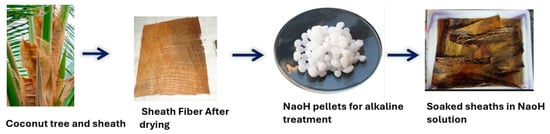
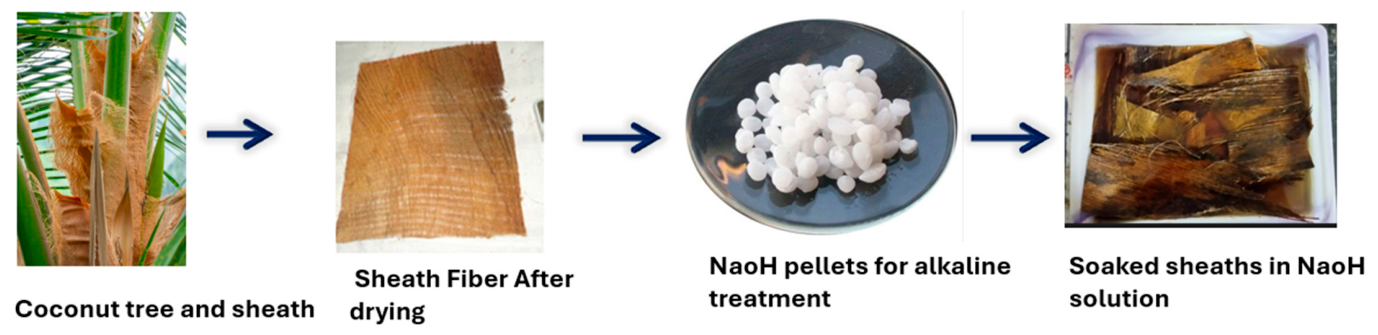
The raw material was initially evenly spread out and allowed to dry for 48 h in direct sunlight in order to eliminate moisture and get the coconut sheath ready for composite construction. The majority of the moisture content was naturally decreased after this first drying. The sheath was then oven-dried for 24 h at 55 °C to guarantee that all remaining moisture had been removed. In addition to reducing the possibility of fungal development or deterioration, this two-step drying method enhanced the coconut sheath’s compatibility with the polymer matrix during composite manufacturing, guaranteeing increased mechanical performance and interfacial bonding. Then, coconut leaf sheath fibers (CLSFs) were subjected to alkaline treatment to enhance their surface and mechanical properties for composite applications. The treatment was carried out using a 5 wt.% sodium hydroxide (NaOH) solution, which was prepared by dissolving NaOH pellets in distilled water. The fibers were immersed completely in the solution and maintained at room temperature for 4 h, allowing the alkali to remove impurities such as hemicellulose, lignin, waxes, and pectin from the fiber surface. After the treatment period, the fibers were thoroughly washed with distilled water until a neutral pH was achieved to ensure the complete removal of residual alkali. The washed fibers were then air-dried, followed by oven-drying at 60 °C for 24 h to eliminate any remaining moisture. This optimized alkali treatment improved the surface roughness and interfacial adhesion of CLSF by exposing more cellulose hydroxyl groups, making the fibers more suitable for use in polymer composite reinforcement. The natural fiber preparation process is shown in Figure 1.
Figure 1.
Schematic diagram of the preparation of coconut leaf sheath fiber (CLSF).
2.3. Biochar Synthesis from Cashew Nutshells
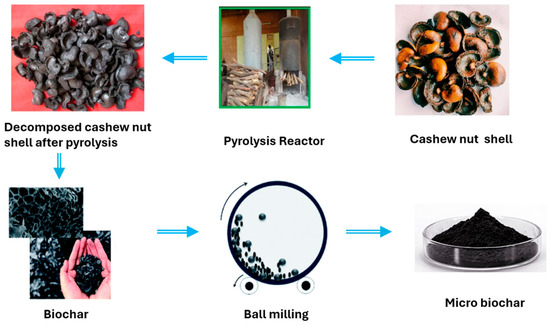
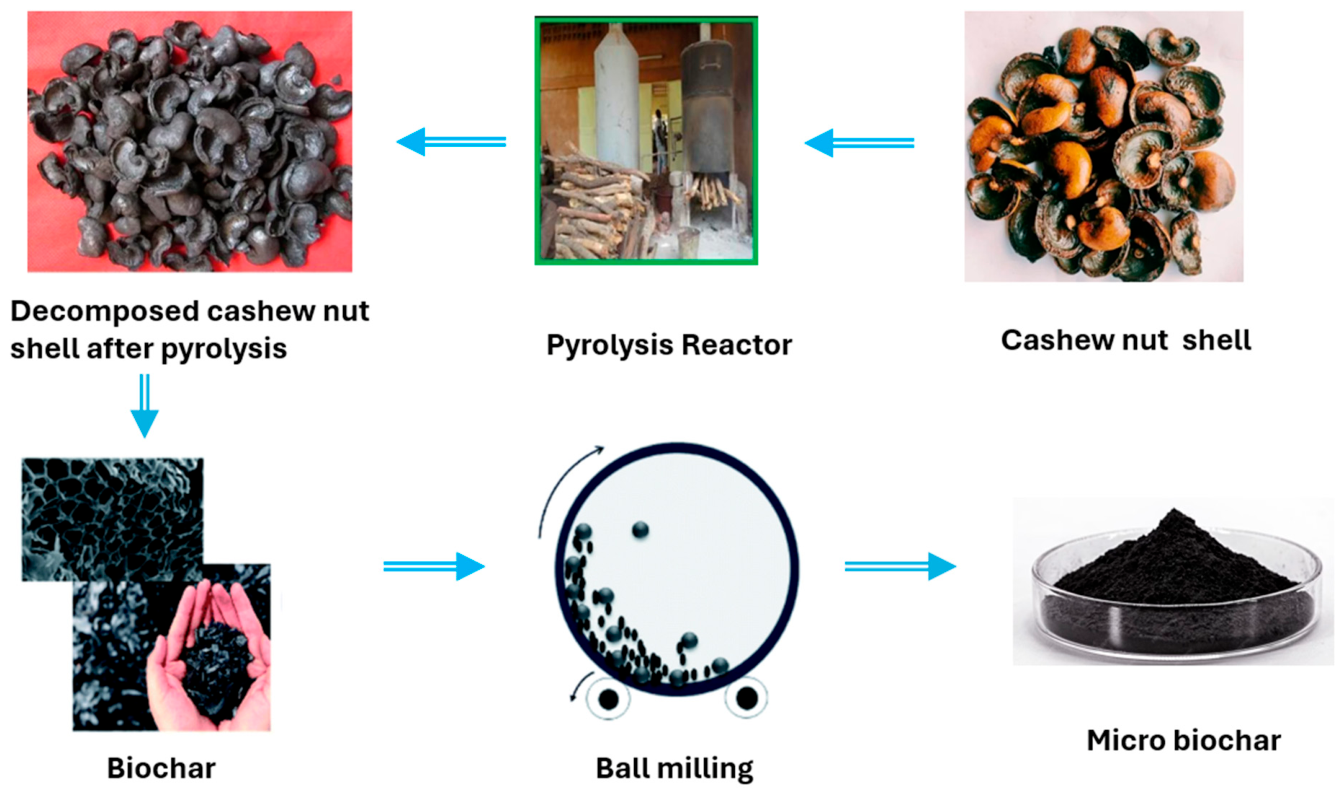
Cashew nutshell waste was cleaned and dried, then pyrolyzed at 500 °C for 2 h in a reactor described as oxygen-limited. The micro biochar production was shown in Figure 2. The char was ground, sieved to below 75 µm, and dried at 80 °C for 2 h before fabrication. The original experimental record does not specify the heating rate, gas composition/flow, or whether the 2 h period excludes ramping; these parameters must be supplied from laboratory records to establish reproducibility. The specific surface area, pore-size distribution, ash content, elemental composition, and pH were not reported and should not be inferred from the pyrolysis temperature alone.
Figure 2.
Schematic diagram of micro biochar production.
2.4. Composite Fabrication
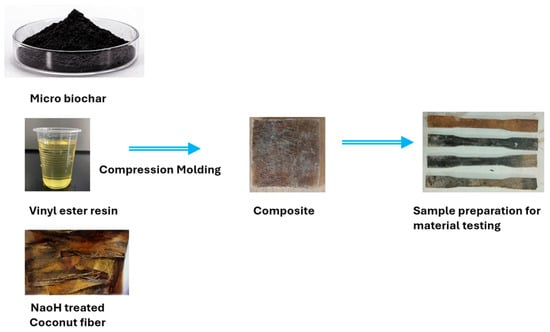
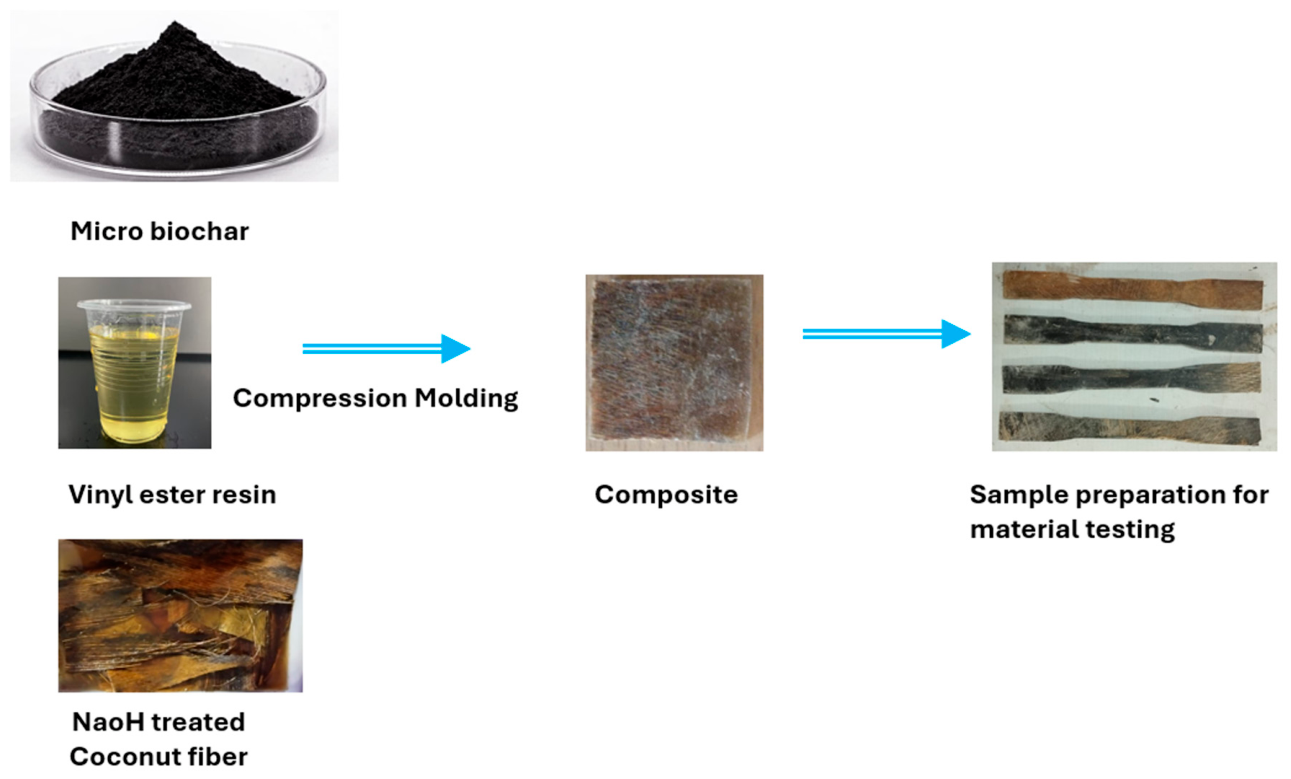
The hand lay-up method and compression molding used to create the composites are shown in Figure 3. In order to maintain a consistent coconut leaf sheath fiber (CLSF) content of 30 weight percent, four compositions were made with biochar loadings of 0, 5, 10, and 15 weight percent. To achieve homogeneity, vinyl ester resin and cobalt naphthenate were first combined while being continuously stirred at 300 rpm for 10 min. Next, cashew nutshell biochar particles were added gradually and properly mixed together. Methyl ethyl ketone peroxide (MEKP) was added as the curing catalyst just prior to pouring, and the CLSF that had been treated with NaOH was then positioned in the mold to attain uniform orientation. This was done with gentle mixing to reduce air entrapment. After pouring the resultant slurry into a mold that had been coated with a release agent, it was compressed for 24 h at room temperature at 1–2 MPa. Lastly, to encourage full crosslinking and improve thermal stability, the composites were post-cured for two hours at 80 °C.
Figure 3.
Schematic diagram of fabrication process.
3. Testing
3.1. X-Ray Diffraction and FTIR Analysis
Wide-angle X-ray diffraction (XRD) was carried out using a Bruker D8 ADVANCE ECO diffractometer with Cu Kα radiation (λ = 0.15406 nm), operated at 40 kV and 40 mA over 2θ = 10–80°. The scan step size and acquisition time were not documented in the available experimental description. XRD is used here to compare changes in diffraction features associated with the lignocellulosic component and biochar-derived carbon, not to infer improved matrix crystallinity. Fourier-transform infrared (FTIR) spectroscopy was employed to identify the characteristic functional groups and examine the chemical interactions among the vinyl ester matrix alkali-treated coconut leaf sheath fibers and cashew nutshell biochar. The FTIR characterization was carried out at the International Research Centre, Kalasalingam Academy of Research and Education, Krishnankoil, Tamil Nadu, India, using a Shimadzu IRTracer-100 FTIR spectrophotometer (Shimadzu Corporation, Kyoto, Japan).
3.2. Mechanical Testing and Fractography
Tensile testing was performed using a Dak System Series 7200 Universal Testing Machine (Dak System Inc., Thane, Maharashtra, India) at a crosshead speed of 2 mm/min.
Rectangular specimens measuring 200 × 20 × 3 mm (length × width × thickness) were prepared for tensile testing. The tensile properties were evaluated following the general testing procedure described in ASTM D3039 [30], with the specimen dimensions selected according to the experimental requirements and specimens measuring 125 × 13 × 3 mm were subjected to three-point bending tests in accordance with ASTM D790 [31]. In accordance with ASTM D2240 [32], Shore D hardness was measured using a durometer. Every test was carried out under carefully monitored circumstances and at room temperature. In order to look into failure processes, the fracture surfaces of the tested specimens were also inspected using scanning electron microscopy (SEM), with pictures taken using ZEISS optical equipment at different magnifications. This thorough process yielded important information on the manufactured composites’ fracture properties and mechanical performance.
4. Result and Discussion
4.1. X-Ray Diffraction Patterns and Crystallinity Index
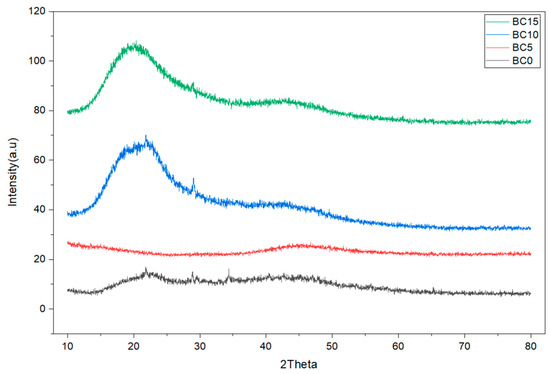
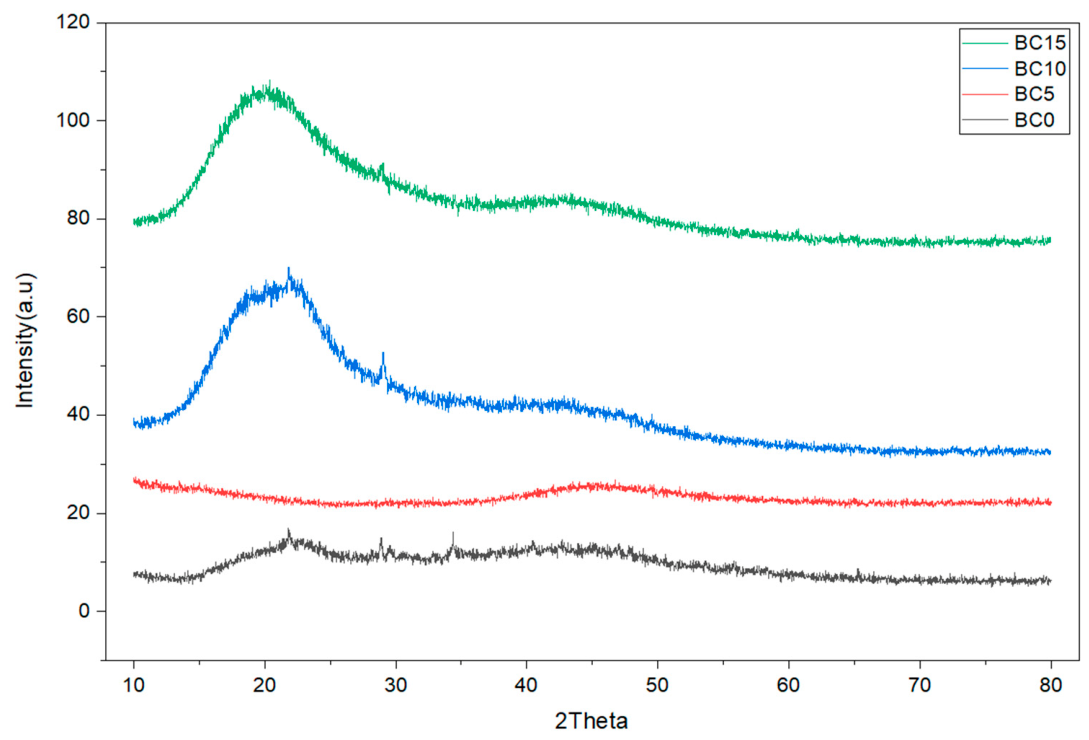
Figure 4 presents the X-ray diffraction (XRD) patterns of alkali-treated coconut-leaf-sheath-fiber-reinforced vinyl ester composites containing 0, 5, 10, and 15 wt.% cashew nutshell biochar (BC0, BC5, BC10, and BC15, respectively). All compositions exhibit broad diffraction features, indicating substantial contributions from noncrystalline and structurally disordered constituents. These features may originate from the amorphous vinyl ester matrix, the lignocellulosic reinforcement, and the disordered carbon structure of the incorporated biochar. The broad diffraction response reflects the combined structural characteristics of these constituents rather than the formation of a distinctly crystalline composite phase.
Figure 4.
XRD analysis of biochar/coconut-fiber-reinforced vinyl ester composites.
A broad diffraction feature is observed around 2θ ≈ 20–22°, together with overlapping intensity contributions extending towards approximately 26°. Cellulose-related diffraction from coconut sheath fibers may contribute to this region, while the disordered aromatic carbon layers present in biochar may produce broad turbostratic carbon scattering at comparable diffraction angles. Consequently, the overlapping diffraction features cannot be assigned exclusively to either cellulose or biochar without additional reference patterns and peak deconvolution analysis. Differences in peak shape and relative intensity among the compositions may reflect changes in their constituent contributions, but they do not independently establish an increase in crystallinity with increasing biochar content. The broad diffraction features and the absence of clearly resolved new crystalline reflections suggest that biochar incorporation does not produce an identifiable new crystalline phase within the detection limits of the present measurements. However, the overlap among matrix, fiber, and biochar contributions prevents a reliable quantitative determination of composite crystallinity from the presented patterns. Therefore, the XRD results are interpreted qualitatively, without assigning crystallinity indices or proposing a crystallinity saturation threshold.
Comparison of the present XRD results with those reported for biochar–polymer systems provides a basis for distinguishing diffraction features arising from the overlapping contributions of individual constituents from those associated with genuine structural modifications. Das et al. [16] reported that biochar generally exhibits a heterogeneous and disordered carbon structure, with its structural characteristics strongly influenced by feedstock composition and pyrolysis conditions. Similarly, Zhang et al. [20] demonstrated that the pyrolysis temperature significantly affects the structural organization and degree of ordering of rice-husk-derived biochar. These findings are consistent with the broad diffraction features observed in the present study, which may be associated with the disordered carbonaceous structure of biochar. However, unlike investigations involving isolated biochar or semicrystalline thermoplastic matrices, the present composites consist of a thermosetting vinyl ester matrix, cellulose-containing natural sheath fibers and biochar particles, each potentially contributing to the overall diffraction pattern. Consequently, variations in the diffraction intensity and peak profiles within the 2θ range of 20–26° may arise from overlapping contributions of cellulose crystalline domains, disordered carbon structures and the amorphous polymer matrix, rather than necessarily indicating changes in crystallinity. Further characteristics of the XRD peak and its interpretation were presented in detail in Table 2.
Table 2.
Characteristic XRD peak positions and phase assignments of coconut-fiber–biochar-reinforced vinyl ester composites.
4.2. FTIR Data
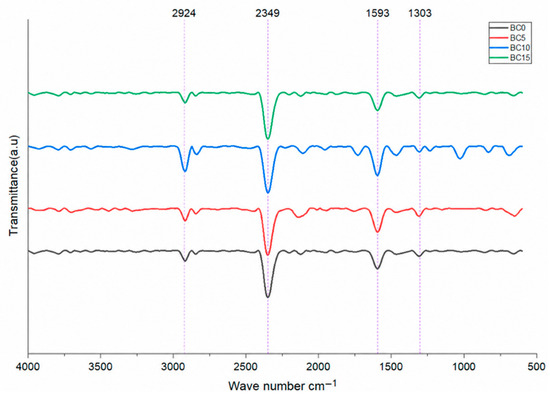
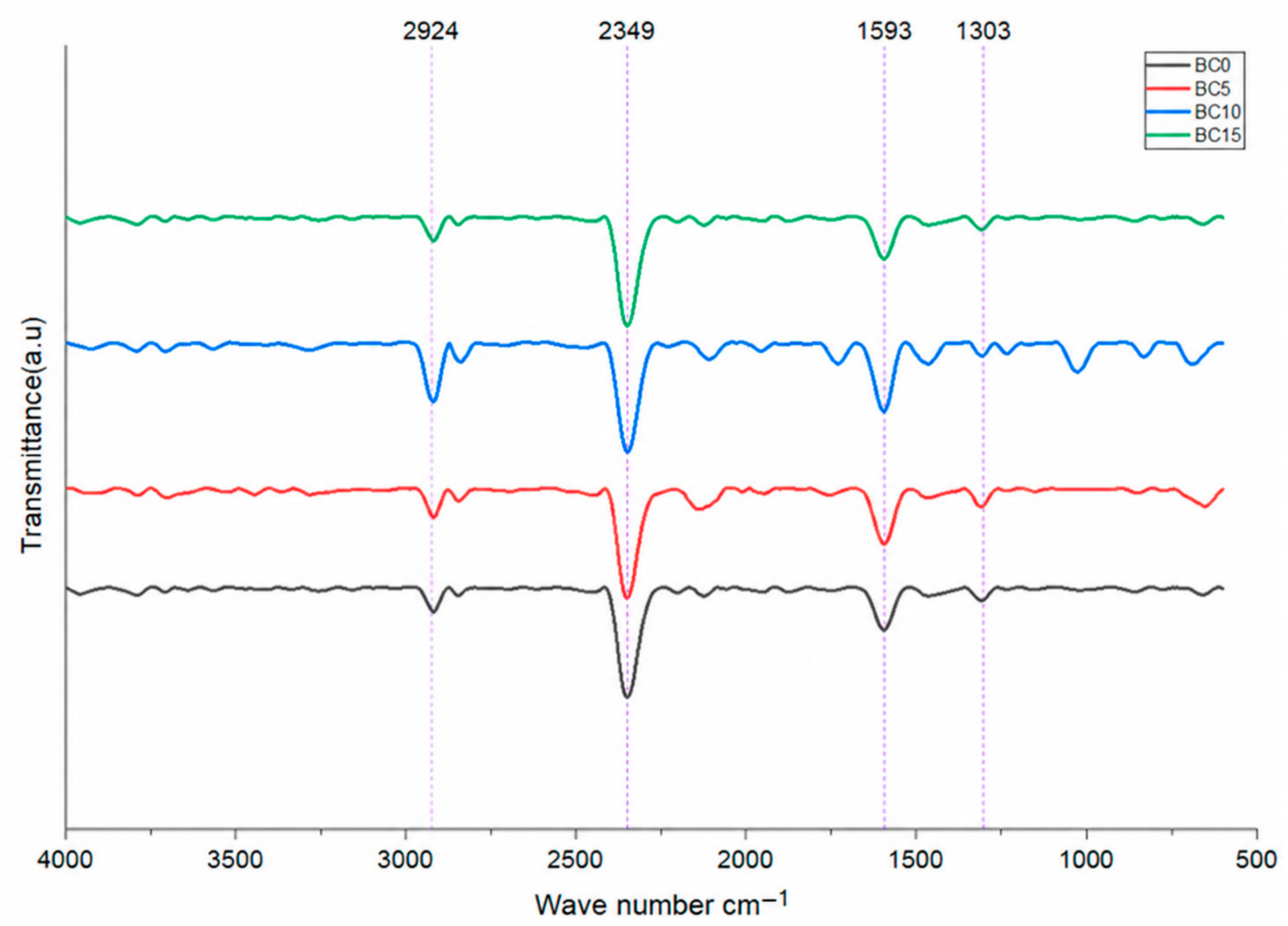
Figure 5 presents the FTIR spectra of alkali-treated coconut-sheath-fiber-reinforced vinyl ester composites containing 0, 5, 10, and 15 wt.% cashew nutshell biochar. The characteristic absorption bands observed at 2924, 1593, and 1303 cm−1 are associated with aliphatic C–H stretching, aromatic C=C vibrations, and C–O vibrations, respectively. The band near 2349 cm−1 is attributed primarily to atmospheric CO2 and is not considered evidence of interfacial bonding. These characteristic bands indicate the presence of functional groups associated with the constituent materials. However, variations in band intensity should be interpreted cautiously because they may also arise from differences in sample composition, thickness, and spectral normalization.
Figure 5.
FTIR analysis of biochar/coconut-fiber-reinforced vinyl ester composites.
The absorption bands or substantial peak shifts were observed following biochar incorporation. This suggests that the formation of new chemical bonds was not detectable by the present FTIR measurements. The absence of new FTIR bands does not necessarily indicate the absence of chemical or secondary interactions between the constituent phases. Functional groups on the biochar surface and alkali-treated coconut sheath fibers may participate in hydrogen bonding, polar interactions, and other interfacial interactions with compatible groups in the vinyl ester matrix. Such interactions could contribute to interfacial adhesion and stress transfer, although their occurrence and relative contributions cannot be confirmed from the FTIR spectra alone.
Similar FTIR observations have been reported by Das et al. [16] for biochar-filled polymer composites and George et al. [22] for coconut-shell-biochar-reinforced PLA–PBAT composites. These studies demonstrate the usefulness of FTIR in identifying oxygen-containing functional groups and aromatic structures associated with biochar and polymer constituents. However, changes in absorption intensity alone cannot be considered conclusive evidence of improved interfacial adhesion. In the present study, the absorption bands observed at 2924, 1593 and 1303 cm−1 are attributed to characteristic vibrations of the composite constituents, whereas the band at 2349 cm−1 is likely associated with atmospheric CO2. Although some chemically modified biochar composites exhibit noticeable shifts in absorption bands, no distinct spectral changes confirming the formation of new chemical bonds were observed in the present composites. This suggests that the FTIR results primarily reflect the functional groups already present in the constituent materials rather than the formation of additional interfacial chemical bonds. Differences between the present findings and those reported in the literature may arise from variations in biochar feedstock, pyrolysis conditions, surface oxidation, polymer matrix chemistry and overlapping absorption bands associated with vinyl ester resin and natural fibers [16,22,23]. The FTIR and mechanical results collectively suggest that biochar incorporation influences composite performance through a combination of physical reinforcement, particle dispersion, and possible interfacial interactions. The mechanical improvements cannot be attributed exclusively to chemical bonding, and additional surface-sensitive or interfacial characterization would be required to establish the specific bonding mechanisms.
The FTIR spectra exhibit characteristic absorption bands associated with functional groups present in the composite constituents. The absence of distinct new absorption bands or substantial peak shifts does not necessarily exclude the possibility of interfacial chemical interactions, as weak or overlapping signals may remain undetected within the sensitivity limits of FTIR spectroscopy. The variations in absorption intensity alone cannot establish uniform biochar dispersion or improved fiber–matrix adhesion. Interfacial interactions, including possible hydrogen bonding, together with physical mechanisms such as matrix wetting and mechanical interlocking, may contribute to effective stress transfer between the reinforcement and vinyl ester matrix. However, the individual contributions of these mechanisms cannot be quantified from the present FTIR results.
4.3. Tensile Strength
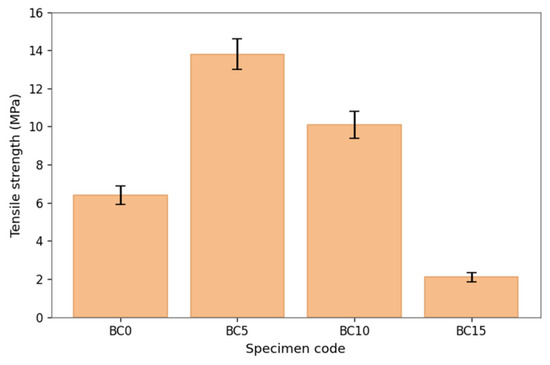
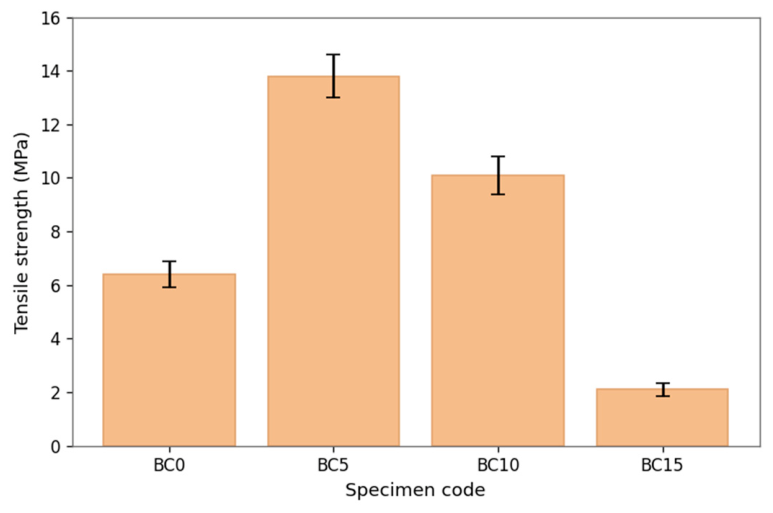
Figure 6 shows the tensile strength increased from 6.4 MPa for BC0 to 13.8 MPa for BC5 (+115.6%), then decreased to 10.1 MPa for BC10 and 2.1 MPa for BC15. The initial increase is consistent with a beneficial balance of filler reinforcement and resin wetting; the subsequent decline may reflect filler agglomeration, increased local stress concentrations and reduced effective matrix continuity. These mechanisms are plausible interpretations supported qualitatively by fracture observations, not independently quantified causes. The tested formulations do not establish a mechanical percolation threshold, which would require a finer loading series and quantitative connectivity or rheological measurements.
Figure 6.
Tensile strength of biochar/coconut-fiber-reinforced vinyl ester composites.
The non-monotonic tensile response is consistent in direction with the broader biochar composite literature reviewed by Das et al. [16], in which the balance between reinforcement and particle clustering depends on filler loading and processing. Rajendran et al. [28] likewise reported a tensile strength improvement in cashew nutshell biochar/hemp–vinyl ester composites, but their reported increase of approximately 94% at 10 wt.% contrasts with the present maximum of 115.6% at 5 wt.%. The difference in optimum loading is plausible given the different fiber architecture (hemp versus coconut leaf sheath), resin-to-filler proportions, particle characteristics and wetting conditions; none of these individual factors was isolated experimentally in the present work. Consequently, the reduced strength at BC15 is consistent with agglomeration and reduced matrix continuity, rather than proof of a specific critical concentration [16,28].
4.4. Flexural Strength
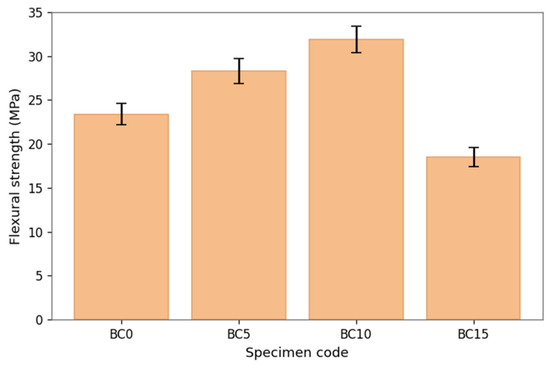
Figure 7 shows the variation in flexural strength of alkali-treated coconut-sheath-fiber-reinforced vinyl ester composites with different biochar contents. As shown in Figure 7, it can be observed that the presence of biochar in the composites improves their flexural properties up to the optimum value, beyond which there is a decrease in the flexural strength of the composites. The flexural strength of the control sample BC0 was found to be 23.40 MPa. The addition of 5% by weight of biochar (BC5) to the composites led to a flexural strength of 28.313 MPa, which is a 21.0% increase in the strength of the control composite. This increase in the flexural strength is because of the uniform distribution of biochar particles in the vinyl ester matrix. The flexural strength obtained with the addition of 10% by weight of biochar (BC10) was found to be 31.875 MPa. This enhancement shows that 10 wt.% biochar gives an optimum level of filler loading where there is strong adhesion at the interface and optimum distribution of the fillers, giving rise to maximum resistance to the bending loads of the composite. However, when the amount of biochar was increased to 15 wt.% (BC15), there was a decrease in the flexural strength to 18.519 MPa. This decrease can be associated with the excessive amount of filler loading, which causes agglomeration of particles and discontinuity of the matrix, leading to the formation of stress concentrations and weakening of the interface adhesion. The BC10 flexural strength of 31.875 MPa corresponds to an increase of approximately 36.2% relative to BC0 (23.40 MPa), while BC15 decreases to 18.519 MPa. The flexural optimum differs from the tensile optimum, consistent with the different stress fields and sensitivity of the tests to local defects. Statistical significance cannot be inferred without replicate counts and dispersion measures.
Figure 7.
Flexural strength of biochar/coconut-fiber-reinforced vinyl ester composites.
The 36.2% improvement in flexural strength observed for BC10 is consistent with previous studies reporting that carbonaceous fillers can enhance the load-bearing capacity of polymer composites [16,21]. Rajendran et al. [28] reported a flexural strength of approximately 71 MPa for hemp/vinyl ester composites containing 15 wt.% cashew nutshell biochar, whereas the present coconut-leaf-sheath-fiber-reinforced composites exhibited a lower value of 18.519 MPa at the same filler loading. This difference may be attributed to variations in fiber characteristics, reinforcement architecture, matrix properties, fiber–matrix interfacial adhesion and fabrication conditions, all of which influence flexural performance. Therefore, a direct comparison of the absolute strength values is not appropriate. However, the findings indicate that the effect of biochar loading depends strongly on the composite system and that increasing filler content does not necessarily lead to continuous improvements in flexural strength. In the present study, the reduction in flexural strength beyond 10 wt.% biochar may be associated with particle agglomeration, reduced resin availability for effective fiber wetting and localized stress concentrations, which can limit stress transfer under bending loads [16,28].
4.5. Impact Test
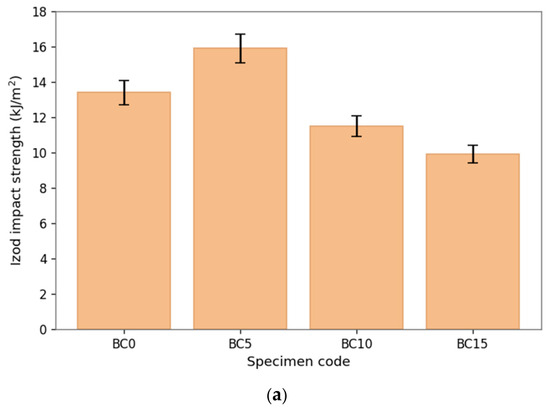
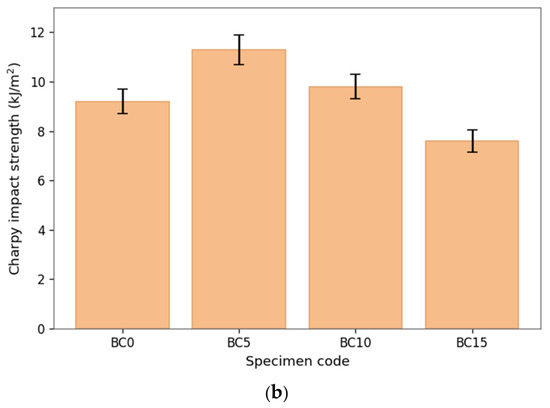
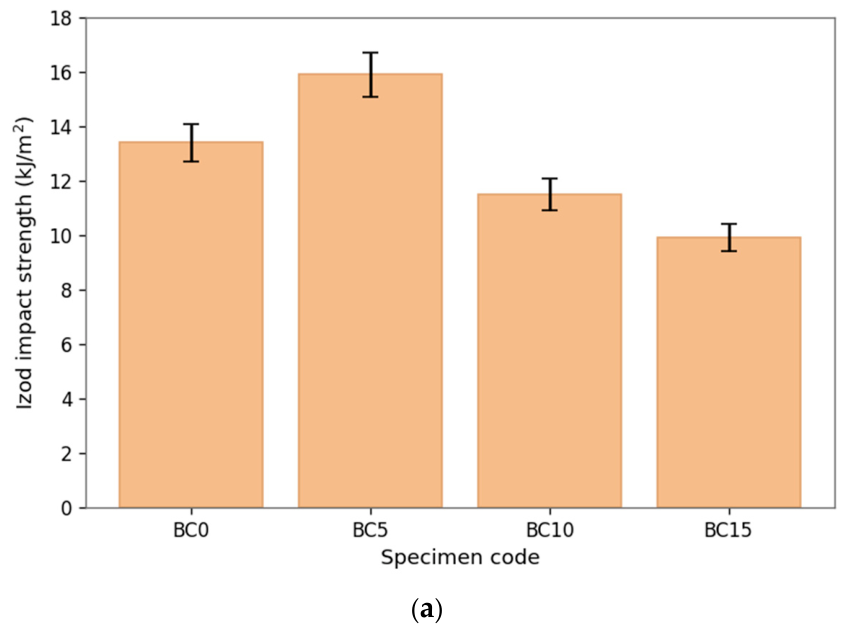
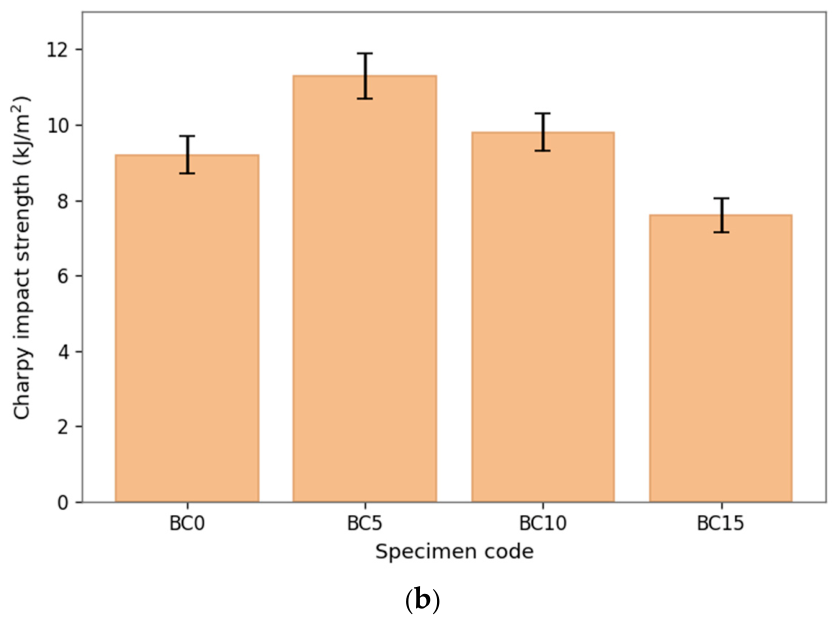
The Izod and Charpy impact test results showed a similar trend in evaluating the effect of biochar content on the impact strength of vinyl ester–coconut fiber composites, as shown in Figure 8a,b. The neat composite without biochar (BC0) exhibited Izod and Charpy impact strengths of 13.4 kJ/m2 and 9.2 kJ/m2, respectively. With the incorporation of 5% biochar (BC 5), both impact strengths increased to 15.9 kJ/m2 and 11.3 kJ/m2, indicating enhanced toughness and energy absorption due to improved fiber–matrix interfacial bonding and uniform filler dispersion. However, as the biochar content increased to 10% (BC10) and 15% (C 15), a gradual decline in impact strength was observed in both tests, with Izod values dropping to 11.5 kJ/m2 and 9.9 kJ/m2, and Charpy values to 9.8 kJ/m2 and 7.6 kJ/m2, respectively. This reduction can be attributed to filler agglomeration and poor wetting of the fibers at higher biochar loadings, leading to stress concentration and premature failure. Overall, the results confirm that 5% biochar addition provides the optimum reinforcement, offering the best balance between stiffness and impact resistance for the composite system.
Figure 8.
(a) Izod impact test; (b) Charpy impact test.
The Izod impact strength increased from 13.4 to 15.9 kJ/m2 (18.7%), while the Charpy impact strength improved from 9.2 to 11.3 kJ/m2 (22.8%) at BC5. These improvements are consistent with previous studies reporting that the impact behavior of natural fiber composites depends on filler content and its influence on energy absorption during fracture [12,15]. Interestingly, the highest flexural strength was obtained at BC10, whereas both impact properties reached their maximum values at BC5. This difference indicates that the mechanisms governing resistance to sudden impact loading may differ from those responsible for flexural strength. At lower biochar contents, improved stress transfer, crack deflection and controlled fiber pull-out may contribute to greater energy absorption. However, these mechanisms remain tentative without detailed quantitative fractographic evidence. Furthermore, direct comparison with published impact values requires caution because differences in testing methods, notch configurations, fiber stacking arrangements and matrix toughness can substantially influence the measured impact strength [12,15,16].
Reinforcement Mechanisms and Mechanical Percolation Behavior
The mechanical behavior of coconut-leaf-sheath-fiber-reinforced vinyl ester composites containing cashew nutshell biochar is governed by the combined effects of fiber reinforcement, particle–matrix interactions, filler dispersion, and matrix continuity. The two reinforcement components contribute through different mechanisms. Coconut sheath fibers, owing to their relatively high aspect ratio, primarily support mechanical loads through longitudinal stress transfer, whereas biochar particles provide localized resistance to deformation and can modify stress distribution within the polymer matrix. At moderate filler concentrations, adequately dispersed biochar particles may restrict localized matrix deformation while preserving sufficient resin continuity for effective stress transfer between the fibers and surrounding matrix. However, increasing the biochar concentration beyond an optimum level may promote particle aggregation, inadequate wetting, and localized defects, thereby reducing the reinforcing efficiency of both constituents.
The experimental results demonstrate that the optimum biochar concentration depends on the applied loading conditions. Tensile strength increased from 6.4 MPa for BC0 to 13.8 MPa for BC5, corresponding to an improvement of approximately 116%. However, further increases in biochar content reduced tensile strength to 10.1 MPa for BC10 and 2.1 MPa for BC15. In contrast, flexural strength increased from 23.40 MPa for BC0 to 28.31 MPa for BC5 and reached a maximum of 31.88 MPa for BC10, before decreasing to 18.52 MPa for BC15. Similarly, Izod impact strength reached its maximum of 15.9 kJ/m2 at 5 wt.% biochar and subsequently declined to 11.5 and 9.9 kJ/m2 at 10 and 15 wt.%, respectively. These differences indicate that moderate biochar incorporation provides beneficial reinforcement, whereas higher concentrations progressively compromise the mechanisms responsible for tensile load transfer, bending resistance, and impact energy absorption.
The deterioration at higher biochar concentrations may be associated with increased particle–particle interactions and reduced separation between neighboring biochar particles. Since the CLSF fraction was maintained at 30 wt.% throughout the study, increasing biochar content also reduced the relative availability of vinyl ester resin for matrix formation and reinforcement wetting. This condition may promote the formation of particle-rich regions, restrict resin penetration around the fibers, and increase the likelihood of interfacial debonding and void formation. Under tensile loading, these regions may act as stress concentrators and initiate premature failure, while under impact loading, particle agglomerates and weak interfaces may facilitate crack propagation rather than effective energy dissipation. The higher flexural strength observed at 10 wt.% suggests that the beneficial resistance to localized deformation remains effective under bending at this concentration, despite the reduction in tensile and impact strengths. At 15 wt.%, the pronounced reduction in all three strength properties indicates that the adverse effects of excessive filler incorporation become dominant.
From a mechanical percolation perspective, increasing the biochar concentration may progressively reduce the distances between particles and promote the formation of interconnected particle-rich regions. A mechanically effective percolated network would require sufficient particle connectivity and interfacial load-transfer capability. However, the development of particle contacts alone does not guarantee improved mechanical properties, particularly when agglomeration, weak interfacial interactions, or insufficient matrix continuity are present. The deterioration in tensile and impact properties above 5 wt.% and the reduction in flexural strength above 10 wt.% suggest a concentration-dependent transition from beneficial particle reinforcement towards defect-dominated mechanical behavior. Nevertheless, these changes cannot be considered direct evidence of a mechanical percolation threshold. The present study did not quantify particle connectivity or establish a critical filler volume fraction through systematic percolation analysis. Therefore, the 10–15 wt.% concentration range may be regarded as a region in which adverse filler interactions become increasingly significant, rather than a confirmed mechanical percolation threshold. Further investigations involving quantitative image analysis, particle-spacing measurements, and dynamic mechanical characterization would be required to establish whether a mechanically connected biochar network develops and to determine its critical concentration.
4.6. Hardness
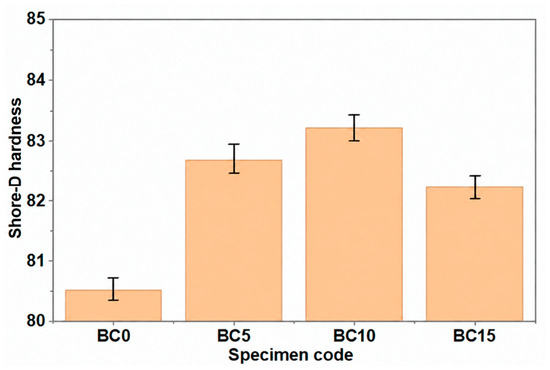
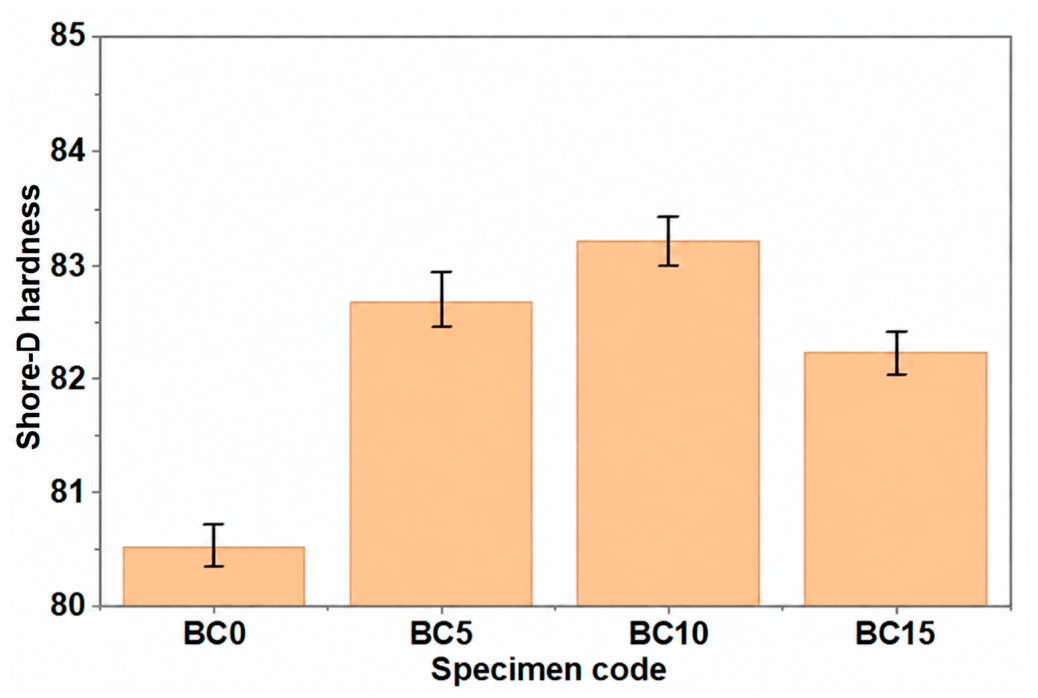
Figure 9 depicts the variation in Shore D hardness of coconut-sheath-fiber-reinforced vinyl ester composites for various biochar loadings. It can be seen that the presence of biochar has a considerable effect on the hardness of the surface of the composites. In the case of the control sample without biochar (BC0), the hardness value was observed to be 80.53, which is the natural hardness of coconut-fiber-reinforced vinyl ester matrix. With the introduction of 5 wt.% of biochar (BC5), the hardness increased to 82.66, implying that the stiff biochar particles increased the resistance of the composites to indentation by making the polymer matrix stiffer. The addition of a higher amount of biochar (10 wt.%) (BC10) resulted in the maximum hardness of 83.22, signifying the optimal biochar loading, in which the biochar particles were evenly distributed in the matrix, with effective bonding of the filler particles with the vinyl ester matrix and coconut sheath fibers, thus restricting the movement of the polymer chains in order to distribute the stress effectively. Upon further increasing the biochar percentage to 15 wt.%, the hardness decreased to 82.22. This reduction may be explained by the agglomeration of the biochar particles at the higher amount of fillers, resulting in poor dispersion and high stresses, as well as weak interfacial zones, which make the reinforcing effect of the filler less efficient. The results have shown that the use of biochar as the reinforcing filler can significantly increase the hardness of the surface of the composites based on the coconut-sheath-fiber-reinforced vinyl ester composite, especially with 10 wt.% of biochar.
Figure 9.
Shore-D hardness of biochar/coconut-fiber-reinforced vinyl ester composites.
The observed hardness behavior is consistent with the contribution of particulate reinforcement to resistance against localized deformation, as reported by Minugu et al. [21]. However, hardness and tensile strength reflect different deformation mechanisms and material responses. Hardness primarily measures resistance to localized indentation, whereas tensile strength depends on the overall load-bearing capacity, stress transfer and failure behavior of the composite. Therefore, the highest Shore D hardness recorded for BC10 does not necessarily coincide with the maximum tensile strength observed for BC5. The reduction in hardness at higher filler contents may be associated with non-uniform particle distribution, filler-rich regions and surface defects, which can reduce the effectiveness of reinforcement. Nevertheless, these possible mechanisms require further microstructural evidence for confirmation. Differences between the present findings and those reported for epoxy- and thermoplastic-based composites may also arise from variations in matrix chemistry, interfacial interactions and processing conditions, including the curing characteristics of thermosetting systems.
4.7. Erosion Test
The erosion resistance of the coconut-fiber-reinforced vinyl ester composites with different biochar contents was assessed based on the American Society for Testing Materials (ASTM) G76 standard, which utilizes an air jet erosion tester. In this experiment, the abrasive particles were propelled by compressed air with an air pressure of 0.4 bar, which impacts the specimen surface at a velocity of 41 m/s. The particles were allowed to hit the specimen surface at a controlled frequency of 8 Hz, along with a discharge rate of 2.5 g/min for 20 min. The abrasive type, particle size distribution, impact angle and stand-off distance were not recorded in the available experimental description, limiting reproducibility.
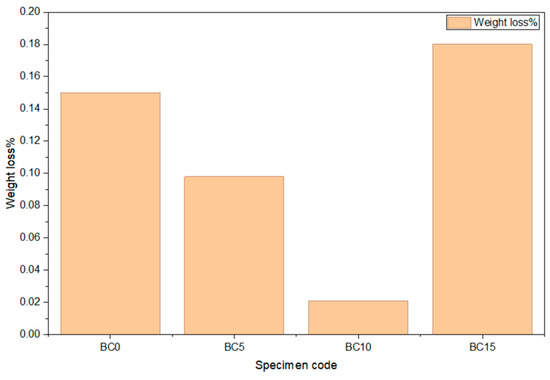
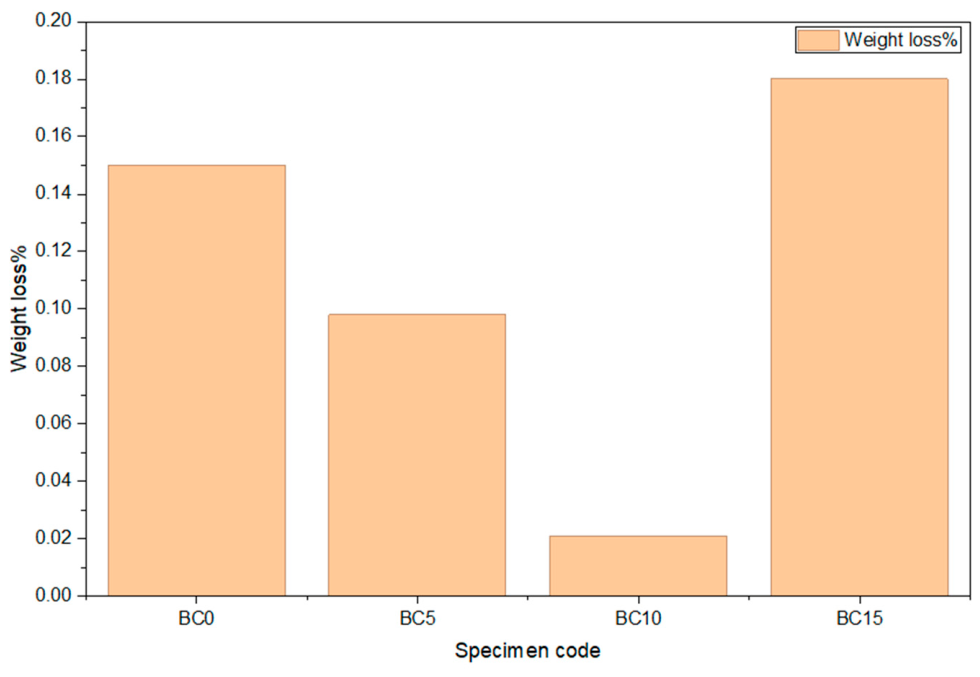
The erosion resistance of the coconut-fiber-reinforced vinyl ester composites with different biochar contents was evaluated by measuring the percentage weight loss of the specimen before and after the experiment by a precision balance. Three samples for each weight percent were used for the experiment to ensure the reliability of results obtained.
The lower the weight loss, the greater the resistance to erosion is for the biochar-filled vinyl ester composites reinforced with the coconut fiber. Figure 10 presents the percentages of weight loss for the composites containing various amounts of biochar filler. The pure composite not containing any biochar filler had a weight loss value of 0.159%, indicating average erosion resistance. At 5 wt.% of biochar filling, there was a reduction in the weight loss value to 0.098%. This indicated improved erosion resistance relative to the unfilled composite due to the reinforcing effect of well-distributed biochar fillers in the composite. The composite with 10 wt.% of biochar filling had the lowest weight loss of 0.021%. However, at a biochar loading of 15 wt.%, the composite showed a sharp increase in the rate of weight loss, showing a sharp decrease in erosion resistance, probably owing to filler agglomeration, poor filler dispersion, or defects in the composite structure itself.
Figure 10.
Weight loss percentage of biochar/coconut-leaf-sheath-fiber-reinforced vinyl ester composites.
The lowest erosion loss (0.021%) was observed for BC10, which also exhibited the highest flexural strength and hardness. This suggests that the improved mechanical properties may have contributed to greater resistance against erosive wear, possibly through enhanced reinforcement–matrix interaction and more uniform filler dispersion. However, erosion behavior is influenced by several factors, including the particle impact angle, impact velocity, erodent characteristics and integrity of the fiber–matrix interface. Therefore, hardness alone cannot fully explain the observed erosion resistance. Previous studies on filled natural fiber composites [15,16] have highlighted the importance of reinforcement distribution and interfacial bonding in determining mechanical performance, which may also help explain the behavior of BC10.
4.8. Sem Fracture Morphology
4.8.1. Tensile Testing
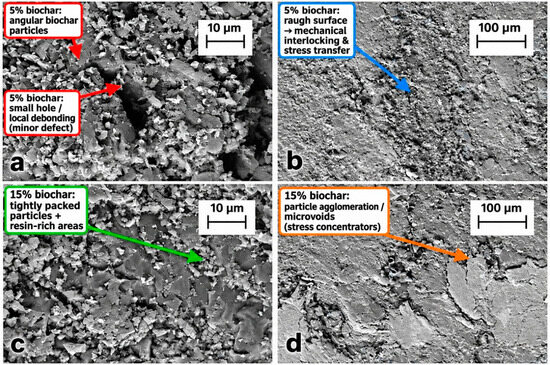
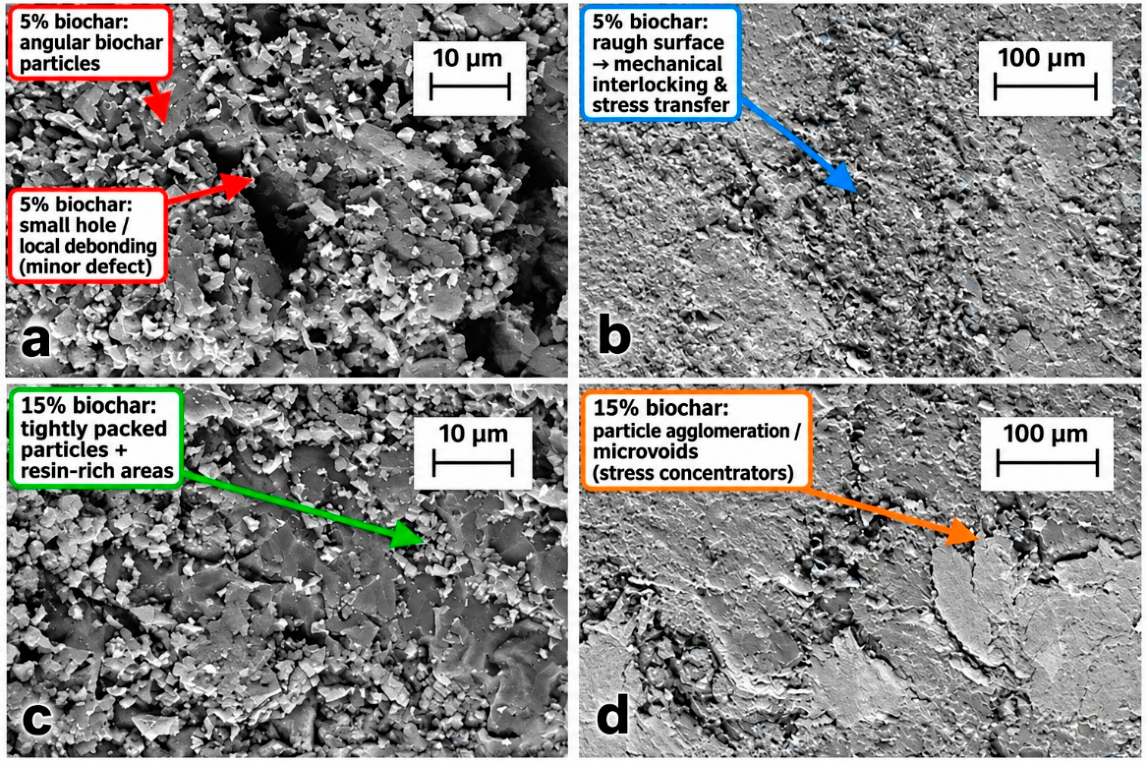
Figure 11 shows the SEM micrographs of the fracture surfaces under tensile failure of biochar-filled polymer composites. The cracked surfaces of the coconut fiber/vinyl ester composites treated with NaOH and loaded with 5% and 15% biochar exhibit clear variations in morphology and interfacial behavior during tensile testing. The surface exhibits a rather even distribution of angular biochar particles at 5% biochar, with fibrillated fibers and embedded particles demonstrating significant fiber–matrix adhesion as a result of the alkali treatment. Although there are small holes and localized debonding, which indicate minimal interfacial defects, the rough surface of the biochar helped with mechanical interlocking and efficient stress transfer. The composite with 15% biochar, on the other hand, has a more varied shape, with smoother resin-rich areas and tightly packed biochar particles. Incomplete wetting causes particle agglomeration and micro voids, even though the increased biochar content improves roughness, crack deflection, and energy absorption. Despite increased toughness, these characteristics might serve as stress concentrators, marginally decreasing tensile strength. While 15% biochar boosts reinforcing potential, but brings agglomeration-related limitations, the overall SEM observations indicate that 5% biochar loading offers superior dispersion and efficient stress transfer. Therefore, to achieve higher mechanical performance, an ideal biochar content must balance enhanced interfacial bonding with reduced flaws.
Figure 11.
SEM micrographs of the fracture surfaces under tensile failure: (a,b) 5% biochar; (c,d) 15% biochar.
4.8.2. Flexural Testing
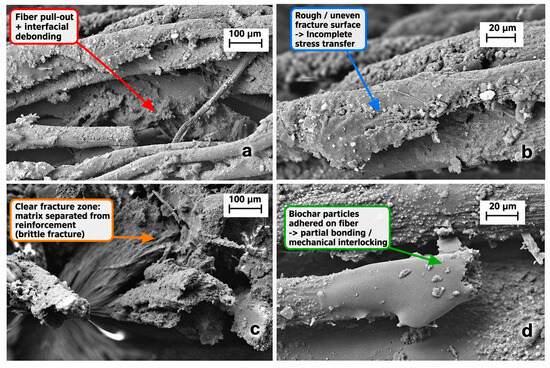
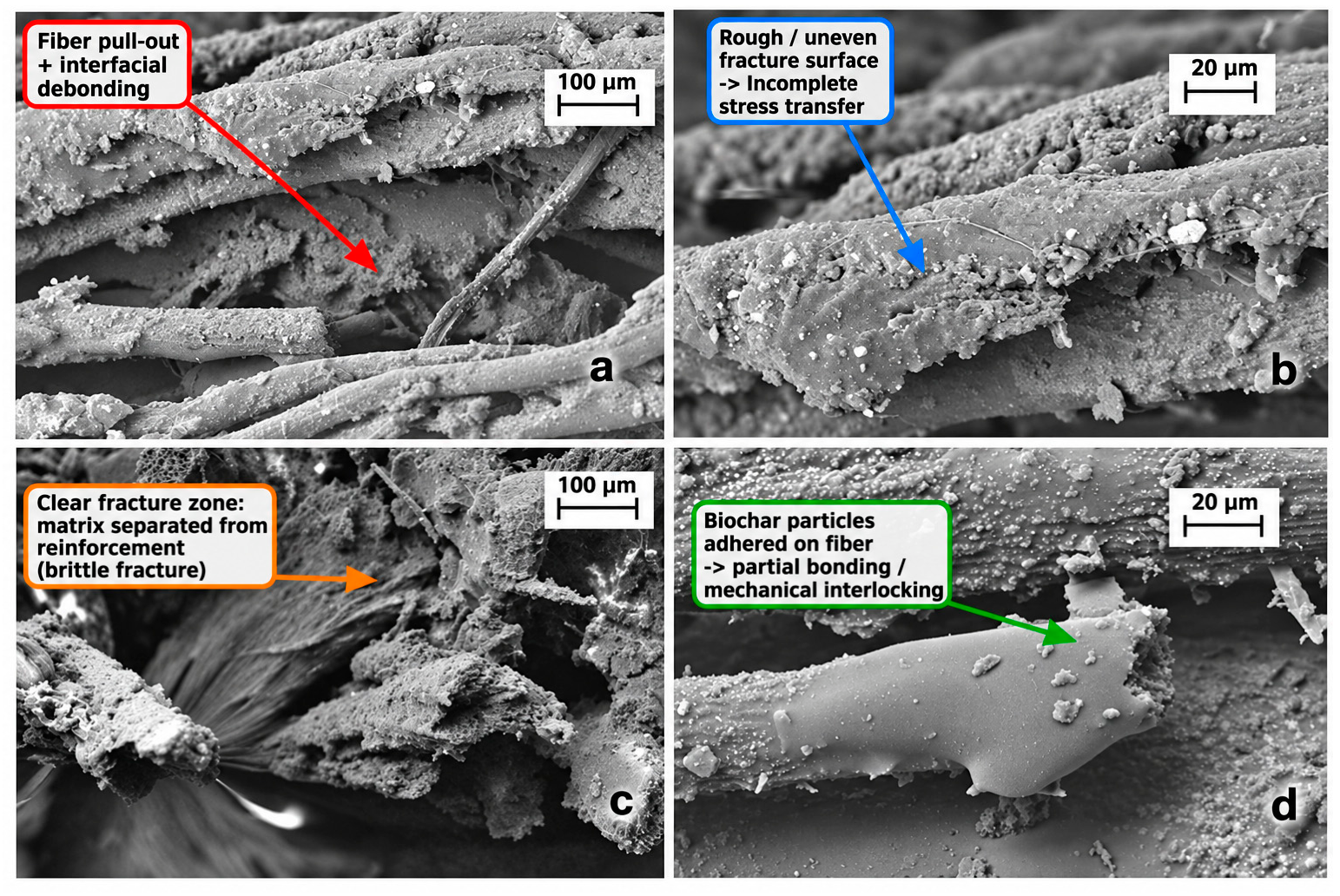
SEM micrographs (Figure 12a–d) reveal the flexural fracture morphology of the composite material. Figure 12a,b show that the fractures have evidence of fiber pull-out and debonding because the adhesion of fibers and the vinyl ester matrix was weak. This is true since the appearance of rough and irregular surfaces indicates that there was no complete stress transfer between the matrix and the fibers, probably due to breakage of fibers and matrix cracking due to flexure load. Figure 12c clearly shows a fracture region where there is separation between the matrix and the reinforcing phase, which indicates brittle fracture of the composite. Figure 12d displays single fibers with biochar particles on the surface of the fibers showing partial bonding and interlock between the filler and the matrix. It is evident from the above SEM micrographs that fiber–matrix interfacial bonding is crucial to flexural properties of the composite material.
Figure 12.
SEM micrographs of the fracture surfaces under flexural failure: (a,b) 5% biochar; (c,d) 10% biochar.
4.8.3. Impact Testing
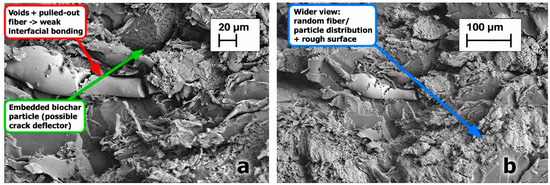
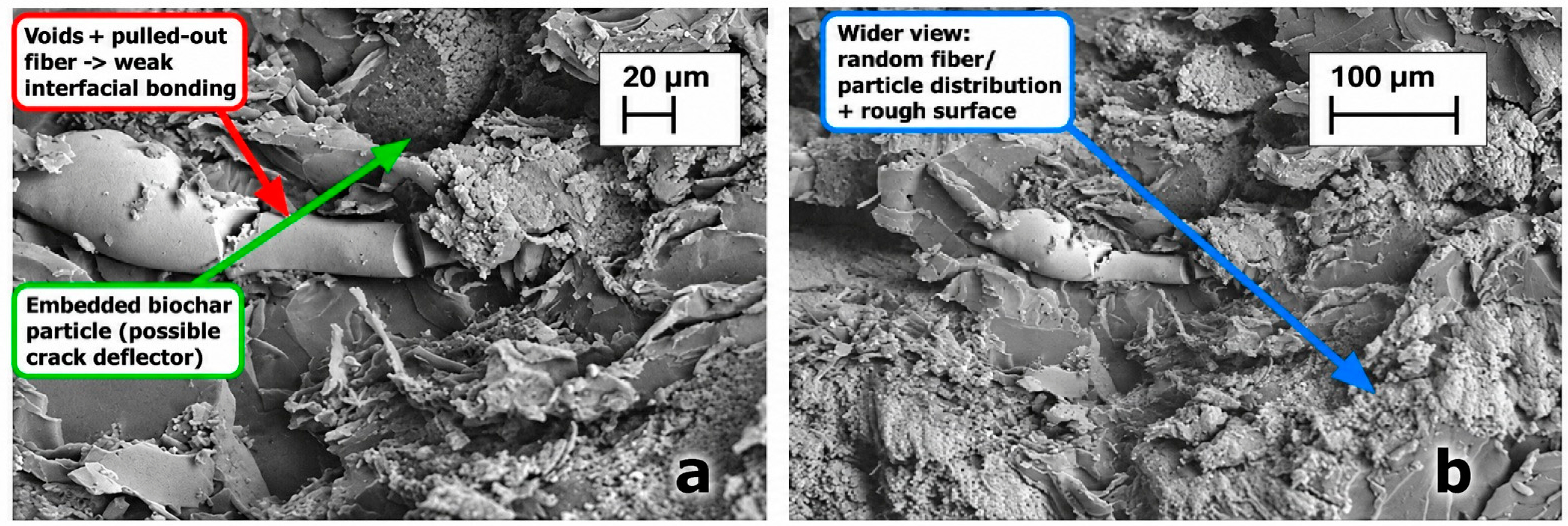
SEM images of the impact fracture surface of the coconut-fiber-reinforced vinyl ester composite polymer with 10 wt.% biochar contents are shown in Figure 13a,b. Based on the general fracture morphology, it is evident that a rough and irregular fracture surface with fiber pull-out, matrix cracking, and partial fiber debonding was observed, which suggests the presence of an energy-absorbing failure mode. Under high magnification, as seen in Figure 13a, poor interfacial bonding between the coconut fibers and vinyl ester resin can be recognized based on the existence of voids and pulled-out fibers, whereas the biochar particles can be seen embedded in the matrix, thus possibly acting as crack deflectors and increasing toughness. At low magnification, as seen in Figure 13b, the fracture surface gives more detail regarding the random distribution of fibers and biochar particles in the polymer matrix. Based on the above features, a combined failure mechanism of brittle and ductile behaviors is observed, wherein the addition of 10 wt.% biochar enhances impact energy absorption.
Figure 13.
SEM micrographs of the fracture surfaces under impact failure of composite containing 10 wt.% biochar. (a) High Magnification; (b) Low Magnification.
5. Conclusions
Cashew nutshell biochar changed the mechanical and erosion responses of coconut leaf sheath fiber/vinyl ester composites in a loading-dependent manner. Tensile strength peaked at 13.8 MPa for BC5 compared with 6.4 MPa for BC0 (+116%). Flexural strength peaked at 31.875 MPa for BC10 compared with 23.40 MPa for BC0 (+36%). The reported Shore D hardness was 83.22, and the reported erosion mass loss was 0.021% at BC10, while impact resistance was highest at BC5 (Izod: 15.9 kJ/m2; Charpy: 11.3 kJ/m2). The decrease in performance at BC15 is consistent with increased defect sensitivity and possible particle clustering, although the mechanisms were not quantitatively isolated. These findings are specific to the investigated formulations. Missing details on filler mass basis, biochar characterization, test parameters and statistical variability restrict reproducibility and the strength of broader claims. Further studies should investigate fiber fraction, intermediate biochar loadings, thermal response and controlled erosion conditions.
Author Contributions
Conceptualization, R.O., S.R. and A.V.; methodology, R.O., V.C.M. and S.R.; validation, V.C.M., S.R. and A.V.; formal analysis, R.O. and V.C.M.; investigation, R.O. and V.C.M.; resources, A.M., F.S., S.R. and A.V.; data curation, R.O. and V.C.M.; writing—original draft preparation, R.O. and V.C.M.; writing—review and editing, A.M., F.S., S.R. and A.V.; visualization, R.O. and V.C.M.; supervision, S.R. and A.V.; project administration, S.R. and A.V. All authors have read and agreed to the published version of the manuscript.
Funding
This research received no external funding.
Institutional Review Board Statement
Not applicable.
Informed Consent Statement
Not applicable.
Data Availability Statement
The data reported in this study are presented in the article. Additional raw experimental records may be requested from the corresponding authors, subject to availability.
Conflicts of Interest
The authors declare no conflicts of interest.
References
- Tang, Y.; Zhan, Z.; De, S.; Marathe, U.; Tekinalp, H.; Ozcan, S.; Dong, W.; Jin, Q.; Zhao, X.; Li, Y. Sustainable biobased composites: From raw materials to recycling. Compos. Part B Eng. 2026, 311, 113188. [Google Scholar] [CrossRef] [Scilit]
- Fitzgerald, A.; Proud, W.; Kandemir, A.; Murphy, R.J.; Jesson, D.A.; Trask, R.S.; Hamerton, I.; Longana, M.L. A Life Cycle Engineering Perspective on Biocomposites as a Solution for a Sustainable Recovery. Sustainability 2021, 13, 1160. [Google Scholar] [CrossRef] [Scilit]
- Ahmed, R.; Manik, K.H.; Nath, A.; Shohag, J.R.; Mim, J.J.; Hossain, N. Recent advances in sustainable natural fiber composites: Environmental benefits, applications, and future prospects. Mater. Today Sustain. 2025, 32, 101220. [Google Scholar] [CrossRef] [Scilit]
- Mohanty, K.; Misra, M.; Hinrichsen, G. Biofibres, biodegradable polymers and biocomposites: An overview. Macromol. Mater. Eng. 2000, 276–277, 1–24. [Google Scholar] [CrossRef] [Scilit]
- Mostovoy, A.; Eremeeva, N.; Shcherbakov, A.; Lopukhova, M.; Ussenkulova, S.; Zhunussova, E.; Bekeshev, A. A Study of the Structure, Properties, and Sorption Activity of Oil Sorbents Based on the Secondary Cellulose-Containing Raw Materials of Buckwheat Cereal Production. Molecules 2025, 30, 2285. [Google Scholar] [CrossRef] [Scilit] [PubMed]
- Naveen, J.; Jawaid, M.; Zainudin, E.S.; Sultan, M.T.H.; Yahaya, R. Evaluation of ballistic performance of hybrid Kevlar®/Cocos nucifera sheath reinforced epoxy composites. J. Text. Inst. 2019, 110, 1179–1189. [Google Scholar] [CrossRef] [Scilit]
- Khan, T.; Karthikeyan, N.; Naveen, J.; Anand, S.P.; Sebaey, T.A. Coconut (Cocos nucifera) sheath-based polymeric composites—A review. Heliyon 2024, 10, e35644. [Google Scholar] [CrossRef] [Scilit] [PubMed]
- Poddar, P.; Asad, M.A.; Islam, M.S.; Sultana, S.; Nur, H.P.; Chowdhury, A.M.S. Mechanical and Morphological Study of Arecanut Leaf Sheath (ALS), Coconut Leaf Sheath (CLS) and Coconut Stem Fiber (CSF). Adv. Mater. Sci. 2016, 1, 1–4. [Google Scholar] [CrossRef] [Scilit]
- Mansingh, B.B.; Narasimhamu, K.L.; Varaprasad, K.C.; Binoj, J.S.; Radhakrishnan, A.; Ali, A. Impact on mechanical properties of surface treated coconut leaf sheath fiber/SiC nano particles reinforced phenol-formaldehyde polymer composites. J. Polym. Mater. 2023, 40, 71–82. [Google Scholar] [CrossRef] [Scilit]
- Kumar, S.M.S.; Duraibabu, D.; Subramanian, K. Studies on mechanical, thermal and dynamics mechanical properties of untreated (raw) and treated coconut sheath fiber reinforced epoxy composites. Mater. Des. 2014, 59, 63–69. [Google Scholar] [CrossRef] [Scilit]
- Pratama, M.I.; Sugiman, S.; Catur, A.D.; Hilton, A. Effects of Alkali (NaOH) Treatment of Banana Bunch Fiber (Musa Paradisiaca) on the Tensile Properties of Banana Bunch Fiber/Unsaturated Polyester Composites. Chem. J. Tek. Kim. 2024, 11, 1–12. [Google Scholar] [CrossRef] [Scilit]
- Mahesh, V.; Harursampath, D. Influence of alkali treatment on physio-mechanical properties of jute–epoxy composite. Adv. Mater. Process. Technol. 2022, 8, 380–391. [Google Scholar] [CrossRef] [Scilit]
- Widodo, E.; Pratikto; Sugiarto; Widodo, T.D. Comprehensive investigation of raw and NaOH alkalized sansevieria fiber for enhancing composite reinforcement. Case Stud. Chem. Environ. Eng. 2024, 9, 100546. [Google Scholar] [CrossRef] [Scilit]
- Chaudhary, S.; Gairola, S.; Sharma, H. Influence of the fruit waste fillers on the thermal, mechanical, and morphological properties of flax/epoxy composites. Proc. Inst. Mech. Eng. Part L J. Mater. Des. Appl. 2024, 238, 534–541. [Google Scholar] [CrossRef] [Scilit]
- Ashik, K.; Sharma, R.S.; Raghavendra, N. Effect of filler on mechanical properties of natural fiber reinforced composites. Asian J. Chem. 2017, 29, 1697–1701. [Google Scholar] [CrossRef] [Scilit]
- Das, C.; Tamrakar, S.; Kiziltas, A.; Xie, X. Incorporation of Biochar to Improve Mechanical, Thermal and Electrical Properties of Polymer Composites. Polymers 2021, 13, 2663. [Google Scholar] [CrossRef] [Scilit] [PubMed]
- Wang, L.; Deng, J.; Yang, X.; Hou, R.; Hou, D. Role of biochar toward carbon neutrality. Carbon Res. 2023, 2, 2. [Google Scholar] [CrossRef] [Scilit]
- Rajput, V.; Saini, I.; Parmar, S.; Pundir, V.; Kumar, V.; Kumar, V.; Naik, B.; Rustagi, S.; Rajput, V.; Saini, I.; et al. Biochar production methods and their transformative potential for environmental remediation. Discov. Appl. Sci. 2024, 6, 408. [Google Scholar] [CrossRef] [Scilit]
- Noori, A.; Bartoli, M.; Frache, A.; Piatti, E.; Giorcelli, M.; Tagliaferro, A. Development of Pressure-Responsive PolyPropylene and Biochar-Based Materials. Micromachines 2020, 11, 339. [Google Scholar] [CrossRef] [Scilit] [PubMed]
- Zhang, Q.; Zhang, D.; Lu, W.; Khan, M.U.; Xu, H.; Yi, W.; Lei, H.; Huo, E.; Qian, M.; Zhao, Y.; et al. Production of high-density polyethylene biocomposites from rice husk biochar: Effects of varying pyrolysis temperature. Sci. Total Environ. 2020, 738, 139910. [Google Scholar] [CrossRef] [Scilit] [PubMed]
- Minugu, O.P.; Gujjala, R.; Shakuntala, O.; Manoj, P.; Chowdary, M.S. Effect of biomass derived biochar materials on mechanical properties of biochar epoxy composites. Proc. Inst. Mech. Eng. Part C J. Mech. Eng. Sci. 2021, 235, 5626–5638. [Google Scholar] [CrossRef] [Scilit]
- George, J.; Jung, D.; Bhattacharyya, D. Improvement of Electrical and Mechanical Properties of PLA/PBAT Composites Using Coconut Shell Biochar for Antistatic Applications. Appl. Sci. 2023, 13, 902. [Google Scholar] [CrossRef] [Scilit]
- Kaur, R.; Kumar, V.T.; Krishna, B.B.; Bhaskar, T. Characterization of slow pyrolysis products from three different cashew wastes. J. Anal. Appl. Pyrolysis 2023, 376, 128859. [Google Scholar] [CrossRef] [Scilit] [PubMed]
- Siva, R.; Kesavaram, B.; Martin, J.J.; Mathiselvan, G.; Navas, K.B.; Sangeetha, M. Mechanical behavior of sisal and banana fiber reinforced hybrid epoxy composites. Mater. Today Proc. 2021, 44, 3692–3696. [Google Scholar] [CrossRef] [Scilit]
- Arpitha, G.R.; Raghu, M.J.; Bharath, K.N.; Jain, N.; Verma, A. Mechanical and micro-structural characterization of biodegradable coir fiber–glass sheet–charcoal reinforced polymer composite: An experimental approach. Discov. Polym. 2024, 1, 7. [Google Scholar] [CrossRef] [Scilit]
- Nasimudeen, N.A.; Karounamourthy, S.; Selvarathinam, J.; Thiagamani, S.M.K.; Pulikkalparambil, H.; Krishnasamy, S.; Muthukumar, C. Mechanical, absorption and swelling properties of vinyl ester based natural fibre hybrid composites. Appl. Sci. Eng. Prog. 2021, 14, 680–688. [Google Scholar] [CrossRef] [Scilit]
- Parashar, S.; Chawla, V. Experimental evaluation and optimization of kenaf-coir based hybrid composite incorporated with titanium carbide nano-fillers. Eng. Solid Mech. 2025, 13, 229–242. [Google Scholar] [CrossRef] [Scilit]
- Rajendran, S.; Palani, G.; Veerasimman, A.; Marimuthu, U.; Kannan, K.; Shanmugam, V. Biochar from cashew nut shells: A sustainable reinforcement for enhanced mechanical performance in hemp fibre composites. Clean. Eng. Technol. 2024, 20, 100745. [Google Scholar] [CrossRef] [Scilit]
- Abdul Khali, H.P.S.; Masri, M.; Saurabh, C.K.; Fazita, M.R.N.; Azniwati, A.A.; Aprilia, N.A.S.; Rosamah, E.; Dungani, R. Incorporation of coconut shell based nanoparticles in kenaf/coconut fibres reinforced vinyl ester composites. Mater. Res. Express 2017, 4, 035020, Corrigendum in Mater. Res. Express 2017, 4, 119501. [Google Scholar] [CrossRef] [Scilit]
- ASTM D3039/D3039M-17(2025); Standard Test Method for Tensile Properties of Polymer Matrix Composite Materials. ASTM International: West Conshohocken, PA, USA, 2025. [Google Scholar] [CrossRef] [Scilit]
- ASTM D790-25; Standard Test Methods for Flexural Properties of Unreinforced and Reinforced Plastics and Electrical Insulating Materials. ASTM International: West Conshohocken, PA, USA, 2025. [Google Scholar] [CrossRef] [Scilit]
- ASTM D2240-15(2021); Standard Test Method for Rubber Property—Durometer Hardness. ASTM International: West Conshohocken, PA, USA, 2021. [Google Scholar] [CrossRef] [Scilit]

Disclaimer/Publisher’s Note: The statements, opinions and data contained in all publications are solely those of the individual author(s) and contributor(s) and not of MDPI and/or the editor(s). MDPI and/or the editor(s) disclaim responsibility for any injury to people or property resulting from any ideas, methods, instructions or products referred to in the content. |
© 2026 by the authors. Licensee MDPI, Basel, Switzerland. This article is an open access article distributed under the terms and conditions of the Creative Commons Attribution (CC BY) license.