


Abstract
Design deviations introduced during the fabrication and installation of nuclear-grade piping systems can alter structural response and substantially increase reanalysis effort. This study develops a mechanics-based framework to identify critical parameters controlling the code-stress ratio of a representative nuclear piping system. Finite-element analysis, Monte Carlo sampling, and Sobol global sensitivity analysis were combined to evaluate the effects of gravity, thermal-pressure loading, and seismic excitation. The results show that parameter sensitivity is strongly load-dependent. Under Level-A conditions, the response is governed mainly by constrained thermal deformation, and the dominant parameters are support locations that control deformation compatibility and the redistribution of secondary stress. By contrast, structural and weight-related parameters have only limited influence in this regime. Under Level-D conditions, however, the governing mechanism shifts to inertia-driven amplification. The dominant variables then become those associated with dynamic constraint, concentrated mass, and eccentric loading, including key support positions, valve eccentricity, and valve weight. Multi-parameter analyses further reveal clear interaction effects, showing that simultaneous deviations in critical supports, concentrated masses, or eccentricities can significantly amplify the stress response and, in some cases, drive the stress ratio beyond the allowable limit. These results show that the mechanical importance of design parameters depends on both the loading regime and system-level parameter interactions, and they provide a quantitative basis for condition-specific tolerance allocation in nuclear piping design.
1. Introduction
Piping systems are indispensable to many industrial facilities, and their structural integrity is of particular importance in safety-critical environments. Among these, nuclear-grade pipelines are especially significant because they serve both as coolant transport channels and as key links among safety-related components and systems [1]. Owing to the severe operating conditions in nuclear power plants, these pipelines must perform reliably under combined loading, including internal pressure, self-weight, thermal expansion, seismic excitation, and extreme accident-induced conditions. Consequently, their design, fabrication, and installation must meet exceptionally stringent requirements for safety, reliability, and long-term service performance [2].
With the continuous development of nuclear energy technology, nuclear power plants have become increasingly large-scale and structurally complex. This trend has led to corresponding increases in the complexity of nuclear piping layouts and the difficulty of stress evaluation during design [3]. In practice, piping layout and stress analysis constitute a substantial portion of the overall engineering workload in nuclear plant design [4]. The assessment of piping systems must account for multiple load categories under normal, upset, emergency, and faulted operating conditions while also considering the influence of geometric, material, and support-related parameters [5]. Design variables such as pipe dimensions, material properties, distributed weight, valve weight, support stiffness, and support locations directly affect the stress state of the piping system and the reaction loads transmitted to supporting structures [6].
A major challenge in engineering practice is that many of these design parameters are not perfectly fixed throughout the construction process. Deviations in valve weight, support stiffness, pipe dimensions, and installation positions commonly arise during fabrication, installation, and on-site adjustment [7]. Such variations are especially frequent in the later stages of nuclear power-plant construction, when interdisciplinary coordination and field constraints often necessitate local design modifications. Under current engineering practice, even small parameter changes are often addressed by re-performing the entire stress analysis to confirm structural acceptability [8,9]. Although this conservative approach ensures safety, it also results in substantial repetitive computation, increased engineering workload, prolonged project schedules, and higher design costs. For nuclear-grade piping systems, which typically involve large numbers of components and highly coupled loading conditions, this inefficiency becomes particularly pronounced [10,11].
In contrast, established design codes such as the ASME BPVC and RCCM-C codes allow limited flexibility for certain design deviations [12,13]. When variations in dimensions, support positions, or component weights remain within prescribed tolerance ranges, the original stress-analysis results may still be considered valid without requiring a complete reanalysis. Only when the deviations exceed the allowable limits must a new stress evaluation be performed [14]. This tolerance-based philosophy has clear practical value because it can reduce unnecessary recalculations while preserving code compliance and safety margins. However, in many engineering contexts, especially where explicit tolerance criteria are not yet fully established or systematically validated, the lack of quantitative understanding of how parameter deviations affect stress responses limits the practical adoption of such an approach.
Beyond code implementation, this issue also reflects a broader mechanics problem. Nuclear piping systems are characterized by strong parameter coupling, multiple load interactions, and complex boundary constraints [15]. The relation between design-parameter variation and structural response is generally nonlinear and condition-dependent, making it difficult for designers to directly infer the consequences of parameter changes. As a result, pipeline design optimization often relies heavily on engineering experience and repeated trial-and-error adjustments in which parameters are manually modified and re-evaluated through successive simulations [16]. This process is not only labor-intensive and time-consuming but also lacks a rigorous basis for identifying the most influential parameters or for distinguishing negligible variations from mechanically significant ones.
Sensitivity analysis provides an effective framework for addressing this problem [17,18,19]. By quantifying the influence of uncertain input parameters on response quantities of interest, sensitivity analysis can identify the dominant factors controlling piping stress behavior under different loading scenarios [20]. Such information is essential for clarifying which design parameters require strict control, which parameters can tolerate moderate deviations, and how parameter interactions affect stress assessment results [21]. From an engineering perspective, this enables a more rational basis for tolerance allocation, management of design modifications, and interdisciplinary coordination [22]. From a mechanics perspective, it helps reveal the relative contributions of geometric, inertial, stiffness-related, and support-related parameters to the overall structural response of piping systems.
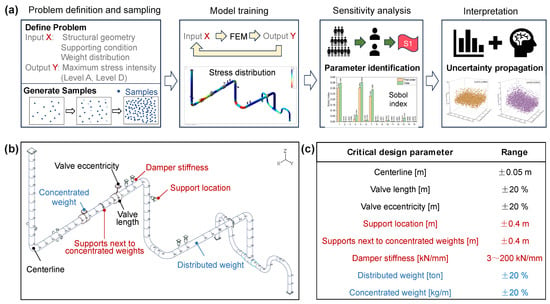
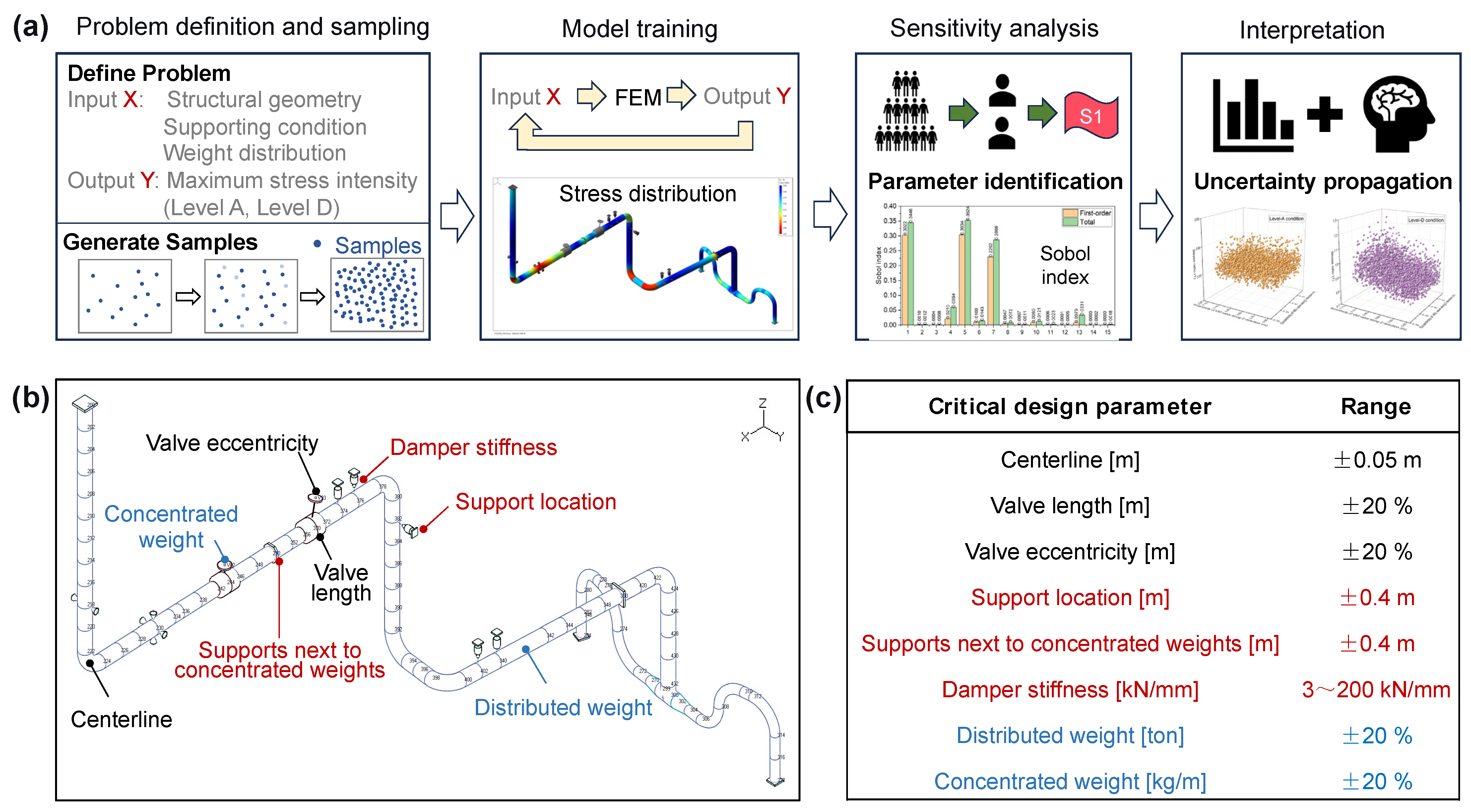
Therefore, a systematic investigation of the sensitivity of nuclear-grade piping stress analysis to key design parameters is of significant practical and theoretical importance. It can provide quantitative support for the establishment of acceptable parameter tolerance ranges, reducing unnecessary reanalysis, improving design efficiency, and enhancing the scientific basis of pipeline optimization. In this context, the present study focuses on the effects of design-parameter variations on the stress response of nuclear-grade piping systems under multiple operating conditions, with the goal of identifying critical parameters and providing a mechanics-informed basis for more efficient and reliable piping design (Figure 1a). Through systematic sensitivity analysis, we illustrate that the influence of key design parameters on the structural response of pipe systems exhibits significant nonlinearity and operational dependence and that the synergistic effects of multiple parameters can greatly amplify the stress response. This complex coupling relationship is often difficult to fully reveal in traditional finite-element analyses based on “single-parameter variations and fixed conditions”. This study, by incorporating Monte Carlo random simulations and multi-parameter coupled disturbance analysis (Figure 1a), systematically captures the amplification paths and coupling mechanisms of key design parameters with respect to stress response, highlighting the advantages of this method in uncertainty analysis for complex engineering systems. The objective is not to propose universal tolerance limits but to provide a reproducible mechanics-based procedure for condition-specific tolerance control.
Figure 1.
Schematic illustration of the sensitivity-analysis framework and the representative piping system. (a) Workflow for uncertainty definition, sampling, finite-element stress evaluation, sensitivity analysis, and interpretation. (b) Representative piping model with annotated valves, supports, valve eccentricity, concentrated weights, distributed weight, and damper locations. (c) Critical design parameters and their prescribed variation ranges. Symbols and colors distinguish structural, support-related, and weight-related parameters.
2. Method
2.1. Finite-Element Model of the Nuclear Piping System
The present study investigates the mechanical response of a nuclear-grade piping system subjected to representative service loads using finite-element analysis. A three-dimensional model of a typical piping configuration in the Hualong Two passive cooling system (PCS, China) was established using the PipeStress commercial code (Octave Intelligence PLC, AL, USA). The model was constructed to capture the coupled effects of structural loading, thermal expansion, and dynamic excitation under realistic support constraints. Herein, the more general contribution of this work is the proposed mechanics-based Monte Carlo–Sobol framework and the finding that parameter importance is load-regime-dependent. For other piping configurations, the same framework should be applied using the corresponding layout, support conditions, and component properties to obtain system-specific tolerance-control priorities.
The pipeline material used in this study is 022Cr19Ni10, with an elastic modulus of 197 GPa, Poisson ratio of 0.3, and density of 7850 kg/m3. The thermal expansion coefficient is 16.8 × 10⁻⁶ 1/K. The internal medium is water with a density of 1000 kg/m3. The self-weight of the pipeline is calculated by multiplying the cross-sectional area by the material density. In the present study, material properties were treated as deterministic design values, and the uncertainty analysis focused on construction- and installation-related parameters. This choice was made because the main objective of the work is to quantify the influence of practical design deviations, such as support-location changes, valve eccentricity, valve weight, and distributed weight, on the code-stress ratio. In addition, the material properties of qualified nuclear-grade piping steels are usually controlled within specified ranges by material standards and quality-assurance procedures. Their expected variability is generally smaller than the geometric, weight-related, and installation-related uncertainties investigated here. Nevertheless, material-property variability, including uncertainty in the elastic modulus, density, and thermal expansion coefficient, may also affect piping-stress response, particularly in safety-critical nuclear applications. The proposed framework can be extended to include material-property uncertainty in future work.
The internal pressure is set to 1.0 MPa (absolute pressure) and applied to the inner wall of the pipeline. In the beam-based model, internal pressure is specified as a pipe pressure load rather than as surface traction on explicitly meshed inner-wall elements. PipeStress converts the pressure input into the corresponding beam-level load and stress contributions according to the piping-code formulation. Similarly, a temperature load of 155 °C (design temperature) is considered. Herein, pressure and temperature were treated as prescribed loading conditions, while the uncertainty analysis focused on design and installation deviations. However, uncertainty in pressure and temperature may further affect the stress ratio, particularly under operating conditions dominated by thermal expansion, which needs further exploration. Two valves are included, with Valve 1 (V93) having a weight of 0.758 tons, a length of 560 mm, and an eccentricity of (0.613 m (Z), 0.14 m (X), 0 m (Y)), while Valve 2 (V62) has a weight of 0.453 tons, a length of 560 mm, and an eccentricity of (0.395 m (Z), 0 m (X), 0 m (Y)). The support conditions are set to match the actual engineering installation constraints, as shown in the model (Figure 1b).
The present finite-element model uses Timoshenko beam elements to enable efficient system-level stress evaluation and high-throughput uncertainty propagation. Straight pipe segments were modeled using straight-axis beam elements, whereas elbows and curved sections were represented by curved pipe elements following the pipe centerline geometry. This modeling approach is appropriate for capturing global flexibility, support reactions, thermal expansion effects, seismic response, and code-stress ratios of slender piping systems. Mesh independence was evaluated by comparing key response quantities, including the maximum stress ratio and displacement (Table A2). As shown in Table A2, the difference between the medium and fine meshes was less than 5% for the maximum stress ratio. Therefore, the medium mesh was adopted for the Sobol analyses to balance accuracy and computational efficiency. Static analyses were performed to determine structural response under combined mechanical and thermal loading, while modal calculations were used to extract the natural frequencies and mode shapes required for seismic response evaluation.
Three representative loading categories were considered. The first is the gravity case, which includes pipe self-weight, fluid weight, valve weight, and the additional bending and torsional effects induced by valve eccentricity. The second is the thermal-pressure case, which includes internal pressure and thermally induced strain associated with the operating temperature of the design. Under constrained support conditions, thermal expansion generates secondary stresses that contribute substantially to the overall stress. The third is the seismic case, which is relevant for systems operating in moderate- to high-seismicity environments and is evaluated through dynamic response-spectrum analysis (Figure A2) to capture inertia-driven structural response.
2.2. Uncertainty Characterization and Sampling Strategy
To quantify the influence of design deviations on piping-stress response, uncertain input parameters were first identified and parameterized. The selected variables include structural parameters (black category in Figure 1c), support parameters (red category in Figure 1c), and weight-related parameters (blue category in Figure 1c) that are known to vary during manufacturing, installation, and field adjustment. Specifically, the uncertain variables considered in this work include pipe centerline length, valve length, valve eccentricity, support position, support stiffness, valve weight, and distributed line weight. These parameters may deviate from nominal design values because of fabrication tolerances, installation errors, equipment replacement, and site-specific modifications.
The admissible variation ranges of the input parameters were defined on the basis of engineering practice, construction records, and relevant design tolerances, as shown in Figure 1c. All uncertain parameters were sampled independently using bounded uniform distributions over the prescribed admissible ranges. This distribution was selected because the present study aims to evaluate the mechanical sensitivity over the allowable design-deviation space rather than to infer site-specific statistical frequencies. The lower and upper bounds were determined from engineering design records, installation-adjustment experience, manufacturer tolerance information, and the tolerance philosophy of ASME Appendix T [12]. The resulting uncertainty model is summarized in Table A1. In addition, the parameter definitions were informed by the tolerance philosophy embodied in Appendix T of the ASME code [12] for nuclear facility piping stress analysis so that the adopted uncertainty model remains consistent with engineering practice and code-based design considerations. A MATLAB-based (MATLAB R2024a) sampling tool was developed to generate random realizations of the uncertain input space. The tool supports both single-parameter and multi-parameter perturbation studies and allows the user to prescribe probability distributions for each parameter, including uniform and normal distributions. This framework enables flexible representation of uncertainty in accordance with the physical origin of the deviations and provides an automated interface for high-throughput parametric simulation.
Monte Carlo simulation was employed to propagate input uncertainty through the finite-element model. In the single-parameter analysis, one uncertain variable was perturbed, while the remaining parameters were fixed at their nominal values, allowing the isolated influence of that variable on the stress response to be quantified. In the multi-parameter analysis, all selected input variables were treated as random and sampled simultaneously according to their prescribed probability distributions. Therefore, each sample represents one possible realization of the piping system within the admissible design deviation space. For each realization, the sampled parameters were mapped to the finite-element model, and the corresponding structural response was computed. By aggregating the results over a sufficiently large number of samples, the statistical characteristics of the output response, particularly the code-stress ratio, were obtained. This procedure enables quantitative assessment of how parameter perturbations are transmitted through the mechanical system and how they influence structural safety margins. The resulting dataset serves as the basis for subsequent sensitivity analysis, parameter ranking, and tolerance evaluation.
2.3. Sensitivity Analysis
Sensitivity analysis was performed to quantify the relative importance of the uncertain design parameters with respect to the piping-stress response under different service conditions. The response metric adopted in this study is the code-stress ratio, defined as the ratio between the calculated stress and the corresponding allowable stress prescribed by the design code. This code stress, evaluated based on ASME Appendix T [12], is primarily based on beam-theory formulations and system-level code-stress measures. Therefore, the objective of the present analysis is to evaluate the code-stress ratio of the piping system rather than local peak stresses that would require detailed three-dimensional solid modeling. A stress ratio below 1 indicates compliance with the code requirement for the corresponding loading condition. The analysis was conducted for the stress evaluation categories relevant to nuclear piping design—namely, Level-A and Level-D conditions. Level A corresponds to normal operating conditions and includes sustained and thermal loads associated with normal pressure, thermal expansion, self-weight, static loads, and anchor-point displacement. Level D corresponds to faulted or accident conditions and includes extreme events such as safe-shutdown earthquake loading and other low-probability, high-consequence scenarios. These loading categories represent progressively increasing severity and therefore provide a comprehensive basis for evaluating parameter sensitivity across service regimes.
After obtaining the output statistics from Monte Carlo simulation, a global sensitivity analysis was performed using the Sobol variance-decomposition method. This method is well suited for systems with nonlinear input–output relations and parameter interactions, and it enables rigorous quantification of the contribution of each uncertain input to the total variance of the response. In the present work, Sobol indices were calculated for all selected parameters with respect to the maximum code-stress ratio under each loading category. Two types of Sobol indices were used:
- (1)
- First-order Sobol index for the i-th uncertain input parameter ():
- (2)
- Total Sobol index for the i-th uncertain input parameter ():
The first-order Sobol index measures the direct contribution of an individual parameter to the variance of the response and therefore reflects its independent effect. The total Sobol index measures the overall contribution of that parameter, including both its direct effect and all interaction effects involving other parameters. Comparison of the first-order and total indices provides insight into the structure of the response surface. When the two values are close, the parameter acts primarily through its own independent contribution. In contrast, when the total index substantially exceeds the first-order index, the parameter participates strongly in coupled or higher-order interactions. To verify the convergence of the global sensitivity results, the Sobol indices were recalculated using increasing base sample sizes (Figure A1). The dominant sensitivity ranking became stable when the base sample size reached N = 3000. Further increasing the sample size produced only minor changes in the leading Sobol indices, while the identity of the dominant parameters remained unchanged. For example, when the base sample size increased from N = 3000 to N = 5000, the relative changes of the leading total-effect indices were below 5%. These quantitative indicators confirm that the reported dominant parameter ranking is statistically stable and not an artifact of sampling uncertainty.
This sensitivity framework makes it possible to identify the dominant parameters governing the stress response of a pipe system under different operating conditions, to distinguish independent effects from interaction-driven effects, and to rank the parameters according to their influence on structural safety. These results further provide a quantitative basis for tolerance allocation and design control. Parameters with high sensitivity should be subject to tighter control during design and installation, whereas parameters with consistently low sensitivity may permit relaxed tolerances without compromising structural integrity. By comparing the sensitivity results with the tolerance provisions in ASME Appendix T, the applicability and conservatism of existing tolerance requirements can also be assessed for the specific piping system considered here.
3. Results and Discussion
3.1. Sensitivity of Pipeline Response to All Design Parameters
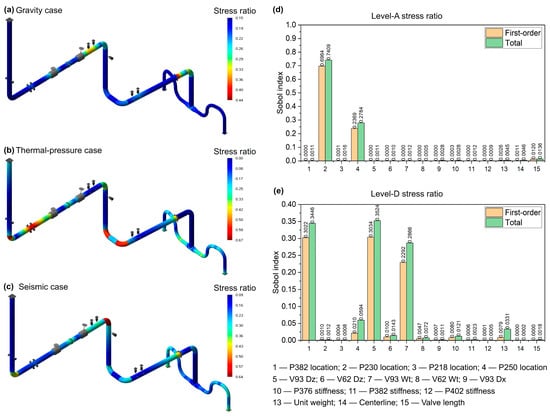
Figure 2a compares the stress-ratio distributions of the pipeline under the three representative loading categories. A clear hierarchy in the mechanical response is observed. Under self-weight loading (gravity case), the stress field remains relatively smooth, and the overall stress level is low. The maximum stress ratio of approximately 0.5 occurs locally near the two valves and the distal longitudinal support, where the distributed gravity load interacts with valve-induced concentrated weights. This response indicates that the self-weight loading is governed primarily by local bending associated with static weight distribution rather than by global constraint-induced amplification. The absence of pronounced stress concentration further suggests that gravity loading alone does not control the structural safety margin of the present piping system. Therefore, its main significance is to provide the baseline sustained-load state upon which more critical thermally or dynamically induced stresses are superposed.
Figure 2.
Stress-ratio distributions under three representative loading cases: (a) gravity, (b) thermal pressure, and (c) seismic loading. Sobol sensitivity indices under Level A (d) and Level D (e) conditions.
In contrast, the thermal-expansion case produces a qualitatively different response (Figure 2b). The maximum stress ratio increases to about 0.87, and the stress field becomes strongly localized, particularly in the lateral segment near the left end of the pipeline, as well as near valves and curved sections. This transition to a sharply localized stress field reflects the fundamental role of constraint in thermally loaded pipe systems. Thermal expansion, if unrestrained, would not generate significant stress; the observed stress concentration therefore arises from the incompatibility between free thermal strain and the imposed support constraints. In this sense, the thermal case is not governed primarily by load magnitude itself but by the structural restriction of deformation paths. The implication is that the mechanically critical regions under normal service are those where geometric discontinuity and kinematic restraint coexist, since these regions most efficiently convert thermal strain into secondary stress.
The seismic case introduces a third response regime characterized by inertia-driven stress amplification (Figure 2c). The highest stresses are concentrated at bends, near the valve weights, and at fixed supports. Unlike the thermal case, in which stress localization is induced mainly by constrained expansion, the seismic response is controlled by the redistribution of inertial forces through the weight-stiffness support system. Regions containing geometric discontinuities or concentrated weights become preferential sites for moment amplification under dynamic excitation, while fixed supports intensify local force transfer because they anchor the vibration path. Although the resulting stress remains within the allowable range, the spatial pattern of the response reveals the structural features most susceptible to dynamic amplification.
The above comparison suggests that the governing mechanism fundamentally differs across loading categories. Self-weight produces a relatively benign, stiffness-dominated static bending response; thermal loading generates constraint-dominated secondary stress; and seismic loading activates inertia-dominated localization. This distinction is important because it implies that the significance of design parameters cannot be assessed independently of the governing mechanism. A parameter that is negligible under one loading regime may become dominant under another if it directly modifies the corresponding force-transfer path or deformation constraint. The observed sensitivity trends are consistent with previous studies showing that piping-stress response is strongly affected by support constraints, thermal-expansion compatibility, dynamic boundary conditions, and inertia-induced bending under seismic loading [19,20].
To quantify these load-dependent effects, Sobol sensitivity analysis was performed for the maximum stress ratio using the parameter ranges defined in Figure 1c. Under Level-A conditions, the first-order and total Sobol indices shown in Figure 2d demonstrate that only a very small subset of parameters contributes appreciably to the output variance. In particular, support positions P230 and P250 dominate the sensitivity spectrum, whereas the remaining parameters have indices close to zero. This result is mechanically consistent with the thermal-stress characteristics discussed above. Because Level-A conditions are strongly influenced by thermal expansion, the dominant variables are those that control the admissible deformation path of the piping system. Support locations determine the effective boundary conditions; alter the release or accumulation of thermal strain; and thereby redistribute the axial force, bending moment, and shear force throughout the network. Therefore, even small positional deviations can trigger significant changes in the global internal force pattern. The implication is that under normal operating conditions, support layout is the primary design lever governing the stress response, whereas local weight or geometric deviations play a comparatively secondary role.
A more detailed comparison of the first-order and total indices provides additional insight into the underlying response structure. For supports P230 and P250, the total-effect indices are higher than the corresponding first-order indices, indicating the presence of interaction effects. However, the difference is moderate, especially for P230; therefore, the result should be interpreted as moderate support-interaction effects rather than substantially stronger total contributions. From a mechanics standpoint, this behavior is expected in a multi-support piping system: the constraint imposed by one support cannot be interpreted independently of the others because each support participates in defining the overall compatibility condition of the structure.
The sensitivity pattern changes markedly under Level-D conditions, as shown in Figure 2e. In this regime, the dominant parameters are support position P382, the weight of valve V93, and the eccentricity of valve V93. All three parameters exhibit both high first-order indices and high total indices, showing that they are important not only through their direct contribution to response variance but also through their interactions with other variables. This shift in dominant parameters reflects a corresponding shift in the governing mechanics. Whereas Level-A sensitivity is controlled mainly by support-mediated thermal constraint, Level-D sensitivity is governed by the coupling among boundary conditions, concentrated inertia, and load eccentricity. Support position P382 modifies the constraint topology and, thus, the global vibration and force-transfer characteristics. The low sensitivity of damper stiffness (e.g., P376 and P382) can be understood from the perspective of a stiffness-saturation effect. Although the nominal range of damper stiffness is broad, most of this range is already sufficiently high relative to the effective flexibility of the piping span controlled by the damper. As a result, the damper provides an approximately restrained boundary condition over a large portion of the sampled range, and further increases in stiffness produce only small changes in the modal response and stress ratio. The V93 weight directly affects the inertial force generated under severe dynamic loading, while its eccentricity converts translational inertia into additional bending and torsional moments. Together, these effects form a support weight–eccentricity coupling mechanism that amplifies local stress and increases response variability under accident-level loading.
This contrast between Level-A and Level-D results reveals a broader mechanics principle: the identity of the dominant uncertain parameters is not intrinsic to the structure alone but emerges from the interaction between structural topology and load type. Under thermally governed service conditions, the critical parameters are those that regulate deformation compatibility; under accident-level dynamic loading, the critical parameters are those that regulate inertial distribution, eccentric moment generation, and dynamic constraint. Consequently, parameter control strategies should be load-specific rather than uniform. Tight tolerance should be imposed on support locations for operating conditions dominated by thermal stress, whereas under severe dynamic conditions, particular attention must also be paid to concentrated weight and eccentricity. This finding provides a rational basis for condition-dependent tolerance design and suggests that simplified tolerance rules that do not distinguish between operating regimes may be either overly conservative or non-conservative, depending on the loading scenario considered.
3.2. Sensitivity of Pipeline Response to Structural Parameters
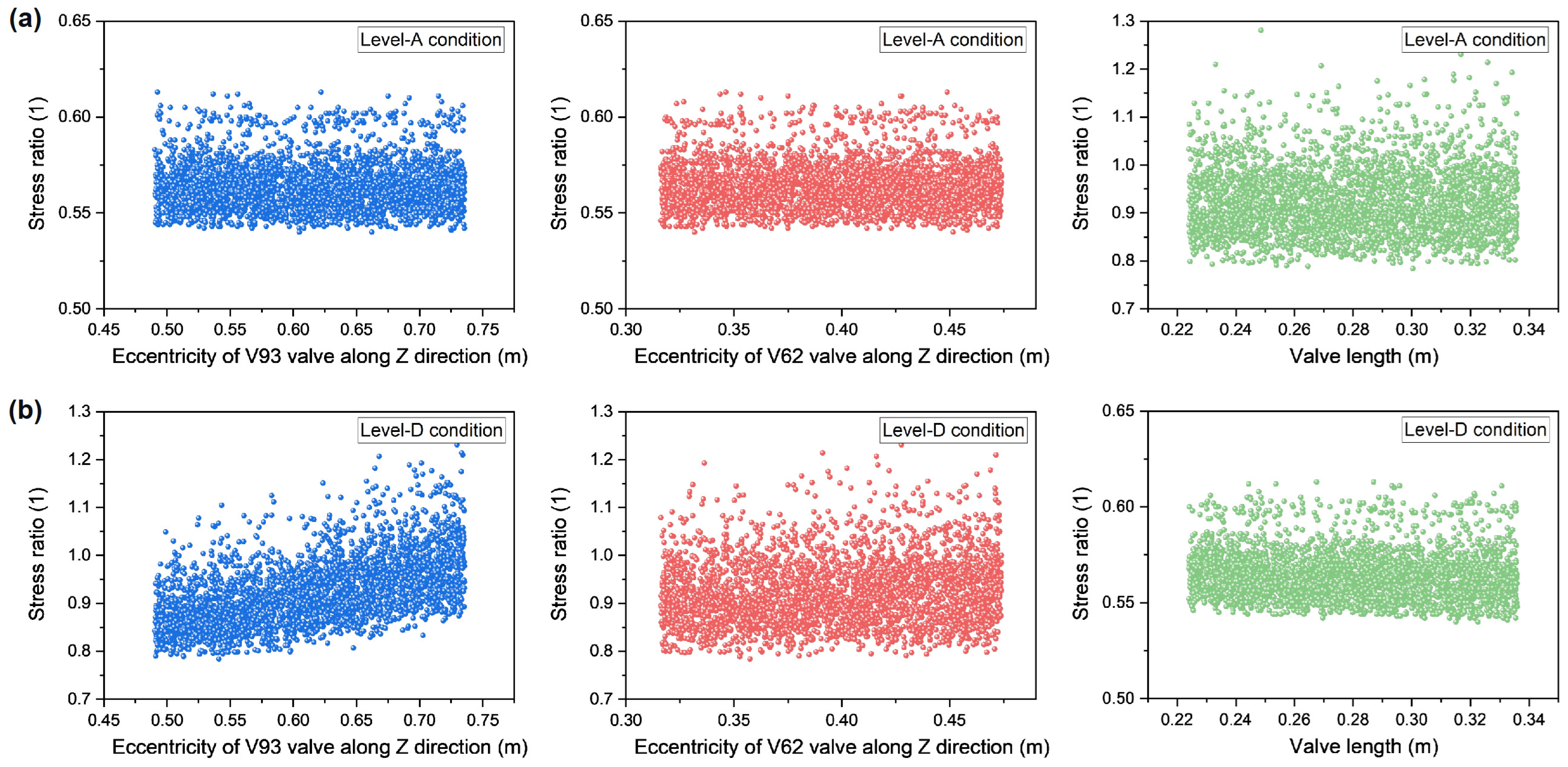
To further resolve the origin of the global sensitivity patterns, we next isolate a subset of representative structural parameters and examine how their perturbations propagate through the piping system. Based on the Sobol ranking in Section 3.1, the eccentricities of valves V93 and V62 and the valve length were selected as characteristic variables. These parameters represent distinct classes of structural perturbation: the valve eccentricities quantify the offset of local concentrated mass relative to the pipe axis and, thus, directly modify the local moment arm, whereas the valve length reflects a geometric variation that alters the structural configuration more gradually. By comparing their effects under different loading regimes, one can distinguish whether the stress response is controlled primarily by geometric compatibility or by inertia-induced moment amplification.
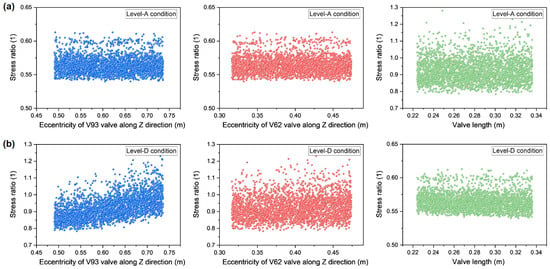
Under Level-A conditions, the maximum stress ratio is only weakly affected by variations in these structural parameters. Both the first-order and total Sobol indices are close to zero, and the stress-ratio variations shown in Figure 3a remain small over the full parameter range. This insensitivity indicates that, under normal operating conditions, the response is dominated by quasi-static thermomechanical loading and support-imposed compatibility rather than by local structural perturbations. In such a regime, the governing stress originates mainly from constrained thermal expansion and internal-pressure-induced force redistribution, so moderate changes in valve eccentricity or valve length do not substantially alter the global deformation path or the associated internal-force balance. The implication is that these structural parameters act only as secondary modifiers of the response under Level-A loading and that their contribution to stress uncertainty remains negligible compared with that of support layout. From a design standpoint, this suggests that, within code-allowable limits, the control precision imposed on low-sensitivity structural parameters may be relaxed under Level-A conditions without materially affecting structural safety.
Figure 3.
Variation of the pipeline stress ratio with structural parameters under (a) Level-A and (b) Level-D conditions: V93 valve eccentricity (blue), V62 valve eccentricity (red), and valve length (green). For two-dimensional scatter plots, repeated values of the horizontal-axis parameter may have different stress ratios because the remaining uncertain variables are sampled simultaneously in the multi-parameter analysis. Therefore the Sobol indices are used together with the scatter plots to evaluate both independent parameter effects and interaction effects.
A markedly different trend emerges under Level-D conditions (Figure 3b). Here, the stress response becomes substantially more sensitive to structural perturbations, and the eccentricity of valve V93, especially in the Z-direction, becomes the dominant parameter. As shown in Figure 3b, the maximum stress ratio increases monotonically with increasing V93 eccentricity, and the increase becomes more pronounced at larger eccentricities. This trend indicates not merely sensitivity but a clear amplification mechanism: once the local concentrated mass is displaced farther from the pipe axis, dynamic excitation generates a larger eccentric inertia moment, which, in turn, intensifies the local bending and stress concentration. The physical origin of this behavior lies in the local structural environment of V93. Because this region is relatively weakly constrained, an increase in valve eccentricity enlarges the offset between the concentrated mass and the structural centroidal axis, thereby enhancing the bending and torsional actions induced by dynamic loading. Under seismic or impact-type excitation, this eccentricity transforms translational inertia into additional rotational demand, modifies the local load-transfer path, and promotes stress localization. The resulting response is strongly nonlinear in practice because the effect of eccentricity becomes increasingly pronounced once the system enters a regime of higher dynamic amplification and reduced safety margin. The engineering consequence is direct: under severe loading conditions, the installation accuracy of the V93 valve should be controlled much more strictly than would be inferred from its negligible influence under Level-A conditions.
In comparison, the eccentricity of valve V62 has a much weaker effect on the maximum stress ratio, and the response remains comparatively stable throughout its perturbation range. Likewise, the effect of valve length remains limited under both loading levels. These differences indicate that the mechanical significance of a structural parameter is determined not only by its nominal physical meaning but also by its structural context, including its local support condition, mass magnitude, stiffness distribution, and position within the load-transfer path. The weak influence of V62 eccentricity can be understood from the perspective of its more favorable support environment and its smaller associated mass and eccentricity, which reduce its ability to generate large secondary moments. Similarly, a change in valve length alters the geometry only gradually and does not efficiently activate the inertia-driven amplification mechanism that dominates the Level-D response. Moreover, within the prescribed range, changing the valve length only slightly modifies the local geometry and does not substantially alter the global support-to-support span, structural flexibility, or thermal-release path. Therefore, it does not strongly participate in either the thermal-constraint mechanism under Level-A loading or the inertia-driven bending amplification mechanism under Level-D loading. These observations emphasize that parameter sensitivity in piping systems is inherently spatially dependent: the same type of perturbation may be either negligible or critical, depending on where it occurs.
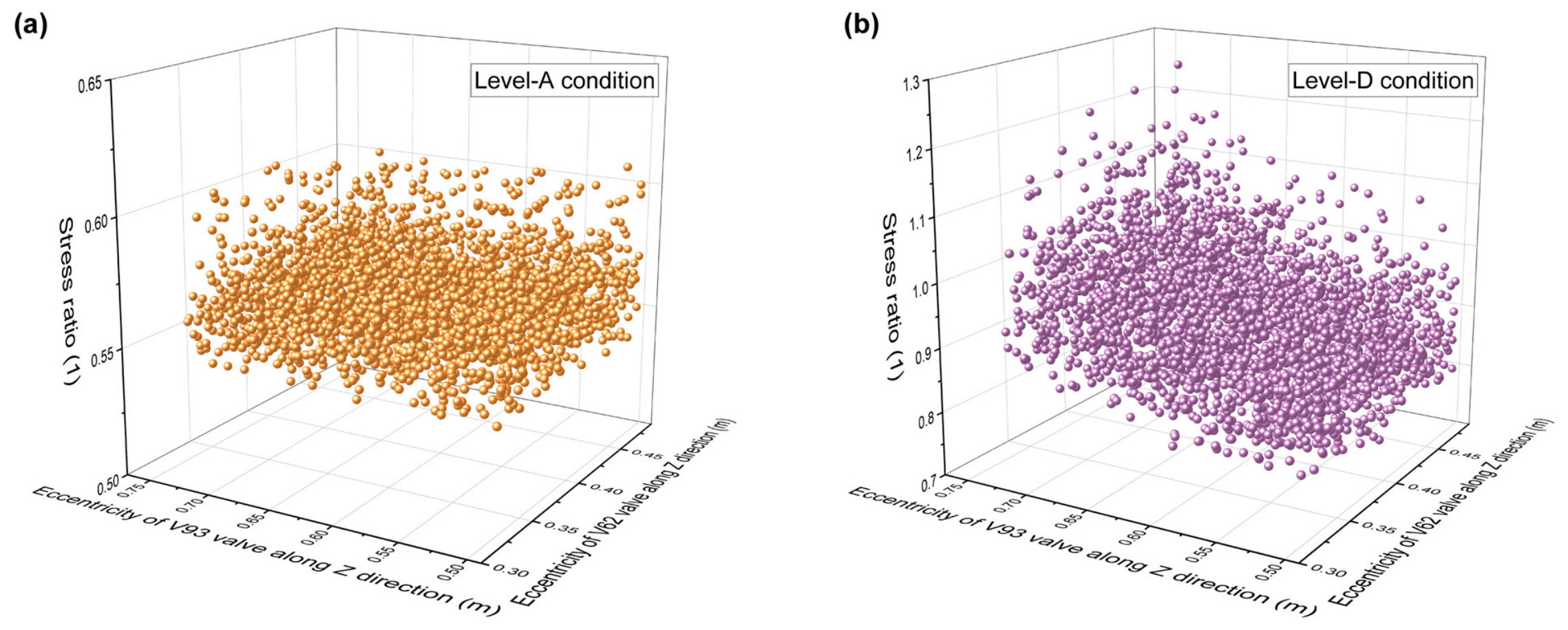
The preceding analysis considers the effect of each structural parameter individually. To assess whether combined perturbations produce additional amplification, we next examine the coupling between the eccentricities of valves V93 and V62. Under Level-A conditions, the pipeline remains largely insensitive to their simultaneous variation. As shown in Figure 4a, the maximum stress ratio changes only weakly across the two-parameter space, and no pronounced amplification zone is observed. This behavior is consistent with the single-parameter results and further confirms that, under quasi-static, thermally dominated conditions, these eccentricity-related perturbations do not strongly modify the governing force-transfer mechanism. Even when both parameters deviate simultaneously, the response remains stable because the dominant thermal-stress field is set primarily by support-mediated compatibility rather than by local mass redistribution.
Figure 4.
Variation of the pipeline stress ratio with the coupled eccentricities of valves V93 and V62 under (a) Level-A and (b) Level-D conditions.
Under Level-D conditions, however, the coupling between V93 and V62 eccentricities becomes pronounced. As shown in Figure 4b, simultaneous increases in both eccentricities lead to a significant rise in the maximum stress ratio, revealing a clear nonlinear amplification effect. This result shows that the influence of eccentricity under severe dynamic loading cannot be interpreted as the sum of two independent local perturbations. Rather, the two offsets interact through the global inertial distribution and vibration characteristics of the piping system, modifying both the local bending demand and the overall modal response. When both eccentricities increase, the superposed inertial moments increase the probability of stress localization and reduce the available safety margin—in some cases, driving the response toward or beyond the allowable threshold. The implication is that structural robustness under accident-level loading is controlled not only by the magnitude of individual deviations but also by their combined configuration.
From a broader mechanics perspective, the results of Figure 3 and Figure 4 reinforce the conclusion that parameter importance is regime-dependent and interaction-dependent. Under Level-A loading, the governing mechanism is global deformation compatibility, so local structural perturbations remain largely inactive. Under Level-D loading, by contrast, the governing mechanism shifts to inertia-induced bending and eccentric moment amplification, so mass-offset parameters become dominant, and their coupling effects become non-negligible. This transition highlights the importance of distinguishing between local geometric perturbations that merely perturb the static configuration and those that actively participate in the dynamic force path. It also suggests that tolerance assignment for nuclear piping systems should be based not only on the nominal type of parameter but also on the loading regime and the potential for coupling-driven amplification.
3.3. Sensitivity of Pipeline Response to Support Parameters
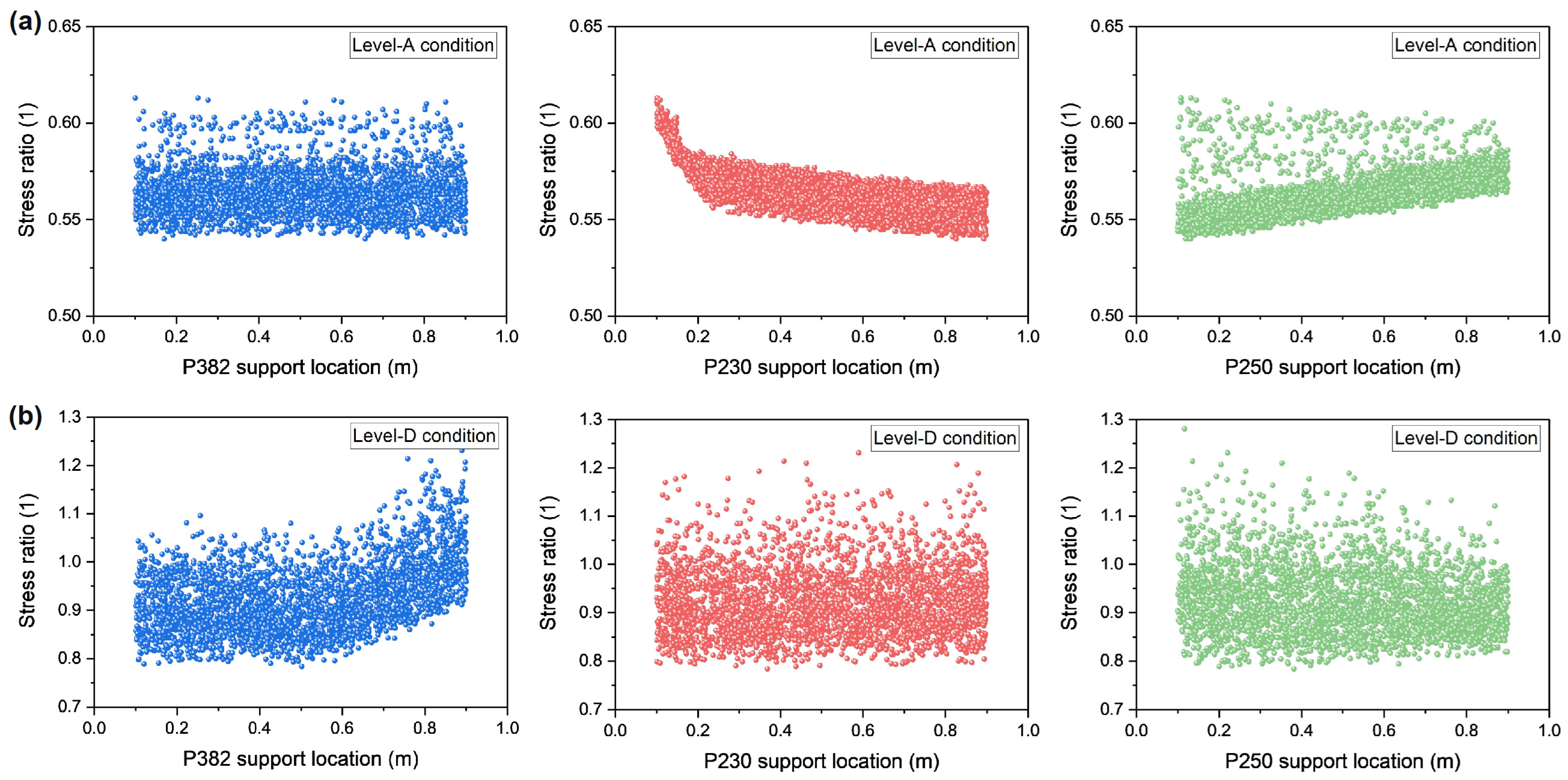
We next examine the influence of support-related parameters, which were identified by the global sensitivity analysis as the dominant source of uncertainty. Unlike local structural variables, support positions govern the boundary constraints of the piping system and therefore directly affect the global load-transfer path. Their deviations can modify deformation compatibility; internal-force redistribution; and, under dynamic loading, the inertia-driven response. As a result, support parameters are expected to have a stronger and more load-dependent influence on the stress ratio than most local geometric variables. This expectation is confirmed by the Sobol results. Under Level-A conditions, most support parameters have negligible first-order and total indices, whereas P230 and P250 clearly dominate the response variance. The large difference between the first-order and total indices further indicates that P230 and P250 act not only through their individual effects but also through strong interactions, highlighting the importance of the overall support topology in controlling the stress field. Under Level-D conditions, the dominant support parameter shifts to P382, while the influence of P250 becomes less pronounced. This change indicates a transition in the governing mechanism, from thermal compatibility under Level-A loading to dynamic constraint under Level-D loading. Because P382 is associated with the damper support, its positional deviation directly alters the dynamic boundary condition, modifies the inertial-force transfer path, and amplifies local bending response under seismic or impact loading.
To clarify how these dominant support parameters affect the response, we next examine the propagation of deviations at support positions P382, P230, and P250. These supports represent distinct mechanical roles within the piping system: P230 and P250 are the first supports spanning the concentrated-mass region and, thus, directly influence the load-transfer path near the valves; P382 provides a critical dynamic constraint through the damper. The response trends shown in Figure 5a reveal that under Level-A conditions, the maximum stress ratio is strongly sensitive only to P230 and P250, while the effect of P382 remains negligible. This selective sensitivity further confirms that not all supports are mechanically equivalent: under thermally dominated conditions, only those supports that participate directly in constraining the main thermal expansion path can significantly affect the global stress level. Among these, P230 exhibits the strongest nonlinear behavior. When its position varies within the interval of 0.2–0.9 m around the reference value of 0.5 m, the stress ratio changes relatively smoothly. However, as the support shifts further toward 0.1–0.2 m, the stress ratio rises rapidly, displaying a threshold-like amplification. This behavior indicates that P230 acts as a strong constraint point whose mechanical effect becomes disproportionately large once its displacement begins to severely restrict the axial thermal-release path of the pipeline. The implication is that the sensitivity of a support parameter may, itself, be state-dependent: beyond a certain positional threshold, a nominally smooth response can become strongly nonlinear because the governing constraint mechanism changes qualitatively.
Figure 5.
Variation of the pipeline stress ratio with support-location parameters under (a) Level-A and (b) Level-D conditions: support location P382 (blue), support location P230 (red), and support location P250 (green).
The role of P250 is different. Its influence on the stress ratio is more gradual and appears to be partly regulatory rather than purely amplifying. As P250 shifts outward, the stress ratio becomes less dispersed, and its fluctuations decrease, suggesting that this movement improves the load-transfer path and enhances the structural capacity to accommodate concurrent parameter disturbances. In contrast to P230, which behaves as a potentially over-constraining support, P250 appears to redistribute the structural demand in a stabilizing manner. This distinction is important because it shows that support optimization cannot be reduced to the minimization of positional deviation alone. Different supports contribute to the response through different mechanisms: some amplify incompatibility when misplaced, whereas others mitigate sensitivity by improving the load path.
Under Level-D conditions, the response trends change again. Figure 5b shows that P382 and P250 become the most influential support locations, whereas P230 plays a comparatively minor role. The projected scatter plots in Figure 5b show similar dispersion ranges for P382 and P250; therefore, Figure 5b is used only to illustrate response trends, while the relative parameter importance is determined according to the Sobol indices. In particular, the stress ratio associated with P382 shows a pronounced nonlinear dependence on position: small deviations induce little change, but beyond a certain range, the stress rises rapidly, indicating a threshold effect similar in form, though different in origin, to that observed for P230 under Level-A loading. Once P382 deviates sufficiently to alter the effective damper action or modal characteristics of the system, the local dynamic amplification becomes much more severe. By contrast, the effect of P250 remains more linear, with rightward movement tending to reduce the stress ratio. These results imply that under accident-level loading, the most critical support parameters are those that govern dynamic boundary conditions and mass-support interaction rather than those that simply constrain thermal expansion.
An important observation is that, despite these sensitivities, the stress ratio for the Level-A condition remains below unity for support-position fluctuations within 0.1–0.9 m when the parameters are varied individually. This indicates that the structure retains a finite tolerance to isolated support deviations. However, such apparent robustness does not imply insensitivity under combined perturbations. Indeed, once the key supports are varied simultaneously, the system response changes qualitatively. This distinction between single-parameter tolerance and multi-parameter fragility is central to the mechanics of constrained piping systems because the force-transfer path is defined collectively by the support network rather than by any one support in isolation.
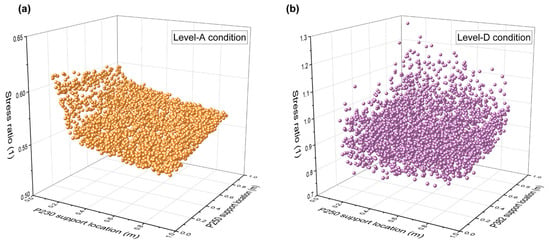
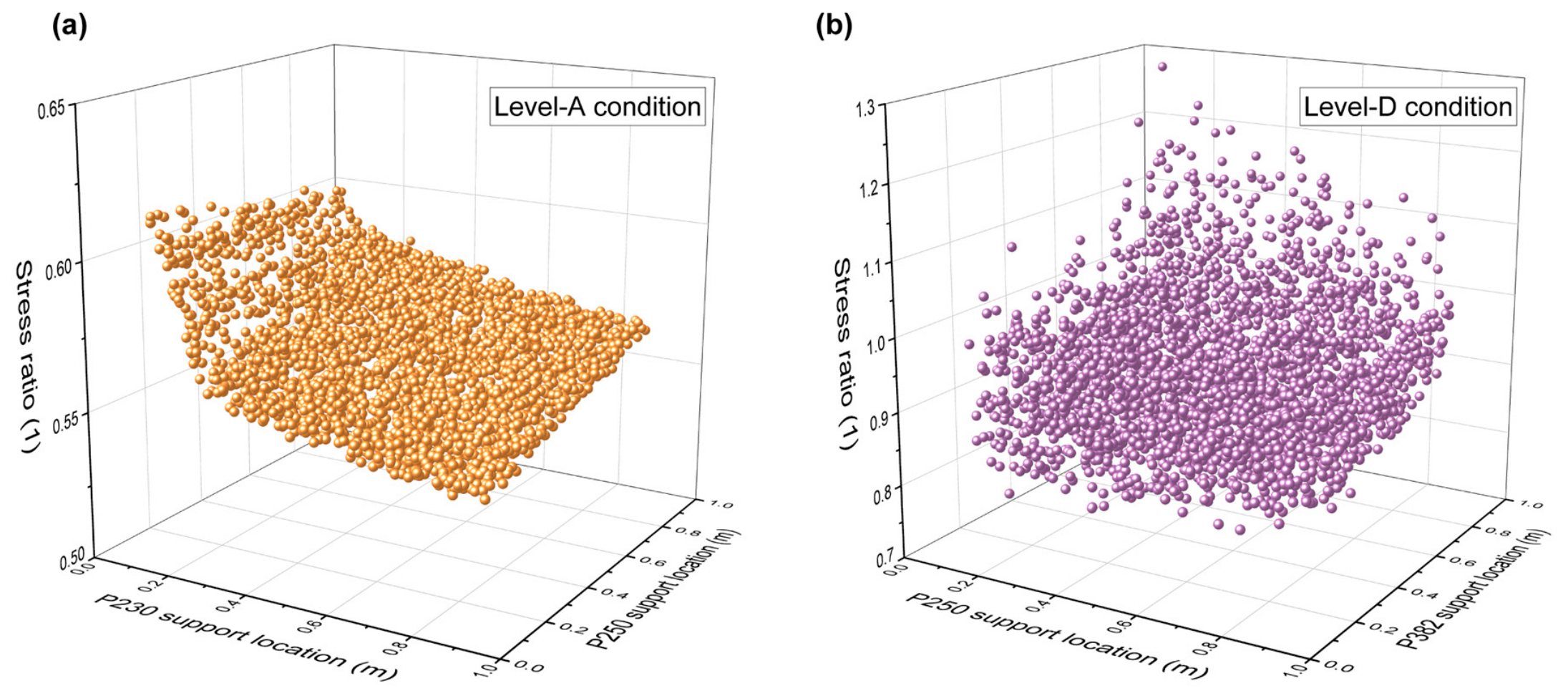
To expose this coupling effect, we next consider the combined deviations of P230 and P250 under Level-A conditions and those of P382 and P250 under Level-D conditions. The resulting response surfaces are shown in Figure 6. Under Level-A conditions, the combined variation of P230 and P250 produces only modest changes in the maximum stress ratio, even though P250 has the stronger individual effect. This result indicates that, while both supports influence the thermal expansion path, the system retains sufficient capacity to redistribute deformation without triggering severe stress amplification. In other words, the support network under normal operating conditions remains mechanically tolerant to the simultaneous perturbation of these two variables, and the corresponding response surface is comparatively smooth.
Figure 6.
Coupled effect of support-location variations on the stress ratio under (a) Level-A conditions for P230 and P250 and (b) Level-D conditions for P382 and P250.
The Level-D response surface is qualitatively different. When P382 shifts toward a larger coordinate while P250 shifts toward a smaller coordinate, the maximum stress ratio rises sharply and may exceed the allowable limit. This is a clear manifestation of coupling amplification. The two supports do not simply contribute independent increments to the response; rather, their combined perturbation reorganizes the dynamic force path, intensifies local inertia-driven bending, and reduces the structural safety margin much more efficiently than either deviation alone. The resulting sensitivity is therefore genuinely system-level in nature. It reflects the fact that, under severe dynamic loading, structural robustness depends on a coordinated support configuration capable of controlling modal response and limiting stress localization. Once this coordination is degraded, even relatively small deviations can produce a disproportionately large mechanical consequence.
3.4. Sensitivity to Weight Parameters
We next examine the influence of weight-related parameters, including the weights of valves V93 and V62 and the uniform distributed weight of the pipeline. Unlike support parameters, which primarily alter boundary constraints, weight parameters affect the response through the load path itself. Their influence is expected to be limited under static loading but becomes significant under dynamic conditions because changes in concentrated or distributed mass directly modify the inertial-force distribution and the associated bending response. This trend is confirmed by the Sobol analysis in Figure 2. Under Level-A conditions, the Sobol indices of most weight parameters remain close to zero, indicating that their contribution to the variance of the stress ratio is negligible. Under Level-D conditions, however, the sensitivity to weight parameters increases markedly. Among them, the weight of valve V93 is the dominant factor, followed by the uniform weight, whereas the influence of valve V62 remains weak. This shift indicates that, under accident-level loading, the governing mechanism changes from a quasi-static, constraint-dominated response to inertia-driven amplification. In this regime, concentrated weight directly increases local inertial forces and bending moments, thereby enhancing the stress concentration and response variability.
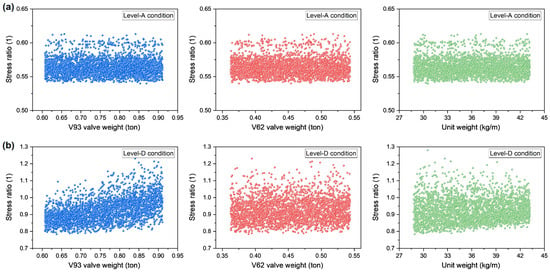
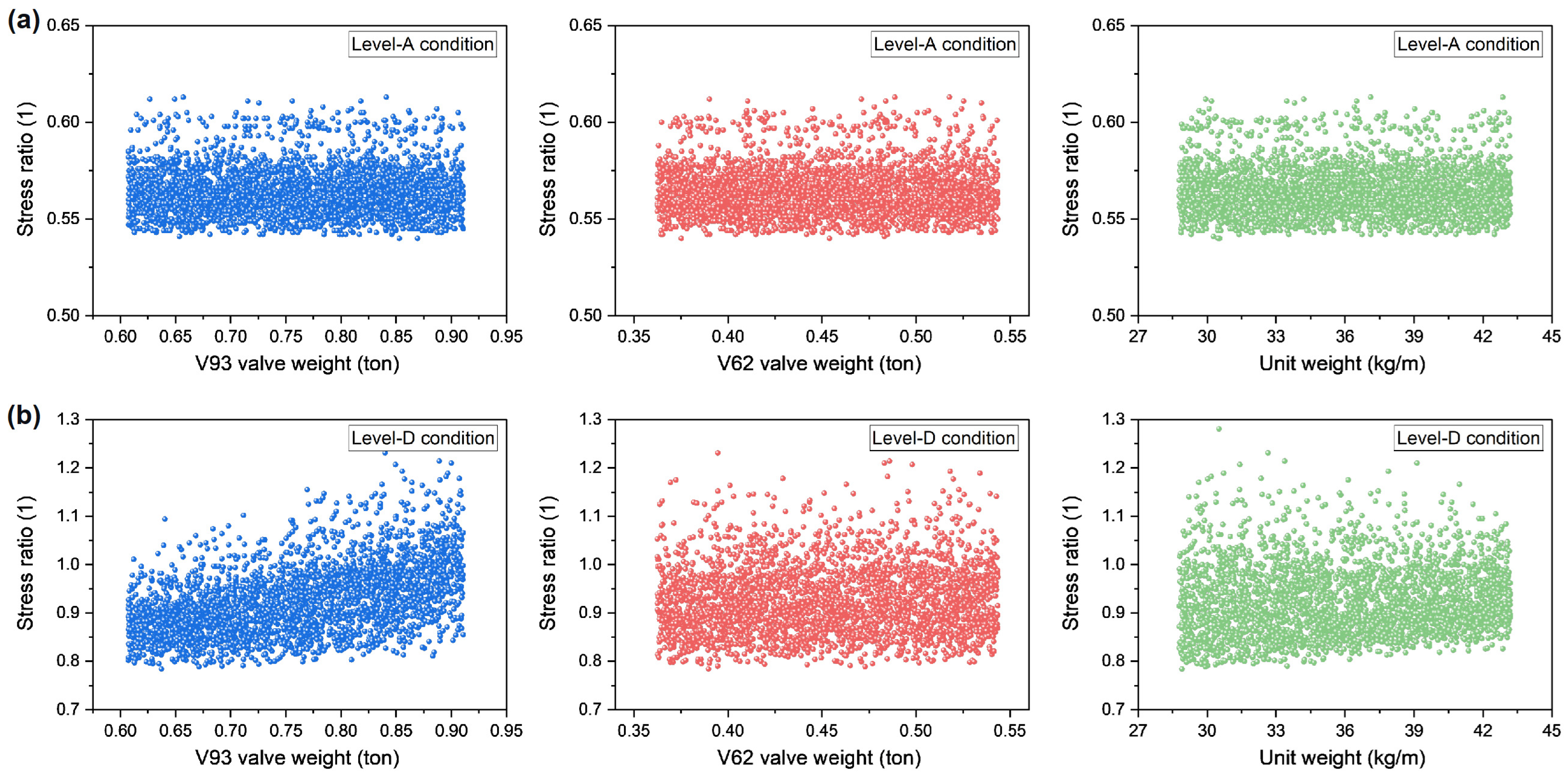
To further clarify how weight perturbations propagate through the structure, we examine the stress ratio associated with the three representative parameters (Figure 7). Although some projected points in Figure 7 exceed unity at certain unit-weight values, these over-limit responses should not be attributed to unit-weight variation alone, as they are a projection of multi-parameter Monte Carlo samples; therefore, other parameters, such as the weight of V93, eccentricity of V93, and support locations, may simultaneously contribute to the high stress ratios. Under Level-A conditions (Figure 7a), the stress ratio remains nearly unchanged as the weights of V93, V62, and the uniform load are varied. The small fluctuations that appear are minor and do not indicate systematic sensitivity. This, again, shows that under normal operating conditions, the response is controlled primarily by thermal and pressure effects and that weight deviations do not efficiently modify the internal-force distribution. Accordingly, these parameters have only a limited influence on structural safety under Level-A conditions.
Figure 7.
Variation of the pipeline stress ratio with weight parameters under (a) Level-A and (b) Level-D conditions: weight of valve V93 (blue), weight of valve V62 (red), and unit weight (green).
A different trend appears under Level-D conditions (Figure 7b). The stress response becomes much more sensitive to weight perturbations, with the weight of valve V93 emerging as the dominant parameter. The nominal weight of valve V93 is 0.758 tons. Data points below 0.758 tons represent a reduction in the weight of V93, whereas data points above 0.758 tons represent an increase in the weight of V93. Increasing the weight of V93 generally increases the Level-D stress ratio because the concentrated mass enhances inertia-induced bending and local stress amplification. By contrast, reducing the weight of V93 lowers the stress ratio, indicating that the structure retains some tolerance only but on the low-mass side. These results show that, under accident conditions, strict control of the weight of valve V93 is essential and that optimization of its layout and support conditions may further reduce the amplification caused by concentrated mass.
Compared with V93, the effects of the weight of valve V62 are weaker. Their variation produces only limited changes in the maximum stress ratio, indicating that they contribute less effectively to local stress amplification. Mechanically, this weaker sensitivity can be attributed to the more favorable support environment near V62. The unit-weight variation also affects the Level-D stress response. However, its overall contribution is lower than that of the weight of V93 due to the fact that uniform weight acts mainly at the global level rather than as a localized source of inertia. Specifically, the unit weight is distributed over the pipe span and therefore generates less localized bending amplification. Its effect is mainly reflected in a moderate shift of the global inertial response rather than a strong local stress concentration. This explains why its effect is lower than that of the weight of V93. These observations further demonstrate that the importance of a weight parameter depends not only on its magnitude but also on its structural location and its ability to participate in dynamic load transfer.
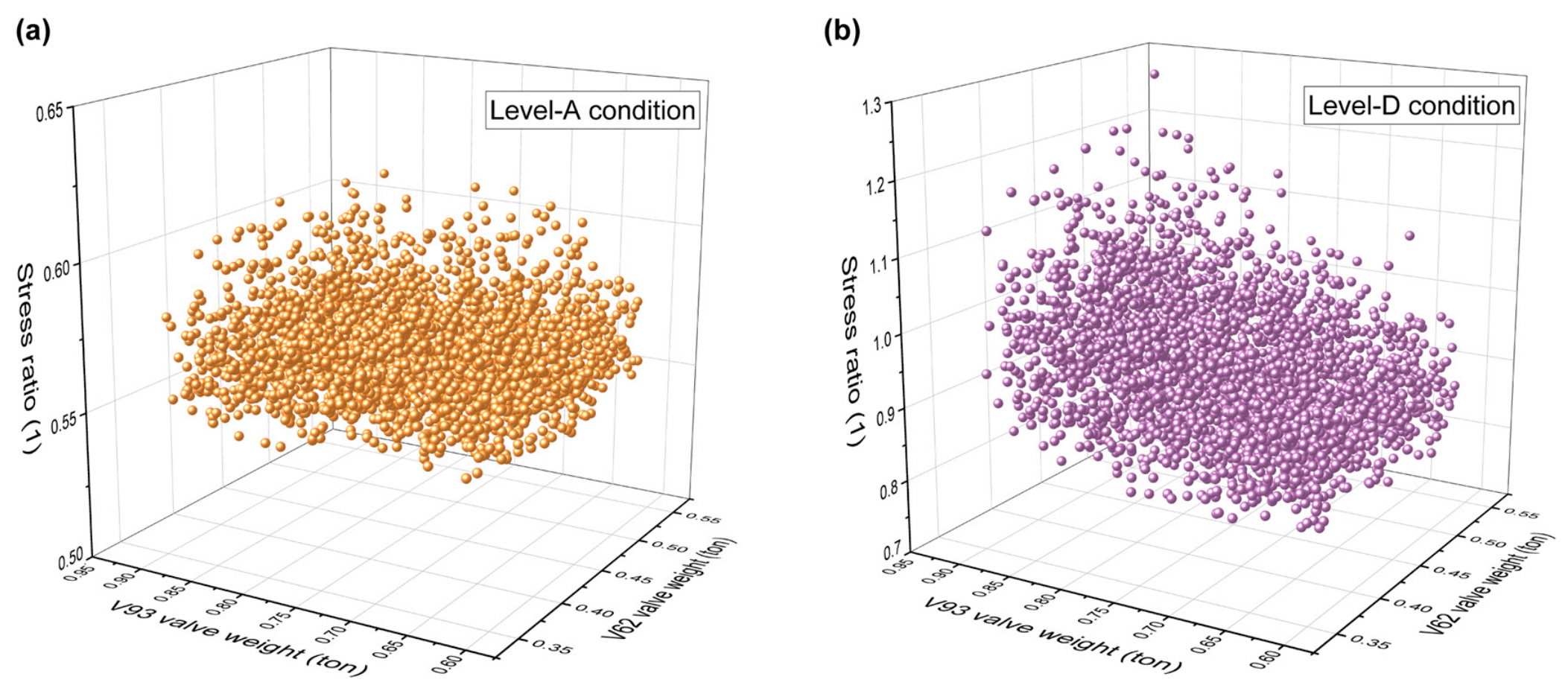
Finally, we examine the coupling between valve weights under multi-parameter perturbations (Figure 8). Under Level-A conditions, the combined variation of the weights of V93 and V62 produces only minor changes in the maximum stress ratio, confirming that the system is largely insensitive to weight perturbations in the quasi-static regime (Figure 8a). Under Level-D conditions, however, the coupled effect becomes much more pronounced (Figure 8b). When the weights of the two valves increase simultaneously, the maximum stress ratio rises sharply, revealing a clear nonlinear amplification effect. This is similar to the results in Figure 7, with multiple design parameters all tuned to the high stress ratio. This behavior arises because multiple concentrated masses jointly modify the inertial distribution and vibration characteristics of the pipeline, leading to superposed bending moments and an enhanced stress concentration. The result shows that, under severe dynamic loading, structural robustness is controlled not only by the deviation of individual masses but also by their combined configuration within the system.
Figure 8.
Variation of the pipeline stress ratio with the coupled valve weights of V93 and V62 under (a) Level-A and (b) Level-D conditions.
Overall, the results show that the sensitivity to weight parameters is strongly load-dependent. Under Level-A conditions, weight deviations have little influence because the response is governed mainly by thermal and pressure-induced effects. Under Level-D conditions, by contrast, concentrated mass becomes an important source of stress amplification through its effect on inertial loading and the local bending response. This finding suggests that tolerance control for weight-related parameters should be condition-specific, with particular emphasis on heavy concentrated components such as valve V93 under accident-level loading.
4. Conclusions
This work presented a mechanics-based sensitivity analysis of a nuclear-grade piping system subjected to representative service and accident-level loading conditions. By combining finite-element analysis, Monte Carlo sampling, and Sobol global sensitivity analysis, the study quantified how uncertainties in design, structural, support, and weight parameters propagate through the piping system and affect the code-stress ratio. The results show that the sensitivity of the piping response is strongly load-dependent. Under Level-A conditions, the stress field is governed primarily by constrained thermal deformation, and the dominant parameters are support locations that control deformation compatibility and thermal strain release. In particular, supports such as P230 and P250 exhibit the highest sensitivity, and their total Sobol indices indicate pronounced interaction effects, demonstrating that the Level-A response is controlled by the overall support topology rather than by isolated local perturbations. By contrast, structural variables such as valve eccentricity and length, as well as weight-related parameters, have only a limited influence under this loading regime. Under Level-D conditions, the governing mechanism shifts from thermal compatibility to inertia-driven amplification. In this regime, the dominant parameters are those that modify the dynamic constraint and concentrated mass distribution, including damper-related support P382, the eccentricity of valve V93, and the weight of valve V93. These parameters significantly alter the inertial-force transfer path and local bending response, leading to stronger nonlinear effects and greater sensitivity to coupled perturbations. Multi-parameter analyses further show that simultaneous deviations in key supports, eccentricities, or valve masses can produce clear amplification effects and may drive the stress ratio beyond the allowable limit. Overall, the present results demonstrate that the mechanical importance of design parameters is neither uniform nor intrinsic but depends on the governing loading regime and on parameter interactions within the structural system. These findings provide a quantitative basis for condition-specific tolerance allocation and support a more rational design strategy for nuclear piping systems in which strict control is focused on the parameters that govern the dominant force-transfer mechanism under each loading condition.
Author Contributions
Conceptualization, H.Z. and R.X.; methodology, H.Z., S.Z. and R.X.; validation, H.Z. and T.L.; formal analysis, H.Z., X.H. and R.X.; investigation, H.Z. and R.X.; data curation, H.Z., X.H. and R.X.; writing—original draft preparation, H.Z. and R.X.; writing—review and editing, H.Z., X.H. and R.X.; visualization, G.J. and R.X.; project administration, R.X.; funding acquisition, H.Z. and R.X. All authors have read and agreed to the published version of the manuscript.
Funding
This research was supported by China Nuclear Power Engineering Co., Ltd., through the Joint Laboratory of Nuclear Engineering Mechanics (Grant No. KY23092).
Data Availability Statement
The original contributions presented in this study are included in the article. Further information may be obtained from the corresponding author.
Acknowledgments
The authors gratefully acknowledge the financial support provided by the Joint Laboratory of Nuclear Engineering Mechanics, China Nuclear Power Engineering Co., Ltd.
Conflicts of Interest
Hang Zhou, Shichao Zhang, and Tianbao Lan were employed by the China Nuclear Power Engineering Co., Ltd., and all remaining authors declare that the research was conducted in the absence of any commercial or financial relationships that could be construed as a potential conflict of interest.
Appendix A
Figure A1.
Convergence test for different sizes of Mote Carlo sampling using the Sobol index of position P230.
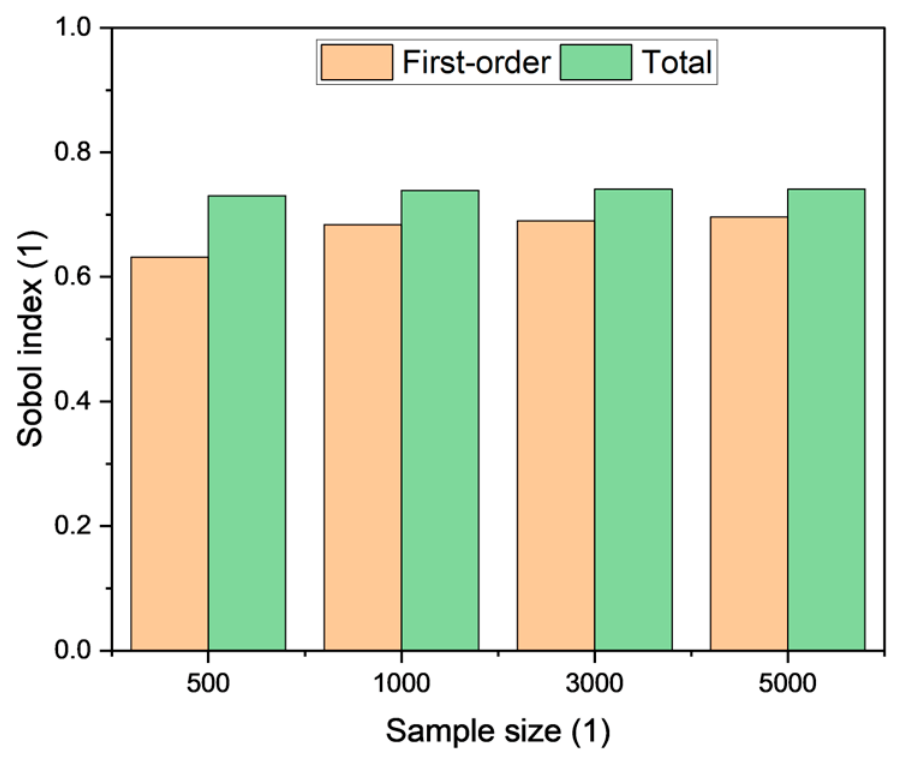
Figure A2.
Seismic loading applied to the piping system. Three levels of support excitation were defined using dynamic response spectra to represent inertia-driven loading induced by seismic impact. For each support level, three response spectra were specified along the x, y, and z directions.
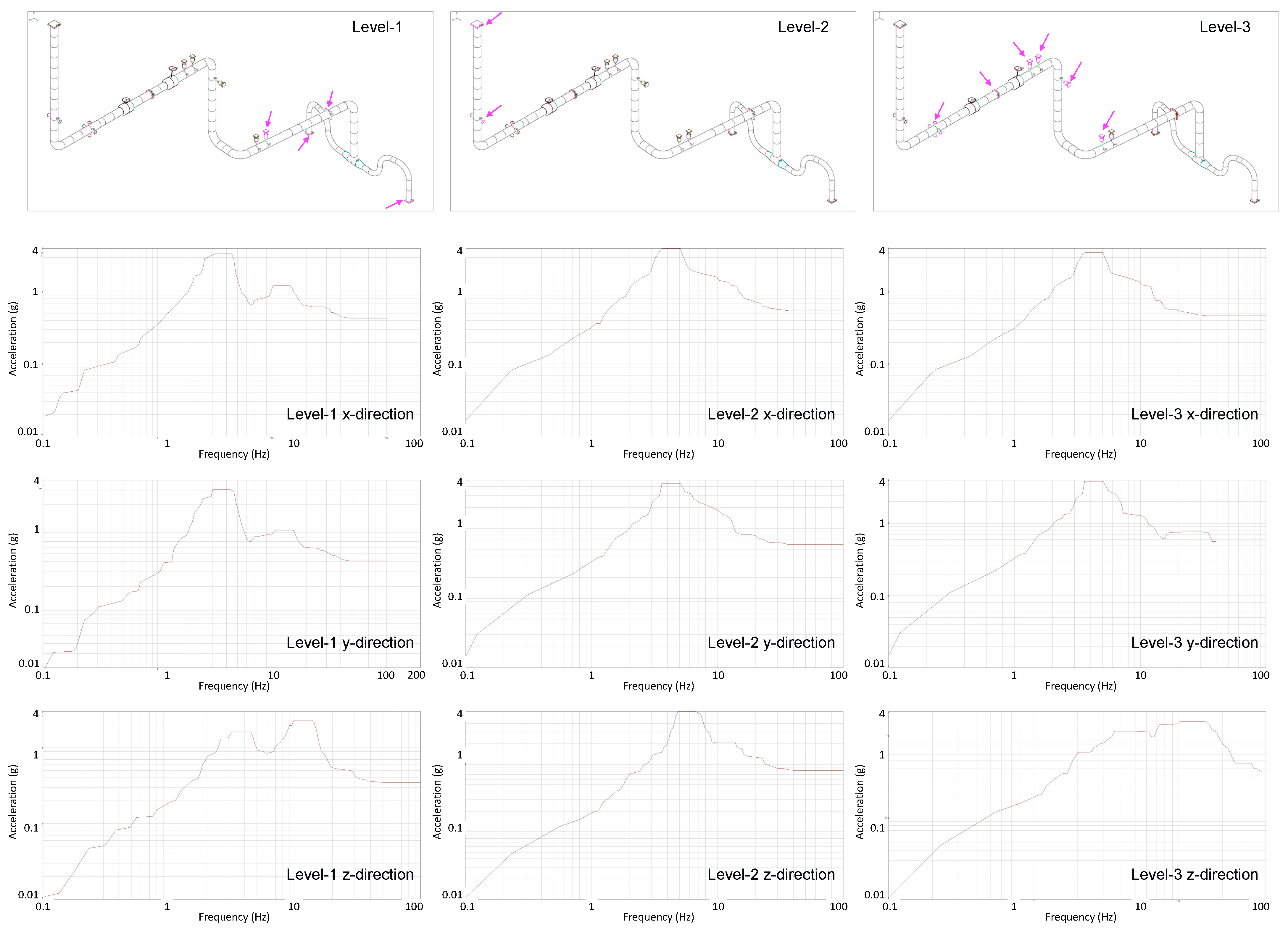
Figure A3.
The geometric information of the Hualong Two passive cooling system.
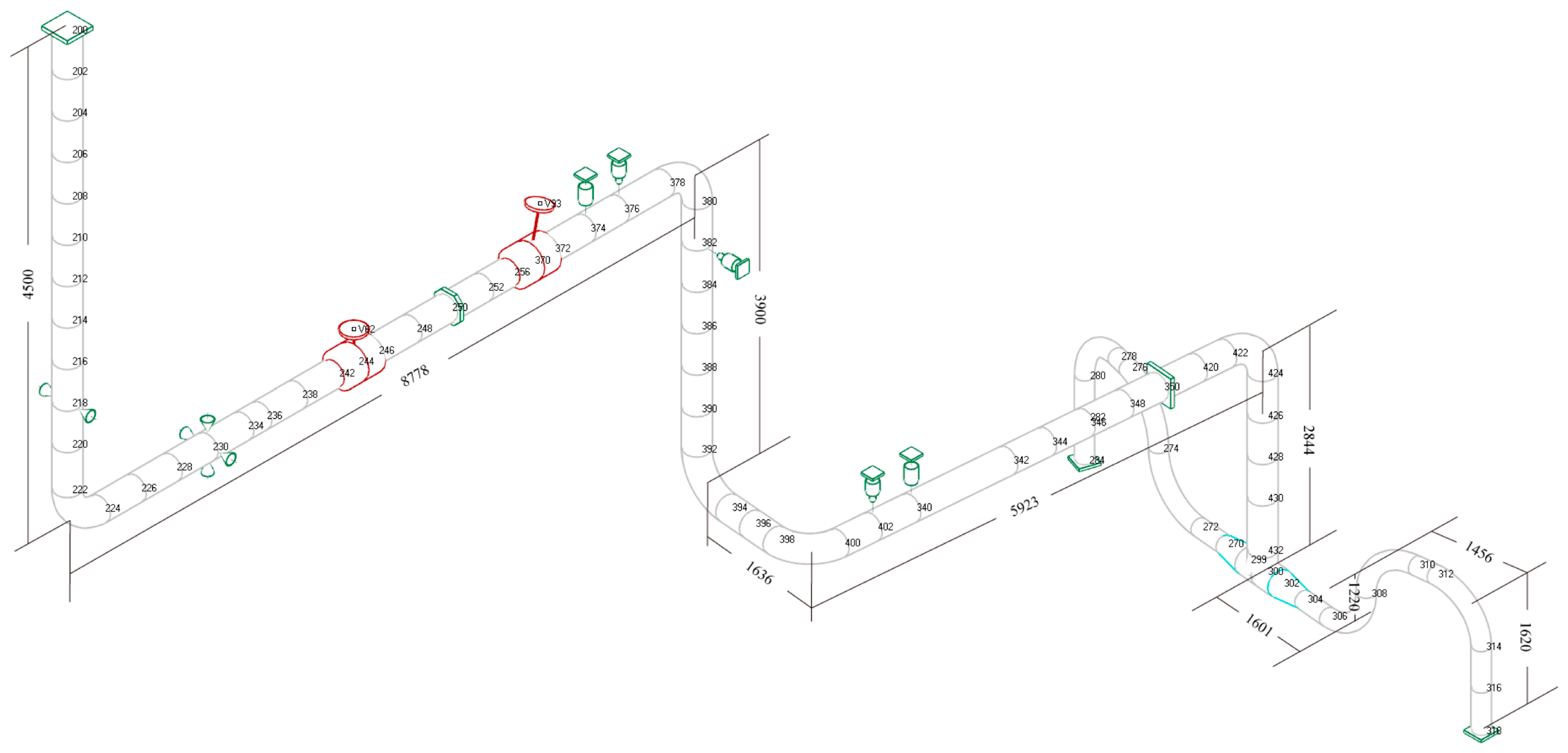
Table A1.
The uncertainty model of the pipeline system.
Table A2.
Mesh convergence for the representative stress ratio.
References
- Wu, Y.; Liu, T.; Tong, J.; Wang, C. Mechanical equipment failure rate prediction method for nuclear power plants. Ann. Nucl. Energy 2025, 222, 111596. [Google Scholar] [CrossRef] [Scilit]
- Antaki, G.; Gilada, R. Nuclear Power Plant Safety and Mechanical Integrity: Design and Operability of Mechanical Systems, Equipment and Supporting Structures; Butterworth-Heinemann: Oxford, UK, 2014. [Google Scholar]
- Kritsky, V. Aging management in the design of nuclear power plants. KnE Mater. Sci. 2018, 4, 399–405. [Google Scholar] [CrossRef] [Scilit]
- Nayyar, M.L. Piping Handbook; Mcgraw-Hill: New York, NY, USA, 1992; Volume 6. [Google Scholar]
- Veritas, D.N. Structural Analysis of Piping Systems: DNV RP-D101; Det Norske Veritas: Høvik, Norway, 2008. [Google Scholar]
- Hisada, T.; Noguchi, H.; Murayama, O. Development of sensitivity analysis code for elastic-plastic dynamic response of piping systems. JSME Int. J. Ser. 1 Solid Mech. Strength Mater. 1992, 35, 515–522. [Google Scholar] [CrossRef] [Scilit]
- Touboul, F.; Sollogoub, P.; Blay, N. Seismic behaviour of piping systems with and without defects: Experimental and numerical evaluations. Nucl. Eng. Des. 1999, 192, 243–260. [Google Scholar] [CrossRef] [Scilit]
- Sun, X.; Song, F.; Yuan, J. Transient analysis and dynamic modeling of the steam generator water level for nuclear power plants. Prog. Nucl. Energy 2024, 170, 105103. [Google Scholar] [CrossRef] [Scilit]
- Muransky, J.S.; Shatford, J.G.; Peterson, C.E.; Swindlehurst, G.B. Oconee nuclear power station main steam line break analysis for steam generator tube stress evaluation. Nucl. Technol. 2004, 148, 48–55. [Google Scholar] [CrossRef] [Scilit]
- Ma, L.W.; He, J.S.; Shu, A.Q.; Zheng, X.T.; Wang, Y. Structural integrity analysis of nuclear power plant pressure vessel penetration nozzle repaired. Appl. Mech. Mater. 2017, 853, 346–350. [Google Scholar] [CrossRef] [Scilit]
- Tian, X.; Li, T.; Liu, R. Application of PIPESTRESS software in stress analysis for nuclear grade pipe. In Proceedings of the Academic Annual Meeting of China Nuclear Society in 2015, Mianyang, China, 21–24 September 2015; Volume 4, pp. 457–462. [Google Scholar]
- ASME. BPVC Section III: Rules for Construction of Nuclear Facility Components, Division 2: Code for Concrete Containments; American Society of Mechanical Engineers: New York, NY, USA, 2015. [Google Scholar]
- AFCEN. RCC-M: Design and Construction Rules for Mechanical Components of PWR Nuclear Islands; AFCEN: Paris, France, 2022. [Google Scholar]
- Ellenberger, P. Piping and Pipeline Calculations Manual: Construction, Design Fabrication and Examination; Elsevier: Oxford, UK, 2014. [Google Scholar]
- Wrigley, P.A.; Wood, P.; Stewart, P.; Hall, R.; Robertson, D. Module layout optimization using a genetic algorithm in light water modular nuclear reactor power plants. Nucl. Eng. Des. 2019, 341, 100–111. [Google Scholar] [CrossRef] [Scilit]
- Sun, Y.; Chen, L.; Wang, Y.; Liu, S.; Jia, K. Intelligent layout of nuclear pipeline system with mechanical constraint. Prog. Nucl. Energy 2026, 191, 106022. [Google Scholar] [CrossRef] [Scilit]
- Hirschberg, S.; Knochenhauer, M. Application of sensitivity analysis in nuclear power plant probabilistic risk assessment studies. In Models and Uncertainty in the Energy Sector; Risoe National Laboratory: Roskilde, Denmark, 1986; pp. 59–73. [Google Scholar]
- Kim, J.Y.; Jang, J.H.; Hwang, J.H.; Kim, Y.J. Stress evaluation method of reinforced wall-thinned Class 2/3 nuclear pipes for structural integrity assessment. Nucl. Eng. Technol. 2024, 56, 1320–1329. [Google Scholar] [CrossRef] [Scilit]
- Gu, X.; Zhang, Y.; Huang, C.; Luo, X.; Zhang, H.; Zhou, R.; Qiu, Y. Sensitivity analysis of influencing factors of gas pipelines with corrosion defects under the action of landslides. Energies 2022, 15, 6640. [Google Scholar] [CrossRef] [Scilit]
- Troian, R. Uncertainty analysis of structural response under a random impact: R. Troian. Optim. Eng. 2023, 24, 49–64. [Google Scholar] [CrossRef] [Scilit]
- Cacuci, D.G. Sensitivity Analysis, uncertainty quantification and predictive modeling of nuclear energy systems. Energy 2022, 15, 6379. [Google Scholar] [CrossRef] [Scilit]
- Mao, G.; Niffenegger, M.; Mao, X. Probabilistic risk assessment for the piping of a nuclear power plant: Uncertainty and sensitivity analysis by using SINTAP procedure. Int. J. Pres. Ves. Pip. 2022, 200, 104791. [Google Scholar] [CrossRef] [Scilit]
Disclaimer/Publisher’s Note: The statements, opinions and data contained in all publications are solely those of the individual author(s) and contributor(s) and not of MDPI and/or the editor(s). MDPI and/or the editor(s) disclaim responsibility for any injury to people or property resulting from any ideas, methods, instructions or products referred to in the content. |
© 2026 by the authors. Licensee MDPI, Basel, Switzerland. This article is an open access article distributed under the terms and conditions of the Creative Commons Attribution (CC BY) license.