


Abstract
Background/Objectives: 3D printing of removable dentures and temporary crowns and bridges is currently one of the fastest-developing technologies in prosthetic dentistry. However, little is known about the effect of different beverage solutions on the strength and color of 3D-printed denture resins. The study aimed to determine the effect of coffee, red wine, 40% ethyl alcohol, and water (reference samples) on six 3D-printed denture resins (Denture 3D+ (Nexdent); Vita Vionic (Vita), Lucitone Digital Print 3D (Dentsply), DX Denture Flex (Dentex); Formlab Denture Base (Formlabs, Optiprint Dentona). Materials and Methods: Resin samples measuring 3.3 × 10 × 65 mm (144 total) and disks 1 × 20 mm (108 total) were produced using an Asiga printer. The printed materials were then stored in coffee, red wine and distilled water and vodka for 30 days. After this time, they were subjected to a flexural strength (FS) test and the measurement of color change (CC), and compared to reference samples measured before contact with the solutions. One- and two-way ANOVA were used for statistical analysis to compare samples before and after contact with the solutions. Results: The vodka solution affected the materials’ FS—the strength was reduced from 10% (Lucitone) to 88% (Detax). For the sample with the most significant FS reduction, the elastic modulus could not be determined. The largest CCs were observed for coffee (E = 22.66 ± 1.26), and red wine (E = 21.04 ± 0.70), whereas vodka had the least effect on CC (Lucitone E = 1.04 ± 0.41 and Form Labs E = 1.31 ± 0.85). Conclusions: 3D-printed resins are susceptible to the effects of commonly consumed substances, such as coffee, vodka, and red wine. When designing and manufacturing removable prosthetic restorations, it is necessary to carefully consider the dietary habits of patients and the materials from which the removable prosthetics are printed.
1. Introduction
Nowadays, 3D printers are commonly used in dental laboratories. They are used to print materials with short contact times with the patient, such as custom trays, surgical templates, and retainers [1,2,3]. This technology is also increasingly used to create restorations that remain in the patient’s mouth for longer periods—over 2–5 years (removable dentures, crowns, and bridges). In such cases, the impact of food intake on such materials is greater [4,5].
In the case of traditional materials used in prosthetics, such as acrylic resins and composite materials, a number of substances (the gold standards) are known to influence their color and mechanical properties. These include coffee, red wine, tea, fruit juices, and alcohol [6,7,8,9,10]. These solutions contain colored compounds that are deposited on surfaces. Some of these solutions also have a low pH, whereas red wine and alcohol contain ethanol, which can have a destructive effect on materials in prolonged contact [11,12,13,14,15].
The long-term influence on both traditional polymethyl methacrylate (PMMA) and composite materials has been observed in numerous publications, showing significant color changes in restorations and a deterioration of mechanical properties. However, printed resins differ from traditional materials in their chemical composition and processing technology [16,17,18,19,20].
In traditional acrylic dentures, PMMA (powder) and methyl methacrylate (MMA) liquid) are cured under pressure at high temperatures in a technical laboratory. This process results in a polymerized material with a low residual monomer content and a high degree of polymerization. Additionally, most acrylics do not contain inorganic fillers [20,21,22].
Some resins used in 3D printing are similar to those commonly used in composites for tooth filling in a dental clinic. However, the curing of most composite materials is different, because polymerization occurs within the oral cavity through a short exposure to a strong light source, such as a polymerization lamp. The cured material is highly cross-linked, with a monomer conversion rate of 60–80% [23,24,25]. Composite materials also contain various types of fillers, with a content of up to 80% [26].
According to patents and data provided by manufacturers, 3D-printed resins constitute a group of materials different in their chemical composition from both traditional acrylics and composite materials. They lack fillers (or their content is very low), and the organic component consists of monomers and oligomers similar to those used in composite materials. Furthermore, the curing technology for these types of materials varies because it involves a short exposure to a light source, rinsing in an isopropyl alcohol solution, and prolonged exposure to a polymerization lamp. Another significant difference is that the material is built using layers of approximately 50 microns, which may also affect its behavior in vivo [27,28,29,30].
Numerous studies have examined the effect of various solutions on color changes in 3D-printed materials [31,32,33,34]. However, only a few studies have examined both variables, changes in mechanical properties across a representative group of resins, because the number of products available on the market is very large [35,36]. Additionally, the current study includes comparisons of several market-leading materials tested under the same conditions.
Frequently studied solvents described in the literature include coffee, tea, fruit juices, and red wine [35,36]. To our knowledge, studies specifically addressing the effect of beverages with higher ethanol concentrations on 3D-printed denture base resins remain limited. As is known, it is used in post-processing to remove unpolymerized monomers from the surface of 3D-printed resins. Manufacturers of 3D-printed resins recommend avoiding prolonged contact with this solution, as it adversely affects the material.
However, in the everyday life of many cultures, the consumption of alcoholic beverages with higher ethanol concentrations than those found in wine is prevalent.
Therefore, it is important to examine the color changes and mechanical properties of six leading denture base materials under the influence of different beverages.
The hypotheses posed in this study define two variables. First, all resins will change color in the same way upon storage. Second, storing the materials will differentially affect their flexural strength in the same way. The similar behavior of different denture base materials may result from the properties of specific monomers used in their production, including their polymerization.
2. Materials and Methods
Six different types of 3D-printed resins intended for the fabrication of removable dentures were selected for the study: Denture 3D+ (Nexdent; Soesterberg, The Netherlands); Vita Vionic (Vita;Säckingen, Germany), Lucitone Digital Print 3D (Dentsply; Charlotte, NC, USA), DX Denture Flex (Dentex; Ettlingen, Germany); Formlab Denture Base (Formlabs; Somerville, MA, USA), and Optiprint (Dentona; Dormund, Germany).
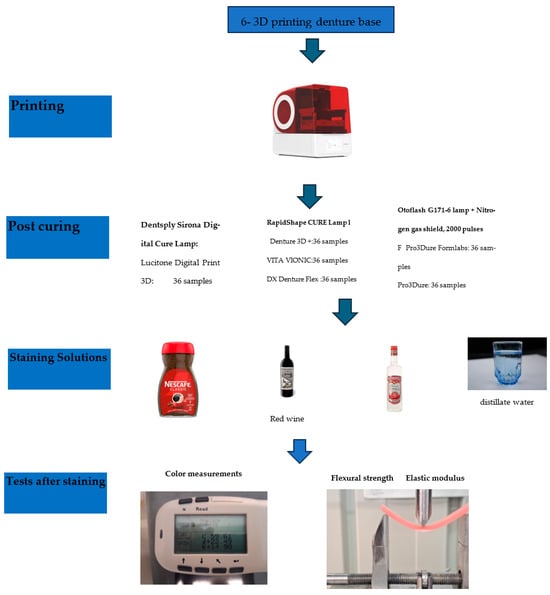
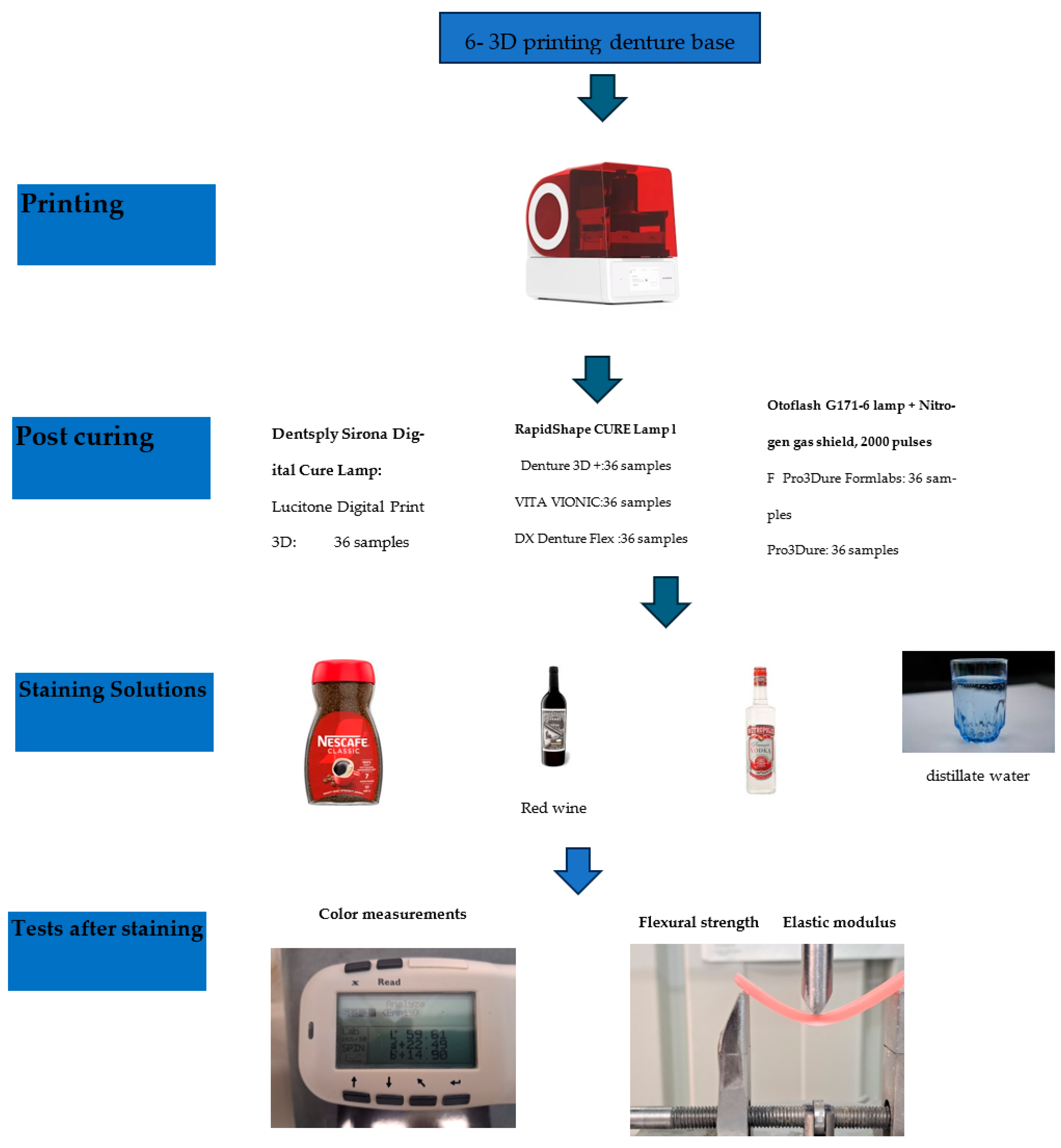
When selecting the 6six resins for testing, the authors were guided by their greatest popularity on the Polish market. Information about the products (denture base resins) is presented in Table 1 and Figure 1.
Table 1.
Materials used for testing.
Figure 1.
Graphical abstract of the tests performing during the study.
Before printing, the resins were mixed by placing the closed resin bottle on a roller mixer (Nextdent, Soesterberg, The Netherlands) for 10 min, according to the manufacturer’s recommendations, to obtain a homogeneous material.
Test samples were designed using the Composer (Asiga, Sidney, Australia) software program. The data was then exported as an STL file to an Asiga Max 2 printer (Asiga, Sydney, Australia) (manufacturer’s recommendations). The thickness of the printed single layer was 0.05 mm.
Formlabs and Optipring resins were cured using an Elegoo Mars 5 printer, as recommended by the manufacturers. Horizontal sample geometry was used during printing, and supports were not used [37].
After printing, the samples were washed with isopropyl alcohol (Cleanser, Microchip Electronic cleaning solution, Katowice, Poland) for 5 min using an ultrasonic cleaner (Bandelin Sigma Aldrich, Poznan, Poland). The samples were then cured in polymerization lamps (Table 1) for 10 min [38].
The sample size used for testing is strictly defined according to Choi et al. [35].
2.1. Solutions
The following solutions were used for the tests: instant coffee (Nescafe Classic, Vevey, Switzerland). The solution was prepared by adding 2 teaspoons of coffee to 200 mL of water at 90 °C. The mixture was thoroughly mixed.
The second coloring solution was red wine (Barrel Smuglers, Cabernet Sauvignon 2022; Mendoza, Argentina, with an alcohol content of 13.5%). This material was used for the tests without modification.
The third solution was 40% ethyl alcohol (Metropolis, Warsaw Vodka Factory Koneser, Warsaw, Poland). The substance was used for the tests without modification. Distilled water was used as a reference solution [39].
2.2. pH Measurement of the Test Solutions
The prepared solutions were measured using a Mettler Toledo F20 pH meter with an InLab Solids Go-ISM food-grade combination electrode (Mettler Toledo, Warsaw, Poland), which was calibrated with pH 4 and pH 8 buffer solutions (from the same company) prior to measurement. Three measurements of each solution were taken and the arithmetic mean was calculated [15].
2.3. Color Change
Twenty-four hours after curing, the color of the samples of the printed resins was measured using an X Rite Spectrophotometer (X Rite, Grand Rapids, MI, USA) at coordinates L, a, b. Three measurements were taken at different locations on each sample, and the average was taken as the result. These values were designated as the reference sample.
Six samples (2 × 20 mm diameter disks) of each resin (18 in total) were placed in 200 mL coffee solution. Similarly, 108 samples were prepared and divided for testing in red wine, vodka and distilled water.
The vessels and solutions were tightly sealed and stored at 37 °C. The test solutions were replaced every seven days. The total exposure time of the samples to the test solutions was 30 days. After this period, the sample surface was washed with distilled water and a soft brush to remove deposits from the material surfaces. The resin surface was dried using a soft laboratory tissue. The color of the samples was measured again using a spectrophotometer. Similarly to the previous test, three selected points on the surface were measured, and the average of these 3 points was calculated, yielding 54 measurements for one resin [7,9,11].
The color change in the 3D-printed resins was calculated using the following formula (Equation (1)).
where indicates the (black/white) coordinate after immersion (the period in the staining solution); L1 is the coordinate before testing.
—(red/green) is the value after the staining solution; a1 is before placement in the environment;
—(yellow/blue) is a coordinate after staining solution use; b1 is an initial value before testing.
2.4. Flexural Strength Testing
Samples measuring 3.3 × 10 × 65 mm (6 samples of each tested resin) were placed in solutions of coffee, red wine, ethanol, and distilled water. These solutions were changed every 7 days, and the total exposure time for the materials was 30 days at 37 °C. The infrequent changes in staining solutions were intended to simulate a group of patients who do not maintain regular hygiene practices while wearing dentures. The samples were stored in tightly closed containers, which were scalded with boiling water before use to prevent contamination with microorganisms [40,41]. For comparison, samples stored at room temperature (23 °C) and 50% humidity for 24 h were used as reference samples. For this study, 144 samples were prepared from 6 resins in 4 solutions.
After this period, the samples were subjected to a 3-point deflection test according to the method described in ISO 20795-1:2013 Dentistry—Base polymers Part 1: Denture base polymers [42]. Namely, the distance between the supports during the fracture test was 50 mm, and the fracture head travel speed was 5 mm/min. The test ended when the sample fractured. A Shimadzu device (ASG-X) was used for the tests. This device calculated the FS [MPa] (Equation (2)) and the modulus of elasticity E [MPa] (Equation (3)), along with the standard deviation [43,44].
with F: fracture load (N); l: span (mm); b: specimen width (mm); h: specimen height (mm).
E: elastic modulus (MPa); F1: load (N) at a point in the straight portion (at the maximum slope) of the load-deflection curve; d: deflection at F1 (mm); l: span (mm); b: specimen width (mm); h: specimen height (mm).
2.5. Statistical Analysis
One-way ANOVA with a post hoc Tukey HSD test was used to analyze the color change and mechanical resistance during each resin test, using the calculator available at https://astatsa.com/OneWay_Anova_with_TukeyHSD (accessed on 16 April 2026). The comparison was made between the samples before storage (references) in staining solutions and after the test was completed. Two-way ANOVA was used to examine statistical differences between resins and the media in which they were stored, using the calculator available at https://www.statskingdom.com/two-way-anova-calculator.html (accessed on 16 April 2026).
3. Results
Color change solutions used for testing had the following pH values: coffee 4.8 ± 0.1; red wine pH = 3.60 ± 0.05., and vodka pH = 7.11 ± 0.1.
The following tables (Table 2, Table 3 and Table 4) present the results obtained for samples stored in solutions of acid, red wine and alcohol.
Table 2.
Color change of 3D-printed resins intended for the fabrication of removable dentures after 30 days, calculated as ΔE.
Table 3.
Flexural strength of the sample after storage in different media [MPa].
Table 4.
Elastic modulus of the sample after storage in different media [MPa].
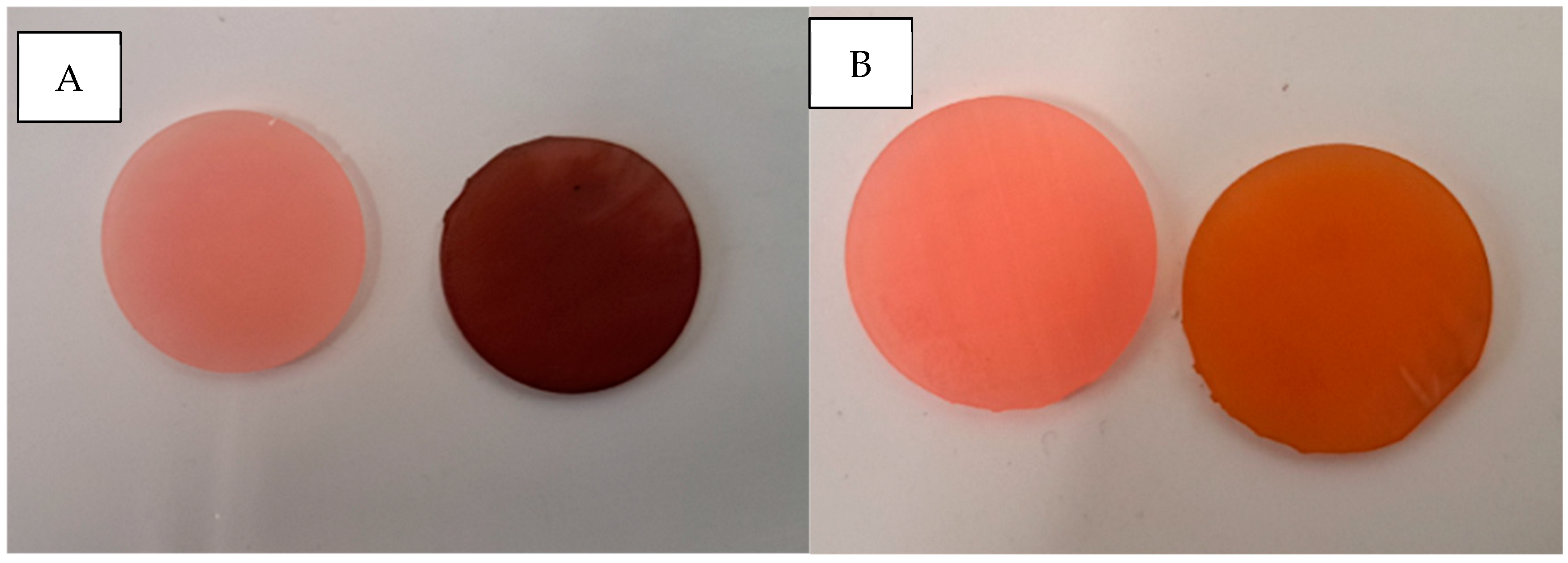
The resin samples showed the least color change after storage in distilled water and vodka. However, after being stored in 40% alcohol, some samples became flexible and easily changed their shape under finger pressure, allowing them to be molded. This was particularly noticeable for the Detax and Optiprint samples. The color change values were statistically significant (at the confidence level of p < 0.01) for the samples stored in red wine and coffee staining solutions compared to the untreated samples. Resins stored in the coffee solutions turned brown, while those stored in red wine changed color toward reddish-brown. Samples stored in vodka were lighter than their original color. The least significant color changes were observed for the Lucitone material in distilled water and coloring foodstuffs: Delta E = 3.30 ± 0.44 in red wine solution and Delta E = 1.34 ± 0.38 for vodka. For comparison, the most significant color changes were obtained for Resin Pro3Dcure: Delta E = 21.04 ± 0.70 and 22.66 ± 1.26 for the red wine and coffee solutions (Figure 2).
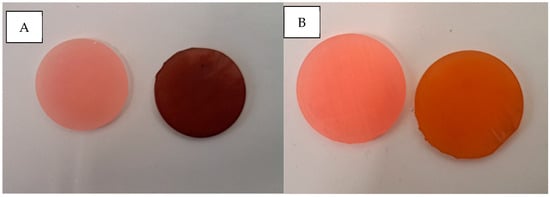
Figure 2.
Optiprint (A) (left) sample before being stored in staining solution, (right) 30 days in red wine. (B) Color change in the material sample after storage in coffee.
Storing resin samples for printing denture bases in various testing solutions significantly affects their fracture resistance. The FS changed most significantly when the materials were stored in vodka. Materials from Detax and Optiprint were most susceptible to this solution. Samples of these materials became very flexible, did not break under the influence of force, and the maximum force at which the samples deformed was 80% lower than the force used to deform samples stored under reference conditions. The least significant changes were observed for the Vita and Dentsply materials stored in vodka (a reduction of about 20%).
Samples stored in distilled water had the least noticeable change in FS compared to the same materials stored in dry conditions at room temperature. These changes were approximately 10% lower compared to the original values.
During the FS testing, it was also possible to determine the elastic modulus (E), which indicates the material’s flexibility and elasticity. The results of these calculations, performed by the Shimazu Flexural Strength instrument computer program, are presented in Table 4.
High elastic moduli (E) were calculated for the resins tested under laboratory conditions, exceeding 3000 MPa for the Lucitone and Denture 3D resins. Placing the samples in water or alcohol reduced this modulus, making them more elastic. The greatest reduction in this value was observed for Denture Flex in vodka and Optiprint (alcohol and red wine). The samples were so flexible that it was impossible to determine the straight-line portion where the increase in force was directly proportional to the deflection. Therefore, the Shimadzu tensile tester software 2.0 could not calculate the elastic modulus.
4. Discussion
Although the initial thesis of these studies was not confirmed, samples of various materials intended for denture base printing had significantly different mechanical properties. They also varied in resistance to color change in solutions with strong discoloring properties. This is primarily due to the different compositions of the resins used to produce 3D-printed resins. Regarding materials based on traditional MMA/PMMA and thermally cured materials, their chemical composition is similar. Powders from different manufacturers can be PMMA polymers with varying molecular weights and polymer bead diameters, or copolymers with ethyl or butyl methacrylate. The monomer is a mixture of methyl methacrylate and ethylene glycol dimethacrylate or 1,4-butanediol dimethacrylate. Their fracture toughness also depends on the length of the polymerization process [43]. However, 3D-printed resins differ in this regard. The number of monomers used is large. The most common are various types of urethane dimethacrylates, bis-GMA (Bisphenol A-glycidyl methacrylate) resin derivatives, and a whole range of acrylates. Therefore, the use of different monomer mixtures significantly affects, for example, FS [4,5]. Among the materials tested, we can distinguish two groups. First, Lucitone and Denture 3D Vita Vionic, which behave similarly to traditional heat-polymerized PMMA/MMA resins. They have an FS and elastic modulus similar to traditional materials, or even greater. They meet the ISO Denture Base Materials standard, as their resistance is above 60 MPa and their elastic modulus is above 2000 MPa.
Lucitone material was also tested for FS and elastic modulus by Coldea et al. The authors subjected the material to 10,000 aging tests in 5–55 °C thermocycling, demonstrating that this thermocycling had a destructive effect on the mechanical properties of the material, reducing them by approximately 40% [45,46]. The tests showed strong plasticization of the material, which was visible as strain increased while the load decreased, continuing either until fracture occurred or a 10 mm deflection was reached. During accelerated aging, chemical processes such as water sorption, solubility, and leaching of residual monomers may occur, affecting the mechanical properties of resin-based materials used for 3D printing [4,6,44,45].
When stored in water and coffee, these materials will undergo some plasticization due to water absorption. This will reduce their FS and modulus, but they still meet the standard requirements. When stored in alcohol, their mechanical resistance is reduced by approximately 30–40%. This occurs due to alcohol absorption and its plasticizing effect.
The second group of acrylic resins includes DX Denture Flex and Optiprint. They are very flexible and do not crack during the FS test. However, they do not meet the standard requirements.
Storing these two materials in a solution containing alcohol causes increased plasticization, leading to material deformation and easy bending under pressure. Some samples then crack easily. This can be explained by their chemical composition. They contain urethane methacrylates, which can absorb water or alcohol more readily than materials containing bis-GMA derivatives [2,3,4,5].
The explanation for these phenomena can be attributed to several factors. Alcohol can have a destructive effect through its short-term action, leaching out unpolymerized monomers and catalysts. This creates micro-voids within the materials. Water or ethanol can penetrate these voids. This has a plasticizing effect on the resin, which is manifested as a reduction in the elastic modulus (samples exposed to 40% ethanol) and a lower FS [2,5,7]. The color change of 3D-printed resins in the presence of coffee and red wine occurs via a two-step mechanism: absorption and adsorption. Liquid components penetrate the resin’s polymer matrix, while chromogenic compounds adhere to the surface and fill the microscopic pores created by the leaching of monomers and oligomers from the cured resin.
Coffee and red wine contain highly pigmented polyphenols (tannins) and chlorogenic acids. These substances are attracted to the resin surface through polar interactions, van der Waals forces, and hydrogen bonding. They become physically trapped in the voids created by the absorbed water [7,8,12].
Additionally, both solutions have a pH of 4, which can cause the slow hydrolysis of methacrylate and acrylic esters, the main components of the resins [7].
For the second group of materials with highly flexible, malleable denture bases, alternative strength testing methods, such as tensile testing, should be considered and incorporated into the standards for testing dental materials. The latest ISO 20795-1 standard from 2013 does not include new materials such as 3D-printed resins. Therefore, a newer version should describe testing methods specific to printing materials [46,47].
The problem of prolonged exposure of denture base materials to a low pH (5) and alkaline pH (8) has been described in the literature. The tested red wine and coffee solutions had a pH < 4 [48]—acidic solutions can adversely affect the mechanical properties of 3D-printed resins. This is consistent with the present results—red wine, with its low pH, reduces the FS and elastic modulus of all resins. This is explained by the fact that methacrylate esters, which are the main components of resins, are easily hydrolyzed by acids, as the polymer chain bonds are interrupted, leading to the formation of numerous cracks in the resin surface [48]. The rate of hydrolysis depends on many factors: hydrophilicity, water diffusivity within the matrix, functional groups present in the polymer chains, sample geometry, and printing the sample in a vertical or horizontal direction [49,50].
However, when attempting to analyze the effect of various agents on 3D-printed materials, one may encounter an issue related to their composition. Some manufacturers do not provide the composition of their materials, despite this being a legal requirement. The information provided is general. For example, the term urethane methacrylate, without providing a CAS number, does not clearly define the specific substance we are dealing with [18,19].
The findings of the present study are consistent with the results of the analysis/testing by Greiger [46]. In this study, the material Denture 3D+, obtained an FS = 98.3 ± 9.5 MPa in air, while in the present study, it was 93.31 ± 5.90 MPa. Samples stored in water had lower fracture resistance values: 72.9 ± 3.4 [51] versus 74.23 ± 6.58 MPa.
Flexural strength may depend on many factors: the nature of the material itself, the orientation in which the samples were cured (vertical or horizontal), the curing time, the atmosphere (contact with oxygen) or an anaerobic environment (inert gas such as glycerin), and the presence of fillers in the 3D-printed resin [51]. In the present study, the manufacturers’ recommendations for the tested materials were strictly followed. Consequently, future research studies can test the same group of resins, but polymerized with different polymers, as mentioned by Gad et al. [51]. Therefore, in similar future studies, the authors should focus on determining the exact chemical composition of the tested resins.
The color changes in the resins stored in various solutions also suggest dividing the resins into two groups. First, harder materials (Lucitone, Vita Vionic, Denture 3D) are less susceptible to color changes. In modern dentistry, color changes can be considered in terms of two components: the perceptibility threshold, which is the point at which 50% of observers can successfully see a color difference, widely accepted as Δ E ≈ 1.2., and the acceptability threshold, at which 50% of observers consider a color mismatch to be clinically unacceptable and requiring correction. This is typically recognized to be in the range of Δ E ≈ 2.7 according to ISO/TR 28642:2016(en) Dentistry—Guidance on color measurement [52]. Minor color changes will therefore be clinically acceptable for these materials.
The low color change in the coffee solution for the Lucitone material was confirmed in the studies of Lawson et al. [53] and NextDent [54].
Materials belonging to the first group are 1–2 units lighter after exposure to alcohol and distilled water than the samples measured before the tests. Coffee and red wine solutions change the color of the materials by 2–4 units, shifting toward a more brownish (coffee) and brownish-red color (red wine).
For the second group of materials, that is, elastic materials, the measurable color changes are significant. DX Denture Flex stored in red wine had a Delta E of 15.56 ± 3.55. The second material tested, Optiprint, stored in coffee, had a Delta E of 22.66 ± 1.26. These are significant color changes; thus, they are clinically unacceptable for the dentist, the patient or the denture wearer. Such significant color changes may result from the strong absorption of the materials, which is derived from their chemical structures and the high content of UDMA and hydroxypropyl methacrylate (DX Denture Flex). This monomer has an OH group, which increases its affinity for water [51]. Such significant color changes may also raise questions about the changes in the surface roughness of materials by washing out some of the unpolymerized monomers or hydrolyzed products. This causes, at a later stage, the absorption of water or other nutrients, creating conditions that may favor biofilm formation [55]. This should be considered by future research.
Samples stored in distilled water show the least color change. This was concluded by previous studies [56,57].
Resin color changes after contact with various dye solutions result from water absorption. This process leads to the absorption of other liquids containing substances that cause discoloration. As water is absorbed, the 3D-printed resin matrix stretches and splits the polymer chains, facilitating the penetration of dyes into the material. Furthermore, the 3D printing process makes individual printed layers visible in microscopic images, which affects the occurrence of porosity, enabling water sorption without hygroscopic expansion [58].
The present study has some limitations. Testing was conducted in vitro, where the period of exposure to dye solutions and alcohol was continuous. Under normal denture wearing conditions, patients take greater or lesser care of their prosthetic restorations, performing various types of hygiene procedures. The effect of strong dye solutions, such as coffee or red wine, is short-lived, similarly to that of alcohol. Moreover, saliva has buffering properties, and the consumption of solid food components, through mechanical interaction with the denture surface, reduces the deposition of dyes on the surface.
The current study was conducted under static conditions. In the future, it will be worthwhile to also perform tests in solutions stirred using a magnetic stirrer rotating at 40 rpm, along with a model of artificial saliva [59].
Although the present study covered a relatively large group of denture base resins (six), it needs to be considered that a wide range of these types of product is available on the market from different manufacturers—other materials may behave differently, which is worth examining.
5. Conclusions
- The present study identified two groups of 3D-printed resins: the first group exhibited mechanical properties (FS and E) similar to traditional thermally polymerized materials, while the second group comprised materials with greater flexibility.
- Materials belonging to the first group are less susceptible to color changes in dye solutions (coffee and red wine).
- A 40% alcohol causes significant reductions in the FS and elastic modulus of flexible resins compared to harder materials.
Author Contributions
Conceptualization, A.W. and Z.R.; methodology, Z.R.; software, A.W.; validation, M.P.-W. and Z.R.; formal analysis, Z.R.; investigation, A.W. and Z.R.; resources, M.P.-W. and L.W.; data curation, M.P.-W.; writing—original draft preparation, Z.R.; writing—review and editing, A.W., M.P.-W. and L.W.; visualization, L.W. and Z.R.; supervision, Z.R.; project administration, M.P.-W.; funding acquisition, M.P.-W. All authors have read and agreed to the published version of the manuscript.
Funding
This research received no external funding.
Institutional Review Board Statement
Not applicable.
Informed Consent Statement
Not applicable.
Data Availability Statement
The original contributions presented in this study are included in the article. Further inquiries can be directed to the corresponding authors.
Conflicts of Interest
The authors declare no conflicts of interest.
Abbreviations
The following abbreviations are used in this manuscript:
| 1,6 HDDMA | 1,6 Hexanediol dimethacrylate |
| Bis-GMA | Bisphenol A-glycidyl methacrylate |
| ethoxylated bis GMA | Ethoxylated Bisphenol A-glycidyl methacrylate |
| HPMA | Dihydroxy propyl methacrylate |
| MMA | Methyl methacrylate |
| PMMA | Polymethyl methacrylate |
| TPO | Diphenyl(2,4,6-trimethylbenzoyl)phosphine oxide |
References
- Schmidt, A.; Berschin, C.; Wöstmann, B.; Schlenz, M.A. Chairside 3-D printed impression trays: A new approach to increase the accuracy of conventional implant impression taking? An in vitro study. Int. J. Implant. Dent. 2023, 9, 47. [Google Scholar] [CrossRef] [Scilit] [PubMed]
- Paradowska-Stolarz, A.; Wezgowiec, J.; Mikulewicz, M. Comparison of Two Chosen 3D Printing Resins Designed for Orthodontic Use: An In Vitro Study. Materials 2023, 16, 2237. [Google Scholar] [CrossRef] [Scilit] [PubMed]
- Sfondrini, M.F.; Pascadopoli, M.; Cerri, M.; Todaro, C.; Gariboldi, F.; Scribante, A. Effect of Printing Angle and Resin Type on the Flexural Strength of 3D-Printed Dental Materials. Appl. Sci. 2025, 15, 11858. [Google Scholar] [CrossRef] [Scilit]
- Al-Qarni, F.D.; Gad, M.M. Printing Accuracy and Flexural Properties of Different 3D-Printed Denture Base Resins. Materials 2022, 15, 2410. [Google Scholar] [CrossRef] [Scilit] [PubMed]
- Fouda, S.; Ji, W.; Gad, M.M.; AlGhamdi, M.A.; Rohr, N. Flexural Strength and Surface Properties of 3D-Printed Denture Base Resins—Effect of Build Angle, Layer Thickness and Aging. Materials 2025, 18, 913. [Google Scholar] [CrossRef] [Scilit] [PubMed]
- Almansour, S.H.; Alkhawaja, J.A.; Khattar, A.; Alsalem, A.M.; Alessa, A.M.; Khan, S.Q.; Ellakany, P.; Gad, M.M.; Fouda, S.M. The Effect of Different Beverages on the Color Stability of Nanocomposite 3D-Printed Denture Base Resins. Prosthesis 2024, 6, 1002–1016. [Google Scholar] [CrossRef] [Scilit]
- Subramanya, J.K.; Muttagi, S. In vitro color change of three dental veneering resins in tea, coffee and tamarind extracts. J. Dent. 2011, 8, 138–145. [Google Scholar] [PubMed] [PubMed Central]
- Waldemarin, R.F.; Terra, P.C.; Pinto, L.R.; Faot, F.; Camacho, G.B. Color change in acrylic resin processed in three ways after immersion in water, cola, coffee, mate and wine. Acta Odontol. Latinoam. 2013, 26, 138–143. [Google Scholar] [PubMed]
- Aydın, N.; Karaoğlanoğlu, S.; Oktay, E.A.; Kılıçarslan, M.A. Investigating the color changes on resin-based CAD/CAM Blocks. J. Esthet. Restor. Dent. 2020, 32, 251–256. [Google Scholar] [CrossRef] [Scilit] [PubMed]
- Al-Shami, A.M.; Alshami, M.A.; Al-Kholani, A.I.; Al-Sayaghi, A.M. Color stability of nanohybrid and microhybrid composites after immersion in common coloring beverages at different times: A laboratory study. BDJ Open 2023, 9, 39. [Google Scholar] [CrossRef] [Scilit] [PubMed]
- Tanthanuch, S.; Kukiattrakoon, B.; Peerasukprasert, T.; Chanmanee, N.; Chaisomboonphun, P.; Rodklai, A. The effect of red and white wine on color changes of nanofilled and nanohybrid resin composites. Restor. Dent. Endod. 2016, 41, 130–136. [Google Scholar] [CrossRef] [Scilit] [PubMed]
- Krajangta, N.; Angkananuwat, C.; Leelaponglit, S.; Saelor, P.; Ngamjarrussriwichai, N.; Klaisiri, A. The Effect of Whitening and Daily Dentifrices on Red Wine Staining in Different Types of Composite Resins. Appl. Sci. 2024, 14, 12030. [Google Scholar] [CrossRef] [Scilit]
- Szalewski, L.; Wójcik, D.; Bogucki, M.; Szkutnik, J.; Różyło-Kalinowska, I. The Influence of Popular Beverages on Mechanical Properties of Composite Resins. Materials 2021, 14, 3097. [Google Scholar] [CrossRef] [Scilit] [PubMed]
- Sarrett, D.C.; Coletti, D.P.; Peluso, A.R. The effects of alcoholic beverages on composite wear. Dent. Mater. 2000, 16, 62–67. [Google Scholar] [CrossRef] [Scilit] [PubMed]
- Commar, B.C.; da Silva, E.V.F.; Silva, C.B.; Bitencourt, S.B.; Penitente, P.A.; Goiato, M.C.; Dos Santos, D.M. Alcohol and light-polymerizing glaze effect on the physical and mechanical properties of a bisacrylate composite resin before and after immersion in chlorhexidine gluconate. J. Prosthet. Dent. 2021, 125, 832.e1–832.e6. [Google Scholar] [CrossRef] [Scilit] [PubMed]
- Al-Fodeh, R.S.; Al-Dwairi, Z.N.; Almasri, M.; Baba, N.Z. Mechanical properties of 3D-printed resin denture teeth: An in vitro study. J. Prosthodont. 2024, 1–8. [Google Scholar] [CrossRef] [Scilit]
- Paradowska-Stolarz, A.; Wieckiewicz, M.; Kozakiewicz, M.; Jurczyszyn, K. Mechanical Properties, Fractal Dimension, and Texture Analysis of Selected 3D-Printed Resins Used in Dentistry That Underwent the Compression Test. Polymers 2023, 15, 1772. [Google Scholar] [CrossRef] [Scilit] [PubMed]
- Revilla-León, M.; Meyers, M.J.; Zandinejad, A.; Özcan, M. A review on chemical composition, mechanical properties, and manufacturing work flow of additively manufactured current polymers for interim dental restorations. J. Esthet. Restor. Dent. 2019, 31, 51–57. [Google Scholar] [CrossRef] [Scilit] [PubMed]
- Penzenstadler, M.; Intarak, N.; Kamnoedboon, P.; Nantanapiboon, D.; Suwanchaikasem, P.; Porntaveetus, T.; Srinivasan, M. In vitro analysis of composition profiles of resins for 3D printing of dentures. J. Dent. 2025, 154, 105565. [Google Scholar] [CrossRef] [Scilit] [PubMed]
- Liu, J.; Wang, W.; Zheng, Y.; Zhao, Z.; Xiong, Y. Preparation and characterization of dental nanocomposite resin for 3D-printed dental crown and bridge restorations. Int. J. Bioprint. 2025, 11, 545–572. [Google Scholar] [CrossRef] [Scilit]
- Tuna, E.B.; Rohlig, B.G.; Sancakli, E.; Evlioglu, G.; Gencay, K. Influence of acrylic resin polymerization methods on residual monomer release. J. Contemp. Dent. Pract. 2013, 14, 259–264. [Google Scholar] [CrossRef] [Scilit] [PubMed]
- Hashem, M.; Alsaleem, S.O.; Assery, M.K.; Abdeslam, E.B.; Vellappally, S.; Anil, S. A comparative study of the mechanical properties of the light-cure and conventional denture base resins. Oral Health Dent. Manag. 2014, 13, 311–315. [Google Scholar] [PubMed]
- Moldovan, M.; Balazsi, R.; Soanca, A.; Roman, A.; Sarosi, C.; Prodan, D.; Vlassa, M.; Cojocaru, I.; Saceleanu, V.; Cristescu, I. Evaluation of the Degree of Conversion, Residual Monomers and Mechanical Properties of Some Light-Cured Dental Resin Composites. Materials 2019, 12, 2109. [Google Scholar] [CrossRef] [Scilit] [PubMed]
- Frauscher, K.E.; Ilie, N. Degree of conversion of nano-hybrid resin-based composites with novel and conventional matrix formulation. Clin. Oral Investig. 2013, 17, 635–642. [Google Scholar] [CrossRef] [Scilit] [PubMed]
- Par, M.; Spanovic, N.; Tauböck, T.T.; Attin, T.; Tarle, Z. Degree of conversion of experimental resin composites containing bioactive glass 45S5: The effect of post-cure heating. Sci. Rep. 2019, 9, 17245. [Google Scholar] [CrossRef] [Scilit] [PubMed]
- Liu, J.; Zhang, H.; Sun, H.; Liu, Y.; Liu, W.; Su, B.; Li, S. The Development of Filler Morphology in Dental Resin Composites: A Review. Materials 2021, 14, 5612. [Google Scholar] [CrossRef] [Scilit] [PubMed]
- Neoh, S.P.; Khantachawana, A.; Santiwong, P.; Chintavalakorn, R.; Srikhirin, T. Effect of post-processing on the surface, optical, mechanical, and dimensional properties of 3D-printed orthodontic clear retainers. Clin. Oral Investig. 2025, 29, 48. [Google Scholar] [CrossRef] [Scilit] [PubMed]
- Aktug Karademir, S.; Atasoy, S.; Akarsu, S.; Karaaslan, E. Effects of post-curing conditions on degree of conversion, microhardness, and stainability of 3D printed permanent resins. BMC Oral Health 2025, 25, 304. [Google Scholar] [CrossRef] [Scilit] [PubMed]
- Topsakal, K.G.; Aksoy, M.; Sükut, Y.; Duran, G.S. Effect of post-curing parameters and material thickness on the color stability of 3D-printed dental resins: An in vitro study. Int. Orthod. 2025, 23, 100985. [Google Scholar] [CrossRef] [Scilit] [PubMed]
- Prakash, J.; Shenoy, M.; Alhasmi, A.; Al Saleh, A.A.; C, S.G.; Shivakumar, S. Biocompatibility of 3D-Printed Dental Resins: A Systematic Review. Cureus 2024, 16, e51721. [Google Scholar] [CrossRef] [Scilit] [PubMed]
- Alfouzan, A.F.; Alotiabi, H.M.; Labban, N.; Al-Otaibi, H.N.; Al Taweel, S.M.; AlShehri, H.A. Color stability of 3D-printed denture resins: Effect of aging, mechanical brushing and immersion in staining medium. J. Adv. Prosthodont. 2021, 13, 160–171, Erratum in J. Adv. Prosthodont. 2022, 14, 334. https://doi.org/10.4047/jap.2021.13.3.160. [Google Scholar] [CrossRef] [Scilit] [PubMed]
- da Silva, M.D.D.; do Carmo Viotto, H.E.; Moisés, L.S.; Coelho, S.R.G.; de Souza, R.F.; Pero, A.C. Stainability of 3D-printed resins for denture base and artificial teeth. BMC Oral Health 2025, 25, 260. [Google Scholar] [CrossRef] [Scilit] [PubMed]
- Espinar, C.; Della Bona, A.; Pérez, M.M.; Pulgar, R. Color and optical properties of 3D printing restorative polymer-based materials: A scoping review. J. Esthet. Restor. Dent. 2022, 34, 853–864. [Google Scholar] [CrossRef] [Scilit] [PubMed]
- Espinar, C.; Bona, A.D.; Pérez, M.M.; Tejada-Casado, M.; Pulgar, R. The influence of printing angle on color and translucency of 3D printed resins for dental restorations. Dent. Mater. 2023, 39, 410–417. [Google Scholar] [CrossRef] [Scilit] [PubMed]
- Choi, H.E.; Kim, S.; Kim, G.Y.; Li, J.; Pieralli, S.; Oh, K.C. Mechanical and esthetic properties of denture base resins in relation to thermocycling. Sci. Rep. 2025, 15, 40789. [Google Scholar] [CrossRef] [Scilit] [PubMed]
- Tokar, E.; Nezir, M.; Polat, S.; Özcan, S. Evaluation of optical and mechanical properties of crown materials produced by 3D printing. Adv. Clin. Exp. Med. 2025, 34, 813–820. [Google Scholar] [CrossRef] [Scilit] [PubMed]
- Carbajal Mejía, J.B.; Wakabayashi, K.; Nakamura, T.; Yatani, H. Influence of abutment tooth geometry on the accuracy of conventional and digital methods of obtaining dental impressions. J. Prosthet. Dent. 2017, 118, 392–399. [Google Scholar] [CrossRef] [Scilit] [PubMed]
- Gekle, S.; Mayinger, F.; Kreitmair, U.; Reymus, M.; Hoffmann, M.; Stawarczyk, B. Impact of different post-polymerization protocols on the material properties of three printed dental resins. J. Mech. Behav. Biomed. Mater. 2025, 172, 107164. [Google Scholar] [CrossRef] [Scilit] [PubMed]
- Song, S.Y.; Shin, Y.H.; Lee, J.Y.; Shin, S.W. Color stability of provisional restorative materials with different fabrication methods. J. Adv. Prosthodont. 2020, 12, 259–264. [Google Scholar] [CrossRef] [Scilit] [PubMed]
- Assaf, C.; Abou Samra, P.; Nahas, P. Discoloration of Resin Composites Induced by Coffee and Tomato Sauce and Subjected to Surface Polishing: An In Vitro Study. Med. Sci. Monit. Basic Res. 2020, 26, e923279. [Google Scholar] [CrossRef] [Scilit] [PubMed] [PubMed Central]
- Quintero, M.; Velásquez, S.; Zapata, J.; López, C.; Cisneros-Zevallos, L. Assessment of Concentrated Liquid Coffee Acceptance during Storage: Sensory and Physicochemical Perspective. Molecules 2021, 26, 3545. [Google Scholar] [CrossRef] [Scilit] [PubMed] [PubMed Central]
- ISO 20795-1:2013; Dentistry—Base Polymers—Part 1. ISO: Geneva, Switzerland, 2013.
- Bora, P.V.; Sayed Ahmed, A.; Alford, A.; Pitttman, K.; Thomas, V.; Lawson, N.C. Characterization of materials used for 3D printing dental crowns and hybrid prostheses. J. Esthet. Restor. Dent. 2024, 36, 220–230. [Google Scholar] [CrossRef] [Scilit] [PubMed]
- Raszewski, Z.; Nowakowska-Toporowska, A.; Nowakowska, D.; Więckiewicz, W. Update on Acrylic Resins Used in Dentistry. Mini-Rev. Med. Chem. 2021, 21, 2130–2137. [Google Scholar] [CrossRef] [Scilit] [PubMed]
- Rohym, S.; Tawfeek, H.E.M.; Kamh, R. Effect of coffee on color stability and surface roughness of newly introduced single shade resin composite materials. BMC Oral Health 2023, 23, 236. [Google Scholar] [CrossRef] [Scilit] [PubMed] [PubMed Central]
- Coldea, A.; Mayinger, F.; Meinen, J.; Hoffmann, M.; Stawarczyk, B. Mechanical properties of 3D printed denture base polymers. J. Prosthet. Dent. 2025, 133, 1361.e1–1361.e8. [Google Scholar] [CrossRef] [Scilit] [PubMed]
- Carneiro Pereira, A.L.; Dias, A.C.M.; Santos, K.S.; Andrade, J.O.; de Boa, P.W.M.; de Medeiros, A.K.B.; Barão, V.A.R.; Borges, B.C.D.; Galvão Barboza, C.A.; Carreiro, A.D.F.P. Influence of salivary pH on the surface, mechanical, physical, and cytotoxic properties of resins for 3D-printed and heat-polymerized denture base. J. Dent. 2025, 156, 105721. [Google Scholar] [CrossRef] [Scilit] [PubMed]
- von Burkersroda, F.; Schedl, L.; Göpferich, A. Why degradable polymers undergo surface erosion or bulk erosion. Biomaterials 2002, 23, 4221–4231. [Google Scholar] [CrossRef] [Scilit] [PubMed]
- Li, P.; Krämer-Fernandez, P.; Klink, A.; Xu, Y.; Spintzyk, S. Repairability of a 3D printed denture base polymer: Effects of surface treatment and artificial aging on the shear bond strength. J. Mech. Behav. Biomed. Mater. 2021, 114, 104227. [Google Scholar] [CrossRef] [Scilit] [PubMed]
- Geiger, V.; Mayinger, F.; Hoffmann, M.; Reymus, M.; Stawarczyk, B. Fracture toughness, work of fracture, flexural strength and elastic modulus of 3D-printed denture base resins in two measurement environments after artificial aging. J. Mech. Behav. Biomed. Mater. 2024, 150, 106234. [Google Scholar] [CrossRef] [Scilit] [PubMed]
- Gad, M.M.; Fouda, S.M. Factors affecting flexural strength of 3D-printed resins: A systematic review. J. Prosthodont. 2023, 32, 96–110. [Google Scholar] [CrossRef] [Scilit] [PubMed]
- ISO 28642:2016(en); Dentistry—Guidance on Colour Measurement. ISO: Geneva, Switzerland, 2016.
- Lawson, N.C.; Safadi, Y.; Alford, A.; Aggarwal, H.; Bora, P.V.; Lawson, T.J.; Givan, D.A. Flexural strength, fracture toughness, translucency, stain resistance, and water sorption of 3D-printed, milled, and conventional denture base materials. J. Prosthodont. 2026, 35, 553–560. [Google Scholar] [CrossRef] [Scilit] [PubMed]
- Gad, M.A.; Abdelhamid, A.M.; ElSamahy, M.; Abolgheit, S.; Hanno, K.I. Effect of aging on dimensional accuracy and color stability of CAD-CAM milled and 3D-printed denture base resins: A comparative in-vitro study. BMC Oral Health 2024, 24, 1124. [Google Scholar] [CrossRef] [Scilit] [PubMed]
- Anadioti, E.; Musharbash, L.; Blatz, M.B.; Papavasiliou, G.; Kamposiora, P. 3D printed complete removable dental prostheses: A narrative review. BMC Oral Health 2020, 20, 343. [Google Scholar] [CrossRef] [Scilit] [PubMed]
- Izzettinoglu, E.; Eroglu, E. Evaluation of mechanical properties and color stability of 3D-printed denture base materials following two surface treatments. BMC Oral Health 2025, 25, 671. [Google Scholar] [CrossRef] [Scilit] [PubMed]
- Al-Ameri, A.; Alothman, O.Y.; Alsadon, O.; Bangalore, D. An In-Vitro Evaluation of Strength, Hardness, and Color Stability of Heat-Polymerized and 3D-Printed Denture Base Polymers After Aging. Polymers 2025, 17, 288. [Google Scholar] [CrossRef] [Scilit] [PubMed] [PubMed Central]
- Myagmar, G.; Daher, R.; Yeo, I.S.; Ahn, J.S.; Han, J.S.; Lee, J.H. Color and surface stainability of additively and subtractively manufactured interim restorative materials against mouth rinses. J. Prosthet. Dent. 2023, 130, 927–934. [Google Scholar] [CrossRef] [Scilit] [PubMed]
- Školáková, T.; Slámová, M.; Školáková, A.; Kadeřábková, A.; Patera, J.; Zámostný, P. Investigation of Dissolution Mechanism and Release Kinetics of Poorly Water-Soluble Tadalafil from Amorphous Solid Dispersions Prepared by Various Methods. Pharmaceutics 2019, 11, 383. [Google Scholar] [CrossRef] [Scilit] [PubMed] [PubMed Central]

Disclaimer/Publisher’s Note: The statements, opinions and data contained in all publications are solely those of the individual author(s) and contributor(s) and not of MDPI and/or the editor(s). MDPI and/or the editor(s) disclaim responsibility for any injury to people or property resulting from any ideas, methods, instructions or products referred to in the content. |
© 2026 by the authors. Licensee MDPI, Basel, Switzerland. This article is an open access article distributed under the terms and conditions of the Creative Commons Attribution (CC BY) license.