


Abstract
Background: Return to play (RTP) after total hip arthroplasty (THA) is increasingly expected by younger and more physically active patients. Current activity recommendations remain heterogeneous and are largely derived from expert opinion and indirect biomechanical modelling approaches, rather than direct in vivo biomechanical evidence. The aim of this article is to systematically map and synthesize the evidence from instrumented hip implant studies and to clarify how direct in vivo telemetry data can inform RTP counselling after THA. Methods: A scoping review was conducted according to a predefined Open Science Framework protocol and reported following PRISMA-ScR guidelines. MEDLINE (PubMed) and Scopus were searched from inception. Peer-reviewed clinical studies reporting direct in vivo biomechanical measurements obtained from instrumented hip implants were included. Conference proceedings, technical notes, reviews, and in vitro or computational-only studies were excluded. Data were extracted and synthesized descriptively according to activity domain, biomechanical variables, and implant technology. Results: Fifty studies met the inclusion criteria. Early investigations established feasibility and evolved from wired strain-gauge systems to fully implantable telemetric prostheses capable of measuring three-dimensional forces, moments, and friction-related parameters. Across cohorts, level walking consistently produced peak hip contact forces of approximately 2–3 times body weight, serving as a clinically meaningful reference loading envelope. Several recreational activities—including cycling, aquatic exercise, Nordic walking, and most gym-machine exercises—generally remained within or close to this range when performed with controlled technique. In contrast, certain rehabilitation tasks, forward-bent postures, lifting maneuvers, and perturbation events generated loads equal to or exceeding those observed during walking. Importantly, frictional moments and load direction showed substantial variability and may be more relevant to implant fixation than peak force magnitude alone. Conclusions: Instrumented hip implants provide objective biomechanical benchmarks that support principle-based and individualized RTP counselling, grounded in directly measured mechanical exposure rather than sport classification alone.
1. Introduction
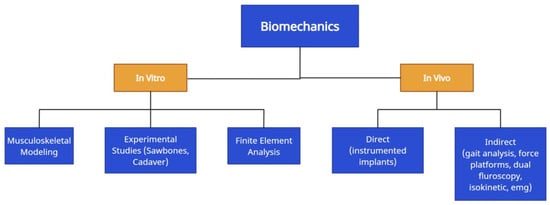
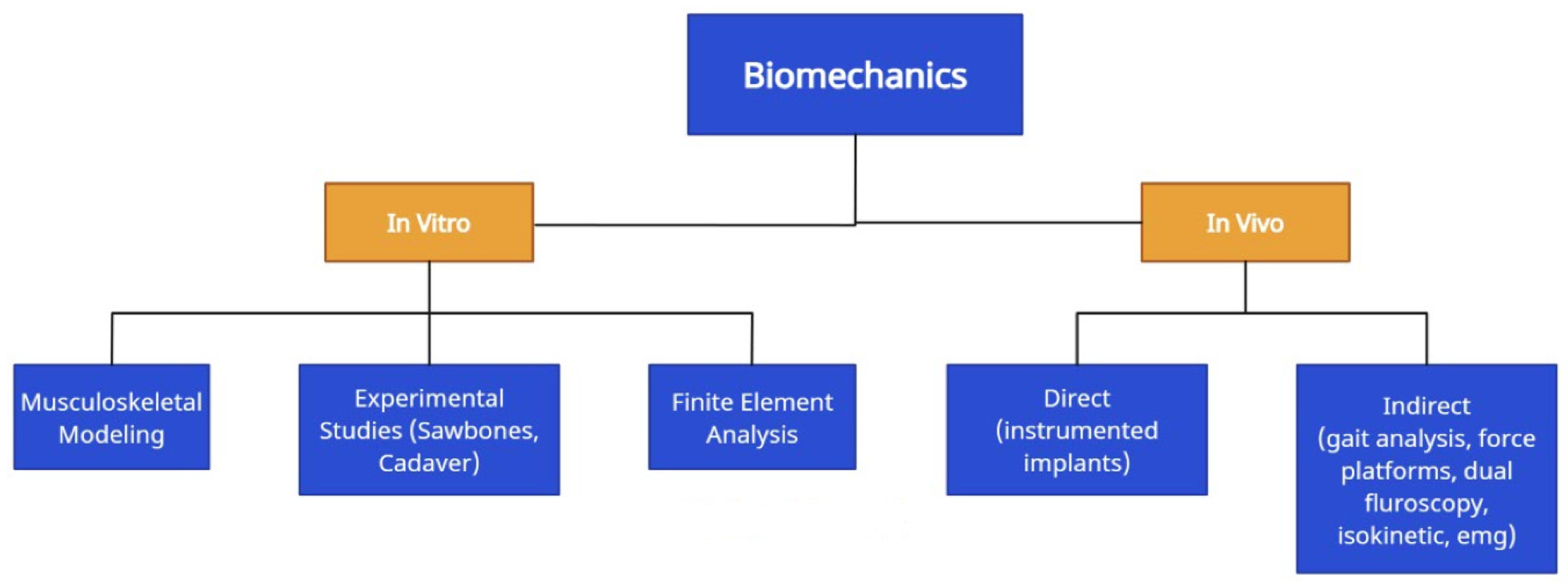
Total hip arthroplasty (THA) has evolved from a procedure primarily aimed at pain relief and restoration of basic mobility into an intervention increasingly expected to support return to sport (RTS) and higher levels of physical activity. As younger and more active patients undergo THA, surgeons are frequently asked to provide guidance regarding safe return to play (RTP). However, current clinical recommendations remain largely based on expert consensus and theoretical biomechanical considerations, rather than direct measurements of the loads experienced by implants during activity [1]. Instrumented hip implants offer a unique opportunity to address this gap by providing direct in vivo measurements of joint loading under real-life conditions, thereby allowing a more objective understanding of the biomechanical environment of the replaced joint (Figure 1) [2].
Figure 1.
Diagram illustrating the most commonly used methods of biomechanical evaluation. Among these approaches, instrumented implants represent the only technique capable of directly measuring biomechanical parameters in vivo.
1.1. Historic Perspective: Origins of Instrumented Hip Implants
The evolution of THA has been closely intertwined with advances in hip biomechanics. Early understanding of load transfer began with the formulation of Wolff’s law in the late nineteenth century, describing bone adaptation to mechanical stress, and was further developed through mechanical models of hip loading during gait in the twentieth century [3]. Early biomechanical investigations relied on simplified two-dimensional static models—such as those describing abductor lever arms and joint reaction forces during single-leg stance—to estimate loading conditions around the hip and to guide prosthetic implant design [4]. With advances in computational power, indirect methods such as three-dimensional motion analysis and musculoskeletal modelling were introduced, enabling the estimation of joint moments and forces during dynamic activities. Nevertheless, these approaches remain dependent on assumptions regarding muscle activation patterns, coordination strategies, and model boundary conditions, which limit their ability to accurately capture the true mechanical environment of the joint in vivo [5]. Recognition of these limitations led to the development of direct measurement techniques, culminating in instrumented hip prostheses capable of recording three-dimensional joint forces, moments, and additional biomechanical parameters in vivo. These technologies provide objective insights into the mechanical environment of the replaced hip joint during functional tasks and have become a critical tool for validating biomechanical models and informing clinical decision-making.
Direct measurement of hip joint forces began in the 1960s and 1970s with strain-gauge equipped prostheses [6,7]. Technological refinement during the 1980s enabled multi-channel telemetry systems and wireless data transmission [8,9]. The Berlin group led by Bergmann and colleagues subsequently developed fully implantable, hermetically sealed telemeterized prostheses, capable of measuring three-dimensional joint forces and temperature without percutaneous connections [10,11,12,13]. These innovations enabled the creation of comprehensive in vivo datasets describing hip joint loading across a wide range of functional activities [11].
1.2. Beyond Forces: Stability and Monitoring Technologies
While joint contact force remains the primary parameter of interest for RTP decisions, complementary measurement approaches contribute to understanding the mechanical environment of THA and long-term implant survivorship. Frictional moments, torsional loads, temperature changes, and implant micromotion have been quantified, highlighting that mechanical exposure after THA is multidimensional and can not be adequately described by peak force alone [13,14,15]. In addition, statistical methods for averaging the highly variable biomechanical signals have also further improved interpretability of in vivo data [16].
1.3. Clinical Relevance for Return to Play
Return to play after total hip arthroplasty remains a subject of ongoing debate, reflecting the tension between increasing patient expectations for high levels of physical activity and concerns regarding implant longevity and mechanical failure. Surveys of orthopedic surgeons consistently demonstrate variability in RTP recommendations, with most clinicians permitting low-impact activities while discouraging participation in higher-impact sports because of theoretical risks of increased wear, loosening, or dislocation, despite limited availability of direct biomechanical evidence supporting these restrictions [17,18,19]. At the same time, registry data and clinical series suggest that many patients successfully resume recreational sports following THA, suggesting a potential discrepancy between conservative clinical recommendations and actual patient behaviour [20,21]. Historically, the absence of objective loading data during sport has limited the development of evidence-based RTP guidance, as indirect approaches such as gait analysis and musculoskeletal modelling cannot fully capture the complex forces acting on the hip during dynamic movements. Instrumented hip implant studies, which directly measure joint forces and moments in vivo, offer a potential means to reconcile these uncertainties by quantifying the mechanical demands associated with different activities and informing more individualized recommendations [11]. Furthermore, the potential future commercialization of instrumented prostheses—similar to the recent introduction of the Persona IQ instrumented total knee arthroplasty (TKA) by Zimmer Biomet—may make these technologies increasingly relevant, potentially enabling continuous implant monitoring during daily and athletic activities [22].
1.4. Purpose of This Scoping Review
Despite decades of telemetry research, its implications for RTP after THA remain fragmented across biomechanical, clinical, and engineering literature and have not been systematically synthesized from return-to-sport perspective, with current RTP guidelines relying on indirect modelling an expert consensus, rather than direct biomechanical evidence. The purpose of this scoping review is to map the body of evidence derived from instrumented hip implant studies, summarize current understanding of activity-specific in vivo loading after THA, and examine how these findings inform evidence-based return-to-play counselling and rehabilitation strategies.
2. Materials and Methods
2.1. Study Design
This scoping review was conducted in accordance with a predefined protocol registered on the Open Science Framework (OSF) and was reported in accordance with the Preferred Reporting Items for Systematic Reviews and Meta-Analyses Extension for Scoping Reviews (PRISMA-ScR) guidelines (Appendix A) [23].
2.2. Eligibility Criteria
Eligibility criteria were defined according to the Population–Concept–Context (PCC) framework, which is commonly used in scoping review methodology. The population comprised adults aged ≥18 years who had undergone total hip arthroplasty. The concept of interest was direct in vivo biomechanical measurements obtained from instrumented hip implants, including parameters such as joint contact forces, resultant force vectors, joint moments or torques, and temporal loading characteristics. Studies relying solely on indirect biomechanical estimation methods, including motion analysis without original biomechanical data.
Studies relying solely on indirect biomechanical estimation methods, including gait analysis without instrumented implants, musculoskeletal modelling, or other simulation approaches, were excluded. Cadaveric, in vitro, computational, and animal studies were also excluded, as they do not provide direct in vivo measurements. Due to the historical development of telemeterized hip implants and the predominance of studies originating from the Charité research group, publications written in English or German were considered eligible.
2.3. Search Strategy and Study Selection
A comprehensive literature search was conducted in MEDLINE (via PubMed) and Scopus from database inception to 6 January 2026. The full search strategies for both databases are included in Appendix B. In addition, the reference lists of included articles and relevant reviews were manually screened to identify additional eligible publications.
2.4. Data Synthesis
Findings were synthesized descriptively using descriptive analytical methods, consistent with recommended scoping review methodology and charted (Appendix C). Findings were summarized through structured and narrative synthesis. Results were organized according to biomechanical measurement type, activity or functional task, and instrumented implant technology. Consistent with the methodological framework of scoping reviews, a formal risk-of-bias assessment was not performed, as the primary objective of this review was to map the existing body of evidence rather than evaluate the methodological quality of individual studies.
3. Results
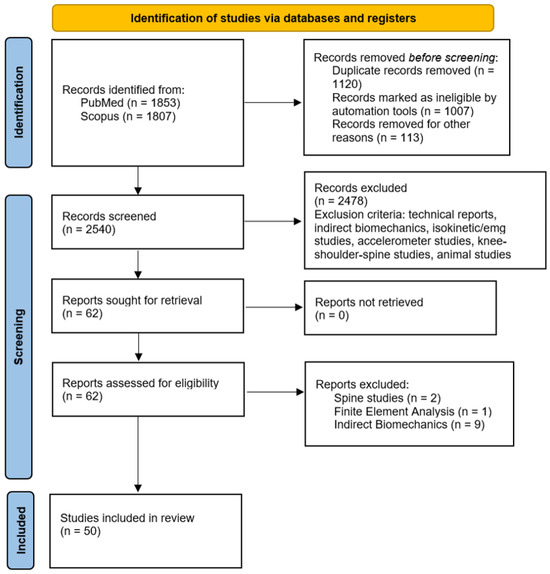
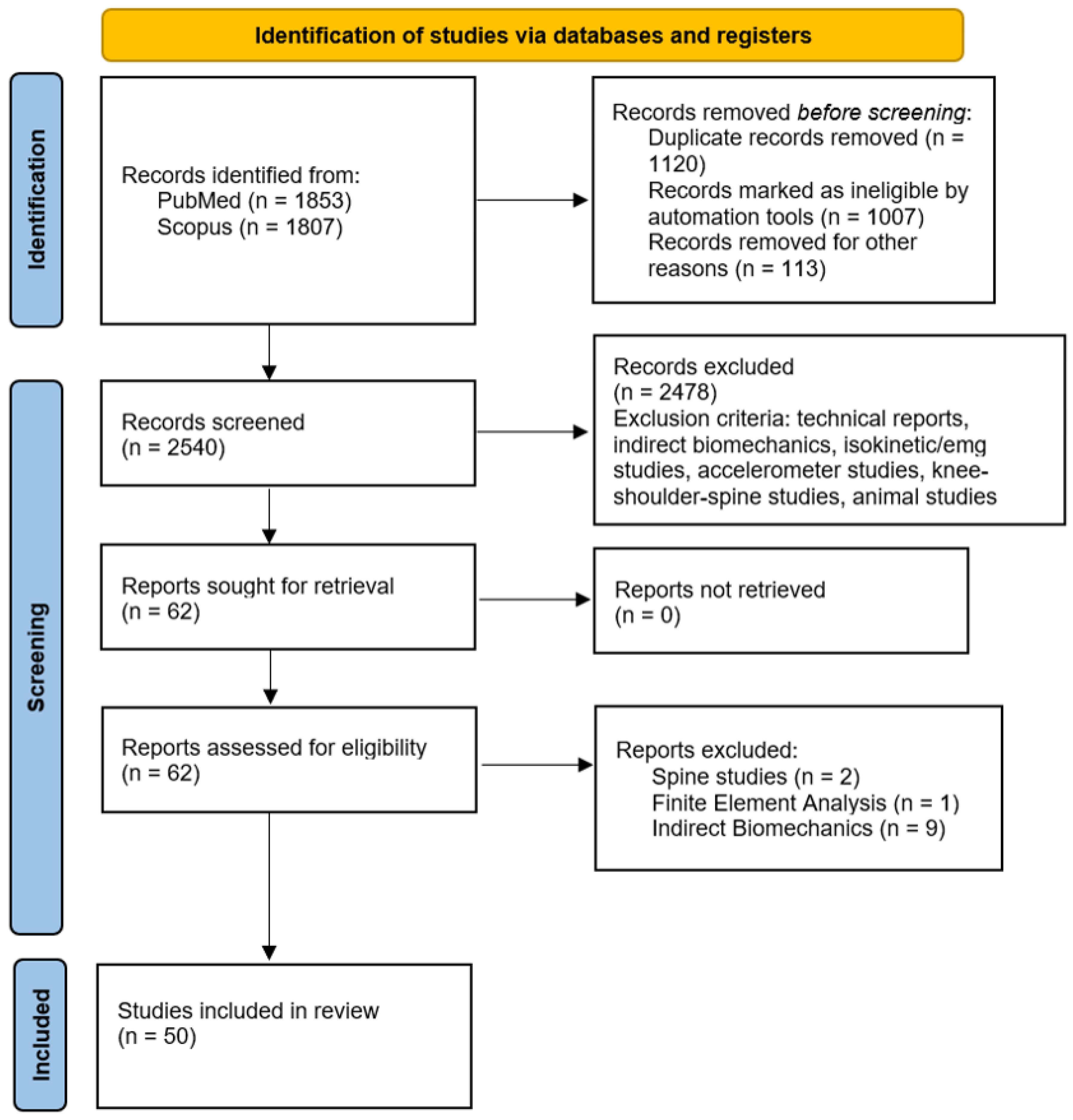
The initial search yielded 3660 records, including 1853 from PubMed and 1807 from Scopus. All records were imported into Rayyan for screening, where 1007 duplicates were automatically identified and removed. An additional 113 duplicates were removed manually, resulting in 2540 unique records for screening. Two reviewers (VG and IT) independently screened titles and abstracts for eligibility. Exclusion criteria were described above and included technical reports, indirect biomechanics, isokinetic/emg/accelerometer studies, and knee–shoulder–spine studies. This process excluded 2478 studies and resulted in 60 articles for full-text review. Following full-text assessment, 46 studies met the predefined inclusion criteria and were included in the final synthesis. After reviewing the reference list of each included paper, four additional papers eligible for inclusion were identified, reaching 50 papers for final analysis. Any disagreements between reviewers were resolved through discussion and consensus, with consultation of a third reviewer (SX) when necessary. The study selection process is presented in a PRISMA-ScR flow diagram (Figure 2).
Figure 2.
PRISMA-ScR flow diagram illustrating the study identification, screening, eligibility assessment, and inclusion process.
Early instrumented hip implant studies (pre-2000): feasibility and foundational observations.
Early investigations into in vivo hip biomechanics were characterized by rapid methodological evolution as researchers sought practical ways to measure loads within the joint. The earliest studies relied on wired or externally connected strain-gauge prostheses and pressure-instrumented hemiarthroplasties, which demonstrated proof of concept but were constrained by short recording duration, restricted patient mobility, and considerable technical complexity [6,24,25]. Subsequent case reports refined sensor placement and improved pressure mapping, enabling longer observation periods and more detailed characterization of loading patterns during activities such as gait, transfers, and rehabilitation exercises [26,27].
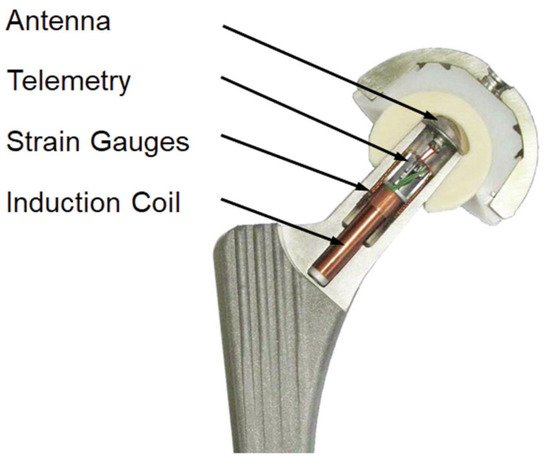
By the late 1980s and 1990s, technological advances—particularly from the Berlin group—shifted the field toward fully implantable telemetry systems capable of wireless data transmission and multi-channel force measurement [28,29]. Graichen and Bergmann described a fully implantable four-channel telemetry system capable of measuring three-dimensional joint forces using strain gauges embedded within a hermetically sealed prosthesis, enabling long-term in vivo measurements without percutaneous leads, with a new example depicted in Figure 3 [9]. These designs eliminated external wiring, allowed more natural patient movement, and enabled repeated measurements across a wider spectrum of activities, including higher-demand tasks and perturbation scenarios [28,29]. Investigations during this period also began to address specific biomechanical questions, such as the influence of gait phases (e.g., heel strike), instability events, and task-specific variations on joint loading [30]. By the mid-1990s, study designs became increasingly hypothesis-driven, moving beyond feasibility demonstrations toward detailed characterization of loading under controlled functional conditions. For example, investigations of stair ascent and descent employed instrumented implants with multi-channel telemetry combined with video synchronization to quantify joint forces, bending moments, and torsional loads, demonstrating that the direction and torque of loading may be critical determinants of implant fixation, rather than force magnitude alone [31]. Similarly, studies evaluating interventions such as ischial weight-bearing orthoses illustrated how telemetry could be used not only to measure loads but also to experimentally test therapeutic concepts, showing that orthotic designs reduced joint forces only modestly and highlighting the complexity of load redistribution in vivo [32]. Parallel studies examining load carriage combined modelling with telemetry measures to evaluate how external loads alter joint forces, illustrating early integration between direct experimental measurement with biomechanical modelling approaches [33].
Figure 3.
The latest generation of instrumented implants, the Hip III prothesis, capable of monitoring three moments and three force components utilizing nine channels. Other prostheses include temperature or pressure sensors in the shaft as well. Used from www.OrthoLoad.com with permission for non-commercial academic publication. Data © Julius Wolff Institute/OrthoLoad [34].
Clinical force measurements were reported in small cohorts. Kotzar et al. presented telemeterized force data from two patients following total hip arthroplasty, demonstrating peak loads of approximately 2.7 times body weight during gait and up to 5.5 times body weight during episodes of instability in single-leg stance [35]. Importantly, the authors noted that measured forces during activities of daily living were generally lower than those predicted by analytical biomechanical models, highlighting early discrepancies between computational estimates and direct measurements.
Several investigations during this period focused on contact pressures rather than resultant forces. Strickland and colleagues reported acetabular contact pressures during early rehabilitation in a pressure-instrumented hemiarthroplasty, demonstrating that isometric hip extension could generate higher pressures than normal gait and that clinical indicators such as pain or range of motion did not reliably reflect mechanical loading [36]. These findings challenged prevailing assumptions regarding the relative safety of commonly prescribed rehabilitation activities.
Studies from the Massachusetts General Hospital group further explored pressure distribution across functional tasks. McGibbon et al. measured acetabular pressures during cane-assisted and load-carrying walking over a two-year period in a single subject, demonstrating that carrying loads ipsilateral to the operated hip increased contact pressures and that contralateral cane use could reduce ipsilateral joint loading while increasing contralateral stresses [37]. Such observations provided early quantitative evidence of activity-dependent modulation of hip joint loading.
The relationship between direct measurements and biomechanical modelling was examined by Park et al., who combined pressure telemetry from instrumented hemiarthroplasty with motion analysis to investigate muscle co-contraction [38]. Their findings indicated that muscle co-contraction contributes substantially to hip joint loading and underscoring the limitations of indirect biomechanical estimation methods [38].
Early attempts to validate biomechanical modelling against in vivo measurements were also reported. Stansfield and colleagues examined the relationship between external gait parameters and internal hip loading, highlighting the challenges of accurately estimating joint forces from kinematics alone and reinforcing the importance of direct telemetry measurements for model validation [39].
Collectively, the pre-2000 literature provided the conceptual and technological foundation for modern instrumented implant research, establishing the critical role of direct in vivo measurement in advancing the understanding of hip biomechanics relevant to functional recovery and activity participation following THA.
Expansion of in vivo telemetry (2000–2010): clinically relevant loading patterns and validation of indirect methods.
During the early 2000s, research using instrumented hip implants transitioned from isolated feasibility reports to more systematic datasets that provided clinically meaningful insight into hip loading during everyday activities. Studies from the Berlin research group established reference values for hip contact forces measured in vivo, demonstrating peak loads of approximately 2–3 times body weight during level walking and slightly higher forces during stair negotiation, with considerable inter-individual variability [11]. These findings reinforced the central role of routine activities as the primary contributors to cumulative implant loading. Parallel work explored the relationship between measured forces and biomechanical modelling. Comparisons between patient-specific musculoskeletal simulations and telemetry data demonstrated reasonable agreement in overall loading patterns but also highlighted notable discrepancies, emphasizing that indirect methods should be interpreted cautiously when used to estimate joint loading [40]. Continued work on telemeterized implants during this period expanded the characterization of load patterns across a wider range of functional conditions and contributed to the development of standardized loading scenarios for implant testing and simulation, bridging early feasibility studies with later large telemetry datasets [41]. Furthermore, measurements during stumbling episodes revealed peak forces substantially exceeding those observed during normal gait, highlighting the potential biomechanical relevance of unexpected perturbations rather than routine activity alone [42]. Beyond force magnitude, this period also introduced measurements of implant temperature during prolonged activity, demonstrating modest increases during extended walking and suggesting that friction-related effects may vary depending on activity characteristics and bearing materials [43]. Although the clinical implications remain uncertain, these findings contributed to a deeper understanding of implant behaviour under sustained loading conditions.
Heller and colleagues further extended telemetry research by integrating instrumented implant measurements with subject-specific musculoskeletal modelling to characterize internal femoral loading during walking and stair climbing. Their results showed that axial compression represents the dominant loading component, whereas bending moments vary along the femoral shaft and are influenced by implant alignment [44]. This work represented an important step toward linking in vivo measurements with biomechanical modelling, advancing understanding of how surgical parameters influence functional loading following THA.
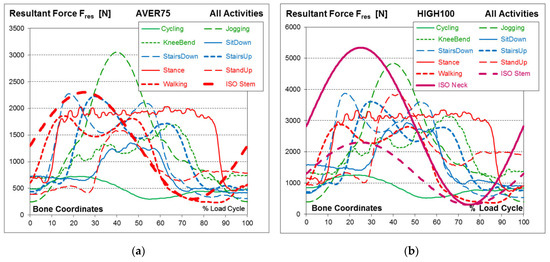
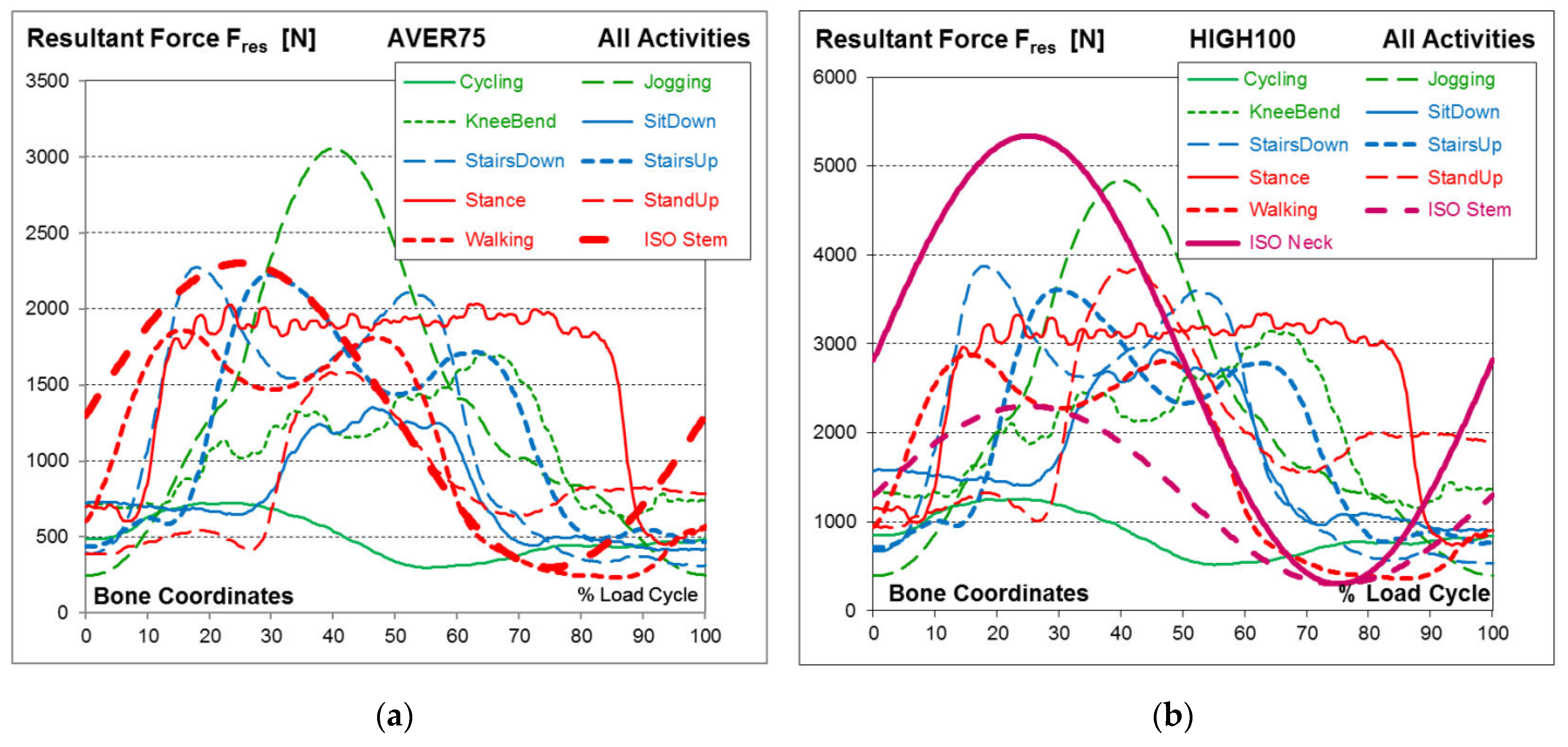
Collectively, studies from 2000 to 2010 provided the first robust clinical framework for interpreting in vivo hip joint loading. These investigations validated the general mechanical safety of routine activities while emphasizing considerable variability between patients and highlighting the potential importance of occasional high-load events (Figure 4). These findings from this period laid the groundwork for subsequent investigations exploring activity-specific loading patterns and their implications for postoperative counselling and return-to-play recommendations [45].
Figure 4.
Typical forces diagram acquired from instrumented-implant studies: (a) average forces in subjects with average bodies; (b) high forces in subjects with high body weight. The resultant forces during nine activities of daily living are compared to the ISO forces, defined for endurance test on the neck of hip implants. Used from www.OrthoLoad.com with permission for non-commercial academic publication. Data © Julius Wolff Institute/OrthoLoad [34,46].
Post-2010 evidence: clinically relevant in vivo loading patterns from instrumented hip implants.
3.1. Activities of Daily Living and “Reference” Loads
From 2010 onward, instrumented implant cohorts were increasingly used to move beyond the analysis of isolated activities and define clinically interpretable reference loading spectra for THA. In a standardized-load analysis of 10 subjects, Bergmann and colleagues quantified typical magnitudes and directions of hip contact forces during common and physically demanding activities of daily living, with the aim of supporting more realistic preclinical implant testing and improving interpretation of in vivo biomechanics, particularly in younger and more physically active THA populations [46]. Complementing this work, comparative analyses across instrumented implants demonstrated that level walking produces distinct load profiles across hip, knee, and spinal implants, reinforcing the need to interpret “activity safety” in joint-specific terms rather than extrapolating findings from one anatomic site to another [46].
3.2. Rehabilitation and Physiotherapy: Loads May Exceed Walking in Selected Tasks
A consistent and clinically relevant observation emerging from post-2010 telemetry studies is that some supervised rehabilitation exercises may can be mechanically demanding and occasionally approach or exceed the loads observed during walking. In a cohort of six patients, Schwachmeyer et al. quantified hip contact forces and moments across 13 common prescribed postoperative physiotherapy exercises including variations in pelvic lifting (bridging), hip abduction (isometric and active), isometric straight and flexed knee and pelvic tilt. Common weight-bearing exercises like the lifting pelvis utilizing only the operated limb generated the highest peaks (up to 441% body weight), exceeding walking loads by 166%. This suggests important information as many surgeons prescribe this exercise during the early post-operative period while not allowing for full-weight-bearing walking, while the activity is being performed during bed-pan use, attributed to the muscle co-contraction effect during unilateral limb exercises [47]. In contrast, long-lever-arm and dynamic exercises tended to produce loads approximately half those observed during walking loads but high torsional moments, while isometric exercises of the hip and knee demonstrated substantial variability depending on contraction intensity [48]. These findings are directly relevant for postoperative counselling, indicating that physiotherapy exercises cannot universally be considered low-loading activities, and that exercise selection and execution intensity significantly influence implant loading.
3.3. Forward-Bent Postures and Lifting: Hip Loads Rise with Flexion and Are Technique-Sensitive
While most telemetry studies focus on gait and sport activities, forward-bent posture such as stooping, lifting and common household or occupational tasks represent an important but often overlooked source of mechanical exposure. Using instrumented hip endoprosthesis data (and, in a parallel cohort, instrumented spinal implants), Damm et al. showed that hip resultant forces increase almost continuously with trunk inclination, with peak hip forces reported in a range of approximately 360–540% of body weight (BW) depending on task and posture [48]. Importantly, lifting technique redistributed loading between the hip and spine. Bent-knee lifting tended to reduce hip joint loads while slightly increasing spine loads, whereas straight-knee lifting tended to increase hip loads while decreasing spine loads, challenging simplified suggestions that techniques beneficial for the spine are necessarily beneficial for the hip joint [48].
3.4. Gait Style Modification: Do Kinematic Changes Equal Kinetic Changes?
Proximal mechanics are also sensitive to how an activity is executed, not only to the activity itself. Using instrumented THA data to validate musculoskeletal simulations, Angelini et al. tested different arm-swing amplitudes and arm positions during level walking and found that altering arm swing influenced upper-body and free-moment metrics but had minimal effect on hip joint reaction forces. This suggests that many gait “style” modifications may not meaningfully unload the hip despite visible kinematic changes [49]. In other words, not every “gait tweak” results in reduced hip loading. These findings support focusing clinical counselling on activity dose, intensity and task selection, rather than expecting arm-position strategies to substantially reduce hip forces.
3.5. Muscle Status and Early Postoperative Biomechanics
Beyond activity-related effects, studies examining periarticular muscle condition demonstrate that patient-specific factors significantly influence in vivo loading. Imaging-based analyses in patients with instrumented implants showed that early postoperative deterioration of hip abductor musculature was associated with higher joint contact forces during activities of daily living, suggesting that muscle integrity represents a key determinant of mechanical exposure after THA [50]. Another cohort study examined the relationship between muscle status and fatty degeneration of tensor fascia lata and gluteal muscles with joint loading over time, reporting increased joint loading associated with muscle atrophy and documenting postoperative changes in loading patterns. These findings support the clinical intuition that rehabilitation and recovery of muscle function are not only functional goals but also important biomechanical modifiers of implant loading [51]. Collectively, these findings provide mechanistic support for targeted rehabilitation strategies aiming at optimizing load distribution following THA.
3.6. Assistive Devices: Forearm Crutches Reduce Hip Loads Modestly—And Mainly Early
In vivo measurements during ambulation with forearm crutches showed only modest average reductions in hip joint loading compared with walking without crutches. Across seven patients, peak hip contact force decreased by approximately ~12–17% depending on gait pattern used (3-, 4-, or 2-point gait), with similar modest reductions in bending moment and torsion [52]. Notably, reductions great than >20% were primarily observed during the first four postoperative weeks, with declining crutch force use over time. Thes observations support the clinical interpretation that crutches may not substantially unload the hip beyond the early recovery phase, and that patient technique and adherence play an important role in determining their effectiveness [52].
3.7. Footwear as a Modifiable Factor Influencing Hip Loading During Walking
Using instrumented total hip prostheses, Palmowski et al. showed that shoe type can influence in vivo hip joint loading during walking [53]. Compared with barefoot walking, most conventional footwear increased resultant contact forces and bending moments at heel strike, with the largest increases observed in everyday and dress-type shoes. In contrast, a minimalist “barefoot shoe” showed lower peak values on hip joint loading [54]. Torsional loads were also higher with several shoe types of footwear, especially stiffed sole and men’s shoes, suggesting that footwear selection may alter mechanical demands at the implant–bone interface even during routine gait, with barefoot shoes again showing minimal values [53]. These findings indicate that footwear represents a simple and potentially modifiable factor influencing hip loading after THA, lubrication film, implant stability and bearing surface wear.
3.8. Friction and Cup Stability: Sustained Loading and Specific Activities Increase Risk-Relevant Moments
A major maturation of the field after 2010 was the shift from focusing solely on force magnitude to examining friction-related moments, which are clinically relevant to acetabular fixation and loosening mechanisms. Direct in vivo measurements during walking demonstrated peak contact forces of approximately 248% of bodyweight and measurable friction moments. Importantly, friction metrics varied substantially between individuals and across phases of gait cycle, emphasizing that patient-specific factors and lubrication state may influence implant-related risk [54]. Another study presenting longitudinal measurements between 3 and 12 months postoperatively showed that friction-related parameters can change over time even when resultant contact forces remain relatively stable, supporting the concept that implant “run-in” phenomena and postoperative recovery may modify tribological behaviour [55]. Clinically, one of the most important observations is that friction moments can increase sharply under specific conditions. After a short rest, initiation of walking was associated with markedly higher friction moments in the first step with increases of approximately 32% to 143% on average, with individual peaks up to 621%, despite no increase in contact force. This finding suggests a lubrication-dependent mechanism rather than purely force dependence phenomenon [56].
3.9. Activity-Specific Loading Relevant to Rehabilitation and Return to Activity
At the same time, other research groups have focused on activity-specific loading patterns relevant to rehabilitation and return to activity decisions. In a large activity screening study including more than 1400 activities and approximately 33,000 measurements across nine subjects, numerous activities generated friction moments at or above a proposed “critical” threshold for cup fixation stability [57]. The highest peaks were reported during tasks characterized by sustained high loading with limited joint motion such as prolonged or unstable one-legged stance variations, stretching exercises, whole-body vibration training, running after stance and breaststroke swimming [57]. Direct measurements during cycling demonstrated that hip joint loads increase approximately linearly with power output and are influenced by cadence and saddle height, providing quantitative guidance for exercise prescription following THA, with 60 rates per minute and high saddle heigh providing the lowest joint loads [58]. Comparative analyses across hip, knee, and spinal implants further contextualized hip loading within whole-body biomechanics and reinforced walking as a key reference activity for interpreting mechanical exposure [59]. Investigations of tensor fascia latae and gluteal muscle status also demonstrated that periarticular muscle atrophy is associated with increased joint loading both in the early postoperative period and long term, underscoring the importance of neuromuscular recovery in modulating mechanical demand [51].
Collectively, these findings are directly relevant to RTP counselling, as they indicate that risk-relevant mechanical exposure may arise from sustained or constrained-loading tasks rather than solely from high-impact sport.
3.10. Water- and Swim-Based Activity: Generally Lower Forces than Land, but Not Uniformly “Low Load”
Aquatic therapy is commonly recommended after THA. However, in vivo telemetry data demonstrate that loading in water depends strongly on the type and the intensity of the activity performed. In instrumented hip and knee implant recipients (including six hip patients), aquatic exercises (categorized in non-weight bearing, weight bearing and dynamic) produced hip joint forces ranging approximately 32% to 396% of body weight, with meaningful reductions of 36–55% compared with equivalent land-based activities for many weight bearing and dynamic movements. However, drag-intensive non-weight-bearing movements performed as higher velocities or resistive fins substantially increased joint forces compared to land base equivalents [60]. For swimming specifically, in vivo measurements showed median maximal hip forces during breaststroke swimming in the range of approximately 157% to 193% body weight, increasing with swimming speed. Crawl kick produced higher hip forces and moments than breaststroke kicking, indicating that swimming technique significantly influences joint loading [61]. Clinically, these data support recommending water-based exercise as a load-modulatable rehabilitation modality, suitable for graded progression toward RTP when technique and intensity are appropriately controlled.
3.11. Nordic Walking (Structured, Coachable): Loads ≈ Ordinary Walking
In vivo telemetry suggests Nordic walking can generally be considered biomechanically comparable to ordinary walking, rather than representing a substantially higher-load activity. In six instrumented-THA patients, hip joint loads during Nordic walking showed the typical double-peak pattern and were comparable to ordinary walking under both level and incline conditions [62]. Technique influenced certain aspects of the loading pattern. Double-poling slightly reduced resultant force and bending moment during contralateral heel strike, whereas the diagonal technique could increase the second peak during uphill walking. However, the absolute peak force remained similar to that observed during ordinary walking [62].
3.12. Manual Handling and Lifting Mechanics
Instrumented implant analyses of standardized lifting tasks provide valuable insight into loading during activities relevant to occupational return. In telemetric measurements of a 10 kg lifting task, different lifting techniques (e.g., stoop versus squat) resulted in similar magnitudes of hip contact force but altered the direction of the resultant force vector, indicating that technique influences load orientation rather than overall magnitude [63]. This observation suggests that mechanical risk during lifting may relate not only to force magnitude but also to the direction of the resultant vector and associated joint moments, underscoring the complexity of translating generic ergonomic lifting advice into implant-specific recommendations [64]. Using instrumented implants measuring hip, knee, and spinal loads during stoop and squat lifting, Brandl et al. evaluated whether commonly used ergonomic risk assessment tools (OWAS and REBA) accurately reflect actual joint loading. Hip contact forces reached approximately three times body weight during lifting, with higher torsional moments observed particularly during squat techniques [64]. While OWAS and REBA action levels were able to distinguish between different loading conditions, similar risk categories did not correspond to equivalent in vivo loads, indicating that observational ergonomic scores only partially reflect true mechanical exposure [64]. These findings suggest that lifting technique influences hip loading characteristics and highlight the limitations of relying solely on observational risk tools to infer joint mechanics after THA.
3.13. Gym-Machine Training: Mostly ≤ Walking, Except Ipsilateral Single-Leg Rope-Pull Variants
The first telemetry study to quantify hip loads across common gym machines (leg curl, leg extension, leg press, rope pull) found that, across 23 load conditions in 7 patients measured approximately 17 months after THA, most configurations produced lower or similar resultant forces and moments compared with treadmill walking at 4 km/h (median walking peaks ~303% BW) [65]. A consistent exception was rope-pull exercises performed in ipsilateral monopod stance, which tended to increase resultant force and bending moment, supporting a pragmatic rehabilitation message: machines can be “low-impact”, but single-leg or ipsilateral stance variants require supervision and careful dose control [65]. Complementing the gym-machine data, in vivo telemetry has also been applied to gymnastics and aerobics-type exercises, providing direct evidence for a class of RTP-relevant “fitness” activities that are commonly performed but historically evaluated using indirect assumptions [66]. Gym based classes may therefore be appropriate for later-phase conditioning, although single-leg stretching tasks, higher-tension resistance bands, and step-board aerobics may require phase-specific restriction and careful technique supervision.
3.14. Whole-Body Vibration (WBV): Forces Remain Well Below Walking Despite Variable Damping
WBV training has also been benchmarked against walking using instrumented hip implants. Across different standing positions and vibration platforms, total hip contact forces during WBV consistently remained below walking peaks, reported as less than approximately 79% of walking forces [67]. At the same time, vibration-induced dynamic force components demonstrated substantial high inter-individual variability and strong damping between the knee and hip joints, indicating that platform cannot reliably be used as a proxy for internal hip loading [67]. Overall, WBV appears to represent relatively low mechanically exposure compared to walking from a hip-load perspective, although dosing cannot be inferred reliably from platform settings alone.
3.15. Sport-Relevant Tasks: Simulator Evidence for Cross-Country Skiing Suggests Loads near Walking—Except in Unilateral Phases
Telemetry has begun to address sport-specific loading more directly. In a simulator study of cross-country skiing techniques, peak loads were generally comparable to or lower than those observed during walking, although technique-dependent differences were identified. Diagonal poling with foot lift produced a median peak resultant force of approximately 315% body weight, whereas other variants ranged broadly but typically remained within a “walking-adjacent” envelope [68]. Bending moments during diagonal techniques could slightly exceed walking values, and occasional outliers were observed [68]. The authors’ clinical interpretation was pragmatic: double or diagonal poling techniques may be acceptable in later stages of rehabilitation, whereas prolonged unilateral standing phases should be minimized, particularly in less experienced patients, and recommendations should account for patient experience and bone quality [68].
3.16. Patient Factors and Expectations: Younger Working-Age Patients Demonstrate Higher Loads in Recommended Activities
A clinically oriented analysis explicitly linked patient expectations and age category to measured loading. In “working age” (<60 years) versus “retirement age” (>60 years) THA patients, recommended activities generated higher hip contact loads in the working-age group. Furthermore, certain activities—including those perceived as “low risk”—produced substantial forces and torques. The authors cautioned that increasing expectations for rapid return to work and sport may expose implants to higher loads than commonly assumed, emphasizing the need for structured counselling toward lower-impact activity profiles when appropriate [69].
3.17. Indirect Prediction and Planning: External Measures as Proxies for In Vivo Loading
Several studies addressed the translational challenge of estimating in vivo joint loading in the absence of implant telemetry. A direct comparison of radiograph-based biomechanical models with instrumented implant measurements found that some simplified models approximate the magnitude of the resultant hip force reasonably well, whereas estimates of force orientation were highly variable and appeared more dependent on model assumptions than on patient-specific factors [70]. More recently, a gait-focused analysis in eight patients with instrumented THA implants demonstrated that ground reaction forces (GRFs) time-series data—alone or combined with external hip moments and lean muscle volume—can be used to predict certain aspects of in vivo hip contact force impulse during gait. These findings support the potential use of clinically accessible proxies for estimating implant loading, while telemetry remains the benchmark for validation [71].
Further studies evaluating whether GRFs and external joint moments can predict in vivo hip contact forces demonstrated that external measures alone are insufficient, but predictive value may improve when combined with muscle metrics or joint moment data, illustrating progress toward noninvasive monitoring strategies [72]. Together, these contemporary investigations reflect a broader shift toward integrating direct measurements with biomechanical modelling, rehabilitation science, and clinical decision-making, advancing understanding of how activity patterns, patient characteristics, and implant mechanics interact in the modern THA population.
3.18. Thermal Environment and Implant Orientation
Beyond pure mechanical measurements, combined in vivo and in silico investigations have evaluated determinants of friction-related temperature increases within hip implants. In a large retrospective dataset comprising approximately 38,000 activity trials from 10 subjects with instrumented THA implants, cup orientation was associated with joint kinematics and friction-related temperature increases. Interestingly, temperature changes were not primarily explained by contact-force magnitude alone, suggesting that tribological risk may be more sensitive to lubrication conditions and kinematics than to peak force levels [15]. Additional analyses of in vivo loading further emphasized the interaction between joint mechanics and implant tribology, demonstrating that variations in loading conditions and activity patterns influence frictional behaviour and mechanical environment of the implant. These findings reinforce the concept that mechanical exposure of the hip joint after THA cannot be adequately characterized by peak force magnitude alone [15].
4. Discussion
4.1. What Instrumented Hip Implants Add to the RTP Debate
The present scoping review demonstrates that instrumented hip implants shift the discussion around return to play (RTP) after THA from one largely based on expert opinion to one grounded in direct in vivo biomechanical evidence. Instrumented hip implants uniquely address this gap by providing in vivo measurements of joint contact forces, moments, frictional behaviour, and activity-dependent loading patterns, enabling RTP guidance to be grounded in measured mechanical exposure rather than in assumptions derived solely from perceived impact alone [11]. Across decades of telemetry research, a consistent observation emerges: routine activities such as walking provide a reproducible reference envelope for hip joint loading, typically in the range of approximately two to three times body weight, albeit with substantial inter-individual variability [11]. Activity monitoring studies demonstrated that patients spend the majority of their time performing low-load activities such as sitting and standing, while walking contributes the largest proportion of cyclic mechanical loading experienced by the implant, providing more realistic assumptions regarding implant use in daily life [73]. This reference frame is clinically meaningful because many activities traditionally considered “safe” including cycling, aquatic exercise, Nordic walking, and several gym-based exercises, frequently fall within or near this envelope when performed in a controlled manner [58,60,62,65]. However, telemetry also reveals that mechanical exposure cannot be inferred solely from activity labels. Certain rehabilitation exercises, lifting tasks, and sustained postures may produce loads equal to or exceeding those encountered during walking [47,48,64]. Thus, instrumented implant studies demonstrate that “low impact” activities necessary correspond to low mechanical exposure is not always valid.
4.2. Reframing Mechanical Risk: Beyond Peak Force
A central insight from instrumented implant research is that mechanical risk cannot be inferred solely from peak contact force magnitude. Frictional moments at the acetabular interface—particularly during sustained loading, constrained positions, or initiation of movement after rest—may be more relevant to fixation and tribological behaviour than force magnitude alone [15,54,55,56,57]. Activities such as prolonged single-leg stance, stretching, or certain swimming patterns can generate friction moments approaching proposed critical thresholds despite only moderate joint contact forces [57]. Similarly, load direction and torsional components vary with technique, as demonstrated in lifting and manual handling tasks, where similar force magnitudes were accompanied by different vector orientations and joint moments [63,64]. These findings suggest that RTP counselling should consider not only which activities are undertaken but also how they are executed.
4.3. Rehabilitation and Patient Factors as Major Determinants
Telemetry evidence highlights that postoperative rehabilitation is a major determinant of joint loading. Weight-bearing physiotherapy exercises can produce loads exceeding walking, and muscle impairment—particularly gluteal or abductor insufficiency—has been associated with increased joint contact forces early after THA [47,50,51]. These observations reinforce the importance of targeted strengthening and neuromuscular rehabilitation as key biomechanical modifiers of joint loading, rather than viewing rehabilitation solely as a means to restore functional performance. Unexpected perturbations, such as stumbling, generate some of the highest recorded forces, emphasizing the role of balance training and fall prevention strategies when evaluating RTP readiness [42]. Moreover, younger or highly active patients may expose implants to higher even loads during recommended activities, underscoring the need for individualized RTP counselling [69].
4.4. Modifiable Factors Influencing Loading
Several modifiable factors influence hip loading during everyday activities. Forward trunk inclination substantially increases joint forces, while lifting technique redistributes loads between the hip and spine [48]. Footwear can alter loading at heel strike, with certain shoe types increasing joint forces and moments compared with barefoot walking [53]. Assistive devices such as crutches provide only modest mechanical unloading beyond early postoperative period, highlighting the importance of patient technique and adherence when such devices are prescribed [52]. Collectively, these findings suggest that RTP guidance should incorporate practical advice regarding posture, equipment, and movement technique in addition to activity selection.
4.5. Role and Limitations of Indirect Biomechanical Approaches
While musculoskeletal modelling and gait-analysis can approximate loading magnitude, these methods remain sensitive to assumptions and may not accurately capture force orientation or frictional behaviour or individual muscle activation patterns [70,71,72]. Telemetry therefore remains the reference standard for understanding true joint mechanics, although integration with modelling approaches offers a promising pathway toward more scalable and clinically applicable tools estimating implant loading. How telemetry evidence informs the RTP algorithm
- (1)
- Risk stratification
Higher caution is warranted in patients with:
- Abductor weakness or muscle atrophy [50,51]
- Balance deficits (stumbling) or fall risk [42]
- High activity expectations or rapid escalation of mechanical load [69]
- (2)
- Use walking as reference exposure
Progress activities relative to the joint load observed during walking (~2–3× BW), which serves as a clinically meaningful reference for mechanical exposure [11]. Certain everyday activities traditionally considered safe, like unilateral pelvic lifting (bridges) for bed-pan use, should be treated with caution as they could cause excessive loads during the early post-op phase [69].
- (3)
- Progress by mechanical principles
- Prioritize restoration of strength, motor control, and balance before returning to sport-specific activity [42,49,50]
- Introduce load-modulatable activities such as cycling, aquatic exercise, Nordic walking, gym machines [58,60,62,65]
- Avoid prolonged static loading and constrained positions during early rehabilitation [57]
- Carefully monitor modifiable factors and technique during lifting and resistance training exercises [48,65]
- (4)
- Categorize activities based on mechanical phenotype
- Early phase: load-modulatable cyclic activities: Activities with controllable intensity and loads ≤ walking should be prioritized, such as cycling, aquatic exercise, Nordic walking, and most gym-machine exercises [58,60,62,65].
- Intermediate phase: walking-adjacent activities: Activities producing loads comparable to walking can be introduced once baseline tolerance is achieved, including selected aerobics, skiing-type movements, and structured conditioning exercises [66,68]
- Advanced phase: technique- and torsion-sensitive activities: Activities involving trunk flexion, lifting, unilateral stance, or altered mechanics should be introduced cautiously, as they modify load direction, torsion, and magnitude rather than simply increasing peak force [48,63,64].
- High-risk scenarios (delayed or restricted): Activities associated with perturbations, start-stop loading, or sustained static loading should be delayed or selectively restricted, as they generate extreme forces or frictional moments [42,56,57]
- (5)
- Individualize final RTP decision: Final RTP clearance should integrate patient-specific factors, activity mechanics, and functional recovery rather than relying solely on traditional sport classifications. RTP after THA should be guided by walking-referenced mechanical exposure, progressed through load-modulatable activities, and individualized based on patient factors, technique, and activity-specific loading characteristics [18,46,69].
4.6. Why Controversy Persists
Despite decades of telemetry research, definitive sport-specific recommendations remain limited by small cohorts, heterogeneous implant designs, and incomplete coverage of high-demand athletic activities. Furthermore, risk mechanisms appear multifactorial, encompassing load magnitude, frictional behaviour, cumulative exposure, and patient specific factors. Importantly, biomechanical parameters measured using instrumented implants have not yet been directly correlated with clinical outcomes, such as implant survivorship, loosening, wear, or revision rates [15,57]. This complexity explains the persistent variation in clinical practice and supports shared decision-making rather than rigid activity prohibitions.
4.7. Clinical Implications
Instrumented implant evidence supports a shift from prescriptive activity bans toward individualized load management strategies. RTP after THA should be viewed as a continuum that emphasizes high-quality rehabilitation, gradual exposure to mechanical load, and patient education regarding modifiable risk factors. Importantly, many recreational activities appear biomechanically acceptable when performed with appropriate technique and gradual progression, whereas less recognized exposures—such as demanding rehabilitation tasks or sustained postures—may represent overlooked sources of mechanical stress.
Limitations
This review is limited by the small, highly selected cohorts implanted with specialized research prostheses, which may restrict generalizability to broader THA populations. Unfortunately, we managed to access only two databases; however, reference chasing ensured that we have included all relevant studies. Substantial heterogeneity in implant design and measurement techniques exists during the early studies; later studies, however, by the Bergman group, are standardized. Activity protocols also show great heterogenicity precluding quantitative synthesis. Most studies evaluated controlled tasks rather than unrestricted sport participation, and high-demand activities remain underrepresented in the telemetry literature. Finally, telemetry quantifies mechanical exposure but does not define clinical failure thresholds, and long-term cumulative loading data are limited.
5. Conclusions
Across the available evidence, joint loading is highly activity- and patient-specific, with many recreational activities falling within the safe range of daily functional loading. At the same time, telemetry demonstrates that the mechanical environment is influenced by factors beyond peak force, including frictional behaviour, load direction, and neuromuscular status. Our findings suggest that routine walking serves as a reproducible reference loading envelope, revealing that many load-modulatable sports fall within this range, while certain supervised rehabilitation exercises and forward-bent postures frequently exceed it. Future research should expand in vivo telemetry datasets across a broader spectrum of sports and functional tasks, study how parameters can influence the mechanical environment within a certain task and integrate telemetry with biomechanical modelling in order to refine evidence-based RTP guidance for physically active patients after THA.
Author Contributions
Conceptualization: V.G.; methodology: I.T. and K.K.; writing—original draft: V.G., P.A. and M.K.; writing—review and editing: V.G., S.A.X., C.T., N.I.L. and R.G.; supervision: A.P., project administration: V.G.; investigation: V.G., I.T., P.A. and M.K.; formal analysis: V.G., K.K. and I.T. All authors have read and agreed to the published version of the manuscript.
Funding
This research received no external funding.
Institutional Review Board Statement
Not applicable.
Informed Consent Statement
Not applicable.
Data Availability Statement
No new data were created during this scoping review. Data sharing is not applicable.
Acknowledgments
Vasileios Giannatos would like to acknowledge the support and academic influence of the JEO–ESSKA Research Fellowship. Special thanks are extended to Laura De Girolamo for her mentorship, which significantly contributed to the development of critical research skills, the expansion of academic perspectives, and the conception of the author’s first scoping review.
Conflicts of Interest
The authors declare no conflicts of interest.
Abbreviations
| RTP | Return to play |
| THA | Total hip arthroplasty |
| RTS | Return to sport |
| TKA | Total knee arthroplasty |
| OSF | Open science framework |
| PRISMA-ScR | Preferred Reporting Items for Systematic Reviews and Meta-Analyses Extension for Scoping Reviews |
| PCC | Population–Concept–Context |
| BW | Body weight |
| WBV | Whole-body vibration |
Appendix A
Table A1.
Preferred Reporting Items for Systematic reviews and Meta-Analyses extension for Scoping Reviews (PRISMA-ScR) checklist.
Appendix B
The PubMed advanced search query was:
(“Arthroplasty, Replacement, Hip”[Mesh] OR “Hip Prosthesis”[Mesh] OR “total hip replacement”[Text Word] OR “total hip arthroplasty”[Text Word] OR “hip implant*”[Text Word] OR “hip prosthes*”[Text Word] OR “THA”[Text Word] OR “THR”[Text Word]) AND ((“in vivo”[Text Word] AND (“load*”[Text Word] OR “force*”[Text Word] OR “moment*”[Text Word] OR “friction”[Text Word] OR “pressure”[Text Word] OR “temperature”[Text Word] OR “measure*”[Text Word])) OR “contact force*”[Text Word] OR “joint load*”[Text Word] OR “instrumented”[TextWord] OR “telemetry”[Text Word] OR “telemetric”[Text Word] OR “telemeterized”[Text Word] OR “orthoload”[Text Word] OR “smart implant*”[Text Word] OR “sensor”[Text Word]).
The Scopus search query was adapted as follows: TITLE-ABS-KEY ((“total hip replacement” OR “total hip arthroplasty” OR “hip prosthesis” OR “hip implant*” OR “THA” OR “THR”) AND ((“in vivo” AND (load* OR force* OR moment* OR measure* OR friction OR temperature)) OR “contact force*” OR “joint load*” OR “instrumented implant*” OR “instrumented prosthes*” OR “telemetr*” OR “orthoload”)).
Appendix C
Table A2.
Data extraction from the included 50 studies. Abbreviations included BW: body weight, RTP: return to play, ADL: activities of daily life, and THA: total hip arthroplasty. Numerical outcomes for the corresponding activity are presented as percentage of the body weight where available, as it is commonly used as a reference point.
References
- Hoorntje, A.; Janssen, K.Y.; Bolder, S.B.T.; Koenraadt, K.L.M.; Daams, J.G.; Blankevoort, L.; Kerkhoffs, G.; Kuijer, P. The Effect of Total Hip Arthroplasty on Sports and Work Participation: A Systematic Review and Meta-Analysis. Sports Med. 2018, 48, 1695–1726. [Google Scholar] [CrossRef] [Scilit]
- Ledet, E.H.; Liddle, B.; Kradinova, K.; Harper, S. Smart implants in orthopedic surgery, improving patient outcomes: A review. Innov. Entrep. Health 2018, 5, 41–51. [Google Scholar] [CrossRef] [Scilit]
- Houcke, J.V.; Khanduja, V.; Pattyn, C.; Audenaert, E. The History of Biomechanics in Total Hip Arthroplasty. Indian J. Orthop. 2017, 51, 359–367. [Google Scholar] [CrossRef] [Scilit]
- Koch, J.C. The laws of bone architecture. Am. J. Anat. 1917, 21, 177–298. [Google Scholar] [CrossRef] [Scilit]
- Crowninshield, R.D.; Brand, R.A. A physiologically based criterion of muscle force prediction in locomotion. J. Biomech. 1981, 14, 793–801. [Google Scholar] [CrossRef] [Scilit] [PubMed]
- Rydell, N.W. Forces acting on the femoral head-prosthesis. A study on strain gauge supplied prostheses in living persons. Acta Orthop. Scand. 1966, 37, 81–132. [Google Scholar] [CrossRef] [Scilit]
- Carlson, C.E. A proposed method for measuring pressures on the human hip joint. Exp. Mech. 1971, 11, 499–506. [Google Scholar] [CrossRef] [Scilit]
- Bergmann, G.; Graichen, F.; Siraky, J.; Jendrzynski, H.; Rohlmann, A. Multichannel strain gauge telemetry for orthopaedic implants. J. Biomech. 1988, 21, 169–176. [Google Scholar] [CrossRef] [Scilit] [PubMed]
- Graichen, F.; Bergmann, G. Four-channel telemetry system for in vivo measurement of hip joint forces. J. Biomed. Eng. 1991, 13, 370–374. [Google Scholar] [CrossRef] [Scilit]
- Graichen, F.; Bergmann, G.; Rohlmann, A. Hip endoprosthesis for in vivo measurement of joint force and temperature. J. Biomech. 1999, 32, 1113–1117. [Google Scholar] [CrossRef] [Scilit]
- Bergmann, G.; Deuretzbacher, G.; Heller, M.; Graichen, F.; Rohlmann, A.; Strauss, J.; Duda, G.N. Hip contact forces and gait patterns from routine activities. J. Biomech. 2001, 34, 859–871. [Google Scholar] [CrossRef] [Scilit]
- Damm, P.; Graichen, F.; Rohlmann, A.; Bender, A.; Bergmann, G. Total hip joint prosthesis for in vivo measurement of forces and moments. Med. Eng. Phys. 2010, 32, 95–100. [Google Scholar] [CrossRef] [Scilit] [PubMed]
- Bergmann, G.; Graichen, F.; Dymke, J.; Rohlmann, A.; Duda, G.N.; Damm, P. High-tech hip implant for wireless temperature measurements in vivo. PLoS ONE 2012, 7, e43489. [Google Scholar] [CrossRef] [Scilit] [PubMed]
- Heilemann, M.; Wendler, T.; Münst, P.; Schleifenbaum, S.; Scholz, R.; Voigt, C. A novel micromotion measurement method to gain instructive insight into the acetabular bone-implant interface. Med. Eng. Phys. 2020, 86, 138–145. [Google Scholar] [CrossRef] [Scilit]
- Damm, P.; Bender, A.; Waldheim, V.; Winkler, T.; Duda, G.N. Surgical cup placement affects the heating up of total joint hip replacements. Sci. Rep. 2021, 11, 15851. [Google Scholar] [CrossRef] [Scilit]
- Bergmann, G.; Gandini, R.; Ruder, H. Averaging of strongly varying signals. Biomed. Tech. 2001, 46, 168–171. [Google Scholar] [CrossRef] [Scilit]
- Krismer, M. Sports activities after total hip arthroplasty. EFORT Open Rev. 2017, 2, 189–194. [Google Scholar] [CrossRef] [Scilit]
- Fortier, L.M.; Rockov, Z.A.; Chen, A.F.; Rajaee, S.S. Activity Recommendations After Total Hip and Total Knee Arthroplasty. J. Bone Jt. Surg. Am. 2021, 103, 446–455. [Google Scholar] [CrossRef] [Scilit]
- Swanson, E.A.; Schmalzried, T.P.; Dorey, F.J. Activity recommendations after total hip and knee arthroplasty: A survey of the American Association for Hip and Knee Surgeons. J. Arthroplast. 2009, 24, 120–126. [Google Scholar] [CrossRef] [Scilit]
- Maharaj, Z.; Cakic, J.N.; Pietrzak, J.R.T. Return to Sports After Total Hip Arthroplasty: Keep your (Femoral) Head in the Game—A Narrative Review. Sports Orthop. Traumatol. 2021, 37, 51–58. [Google Scholar] [CrossRef] [Scilit]
- Lin, Y.J.; Terner, B.; Piergrossi, D.; Rozell, J.; Schwarzkopf, R.; Arshi, A. Return to Sports After Total Hip Arthroplasty: Patterns of Participation and Sport-Specific Outcomes. J. Arthroplast. 2025; in press. [CrossRef] [Scilit] [PubMed]
- Wakale, S.; Goswami, T. Investigating Smart Knee Implants. Designs 2025, 9, 93. [Google Scholar] [CrossRef] [Scilit]
- Giannatos, V.; Xergia, S.; Tatani, I.; Panagopoulos, A.; Antzoulas, P.; Kroustalakis, M. Direct In Vivo Biomechanics After Total Hip Arthroplasty Using Instrumented Implants: A Scoping Review. Available online: https://osf.io/u4jh5 (accessed on 6 January 2026).
- Hodge, W.A.; Carlson, K.L.; Fijan, R.S.; Burgess, R.G.; Riley, P.O.; Harris, W.H.; Mann, R.W. Contact pressures from an instrumented hip endoprosthesis. J. Bone Jt. Surg. Am. 1989, 71, 1378–1386. [Google Scholar] [CrossRef] [Scilit]
- English, T.A.; Kilvington, M. In vivo records of hip loads using a femoral implant with telemetric output (A preliminary report). J. Biomed. Eng. 1979, 1, 111–115. [Google Scholar] [CrossRef] [Scilit]
- Davy, D.T.; Kotzar, G.M.; Brown, R.H.; Heiple, K.G.; Goldberg, V.M.; Heiple, K.G., Jr.; Berilla, J.; Burstein, A.H. Telemetric force measurements across the hip after total arthroplasty. J. Bone Jt. Surg. Am. 1988, 70, 45–50. [Google Scholar] [CrossRef] [Scilit]
- Givens-Heiss, D.L.; Krebs, D.E.; Riley, P.O.; Strickland, E.M.; Fares, M.; Hodge, W.A.; Mann, R.W. In vivo acetabular contact pressures during rehabilitation, Part II: Postacute phase. Phys. Ther. 1992, 72, 700–705; discussion 706–710. [Google Scholar] [CrossRef] [Scilit]
- Bergmann, G.; Rohlmann, A.; Graichen, F. In vivo measurement of hip joint stress. 1. Physical therapy. Z. Orthop. Ihre Grenzgeb. 1989, 127, 672–679. [Google Scholar] [CrossRef] [Scilit]
- Bergmann, G.; Graichen, F.; Rohlmann, A. Hip joint loading during walking and running, measured in two patients. J. Biomech. 1993, 26, 969–990. [Google Scholar] [CrossRef] [Scilit]
- Bergmann, G.; Kniggendorf, H.; Graichen, F.; Rohlmann, A. Influence of shoes and heel strike on the loading of the hip joint. J. Biomech. 1995, 28, 817–827. [Google Scholar] [CrossRef] [Scilit]
- Bergmann, G.; Graichen, F.; Rohlmann, A. Is staircase walking a risk for the fixation of hip implants? J. Biomech. 1995, 28, 535–553. [Google Scholar] [CrossRef] [Scilit] [PubMed]
- Bergmann, G.; Correa da Silva, M.; Neff, G.; Rohlmann, A.; Graichen, F. Evaluation of ischial weight-bearing orthoses, based on in-vivo hip joint force measurements. Clin. Biomech. 1994, 9, 225–234. [Google Scholar] [CrossRef] [Scilit]
- Bergmann, G.; Graichen, F.; Rohlmann, A.; Linke, H. Hip joint forces during load carrying. Clin. Orthop. Relat. Res. 1997, 355, 190–201. [Google Scholar] [CrossRef] [Scilit]
- OrthoLoad. Available online: http://www.OrthoLoad.com (accessed on 1 February 2026).
- Kotzar, G.M.; Davy, D.T.; Goldberg, V.M.; Heiple, K.G.; Berilla, J.; Heiple, K.G., Jr.; Brown, R.H.; Burstein, A.H. Telemeterized in vivo hip joint force data: A report on two patients after total hip surgery. J. Orthop. Res. 1991, 9, 621–633. [Google Scholar] [CrossRef] [Scilit]
- Strickland, E.M.; Fares, M.; Krebs, D.E.; Riley, P.O.; Givens-Heiss, D.L.; Hodge, W.A.; Mann, R.W. In vivo acetabular contact pressures during rehabilitation, Part I: Acute phase. Phys. Ther. 1992, 72, 691–699. [Google Scholar] [CrossRef] [Scilit]
- McGibbon, C.A.; Krebs, D.E.; Mann, R.W. In vivo hip pressures during cane and load-carrying gait. Arthritis Care Res. 1997, 10, 300–307. [Google Scholar] [CrossRef] [Scilit]
- Park, S.; Krebs, D.E.; Mann, R.W. Hip muscle co-contraction: Evidence from concurrent in vivo pressure measurement and force estimation. Gait Posture 1999, 10, 211–222. [Google Scholar] [CrossRef] [Scilit] [PubMed]
- Stansfield, B.W.; Nicol, A.C.; Paul, J.P.; Kelly, I.G.; Graichen, F.; Bergmann, G. Direct comparison of calculated hip joint contact forces with those measured using instrumented implants. An evaluation of a three-dimensional mathematical model of the lower limb. J. Biomech. 2003, 36, 929–936. [Google Scholar] [CrossRef] [Scilit] [PubMed]
- Heller, M.O.; Bergmann, G.; Deuretzbacher, G.; Dürselen, L.; Pohl, M.; Claes, L.; Haas, N.P.; Duda, G.N. Musculo-skeletal loading conditions at the hip during walking and stair climbing. J. Biomech. 2001, 34, 883–893. [Google Scholar] [CrossRef] [Scilit]
- Bergmann, G.; Graichen, F.; Rohlmann, A.; Bender, A.; Heinlein, B.; Duda, G.N.; Heller, M.O.; Morlock, M.M. Realistic loads for testing hip implants. Biomed. Mater. Eng. 2010, 20, 65–75. [Google Scholar] [CrossRef] [Scilit]
- Bergmann, G.; Graichen, F.; Rohlmann, A. Hip joint contact forces during stumbling. Langenbecks Arch. Surg. 2004, 389, 53–59. [Google Scholar] [CrossRef] [Scilit]
- Bergmann, G.; Graichen, F.; Rohlmann, A.; Verdonschot, N.; van Lenthe, G.H. Frictional heating of total hip implants. Part 1: Measurements in patients. J. Biomech. 2001, 34, 421–428. [Google Scholar] [CrossRef] [Scilit]
- Heller, M.O.; Bergmann, G.; Deuretzbacher, G.; Claes, L.; Haas, N.P.; Duda, G.N. Influence of femoral anteversion on proximal femoral loading: Measurement and simulation in four patients. Clin. Biomech. 2001, 16, 644–649. [Google Scholar] [CrossRef] [Scilit] [PubMed]
- Bergmann, G.; Graichen, F.; Rohlmann, A.; Westerhoff, P.; Bender, A.; Gabel, U.; Heinlein, B. Loads acting on orthopaedic implants. Measurements and practical applications. Orthopade 2007, 36, 195–204. [Google Scholar] [CrossRef] [Scilit]
- Bergmann, G.; Bender, A.; Dymke, J.; Duda, G.; Damm, P. Standardized Loads Acting in Hip Implants. PLoS ONE 2016, 11, e0155612. [Google Scholar] [CrossRef] [Scilit]
- Schwachmeyer, V.; Damm, P.; Bender, A.; Dymke, J.; Graichen, F.; Bergmann, G. In vivo hip joint loading during post-operative physiotherapeutic exercises. PLoS ONE 2013, 8, e77807. [Google Scholar] [CrossRef] [Scilit] [PubMed]
- Damm, P.; Reitmaier, S.; Hahn, S.; Waldheim, V.; Firouzabadi, A.; Schmidt, H. In vivo hip and lumbar spine implant loads during activities in forward bent postures. J. Biomech. 2020, 102, 109517. [Google Scholar] [CrossRef] [Scilit]
- Angelini, L.; Damm, P.; Zander, T.; Arshad, R.; Di Puccio, F.; Schmidt, H. Effect of arm swinging on lumbar spine and hip joint forces. J. Biomech. 2018, 70, 185–195. [Google Scholar] [CrossRef] [Scilit]
- Damm, P.; Zonneveld, J.; Brackertz, S.; Streitparth, F.; Winkler, T. Gluteal muscle damage leads to higher in vivo hip joint loads 3 months after total hip arthroplasty. PLoS ONE 2018, 13, e0190626. [Google Scholar] [CrossRef] [Scilit]
- Damm, P.; Brackertz, S.; Streitparth, F.; Perka, C.; Bergmann, G.; Duda, G.N.; Winkler, T. ESB Clinical Biomechanics Award 2018: Muscle atrophy-related increased joint loading after total hip arthroplasty and their postoperative change from 3 to 50 months. Clin. Biomech. 2019, 65, 105–109. [Google Scholar] [CrossRef] [Scilit] [PubMed]
- Damm, P.; Schwachmeyer, V.; Dymke, J.; Bender, A.; Bergmann, G. In vivo hip joint loads during three methods of walking with forearm crutches. Clin. Biomech. 2013, 28, 530–535. [Google Scholar] [CrossRef] [Scilit] [PubMed]
- Palmowski, Y.; Popović, S.; Kosack, D.; Damm, P. Analysis of hip joint loading during walking with different shoe types using instrumented total hip prostheses. Sci. Rep. 2021, 11, 10073. [Google Scholar] [CrossRef] [Scilit]
- Damm, P.; Dymke, J.; Ackermann, R.; Bender, A.; Graichen, F.; Halder, A.; Beier, A.; Bergmann, G. Friction in total hip joint prosthesis measured in vivo during walking. PLoS ONE 2013, 8, e78373. [Google Scholar] [CrossRef] [Scilit] [PubMed]
- Damm, P.; Bender, A.; Bergmann, G. Postoperative changes in in vivo measured friction in total hip joint prosthesis during walking. PLoS ONE 2015, 10, e0120438. [Google Scholar] [CrossRef] [Scilit] [PubMed]
- Damm, P.; Bender, A.; Duda, G.; Bergmann, G. In vivo measured joint friction in hip implants during walking after a short rest. PLoS ONE 2017, 12, e0174788. [Google Scholar] [CrossRef] [Scilit] [PubMed]
- Bergmann, G.; Bender, A.; Dymke, J.; Duda, G.N.; Damm, P. Physical Activities That Cause High Friction Moments at the Cup in Hip Implants. J. Bone Jt. Surg. Am. 2018, 100, 1637–1644. [Google Scholar] [CrossRef] [Scilit]
- Damm, P.; Dymke, J.; Bender, A.; Duda, G.; Bergmann, G. In vivo hip joint loads and pedal forces during ergometer cycling. J. Biomech. 2017, 60, 197–202. [Google Scholar] [CrossRef] [Scilit]
- Damm, P.; Kutzner, I.; Bergmann, G.; Rohlmann, A.; Schmidt, H. Comparison of in vivo measured loads in knee, hip and spinal implants during level walking. J. Biomech. 2017, 51, 128–132. [Google Scholar] [CrossRef] [Scilit]
- Kutzner, I.; Richter, A.; Gordt, K.; Dymke, J.; Damm, P.; Duda, G.N.; Günzl, R.; Bergmann, G. Does aquatic exercise reduce hip and knee joint loading? In vivo load measurements with instrumented implants. PLoS ONE 2017, 12, e0171972. [Google Scholar] [CrossRef] [Scilit]
- Zhou, S.; Bender, A.; Kutzner, I.; Dymke, J.; Maleitzke, T.; Perka, C.; Duda, G.N.; Winkler, T.; Damm, P. Loading of the Hip and Knee During Swimming: An in Vivo Load Study. J. Bone Jt. Surg. Am. 2023, 105, 1962–1971. [Google Scholar] [CrossRef] [Scilit]
- Palmowski, Y.; Popovic, S.; Schuster, S.G.; Hardt, S.; Damm, P. In vivo analysis of hip joint loading on Nordic walking novices. J. Orthop. Surg. Res. 2021, 16, 596. [Google Scholar] [CrossRef] [Scilit]
- Bender, A.; Schmidt, H.; Wellner, D.L.; Duda, G.N.; Brandl, C.; Damm, P. In vivo load on knee, hip and spine during manual materials handling with two lifting techniques. J. Biomech. 2024, 163, 111963. [Google Scholar] [CrossRef] [Scilit]
- Brandl, C.; Bender, A.; Schmachtenberg, T.; Dymke, J.; Damm, P. Comparing risk assessment methods for work-related musculoskeletal disorders with in vivo joint loads during manual materials handling. Sci. Rep. 2024, 14, 6041. [Google Scholar] [CrossRef] [Scilit] [PubMed]
- Haffer, H.; Bender, A.; Krump, A.; Hardt, S.; Winkler, T.; Damm, P. Is Training With Gym Machines Safe After Hip Arthroplasty?—An In Vivo Load Investigation. Front. Bioeng. Biotechnol. 2022, 10, 857682. [Google Scholar] [CrossRef] [Scilit]
- Haffer, H.; Popovic, S.; Martin, F.; Hardt, S.; Winkler, T.; Damm, P. In vivo loading on the hip joint in patients with total hip replacement performing gymnastics and aerobics exercises. Sci. Rep. 2021, 11, 13395. [Google Scholar] [CrossRef] [Scilit]
- Bergmann, G.; Kutzner, I.; Bender, A.; Dymke, J.; Trepczynski, A.; Duda, G.N.; Felsenberg, D.; Damm, P. Loading of the hip and knee joints during whole body vibration training. PLoS ONE 2018, 13, e0207014. [Google Scholar] [CrossRef] [Scilit]
- Aschenbrenner, D.; Scupin, P.; Dymke, J.; Zhou, S.; Maleitzke, T.; Hainzl, S.; Duda, G.N.; Perka, C.; Wolfarth, B.; Winkler, T.; et al. In Vivo hip joint loading during cross-country skiing on a simulator. Front. Bioeng. Biotechnol. 2025, 13, 1653208. [Google Scholar] [CrossRef] [Scilit]
- Bender, A.; Damm, P.; Hommel, H.; Duda, G.N. Overstretching Expectations May Endanger the Success of the “Millennium Surgery”. Front. Bioeng. Biotechnol. 2022, 10, 789629. [Google Scholar] [CrossRef] [Scilit]
- Eschweiler, J.; Asseln, M.; Damm, P.; Quack, V.; Rath, B.; Bergmann, G.; Tingart, M.; Radermacher, K. Evaluation of biomechanical models for therapy planning of total hip arthroplasty—Direct comparison of computational results with in vivo measurements. Z. Orthop. Unfall. 2014, 152, 603–615. [Google Scholar] [CrossRef] [Scilit] [PubMed]
- Alves, S.A.; Polzehl, J.; Brisson, N.M.; Bender, A.; Agres, A.N.; Damm, P.; Duda, G.N. Ground reaction forces and external hip joint moments predict in vivo hip contact forces during gait. J. Biomech. 2022, 135, 111037. [Google Scholar] [CrossRef] [Scilit]
- Amiri, P.; Bull, A.M.J. Prediction of in vivo hip contact forces during common activities of daily living using a segment-based musculoskeletal model. Front. Bioeng. Biotechnol. 2022, 10, 995279. [Google Scholar] [CrossRef] [Scilit] [PubMed]
- Morlock, M.; Schneider, E.; Bluhm, A.; Vollmer, M.; Bergmann, G.; Müller, V.; Honl, M. Duration and frequency of every day activities in total hip patients. J. Biomech. 2001, 34, 873–881. [Google Scholar] [CrossRef] [Scilit]
Disclaimer/Publisher’s Note: The statements, opinions and data contained in all publications are solely those of the individual author(s) and contributor(s) and not of MDPI and/or the editor(s). MDPI and/or the editor(s) disclaim responsibility for any injury to people or property resulting from any ideas, methods, instructions or products referred to in the content. |
© 2026 by the authors. Licensee MDPI, Basel, Switzerland. This article is an open access article distributed under the terms and conditions of the Creative Commons Attribution (CC BY) license.