


Abstract
Lightweight electric vehicles are increasingly proposed for low-emission logistics, municipal services and decentralised transport tasks. However, their suitability in resource- and technology-constrained development contexts cannot be assessed through vehicle specifications alone. Payload, motor power, range and acquisition cost do not indicate whether a system can be inspected, repaired, charged, documented, supplied, adapted and sustained under local conditions. This article develops an AHP-based socio-technical framework for early-stage selection of modular lightweight electric mobility architectures. The framework evaluates vehicle architecture before propulsion, wheel configuration and project-specific implementation details, linking engineering boundary calculations with criteria for modular maintainability, repairability, supplier independence, documentation and local technical capability. The O-Waste pilot with the Mbolo Association in The Gambia provides the field-informed implementation context for the study, while the proposed framework remains transferable beyond one route, container arrangement or waste quantity. Vehicle selection is treated as a socio-technical engineering decision in which mechanical adequacy and local technical continuity must be considered together. The contribution is a structured decision pathway and circular capability system for identifying lightweight electric mobility configurations that can remain technically appropriate, locally understandable, repairable, supplied and supportable over time.
1. Introduction
1.1. Vehicle Introduction Under Local Operating Constraints
In many resource- and technology-constrained development contexts, the introduction of new vehicle technologies is conditioned by more than technical availability, purchase cost or nominal performance. It is also shaped by transport policy, institutional coordination, regulatory enforcement, vehicle standards, fleet renewal, spare-part availability, maintenance routines, inspection capacity, charging infrastructure, operator training and the ability of local actors to keep vehicles operational over time. These conditions are especially relevant when electric mobility is introduced as a development, municipal-service or circular-economy solution, because the long-term viability of the vehicle depends on the wider system that supports it.
Lightweight electric vehicles are relevant in this context, but not automatically appropriate. Electric cargo bicycles, tricycles, assisted trailers, light quadricycles and compact utility platforms can reduce local emissions, lower noise levels and operate in areas where larger vehicles are costly, spatially inefficient or difficult to maintain [1,2,3,4]. In developing and emerging economies, electric two- and three-wheelers are also considered promising because they may reduce dependence on imported fuels and offer a more accessible entry point into electric mobility than full-size electric cars or trucks [5,6,7,8,9,10]. Nevertheless, payload, motor power, battery capacity, range and acquisition cost do not show whether a vehicle can be inspected, repaired, charged, protected, documented, supplied or adapted under local conditions.
For heavy low-speed service tasks, the problem becomes architectural before it becomes a question of vehicle model or drivetrain selection. The challenge is not only to move a load electrically, but to distribute a high and variable payload in a configuration that remains stable, controllable, maintainable and locally adaptable. Vehicle architecture determines where the load is placed, how many wheels support it, how braking forces are distributed, how the vehicle behaves on slopes or uneven surfaces, where propulsion should act and which components can be accessed for repair. Motor power, battery capacity and charging strategy can therefore only be meaningfully specified after these architectural conditions are understood.
A central dilemma then emerges between technical integration and local technical autonomy. Closed commercial electric utility vehicles may offer high nominal payload, factory integration and predictable performance, but they can reduce local autonomy when essential subsystems are proprietary, difficult to diagnose or dependent on distant suppliers. Conversely, very simple or improvised vehicle solutions may be easier for local workshops to modify, but they can become unsafe if braking, coupling, load distribution, wheel loading, centre of gravity or motor torque are not calculated. These opposing risks indicate that vehicle introduction in such contexts requires attention to both technical performance and local operating conditions.
1.2. Local Capability and Technological Appropriation in The Gambia
The Gambia is used in this article as the empirical context for examining the relationship between externally supplied mobility technologies and local operating conditions. This context should not be interpreted as technologically homogeneous or as lacking technical experience. Everyday mobility has historically relied on externally introduced vehicles, components and infrastructures that become locally useful through repair, modification and social normalisation. The locally known gele gele system illustrates this process: imported and locally modified vehicles became part of daily transport practice, while national transport policy documents also identify second-hand imported platforms, informal transport services, weak fleet renewal, roadworthiness concerns and the need for stronger safety standards as key issues in the transport sector [11]. Recent Gambian initiatives involving tricycles and e-bikes show that small electric or assisted mobility solutions are also being explored through development programmes, youth-enterprise support and institutional interventions [12].
African scholarship on science, technology and innovation reinforces the need to understand such mobility systems through use, adaptation and local meaning-making. Mavhunga argues against viewing Africa only as a passive recipient of external technology, instead emphasising African knowledge, meaning-making and practice as central to technological transformation [13]. Studies of automotive engineering and repair systems in African cities similarly show that informal mechanics, technicians and artisans are not merely end-users of imported artefacts, but active producers of technical knowledge, repair routines and adaptive solutions [14,15]. In transport studies, the dependence of many African countries on imported used vehicles has also been interpreted as a political-economic condition shaped by purchasing power, regulation, historical underinvestment and global vehicle flows rather than as a simple consumer preference [16]. Recent work on electric two- and three-wheelers in Africa further shows that electrification remains technically and economically promising, but still constrained by infrastructure, cost, charging, standards, maintenance and after-sales support [6,17].
Repair and learning are therefore part of the technical system, not only later social effects. Situated learning, communities of practice, repair studies and appropriate technology show that technical capability is built through repeated use, inspection, documentation, maintenance and adaptation [18,19,20,21,22]. These practices also involve tacit and situated forms of knowledge, developed through repeated action, adjustment, failure recognition and practical judgement [23,24]. Artefacts are also not neutral once implemented, because their material form can distribute control, dependency and responsibility in different ways [25]. The example of the Zimbabwe Bush Pump further shows that a technology can become locally durable when its mechanical form, repair practices, user knowledge and institutional setting remain open to adaptation [26].
Modularity is relevant in this context because it helps distinguish between components that must remain standardised and externally supplied, interfaces that require technical control, and non-critical structures that may be inspected, repaired or adapted locally. In product architecture theory, modularity reduces complexity by organising components through defined interfaces, separable modules and controlled interactions [27,28]. In resource- and technology-constrained settings, the same principle can support a clearer relationship between external components, local maintenance capacity and progressive technical learning. Vehicle selection is therefore treated here as a socio-technical engineering decision: mechanical suitability and local technical capability are evaluated together rather than sequentially. This perspective is consistent with socio-technical transition studies, which emphasise that technological change depends on the interaction between artefacts, infrastructures, user practices, institutions, learning processes and governance conditions [29,30,31,32].
1.3. The O-Waste Pilot in The Gambia
Waste-management conditions in The Gambia make the mobility-selection problem more concrete. Studies on municipal solid waste management in the Greater Banjul Area and Kanifing Municipality show that waste-service improvement is constrained by collection organisation, infrastructure limitations, financing, public-health concerns, institutional capacity and the need for more effective recycling and recovery systems [33,34,35,36]. Recent circular-economy initiatives and diagnostic work further indicate that waste management is increasingly framed not only as a disposal problem, but also as an opportunity for local enterprise development, resource recovery and institutional coordination [37,38]. Development and circular-economy initiatives in The Gambia also show increasing attention to climate resilience, local enterprise development and resource-recovery systems [39,40]. Comparable initiatives outside The Gambia, such as e-bike-supported recycling in Fortaleza and electric-tricycle-based recyclable-material collection, suggest that lightweight electric mobility can support decentralised waste and recycling services [41,42].
Within this setting, the “Re-circulating O-Waste in The Gambia’s Food Supply Chain” project, hereafter O-Waste, provides the field-informed implementation context in which the framework proposed in this article is applied and refined. Its relevance does not lie in providing a predetermined vehicle solution. Rather, it offers an applied setting in which previous mobility experience, field observations and project documentation can be translated into clearer vehicle-selection parameters.
Organic-waste collection requires a vehicle system that can operate over real distances, carry variable loads, tolerate mixed road and access conditions, support charging and maintenance routines, and remain understandable to the people who operate, repair and institutionalise the service. Previous project experience and earlier mobility-related interventions in The Gambia showed that vehicle acquisition alone is insufficient when vehicle architecture, component specification, charging reliability, workshop support, spare-part anticipation and user interaction have not been analysed before scaling a vehicle-based service system [43,44]. These earlier experiences inform the present framework not as final validation, but as field-based evidence for defining what must be considered before selecting a vehicle architecture.
In practical terms, the O-Waste pilot with the Mbolo Association involves organic-waste collection, circular-economy objectives, local institutions, renewable-energy possibilities, maintenance planning and operational feedback. This applied context allows the analysis to move from a general discussion of electric mobility in development settings to a more operational question: which lightweight electric mobility architecture can connect external technical inputs with local capability, service routines and cultural acceptance over time?
Even so, the framework is not derived from one specific market route, container arrangement or daily waste quantity. O-Waste illustrates where and how the method can be applied, but it does not predetermine the technical hierarchy. Project-specific logistics, such as container geometry, collection frequency and route scheduling, should therefore be addressed after the architecture and propulsion pathway have been selected.
1.4. Research Aim and Contribution
Building on the preceding context, this article addresses an early-stage architecture-selection problem rather than the validation of a completed vehicle, prototype or final collection service. Its aim is to develop an AHP-based framework for identifying a lightweight electric vehicle architecture before detailed design, procurement, prototyping and field validation. The framework links engineering boundary conditions with local technical capability, so that vehicle selection can be assessed beyond payload, nominal motor power, battery capacity, range or acquisition cost.
This aim responds to the limitations of specification-based vehicle selection in settings where externally supplied components, local maintenance capacity and long-term service continuity must be considered together. The objective is not complete technological independence, since external suppliers and standardised components will remain necessary. Rather, the analysis seeks to identify an architecture and configuration pathway that can reduce opaque dependency while supporting controlled interfaces, modular replacement, local inspection, documentation, workshop adaptation and progressive learning.
The Analytic Hierarchy Process (AHP) is used as a structured decision-support method for this early-stage comparison [45]. Pairwise comparisons are applied at both criterion and alternative levels, while consistency ratios are used to assess the internal coherence of the expert judgements. Engineering calculations define non-negotiable screening boundaries such as operating mass, braking force, wheel loading, slope traction, required wheel torque, coupling force and stability-related conditions. Socio-technical criteria then assess whether each architecture can be maintained, repaired, supplied, documented, adapted and progressively improved by local actors. Numerical comparison is used not to create artificial certainty, but to make the reasoning transparent, traceable and open to later stakeholder and field-based revision.
The article contributes to the literature in three ways. First, it reframes lightweight mobility selection as a socio-technical engineering problem rather than a procurement choice based on specifications alone. Second, it proposes a staged method that separates architecture selection, propulsion and wheel selection from project-specific implementation, preventing the empirical pilot from predetermining the mechanical result. Third, it introduces local technical continuity and technological appropriation as core evaluation dimensions, linking modularity, repairability, supplier independence, documentation, user learning and incremental improvement to the technical comparison of vehicle architectures.
Taken together, these contributions position modular lightweight mobility not only as a vehicle category or as a ranking of alternatives, but as the first design layer of a circular socio-technical capability system in which technical adequacy, maintenance, repair, documentation, user learning, local adaptation and long-term service sustainability must develop together. Within this framework, environmental sustainability and long-term service sustainability are treated as related but distinct dimensions. Environmental sustainability refers to the environmental implications of vehicle operation and resource use, whereas long-term service sustainability refers to the capacity of the mobility system to remain operational through maintenance, repair, spare-part access, documentation, local technical capability and institutional continuity.
2. Data and Methods
2.1. Research Design and Scope
This study develops an AHP-based socio-technical engineering framework for early-stage vehicle architecture selection. The method translates the conceptual problem defined in the Introduction into a staged comparison procedure. Operational, environmental and local-capability requirements are first defined; a reference operating envelope is then established; candidate architecture families are identified; engineering boundary conditions are derived; wheel–ground interface and propulsion compatibility are screened; and these constraints are finally translated into AHP criteria and sensitivity scenarios. Applied ranking, final architecture hierarchy and configuration implications are reserved for the Results Section.
Rather than reducing the O-Waste mobility system to the selection of a vehicle model, motor or battery, the framework treats architecture selection as the first technical decision through which later operation, repair, documentation, spare-part management, workshop adaptation and user learning can become part of a locally sustained circular service system. Vehicle architecture is therefore not only a mechanical layout, but also the technical layer through which external components, local maintenance capacity and long-term service continuity become connected.
Vehicle selection is consequently not approached as a market-model or supplier-catalogue comparison. In the O-Waste implementation context, the central methodological question is which architecture can connect external technical inputs with local operational continuity. This requires distinguishing between components that should remain standardised and externally supplied, structures that may be locally adapted, interfaces that must be controlled, and routines that must be documented and learned by operators and workshops. The vehicle is evaluated as a loaded socio-technical system rather than as an isolated drivetrain or procurement object.
Architecture selection, wheel–ground interface and propulsion compatibility are treated as sequential layers of the same system rather than as independent optimisation problems. This distinction is important because wheel format, motor location, torque transmission, braking distribution, replaceability and diagnostic complexity depend on the architecture in which they are embedded. Project-specific implementation variables, such as route scheduling, container arrangement or final charging configuration, are therefore addressed only after the architecture and propulsion pathway have been selected.
The analysis remains deliberately limited to the architecture and configuration-pathway level. It does not validate a finished vehicle, certify a final mechanical design or claim that one configuration is universally superior. Detailed structural design, component procurement, battery-system selection, controller programming, supplier testing, prototype construction and field validation remain necessary later stages. Battery chemistry, complete BMS design, detailed solar modelling, structural fatigue analysis, final supplier selection and full prototype validation also remain outside the primary comparison. These elements become meaningful only after the architecture has defined the load path, motor location, braking distribution, platform height, coupling interface, maintainability logic and supplier-dependence profile.
This scope operationalises the analytical boundary established in the Introduction. It allows mechanical adequacy and local technical capability to be evaluated within the same decision process, while preventing the O-Waste pilot context from predetermining the preferred architecture. The method therefore defines the first analytical layer of the proposed circular socio-technical capability system: it establishes the parameters needed to identify which vehicle architecture can connect external technical inputs with local operation, maintenance, repair, documentation and long-term service sustainability.
A distinction is also made between the primary heavy-load platform and auxiliary fleet roles. A two-wheeled electric bicycle, for example, may be inappropriate as the main 300–400 kg load-bearing vehicle, yet still useful for inspection, spare-part delivery, tool transport or operator support. For this reason, the ranking process evaluates architectures primarily as load-bearing platforms, while secondary roles are considered separately in the interpretation of results.
2.2. Operational Requirements and Boundary Conditions
The framework is applied to early-stage vehicle architecture selection for heavy low-speed service tasks in contexts where technical performance and local support capacity must be considered together. The O-Waste pilot with the Mbolo Association provides the field-informed testing and implementation context. However, the basic design envelope is not limited to one route, one container arrangement, one daily collection schedule or one solar-charging configuration. Instead, the method defines a conservative reference envelope from the most relevant operational needs of the pilot, including load-platform requirements, operating mass, travel distance, access conditions, charging constraints and local maintenance capacity.
A common reference envelope is required before comparing architecture families. Each alternative must first be screened against the loaded conditions that determine whether it can become safe, controllable and locally supportable. For this reason, the vehicle is evaluated as a complete loaded system rather than as an isolated electric drivetrain.
Organic-waste collection requires operation under mixed paved and unpaved surfaces, sandy or degraded road sections, local access ramps, road edges and low-speed manoeuvring conditions. These requirements make stability, braking distribution, wheel loading, slope traction, wheel–ground interaction and coupling forces central to the comparison.
Environmental and infrastructure conditions also affect the selection problem. Humidity, dust, high temperatures, coastal salinity, cleaning water, charging limitations and the need for protected parking and battery handling influence corrosion risk, electrical protection, maintenance planning and component durability. At this stage, these factors are not used to complete the detailed design of every subsystem. Rather, they define boundary conditions for selecting a basic vehicle architecture and propulsion pathway that can later support modular inspection, replacement and adaptation. Detailed evaluation of brakes, batteries, controllers, connectors, body protection and workshop procedures should follow once the architecture and propulsion concept have been selected.
Local technical capability is treated as a screening requirement, not as a fully resolved implementation plan. The selected architecture should therefore be assessed according to whether it can later support inspection, repair, modular replacement, documentation, spare-part access and adaptation of non-critical structures through local workshop capacity. Safety-critical components such as motors, brakes, bearings, tyres, batteries, controllers and connectors may still require standardised external supply. The framework therefore considers both local workshop capability and accessible supplier options, without assuming that all components can or should be locally manufactured.
Battery selection is treated as a later detailed design and procurement issue rather than as the main object of the architecture comparison. Battery performance, charging reliability and battery-management systems are critical for operation, but they depend strongly on cell quality, supplier support, compatibility, protection, replacement options and local diagnostic capacity. For the purpose of this framework, batteries are considered through their implications for modularity, supplier reliability, charging safety, replaceability and technological lock-in. A later detailed configuration should combine access to a reliable supplier with enough standardisation to avoid dependence on a single proprietary battery or control system.
These requirements define the basis for the reference operating envelope presented in Table 1 and the candidate architecture families introduced later in the method. They also determine which engineering calculations are required before applying AHP: operating mass, braking demand, wheel loading, slope traction, wheel torque and coupling forces. The following subsections describe how these requirements are translated into a traceable architecture-selection method.
Table 1.
Condensed operating envelope retained in the main manuscript; detailed calculations are reported in Supplementary Material S1.
2.3. Evidence Base and Use of Supplementary Materials
The evidence base is used to define the comparison framework, the boundary conditions and the evaluation criteria. It does not predetermine the preferred architecture. Instead, each source group supports a different methodological function within the staged analysis.
General light electric mobility literature defines the candidate vehicle families and explains why cargo cycles, electric cargo bicycles, assisted trailers, tricycles and compact service platforms are relevant for urban and service logistics [1,2,3,4,46,47,48,49]. The developing-context and African e-mobility literature defines barriers related to charging, affordability, financing, standards, after-sales service, local assembly, repair capacity, supply chains and institutional readiness [5,6,7,8,9,10,17,50,51]. The Gambian waste-management and circular-economy literature defines the local service context in which a vehicle-based organic-waste collection system would operate, particularly in relation to the Greater Banjul Area, Kanifing Municipality, market waste, recycling, recovery and local circular-economy initiatives [33,34,35,36,37,38,52].
A second group of sources supports the socio-technical interpretation of the comparison. African technology-appropriation, repair and used-vehicle literature supports the treatment of imported mobility technologies as systems that become locally viable through repair, adaptation, economic embedding and technical learning [11,12,13,14,15,16,17]. The modularity, repair, appropriate-technology, situated-learning and socio-technical-transition literature justifies treating local technical capability, maintainability, legibility, supplier independence and progressive local improvement as selection dimensions rather than as later implementation details [18,19,20,21,22,23,24,25,26,29,30,31,32]. AHP decision theory and previous mobility-comparison work provide the structure for comparing alternatives through criteria, weighting, consistency and sensitivity analysis [45,53]. The use of sensitivity scenarios is also informed by previous mobility research in which vehicle technologies were assessed under environmental and techno-economic priorities [53]. Project and field reports from O-Waste and earlier mobility-related experience in The Gambia ground the reference envelope and validation context without predetermining the final hierarchy [43,44].
Within this evidence base, the Analytic Hierarchy Process (AHP) is used as the decision-support structure for comparing vehicle architectures [45]. AHP decomposes a decision problem into a goal, criteria and alternatives. Pairwise comparisons are then used to derive relative priorities, while consistency checks make the judgement process more transparent. In this article, AHP is not used to claim a definitive universal ranking, but to make explicit how engineering boundaries and local technical-capability requirements influence early-stage architecture selection.
The Supplementary Material supports the transparency of this process. Supplementary Material S1 provides the engineering boundary calculations used to define operating mass, braking force, wheel loading, slope traction, wheel torque and coupling forces. Supplementary Material S2 explains the candidate architecture families and their interpretation before scoring. Supplementary Materials S3 and S4 document the wheel–ground and propulsion screening logic that connects architecture selection to component feasibility. Supplementary Material S5 contains the complete expert-derived AHP pairwise-comparison matrices, local priorities, qualitative justification and consistency assessments. Supplementary Material S6 presents alternative weighting scenarios together with an exploratory sensitivity analysis that perturbs both criterion weights and local priorities. Supplementary Material S7 provides the stakeholder-review, prototype-testing, pilot-monitoring and iterative-learning structure for later validation. The main article therefore presents the selection logic and results, while the Supplementary Material preserves the traceability of calculations, scoring and later validation planning. This staged relationship between the main manuscript and the Supplementary Material is summarised in Figure 1.
Figure 1.
Staged decision pathway linking the main manuscript with Supplementary Materials S1–S7. The main article reports the framework, condensed methodological logic and preliminary results, while Supplementary Materials S1–S7 provide the extended calculations, screening tables, complete AHP pairwise matrices, sensitivity analyses and validation-monitoring templates.
2.4. Reference Operating Envelope
A common operating envelope is required before comparing architecture families. Without a shared reference case, each alternative could appear suitable under different assumptions. The envelope used here is a demanding but transparent screening scenario for heavy low-speed service in a resource- and technology-constrained environment. It is not an exact description of one O-Waste route, one collection day or one container arrangement. Its purpose is to establish a common load, access and support basis before architecture selection is attempted.
The payload envelope, mpayload, is set at 400 kg as the maximum intended payload condition for the vehicle system. This value is derived from the maximum load associated with the planned waste-container capacity and the available cargo space, while also providing the upper-load condition used for propulsion and architecture screening. This maximum payload condition is also constrained by the need to maintain an acceptable load height and centre-of-gravity position and by the propulsion demand associated with the intended low-speed operating role. These constraints define an upper screening envelope before architecture-specific structural and dynamic verification is performed. When the estimated structure (mstructure), operator (moperator) and auxiliary elements (mauxiliary) are included, the reference operating mass, mref, is approximately 700 kg:
mref = mstructure + moperator + mpayload + mauxiliary
mref = 180 kg + 80 kg + 400 kg + 40 kg = 700 kg
The complete derivation and calculation sequence are reported in Supplementary Material S1 as Equations (S1)–(S17).
This 700 kg moving mass is a screening reference, not a claim about one exact operating day. The reference operating envelope was informed by previous field testing of lightweight electric tricycles conducted in The Gambia in 2021 [44], together with the operational requirements subsequently defined for the O-Waste project [43]. These field and project inputs were translated into common screening conditions so that all alternatives could be assessed under the same demanding braking, wheel-loading, traction, torque and coupling assumptions. The 5° and 10° slope conditions represent, respectively, a preferred repeated-access condition and a more severe short-duration access check associated with the types of ramps, degraded surfaces and access constraints considered relevant to O-Waste operation. Similarly, the rough-ground rolling-resistance assumption, braking-deceleration reference and nominal wheel radius are used as comparable low-speed screening values rather than as universal vehicle-design or certification limits. The condensed operating envelope retained in the main article is summarised in Table 1.
Environmental exposure and local support constraints are treated as architecture-level conditions. Humidity, rain, dust, salinity, cleaning water, high temperature and protected battery handling influence corrosion risk, connector protection, maintenance intervals and component selection. The selected architecture must therefore allow safety-critical modules to be standardised and externally supplied, when necessary, while still enabling local actors to inspect, replace, protect, document and adapt non-critical structures.
2.5. Candidate Architecture Families
The candidate architecture families are retained because they cover the main plausible lightweight electric pathways for organic-waste collection and related low-speed service tasks. They are not treated as equivalent products. Each family distributes load, braking, steering precision, propulsion interfaces and maintenance burden differently. The main manuscript therefore presents the condensed architecture set, while Supplementary Material S2 provides the extended interpretation of each family before scoring. The architecture families retained for the main comparison are summarised in Table 2.
Table 2.
Candidate architecture families retained for the main comparison; extended interpretation is provided in Supplementary Material S2.
This architecture step is deliberately placed before wheel and propulsion choices. A hub motor, mid-drive system, trailer-driven axle or factory-integrated drivetrain has different implications depending on where the payload is carried, how many wheels support it, how braking is distributed, whether a trailer is used and whether interfaces can be inspected and repaired locally.
2.6. Architecture Interpretation Before Scoring
Before AHP scoring, the architecture families must be interpreted qualitatively against the reference envelope. This step prevents the numerical comparison from appearing arbitrary. The question is not whether one product is stronger than another, but whether each architecture can combine mechanical adequacy with local technical continuity under the same loaded service assumptions. The extended justification is reported in Supplementary Material S2; the main manuscript retains only the implications needed to understand the later scoring.
A1 is retained as the simplest and most familiar reference, but it is not treated as the preferred primary heavy-load platform. Its value is mainly auxiliary: inspection, operator movement, light transport, tool delivery and spare-part support. A2 adds static support and local familiarity through a rear cargo layout, but rear load concentration can reduce front-wheel normal force, steering authority and braking control.
A3 improves front-end support and braking distribution through two front contact points. However, three-wheeled stability cannot be inferred from wheel count alone; track width, centre-of-gravity height, steering behaviour, lateral acceleration and load transfer remain critical [54]. A3 is therefore promising only if steering geometry, alignment and braking serviceability can be inspected and maintained locally.
A4 separates the traction unit from the load module. This makes it socio-technically relevant because non-critical structures can be adapted, repaired or replaced without changing the entire vehicle. Its advantage is conditional: coupling, trailer braking, articulation, wiring, connectors and inspection routines become safety-critical interfaces. A5 provides strong physical support through four contact points and a potentially low platform, but it may also increase component count, supplier dependence and maintenance complexity. A6 is useful as an industrial benchmark because its enclosed cargo configuration can provide weather protection, improved load containment and greater separation between the operator and the transported organic waste, with potential benefits for leakage, odour and hygiene control. These advantages relate primarily to cargo integration and containment rather than to the proprietary nature of the vehicle architecture itself, since comparable enclosed containers or protective cargo modules could also be incorporated into other architectures. Nevertheless, proprietary diagnostics, imported spares and limited local modification can make A6 fragile as a locally sustained system.
2.7. Engineering Boundary Calculations
The engineering boundary calculations translate the reference operating envelope into physical implications that each architecture must later satisfy. In the main manuscript, they are retained as design-relevant consequences. The complete derivation is moved to Supplementary Material S1 to preserve reproducibility without overloading the Method Section. The values are screening references for early-stage comparison, not legal certification values or final mechanical design specifications. The engineering implications retained in the main manuscript are summarised in Table 3.
Table 3.
Engineering implications retained in the main manuscript from Supplementary Material S1.
Five implications are retained for the subsequent comparison. First, the braking-force estimate shows that braking cannot be treated as a secondary accessory. Second, static wheel loading shows why wheel count must be interpreted together with geometry and load position. The values of 350, 233 and 175 kg per wheel are therefore used only as first-order static averages. They are not architecture-specific axle-load predictions or direct stability measures; actual wheel and axle loads depend on wheelbase, track width, payload position, centre-of-gravity height, axle geometry and braking load transfer, which can only be quantified once a specific architecture has been dimensioned. Third, severe short-duration access conditions show that nominal motor power is insufficient without usable tractive force. Fourth, the wheel-torque check defines the order of magnitude required at the contact patch. Fifth, the trailer-coupling estimate shows that A4 requires a structural, inspectable and maintainable interface rather than a simple hitch. The slope-related traction and torque envelope used for this screening is illustrated in Figure 2.
Figure 2.
Engineering envelope for access slope, required tractive force and wheel torque, calculated from the reference operating envelope and the traction and torque equations reported in Supplementary Material S1.
2.8. Wheel–Ground Interface and Wheel Selection Logic
Wheel–ground interaction is treated as a screening layer after architecture definition because architecture alone does not determine operational suitability. Wheel size, tyre section, rolling radius, hub strength, braking integration, bearing capacity and local replacement availability influence whether a system can transfer the required load, braking and traction to the ground under mixed paved, sandy, degraded and irregular access conditions. Supplementary Material S3 documents the extended wheel–ground screening for A1–A6.
Fat-bike or large-volume wheel formats are used only as market references because wide tyres and large air volume can improve contact and flotation on loose or irregular surfaces [55,56]. They are not final prescriptions. Their suitability still depends on load rating, spoke and rim strength, axle support, braking compatibility and whether tyres, tubes and replacement parts can be obtained locally or through reliable suppliers.
The key methodological point is that wheel choice must follow architecture role. A1 may use bicycle-derived wheel formats for auxiliary roles, while A4 may use one-wheel format for the traction unit and another for the trailer module. A5 and A6 may benefit from smaller utility or industrial wheel assemblies, but these can increase component count and supplier dependence. The detailed architecture-by-architecture screening is therefore left to Supplementary Material S3, while the main text retains the decision logic.
2.9. Propulsion Screening Logic After Architecture Definition
Propulsion is screened only after architecture definition because motor suitability depends on vehicle role, wheel loading, torque path, braking distribution and local maintenance capacity. A propulsion option that is sufficient for A1 as an auxiliary vehicle may be unsafe for a primary heavy-load platform. Conversely, a technically strong industrial drivetrain may be unsuitable if it creates excessive diagnostic complexity or supplier dependence. Supplementary Material S4 provides the extended propulsion screening.
The screening distinguishes five propulsion pathways: wheel hub motors, mid-drive or geared drivetrains, dual or distributed propulsion, trailer-driven or load-module-driven propulsion, and factory-integrated drivetrains. These options are not ranked independently from architecture. They are interpreted according to whether they support usable torque, replaceability, protected wiring, controller simplicity, diagnostic accessibility and local serviceability. The condensed wheel–ground and propulsion screening logic used in the main manuscript is summarised in Table 4.
Table 4.
Condensed wheel–ground and propulsion screening logic derived from Supplementary Materials S3 and S4.
2.10. AHP Criteria, Scoring Procedure and Sensitivity Logic
The AHP hierarchy translates the preceding engineering and socio-technical screening steps into explicit criteria (see Table 5). The method does not use AHP to produce artificial certainty or to claim a universal ranking. It uses AHP to make transparent how engineering limits and local technical-capability requirements influence early-stage architecture selection [45]. The quantitative engineering calculations are used to establish feasibility boundaries and identify physical risks, whereas the AHP structures context-dependent socio-technical judgement among alternatives that remain plausible within those boundaries. The resulting priorities should therefore be interpreted as a transparent decision-support outcome rather than as mathematical proof that one architecture is objectively or universally superior.
Table 5.
AHP criteria retained in the main manuscript; operational definitions, pairwise matrices and consistency calculations are provided in Supplementary Material S5.
The complete criteria- and alternative-level pairwise matrices, derived local priorities, qualitative justification and consistency calculations are reported in Supplementary Material S5, while the weighting scenarios and additional perturbation analysis are reported in Supplementary Material S6. The pairwise comparisons and preliminary scoring used in the present AHP analysis were conducted by the first author. The evaluator is an industrial designer with experience in product and mobility-system development and direct technical involvement in the O-Waste project and previous lightweight-mobility testing in The Gambia. The judgements were derived from the engineering boundary calculations, the literature-based criteria, project documentation, previous field experience and the qualitative architecture assessment reported in Supplementary Materials S1–S5. The resulting priorities should therefore be interpreted as an expert-led preliminary assessment rather than as a stakeholder-consensus evaluation.
For the balanced baseline scenario, the six criteria were treated as equally important. This equal weighting does not imply that the criteria are functionally independent or that they occur simultaneously within the design process. The framework follows a staged logic in which architectural and structural decisions influence subsequent conditions of load stability, braking and operational control, traction, manoeuvrability, modularity and local maintainability. These functional and sequential relationships were therefore not interpreted as differences in decision importance. Each criterion represents a distinct and necessary dimension of vehicle-system viability, and no criterion was given prior preference in the baseline pairwise comparison.
The pairwise comparison matrix for the six criteria therefore assigns equal weights of 0.1667 to C1–C6. The matrix is fully consistent, with λmax = 6.000, CI = 0.000 and CR = 0.000, which is below the adopted AHP consistency threshold of CR ≤ 0.10. The complete matrix and consistency calculation are reported in Supplementary Material S5.
At the alternative level, one 6 × 6 pairwise-comparison matrix was constructed for A1–A6 under each criterion C1–C6. All six matrices satisfy the adopted consistency threshold of CR ≤ 0.10, with CR values of 0.008, 0.000, 0.012, 0.015, 0.012 and 0.011 for C1–C6, respectively. These matrices generate the local priorities used in the global architecture ranking. The complete matrices, priority vectors and consistency calculations are reported in Supplementary Material S5.
The global priority of architecture alternative Aj can be calculated as follows:
where wi is the weight assigned to criterion i, and pij is the local priority of alternative Aj under criterion i. The criterion weights sum to 1.00. The use of alternative weighting scenarios follows the logic of previous mobility-comparison work in which vehicle technologies were assessed under different environmental and techno-economic priorities [17]. In this article, that logic is adapted to an architecture-selection problem that combines physical boundaries with local technical continuity.
To reduce conceptual overlap and avoid double counting, C4, C5 and C6 are operationally distinguished. C4 concerns manoeuvring and operation of the complete vehicle, including positioning, reversing, parking and operational familiarity. C5 concerns architecture and interfaces, including module separability, standardisation and safe adaptation of non-critical structures. C6 concerns maintenance and supply continuity, including diagnostic accessibility, repair requirements, spare-part access and supplier dependence. Technological appropriation is therefore treated as a broader socio-technical outcome supported by these dimensions rather than as an additional AHP criterion.
Sensitivity analysis is included because the preliminary ranking should not depend on a single weighting assumption. Supplementary Material S6 defines five weighting scenarios: W1 balanced, W2 safety-priority, W3 local-capability, W4 infrastructure-stress and W5 supplier-risk. In addition, an exploratory perturbation analysis varies both criterion weights and local priorities by ±10% around the balanced baseline and renormalises them across 20,000 iterations. The ±10% range is used as a screening uncertainty assumption rather than as an empirical confidence interval. These analyses do not replace stakeholder-derived judgements; they test whether modest changes in both weights and scores produce frequent rank reversal.
Finally, Supplementary Material S7 defines how the framework should later be tested through prototype operation and pilot monitoring. Supplementary Material S7 is not treated as completed validation in this article. It provides the follow-up structure through which field evidence can refine criteria, weights, design interfaces, maintenance documentation and training routines after implementation.
3. Results and Discussion
This section applies the staged framework defined in Section 2. The results should be read as a preliminary expert-led architecture-selection outcome, not as final stakeholder validation, final field validation or a completed vehicle design. Because the O-Waste pilot is still in the implementation and learning phase, the purpose of the section is to identify the most coherent architecture pathway for further development and to clarify the conditions under which that pathway can become locally maintainable, repairable, documentable and operationally sustainable.
The results follow the same sequence as the method but change their function. Section 2 defines the reference envelope, architecture families, engineering implications, wheel–ground and propulsion filters, AHP criteria and sensitivity logic. Section 3 interprets the outcome of that sequence. The engineering envelope from Supplementary Material S1 is read as a set of design consequences; the preliminary AHP ranking from Supplementary Material S5 is presented as the main architecture-level result; the sensitivity analyses from Supplementary Material S6 test the ranking under alternative weighting assumptions and modest simultaneous perturbations of criterion weights and local priorities; wheel–ground and propulsion implications are interpreted through Supplementary Materials S3 and S4; and the preferred architecture is translated into a socio-technical capability system linked to the validation and monitoring structure in Supplementary Material S7.
3.1. Engineering Envelope and Design Consequences
Applying the reference operating envelope confirms that the vehicle must be analysed as a complete loaded system rather than as an isolated electric drivetrain. The 400 kg payload envelope becomes technically meaningful only when combined with vehicle structure, operator mass, batteries, containers and auxiliary elements. Under the 700 kg reference moving mass defined in Section 2.4 and detailed in Supplementary Material S1, braking, traction, wheel loading and coupling forces exceed ordinary bicycle-scale assumptions. This does not exclude lightweight electric mobility, but it requires the architecture to be selected through explicit engineering boundaries rather than through catalogue specifications alone.
Braking is the first design consequence. The braking-force estimate reported in Supplementary Material S1 indicates that heavy-load operation cannot rely on a single bicycle-scale braking point or on tractor-only braking when a loaded trailer is used. Architectures that distribute braking across several contact points, or that allow braking on the load-carrying module, have a clear safety advantage. This directly affects the interpretation of A1–A6: two-wheeled layouts are limited for the primary heavy-load role, delta tricycles require careful control of rear load concentration, and modular trailer-based configurations require braking to be considered at the load module rather than only at the traction unit.
Access conditions create a second design consequence. The severe 10 deg access condition is not interpreted as a normal continuous operating slope, but as a short-duration verification case for ramps, road edges, uneven access points and degraded surfaces. The resulting traction and wheel-torque demands show why increasing motor power alone is not a sufficient response. In many cases, reducing access slope, lowering platform height, improving wheel–ground contact or distributing traction may be safer and more maintainable than simply selecting a larger motor.
Coupling force is the third design consequence and is especially relevant for A4. The trailer coupling must transmit longitudinal traction and braking loads while remaining inspectable, maintainable and protected from impact, corrosion and electrical strain. This is why A4 is not treated as a simple trailer attached to a bicycle, but as a modular architecture whose interfaces become part of the safety-critical design.
3.2. Preliminary Architecture-Level AHP Ranking
The balanced AHP scenario W1 applies the six criteria C1–C6 to the six architecture families A1–A6. The complete scoring matrix and qualitative justification are reported in Supplementary Material S5. The condensed preliminary ranking retained in the main article is summarised in Table 6, so that the result remains visible without reproducing the full matrix.
Table 6.
Preliminary architecture ranking under the balanced baseline scenario W1; complete pairwise matrices, local priorities and consistency calculations are provided in Supplementary Material S5.
Under W1, A4 obtains the highest preliminary score (0.205), followed by A5 (0.182) and A3 (0.172). This result should not be interpreted as evidence that A4 performs best under every individual criterion or that it is the physically strongest architecture. Some alternatives perform better in specific mechanical dimensions; for example, A5 provides stronger inherent physical support through its four contact points. The purpose of the framework is instead to identify the architecture that provides the most coherent overall balance between engineering adequacy and the socio-technical conditions of implementation. A4 therefore emerges as the leading preliminary socio-technical development pathway under the tested assumptions. It performs well because it separates the traction unit from the load module, allows non-critical structures to be fabricated or adapted locally, and can support modular replacement, inspection routines, documentation and supplier flexibility. However, this advantage remains conditional: coupling, trailer braking, articulation, wiring, connectors and inspection procedures must be designed and verified. A5 is the strongest physical-performance alternative because its four contact points can improve static support, load distribution and braking potential. Its lower ranking than A4 under the balanced socio-technical scenario reflects the risk that additional steering, suspension, drivetrain and brake components can increase maintenance burden and supplier dependence. A6 demonstrates that factory integration alone is not equivalent to appropriateness. It may solve several product-level issues, but can become fragile as a locally sustained system if diagnostics, batteries, controllers or spare parts depend on distant proprietary service chains.
A1 and A2 should not be discarded. Their lower ranking concerns the primary heavy-load role under the 700 kg reference envelope. A1 remains relevant for auxiliary fleet functions such as inspection, operator movement, tools and spare-part delivery. A2 remains relevant where local familiarity and repairability are important, but it would require careful management of rear load concentration, front-wheel control, braking distribution and rollover risk.
3.3. Sensitivity of the Architecture Ranking
The sensitivity scenarios reported in Supplementary Material S6 test whether the preferred pathway depends on one weighting assumption. Table 7 summarises the relative behaviour of the six architectures across the balanced, safety-priority, local-capability, infrastructure-stress and supplier-risk scenarios. The table is used here for interpretation only; the full scenario definitions and supporting values are retained in Supplementary Material S6.
Table 7.
Sensitivity of architecture ranking across weighting scenarios W1–W5; detailed weighting scenarios and the additional perturbation analysis are provided in Supplementary Material S6.
The sensitivity analyses reported in Supplementary Material S6 test whether the preliminary architecture hierarchy depends on one weighting assumption. Five weighting scenarios are considered: W1 balanced, W2 safety-priority, W3 local-capability, W4 infrastructure-stress and W5 supplier-risk. Table 7 summarises the resulting architecture scores and ranks. In addition to these weight-based scenarios, Supplementary Material S6 reports an exploratory perturbation analysis in which both criterion weights and local priorities are varied simultaneously.
Across the five weighting scenarios, A4 remains the highest-ranked architecture, with global priority scores ranging from 0.202 to 0.207 (see Figure 3). A5 remains the closest alternative and ranks second in all five scenarios, with its relative score increasing particularly under the safety-priority and infrastructure-stress assumptions. A3 generally remains the intermediate technical candidate, while A2 becomes relatively more competitive under the supplier-risk scenario. A1 and A6 remain more strongly constrained by heavy-load physical limitations and local technical-continuity limitations, respectively.
Figure 3.
Sensitivity of the preliminary architecture ranking across weighting scenarios W1–W5. A4 remains the leading preliminary candidate across the five weighting scenarios, while A5 remains the closest alternative and becomes relatively more competitive under safety-priority and infrastructure-stress weighting. Detailed scenario values and the additional perturbation analysis are reported in Supplementary Material S6.
A5 remains an important physical-performance benchmark. Its four contact points, lower-platform potential and distributed braking capability remain mechanically valuable, even though its additional steering, suspension, drivetrain and braking components can increase maintenance burden and supplier dependence. A4 does not replace this physical advantage; rather, it obtains the higher combined priority because its modular architecture provides a stronger balance between engineering adequacy, interface control, local adaptability, maintainability and supplier flexibility.
The weight-based scenarios therefore indicate that the ranking is not dependent on one particular criterion-weight combination. However, changing only the criterion weights addresses only one source of uncertainty. To test sensitivity to the expert-derived local priorities as well, Supplementary Material S6 applies an exploratory 20,000-iteration perturbation analysis in which both weights and local priorities are independently varied by ±10% around the balanced baselin− and renormalised. Under this screening assumption, A4 retains the first rank in approximately 99.98% of the iterations, while A5 reaches the first rank only exceptionally. Because the ±10% interval is an assumed screening range rather than an empirically derived confidence interval, this result should be interpreted as evidence of stability under modest model perturbations rather than as statistical proof of field robustness.
Overall, the sensitivity analyses support A4 as the leading preliminary candidate for the next design and prototype stage under the tested assumptions. This result should not be read as final stakeholder validation, final field validation or proof that the A4 configuration is ready for deployment. Its selection identifies the architecture that should now receive the more detailed engineering, prototype and pilot verification defined in Supplementary Material S7.
3.4. Wheel–Ground and Propulsion Implications
The ranking must be interpreted together with the wheel–ground and propulsion screening reported in Supplementary Materials S3 and S4. The same architecture score can lead to different configuration decisions depending on wheel loading, rolling radius, tyre availability, hub strength, braking integration, bearing capacity, motor layout, controller complexity and replacement options. The result therefore does not prescribe one wheel or one motor; it defines which configuration pathway should be developed first.
For A4, the result implies a modular configuration logic rather than a finished drivetrain specification. The traction unit and the load-carrying module may use different wheel formats, but their interface must be controlled. Trailer axle loading, trailer braking, coupling geometry, connector protection and spare-part compatibility are more important than selecting a powerful motor in isolation. Hub motors may be attractive where wheel-motor modules can be replaced and sealed components are available, but they must be checked against the torque and heat implications of Supplementary Material S1. Geared, trailer-driven or distributed propulsion may increase low-speed capability, but only if they do not create excessive diagnostic complexity or supplier lock-in.
For A5, the main wheel–ground implication is stronger static support and distributed braking potential, but also a higher maintenance load. More tyres, bearings, steering components and brake elements must be inspected, stocked and repaired. For A3, steering geometry, track width and alignment become decisive because the front support and braking advantages depend on local precision in fabrication, adjustment and maintenance. For A1 and A2, familiarity and repairability remain advantages, but they do not remove the heavy-load limitations identified by the engineering envelope. For A6, factory integration may reduce engineering uncertainty, but it increases dependence on the service chain if diagnostics and replacement components are proprietary.
3.5. Integrated Socio-Technical Capability System
The ranking becomes meaningful only when translated into a capability system. In this article, A4 is not presented as a final vehicle product or as a generic tractor-trailer recommendation. It is presented as the leading preliminary socio-technical pathway under the tested assumptions because it can connect architecture, modular maintenance, local repair, supplier access, documentation, operator learning and pilot feedback. This interpretation is consistent with the overall framing of vehicle selection as the joint evaluation of mechanical adequacy and local technical continuity.
The capability system requires clear boundaries between standardised safety-critical components and locally adaptable structures. Motors, brakes, bearings, tyres, batteries, controllers and connectors may still require reliable external supply. Local capability does not mean manufacturing every component locally. It means that the selected architecture allows local actors to understand the system, diagnose faults, replace modules, protect vulnerable interfaces, fabricate or adapt non-critical structures and document maintenance routines without being locked into one opaque supplier.
This is also the point at which environmental sustainability, long-term service sustainability and technological appropriation become part of the technical argument. Environmental sustainability concerns the environmental implications of vehicle operation and resource use; whereas, long-term service sustainability concerns whether the system can remain maintained, supplied, documented and operational over time. A vehicle may therefore offer environmental advantages while remaining weak as a service system if it cannot be repaired, supplied or technically supported under local conditions. Technological appropriation refers here to the process through which the technology becomes understandable and usable through operation, maintenance, repair routines, documentation, workshop practice and institutional learning, rather than remaining dependent on distant expertise. These interconnected dimensions are integrated into the socio-technical capability system summarised in Figure 4, which links the selected architecture with modular maintenance, local repair capacity, accessible suppliers, documentation, operator learning, technological appropriation, sustainability and pilot feedback.
Figure 4.
Integrated socio-technical capability system linking the selected architecture with modular maintenance, local repair capacity, accessible suppliers, documentation, operator learning, technological appropriation, sustainability and pilot feedback.
3.6. Validation, Monitoring and Limitations
The framework produces a completed expert-led AHP calculation, but it does not constitute stakeholder consensus, final engineering validation or completed field validation. Supplementary Material S7 therefore begins with stakeholder review of the expert-derived AHP judgements rather than with completion of the analytical procedure. Relevant operators, workshop actors and project stakeholders should review the criteria definitions, pairwise judgements, weights and resulting ranking. The process should then move to controlled prototype tests for braking, slope startability, wheel loading, coupling behaviour, motor temperature and connector protection, followed by monitored pilot operation covering route conditions, operator feedback, energy use, charging routines, failure events and repair interventions. The validation and monitoring logic derived from Supplementary Material S7 is summarised in Table 8.
Table 8.
Validation and monitoring logic derived from Supplementary Material S7.
The main limitation is that the present pairwise judgements and local priorities remain expert-derived. They should therefore be treated as a transparent and internally consistent decision-support result rather than as stakeholder consensus or final proof. Stakeholder review of the criteria definitions and expert-derived pairwise judgements, together with architecture-specific prototype measurements and pilot monitoring, may modify the local priorities, scenario weights, ranking interpretation and configuration details. This is an intended feature of the framework: the assumptions are made explicit so that later field evidence can refine them systematically.
The framework is transferable as a method, not as a universal vehicle design. A different project may involve lower payloads, different route surfaces, better charging infrastructure, weaker supplier access, stronger workshops or different institutional support. In such cases, the same staged method can be reused, but the reference envelope, scoring, weights and validation sequence should be adjusted to the new context.
4. Conclusions
Although some of the architecture-selection outcomes may appear consistent with technical intuition or with practical experience from the local implementation context, the results show why such decisions should be defined through a transparent and methodologically traceable framework. In resource- and technology-constrained development contexts, vehicle suitability cannot depend only on informal judgement, supplier availability or the apparent strength of a vehicle product. It must be assessed through explicit criteria that can be reviewed, adjusted and tested as technical, operational, institutional and supplier-related conditions.
This is especially relevant because the proposed system is not static. The framework has been structured through an exemplified relationship between operating envelope, architecture, wheel–ground interface, propulsion logic and local technical capability, but these relationships may evolve during implementation. Local workshop capacity may improve, new maintenance routines may emerge, operators may identify unexpected failures, and supplier networks may change. Future local availability of tyres, bearings, brakes, controllers, battery modules or structural parts could modify the relationship between criteria and alternatives. Similarly, new component technologies, such as safer or more sustainable sodium-ion battery modules, could later be incorporated into the framework through the criteria related to modularity, supplier access, safety, environmental performance and local serviceability. The value of the method is therefore not that it fixes one final solution, but that it provides a structured way to update the decision responsibly as the technical, operational and institutional context develops.
The circular character of the proposed socio-technical capability system lies in the continuous feedback between operation and design. Once the service is implemented, maintenance records, operator experience, component failures, spare-part availability, supplier response and workshop feedback should not be treated as external observations, but as inputs for improving the configuration. A correctly applied methodology can therefore allow the system to evolve through use: components can be replaced or standardised, interfaces can be simplified, documentation can be improved, and local actors can progressively strengthen their technical capability.
The transferable contribution of the study is therefore the staged decision logic rather than the specific ranking obtained in The Gambia. The sequence linking operating requirements, engineering boundary calculations, architecture screening, wheel–ground and propulsion logic, AHP comparison, sensitivity analysis and subsequent validation can be applied in other service contexts. By contrast, the operating envelope, engineering assumptions, expert pairwise judgements, local priorities, weighting scenarios and resulting architecture ranking are context-specific and should be recalculated when payloads, infrastructure, workshop capability, supplier access or institutional conditions differ.
In this sense, the article closes the first analytical stage of the proposed mobility system. Its relevance lies not in presenting a definitive vehicle solution, but in showing how lightweight electric mobility can be adapted coherently to development contexts when engineering constraints, technological appropriation, supplier dependence, maintenance capacity and long-term service sustainability are treated as connected parts of the same system.
Supplementary Materials
The following supporting information can be downloaded at: https://www.mdpi.com/article/10.3390/vehicles8100248/s1, Table S1: Complete numbered equation set and engineering boundary implications; Table S2: Extended interpretation of candidate architecture families A1–A6; Table S3: Wheel-size and wheel-ground interface screening by architecture family; Table S4: Extended propulsion screening by propulsion option and architecture role; Table S5.1: AHP criteria, operational definitions and scoring logic; Table S5.2: Pairwise comparison matrix for criteria C1–C6 in the balanced baseline scenario; Table S5.3: Consistency assessment of the criteria pairwise comparison matrix; Table S5.4: Pairwise comparison of alternatives A1–A6 under C1: Load stability and payload integration; Table S5.5: Pairwise comparison of alternatives A1–A6 under C2: Braking safety and operational control; Table S5.6: Pairwise comparison of alternatives A1–A6 under C3: Traction and low-speed access capability; Table S5.7: Pairwise comparison of alternatives A1–A6 under C4: Manoeuvrability and operational familiarity; Table S5.8: Pairwise comparison of alternatives A1–A6 under C5: Modularity and local adaptability; Table S5.9: Pairwise comparison of alternatives A1–A6 under C6: Local maintainability and supplier independence; Table S5.10: Consistency summary for the six alternative-level pairwise comparison matrices; Table S5.11: Local priorities and balanced global priority scores using equal W1 criterion weights; Table S5.12: Qualitative justification of the revised AHP priorities; Table S6.1: Revised criterion weights for the AHP sensitivity scenarios; Table S6.2: Sensitivity of architecture ranking across weighting scenarios W1–W5; Table S6.3: Exploratory Monte Carlo robustness check around W1 (20,000 iterations, ±10% perturbation); Table S6.4: Interpretation of revised sensitivity behaviour for design development; Table S7.1: Validation stages and links to the framework; Table S7.2: Pilot operation monitoring template; Table S7.3: Maintenance, repair and documentation monitoring template; Table S7.4: How monitoring evidence should refine the AHP criteria.
Author Contributions
Conceptualization, K.K.; methodology, K.K.; investigation, K.K.; writing—original draft preparation, K.K.; writing—review and editing, K.K. and L.V.C.; visualisation, K.K.; supervision, L.V.C. All authors have read and agreed to the published version of the manuscript.
Funding
This research received no external funding. However, the empirical and project-based context discussed in the manuscript is informed by previous and ongoing activities, documentation and exchanges connected to the O-Waste project, Mbolo Association and related local implementation partners. These project activities provided contextual and technical background, but did not constitute specific funding for the present article.
Institutional Review Board Statement
Not applicable. This article develops a design and selection framework based on engineering calculations, project documentation, technical reports and field-informed design exchanges. It does not report a formal human-subjects study, clinical research or identifiable participant data.
Informed Consent Statement
Not applicable. The manuscript does not include identifiable personal data, direct participant quotations or formal interview material.
Data Availability Statement
The calculation tables, AHP matrices, sensitivity analysis and Supplementary design material are planned to be made available as Supplementary Materials upon final submission. Additional project-related documentation may be subject to confidentiality, authorship, institutional or partner approval and will therefore only be shared where permission has been granted.
Conflicts of Interest
The authors declare no conflicts of interest.
References
- Aiello, G.; Quaranta, S.; Certa, A.; Inguanta, R. Optimization of Urban Delivery Systems Based on Electric Assisted Cargo Bikes with Modular Battery Size, Taking into Account the Service Requirements and the Specific Operational Context. Energies 2021, 14, 4672. [Google Scholar] [CrossRef] [Scilit]
- Papaioannou, E.; Iliopoulou, C.; Kepaptsoglou, K. Last-Mile Logistics Network Design under E-Cargo Bikes. Future Transp. 2023, 3, 403–416. [Google Scholar] [CrossRef] [Scilit]
- Teodorascu, V.; Burnete, N.; Kocsis, L.B.; Duma, I.; Burnete, N.V.; Molea, A.; Sechel, I.C. Development of the Electrical Assistance System for a Modular Attachment Demonstrator Integrated in Lightweight Cycles Used for Urban Parcel Transportation. Vehicles 2025, 7, 164. [Google Scholar] [CrossRef] [Scilit]
- Vasiutina, H.; Szarata, A.; Rybicki, S. Evaluating the Environmental Impact of Using Cargo Bikes in Cities: A Comprehensive Review of Existing Approaches. Energies 2021, 14, 6462. [Google Scholar] [CrossRef] [Scilit]
- Ka, I.; Djité, A.N.; Diop, S.A.C.; Ayetor, G.K.; Diouf, B. The Electric Vehicle Transition in Emerging Economies. Vehicles 2026, 8, 37. [Google Scholar] [CrossRef] [Scilit]
- Ayetor, G.K.; Mbonigaba, I.; Mashele, J. Feasibility of Electric Two and Three-Wheelers in Africa. Green Energy Intell. Transp. 2023, 2, 100106. [Google Scholar] [CrossRef] [Scilit]
- United Nations Environment Programme. Global Emerging Market Overview for Electric Two- and Three-Wheelers; UNEP: Nairobi, Kenya, 2024; Available online: https://www.unep.org/resources/report/global-emerging-market-overview-electric-two-and-three-wheelers (accessed on 3 April 2026).
- Qiao, W.; Reja, B. Electric Mobility in Developing Countries: Cost Benefit Analysis and Policy Guidance; Mobility and Transport Connectivity Series; World Bank: Washington, DC, USA, 2026; Available online: https://www.worldbank.org/en/topic/transport/publication/e-mobility-in-developing-countries (accessed on 14 April 2026).
- International Climate Initiative. Transforming Mobility with Electric Two and Three-Wheelers; International Climate Initiative: Berlin, Germany, 2023; Available online: https://www.international-climate-initiative.com/en/iki-media/news/transforming-mobility-with-electric-two-and-three-wheelers/ (accessed on 21 April 2026).
- Arroyo Arroyo, F.; Vesin, V.; Menéndez, A.; Bonneau, P.X. The Electrification of Two- and Three-Wheelers in the Sahel: Four Questions to Understand (and Guide) the Transition; World Bank Blogs: Washington, DC, USA, 2022; Available online: https://blogs.worldbank.org/en/transport/electrification-two-and-three-wheelers-sahel-four-questions-understand-and-guide (accessed on 27 April 2026).
- Ministry of Transport, Works and Infrastructure. The Gambia National Transport Policy 2018–2027; Government of The Gambia: Banjul, The Gambia, 2018. Available online: https://policies.gov.gm/f/caa87e48-5bad-11ec-9b31-029254d29bb1 (accessed on 27 April 2026).
- Bobb, C.O. EU Gives Tricycles and E-Bikes to Young Gambia Entrepreneurs. The Point, 26 June 2020. Available online: https://thepoint.gm/africa/gambia/national-news/eu-gives-tricycles-and-e-bikes-to-young-gambia-entrepreneurs (accessed on 19 June 2026).
- Mavhunga, C.C. (Ed.) What Do Science, Technology, and Innovation Mean from Africa? MIT Press: Cambridge, MA, USA, 2017. [Google Scholar] [CrossRef] [Scilit]
- Kawooya, D. Informal–Formal Sector Interactions in Automotive Engineering, Kampala. In Innovation and Intellectual Property: Collaborative Dynamics in Africa; de Beer, J., Armstrong, C., Oguamanam, C., Schonwetter, T., Eds.; University of Cape Town Press: Cape Town, South Africa, 2014; pp. 59–76. Available online: https://scholarcommons.sc.edu/libsci_facpub/154/ (accessed on 8 April 2026).
- Mchome, E.L. Resilience from Below: Technicians, Repair and Maintenance Works in Post-socialist Dar es Salaam, 1985–2020. HoST—J. Hist. Sci. Technol. 2022, 16, 73–98. [Google Scholar] [CrossRef] [Scilit]
- Boateng, F.G.; Klopp, J.M. Beyond Bans: A Political Economy of Used Vehicle Dependency in Africa. J. Transp. Land Use 2022, 15, 651–670. [Google Scholar] [CrossRef] [Scilit]
- Owigar, J.A.; Lah, O. African E-Mobility Startups’ Perceptions and Use of Information Systems: Challenges and Opportunities. Sustain. Earth 2025, 8, 5. [Google Scholar] [CrossRef] [Scilit]
- Lave, J.; Wenger, E. Situated Learning: Legitimate Peripheral Participation; Cambridge University Press: Cambridge, UK, 1991. [Google Scholar] [CrossRef] [Scilit]
- Wenger, E. Communities of Practice: Learning, Meaning, and Identity; Cambridge University Press: Cambridge, UK, 1998. [Google Scholar] [CrossRef] [Scilit]
- Graham, S.; Thrift, N. Out of Order: Understanding Repair and Maintenance. Theory Cult. Soc. 2007, 24, 1–25. [Google Scholar] [CrossRef] [Scilit]
- Jackson, S.J. Rethinking Repair. In Media Technologies: Essays on Communication, Materiality, and Society; Gillespie, T., Boczkowski, P.J., Foot, K.A., Eds.; MIT Press: Cambridge, MA, USA, 2014; pp. 221–239. [Google Scholar] [CrossRef] [Scilit]
- Pearce, J.M. The Case for Open Source Appropriate Technology. Environ. Dev. Sustain. 2012, 14, 425–431. [Google Scholar] [CrossRef] [Scilit]
- Polanyi, M. The Tacit Dimension; University of Chicago Press: Chicago, IL, USA, 1966; p. 108. [Google Scholar]
- Suchman, L. Plans and Situated Actions: The Problem of Human-Machine Communication; Cambridge University Press: Cambridge, UK, 1987; p. 203. [Google Scholar]
- Winner, L. Do Artifacts Have Politics? Daedalus 1980, 109, 121–136. Available online: https://www.jstor.org/stable/20024652 (accessed on 8 April 2026).
- de Laet, M.; Mol, A. The Zimbabwe Bush Pump: Mechanics of a Fluid Technology. Soc. Stud. Sci. 2000, 30, 225–263. [Google Scholar] [CrossRef] [Scilit]
- Baldwin, C.Y.; Clark, K.B. Design Rules, Volume 1: The Power of Modularity; MIT Press: Cambridge, MA, USA, 2000. [Google Scholar] [CrossRef] [Scilit]
- Schilling, M.A. Toward a General Modular Systems Theory and Its Application to Interfirm Product Modularity. Acad. Manag. Rev. 2000, 25, 312–334. [Google Scholar] [CrossRef] [Scilit]
- Geels, F.W. Technological Transitions as Evolutionary Reconfiguration Processes: A Multi-Level Perspective and a Case-Study. Res. Policy 2002, 31, 1257–1274. [Google Scholar] [CrossRef] [Scilit]
- Geels, F.W. The Multi-Level Perspective on Sustainability Transitions: Responses to Seven Criticisms. Environ. Innov. Soc. Transit. 2011, 1, 24–40. [Google Scholar] [CrossRef] [Scilit]
- Smith, A.; Stirling, A.; Berkhout, F. The Governance of Sustainable Socio-Technical Transitions. Res. Policy 2005, 34, 1491–1510. [Google Scholar] [CrossRef] [Scilit]
- Schot, J.; Geels, F.W. Strategic Niche Management and Sustainable Innovation Journeys: Theory, Findings, Research Agenda, and Policy. Technol. Anal. Strateg. Manag. 2008, 20, 537–554. [Google Scholar] [CrossRef] [Scilit]
- Sanneh, E.S.; Hu, A.H.; Chang, Y.M.; Sanyang, E. Introduction of a Recycling System for Sustainable Municipal Solid Waste Management: A Case Study on the Greater Banjul Area of The Gambia. Environ. Dev. Sustain. 2011, 13, 1065–1080. [Google Scholar] [CrossRef] [Scilit]
- Fatty, F.N.K.; Komma, L. In-Depth Analysis of Municipal Solid Waste Management in Kanifing Municipality, The Gambia. Int. J. Sci. Res. Publ. 2019, 9, 836–842. [Google Scholar] [CrossRef] [Scilit]
- Badgie, D.; Muda, A.B.; Manaf, L.A. Integrated Study of Solid Waste Management System in the Kanifing Municipal Council (KMC), The Gambia. Proc. Postgrad. Colloq. Semester 1 2009, 376–381. Available online: https://api.semanticscholar.org/CorpusID:54535785 (accessed on 3 April 2026).
- Oyareme, V.; Osaji, E.I.O.; Barrow, A.; Bah, A. The Effects and Management of Municipal Solid Waste Generation and Disposal on Human Health in Serrekunda Market (Commercial Center), Kanifing Municipality, The Gambia. Open Access Libr. J. 2021, 8, e7755. [Google Scholar] [CrossRef]
- World Bank. The Gambia Circular Economy Diagnostic; World Bank: Washington, DC, USA, 2025; Available online: https://openknowledge.worldbank.org/entities/publication/98fb27d7-94e2-42ca-b4ee-b3c33bf525be (accessed on 18 June 2026).
- WasteAid. Building a Circular Economy in The Gambia: How WasteAid and CIWM Are Driving Change; WasteAid: Ashford, UK, 2022; Available online: https://www.worldbank.org/en/country/gambia/publication/the-gambia-circular-economy-diagnostic (accessed on 8 April 2026).
- United Nations Development Programme. The Gambia Annual Report 2019–2021; UNDP: Banjul, The Gambia, 2022; Available online: https://www.undp.org/gambia/publications/undp-gambia-2019-2021-report (accessed on 3 April 2026).
- WasteAid. WasteAid Awarded EU Funding for Climate Resilience in The Gambia; WasteAid: Ashford, UK, 2021; Available online: https://wasteaid.org/wasteaid-awarded-eu-funding-for-climate-resilience-in-the-gambia/ (accessed on 14 April 2026).
- Shin, J.; Zhang, H. E-Tricycles Are Powering a Recycling Revolution in Fortaleza, Brazil. 2024. Available online: https://www.wri.org/insights/e-tricycles-power-recycling-revolution-in-fortaleza-brazil (accessed on 21 April 2026).
- Transformative Urban Mobility Initiative. RE-CICLO: Electric Tricycles for Recyclable Material Collection; Transformative Urban Mobility Initiative: Eschborn, Germany, 2024; Available online: https://transformative-mobility.org/multimedia/re-ciclo-electric-tricycles-for-recyclable-material-collection/ (accessed on 14 April 2026).
- Mbolo Association. Interim Narrative Report: Re-Circulating O-Waste in The Gambia’s Food Supply Chain, Year 2, NDICI CSO/2023/176500/4; Mbolo Association: Kanifing, The Gambia, 2025; unpublished project report. [Google Scholar]
- Kaulicke, K. Report on the Tests Carried out with Tricycles of the Fandema Project in The Gambia; Mbolo Association/Fandema Project: Tujereng, The Gambia, 2021; unpublished project report. [Google Scholar]
- Saaty, T.L. The Analytic Hierarchy Process; McGraw-Hill: New York, NY, USA, 1980; p. 287. [Google Scholar]
- Narayanan, S.; Antoniou, C. Electric Cargo Cycles: A Comprehensive Review. Transp. Policy 2022, 116, 278–303. [Google Scholar] [CrossRef] [Scilit]
- Carracedo, D.; Mostofi, H. Electric Cargo Bikes in Urban Areas: A New Mobility Option for Private Transportation. Transp. Res. Interdiscip. Perspect. 2022, 16, 100705. [Google Scholar] [CrossRef] [Scilit]
- D’Hondt, J.; Juwet, M.; Demeester, E.; Slaets, P. Development of an Electric Tricycle for Service Companies and Last-Mile Parcel Delivery. Transp. Probl. 2022, 17, 175–187. [Google Scholar] [CrossRef] [Scilit]
- Sárdi, D.L.; Bóna, K. A Geometrical Structure-Based New Approach for City Logistics System Planning with Cargo Bikes and Its Application for the Shopping Malls of Budapest. Appl. Sci. 2021, 11, 3300. [Google Scholar] [CrossRef] [Scilit]
- Mwangi, A.; Abubaker, I.; Kipkirui, J.; Oursler, A. Assessing Supply Chain Barriers to and Opportunities for Advancing Road Transport Electrification in Kenya; Working Paper; World Resources Institute: Addis Ababa, Ethiopia, 2025. [Google Scholar] [CrossRef] [Scilit]
- Odoom, C. Supporting E-Mobility Start-Ups in Africa: A Case Study of Ghana’s Solar Taxi Limited; African Center for Economic Transformation: Accra, Ghana, 2023; Available online: https://acetforafrica.org/research-and-analysis/insights-ideas/policy-briefs/supporting-e-mobility-start-ups-in-africa-a-case-study-of-ghanas-solar-taxi-limited/ (accessed on 21 April 2026).
- Kanifing Municipal Council. Waste Collection; Kanifing Municipal Council: Kanifing, The Gambia, 2026. Available online: https://kanifing.gm/waste-collection/ (accessed on 18 June 2026).
- Cremades, L.V.; Canals Casals, L. Analysis of the Future of Mobility: The Battery Electric Vehicle Seems Just a Transitory Alternative. Energies 2022, 15, 9149. [Google Scholar] [CrossRef] [Scilit]
- Rodríguez-Licea, M.A. On the Tripped Rollovers and Lateral Skid in Three-Wheeled Vehicles and Their Mitigation. Vehicles 2021, 3, 357–376. [Google Scholar] [CrossRef] [Scilit]
- Schwalbe. MTB Tires: Fat Bike Tire; Schwalbe, Ed.; Ralf Bohle GmbH: Reichshof, Germany; Available online: https://www.schwalbe.com/en/bike-tires/mtb/ (accessed on 22 June 2026).
- Surly Bikes. Pugsley Frameset. Available online: https://surlybikes.com/uploads/downloads/Surly_Pugsley_Frame_Sheet.pdf (accessed on 21 April 2026).
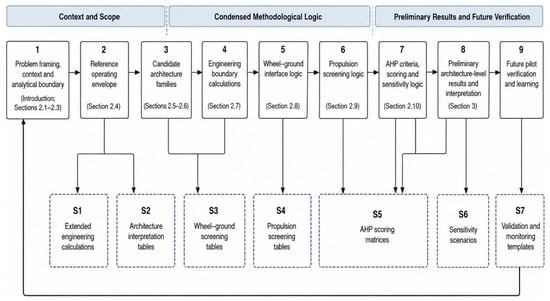
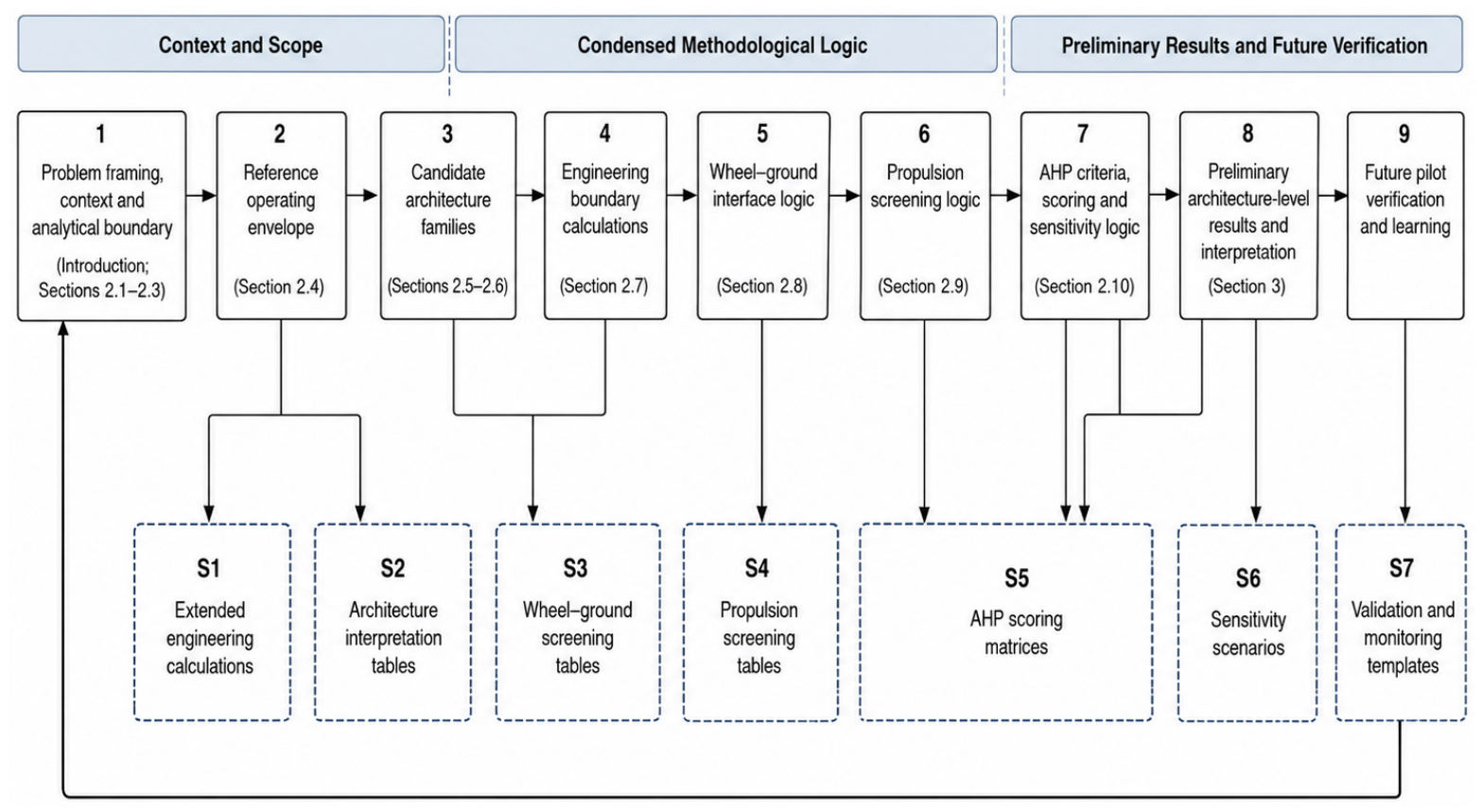
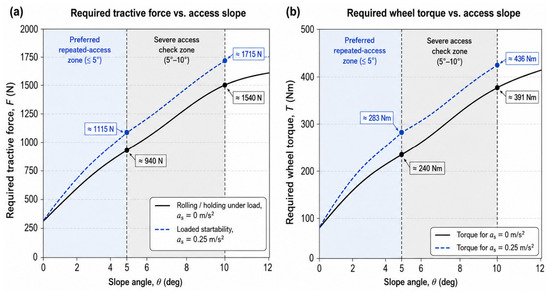
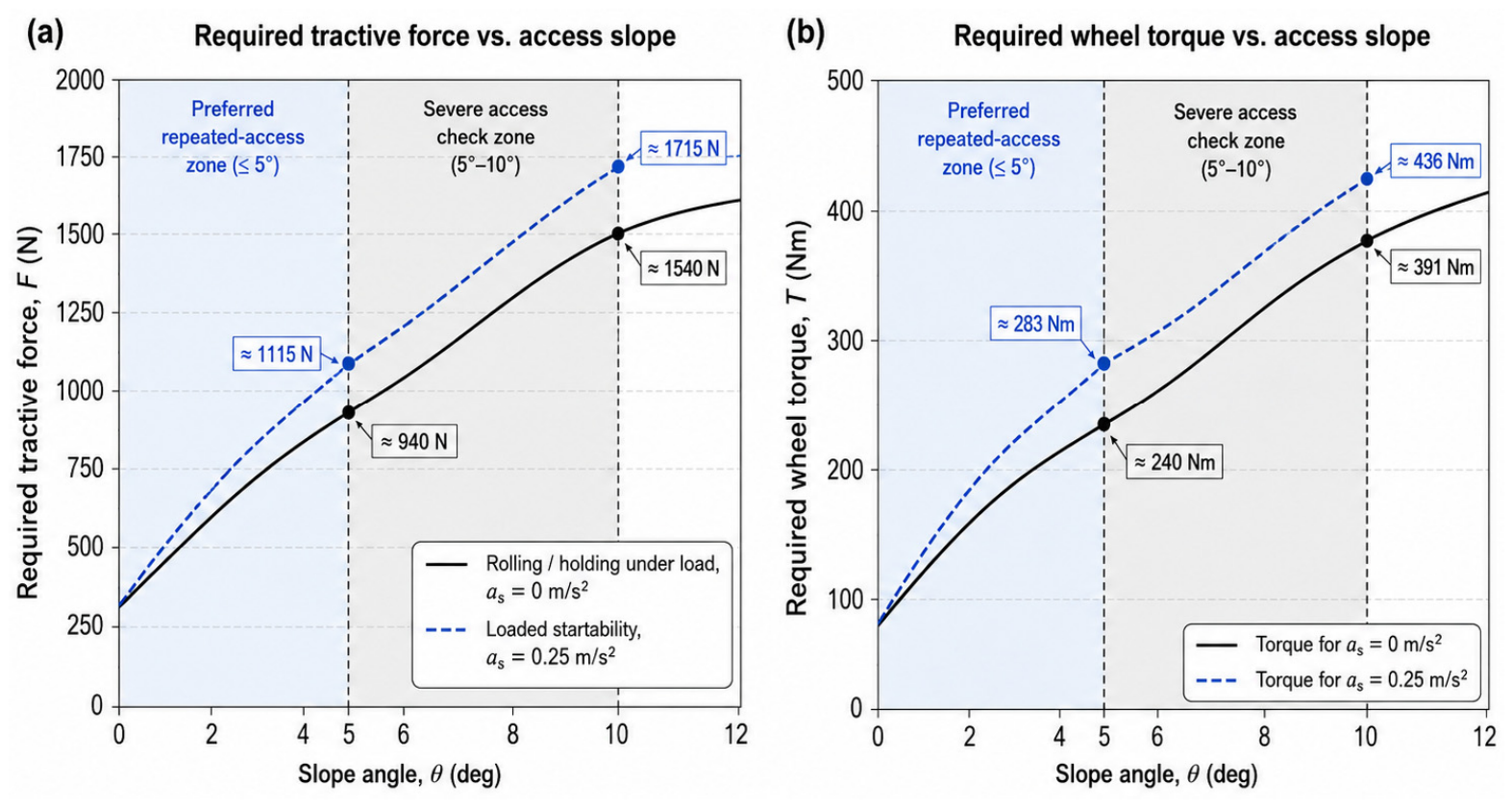
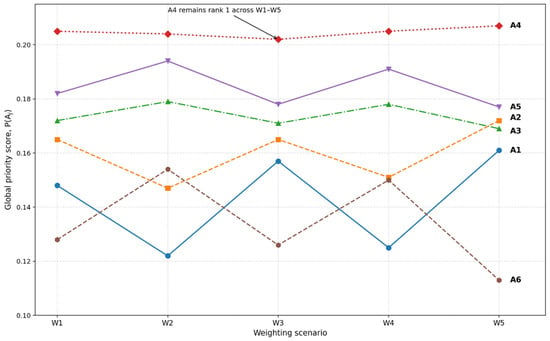
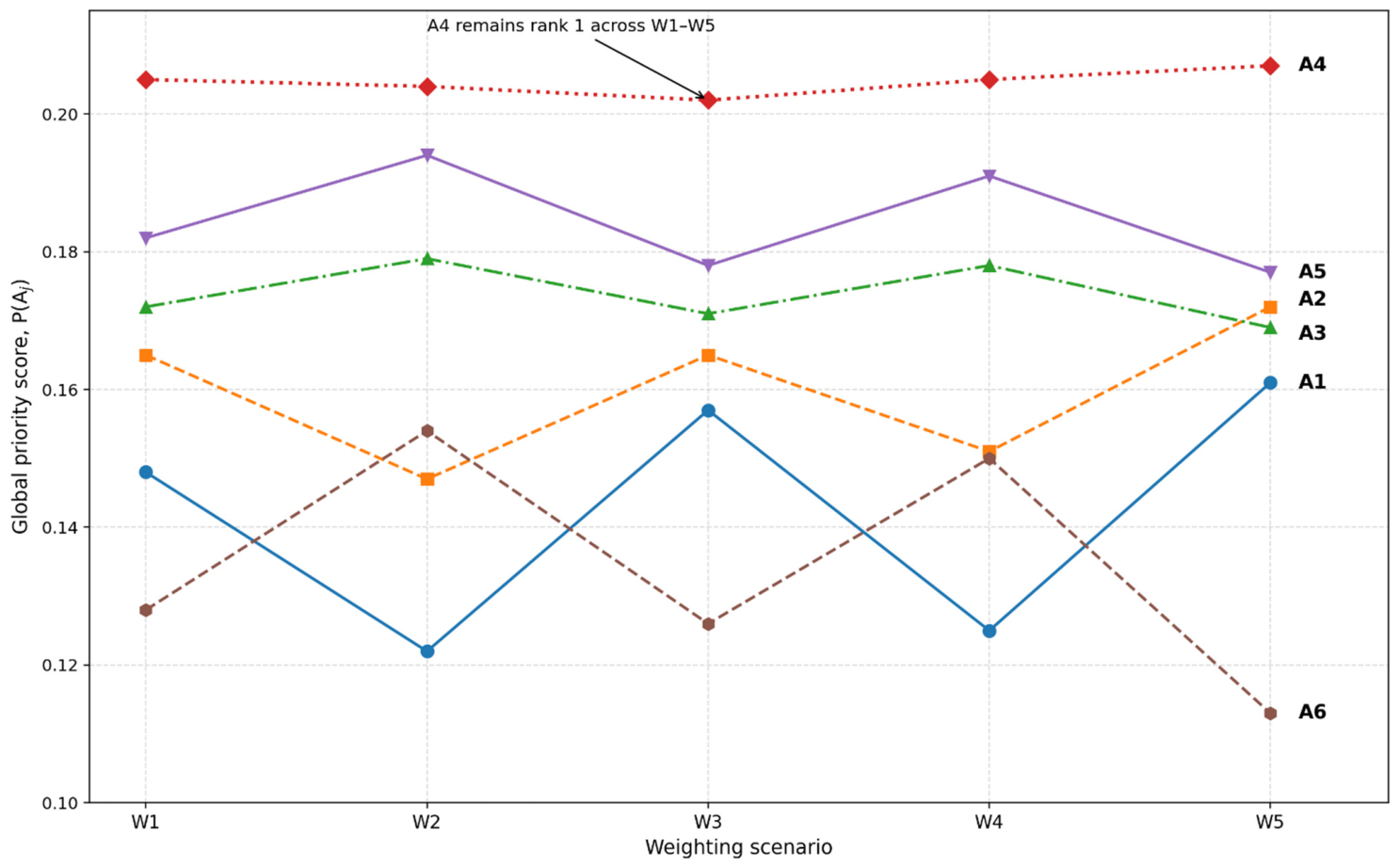
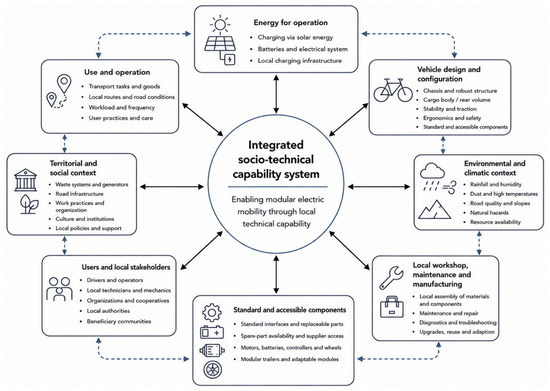
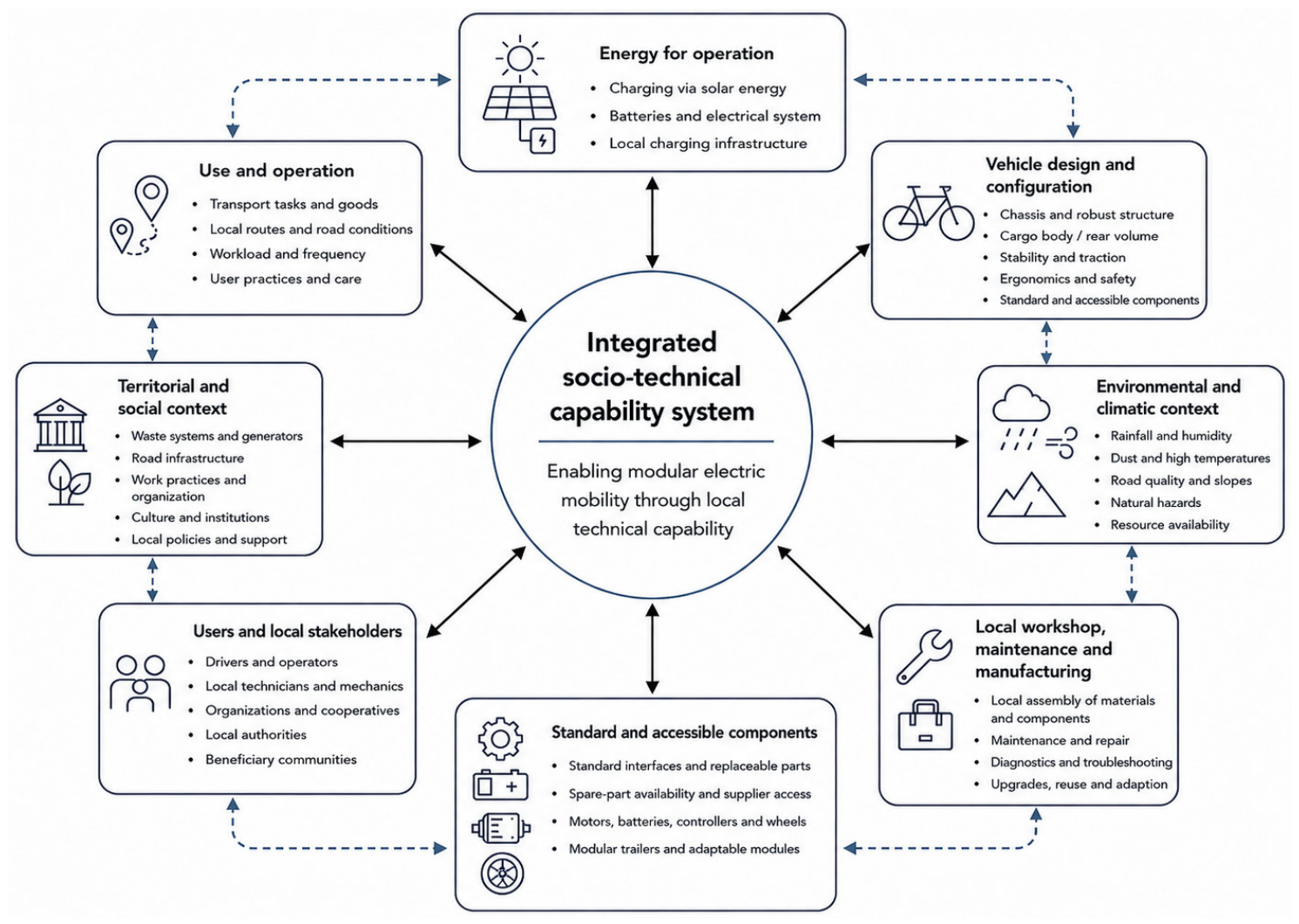

Disclaimer/Publisher’s Note: The statements, opinions and data contained in all publications are solely those of the individual author(s) and contributor(s) and not of MDPI and/or the editor(s). MDPI and/or the editor(s) disclaim responsibility for any injury to people or property resulting from any ideas, methods, instructions or products referred to in the content. |
© 2026 by the authors. Licensee MDPI, Basel, Switzerland. This article is an open access article distributed under the terms and conditions of the Creative Commons Attribution (CC BY) license.