

You are currently viewing a new version of our website. To view the old version click .

Vehicles, Volume 3, Issue 2

June 2021 - 11 articles

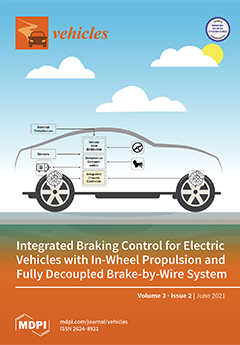
Cover Story: This paper investigates the potential of new mechatronic chassis systems for battery electric vehicles such as brake-by-wire and in-wheel propulsion in combination with an integrated chassis controller. In a case study on continuous wheel slip control (WSC), the proportional integral (PI) and integral sliding mode (ISM) approaches were benchmarked against each other and against the traditionally used rule-based approach to show their advantages with regard to active safety, vehicle stability and driving comfort. Therefore, model-in-the-loop (MIL) experiments were performed under real-time conditions for experimentally validated models of the target vehicle and its systems. The controller also observes non-measurable parameters, e.g., vehicle mass or road grade, which can have a significant influence on control performance and vehicle safety. View this paper.
  • Issues are regarded as officially published after their release is announced to the table of contents alert mailing list .
  • You may sign up for email alerts to receive table of contents of newly released issues.
  • PDF is the official format for papers published in both, html and pdf forms. To view the papers in pdf format, click on the "PDF Full-text" link, and use the free Adobe Reader to open them.

Articles (11)

  • Article
  • Open Access
6 Citations
5,073 Views
30 Pages

Artificial Neural Network Prediction of the Optimal Setup Parameters of a Seven Degrees of Freedom Mathematical Model of a Race Car: IndyCar Case Study

  • Danilo D’Andrea,
  • Giacomo Risitano,
  • Ernesto Desiderio,
  • Andrea Quintarelli,
  • Dario Milone and
  • Fabio Alberti

20 June 2021

The aim of this paper is the development of a 7-DOF (Degrees Of Freedom) mathematical model of an IndyCar and the implementation of an Artificial Neural Network in order to predict the optimal setup parameters of the car, reducing time and costs for...

  • Article
  • Open Access
3 Citations
5,174 Views
15 Pages

Simulation-Based Assessment of Parking Constraints for Automated Mobility on Demand: A Case Study of Zurich

  • Claudio Ruch,
  • Roman Ehrler,
  • Sebastian Hörl,
  • Milos Balac and
  • Emilio Frazzoli

1 June 2021

In a coordinated mobility-on-demand system, a fleet of vehicles is controlled by a central unit and serves transportation requests in an on-demand fashion. An emerging field of research aims at finding the best way to operate these systems given cert...

  • Article
  • Open Access
11 Citations
4,201 Views
13 Pages

1 June 2021

The multiaxial character of high-speed railway brake disc thermomechanical fatigue damage is studied in this work. Although the amplitudes and distributions of temperature, strain and stress are similar with uniform and rotating loading methods, the...

  • Article
  • Open Access
45 Citations
9,348 Views
15 Pages

Radar Target Simulation for Vehicle-in-the-Loop Testing

  • Axel Diewald,
  • Clemens Kurz,
  • Prasanna Venkatesan Kannan,
  • Martin Gießler,
  • Mario Pauli,
  • Benjamin Göttel,
  • Thorsten Kayser,
  • Frank Gauterin and
  • Thomas Zwick

19 May 2021

Automotive radar sensors play a vital role in the current development of autonomous driving. Their ability to detect objects even under adverse conditions makes them indispensable for environment-sensing tasks in autonomous vehicles. As their functio...

  • Article
  • Open Access
10 Citations
7,058 Views
24 Pages

18 May 2021

To analyze the influence of suspension kinematics on tire wear, detailed simulation models are required. In this study, a non-linear, flexible multibody model of a rear axle system is built up in the simulation software MSC Adams/View. The physical m...

  • Article
  • Open Access
3 Citations
6,972 Views
21 Pages

14 May 2021

The important change in the transition from partial to high automation is that a vehicle can drive autonomously, without active human involvement. This fact increases the current requirements regarding ride comfort and dictates new challenges for aut...

  • Article
  • Open Access
4 Citations
3,097 Views
15 Pages

13 May 2021

The most important change in the transition from partial to high automation is that the vehicle can drive autonomously, without active human involvement. This fact increases the current requirements regarding ride comfort and dictates new challenges...

  • Article
  • Open Access
27 Citations
5,227 Views
10 Pages

29 April 2021

The increasing worldwide demand on urban road transportation systems requires more restrictive measures and policies to reduce congestion, time delay and pollution. Autonomous vehicle mobility services, both shared and private, are possibly a good st...

  • Article
  • Open Access
17 Citations
5,300 Views
16 Pages

Comparative Analysis of Machine Learning-Based Approaches for Anomaly Detection in Vehicular Data

  • Konstantinos Demestichas,
  • Theodoros Alexakis,
  • Nikolaos Peppes and
  • Evgenia Adamopoulou

25 April 2021

The rapid growth of demand for transportation, both for people and goods, as well as the massive accumulation of population in urban centers has augmented the need for the development of smart transport systems. One of the needs that have arisen is t...

  • Article
  • Open Access
2 Citations
5,197 Views
9 Pages

22 April 2021

The Worldwide harmonized Light duty Test Procedure saw its light first as the United Nations Economic Commission for Europe Global Technical Regulation in 2017. However, it remains unclear how much the deviation is between the actual and test fuel ec...

of 2

Get Alerted

Add your email address to receive forthcoming issues of this journal.

XFacebookLinkedIn
Vehicles - ISSN 2624-8921