


Abstract
Blood mineral concentrations are commonly used to assess mineral status in dairy herds, but their interpretation may be influenced by physiological stage and diet. This prospective longitudinal study aimed to characterize serum macromineral and trace element profiles throughout the production cycle in 48 multiparous Holstein-Friesian cows sampled five times from the dry period to late lactation. Mineral concentrations in diets and drinking water were assessed, and serum macrominerals and trace elements were analyzed by inductively coupled plasma–optical emission spectrometry and inductively coupled plasma–mass spectrometry, respectively. Significant temporal variation was observed for Co, Cu, Fe, I, Mg, Mn, Mo, total P, S, and Zn. Among the sampling periods evaluated, Fe, I, Mg, Mn, total P, and Zn showed their lowest concentrations during early lactation, whereas Cu increased after calving and Co and Mo followed distinct temporal patterns. Calcium, Cr, K, Na, and Se remained comparatively stable, with all elements within physiological ranges. Total P was affected by lactation group, and time-by-lactation interactions occurred for Co, Se, and Zn. Milk yield was modestly positively associated with several minerals. Overall, serum mineral profiles varied across the sampling periods evaluated and should be interpreted considering production stage, dietary transition, and lactation group.
Keywords:
dairy cows; mineral status; lactation stage; longitudinal study; serum; ICP; transition period 1. Introduction
Minerals are essential for maintaining health, metabolic function, reproduction, and milk production in dairy cows. Macrominerals such as calcium (Ca), phosphorus (P), magnesium (Mg), sodium (Na), potassium (K), and sulfur (S) contribute to skeletal integrity, acid–base and osmotic balance, neuromuscular function, and energy and protein metabolism. The trace elements considered in the present study—including cobalt (Co), chromium (Cr), copper (Cu), iron (Fe), iodine (I), manganese (Mn), selenium (Se), and zinc (Zn)—participate directly or indirectly in antioxidant defense, immune function, thyroid metabolism, oxygen transport, and reproductive performance. Consequently, adequate mineral supply is required throughout the production cycle, particularly during periods of pronounced physiological and metabolic change [1,2,3].
The dairy cow production cycle comprises very different physiological stages. During the dry period and late gestation, nutrients are required for fetal growth, mammary gland development, and preparation for calving. Around parturition, dry matter intake commonly declines while nutrient demands increase rapidly because of colostrum synthesis and the onset of milk production [1,4]. During early and mid-lactation, nutrient partitioning is strongly directed towards the mammary gland, whereas later in lactation body reserves are gradually restored in preparation for the subsequent dry period [1]. These changes in dietary intake, mineral absorption, tissue distribution, endogenous mobilization, and secretion in colostrum and milk may modify circulating mineral concentrations throughout the production cycle [2,4,5,6].
Serum or plasma mineral concentrations are frequently used as part of herd-level nutritional monitoring [7,8]. However, circulating concentrations do not necessarily directly reflect dietary supply. Mineral availability depends on chemical form, gastrointestinal solubility and absorption, interactions between dietary components, and element-specific homeostatic regulation [2]. Circulating concentrations may also be influenced by mobilization from or deposition in body tissues, transfer to the fetus, secretion in colostrum and milk, inflammatory responses, and changes in plasma volume. Moreover, the value of serum or plasma as an indicator of mineral status is strongly influenced by the element considered [7,8]. Thus, a decrease in serum concentrations at a particular production stage does not necessarily indicate dietary deficiency, in the same way that higher concentrations do not necessarily reflect greater body reserves. Interpretation of serum mineral profiles should therefore consider the physiological stage at sampling and the element-specific limitations of circulating biomarkers [8,9].
Previous studies have reported changes in individual minerals during the transition period or at different stages of lactation [5,6,10,11,12]. Nevertheless, much of the available evidence is based on cross-sectional comparisons involving different animals at each stage of production [5,11,12], assessments restricted to the weeks immediately surrounding calving, and analysis of a limited number of elements [6]. These study designs do not fully distinguish within-cow temporal changes from differences between animals, herds, feeding programs, or management conditions. Longitudinal studies following the same cows from the dry period through advanced lactation and simultaneously assessing a broad panel of macrominerals and trace elements are scarce.
In well-managed commercial herds, mineral contributions from diets and drinking water can be characterized to assess whether the supply meets established requirements [1]. Studying the changes in mineral concentrations in this type of herd would enable examination of stage-related variation while reducing the influence of inadequate mineral nutrition and between-herd differences. Under these conditions, temporal changes in circulating concentrations may provide some insights into the physiological dynamics of mineral metabolism and help improve the interpretation of mineral profiles used in dairy herd monitoring [7,8,13].
The objective of this prospective longitudinal observational study was to characterize changes in serum macrominerals and trace element concentrations throughout the production cycle of multiparous Holstein-Friesian cows, from the dry period to late lactation, under conditions of well-characterized and adequate dietary mineral supply. Differences in serum mineral profiles between parity groups and the associations with normalized 305-day milk yield were also evaluated.
2. Materials and Methods
Animal sampling and handling procedures were approved by the Bioethics Committee of the Rof-Codina Clinical Veterinary Hospital (University of Santiago de Compostela, Spain) (AELU001/21/INVMED(02)/Animal (05)/MM/01).
2.1. Animals, Diet and Farm Management
The study was conducted between December 2021 and February 2023 on a commercial dairy farm in Galicia, northwestern Spain. The herd comprised 396 Holstein-Friesian cows, of which 220 were lactating and had an average 305-d milk yield of 12,237 kg/cow, with mean milk fat and protein contents of 4.19% and 3.37%, respectively. All of the animals were housed indoors throughout the year and fed a total mixed ration (TMR) formulated according to the production stage. Veterinary care and herd health management were provided by the Food-Producing Animal Service of the Rof Codina Teaching University Veterinary Hospital, Faculty of Veterinary Medicine, Lugo, University of Santiago de Compostela.
Forty-eight multiparous Holstein-Friesian cows from the farm were included in the study: 24 were in their second lactation and 24 in their third or later lactation. Among the latter group, the mean number of lactations was 4.00 ± 0.93 (mean ± SD; range 3–6). Nine cows were in their third lactation, 7 in their fourth, 7 in their fifth, and 1 in its sixth lactation.
During the study, cows were fed a TMR formulated to meet NASEM [1] nutrient recommendations. Dry ration consisted of 12 kg of corn silage, 7 kg of barley straw, 3.5 kg of rapeseed meal, and 1 kg of a commercial protein–vitamin–mineral concentrate, providing an estimated dry matter intake (DMI) of 14.07 kg/cow per day. The dry-cow diet had a nearly neutral dietary cation-anion difference (DCAD) (+4.4 mEq/kg of dry matter (DM)). The lactation TMR was formulated for a DMI of 25.7 kg/cow per day and consisted of 24 kg of grass silage, 22 kg of corn silage, 4.3 kg of rapeseed meal, and 9.7 kg of a commercial protein–vitamin–mineral concentrate. Macromineral and trace element concentrations in the dry-cow and lactation diets, and in the drinking water are presented in Table 1.
Table 1.
Macromineral and trace element concentrations in the dry cow diet, lactating cow diet and drinking water in the farm under study.
NASEM [1] dietary reference values for dry cows, Ca, 0.35% DM; P, 0.20% DM; Mg, 0.14% DM; Na, 0.17% DM; K, 0.66% DM; and S, 0.20% DM; Co, 0.20 mg/kg DM; Cu, 18.5 mg/kg DM; Fe, 14.0 mg/kg DM; Mn, 40.5 mg/kg DM; Se, 0.30 mg/kg DM; Zn, 31.0 mg/kg DM. For lactating cows, Ca, 0.59% DM; P, 0.36% DM; Mg, 0.17% DM; Na, 0.22% DM; K, 1.02% DM; and S, 0.20% DM; Co, 0.20 mg/kg DM; Cu, 9.0 mg/kg DM; Fe, 17.6 mg/kg DM; Mn, 28.0 mg/kg DM; Se, 0.30 mg/kg DM; Zn, 60.8 mg/kg DM. No dietary requirement was established for Cr or Mo. Maximum permitted concentrations in complete feed under European Union legislation, as reported in the source: Co, 1 mg/kg; Cu, 30 mg/kg; Fe, 450 mg/kg; Mn, 150 mg/kg; Se, 0.2/0.5 mg/kg; and Zn, 120 mg/kg. Commission Regulation (EC) No 1334/2003 and Commission Implementing Regulation (EU) 2018/1039 [14,15]. Maximum parametric values for drinking water established by Spanish Royal Decree 3/2023: Cr, 25 µg/L; Cu, 2000 µg/L; Fe, 200 µg/L; Mn, 50 µg/L and Se, 20 µg/L [16].
2.2. Experimental Design and Sample Collection
Sampling was performed at five physiologically relevant times relative to calving: T1 (dry period; average 52 days before calving), T2 (prepartum transition; average 13 days before calving), T3 (early lactation; average 15 days in milk [DIM]), T4 (peak-to-mid-lactation; average 74 DIM), and T5 (late lactation; average 205 DIM). The sampling timeline and sampling windows are represented in Figure 1.
Figure 1.
Timeline of sample collection relative to calving. Sampling periods are indicated as T1–T5. The dashed vertical line represents the day of calving (day 0). DBC: days before calving; DIM: days in milk; lact.: lactation.
Blood samples were collected by coccygeal venipuncture into 5-mL trace-element serum tubes without anticoagulant (Vacuette® Z Trace Elements Serum Clot Activator; Greiner Bio-One, Kremsmünster, Austria). The refrigerated samples were transported to the laboratory and centrifuged within 4 h of collection at 3000 rpm for 10 min to separate the serum. Two serum aliquots were prepared from each sample and stored at −18 °C until further analysis.
2.3. Sample Preparation and Mineral Analysis
Serum samples intended for determination of Ca, P, Mg, Na, K, S, Co, Cr, Cu, Fe, Mn, Mo, Se, and Zn concentrations were digested using a nitric acid–hydrogen peroxide procedure adapted from Luna et al. [17]. Briefly, 1 mL of serum was transferred to polypropylene tubes and mixed with 0.6 mL of concentrated nitric acid (69%; PanReac, Barcelona, Spain) and 0.4 mL of hydrogen peroxide (33%; PanReac, Barcelona, Spain). Samples were incubated in open vessels at 60 °C for 12 h to ensure complete digestion. After digestion, the solutions were diluted to a final volume of 5 mL with Milli-Q water (Millipore Corp., Bedford, MA, USA) and centrifuged at 2000 rpm for 5 min. The resulting supernatant was subsequently used for elemental determination.
Iodine was determined in pooled serum samples. Within each lactation group, samples obtained from 24 cows were divided into two independent pools of 12 cows each, resulting in four pools per sampling time point (two pools from second-lactation cows and two pools from cows in their third or greater lactation). Due to the specific analytical requirements for I determination, pooled samples were subjected to alkaline extraction. Specifically, 1 mL of pooled serum was combined with 0.4 mL of tetramethylammonium hydroxide (25%; Merck, Darmstadt, Germany) and 2 mL of Milli-Q water and incubated at 90 °C for 4 h. The extracts were then diluted to 10 mL with Milli-Q water, centrifuged, and the supernatant was used for iodine determination [17].
The ration (TMR) was oven-dried at 60 °C for 24 h, before being ground and sieved through a 0.5 mm mesh. Samples were subsequently acid-digested using 8 mL of concentrated nitric acid (69%) and 2 mL of hydrogen peroxide (33%) in a microwave digestion system (Ethos Plus; Milestone, Sorisole, Italy). Water samples were acidified with nitric acid to a final concentration of 1% prior to analysis.
Macrominerals (Ca, P, Mg, Na, K and S) were determined by inductively coupled plasma optical emission spectrometry (ICP-OES; Agilent 5900, Agilent Technologies, Tokyo, Japan), whereas trace elements (Co, Cr, Cu, Fe, I, Mn, Mo, Se and Zn) were quantified by inductively coupled plasma–mass spectrometry (ICP-MS; Agilent 7900 ICP-MS, Agilent Technologies, Tokyo, Japan). All analyses were performed at the Research Infrastructures Unit of the University of Santiago de Compostela (Lugo, Spain), an ISO-accredited facility operating under established quality assurance protocols.
To ensure analytical reliability, calibration standards ranging from 0.2 to 10,000 μg/L were freshly prepared on each sampling day. Calibration curves showed coefficients of determination greater than 0.999, while relative standard deviations remained below 5%. All samples were analyzed in triplicate. Quality control procedures included the use of analytical blanks in every batch, and limits of detection (LOD) were calculated as three times the standard deviation of blank measurements. The LOD values were sufficiently low for quantification of all elements analyzed. Method accuracy was assessed using bovine serum samples spiked with known concentrations of the target minerals at levels 2- to 10-fold higher than the expected concentrations (n = 63). Recovery rates ranged from 99.0% to 104% for macrominerals and from 96.6% to 112% for trace elements, confirming satisfactory analytical performance.
2.4. Data Analysis
Statistical analyses were performed using IBM SPSS Statistics version 29.0.1.0 (IBM Corp., Armonk, NY, USA). Linear mixed models for repeated measures were used to evaluate serum element concentrations. Individual milk yield normalized to 305 days of lactation (kg/cow), as well as milk fat and protein percentages, were obtained from the official milk recording system in Galicia (Laboratorio Interprofesional Galego de Análise do Leite, Galicia, Spain). Time, lactation group, and their interaction were included as fixed effects, whereas 305-d normalized milk production was included as a covariate. Protein and fat percentage were also evaluated as potential covariates during model development; however, because they did not consistently contribute to explaining the variability in serum mineral concentrations, they were excluded from the final models.
Models were fitted using restricted maximum likelihood and a first-order autoregressive covariance structure to account for repeated measurements within cows. Initially, an individual random intercept was evaluated; however, for Fe and Se, the random intercept variance was estimated as zero, resulting in numerical instability and non-positive definite Hessian matrices. Therefore, the random intercept was omitted only for these elements, whereas it was retained for the remaining minerals.
Owing to the pooled sampling design and the limited number of pooled observations available for iodine analysis, the iodine model did not include normalized milk production as a covariate or an individual random effect. Nevertheless, the same fixed-effect structure (time, lactation group, and their interaction) and covariance structure were retained.
Pairwise comparisons were adjusted using Bonferroni correction. Model residuals were assessed for normality and homoscedasticity using Q–Q plots and residual-versus-fitted value plots. Variables not meeting model assumptions were log10-transformed prior to analysis. Results are presented as back-transformed estimated marginal means with the corresponding 95% confidence intervals. In addition, descriptive statistics (mean ± standard deviation) were calculated from the original untransformed data to describe the variability of the study population. Results were considered statistically significant at p < 0.05.
2.5. Use of Generative Artificial Intelligence
During the preparation of this manuscript, the authors used ChatGPT-5.6 (OpenAI) to improve the readability and grammar of the text. All content generated by the tool was carefully reviewed, edited, and revised by the authors, and the final manuscript was reviewed and corrected by a native English speaker. All scientific concepts, analyses, results, conclusions, and interpretations were developed by the authors. The authors take full responsibility for the content of the published article.
3. Results
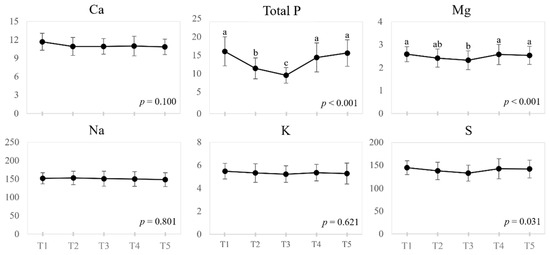
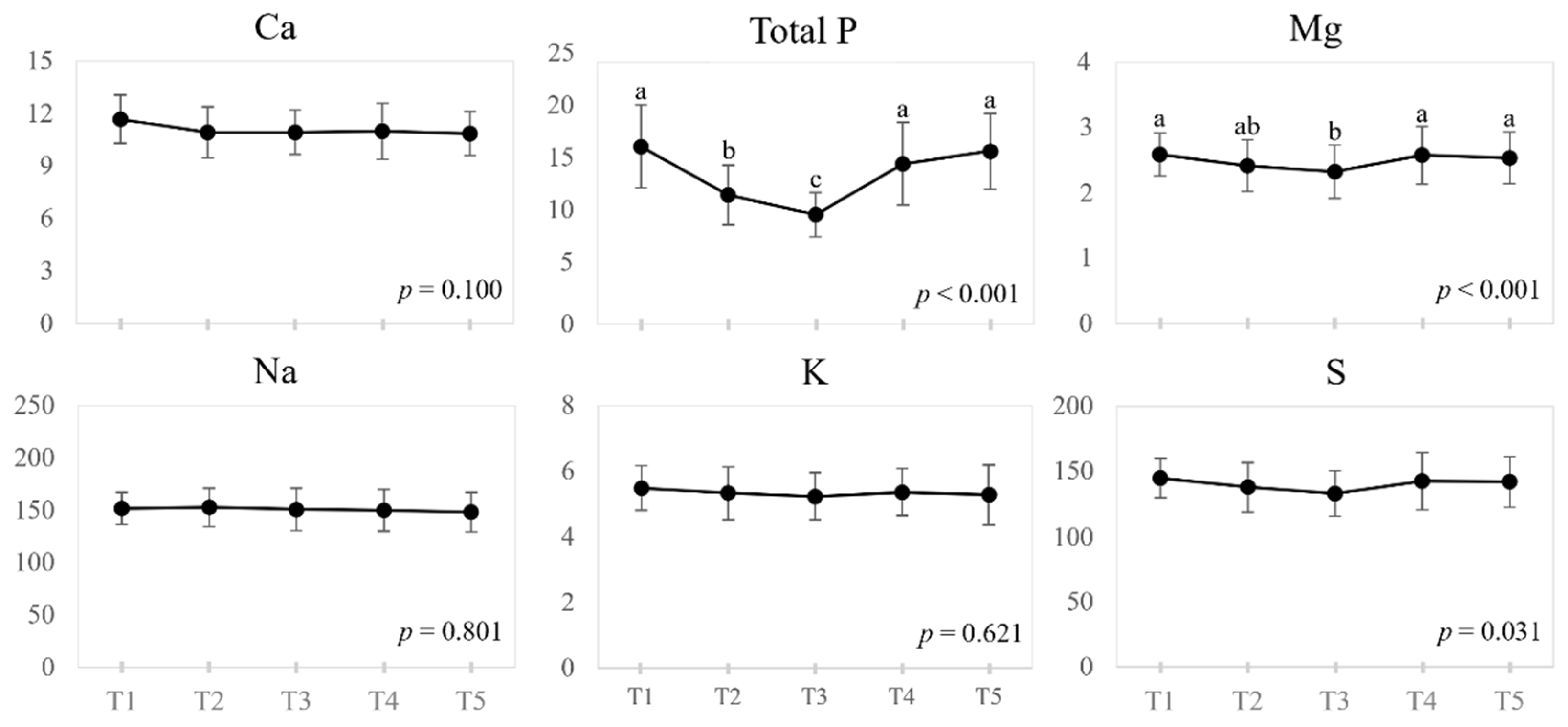
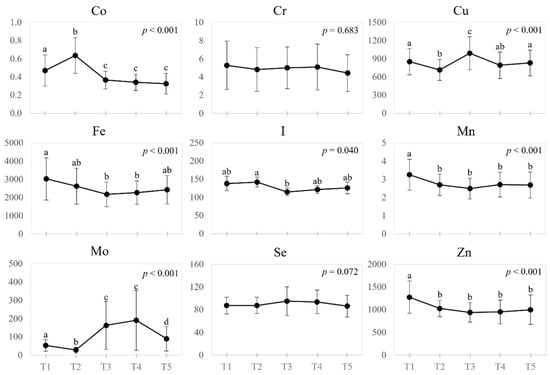
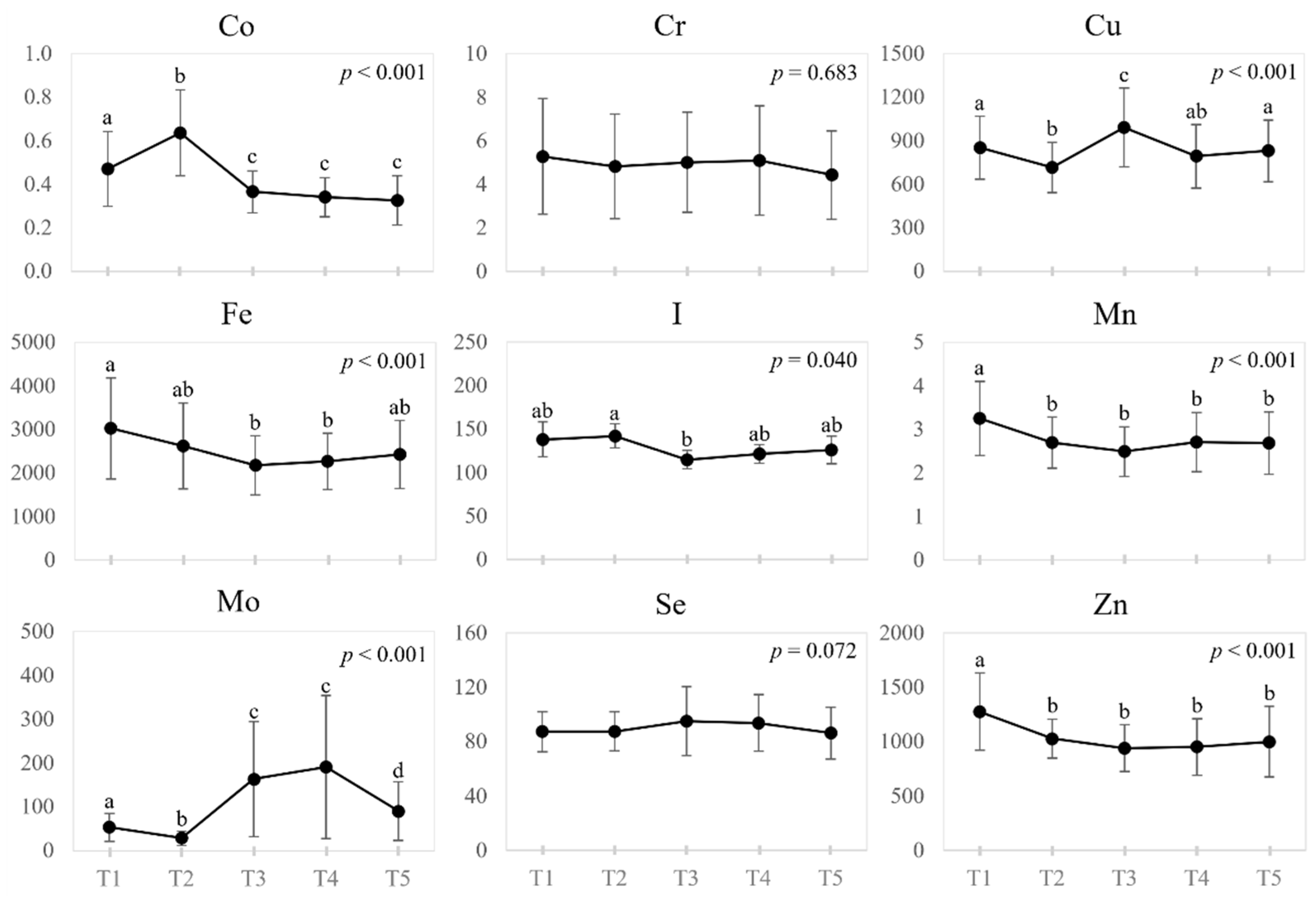
The estimated marginal means derived from the mixed-effects models are summarized in Table 2 and Table 3, while the temporal distribution of macromineral and trace element concentrations based on raw data is shown in Figure 2 and Figure 3. The figures provide a graphical representation of the biological variability observed among animals and illustrate the temporal patterns identified by the models.
Table 2.
Macromineral concentrations for each sampling time and lactation group, presented as back-transformed estimated marginal means with 95% confidence intervals [mean (95% CI)] derived from linear mixed-effects models. p-values indicate the effects of time point (T), lactation group (L), time point × lactation group interaction (T×L), and normalized milk yield (Prod.). K and Na are expressed in mEq/L; all other elements are expressed in mg/dL.
Table 3.
Trace element concentrations for each sampling time and lactation group, presented as back-transformed estimated marginal means with 95% confidence intervals [mean (95% CI)] derived from linear mixed-effects models. p-values indicate the effects of time point (T), lactation group (L), time point × lactation group interaction (T×L), and 305-days normalized milk yield (Prod.). All values are expressed in µg/L. * For iodine, pooled samples (2 pools per lactation group and sampling time point; 12 cows per pool) were used, and the 305-day normalized milk yield was not included in the model.
Figure 2.
Serum macromineral concentrations across different time points for all cows (n = 48). Means and standard deviations were calculated from raw data. Different letters indicate significant pairwise differences between time points (p < 0.05). K and Na are expressed in mEq/L; all other elements are expressed in mg/dL.
Figure 3.
Serum trace element concentrations across different sampling times for all cows (n = 48). Means and standard deviations were calculated from raw data. Different letters indicate significant pairwise differences between time points (p < 0.05). All values are expressed in µg/L.
Regarding macrominerals, significant temporal differences were observed for total P, Mg, and S. However, although there was a significant overall effect of time on S, there were no significant pairwise differences between different sampling times. Magnesium and particularly total P concentrations declined from the dry period to early lactation, reaching lowest levels during early lactation, followed by an increase thereafter. By contrast, Ca, Na, and K remained relatively stable across sampling periods, with no significant temporal differences observed.
Among trace elements, significant temporal variations were observed for Co, Cu, Fe, I, Mn, Mo, and Zn. By contrast, no significant temporal changes were observed for Cr and Se, although Se concentrations tended to vary over time (p = 0.072).
A similar temporal pattern was observed for Fe, I, Mn, and Zn, with higher concentrations during the dry period, a decrease towards early lactation—when the lowest values were recorded—and a subsequent slight increase during the remainder of the production cycle. By contrast, Co concentrations peaked during the prepartum period, declined during early lactation, and remained relatively stable thereafter. Copper concentrations differed markedly between the prepartum and postpartum periods, reaching lowest values before calving and highest values after calving. Finally, Mo concentrations decreased during the prepartum period, increased during early and mid-lactation, when greater variability was also observed, and again decreased towards late lactation.
A significant effect of lactation was observed only for total P, with the concentrations being consistently higher (13–19% higher) in cows during second lactation than in cows during the third or later lactations across all five sampling time points.
Significant time × lactation interactions were detected for Co, Se, and Zn. Cobalt concentrations increased between the dry period and the prepartum period in both groups; however, concentrations were higher in cows in their second lactation during the dry period, but similar between groups during the prepartum period and early lactation. Different temporal patterns were observed for Se between the lactation groups, with concentrations increasing from the dry period to mid-lactation in cows with three or more lactations, while remaining relatively stable in second-lactation cows. The Zn concentrations increased in second-lactation cows between mid- and late lactation, whereas the concentrations decreased in cows in their third or later lactations in the same interval.
Normalized 305-day milk yield significantly affected the concentrations of the macrominerals Ca, total P, Mg, Na, K, and S, as well as those of the trace elements Co, Se, and Zn. In all cases, regression coefficients were positive, indicating that higher milk production was associated with higher serum mineral concentrations independently of sampling time and lactation group. Although significant, the effect of normalized milk yield was modest, with estimated increases ranging from approximately 0.9% to 2.4% per 1000-unit increase in normalized milk yield.
4. Discussion
The present longitudinal study showed that serum mineral profiles varied throughout the production cycle of multiparous dairy cows, reflecting the combined influence of physiological stage and stage-specific feeding, while circulating concentrations generally remained within physiological ranges [3,7,18,19]. Among macrominerals, total P and Mg decreased towards early lactation, followed by a recovery during mid- and late lactation, whereas Ca, Na, and K remained comparatively stable at the population level. The concentrations of the trace elements Fe, I, Mn, and Zn showed a similar decrease towards early lactation followed by a variable recovery, while the concentration of Cu increased after calving, and those Co and Mo followed distinct element-specific trajectories. The Cr and Se concentrations remained comparatively stable at the population level. These results indicate that serum mineral concentrations are dynamic and should not be interpreted solely as direct indicators of dietary mineral adequacy, particularly because the suitability of circulating concentrations as biomarkers differs among elements [7,8].
Previous studies have observed differences in mineral concentrations at different production stages; however, several studies used cross-sectional designs in which different animals represented a stage of the lactation cycle [5,12]. The dietary mineral supply was not necessarily standardized in these studies and, in many cases, was not adequately characterized, making it difficult to determine whether the observed differences reflected physiological changes associated with production stage or variations in mineral intake, herd management, or animal characteristics. Longitudinal information is scarce, as studies often focus on a small number of elements or on the period immediately surrounding calving. For example, Daniel et al. [6] evaluated the Zn, Cu, and Mn balance between late lactation and the subsequent mid-lactation period in 12 cows. Cavestany et al. [20] followed changes in Ca, P, and Mg between the prepartum and postpartum periods in a pasture-based production system, whereas Mezzetti et al. [21] identified time-related changes in Ca, Mg, P, and Zn from dry-off until late gestation. However, these studies covered narrower mineral panels and shorter portions of the production cycle than the present study. By following the same cows from the dry period until approximately 205 days in milk, the present study extends previous longitudinal approaches through the evaluation of a broader panel of macrominerals and trace elements across a large portion of the production cycle. In addition, the common farm environment and the characterization of mineral supply from both diets and drinking water reduced between-animal, between-herd, and nutritional variability, enabling direct examination of temporal changes in mineral status.
The macromineral data should be interpreted in the context of the herd hypocalcemia-prevention strategy. The dry-cow diet was deliberately formulated with relatively low Ca and P, a higher Mg concentration, and a nearly neutral dietary cation-anion difference (+4.4 mEq/kg DM) to support the homeostatic response to the abrupt increase in Ca demand at calving [2,22,23]. The prevalence of clinical hypocalcemia in the herd was below 1%, suggesting that the overall preventive program was effective under the routine feeding and management conditions on the farm, although the observational nature of the study precludes this outcome being attributed to any specific dietary component.
Time-dependent changes in Ca, P, and Mg around calving have also been described [20,21], although the direction and magnitude differed among minerals and parity groups, highlighting the influence of the production system, sampling window, and prepartum feeding strategy.
Total P showed the greatest temporal variation, decreasing until early lactation and recovering thereafter despite the higher P concentration of the lactation diets. This pattern may reflect changes in intake, P redistribution, cellular metabolism, and secretion into milk rather than dietary supply alone [3,24,25,26]. Circulating inorganic P is also affected by feeding pattern, lactation number, and milk production and has limitations as an isolated indicator of dietary P status [24]. Total P was the only mineral consistently affected by lactation group, being 13–19% higher in second-lactation cows. This age-related pattern is consistent with the findings of McAdam and O’Dell [10] and Cozzi et al. [27], who reported higher circulating P concentrations in younger cows, and with those of Cattaneo et al. [28], who observed a tendency towards higher P during first lactation than during second lactation. Cavestany et al. [20] also found that Ca, P, and Mg varied more markedly in primiparous than in multiparous cows during the transition period. Although the parity categories differ from those used here, the collective evidence suggests that physiological maturity influences circulating P and should be considered when interpreting serum profiles. However, because P was measured by ICP-OES, the reported values represent total elemental P and are not directly comparable with routine biochemical measurements of inorganic phosphate.
Magnesium concentrations also decreased during early lactation and subsequently recovered. The higher Mg content in the dry-cow diet formed part of a strategy to support Ca regulation. The postpartum decline may reflect the transition to a diet with a lower Mg content, together with changes in intake and gastrointestinal absorption. This interpretation is consistent with the dependence of Mg status on continuous gastrointestinal absorption and with its role in maintaining an effective homeostatic response to Ca demand [2]. By contrast, Ca remained stable. However, the first postpartum sample was collected at approximately 15 DIM, i.e., after the main period of risk for acute and delayed hypocalcemia. The results therefore indicate that Ca homeostasis had generally been restored by early lactation but do not rule out the possibility of transient hypocalcemia immediately after calving [29]. Previous findings for Ca, P, and Mg across lactation are variable. Thus, Piccione et al. [30] detected a postpartum decrease in Ca but little temporal variation in P or Mg, whereas Fadlalla et al. [31] and Perumal et al. [32] found no significant differences in these macrominerals according to lactation stage. By contrast, the monthly assessments by Nozad et al. [33] revealed variations in serum Ca, P, Mg, Na, K, and Cl concentrations during lactation. These differences may reflect variation in breed, production system, diet, sampling intervals, physiological stages represented, and analytical methodology, as many previous studies used colorimetric assays or atomic absorption spectrometry rather than ICP-OES.
Other minerals, such as Na and K, remained stable. This is consistent with the findings of Mezzetti et al. [21], who reported that Na was not significantly affected by time during the dry and prepartum periods, and with those of Cozzi et al. [27], who reported limited effects of lactation stage on major blood minerals, although P and Na were influenced by season. The weak effect of time for S—with no significant pairwise differences—suggests only limited temporal variation.
Among trace elements, several element-specific temporal patterns were observed. The concentrations of Fe, I, Mn, and Zn were lowest during early lactation. This period is characterized by increased milk production, incomplete recovery of feed intake, redistribution of nutrients towards the mammary gland, and continuing metabolic and inflammatory adaptation after calving [4,5]. These processes may alter circulating concentrations of elements without causing true depletion of body reserves. The temporal changes must nevertheless be interpreted in the context of the feeding program. Dietary Fe, Se, and Mo concentrations were higher in the lactation ration, but the serum concentrations either decreased during early lactation or followed patterns that were not proportional to dietary supply. Conversely, the postpartum increase in Mo coincided with a substantially higher Mo concentration in the lactation diet, suggesting that dietary exposure contributed to the temporal pattern. Overall, serum concentrations reflect the balance in dietary supply, mineral solubility and gastrointestinal absorption, interactions among dietary components, endogenous excretion, tissue distribution, homeostatic regulation, inflammatory redistribution, and secretion into colostrum and milk rather than dietary concentration [2,8]. Recent work has also emphasized that the relationship between dietary supply and circulating or retained Zn, Cu, and Mn is nonlinear and strongly influenced by mineral-specific homeostatic adaptations and DMI [6,34].
One of the clearest examples of this pattern was observed for zinc. The Zn concentrations decreased between the dry period and early lactation, with only a moderate recovery thereafter. Lower circulating Zn around parturition and during early lactation has previously been reported. For example, Wang et al. [35] found that serum Zn reached peak levels during the first week postpartum and subsequently increased towards baseline. Similarly, Hussein et al. [12] observed higher Zn concentrations in close-up cows than in fresh- and early-lactation cows. Badiei et al. [36] also reported significantly lower serum Zn concentrations at calving than at one month prepartum, followed by a subsequent increase during the postpartum period. Pieper et al. [9] also showed that serum and plasma Zn changed rapidly across the production cycle—with lowest concentrations occurring around parturition—and proposed that stage-specific values should be used when evaluating Zn status. Daniel et al. [6] reported a negative Zn balance during the first three weeks after calving, despite a positive balance during most of the remaining study period. A similarly prolonged postpartum reduction in concentrations was observed by Cattaneo et al. [28], who followed first- and second-lactation cows from the prepartum period to 120 DIM and found that Zn declined close to calving and did not recover to earlier concentrations until approximately seven weeks postpartum. Serum Zn should nevertheless be interpreted cautiously because physiological stress and inflammatory redistribution can reduce circulating concentrations, and serum Zn has limited sensitivity for detecting marginal deficiency [8].
Serum concentrations of Fe and Mn followed broadly comparable trajectories in the present study. Hussein et al. [12] likewise reported lower Fe and Mn concentrations in close-up and fresh cows than in cows at later lactation stages, although the cross-sectional sampling periods differed from those used here. The decrease in Fe concentrations at around calving is also consistent with the findings of Kurpińska et al. [37], who monitored cows from the dry period to 60 DIM and observed a significant reduction at parturition, and with Mohammed et al. [38], who reported lower serum Fe postpartum than during late gestation. These findings support a consistent periparturient redistribution of circulating Fe across different production systems, although differences in analytical methods and sampling schedules limit direct comparison. Iodine followed a pattern similar to Fe, Mn, and Zn. Longitudinal information on circulating I throughout the dairy production cycle remains limited, and previous studies have mainly focused on dietary I supply or supplementation rather than on the physiological trajectory across lactation [39,40,41]. These studies indicate that circulating I responds to dietary supply, with plasma inorganic I particularly reflecting recent I intake [39]. Therefore, the marked reduction in DMI known to occur as parturition approaches [42] may have contributed to the decrease in circulating I observed between the prepartum period and early lactation, although the present data do not allow the underlying mechanism to be established. In addition, the pooled analytical design limits inference regarding individual variability and its associations with milk production or lactation group.
Copper followed the opposite temporal pattern, reaching lowest concentrations before calving and highest concentrations during early lactation. Similar increases in circulating Cu have been reported around calving and during the first weeks postpartum [12,35]. As well as dietary intake and body stores, circulating Cu is influenced by ceruloplasmin, the major Cu-transporting protein in blood and a positive acute-phase protein whose concentration increases during the periparturient inflammatory response [43,44]. Moreover, serum Cu does not necessarily reflect hepatic Cu reserves, particularly before substantial depletion occurs [8]. Accordingly, the postpartum increase in serum Cu may at least partly reflect increased hepatic synthesis of ceruloplasmin associated with the physiological acute-phase response rather than an improvement in Cu reserves [44]. Because ceruloplasmin and other inflammatory biomarkers were not measured, the relative contribution of inflammatory and transport-related mechanisms could not be established.
A different pattern was observed for Co, which increased between the dry period and the prepartum transition and subsequently decreased during early lactation. Because cows received the same dry-cow ration until prepartum, the increase cannot be attributed to differences in dietary Co concentration. Serum Co has limited value as a functional indicator because its biological relevance in ruminants is largely mediated through ruminal vitamin B12 synthesis. Indeed, dietary Co supplementation does not consistently alter serum or liver Co, and serum Co has been reported to decrease as lactation progresses [45,46]. The source of Co supplementation may also influence the circulating profile, as Mion et al. [47] reported a treatment-by-time interaction in serum Co, with differences between organic and inorganic sources varying from the peripartum period to 105 DIM. Moreover, increasing Co or vitamin B12 supply during the transition period has shown limited effects on productive and metabolic outcomes when basal Co supply is adequate [48]. The biological significance of the transient prepartum increase therefore remains uncertain in the absence of vitamin B12 measurements or related functional biomarkers.
Regarding Mo, concentrations decreased during the prepartum period, then increased during early and mid-lactation, and declined again towards late lactation. Greater variability was also observed during lactation. Although the underlying factors could not be directly evaluated, differences in Mo exposure from forage and other dietary components may have contributed to the variability. The farm where the present study was conducted is located in an area characterized by elevated soil Mo concentrations, according to the Geochemical Atlas of Galicia, with mapped values >1 mg/kg [49]. This local geochemical background may contribute to the elevated Mo content of grass silage and other types of forage produced in the area. Furthermore, previous observations in dairy herds from the same region have also shown elevated circulating Mo concentrations, indicating the influence of local soil and feeding conditions [49,50]. Despite the high serum Mo concentrations and the known antagonistic interaction between Mo and Cu in ruminants, no concurrent reduction in serum Cu was observed, and Cu remained within the physiological range throughout the study.
No significant overall temporal effect was observed for Se, although the trajectory differed between lactation groups. This is consistent with the findings of Hussein et al. [12], who reported no significant differences in serum Se among production stages. However, stage- and parity-related variation has been described elsewhere; Pilarczyk et al. [51] found the highest serum Se concentrations in early-lactation multiparous cows and the lowest in dry cows. Dietary Se concentration and source are known to influence circulating Se and the changes around calving [52]. In the present study, however, cows from both lactation groups received the same diets at each physiological stage, indicating that the differences between groups in Se trajectories were unlikely to reflect differences in dietary Se supply and may be related to parity-associated differences in Se metabolism, requirements or utilization.
Normalized 305-day milk yield was positively associated with serum Ca, total P, Mg, Na, K, and S, as well as Co, Se, and Zn, although with small effects estimated. Positive relationships between milk production and several circulating minerals have also been reported by Sizova et al. [53], who observed higher serum Ca, Mg, P, Se, and Zn concentrations, together with a tendency towards higher Co, in cows with greater daily milk yield. Rather than supporting a simple depletion model associated with higher milk output, these positive associations may reflect the greater feed intake and, consequently, increased total mineral intake commonly associated with higher milk production [54,55]. Consistent with this interpretation, Daniel et al. [6] showed that the increase in DMI later in lactation was accompanied by much higher intake of Zn, Cu, and Mn and positive Cu and Mn balances. However, because individual DMI and mineral intake were not measured in the present study, this explanation remains speculative. Normalized 305-day milk yield may also reflect overall intake capacity, health, and metabolic adaptation rather than exerting a direct effect on circulating mineral concentrations.
From a practical perspective, the present findings support a production stage- and diet-specific interpretation of serum mineral profiles. Lower concentrations during early lactation should not automatically be regarded as evidence of inadequate dietary supply, particularly when the ration has been analyzed, animals are clinically healthy, and values remain within physiological ranges. The usefulness of circulating concentrations as indicators of mineral status differs markedly among elements and may be affected by physiological and health-related factors [3,7,8,18]. Herd assessments should therefore account for production stage, either by sampling cows at comparable stages or by adequately representing different production groups. This is particularly relevant for Zn, for which stage-specific values have been proposed [9]. Interpretation should integrate sampling time, current diet, estimated intake, lactation number, milk production, and health status rather than relying on an isolated serum measurement.
The present study does not demonstrate that additional supplementation is required during periods when serum concentrations are lowest. In adequately supplied cattle, increasing dietary mineral concentrations may not produce a proportional increase in circulating concentrations because absorption, endogenous excretion, and tissue retention are regulated independently for each element [2]. Moreover, excessive Zn, Cu, or Mn supply may eventually exceed the homeostatic regulatory capacity and promote unregulated tissue retention [34]. The early-lactation peaks observed in the present study should therefore be interpreted as evidence of marked mineral dynamics rather than as a direct indication for supplementation. Nevertheless, they indicate a biologically relevant period for future controlled studies evaluating whether stage-specific interventions improve functional mineral status, health, or performance.
The main strengths of the present study include the prospective longitudinal design, repeated sampling of the same cows throughout the production cycle, the broad elemental panel analyzed by ICP-MS and ICP-OES, and the characterization of mineral concentrations in the diets and the drinking water. Conducting the study within a single commercial herd was also a strength, as all animals were exposed to the same management, environmental conditions, veterinary care, and feeding system, thereby reducing between-herd variability and allowing evaluation of temporal changes against a well-characterized nutritional background.
The findings of the present study should be interpreted considering certain limitations. First, iodine was measured in pooled serum samples, which restricted evaluation of individual variability and prevented inclusion of this factor in some animal-level analyses. In addition, only cows in their second or later lactations were included; therefore, the mineral trajectories described here may not fully represent those of primiparous cows. An additional limitation is the absence of sampling during the immediate periparturient period, which prevented the characterization of rapid changes in circulating mineral concentrations occurring during this critical period. In addition, variability in the actual sampling days within each period, partly resulting from differences between expected and actual calving dates, may have influenced serum mineral concentrations. Further longitudinal studies including primiparous cows and herds with suboptimal or deficient mineral supply would be valuable to determine whether the temporal patterns observed under adequate nutritional conditions are maintained, amplified, or modified across different physiological and nutritional contexts. The absence of a group of cows receiving suboptimal or deficient mineral intake is another limitation of the present study, as inclusion of such animals, together with larger cohorts, more frequent sampling, and cows that subsequently develop metabolic diseases, could help determine whether serum mineral trajectories are modified under inadequate mineral supply, precede disease onset, and potentially serve as early indicators of metabolic disturbances.
5. Conclusions
Serum macromineral and trace element profiles varied throughout the production cycle of multiparous Holstein-Friesian cows, reflecting the combined influence of physiological stage and stage-specific feeding, although concentrations generally remained within physiological ranges. Early lactation was the main point of change, with total P and Mg reaching their lowest concentrations, while Ca, Na, and K remained comparatively stable. Among trace elements, Fe, I, Mn, and Zn reached lowest concentrations during early lactation, whereas Cu increased after calving and Co and Mo followed distinct temporal patterns. Total P was the only element consistently affected by lactation group, with higher concentrations in second-lactation cows than in cows in their third or later lactations, indicating that lactation number should be considered, particularly when interpreting total P in serum. Normalized 305-day milk yield was modestly positively associated with several elements. These findings characterize serum mineral profiles at the specific sampling periods evaluated and should not be extrapolated to unsampled stages of the production cycle. In particular, they do not capture short-term fluctuations that may occur during the immediate periparturient period. Overall, the findings demonstrate dynamic serum mineral profiles across the production cycle and highlight the importance of standardizing sampling time and interpreting the results in relation to the current diet, production stage, and lactation group.
Author Contributions
Conceptualization, C.F.-V., B.L. and M.M.; methodology, C.F.-V., B.L. and M.M.; software, C.F.-V., B.L. and M.M.; formal analysis, C.F.-V., B.L. and M.M.; investigation, C.F.-V., B.L., L.R., M.L.-A. and M.M.; resources, C.F.-V. and B.L.; data curation, C.F.-V., B.L. and M.L.-A.; writing—original draft preparation, C.F.-V., B.L., L.R., M.L.-A. and M.M.; writing—review and editing, C.F.-V., B.L. and M.M.; supervision, L.R. and M.M. All authors have read and agreed to the published version of the manuscript.
Funding
This research was carried out within the IMedA Research group of the University of Santiago de Compostela (USC) that belong to the “Grupo de Potencial Crecimiento” funded by GAIN (Axencia Galega de Innovación; grant number ED431B 2026/13).
Institutional Review Board Statement
Animal sampling and handling were carried out in accordance with Directive 2010/63/EU on the protection of animals used for scientific purposes (European Parliament, 2010), and the trial complied with Spanish legislation on animal care (Royal Decree 53/2013; 1083/2025). The procedures were supervised by the Bioethics Committee of the Rof-Codina Clinical Veterinary Hospital, USC, Spain, on 5 May 2022 (AELU001/21/INVMED(02)/Animal (05)/MM/01).
Informed Consent Statement
Verbal informed consent was obtained from the farm owner. Verbal rather than written consent was used because the study was conducted on a farm within an established veterinary and research collaboration with the university veterinary service, and participation was agreed directly with the farm owner; therefore, a separate written consent form was not obtained.
Data Availability Statement
The data that support the study findings are available from the corresponding author upon request.
Acknowledgments
Belén Larrán is in receipt of a FPU fellowship (Ref. FPU21/01742) from the Spanish Ministry of Education, Culture and Sports. Belén Larrán, Marta López-Alonso, and Marta Miranda belong to Grupo de Potencial Crecimiento financed by GAIN (Axencia Galega de Innovación; grant number ED431B 2026/13). The authors thank RIAIDT-USC for the use of analytical facilities.
Conflicts of Interest
The authors declare no conflicts of interest.
Abbreviations
The following abbreviations are used in this manuscript:
| CI | Confidence interval |
| DBC | Days before calving |
| DCAD | Dietary cation-anion difference |
| DIM | Days in milk |
| DM | Dry matter |
| DMI | Dry matter intake |
| ICP-MS | Inductively coupled plasma–mass spectrometry |
| ICP-OES | Inductively coupled plasma–optical emission spectrometry |
| LOD | Limit of detection |
| NASEM | National Academies of Sciences, Engineering, and Medicine |
| SD | Standard deviation |
| TMR | Total mixed ration |
References
- National Academies of Sciences Engineering and Medicine. Nutrient Requirements of Dairy Cattle; 8th rev. ed.; The National Academies Press: Washington, DC, USA, 2021. [Google Scholar] [CrossRef] [Scilit] [PubMed]
- Goff, J.P. Mineral absorption mechanisms, mineral interactions that affect acid–base and antioxidant status, and diet considerations to improve mineral status. J. Dairy Sci. 2018, 101, 2763–2813. [Google Scholar] [CrossRef] [Scilit] [PubMed]
- Suttle, N.F. Mineral Nutrition of Livestock, 5th ed.; CABI: Wallingford, UK, 2022. [Google Scholar] [CrossRef] [Scilit]
- Drackley, J.K. Biology of dairy cows during the transition period: The final frontier? J. Dairy Sci. 1999, 82, 2259–2273. [Google Scholar] [CrossRef] [Scilit] [PubMed]
- Premi, M.; Mezzetti, M.; Ferronato, G.; Barbato, M.; Piccioli Cappelli, F.; Minuti, A.; Trevisi, E. Changes of plasma analytes reflecting metabolic adaptation to the different stages of the lactation cycle in healthy multiparous Holstein dairy cows raised in high-welfare conditions. Animals 2021, 11, 1714. [Google Scholar] [CrossRef] [Scilit] [PubMed]
- Daniel, J.-B.; Brugger, D.; van der Drift, S.; van der Merwe, D.; Kendall, N.; Windisch, W.; Doelman, J.; Martín-Tereso, J. Zinc, copper, and manganese homeostasis and potential trace metal accumulation in dairy cows: Longitudinal study from late lactation to subsequent mid-lactation. J. Nutr. 2023, 153, 1008–1018. [Google Scholar] [CrossRef] [Scilit] [PubMed]
- Herdt, T.H.; Hoff, B. The use of blood analysis to evaluate trace mineral status in ruminant livestock. Vet. Clin. N. Am. Food Anim. Pract. 2011, 27, 255–283. [Google Scholar] [CrossRef] [Scilit] [PubMed]
- Spears, J.W.; Brandao, V.L.N.; Heldt, J. Invited review: Assessing trace mineral status in ruminants, and factors that affect measurements of trace mineral status. Appl. Anim. Sci. 2022, 38, 252–267. [Google Scholar] [CrossRef] [Scilit]
- Pieper, L.; Schmidt, F.; Müller, A.-E.; Staufenbiel, R. Zinc concentrations in different sample media from dairy cows and establishment of reference values. Tierarztl. Prax. Ausg. G. Grosstiere Nutztiere 2017, 45, 213–218. [Google Scholar] [CrossRef] [Scilit] [PubMed]
- McAdam, P.A.; O’Dell, G.D. Mineral profile of blood plasma of lactating dairy cows. J. Dairy Sci. 1982, 65, 1219–1226. [Google Scholar] [CrossRef] [Scilit] [PubMed]
- Grešáková, Ľ.; Holodová, M.; Szumacher-Strabel, M.; Huang, H.; Ślósarz, P.; Wojtczak, J.; Sowińska, N.; Cieślak, A. Mineral status and enteric methane production in dairy cows during different stages of lactation. BMC Vet. Res. 2021, 17, 287. [Google Scholar] [CrossRef] [Scilit] [PubMed]
- Hussein, H.A.; Müller, A.-E.; Staufenbiel, R. Comparative evaluation of mineral profiles in different blood specimens of dairy cows at different production phases. Front. Vet. Sci. 2022, 9, 905249. [Google Scholar] [CrossRef] [Scilit] [PubMed]
- Fernández-Villa, C.; Rigueira, L.; López-Alonso, M.; Larrán, B.; Orjales, I.; Herrero-Latorre, C.; Pereira, V.; Miranda, M. Identification of patterns of trace mineral deficiencies in dairy and beef cattle herds in Spain. Animals 2025, 15, 2480. [Google Scholar] [CrossRef] [Scilit] [PubMed]
- European Commission. Commission Regulation (EC) No 1334/2003 of 25 July 2003 Amending the Conditions for Authorisation of a Number of Additives in Feedingstuffs Belonging to the Group of Trace Elements; Official Journal of the European Union: Luxembourg, 2003; Volume L187, pp. 11–15. Available online: https://eur-lex.europa.eu/eli/reg/2003/1334/oj (accessed on 22 September 2026).
- European Commission. Commission Implementing Regulation (EU) 2018/1039 of 23 July 2018 Concerning the Authorisation of Copper(II) Diacetate Monohydrate, Copper(II) Carbonate Dihydroxy Monohydrate, Copper(II) Chloride Dihydrate, Copper(II) Oxide, Copper(II) Sulphate Pentahydrate, Copper(II) Chelate of Amino Acids Hydrate, Copper(II) Chelate of Protein Hydrolysates, Copper(II) Chelate of Glycine Hydrate (Solid) and Copper(II) Chelate of Glycine Hydrate (liquid) as Feed Additives for All Animal Spe-cies and Amending Regulations (EC) No 1334/2003, (EC) No 479/2006 and (EU) No 349/2010 and Implementing Regulations (EU) No 269/2012, (EU) No 1230/2014 and (EU) 2016/2261; Official Journal of the European Union: Luxembourg, 2018; Volume L186, pp. 3–24. Available online: https://eur-lex.europa.eu/eli/reg_impl/2018/1039/oj (accessed on 22 September 2026).
- Ministerio de la Presidencia, Relaciones con las Cortes y Memoria Democrática. Real Decreto 3/2023, de 10 de enero, por el que se establecen los criterios técnico-sanitarios de la calidad del agua de consumo, su control y suministro. Bol. Of. Estado 2023, 9, 4253–4354. Available online: https://www.boe.es/eli/es/rd/2023/01/10/3 (accessed on 22 September 2026).
- Luna, D.; Miranda, M.; Minervino, A.H.H.; Piñeiro, V.; Herrero-Latorre, C.; López-Alonso, M. Validation of a simple sample preparation method for multielement analysis of bovine serum. PLoS ONE 2019, 14, e0211859. [Google Scholar] [CrossRef] [Scilit] [PubMed]
- Puls, R. Mineral Levels in Animal Health: Diagnostic Data, 2nd ed.; Sherpa International: Clearbrook, BC, Canada, 1994. [Google Scholar]
- Bertoni, G.; Trevisi, E. Use of the liver activity index and other metabolic variables in the assessment of metabolic health in dairy herds. Vet. Clin. N. Am. Food Anim. Pract. 2013, 29, 413–431. [Google Scholar] [CrossRef] [Scilit] [PubMed]
- Cavestany, D.; Blanc, J.E.; Kulcsar, M.; Uriarte, G.; Chilibroste, P.; Meikle, A.; Febel, H.; Ferraris, A.; Krall, E. Studies of the transition cow under a pasture-based milk production system: Metabolic profiles. J. Vet. Med. A 2005, 52, 1–7. [Google Scholar] [CrossRef] [Scilit] [PubMed]
- Mezzetti, M.; Minuti, A.; Piccioli-Cappelli, F.; Trevisi, E. Inflammatory status and metabolic changes at dry-off in high-yield dairy cows. Ital. J. Anim. Sci. 2020, 19, 51–65. [Google Scholar] [CrossRef] [Scilit]
- Santos, J.E.P.; Lean, I.J.; Golder, H.; Block, E. Meta-analysis of the effects of prepartum dietary cation-anion difference on performance and health of dairy cows. J. Dairy Sci. 2019, 102, 2134–2154. [Google Scholar] [CrossRef] [Scilit] [PubMed]
- Wächter, S.; Cohrs, I.; Golbeck, L.; Wilkens, M.R.; Grünberg, W. Effects of restricted dietary phosphorus supply to dry cows on periparturient calcium status. J. Dairy Sci. 2022, 105, 748–760. [Google Scholar] [CrossRef] [Scilit] [PubMed]
- Forar, F.L.; Kincaid, R.L.; Preston, R.L.; Hillers, J.K. Variation of inorganic phosphorus in blood plasma and milk of lactating cows. J. Dairy Sci. 1982, 65, 760–763. [Google Scholar] [CrossRef] [Scilit] [PubMed]
- Grünberg, W. Phosphorus metabolism during transition. Vet. Clin. N. Am. Food Anim. Pract. 2023, 39, 261–274. [Google Scholar] [CrossRef] [Scilit] [PubMed]
- Abramowicz, B.; Tomaszewska, E.; Brzezińska, O.; Kłos, K.; Urosevic, M.; Kurek, Ł. Phosphorus metabolism and function in ruminants: Current knowledge. Animals 2026, 16, 130. [Google Scholar] [CrossRef] [Scilit] [PubMed]
- Cozzi, G.; Ravarotto, L.; Gottardo, F.; Stefani, A.L.; Contiero, B.; Moro, L.; Brscic, M.; Dalvit, P. Short communication: Reference values for blood parameters in Holstein dairy cows: Effects of parity, stage of lactation, and season of production. J. Dairy Sci. 2011, 94, 3895–3901. [Google Scholar] [CrossRef] [Scilit] [PubMed]
- Cattaneo, L.; Piccioli-Cappelli, F.; Minuti, A.; Trevisi, E. Metabolic and physiological adaptations to first and second lactation in Holstein dairy cows. J. Dairy Sci. 2023, 106, 3559–3575. [Google Scholar] [CrossRef] [Scilit] [PubMed]
- McArt, J.A.A.; Oetzel, G.R. Considerations in the diagnosis and treatment of early lactation calcium disturbances. Vet. Clin. N. Am. Food Anim. Pract. 2023, 39, 241–259. [Google Scholar] [CrossRef] [Scilit] [PubMed]
- Piccione, G.; Messina, V.; Marafioti, S.; Casella, S.; Giannetto, C.; Fazio, F. Changes of some haematochemical parameters in dairy cows during late gestation, post partum, lactation and dry periods. Vet. Med. Zoot. 2012, 58, 59–64. [Google Scholar]
- Fadlalla, I.M.T.; Omer, S.A.; Atta, M. Determination of some serum macroelement minerals levels at different lactation stages of dairy cows and their correlations. Sci. Afr. 2020, 8, e00351. [Google Scholar] [CrossRef] [Scilit]
- Perumal, P.; De, A.K.; Bhattacharya, D.; Chakurkar, E.B. Lactation stages modulate the hematological, serum biochemical, and endocrinological profiles and oxidative stress markers in crossbred cows under tropical humid island ecosystem of Andaman and Nicobar Islands. Trop. Anim. Health Prod. 2023, 55, 131. [Google Scholar] [CrossRef] [Scilit] [PubMed]
- Nozad, S.; Ramin, A.G.; Moghaddam, G.; Asri-Rezaei, S.; Kalantary, L. Monthly evaluation of blood hematological, biochemical, mineral, and enzyme parameters during the lactation period in Holstein dairy cows. Comp. Clin. Pathol. 2014, 23, 275–281. [Google Scholar] [CrossRef] [Scilit]
- Daniel, J.-B.; Martín-Tereso, J. Review: Homeostatic boundaries to dietary Zn, Cu and Mn supply in cattle. Animal 2025, 19, 101532. [Google Scholar] [CrossRef] [Scilit] [PubMed]
- Wang, J.; Zhu, X.; Wang, Z.; Li, X.; Zhao, B.; Liu, G. Changes in serum copper and zinc levels in peripartum healthy and subclinically hypocalcemic dairy cows. Biol. Trace Elem. Res. 2014, 159, 135–139. [Google Scholar] [CrossRef] [Scilit] [PubMed]
- Badiei, K.; Orangi, H.; Mostaghni, K.; Pourjafar, M.; Roushan, A. Serum trace minerals in different physiological states of high- and average-producing dairy cows. Comp. Clin. Pathol. 2011, 20, 427–431. [Google Scholar] [CrossRef] [Scilit]
- Kurpińska, A.; Jarosz, A.; Skrzypczak, W. Parameters of protein and iron metabolism in dairy cows during periparturient period. Acta Sci. Pol. Zootech. 2019, 18, 3–10. [Google Scholar] [CrossRef] [Scilit]
- Mohammed, S.E.; Ahmad, F.O.; Frah, E.A.M.; Elfaki, I. Determination of blood glucose, total protein, certain minerals, and triiodothyronine during late pregnancy and postpartum periods in crossbred dairy cows. Vet. Med. Int. 2021, 2021, 6610362. [Google Scholar] [CrossRef] [Scilit] [PubMed]
- McCoy, M.A.; Smyth, J.A.; Ellis, W.A.; Arthur, J.R.; Kennedy, D.G. Experimental reproduction of iodine deficiency in cattle. Vet. Rec. 1997, 141, 544–547. [Google Scholar] [CrossRef] [Scilit] [PubMed]
- Hemingway, R.G.; Fishwick, G.; Parkins, J.J.; Ritchie, N.S. Plasma inorganic iodine and thyroxine concentrations for beef cows in late pregnancy and early lactation associated with different levels of dietary iodine supplementation. Vet. J. 2001, 162, 158–160. [Google Scholar] [CrossRef] [Scilit] [PubMed]
- Guyot, H.; De Oliveira, L.A.; Ramery, E.; Beckers, J.-F.; Rollin, F. Effect of a combined iodine and selenium supplementation on I and Se status of cows and their calves. J. Trace Elem. Med. Biol. 2011, 25, 118–124. [Google Scholar] [CrossRef] [Scilit] [PubMed]
- Hayirli, A.; Grummer, R.R.; Nordheim, E.V.; Crump, P.M. Animal and dietary factors affecting feed intake during the prefresh transition period in Holsteins. J. Dairy Sci. 2002, 85, 3430–3443. [Google Scholar] [CrossRef] [Scilit] [PubMed]
- Kincaid, R.L.; Gay, C.C.; Krieger, R.I. Relationship of serum and plasma copper and ceruloplasmin concentrations of cattle and the effects of whole blood sample storage. Am. J. Vet. Res. 1986, 47, 1157–1159. [Google Scholar] [CrossRef] [Scilit]
- Bossaert, P.; Trevisi, E.; Opsomer, G.; Bertoni, G.; De Vliegher, S.; Leroy, J.L.M.R. The association between indicators of inflammation and liver variables during the transition period in high-yielding dairy cows: An observational study. Vet. J. 2012, 192, 222–225. [Google Scholar] [CrossRef] [Scilit] [PubMed]
- Kincaid, R.L.; Lefebvre, L.E.; Cronrath, J.D.; Socha, M.T.; Johnson, A.B. Effect of dietary cobalt supplementation on cobalt metabolism and performance of dairy cattle. J. Dairy Sci. 2003, 86, 1405–1414. [Google Scholar] [CrossRef] [Scilit] [PubMed]
- Kincaid, R.L.; Socha, M.T. Effect of cobalt supplementation during late gestation and early lactation on milk and serum measures. J. Dairy Sci. 2007, 90, 1880–1886. [Google Scholar] [CrossRef] [Scilit] [PubMed]
- Mion, B.; Ogilvie, L.; Van Winters, B.; Spricigo, J.F.W.; Anan, S.; Duplessis, M.; McBride, B.W.; LeBlanc, S.J.; Steele, M.A.; Ribeiro, E.S. Effects of replacing inorganic salts of trace minerals with organic trace minerals in the pre- and postpartum diets on mineral status, antioxidant biomarkers, and health of dairy cows. J. Anim. Sci. 2023, 101, skad041. [Google Scholar] [CrossRef] [Scilit] [PubMed]
- Weerathilake, W.A.D.V.; Brassington, A.H.; Williams, S.J.; Kwong, W.Y.; Sinclair, L.A.; Sinclair, K.D. Added dietary cobalt or vitamin B12, or injecting vitamin B12 does not improve performance or indicators of ketosis in pre- and post-partum Holstein-Friesian dairy cows. Animal 2019, 13, 750–759. [Google Scholar] [CrossRef] [Scilit] [PubMed]
- Xunta de Galicia. Atlas Geoquímico de Galicia; Consellería de Industria e Comercio, Dirección Xeral de Industria: Santiago de Compostela, Spain, 1992.
- Orjales, I.; Herrero-Latorre, C.; Miranda, M.; Rey-Crespo, F.; Rodríguez-Bermúdez, R.; López-Alonso, M. Evaluation of trace element status of organic dairy cattle. Animal 2018, 12, 1296–1305. [Google Scholar] [CrossRef] [Scilit] [PubMed]
- Pilarczyk, B.; Jankowiak, D.; Tomza-Marciniak, A.; Pilarczyk, R.; Sablik, P.; Drozd, R.; Tylkowska, A.; Skólmowska, M. Selenium concentration and glutathione peroxidase (GSH-Px) activity in serum of cows at different stages of lactation. Biol. Trace Elem. Res. 2012, 147, 91–96. [Google Scholar] [CrossRef] [Scilit] [PubMed]
- Weiss, W.P.; Hogan, J.S. Effect of selenium source on selenium status, neutrophil function, and response to intramammary endotoxin challenge of dairy cows. J. Dairy Sci. 2005, 88, 4366–4374. [Google Scholar] [CrossRef] [Scilit] [PubMed]
- Sizova, E.A.; Miroshnikov, S.A.; Notova, S.V.; Marshinskaya, O.V.; Kazakova, T.V.; Tinkov, A.A.; Skalny, A.V. Serum and hair trace element and mineral levels in dairy cows in relation to daily milk yield. Biol. Trace Elem. Res. 2022, 200, 2709–2715. [Google Scholar] [CrossRef] [Scilit] [PubMed]
- Kertz, A.F.; Reutzel, L.F.; Thomson, G.M. Dry matter intake from parturition to midlactation. J. Dairy Sci. 1991, 74, 2290–2295. [Google Scholar] [CrossRef] [Scilit] [PubMed]
- Hristov, A.N.; Price, W.J.; Shafii, B. A meta-analysis examining the relationship among dietary factors, dry matter intake, and milk and milk protein yield in dairy cows. J. Dairy Sci. 2004, 87, 2184–2196. [Google Scholar] [CrossRef] [Scilit] [PubMed]



Disclaimer/Publisher’s Note: The statements, opinions and data contained in all publications are solely those of the individual author(s) and contributor(s) and not of MDPI and/or the editor(s). MDPI and/or the editor(s) disclaim responsibility for any injury to people or property resulting from any ideas, methods, instructions or products referred to in the content. |
© 2026 by the authors. Licensee MDPI, Basel, Switzerland. This article is an open access article distributed under the terms and conditions of the Creative Commons Attribution (CC BY) license.