


Abstract
Dairy cattle are particularly susceptible to welfare challenges that can negatively impact their behaviour, physiological responses, milk yield, and overall health. These challenges include rough handling by unfamiliar people, extreme climatic conditions, inconsistent feeding, regrouping, and transportation. This pilot study investigated the interrelationships between behavioural and physiological responses and milk production of dairy cows reared in a smallholder stall housing system, restricting cow movement to standing and lying down in the Rajshahi district of Bangladesh. Fifty cows were observed, with all cows assessed over two days. Video recordings were made using a smartphone during the morning milking routine, focusing on specific behaviours: ear position (upright, forward, backward, downward), sniffing, stepping, and tail movement. Observations were conducted during the first two minutes after the start of the milking process manually. Physiological responses recorded included rectal temperature, vaginal temperature, and heart rate. Productivity outcomes include body condition score (BCS), milk yield per milking, daily milk yield, and milking frequency. Environmental data were collected to calculate the Temperature-Humidity Index (THI), which averaged 84.5 (±1.78 SD), exceeding the thermal comfort zone for dairy cattle (THI < 72). Statistical analyses comprised principal component analysis (PCA) to determine the most descriptive variables. Pearson correlation assesses the direction and strength of relationships between variables, and simple linear regression to evaluate milk production variables using all other variables as predictors. Results showed that cows displaying an upright ear position during milking had a positive relation with average daily milk yields (r = 0.456, p = 0.001). Milk yield was negatively correlated with THI (r = −0.331, p = 0.02), forward ear position (r = −0.356, p = 0.01), kicking (r = −0.531, p < 0.001), and sniffing behaviour during milking (r = −0.511, p < 0.001). The daily milk yields were positively correlated with body condition scores of milking cows (r = 0.661, p < 0.001). Rectal and vaginal temperatures were positively associated with each other (r = 0.777, p < 0.001). Similarly, rectal temperature and heart rate were positively associated with each other (r = 0.511, p < 0.001). Therefore, ear position, kicking, and sniffing behaviour during milking were used to assess emotional states, with forward ears associated with signs of stress. Healthy cows with higher body condition scores (BCS) produced more milk, requiring farmers to milk them more than twice a day. This pilot study highlights key behaviour and physiological responses relevant to stress and milk production, and thus overall welfare. For greater generalisability, future research should incorporate larger sample sizes and repeated environmental assessments over extended periods.
1. Introduction
Emotion is defined as an internal psychological state resulting from a brief, intense mental response to specific stimuli, and involves a complex interplay of behavioural, physiological, motor, sensory, and cognitive processes [1,2]. Emotions are typically described along two dimensions: valence, which ranges from positive to negative, and arousal, which varies from low to high intensity [3]. Valence indicates the intrinsic attractiveness or aversiveness of a stimulus, while arousal denotes the level of emotional activation [4]. Promoting positive emotional states in food-producing animals is critical, as negative emotions increase stress hormone levels and can impair both the quality and quantity of animal-derived food products [5,6].
Dairy cattle frequently experience negative emotional states, including fear, anxiety, and stress, during routine husbandry practices. These emotions commonly result from rough handling by unfamiliar people, extreme weather, inconsistent feeding, regrouping, and transportation [7,8]. Stress disrupts the expression of natural behaviours and increases stereotypic activities such as vigilance, avoidance, vocalization, urination, and a heightened sense of unpredictability and anticipation of adverse events, ultimately compromising welfare [9,10]. In dairy cows, specific ear postures have been associated with emotional states: upright ears are linked with positive emotions, while forward-facing ears indicate negative emotions [11]. Fear elicits immediate defensive responses to perceived threats, whereas stress refers to the physiological and behavioural mechanisms that enable animals to cope with stress [12]. Chronic hyperarousal related to anxiety may result from prolonged anticipation of unpredictable stressors [7,13,14]. These negative emotional states are often associated with reduced feed intake [15], diminished reproductive and productive performance [16,17], increased abnormal behaviours [14], and compromised immune function [18], which increases susceptibility to mastitis and other infectious or metabolic diseases [19]. Phillips et al. (2015) observed lateralised behaviours in cows responding to an unfamiliar person in their laneway, noting that cows experiencing negative emotions tended to pass the person on their right (from the cow’s perspective) [8]. These right-side-passing cows had higher crush scores and were less dominant. Lee et al. (2018) compared the behavioural responses of pharmacologically induced anxious and non-anxious beef cattle and reported that anxious cattle spent more time attending to threats, displayed greater vigilance, more backward ear postures, head shaking, tail swishing, defecation, and fewer forward ear postures than non-anxious cattle [14]. Behavioural assessments such as flight speed, crush scores, forced lateralisation, and human approach tests are also used to assess emotional states in dairy cows [8,20,21,22]. Thus, identifying cows exposed to persistent stressors during daily management is crucial for implementing targeted interventions to protect their welfare, health, and productivity.
Behavioural measures of emotion are limited by practical constraints, including insufficient labour, time, infrastructure, and personnel with expertise in cattle behaviour. Experimental procedures such as separating cattle from their social groups, depriving them of feed or water, or restraining them can confound emotional testing results in response to threat stimuli or other interventions. Additionally, most behavioural measures are derived from studies on feedlot cattle rather than dairy cattle, with the exception of the forced lateralisation test. The sensitivity and emotional responses of beef and dairy cattle can vary widely based on management practices, human interaction, and production systems. While dairy cattle are often handled regularly for routine milking and farm management, many beef cattle farms across the world also involve frequent handling and can provide environments where beef cattle become familiar with humans. Additionally, longevity can differ between dairy and beef farming systems, with some beef cattle living longer than their dairy counterparts. Emotional responses in both types of cattle are also shaped by individual characteristics, species, breed, temperament, and arousal level [23]. For instance, one animal may respond aggressively to a threat, while another may withdraw.
Stress is associated with sudden changes in blood flow and body temperature in both humans and animals [24,25]. In threatening situations, the hypothalamic–pituitary–adrenal (HPA) axis and central nervous system (CNS) are rapidly activated. The HPA axis secretes cortisol, which promotes gluconeogenesis and catabolism to provide additional energy for the fight-or-flight response [26]. The CNS releases adrenaline and noradrenaline, preparing the animal for immediate action. These responses redirect blood flow to vital organs such as the brain and skeletal muscles through vasodilation and vasoconstriction, thereby altering body temperature [27,28]. Recently, changes in body temperature have been investigated as physiological indicators of emotional states, as both short- and long-term emotional shifts influence blood flow and can be detected through temperature monitoring [29,30,31]. Concurrently, non-invasive monitoring tools have been developed to track heart rate, respiratory rate, feeding activity, and movement behaviours [32,33,34]. However, these technologies are often expensive and may require handling or equipment that interferes with natural cow behaviour and emotional state [35]. In countries such as Bangladesh, where most herds are small and resources are limited, expensive monitoring technologies are often impractical. Accordingly, this study examines the interrelationships between behavioural and physiological responses and milk production in crossbred dairy cows (Friesian × indigenous) reared in smallholder stall-housing systems that restrict movement to standing and lying down in the Rajshahi district of Bangladesh.
2. Materials and Methods
2.1. Animals
Fifty lactating dairy cows managed under small-scale farms in the Khorkhori and Meherchondi areas in Rajshahi District of Bangladesh were studied for 2 repeated days during the second half of September 2023. Most of the cows (around 90%) were crossbreeds of Holstein-Friesian, with the remaining 10% being of indigenous origin. Of the total, 14 cows were in early lactation (<90 days in milk), while the other 36 were in mid lactation (>90 days in milk). The majority (n = 34) were milked twice daily, once in the morning between 8:00 and 10:00 a.m. and again in the afternoon between 4:00 and 5:00 p.m. A few high-producing cows were also milked at night (n = 16). No signs of lameness or mastitis were observed during the study period. Cows were housed in multiple farms, and the housing system was intensive: restricted cow movement and each farm included had at least 5 cows. Parity of cows were: first parity 22, second parity 8, third parity 6, 4th parity 8, and 5th parity 6. The cows were milked sequentially (one by one) and milked manually in the house by a milkman.
2.2. Microclimatic Condition
Ambient temperature and relative humidity (RH) of each farm area were obtained daily at the morning from the internet (https://www.accuweather.com/, accessed on 24 September 2023 and 27 September 2023) to calculate Temperature Humidity Index (THI) according to Buffington et al. (1983) by the following formula: THI = F − (0.55 − (0.55 × RH/100)) × (F − 58), where F = (ambient temperature measured in Celsius × 1.8) + 32 [36]. During the experimental time period, the THI Ranges from 80.9 to 86.6 in the farm locations.
2.3. Cow Behaviours
Each cow’s behaviour was recorded from roughly one metre away during the morning milking, for two minutes a day over two consecutive days. Video recordings were captured using a Samsung Galaxy A35 smartphone (Samsung Electronics, 129 Samsung-ro, Maetan-3dong, Suwon-si, Gyeonggi-do, 16677, Republic of Korea). Individual cows were identified from the video, and their behaviours (Table 1) were coded using a one-zero sampling technique as described in Goma et al. (2018) and Uddin et al. (2021) [7,31], where the presence of behaviour was indicated by 1, and the absence of behaviour was considered 0.
Table 1.
Ethogram of studied behaviours.
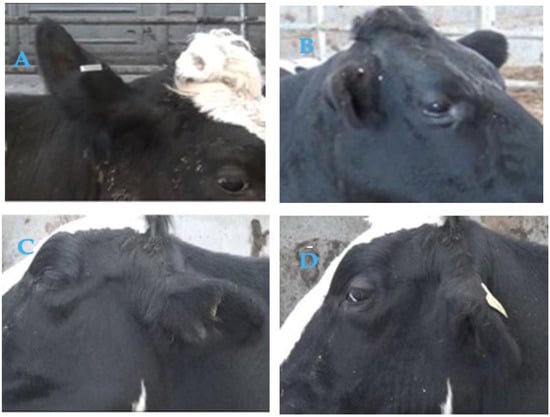
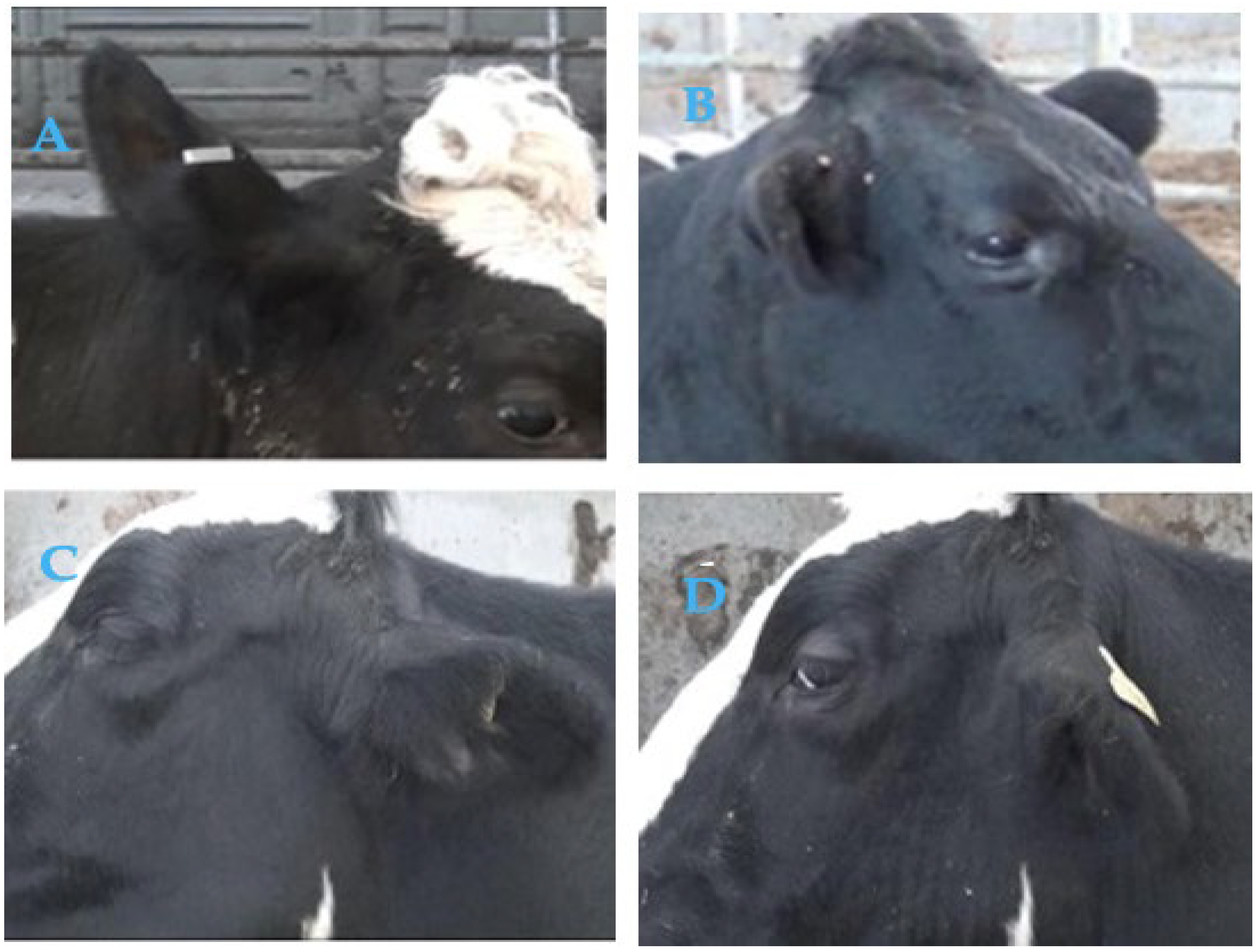
Figure 1.
Ear positions were classified as follows: Upright ear (A); Forward ear (B); Backward ear (C); Downward ear (D).
2.4. Physiological Measures
2.4.1. Rectal Temperature
Just after recording cow behaviour, each cow’s rectal temperature was recorded using a digital thermometer (Rossmax Thermometer TG-100, Rossmax International Ltd: 12F, No. 189, Kang Chien Road, Neihu District, Taipei City 114, Taiwan) with a precision of ±0.2 °F. Each cow was gently restrained inside the shed, and the tail was lifted with one hand to allow the thermometer to access the rectum. Any visible fecal matter was carefully wiped away before inserting the thermometer at a 45° angle to ensure proper contact with the rectal mucosa. The thermometer remained in place for about 60 s, or until it signalled completion with a beep, after which it was removed. All temperature readings were documented in °F.
2.4.2. Vaginal Temperature
After recording rectal temperature, the vaginal temperature of each cow was taken using a dedicated digital thermometer (Rossmax Thermometer TG-100, Rossmax International Ltd: 12F, No. 189, Kang Chien Road, Neihu District, Taipei City 114, Taiwan), distinct from that used for rectal readings. While the cow was manually restrained in the shed, the tail was gently moved aside. The thermometer probe was then inserted at a 45° angle into the vaginal canal to ensure proper contact with the vaginal mucosa and held in place for about 60 s, or until it signalled completion with a beep, after which it was withdrawn. Readings were then noted in °F.
2.4.3. Heart Rate
After recording vaginal temperature, the heart rate was assessed by placing a stethoscope (3M™ Littmann® Classic III™ Stethoscope, 3M Company, 3M Center, Building 225-4N-14, St. Paul, MN 55144-1000, USA) on the left side of the cow’s chest, just behind the elbow joint. This was done after ensuring that the cow was calm and in a comfortable position in the shed. The number of heartbeats heard through the stethoscope in one minute was counted and recorded as beats per minute (BPM).
2.4.4. Body Condition Score
Body condition score of each cow was assessed using the 5-point scale described by Ferguson et al. (1994) [39], where a score of 1 indicates an emaciated animal and 5 represents obesity. Each cow was evaluated visually and by touch, focusing on fat cover over the loin and tailhead regions.
2.5. Milk Production
The milk yield of each cow was recorded manually from the owner’s answer as part of our questionnaire on morning yield and total daily milk yield. Additional data were also recorded, such as the number of parities per cow and daily milking frequency.
2.6. Statistical Analysis
All data were taken in the data collection sheet individually and input into Microsoft Excel (Microsoft Corporation, One Microsoft Way, Redmond, WA 98052, USA). For each cow, behavioural data were summed across the two observation days. For each behaviour (e.g., kicking), the score represents the total number of observation sessions (maximum of 2) in which the behaviour was observed during the two-day period. While physiological data, THI, and production values were averaged over those same two days to yield a single data point per cow. Finally, data were input and analyzed using Minitab (v2022) (Minitab, LLC, State College, PA, USA). Descriptive statistics were generated as the mean, standard deviation, minimum, maximum, and median of each variable. Then, normality tests of each variable were conducted according to the Shapiro–Wilk test; a variable was considered normally distributed when p > 0.05. Most descriptive variables were determined by principal component analysis (PCA) using eigenvalues greater than 1 and loading coefficients greater than 0.3. Relationships between most descriptive variables were examined using Pearson correlation with a cut-off value for the relationship of p < 0.05. Finally, simple linear regression analysis was tested using production variables as responses and all other variables as predictors with a testing threshold of R2 < 0.15. Statistical significance was considered at p < 0.05.
3. Results
3.1. Descriptive Statistics of Recorded Variables
Under the current farm conditions of this small-scale dairy herd in Bangladesh, the average THI was 84.5, substantially exceeding the thermal comfort threshold for dairy cows (<72) [40], as presented in Table 2. This persistent heat stress was associated with a low average body condition score (2.8) and reduced daily milk yield (10.7 L). Despite these challenging environmental conditions, the cows maintained rectal (101.7 °F) and vaginal (101.3 °F) temperatures, as well as heart rates (65.9 beats per minute), within normal physiological ranges, suggesting some degree of thermoregulatory adaptation. However, behavioural indicators of stress were evident: frequent kicking (0.5) and sniffing (1.0). Additionally, cows ruminate fewer than twice per observation period, indicating decreased feeding activity and increased discomfort. This was further corroborated by a predominance of upright and forward ear positions compared to backward and downward ear positions (Table 2), highlighting the impact of heat stress on animal well-being.
Table 2.
Descriptive statistics of environmental conditions, cow demographics, physiology, milk yield performance, and behavioural indicators (evaluated 50 cows for two days).
3.2. Principal Component Analysis
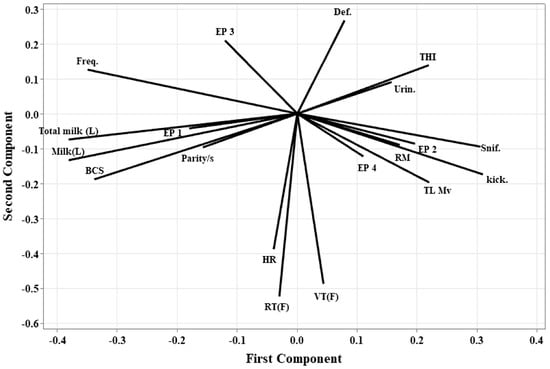
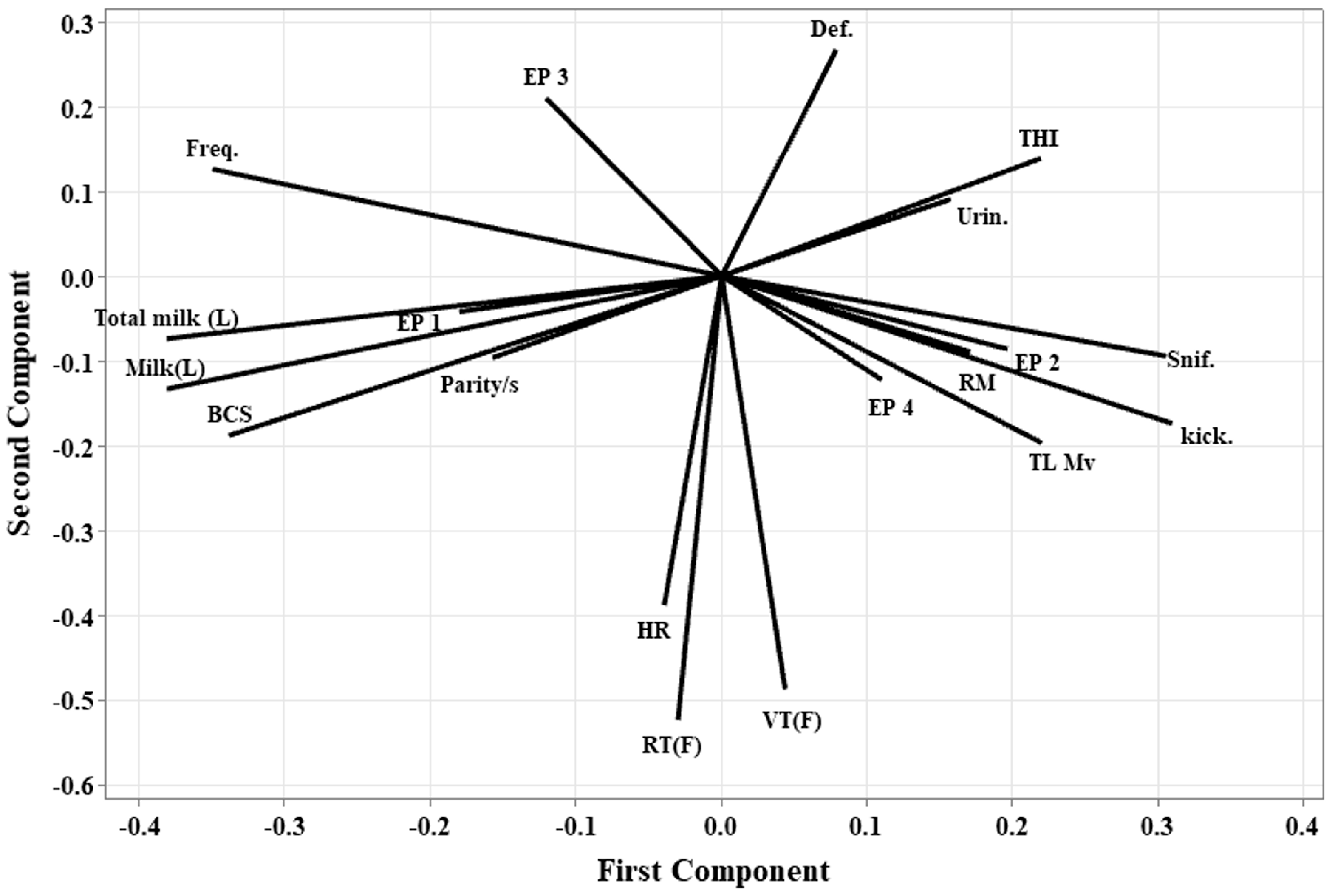
To uncover the relationships among the measured variables in a reduced dimensional space, principal component analysis (PCA) was performed using eighteen variables (Figure 2). Initially, six components with eigenvalues greater than 1 were identified, collectively explaining 80.6% of the total variance. However, only Components 1 and 2 contained qualifying variables with loading coefficients greater than 0.3. PCA indicates that THI, BCS, milk yield, body temperature, urination, defecation, and ear positions are the important parameters to investigate further.
Figure 2.
Loading coefficients of principal component analysis. Here, EP 1 = Upright ear position, EP 2 = Forward ear position, EP 3 = Backward ear position, EP 4 = Downward ear position, THI = Temperature humidity index, BCS = Body condition score, RM = Rumination, VT (F) = Vaginal temperature (°F), Def. = Defecation, Urin. = Urination, Kick. = kicking, TL Mv = Tail movement, Total milk (L) = Daily milk yield, Milk (L) = Milk yield in the morning, Snif. = Sniffing, Freq. = Milking frequency in a day, RT (F) = Rectal temperature (°F), HR = Heart rate (Beats per minute), and Parity/s = Number of parities.
Component 1 includes the variables BCS, milk yield in the morning, daily total milk yield, milking frequency, kicking, and sniffing (Table 3). In this component, BCS, milk yield in the morning, daily total milk yield, number of parities, and upright ear position are clustered together on the left lower-hand side of the graph and demonstrate that they correlate with each other: if one is decreased, then another will be decreased (Figure 2). In other words, THI and urination behaviour are clustered together on the right upper-hand side of the graph and demonstrate that if the THI and urination frequency are higher, then the BCS becomes low, and also decreases milk production.
Table 3.
Loading coefficients (>0.3) of variables for the two components generated by principal component analysis (n = 50).
3.3. Association of Variables
As shown in Table 4, the temperature-humidity index (THI) was negatively associated with milk production variables: milk yield in the morning (p = 0.02), whole day milk yield (p = 0.02), and milking frequency (p = 0.05), while BCS exhibited a positive correlation with those milk production variables (p < 0.05), and THI and BCS associated negatively (p < 0.001). Cows with a higher number of parities have no effect on the production of milk during morning milking, but they were less likely to urinate during our observations. Rectal and vaginal temperatures were positively correlated (p < 0.001), and rectal temperature was further positively associated with heart rate (p < 0.001). Sniffing, kicking, and tail movement were negatively associated with milk production variables (p < 0.05). Ear position showed a consistent relationship with milk production variables, where an upright ear position was positively associated with milk yield in the morning (p = 0.001), daily total milk yield (p < 0.001), and milking frequency(p = 0.001), whereas a forward ear position was negatively associated with those milk production variables (p < 0.05) (Table 4).
Table 4.
Correlations among behavioural, physiological, and milk production variables in dairy cows (Pearson correlation test at 95% confidence level).
3.4. Relationship Between Variables
As shown in the correlation analysis, simple linear regression analysis revealed the positive relationship between milk production and body condition score (Equation (1)), milk production and upright ear position (Equation (4)), milking frequency and upright ear position (Equation (8)), and milking frequency and body condition score (Equation (10)). In contrast, there was a negative relationship between milk production and kicking and sniffing behaviour (Equations (2) and (3), respectively), milking frequency, and kicking, sniffing, and tail movement behaviour (Equations (5)–(7), respectively), and milking frequency and forward ear position (Equation (9)).
Equation (1):
Daily Milk Yield = −10.41 + 5.906 Body Condition Score (R2 = 55.31%, p = 0.000)
Equation (2):
Daily Milk Yield = 7.36 − 2.808 Kicking (R2 = 26.16%, p = 0.000)
Equation (3):
Daily Milk Yield = 7.81 − 1.795 Sniffing (R2 = 26.16%, p = 0.000)
Equation (4):
Daily Milk Yield = 4.47 + 2.270 Upright Ear Position (R2 = 20.79%, p = 0.001)
Equation (5):
Milking frequency = 2.49 − 0.695 Kicking (R2 = 21.91%, p = 0.001)
Equation (6):
Milking frequency = 2.57 − 0.405 Sniffing (R2 = 16.90%, p = 0.003)
Equation (7):
Milking frequency = 3.47 − 0.764 Tail movement (R2 = 20.19%, p = 0.001)
Equation (8):
Milking frequency = 1.72 + 0.649 Upright Ear Position (R2 = 21.63%, p = 0.001)
Equation (9):
Milking frequency = 2.81 − 0.650 Forward Ear Position (R2 = 20.75%, p = 0.001)
Equation (10):
Milking frequency = −0.89 + 1.098 Body Condition Score (R2 = 24.30%, p = 0.000)
4. Discussion
This study aimed to address a crucial knowledge gap by examining how dairy cows’ emotional responses, including behavioural and physiological responses, are influenced by their environment and everyday management practices in smallholder dairy farming systems typical of developing countries. The focus was on how these emotional cues relate to milk production outcomes. The guiding hypothesis suggested that common challenges in these settings, such as limited resources and exposure to environmental stress, particularly higher temperature-humidity index (THI), could significantly affect both the cows’ emotional well-being and their productivity. The key findings indicate that stress-related behaviours during milking, such as forward ear position, kicking, and sniffing, were linked to lower milk production, while upright ear position (positive emotion) was linked to higher milk yields. Similarly, body condition score (BCS) was positively associated with daily milk yield and milking frequency, while negatively associated with the THI.
Lange et al. (2021) also noted that upright ear positions (EP1) in cows are linked to negative emotions, while forward ear position as well as relaxed ear position indicate positive emotional states of the cow [38]. In this study, we observed that there is a positive correlation between upright ear position and milk yield and milking frequency, and the frequent ear posture with upright positioning during milking indicates a positive emotional state rather than a negative emotional state. Whenever forward ear position and milk yield in milking cows during their milking have a negative correlation, it indicates a negative emotional state rather than a positive emotional state. In this study, cows are milked manually and subjected to human intervention during the milking process. Therefore, cows that are milked more frequently tend to exhibit a more frequent upright ear position, which suggests a positive emotional state in milking cows, and that they feel happy rather than stressed while yielding a large amount of milk. Goma et al. (2018) observed that cows showing upright or forward ear postures tended to walk briskly without turning their heads to observe the person, behaviour indicative of heightened arousal or vigilance [7]. The work of Lange et al. (2021) highlighted specific ear postures as meaningful indicators of emotional states in dairy cows [38]. Their findings suggest that backward and downward ear positions correspond to calm and positive emotions. The positive correlation between upright ear position exhibition during milking and milk yield in this study further implies that upright ear positioning during milking may have a positive emotional link. The current study’s interpretation of ear postures as reflections of emotional states is consistent with earlier research. Boissy et al. (2011) emphasized that ear positioning is a crucial indicator of internal affect and social signalling across various animal species [41].
Uddin et al. (2021) reported that there is a positive association between rectal temperature and sniffing behaviour, and noted that sniffing behaviour is indicative of anxiety in dairy cows faced with challenging environments [31]. This study does not find any positive association between the rectal temperature and sniffing behaviour, but sniffing has a negative effect on milk yield during milking. Goma et al. (2018) also observed that anxious cows were more likely to sniff the ground when passing unfamiliar individuals in familiar pathways on their way back from milking to feeding areas [7].
The results reveal that small-scale dairy farms in Bangladesh contend with environmental conditions characterized by a Temperature-Humidity Index (THI) significantly exceeding the thermoneutral threshold for dairy cattle, with an average of 84.8. This elevated THI was associated with lower body condition scores (BCS) and reduced milk production, highlighting the physiological strain caused by heat stress. Negative correlations between THI and both milk output and BCS further supported this relationship. These findings underscore the urgent need for modifications in housing systems, including more space, shade, and opportunities for cows to cool down.
The heightened THI levels recorded on Bangladeshi small-scale dairy farms seem to reflect the broader impacts of global climate change. Human-driven activities, such as fossil fuel combustion and deforestation, have increased greenhouse gas concentrations, intensified the greenhouse effect, and accelerated global warming. Consequently, ambient temperatures and humidity levels have risen, directly affecting livestock thermal comfort. In dairy cattle, a THI below 72 is generally considered within the thermoneutral range, while values between 72 and 79 indicate mild heat stress, 80 to 89 represent moderate stress, and readings above 90 suggest severe heat stress responses [42].
In smallholder dairy systems throughout developing countries, cows are often tethered indoors for extended periods. THI values in this study were recorded in the morning; however, it is likely that temperatures and humidity increased in the afternoon and evening as solar radiation intensified. Under such conditions, cows must expend additional energy to regulate their core body temperature within the thermoneutral range [15]. This thermoregulatory burden negatively affects their behaviour, leading to reduced feed intake and rumination, which in turn contribute to lower milk production and decreased metabolic heat output [15]. Similar outcomes were reported by Magrin et al. (2017), where calves exposed to optimal THI levels exhibited increased feeding activity and rumination, while those in environments with THI ≥ 74 showed declines in both behaviours [43]. Correa-Calderón et al. (2022) also found that cattle under heat stress conditions consumed less feed compared to those in cooler, more comfortable environments [44].
Consistent with patterns observed in heat-stress environments, most cows in this study exhibited lower-than-ideal body condition scores and diminished milk output. Interestingly, key physiological indicators: rectal and vaginal temperatures, as well as heart rate, remained within normal limits, suggesting that the cows were able to maintain thermal balance despite the environmental strain. As homeotherms, they appeared to regulate their internal states through behavioural adaptations.
Our results align with previous research showing that prolonged exposure to heat stress negatively affects feed intake and milk production [45,46,47], as well as growth performance and overall animal welfare [16,48]. Heat stress has also been associated with reduced fertility, weakened immune responses, and compromised health, with severe cases potentially leading to mortality and significant economic losses [49,50].
Interestingly, this study suggests that more productive cows may suffer more under extreme environmental conditions: healthier cows with higher BCS produce milk more frequently but also show increased signs of stress, such as an upright ear position, particularly in higher THI scenarios. Similar to our findings, Goma et al. (2018) reported that anxious cows, which tend to view unfamiliar people with their left eye, which is connected to the right hemisphere of the brain where the fight-or-flight centre is located, produced more milk but with lower fat content [7]. Additionally, Rizhova and Kokorina (2005) found that cows with access to high-quality feed that see a feeder approaching from their left side (left eye view) typically produce more milk than those viewing it from their right [51]. We hypothesize that this anxiety can disrupt the milk letdown process, leading to a retention of more residual milk in the udder and, consequently, lower fat content in the milk produced. Therefore, it is clear that high-yielding cows are more sensitive to stress.
5. Limitations of the Study
This study evaluated 50 cows from a limited area, and data were collected once a day for two days; the findings of this study may limit the broader applicability across diverse farm settings. In the future, researchers should study more cows from different farms, use additional ways to measure stress via determining stress hormone levels in blood, and collect information at different times of the day over months. The one-zero behavioural recording system is quick and straightforward, but it does not capture the frequency of behaviours and may reduce accuracy. Therefore, it is best suited for initial observations or identifying broad behavioural trends. For precise analysis, we recommend monitoring a continuous behavioural record, including frequency or duration of behaviour. It will also be important to consider variability in video quality of the recorded cow behaviour and its subjective interpretation, and the specific breeds of cows being studied. In addition, given the exploratory nature of our study and the biological relevance of the selected variables, we aimed to provide a comprehensive initial assessment. However, we agree that future studies with larger sample sizes or the application of model selection techniques such as stepwise regression based on AIC would enhance the robustness and generalizability of the findings.
6. Conclusions
This study highlights the significant impact of environmental and management factors on the emotional well-being and productivity of dairy cows in smallholder farms in developing countries. Key findings indicate that heat stress, as measured by the high temperature-humidity index, negatively affects both milk yield and cow welfare, with behavioural and physiological responses such as ear position, body temperature, and rectal and/or vaginal temperature serving as valuable indicators of stress and emotional state. The results emphasize the necessity to improve housing conditions and adopt stress-mitigation strategies to support both animal welfare and farm productivity in the smallholder dairy farms in developing countries.
Author Contributions
M.I.Z.M.: Conceptualisation, methodology, investigation, visualization, writing—original draft, writing—review and editing, supervision. J.U.: Conceptualisation, methodology, funding acquisition, resources, investigation, visualization, writing—review and editing, supervision. M.N.A.: Methodology, visualization, writing—original draft, validation, data curation, formal analysis, writing—review and editing. A.U.: Methodology, data collection, investigation, writing—original draft. R.H.: Methodology, data collection, investigation. A.A.G.: Methodology, formal analysis, data curation, writing—review and editing. M.M.R.: Conceptualisation, visualization, writing—review and editing. M.R.I.: Methodology, resources, data collection, investigation. All authors have read and agreed to the published version of the manuscript.
Funding
This research was funded by the Faculty of Veterinary and Animal Sciences at the University of Rajshahi during the financial year 2022–2023, under the direction of Jashim Uddin.
Institutional Review Board Statement
This study was approved by the Institutional Animal, Medical Ethics, Biosafety, and Biosecurity Committee (IAMEBBC) of the Institute of Biological Sciences, University of Rajshahi, Bangladesh, following the institution’s ethical guidelines (Protocol code: 274/320(74)/IAMEBBC/IBSc), and the date of approval was 18 May 2023.
Informed Consent Statement
All procedures involving privately owned animals were conducted with the informed consent of the owners and in accordance with relevant institutional and national guidelines.
Data Availability Statement
The original contributions presented in this study are included in the article. Further inquiries can be directed to the corresponding authors.
Acknowledgments
The authors are grateful to the farmers and the evaluated cows included in this study.
Conflicts of Interest
The authors declare no conflicts of interest.
References
- Adolphs, R. How should neuroscience study emotions? By distinguishing emotion states, concepts, and experiences. Soc. Cogn. Affect. Neurosci. 2017, 12, 24–31. [Google Scholar] [CrossRef] [Scilit]
- Désiré, L.; Boissy, A.; Veissier, I. Emotions in farm animals: A new approach to animal welfare in applied ethology. Behav. Process. 2020, 60, 165–180. [Google Scholar] [CrossRef] [Scilit]
- Mendl, M.; Burman, O.H.P.; Paul, E. An integrative and functional framework for the study of animal emotion and mood. Proc. R. Soc. B Biol. Sci. 2010, 277, 2895–2904. [Google Scholar] [CrossRef] [Scilit] [PubMed]
- Tamioso, P.R.; Molento, C.F.M.; Boivin, X.; Chandèze, H.; Andanson, S.; Delval, É.; Hazard, D.; da Silva, G.P.; Taconeli, C.A.; Boissy, A. Inducing positive emotions: Behavioural and cardiac responses to human and brushing in ewes selected for high vs low social reactivity. Appl. Anim. Behav. Sci. 2018, 208, 56–65. [Google Scholar] [CrossRef] [Scilit]
- Forkman, B.; Boissy, A.; Meunier-Salaün, M.C.; Canali, E.; Jones, R.B. A critical review of fear tests used on cattle, pigs, sheep, poultry and horses. Physiol. Behav. 2007, 92, 340–374. [Google Scholar] [CrossRef] [Scilit] [PubMed]
- Proctor, H.S. Animal Sentience: Where Are We and Where Are We Heading? Animals 2012, 2, 628–639. [Google Scholar] [CrossRef] [Scilit]
- Goma, A.A.; Pearce, G.P.; Uddin, J.; Rimon, E.; Davies, H.; Phillips, C.J.C. A forced lateralisation test for dairy cows and its relation to their behaviour. Appl. Anim. Behav. Sci. 2018, 207, 8–19. [Google Scholar] [CrossRef] [Scilit]
- Phillips, C.J.C.; Oevermans, H.; Syrett, K.L.; Jespersen, A.Y.; Pearce, G.P. Lateralization of behavior in dairy cows in response to conspecifics and novel persons. J. Dairy Sci. 2015, 98, 2389–2400. [Google Scholar] [CrossRef] [Scilit] [PubMed]
- Morgan, K.N.; Tromborg, C.T. Sources of stress in captivity. Appl. Anim. Behav. Sci. 2006, 102, 262–302. [Google Scholar] [CrossRef] [Scilit]
- Siebert, K.; Langbein, J.; Schön, P.C.; Tuchscherer, A.; Puppe, B. Degree of social isolation affects behavioural and vocal response patterns in dwarf goats (Capra hircus). Appl. Anim. Behav. Sci. 2011, 131, 53–62. [Google Scholar] [CrossRef] [Scilit]
- Lambert, H.; Carder, G. Positive and negative emotions in dairy cows: Can ear postures be used as a measure? Behav. Process. 2019, 158, 172–180. [Google Scholar] [CrossRef] [Scilit]
- Mills, D.S. The Encyclopedia of Applied Animal Behaviour and Welfare; CABI: Wallingford, UK, 2010. [Google Scholar]
- Grillon, C. Startle reactivity and anxiety disorders: Aversive conditioning, context, and neurobiology. Biol. Psychiatry 2002, 52, 958–975. [Google Scholar] [CrossRef] [Scilit] [PubMed]
- Lee, C.; Cafe, L.M.; Robinson, S.L.; Doyle, R.E.; Lea, J.M.; Small, A.H.; Colditz, I.G. Anxiety influences attention bias but not flight speed and crush score in beef cattle. Appl. Anim. Behav. Sci. 2018, 205, 210–215. [Google Scholar] [CrossRef] [Scilit]
- Osei-Amponsah, R.; Dunshea, F.R.; Leury, B.J.; Cheng, L.; Cullen, B.; Joy, A.; Abhijith, A.; Zhang, M.H.; Chauhan, S.S. Heat stress impacts on lactating cows grazing australian summer pastures on an automatic robotic dairy. Animals 2020, 10, 869. [Google Scholar] [CrossRef] [Scilit] [PubMed]
- Silva, W.C.; Silva, J.A.R.; Camargo-Júnior, R.N.C.; Silva, É.B.R.; Santos, M.R.P.; Viana, R.B.; Silva, A.G.M.; Silva, C.M.G.; Lourenço-Júnior, J.B. Animal welfare and effects of per-female stress on male and cattle reproduction—A review. Front. Vet. Sci. 2023, 10, 1083469. [Google Scholar] [CrossRef] [Scilit] [PubMed]
- West, J.W. Effects of heat-stress on production in dairy cattle. J. Dairy Sci. 2003, 86, 2131–2144. [Google Scholar] [CrossRef] [Scilit]
- Fell, L.R.; Colditz, I.G.; Walker, K.H.; Watson, D.L. Associations between temperament, performance and immune function in cattle entering a commercial feedlot. Aust. J. Exp. Agric. 1999, 39, 795–802. [Google Scholar] [CrossRef] [Scilit]
- Goff, J.P.; Kimura, K.; Horst, R.L. Effect of mastectomy on milk fever, energy, and vitamins A, E, and β-carotene status at parturition. J. Dairy Sci. 2002, 85, 1427–1436. [Google Scholar] [CrossRef] [Scilit] [PubMed]
- Kilgour, R.J.; Melville, G.J.; Greenwood, P.L. Individual differences in the reaction of beef cattle to situations involving social isolation, close proximity of humans, restraint and novelty. Appl. Anim. Behav. Sci. 2006, 99, 21–40. [Google Scholar] [CrossRef] [Scilit]
- Gibbons, J.M.; Lawrence, A.B.; Haskell, M.J. Consistency of flight speed and response to restraint in a crush in dairy cattle. Appl. Anim. Behav. Sci. 2011, 131, 15–20. [Google Scholar] [CrossRef] [Scilit]
- Hulbert, L.E.; Moisá, S.J. Stress, immunity, and the management of calves. J. Dairy Sci. 2016, 99, 3199–3216. [Google Scholar] [CrossRef] [Scilit] [PubMed]
- Baragli, P.; Yngvesson, J.; Gentili, C.; Lanata, A. Editorial: Emotions and emotional interplay within and between species: A “one welfare” perspective. Front. Vet. Sci. 2022, 9, 1011214. [Google Scholar] [CrossRef] [Scilit] [PubMed]
- Herborn, K.A.; Jerem, P.; Nager, R.G.; McKeegan, D.E.F.; McCafferty, D.J. Surface temperature elevated by chronic and intermittent stress. Physiol. Behav. 2018, 191, 47–55. [Google Scholar] [CrossRef] [Scilit]
- Yaribeygi, H.; Panahi, Y.; Sahraei, H.; Johnston, T.P.; Sahebkar, A. The impact of stress on body function: A review. EXCLI J. 2017, 16, 1057–1072. [Google Scholar] [CrossRef] [Scilit] [PubMed]
- Herman, J.P.; McKlveen, J.M.; Ghosal, S.; Kopp, B.; Wulsin, A.; Makinson, R.; Scheimann, J.; Myers, B. Regulation of the Hypothalamic-Pituitary-Adrenocortical Stress Response. Compr. Physiol. 2016, 6, 603–621. [Google Scholar] [CrossRef] [Scilit]
- Vianna, D.M.; Carrive, P. Changes in cutaneous and body temperature during and after conditioned fear to context in the rat. Eur. J. Neurosci. 2005, 21, 2505–2512. [Google Scholar] [CrossRef] [Scilit] [PubMed]
- Fernandes, G.; Lam, R.; Park, J.; Drummond, G.T.; Sur, M. Noradrenaline Regulation of Brain-Body Communication. Adv. Exp. Med. Biol. 2025, 1477, 35–61. [Google Scholar] [CrossRef] [Scilit] [PubMed]
- Uddin, J.; Phillips, C.J.C.; Goma, A.A.; McNeill, D.M. Relationships between infrared temperature and laterality. Appl. Anim. Behav. Sci. 2019, 220, 104855. [Google Scholar] [CrossRef] [Scilit]
- Uddin, J.; McNeill, D.M.; Lisle, A.T.; Phillips, C.J.C. A sampling strategy for the determination of infrared temperature of relevant external body surfaces of dairy cows. Int. J. Biometeol. 2020, 64, 1583–1592. [Google Scholar] [CrossRef] [Scilit] [PubMed]
- Uddin, J.; Phillips, C.J.C.; Auboeuf, M.; McNeill, D.M. Relationships between body temperatures and behaviours in lactating dairy cows. Appl. Anim. Behav. Sci. 2021, 241, 105359. [Google Scholar] [CrossRef] [Scilit]
- Rzucidlo, C.L.; Curry, E.; Shero, M.R. Non-invasive measurements of respiration and heart rate across wildlife species using Eulerian Video Magnification of infrared thermal imagery. BMC Biol. 2023, 21, 61. [Google Scholar] [CrossRef] [Scilit] [PubMed]
- Eigenberg, R.A.; Hahn, G.L.; Nienaber, J.A.; Brown-Brandl, T.; Spiers, D. Development of a new respiration rate monitor for cattle. Trans. ASAE 2000, 43, 723–728. [Google Scholar] [CrossRef] [Scilit]
- Lees, A.A.; Lea, J.M.; Salvin, H.E.; Lefcourt, A.M.; Erez, B.; Varner, M.A.; Barfield, R.; Tasch, U. A noninvasive radiotelemetry system to monitor heart rate for assessing stress responses of bovines. J. Dairy Sci. 1999, 82, 1179–1187. [Google Scholar] [CrossRef] [Scilit] [PubMed]
- Stewart, M.; Webster, J.R.; Schaefer, A.L.; Cook, N.J.; Scott, S.L. Infrared thermography as a non-invasive tool to study animal welfare. Anim. Welf. 2005, 14, 319–325. [Google Scholar] [CrossRef] [Scilit]
- Buffington, D.E.; Collier, R.J.; Canton, G.H. Shade management systems to reduce heat stress for dairy cows in hot, humid climates. Trans. ASAE 1983, 26, 1798–1802. [Google Scholar] [CrossRef] [Scilit]
- Melby, M.C. Evaluating human injury risk during interactions with unhealthy Holstein cows. J. Anim. Sci. 2024, 102, 485–486. [Google Scholar] [CrossRef] [Scilit]
- Lange, A.; Waiblinger, S.; van Hasselt, R.; Mundry, R.; Futschik, A.; Luerzel, S. Effects of restraint on heifers during gentle human-animal interactions. Appl. Anim. Behav. Sci. 2021, 243, 105445. [Google Scholar] [CrossRef] [Scilit]
- Ferguson, J.D.; Galligan, D.T.; Thomsen, N. Principal descriptors of body condtion score in Holstein cows. J. Dairy Sci. 1994, 77, 2695–2703. [Google Scholar] [CrossRef] [Scilit] [PubMed]
- Bhateshwar, V.; Rai, D.C.; Datt, M. Heat stress responses in small ruminants under arid and semi-arid regions of western India: A Review. Agric. Rev. 2022, 4, 164–172. [Google Scholar] [CrossRef] [Scilit]
- Boissy, A.; Aubert, A.; Désiré, L.; Greiveldinger, L.; Delval, E.; Veissier, I. Cognitive sciences to relate ear postures to emotions in sheep. Anim. Welf. 2011, 20, 47–56. [Google Scholar] [CrossRef] [Scilit]
- Dimov, D.; Penev, T.; Marinov, I. Temperature-humidity index–an indicator for prediction of heat stress in dairy cows. Vet. IR Zootech. 2020, 78, 10–15. [Google Scholar]
- Magrin, L.; Brscic, M.; Lora, I.; Rumor, C.; Tondello, L.; Cozzi, G.; Gottardo, F. Effect of a ceiling fan ventilation system on finishing young bulls’ health, behaviour and growth performance. Animal 2017, 11, 1084–1092. [Google Scholar] [CrossRef] [Scilit] [PubMed]
- Correa-Calderón, A.; Avendaño-Reyes, L.; López-Baca, M.; Macías-Cruz, U. Heat stress in dairy cattle with emphasis on milk production and feed and water intake habits. Review. Rev. Mex. Cienc. Pecu. 2022, 13, 488–509. [Google Scholar]
- Giannone, C.; Bovo, M.; Ceccarelli, M.; Torreggiani, D.; Tassinari, P. Review of the Heat Stress-Induced Responses in Dairy Cattle. Animals 2023, 13, 3451. [Google Scholar] [CrossRef] [Scilit] [PubMed]
- Thornton, P.; Nelson, G.; Mayberry, D.; Herrero, M. Impacts of heat stress on global cattle production during the 21st century: A modelling study. Lancet Planet. Health 2022, 6, 192–201. [Google Scholar] [CrossRef] [Scilit]
- Iqbal, A.; Qudoos, A.; Bayram, I.; Tytariova, O.; Bomko, V.; Kuzmenko, O.; Cherniavskyi, O. Heat stress in dairy cows. Technol. Prod. Process. Livest. Prod. 2021. [Google Scholar] [CrossRef] [Scilit]
- Wankar, A.K.; Rindhe, S.N.; Doijad, N.S. Heat stress in dairy animals and current milk production trends, economics, and future perspectives: The global scenario. Trop. Anim. Health Prod. 2021, 53, 70. [Google Scholar] [CrossRef] [Scilit] [PubMed]
- Tariq, A.; Bromfield, J.J. Heat stress: An environmental challenge to immune resilience and health in dairy cows. Front. Anim. Sci. 2026, 7, 1755098. [Google Scholar] [CrossRef] [Scilit]
- Lacerda, T.; Loureiro, B. Selecting thermotolerant animals as a strategy to improve fertility in Holstein cows. Glob. J. Anim. Sci. Res. 2015, 3, 119–127. [Google Scholar] [CrossRef] [Scilit] [PubMed]
- Rizhova, L.Y.; Kokorina, E.P. Behavioural asymmetry is involved in regulation of autonomic processes: Left side presentation of food improves reproduction and lactation in cows. Behav. Brain Res. 2005, 161, 75–81. [Google Scholar] [CrossRef] [Scilit] [PubMed]

Disclaimer/Publisher’s Note: The statements, opinions and data contained in all publications are solely those of the individual author(s) and contributor(s) and not of MDPI and/or the editor(s). MDPI and/or the editor(s) disclaim responsibility for any injury to people or property resulting from any ideas, methods, instructions or products referred to in the content. |
© 2026 by the authors. Licensee MDPI, Basel, Switzerland. This article is an open access article distributed under the terms and conditions of the Creative Commons Attribution (CC BY) license.