


Abstract
Reaching net-zero emissions requires more than displacing fossil combustion with renewable electricity; several of the largest industrial emitters—cement, steel, chemicals, and aviation—cannot be fully electrified with current technology, and captured carbon dioxide (CO2) itself must find a productive destination rather than remain a permanent liability. Converting CO2 into formic acid (HCOOH) has emerged as one of the more mature answers to that second problem. Formic acid combines a respectable hydrogen content (4.4 wt%), a stable liquid state at ambient conditions, and comparatively benign handling relative to gaseous or cryogenic hydrogen, positioning it as both a chemical feedstock and an energy carrier. This review synthesizes the current state of CO2-to-HCOOH conversion across thermochemical, electrochemical, photocatalytic, and biocatalytic routes; examines formic acid’s performance as a liquid organic hydrogen carrier (LOHC) and direct fuel-cell fuel; and evaluates the technology through a recently published pilot-scale case study of a photocatalytic reactor, branded RK-X, developed by the author’s employer—presented here as a single illustrative example rather than a representative benchmark—to show both the promise and the unresolved energetic and economic questions still facing the field. We conclude that formic acid-based CO2 utilization is technically credible and policy-relevant, but that claims of net energy or carbon benefit must be assessed pathway-by-pathway, powered overwhelmingly by low-cost renewable electricity, and confirmed through independent life-cycle assessment before the technology can be considered a settled pillar of the net-zero toolkit.
1. Introduction
The net-zero transition is often narrated as a story about electricity: replace coal and gas power plants with wind, solar, and storage, and electrify transport and heating on top. That narrative is accurate for a large share of global emissions, but it leaves an awkward remainder. Cement, steel, chemicals, and aviation together account for roughly a third of global CO2 emissions, and each faces process chemistry or energy-density requirements that renewable electricity alone does not solve. For these hard-to-abate sectors, carbon capture is frequently the only near-term lever available—but capture only becomes economically self-sustaining once the captured CO2 has somewhere useful to go.
This is the distinction between carbon capture and storage (CCS) and carbon capture and utilization (CCU). CCS treats CO2 as waste to be sequestered permanently underground; it reduces emissions but generates no direct revenue and requires durable, publicly underwritten infrastructure. CCU instead treats CO2 as a feedstock, converting it into marketable fuels, chemicals, or materials and thereby creating an economic incentive to capture it in the first place. Reframing carbon as a resource rather than a liability is the conceptual core of what is increasingly called the circular carbon economy: a system in which carbon already in circulation is cycled through value chains instead of being extracted anew from the ground and released once [1].
Among the many CO2-derived products under investigation, formic acid occupies an unusually favorable niche. It has an established industrial market as a preservative, antibacterial agent, and animal-feed additive, so a portion of any new production capacity does not depend on new demand being created from scratch. More importantly for the net-zero conversation, formic acid contains 4.4 wt% hydrogen, releases that hydrogen through mild catalytic dehydrogenation, and remains a stable, transportable liquid under ordinary ambient conditions—a combination that positions it as both a chemical product in its own right and a liquid organic hydrogen carrier (LOHC) for a hydrogen economy that still lacks cheap, safe, energy-dense storage and transport options.
Formic acid is not the only liquid e-fuel competing for attention and renewable electricity in this space. Green methanol and e-methane (synthetic methane from CO2 methanation) are both further along in announced commercial capacity and already ride on existing chemical and gas-grid infrastructure, while green ammonia is being pursued chiefly as a hydrogen carrier and marine fuel. Formic acid enters this competition from a much smaller demand base: global formic acid consumption is on the order of 0.8–1 Mt per year [2], roughly two orders of magnitude below methanol demand. That smaller market cuts both ways for a net-zero assessment—it means CO2-to-formic-acid conversion can realistically absorb only a low single-digit share of the multi-gigatonne CO2 streams that hard-to-abate sectors need to manage, even at full market saturation, but it also means new capacity is comparatively easy to site against existing, non-speculative demand while the broader market for CO2-derived fuels continues to grow.
This review has three aims: first, to summarize the principal routes by which CO2 is converted to formic acid—thermochemical hydrogenation, electrochemical reduction, photocatalysis, and biocatalysis—and the catalytic advances that have brought each closer to industrial relevance; second, to examine formic acid’s downstream role as a hydrogen carrier and direct fuel-cell fuel, and to compare it honestly against competing carriers; and third, to use a recently published pilot-scale engineering study of a photocatalytic reactor (the RK-X platform) as a critical, single-case illustration of what “scaling up” CO2-to-formic-acid conversion looks like in practice, reading comparatively against the other three routes surveyed in Section 3 and including the parts of that story that remain unresolved or unverified by independent parties. The intention throughout is not to present formic acid as a silver bullet, but to give as accurate a picture as the current literature allows of where this chemistry can realistically contribute to a net-zero world, and where it cannot yet.
This review follows a narrative rather than a systematic design, appropriate for a focused synthesis of one bridge chemical rather than an exhaustive meta-analysis of CO2 utilization. Sources were located through Web of Science, Scopus, and Google Scholar searches (through July 2026) by combining terms such as formic acid, CO2 utilization, CO2 hydrogenation, electrochemical and photocatalytic CO2 reduction, liquid organic hydrogen carriers, and techno-economic or life-cycle assessment, supplemented by patent and industry-report searches and by citation-chasing from key papers. Peer-reviewed studies from 2014 onward reporting quantitative performance, cost, or life-cycle data were prioritized, alongside a small number of earlier foundational papers and current policy documents needed for context.
2. Why Formic Acid? The Physicochemical Case for a CO2-Derived Energy Vector
Any candidate hydrogen carrier is judged against a small set of practical criteria: how much hydrogen it holds by weight and by volume, whether it is liquid (and therefore compatible with existing tanker, pipeline, and fueling infrastructure) at ordinary temperature and pressure, how toxic or flammable it is, and how much energy is lost charging and discharging the carrier. Table 1 places formic acid alongside methanol, ammonia, a representative aromatic LOHC (toluene/methylcyclohexane), and compressed hydrogen gas [3,4,5].
Table 1.
Formic acid against competing hydrogen carriers.
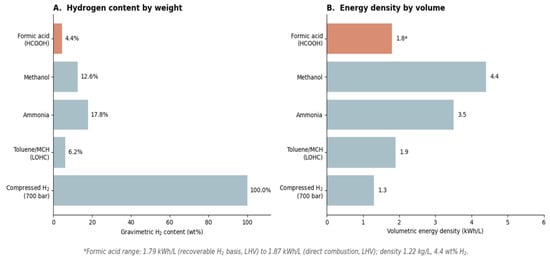
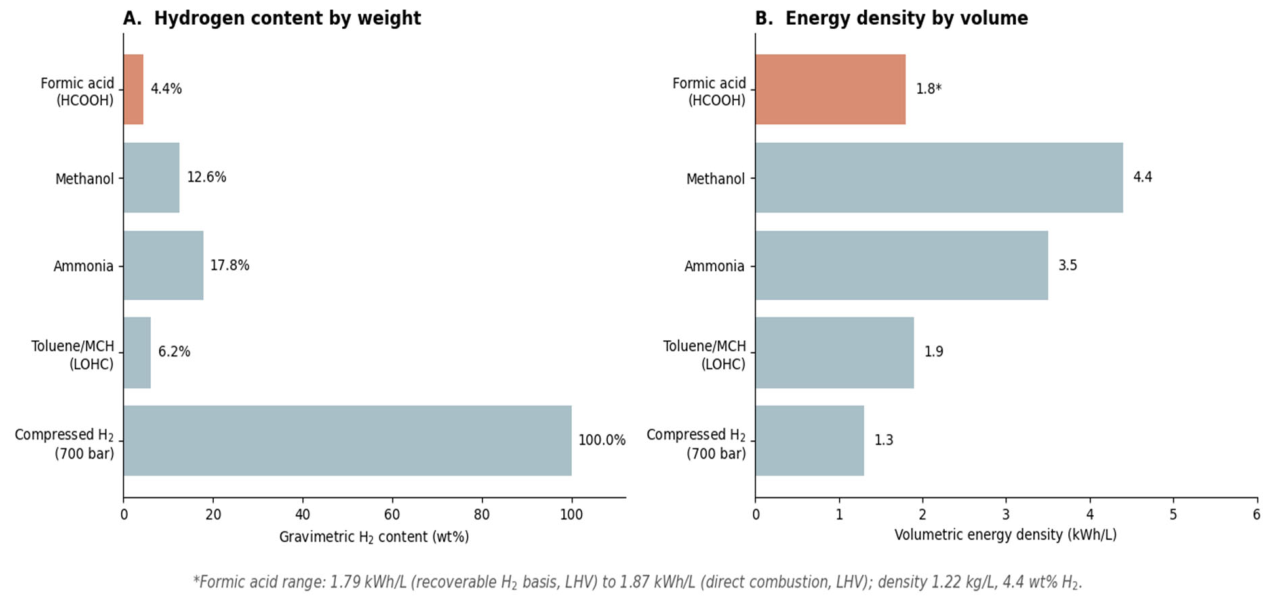
Formic acid does not win outright on any single metric as seen in Figure 1. Its gravimetric hydrogen content is the lowest of the liquid carriers shown, and it is corrosive enough to require compatible materials of construction. Its case rests instead on the combination of properties: it is non-flammable under most storage conditions, it dehydrogenates at far lower temperatures (60−120 °C) than aromatic LOHCs (which typically require 300 °C or more), and unlike ammonia it is not acutely toxic at the concentrations typically handled. The low-temperature release is particularly relevant to a circular energy system, since it can be driven by waste heat recovered from a fuel cell rather than by additional primary energy input.
Figure 1.
Formic acid trades hydrogen density for handling simplicity.
3. Production Pathways from CO2 to Formic Acid
Four broad families of chemistry convert CO2 into formic acid or its conjugate base, formate: thermochemical catalytic hydrogenation, electrochemical reduction, photocatalysis, and biocatalysis [6]. Table 2 summarizes typical operating conditions and representative performance benchmarks reported for each; the subsections that follow discuss the underlying chemistry and recent advances.
Table 2.
Operating conditions, representative performance, and main bottlenecks for the four CO2-to-formic-acid production pathways.
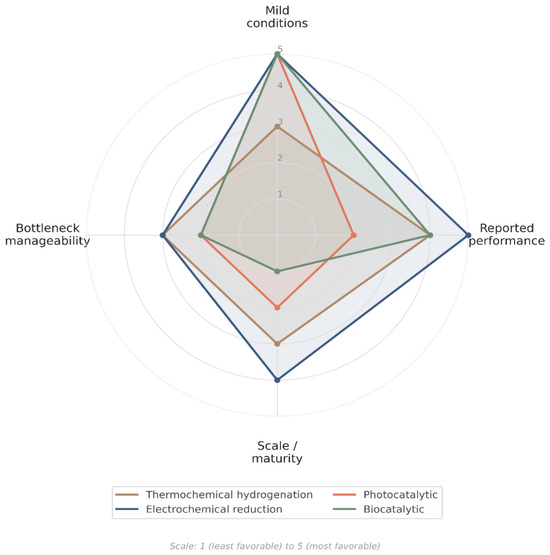
Figure 2 synthesizes these same qualitative comparisons across four dimensions to make the trade-offs between pathways visually explicit. No single pathway dominates: electrochemical reduction is the most balanced performer, while the photocatalytic and biocatalytic routes trade scale and maturity for milder operating conditions.
Beyond the qualitative comparison in Figure 2, it is useful to sketch the technological arrangement each pathway implies. Thermochemical hydrogenation calls for a pressure-rated stirred-tank or trickle-bed reactor fed with compressed H2 and CO2 (30–50 bar, 30–80 °C), followed by a flash separator that recycles unreacted gas to the reactor inlet and downstream distillation/extraction to concentrate the aqueous formic acid product, with spent ionic liquid or leached metal as the main waste stream requiring disposal; the hazard here is dominated by the compressed hydrogen inventory and rises with both operating pressure and temperature. Electrochemical reduction instead uses an electrolyzer stack (gas-diffusion cathode, ion-exchange membrane, anode compartment evolving O2) run near ambient temperature and pressure, with a separator recovering formate/formic acid from the catholyte and a recycle loop returning unconverted CO2 and electrolytes to the stack; its hazards are chiefly electrical and chemical (corrosive electrolyte) rather than pressure-related. Photocatalytic and biocatalytic reactors follow the same generic block flow—illuminated or enzyme-loaded reactor, product separator, recycle of unconverted CO2 and catalyst/enzyme, disposal of spent catalyst or cofactor—but at ambient temperature and pressure, their hazard profile is comparatively mild, with light penetration and catalyst/enzyme lifetime being the binding practical constraints rather than containment of a pressurized or corrosive stream.
3.1. Thermochemical (Catalytic) Hydrogenation
Direct hydrogenation of CO2 with molecular H2 is thermodynamically uphill in the gas phase but becomes favorable in solution, particularly in the presence of a base or an appropriately designed catalyst. Homogeneous catalysts built around ruthenium, iridium, and increasingly iron have been studied for decades; a longstanding challenge has been that many such systems require a stoichiometric base to pull the equilibrium toward product, complicating downstream isolation of free formic acid [7]. The thermodynamics of this step deserve explicit comment: gas-phase hydrogenation of CO2 to formic acid is overall endothermic once the unfavorable entropy of converting two moles of gas into one mole of condensed product is included, so elevated pressure is a thermodynamic requirement rather than only a kinetic convenience—it is what shifts the equilibrium toward formic acid and is a first-order reason for the 30–50 bar operating window in Table 2, with the compressed hydrogen inventory becoming the dominant process-safety concern as pressure and temperature both increase [8]. The alternative route of reacting CO2 directly with water rather than H2 is thermodynamically even less favorable and more energy-demanding, which is part of why electrochemical reduction (Section 3.2) rather than water-mediated hydrogenation has attracted the greater share of recent industrial interest. More recent designs have overcome this: heterogenized iridium catalysts supported on solid phosphines operating in an ionic-liquid solvent have achieved turnover numbers above 12,000 under base-free conditions, with the ionic liquid and catalyst both recoverable and reusable across multiple cycles [9]. Separately, catalytic systems operating in acidic aqueous media without any additive have demonstrated that base-free, high-purity formic acid synthesis is achievable directly from CO2 and H2, removing one of the traditional cost and complexity barriers to industrial deployment [10].
3.2. Electrochemical CO2 Reduction
Electrochemical CO2 reduction to formate/formic acid (CO2RR) has attracted the most sustained recent attention, in large part because it couples naturally to renewable electricity and can, in principle, be switched on and off to follow variable wind or solar generation [11]. A thermodynamic accounting is equally relevant here: the standard potential for CO2 reduction to formate (−0.61 V vs. SHE, close to that of the competing hydrogen evolution reaction) means high Faradaic efficiency is fundamentally a selectivity problem fought over a narrow thermodynamic margin, not merely a kinetic one; once an integrated CO2-capture step is coupled to the reduction, the combined transport, kinetic, and thermodynamic penalties are larger than a treatment of the reduction potential in isolation would suggest [12]. Catalyst design has moved from early bismuth- and tin-based electrodes toward finely tuned surface chemistries: phase-engineered tin sulphide catalysts operating in acidic media have reached Faradaic efficiencies above 90% at industrially relevant current densities near 1 A/cm2, addressing a longstanding criticism that lab-scale CO2RR results do not translate to commercially useful throughput [13]. Electronic microenvironment engineering of bismuth single-site catalysts has likewise been used to suppress the competing hydrogen evolution reaction and sharpen selectivity toward the desired formate product [14]. Beyond metal catalysts, metal-free molecular approaches—such as recyclable organohydride mediators stabilized by added salts—have demonstrated proof-of-concept formate yields around two-thirds under quantum-chemistry-guided design, illustrating that the field is diversifying beyond precious-metal electrocatalysis [15]. Continuous-flow reactor engineering has become as important a research question as the catalyst itself, since sustained, industrially relevant operation depends on managing gas–liquid mass transfer, product crossover, and electrolyte stability over long duty cycles.
3.3. Photocatalytic and Photoelectrochemical Routes
Photocatalytic CO2 reduction uses light, rather than electrical potential, to drive the redox chemistry, typically via a heterogeneous semiconductor or metal-complex photocatalyst under visible-light illumination. A notable recent demonstration achieves selective CO2-to-formic-acid conversion at the gas–water interface of CO2 microbubbles bubbled through a copper–phenanthroline photocatalyst solution, with formation rates enhanced substantially by the addition of iodide as a co-catalyst [16]. Photocatalysis has historically lagged electrochemical routes in overall energy efficiency because visible-light photon-to-product conversion (quantum efficiency) remains low and because light penetration becomes a genuine engineering constraint once reactors are scaled beyond laboratory glassware. Section 4 examines one attempt to address that scale-up problem directly.
3.4. Biocatalytic Routes
Enzymatic reduction of CO2 to formate using formate dehydrogenase, typically with an NAD(P)H cofactor, offers very high selectivity under mild aqueous conditions and has attracted interest in integrating CO2 capture with biological or hybrid bio-electrochemical systems. Its industrial relevance remains constrained chiefly by enzyme operational stability and the cost of regenerating the reduced cofactor at scale, and to date it has been demonstrated mainly at laboratory rather than pilot scale.
4. A Scale-Up Case Study: The RK-X Photocatalytic Reactor
Moving any of these chemistries from a laboratory beaker to an industrially relevant reactor is where much of the remaining uncertainty in the field lives. A 2025 study by Köntös and Masason [17] is instructive precisely because it attempts that jump explicitly. The authors describe a 1600 L continuous stirred-tank photoreactor (branded “RK-X”), agitated by the pressurized flow of CO2 gas itself rather than a mechanical stirrer, and illuminated by LED panels to drive photocatalytic reduction of dissolved CO2 over a fulvic-acid-based homogeneous catalyst [18]. Framed around a notional feedstock of 10,000 tonnes of CO2 per year, the study reports an 85% conversion yield with stable catalyst performance over roughly 25 h of continuous operation, translating—under the authors’ assumptions—to a hydrogen energy content on the order of 11−14 GWh depending on the efficiency figure used.
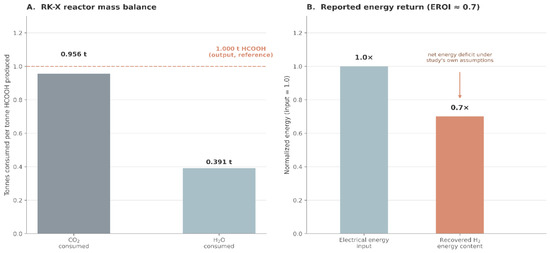
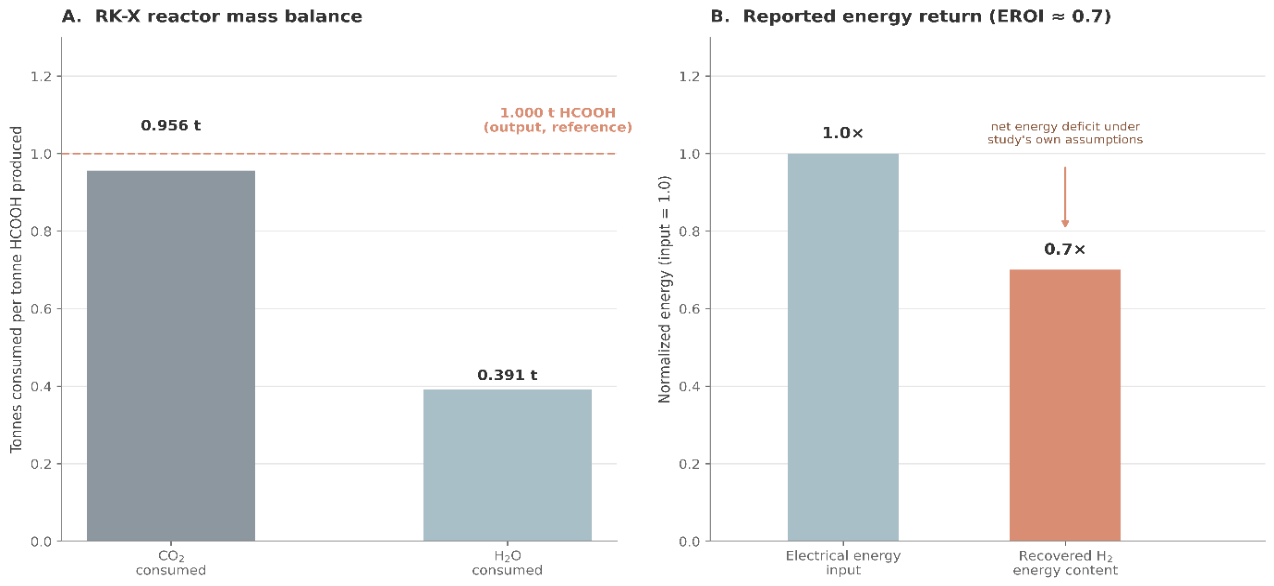
The study is a useful illustration of the engineering questions that dominate scale-up: managing reactor pressure and liquid level with automated control loops, dosing CO2 to maintain solubility as it is consumed, and balancing light intensity against energy input across three simulated LED power levels. It also usefully reports a mass balance (0.956 t CO2 and 0.391 t H2O consumed per tonne of HCOOH produced) and a specific energy consumption figure (roughly 2−2.7 kWh per kg of HCOOH depending on operating mode) on Figure 3, that can be compared against other production routes.
Figure 3.
Mass and energy balance reported for the RK-X pilot-scale photoreactor, as reported in Köntös & Masason (2025) [17] and Köntös (2023) [18].
The reported EROI of approximately 0.7 can be reconstructed explicitly from the study’s own figures. Formic acid contains 4.4 wt% recoverable hydrogen; at the lower heating value of H2 (33.3 kWh/kg), this corresponds to an energy content of 0.044 × 33.3 = 1.47 kWh per kg of HCOOH produced. Against the study’s reported electrical energy consumption of 2.0−2.7 kWh per kg HCOOH (LED illumination plus auxiliary loads), EROI (energy recovered as H2, divided by electrical energy input) works out to 1.47/2.7 = 0.54 at the higher end of reported consumption, and 1.47/2.0 = 0.74 at the lower end. This range brackets the study’s reported EROI of ~0.7: even on its own numbers, the RK-X configuration as tested uses more electricity than it recovers as usable hydrogen.
Several aspects of the study also call for a measure of caution before its figures are treated as representative of the field. Köntös and Masason disclose that both are paid employees of the company that manufactures the proprietary catalyst used, a conflict of interest that does not invalidate the reported measurements but does mean independent replication carries extra weight before the results are generalized. This review treats the RK-X case as one illustrative data point among several possible scale-up routes, not as evidence that photocatalytic or vendor-led scale-up outperforms alternatives; readers seeking a catalyst-agnostic view of the broader industrial CO2 electrolysis scale-up landscape, including electrochemical pilot and demonstration plants for formate and other C1 products, are directed to recent independent reviews of that field [19,20].
The authors’ own energy-return-on-investment calculation—roughly 0.7, meaning more electrical energy is consumed producing the hydrogen than is later recovered from it—is itself a caution against overstating the net energy benefit of the specific configuration studied, even though Köntös and Masason argue the balance improves once cheap renewable electricity and the value of avoided CO2 emissions are factored in. The study has already been cited as the technical basis for a follow-on feasibility analysis of in situ CO2 utilization on Mars, an application that further illustrates both the versatility of the underlying chemistry and the importance of validating the base case before building further conclusions on top of it [21].
The appropriate reading of this case study, in other words, is as a demonstration that engineers are actively solving the practical control-systems and reactor-design problems standing between laboratory photocatalysis and continuous industrial operation—not as proof that any specific configuration is already net energy- or carbon-positive at scale. That distinction matters for a Special Issue readership evaluating which sustainable chemistry claims are ready for investment and which still require independent verification.
5. Formic Acid as a Liquid Organic Hydrogen Carrier and Fuel-Cell Fuel
Once produced, formic acid’s value as an energy vector depends on how efficiently its stored hydrogen can be recovered. Two routes dominate: catalytic dehydrogenation to release gaseous H2 for use in a conventional hydrogen fuel cell, or direct electro-oxidation of formic acid itself in a direct formic acid fuel cell (DFAFC) [22]. The patent literature illustrates this same loop in device form: a US patent for a formic-acid-fueled electricity generation device includes process diagrams that depict the capture-to-power arrangement in hardware terms, offering a useful visual complement to the schematic process flows described above [23].
Dehydrogenation is typically catalyzed by palladium, ruthenium, or iridium complexes and proceeds at 60−120 °C, a temperature window low enough to be driven by waste heat recovered from a downstream polymer electrolyte fuel cell, improving the overall system’s round-trip efficiency [24]. A persistent engineering challenge is selectivity: formic acid can decompose along two competing pathways, one yielding H2 and CO2 (the useful pathway) and the other yielding CO and water, with even trace CO contamination poisoning downstream fuel-cell electrodes. Catalyst and support design continues to focus on suppressing this dehydration pathway and maintaining activity over extended operating lifetimes.
DFAFCs avoid the separate dehydrogenation step by oxidizing formic acid directly at the anode, offering a high theoretical open-circuit potential (1.48 V) and comparatively low fuel crossover through Nafion-type membranes relative to direct methanol fuel cells [25,26]. Reported power densities vary widely by design and operating mode, from a few mW/cm2 under passive, air-breathing operation to over 100 mW/cm2 with actively pumped, temperature-controlled reactant flow, and palladium-black anode catalysts remain the dominant choice for suppressing the competing CO-forming pathway [27]. DFAFCs have found their clearest niche in portable and small-scale power applications rather than grid-scale storage, where their moderate power density is less of a constraint.
A combined techno-economic analysis and life-cycle assessment of formic acid as an LOHC offers a useful reality check on both routes [28]: it finds that, evaluated on full life-cycle terms, formic acid is currently less competitive than delivering liquefied hydrogen directly, though formic acid produced specifically via electrochemical CO2 reduction retains the lowest global-warming potential among the CO2-derived pathways considered. This is an important qualifier for any “new economy” narrative built around formic acid: its climate case is strongest when the CO2 reduction step itself is powered by low-carbon electricity, and weakest when it is compared against hydrogen delivered by other already-mature logistics chains.
6. Techno-Economic Reality Check
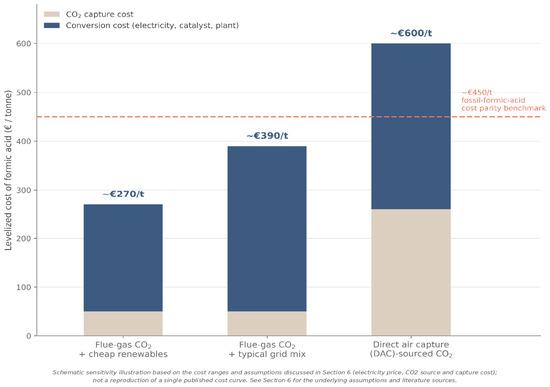
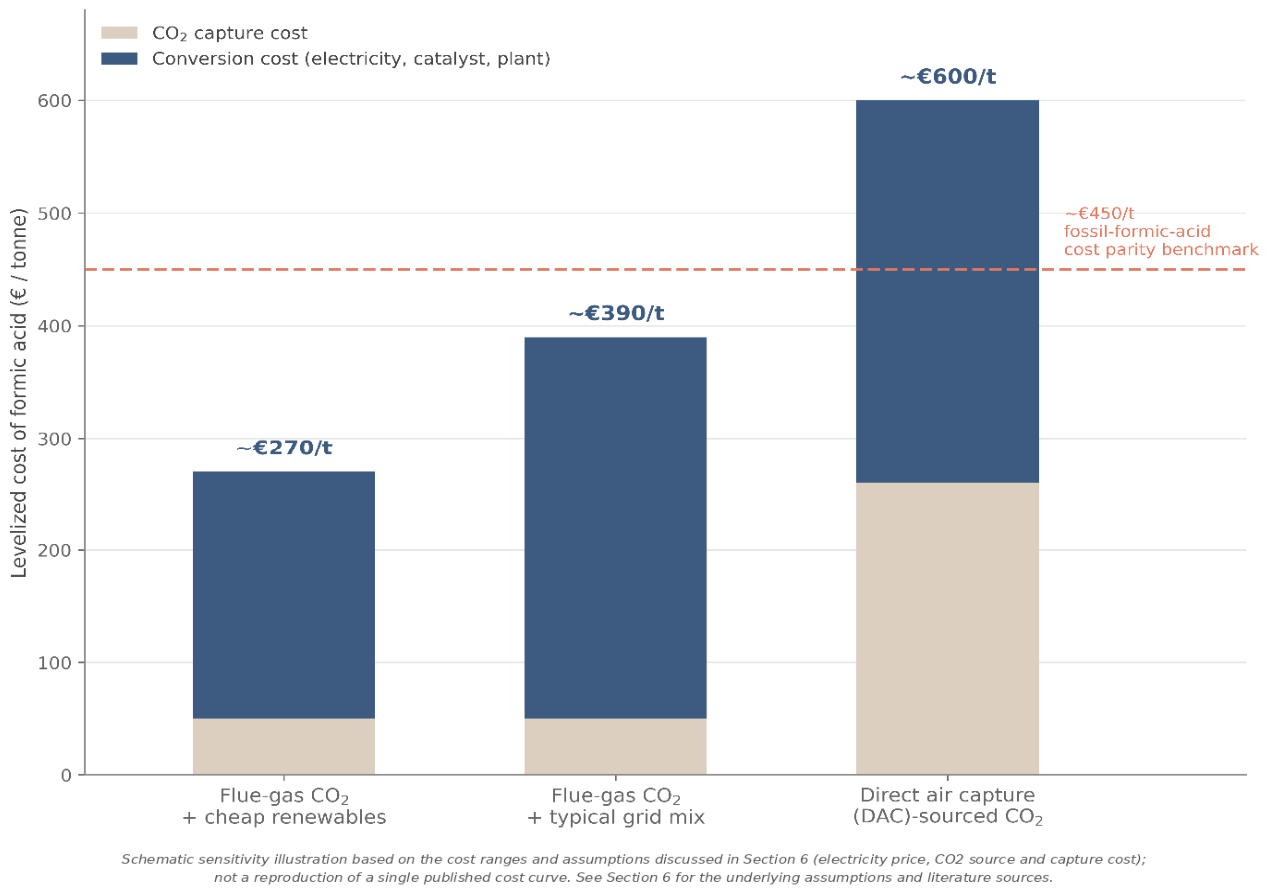
Cost sensitivity analyses of formic acid production presented on Figure 4. consistently identify the same two levers: the cost of the CO2 feedstock itself (which depends heavily on whether it comes from concentrated flue gas or from more dilute, energy-intensive direct air capture) and the price of the electricity or hydrogen used to drive the reduction chemistry. Modeling of the levelized cost of formic acid across both flue-gas capture and direct air capture pathways shows that costs competitive with conventional, fossil-derived formic acid production (below roughly €450 per tonne) are only reached when renewable electricity is cheap and CO2 capture costs are moderate; direct air capture in particular remains expensive enough today that flue-gas-sourced CO2 is the more realistic near-term feedstock for cost-competitive formic acid.
Figure 4.
Schematic techno-economic sensitivity of CO2-to-formic-acid production cost.
Reported production-cost figures in the low hundreds of euros per tonne of formic acid, alongside CO2 capture costs on the order of €50 per tonne, suggest the economics are not far from break-even under favorable renewable-electricity pricing, but they are also sensitive enough to input assumptions that independent, standardized techno-economic comparisons across studies—rather than any single paper’s headline figures—should guide investment decisions. The broader point for a net-zero strategy is that CO2-to-formic-acid conversion is not automatically cheap or automatically clean; it inherits the carbon intensity and cost of whatever electricity source powers it, which is precisely why its deployment is usually discussed alongside renewable buildout rather than as a standalone solution.
Formic acid’s techno-economic position should also be read against competing e-fuel investment cases operating under the same EU policy signals. Green ammonia and e-methanol currently attract far larger capital commitments and benefit from established shipping-fuel and chemical-feedstock offtake respectively, while e-kerosene is pulled forward by RefuelEU Aviation’s sub-mandates rather than by formic acid’s smaller preservative and animal-feed niches. Under the EU’s Carbon Border Adjustment Mechanism (CBAM) [29] and the recast Renewable Energy Directive (RED III) [30], all of these routes compete for the same scarce input—additional, low-cost renewable electricity—and RED III’s additionality and temporal-correlation rules for renewable fuels of non-biological origin apply to CO2-derived formic acid in the same way they apply to e-ammonia or e-methanol. Formic acid is therefore competing less against other formic-acid producers than against every other electricity-intensive decarbonization pathway for the same constrained pool of renewable electrons, which is why techno-economic claims for any single pathway—including the one examined in Section 4—should be read alongside, not instead of, that broader competition.
7. Toward a New Circular Carbon Economy
The policy environment around CO2 utilization has moved quickly. The European Union’s Carbon Border Adjustment Mechanism took effect for covered sectors in 2026, extending a carbon-price signal to imported goods and creating fresh commercial pressure on carbon-intensive exporters to either decarbonize or absorb the border cost—a pressure that strengthens the business case for converting captured CO2 into sellable products rather than treating it purely as a compliance cost. International bodies including the IEA and the Global CCS Institute continue to frame carbon capture, utilization, and storage collectively as accounting for a meaningful share—on the order of one-fifth—of the emissions reductions needed by 2050, precisely because hard-to-abate sectors such as cement, steel, and chemicals cannot fully decarbonize through electrification alone [31,32].
CCU’s distinguishing appeal within this policy landscape is that it converts a captured-carbon liability into a marketable commodity, which is what makes the phrase “circular carbon economy” more than a slogan: carbon already extracted and in circulation is cycled through additional value-generating steps—formic acid production, hydrogen release, fuel-cell power generation—before any of it is ultimately re-released or permanently stored. Formic acid’s dual identity as both an established industrial chemical and a candidate hydrogen carrier gives it a practical advantage here over purely novel CO2-derived products: a portion of its market already exists, which lowers the demand-creation risk that many circular-economy technologies face. The patent literature cited in Section 5 for its fuel-cell hardware diagrams [23] is equally suggestive here: its capture-to-power process schematic is a useful visual template for illustrating the closed CO2-to-formic-acid-to-power loop that defines this circular carbon economy concept.
8. Challenges and Outlook
Several open problems stand between the current state of the art and formic acid playing a settled role in net-zero infrastructure:
- Catalyst durability and poisoning. Long-duration operation without loss of selectivity or activity—whether in electrochemical, thermochemical, or photocatalytic systems—remains less proven at industrial timescales than at laboratory scale.
- CO2 capture cost. Direct air capture in particular remains too expensive for most techno-economic scenarios to close; near-term deployment will likely concentrate on concentrated point-source flue-gas capture.
- Energy return and carbon accounting. As the RK-X case study illustrates, a process can be technically elegant while still consuming more energy than it recovers under a specific set of operating assumptions; independent, standardized life-cycle assessment—not vendor-reported figures alone, and following recognized methodology such as ISO 14040/14044 [33,34]—should underpin investment and policy decisions.
- Standardization and certification. As with “green” hydrogen and “green” ammonia, the market will need agreed certification standards, for the carbon intensity of the electricity and CO2 feedstock used, to prevent “CO2-derived” from becoming a marketing label detached from verified climate benefit.
- Integration with variable renewables. Electrochemical and photocatalytic routes are well suited in principle to following intermittent wind and solar output, but demonstrating this coupling at the reactor-control level, rather than only in techno-economic models, remains an active engineering task.
None of these challenges is disqualifying; each is the kind of problem that incremental catalyst, reactor, and policy engineering has a track record of solving over a decade-long horizon. But an “outstanding” contribution to this Special Issue is better served by stating that horizon honestly than by presenting formic acid as an already-solved pillar of the net-zero transition.
9. Conclusions
Formic acid sits at a genuinely useful intersection of carbon management and hydrogen storage: it gives captured CO2 an economically productive destination, and it gives the hydrogen economy a liquid, low-toxicity, ambient-temperature carrier compatible in large part with existing chemical logistics. The chemistry to make it—thermochemical, electrochemical, photocatalytic, and biocatalytic—has matured substantially over the past decade, and pilot-scale engineering efforts such as the RK-X reactor demonstrate that the practical reactor-control problems of scale-up are being actively addressed rather than merely theorized about.
At the same time, this review’s closer look at the techno-economic and life-cycle literature counsels against treating CO2-to-formic-acid conversion as an automatic net-zero win. Its climate and economic case depends entirely on the carbon intensity and price of the electricity that drives it; current life-cycle assessments find it less competitive than direct liquefied-hydrogen delivery on a full life-cycle basis, and at least one detailed pilot-scale study reports an energy return below unity under its own stated assumptions. The honest and, we would argue, more durable case for formic acid in a net-zero world is not that it is already a finished solution, but that it is one of a small number of CO2 utilization pathways mature enough to deserve continued investment, independent verification, and integration with the broader buildout of low-cost renewable electricity—the resource on which its entire climate benefit ultimately rests.
Funding
The author received no financial support for the research, authorship, and/or publication of this article.
Data Availability Statement
The raw data supporting the conclusions of this article will be made available by the authors on request.
Acknowledgments
This work is supported by IOI Investment Zrt.
Conflicts of Interest
Author K.Z. was employed by the company IOI Investment Zrt. The funding sponsors had no role in the design of the study; in the collection, analyses, or interpretation of data; in the writing of the manuscript; or in the decision to publish the results. The author declared no conflicts of interest.
References
- Ghiat, I.; Banu, A.; Bicer, Y.; Amhamed, A.I.; Al-Ansari, T. Circularity within carbon capture networks: A review of capture and utilization technologies. J. CO2 Util. 2025, 95, 103075. [Google Scholar] [CrossRef] [Scilit]
- IMARC Group. Formic Acid Market: Global Industry Trends, Share, Size, Growth, Opportunity and Forecast 2025–2034. Available online: https://www.imarcgroup.com/formic-acid-market (accessed on 27 August 2026).
- Al-Breiki, M.; Bicer, Y. Formic Acid. In Sustainable Energy Carriers for Energy Storage and Transport; Green Energy and Technology; Springer: Cham, Switzerland, 2025. [Google Scholar] [CrossRef] [Scilit]
- Daud, M.U.; Taddeo, F.; Lisi, L.; Salzano, E.; Di Serio, M.; Tesser, R.; Russo, V. Liquid organic hydrogen carriers (LOHC): From definitions to recent developments. Rendiconti Lincei Sci. Fis. Nat. 2026, 37, 3–34. [Google Scholar] [CrossRef] [Scilit]
- Reymond, A.; Camilli, L.; Marti, A.; Araque, M.; Wojcieszak, R. Liquid Organic Hydrogen Carriers (LOHCs): Comprehensive Comparison and Future Outlook. Energy Fuels 2026, 40, 3443–3468. [Google Scholar] [CrossRef] [Scilit]
- Aresta, M.; Dibenedetto, A.; Angelini, A. Catalysis for the valorization of exhaust carbon: From CO2 to chemicals, materials, and fuels. Chem. Rev. 2014, 114, 1709–1742. [Google Scholar] [CrossRef] [Scilit]
- Álvarez, A.; Bansode, A.; Urakawa, A.; Bavykina, A.V.; Wezendonk, T.A.; Makkee, M.; Gascon, J.; Kapteijn, F. Challenges in the greener production of formates/formic acid, methanol, and DME by heterogeneously catalyzed CO2 hydrogenation processes. Chem. Rev. 2017, 117, 9804–9838. [Google Scholar] [CrossRef] [Scilit]
- Xu, W.; Ma, L.; Huang, B.; Cui, X.; Niu, X.; Zhang, H. Thermodynamic analysis of formic acid synthesis from CO2 hydrogenation. In Proceedings of the 2011 International Conference on Materials for Renewable Energy & Environment, Shanghai, China, 20–22 May 2011; pp. 1473–1477. [Google Scholar] [CrossRef] [Scilit]
- Hu, J.; Ma, W.; Liu, Q.; Geng, J.; Wu, Y.; Hu, X. Reaction and separation system for CO2 hydrogenation to formic acid catalyzed by iridium immobilized on solid phosphines under base-free condition. iScience 2023, 26, 106672. [Google Scholar] [CrossRef] [Scilit]
- Moret, S.; Dyson, P.J.; Laurenczy, G. Direct synthesis of formic acid from carbon dioxide by hydrogenation in acidic media. Nat. Commun. 2014, 5, 4017. [Google Scholar] [CrossRef] [Scilit]
- Fernández-Caso, K.; Díaz-Sainz, G.; Alvarez-Guerra, M.; Irabien, A. Electroreduction of CO2: Advances in the continuous production of formic acid and formate. ACS Energy Lett. 2023, 8, 1992–2024. [Google Scholar] [CrossRef] [Scilit]
- Banerjee, A.; Morales-Guio, C.G. Integrated CO2 capture and electrochemical conversion: Coupled effects of transport, kinetics and thermodynamics in the direct reduction of captured-CO2 adducts. EES Catal. 2025, 3, 205–234. [Google Scholar] [CrossRef] [Scilit]
- Shen, H.; Jin, H.; Li, H.; Wang, H.; Duan, J.; Jiao, Y.; Qiao, S.-Z. Acidic CO2-to-HCOOH electrolysis with industrial-level current on phase engineered tin sulfide. Nat. Commun. 2023, 14, 2843. [Google Scholar] [CrossRef] [Scilit]
- Wang, T.; Jin, T.L.; Liu, Z.; Wang, J.; Gong, Y.; Ma, M.; Chen, J.; Shen, S.; Wu, R.; Huang, Y.-C.; et al. Electronic microenvironment regulation of bismuth-salophen single-site catalysts for enhanced selectivity in CO2 electrolysis to formic acid. Adv. Sci. 2025, 12, e02061. [Google Scholar] [CrossRef] [Scilit]
- Karapapa, P.; Mondal, S.; Zeglio, E.; Das, B. From CO2 to C1 liquid fuels: Molecular electrochemical production of formic acid and methanol. Angew. Chem. Int. Ed. 2026, 65, e202522226. [Google Scholar] [CrossRef] [Scilit]
- Bose, S.; Mehrgardi, M.A.; Zare, R.N. Selective photochemical conversion of carbon dioxide to formic acid at gas–water interface of microbubbles. J. Am. Chem. Soc. 2025, 147, 27449–27457. [Google Scholar] [CrossRef] [Scilit]
- Köntös, Z.; Masason, M.L. Extending the CO2 value chain: From fossil fuels to formic acid and stored hydrogen. J. Chem. Res. 2025, 49. [Google Scholar] [CrossRef] [Scilit]
- Köntös, Z. Development of a photocatalytic method to convert CO2 into formic acid with fulvic acid complex. Energy Environ. 2023, 36, 925–935. [Google Scholar] [CrossRef] [Scilit]
- Belsa, B.; Xia, L.; García de Arquer, F.P. CO2 electrolysis technologies: Bridging the gap toward scale-up and commercialization. ACS Energy Lett. 2024, 9, 4293–4305. [Google Scholar] [CrossRef] [Scilit]
- Jiang, Y.; Wu, G.; Pu, Y.; Wang, Y.; Chu, N.; Zeng, R.J.; Zhang, X.; Zhu, X.; Liang, P. Flow-electrode capacitive separation of organic acid products and recovery of alkali cations after acidic CO2 electrolysis. Proc. Natl. Acad. Sci. USA 2024, 121, e2408205121. [Google Scholar] [CrossRef] [Scilit]
- Köntös, Z. Photocatalytic CO2 conversion via the RK-X process: A comprehensive feasibility analysis of in situ resource utilisation on Mars. Inventions 2026, 11, 46. [Google Scholar] [CrossRef] [Scilit]
- Eppinger, J.; Huang, K. Formic acid as a hydrogen energy carrier. ACS Energy Lett. 2017, 2, 188–195. [Google Scholar] [CrossRef] [Scilit]
- Huang, K.; Zheng, J. Electricity Generation Devices Using Formic Acid. U.S. Patent US11258085B2, 22 February 2022. Available online: https://patents.google.com/patent/US11258085B2/en (accessed on 4 September 2026).
- Kawanami, H.; Himeda, Y.; Laurenczy, G. Formic acid as a hydrogen carrier for fuel cells toward a sustainable energy system. In Advances in Inorganic Chemistry; van Eldik, R., Hubbard, C.D., Eds.; Academic Press: Cambridge, MA, USA, 2017; Volume 70, pp. 395–427. [Google Scholar] [CrossRef] [Scilit]
- Yu, X.; Pickup, P.G. Recent advances in direct formic acid fuel cells (DFAFC). J. Power Sources 2008, 182, 124–132. [Google Scholar] [CrossRef] [Scilit]
- Aslam, N.M.; Masdar, M.S.; Kamarudin, S.K.; Daud, W.R.W. Overview on direct formic acid fuel cells (DFAFCs) as an energy sources. APCBEE Procedia 2012, 3, 33–39. [Google Scholar] [CrossRef] [Scilit]
- Rejal, S.Z.; Masdar, M.S.; Kamarudin, S.K. A parametric study of the direct formic acid fuel cell (DFAFC) performance and fuel crossover. Int. J. Hydrogen Energy 2014, 39, 10267–10274. [Google Scholar] [CrossRef] [Scilit]
- Kim, C.; Lee, Y.; Kim, K.; Lee, U. Implementation of Formic Acid as a Liquid Organic Hydrogen Carrier (LOHC): Techno-Economic Analysis and Life Cycle Assessment of Formic Acid Produced via CO2 Utilization. Catalysts 2022, 12, 1113. [Google Scholar] [CrossRef] [Scilit]
- European Union. Regulation (EU) 2023/956 of the European Parliament and of the Council Establishing a Carbon Border Adjustment Mechanism. Off. J. Eur. Union 2023, L130, 52–104. Available online: https://eur-lex.europa.eu/eli/reg/2023/956/oj (accessed on 3 September 2026).
- European Union. Directive (EU) 2023/2413 of the European Parliament and of the Council of 18 October 2023 Amending Directive (EU) 2018/2001, Regulation (EU) 2018/1999 and Directive 98/70/EC as Regards the Promotion of Energy from Renewable Sources, and Repealing Council Directive (EU) 2015/652. Off. J. Eur. Union 2023, L, 2023/2413. Available online: https://eur-lex.europa.eu/eli/dir/2023/2413/oj/eng (accessed on 3 September 2026).
- Bhardwaj, A.; McCormick, C.; Friedmann, J. Opportunities and Limits of CO2 Recycling in a Circular Carbon Economy: Techno-Economics, Critical Infrastructure Needs, and Policy Priorities; Center on Global Energy Policy, Columbia University SIPA: New York, NY, USA, 2021; Available online: https://www.energypolicy.columbia.edu/wp-content/uploads/2021/05/CO2-Recycling_CGEP_Report_012124.pdf (accessed on 4 September 2026).
- The Circular Carbon Economy. International Energy Forum. Available online: https://www.ief.org/programs/circular-carbon-economy (accessed on 4 September 2026).
- ISO 14040:2006; Environmental Management—Life Cycle Assessment—Principles and Framework. ISO: Geneva, Switzerland, 2006.
- ISO 14044:2006; Environmental Management—Life Cycle Assessment—Requirements and Guidelines. ISO: Geneva, Switzerland, 2006.


Disclaimer/Publisher’s Note: The statements, opinions and data contained in all publications are solely those of the individual author(s) and contributor(s) and not of MDPI and/or the editor(s). MDPI and/or the editor(s) disclaim responsibility for any injury to people or property resulting from any ideas, methods, instructions or products referred to in the content. |
© 2026 by the author. Licensee MDPI, Basel, Switzerland. This article is an open access article distributed under the terms and conditions of the Creative Commons Attribution (CC BY) license.