


Abstract
The copper ferrite/nitrogen-doped biochar (CuFe2O4/Nx-BC) was synthesized by a one-step sol–gel pyrolysis method, and its efficiency in activating PS to degrade MB was evaluated. The influences of preparation conditions, degradation conditions, and common anions on the degradation efficiency of MB were investigated, and the mechanism of CuFe2O4/N0.5-BC activating PS was inferred. The results showed the saturation magnetization of CuFe2O4/N0.5-BC was 25.53 emu/g. Under the optimal degradation conditions, compared to PS alone, the degradation efficiency of MB in the CuFe2O4/N0.5-BC + PS system increased from 26.2% to 94.1%, the reaction rate constant in the CuFe2O4/N0.5-BC + PS system (0.02954 min−1) was 9.12 times higher than that in the PS alone system (0.00324 min−1); Compared to the CuFe2O4/BC system, the degradation efficiency of MB in the CuFe2O4/N0.5-BC + PS system increased from 34% to 94.1%, while the reaction rate constant is 1.1 times that in the CuFe2O4/BC + PS system. After CuFe2O4/N0.5-BC underwent five cycles of application, the degradation efficiency of MB in the CuFe2O4/N0.5-BC + PS still reached 87.5%. SO4•− plays a major role, •OH played a certain role and O2•− was also responsible for the degradation of MB in the CuFe2O4/N0.5-BC + PS system. CuFe2O4/N0.5-BC is a green and effective catalyst for the PS-AOP method to treat MB-contaminated water.
1. Introduction
With the increase in the discharge of organic dye wastewater, the impact of organic dyes on the ecological environment is becoming more and more serious. Methylene blue (MB) is a thiazine-based basic dye, widely used in inks, textiles, and bacterial tissue staining. If it persists in the environment for a long time, it can cause various health problems such as breathing difficulties, blindness, and abdominal diseases [1], Therefore, effective and feasible methods for treating MB wastewater are needed. The methods for removing methylene blue from wastewater include adsorption [2,3,4]; biodegradation [5]; advanced oxidation such as photocatalytic degradation [6,7], Fenton [8] or Fenton-like degradation [9,10,11]; persulfate oxidation degradation [12,13,14]; etc. Among them, advanced oxidation technology based on sulfate radical (SO4•−) (PS-AOP) is a green and efficient technology for oxidizing refractory organic pollutants. It has advantages such as strong oxidation capacity, wide pH application range, mild reaction conditions, and a high mineralization efficiency to organic substances and high safety [15,16]. However, persulfates (PSs) themselves have weak oxidation capacity and are relatively stable at room temperature, requiring being activated to generate active species such as SO4•−. The activation methods of persulfates include ultraviolet light activation, thermal activation, homogeneous catalytic activation, and heterogeneous catalytic activation [17], etc. Among them, heterogeneous catalytic activation has the advantages of high catalyst stability, convenient recovery, and wide application range, while it also has shortcomings such as catalyst agglomeration, consumption of active sites, and high energy consumption [18,19], and heterogeneous catalysts need suitable carriers [20].
Spinel ferrite magnetic materials or carbon materials have been widely used as the heterogeneous catalysts for activation of PSs to degrade various organic contaminants [21]. Combining carbon materials with spinel ferrite improves the PS activation efficiency and solves the separation problem of carbon catalysts [22]. Copper ferrite (CuFe2O4) is one of spinel ferrite heterogeneous catalyst with high catalytic activity and good stability [23,24,25]. However, CuFe2O4 particles tend to aggregate, which reduces their activity. Biochar (BC) has abundant oxygen-containing groups on its surface, endowing it with hydrophilic, hydrophobic, and buffering properties against acids and bases [26]. Accordingly, it is an excellent carrier for CuFe2O4 catalysts [27]. Our preliminary work confirmed that loading CuFe2O4 uniformly on the surface of BC through a one-step sol–gel pyrolysis method can overcome the agglomeration of CuFe2O4 and enhance the efficiency of CuFe2O4 in activating PS to degrade malachite green [28]. The performance of CuFe2O4/BC in activating PSs to degrade organic pollutants can still be enhanced. This can be achieved by doping CuFe2O4 [29,30] or doping BC [31,32] to further increase the catalytic activity of CuFe2O4/BC. The N-doping of BC endows the surface of biochar with nitrogen-containing functional groups, and the nitrogen doping on the surface of biochar can enhance the catalytic activation to peroxydisulfate (PS) [33] or peroxymonosulfate (PMS) [34]. Due to the stronger electronegativity of N atoms compared to C, N atoms can effectively promote the electron transfer of adjacent C atoms, resulting in a higher charge density of carbon atoms. Consequently, the adsorption performance between PMS or PS molecules and carbon atoms near N atoms is significantly enhanced, which means that PMS or PS is more easily adsorbed by nitrogen-doped carbon materials [35,36,37]. N-doping enhances the reactivity of the catalyst towards electron acceptor molecules, forming sp2 hybridized graphitic N. The formation of graphitic N can partially repair the structural defects of carbon materials and enhance their oxidation resistance [35,36,37], which enhances the electronic properties of the conjugated carbon network and breaks the inertness of biochar [38,39]. Therefore, the CuFe2O4/Nx-BC composite material was constructed by loading CuFe2O4 onto N-doped biochar, and CuFe2O4/Nx-BC was utilized to activate persulfate for the degradation of MB.
In this work, CuFe2O4/Nx-BC was prepared by a one-step sol–gel pyrolysis method using eucalyptus wood powder as the biochar raw material, Fe(NO3)3 and Cu(NO3)2 as metal precursors, dicyandiamide as the nitrogen source, and citric acid as the chelating agent. The samples were characterized by XRD, SEM, XPS, and VSM to analyze their crystal structure, morphology, and magnetic properties. MB was used as the target pollutant to investigate its degradation effect of persulfate activated by CuFe2O4/Nx-BC. The effects of preparation conditions, degradation conditions, and common anion concentrations on the degradation efficiencies of MB were examined. The degradation effects of different oxidants on MB were compared, and the TOC removal efficiency on the optimal conditions was also detected. The influence of radical scavengers on the degradation efficiency of MB in the CuFe2O4/Nx-BC+PS system was investigated, and the main active radicals were speculated. The mechanism of CuFe2O4/Nx-BC activating PS to degrade MB was also speculated. The work aims to provide an efficient, stable, and reusable catalytic system for organic dye (MB) degradation and offer an insight into the application of N-doping of biochar and support strategies to enhance the catalytic activity of ferrite spinel (CuFe2O4) composite catalyst in heterogeneous PS-AOPs.
2. Materials and Methods
2.1. Experimental Reagents and Instruments
The experimental reagents are listed in Table S1 and the experimental equipment is listed in Table S2 in the Supplementary Materials.
2.2. Experimental Methods
2.2.1. Synthesis of CuFe2O4/N0.5-BC Composite Materials
Based on the method from the literature [28], The raw materials were slightly modified and CuFe2O4/Nx-BC was prepared by a one-step sol–gel pyrolysis method. Specifically, 8.080 g of Fe(NO3)3·9H2O (20 mmol), 2.416 g of Cu(NO3)2·3H2O (10 mmol), 2.4 g of dicyandiamide (with a mass ratio of dicyandiamide to eucalyptus wood powder of 1:1), and 2.4 g of eucalyptus wood powder were mixed in the deionized water. Then, citric acid solution was gradually added to the above solution until the molar ratio of citric acid to total cations was 1. After stirring at 60 °C for 3 h, the mixed solution was evaporated at 90 °C until a brown gel was formed. Finally, the obtained mixture was placed in a tube furnace for pyrolysis with a heating rate of 5 °C/min to 500 °C and kept at 500 °C for 1 h under nitrogen protection (nitrogen flow rate of 50 mL/min). After cooling to room temperature, CuFe2O4/Nx-BC was slightly boiled and washed until the pH of the solution was neutral. Using the same method, the comparative material CuFe2O4/BC was prepared without adding dicyandiamide to the raw materials, CuFe2O4 was prepared without adding eucalyptus wood powder and dicyandiamide to the raw materials, and BC and N0.5-BC were prepared using only eucalyptus wood powder or eucalyptus wood powder and dicyandiamide as the raw materials.
2.2.2. Characterization of CuFe2O4/Nx-BC
The characterization methods of the prepared material CuFe2O4/Nx-BC are described in Text S1 in the Supplementary Materials.
2.2.3. CuFe2O4/N0.5-BC Activated PS for MB Degradation
The experiment of CuFe2O4/N0.5-BC activating PS to degrade MB was conducted as follows: 20 mg of CuFe2O4/N0.5-BC was dispersed in 100 mL of 50 mg/L MB aqueous solution and shaken at a constant speed of 150 rpm for 30 min to reach adsorption/desorption equilibrium. If necessary, the initial pH of the MB aqueous solution was adjusted to the desired value with 200 mM H2SO4 or NaOH solution. Then, 0.30 mM PS was added to the MB solution to start the reaction. At the specified time intervals, 3 mL of the aqueous solution sample was quickly taken out, filtered through a 0.45 µm PTFE membrane to separate CuFe2O4/N0.5-BC, and the absorbance A of the filtrate was measured at the maximum absorption wavelength of 664 nm using a UV-Vis spectrophotometer. The residual concentration C of MB was calculated based on the relationship curve equation between the absorbance A and concentration C of MB (A = 0.1007C + 0.0079, correlation coefficient R2 = 0.9992, C applicable range 0.1–8 mg/L). The residual ratio of MB was C/C0, and the degradation efficiency of MB was calculated by the formula: η = (1 − C/C0) × 100% [40], where C is the residual concentration of MB after degradation and C0 is the initial concentration of MB. When degrading MB using other materials, the operation steps were almost the same, except that the CuFe2O4/N0.5-BC is replaced with the specific material.
In addition, the total organic carbon (TOC) was analyzed using the N/C3100 TOC analyzer (Analytic Jena, Jena, Germany). Under the optimal conditions, the effects of common inorganic anions, oxidants and quenchers on the activation of PS by CuFe2O4/N0.5-BC for the degradation of MB were investigated. In the multi-cycle catalytic experiments, after each degradation reaction, the CuFe2O4/N0.5-BC catalyst was separated from the reaction system by an external magnetic field, washed several times with the deionized water and ethanol, and then dried overnight in a vacuum oven at 60 °C. The same/similar experimental conditions were then performed to degrade MB.
3. Results and Discussion
3.1. The Influence of Preparation Factors of CuFe2O4/NX-BC on the Degradation Efficiency of MB
3.1.1. The Influence of Nitrogen Doping Amounts on the Degradation Efficiency of MB
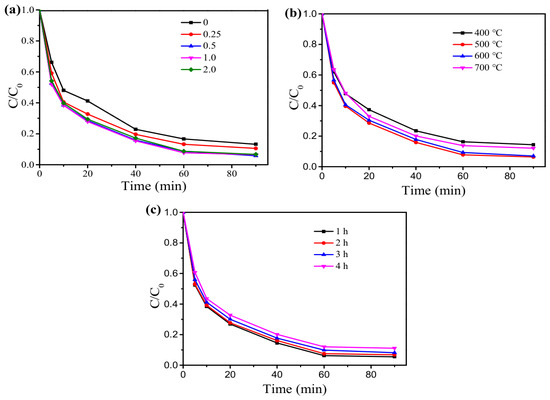
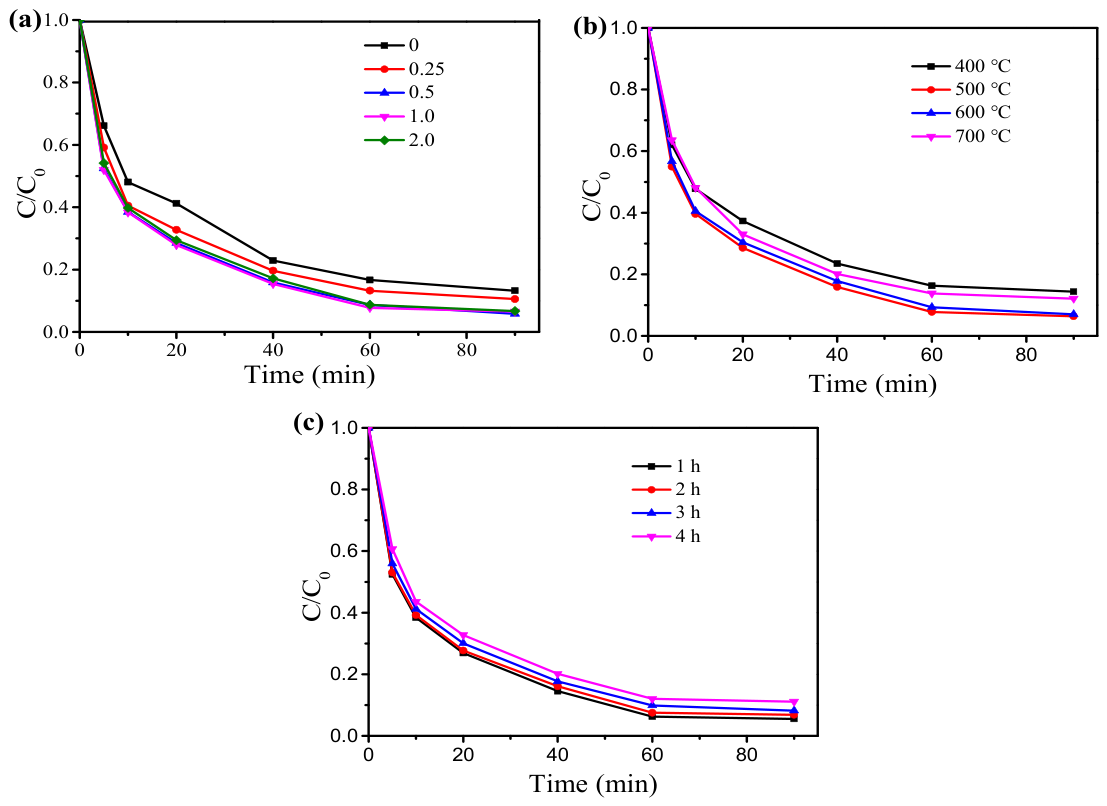
The effect of nitrogen doping amount during the preparation of CuFe2O4/Nx-BC on the degradation efficiency of MB was studied. The experimental results are shown in Figure 1a. When the nitrogen doping amount of CuFe2O4/Nx-BC is x = 0, 0.25, 0.5, 1, and 2, the degradation efficiencies of MB are 86.7%, 89.5%, 94.2%, 93.4%, and 93.2%, respectively. The results show that when the nitrogen doping amount (x = 0, 0.25, 0.5) increases, the degradation efficiency of MB also increases; when it continues to increase (x = 1, 2), the degradation efficiency of MB no longer increases. This may be due to the increase in nitrogen content, which enhances the nitrogen-containing functional groups on the surface of CuFe2O4/Nx-BC, thereby improving the degradation of MB. However, further increasing the nitrogen doping amount does not significantly change the degradation efficiency of MB. Therefore, x = 0.5 was selected for subsequent experiments.
Figure 1.
The influence (a) N-doping amount, (b) pyrolysis temperature and (c) pyrolysis time. Reaction conditions: [Catalyst] = 0.2 g/L, [MB] = 50 mg/L, [V] = 100 mL, [PS] = 0.30 mM, pH = 5.4, Temperature = 25 °C, Time = 90 min.
3.1.2. The Influence of Pyrolysis Temperatures on the Degradation Efficiency of MB
The effect of pyrolysis temperature preparation for CuFe2O4/N0.5-BC on the MB degradation efficiency was studied by using CuFe2O4/N0.5-BC prepared at different temperatures. The experimental results are shown in Figure 1b. When the pyrolysis temperatures were 400 °C and 500 °C, the degradation efficiencies of MB were 85.6% and 93.6% respectively. The degradation efficiency of MB increased with the increase in pyrolysis temperature, which could be attributed to the proportion that the inverse spinel phase (tetragonal phase) increased as the temperature increased, while the spinel phase (cubic phase) decreased; that is, the phase transition of CuFe2O4 from the spinel to the inverse spinel phase controlled by the pyrolysis temperature increase from 400 °C to 500 °C, and the material with an inverse spinel/spinel ratio of 65.38% has a significant surface state that can capture photoinduced electrons [41], which was conducive to the degradation of MB molecule. When the pyrolysis temperature for CuFe2O4/N0.5-BC was 600 °C and 700 °C, the degradation efficiencies of MB were 92.9% and 87.8% respectively. The degradation efficiency of MB decreased with the further increase in pyrolysis temperature from 600 °C to 700 °C. The phase transition of CuFe2O4 is also from the cubic phase to the tetragonal phase from 600 °C to 700 °C [42,43], and the phase transition from tetragonal to cubic can be observed at temperatures above 700 °C [42]. However, the researchers found that particle size and specific surface area may play more important roles than crystalline structure in the catalytic performance of CuFe2O4 [44], and it may be the sintering and agglomeration of CuFe2O4 particles with the increase in pyrolysis temperature [45], which resulted in a decrease in active site exposure and the efficient contact with MB molecule, and the degradation efficiency of MB. The BET surface area (SBET) of CuFe2O4/N0.5-BC prepared at the pyrolysis temperature of 400 °C, 500 °C, 600 °C and 700 °C investigated by N2 adsorption–desorption isotherms are 149.56 m2/g, 232.47 m2/g, 180.32 m2/g, and 166.37 m2/g, respectively. Accordingly, 500 °C was selected as the pyrolysis temperature of preparing for CuFe2O4/N0.5-BC.
3.1.3. The Influence of Pyrolysis Time on the Degradation Efficiency of MB
CuFe2O4/N0.5-BC was prepared with pyrolysis time of 1 h, 2 h, 3 h, and 4 h to investigate the effect of pyrolysis time on the MB degradation efficiency. The experimental results are shown in Figure 1c. When the pyrolysis time preparing for CuFe2O4/N0.5-BC was 1 h, 2 h, 3 h, and 4 h, the degradation efficiencies of MB were 94.5%, 93.1%, 91.8%, and 88.6%, respectively. The experimental results indicated that the degradation efficiency of MB decreased with the increase in pyrolysis time preparing for CuFe2O4/N0.5-BC, which might be due to the partial sintering and reducing in specific surface area of CuFe2O4/N0.5-BC as the pyrolysis time increased. Accordingly, 1 h was selected as the pyrolysis time preparing for CuFe2O4/N0.5-BC.
In conclusion, the optimal preparation conditions for CuFe2O4/Nx-BC were a nitrogen doping amount of x = 0.5, a pyrolysis temperature of 500 °C, and a pyrolysis time of 1 h. and the as-prepared CuFe2O4/N0.5-BC was characterized and utilized to investigate degradation condition of MB by PS.
3.2. Characterization of CuFe2O4/N0.5-BC
3.2.1. SEM
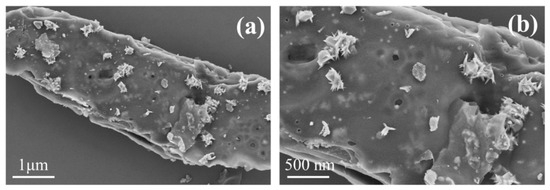
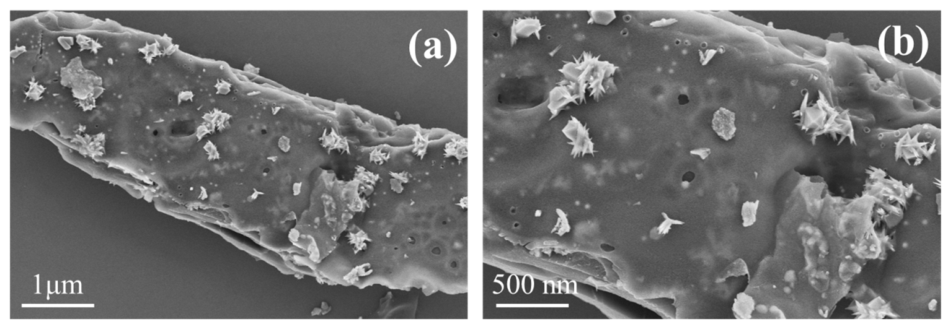
Figure 2a,b shows the SEM images of CuFe2O4/N0.5-BC. There are some granular CuFe2O4 on the surface of N0.5-BC, indicating that CuFe2O4 is loaded on N0.5-BC.
Figure 2.
SEM images of CuFe2O4/N0.5-BC.
3.2.2. XRD
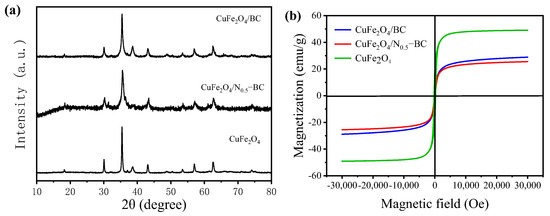
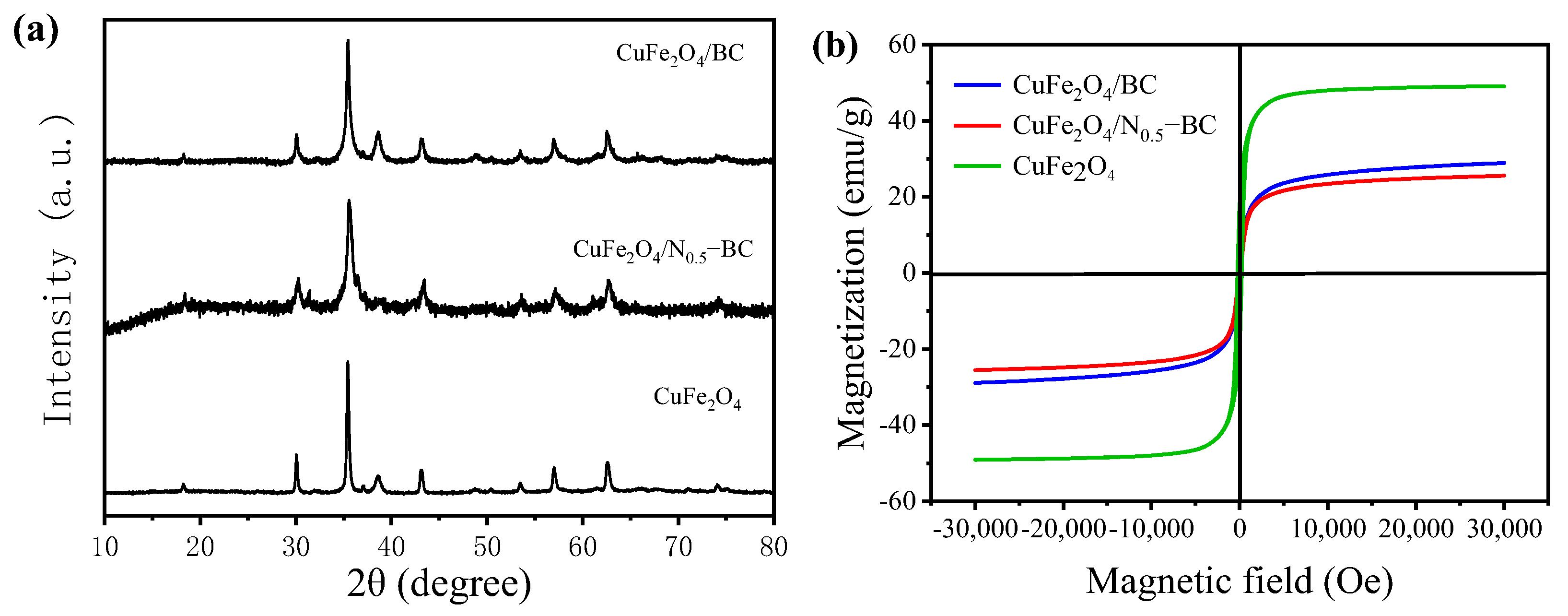
Figure 3a shows the XRD patterns of CuFe2O4, CuFe2O4/BC and CuFe2O4/N0.5-BC. The peaks of CuFe2O4 at 18.34°, 30.24°, 35.56°, 38.82°, 43.44°, 53.60°, 56.80° and 62.66° correspond to the (111), (220), (311), (400), (422), (511) and (440) planes of the standard card of CuFe2O4 (JCPDS No. 77-0010), indicating a well-defined crystal structure. The peaks of CuFe2O4/BC and CuFe2O4/N0.5-BC are exactly the same as those of CuFe2O4, which suggests that the carrier BC support and N-doping of BC has no effect on the crystal structure of CuFe2O4. Moreover, the crystallite size was calculated using Scherrer method [46], and the crystallite size of CuFe2O4, CuFe2O4/BC and CuFe2O4/N0.5-BC were 58.1 nm, 17.2 nm and 12.2 nm, respectively.
Figure 3.
XRD patterns (a) and magnetic hysteresis loops (b) of CuFe2O4, CuFe2O4/BC and CuFe2O4/N0.5-BC.
3.2.3. VSM
The magnetic hysteresis loops of CuFe2O4, CuFe2O4/BC and CuFe2O4/N0.5-BC are shown in Figure 3b. The magnetic hysteresis loops indicate that CuFe2O4, CuFe2O4/BC and CuFe2O4/N0.5-BC are magnetic. The saturation magnetization of CuFe2O4, CuFe2O4/BC and CuFe2O4/N0.5-BC are 49. emu/g, 28.89 emu/g, and 25.53 emu/g, respectively. The saturation magnetization of CuFe2O4/N0.5-BC is slightly lower than that of CuFe2O4/BC, and lower than that of CuFe2O4, indicating nonmagnetic supporters reduce the saturation magnetization of composes; the results are consistent with the research results of Tainara Ramos Neves et al. [47]. However, CuFe2O4/N0.5-BC still has a relatively high magnetic property, enabling the rapid separation and recovery of the catalyst in an external magnetic field and avoiding the impact of the catalyst on the environment.
3.2.4. XPS
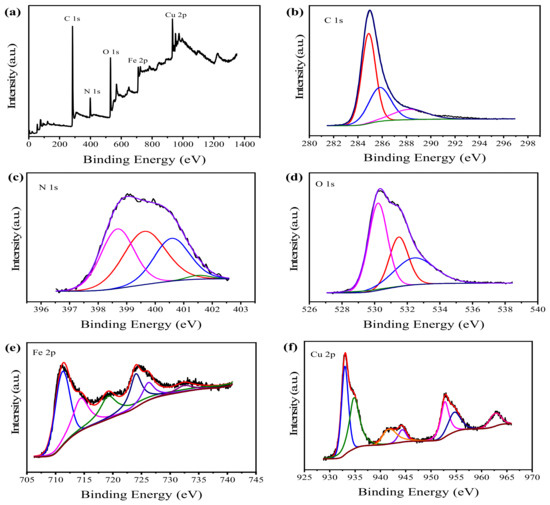
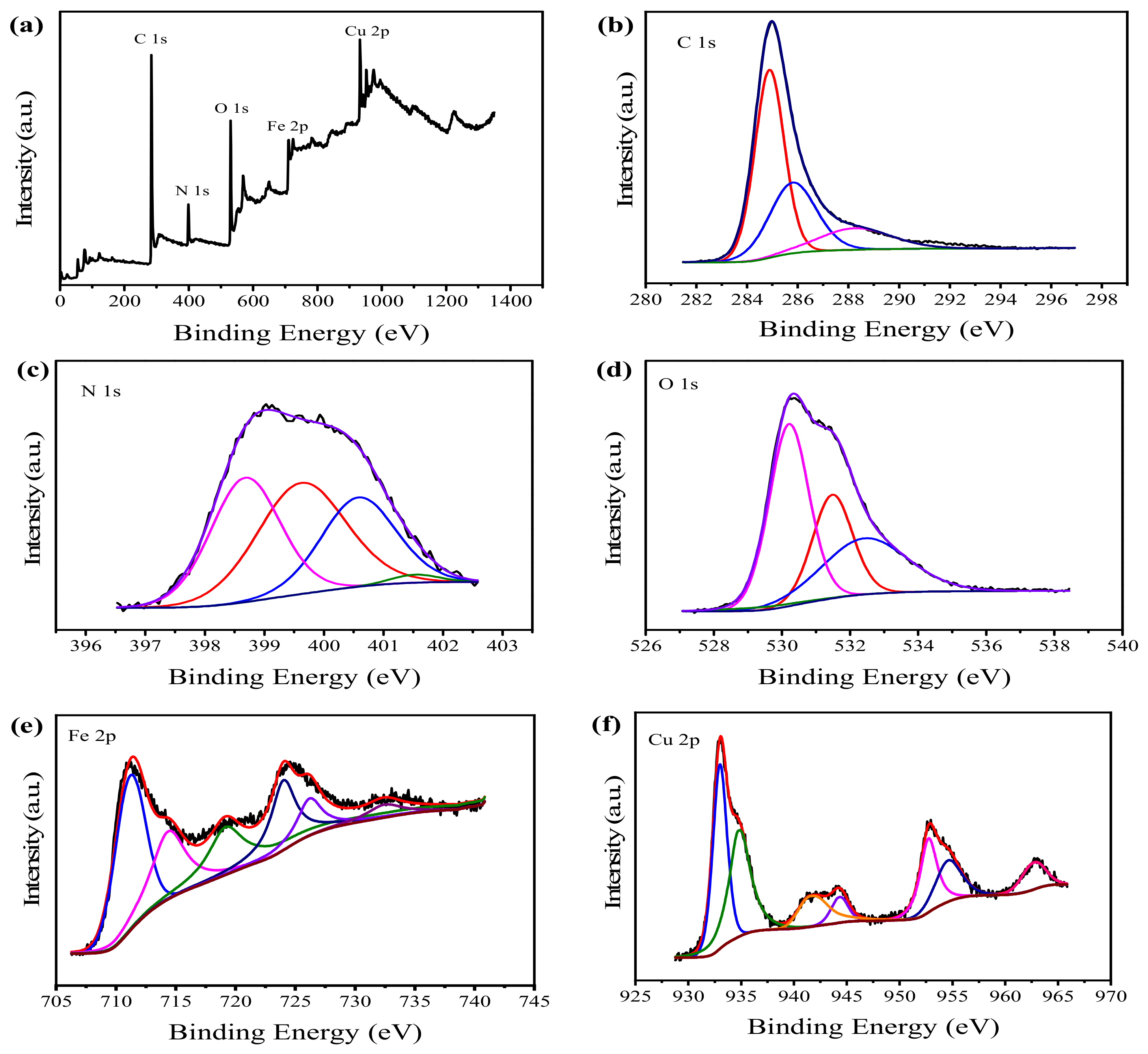
The surface composition and chemical state of CuFe2O4/N0.5-BC were analyzed by XPS. The survey spectrum for the overall XPS scan and high-resolution spectra for the individual C 1s, N 1s, O 1s, Fe 2p, and Cu 2p regions of CuFe2O4/N0.5-BC are shown in Figure 4. As shown in Figure 4a, the survey spectrum for the overall XPS scan indicates that C, N, O, Fe and Cu elements exist in CuFe2O4/N0.5-BC. As shown in Figure 4b, the peak at 284.88 eV of C 1s is attributed to C–C, C=C and graphite, and the peaks at 285.83 and 288.33 eV correspond to C–OH, COC and COOR of the carbon skeleton of CuFe2O4/N0.5-BC, which is consistent with the previous reports in the literature [28]. As shown in Figure 4c, the peak at 398.68 eV corresponds to pyridine N of CuFe2O4/N0.5-BC, the peak at 399.68 eV corresponds to pyrrole N of CuFe2O4/N0.5-BC, and the peak at 400.63 eV is attributed to graphitic N of CuFe2O4/N0.5-BC [38,48]. As shown in Figure 4d, the peak at about 530.23 eV is attributed to lattice oxygen of the Fe–O and Cu–O bonds of CuFe2O4/N0.5-BC; the peak at 531.48 eV is attributed to oxygen on –OH, which to some extent indicates that (M-(OH)2 or MO-OH) exists on the surface of CuFe2O4/N0.5-BC [28,32,36]. Meanwhile, the peak at 532.48 eV is attributed to the multiple effects of physical and/or chemical adsorbed water on the surface [49]. As shown in Figure 4e, in the Fe 2p spectrum, the fitted peaks at 711.18 eV and 714.35 eV are assigned to Fe 2p3/2, while the peaks located at 724.00 eV and 726.19 eV correspond to Fe 2p1/2, respectively [50]; the peaks at 719.16 eV and 732.47 eV are attributed to the vibration satellite peak; the above results prove that Fe3+ (with peaks at 714.35 eV for Fe 2p3/2 and 726.19 eV for Fe 2p1/2) exists in CuFe2O4/N0.5-BC. As shown in Figure 4f, the peaks located at 934.72 eV and 954.58 eV in the Cu 2p spectrum are assigned to the spin–orbit doublet of Cu2+, corresponding to the Cu 2p3/2 and Cu 2p1/2 states, respectively. Additionally, the peaks observed at 941.54 eV, 944.29 eV, and 962.67 eV are identified as satellite peaks of Cu 2p [28,32].
Figure 4.
The survey spectrum for the overall XPS scan (a) and high-resolution spectra for the individual (b) C 1s, (c) N 1s, (d) O 1s, (e) Fe 2p and (f) Cu 2p regions of CuFe2O4/N0.5-BC.
3.3. The Conditions of MB Degradation by PS Activation with CuFe2O4/N0.5-BC
3.3.1. Comparation of the Different Systems
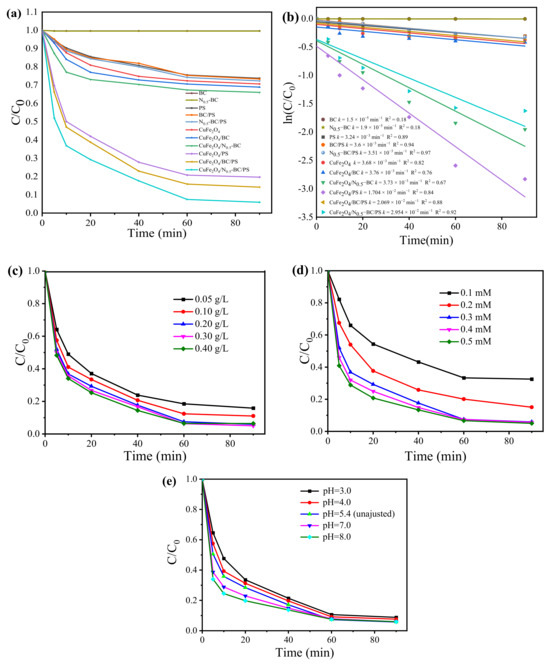
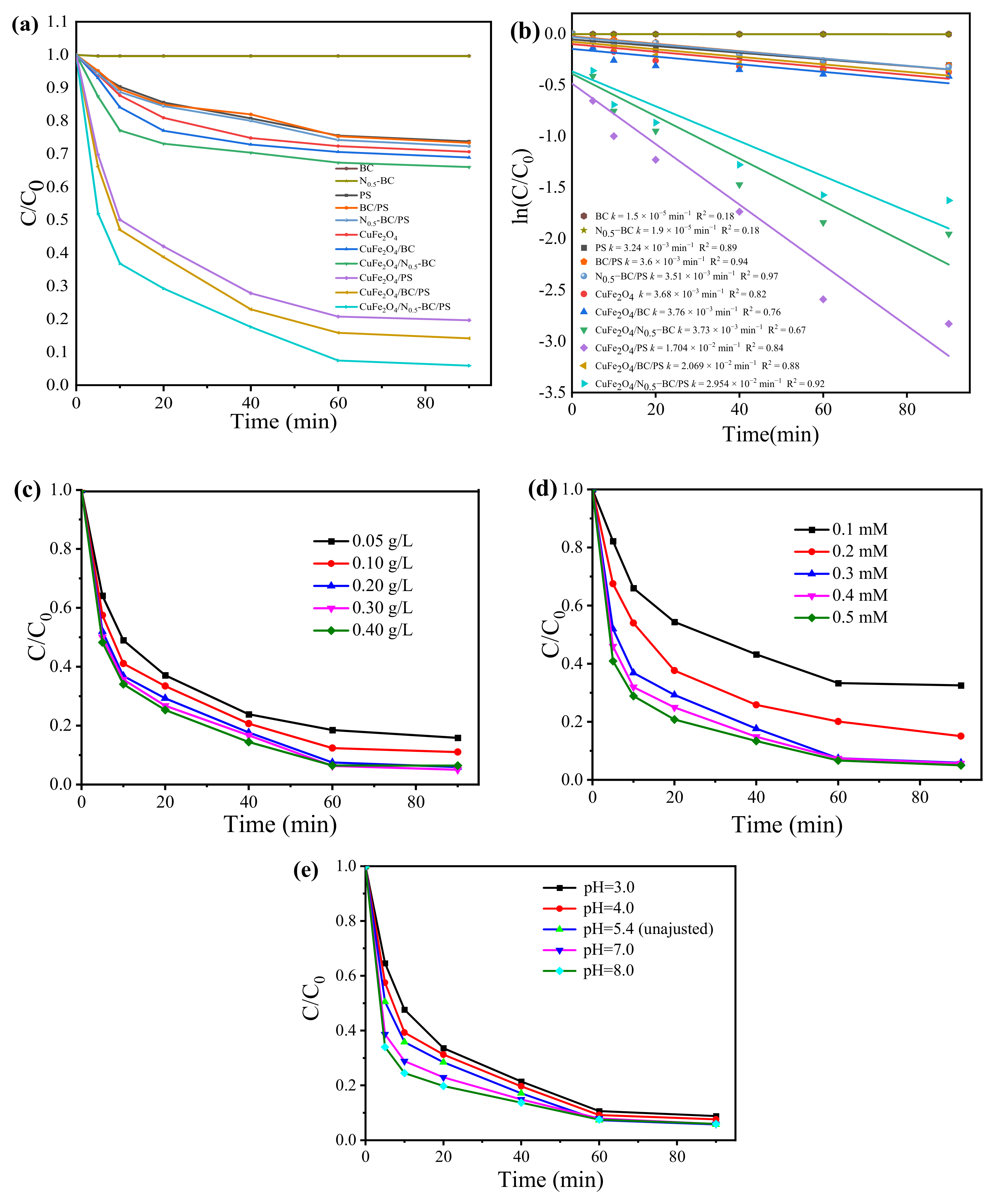
The degradation of MB in the different systems including BC, N0.5-BC, CuFe2O4, CuFe2O4/BC, CuFe2O4/N0.5-BC, PS, BC + PS, N0.5-BC + PS, CuFe2O4 + PS, CuFe2O4/BC + PS and CuFe2O4/N0.5-BC + PS were investigated. The degradation efficiencies of MB and the corresponding pseudo-first-order kinetic model in the different systems was compared, and the results are shown in Figure 5a,b. When BC or N0.5-BC alone was present, MB was hardly removed, indicating that BC or N0.5-BC alone could not effectively adsorb or degrade MB. When CuFe2O4 alone was present, MB removal was slightly improved, and the removal efficiency of MB was very low (29.4%). When PS alone was present, the degradation efficiency of MB was only 26.2%, indicating that PS alone could not effectively degrade MB. This is due to the relatively low oxidation potential of PS. The removal efficiencies of MB in the CuFe2O4/BC and CuFe2O4/N0.5-BC system were 31.1% and 34.0%, respectively. This results in MB molecules mainly being adsorbed on the surfaces of CuFe2O4/BC and CuFe2O4/N0.5-BC. The above results indicate that the direct oxidation of MB by PS or the adsorption of MB on CuFe2O4/BC and CuFe2O4/N0.5-BC is relatively inefficient. The degradation efficiencies of MB in the BC + PS (26.6%) and N0.5-BC + PS (27.7%) system were only more than that in PS alone (26.2%), while they were higher than that in BC or N0.5-BC alone, suggesting BC and N0.5-BC had a weak activation effect on PS. The degradation efficiency of MB in the CuFe2O4 + PS system was 80.3%, much more than 26.2% of PS alone or 29.4% of CuFe2O4 alone, suggesting CuFe2O4 had good activation effect on PS. The degradation efficiency of MB in the CuFe2O4/BC + PS system was 85.8% and more than 80.3% in the CuFe2O4 + PS system, indicating PS activation with CuFe2O4/BC was enhanced compared with CuFe2O4. CuFe2O4 has magnetic properties and is prone to aggregation. By loading CuFe2O4 onto BC, the dispersion of CuFe2O4 can be improved and its active sites are more fully exposed, thereby enhancing its catalytic activity. The degradation efficiency of MB in the CuFe2O4/N0.5-BC + PS system was 94.1%, significantly improving the degradation efficiency of MB. The N atoms in CuFe2O4/N0.5-BC have lone pairs of electrons and high electronegativity, which not only enhance the electron density but also cause electron rearrangement through conjugation with sp2-hybridized C, accelerating electron transfer [33] and thereby increasing the degradation efficiency of MB in the CuFe2O4/N0.5-BC + PS system. As shown in Figure 5b, the reaction rate constant of the CuFe2O4/N0.5-BC + PS system (0.02954 min−1) was 9.12 times higher than that of the PS alone system (0.00324 min−1). Compared to the CuFe2O4/N0.5-BC system (0.00373 min−1), the reaction rate constant in the CuFe2O4/N0.5-BC + PS system increased by 6.92 times. Moreover, the reaction rate constant in the CuFe2O4/N0.5-BC + PS system is 1.1 times of that in the CuFe2O4/BC + PS system (0.02069 min−1). This indicates that CuFe2O4/N0.5-BC can activate PS to form ROS and degrade MB effectively. Correspondingly, the CuFe2O4/N0.5-BC + PS system was selected for the subsequent MB degradation system.
Figure 5.
MB degradation efficiency (a) and the corresponding pseudo-first-order kinetic model (b) in the different systems, the influence of (c) CuFe2O4/N0.5-BC dosage, (d) PS concentration and (e) initial pH. Reaction conditions: [Catalyst] = 0.2 g/L except for (b), [MB] = 50 mg/L, [V] = 100 mL, [PS] = 0.30 mM except for (c), pH = 5.4 except for (d), Temperature = 25 °C, Time = 90 min.
3.3.2. The Influence of the Dosage of CuFe2O4/N0.5-BC
The degradation of MB at the different dosage of CuFe2O4/N0.5-BC at 0.05, 0.10, 0.20, 0.30, and 0.40 g/L were investigated. The results are shown in Figure 5c. When the dosage of CuFe2O4/N0.5-BC increased from 0.05 g/L to 0.20 g/L within 90 min in the CuFe2O4/N0.5-BC + PS system, the degradation efficiency of MB increased from 84.1% to 94.1%. An increase in the dosage of CuFe2O4/N0.5-BC not only enhances the adsorption of MB molecules on the surface of CuFe2O4/N0.5-BC but also provides more effective active sites for PS, facilitating the generation of SO4•− and promoting more and more effective interactions between MB and free radicals, thereby increasing the degradation efficiency [51]. While the dosage of CuFe2O4/N0.5-BC increased from 0.20 g/L to 0.40 g/L, the degradation efficiency decreased from 94.1% to 93.6%. At high dosages, CuFe2O4/N0.5-BC may experience slight aggregation due to its magnetic properties, resulting in a decrease in the total surface area and a reduction in the number of effective active sites [52]. Excessive catalysts can produce an excessive number of active sites, which interact with the free radicals generated by PS and cause quenching, leading to a decrease in the degradation efficiency of MB.
3.3.3. The Influence of PS Concentration
The degradation of MB by PS at the different concentration of 0.10, 0.20, 0.30, 0.40, and 0.50 mM were investigated. The results are shown in Figure 5d. The degradation efficiency of MB increased significantly from 67.5% to 94.1% within 90 min as the PS concentration rose from 0.10 mM to 0.30 mM in the CuFe2O4/N0.5-BC + PS system. This indicates that an increase in PS concentration leads to more adsorption of S2O82− on the active sites of CuFe2O4/N0.5-BC, thereby generating more SO4•− and enhancing the degradation efficiency of MB. When the PS concentration increased from 0.30 mM to 0.50 mM, the degradation efficiency of MB rose from 94.1% to 94.9%, suggesting that an excessive PS concentration (≥0.30 mM) does not significantly improve the degradation efficiency of MB. On one hand, a certain amount of PS is activated by the limited number of active sites on the surface of CuFe2O4/N0.5-BC to generate free radicals. On the other hand, the excess PS produces additional S2O82−, which reacts with the free radicals and causes quenching.
3.3.4. The Influence of the Initial pH of the System
The degradation of MB in the system at the initial pH value of 3.0, 4.0, 5.4, 7.0, and 8.0 were investigated. The experimental results are shown in Figure 5e. The initial pH of the CuFe2O4/N0.5-BC + PS system without any adjustment was 5.4. When pH = 3.0, the degradation efficiency of MB was 91.2%, which was significantly lower than that at the initial pH. The possible reasons are as follows: acidic solutions produce H+, which accelerates the formation of H-bonds between the -O-O- groups of S2O82−, thereby hindering the reaction between the catalyst and PS; at the same time, CuFe2O4/N0.5-BC composite materials are prone to dissolving and releasing metal ions under low-pH condition [49], reducing the activity of CuFe2O4/N0.5-BC. When the reaction time was 40 min, the pH value increased from 5.4 to 8.0, and the degradation efficiency increased from 82.9% to 86.3%, indicating that the CuFe2O4/N0.5-BC + PS system is more favorable for MB degradation under weakly alkaline conditions. This may be the result that the number of surface hydroxyl group of CuFe2O4/N0.5-BC increases with the increase in pH [14,53], thereby improving the degradation efficiency of MB. When the pH increased to weakly alkaline, there was no significant increase in the degradation efficiency of MB. Therefore, all subsequent experiments were conducted under natural pH conditions.
Consequently, the subsequent experiments for degrading MB in the CuFe2O4/N0.5-BC + PS system were conducted at room temperature with an oscillation speed of 150 rpm, a CuFe2O4/N0.5-BC dosage of 0.20 g/L, PS concentration of 0.30 mM, the initial concentration of MB of 50 mg/L, pH of 5.4, volume of 100 mL, and reaction time of 90 min.
3.4. The Influence of Common Inorganic Anions on MB Degradation by PS Activation with CuFe2O4/N0.5-BC
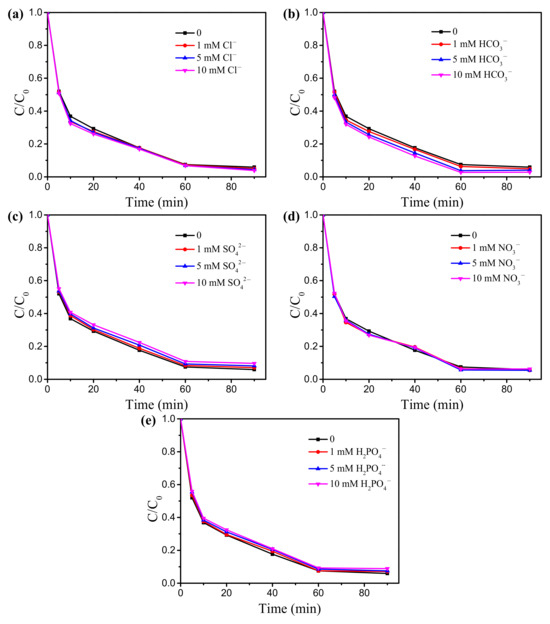
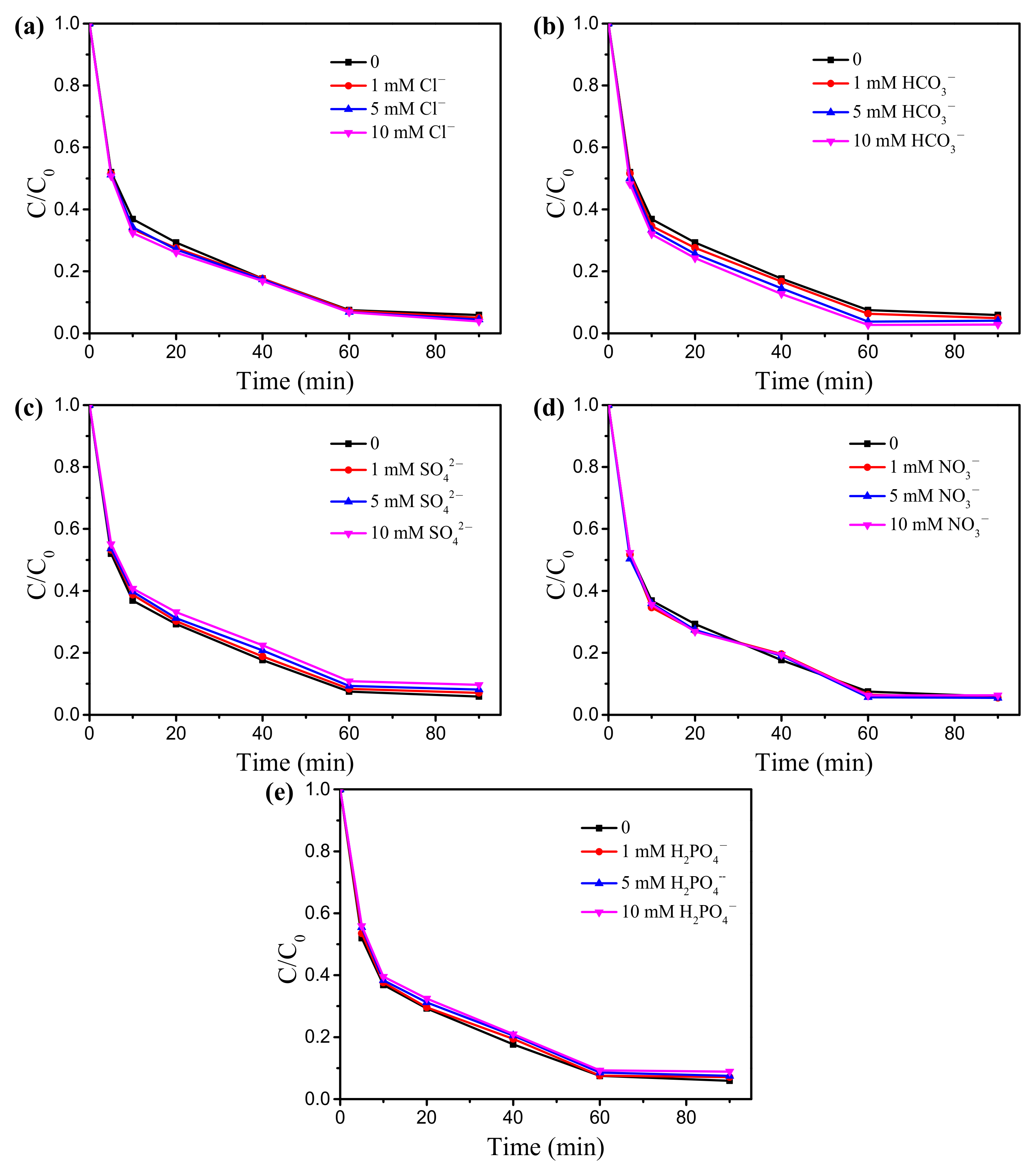
The different concentration gradients of Cl−, HCO3−, SO42−, NO3− and H2PO4− were selected to investigate the influence of common inorganic anions at different concentrations on the degradation efficiency of MB. The experimental results are shown in Figure 6. As shown in Figure 6a, when the Cl− concentration increased from 0 to 1, 5, 10 mM, the degradation efficiencies of MB were 94.1%, 95.0%, 95.5%, and 96.2%, respectively. With the Cl− concentration increasing, the degradation efficiency of MB slightly increased. The possible reason for this is that Cl− reacts with SO4•− to produce chlorine radicals •Cl (E0 = 1.36–2.41 V), which facilitate the attack on MB molecules, promote the degradation of MB [28,29]. As shown in Figure 6b, when the HCO3− concentration increased from 0 to 1, 5, 10 mM, the degradation efficiencies of MB were 94.1%, 95.1%, 95.9%, and 97.2% respectively. With the increase of HCO3− concentration, the degradation efficiency of MB also increased; the result is consistent with Chun Cai et al.’s research findings [54]. This may be due to the reaction of HCO3− with SO4•− or •OH to form CO3•− [55,56]. Although the activity of CO3•− is relatively low, its selectivity is strong, which is conducive to promoting the degradation of MB [51]. As shown in Figure 6c, when the concentration of SO42− increased from 0 to 1, 5, 10 mM, the degradation efficiencies of MB were 94.1%, 92.9%, 91.8%, and 90.3% respectively. With the increase in SO42− concentration, the degradation efficiency of MB slightly decreased, which can be attributed to the inherent characteristics of SO4•− [57]. As shown in Figure 6d, when the NO3− concentration increased from 0 to 1, 5, and 10 mM, the degradation efficiencies of MB were 94.1%, 94.6%, 94.6%, and 93.7%, respectively. With the increase of NO3− concentration, the degradation efficiency of MB remained almost unchanged. This may be due to the reaction rate between NO3− and SO4•− was relatively low and they hardly reacted with each other [28]. As shown in Figure 6e, when the concentration of H2 increases from 0 to 1, 5, and 10 mM, the degradation efficiencies of MB are 94.1%, 92.9%, 92.5%, and 91.1%, respectively. With the increase of H2 concentration, the degradation efficiency of MB slightly decreases. This is due to H2 reacts with SO4•− to generate H2 with a weaker redox potential [51]. Moreover, H2 potentially affects the surface of CuFe2O4/N0.5-BC through chelation reaction, occupying active radical sites and inhibiting the degradation of MB molecules [57]. However, the influence of the investigated common inorganic anions on MB degradation efficiency is minor and negligible, indicating CuFe2O4/N0.5-BC is resistant to common inorganic anions in environments.
Figure 6.
The influence of common inorganic anions on MB degradation (a) Cl−, (b) HCO3−, (c) SO42−, (d) NO3−, (e) H2PO4− reaction conditions: [catalyst] = 0.2 g/L, [MB] = 50 mg/L, V = 100 mL, [PS] = 0.30 mM, pH = 5.4, temperature = 25 °C, time = 90 min.
3.5. CuFe2O4/N0.5-BC Catalyzes Different Oxidants for Degradation of MB
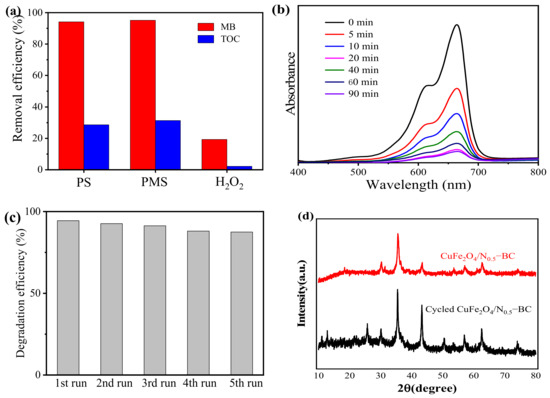
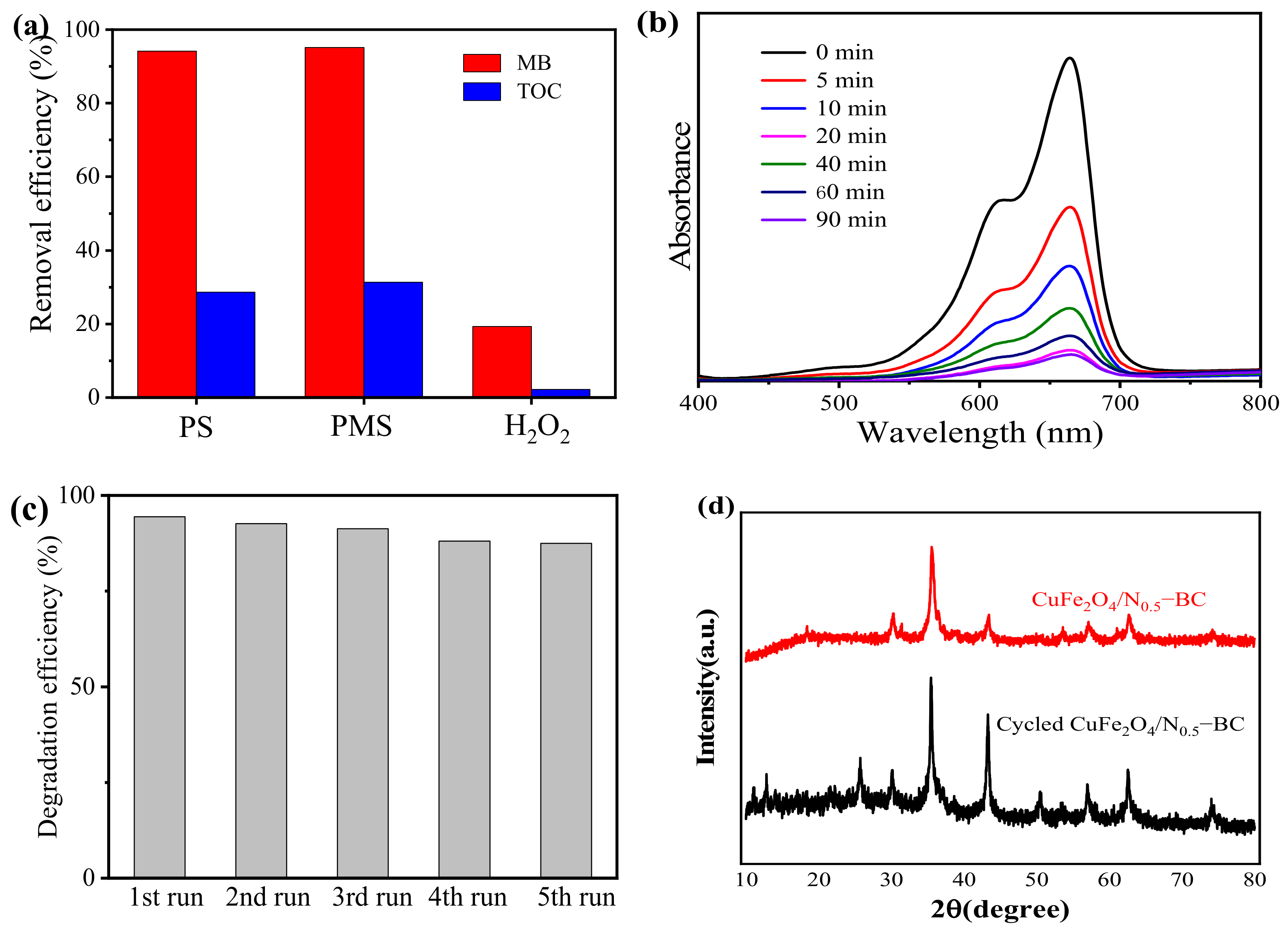
The catalytic activities of CuFe2O4/N0.5-BC towards various oxidants such as PS, PMS, and H2O2 under the same conditions, and the effects of these oxidants on the degradation of MB, were comparatively evaluated. The experimental results are shown in Figure 7a. In the CuFe2O4/N0.5-BC + various oxidant systems, the degradation efficiencies of MB were in the order of: CuFe2O4/N0.5-BC + PMS > CuFe2O4/N0.5-BC + PS > CuFe2O4/N0.5-BC + H2O2, indicating that the degradation efficiency of MB by SO4•− was higher than that by •OH. Among the various oxidants, the degradation efficiency of MB in the CuFe2O4/N0.5-BC + PMS system was the highest, reaching 95.1%, followed by the PS system (94.1%), with the corresponding TOC removal efficiencies being 31.3% and 28.6%, respectively. In the CuFe2O4/N0.5-BC + PMS and CuFe2O4/N0.5-BC + PS systems, SO4•−, O2•− and •OH were formed, leading to the degradation of MB. In the CuFe2O4/N0.5-BC + H2O2 systems, only •OH was formed, and the degradation efficiency of MB was only 19.3%, with the corresponding TOC removal efficiency only being 2.2%. This might be due to the oxidation potential of •OH (E0 = 1.9–2.7 V) being lower than that of SO4•− (E0 = 2.5–3.1 V). The results indicated that CuFe2O4/N0.5-BC was more effective in activating persulfate compared to H2O2.
Figure 7.
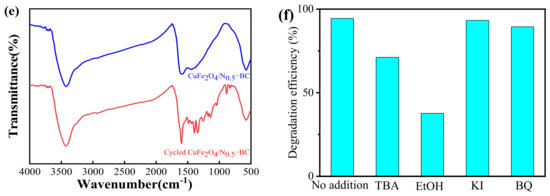
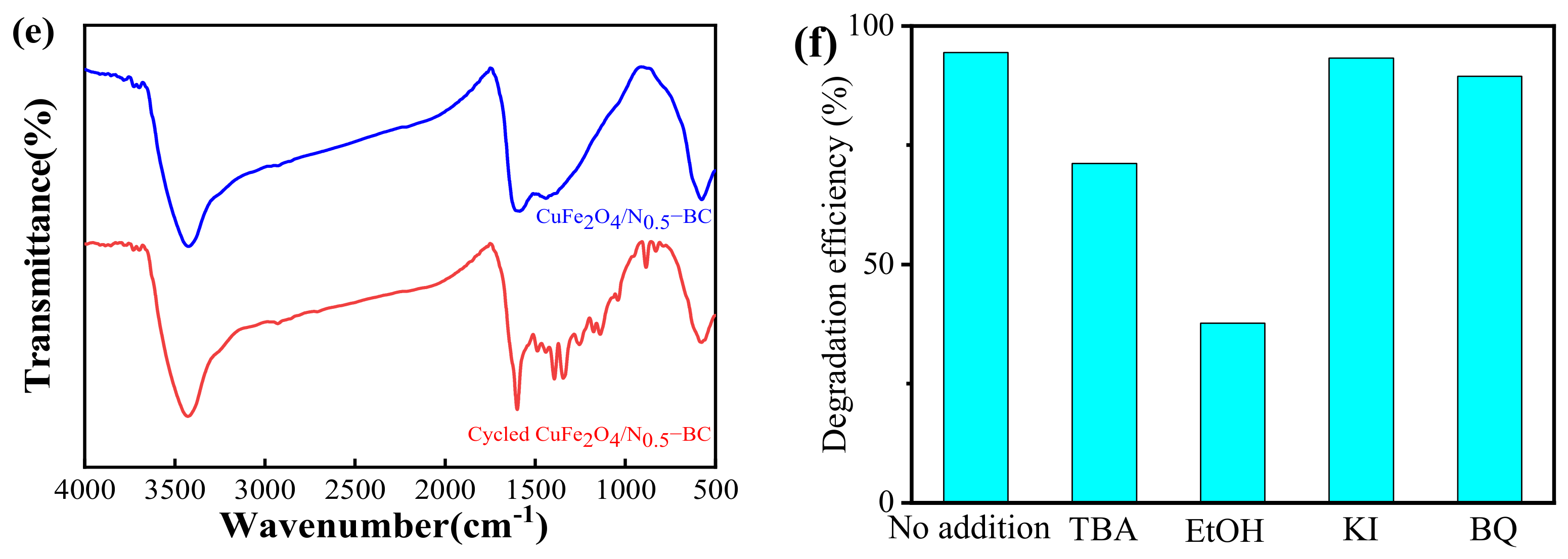
(a) Comparison of various oxidants activation with CuFe2O4/N0.5-BC, (b) UV–vis spectra of MB during degradation, (c) recycle experiments, (d) XRD patterns and (e) FTIR spectra before and after MB degradation reaction, (f) various free radical quenching experiments.
3.6. UV-Vis Absorption Spectrum Analysis of MB in the CuFe2O4/N0.5-BC + PS System
To determine the transformation of the structural characteristics of MB, the changes in the UV-Vis spectra of the MB solution during degradation in the CuFe2O4/N0.5-BC + PS system were analyzed. At different intervals of reaction time, the reaction products were taken out, filtered through a membrane filter, and the filtrate was scanned for spectra within the wavelength range of 400–800 nm. The results are shown in Figure 7b. The peak at 664 nm corresponds to the luminescent group of the MB molecule [11]. As the reaction time increased, the absorption peak weakened and almost disappeared after the reaction lasted for 90 min, indicating that these luminescent groups were decomposed. No additional absorption peaks were observed. These spectral changes were related to the disappearance of the conjugated structure in the heterocyclic aromatic structure, which was caused by the strong π-π* electron transition in the MB molecular structure [58].
3.7. The Reusability of CuFe2O4/N0.5-BC
To investigate the reusability of CuFe2O4/N0.5-BC, after each degradation experiment was completed, CuFe2O4/N0.5-BC was separated from the CuFe2O4/N0.5-BC + PS system using an external magnetic field, washed, and dried before being reused for five cycles. The degradation efficiency of MB and the sequence of CuFe2O4/N0.5-BC recycling are shown in Figure 7c. The MB degradation efficiencies corresponding to five cycles of CuFe2O4/N0.5-BC were 94.4%, 92.6%, 91.3%, 88.0%, and 87.5%, respectively. The results indicate that the recycled CuFe2O4/N0.5-BC particles still exhibit good reusability after five cycles, while the catalytic degradation efficiency of MB decreases. The decrease in the catalytic degradation effect of CuFe2O4/N0.5-BC may be due to the slight loss of CuFe2O4/N0.5-BC during the recovery and washing process, or the dissolution of metal ions, which leads to a decrease in the catalytic activity of CuFe2O4/N0.5-BC. To further assess the catalyst’s stability, XRD and FT-IR analyses were performed before and after MB degradation reaction (Figure 7d,e). These analyses showed that the lattice characteristic peaks and functional group signals remained unchanged, indicating the catalyst’s framework staying intact during the catalytic process.
3.8. Identification of Free Radicals and the Mechanism of CuFe2O4/N0.5-BC Activating PS
To evaluate the role of free radicals formed in the CuFe2O4/N0.5-BC + PS system, various free radical scavengers were used in the system. The results of MB degradation efficiency after adding free radical scavengers are shown in Figure 7f. When the concentration of tertiary butanol (TBA, selective scavenger for •OH, based on the higher rate constant for the reaction with •OH (k = 3.8–7.6 × 10⁸ M−1s−1) than SO4•− (k = 4.0–9.1 × 10⁵ M−1s−1)) [22,50] was 1 mol/L, the degradation efficiency of MB was 71.3%, and the degradation efficiency decreased. This indicates that during the degradation of MB in the CuFe2O4/N0.5-BC + PS system, •OH played a certain role. •OH might be produced due to the reaction between SO4•− and OH− in water [28,59]. However, when 1 mol/L ethyl alcohol (EtOH, scavenger for both SO4•− (k = 1.6–7.7 × 10⁷ M−1s−1) and •OH (k = 1.2–2.8 × 10⁹ M−1s−1)) [28,60] was added to the CuFe2O4/N0.5-BC + PS system, the degradation efficiency was 37.7%, indicating a significant decrease in degradation efficiency, which suggests that SO4•− plays a crucial role in the degradation of MB. When 0.1 mM KI (surface-bound reactive species scavenger) was added, the MB degradation efficiency was 93.3%, indicating that surface-bound radicals have little effect on the degradation of MB. When the concentration of p-benzoquinone (BQ, scavenger for O2•−) was 1 mM, the MB degradation efficiency was 89.5%, slightly lower than that of the control experiment, suggesting that O2•− has little impact on the degradation of MB. In conclusion, SO4•− plays a major role, •OH played a certain role and O2•− was also responsible for the degradation of MB in the CuFe2O4/N0.5-BC + PS system.
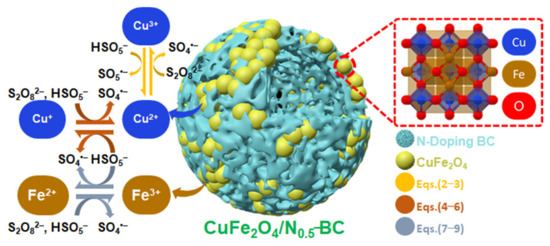
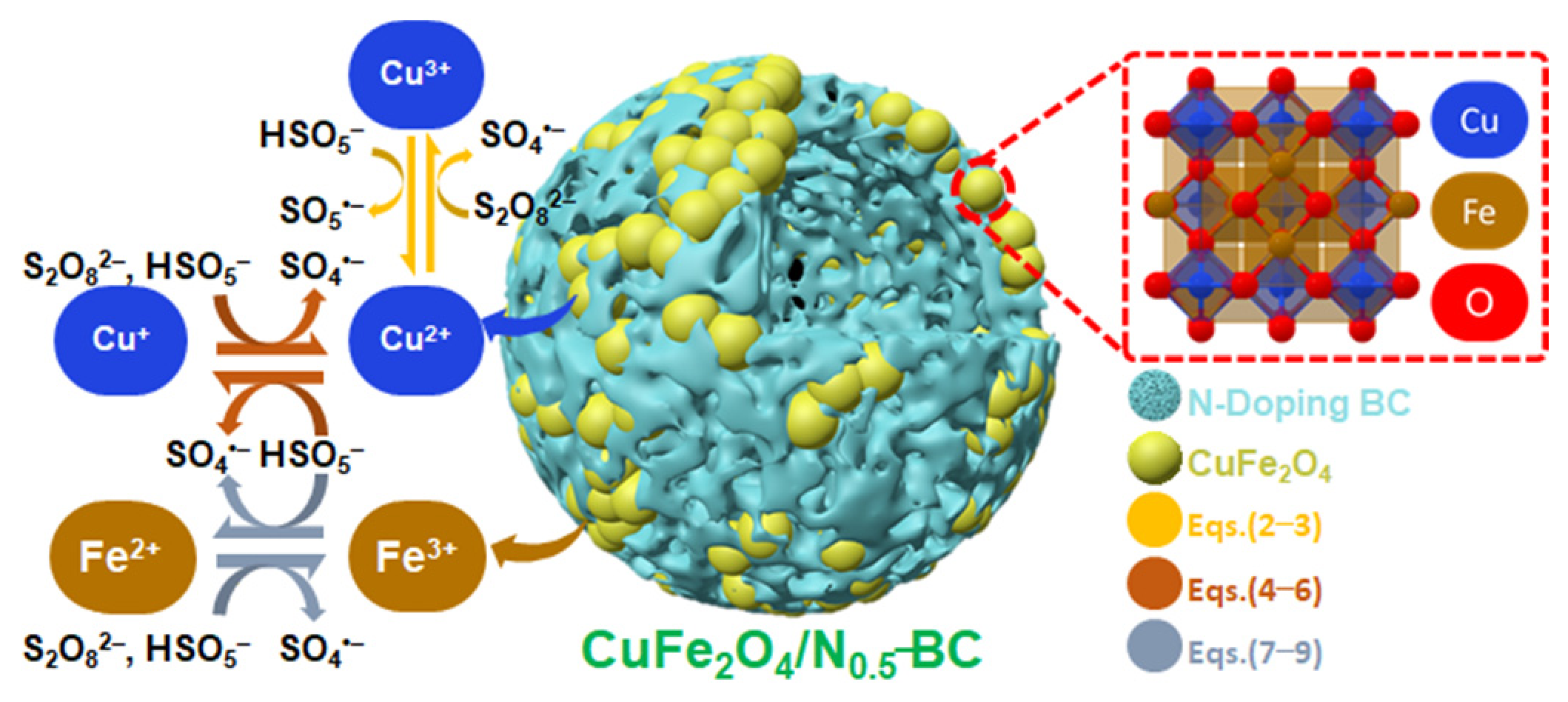
Based on the free radical scavenging experiments results and the related literature [28,61,62,63], a possible mechanism for the degradation of MB in the CuFe2O4/N0.5-BC + PS system is proposed (Figure 8). In the MB aqueous solution, some PS can react with H2O to generate HSO5− (Equation (1)). Cu(II) adsorbed on the surface of CuFe2O4/N0.5-BC is oxidized by PS to Cu(III), generating SO4•− (Equation (2)). Cu(III) activates HSO5− to produce SO5•− (Equation (3)). Cu(II) reacts with PS to generate SO4•− (Equation (4)). Cu(I) can further react with PS and HSO5− to generate SO4•− and •OH (Equations (5) and (6)).
H2O + S2O82− → HSO5− +HSO4−
Cu(II) + S2O82− → Cu(III) + SO4•−+ SO42−
Cu(III) + HSO5− → Cu(II) + SO5•−+ H+
Cu(II) + HSO5− → Cu(I) + SO4•−+ H+
Cu(I) + S2O82− → Cu(II) + SO4•−+ SO42−
Cu(I) + HSO5− → Cu(II) + SO4•− + OH−·
Figure 8.
Mechanism of CuFe2O4/N0.5-BC activation for PS.
In addition, Fe(III) on the surface of CuFe2O4/N0.5-BC can activate HSO5− to form SO4•− (Equation (7). Fe(II) can react with S2O82− and HSO5− to generate SO4•− (Equations (8) and (9)). Moreover, the BC surface rich in oxygen-containing functional groups can interact with PS (Equations (10) and (11)) [64]. BC acts as a bridge for electron transfer, promoting rapid electron transfer in the catalytic cycle of free radical generation [34]. Due to the greater electronegativity of the N atom than that of the C atom, N-doped BC can more easily weaken the -O-O- bond of PS, making it easier for MB to be oxidatively degraded through electron bridging [65]. SO5•− is converted to SO4•− (Equation (12)). SO4•− hydrolyzes to generate •OH (Equation (13)). Based on the above-mentioned analysis, the reaction can not only generate highly active free radicals from S2O82− and HSO5−, but also restore the metal center to its initial oxidation state. Ultimately, the generated free radicals will degrade MB molecules, producing fewer harmful products.
Fe(III) + HSO5− → Fe(II) + SO5•− + H+
Fe(II) + S2O82− → Fe(III) + SO4•− + SO42−
Fe(II) + HSO5− → Fe(III) + SO4•− + OH−
BCsurf-OOH + S2O82− → SO4•−+ BCsurf-OO• + HSO4−
BCsurf-OH + S2O82− → SO4•−+ BCsurf-O• + HSO4−
2SO5•− → 2SO4•− + O2·
SO4•− + H2O → •OH + SO42− + H+·
4. Conclusions
CuFe2O4/N0.5-BC were successfully synthesized by one-step sol–gel pyrolysis using eucalyptus wood powder as the biochar raw material, Fe(NO3)3 and Cu(NO3)2 as metal precursors, dicyandiamide as the nitrogen source, and citric acid as the chelating agent, and CuFe2O4/N0.5-BC was used for the activation of PS to degrade MB, The main conclusions obtained are as follows:
- (1)
- The optimal preparation conditions of CuFe2O4/N0.5-BC were determined by single-factor experiments as follows: nitrogen doping amount x = 0.5, pyrolysis temperature 500 °C, and pyrolysis time 1 h. The saturation magnetization of CuFe2O4/N0.5-BC was 25.53 emu/g and could be magnetically recycled.
- (2)
- Under the optimal conditions of 0.2 g/L CuFe2O4/N0.5-BC, 0.30 mM PS, 50 mg/L initial MB concentration, and 100 mL volume, the degradation efficiency of MB was 94.1% after 90 min of reaction. Compared to PS alone, the degradation efficiency of MB increased from 26.2% to 94.1%, and the reaction rate constant in the CuFe2O4/N0.5-BC + PS system (0.02954 min−1) was 9.12 times higher than that in the PS alone system. Compared to the CuFe2O4/BC system, the degradation efficiency of MB in the CuFe2O4/N0.5-BC + PS system increased from 34% to 94.1%, while the reaction rate constant is 1.1 times that in the CuFe2O4/BC + PS system. Both Cl− and HCO3− promoted the degradation of MB, while NO3− had almost no effect on the degradation rate of MB. SO42− and H2PO4− inhibited the degradation of MB. CuFe2O4/N0.5-BC exhibited good reusability in multiple cycles; after five cycles of application, the degradation efficiency of MB in the CuFe2O4/N0.5-BC + PS still reached 87.5%. SO4•− plays a major role, •OH played a certain role and O2•− was also responsible for the degradation of MB in the CuFe2O4/N0.5-BC + PS system.
- (3)
- The N-doping of biochar and support strategies can enhance the catalytic activity of CuFe2O4 for persulfate promoted Methylene Blue degradation. CuFe2O4/N0.5-BC is a green and effective catalyst for treating MB-polluted water.
Supplementary Materials
The following supporting information can be downloaded at: https://www.mdpi.com/article/10.3390/chemistry8090125/s1, Test S1: the characterization methods of the prepared material CuFe2O4/Nx-BC; Table S1: the main chemical reagent; Table S2: The main experimental instruments.
Author Contributions
X.W.: Investigation, Methodology, Writing—original draft. Q.H.: Conceptualization, Data curation, Formal analysis, Investigation, Methodology, Writing—original draft. L.W.: Investigation, Software. K.L.: Investigation, Methodology. Q.Z.: Conceptualization, Data curation. X.X.: Investigation, Software. C.C.: Funding acquisition, Conceptualization, Methodology, Project administration, Resources, Supervision, Writing—review and editing. All authors have read and agreed to the published version of the manuscript.
Funding
This research was funded by the National Natural Science Foundation of China (No. 31660183), Guangxi Natural Science Foundation (No. 2025GXNSFAA069247), and Guangxi Key Laboratory of Petrochemical Resource Processing and Process Intensification Technology (No. 2024K002).
Data Availability Statement
Data will be available on request.
Acknowledgments
We thank the support from the National Natural Science Foundation of China (31660183), Guangxi Natural Science Foundation (2025GXNSFAA069247), and the Dean/Opening Project of Guangxi Key Laboratory of Petrochemical Resource Processing and Process Intensification Technology (2024K002).
Conflicts of Interest
The authors declare no conflicts of interest.
References
- Mashkoor, F.; Nasar, A. Magsorbents: Potential Candidates in Wastewater Treatment Technology—A Review on the Removal of Methylene Blue Dye. J. Magn. Magn. Mater. 2020, 500, 166408. [Google Scholar] [CrossRef] [Scilit]
- Li, H.; Budarin, V.L.; Clark, J.H.; North, M.; Wu, X. Rapid and Efficient Adsorption of Methylene Blue Dye from Aqueous Solution by Hierarchically Porous, Activated Starbons®: Mechanism and Porosity Dependence. J. Hazard. Mater. 2022, 436, 129174. [Google Scholar] [CrossRef] [Scilit] [PubMed]
- Yao, X.; Ji, L.; Guo, J.; Ge, S.; Lu, W.; Cai, L.; Wang, Y.; Song, W.; Zhang, H. Magnetic Activated Biochar Nanocomposites Derived from Wakame and its Application in Methylene Blue Adsorption. Bioresour. Technol. 2020, 302, 122842. [Google Scholar] [CrossRef] [Scilit] [PubMed]
- Zhou, H.; Li, Y.; Du, Q.; Pi, X.; Zhang, J.; Wang, X.; Chen, B.; Yin, L.; Zhang, Y.; Li, Y.; et al. Preparation and Characterization of Zirconium-Based Metal-Organic Skeleton Composite Sodium Alginate@SiO2 and its Adsorption on Methylene Blue Solution in Water. Int. J. Biol. Macromol. 2025, 304, 140916. [Google Scholar] [CrossRef] [Scilit] [PubMed]
- Bharti, V.; Vikrant, K.; Goswami, M.; Tiwari, H.; Sonwani, R.K.; Lee, J.; Tsang, D.C.W.; Kim, K.; Saeed, M.; Kumar, S.; et al. Biodegradation of Methylene Blue Dye in a Batch and Continuous Mode Using Biochar as Packing Media. Environ. Res. 2019, 171, 356–364. [Google Scholar] [CrossRef] [Scilit] [PubMed]
- Nguyen, C.H.; Fu, C.; Juang, R. Degradation of Methylene Blue and Methyl Orange by Palladium-Doped TiO2 Photocatalysis for Water Reuse: Efficiency and Degradation Pathways. J. Clean. Prod. 2018, 202, 413–427. [Google Scholar] [CrossRef] [Scilit]
- Rana, A.; Sonu, S.; Soni, V.; Chawla, A.; Sudhaik, A.; Raizada, P.; Ahamad, T.; Thakur, P.; Thakur, S.; Singh, P. Novel S-Scheme Derived Mo–Bi2WO6/WO3/Biochar Composite for Photocatalytic Removal of Methylene Blue Dye. J. Phys. Chem. Solids 2025, 196, 112385. [Google Scholar] [CrossRef] [Scilit]
- Vasudevan, V.; Pei, B.; Xiong, W.; He, J.; Li, S.; Huang, D.; Liao, X.; Lin, J. Enhanced Fenton Degradation of Methylene Blue Dye Using CuFe2O4/Fe2O3/Chcp Heterogeneous Catalyst for Superior H2O2 Activation. J. Environ. Chem. Eng. 2024, 12, 114813. [Google Scholar] [CrossRef] [Scilit]
- Liu, Y.; Jiao, J.; Gai, Q.; Fu, Y.; Qiu, Y.; Wang, Y. Natural Sporopollenin Cooperated with Cu2O for Enhancing Fenton-Like Reaction and Insight Into its Adsorption Contributing to the Degradation of Rhodamine B and Methylene Blue. Chem. Eng. Sci. 2026, 321, 122686. [Google Scholar] [CrossRef] [Scilit]
- Shi, G.; Zeng, S.; Liu, Y.; Xiang, J.; Deng, D.; Wu, C.; Teng, Q.; Yang, H. Efficient Heterogeneous Fenton-Like Degradation of Methylene Blue Using Green Synthesized Yeast Supported Iron Nanoparticles. Ecotox. Environ. Safe. 2023, 263, 115240. [Google Scholar] [CrossRef] [Scilit] [PubMed]
- Sun, Y.; Tu, S.; Li, Y.; Sui, X.; Geng, S.; Wang, H.; Duan, X.; Chang, L. Degradation Mechanism of Methylene Blue by Heterogenous Electro-Fenton with CeO2/rGO Composite Cathode. Colloids Surf. A Physicochem. Eng. Asp. 2024, 690, 133861. [Google Scholar] [CrossRef] [Scilit]
- Gao, Y.; Cao, W.; Wang, K.; Shi, H.; Wang, S.; Meng, Q.; Du, K.; Wang, C.; Lin, J. Performance and Mechanism of Magnetic Fe3O4@MnO2 Catalyst for Rapid Degradation of Methylene Blue by Activation of Peroxymonosulfate. J. Alloys Compd. 2024, 987, 174144. [Google Scholar] [CrossRef] [Scilit]
- Sun, Q.; Huang, S.; Li, Z.; Su, D.; Sun, J. Synergistic Activation of Persulfate by Heat and Cobalt-Doped-Bimetallic-Mofs for Effective Methylene Blue Degradation: Synthesis, Kinetics, DFT Calculation, and Mechanisms. J. Environ. Chem. Eng. 2023, 11, 109065. [Google Scholar] [CrossRef] [Scilit]
- Wen, D.; Li, W.; Lv, J.; Qiang, Z.; Li, M. Methylene Blue Degradation by the VUV/UV/Persulfate Process: Effect of Ph on the Roles of Photolysis and Oxidation. J. Hazard. Mater. 2020, 391, 121855. [Google Scholar] [CrossRef] [Scilit] [PubMed]
- Li, X.; Jie, B.; Lin, H.; Deng, Z.; Qian, J.; Yang, Y.; Zhang, X. Application of Sulfate Radicals-Based Advanced Oxidation Technology in Degradation of Trace Organic Contaminants (TrOCs): Recent Advances and Prospects. J. Environ. Manag. 2022, 308, 114664. [Google Scholar] [CrossRef] [Scilit] [PubMed]
- Ushani, U.; Lu, X.; Wang, J.; Zhang, Z.; Dai, J.; Tan, Y.; Wang, S.; Li, W.; Niu, C.; Cai, T.; et al. Sulfate Radicals-Based Advanced Oxidation Technology in Various Environmental Remediation: A State-of-the–Art Review. Chem. Eng. J. 2020, 402, 126232. [Google Scholar] [CrossRef] [Scilit]
- Wang, J.; Wang, S. Activation of Persulfate (Ps) and Peroxymonosulfate (Pms) and Application for the Degradation of Emerging Contaminants. Chem. Eng. J. 2018, 334, 1502–1517. [Google Scholar] [CrossRef] [Scilit]
- Sdoukou, E.; Antonopoulou, M.; Salmas, C.E.; Kyzas, G.Z.; Konstantinou, I. Peroxymonosulfate/Persulfate Activation by Ni (Hydr)Oxides Loaded on Tire Char/Activated Char through Radical and Nonradical Pathways for Efficient Degradation of Emerging Pollutants in Waters and Wastewaters. J. Environ. Chem. Eng. 2025, 13, 118834. [Google Scholar] [CrossRef] [Scilit]
- Xiao, S.; Cheng, M.; Zhong, H.; Liu, Z.; Liu, Y.; Yang, X.; Liang, Q. Iron-Mediated Activation of Persulfate and Peroxymonosulfate in Both Homogeneous and Heterogeneous Ways: A Review. Chem. Eng. J. 2020, 384, 123265. [Google Scholar] [CrossRef] [Scilit]
- Zheng, X.; Niu, X.; Zhang, D.; Lv, M.; Ye, X.; Ma, J.; Lin, Z.; Fu, M. Metal-Based Catalysts for Persulfate and Peroxymonosulfate Activation in Heterogeneous Ways: A Review. Chem. Eng. J. 2022, 429, 132323. [Google Scholar] [CrossRef] [Scilit]
- Song, T.; Kang, X.; Guo, C.; He, Z.; Ge, M. Recent Advances in Persulfate Activation by Magnetic Ferrite-Carbon Composites for Organic Contaminants Degradation: Role of Carbon Materials and Environmental Application. J. Environ. Chem. Eng. 2023, 11, 109087. [Google Scholar] [CrossRef] [Scilit]
- Wang, L.; Lu, X.; Chen, G.; Zhao, Y.; Wang, S. Synergy Between MgFe2O4 and Biochar Derived from Banana Pseudo-Stem Promotes Persulfate Activation for Efficient Tetracycline Degradation. Chem. Eng. J. 2023, 468, 143773. [Google Scholar] [CrossRef] [Scilit]
- Wang, Y.; Zhao, H.; Li, M.; Fan, J.; Zhao, G. Magnetic Ordered Mesoporous Copper Ferrite as a Heterogeneous Fenton Catalyst for the Degradation of Imidacloprid. Appl. Catal. B Environ. 2014, 147, 534–545. [Google Scholar] [CrossRef] [Scilit]
- Nguyen, M.T.; Nguyen, M.D.; Nguyen, T.H.; Gao, M.; Kaushik, N.; Vasilyevich, O.V.; Petrovna, A.A.; Andreevich, O.N.; Kaushik, N.K.; Nguyen, T.T.; et al. Microwave-Assisted Synthesis of Copper Ferrite Nanocatalysts for Synergistic Plasma-Fenton Degradation of Rhodamine B. Colloids Surf. A Physicochem. Eng. Asp. 2025, 705, 135681. [Google Scholar] [CrossRef] [Scilit]
- Soufi, A.; Hajjaoui, H.; Boumya, W.; Elmouwahidi, A.; Baillón-García, E.; Abdennouri, M.; Barka, N. Recent Trends in Magnetic Spinel Ferrites and their Composites as Heterogeneous Fenton-Like Catalysts: A Review. J. Environ. Manag. 2024, 367, 121971. [Google Scholar] [CrossRef] [Scilit] [PubMed]
- Chen, J.; Zhou, J.; Zheng, W.; Leng, S.; Ai, Z.; Zhang, W.; Yang, Z.; Yang, J.; Xu, Z.; Cao, J.; et al. A Complete Review on the Oxygen-Containing Functional Groups of Biochar: Formation Mechanisms, Detection Methods, Engineering, and Applications. Sci. Total Environ. 2024, 946, 174081. [Google Scholar] [CrossRef] [Scilit] [PubMed]
- Wen, J.; Long, Y.; Zhu, L.; Zeng, L.; Qin, X.; Song, S.; Lu, M.; Deng, L. Bimetallic CuFe2O4 Photocatalytic Activates Persistent Free Radicals and Accelerates Electron Transfer in Biochar: Efficient Degradation of Tetracycline. Environ. Res. 2025, 275, 121413. [Google Scholar] [CrossRef] [Scilit] [PubMed]
- Huang, Q.; Chen, C.; Zhao, X.; Bu, X.; Liao, X.; Fan, H.; Gao, W.; Hu, H.; Zhang, Y.; Huang, Z. Malachite Green Degradation by Persulfate Activation with CuFe2O4@Biochar Composite: Efficiency, Stability and Mechanism. J. Environ. Chem. Eng. 2021, 9, 105800. [Google Scholar] [CrossRef] [Scilit]
- Fan, H.; Chen, C.; Huang, Q.; Lu, J.; Hu, J.; Wang, P.; Liang, J.; Hu, H.; Gan, T. Zinc-Doped and Biochar Support Strategies to Enhance the Catalytic Activity of CuFe2O4 to Persulfate for Crystal Violet Degradation. Environ. Sci. Pollut. Res. 2023, 30, 38775–38793. [Google Scholar] [CrossRef] [Scilit] [PubMed]
- Zhong, W.; Peng, Q.; Liu, K.; Zhang, Y.; Xing, J. Al3+ Doped CuFe2O4 Efficiently Activates Peroxymonosulfate for Long-Term and Stable Degradation of Tetracycline: Synergistic and Regulatory Role of Al3+. Sep. Purif. Technol. 2023, 310, 123204. [Google Scholar] [CrossRef] [Scilit]
- Dong, Z.; Niu, C.; Guo, H.; Niu, H.; Liang, S.; Liang, C.; Liu, H.; Yang, Y. Anchoring CuFe2O4 Nanoparticles Into N-Doped Carbon Nanosheets for Peroxymonosulfate Activation: Built-in Electric Field Dominated Radical and Non-Radical Process. Chem. Eng. J. 2021, 426, 130850. [Google Scholar] [CrossRef] [Scilit]
- Liu, X.; Pei, Y.; Cao, M.; Yang, H.; Li, Y. Magnetic CuFe2O4 Nanoparticles Anchored on N-Doped Carbon for Activated Peroxymonosulfate Removal of Oxytetracycline From Water: Radical and Non-Radical Pathways. Chemosphere 2023, 334, 139025. [Google Scholar] [CrossRef] [Scilit] [PubMed]
- Yin, Q.; Yan, H.; Liang, Y.; Wang, H.; Duan, P.; Lai, B. Nitrogen Doped Biochar Derived from Algae as Persulfate Activator for the Degradation of Tetracycline: Role of Exogenous N Doping and Electron Transfer Pathway. Sep. Purif. Technol. 2023, 318, 123970. [Google Scholar] [CrossRef] [Scilit]
- Hu, F.; Wang, T.; Zhang, P.; Hu, Y.; Chen, Z.; Zeng, B.; Jiang, F.; Zhang, S. In-Situ Synthesis of N-Doped Biochar from Swine Manure to Activate Peroxymonosulfate for Efficient Tetracycline Degradation: The Key Role of Electron Transfer Process. Sep. Purif. Technol. 2025, 375, 133813. [Google Scholar] [CrossRef] [Scilit]
- Xu, L.; Wu, C.; Liu, P.; Bai, X.; Du, X.; Jin, P.; Yang, L.; Jin, X.; Shi, X.; Wang, Y. Peroxymonosulfate Activation by Nitrogen-Doped Biochar from Sawdust for the Efficient Degradation of Organic Pollutants. Chem. Eng. J. 2020, 387, 124065. [Google Scholar] [CrossRef] [Scilit]
- Zhu, Z.; Yang, X.; Ye, X.; Li, Q.; Wang, J.; Wu, L.; Huang, Z.; Wang, M. Activating Peroxymonosulfate by High Nitrogen-Doped Biochar from Lotus Pollen for Efficient Degradation of Organic Pollutants from Water: Performance, Kinetics and Mechanism Investigation. Sep. Purif. Technol. 2024, 346, 127456. [Google Scholar] [CrossRef] [Scilit]
- Ju, M.; Yan, L.; Cheng, Z.; Li, T.; Li, G.; Rao, P.; Chen, Q.; Huo, B. Enhanced Catalytic Degradation of Sulfamethazine by Magnetic N-Doped Biochar: Performance Evaluation and Mechanism Insight. Process Saf. Environ. Prot. 2025, 203, 107981. [Google Scholar] [CrossRef] [Scilit]
- Ding, D.; Yang, S.; Qian, X.; Chen, L.; Cai, T. Nitrogen-Doping Positively Whilst Sulfur-Doping Negatively Affect the Catalytic Activity of Biochar for the Degradation of Organic Contaminant. Appl. Catal. B Environ. 2020, 263, 118348. [Google Scholar] [CrossRef] [Scilit]
- Zaeni, J.R.J.; Lim, J.; Wang, Z.; Ding, D.; Chua, Y.; Ng, S.; Oh, W. In Situ Nitrogen Functionalization of Biochar Via One-Pot Synthesis for Catalytic Peroxymonosulfate Activation: Characteristics and Performance Studies. Sep. Purif. Technol. 2020, 241, 116702. [Google Scholar] [CrossRef] [Scilit]
- Kocijan, M.; Ćurković, L.; Vengust, D.; Radošević, T.; Shvalya, V.; Gonçalves, G.; Podlogar, M. Synergistic Remediation of Organic Dye by Titanium Dioxide/Reduced Graphene Oxide Nanocomposite. Molecules 2023, 28, 7326. [Google Scholar] [CrossRef] [Scilit] [PubMed]
- Hou, D.; Tian, J.; Wei, J.; Jia, D.; Ma, K.; Xue, H.; Jiang, T. Controllable Phase Transition Dependent Photoinduced Charge Separation in CuFe2O4 for Photocatalytic Hydrogen Evolution. Inorg. Chem. Front. 2024, 11, 4846–4854. [Google Scholar] [CrossRef] [Scilit]
- Zander, J.; Daumann, F.; Loukrakpam, R.; Roth, C.; Weber, B.; Marschall, R. Correlations of Calcination Temperature with the Catalytic Properties of CuFe2O4 for the Synthesis of Green Fuels. Adv. Energy Sustain. Res. 2025, 6, 2400281. [Google Scholar] [CrossRef] [Scilit]
- López-Ramón, M.V.; Álvarez, M.A.; Moreno-Castilla, C.; Fontecha-Cámara, M.A.; Yebra-Rodríguez, Á.; Bailón-García, E. Effect of Calcination Temperature of a Copper Ferrite Synthesized by a Sol-Gel Method on its Structural Characteristics and Performance as Fenton Catalyst to Remove Gallic Acid from Water. J. Colloid Interface Sci. 2018, 511, 193–202. [Google Scholar] [CrossRef] [Scilit] [PubMed]
- Yu, D.; Ni, H.; Wang, L.; Wu, M.; Yang, X. Nanoscale-Confined Precursor of CuFe2O4 Mediated by Hyperbranched Polyamide as an Unusual Heterogeneous Fenton Catalyst for Efficient Dye Degradation. J. Clean. Prod. 2018, 186, 146–154. [Google Scholar] [CrossRef] [Scilit]
- Kombaiah, K.; Vijaya, J.J.; Kennedy, L.J.; Bououdina, M.; Al-Najar, B. Conventional and Microwave Combustion Synthesis of Optomagnetic CuFe2O4 Nanoparticles for Hyperthermia Studies. J. Phys. Chem. Solids 2018, 115, 162–171. [Google Scholar] [CrossRef] [Scilit]
- Hassanzadeh-Tabrizi, S.A. Precise Calculation of Crystallite Size of Nanomaterials: A Review. J. Alloys Compd. 2023, 968, 171914. [Google Scholar] [CrossRef] [Scilit]
- Neves, T.R.; Schildt, L.F.L.; Silva, M.L.L.S.; Vasconcelos, V.V.V.; Di Conzo, C.; Mura, F.; Rossi, M.; Varvaro, G.; Abdolrahimi, M.; Quaranta, S.; et al. Magnetic CuFe2O4 Nanoparticles Immobilized on Modified Rice Husk-Derived Zeolite for Chlorogenic Acid Adsorption. Magnetochemistry 2024, 10, 87. [Google Scholar] [CrossRef] [Scilit]
- Liu, N.; Zhang, L.; Xue, Y.; Lv, J.; Yu, Q.; Yuan, X. Nitrogen-Doped Carbon Material as a Catalyst for the Degradation of Direct Red23 Based on Persulfate Oxidation. Sep. Purif. Technol. 2017, 184, 213–219. [Google Scholar] [CrossRef] [Scilit]
- Zhang, H.; Song, Y.; Nengzi, L.; Gou, J.; Li, B.; Cheng, X. Activation of Persulfate by a Novel Magnetic CuFe2O4/Bi2O3 Composite for Lomefloxacin Degradation. Chem. Eng. J. 2020, 379, 122362. [Google Scholar] [CrossRef] [Scilit]
- Chen, Z.; Wang, L.; Xu, H.; Wen, Q. Efficient Heterogeneous Activation of Peroxymonosulfate by Modified CuFe2O4 for Degradation of Tetrabromobisphenol A. Chem. Eng. J. 2020, 389, 124345. [Google Scholar] [CrossRef] [Scilit]
- Wang, Y.; Tian, D.; Chu, W.; Li, M.; Lu, X. Nanoscaled Magnetic CuFe2O4 as an Activator of Peroxymonosulfate for the Degradation of Antibiotics Norfloxacin. Sep. Purif. Technol. 2019, 212, 536–544. [Google Scholar] [CrossRef] [Scilit]
- Wang, Q.; Wang, B.; Ma, Y.; Xing, S. Enhanced Superoxide Radical Production for Ofloxacin Removal Via Persulfate Activation with Cu-Fe Oxide. Chem. Eng. J. 2018, 354, 473–480. [Google Scholar] [CrossRef] [Scilit]
- Li, Y.; Baghi, R.; Filip, J.; Islam, S.; Hope-weeks, L.; Yan, W. Activation of Peroxydisulfate by Ferrite Materials for Phenol Degradation. Acs Sustain. Chem. Eng. 2019, 7, 8099–8108. [Google Scholar] [CrossRef] [Scilit]
- Cai, C.; Liu, Y.; Xu, R.; Zhou, J.; Zhang, J.; Chen, Y.; Liu, L.; Zhang, L.; Kang, S.; Xie, X. Bicarbonate Enhanced Heterogeneous Activation of Peroxymonosulfate by Copper Ferrite Nanoparticles for the Efficient Degradation of Refractory Organic Contaminants in Water. Chemosphere 2023, 312, 137285. [Google Scholar] [CrossRef] [Scilit] [PubMed]
- He, C.; Wang, J.; Liu, J.; Dai, Y.; Liu, Q.; Zhou, Z.; Ren, B.; Lin, Z.; Yang, X. Degradation of Tetracycline Dominated by Non–Radical Pathway: Oxygen Vacancies in CuFe2O4 as Key Triggering Factors for Enhanced Peroxymonosulfate Activation. J. Environ. Chem. Eng. 2025, 13, 118431. [Google Scholar] [CrossRef] [Scilit]
- Li, Z.; Guo, C.; Lyu, J.; Hu, Z.; Ge, M. Tetracycline Degradation by Persulfate Activated with Magnetic Cu/CuFe2O4 Composite: Efficiency, Stability, Mechanism and Degradation Pathway. J. Hazard. Mater. 2019, 373, 85–96. [Google Scholar] [CrossRef] [Scilit] [PubMed]
- Jaafarzadeh, N.; Ghanbari, F.; Ahmadi, M. Efficient Degradation of 2,4-Dichlorophenoxyacetic Acid by Peroxymonosulfate/Magnetic Copper Ferrite Nanoparticles/Ozone: A Novel Combination of Advanced Oxidation Processes. Chem. Eng. J. 2017, 320, 436–447. [Google Scholar] [CrossRef] [Scilit]
- Dassanayake, R.S.; Rajakaruna, E.; Abidi, N. Borax-Cross-Linked Guar Gum-Manganese Dioxide Composites for Oxidative Decolorization of Methylene Blue. J. Nanomater. 2019, 2019, 7232715. [Google Scholar] [CrossRef] [Scilit]
- Wang, J.; Wang, S. Reactive Species in Advanced Oxidation Processes: Formation, Identification and Reaction Mechanism. Chem. Eng. J. 2020, 401, 126158. [Google Scholar] [CrossRef] [Scilit]
- Niu, B.; Wang, N.; Chen, Y.; Yu, M.; Hou, Z.; Li, Z.; Zheng, Y. Tourmaline Synergized with Persulfate for Degradation of Sulfadiazine: Influencing Parameters and Reaction Mechanism. Sep. Purif. Technol. 2021, 257, 117893. [Google Scholar] [CrossRef] [Scilit]
- Li, J.; Ren, Y.; Ji, F.; Lai, B. Heterogeneous Catalytic Oxidation for the Degradation of P-Nitrophenol in Aqueous Solution by Persulfate Activated with CuFe2O4 Magnetic Nano-Particles. Chem. Eng. J. 2017, 324, 63–73. [Google Scholar] [CrossRef] [Scilit]
- Lyu, J.; Ge, M.; Hu, Z.; Guo, C. One-Pot Synthesis of Magnetic CuO/Fe2O3/CuFe2O4 Nanocomposite to Activate Persulfate for Levofloxacin Removal: Investigation of Efficiency, Mechanism and Degradation Route. Chem. Eng. J. 2020, 389, 124456. [Google Scholar] [CrossRef] [Scilit]
- Zhao, Y.; Song, M.; Cao, Q.; Sun, P.; Chen, Y.; Meng, F. The Superoxide Radicals’ Production via Persulfate Activated with CuFe2O4@Biochar Composites to Promote the Redox Pairs Cycling for Efficient Degradation of O-Nitrochlorobenzene in Soil. J. Hazard. Mater. 2020, 400, 122887. [Google Scholar] [CrossRef] [Scilit] [PubMed]
- Zhu, F.; Wu, Y.; Liang, Y.; Li, H.; Liang, W. Degradation Mechanism of Norfloxacin in Water Using Persulfate Activated by Bc@Nzvi/Ni. Chem. Eng. J. 2020, 389, 124276. [Google Scholar] [CrossRef] [Scilit]
- Ye, S.; Zeng, G.; Tan, X.; Wu, H.; Liang, J.; Song, B.; Tang, N.; Zhang, P.; Yang, Y.; Chen, Q.; et al. Nitrogen-Doped Biochar Fiber with Graphitization from Boehmeria Nivea for Promoted Peroxymonosulfate Activation and Non-Radical Degradation Pathways with Enhancing Electron Transfer. Appl. Catal. B Environ. 2020, 269, 118850. [Google Scholar] [CrossRef] [Scilit]
Disclaimer/Publisher’s Note: The statements, opinions and data contained in all publications are solely those of the individual author(s) and contributor(s) and not of MDPI and/or the editor(s). MDPI and/or the editor(s) disclaim responsibility for any injury to people or property resulting from any ideas, methods, instructions or products referred to in the content. |
© 2026 by the authors. Licensee MDPI, Basel, Switzerland. This article is an open access article distributed under the terms and conditions of the Creative Commons Attribution (CC BY) license.