


Abstract
Understanding the mechanical behavior of bimetallic nanoparticles under compressive stress is relevant for the use of these nanostructures in catalysis and nanomechanics. In this work, we present molecular dynamics (MD) simulations of compressive deformation in Pt–Ni nanoparticles—and bulk systems for comparison—with varying compositions (PtxNi1−x) and local distributions. The simulations show that the mechanical response is governed by local strain fields, which influence both elastic and plastic regimes. The final trajectories were analyzed by dislocation analysis (DXA), simulated STEM imaging, and geometric phase analysis (GPA), which allowed the obtention of high-resolution strain maps. Analysis of von Mises stress distribution allowed us to correlate composition and atomic ordering with the formation and evolution of dislocations in the nanoparticles. The Pt0.5Ni0.5 intermetallic compound exhibits superior mechanical performance under uniaxial compression; in bulk, this composition also shows enhanced elastic energy storage. In polycrystalline nanoparticles, energy dissipation increased with decreasing average grain size, which is attributed to elevated plastic activity induced by the presence of multiple crystallographic orientations. GPA results show that it is possible to discriminate between compositions differing by as little as = 0.1 based on local strain distributions, and the comparison with GPA performed on real STEM micrographs gives a fair agreement. GPA and atomistic stress maps reveal how strain fields evolve during compression and how they correlate with the development of plasticity. These findings highlight the critical role of local structural heterogeneities in dictating the mechanical behavior of nanoscale Pt–Ni systems, and provide strong evidence that GPA can correlate local strain and composition in real high-resolution micrographs.
1. Introduction
Metal nanoparticles are nanostructures that have been largely studied in the last decade due to their unique properties and potential applications in a wide range of fields, including catalysis, electronics, and biomedicine [1]. Among these, bimetallic nanoparticles have shown enhanced properties compared to their monometallic counterparts, as the combination of different metal elements can lead to unique surface structures, atomic segregation behaviors, and synergistic effects, offering opportunities for tailoring their characteristics to specific needs [2].
The combination of platinum and an additional metal is of particular interest, as these Pt-based materials may exhibit improved catalytic and magnetic properties [3]. These properties have allowed, for example, the use of Pt–Ni nanocages as effective agents in anticancer therapy, and as the active components to obtain high catalytic activity in formic acid oxidation reactions [4]. It has been found that the addition of nickel to Pt nanoparticles can improve the hydrogenation rate and selectivity [5]. Another representative example of the use of Pt–Ni nanoparticles in electrocatalysis is the work by Tian et al., who developed bunched Pt–Ni alloy nanocages with a Pt-skin structure, achieving high oxygen reduction activity and durability in practical fuel cells [6].
The magnetic properties of nickel-based nanostructures have also been extensively studied, highlighting their potential applications in devices for specific purposes [7]. While the catalytic and magnetic properties of platinum–nickel nanoparticles have been widely investigated, a comprehensive understanding of their mechanical behavior at the nanoscale is still lacking. Specifically, detailed investigations into the deformation mechanisms, such as dislocation nucleation and propagation, and the influence of strain fields on structural stability are critical for optimizing their performance and ensuring their long-term integrity in these and other applications [8]. Nickel and its nanostructures are also widely studied in mechanically and electrochemically demanding environments, such as in the implementation of molecular dynamics simulations of nanobubble collapse on Ni and porous Ni foam boundaries, which have shown that shock-induced confirmwater nano-hammers can cause erosion, dislocation nucleation, and strut compression, thereby modifying the mechanical and thermal stability of Ni foams under extreme loading [9].
In previous works, some of us have investigated, using molecular dynamics simulations, how the composition and elemental distribution affect the mechanical properties of bimetallic nanoparticles, specifically for NiCo nanospheres [10] and AuPd nanocubes [11]. Recently, we extended this approach to study high-entropy nanoalloys, showing how their complex chemical disorder influences their mechanical response [12]. In the current work, we focus on the mechanical properties of Pt–Ni nanoparticles, specifically examining how their bimetallic nature impacts dislocation dynamics and overall structural integrity under various loading conditions, an area where detailed atomistic insights are still emerging [10].
Vegard’s law is commonly used to estimate nanoparticle composition from lattice parameters measured in high-angle annular dark-field scanning transmission electron microscopy (HAADF-STEM) images [13]. While it is widely accepted that it correctly predicts the composition of macroscopic alloys, its applicability at the nanoscale has been debated due to the influence of surface effects and structural disorder [14,15]. Several reasons exist for this debate: At the nanoscale, quantum confinement and surface effects can significantly alter the atomic spacing, leading to deviations from the linear relationship between lattice parameter and composition predicted by Vegard’s law [16,17]; additionally, structural defects such as dislocations and vacancies can affect the local lattice parameter, further complicating the composition analysis [18,19], and the reduced coordination number of surface atoms, which may constitute a large proportion of the material in nanoparticles. Changes in interatomic distances may also complicate the relation between lattice parameter and composition [20].
Polycrystallinity and the presence of multiple crystallographic orientations within nanoparticles can lead to internal stresses and lattice distortions that deviate from the bulk behavior, challenging the direct application of Vegard’s law [21]. Despite these challenges, studies often rely on Vegard’s law as a first approximation for compositional analysis in nanomaterials, due to its simplicity and the lack of readily available alternative methods [22].
One of the issues considered in this study deals with the applicability and limitations of Vegard’s law for bimetallic nanoparticles (in particular, Pt–Ni) by comparing macroscopic and atomistic measurements of lattice parameters against compositional variations. An appropriate way to do this is through atomistic modeling. We present here the results of a study on the mechanical properties of platinum–nickel nanoparticles using several simulation and analysis tools in tandem, particularly molecular dynamics simulations, HAADF-STEM simulations, dislocation analysis, and examination of the local atomic environment through common neighbor analysis (CNA). This methodology is aimed at contributing to the understanding of how crystallographic structure, strain distribution, and defect evolution influence the mechanical response of bimetallic nanostructures [23].
2. Methodology
2.1. Atomistic Models
To investigate the mechanical properties of platinum–nickel nanoparticles, we performed molecular dynamics (MD) simulations using the Large-scale Atomic/Molecular Massively Parallel Simulator (LAMMPS, 2 Aug 2023, Update 3) software [24]. The nanoparticles were modeled as cuboidal structures with varying compositions and spatial distributions of platinum and nickel; the choice of geometry was based on several studies reported in the literature [25,26,27]. Several models were built, either as monocrystals, or as polycrystalline structures, to investigate the effects of grain boundaries and structural defects on the mechanical properties of the nanoparticles [28]. For the monocrystalline nanoparticles, we simply extracted a cubic volume of unit cells from an fcc perfect structure. To simulate a bulk alloy, we followed the same procedure, but this time applying periodicity to the structure. For polycrystalline structures, a Voronoi tessellation method was employed, as implemented in the software ATOMSK (v0.13.1) [29], in order to generate nanoparticles of roughly the same size as the monocrystalline ones, with a distinct number of grains and grain orientations, so we could investigate the influence of grain boundaries on the mechanical response. In each of the systems, the lattice parameter was chosen in accordance to Vegard’s law, using the nominal bulk values of the lattice constants for Pt and Ni of 3.92 and 3.52 Å, respectively. Built in this way, the nanoparticles were composed of approximately 50,000 atoms, with variations due to differences in compositions and grain size.
Three kinds of Pt–Ni nanoparticles were designed:
- Kind I: Monocrystalline nanocubes of around 8 nm per side (close to 50,000 atoms total), with an homogeneous random PtxNi1−x composition;
- Kind II: Polycrystalline nanocubes with average grain sizes of 512,255,172,126, and 95 nm3, with all the grains having the same PtxNi1−x composition;
- Kind III: Monocrystalline nanocubes with regions of several compositions, where the interfaces between two adjacent regions were parallel the two of the sides of the cube.
Models of the kinds I and II were subjected to uniaxial compression deformation to evaluate their mechanical properties and identify the deformation mechanisms, while models of the kind III were used to explore the effects of composition on the strain distribution.
2.2. Simulation Details
Interatomic interactions were described by a modified embedded atom method (MEAM) potential parameterized for Ni–Pt alloys [30], and GPU acceleration (KOKKOS package) was employed to improve computational efficiency [31]. This potential belongs to the class of second nearest-neighbor modified embedded-atom method (2NN MEAM) models, and it was specifically parameterized and validated for Pt–Ni alloys, in both ordered and disordered alloy phases. This MEAM potential is able to accurately reproduce the structural, thermodynamic, and phase behavior over a wide range of compositions, making it an appropriate choice for studies of Pt–Ni alloy nanoparticles and bulk materials.
A set of MD simulations involved subjecting the nanoparticles and bulk structures to uniaxial compressive loading along different crystallographic directions to determine their mechanical response, including Young’s modulus, yield strength, and deformation mechanisms. Periodic boundary conditions were implemented in all directions, but in the case of nanoparticles the simulation box was large enough to avoid interactions between images, leaving a vacuum region about 8 nm wide between each face of the particle and the corresponding border of the simulation box. Unlike simulation procedures focused on mechanical and thermal characteristics, air permeability, and electrolyte interactions [32], our goal here is to understand how alloying and local environment generate strain. Thus, we did not subject the structures to annealing treatment, but just a local energy minimization; the initial configurations were relaxed by energy minimization using the conjugate gradient algorithm, allowing box relaxation in the lateral directions in the bulk simulations. The systems were then equilibrated at 300 K under a Nosé–Hoover thermostat (NVT ensemble) for 15 ps, with a time step of 1 fs, and then relaxed using a zero-pressure barostat coupled with a Nosé–Hoover thermostat at 300 K to minimize artifacts from the initial Voronoi construction in the case of the polycrystalline nanoparticles [33], and to relax the frontiers between regions with different compositions in some of the models and ensure that the interatomic distances are consistent with the interaction model.
Right after the NVT thermalization, compression on the nanoparticles was applied along the z-axis by means of two planar indenters, using the fix indent LAMMPS command, with one indenter acting on the top surface and the other on the bottom surface of the system, keeping the upper indenter moving in the direction of the particle at constant velocity while the other is kept immobile, thereby generating a uniaxial strain. The indenters were defined as planes interacting with the atoms through a potential of the form , where eV/Å3 and is the separation distance between the plane (located at R) and the atom. The original position of the lower indenter was chosen to be 2.0 Å below the atoms with the smallest z coordinate, a distance large enough to ensure that the initial interaction of the particle with the plane was negligible. For the same reason, the upper indenter was positioned 2.0 Å above the atoms with the highest z coordinate. When the upper indenter starts moving, the indenters are not close enough to each other to produce compressive stress; thus, the definition of the origin in the stress–strain curve had to be performed in the post-processing stage of each of the simulations, by identifying the time step at which the force experienced by the indenters stops fluctuating around zero. The velocity of the upper indenter was chosen to be 0.015 Å/ps, equivalent to an engineering strain rate of .
For the simulation of bulk systems, each system was compressed uniaxially along the z-direction by deformation of the simulation box at a constant strain rate, leaving the x and y dimensions to vary in response to the compression, using the fix deform LAMMPS command. Implemented in this way, the compressive stress is zero at the moment the isothermal–isobaric thermalization is performed, right before the deformation starts. Deformation was made at a constant engineering strain rate of . Each compression simulation was run for up to 2,000,000 time steps (2 ns) for nanoparticles and 350,000 time steps (0.35 ns) for bulk systems, allowing us to compare the mechanical response of both kinds of systems.
During the simulations, atomic-level stresses, potential energies, and von Mises stress distributions were computed, while global stress–strain data were recorded for quantitative analysis of the overall mechanical response. The compression runs up to 0.35 ns were implemented to capture the elastic response and the onset of plasticity, rather than to reach a fully developed steady-state plastic flow. Directional Young’s moduli were calculated for the bulk systems, using the same interaction potential as in the MD simulations, using the Python library implemented in the current version of LAMMPS, following the methodology discussed in Reference [34]. For purposes of comparison, we calculated the elastic constants for the bulk systems, following a simplified version of the method proposed by Clavier and Thompson [35]—simplification made by those same authors—and available in the examples folder included in LAMMPS. Along the simulations, we calculated the atomistic von Mises stress, as defined in Reference [36], to construct stress maps using the OVITO interface [37]. The Dislocation Extraction Algorithm (DXA) [12,38,39] and CNA [40] were employed for the identification and tracking of dislocation defects and local structural arrangements, respectively.
As one of the objectives of the study is to find how sensitive the deformation maps—as obtained by geometric phase analysis (GPA)—are to the local composition of the nanoalloys, we first generated additional models of monocrystalline particles with controlled composition variations, defining parallel layers, each layer with a specific overall chemical composition. Different concentrations and layer thicknesses were used. For these models, we performed an energy minimization first, followed by a heat equilibration, using an NVT run with a Nosé–Hoover thermostat to maintain a target temperature of 300 K with a damping parameter of 0.1. As usual, the integration time step was set to 0.001 ps, and the simulations ran for a total of 1,000,000 steps.
2.3. Real and Simulated HAADF-STEM Micrographs
Using the last configurations from the trajectory files obtained from the MD runs, we generated high-angle annular dark-field scanning transmission electron simulated micrographs using the open source code abTEM (v2.1.3) [41]. This program makes use of the implementation of the multislice [42] and PRISM (Plane-wave Reciprocal-space Interpolated Scattering Matrix) [43] algorithms as implemented in the Prismatic software (v2.0.0) [44]. An essential feature of the abTEM code is its ability to perform the main calculations by the use of GPU, which enabled us to generate high resolution STEM simulated micrographs of systems composed of more than 60,000 atoms. The simulations were made using an accelerating voltage of 200 keV, a semiangle cutoff of 10 mrad, and aberration parameters set to and . These values reproduce the optical settings of the experimental microscope, ensuring that the simulated images reflect the same contrast and resolution conditions as those observed experimentally. In this way, we were able to make a quantitative analysis of the simulated contrast profiles and to correlate local compositional fluctuations with the intensity variations in the micrographs.
The simulated electron micrographs were analyzed by geometric phase analysis, as performed by the GPA plugin (v2.1) for the Digital Micrograph software (v3.61.4719.0) [45]; this technique allows the mapping of local strain, lattice distortions, displacement fields, and rotations in the crystal lattice [46,47]. In order to contrast against the effects found in the simulated micrographs, we also performed GPA on experimental HAADF-STEM images of Pt–Ni cuboidal nanoparticles prepared by a co-reduction method following the methodology described elsewhere [26].
2.4. Dislocation and Common Neighbor Analysis
To study the deformation mechanisms in the platinum–nickel nanoparticles, we employed the dislocation extraction algorithm to analyze the evolution of dislocations during the simulated deformation. For this, we used the DXA algorithm as implemented in the Ovito visualization and analysis software (v3.12.2) [48]. This allowed us to quantify the dislocation density, Burgers vector distributions, and dislocation interactions, providing a detailed understanding of the plastic deformation mechanisms in these nanostructures.
To investigate the local atomic environment and coordination within the platinum–nickel nanoparticles, we performed common neighbor analysis [40]. This technique provides insight into the types of atomic bonding and local defects, such as dislocations and grain boundaries, present in the nanostructures.
2.5. Experimental STEM Imaging and GPA Maps
The experimental Pt–Ni nanoparticles used for comparison in this work were synthesized and imaged by HAADF-STEM following the same co-reduction procedure and microscopy conditions reported in our previous study, where cuboidal Pt–Ni particles were obtained and structurally characterized [26]. Strain maps were extracted from these experimental STEM micrographs by GPA using the same image-processing methodology employed with the simulated HAADF-STEM images, allowing a direct semi-quantitative comparison between the local strain maps measured experimentally and those obtained from our atomistic models.
3. Results and Discussion
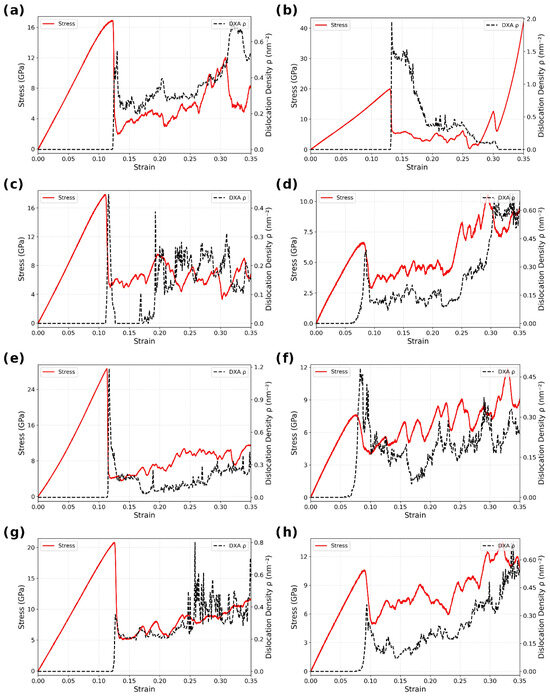
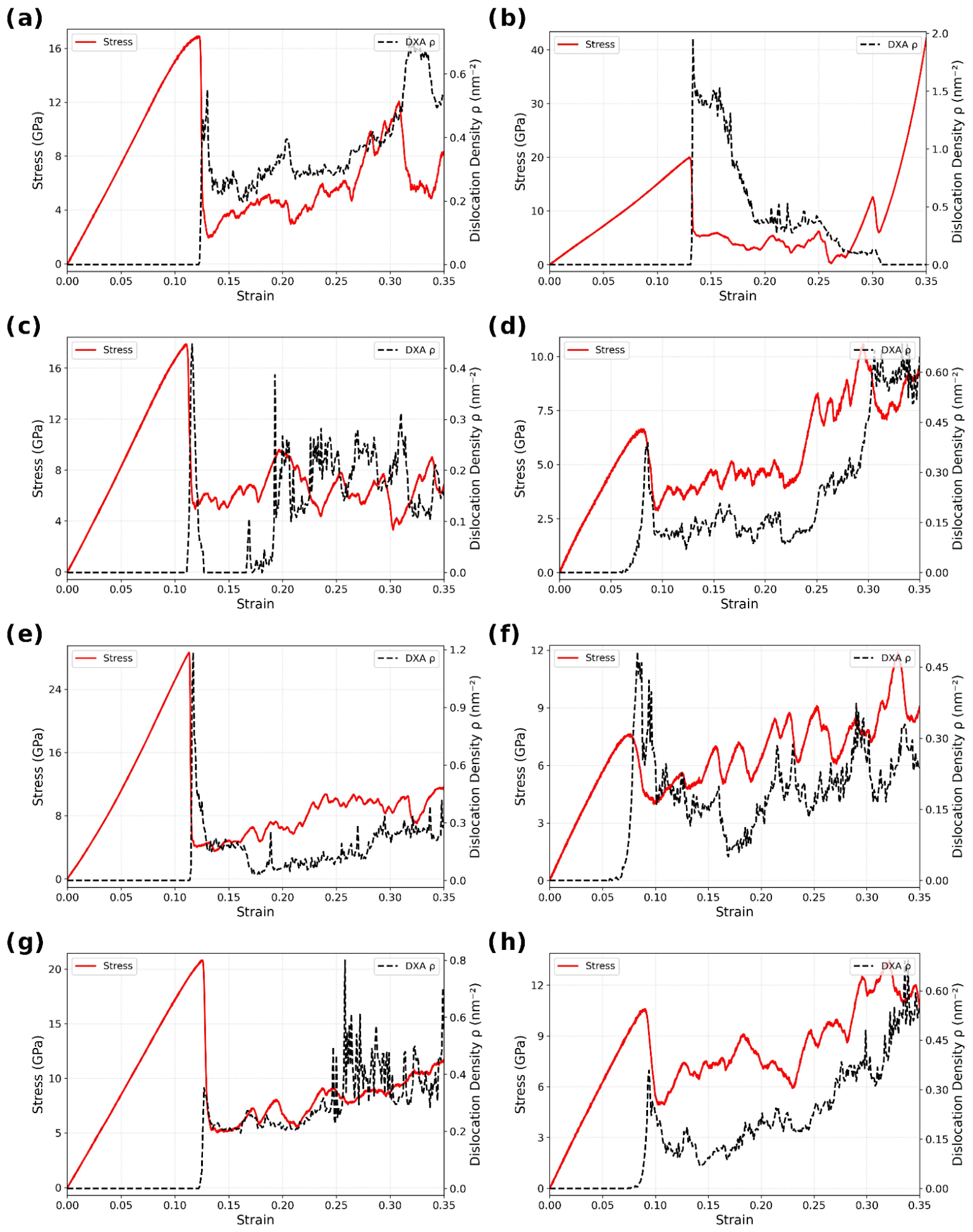
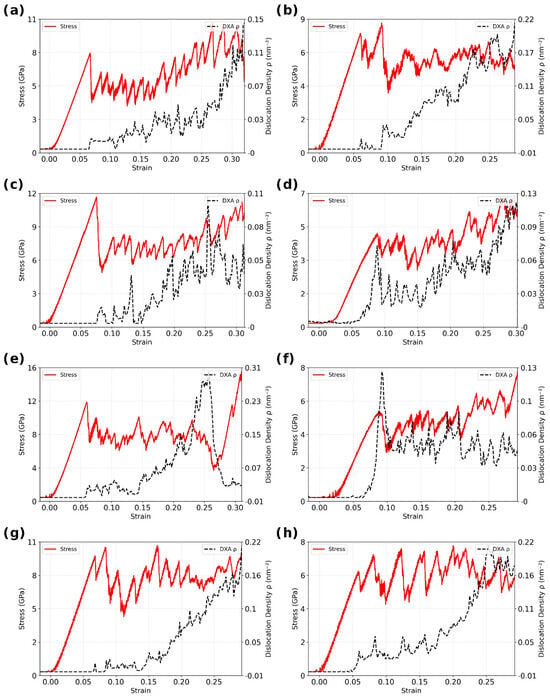
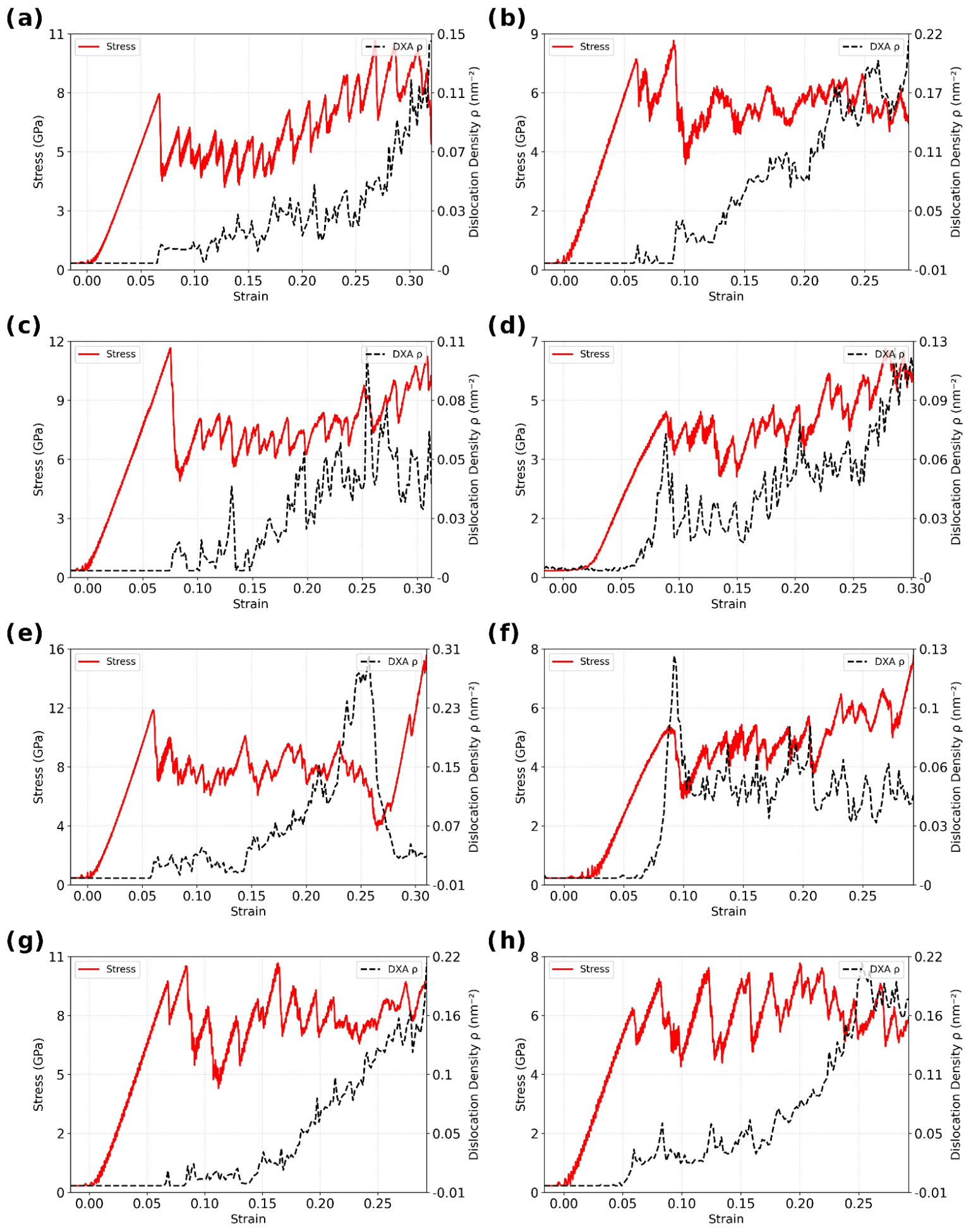
We first analyzed the mechanical properties of the systems through their stress–strain curves and dislocation density as a function of strain, for both bulk and nanoparticle configurations, considering several compositions including pure elements and intermetallic compounds. As the appearance of lattice defects in the plastic regime widely varies from one simulation run to another for any given system, specific details of both stress–strain response and dislocation density curves in this regime are not as relevant as general trends, and we show just a set of characteristic plots in Figure 1 for bulk systems, and in Figure 2 for nanoparticles. Considering that for bulk systems the appearance of lattice linear defects could generate artifacts—by the introduction of periodic image fields—related to the simulation box size and the use of periodic boundary conditions [49], we performed a preliminary analysis with larger systems, obtaining similar behaviors, supporting the reliability of the findings. For bulk monocrystalline systems, stress–strain curves were obtained for pure nickel, pure platinum, and intermetallic compounds (Pt0.5Ni0.5 and Pt0.75Ni0.25). In general, significant variability in the plastic regime was observed, particularly for pure nickel and platinum, with the amplitude of stress fluctuations increasing with deformation. These fluctuations are correlated to the appearance of twins in the structure, especially at higher strains, which contributed to the increased hardness at the end of compression. The appearance of twins was more frequent in pure metals than in the intermetallic compounds. Analysis indicated that drastic changes in stress values were often associated with sudden increases in dislocation density, although the correlation was not straightforward. Monometallic bulk systems (pure Ni and Pt) exhibited the smoothest dislocation density curves, while random alloys showed significantly more noise and fluctuations throughout the deformation process, with intermetallic compounds having a less noisy dislocation density evolution compared to their random alloy counterparts of the same composition. This is likely due to the periodicity of the ordered structure, which imposes regularity on the dislocation nucleation processes, provoking a more deterministic dislocation behavior and, consequently, a smoother evolution of dislocation density during deformation.
Figure 1.
Stress and dislocation density vs. strain plots for the bulk systems: (a) Ni, (b) Pt, (c) Pt0.25Ni0.75 intermetallic, (d) Pt0.25Ni0.75 alloy, (e) Pt0.5Ni0.5 intermetallic, (f) Pt0.5Ni0.5 alloy, (g) Pt0.75Ni0.25 intermetallic, (h) Pt0.75Ni0.25 alloy.
Figure 2.
Stress and dislocation density vs. strain plots for the nanoparticle systems: (a) Ni, (b) Pt, (c) Pt0.25Ni0.75 intermetallic, (d) Pt0.25Ni0.75 alloy, (e) Pt0.5Ni0.5 intermetallic, (f) Pt0.5Ni0.5 alloy, (g) Pt0.75Ni0.25 intermetallic, (h) Pt0.75Ni0.25 alloy.
Another issue to be considered is that the strain rate used in the MD runs is several orders of magnitude higher than typical experimental rates, even though this rate lies within the usual range for MD studies constrained to nanosecond time scales [27]. As a consequence, the absolute values of yield stress and flow stress reported here should be considered as upper bounds, as the limited time for thermally activated dislocation nucleation and motion suppresses stress relaxation and shifts plasticity onset to higher loads. These high strain rates favor dislocation glide and deformation twinning in low-stacking-fault-energy Pt–Ni configurations—so the observed twin fractions and hardening associated with twin–dislocation interactions are likely enhanced compared to quasi-static compression conditions [50].
The results also showed that, at the end of the elastic regime, the appearance of dislocation planes marked the onset of plastic deformation. The correlation between stress drops and increases in dislocation density was consistent with the expectation that rapid dislocation generation releases stored stress in the material, facilitating structural transitions to energetically favorable states. The strengthening observed in the plastic regime can be attributed to the proliferation of dislocations and their subsequent interactions, leading to increased resistance to further deformation [10,11,51].
For random alloys, the production of dislocations during plastic deformation was less abrupt than in intermetallic compounds, with a more monotonic increase in dislocation density with strain. Stress drops during deformation were also less pronounced than in the intermetallics, suggesting that the absence of pre-ordered lattice structures in random alloys leads to more gradual stress release via defect formation.
In the nanoparticle systems, stress drops were generally even smaller than in bulk, and stress release through dislocation formation was less efficient. Notably, at high strains, certain compositions (e.g., Pt0.5Ni0.5 and Pt0.25Ni0.75) exhibited strain hardening, evidenced by stress levels exceeding those of the elastic maximum. This hardening is hypothesized to arise from the coalescence and interaction of dislocation lines, forming larger dislocation planes capable of sustaining higher stress.
While bulk Pt–Ni alloys, in general, follow Vegard’s law, as expected from its empirical origin, it is also likely to find deviations due to strain and lattice distortions in the vicinity of grain borders in polycristalline systems, or, in the case of nanoparticles, surface effects [52]. We verified this in our random alloy models, both as bulk and nanoparticles. We found that the MEAM potential, when used in our models, produces average interatomic distances slightly larger than those predicted by Vegard’s law, and this trend becomes more pronounced as the composition reaches Pt0.5Ni0.5, as can be seen in Figure S1 of the Supplementary Information.
Comparison between bulk and nanoparticle systems revealed clear differences in elastic behavior. Nanoparticles exhibited lower maximum compressibility and lower peak stress values compared to bulk counterparts, which is consistent with the reduced ability of nanoparticles to accommodate deformation in all spatial directions. A representative set of stress–strain plots showing this trend is included in the Supplementary Information as Figure S2.
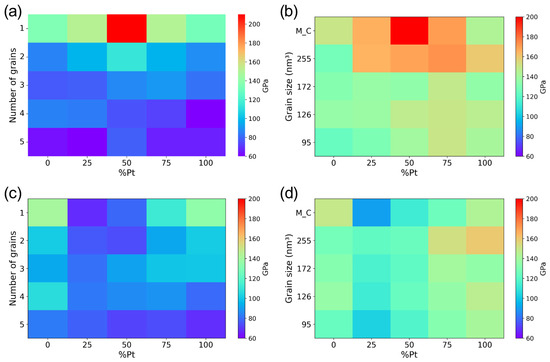
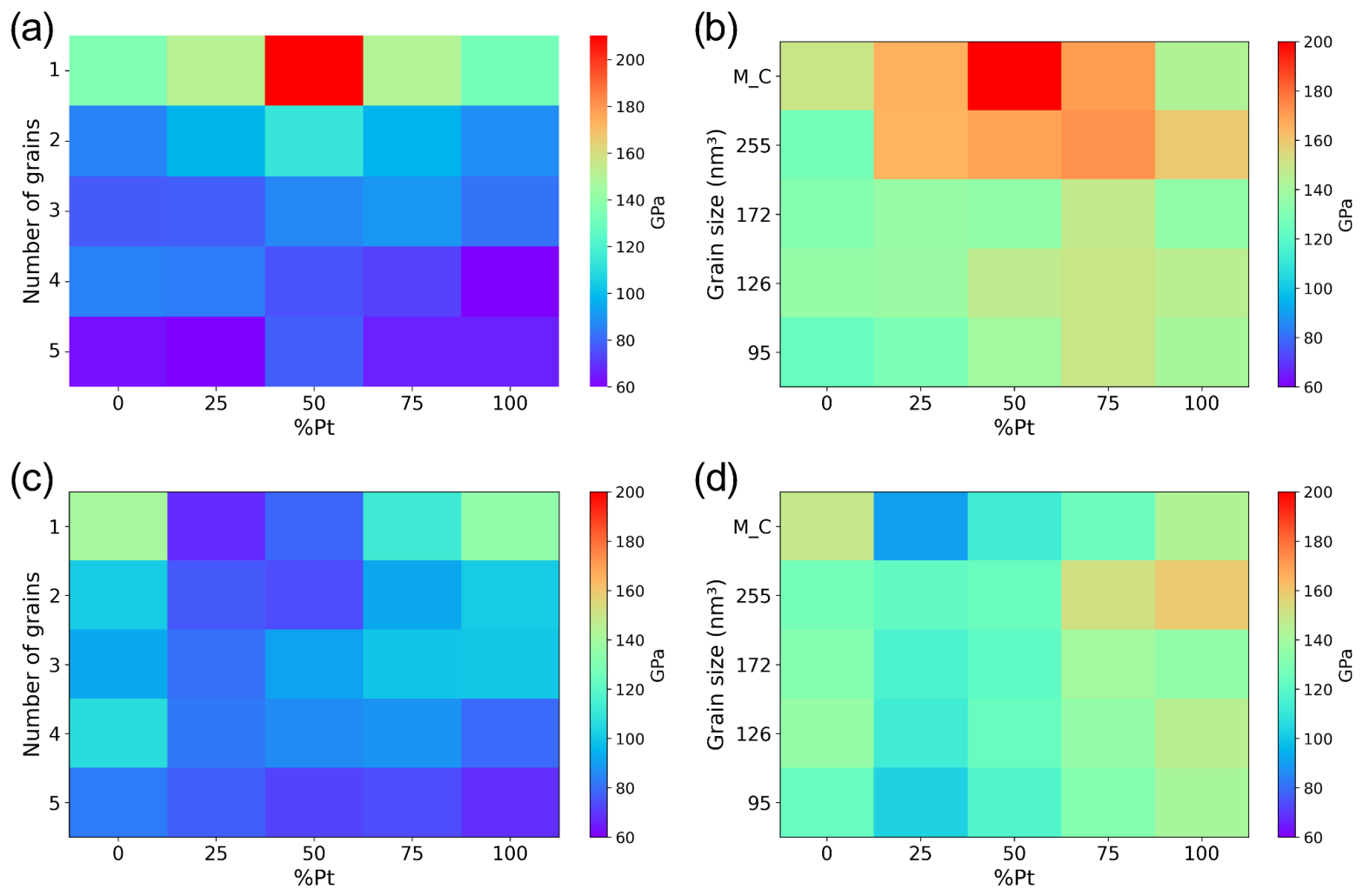
Maps of Young’s modulus as a function of composition and kind of system were generated for both intermetallic and randomly alloyed systems, for both bulk and nanoparticle samples; the maps are shown in Figure 3. In general, the Young’s modulus increased with decreasing grain count in bulk samples [53]—as expected—and decreased with increasing platinum content in randomly alloyed systems, consistent with previous findings [52]. However, the maximum modulus in the intermetallic compound system occurred near the Pt0.5Ni0.5 composition.
Figure 3.
Young’s modulus values obtained from linear fit of the stress–strain curves for each combination of composition and grain size: (a) intermetallic compound nanoparticles, (b) intermetallic bulk systems, (c) alloyed nanoparticles, (d) alloyed bulk systems.
As can also be seen from Figure 3a,b, in the elastic regime, the Pt0.5Ni0.5 composition displayed the best overall mechanical performance, both as bulk and nanoparticle. The MD results showed enhanced stiffness, reflected in the higher Young’s modulus and higher stress levels at comparable elastic strains, together with a pronounced nonlinear elastic response, suggesting a more robust elastic response under uniaxial compression. Strain maps, when plotted at equal visualization scales, revealed a systematic offset between nanoparticles and bulk systems: while both followed similar deformation trends, the absolute strain ranges were shifted, except in the equiatomic case, which remained comparatively stable across both configurations.
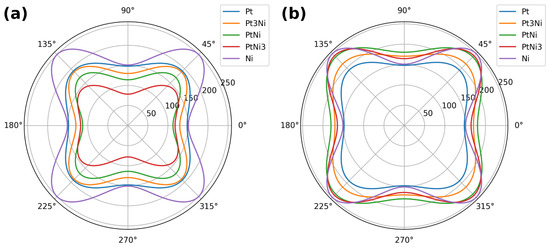
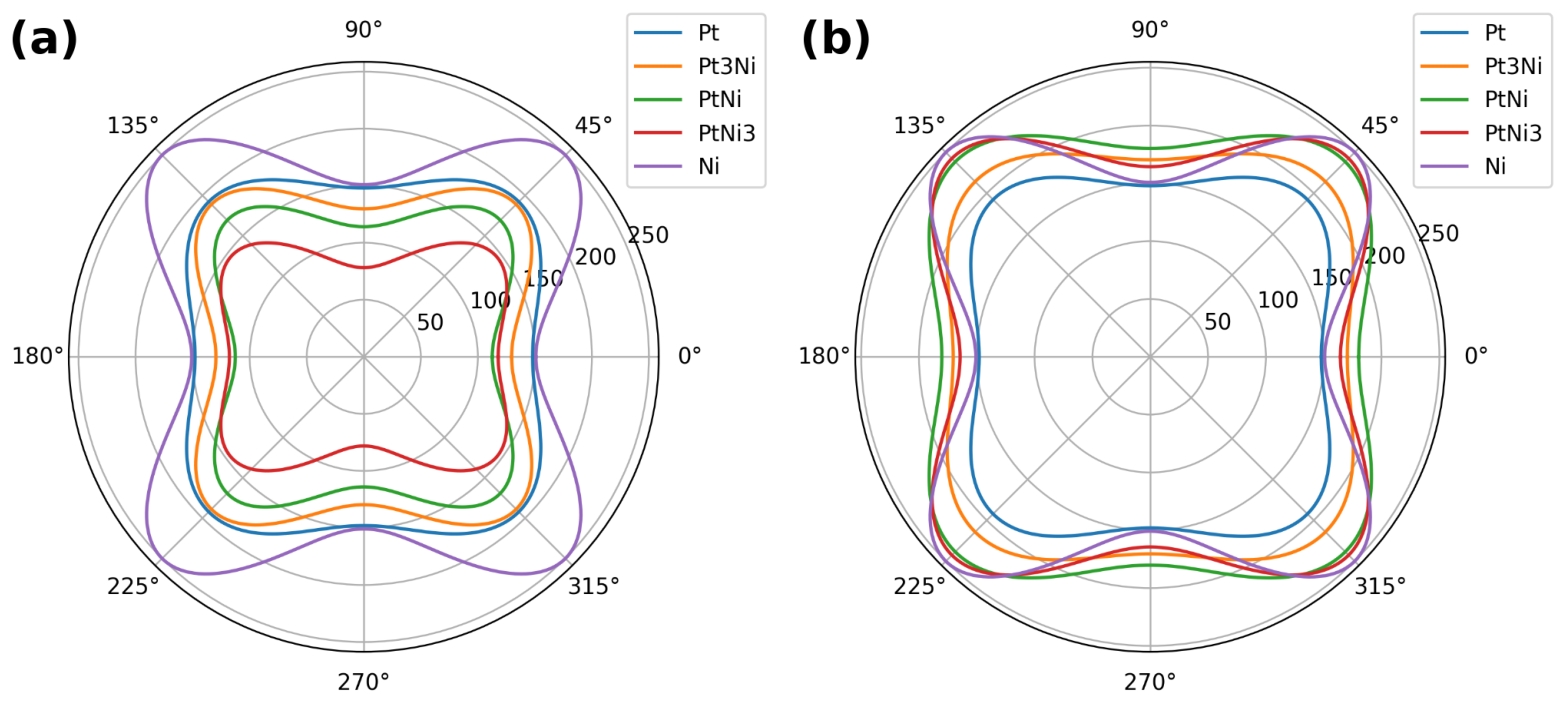
The elastic constant tensor was calculated for the bulk monocrystalline systems, considering both alloys and intermetallic compounds. From the obtained tensor constants, the Young’s modulus was determined for each spatial direction. Results are summarized in Figure 4, where it can be noted that the maximum modulus in the intermetallic systems occurs for the Pt0.5Ni0.5 compound when the compression direction is parallel to the planes, while also revealing that the directional dependence of Young’s modulus increases in relation to the nickel content of the system.
Figure 4.
Directional Young’s modulus for bulk monocrystalline systems on the plane, obtained from the elastic constant tensor for each material, with the Z axis pointing at 0 degrees and the X axis at 90 degrees. (a) Alloy, (b) intermetallic compound.
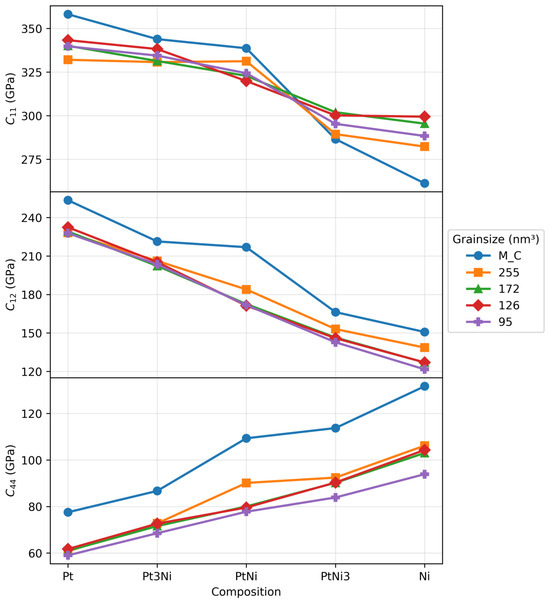
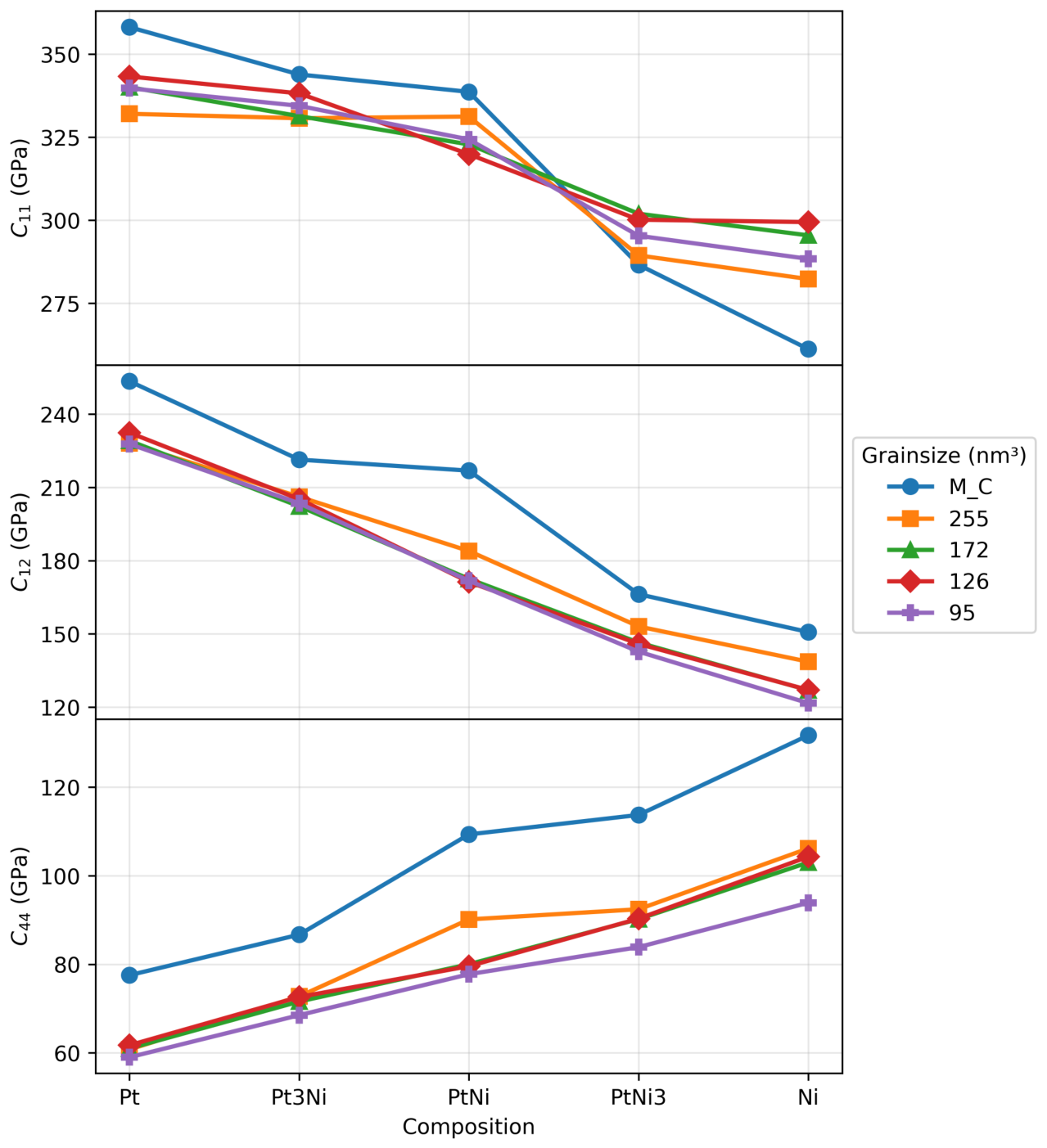
It can be noted that the range of Young’s modulus values differed significantly between bulk and nanoparticle systems, as well as between intermetallic and random alloy compositions. Bulk systems, particularly intermetallics, generally reach the highest modulus values, with the nanoparticle and random alloy systems showing reduced modulus ranges. Table 1 shows the values of the elastic constants for the pure elements obtained from our simulations and, when available, a comparison against previously reported experimental values. A graphical visualization of the values of the independent elastic stiffness constants in function of the composition is shown in Figure 5.
Table 1.
Elastic constants and mechanical properties for Ni and Pt compared with experimental values.
Figure 5.
Values of normal elastic constants (top), normal coupling constants (middle), and shear constants (bottom) as a function of alloy composition, calculated for a representative volume element of the bulk material. Colors identify the different grain sizes (in nm3), or, in the case of the data plotted in blue, monocrystalline systems.
A consistent pattern was also found when comparing bulk systems with nanoparticles. Bulk configurations generally showed higher values of elastic limit, as if their strain and stress distributions were shifted upwards compared to the nanoscale case. Nevertheless, nanoparticles appear to have a more heterogeneity, with strain distributions varying across distinct internal regions, which could be directly observed in line-profile analyses of GPA strain maps. This heterogeneity often manifests as localized strain concentrations, influencing the overall mechanical response and potentially leading to premature failure or deformation mechanisms not observed in bulk materials [27].
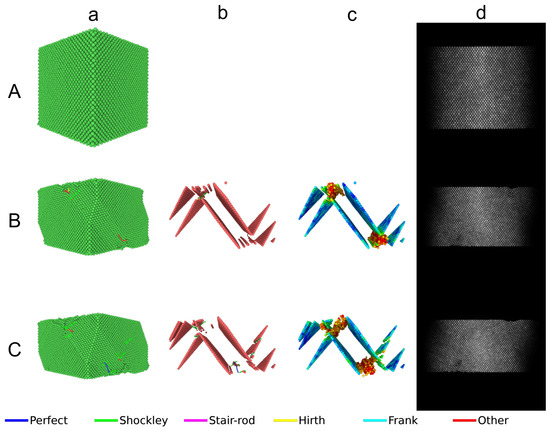
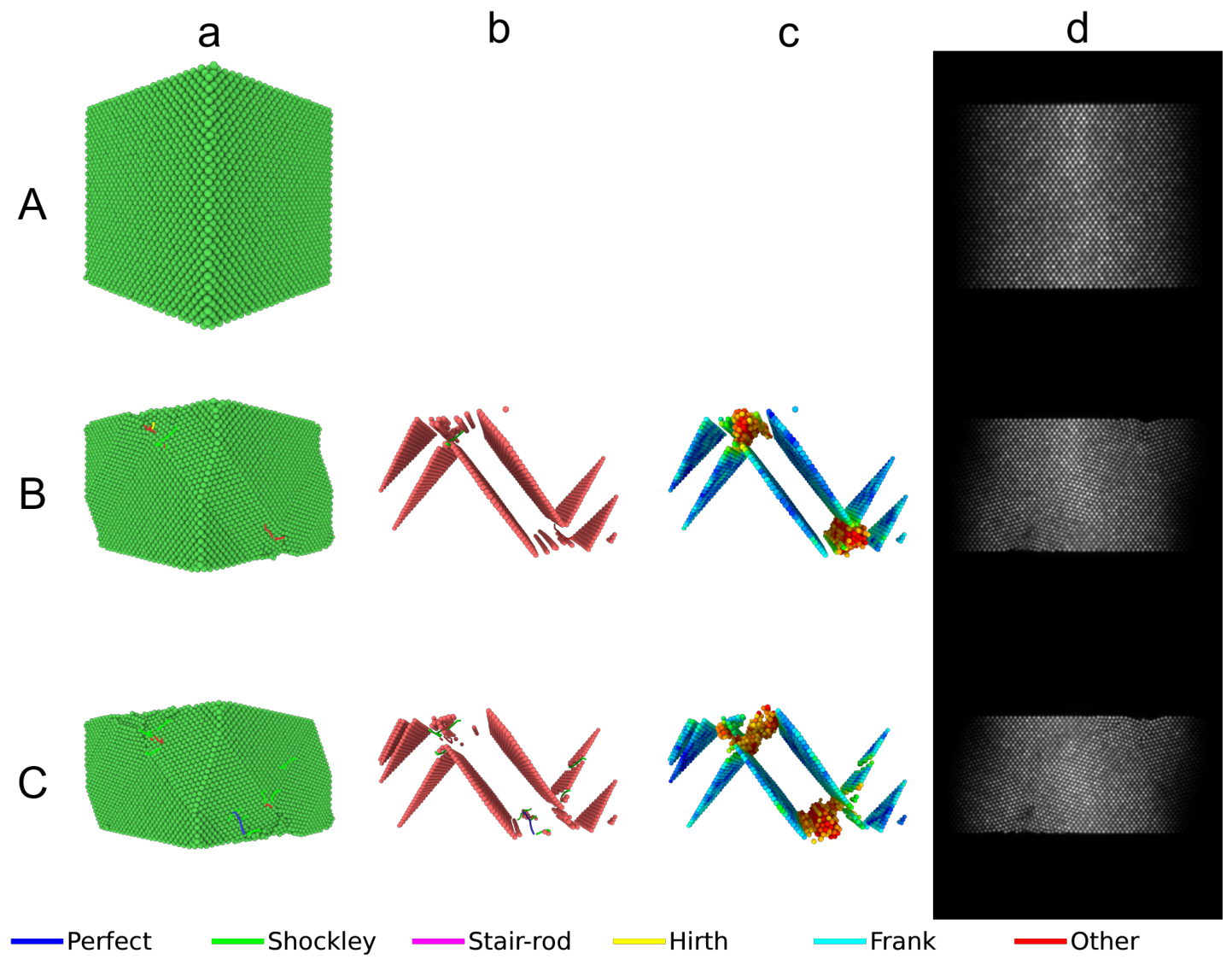
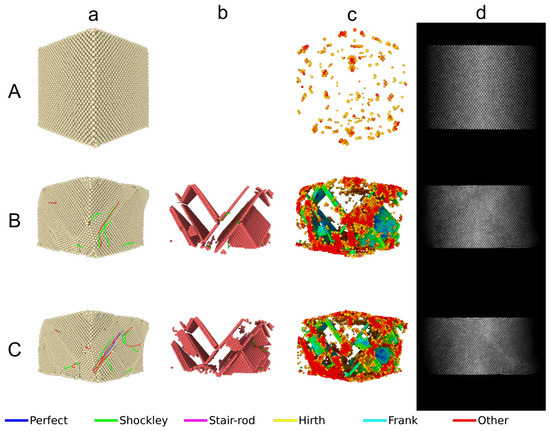
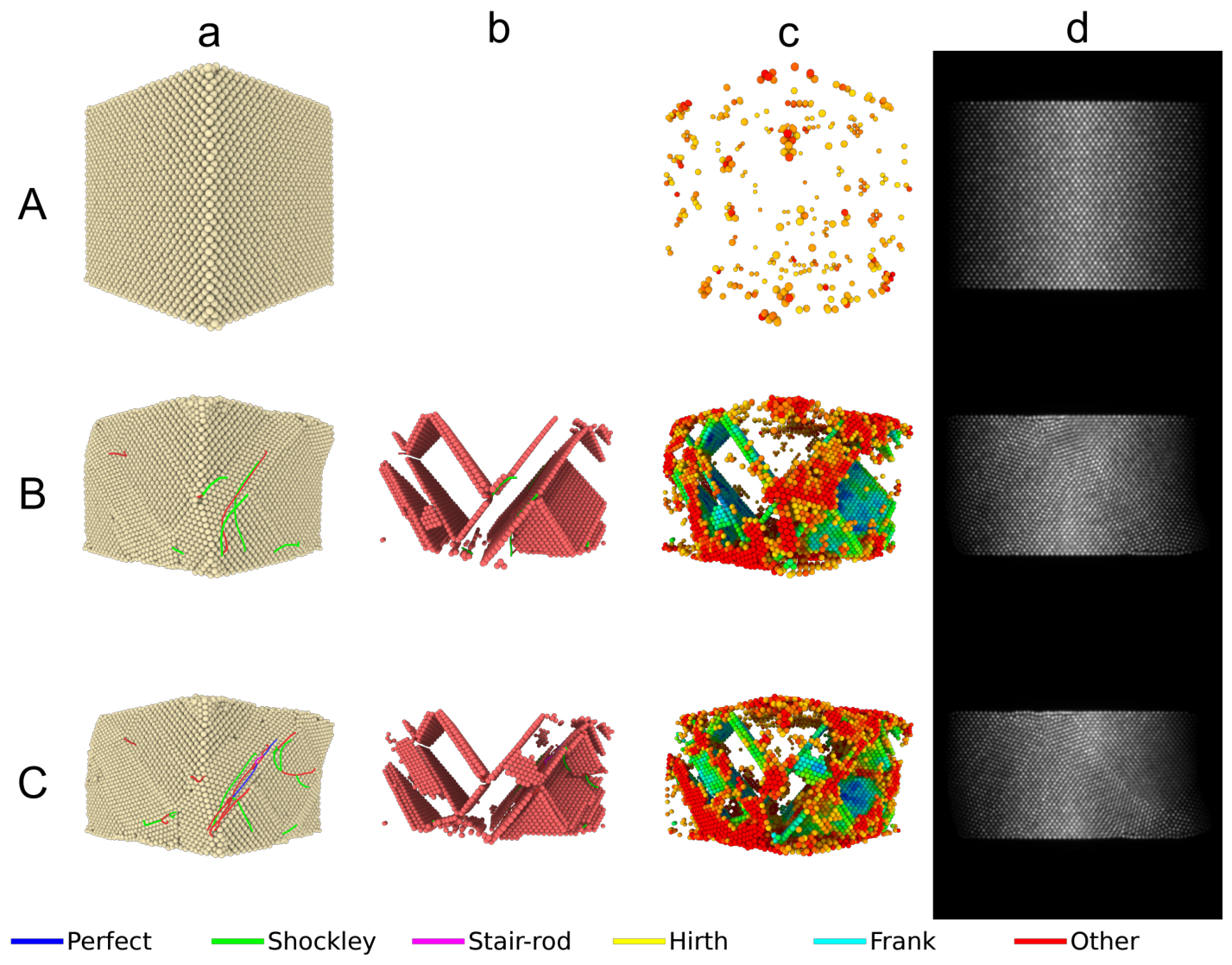
For Ni-rich systems, the formation of dislocation planes is lower than in low Ni-content systems (Figure 6), and these planes tend to separate one from each other as strain increases, rather than producing new planes, in contrast to Pt-rich systems (Figure 7), where the number of planes increases to a greater extent throughout compression. Ni-rich systems also exhibit lower accumulated von Mises stress values during compression compared with Pt-rich compounds. This clearly is due to a compositional dependence on dislocation nucleation and propagation mechanisms, with higher platinum content potentially promoting a more distributed and dynamic dislocation activity. Similar representations for alloyed nanoparticles are shown in the Supplementary Information, Figures S3–S16, where these tendencies can be observed.
Figure 6.
View of a 100% Ni nanoparticle from different perspectives in strain and structural analysis: (A) at strain = 0, (B) at strain = 0.12 (all systems already beyond the elastic limit), (C) at strain = 0.20. (a) View with DXA analysis superimposed, (b) only HCP planes and dislocation lines, (c) HCP planes and atoms with von Mises stress greater than 6 GPa, (d) STEM simulation view. Dislocation lines are represented in colors depending on their specific kind.
Figure 7.
View of a 100% Pt nanoparticle from different perspectives in strain and structural analysis: (A) at strain = 0, (B) at strain = 0.12 (all systems already beyond the elastic limit), (C) at strain = 0.20. (a) View with DXA analysis superimposed, (b) only HCP planes and dislocation lines, (c) HCP planes and atoms with von Mises stress greater than 6 GPa, (d) STEM simulation view. Dislocation lines are represented in colors depending on their specific kind.
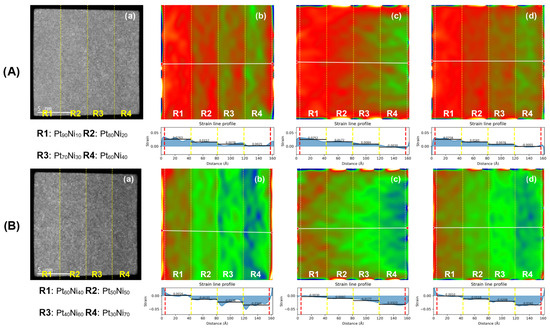
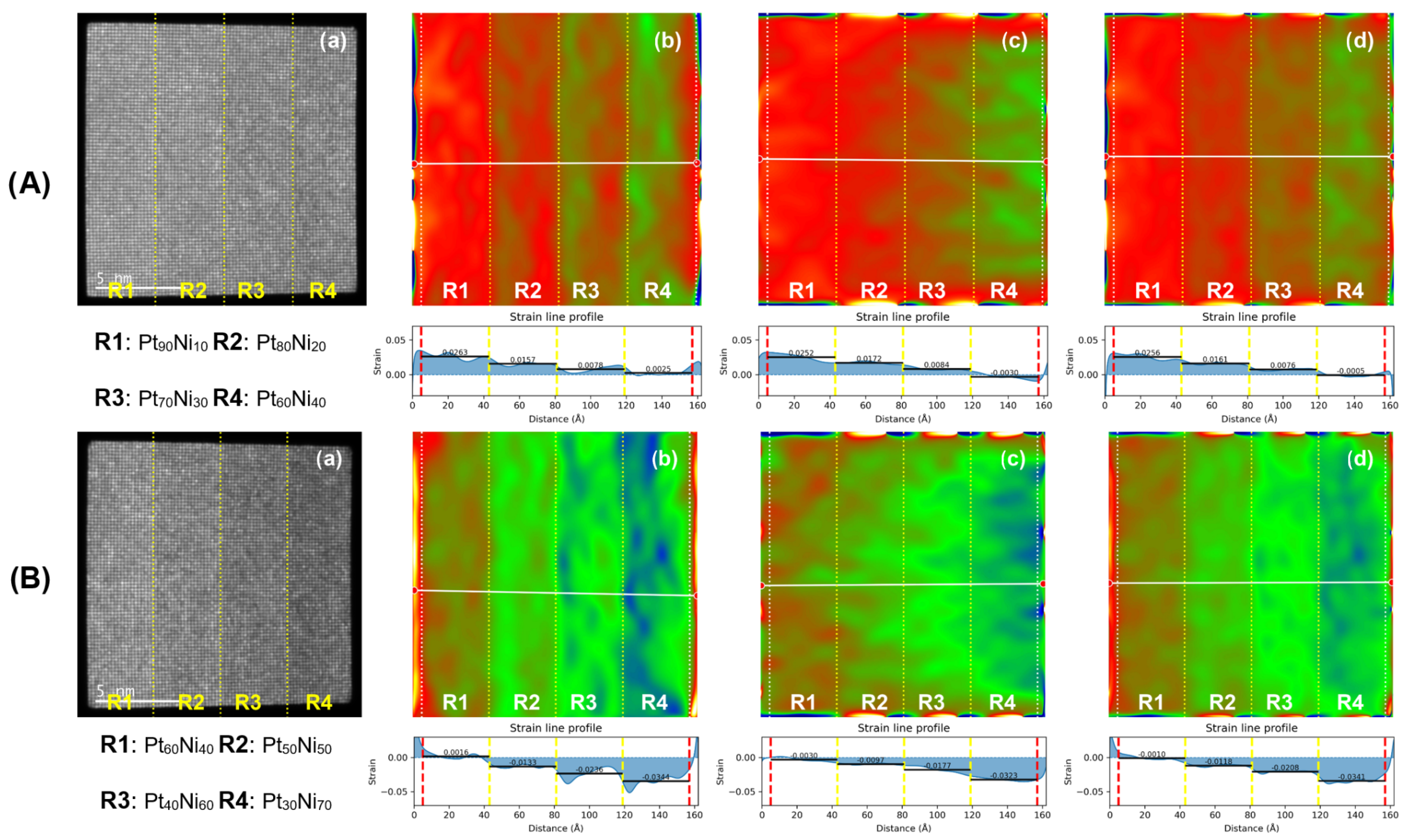
We used our models of layered Pt–Ni nanoparticles, thermalized by MD, to produce simulated STEM micrographs and their corresponding GPA strain maps. The four layers in each nanoparticle, labeled as , , , and in Figure 8(Aa,Ba), differ in their composition, increasing the amount on Ni in when going from to . As can be noted in Figure 8, differences as low as in composition produce differences in lattice strain sufficiently large to allow for a discrimination on neighboring regions in our models. This is particularly true in the case of strain maps , where differences in strain as low as 0.01 are enough to produce maps in which two neighboring regions may be differentiated; see Figure 8(Ab,Bb). Strain maps , as can be seen in Figure 8(Ac,Bc), are not as clear as those of to make this discrimination, but dilatation maps, as can be seen in Figure 8(Ad,Bd), show, again, that differences on the order of 0.01 produce differences in the maps that can be easily detected by the naked eye. In general, it is not unexpected that strain maps are correlated to composition in alloys, and this has actually been studied before, for example, in Ref. [57], but the somehow unexpected result here is that the molecular dynamics simulations, complemented by STEM and GPA, revealed that it is possible to discriminate between PtxNi1−x compositions differing by as little as = 0.1. The sensitivity of GPA to particle size was also evident: larger nanoparticles provided clearer periodicity features, suggesting that system size influences the reliability of strain quantification. This capacity for fine compositional discrimination is critical for understanding local variations in mechanical properties, as even minor compositional shifts can induce significant alterations in strain distribution and overall material response [26]. The ideality of the models certainly makes this correlation between strain and composition straightforward, and it is expected that, in the case of real nanoalloyed particles, the intermixing of differences in composition with irregularities in the shape of the particles and defects in the crystal lattice could diminish the clarity of such compositional differentiation through strain mapping [58]. These idealized models do not explicitly include amorphous surface layers, point defects, pre-existing dislocations, or grain boundaries. Each of these features can introduce additional local strain, lattice discontinuities, orientation changes, or loss of crystalline periodicity. As a result, the strain field associated with compositional variations may overlap with strain fields generated by structural defects, making the distinction between neighboring compositions less clear in real nanoparticles. GPA requires the selection of well-defined reference lattice vectors; the presence of different orientations within the same region can produce discontinuities or artifacts in the strain maps. Similarly, dislocations generate their own strain fields, which can be comparable to, or even larger than, those originated by small compositional variations, and may interfere with the interpretation of the GPA maps.
Figure 8.
Geometric phase analysis of a nanoparticle divided into stripes with different compositions: (A) regions from Pt0.9Ni0.1 to Pt0.6Ni0.4, (B) regions from Pt0.6Ni0.4 to Pt0.3Ni0.7. (a) STEM view, (b) strain map , (c) strain map , (d) dilatation map . Below (b–d), the linear strain profile along the white line shown in each map.
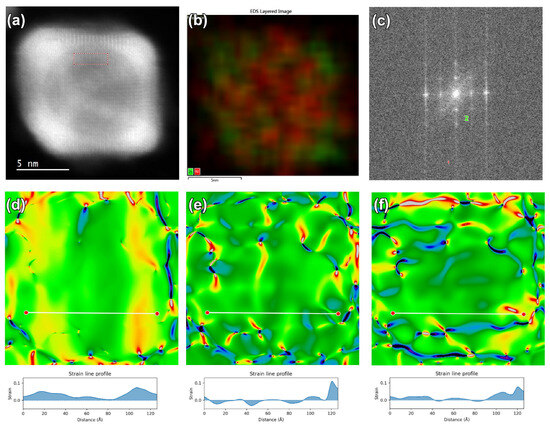
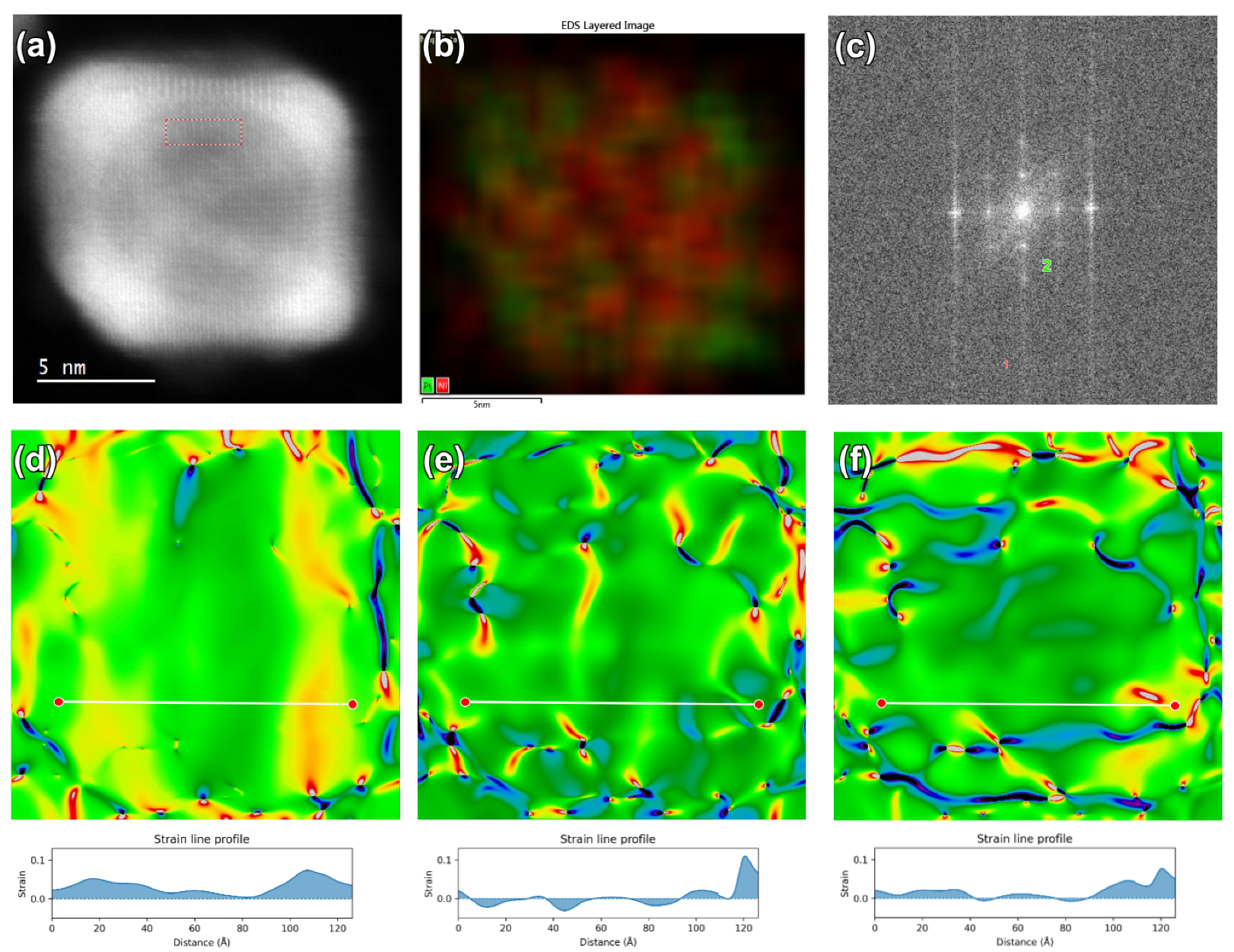
In order to have a more realistic assessment of this methodology, we used as proof of concept the case of cuboidal inhomogeneous Pt–Ni nanoparticles, reported previously in a recent paper [26]. Figure 9 shows the GPA strain maps calculated from an HAADF-STEM image of one of these cuboidal Pt–Ni nanoparticles, reproduced in Figure 9a from its original source. The corresponding energy-dispersive X-ray spectroscopy (EDS) analysis is shown in Figure 9b, where it can be easily noted that the content of Pt in the corners of the particle, mapped using the green color, is higher than in the central part of the particle, where Ni content, mapped in red, is concentrated. As can be seen in Figure 9a, atomic columns are fairly well resolved, enabling the application of geometric phase analysis for localized strain mapping [59], and the actual power spectrum is shown in Figure 9c, where the noncollinear reciprocal lattice vectors used for GPA are identified. The resulting strain maps are shown in Figure 9d for , (e) for , and (f) for the dilatation map . For these maps, we used the region marked in Figure 9a as reference. The normal strain map is particularly interesting for our purpose, as it can be readily noted that a clear correlation exists between compositional variations and the resulting lattice strain, with the Pt-rich corners exhibiting distinct strain profiles compared to the Ni-enriched core [60]. This observation underscores the efficacy of combining HAADF-STEM with GPA for delineating local compositional variations through their induced strain fields, even in complex nanoscale architectures [61,62].
Figure 9.
GPA analysis of a STEM micrograph of a Pt–Ni nanoparticle: (a) STEM image, with the reference region of interest (ROI) marked by a yellow box; (b) EDS chemical map, where green represents Pt and red represents Ni; (c) diffractogram used for GPA, where the red and green circles, labeled 1 and 2, identify the two non-collinear reciprocal-lattice reflections selected for the analysis; (d) strain map ; (e) strain map ; and (f) dilatation map . The colors in panels (d–f) represent the local strain or dilatation values according to the corresponding color scales.
4. Conclusions
We used molecular dynamics simulations and simulated HAADF-STEM analysis to study mechanical responses of Pt–Ni nanoparticles and bulk systems, revealing a complex interplay between compositional variations, system dimensions, and deformation mechanisms. Overall, these results establish a clear correlation between composition, system size, and mechanical regime. Elastic and plastic behaviors are not only composition-dependent but are also strongly influenced by the size of the system, because in nanoparticles elastic moduli tend to be lower than in bulk, and the existence of a surface allows an easier nucleation of dislocations. While it is already understood that strain distribution correlates with local composition in alloyed systems, our models and their comparison with real Pt–Ni nanoparticles show that GPA analysis is able to differentiate regions with different composition even if the difference in strain is very small. The interpretation of these strain maps, however, must consider potential artifacts arising from misalignment of the lattice with respect to the electron beam, amorphous surface layers, or the application of Gaussian masks during FFT analysis [63]. Also, flyback effects related to the use of STEM imaging, along with the inherent limitations of two-dimensional projections of three-dimensional strain fields, further require a conservative interpretation of GPA results [64]. But even when considering these issues, we believe that this methodology provides a promising approach for studying composition in nanoalloyed materials.
Supplementary Materials
The following supporting information can be downloaded at https://www.mdpi.com/article/10.3390/chemistry8070097/s1.
Author Contributions
J.A.M.-U.: Methodology, software, formal analysis, investigation, writing—review and editing. J.D.-A.: Formal analysis, visualization, writing—review and editing. J.J.V.S.: Investigation (synthesis). D.B.U.: Investigation (electron microscopy). M.J.-Y.: Investigation (electron microscopy), writing—review and editing. S.J.M.-R.: Conceptualization, funding acquisition, project administration, writing—original draft, writing—review and editing. All authors have read and agreed to the published version of the manuscript.
Funding
This research was funded by the Consejo Nacional de Humanidades, Ciencia, y Tecnología (CONAHCYT), grant CF-2023-I-1712: “Fases, estructura, y propiedades mecánicas de nanoaleaciones multimetálicas”.
Data Availability Statement
The original contributions presented in this study are included in the article/Supplementary Materials. Further inquiries can be directed to the corresponding author.
Conflicts of Interest
The authors declare no conflicts of interest.
References
- Bautista, M.M.C.; Ortega, G.C.C.; Jaramillo-Colpas, J. Emerging Technologies in the Development of Metallic and Bimetallic Nanoparticles in the Last Decade: A Scientometric Analysis. J. Eng. Technol. Sci. 2023, 55, 177–188. [Google Scholar] [CrossRef] [Scilit]
- Wang, D.; Li, Y. Bimetallic Nanocrystals: Liquid-Phase Synthesis and Catalytic Applications. Adv. Mater. 2011, 23, 1044–1060. [Google Scholar] [CrossRef] [Scilit] [PubMed]
- Cao, F.; Liu, R.; Lin, W.; Deng, R.; Zhou, L.; Liu, D.; Song, S.; Zhao, F.; Zhang, H. Metal-decorated Ni7S6 composite microflowers: Synthesis, characterization, and application. Mater. Res. Bull. 2014, 53, 199–204. [Google Scholar] [CrossRef] [Scilit]
- Saquib, M.; Halder, A. Ensemble Effect of Ni in Bimetallic PtNi on Reduced Graphene Oxide Support for Temperature-Dependent Formic Acid Oxidation. ChemistrySelect 2018, 3, 3909–3917. [Google Scholar] [CrossRef] [Scilit]
- Pizzutilo, E.; Freakley, S.J.; Cherevko, S.; Venkatesan, S.; Hutchings, G.J.; Liebscher, C.H.; Dehm, G.; Mayrhofer, K.J.J. Gold–Palladium Bimetallic Catalyst Stability: Consequences for Hydrogen Peroxide Selectivity. ACS Catal. 2017, 7, 5699–5705. [Google Scholar] [CrossRef] [Scilit]
- Tian, X.; Zhao, X.; Su, Y.; Wang, L.; Wang, H.; Dang, D.; Chi, B.; Liu, H.; Hensen, E.J.M.; Lou, X.W.; et al. Engineering bunched Pt-Ni alloy nanocages for efficient oxygen reduction in practical fuel cells. Science 2019, 366, 850–856. [Google Scholar] [CrossRef] [Scilit] [PubMed]
- Li, X.; Wang, Y.; Song, G.; Peng, Z.; Yu, Y.M.; She, X.; Li, J. Synthesis and Growth Mechanism of Ni Nanotubes and Nanowires. Nanoscale Res. Lett. 2009, 4, 1015. [Google Scholar] [CrossRef] [Scilit] [PubMed]
- Fu, K.; Zhang, X.; Shi, C.; Liu, E.; He, F.; Li, J.; Zhao, N.; He, C. An approach for fabricating Ni@graphene reinforced nickel matrix composites with enhanced mechanical properties. Mater. Sci. Eng. A 2017, 715, 108–116. [Google Scholar] [CrossRef] [Scilit]
- Rezaee, S.; Kadivar, E.; el Moctar, O. Molecular dynamics simulations of a nanobubble’s collapse-induced erosion on nickel boundary and porous nickel foam boundary. J. Mol. Liq. 2024, 397, 124029. [Google Scholar] [CrossRef] [Scilit]
- de la Rosa Abad, J.A.; Bringa, E.M.; Mejía-Rosales, S.; Mariscal, M.M. On the mechanical response in nanoalloys: The case of NiCo. Faraday Discuss. 2022, 242, 23–34. [Google Scholar] [CrossRef] [Scilit] [PubMed]
- de la Rosa Abad, J.A.; Londoño-Calderón, A.; Bringa, E.M.; Soldano, G.J.; Paz, S.A.; Santiago, U.; Mejía-Rosales, S.; Yacamán, M.J.; Mariscal, M.M. Soft or Hard? Investigating the Deformation Mechanisms of Au–Pd and Pd Nanocubes under Compression: An Experimental and Molecular Dynamics Study. J. Phys. Chem. C 2021, 125, 25298–25306. [Google Scholar] [CrossRef] [Scilit]
- Amaro, E.; Delgado-Alvarez, J.; Martínez-Uribe, J.A.; Mejía-Rosales, S. Mechanical Response of FeNiCrCoAl High-Entropy Alloys at the Nanoscale: Predictions from Molecular Dynamics. Nanomaterials 2025, 15, 652. [Google Scholar] [CrossRef] [Scilit] [PubMed]
- Zacharaki, E.; Bremmer, G.M.; Vajeeston, P.; Kalyva, M.; Fjellvåg, H.; Kooyman, P.J.; Sjåstad, A.O. One-pot synthesis of cobalt–rhenium nanoparticles taking the unusual β-Mn type structure. Nanoscale Adv. 2020, 2, 1850–1853. [Google Scholar] [CrossRef] [Scilit] [PubMed]
- Kumara, L.S.R.; Sakata, O.; Kobayashi, H.; Song, C.; Kohara, S.; Ina, T.; Yoshimoto, T.; Yoshioka, S.; Matsumura, S.; Kitagawa, H. Hydrogen storage and stability properties of Pd–Pt solid-solution nanoparticles revealed via atomic and electronic structure. Sci. Rep. 2017, 7, 14606. [Google Scholar] [CrossRef] [Scilit] [PubMed]
- Chamorro, W.; Caillard, A.; Brault, P.; Baranton, S.; Coutanceau, C. Binary and ternary Pt-based clusters grown in a plasma multimagnetron-based gas aggregation source: Electrocatalytic evaluation towards glycerol oxidation. Nanoscale Adv. 2021, 3, 1730–1740. [Google Scholar] [CrossRef] [Scilit] [PubMed]
- Slejko, E.A.; Cozzarini, L.; Lughi, V. Engineering of colloidal nanocrystal thin films and their optoelectronic properties: A simple and effective route. Nano-Struct. Nano-Objects 2020, 22, 100432. [Google Scholar] [CrossRef] [Scilit]
- Vecchio, D. Multi-Scale Functional Nanomaterials for the Spectroscopic Detection of Ionizing Radiation and Characterization of Complex Structural Networks. Ph.D. Thesis, University of Michigan, Ann Arbor, MI, USA, 2022. [Google Scholar] [CrossRef] [PubMed]
- Cantor, B. Local Nanostructure in Multicomponent High-Entropy Materials. High Entropy Alloys Mater. 2024, 2, 277–306. [Google Scholar] [CrossRef] [Scilit]
- Mathaudhu, S.N. Building on Gleiter: The Foundations and Future of Deformation Processing of Nanocrystalline Metals. Metall. Mater. Trans. A 2020, 51, 6020–6044. [Google Scholar] [CrossRef] [Scilit]
- Xiong, S.; Lee, S.Y.; Noyan, I.C. Average and local strain fields in nanocrystals. J. Appl. Crystallogr. 2019, 52, 262–273. [Google Scholar] [CrossRef] [Scilit]
- Nelli, D.; Roncaglia, C.; Minnai, C. Strain engineering in alloy nanoparticles. Adv. Phys. X 2022, 8, 2127330. [Google Scholar] [CrossRef] [Scilit]
- Gu, Q.; Nelayah, J.; Afanasiev, P.; Piccolo, L.; Alloyeau, D.; Ricolleau, C. Structural Properties of Catalytically Active Bimetallic Gold–Palladium Nanoparticles Synthesized on Rutile Titania Nanorods by Pulsed Laser Deposition. Cryst. Growth Des. 2017, 18, 68–76. [Google Scholar] [CrossRef] [Scilit]
- Manolis, G.D.; Dineva, P.; Rangelov, T.; Sfyris, D. Mechanical models and numerical simulations in nanomechanics: A review across the scales. Eng. Anal. Bound. Elem. 2021, 128, 149–170. [Google Scholar] [CrossRef] [Scilit]
- Thompson, A.P.; Aktulga, H.M.; Berger, R.; Bolintineanu, D.; Brown, W.M.; Crozier, P.; in ’t Veld, P.J.; Kohlmeyer, A.; Moore, S.; Nguyen, T.D.; et al. LAMMPS—A flexible simulation tool for particle-based materials modeling at the atomic, meso, and continuum scales. Comput. Phys. Commun. 2021, 271, 108171. [Google Scholar] [CrossRef] [Scilit]
- Espinosa, I.M.P.; Jacobs, T.D.B.; Martini, A. Evaluation of Force Fields for Molecular Dynamics Simulations of Platinum in Bulk and Nanoparticle Forms. J. Chem. Theory Comput. 2021, 17, 4486–4498. [Google Scholar] [CrossRef] [Scilit] [PubMed]
- Silva, C.E.R.D.; Uribe, D.B.; Asare, P.; Salazar, J.J.V.; Martínez-Uribe, J.A.; Mejía-Rosales, S.J.; Palomares-Báez, J.P.; Yacamán, M.J. Ni–Pt alloy nanoparticles studies: Microscopy and molecular dynamics insights. MRS Adv. 2026, 11, 690–697. [Google Scholar] [CrossRef] [Scilit]
- Amodeo, J.; Pizzagalli, L. Modeling the mechanical properties of nanoparticles: A review. Comptes Rendus Phys. 2021, 22, 35–66. [Google Scholar] [CrossRef] [Scilit]
- Rupert, T.J. Solid solution strengthening and softening due to collective nanocrystalline deformation physics. Scr. Mater. 2014, 81, 44–47. [Google Scholar] [CrossRef] [Scilit]
- Hirel, P. Atomsk: A tool for manipulating and converting atomic data files. Comput. Phys. Commun. 2015, 197, 212–219. [Google Scholar] [CrossRef] [Scilit]
- Kim, J.S.; Seol, D.; Ji, J.; Jang, H.S.; Kim, Y.; Lee, B.J. Second nearest-neighbor modified embedded-atom method interatomic potentials for the Pt-M (M = Al, Co, Cu, Mo, Ni, Ti, V) binary systems. Calphad 2017, 59, 131–141. [Google Scholar] [CrossRef] [Scilit]
- Edwards, H.; Trott, C.R.; Sunderland, D. Kokkos: Enabling manycore performance portability through polymorphic memory access patterns. J. Parallel Distrib. Comput. 2014, 74, 3202–3216. [Google Scholar] [CrossRef] [Scilit]
- Rezaee, S.; Araghi, H.; Noshad, H.; Zabihi, Z. Physical characteristics of nickel thin-films and nickel thin-film foams as Li-air batteries anode and cathode current collectors. J. Mol. Liq. 2023, 383, 122171. [Google Scholar] [CrossRef] [Scilit]
- Rojas-Nunez, J.; Baltazar, S.E.; González, R.I.; Bringa, E.M.; Allende, S.; Kiwi, M.; Valencia, F.J. Polycrystalline Ni nanotubes under compression: A molecular dynamics study. Sci. Rep. 2020, 10, 21096. [Google Scholar] [CrossRef] [Scilit] [PubMed]
- Singh, S.; Lang, L.; Dovale-Farelo, V.; Herath, U.; Tavadze, P.; Coudert, F.X.; Romero, A.H. MechElastic: A Python library for analysis of mechanical and elastic properties of bulk and 2D materials. Comput. Phys. Commun. 2021, 267, 108068. [Google Scholar] [CrossRef] [Scilit]
- Clavier, G.; Thompson, A.P. Computation of the thermal elastic constants for arbitrary manybody potentials in LAMMPS using the stress-fluctuation formalism. Comput. Phys. Commun. 2023, 286, 108674. [Google Scholar] [CrossRef] [Scilit]
- Kilymis, D.; Gérard, C.; Amodeo, J.; Waghmare, U.V.; Pizzagalli, L. Uniaxial compression of silicon nanoparticles: An atomistic study on the shape and size effects. Acta Mater. 2018, 158, 155–166. [Google Scholar] [CrossRef] [Scilit]
- Stukowski, A. Visualization and analysis of atomistic simulation data with OVITO–the Open Visualization Tool. Model. Simul. Mater. Sci. Eng. 2009, 18, 15012. [Google Scholar] [CrossRef] [Scilit]
- Ngô, B.N.D.; Stukowski, A.; Mameka, N.; Markmann, J.; Albe, K.; Weißmüller, J. Anomalous compliance and early yielding of nanoporous gold. Acta Mater. 2015, 93, 144–155. [Google Scholar] [CrossRef] [Scilit]
- Przybilla, T.; Xie, Z.; Prakash, A.; Thiess, E.; Niekiel, F.; Zubiri, B.A.; Mačković, M.; Schweizer, P.; Guénolé, J.; Kelly, S.T.; et al. Revealing nanoscale plasticity of metallic nanosponges with correlative and scale-bridging 3D microscopy and modelling. Commun. Mater. 2025, 6, 204. [Google Scholar] [CrossRef] [Scilit]
- Honeycutt, J.D.; Andersen, H.C. Molecular dynamics study of melting and freezing of small Lennard-Jones clusters. J. Phys. Chem. 1987, 91, 4950–4963. [Google Scholar] [CrossRef] [Scilit]
- Madsen, J.; Susi, T. The abTEM code: Transmission electron microscopy from first principles. Open Res. Eur. 2021, 1, 24. [Google Scholar] [CrossRef] [Scilit]
- Kirkland, E.J.; Loane, R.F.; Silcox, J. Simulation of annular dark field stem images using a modified multislice method. Ultramicroscopy 1987, 23, 77–96. [Google Scholar] [CrossRef] [Scilit]
- Ophus, C. A fast image simulation algorithm for scanning transmission electron microscopy. Adv. Struct. Chem. Imaging 2017, 3, 13. [Google Scholar] [CrossRef] [Scilit] [PubMed]
- DaCosta, L.R.; Brown, H.G.; Pelz, P.M.; Rakowski, A.; Barber, N.; O’Donovan, P.; McBean, P.; Jones, L.; Ciston, J.; Scott, M.; et al. Prismatic 2.0—Simulation software for scanning and high resolution transmission electron microscopy (STEM and HRTEM). Micron 2021, 151, 103141. [Google Scholar] [CrossRef] [Scilit] [PubMed]
- Du, H. GPA: Geometric Phase Analysis Software. ResearchGate, 2018. Available online: https://www.researchgate.net/publication/325551978_GPA_Geometric_Phase_Analysis_software (accessed on 9 July 2026).
- Chung, J.; Lian, G.; Rabenberg, L. Practical and Reproducible Mapping of Strains in Si Devices Using Geometric Phase Analysis of Annular Dark-Field Images from Scanning Transmission Electron Microscopy. IEEE Electron Device Lett. 2010, 31, 854–856. [Google Scholar] [CrossRef] [Scilit]
- Hÿtch, M.J. Geometric phase analysis of high resolution electron microscope images. Scanning Microsc. 1997, 11, 53–66. [Google Scholar]
- Stukowski, A.; Bulatov, V.V.; Arsenlis, A. Automated identification and indexing of dislocations in crystal interfaces. Model. Simul. Mater. Sci. Eng. 2012, 20, 85007. [Google Scholar] [CrossRef] [Scilit]
- Cai, W.; Bulatob, V.V.; Chang, J.; Li, J.; Yip, S. Periodic image effects in dislocation modelling. Philos. Mag. A J. Theor. Exp. Appl. Phys. 2003, 83, 539–567. [Google Scholar] [CrossRef] [Scilit]
- Agarwal, G.; Dongare, A.M. Deformation Twinning in Polycrystalline Mg Microstructures at High Strain Rates at the Atomic Scales. Sci. Rep. 2019, 9, 3550. [Google Scholar] [CrossRef] [Scilit] [PubMed]
- Amodeo, J.; Lizoul, K. Mechanical properties and dislocation nucleation in nanocrystals with blunt edges. Mater. Des. 2017, 135, 223–231. [Google Scholar] [CrossRef] [Scilit]
- Eiler, K.; Fornell, J.; Navarro-Senent, C.; Pellicer, E.; Sort, J. Tailoring magnetic and mechanical properties of mesoporous single-phase Ni–Pt films by electrodeposition. Nanoscale 2020, 12, 7749–7758. [Google Scholar] [CrossRef] [Scilit] [PubMed]
- Kardani, A.; Montazeri, A.; Urbassek, H.M. Computational Analysis of the Mechanical Properties of Ta/Cu Nanocomposite Dental Implants: On the Role of Incoherent Interfaces. Met. Mater. Int. 2023, 29, 2385–2397. [Google Scholar] [CrossRef] [Scilit]
- Epstein, S.G.; Carlson, O.N. The elastic constants of nickel-copper alloy single crystals. Acta Metall. 1965, 13, 487–491. [Google Scholar] [CrossRef] [Scilit]
- Collard, S.M.; McLellan, R.B. High-temperature elastic constants of platinum single crystals. Acta Metall. Mater. 1992, 40, 699–702. [Google Scholar] [CrossRef] [Scilit]
- Yokoo, M.; Kawai, N.; Nakamura, K.G.; Kondo, K.i.; Tange, Y.; Tsuchiya, T. Ultrahigh-pressure scales for gold and platinum at pressures up to 550 GPa. Phys. Rev. B 2009, 80, 104114. [Google Scholar] [CrossRef] [Scilit]
- Montoro, L.A.; Medeiros-Ribeiro, G.; Ramírez, A.J. Novel Approach for High-Resolution Elastic Behavior Assessment of Alloyed Strained Nanostructures. J. Phys. Chem. C 2010, 114, 12409–12415. [Google Scholar] [CrossRef] [Scilit]
- Chattot, R.; Bacq, O.L.; Beermann, V.; Kühl, S.; Herranz, J.; Henning, S.; Kühn, L.; Asset, T.; Guétaz, L.; Renou, G.; et al. Surface distortion as a unifying concept and descriptor in oxygen reduction reaction electrocatalysis. Nat. Mater. 2018, 17, 827–833. [Google Scholar] [CrossRef] [Scilit] [PubMed]
- Bijelić, L.; Ruiz-Zepeda, F.; Hodnik, N. The role of high-resolution transmission electron microscopy and aberration corrected scanning transmission electron microscopy in unraveling the structure–property relationships of Pt-based fuel cells electrocatalysts. Inorg. Chem. Front. 2024, 11, 323–341. [Google Scholar] [CrossRef] [Scilit] [PubMed]
- Huang, Z.; Li, T.; Li, B.; Dong, Q.; Smith, J.; Li, S.; Xu, L.; Wang, G.; Chi, M.; Hu, L. Tailoring Local Chemical Ordering via Elemental Tuning in High-Entropy Alloys. J. Am. Chem. Soc. 2024, 146, 2167–2173. [Google Scholar] [CrossRef] [Scilit] [PubMed]
- Mukherjee, D.; Gamler, J.T.L.; Skrabalak, S.E.; Unocic, R.R. Lattice Strain Measurement of Core@Shell Electrocatalysts with 4D Scanning Transmission Electron Microscopy Nanobeam Electron Diffraction. ACS Catal. 2020, 10, 5529–5541. [Google Scholar] [CrossRef] [Scilit]
- Gamler, J.T.L.; Leonardi, A.; Sang, X.; Koczkur, K.M.; Unocic, R.R.; Engel, M.; Skrabalak, S.E. Effect of lattice mismatch and shell thickness on strain in core@shell nanocrystals. Nanoscale Adv. 2020, 2, 1105–1114. [Google Scholar] [CrossRef] [Scilit] [PubMed]
- Dachraoui, W.; Bodnarchuk, M.I.; Vogel, A.; Kovalenko, M.V.; Erni, R. Unraveling the shell growth pathways of Pd-Pt core-shell nanocubes at atomic level by in situ liquid cell electron microscopy. Appl. Phys. Rev. 2021, 8, 041407. [Google Scholar] [CrossRef] [Scilit]
- Torruella, P.; Ruiz-Caridad, A.; Walls, M.; Roca, A.G.; López-Ortega, A.; Blanco-Portals, J.; López-Conesa, L.; Nogués, J.; Peiró, F.; Estradé, S. Atomic-Scale Determination of Cation Inversion in Spinel-Based Oxide Nanoparticles. Nano Lett. 2018, 18, 5854–5861. [Google Scholar] [CrossRef] [Scilit] [PubMed]

Disclaimer/Publisher’s Note: The statements, opinions and data contained in all publications are solely those of the individual author(s) and contributor(s) and not of MDPI and/or the editor(s). MDPI and/or the editor(s) disclaim responsibility for any injury to people or property resulting from any ideas, methods, instructions or products referred to in the content. |
© 2026 by the authors. Licensee MDPI, Basel, Switzerland. This article is an open access article distributed under the terms and conditions of the Creative Commons Attribution (CC BY) license.