


Abstract
A library of 20 roof-shaped biaxial nematogens has been synthesized, with two different lateral chains, R1 and R2, and a terminal carboxyl ester linked via spacers of different lengths. Polarized optical microscopy (POM), differential scanning calorimetry (DSC) and X-ray scattering (XRS) studies show that all nematogens exclusively form nematic phases. The chain and spacer lengths influence the melting temperature, which could be decreased by more than 80 K. Some nematogens reveal a second-order glass transition to nematic glass upon cooling. While the short chains R1 are located in the interior of the nematogen, the other aliphatic residues interdigitate with neighboring molecules and generate an aspect ratio close to the optimum molecular biaxiality according to Straley. With XRS (aspect ratio, order parameters) and DSC data, a promising candidate for a comprehensive study on the biaxial nematic phase was identified.
1. Introduction
The liquid crystals (LCs) represent the fourth state of matter combining the long-range orientational order of crystalline solids with the low viscosity of liquids. Due to their anisotropic physical and self-healing properties, liquid crystals play a crucial role in modern display technologies, photonic devices, sensors, and advanced functional materials [1,2,3,4,5,6,7]. Their macroscopic properties are driven by precise molecular self-assembly. Therefore, the relationship between molecular architecture and the liquid crystalline phase (mesophase) is an important topic in liquid crystal research [8].
Among all LC phases, the nematic phase of rod-shaped molecules represents the most basic one. The nematogens possess long-range orientational order but no long-range positional order [9,10,11,12,13]. Nematogens align with the extraordinary molecular axis along a preferred direction, which is called the major director . The other molecular axes do not align with minor directors and, consequently, such nematic phases are uniaxial. M. J. Freiser predicted in 1970 that a second, minor axis may align along a minor director and that a nematic phase with a complete orientational long-range order may exist [10]. This phase is optically described by three refractive indices, possesses two optical axes and is therefore biaxial. To obtain such delicate biaxial nematic phases, special nematogens with controlled shape anisotropy are needed. Straley and Boccara et al. studied theoretically hard board-shaped mesogens and postulated an ideal aspect ratio (length L:breadth B:width W) at which the formation of a biaxial nematic phase should be most probable [14,15]. The highest molecular biaxiality is proposed for an aspect ratio of 10:3.16:1 [14]. Another study on soft platelets arrived at an aspect ratio of 15:5:3 (9.48:3.16:1.90) [11]. In the same publication, V-shaped mesogens were also suggested to generate biaxial nematic phases with an optimum tetrahedral apex angle.
The identification and proof of a biaxial nematic phase would lead to a significant improvement in the understanding of liquid crystal self-assembly and might impact liquid crystal science and technology. The additional orientational long-range order could create new opportunities for advanced applications or improve existing technologies [3], including electro-optical devices [3,4,5], biological and chemical sensors [6], or photonic systems [6]. Faster switching processes compared to conventional uniaxial nematic systems were anticipated, owing to the ease of reorientation of the minor director [16]. Consequently, the search for a stable thermotropic biaxial nematic phase is of interest not only from a fundamental perspective. However, after an intense search for the thermotropic biaxial nematic phase in the family of low-molecular-mass mesogens for more than five decades [11,17,18,19,20,21,22], no nematic material was discovered. It was finally accepted that a predicted but elusive phase has not been formed.
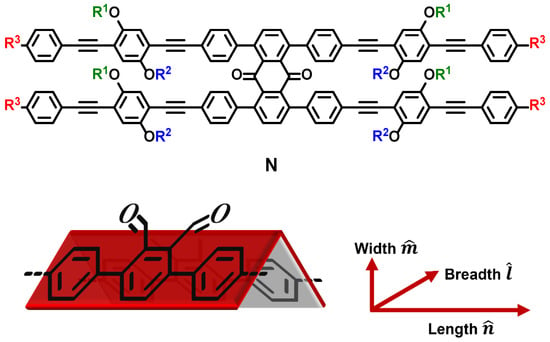
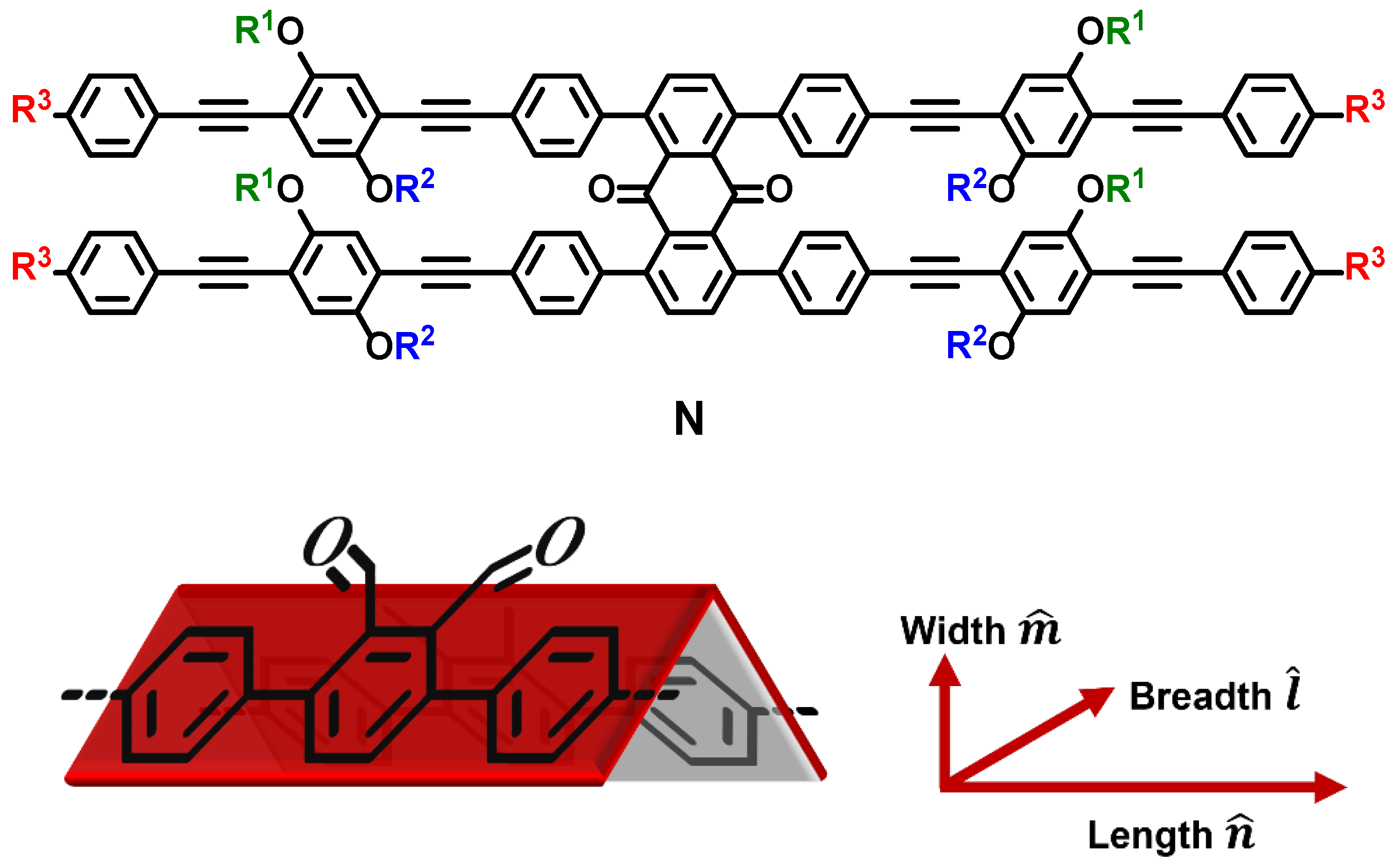
One key challenge is to modify the aspect ratio of bent and board-shaped mesogens using various substituents, so it matches the predicted aspect ratios and exhibits the maximum molecular biaxiality. For bent-shaped nematogens, the tetrahedral apex angle was proposed to be the optimum geometry [17]. For board-shaped molecules the aspect ratios proposed by Straley [14] or Luckhurst [11] were realized. After the first unsuccessful period of research summarized by Praefke [18], more recently, X-shaped mesogens have been shown to have optimum shape; however, indications for biaxiality were only given by conoscopy and these nematogens did not undergo comprehensive studies [23]. This motivated us to design roof-shaped nematogens on the basis of a 1,4,5,8-substituted anthraquinone with a bent configuration possessing a large dipole moment along the minor axis (Figure 1) [24,25,26]. The long, conjugated oligo(ethynylenephenylene) arms define the length L (major director ) and the length of the anthraquinone core is the molecular breadth B (minor director ). A roof-shaped lead structure with maximum molecular biaxiality has recently been identified using X-ray scattering (XRS) on magnetic-field-aligned samples and NMR relaxometry [25]. A subsequent study on a unsymmetric derivative showed the highest known electron mobility by time-of-flight (TOF) investigations, which was explained by the special biaxial conjugated molecules and at least local biaxial order [26]. Eventually, we studied a molecule that could be cooled to a nematic phase and was found by a comprehensive study using polarized optical microscopy (POM), differential scanning calorimetry (DSC), X-ray scattering (XRS), electrical capacitance and resistance measurements, solid state nuclear magnetic resonance (solid-state NMR), and molecular dynamics (MD) simulations to be a monotropic biaxial nematic phase [27]. However, these materials reveal an important disadvantage for the reliable study of biaxial phases—they all possess high melting temperatures and consequently the possible biaxial phases are not enantiotropic. Similar limitations have been reported for several classes of mesogens, including oxadiazole-based systems, where extensive molecular optimization failed to substantially reduce the melting temperature [28,29]. Thus, one of the remaining challenges is to design nematogens with an enantiotropic biaxial nematic phase at room temperature. Such materials would enable systematic investigation of the biaxial nematic state using a broad range of experimental techniques without the restrictions associated with slow crystallization or the limited thermal stability of a monotropic phase. A useful strategy to tune the thermotropic behavior is to modify substituents attached to the lead structure in length or functionality. In this work, we therefore independently varied the alkyl chains R1, R2, R3, including their length and branching. A library of 20 molecules was successfully synthesized with an ester as the functional terminal group at R3. We highlight that POM, DSC and XRS studies confirm broad nematic phases, for which the melting and clearing temperatures decreased by more than 80 K with an increasing number of methylene groups. The positions and sizes of the lateral chains R1 and R2 play a crucial role. The long chains R2 and the terminal chains R3 point to the periphery and interdigitate with neighbors. With the help of room-temperature glass transitions (DSC) and order parameters in the uniaxial phase and aspect ratios obtained by XRS, a new candidate for the discovery of a possible biaxial nematic is identified. Although the melting points require a reduction, the present molecular structure is a new platform for further nematogen engineering and design to optimize the material properties.
Figure 1.
Lead structure of roof-shaped mesogen (N). The three substituents R1, R2 and R3 are marked in color. The length of the molecule is represented by director , the breadth by , and the width by .
2. Materials and Methods
Preparative recycling gel permeation chromatography (GPC). GPC was performed with the liquid chromatograph LC-20A (Shimadzu). The column set (PSS SDV 50 Å, 20,600 mm; PSS SDV 500 Å, 20,600 mm) was eluted with HPLC-grade CHCl3 at a flow rate of 4.0 mL min−1.
Nuclear magnetic resonance spectroscopy (NMR) in solution. NMR spectra were recorded on a Bruker Advance III HD 400 spectrometer (Bruker) operating at 400 MHz (1H) or 100 MHz (13C), with the residual solvent signal used as the internal standard.
Matrix-assisted laser deionization (MALDI) mass spectrometry. Mass spectra were recorded on a Bruker-Daltonics autflex II (MALDI) (Bruker) and on a Bruker-Daltonics ultrafleXtreme (HRMS-MALDI) (Bruker).
Polarized optical microscopy (POM). Studies on optical textures of the mesophases were performed with a Nikon Eclipse LV100Pol optical polarizing microscope (Nikon) equipped with a Linkam LTS420 heating stage and a Linkam T95-HS system controller. The POM heating system was calibrated by commercially available compounds.
X-ray scattering (XRS). The temperature-dependent SAXS and WAXS X-ray investigations were performed on a Bruker Nanostar (Detector Vantec2000, Microfocus copper anode X-ray tube Incoatec) (Bruker). The powder was transferred to a Mark capillary, which was sealed and glued into the metal sample holder with magnets. The XRS heating system was calibrated by liquid crystal standard compounds. The XRS data was evaluated by the program datasqueeze 3.0.23 using silver behenate as a calibration standard.
Differential scanning calorimetry (DSC). DSC measurements were performed on a PerkinElmer DSC 8500 (PerkinElmer) equipped with a cryofill cooling system and Pt/Ir ovens. The samples were sealed in TA hermetic pans and lids. All measurements were performed at a rate of 10 K/min and were evaluated with the Pyris Software for Windows.
Fourier transform infrared (FT-IR) microscopy. FT-IR spectra were recorded with a JASCO FT/IR-4600 (Jasco). The samples were prepared as thin films.
Elemental analysis (EA). Elemental analysis was performed with a vario MICRO cube (elementar). The data are given in percent by mass.
Order parameter. The order parameter was determined by XRS using the whole azimuth angle of the halo. After the χ scan, the order parameter was calculated using the Leadbetter–Norris method [30].
Melting points. The melting points of precursors were measured with the automated melting point system OptiMelt (SRS). The heating rate was set to 5 K min−1.
3. Results and Discussion
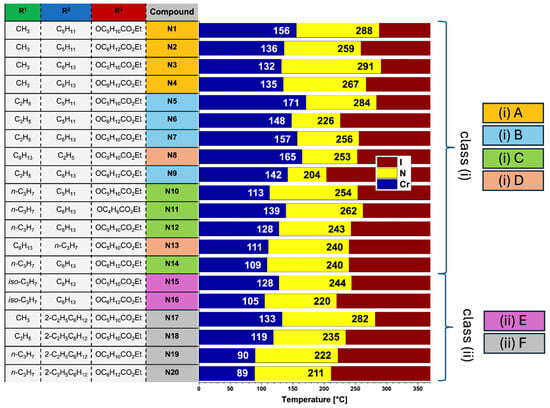
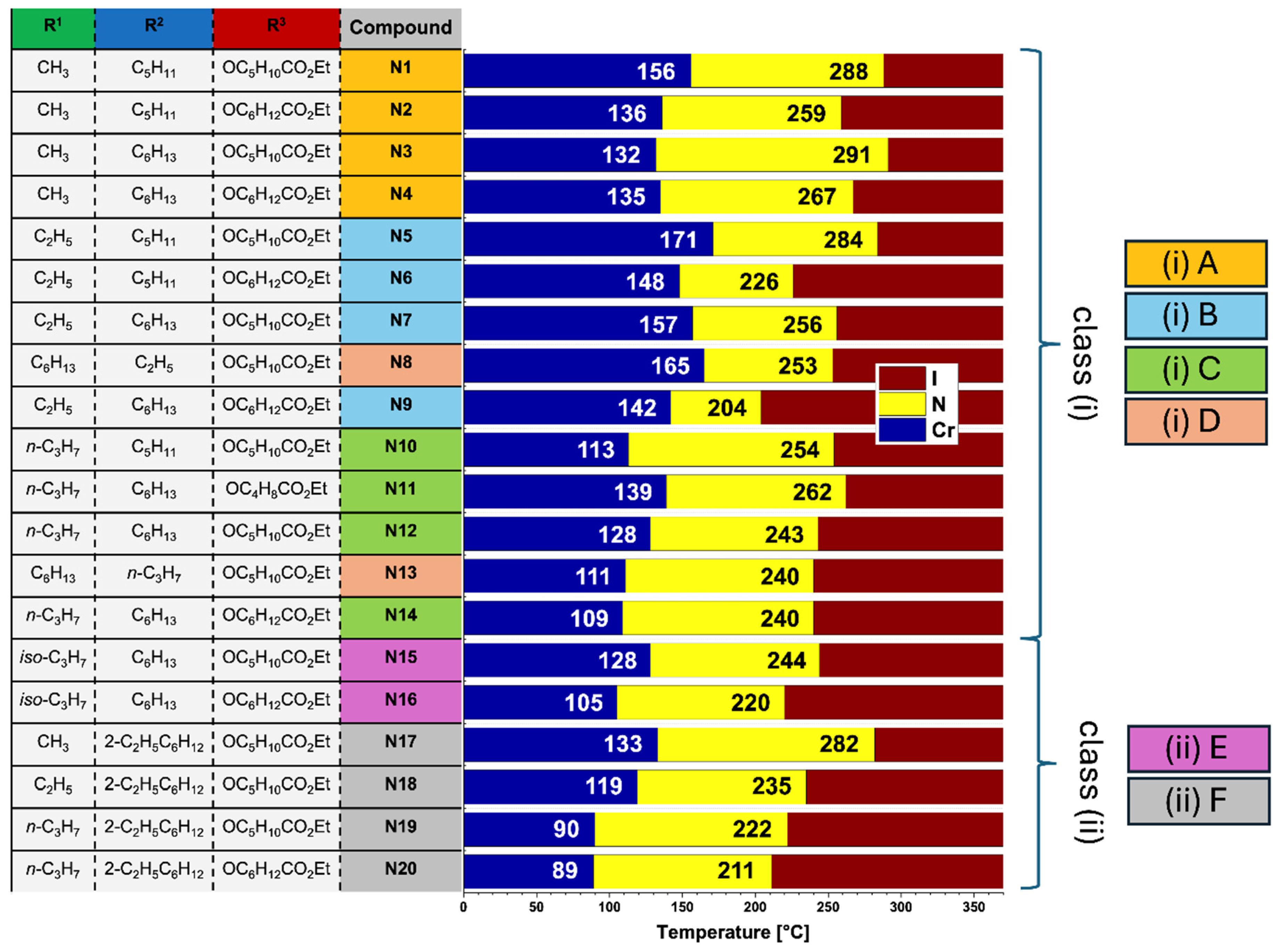
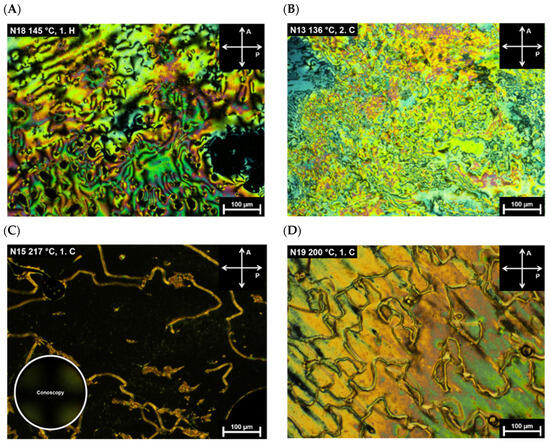
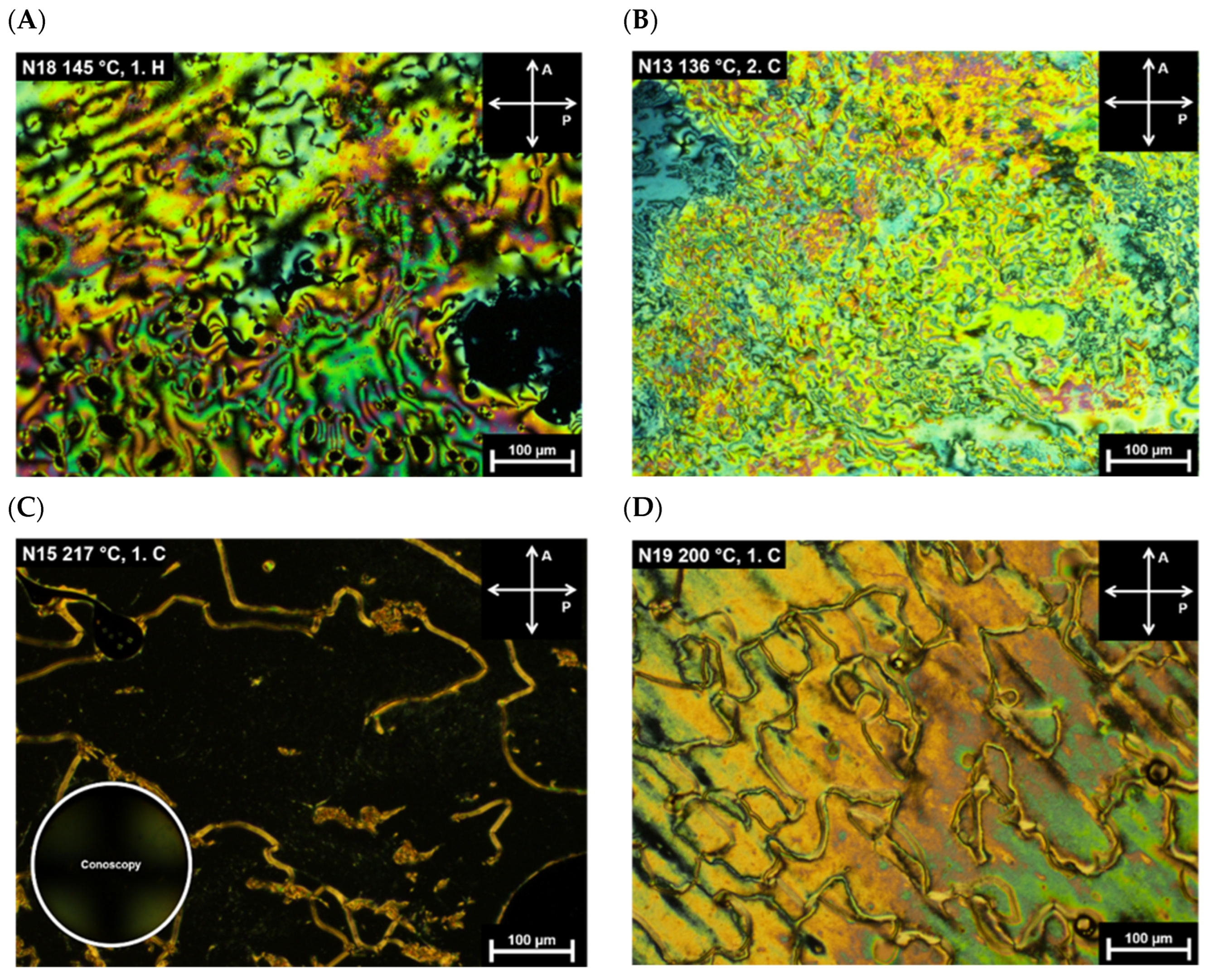
To investigate the influence of alkyl chain architecture on the thermal properties and alignment in an LC phase, a library containing 20 roof-shaped nematogens (Figure 1) was synthesized (Figure 2). The synthetic procedure was previously published and is described in detail in the Supplementary Materials [25,26,27]. The lengths of the lateral substituents R1 and R2 as well as the terminal ester chain R3 were systematically varied. The melting and clearing temperatures were determined by DSC and confirmed by POM. POM (Figure 3) revealed a broad nematic phase range with characteristic Schlieren, Mosaic and homeotropic textures for all the materials.
Figure 2.
Library of 20 synthesized molecules including the melting and clearing temperatures determined from DSC and POM studies.
Figure 3.
Characteristic textures for nematic phases. (A) Schlieren texture of N18 at 145 °C during first heating cycle. (B) Mosaic and Schlieren texture of N13 at 136 °C during second cooling cycle. (C) Schlieren texture and homeotropically aligned areas of N15 at 217 °C during first cooling cycle. The inlet shows an isogyre cross from conoscopy, measured in the homeotropically aligned area. (D) Schlieren texture of N19 at 200 °C during first cooling cycle.
The molecules in the library can be subdivided into different comparable classes: (i) Molecules with linear chains were further subdivided in groups of the same chain R1 but with varying R2 and R3 (A R1 = methyl, B R1 = ethyl, C R1 = propyl group) and group D inverted the lateral substitution pattern (N8, N13); (ii) nematogens contained branched chains with group E comprising molecules in which the internal short chain is branched and group F contained long branched chains (2-C2H5C6H12: 2-Ethylhexyl, R2).
For class (i) mesogens (groups A, B, C), the melting and clearing temperatures decrease typically with increasing lateral chain lengths (R1 and R2). All nematogens form an enantiotropic nematic phase over a broad temperature range of 62–159 K. More detailed analysis reveals that when changing the terminal chain length of R3 from C5 to C6, the melting temperature and clearing temperatures drop (see the mesogen pairs N1/N2 (group A); N5/N6 and N7/N9 (group B); and N12/N14 (group C)). At first sight this could be explained by the shape of the chains, which are linear for the C5 spacer and bent for the C6 spacer and, thus, might be interpreted as an odd–even effect. However, the series N11, N12, and N14 with a terminal chain spacer length of C4, C5 and C6 show a linear decrease in melting and clearing temperatures. Consequently, this behavior is better regarded as an entropy effect [31], since the ethyl ester groups are connected to the core via spacers of different lengths. Assuming that in the crystal these ethyl ester units are nanosegregated from the aliphatic chains, causing specific chain conformations, the melting of the longer spacers increases the melting transition entropies more than the shorter spacers. For each molecule, four spacers contribute to this entropy change. According to the formula ΔH/ΔS = T (ΔH melting enthalpy, ΔS melting entropy, T = melting temperature), the melting temperature decreases when the transition entropy increases more than the transition enthalpy. Thus, with increasing spacer lengths, the melting temperature decreases continuously, as revealed by N11, N12 and N14.
This simple relationship does not hold when the side chains are inspected. While in group A, clearing temperatures increase and melting temperatures decrease when R2 changes from Pentyl to Hexyl chains (N1/N3; N2/N4), both temperatures decrease in group B (N5/N7; N6/N9) and in group C, the melting temperature increases and the clearing temperature decreases (N10/N12). Thus, the impact of the different chain lengths R1 and R2 on the LC behavior is not independent of each other. This has been recently shown for a pair of mesogens N12/N13 with an inverted lateral chain structure [27]. The chains pointing to the interior of the nematogen cause evident intramolecular steric repulsion between the neighboring conjugated arms; thus, we predicted that the smaller chains should be accommodated in the interior of the nematogen while the longer chains should be located at the lateral periphery. Indeed, solid-state NMR confirmed that the short chains are located between the arms [27]. While for group A there is a significant difference in the size of the lateral chains R1 and R2, this difference decreases in groups B and C, which most probably influences the conformation of the mesogens and explains the different influences on the transition temperatures.
In class (i), group D, there are two molecules with inverted lateral chain patterns, namely, N8 and N13 when compared with N7 and N12. However, the mesogens have the same composition and are only constitutional isomers. The impact on the clearing temperature is marginal for both pairs. Only the melting temperatures are differently affected. In the case of N7/N8, the inverted structure N8 has the higher melting temperature, while for N12/N13 the inverted mesogen, N13 has the lower one. Nonetheless, comprehensive structural studies for N12/N13 revealed that the inverted substitution pattern does not promote the self-assembly of the minor molecular axis [27]. Therefore, the inverted structure N13 was not further considered favorable for finding a biaxial nematic.
The second class (ii) collects all mesogens with sterically more bulky side chains. Group E contains the bulky groups at R1, which are the smaller lateral chains, while group F comprises the molecules with bulky 2-ethylhexyl groups. The sterically bulky iso-propyl groups (group E) led to higher melting temperatures and a slightly decreased mesophase range compared with the derivative with linear n-propyl substituents at R1. Since the smaller R1 substituents were shown to be located between the conjugated arms, the steric repulsion changes the molecular shape, which rationalizes the different thermotropic properties. This situation changes when bulky, branched chains are attached as R2 (class ii, group F), which were shown to point to the lateral periphery of the nematogen [27]. With the increasing size of the chain R1 (Me, Et, n-Pr), the melting and clearing temperatures drop. The melting temperatures reached a minimum value of 90 °C and 89 °C for compounds N19 and N20.
Eventually, it is important to note that all compounds with n-propyl or iso-propyl chains can be strongly supercooled without crystallization and at room temperature, glass transitions result in the formation of nematic glasses. This is not typically observed for nematogens with shorter chains (ethyl, methyl or H [25]). Here, more frequently, crystallization is apparent in the DSC and POM studies (see ESI and the literature [11,32,33,34,35]). If it is assumed that flatter conformers promote crystallization [25], then this points to controlling the degree of roof inclination with the steric demand of the shorter chains. Sterically more bulky groups should lead to a larger perturbation from planarity. These derivatives reduce the crystallization tendency and form the glass phases. To conclude this first section, it was possible to reduce the melting points by systematically varying the alkyl substituents from 171 °C (N5) to 89 °C (N20) across the investigated compound library (Figure 2). Although an enantiotropic room-temperature nematic phase has not yet been achieved, these results demonstrate that the thermal properties of roof-shaped nematogens can be effectively tuned through rational molecular design without changing the general molecular structure. Future work will follow up to decrease the melting temperature below room temperature.
A further challenge in this area of research is to prove the nature of the nematic phases. In POM studies it was proposed that uniaxial nematic phases should have disclination lines with strengths of ±1/2 and ±1, while biaxial nematic phases should exclusively reveal disclination lines with strength of ±1/2 [36,37,38]. In this library the presence of disclinations with strengths of ±1/2 and ±1 detected in the Schlieren texture above 120 °C and the low viscosity provide unambiguous evidence for the uniaxial nematic nature of the mesophases. Exclusive two-branched defects have not been observed. The literature also provides evidence of biaxiality by Conoscopy [20,37]. However, this works only with homeotropically aligned samples. The homeotropic domains (Figure 3C) were in some cases observed after cooling from the isotropic phase, which has been shown to be a consequence of a transesterification of the terminal ester group with the OH groups at the glass surface, generating an alignment layer [27]. Conoscopy at high temperature confirmed the uniaxial nature of the homeotropically aligned phases of the library. However, a recent comprehensive study conducted for N12 revealed that this method is very challenging because even with significant split isogyres, it is not a general proof of biaxiality. In this case the biaxial phase cannot be distinguished from the formation of biaxial director fields of a uniaxial phase, which can be generated by molecular motion and realignment during cooling [27].
Theory predicts that the transitions I-Nb and Nu-Nb should be second order, i.e., the transition enthalpy in DSC studies should converge to zero [32,33]. In this library the transition enthalpies at the clearing transition are rather small (0.60–1.06 kJ/mol). However, the materials slowly decompose in the isotropic phase above 230 °C; thus, small clearing enthalpies above this temperature suffer from decomposition of the material. The recent results for N12, possessing a low-temperature nematic glass, demonstrate that there is a second-order transition, which might indicate the sought process. More detailed studies with a new technique, i.e., capacitance and resistance measurements, indicate that a monotropic uniaxial nematic transforms into a monotropic biaxial nematic phase [27]. Therefore, the n-propyl and iso-propyl derivatives of the library may be interesting candidates for more profound future studies.
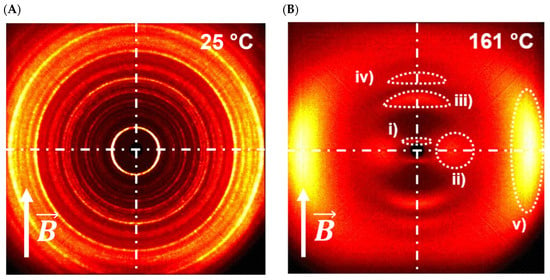
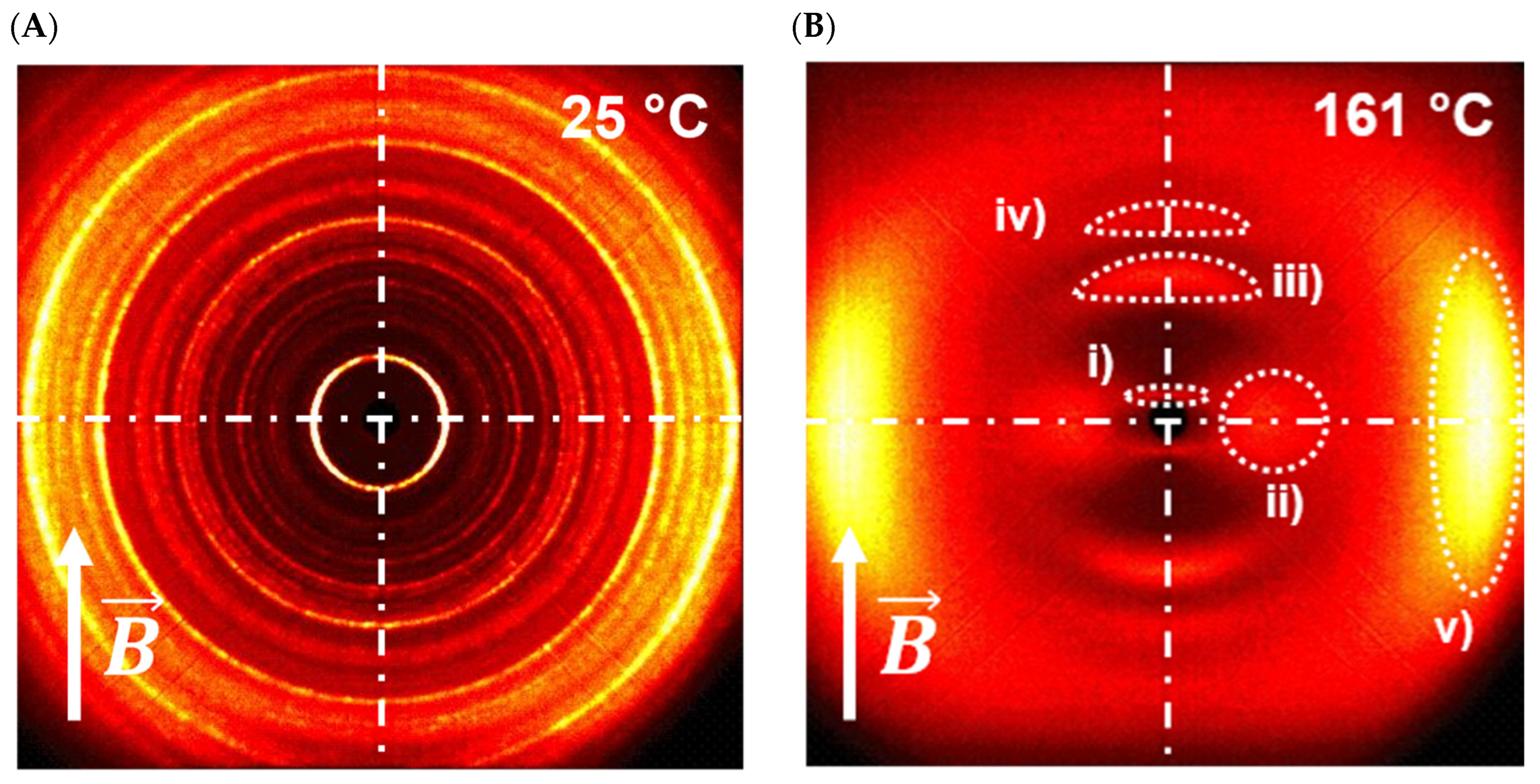
To obtain more insight into which of the materials in the library might be the most relevant, X-ray scattering on magnetic-field-aligned samples was performed. The sample holder equipped with two ring magnets (1T, Sm2Co17, Deutsche Techna) was especially designed to induce the alignment of the long axis L (director ) by inducing diamagnetic ring currents. Indeed, all materials align with the director along the meridian when heated to the nematic phase. Figure 4 highlights the results of N18 as a representative example. Figure 4A shows the XRS of an unaligned crystalline powder, where the diffraction pattern changes to an aligned pattern in Figure 4B. All compounds exhibit such a characteristic scattering pattern for nematic phases with exclusively broad scattering intensities reminiscent of a liquid-like self-assembly. The diffuse small-angle signals (i) and (ii) can be attributed to the molecular length L and breadth B. The additional signals along the meridian can be explained by the periodic electron density along the long axis of the molecules [25,26,27]. The halo (v) is a result of the average separation of aliphatic chains and the stacking of the molecules along the minor director (see Figure 1). The overall XRS pattern of these nematogens can be regarded as the result of the rectangular form factor of the roof-shaped nematogen. The high similarity of the scattering patterns throughout the entire library demonstrates that the systematic variation in the substituents has no significant impact on the general rectangular molecular structure in the nematic phase.
Figure 4.
Exemplary 2D X-ray scattering patterns of compound N18. (A) Crystalline phase at 25 °C prior to the first heating into the nematic phase. (B) Sample aligned in a magnetic field B at 161 °C during heating. The signals corresponding to the length L (i), breadth B (ii), and halo (v) are labeled. Additional signals indicating the periodicity of the nematogens are labeled on the meridian (iii and iv).
Since the width of the roof-shaped molecules cannot be defined as the hydrocarbon distance of the halo (v), it was estimated by the molecular volume, which can be obtained from the density [26]. The molecular volume Vmol can be calculated as L*B*W and, thus, W = Vmol/L/B. The density of compound N18 was measured by the buoyancy method [39]. It was determined to be 0.94 g/cm3 at 22 °C. Since the temperature variable’s overall aliphatic volume VCH for the CH2 and CH3 groups can be calculated [40], the aromatic volume, including four carboxy groups, was obtained by Vcore = Vmol − VCH at 22 °C. This core volume is considered to be the same for all molecules in the library and is assumed to be temperature-invariant. Thus, by calculating the temperature-dependent aliphatic volume for each compound for the temperature of the XRS experiment, the molecular volume at the temperature T (°C) was obtained by Vmol(T) = Vcore,22 °C + VCH (T). From Vmol(T) the width W is calculated for each material. Subsequently, the aspect ratios L:B:W can be calculated and are normalized to B = 3.16, in order to compare the ratio to the theoretically predicted values.
Table 1 summarizes the experimentally derived values L, B, W and the corresponding aspect ratios, which can now be compared with the theoretical lengths obtained from model compounds (Chem3D). The lengths of model nematogens with C4 and C6 spacers range from 58 Å to 68 Å, the length of the conjugated core is 39.5 Å and its breadth is minimal 9 Å. The experimental lengths L (Table 1) range from 57.1 Å (N17, R3 = C5) to 44.5 Å (N11, R3 = C4). The N11 with the C4 spacer should have a total chain length of approximately 18.5 Å (58.0 Å − 39.5 Å). If the chains are interdigitating completely, only half of this length will contribute to the experimentally determined total length of the molecule. However, the length L would still be 48.8 Å (39.5 Å + 9.25 Å), i.e., 4 Å larger than the value of the XRS results. In this case the terminal chains enter into the area of the core along the long axes. The same calculation for the C5 and C6 spacers provides values of 51.3 Å and 53.8 Å for a full interdigitation of the chains. Thus, for compound N17 with an experimental length of 57.1 Å, it becomes clear that the chains do only partially interdigitate. An example of a fully interdigitated nematogen is compound N4 with an experimental length of 53.3 Å compared with a predicted value of 53.8 Å. The breadth of the molecules is always larger than the minimum value of 9 Å for the aromatic core and ranges from 11.9 Å to 19.5 Å. Assuming that aliphatic chains align alongside the long molecular axis and fully interdigitate with an average hydrocarbon distance of 4.5 Å, on both sides of the molecules, the minimum breadth should be 13.5 Å (9 Å + 4.5 Å), which is already slightly larger than the experimental minimum value. The average value of the breadth is 15.8 Å and matches the expected value for laterally interdigitated nematogens rather well. Interestingly, the breadth for the branched chain derivative is not especially large, although a larger number of carbon atoms are placed between the molecules along B. This is evidence that the packing of these molecules is a complex interplay between the 3D conformation of the roof-shaped nematogens guided by the size of the small chains R1 in the interior of the core, extending the interdigitation of the terminal chains R3 and the interdigitation of the lateral long chains R2.
Table 1.
XRS results and aspect ratio normalized to B = 3.16.
This situation is also reflected by the aspect ratios in Table 1, which were measured in the enantiotropic, i.e., the high-temperature range of the nematic phases. There is no evident relationship between the aspect ratio and molecular structure. Some of these molecules are significantly close to the maximum molecular biaxiality according to Straley [14], such as N1, N2, N9, and N18. Other compounds deviate strongly, e.g., N12 and N13. It is this molecule, N12, which has been recently demonstrated to generate a uniaxial nematic phase at 133 °C and the first monotropic biaxial nematic phase at room temperature. At this temperature the molecule achieved almost the ideal aspect ratio [27].
The determination of the order parameters ⟨P2⟩ and ⟨P4⟩ could help identify the best candidate for finding a biaxial nematic. They can be determined from the 2D-XRS patterns according to the Leadbetter–Norris method [30]. Whereas ⟨P2⟩ describes the long-range orientational order along the long-axis director , ⟨P4⟩ refers to the conical or symmetrical distribution of the molecules [41,42]. To obtain these parameters, an χ-scan is performed over the entire range of the halo (0–360°), and the resulting intensity is fitted according to the literature [30]. The order parameters ⟨P2⟩ and ⟨P4⟩ are calculated from the values obtained using Legendre polynomials. Detailed information can be found in the cited literature [30]. Nematogen N12, which was theoretically predicted to show a nematic phase with a high biaxial order parameter and experimentally demonstrated to generate a monotropic biaxial nematic at room temperature, reveals high-order parameters of ⟨P2⟩ = 0.55 and ⟨P4⟩ = 0.28, while the order parameters decrease sharply when the substitution pattern is reversed, such as for compound N13 (0.45; 0.18). For this compound the molecular dynamics simulation predicted a very small biaxiality parameter. Thus, high XRS-order parameters might indicate a possible candidate for a biaxial nematic phase. For all investigated compounds, the order parameters ⟨P2⟩ ranging from 0.29 to 0.55 and ⟨P4⟩ from approximately 0.12 to 0.28 are consistent with the orientational order expected for nematic liquid crystals (see Table 2).
Table 2.
Order parameter <P2> and <P4> of all nematogens.
All order parameters were analyzed at (200 ± 35) °C, i.e., an average of 70 °C above the melting temperatures and well below the clearing temperature to avoid decomposition. For example, order parameters at variable temperatures were determined for N12, which are relatively constant over the whole enantiotropic temperature range (see ESI). It is immediately evident that, analogous to the pair N12 and N13, the pair N7 and N8 shows high-order parameters for N7 but only low-order parameters for the nematogen N8 with the inverted substitution pattern. Therefore, it can be clearly concluded, based on our hypothesis, that class (i), group D, mesogens with inverted substitution patterns reveal loworder parameters and are not promising for finding a biaxial nematic self-assembly. In class(i), group A, the nematogens with R1 = CH3 seem to have a lower tendency for orientational order with longer C6 spacers. In group B the spacer length does not seem to play an important role; only the substitution pattern impacts the order parameter. An exception is N5, which was studied at a much higher temperature.
Interestingly the behavior changes again in group C. Here the combination between the C4 and C5 spacers with R2 = C6H13 furnishes the highest order for N11 and N12, while N10 and N14 fail to develop such high-order parameters. These are only very small structural differences leading to a large impact on the order parameters, which cannot yet be explained by our structural basis. Class (ii) nematogens with branched chains almost all exhibit low-order parameters. There is one exception, which is compound N18, with R1 = C2H5, R2 = 2-ethyl-hexyl and a C5 spacer. Obviously, the finding of well-ordered nematogens requires focusing on the subtle interplay between all substituents.
Eventually, considering the XRS results, i.e., the aspect ratio and order parameters, the library possesses, apart from N12, four more nematogens, N1, N9, N11 and N18, with promising XRS data for finding the biaxial nematic. However, except N11, all these candidates show crystallization close to room temperature, while candidates with a low-temperature glass transition such as N5, N10, N15, N16, N19, and N20 reveal low-order parameters. Thus, for more comprehensive searches for a biaxial nematic phase, N11 is most promising.
4. Conclusions
A library of 20 roof-shaped nematogens with systematically varied lateral and terminal alkyl chains of different lengths was successfully synthesized. POM, DSC and XRS data confirm that the special molecular design generated stable broad nematic phases in all cases. For many of the nematogens, the nematic phases could be supercooled to room temperature, where they generated a glassy nematic phase. This systematic study revealed that with increasing chain lengths (lateral and terminal), the melting and clearing temperatures decrease. The minimum melting temperature of 89 °C was achieved using branched chains. XRS studies confirm that the nematogens are interdigitated along the major director with the terminal chains and with the longer lateral chains. Order parameters are determined and are in the typical range of nematic phases. The nematic self-assembly is a complex interplay between all flexible chains—the smaller chains enter the interior of the nematogens, where they impact the conformation of nematogens and the longer lateral chains are directed towards the periphery, where they interdigitate. The order-parameter study confirmed that an inverted substitution pattern of class (i) group D mesogens has a considerably lower orientational order. Although no detailed structure–property relationship can be established, this investigationshows that the nematic self-assembly is a complex interplay between the lengths of the lateral and the terminal chains. However, based on XRS and DSC data, one of the most promising candidates for further comprehensive biaxiality studies has been identified: nematogen N11; it undergoes a transition to a nematic glass with high-order parameters in the enantiotropic nematic phase. Future work will be performed on this candidate to characterize the nature of the nematic phases over the whole temperature range in perfectly aligned samples.
Supplementary Materials
The following supporting information can be downloaded at https://www.mdpi.com/article/10.3390/chemistry8110149/s1. Detailed description of the methods, chemicals and synthetic procedures [43,44,45,46,47,48,49,50,51,52,53,54]; Scheme S1: Synthesis of 50–61 with substituents R1 and R2; Scheme S2: Synthesis of various arm building blocks; Scheme S3: Synthesis of terminal groups 82–84; Scheme S4: Synthesis of the liquid crystalline target molecules N1–N20; Table S1: Molecule numbers 4–61 with various substituents. Table S2: Molecule numbers 62–81 and A/N1–A/N20 with various substituents; Table S3: Numbers of terminal groups; Table S4: DSC data of N1–N20; Table S5: Absolute values for length L, breadth B and width W as well as the aspect ratio of L:B:W for molecules N1–N20; Figure S1: 1H and 13C NMR spectra of N1 in CDCl3; Figure S2: 1H and 13C NMR spectra of N2 in CDCl3.; Figure S3: 1H and 13C NMR spectra of N3 in CDCl3; Figure S4: 1H and 13C NMR spectra of N4 in CDCl3.; Figure S5: 1H and 13C NMR spectra of N5 in CDCl3; Figure S6: 1H and 13C NMR spectra of N6 in CDCl3; Figure S7: 1H and 13C NMR spectra of N7 in CDCl3; Figure S8: 1H and 13C NMR spectra of N8 in CDCl3.; Figure S9: 1H and 13C NMR spectra of N9 in CDCl3.; Figure S10: 1H and 13C NMR spectra of N10 in CDCl3; Figure S11: 1H and 13C NMR spectra of N11 in CDCl3.; Figure S12: 1H and 13C NMR spectra of N14 in CDCl3; Figure S13: 1H and 13C NMR spectra of N15 in CDCl3.; Figure S14: 1H and 13C NMR spectra of N16 in CDCl3; Figure S15: 1H and 13C NMR spectra of N17 in CDCl3; Figure S16: 1H and 13C NMR spectra of N19 in CDCl3; Figure S17: 1H and 13C NMR spectra of N20 in CDCl3; Figure S18: HRMS-MALDI spectra of N1–N20 measured with DCTB as matrix; Figure S19: Exemplarily temperature dependency of the order parameters ⟨P2⟩ and ⟨P4⟩ for N12 within a temperature range of 64 K. Figure S20: POM images of characteristic textures for the nematic phases of several selected compounds; Figure S21: DSC (two cycles) of N1 from 40 °C to 320 °C; Figure S22: DSC (two cycles) of N2 from 40 °C to 300 °C; Figure S23: DSC (two cycles) of N3 from –10 °C to 330 °C; Figure S24: DSC (two cycles) of N4 from 30 °C to 300 °C; Figure S25: DSC (two cycles) of N5 from 15 °C to 325 °C; Figure S26: DSC (two cycles) of N6 from –10 °C to 260 °C; Figure S27: DSC (two cycles) of N7 from –10 °C to 300 °C; Figure S28: DSC (two cycles) of N8 from –10 °C to 290 °C; Figure S29: DSC (two cycles) of N9 from –10 °C to 290 °C; Figure S30: DSC (two cycles) of N10 from –10 °C to 280 °C; Figure S31: DSC (two cycles) of N11 from –10 °C to 290 °C; Figure S32: DSC (two cycles) of N12 from –10 °C to 280 °C; Figure S33: DSC (two cycles) of N13 from –10 °C to 280 °C.; Figure S34: DSC (two cycles) of N14 from 25 °C to 275 °C; Figure S35: DSC (two cycles) of N15 from 25 °C to 270 °C.; Figure S36: DSC (two cycles) of N16 from 20 °C to 280 °C.; Figure S37: DSC (two cycles) of N17 from 30 °C to 300 °C; Figure S38: DSC (two cycles) of N18 from –10 °C to 270 °C; Figure S39: DSC (two cycles) of N19 from –10 °C to 240 °C; Figure S40: DSC (two cycles) of N20 from –10 °C to 250 °C.
Author Contributions
Conceptualization, M.L. and N.S.; methodology, N.S.; software, N.S.; validation, M.L., N.S.; formal analysis, N.S., M.L.; investigation, N.S.; resources, M.L.; data curation, N.S., M.L.; writing—original draft preparation, N.S.; writing—review and editing, M.L. and N.S.; visualization, N.S.; supervision, M.L.; project administration, M.L.; funding acquisition, M.L. All authors have read and agreed to the published version of the manuscript.
Funding
This study was funded by the German Science Foundation (DFG) via LE 1571/10-1.
Data Availability Statement
The original contributions presented in this study are included in the article/Supplementary Material. Further inquiries can be directed to the corresponding author.
Acknowledgments
M.L. and N.S. are grateful for the financial support by the German Science Foundation (DFG) via LE 1571/10-1.
Conflicts of Interest
The authors declare no conflicts of interest.
Abbreviations
The following abbreviations are used in this manuscript:
| B | Breadth |
| DSC | Differential scanning calorimetry |
| EA | Elemental analysis |
| ESI | Electronic supporting information |
| FT-IR | Fourier transform infrared |
| GPC | Gel permeation chromatography |
| HPLC | High-performance liquid chromatography |
| HRMS | High-resolution mass spectrometry |
| I | Isotropic |
| L | Length |
| LC | Liquid crystal/liquid crystalline |
| MALDI | Matrix-assisted laser desorption/ionization |
| MD | Molecular dynamics |
| NB | Biaxial nematic |
| NMR | Nuclear magnetic resonance |
| NU | Uniaxial nematic |
| POM | Polarized optical microscopy |
| SAXS | Small-angle X-ray scattering |
| TOF | Time of flight |
| VCH | CH volume |
| VCore | Core volume |
| Vmol | Molecular volume |
| W | Width |
| WAXS | Wide-angle X-ray scattering |
| XRS | X-ray scattering |
References
- Schadt, M. The Twisted Nematic Effect: Liquid Crystal Displays and Liquid Crystal Materials. Mol. Cryst. Liq. Cryst. 1988, 165, 405–438. [Google Scholar] [CrossRef] [Scilit]
- Gray, G.W.; Harrison, K.J.; Nash, J. New family of nematic liquid crystals for displays. Electron. Lett. 1973, 6, 130–131. [Google Scholar] [CrossRef] [Scilit]
- Brimicombe, P.D. Applications. In Biaxial Nematic Liquid Crystals: Theory, Simulation and Experiment; Luckhurst, G.R., Sluckin, T.J., Eds.; John Wiley & Sons: Hoboken, NJ, USA, 2015; pp. 215–227. [Google Scholar] [CrossRef] [Scilit]
- Acharya, B.R.; Baldwin, K.W.; MacHarrie, R.A.; Rogers, J.A.; Huang, C.C.; Pindak, R. In-fiber nematic liquid crystal optical modulator based on in-plane switching with microsecond response time. Appl. Phys. Lett. 2002, 81, 5243–5245. [Google Scholar] [CrossRef] [Scilit]
- Sit, A.; Di Colandrea, F.; D’Errico, A.; Karimi, E. Spatially twisted liquid-crystal devices. APL Photonics 2024, 9, 056112. [Google Scholar] [CrossRef] [Scilit]
- Chien, L.-C.; Most, D.R.; Yokoyama, H.; VanTreeck, H.J.; Grinwald, B.A.; Kupcho, K.A.; Sen, A.; Bonds, M.D.; Anhalt, K.; Israel, B.A.; et al. Nematic liquid crystal interfaces for chemical and biological detection. In Proceedings of the SPIE OPTO, San Francisco, CA, USA, 22–27 January 2011. Volume Emerging Liquid Crystal Technologies VI. [Google Scholar]
- Folcia, C.L.; Ortega, J.; Sierra, T.; Martínez-Bueno, A.; Etxebarria, J. Chiral ferroelectric nematic liquid crystals as materials for versatile laser devices. Giant 2024, 19, 100316. [Google Scholar] [CrossRef] [Scilit]
- Mandle, R.J.; Cowling, S.J.; Sage, I.; Colclough, M.E.; Goodby, J.W. Relationship between molecular association and re-entrant phenomena in polar calamitic liquid crystals. J. Phys. Chem. B 2015, 119, 3273–3280. [Google Scholar] [CrossRef] [Scilit] [PubMed]
- Tschierske, C.; Pelzl, G.; Diele, S. Definitionen von Grundbegriffen mit Bezug zu niedermolekularen und polymeren Flüssigkristallen. Angew. Chem. 2004, 116, 6340–6368. [Google Scholar] [CrossRef] [Scilit]
- Freiser, M.J. Ordered States of a Nematic Liquid. Phys. Rev. Lett. 1970, 24, 1041–1043. [Google Scholar] [CrossRef] [Scilit]
- Luckhurst, G.R. Biaxial nematic liquid crystals: Fact or fiction? Thin Solid Films 2001, 393, 40–52. [Google Scholar] [CrossRef] [Scilit]
- Tschierske, C. Entwicklung struktureller Komplexität durch Selbstorganisation in flüssigkristallinen Systemen. Angew. Chem. 2013, 125, 8992–9047. [Google Scholar] [CrossRef] [Scilit]
- Tschierske, C. Non-conventional liquid crystals—The importance of micro-segregation for self-organisation. J. Mater. Chem. 1998, 8, 1485–1508. [Google Scholar] [CrossRef] [Scilit]
- Straley, J.P. Ordered phases of a liquid of biaxial particles. Phys. Rev. A 1974, 10, 1881–1887. [Google Scholar] [CrossRef] [Scilit]
- Boccara, N.; Mejdani, R.; De Seze, L. Solvable model exhibiting a first-order phase transition. J. Phys. 1977, 38, 149–151. [Google Scholar] [CrossRef] [Scilit]
- Dingemans, T.J.; Madsen, L.A.; Zafiropoulos, N.A.; Lin, W.; Samulski, E.T. Uniaxial and biaxial nematic liquid crystals. Philos. Trans. A Math. Phys. Eng. Sci. 2006, 364, 2681–2696. [Google Scholar] [CrossRef] [Scilit] [PubMed]
- Maisch, S.; Krause, A.-M.; Schmidt, D.; Lehmann, M. To be or not to be—Nematic liquid crystals from shape-persistent V-shaped nematogens with the ‘magic angle’. Liq. Cryst. 2017, 45, 136–151. [Google Scholar] [CrossRef] [Scilit]
- Praefcke, K.; Blunk, D.; Singer, D.; Goodby, J.; Toyne, K.; Hird, M.; Styring, P.; Norbert, W. Design of low-molar mass thermomesogens in the search for biaxial nematic liquid crystals. Mol. Cryst. Liq. Cryst. Sci. Technol. Sect. A 1998, 323, 231–259. [Google Scholar] [CrossRef] [Scilit]
- Lehmann, M. Biaxial nematics from their prediction to the materials and the vicious circle of molecular design. Liq. Cryst. 2011, 38, 1389–1405. [Google Scholar] [CrossRef] [Scilit]
- Lehmann, M. Low Molar Mass Thermotropic Systems. In Biaxial Nematic Liquid Crystals: Theory, Simulation and Experiment; Luckhurst, G.R., Sluckin, T.J., Eds.; John Wiley & Sons: Hoboken, NJ, USA, 2015; pp. 333–367. [Google Scholar] [CrossRef] [Scilit]
- Goodby, J.W.; Collings, P.J.; Kato, T.; Tschierske, C.; Gleeson, H.; Raynes, P.; Vill, V. Handbook of Liquid Crystals, 8 Volume Set; John Wiley & Sons: Hoboken, NJ, USA, 2014; Volume 1. [Google Scholar]
- Luckhurst, G.R.; Sluckin, T.J. Biaxial Nematic Liquid Crystals: Theory, Simulation and Experiment; John Wiley & Sons: Hoboken, NJ, USA, 2015. [Google Scholar]
- Chen, H.H.; Lin, H.A.; Lai, Y.H.; Lin, S.Y.; Chiang, C.H.; Hsu, H.F.; Shih, T.L.; Lee, J.J.; Lai, C.C.; Kuo, T.S. Enantiotropic nematics from cross-like 1,2,4,5-tetrakis(4′-alkyl-4-ethynylbiphenyl)benzenes and their biaxiality studies. Chem. Eur. J. 2012, 18, 9543–9551. [Google Scholar] [CrossRef] [Scilit] [PubMed]
- Norvez, S.; Tournilhac, F.-G.; Bassoul, P.; Herson, P. Mesomorphism and Polar Distortion in 1,4,5,8-Tetrasubstituted Anthraquinones and Anthracenes. Chem. Mater. 2001, 13, 2552–2561. [Google Scholar] [CrossRef] [Scilit]
- Lehmann, M.; Maisch, S.; Scheuring, N.; Carvalho, J.; Cruz, C.; Sebastião, P.J.; Dong, R.Y. From molecular biaxiality of real board-shaped mesogens to phase biaxiality? On the hunt for the holy grail of liquid crystal science. Soft Matter 2019, 15, 8496–8511. [Google Scholar] [CrossRef] [Scilit] [PubMed]
- Lehmann, M.; Scheuring, N.; Mager, L.; Singh, D.P.; Mandle, R.; Eremin, A. High Electron Charge Carrier Mobility in the Nematic Phase of a Roof-Shaped Nematogen with Optimum Molecular Biaxiality. Adv. Sci. 2025, 12, e10009. [Google Scholar] [CrossRef] [Scilit] [PubMed]
- Scheuring, N.; Hoß, M.; Bachmann, S.; Mandle, R.; Pöppler, A.-C.; Figueirinhas, J.L.M.; Cruz, C.; Sebastião, P.J.; Lehmann, M. Tailoring Roof-Shaped Nematogens-Alignment and Biaxial Packing in a Nematic LC Phase. ChemRxiv 2026, 2026. [Google Scholar] [CrossRef] [Scilit] [PubMed]
- Speetjens, F.; Lindborg, J.; Tauscher, T.; LaFemina, N.; Nguyen, J.; Samulski, E.T.; Vita, F.; Francescangeli, O.; Scharrer, E. Low nematic onset temperatures and room temperature cybotactic behavior in 1,3,4-oxadiazole-based bent-core mesogens possessing lateral methyl groups. J. Mater. Chem. 2012, 22, 22558–22564. [Google Scholar] [CrossRef] [Scilit]
- Packard, M.; Gulliford, K.; Scharrer, E. Oxazole-based liquid crystals with low temperature nematic phases. Mol. Cryst. Liq. Cryst. 2017, 647, 186–195. [Google Scholar] [CrossRef] [Scilit]
- Sims, M.T.; Abbott, L.C.; Richardson, R.M.; Goodby, J.W.; Moore, J.N. Considerations in the determination of orientational order parameters from X-ray scattering experiments. Liq. Cryst. 2018, 46, 11–24. [Google Scholar] [CrossRef] [Scilit]
- Lehmann, M. Phase transitions in complex functional liquid crystals—The entropy effect. Front. Soft Matter 2023, 3, 1089726. [Google Scholar] [CrossRef] [Scilit]
- Apreutesei, D.; Mehl, G. Investigation of the Complete Miscibility of Disc-rod Mesogens in the Nematic Phase. Mol. Cryst. Liq. Cryst. 2006, 449, 107–115. [Google Scholar] [CrossRef] [Scilit]
- Kouwer, P.H.; Mehl, G.H. Full miscibility of disk- and rod-shaped mesogens in the nematic phase. J. Am. Chem. Soc. 2003, 125, 11172–11173. [Google Scholar] [CrossRef] [Scilit] [PubMed]
- Date, R.W.; Bruce, D.W. Shape amphiphiles: Mixing rods and disks in liquid crystals. J. Am. Chem. Soc. 2003, 125, 9012–9013. [Google Scholar] [CrossRef] [Scilit] [PubMed]
- Hunt, J.J.; Date, R.W.; Timimi, B.A.; Luckhurst, G.R.; Bruce, D.W. Toward the biaxial nematic phase of low molar mass thermotropic mesogens: Substantial molecular biaxiality in covalently linked rod-disk dimers. J. Am. Chem. Soc. 2001, 123, 10115–10116. [Google Scholar] [CrossRef] [Scilit] [PubMed]
- Chandrasekhar, S.; Nair, G.G.; Rao, D.S.; Prasad, S.K.; Praefcke, K.; Blunk, D. A thermotropic biaxial nematic liquid crystal. Curr. Sci. 1998, 165, 1042–1046. [Google Scholar]
- Dierking, I.; Palangana, A.J.; Vij, J.K.; Kocot, A.; Madsen, L.A.; Davidson, P. Characterisation. In Biaxial Nematic Liquid Crystals: Theory, Simulation and Experiment; Luckhurst, G.R., Sluckin, T.J., Eds.; John Wiley & Sons: Hoboken, NJ, USA, 2015; pp. 229–284. [Google Scholar] [CrossRef] [Scilit]
- Chiccoli, C.; Feruli, I.; Lavrentovich, O.D.; Pasini, P.; Shiyanovskii, S.V.; Zannoni, C. Topological defects in schlieren textures of biaxial and uniaxial nematics. Phys. Rev. E Stat. Nonlin. Soft Matter Phys. 2002, 66, 030701. [Google Scholar] [CrossRef] [Scilit] [PubMed]
- Goldenberg, M.; Vreeman, G.; Sun, D.J.; Moffit, M.; Li, M.; Zernik, M.; Ahuja, S.; Kim, Y.; Semin, D.; Sun, C.C. A material-sparing simplified buoyancy method for determining the true density of solids. Int. J. Pharm. 2023, 635, 122694. [Google Scholar] [CrossRef] [Scilit] [PubMed]
- Donnio, B.; Heinrich, B.; Allouchi, H.; Kain, J.; Diele, S.; Guillon, D.; Bruce, D.W. A generalized model for the molecular arrangement in the columnar mesophases of polycatenar mesogens. Crystal and molecular structure of two hexacatenar mesogens. J. Am. Chem. Soc. 2004, 126, 15258–15268. [Google Scholar] [CrossRef] [Scilit] [PubMed]
- Dalmolen, L.G.P.; Picken, S.J.; de Jong, A.F.; de Jeu, W.H. The order parameters <P2> and <P4> in nematic p-alkyl-p′-cyano-biphenyls: Polarized Raman measurements and the influence of molecular association. J. Phys. 1985, 46, 1443–1449. [Google Scholar] [CrossRef] [Scilit]
- Singh, G.; Agra-Kooijman, D.M.; Fisch, M.R.; Vengatesan, M.; Song, J.-K.; Kumar, S. Orientational order in the nematic and heliconical nematic liquid crystals. arXiv 2015, arXiv:1510.08362. [Google Scholar]
- Heiney, Data Squeeze 3.0.23. Available online: https://www.physics.upenn.edu/~heiney/datasqueeze (accessed on 22 October 2026).
- Edwards, R.; de Vries, W.; Westwell, A.D.; Daniels, S.; Wirth, T. Solid-Supported Iodonium Salts for Fluorinations. Eur. J. Org. Chem. 2015, 2015, 6909–6916. [Google Scholar] [CrossRef] [Scilit]
- Lehmann, M.; Seltmann, J. Low temperature enantiotropic nematic phases from V-shaped, shape-persistent molecules. Beilstein J. Org. Chem. 2009, 5, 73. [Google Scholar] [CrossRef] [Scilit] [PubMed]
- Kusumi, T.; Ooi, T.; Walchli, M.R.; Kakisawa, H. Structure of the novel antibiotics boxazomycins A, B, and C. J. Am. Chem. Soc. 2002, 110, 2954–2958. [Google Scholar]
- Paduraru, P.M.; Popoff, R.T.; Nair, R.; Gries, R.; Gries, G.; Plettner, E. Synthesis of substituted alkoxy benzene minilibraries, for the discovery of new insect olfaction or gustation inhibitors. J. Comb. Chem. 2008, 10, 123–134. [Google Scholar] [CrossRef] [Scilit] [PubMed]
- Andrés-Gil, J.I.; Bartolomé-Nebreda, J.M.; Alvarez-Escobar, R.M.; Bakker, M.H.M.; Megens, A.A.H.P. C-Substituted Tricyclic Isoxazoline Derivatives and Their Use as Anti-Depressants. WO 2004/016621 A1, 26 February 2004. [Google Scholar]
- Löbermann, F.; Weisheit, L.; Trauner, D. Intramolecular Vinyl Quinone Diels–Alder Reactions: Asymmetric Entry to the Cordiachrome Core and Synthesis of (−)-Isoglaziovianol. Org. Lett. 2013, 15, 4324–4326. [Google Scholar] [CrossRef] [Scilit] [PubMed]
- Boyer, S.H.; Jiang, H.; Jacintho, J.D.; Reddy, M.V.; Li, H.; Li, W.; Godwin, J.L.; Schulz, W.G.; Cable, E.E.; Hou, J.; et al. Synthesis and biological evaluation of a series of liver-selective phosphonic acid thyroid hormone receptor agonists and their prodrugs. J. Med. Chem. 2008, 51, 7075–7093. [Google Scholar] [CrossRef] [Scilit] [PubMed]
- Zhu, X.; Plunkett, K.N. Controlled regioregularity in oligo(2-methoxy-5-(2′-ethylhexyloxy)-1,4-phenylenevinylenes. J. Org. Chem. 2014, 79, 7093–7102. [Google Scholar] [CrossRef] [Scilit] [PubMed]
- Cross, T.A.; Davis, M.C. Synthesis of Hydroxyalkyl-Substituted, Push–Pull Chromophores based on Diphenylacetylenes and 1,4-Bis(phenylethynyl)benzenes. Synth. Commun. 2008, 38, 499–516. [Google Scholar] [CrossRef] [Scilit]
- Höger, S.; Bonrad, K.; Mourran, A.; Beginn, U.; Moller, M. Synthesis, aggregation, and adsorption phenomena of shape-persistent macrocycles with extraannular polyalkyl substituents. J. Am. Chem. Soc. 2001, 123, 5651–5659. [Google Scholar] [CrossRef] [Scilit] [PubMed]
- Desroches, M.; Morin, J.-F. Synthesis and properties of a trapezoid shaped macrocycle with different [n]yne units. RSC Adv. 2017, 7, 17117–17121. [Google Scholar] [CrossRef] [Scilit]

Disclaimer/Publisher’s Note: The statements, opinions and data contained in all publications are solely those of the individual author(s) and contributor(s) and not of MDPI and/or the editor(s). MDPI and/or the editor(s) disclaim responsibility for any injury to people or property resulting from any ideas, methods, instructions or products referred to in the content. |
© 2026 by the authors. Licensee MDPI, Basel, Switzerland. This article is an open access article distributed under the terms and conditions of the Creative Commons Attribution (CC BY) license.