


Abstract
Direct air capture (DAC) with supported amines depends on reversible CO2–amine interactions within a confined phase, so working capacity is governed by both access to the amine-containing phase and regeneration conditions. In this study, tetraethylenepentamine (TEPA)- and polyethylenimine (PEI)-functionalized biomass-derived porous carbons were evaluated in a fixed-bed system at 500 ppm CO2. TEPA samples showed substantially higher amine-mass-normalized uptake than PEI at comparable loading, indicating more favorable adsorption-transport behavior under the fixed-bed conditions. TEP-30 and TEP-40 reached 0.38–0.39 mmol g−1 under dry atmospheric-pressure conditions. Increasing the adsorption pressure to 0.2 MPa(g) raised the TEP-30 capacity to 0.58 mmol g−1. Regeneration at 110 °C caused rapid capacity loss, whereas vacuum alone at 500 Pa was insufficient. Coupling 80 °C with 500 Pa improved short-term cyclic working-capacity retention under the tested cycles by combining thermal activation of desorption with a low gas-phase CO2 chemical potential. The results establish a reaction–transport framework for interpreting supported-amine DAC and demonstrate the potential of moderate-temperature, deep-vacuum regeneration under the tested fixed-bed cycles.
1. Introduction
Atmospheric CO2 removal is increasingly considered alongside emission reduction because some residual emissions are difficult to eliminate completely. Direct air capture (DAC) separates CO2 directly from ambient air and can be coupled with storage or utilization, allowing carbon removal to be deployed independently of a concentrated emission source [1,2]. At an atmospheric CO2 concentration of about 0.04%, however, the gas-phase driving force is small and a practical DAC process must sustain working capacity and mass transfer while limiting pressure drop, moisture sensitivity, and regeneration demand.
Liquid absorption, membrane separation, and solid adsorption have all been considered for DAC. Liquid systems can provide rapid reaction rates but commonly involve corrosive media, solvent management, and substantial regeneration heat. Membranes face a limited permeation driving force at atmospheric CO2 partial pressure and generally require staged enrichment. Solid adsorbents can be operated in temperature-, vacuum-, or combined-swing cycles and are compatible with modular fixed-bed configurations [3,4]. Supported amines are particularly relevant at air-level CO2 because primary and secondary amine sites provide reversible chemical affinity that is much stronger than physisorption on an unmodified carbon surface. The useful performance of such sorbents is nevertheless determined by the amount of amine that can participate within the adsorption time scale, rather than by nominal amine content alone [5,6].
For a supported-amine sorbent, CO2 binding and transport occur in the same confined amine phase. Increasing amine loading raises the number of potential reactive sites, but it also reduces free pore volume, covers pore entrances, and can lengthen the path that CO2 must traverse before reaching an available amine group. Amine-support interactions and polymer-chain entanglement further affect segmental mobility and regeneration [7,8]. Small polyethylenepolyamines generally impose a lower transport penalty than polymeric PEI, whereas a dense PEI phase can contain a large amine inventory while leaving only a fraction of the sites accessible on the fixed-bed time scale [9,10,11]. Temperature and water vapor also modify the local amine environment, reversible CO2–amine association, and intrapore transport [11,12]. These effects make the observed uptake a coupled reaction–transport response rather than a direct measure of intrinsic amine reactivity.
Biomass-derived porous carbon offers a low-cost and structurally tunable support for solid amines. Amine-modified biomass-derived activated carbons have been investigated for CO2 capture [13]. Less attention has been paid to how amine molecular size and loading alter the fraction of reactive sites that remains accessible, or to how this material-level behavior carries over to pressure, humidity, and regeneration conditions. The formulation that gives the highest initial uptake is therefore not necessarily the one that provides the best balance of amine loading, mass transfer, and recoverable working capacity.
In this study, bamboo-derived porous carbon was used as a common support for tetraethylenepentamine (TEPA; TEP samples) and branched polyethylenimine (PEI) at theoretical loadings of 10–50%. Dynamic adsorption at 500 ppm CO2 was combined with elemental analysis, N2 physisorption, SEM, and FT-IR to distinguish amine inventory from amine-normalized uptake and pore-space changes. TEP-30 was then used to examine pressure effects; humidity tests are reported in the Supporting Information, and regeneration was evaluated by temperature screening, high-temperature cycling, vacuum-only operation, and coupled temperature-vacuum operation. The discussion focuses on the experimentally supported relation between amine loading, reversible CO2–amine interaction, and transport during adsorption and regeneration.
2. Materials and Methods
2.1. Materials
Porous biochar (BC) was prepared in the laboratory by pyrolysis, carbonization, activation, and upgrading of bamboo waste. Tetraethylenepentamine (TEPA, MW = 189.31) was purchased from Sahn Chemical Technology Co., Ltd. (Shanghai, China). Branched polyethylenimine (PEI, MW = 800) was purchased from Zancheng Technology Co., Ltd. (Tianjin, China). Ethanol (C2H5OH, 99.7%) was purchased from Chengdu Kelong Chemical Co., Ltd. (Chengdu, China). High-purity N2 (99.99%) and dry simulated air containing 500 ppm CO2 were supplied by Chengdu Xuyuan Chemical Co., Ltd. (Chengdu, China).
2.2. Preparation Method
A prescribed mass of TEPA or PEI was dissolved in 20 mL of ethanol and stirred at room temperature for 30 min. Porous carbon was then added according to Table 1, and the suspension was stirred at 30 °C for 3 h while ethanol gradually evaporated. The resulting material was dried in a vacuum oven at 65 °C for 12 h. Samples are denoted X-y, where X represents TEP or PEI and y is the theoretical amine mass fraction, calculated from the mass of amine added relative to the combined mass of amine and porous carbon.
Table 1.
Amounts of amine and biochar used for preparing adsorbents with different amine loadings.
2.3. Characterization and Testing
Surface morphology was examined by scanning electron microscopy (SEM; Thermo Fisher, Shanghai, China). N2 adsorption–desorption isotherms were measured at 77 K using an ASAP 2460 surface-area and porosity analyzer (Micromeritics, Norcross, GA, USA). The BET and t-plot methods were used to determine specific surface area and micropore volume, and pore-size distribution was obtained using the instrument analysis model. Pristine and amine-loaded samples were vacuum-degassed under conditions selected to limit amine loss. Surface functional groups were characterized by FT-IR spectroscopy (PerkinElmer, Shanghai, China; 650–4000 cm−1). C, H, and N contents were measured with a vario MACRO cube elemental analyzer (Elementar, FRA, Germany). The actual amine mass fraction was estimated from the nitrogen balance, wam = (Ns − NBC)/(Nam − NBC), where Ns, NBC, and Nam are the nitrogen mass fractions of the modified sample, BC, and the corresponding amine, respectively.
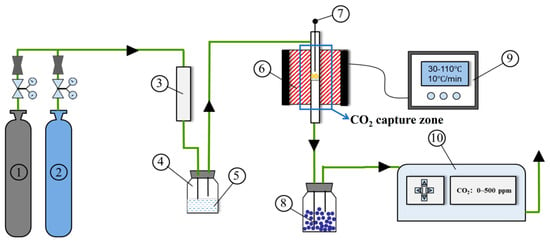
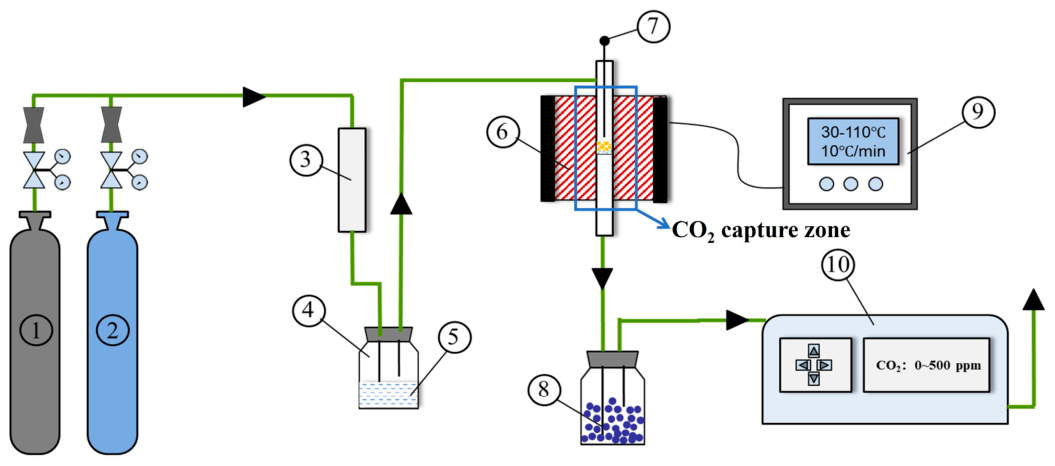
Dynamic CO2 adsorption was measured in the laboratory-built fixed-bed system shown in Figure 1. Before each baseline test, the sample was heated to 110 °C at 10 °C min−1 under high-purity N2 flowing at 200 mL min−1, held for 30 min, cooled to 30 °C, and stabilized for a further 30 min. The feed was then switched to dry simulated air containing 500 ppm CO2 at 150 mL min−1. Outlet CO2 concentration was recorded continuously, and mass-specific uptake was obtained by integrating the breakthrough curve. The same apparatus, pretreatment sequence, and integration procedure were used for cross-sample comparisons. Quantitative adsorption capacities were determined in triplicate and are reported with error bars in Figure 2.
Figure 1.
Schematic diagram of the fixed-bed CO2 adsorption-desorption system: ① simulated dry air; ② high-purity nitrogen; ③ gas mixer; ④ water-vapor generator; ⑤ distilled water; ⑥ electric heating furnace; ⑦ thermocouple; ⑧ moisture dryer; ⑨ temperature-programmed controller; and ⑩ CO2 analyzer.
Figure 2.
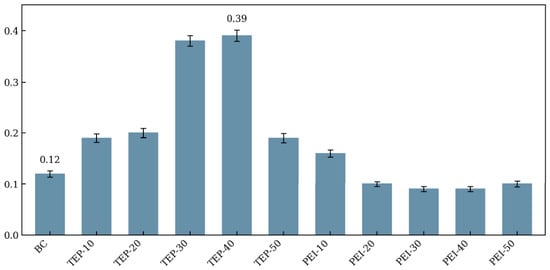
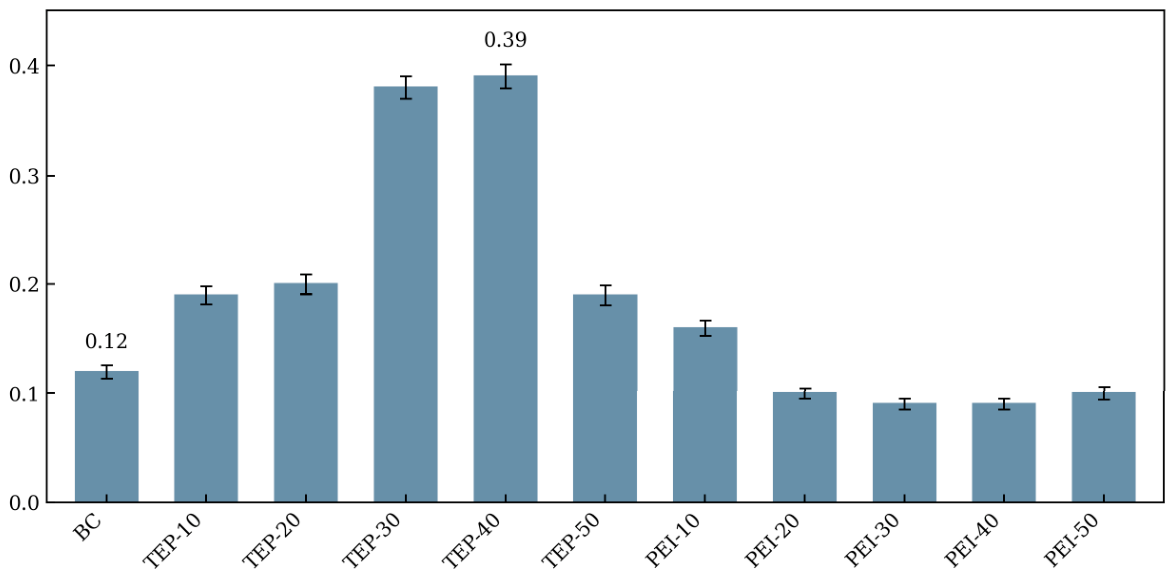
Dynamic CO2 adsorption capacities calculated from the breakthrough curves of BC and the amine-functionalized samples. Error bars represent the standard deviation of three independent measurements.
TEP-30, which provided a capacity close to TEP-40 at a lower actual amine loading, was selected for operating-condition tests at 30 °C. Pressure effects were measured at 0, 0.1, and 0.2 MPa(g). Humidity experiments are reported separately in Supporting Information Section S4.
Regeneration was evaluated by varying desorption temperature and pressure. Temperature screening was conducted under 2 kPa absolute pressure, and repeated thermal regeneration was examined at 110 °C. Vacuum-only regeneration was tested at 500 Pa without additional heating. Coupled temperature-vacuum regeneration was evaluated at 80 °C under 20 kPa and 500 Pa absolute pressure. Adsorption between regeneration steps was conducted at 30 °C with simulated air at 150 mL min−1; N2 was supplied at 200 mL min−1 where applicable. Regenerated adsorption capacity was determined from the subsequent breakthrough curve. Here, recovered adsorption capacity denotes the uptake measured after a regeneration step, and capacity retention is the recovered capacity divided by the initial capacity.
Dynamic uptake and amine-mass-normalized uptake were calculated using Equations (1) and (2), respectively [14,15]:
where Q is the mass-specific dynamic uptake (mmol g−1), Cin is the measured inlet CO2 mole fraction, v is the inlet volumetric flow rate, A is the time integral of (1 − Cout/Cin), Vm is the gas molar volume, m is the adsorbent mass, and wam is the actual amine mass fraction.
Q = CinvA/(mVm)
ηam = Q/wam
3. Results and Discussion
3.1. Effects of Amine Type and Loading on CO2 Capture
BC adsorbed 0.12 mmol g−1 at 500 ppm CO2, whereas TEP-30 and TEP-40 reached 0.38 and 0.39 mmol g−1, respectively (Figure 2), higher than that reported in most existing literatures (Table 2). The similar breakthrough positions of TEP-30 and TEP-40 indicate a capacity plateau rather than a meaningful difference between the two formulations. TEP-30 contained 225.8 mg g−1 actual amine, less than PEI-30 (277.5 mg g−1), but its amine-mass-normalized uptake was 1.68 mmol CO2 per g amine, 5.25 times the value for PEI-30; the corresponding TEP-40/PEI-40 ratio was 6.7. Both TEPA and PEI contain primary and secondary amine groups capable of reversible CO2 binding, so the large difference in normalized uptake is not explained by nitrogen content alone. Under the present flow conditions, TEPA gives a higher amine-mass-normalized uptake, whereas the PEI-containing phase is more strongly affected by transport restriction within the polymer-filled pore network.
Table 2.
CO2 adsorption performance of representative porous and solid-amine sorbents near air-level concentration.
The TEP series showed a rise in total uptake followed by a decline at the highest loading. TEP-10 gave the largest normalized uptake but contained too little amine to provide a high mass-specific capacity. At intermediate loading, the larger amine inventory was accompanied by sufficient gas access to produce the observed TEP-30/TEP-40 capacity plateau. At 50% theoretical loading, the actual TEP content increased to 316.6 mg g−1, but the normalized uptake fell to 0.60 mmol CO2 per g amine. The additional amine therefore did not translate proportionally into additional CO2 uptake within the breakthrough time scale. This behavior is consistent with increasing diffusion resistance and partial shielding of amine-rich regions as the confined liquid-like phase becomes denser. The effect appears earlier for PEI, whose capacity decreased after 10% loading and remained low at higher loadings. In this sense, the measured capacity reflects the combined effects of amine loading and transport through the amine-containing pore network, rather than the total number of amine groups present in the sample. Because the capacity had already plateaued at 30–40% loading and declined at 50%, nominal loadings of 60–90% were not pursued.
TEP-30 provided approximately 97% of the TEP-40 capacity while using 14% less actual amine. TEP-30 was therefore selected for the subsequent pressure and regeneration experiments; the lower amine loading reduces amine consumption and formulation cost while retaining essentially the same initial CO2 capacity as TEP-40.
3.2. Structural Evolution and Amine-Loading Effects
3.2.1. Micromorphology and Pore Structure
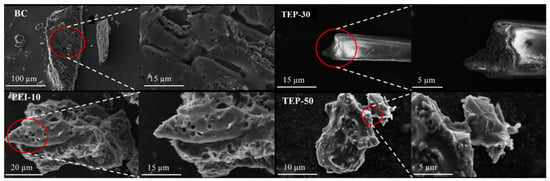
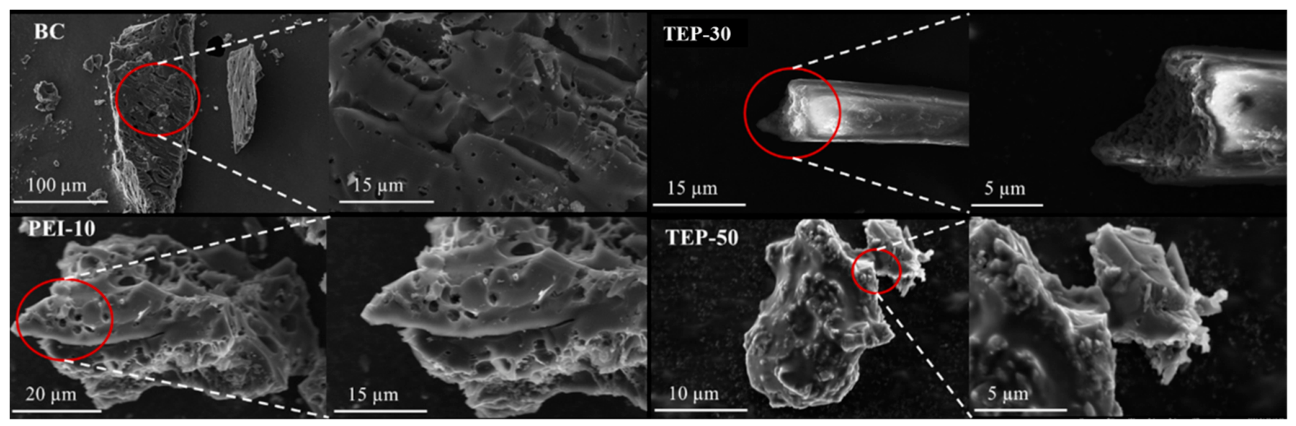
SEM images (Figure 3) show a rough and open framework for BC. TEP-30 retains recognizable pore outlines, whereas TEP-50 exhibits more extensive surface coverage and densification. The PEI-loaded sample has a flatter, more covered surface, consistent with formation of a more continuous polymer-rich phase at external surfaces and pore entrances. SEM resolves micrometer-scale morphology and cannot establish the molecular distribution of amines inside individual pores.
Figure 3.
SEM images of BC, PEI-10, TEP-30 and TEP-50.
These morphological changes are consistent with the loading-dependent adsorption response. Adding TEPA increases the amine inventory, but the reaction can proceed only where CO2 reaches the amine phase. Moderate loading preserves pathways for gas access, whereas excessive TEPA or polymeric PEI coverage reduces the fraction of the amine inventory that can participate during the fixed-bed contact time [8,9,10]. Site density and transport are therefore coupled: adding more chemical functionality becomes ineffective once the surrounding free volume and access pathways are substantially restricted.
3.2.2. Pore-Structure Evolution and Probe Accessibility
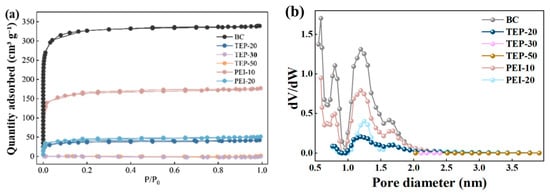
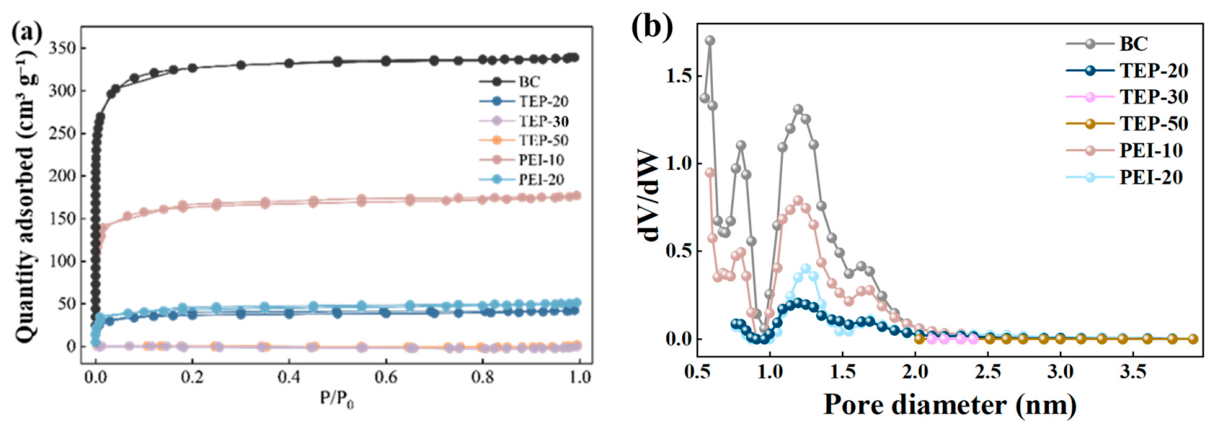
BC has a BET surface area of 1286.94 m2 g−1 and a total pore volume of 0.53 cm3 g−1 (Figure 4 and Table 3). After amine incorporation, these values decreased to 137.35 m2 g−1 and 0.07 cm3 g−1 for TEP-20 and to 0.58 m2 g−1 and 0.01 cm3 g−1 for TEP-30. PEI-10 and PEI-20 retained BET surface areas of 625.09 and 159.12 m2 g−1, respectively. The loss of N2-accessible area and pore volume is consistent with extensive filling or shielding of the original carbon pore network by the amine phase. The average pore size in Table 3 is a model-derived mean descriptor of the N2-accessible structure rather than a monodisperse physical pore diameter.
Figure 4.
(a) N2 adsorption–desorption isotherms and (b) pore-size distributions of BC and selected amine-functionalized porous carbons.
Table 3.
Pore-structure parameters of BC and selected amine-functionalized porous carbons.
TEP-30 nevertheless retained a dynamic CO2 uptake of 0.38 mmol g−1 despite its nearly vanishing N2-accessible surface area at 77 K. The contrast is important for interpreting the reaction environment. N2 physisorption measures probe-accessible pore space in a rigid low-temperature experiment, whereas CO2 adsorption at 30 °C occurs in a flexible amine-containing phase and is additionally driven by reversible chemical interaction with amine sites. PEI-10 retained a much larger BET area but did not approach the TEP-30 capacity, indicating that total surface area alone is not a useful descriptor once the pores contain reactive amines [8,9]. For DAC, the relevant structural quantity is the connected free volume that allows CO2 to enter the amine phase, reach a reactive group, and leave again during regeneration. The adsorption result therefore reflects a dynamic reaction–transport space that is not represented directly by the 77 K BET area.
3.2.3. Amine Loading and Chemical Structure
Elemental analysis (Table 4) quantifies the amine inventory independently of the breakthrough response. BC contains only 0.05 wt% N. The actual amine loadings of TEP-10, TEP-30, and TEP-40 were 70.6, 225.8, and 263.6 mg g−1, while the corresponding amine-mass-normalized uptakes were 2.69, 1.68, and 1.48 mmol CO2 per g amine. The high amine-mass-normalized uptake at low loading does not produce the largest mass-specific capacity because the total amine inventory is small. At intermediate loading, the larger amine inventory offsets the lower amine-mass-normalized uptake and gives the TEP-30/TEP-40 capacity plateau. The decrease at TEP-50 shows that additional amine loading did not translate into additional dynamic CO2 uptake under the tested DAC conditions. A nitrogen-normalized comparison gives 0.063 mol CO2 mol N−1 for TEP-30 and 0.0137 mol CO2 mol N−1 for PEI-30; the full comparison is provided in Figure S3.
Table 4.
Elemental composition, actual amine loading, and amine-mass-normalized CO2 uptake.
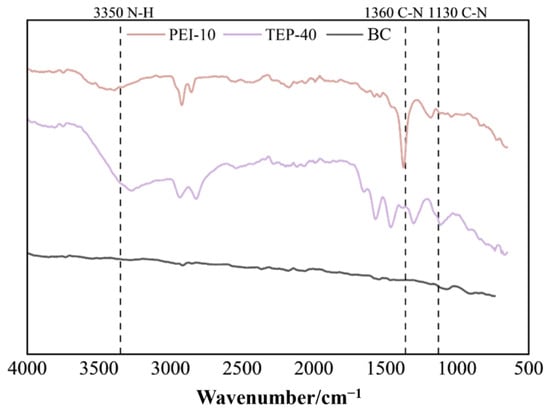
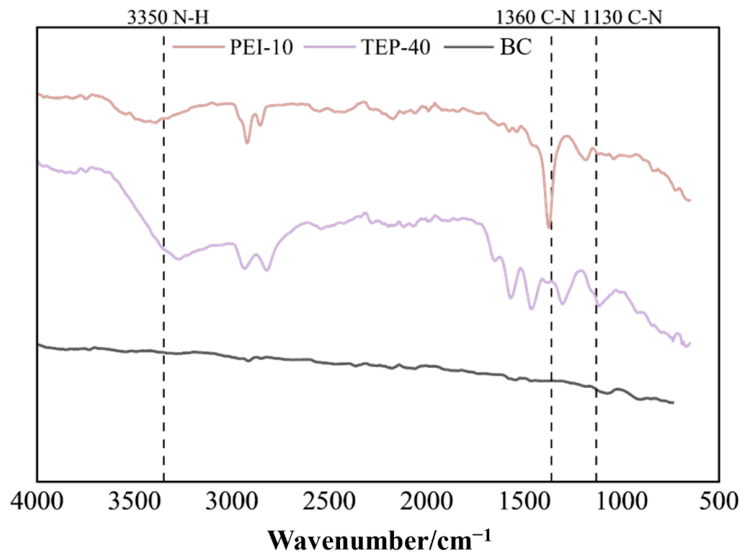
The same limitation is stronger for PEI. PEI-50 contained an estimated 455.4 mg g−1 actual amine but provided an amine-mass-normalized uptake of only 0.22 mmol CO2 per g amine. At 30% theoretical loading, PEI-30 contained more actual amine than TEP-30, yet its normalized uptake was 81% lower. The N–H and C–N bands in the FT-IR spectra (Figure 5) confirm the presence of amine-containing species, but the spectra do not identify the CO2-bound products because they were not acquired operando during adsorption. Accordingly, the present evidence supports differences in accessible amine inventory and reaction–transport behavior, but it does not justify assigning a specific carbamate, carbamic-acid, or bicarbonate population to either TEP or PEI. Elemental analysis defines how much amine is present, N2 adsorption describes probe-accessible pore space, and the breakthrough experiment shows how much of that amine-containing structure contributes to CO2 capture on the process time scale. TGA provides an independent semi-quantitative check of the TEPA inventory; the curves and loading comparison are provided in Figure S2.
Figure 5.
FT-IR spectra of BC, PEI-10, and TEP-30.
3.3. Effects of Operating Conditions on CO2 Adsorption
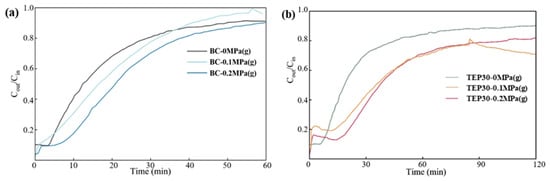
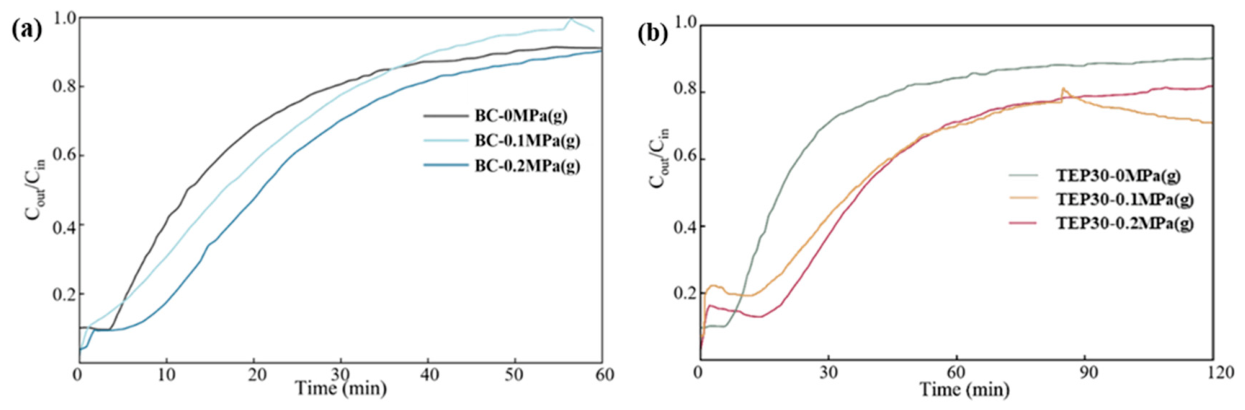
Increasing the adsorption pressure to 0.1 and 0.2 MPa(g) raised the BC capacity from 0.12 to 0.13 and 0.16 mmol g−1 and the TEP-30 capacity from 0.38 to 0.41 and 0.58 mmol g−1, respectively (Figure 6 and Table 5). At 0.2 MPa(g), the increases were 33.3% for BC and 52.6% for TEP-30, while the time for TEP-30 to reach 80% breakthrough increased from about 30 min to more than 60 min. The stronger pressure response of TEP-30 is consistent with the chemical contribution of the amine phase. Raising the CO2 partial pressure increases the gas-phase chemical potential and the frequency with which CO2 can encounter available amine sites, shifting the reversible adsorption response toward a larger loaded fraction. The breakthrough curve, however, also contains external and intraparticle mass-transfer contributions, so the pressure-dependent delay should not be interpreted as an intrinsic amine–CO2 reaction rate. From a process perspective, the additional working capacity obtained by pressurization must also be balanced against the compression duty associated with the large air flow required for DAC.
Figure 6.
Effects of adsorption pressure on dynamic CO2 breakthrough: (a) BC at 0, 0.1, and 0.2 MPa(g); and (b) TEP-30 at 0, 0.1, and 0.2 MPa(g).
Table 5.
Dynamic CO2 adsorption capacities of BC and TEP-30 under different pressure conditions.
The humidity comparison for TEP-30 is presented in Supporting Information Section S4 (Figure S4).
3.4. Regeneration Performance
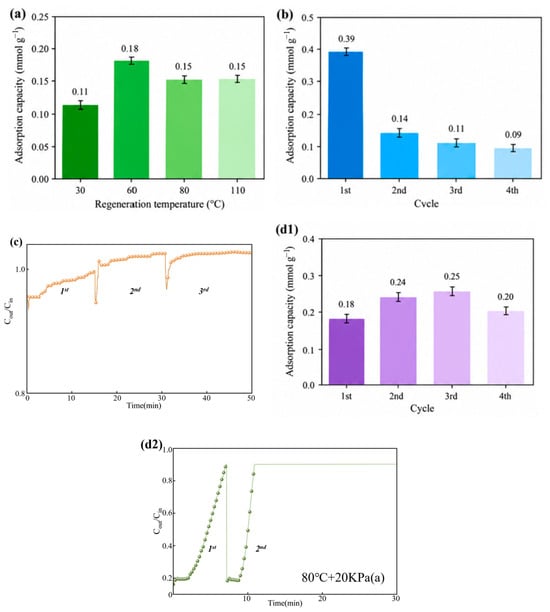
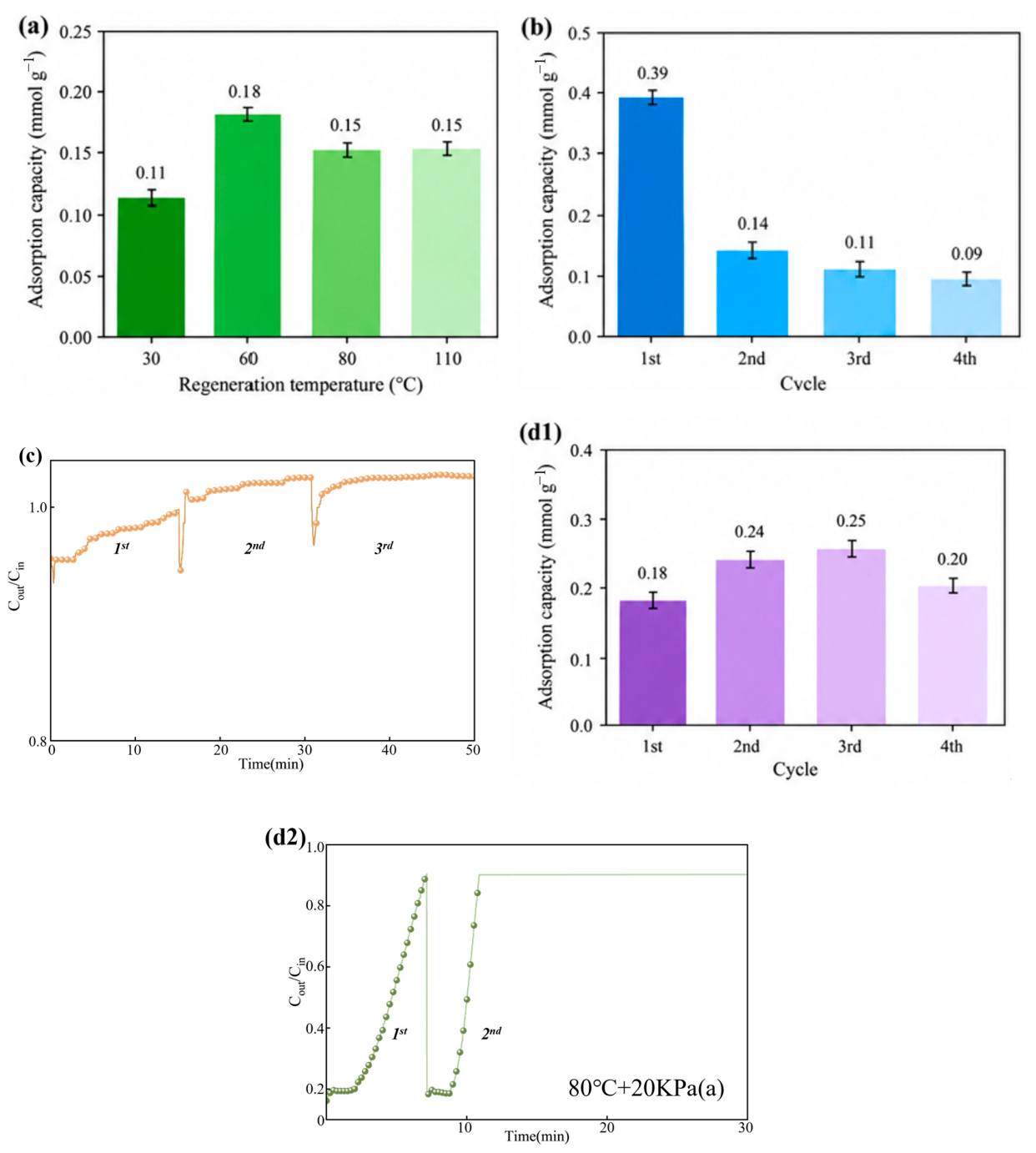
Figure 7a compares the recovered TEP-30 capacity after regeneration at different temperatures under 2 kPa absolute pressure. Regeneration at 60 °C gave 0.18 mmol g−1, while regeneration at 80 and 110 °C gave 0.15 mmol g−1 in both cases. This result does not imply that the intrinsic desorption reaction is faster at the lower temperature. Instead, it shows that within the applied regeneration period the additional thermal input above 60 °C did not produce a larger recoverable working capacity. Regeneration of a supported amine requires both reversal of CO2–amine association and transport of the released CO2 through the confined amine phase and pore network. Once sufficient thermal activation is available for dissociation and molecular motion, further heating can be offset by changes in the impregnated amine phase or thermally induced changes in the impregnated amine phase. Temperature-vacuum swing studies likewise show that working capacity depends on the combined desorption temperature, pressure, and cycle time rather than temperature alone [19].
Figure 7.
Effects of regeneration conditions on the adsorption-regeneration performance of amine-functionalized porous carbons: (a) TEP-30 after regeneration at different temperatures under 2 kPa absolute pressure; (b) TEP-30 during repeated temperature-swing regeneration at 110 °C; (c) TEP-30 during vacuum-only regeneration at 500 Pa absolute pressure; (d1) TEP-30 during coupled regeneration at 80 °C and 500 Pa absolute pressure; and (d2) TEP-30 during coupled regeneration at 80 °C and 20 kPa absolute pressure. Adsorption was conducted at 30 °C using simulated air at 150 mL min−1, with N2 supplied at 200 mL min−1 where applicable.
Repeated regeneration at 110 °C (Figure 7b) exposed the limitation of using high temperature as the dominant regeneration driving force. In the separate 110 °C regeneration series, the initial TEP-30 capacity was 0.39 mmol g−1 and decreased to 0.14, 0.11, and 0.09 mmol g−1 in the subsequent cycles. The sharp first-cycle loss and continued decline are consistent with redistribution, volatilization, or thermal aging of the impregnated TEPA phase [20]. Any of these changes can reduce the retained amine inventory or move amine into regions where CO2 access is less favorable. The present measurements do not distinguish among these degradation pathways, but they show that repeated high-temperature exposure over the tested cycles did not maintain the initial working capacity. The single 110 °C pretreatment applied before baseline adsorption is therefore distinguished from repeated reheating of the CO2-loaded sorbent; the low-temperature TGA comparison is provided in Figure S2.
Deep vacuum alone was also insufficient (Figure 7c). At 500 Pa without additional heating, the apparent amount of CO2 released within the selected period was no more than approximately 0.002 mmol g−1, and the subsequent adsorption curve approached breakthrough rapidly. At 80 °C and 20 kPa absolute pressure (Figure 7(d2)), the apparent released amount remained below approximately 0.02 mmol g−1. These two conditions separate the roles of thermal activation and gas-phase pressure in the reverse process. Lowering pressure favors desorption by reducing the external CO2 chemical potential, but it does not by itself provide the thermal energy and molecular mobility needed to reverse strongly associated CO2–amine states within the experimental time. Conversely, moderate heating at insufficiently low pressure leaves a larger product-side CO2 activity and therefore a weaker driving force for continued release. The observed response is thus controlled by coupled reaction-equilibrium and transport effects rather than by either temperature or vacuum in isolation.
Combining 80 °C with 500 Pa absolute pressure (Figure 7(d1)) produced improved short-term cyclic working-capacity retention. Under this condition, TEP-30 showed adsorption capacities of 0.18, 0.24, 0.25, and 0.20 mmol g−1 over four cycles, all above the 0.12 mmol g−1 capacity of BC. Moderate heating and deep vacuum perform complementary functions: heating facilitates dissociation of reversible CO2–amine associations and increases molecular mobility in the confined amine phase, while deep vacuum maintains a low gas-phase CO2 chemical potential and continuously removes the released product from the pore network. Maintaining both conditions therefore sustains the driving force for the reverse reaction while avoiding repeated high-temperature exposure under the tested cycles. This interpretation is consistent with process studies of temperature-vacuum swing DAC [21]. It describes the process-scale reaction–transport response supported by the present experiments; the molecular identity and intrinsic dissociation kinetics of individual surface species were not measured.
The regeneration experiments therefore distinguish three limitations that are often conflated in a single desorption test. Repeated high-temperature regeneration reduced cyclic working capacity over the tested cycles, deep vacuum without heating did not provide adequate activation, and moderate temperature with insufficient vacuum did not maintain a sufficiently low product-side CO2 potential. The 80 °C/500 Pa condition addressed these limitations simultaneously and improved the later-cycle retention relative to thermal regeneration alone. Further work should quantify the separate contributions of desorption pressure, temperature, residence time, and gas handling using a common sorbent formulation, together with longer cycling, operando identification of CO2-bound species, and kinetic measurements capable of separating chemical reaction from diffusion. These measurements would extend the present reaction–transport interpretation to intrinsic regeneration kinetics without overstating what can be obtained from breakthrough data alone. Because operation at 500 Pa requires additional vacuum work and gas handling, this condition should not be interpreted as a process-energy optimum.
4. Conclusions
TEPA- and PEI-functionalized biomass-derived porous carbons were compared at 500 ppm CO2 to determine how amine inventory, amine-mass-normalized uptake, operating conditions, and regeneration affect fixed-bed DAC performance. TEP-30 and TEP-40 reached 0.38–0.39 mmol g−1 under dry atmospheric-pressure conditions, approximately 3.2 times the capacity of BC. TEP-30 achieved nearly the same capacity as TEP-40 with a lower actual amine loading, and its amine-mass-normalized uptake was 5.25 times that of PEI-30. These results are consistent with the need for gas access to the amine-containing pore network during dynamic CO2 capture. For TEP-30, increasing the pressure to 0.2 MPa(g) raised the capacity to 0.58 mmol g−1. Regeneration experiments further separated the roles of temperature and pressure: repeated 110 °C treatment caused rapid capacity loss, vacuum alone at 500 Pa was ineffective, and coupling 80 °C with 500 Pa improved short-term cyclic working-capacity retention under the tested cycles. The combined results support a reaction–transport interpretation in which adsorption depends on both amine loading and transport through the amine-containing pore network, moderate heating facilitates reversal of CO2–amine association, and deep vacuum maintains the driving force for product removal. Longer cycling, process-energy analysis, operando speciation, and intrinsic kinetic measurements are required before molecular reaction rates or scale-up performance can be assigned.
Supplementary Materials
The following supporting information can be downloaded at: https://www.mdpi.com/article/10.3390/reactions7040059/s1.
Author Contributions
Conceptualization: W.C., J.Y., B.W.; Data curation: W.C., A.X., R.L., F.G., L.X.; Formal analysis: J.Y.; Investigation: W.C., J.Y., A.X., R.L., F.G., Z.Z., B.W., L.X.; Methodology: W.C., J.Y., A.X., B.W.; Project administration: W.C., J.Y.; Re-sources: W.C., J.Y., L.X.; Supervision: W.C., B.W.; Writing—original draft: J.Y., F.G.; Writing—review & editing: W.C., J.Y., R.L., Z.Z., B.W. All authors have read and agreed to the published version of the manuscript.
Funding
This research received no external funding.
Data Availability Statement
Data are available from the authors upon reasonable request.
Conflicts of Interest
Authors Wenhao Cao, Jie Yu, Ruili Li, Zheng Zhang and Anqi Xie were employed by China Petroleum Engineering & Construction Corporation Southwest Company, the author Li Xiang was employed by the company PetroChina Southwest Oil & Gas Field Company Natural Gas Purification Plant. The remaining author declares that the research was conducted in the absence of any commercial or financial relationships that could be construed as a potential conflict of interest.
References
- Sanz-Pérez, E.S.; Murdock, C.R.; Didas, S.A.; Jones, C.W. Direct capture of CO2 from ambient air. Chem. Rev. 2016, 116, 11840–11876. [Google Scholar] [CrossRef] [Scilit] [PubMed]
- Erans, M.; Sanz-Pérez, E.S.; Hanak, D.P.; Clulow, Z.; Reiner, D.M.; Mutch, G.A. Direct air capture: Process technology, techno-economic and socio-political challenges. Energy Environ. Sci. 2022, 15, 1360–1405. [Google Scholar] [CrossRef] [Scilit]
- Zhu, X.; Xie, W.; Wu, J.; Miao, Y.; Xiang, C.; Chen, C.; Ge, B.; Gan, Z.; Yang, F.; Zhang, M.; et al. Recent advances in direct air capture by adsorption. Chem. Soc. Rev. 2022, 51, 6574–6651. [Google Scholar] [CrossRef] [Scilit] [PubMed]
- Wu, X.; Krishnamoorti, R.; Bollini, P. Technological options for direct air capture: A comparative process engineering review. Annu. Rev. Chem. Biomol. Eng. 2022, 13, 279–300. [Google Scholar] [CrossRef] [Scilit] [PubMed]
- Panda, D.; Kulkarni, V.; Singh, S.K. Evaluation of amine-based solid adsorbents for direct air capture: A critical review. React. Chem. Eng. 2023, 8, 10–40. [Google Scholar] [CrossRef] [Scilit]
- Holmes, H.E.; Banerjee, S.; Vallace, A.; Lively, R.P.; Jones, C.W.; Realff, M.J. Tuning sorbent properties to reduce the cost of direct air capture. Energy Environ. Sci. 2024, 17, 4544–4559. [Google Scholar] [CrossRef] [Scilit]
- Wang, X.; Song, C. Developing high-capacity solid “molecular basket” sorbents for selective CO2 capture and separation. Acc. Chem. Res. 2023, 56, 3358–3368. [Google Scholar] [CrossRef] [Scilit] [PubMed]
- Rim, G.; Priyadarshini, P.; Song, M.; Wang, Y.; Bai, A.; Realff, M.J.; Lively, R.P.; Jones, C.W. Support pore structure and composition strongly influence the direct air capture of CO2 on supported amines. J. Am. Chem. Soc. 2023, 145, 7190–7204. [Google Scholar] [CrossRef] [Scilit] [PubMed]
- Moon, H.J.; Carrillo, J.M.Y.; Jones, C.W. Distribution and mobility of amines confined in porous silica supports assessed via neutron scattering, NMR, and MD simulations: Impacts on CO2 sorption kinetics and capacities. Acc. Chem. Res. 2023, 56, 2620–2630. [Google Scholar] [CrossRef] [Scilit] [PubMed]
- Moon, H.J.; Carrillo, J.-M.; Leisen, J.; Sumpter, B.G.; Osti, N.C.; Tyagi, M.; Jones, C.W. UUnderstanding the impacts of support-polymer interactions on the dynamics of poly(ethyleneimine) confined in mesoporous SBA-15. J. Am. Chem. Soc. 2022, 144, 11664–11675. [Google Scholar] [CrossRef] [Scilit] [PubMed]
- Priyadarshini, P.; Rim, G.; Rosu, C.; Song, M.; Jones, C.W. Direct air capture of CO2 using amine/alumina sorbents at cold temperature. ACS Environ. AU 2023, 3, 295–307. [Google Scholar] [CrossRef] [Scilit] [PubMed]
- Robertson, M.; Qian, J.; Qiang, Z. Polymer sorbent design for the direct air capture of CO2. ACS Appl. Polym. Mater. 2024, 6, 14169–14189. [Google Scholar] [CrossRef] [Scilit] [PubMed]
- Yang, Y.; Liu, Y.; Liu, S.; Zhao, Y.; Zhang, Q.; Su, L.; Chen, Z.; Zhao, M. Experimental and theoretical investigation of amine-modified biomass-derived activated carbon for CO2 capture: The effects of carbon chain length and types of amine. Chem. Eng. Sci. 2024, 292, 119968. [Google Scholar] [CrossRef] [Scilit]
- Lee, W.H.; Zhang, X.; Banerjee, S.; Jones, C.W.; Realff, M.J.; Lively, R.P. Sorbent-coated carbon fibers for direct air capture using electrically driven temperature swing adsorption. Joule 2023, 7, 1241–1259. [Google Scholar] [CrossRef] [Scilit]
- Ferru, N.; Bischof, M.; Saporito, M.; Büchner, D.; Grossmann, Q.; Dufour-Décieux, V.; Pini, R.; Bardow, A.; Mazzotti, M. Structured sorbents for Direct Air Capture: The impact of materials and chemicals on performance. AIChE J. 2026, 72, e70513. [Google Scholar] [CrossRef] [Scilit]
- Zhang, C.; Sun, S.; He, S.; Wu, C. Direct air capture of CO2 by KOH-activated bamboo biochar. J. Energy Inst. 2022, 105, 399–405. [Google Scholar] [CrossRef] [Scilit]
- Zhang, X.; Huang, P.; Zhao, C.; Yu, X.; Yao, Y. TEPA functionalized adsorbents dominated by pore type and pore size: Direct air capture characteristics and economic efficiency optimization. Process Saf. Environ. Prot. 2025, 203, 107982. [Google Scholar] [CrossRef] [Scilit]
- Ai, J.; Reid, M.; Bacsik, Z.; Håkansson, K.; Carne, L.J.; Ullah, L.; Wu, J.; Yuan, J.; Granberg, H.; Hedin, N. Highly aminated carbon paper for CO2 capture. Sustain. Chem. Clim. Action 2025, 7, 100149. [Google Scholar] [CrossRef] [Scilit]
- Stampi-Bombelli, V.; van der Spek, M.; Mazzotti, M. Analysis of direct capture of CO2 from ambient air via steam-assisted temperature-vacuum swing adsorption. Adsorption 2020, 26, 1183–1197. [Google Scholar] [CrossRef] [Scilit]
- Al-Absi, A.A.; Benneker, A.M.; Mahinpey, N. Amine sorbents for sustainable direct air capture: Long-term stability and extended aging study. Energy Fuels 2024, 38, 8938–8950. [Google Scholar] [CrossRef] [Scilit]
- Balasubramaniam, B.M.; Thierry, P.-T.; Lethier, S.; Pugnet, V.; Llewellyn, P.; Rajendran, A. Process-performance of solid sorbents for Direct Air Capture (DAC) of CO2 in optimized temperature-vacuum swing adsorption (TVSA) cycles. Chem. Eng. J. 2024, 485, 149568. [Google Scholar] [CrossRef] [Scilit]

Disclaimer/Publisher’s Note: The statements, opinions and data contained in all publications are solely those of the individual author(s) and contributor(s) and not of MDPI and/or the editor(s). MDPI and/or the editor(s) disclaim responsibility for any injury to people or property resulting from any ideas, methods, instructions or products referred to in the content. |
© 2026 by the authors. Licensee MDPI, Basel, Switzerland. This article is an open access article distributed under the terms and conditions of the Creative Commons Attribution (CC BY) license.