


Abstract
Charal (Chirostoma spp.) is a small pelagic fish of high nutritional and economic importance in central Mexico. However, its high moisture content and rapid post-harvest deterioration result in substantial losses in artisanal fisheries. Solar drying represents a sustainable preservation alternative, particularly in regions with limited access to refrigeration. This study investigates the drying kinetics of whole charal under field-realistic mild-to-moderate solar drying scenarios, including forced convection, natural convection, and open-air exposure. Experimental drying curves were modeled using classical thin-layer formulations, and neural network models were evaluated as complementary one-step-ahead predictors of experimental moisture ratio. Among the evaluated thin-layer models, the Modified Page formulation consistently provided the most reliable empirical description of the drying curves, with coefficients of determination greater than 0.97. An ablation-style comparison of ANN, CNN, LSTM, and CNN-LSTM architectures showed that the CNN model achieved the highest global predictive accuracy in the present dataset, with R2 = 0.987 and MSE = 4.3 × 10⁻⁴. Because the dataset contained a limited number of independent drying curves, the deep-learning results are interpreted as exploratory and complementary to thin-layer modeling rather than as a replacement for classical empirical models. The proposed framework may support future drying-endpoint estimation and decision-support tools for artisanal fish processing, provided that additional validation is performed with standardized sample masses, environmental covariates, and product-quality indicators.
1. Introduction
Fish products constitute a fundamental source of high-quality protein, essential fatty acids, and micronutrients for human nutrition [1,2], particularly in regions where access to diversified animal protein is limited. In Mexico, charal (Chirostoma spp.) plays a crucial role in the diet, economy, and cultural identity of lacustrine communities in the central and western regions of the country. This small native pelagic fish is characterized by high protein content, low lipid levels, and significant commercial value. However, charal exhibits a high initial moisture content, typically exceeding 70–80% on a wet basis, which makes it highly perishable and susceptible to rapid microbial spoilage immediately after capture.
Post-harvest losses in small-scale fisheries remain a persistent challenge in developing regions, where refrigeration infrastructure is often unavailable, unreliable, or economically unfeasible. This limitation is particularly critical in areas with restricted access to cold-chain facilities [3,4]. Traditional preservation practices, such as open-sun drying, are still widely employed in rural communities due to their simplicity and low cost. Nevertheless, these methods offer limited control over critical process variables, including temperature, airflow, and exposure to environmental contaminants. Therefore, open-sun drying frequently leads to quality degradation manifested as protein denaturation, lipid oxidation, discoloration, and increased microbiological risk. These shortcomings underscore the need for controlled, low-cost, and energy-efficient drying technologies capable of preserving fish quality while ensuring food safety.
Solar drying has emerged as a promising and sustainable alternative to conventional fossil fuel–based dehydration systems due to its low energy demand and reduced environmental impact [5,6]. By harnessing renewable solar energy, solar dryers can significantly reduce energy consumption and greenhouse gas emissions while extending product shelf life. Appropriately designed solar drying systems provide partial control of temperature and airflow, enabling low-temperature dehydration that minimizes thermal damage to heat-sensitive biomolecules such as proteins and polyunsaturated fatty acids. For fish products, maintaining drying temperatures below approximately 55 °C is particularly important to limit protein denaturation and oxidative rancidity, thereby preserving both nutritional and sensory quality.
The proposed approach also aligns with the United Nations Sustainable Development Goals (SDGs). By reducing post-harvest losses and supporting preservation of locally important aquatic foods, the work contributes to SDG 2 (Zero Hunger). Its reliance on renewable solar energy supports SDG 7 (Affordable and Clean Energy), while improved drying management and reduced waste are consistent with SDG 12 (Responsible Consumption and Production). Finally, the use of solar energy as an alternative to energy-intensive preservation practices supports SDG 13 (Climate Action) by promoting lower-carbon food-processing pathways.
From a process engineering perspective, drying is a complex phenomenon involving coupled heat and mass transfer processes governed by multiple interacting variables, including temperature, air velocity, relative humidity, product geometry, and internal microstructure. Accurate modeling of drying kinetics is therefore essential for process optimization, energy management, and quality control. Thin-layer drying models such as Newton, Page, Modified Page, Verma, and Two-Term Exponential have been extensively applied to agricultural products, particularly fruits and vegetables, with satisfactory results. These models remain widely used for describing drying behavior under solar and low-temperature conditions [7,8]. In contrast, comparatively fewer studies have focused on small fish species, especially under solar drying conditions and low-temperature regimes, despite their relevance for artisanal fisheries.
In parallel with advances in process modeling, artificial intelligence techniques have gained increasing attention in food engineering for the analysis of nonlinear and time-dependent drying processes [9,10,11]. Artificial neural networks (ANNs), convolutional neural networks (CNNs), and long short-term memory (LSTM) networks have demonstrated strong predictive performance in drying applications, often outperforming classical regression-based approaches under complex operating conditions. Hybrid architectures combining CNN and LSTM networks have been proposed to jointly capture local temporal patterns and long-range dependencies in time-series data [12,13]. However, the performance gains associated with such hybrid architectures strongly depend on the characteristics of the underlying process and the temporal resolution of the available data.
Despite these advances, the application of deep learning models to the solar drying of fish products remains limited in the literature. Most existing studies focus on plant-based matrices, with relatively few contributions addressing high-protein animal products, such as fish [14]. Furthermore, the integration of classical thin-layer drying models with deep learning approaches has not been sufficiently explored as a strategy for combining physical consistency with data-driven prediction. This limitation is particularly evident for small pelagic fish processed under artisanal conditions.
In this context, the present study investigates the solar drying kinetics of charal under field-realistic solar drying scenarios, including forced convection, natural convection, and open-air exposure. These scenarios were not designed as strictly controlled one-factor comparisons; rather, they represent practical operating alternatives in which temperature, airflow, exposure, sample loading, and drying time vary jointly. The objective was to (i) characterize moisture-ratio evolution under these practical scenarios, (ii) identify the most suitable thin-layer formulation for describing the experimental curves, and (iii) evaluate whether data-driven time-series models can provide useful one-step-ahead prediction of experimental moisture ratio. The deep learning component is therefore interpreted as a complementary predictive tool rather than as a replacement for the Modified Page model or as evidence of mechanistic superiority.
2. Materials and Methods
2.1. Raw Materials
Fresh charal specimens were obtained from local artisanal fisheries operating in the lacustrine region of Ajijic and Chapala, Jalisco, Mexico, immediately after capture. To minimize thermal exposure and microbial activity before processing, the fish were transported to the laboratory in insulated containers under ambient conditions. Upon arrival, all specimens were visually inspected to verify the absence of mechanical damage, abnormal coloration, or evident signs of spoilage.
The initial moisture content of fresh charal was determined using the standard gravimetric method based on oven drying at 105 °C until constant mass was achieved, following widely accepted procedures for food materials [15]. Moisture content was expressed on a wet basis (w.b.) as:
where mw represents the initial wet mass and md denotes the dry mass obtained after oven drying. All measurements were conducted in triplicate to ensure repeatability, and the average value was used as the initial moisture content for subsequent analysis.
Before the drying experiments, the fish were gently washed with potable water to remove surface impurities and residual debris. No salting, blanching, or chemical pretreatment was applied to preserve the intrinsic physicochemical properties of the raw material and to evaluate the natural drying behavior of charal under solar conditions. All specimens were dried whole and un-eviscerated, maintaining their native geometry and internal structure. This approach was selected to reflect traditional artisanal drying practices and to capture the influence of internal mass transfer resistance associated with intact fish morphology.
The initial experimental conditions and sample characteristics corresponding to each drying configuration are summarized in Table 1. The complete dataset for all replicates is provided as Supplementary Material (IEEE DataPort, DOI: 10.21227/8g1v-n312).
Table 1.
Initial experimental conditions and sample characteristics for solar drying of charal.
Table 1 reports sample-level and initial-condition information, whereas Table 2 reports time-averaged operating conditions observed during drying. The two tables are intentionally separated because the experiments represent practical solar drying scenarios rather than controlled treatments in which only the dryer mode changes.
Table 2.
Operating conditions of solar drying experiments.
2.2. Solar Dryer Description
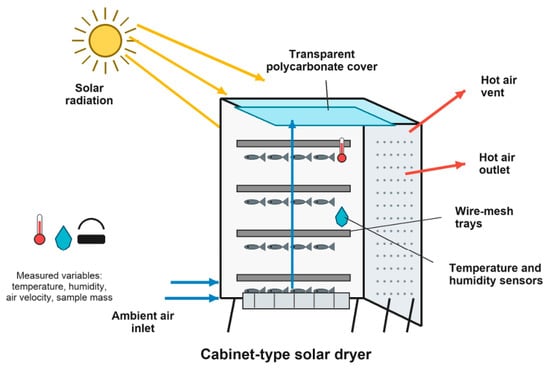
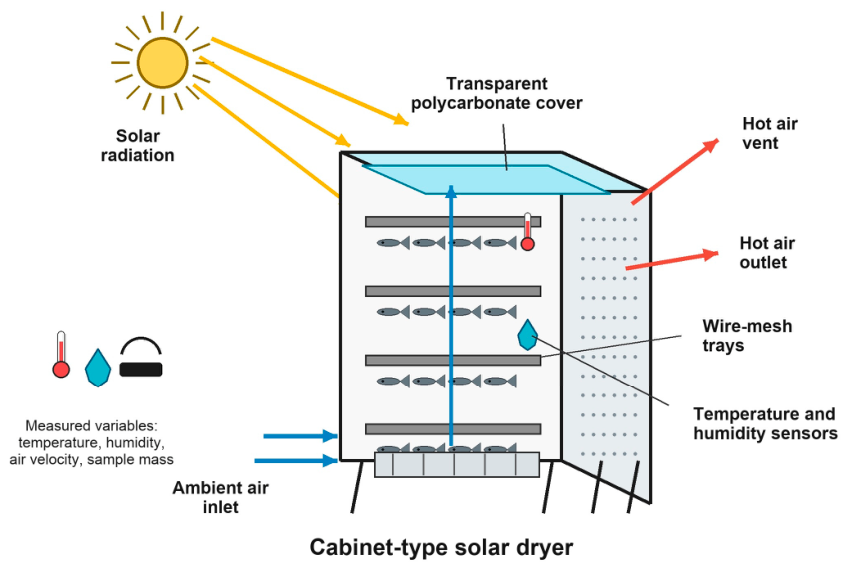
The drying experiments were conducted using cabinet-type solar drying systems designed for small-scale food dehydration. The primary experimental configuration consisted of a direct-type solar dryer equipped with a transparent polycarbonate enclosure that allows direct transmission of solar radiation to the product surface. This design enables the simultaneous action of radiative heating and convective mass transfer within the drying chamber, which is characteristic of low-temperature solar drying systems.
The drying chamber was constructed as a vertical cabinet incorporating perforated lateral and bottom sections to promote airflow driven by buoyancy forces. This configuration facilitates natural air circulation resulting from temperature gradients generated inside the chamber during solar exposure. The dryer was installed outdoors in an open area with unobstructed solar access and oriented toward the south to maximize incident solar radiation throughout the drying period. A schematic representation of the solar dryer is shown in Figure 1.
Figure 1.
Schematic representation of the employed cabinet-type solar dryer.
Internal air temperature within the drying chamber was continuously monitored using calibrated thermocouples with an accuracy of ±0.5 °C. Ambient air temperature and relative humidity were recorded using a digital thermo-hygrometer placed near the dryer inlet. Solar irradiance was measured using a calibrated pyranometer, enabling quantitative characterization of the external climatic conditions influencing the drying process.
In this study, natural convection refers to drying inside the cabinet-type solar dryer without mechanical air movement, where airflow was driven by buoyancy and pressure differences induced by solar heating. Forced convection refers to otherwise comparable cabinet drying assisted by fan-driven airflow through the chamber. Open-air drying refers to direct exposure of the samples to outdoor ambient solar conditions without enclosure. The detailed operating conditions for each practical scenario are summarized in Table 2.
2.3. Drying Procedure and Moisture Ratio
Whole charal specimens were uniformly distributed in a single layer on stainless steel mesh trays to ensure homogeneous exposure to solar radiation and airflow. Drying was initiated during morning hours and continued until the equilibrium moisture content was reached, defined as three consecutive mass measurements with a change lower than 0.01 g. Sample mass was recorded at regular time intervals of 30 min using an analytical balance with a resolution of ±0.001 g.
Drying experiments were conducted under mild-to-moderate solar drying conditions, with average internal drying temperatures ranging from 25.9 to 60.7 °C depending on the scenario (Table 2). Because the CN configurations reached approximately 60.7 °C, the term low-temperature is used in a relative solar-drying sense and not as evidence that protein denaturation, lipid oxidation, microbial safety, color, water activity, or sensory quality were directly controlled. No quality or safety indicators were measured in this study; therefore, claims regarding quality preservation are limited to moisture removal and drying-kinetics behavior.
Drying kinetics were characterized using the moisture ratio (MR), defined as:
where Mt is the moisture content at time t, M0 is the initial moisture content, and Me is the equilibrium moisture content, all expressed on a dry basis. Under the low relative humidity conditions observed during the experiments, Me was small relative to M0; accordingly, Me was assumed negligible and the expression simplified to MR ≈ Mt/M0, a commonly adopted simplification in solar drying studies under dynamic environmental conditions [7]. This assumption was verified to be consistent with the observed experimental conditions and is explicitly acknowledged as a methodological simplification.
2.4. Thin-Layer Drying Models
To characterize the drying kinetics of whole charal, the experimental MR data were fitted using six widely accepted thin-layer drying models (Table 3). Model parameters were estimated by nonlinear regression using the least-squares method implemented in Python 3.12, with parameter bounds imposed to ensure physical plausibility. The parameter identification was performed independently for each experimental run.
Table 3.
Thin-layer drying models used to describe the MR of charal during solar drying.
Model performance was assessed using three complementary metrics: the coefficient of determination (R2), the mean squared error (MSE), and the mean absolute error (MAE), defined as:
where n is the total number of samples, γi is the i-th observed output, is the corresponding predicted value, and ȳ is the sample mean of the observed data. Fitted model parameters for all configurations are available in the Supplementary dataset (fits_by_run.csv, fits_summary_by_secador.csv).
2.5. Dataset Construction
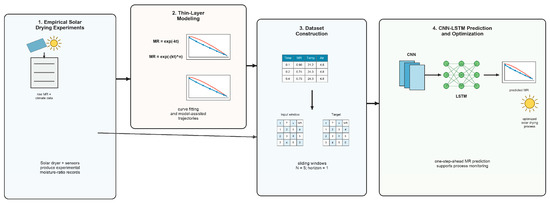
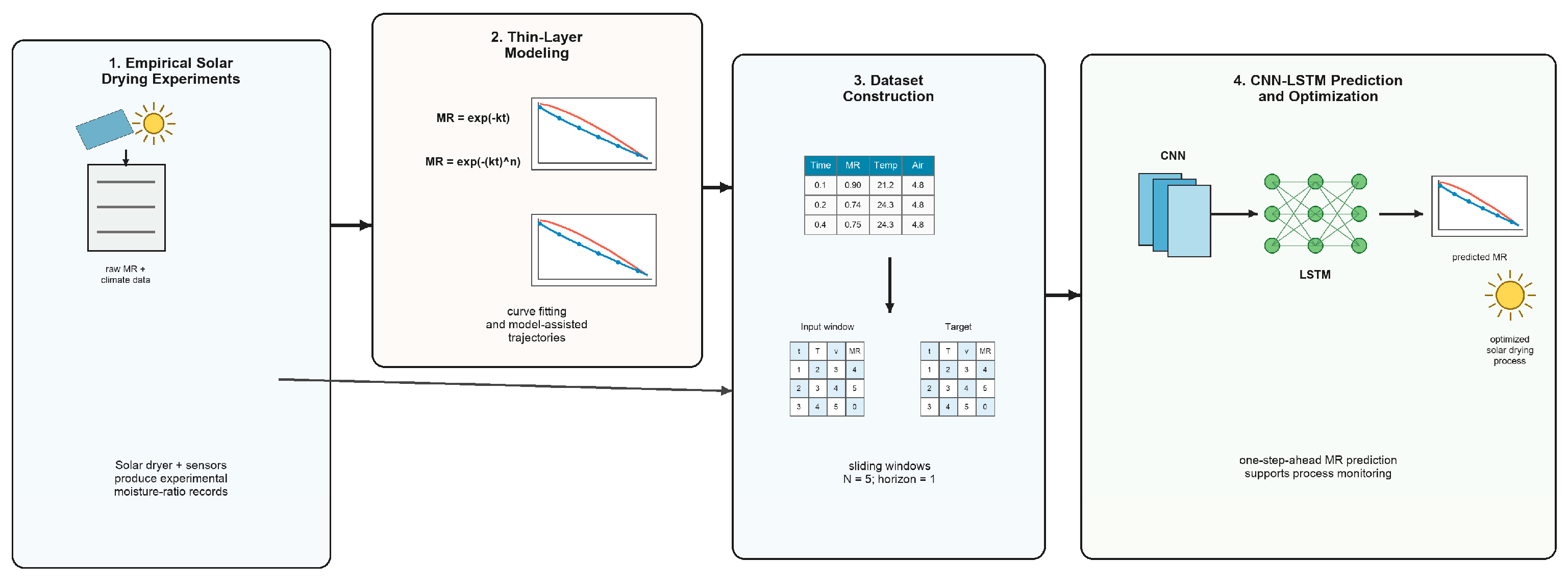
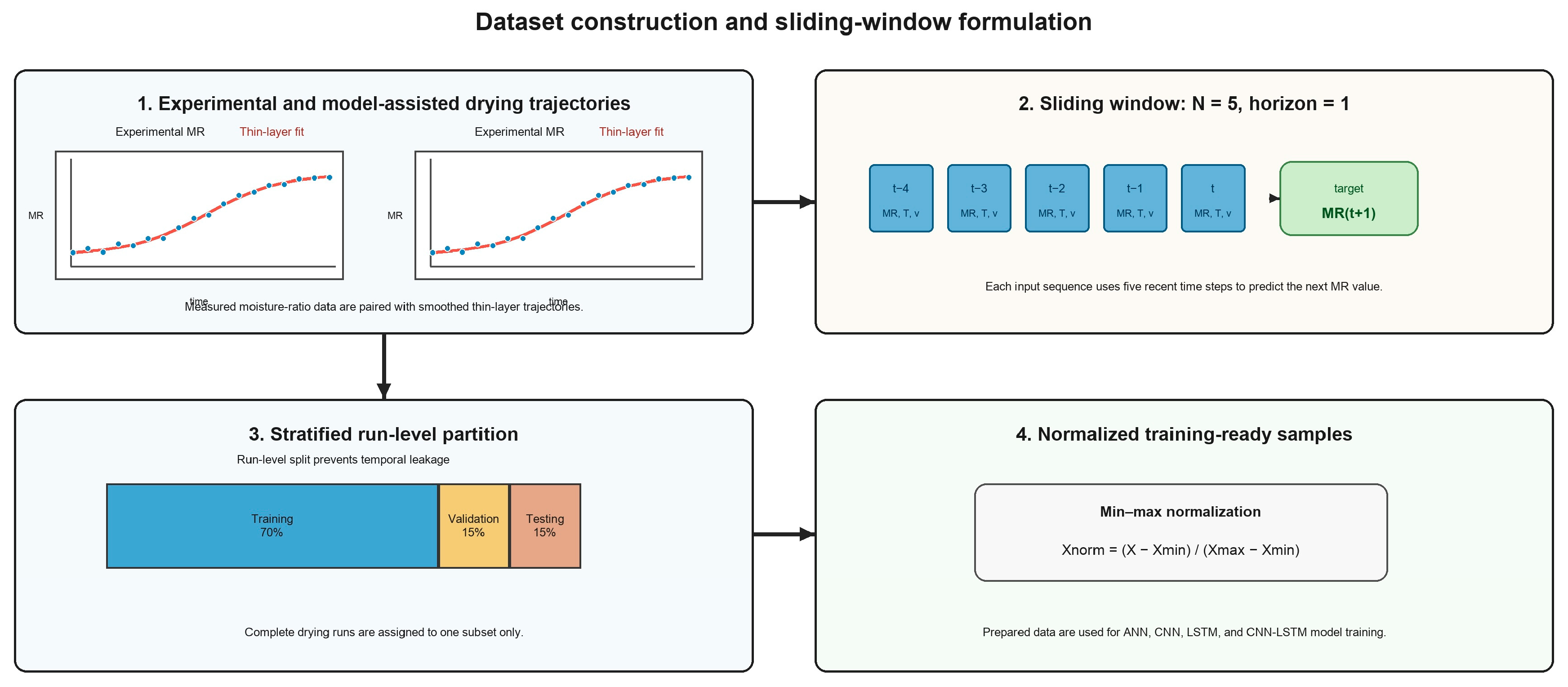
The thin-layer drying models that exhibited the best statistical performance were first used to identify a physically interpretable reference description of the drying curves. For the neural-network experiments, however, the supervised target was the experimental moisture ratio (MR_exp), not only the smoothed Modified Page trajectory. The model-assisted trajectories were retained as a benchmark and as supplementary outputs for reproducibility, but the reported deep-learning evaluation corresponds to one-step-ahead prediction of experimental MR values derived from the measured drying curves. Figure 2 illustrates the data workflow.
Figure 2.
Hybrid data preprocessing and sequence construction workflow for modeling solar drying kinetics of charal (Chirostoma spp.).
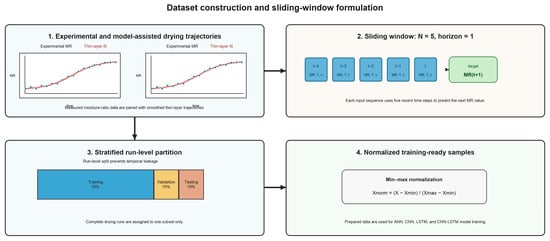
A sliding window approach was implemented to construct supervised learning sequences, as summarized in Figure 3. A fixed window size of N = 5 time-steps was used as input to predict the subsequent experimental moisture ratio value (N + 1). The experimental dataset contained 18 independent drying curves and 185 raw MR observations. With a window size of five, horizon of one step, and stride of one, these curves generated 95 supervised sequences. These windowed samples are temporally correlated and are therefore not interpreted as independent experimental replicates.
Figure 3.
Dataset construction and sliding window approach.
Prior to model training, all input and output variables were normalized to the range [0, 1]. Complete drying runs were assigned to training, validation, or testing subsets to prevent temporal leakage between subsets. The final partition contained 55 training sequences, 18 validation sequences, and 22 testing sequences. This run-level grouping provides a more conservative assessment than random point-wise splitting, although the limited number of independent drying curves remains an important limitation. The complete code implementing these procedures is available in the Code Ocean reproducible capsule [16].
2.6. Deep Learning Models
2.6.1. LSTM Network Architecture
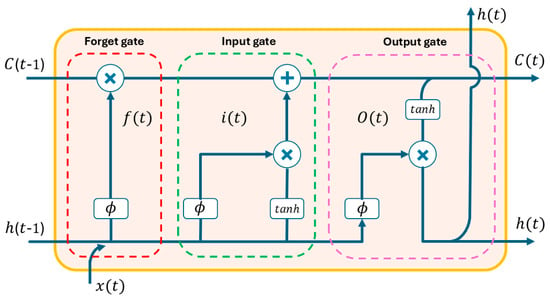
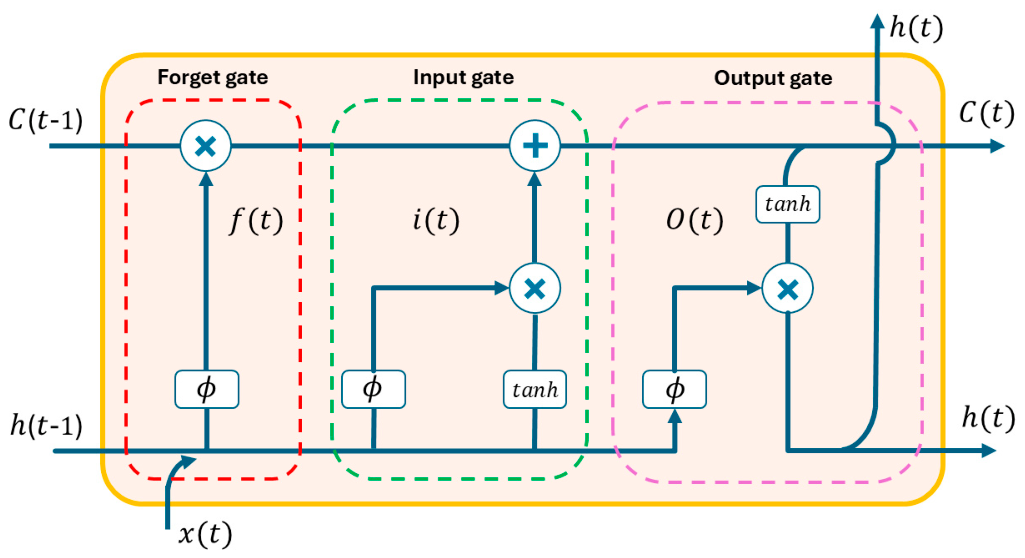
LSTM networks were originally introduced to address the vanishing and exploding gradient problems encountered during backpropagation through time in conventional recurrent neural networks [12]. LSTM units incorporate a memory cell coupled with three gating mechanisms that regulate information flow: the input gate, the forget gate, and the output gate [17,18]. The structure of the LSTM cell used to motivate the architecture is shown in Figure 4, and the mathematical formulation is given by:
where x denotes the Hadamard product, ϕ(·) is the logistic sigmoid function, and x(t), h(t), C(t) are the input, hidden state, and cell state at time t, respectively.
Figure 4.
LSTM cell structure showing the recurrent information flow through the forget, input, and output gates. The diagram indicates the hidden state h(t), cell state C(t), previous states h(t − 1) and C(t − 1), input x(t), sigmoid activation Φ, hyperbolic tangent activation tanh, and element-wise operations used to regulate temporal memory.
2.6.2. CNN Architecture
Although CNNs were originally conceived for two-dimensional pattern recognition tasks [19], one-dimensional (1D) CNNs have emerged as efficient models for sequential and time-series data [20]. Filters slide along the temporal axis to capture local temporal dependencies, enabling automatic feature extraction directly from raw signals [21]. CNNs commonly use the rectified linear unit (ReLU) activation function:
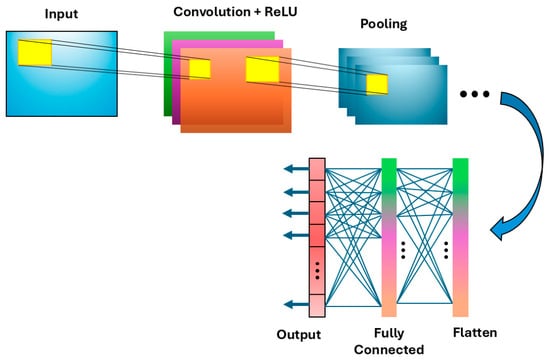
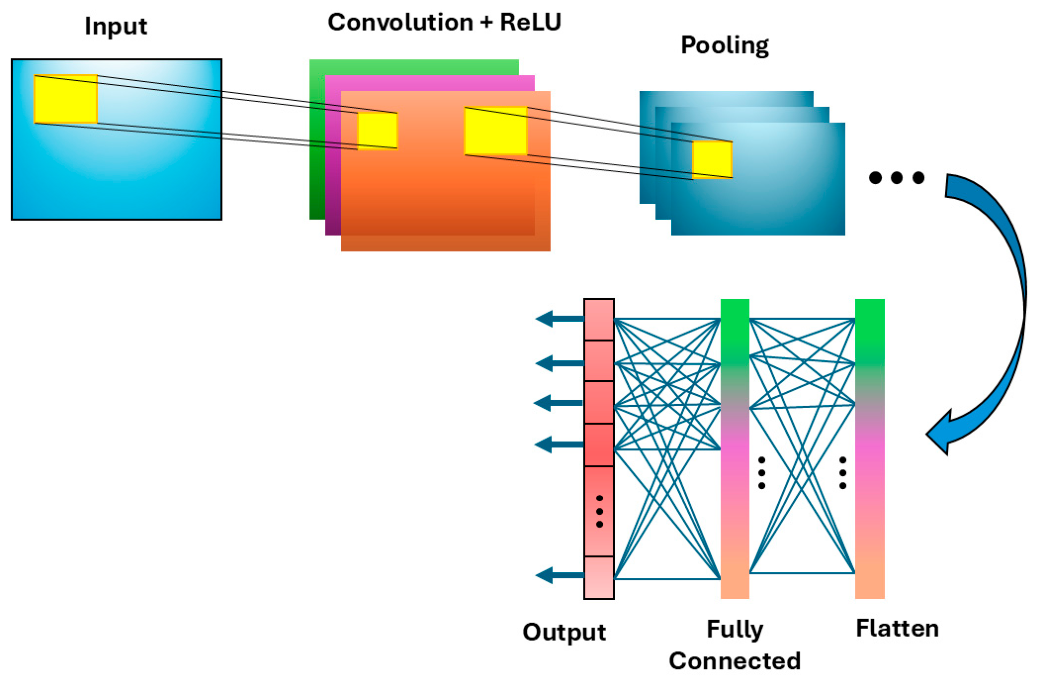
The 1D convolutional layers are followed by pooling layers and fully connected layers for regression output, as illustrated in Figure 5.
Figure 5.
Schematic representation of the one-dimensional convolutional neural network (CNN) architecture used for moisture-ratio prediction. The diagram shows feature extraction from the input sequence through convolution and ReLU activation, dimensionality reduction by pooling, flattening, and regression through fully connected layers to generate the predicted output.
2.6.3. Hybrid CNN–LSTM Architecture
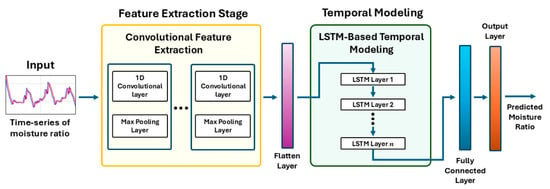
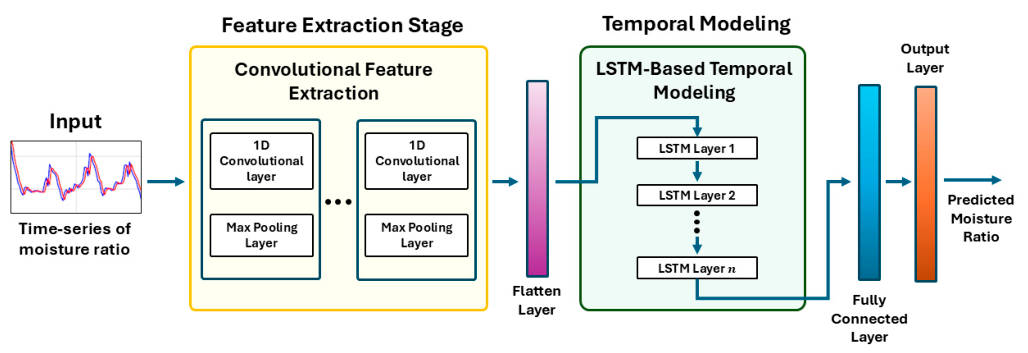
Hybrid CNN–LSTM architectures combine convolutional feature extraction with recurrent temporal modeling, enabling joint capture of short-term local patterns and long-range dependencies [13,22,23]. The architecture consists of two sequential stages: (i) feature extraction using 1D CNNs and (ii) temporal dependency learning using stacked LSTM layers. One-dimensional convolutional filters operate along the temporal axis to extract local patterns associated with short-term moisture ratio variations, followed by a max-pooling layer and a flattening operation. The extracted features are then passed to stacked LSTM layers that model temporal dependencies over extended time horizons.
The proposed CNN–LSTM model is not intended to replace thin-layer models under steady drying conditions. Instead, it provides a scalable predictive framework capable of incorporating additional dynamic variables in future real-time implementations. A schematic representation of the proposed architecture is shown in Figure 6.
Figure 6.
Architecture of the implemented CNN–LSTM model for moisture ratio prediction.
2.6.4. Feedforward ANN
The ANN architecture consisted of two fully connected hidden layers with 64 and 32 neurons respectively, using ReLU activation functions. This architecture maps the sliding window input sequences to predicted moisture ratio values through nonlinear transformations. ANNs have been widely applied to drying kinetics modeling due to their ability to approximate nonlinear relationships [10].
2.7. Training and Performance Evaluation
All models were trained using the windowed experimental MR sequences described in Section 2.5. Neural network models were implemented in Python 3.12 using TensorFlow 2.17.0 and Keras 3.5.0, with data handling and evaluation performed using NumPy 1.26.4, pandas 2.2.2, and scikit-learn 1.5.1. Hyperparameters were selected through preliminary sensitivity trials constrained by the small number of independent drying curves and by the need to avoid over-parameterized architectures. The window size of five time steps was retained because it provided sufficient local temporal context while preserving an adequate number of training sequences. CNN filters, LSTM hidden units, dropout rate, batch size, and learning rate were then fixed across architectures to enable a fair comparative architecture assessment. The Adam optimizer was employed with a fixed learning rate of 0.001. Dropout layers with a rate of 0.2 were incorporated to reduce overfitting. A batch size of 32 and a maximum of 300 training epochs were used for all models. Early stopping was applied based on validation error plateauing. The specific hyperparameters are summarized in Table 4.
Table 4.
Hyperparameters selected for the implementation of deep learning models.
In this supervised formulation, the neural networks learn a one-step-ahead mapping between recent drying history and the subsequent experimental moisture-ratio value. The learned information should therefore be understood as local temporal structure in the measured drying curve, including recent drying-rate trends, curvature changes, and late-stage flattening of MR evolution. The models do not infer mechanistic drying parameters, nor are they intended to replace thin-layer equations as physically interpretable descriptions of the process.
Prediction accuracy was analyzed at two levels: (1) global performance, computed by aggregating results across all configurations and runs, and (2) trajectory-level performance, assessed on individual drying curves to examine sensitivity to drying conditions and stage.
3. Results
3.1. Empirical Drying Behavior
The experimental drying campaigns conducted under real solar conditions confirmed the characteristic falling-rate behavior in all configurations. In all cases, the drying process was characterized by the absence of a constant-rate period and by a progressive reduction in drying velocity as moisture content decreased. This behavior is consistent with the intact morphology of whole charal specimens, in which the skin and internal tissue structure restrict surface evaporation and favor diffusion-controlled moisture transport. Cabinet-type solar dryers exhibited smoother drying kinetics and lower variability in drying rates than open-air configurations.
3.2. Thin-Layer Model Performance
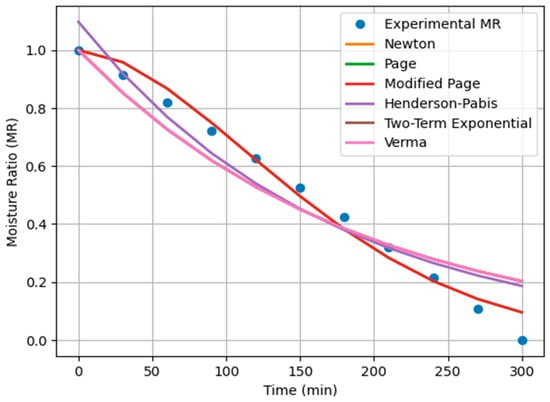
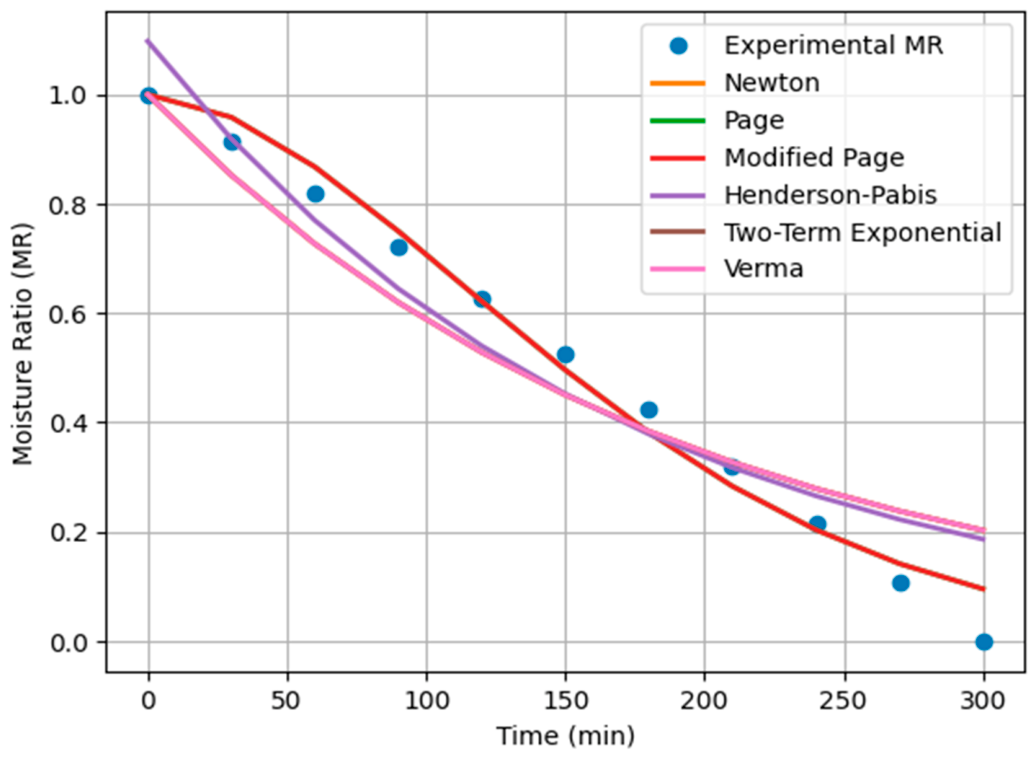
The experimental moisture ratio data were fitted using six thin-layer drying models and model performance was evaluated independently for each experimental run. The Modified Page model consistently exhibited superior performance across the majority of experimental runs, yielding coefficients of determination in the range 0.976 ≤ R2 ≤ 0.992, along with low MSE and MAE values on the order of 10−3 and 10−2, respectively. In contrast, simpler formulations such as the Newton and Henderson–Pabis models exhibited comparatively lower predictive accuracy, particularly during the later diffusion-controlled stages of drying. A comparison of experimental moisture ratio data and thin-layer model predictions is shown in Figure 7. Fitted model parameters for each configuration are provided in the Supplementary dataset.
Figure 7.
Comparison of experimental moisture ratio data and thin-layer model predictions for charal under solar drying conditions.
The multi-criteria evaluation considered high R2 together with low MSE and MAE, with priority given to models that maintained stable performance across independent runs rather than to a single metric alone. Under these criteria, the Modified Page model was selected as the most appropriate empirical reference model.
Based on the multi-criteria evaluation, the Modified Page model was adopted as the foundation for generating the structured drying trajectories used in the development of deep-learning models.
3.3. Deep Learning Model Performance
Global performance metrics, summarized in Table 5, were interpreted as an ablation-style comparison of increasing architectural complexity: a feedforward ANN baseline, a standalone CNN for local temporal feature extraction, a standalone LSTM for recurrent temporal modeling, and the hybrid CNN-LSTM architecture. The CNN model achieved the highest overall one-step-ahead predictive accuracy in terms of R2 and error-based metrics, indicating that local temporal information was sufficient for the short, smooth drying trajectories available in this dataset. Because these models were trained on a small set of windowed sequences derived from experimental drying curves, the differences among neural architectures should be interpreted cautiously and not as statistically proven superiority.
Table 5.
Ablation-style comparison of neural-network architectures for one-step-ahead prediction of charal solar drying kinetics.
The superior global performance of the standalone CNN suggests that, for the present short and smooth trajectories, short-range local patterns within the five-step input window were sufficient for predicting the next MR value. The LSTM and CNN-LSTM architectures did not provide a clear advantage under these data conditions, most likely because the number of independent drying curves was limited and the available sequences were too short to benefit substantially from long-memory recurrent modeling.
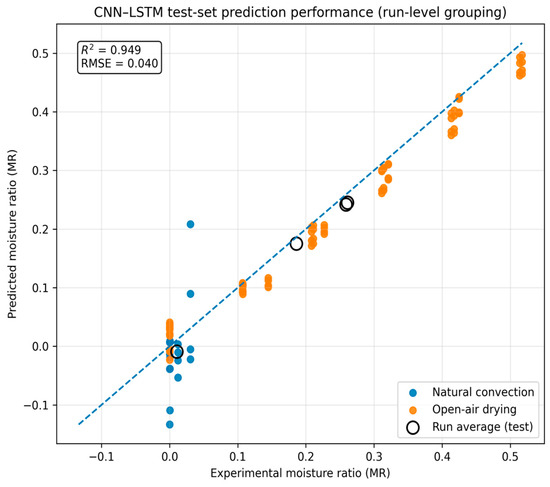
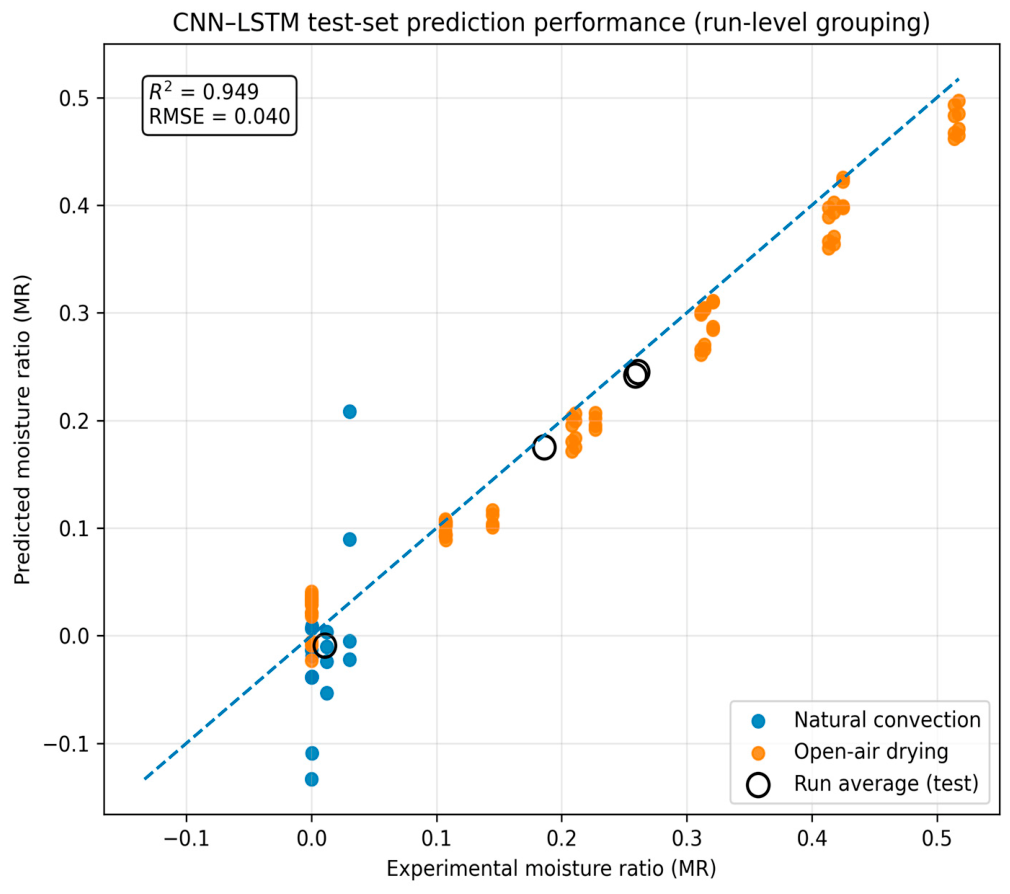
The hybrid CNN–LSTM model exhibited lower global performance metrics than the standalone CNN, while remaining competitive with the LSTM and ANN baselines. Figure 8 shows the run-level prediction behavior for the tested configurations. The apparent stability of CNN–LSTM at the trajectory level should be interpreted as an observed pattern in this dataset rather than as a statistically demonstrated advantage, because the number of independent test runs was limited.
Figure 8.
Run-level prediction performance of the CNN-LSTM model for one-step-ahead moisture-ratio estimation under test-set drying configurations. Blue and orange markers represent individual test predictions for natural-convection and open-air drying runs, respectively; open black circles indicate run-average test values. The dashed diagonal line denotes ideal agreement between experimental and predicted moisture ratio values, and departures from this line indicate prediction error.
3.4. Robustness Analysis Across Drying Configurations
A run-level error summary was performed to complement the global point-wise metrics. Table 6 reports the mean absolute error and its standard deviation across the independent drying runs represented in the testing set. Because some configurations are represented by a small number of runs, these results are descriptive and no formal significance claims are made.
Table 6.
Variance-based robustness analysis of deep learning models. Mean absolute error (MAE) reported as mean ± standard deviation (σ) by dryer configuration, from run-level testing results.
Overall, these results indicate that standalone CNN architectures provided the best global one-step-ahead prediction in the present dataset, whereas CNN–LSTM behavior at the run level suggests potential value for future datasets with longer trajectories and richer environmental inputs.
4. Discussion
The experimental results confirm that solar drying of whole charal under low-temperature conditions is an effective strategy for moisture reduction, providing a viable preservation alternative for artisanal fisheries. The strong agreement between experimental data and Modified Page model predictions demonstrates the suitability of classical empirical formulations for this application. Its superior performance over simpler models (Newton, Henderson–Pabis) is attributed to its ability to capture curvature changes during both early and late drying stages.
The integration of thin-layer modeling with deep learning should therefore be interpreted as a complementary modeling strategy. The Modified Page model remains the most parsimonious and physically interpretable option for describing complete drying curves after sufficient experimental data have been collected. In contrast, the CNN model addresses an operational prediction problem: estimating the next experimental MR value from recent process history. Thus, the practical value of CNN-based prediction is not to replace Page-type curve fitting, but to support short-horizon endpoint estimation, operational monitoring, and future real-time decision-support or control when additional dynamic inputs, such as temperature, humidity, air velocity, and irradiance, are incorporated.
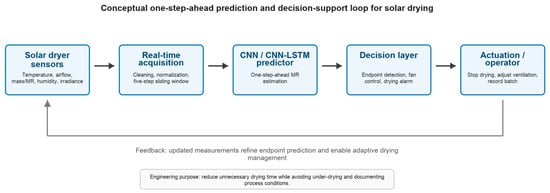
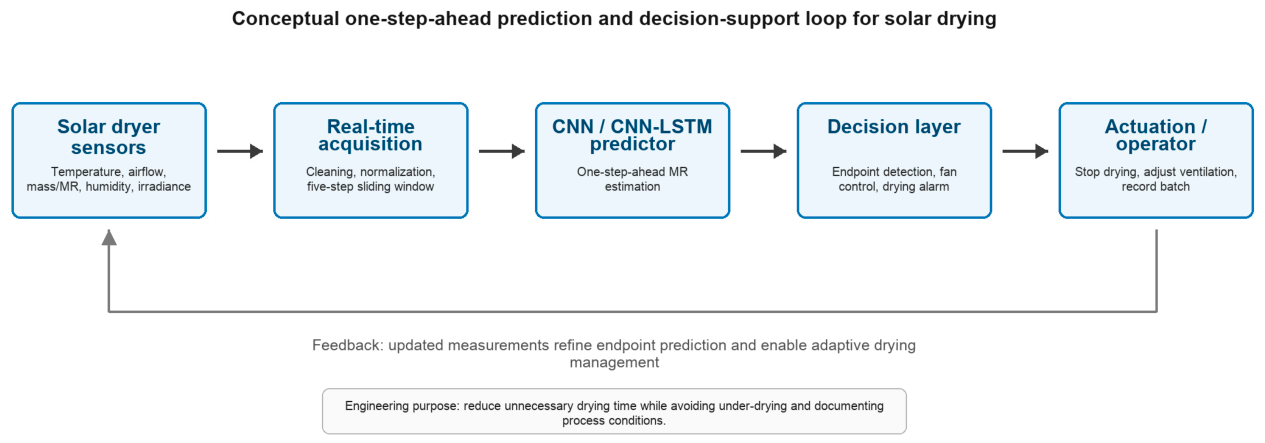
For engineering deployment, the one-step-ahead predictor can be interpreted as one component of a larger decision-support loop rather than as a standalone drying model. Figure 9 illustrates a possible implementation in which sensor measurements from the solar dryer are acquired in real time, normalized into sliding-window inputs, processed by a CNN or CNN-LSTM predictor, and passed to a decision layer that can recommend endpoint detection, fan adjustment, or drying termination.
Figure 9.
Conceptual decision-support architecture for integrating one-step-ahead moisture-ratio prediction into solar drying process management.
Although direct thermal or exergetic efficiency was not measured in the present experiments, the proposed loop has practical energy relevance because endpoint prediction can reduce unnecessary drying time and avoid excessive fan operation in forced-convection scenarios. Future engineering implementations should quantify useful moisture removal per unit of solar and auxiliary energy input and compare natural-convection, forced-convection, and open-air scenarios using consistent loading and environmental monitoring.
Regarding the experimental design, configuration CN_2 involved a substantially larger sample mass (100.73 ± 1.52 g versus approximately 2.5–3.1 g for the other configurations). This was not a simple replicate of the small-sample natural-convection cases; rather, it represents a large-batch drying condition with a different effective loading and mass-transfer regime. The larger product bed can alter internal moisture migration pathways, exposed surface-to-mass ratio, and local airflow/product interactions. Therefore, CN_2 was retained in the benchmark as a field-realistic large-batch case, but it is interpreted as a physical confounder and not as a strictly comparable treatment. Direct inter-configuration comparisons involving CN_2 should consequently be treated with caution, and future studies should standardize sample mass across configurations when the objective is formal treatment comparison.
It should be noted that, although the neural networks were trained to predict experimental MR values, the dataset remains small and the windowed sequences are correlated within drying runs. The results therefore support feasibility of short-horizon prediction rather than broad generalization across products, dryers, or climatic regions. Future work should include repeated random splits, leave-one-run-out validation, and direct comparison between models trained on raw observations and model-assisted trajectories.
The experimental data were obtained under the solar irradiance and climatic conditions of the Chapala–Ajijic region. Although the proposed framework is methodologically transferable, direct application to other geographic regions may require retraining or fine-tuning. The primary strength of the approach lies not in the universality of a single trained model but in the adaptability of the framework through the incorporation of additional data.
From an energy efficiency and sustainability perspective, the proposed modeling framework supports the optimization of solar drying schedules by reducing unnecessary drying duration and maximizing the effective use of available solar energy. Controlled solar drying systems (natural and mild forced convection) exhibited more stable drying behavior than open-air configurations, supporting their adoption in artisanal processing contexts.
5. Conclusions
This study analyzed the solar drying kinetics of whole charal under field-realistic mild-to-moderate solar drying scenarios using a combined empirical and data-driven modeling framework. The scenarios should not be interpreted as a strictly controlled comparison of dryer modes, because temperature, airflow, sample loading, and drying duration varied jointly.
The Modified Page model provided the most reliable empirical description of the drying curves, with R2 values in the range of approximately 0.976–0.992 across configurations. Among the evaluated neural networks, the standalone CNN achieved the highest global one-step-ahead prediction accuracy. However, because the dataset included only 18 independent drying curves, these neural-network results should be regarded as exploratory and complementary to thin-layer modeling rather than as a replacement for classical empirical models.
From a practical perspective, the framework may support improved drying-endpoint estimation and future decision-support tools for small-scale processors. Such applications will require additional validation with standardized sample masses, larger independent datasets, environmental covariates, and quality indicators.
Future work will extend this framework to other fish species, product geometries, and climatic regions. The incorporation of real-time environmental variables, direct training on raw experimental data, and adaptive learning strategies will be explored to improve model transferability and predictive robustness under diverse solar and atmospheric conditions.
Limitations and Methodological Considerations
Key limitations include the field-based nature of the scenarios, the larger CN_2 sample mass, the lack of direct quality and food-safety measurements, and the limited number of independent drying runs. These factors restrict direct inter-configuration comparisons and preclude strong claims about statistical superiority, product quality preservation, or broad model generalization.
Supplementary Materials
The following supporting information can be downloaded at: https://doi.org/10.21227/8g1v-n312.
Author Contributions
Conceptualization, R.B.R.-C.; methodology, R.B.R.-C., I.P.-F., R.F.C.-C. and C.A.G.-G.; software, R.F.C.-C. and C.A.G.-G.; validation, C.L.R.-C. and I.P.-F.; formal analysis, R.B.R.-C., I.P.-F., R.F.C.-C. and C.A.G.-G.; investigation, V.N.G.-G. and E.J.-C.; resources, E.J.-C.; data curation, V.N.G.-G.; writing—original draft preparation, R.B.R.-C.; writing—review and editing, C.L.R.-C., I.P.-F., C.A.G.-G. and E.X.M.G.; visualization, R.F.C.-C.; supervision, R.B.R.-C.; project administration, R.B.R.-C.; funding acquisition, C.L.R.-C. and E.X.M.G. All authors have read and agreed to the published version of the manuscript.
Funding
This research was supported in part by the Secretaría de Ciencia, Humanidades, Tecnología e Innovación (SECIHTI) through SNII scholarship 244413 and research support programs, and by the Universidad de Guadalajara (UdeG) through institutional funding.
Institutional Review Board Statement
Not applicable. Fish specimens were obtained post-harvest from artisanal fisheries for human consumption. No live animal experimentation was conducted.
Informed Consent Statement
Not applicable.
Data Availability Statement
The experimental solar drying dataset, including raw gravimetric measurements, model-assisted drying trajectories, and deep learning evaluation outputs, is available at IEEE DataPort [24] (DOI: 10.21227/8g1v-n312; note that access to dataset files requires an IEEE DataPort subscription). The complete source code, dependencies, and computational environment required to reproduce all results reported in this study are freely available as a published reproducible capsule on Code Ocean [16] (DOI: 10.24433/CO.1753855.v1). Raw experimental data are additionally available from the corresponding author upon reasonable request.
Acknowledgments
During the preparation of this work, the authors used generative artificial intelligence tools to review and improve the clarity and coherence of the manuscript text. After using this tool, the authors reviewed and edited the content as needed and take full responsibility for the content of this publication.
Conflicts of Interest
The authors declare no conflicts of interest. The funders had no role in the design of the study; in the collection, analyses, or interpretation of data; in the writing of the manuscript; or in the decision to publish the results.
References
- FAO. The State of World Fisheries and Aquaculture; FAO: Rome, Italy, 2022. [Google Scholar]
- Tacon, A.G.; Metian, M. Fish matters: Importance of aquatic foods in human nutrition and global food supply. Rev. Fish. Sci. 2013, 21, 22–38. [Google Scholar] [CrossRef] [Scilit]
- FAO. Post-Harvest Losses in Small-Scale Fisheries; FAO Fisheries Technical Paper; FAO: Rome, Italy, 2018. [Google Scholar]
- Gustavsson, J.; Cederberg, C.; Sonesson, U. Global Food Losses and Food Waste; FAO: Rome, Italy, 2011. [Google Scholar]
- Mujumdar, A.S. Handbook of Industrial Drying, 4th ed.; CRC Press: Boca Raton, FL, USA, 2015. [Google Scholar]
- Esper, A.; Mühlbauer, W. Solar drying—An effective means of food preservation. Renew. Energy 1998, 15, 95–100. [Google Scholar] [CrossRef] [Scilit]
- Erbay, Z.; Icier, F. A review of thin layer drying of foods. Crit. Rev. Food Sci. Nutr. 2010, 50, 441–464. [Google Scholar] [CrossRef] [Scilit] [PubMed]
- Akpinar, E.K. Determination of suitable thin-layer drying curve model for some vegetables and fruits. J. Food Eng. 2006, 73, 75–84. [Google Scholar] [CrossRef] [Scilit]
- Goodfellow, I.; Bengio, Y.; Courville, A. Deep Learning; MIT Press: Cambridge, MA, USA, 2016. [Google Scholar]
- Yang, T.; Zheng, X.; Vidyarthi, S.K.; Xiao, H.; Yao, X.; Li, Y.; Zang, Y.; Zhang, J. Artificial neural network modeling and genetic algorithm multiobjective optimization of process of drying-assisted walnut breaking. Foods 2023, 12, 1897. [Google Scholar] [CrossRef] [Scilit] [PubMed]
- Liu, J.; Wang, Y.; Li, Z. Deep learning-based prediction of drying behavior in food processing. J. Food Eng. 2021, 292, 110263. [Google Scholar] [CrossRef] [Scilit]
- Hochreiter, S.; Schmidhuber, J. Long short-term memory. Neural Comput. 1997, 9, 1735–1780. [Google Scholar] [CrossRef] [Scilit] [PubMed]
- Alhussein, M.; Aurangzeb, K.; Haider, S.I. Hybrid CNN-LSTM Model for Short-Term Individual Household Load Forecasting. IEEE Access 2020, 8, 180544–180557. [Google Scholar] [CrossRef] [Scilit]
- Onwude, D.I.; Hashim, N.; Janius, R.B.; Nawi, N.M.; Abdan, K. Modeling the thin-layer drying of fruits and vegetables: A review. Compr. Rev. Food Sci. Food Saf. 2016, 15, 599–618. [Google Scholar] [CrossRef] [Scilit] [PubMed]
- AOAC. Official Methods of Analysis, 20th ed.; Association of Official Analytical Chemists: Gaithersburg, MD, USA, 2016. [Google Scholar]
- Recio-Colmenares, R.B.; Recio-Colmenares, C.L.; García-García, C.A.; Conchas-Cedano, R.F. Deep Learning-Based Modeling of Solar Drying Kinetics of Charal (Chirostoma spp.)—Reproducible Code Capsule. Code Ocean. 2026. Available online: https://codeocean.com/capsule/0698508/tree/v1 (accessed on 20 May 2006).
- Lindemann, B.; Müller, T.; Vietz, H.; Jazdi, N.; Weyrich, M. A survey on long short-term memory networks for time series prediction. Procedia CIRP 2021, 99, 650–655. [Google Scholar] [CrossRef] [Scilit]
- Van Houdt, G.; Mosquera, C.; Nápoles, G. A review on the long short-term memory model. Artif. Intell. Rev. 2020, 53, 5929–5955. [Google Scholar] [CrossRef] [Scilit]
- LeCun, Y.; Bottou, L.; Bengio, Y.; Haffner, P. Gradient-based learning applied to document recognition. Proc. IEEE 1998, 86, 2278–2324. [Google Scholar] [CrossRef] [Scilit]
- Kiranyaz, S.; Avci, O.; Abdeljaber, O.; Ince, T.; Gabbouj, M.; Inman, D.J. 1D convolutional neural networks and applications: A survey. Mech. Syst. Signal Process. 2021, 151, 107398. [Google Scholar] [CrossRef] [Scilit]
- Li, Z.; Liu, F.; Yang, W.; Peng, S.; Zhou, J. A survey of convolutional neural networks: Analysis, applications, and prospects. IEEE Trans. Neural Netw. Learn. Syst. 2022, 33, 6999–7019. [Google Scholar] [CrossRef] [Scilit] [PubMed]
- Ren, C.; Jia, L.; Wang, Z. A CNN-LSTM hybrid model based short-term power load forecasting. In Proceedings of the 2021 Power System and Green Energy Conference (PSGEC), Shanghai, China, 26–28 August 2021; pp. 182–186. [Google Scholar] [CrossRef] [Scilit]
- Recio-Colmenares, C.L.; Recio-Colmenares, R.B.; Conchas-Cedano, R.F.; Pilatowsky-Figueroa, I.; García-García, C.A. Data-driven hybrid CNN-LSTM neural networks for predicting drying kinetics of green tomatoes (Physalis ixocarpa) integrating mathematical models. IEEE Access 2025, 13, 57413–57425. [Google Scholar] [CrossRef] [Scilit]
- Recio-Colmenares, R.B.; Recio-Colmenares, C.L.; García-García, C.A.; Conchas-Cedano, R.F.; García-García, E.X.M.; Pilatowsky-Figueroa, I.; Juárez-Castillo, E.; Gómez-García, V.N. Solar Drying Kinetics Dataset of Charal (Chirostoma spp.) Under Low-Temperature Conditions. IEEE DataPort. 2026. Available online: https://ieee-dataport.org/documents/solar-drying-kinetics-dataset-charal-chirostoma-spp-under-low-temperature-conditions (accessed on 20 May 2026).

Disclaimer/Publisher’s Note: The statements, opinions and data contained in all publications are solely those of the individual author(s) and contributor(s) and not of MDPI and/or the editor(s). MDPI and/or the editor(s) disclaim responsibility for any injury to people or property resulting from any ideas, methods, instructions or products referred to in the content. |
© 2026 by the authors. Licensee MDPI, Basel, Switzerland. This article is an open access article distributed under the terms and conditions of the Creative Commons Attribution (CC BY) license.