1. Introduction
Pre-sowing soil tillage remains one of the most energy-intensive and mechanically aggressive operations in irrigated cropping systems worldwide. Conventional soil preparation technologies typically involve multiple sequential field passes, including primary tillage, secondary seedbed preparation, leveling, and seeding. Under irrigated conditions, such multi-pass operations intensify soil recompaction, disrupt soil structure, and increase fuel and energy consumption due to repeated mechanical loading of the soil profile [
1,
2,
3]. The cumulative impact of these operations is not limited to energy inefficiency; it also accelerates structural degradation, reduces soil porosity, and negatively affects moisture retention and root-zone aeration.
In arid and semi-arid regions, where irrigation is essential for stable crop production, the mechanical vulnerability of soils further exacerbates these challenges. Pre-sowing soil tillage in irrigated agriculture is characterized by high energy demand and significant mechanical disturbance of the soil structure, particularly in regions with inherently low organic matter content. The soil cover of Southern Kazakhstan is predominantly composed of dark chestnut, chestnut, brown, and gray-brown soils located south of the chestnut soil zone and occupying approximately 120 million hectares, or 44% of the national territory [
4]. The low humus content (1.0–2.0%) results in weak aggregate stability and increased sensitivity to intensive mechanical treatment, making effective crop production in this zone feasible mainly under irrigation and with the application of resource-saving technologies.
In Southern Kazakhstan—including the Turkestan, Zhambyl, Kyzylorda, and Almaty regions—irrigated agriculture is practiced largely on sierozem soils that frequently occur as spatially heterogeneous soil mosaics composed of light chestnut loams, solonetzic inclusions, and other intrazonal soil types. This soil heterogeneity produces substantial variability in physical and mechanical properties, including bulk density, cohesion, and shear resistance. As a result, conventional tillage machinery operates under unstable loading conditions, leading to inefficient soil fragmentation, excessive draft forces, and increased energy expenditure [
3,
4,
5]. The soil structure and agrophysical characteristics of these soils have been described in earlier studies on soil management and erosion control systems in Central Asian irrigated agriculture [
4,
5]. These effects are especially pronounced when full-width tillage is repeatedly applied across the entire field, disturbing soil volumes not directly involved in plant establishment.
From both agronomic and engineering perspectives, this situation highlights a fundamental contradiction: modern irrigated agriculture requires precise and carefully controlled soil preparation, yet the dominant mechanization strategies remain based on energy-intensive approaches developed for non-irrigated or structurally resilient soils. The challenge, therefore, lies not only in improving machine performance but in redefining the interaction between soil disturbance, energy input, and agronomic functionality.
Single-pass tillage–seeding technologies have been proposed as an effective means of reducing cumulative soil disturbance, limiting machine traffic, and improving energy efficiency. Previous studies have demonstrated reductions in fuel consumption and operational costs when soil preparation and seeding are integrated into a single technological operation [
5,
6,
7]. However, many existing combined machines were designed for high-power tractors and rely largely on empirically selected working-body parameters. Such designs are not well suited to the low-traction conditions typical of irrigated farming systems in Central Asia, where available tractors often fall into the moderate-power class and minimizing soil disturbance is a priority rather than maximizing throughput [
6,
7].
Rotary tillage tools are widely used for seedbed preparation in cohesive and irrigated soils due to their ability to generate fine aggregates and produce a uniform soil structure. At the same time, their energetic performance is highly sensitive to blade geometry, installation angle, and kinematic interaction with soil. Earlier investigations have shown that blade orientation and cutting trajectory significantly influence soil failure mechanisms, reaction forces, and torque demand [
8,
9,
10,
11]. Despite these findings, the majority of rotary implement designs continue to be based on empirical adjustments rather than analytically optimized configurations, limiting their adaptability to specific soil environments.
Moreover, while strip-based soil disturbance has been recognized as a promising strategy for reducing energy expenditure and preserving soil structure, the integration of strip tillage principles with analytically optimized rotary working bodies has received insufficient attention. Quantitative relationships between blade geometry, soil-cutting mechanics, localized disturbance, and system-level energy performance remain poorly defined in the context of combined tillage–seeding systems. This gap prevents the development of reproducible engineering solutions tailored to irrigated soils with low structural resilience.
The engineering contribution of this study lies in establishing a quantitative link between rotary blade geometry, soil-cutting mechanics, and overall energy performance under irrigated conditions. Unlike conventional empirical approaches, the proposed methodology integrates analytical modeling of soil–tool interaction with engineering optimization and field validation. Such integration enables the development of mechanization systems that are not only operationally effective but also physically justified from a soil-mechanical and energy-transfer perspective.
By focusing on controlled strip-based soil disturbance and analytically defined blade geometry, the study seeks to reconcile agronomic requirements for high-quality seedbed formation with engineering objectives of reduced traction demand and energy consumption. This approach aligns with global trends toward conservation and precision tillage, where productivity gains are pursued through optimization of soil–machine interaction rather than increased mechanical intensity.
Recent studies also confirm the growing importance of resource-efficient strip-tillage and combined seeding systems for sustainable agricultural production under diverse soil and climatic conditions [
12,
13,
14].
Based on the identified research gap, the objective of the present study is to develop and validate a low-traction combined implement for rotary strip tillage and precision seeding. The research integrates analytical modeling, engineering optimization of rotary working bodies, and comparative field evaluation under irrigated sierozem soil conditions of Southern Kazakhstan. The ultimate goal is to establish a reproducible design framework for resource-efficient tillage–seeding systems capable of operating under the soil, climatic, and power constraints characteristic of irrigated agriculture in arid regions.
2. Materials and Methods
2.1. Engineering Concept and Prototype Design
The combined implement was developed using a systematic engineering approach aimed at reducing cumulative soil disturbance, energy consumption, and metal intensity during pre-sowing operations under irrigated conditions. The core concept was to integrate rotary tillage and precision seeding into a single-pass, strip-based process, restricting intensive mechanical soil action to the seed-row zones.
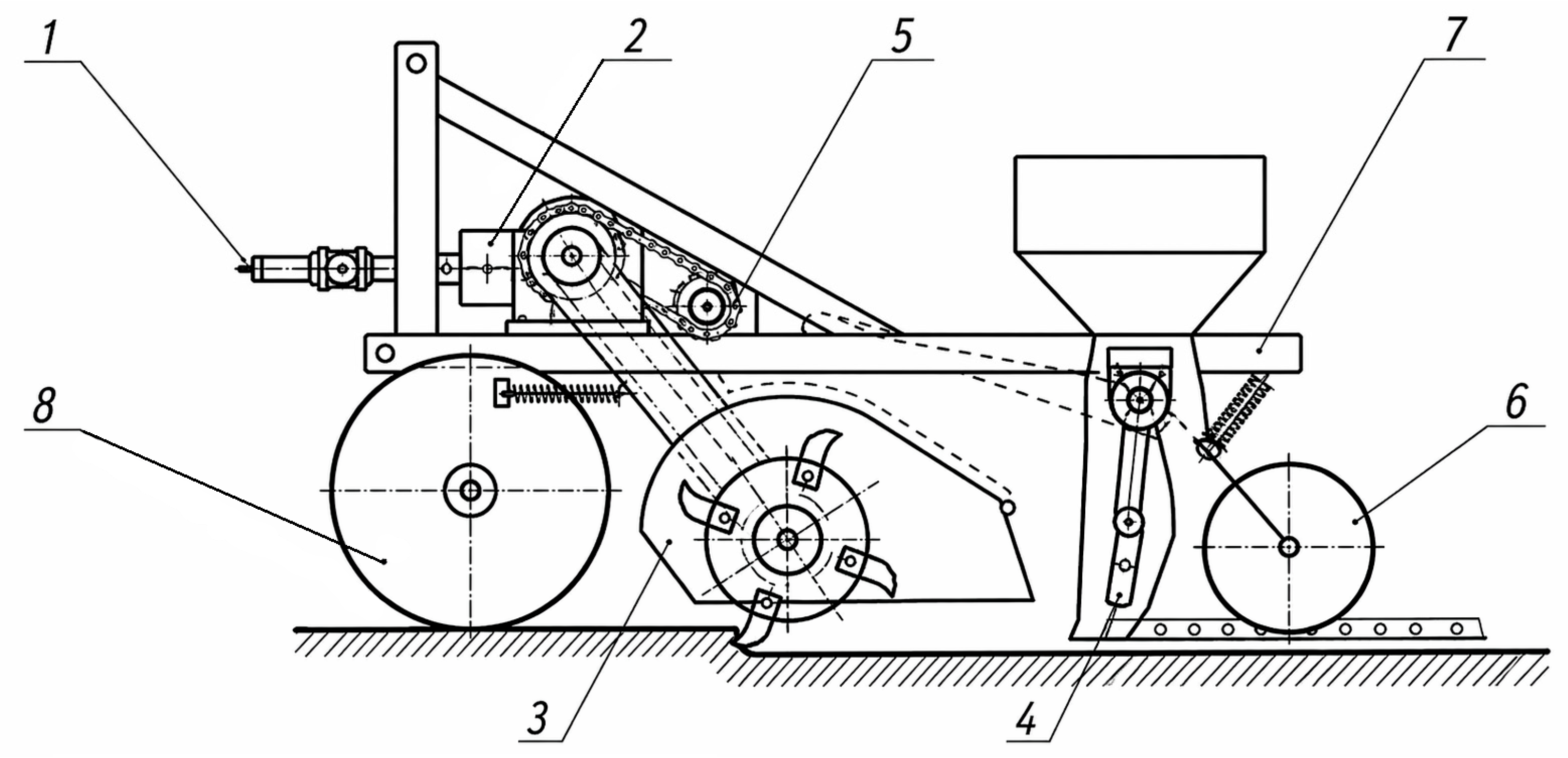
The final adopted design (
Figure 1) is a PTO-driven, mounted implement. Its main components include a welded rectangular frame (7), a gearbox (2) for power transmission, a fluted-roller type precision seeding unit (4), and an active rotary tiller unit (3). The tiller unit is equipped with two L-shaped knife rotors, each operating within a specified strip width. The rotors are enclosed by a protective hood. Depth control is managed by a set of gauge wheels (8), and soil compaction after seeding is ensured by two press wheels (6). Power is transmitted from the tractor’s PTO via a cardan shaft (1) to the gearbox (2), and then distributed by chain drives (5) to the rotary tillers and the seeding metering mechanism (
Figure 1).
Working depth is controlled by gauge wheels mounted on the frame, ensuring stable penetration under variable soil resistance. Soil consolidation after seeding is provided by press wheels positioned directly behind the seeding units. Power is transmitted from the tractor PTO to the gearbox and subsequently distributed to the rotary tillage drums and seeding mechanisms via chain drives, ensuring kinematic synchronization between soil preparation and seed placement.
2.2. Technical Characteristics of the Experimental Prototype
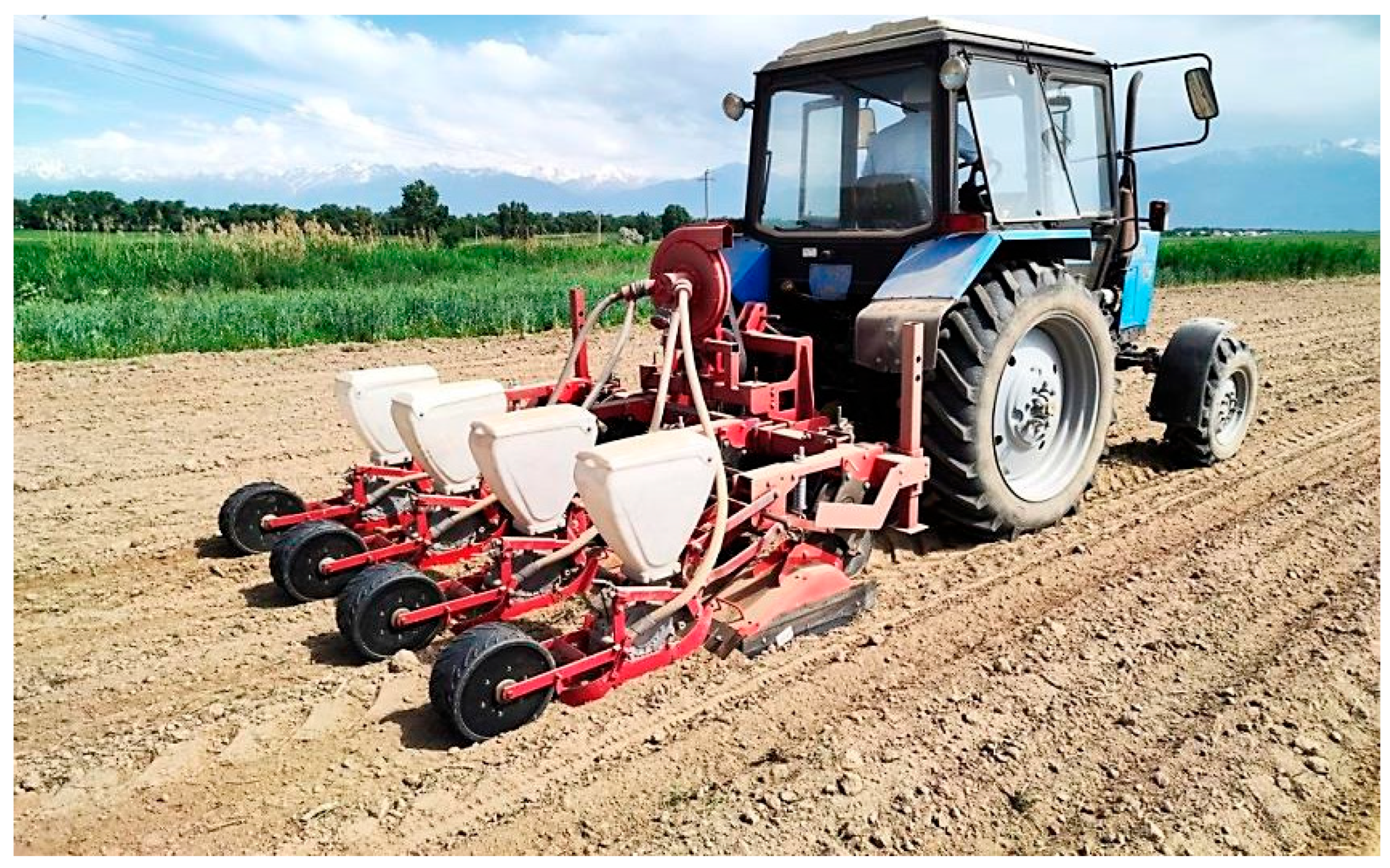
The FS-2.1 prototype was manufactured in accordance with finalized engineering documentation and configured for operation with low-traction tractors commonly used in irrigated farming systems of Southern Kazakhstan (
Figure 2)
All performance indicators reported in
Section 3 were obtained using the FS-2.1 configuration specified in
Table 1.
2.3. Analytical Background and Optimization of Rotary Blade Geometry
Optimization of the rotary knife geometry was based on an analytical model of soil cutting that accounts for the mechanical properties of irrigated sierozem soils and the kinematic parameters of rotary tillage [
6,
7]. The analytical framework is supported by established studies on rotary tillage mechanics and soil–tool interaction [
10,
11,
12,
13], while prototype-specific parameters were derived from the experimental development of the FS-2.1 implement. The analysis focused on determining soil chip thickness, specific cutting area, and blade–soil interaction sequence.
The specific cutting area
was expressed as:
where, (
b) is blade width, (
h) is tillage depth, and
α is the blade installation angle. Parametric analysis showed that increasing
α promotes slicing-dominated soil failure, reducing effective cutting area and energy demand. The optimal blade installation angle was identified as 54–56°, yielding a calculated reduction in specific cutting area of approximately 22%.
2.4. Soil–Blade Interaction Model and Kinematic Constraints
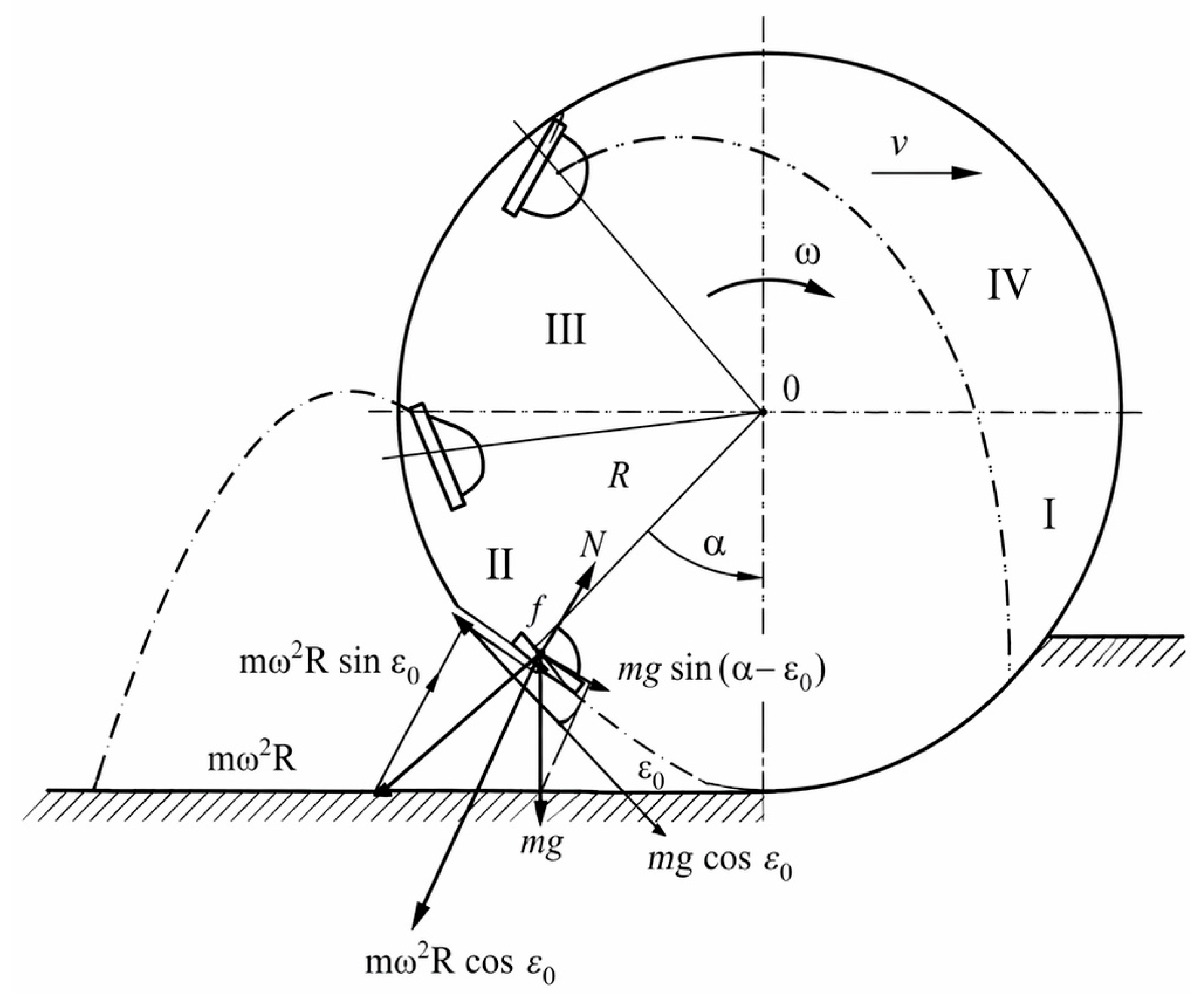
To ensure stable soil fragmentation and prevent soil accumulation beneath the rotary drum, a force balance was formulated for a soil chip element interacting with the blade. The condition preventing forward carry-over of soil particles is expressed as a force-balance relationship derived from classical rotary tillage mechanics [
10,
11,
12,
13]:
where
f—soil-to-blade friction coefficient
m—mass of soil chip element (kg)
—gravitational acceleration (9.81 m·s−2)
—drum angular velocity (rad/s)
—blade clearance angle (degrees)
R—rotor radius (m)
The forces acting on a soil chip element on the blade are shown in
Figure 3.
Solving the inequality yields a limiting rotational speed ensuring effective soil ejection and stable cutting conditions. Based on this analysis, the optimal blade installation angle was determined to be 54–56°, enabling stable operation at forward speeds of 1.5–3.0 km·h−1.
The speed range of 1.5–3.0 km·h−1 corresponds to the kinematic conditions required for stable soil fragmentation derived from the analytical model. In practical field operation, the FS-2.1 implement can operate at higher forward speeds (up to 8 km·h−1) depending on soil conditions and tractor power.
2.5. Power Demand Decomposition
The total power consumption of the rotary tillage implement was analyzed through component breakdown based on standard engineering approaches to rotary tillage energy analysis [
1,
10]:
where
—soil cutting power (kW)
—soil ejection power (kW)
—resistance overcoming power (kW)
—rolling resistance power (kW)
—transmission losses (kW)
Soil cutting power was calculated as:
where
Soil ejection power:
where
All equations presented above are expressed in SI units to ensure dimensional consistency and comparability with international engineering standards.
2.6. Experimental Site and Soil Conditions
Field experiments were conducted during the 2021 growing season on the experimental fields of the Kazakh Research Institute of Agriculture and Rural Development (KRIARD), located in the Almaty region of Southern Kazakhstan (43°18′ North latitude, 76°54′ East longitude) at an altitude of approximately 740 m above sea level. The experimental site is typical of the irrigated agricultural systems of Southern Kazakhstan. The field experiments were conducted under irrigated agricultural conditions using soybean (Glycine max L.) as the test crop. The previous crop in the rotation before the experiment was winter wheat. Such crop rotation is typical for irrigated farming systems in southern Kazakhstan.
The soil belongs to irrigated sierozem soils, represented by light chestnut loam subtypes. At the time of testing, the topsoil layer (0–0.20 m) exhibited consolidated pre-sowing conditions.
Prior to the field experiments, the physical properties of the soil were characterized to ensure reproducibility of the experimental conditions. Soil samples were collected from the 0–0.20 m layer and analyzed for moisture content, penetration resistance, and structural condition. These parameters are typical for irrigated sierozem soils of Southern Kazakhstan and correspond to consolidated pre-sowing soil conditions commonly observed after irrigation events.
2.7. Experimental Design and Measurement Procedures
The performance of the FS-2.1 single-pass (SP) system was evaluated in comparison with a conventional multi-pass (CP) technology consisting of sequential primary tillage, secondary soil preparation, surface leveling, and conventional row-crop seeding. The conventional multi-pass technology consisted of four sequential operations: (1) primary tillage using a moldboard plow, (2) secondary soil preparation using a field cultivator, (3) surface leveling using a harrow, and (4) conventional row-crop seeding using a mechanical seeder.
A randomized complete block design with four replications was employed. Each experimental plot represented a full operational pass of the respective technology.
Measured parameters included traction load, fuel consumption, total energy input, soil aggregate size distribution, surface leveling deviation, and seeding depth and spacing accuracy.
2.8. Statistical Analysis
All experimental data were expressed as mean ± standard deviation (SD). Statistical analysis was performed using IBM SPSS Statistics 26 (IBM Corp., Armonk, NY, USA).
Differences between experimental treatments were evaluated using one-way analysis of variance (ANOVA) at a confidence level of 95% (p < 0.05). When statistically significant differences were detected, Tukey’s HSD post hoc test was applied for pairwise comparisons. The assumptions of normality and homogeneity of variance were verified prior to analysis.
The experimental design, field measurements, and statistical processing were conducted in accordance with established agricultural engineering testing methodologies adopted in Kazakhstan and the CIS countries, including the standards GOST 20915-2011 [
14] (Agricultural machinery. Methods for field testing) and related national testing procedures.
2.9. Economic Evaluation
The economic performance of the FS-2.1 system was evaluated using an operational cost analysis, including fuel consumption, labor requirements, machinery depreciation, and maintenance costs. The fuel price was assumed to be 0.85 USD L−1 based on regional market conditions during the experimental period. Machinery depreciation was calculated assuming a service life of 10 years and an annual utilization of 300 ha.
The cost–benefit ratio was determined as the ratio of operational cost savings achieved by the single-pass technology to the additional capital investment required for the combined implement.
To improve the robustness of the economic analysis, a sensitivity analysis with respect to fuel price variation was also conducted.
4. Discussion
The results obtained in this study indicate that the observed reductions in traction resistance, fuel consumption, and total energy input are primarily the consequence of structural and kinematic optimization of the rotary tillage system rather than of any simplification of the technological process. In other words, the improvement is not achieved through reduced functionality, but through a more rational transformation of mechanical energy into effective soil fragmentation. This distinction is important because it demonstrates that energy savings can be achieved without compromising agronomic quality, thereby addressing a long-standing trade-off in soil tillage engineering.
The analytical reduction in specific cutting area resulting from optimization of the blade installation geometry provides a physically grounded explanation for the energetic improvements observed at the field scale. Classical theories of rotary tillage describe soil failure as a combination of compressive deformation, shear displacement, and tensile fracture. When blade geometry is not matched to soil mechanical properties, a significant portion of the applied energy is dissipated in non-productive deformation and repeated re-cutting of already disturbed material. By contrast, the optimized configuration identified in this study promotes a controlled slicing mechanism that minimizes redundant deformation. Similar relationships between blade geometry and soil resistance have been reported in both theoretical analyses and experimental investigations of soil–tool interaction [
11], yet they have rarely been translated into design methodologies for combined tillage–seeding machines.
The approximately 22% reduction in specific cutting area fundamentally altered the dominant soil failure mechanism, shifting it from compression-dominated to slicing-dominated cutting. This transition has several mechanical implications. First, it reduces peak reaction forces acting on individual blades, thereby lowering draft requirements. Second, it limits simultaneous blade–soil engagement along the rotor circumference, thereby distributing load more evenly over time and stabilizing torque demand. Third, it reduces the likelihood of soil accumulation and secondary compaction beneath the rotary drum.
The agreement between analytical predictions and field measurements, therefore, provides validation of the proposed soil–blade interaction model under irrigated sierozem conditions. This agreement is particularly significant because it demonstrates that predictive engineering approaches can successfully capture the behavior of structurally weak, heterogeneous soils that are often considered difficult to model. Such validation strengthens confidence in the use of analytical tools for guiding the design of soil-working machinery, reducing reliance on empirical trial-and-error methods.
Compared with previously reported combined tillage–seeding systems, which typically achieve energy savings of 20–40% [
1], the reduction in total energy input observed with the FS-2.1 system represents a substantial improvement. This enhanced performance can be attributed to the synergistic interaction of two engineering principles. The first is the localization of intensive soil disturbance to discrete strips aligned with crop rows, which limits the treated soil volume to zones directly involved in plant establishment. The second is the analytical optimization of blade geometry based on soil mechanical behavior rather than empirical adjustment. While each of these approaches has been studied independently, their integration creates a cumulative effect that amplifies energy efficiency gains.
Strip-based disturbance has been shown to reduce energy expenditure and mitigate soil degradation while preserving agronomic functionality [
3,
10]. In the present study, this concept is extended by demonstrating that the effectiveness of strip tillage depends strongly on the mechanics of soil cutting within the strip itself. Without an optimized blade geometry, localized disturbances may still result in inefficient energy transfer. Thus, the results suggest that spatial selectivity and mechanical optimization must be considered jointly rather than as isolated design strategies.
The effectiveness of the developed system under irrigated sierozem soils is particularly noteworthy. These soils are characterized by low humus content, weak aggregation, and susceptibility to recompaction when subjected to repeated full-width tillage. Traditional approaches often exacerbate these limitations by applying uniform mechanical treatment across the entire field. By reducing the disturbed soil volume and limiting loading outside the root zone, the proposed system mitigates secondary compaction effects while maintaining favorable seedbed conditions. This observation aligns with broader global trends toward conservation and precision tillage strategies aimed at decoupling agricultural productivity from resource consumption [
1,
10,
11].
From an engineering design perspective, the findings underscore the importance of integrating analytical modeling into machinery development workflows. The demonstrated correspondence between force balance calculations, power decomposition, and measured field performance confirms that predictive engineering frameworks can significantly enhance machine efficiency. Modeling-driven optimization approaches have similarly proven effective in improving rotary implement design and combined tillage systems in other contexts [
2,
9]. The methodology proposed here is therefore transferable across different soil textures, moisture regimes, and tractor power classes by recalibrating geometric and kinematic parameters.
Operational viability is further supported by economic and reliability indicators. Favorable cost–benefit ratios and high operational availability suggest that the system is suitable for commercial implementation rather than remaining an experimental prototype. This aspect is particularly relevant for irrigated agriculture in regions where fuel costs, limited tractor power, and the need for sustainable soil management constrain mechanization choices. The combination of reduced energy demand and stable agronomic performance provides a practical pathway for modernization of tillage technologies without requiring major increases in capital investment.
Nevertheless, several limitations of the present study should be acknowledged. The field experiments were conducted during a single growing season at one experimental site. Although the obtained results are representative of irrigated sierozem soils of Southern Kazakhstan, additional multi-season and multi-location experiments would be necessary to confirm the robustness of the observed effects under varying climatic conditions, soil moisture regimes, and crop rotations. Future research should therefore include long-term field trials conducted across different irrigated regions to evaluate the stability of the proposed technology under broader agroecological conditions. Such investigations will allow further refinement of the engineering parameters of the system and provide a more comprehensive assessment of its agronomic and energetic performance.
Future research should therefore include long-term field trials conducted across different irrigated regions to evaluate the stability of the proposed technology under broader agroecological conditions. Such investigations will allow further refinement of the engineering parameters of the system and provide a more comprehensive assessment of its agronomic and energetic performance.