


Abstract
The chili pepper (Capsicum annuum) is among the most widely consumed vegetables worldwide, valued for its sensory and nutritional properties. Nevertheless, it is highly vulnerable to deterioration due to its elevated moisture content. Effective preservation strategies, such as the addition of salt combined with drying, are therefore crucial to maintaining quality and extending shelf life. This study employed a modified Reaction Engineering Approach (REA) to model the drying kinetics and temperature behavior of chili paste under continuous and intermittent conductive hydro-drying conditions. Thirty experiments were conducted considering various salt concentrations (0, 7.5 and 15 g salt/100 g paste), water temperatures in the hydro-dryer, and heating intermittency through on/off cycles. The modified REA model accurately predicted both moisture and temperature profiles, with determination coefficients of 0.9463 and 0.8820, respectively. In addition to direct validation with the complete dataset, cross-validation between cayenne and jalapeño varieties demonstrated the ability of the model to generalize across different formulations and structural characteristics. These results confirm the robustness of the proposed framework and its suitability as a predictive tool for heterogeneous food matrices. Direct and cross-validation confirmed strong predictive performance across all operating conditions and both chili varieties, supporting the use of the modified REA model as a robust tool for representing coupled moisture–temperature dynamics in conductive hydro-drying of semi-solid matrices. Overall, the model provides a reliable platform for analyzing, designing, optimizing, and controlling hydro-drying processes in semi-solid foods, supporting the development of more efficient and sustainable preservation strategies.
1. Introduction
Chili pepper (C. annuum) pastes, widely produced as sauces, seasonings, and dehydrated condiments, are commonly known as ají in many Latin American regions [1]. These pastes present high moisture content and a dense cellular matrix rich in pigments and soluble solids, which increases perishability and complicates thermal processing [2]. In addition, their structural heterogeneity and compositional variability influence heat and mass transfer during dehydration, making predictive modeling particularly challenging [1,2].
Drying semi-solid foods such as pastes and purees involves coupled heat and mass transfer mechanisms that become more complex under conduction-dominated and intermittent heating regimes [3,4]. Accurate modeling requires analytical frameworks that represent the dynamic evolution of moisture gradients, surface temperature, and vapor concentration [3,5,6]. In ají pastes, rapid pigment degradation and solute-driven changes in water mobility further increase the need for reliable models that describe thermal behavior and formulation effects more clearly.
Conductive hydro-drying, derived from the Refractance WindowTM concept, provides an efficient heat-transfer mechanism for semi-solid systems. In this configuration, heat is transferred primarily by conduction through a thin plastic film in contact with circulating hot water, resulting in rapid changes in surface temperature and moisture [7]. Unlike thin-film Refractance WindowTM drying, which typically operates with layers below 1 mm, conductive hydro-drying handles product layers in the range of 1.0–1.5 mm, where radiative effects diminish and conduction becomes the dominant mechanism [8,9]. Under these conditions, the predictive capacity of traditional convective drying models, which rely on assumptions of uniformity and steady-state heat transfer, becomes limited.
Intermittent drying introduces alternating heating and tempering phases that favor internal moisture migration, reduce thermal degradation, and improve energy management [10,11]. Heat supply can be adjusted by modifying the heating rate and temperature, as well as humidity, pressure, and the mode of energy input (convection, conduction, radiation, or microwaves). However, the rapid transitions between heating and tempering generate abrupt changes in temperature and vapor concentration, which expose inherent limitations in empirical and semi-empirical models that assume steady external conditions and minimal internal resistance [12]. Previous research has demonstrated the benefits of applying cyclic temperature variations in intermittent drying to improve energy efficiency and product quality [12]. However, these improvements were typically implemented through predefined periodic functions [13,14], which do not capture the real thermal behavior of the circulating water or the transient interaction between the heating medium and the food matrix in conduction-based systems.
The Reaction Engineering Approach (REA) offers a mechanistically inspired but simplified framework to describe drying kinetics by linking moisture removal to an apparent activation energy term [14]. However, most reported applications rely on constant drying conditions and forced convection, and do not account for conductive heat transfer, solute effects, or transient heating regimes. Under intermittent operation, these assumptions restrict the ability of REA to represent rapid temperature fluctuations and shifts in evaporation resistance. Although recent studies on pastes and other high-solid matrices emphasize the need for models that integrate structure-dependent and conduction-driven thermal behavior, REA formulations for conduction-based hydro-drying under intermittent heating are still limited.
The present study tackles structural heterogeneity and compositional variability through a modified REA framework specifically adapted to conductive hydro-drying of semi-solid systems. The activation–energy expression was reformulated to include a salt-dependent term, enabling representation of formulation effects on vapor pressure and moisture mobility. Conductive heat transfer through the plastic film was explicitly incorporated into the energy balance, reflecting the dominant mechanism governing heat transfer. Intermittent operation was described using independent differential equations for heating and cooling phases, which allowed the model to resolve transient boundary conditions dynamically rather than impose them externally. In addition to direct calibration, bidirectional cross-validation between cayenne and jalapeño pastes was performed, exposing the model to structurally and compositionally distinct matrices and providing a rigorous test of its generalization capacity under heterogeneous conditions.
This study addresses these limitations by developing a modified REA model that incorporates conductive hydro-drying mechanisms, on/off heating cycles, and formulation effects associated with salt concentration. The objective of this study was to model the drying kinetics and temperature evolution of chili paste using the REA under continuous and intermittent conductive hydro-drying conditions. This work was organized into three main stages: (i) experimental evaluation of drying behavior under different process conditions, including salt concentration, water temperature, and heating cycles; (ii) modification of REA equations to incorporate conductive hydro-drying mechanisms and intermittent energy supply; and (iii) validation of the modified model using both direct comparison with experimental data and cross-validation between cayenne and jalapeño varieties.
2. Materials and Methods
2.1. Raw Material
Cayenne and red jalapeño chili pastes (C. annuum) were provided by Hugo Restrepo and Cía. S.A. (Yumbo, Valle del Cauca, Colombia). Samples were prepared with different concentrations of sodium chloride (NaCl) (0, 7.5, and 15 g salt/100 g paste) and stored in a cold room (Dártico, Colombia) at 4 ± 2 °C.
2.2. Drying
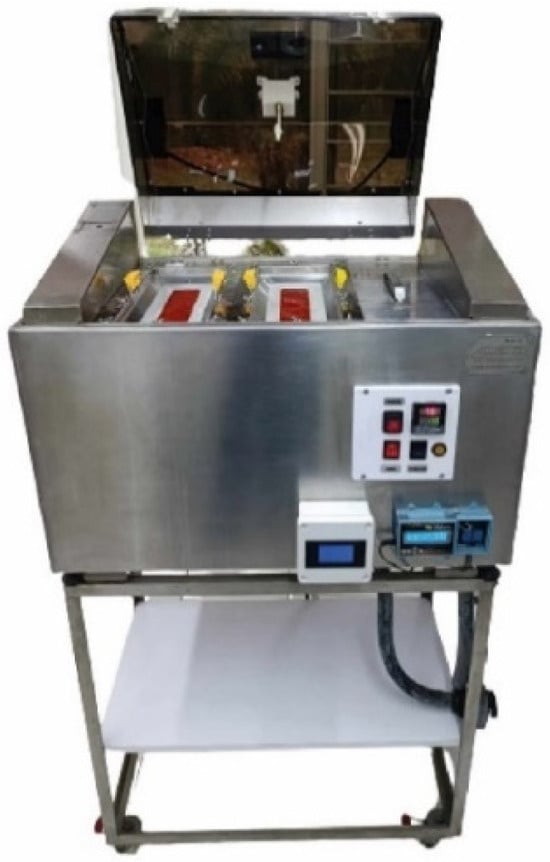
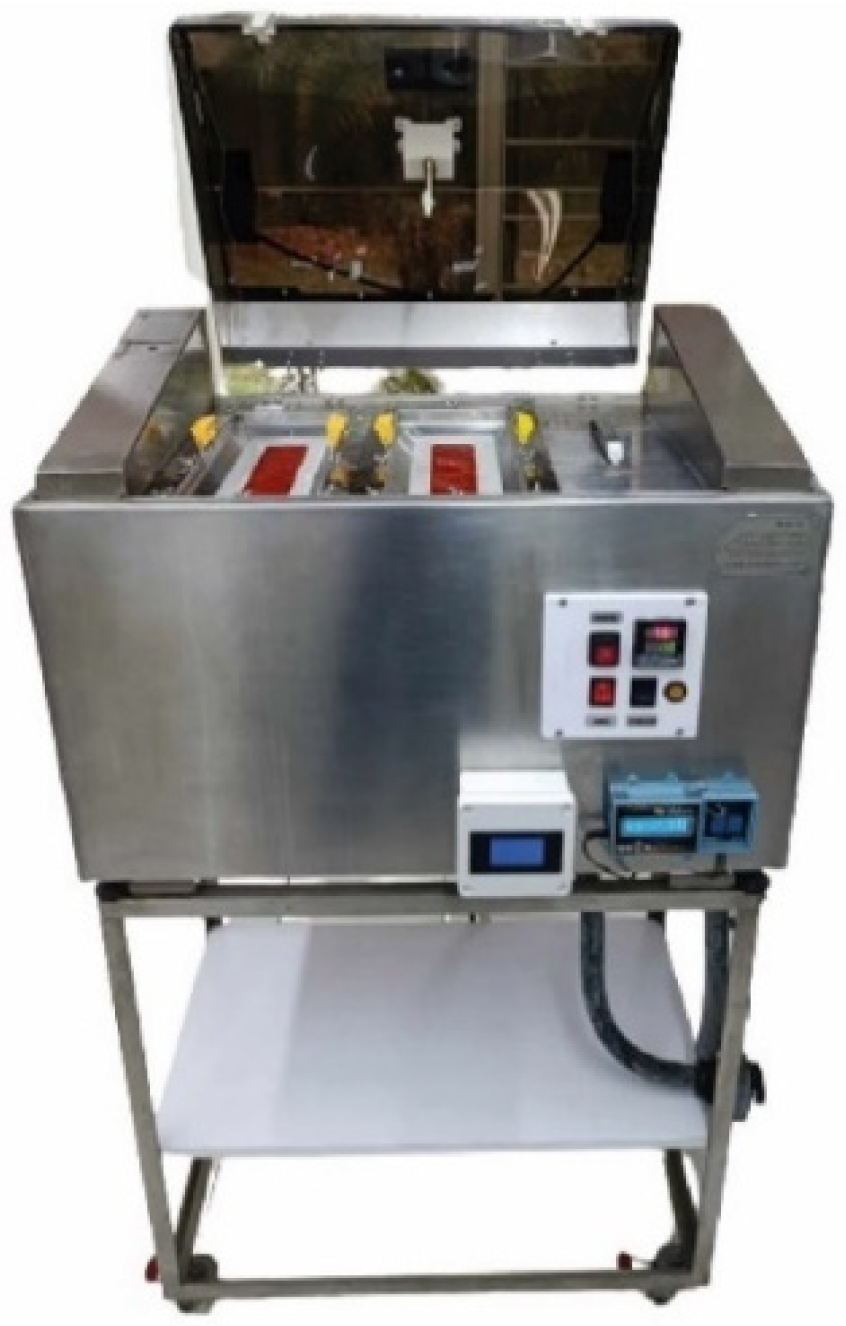
Continuous and intermittent conductive hydro-drying experiments were conducted using a conductive hydro-dryer (Figure 1) (HS-50 mini, CEI ROBOTS®, Cali, Colombia). The effects of salt concentration, water temperature in the dryer, and heating intermission cycles (on/off) were evaluated. Water temperatures of 70, 80, and 90 °C were applied in the hydro-dryer. Intermittent operation was implemented using heating intermission cycles of 15 and 30 min (on/off), while 0 min corresponded to continuous operation. A total of 30 experiments were performed under extreme and intermediate conditions (15 for cayenne and 15 for jalapeño, as shown in Table 1). Drying kinetics and temperature profiles were recorded for each case.
Figure 1.
HS-50 mini conductive hydro-dryer.
Table 1.
Experimental design and operating conditions for conductive hydro-drying of cayenne and jalapeño chili pastes.
The dryer was equipped with removable stainless-steel trays with a plastic base of 250 µm thickness (MylarTM film, DuPont, Wilmington, DE, USA), an insulated tank with electric resistances for water heating, a thermostat, a recirculation pump, an intermission controller, and a digital wattmeter.
A 1 mm thick layer of paste was spread uniformly on the plastic film using rectangular molds (4.7 × 23.3 cm). The product mass to be dehydrated (, g) was determined from Equation (1) using the density of the chili pastes (g/cm3), the mold area (cm2), and the layer thickness (cm).
2.3. Drying Kinetics
Moisture variation as a function of time was determined by weighing one tray every 5 min on a balance (AdventurerTM ARA520, OHAUS, NJ, USA) until a constant weight was reached, corresponding to equilibrium moisture content (EMC). The initial moisture content was determined using the official AOAC [15] gravimetric oven method (AOAC 934.01) at 105 ± 2 °C until a constant weight was achieved. Moisture at each time point (), expressed on a dry basis (g water/g dry matter), was calculated using Equation (2). Experimental drying curves are provided in the Supplementary Materials (Figures S1 and S2).
where is the weight of the tray with the sample at time t (g), is the weight of the empty tray (g), is the initial sample weight (g), and is the initial product moisture (g water/g wet sample).
2.4. Temperature Profiles
Temperature during drying was monitored in the second tray of the dryer using a Flir E4 thermographic camera (Teledyne FLIR, Wilsonville, OR, USA). Measurements were taken at the center of the sample every 2 min during the first 10 min and every 4 min thereafter until the end of the drying process. Temperature profiles are available in the Supplementary Materials (Figures S1 and S2).
2.5. Mathematical Modeling
2.5.1. Reaction Engineering Approach (REA) Model
The REA describes drying as a mass transfer process driven by the difference in vapor concentration between the surface of the material and the bulk air. The general formulation is given by:
Here, is the dry solid mass of the sample, (kg water/kg dry solid) is the average moisture content on a dry basis, (s) is the drying time, (m/s) is the convective mass transfer coefficient, (m2) is the exposed surface area, (kg/m3) is the vapor concentration at the sample surface, and (kg/m3) is the vapor concentration in the bulk drying air.
A key feature of REA is that is not directly assumed as saturation at the surface temperature, but rather is corrected by an exponential term that accounts for activation energy, as introduced by [16]:
where (kJ/mol) is the activation energy, (J/mol·K) is the universal gas constant, and (K) is the sample temperature. The saturated vapor concentration can be expressed as a polynomial function of temperature, as implemented in the REA framework by Putranto et al. (2011) [14], who adopted a regression-based approximation consistent with saturation pressure correlations and the ideal gas relationship (Equation (5)).
The bulk vapor concentration is calculated from the vapor pressure, molar mass of water vapor, and drying air temperature:
The vapor pressure is defined as the product of relative humidity and saturation pressure (Equation (7)), while the saturation pressure is obtained through the (1983) correlation obtained by [17] (Equation (8)).
where (Pa) is the vapor pressure, is the relative humidity, (Pa) is the saturation pressure, (kg/mol) is the molar mass of water vapor, (kJ/mol·K) is the universal gas constant, and (K) is the bulk air temperature above the sample. Constants in Equation (8) are defined as , , , , , , , and .
By substituting these relationships, Equation (3) is rewritten as follows:
This expression allows for calculation of the activation energy () as follows:
The drying rate is determined experimentally, which enables linking to the average moisture content. This dependency is expressed through a functional relationship:
where is the equilibrium moisture content and is the equilibrium activation energy, representing the maximum value determined by equilibrium relative humidity and drying temperature. The latter is obtained from:
with as the relative humidity of the air in equilibrium with the sample surface and as the corresponding temperature.
REA also accounts for the temperature profile of the sample by coupling heat transfer with moisture evaporation. The energy balance is described by:
where is the sample mass, is the specific heat, is the convective heat transfer coefficient, and is the latent heat of vaporization.
In practice, Equations (9) and (13) are solved simultaneously using numerical methods for ordinary differential equations. Together, they provide coupled predictions of both moisture loss and temperature evolution during drying, forming the basis of the original REA framework.
2.5.2. REA-Based Modeling of Conductive Hydro-Drying
Mathematical modeling was performed using the REA, with original extensions introduced to adapt the classical formulation to conductive hydro-drying under continuous and intermittent operation. These modifications were developed to explicitly incorporate conductive heat transfer, transient boundary conditions during heating–cooling cycles, and formulation effects associated with salt concentration in semi-solid matrices.
The relationship between activation energy and average moisture content (Equation (11)) was reformulated as shown in Equation (14):
where the first term represents the difference between product moisture () and equilibrium moisture , the second term accounts for the vapor concentration ratio between the food surface () and surrounding air (), and the last term corresponds to salt concentration in chili paste (). The latter term represents formulation-driven changes in the thermodynamic driving force for evaporation. Dissolved NaCl lowers the chemical potential of water in the liquid phase, reducing water activity and, consequently, the equilibrium vapor pressure at the paste surface [18,19]. Under these conditions, surface vapor pressure can be expressed as the product of water activity and saturation pressure at the local temperature; therefore, lower water activity reduces the surface vapor concentration and increases the apparent resistance to evaporation [18]. In semi-solid matrices with high soluble-solid content, NaCl also alters water binding and mobility, effects that are commonly reflected in shifts in sorption behavior and reduced moisture availability for phase change [18,20]. Consistent trends have been reported in drying-related studies, where increasing NaCl concentration reduces the evaporation driving force and modifies moisture removal kinetics [21].
By rearranging Equation (14) and substituting into Equation (9), the drying rate () was expressed as in Equation (15):
Prediction of temperature behavior () was achieved by modifying Equation (13) to incorporate a conductive heat transfer term through the plastic film (Equation (16)):
where (W/m·K) represents the thermal conductivity of the Mylar plastic film, (K) represents the water temperature in the hydro-dryer, (K) represents the sample temperature, and (m) represents the sample thickness.
Water temperature in the hydro-dryer was constant in the continuous mode. For the intermittent mode, two differential equations were defined: one for the heating phase (Equation (17)) and another for the cooling phase (Equation (18)), considering convection between the water and the food.
where (kg) accounts for the mass of water used during drying, (J/kg·K) is the specific heat of water, (W/m2·K) is the convective heat transfer coefficient under heating, (W/m2·K) the convective heat transfer coefficient under cooling, and (K) the drying temperature.
The coefficients , , and , together with the variables , , , and were treated as adjustable parameters of the model. Table 2 presents the values of the fixed variables used in both equations, while Table 3 summarizes the dependent variables of chili paste for each experiment, categorized by salt concentration and variety. Additional variables, such as equilibrium moisture content , sample mass (), equilibrium air temperature above the sample (, and equilibrium relative humidity near the sample surface (), are provided in the Supplementary Materials (Tables S1 and S2).
Table 2.
Fixed parameters used in the mathematical model.
Table 3.
Dependent parameters of chili paste.
2.6. Parameter Estimation and Model Validation
The differential equations for moisture and temperature (Equations (15)–(18)) were solved simultaneously in MATLAB R2025a (MathWorks, Natick, MA, USA) using the ode15s solver. A multistart strategy was implemented by initializing 100 different starting points for the solution space, ensuring that the optimization did not converge to local minima. Parameter estimation (, adjustable parameters) was performed using the Nelder–Mead simplex optimization algorithm (fminsearch function) to minimize the objective or “cost” function based on the least squares criterion, which corresponds to the sum of squared differences between model predictions and experimental measurements (Equation (19)).
where is the objective or cost function of the model, is the vector of parameters to be identified, is the vector of simulated variables at instant i of experiment j, and is the vector of experimental measurements at instant i of experiment j.
To analyze the sensitivity of the model outputs with respect to the estimated parameters, , and were defined as the system outputs with , while the adjustable parameters were denoted by with . The time evolution of the sensitivity functions was computed by differentiating the modified REA equations with respect to each parameter:
Here, represents the right-hand terms of the coupled REA-based drying equations for moisture (Equation (15)) and temperature (Equations (16)–(18)). The sensitivity functions were numerically integrated simultaneously with the state variables using the same solver and time employed for parameter estimation.
These sensitivity functions were then used to compute the lower bound of the parameter-estimation variance (Cramer–Rao bound) through the inverse of the Fisher information matrix:
where corresponds to the measured moisture and temperature at time i in experiment , and denotes the covariance matrix of the experimental measurements. The diagonal entries of the inverse of the Fisher matrix provide the minimum achievable estimation variance:
Finally, the confidence intervals (CIs) for the estimated parameters, calculated at a 95% confidence level, are as follows:
where .
To examine how each pair of parameters is related, the correlation matrix can be derived using the covariance matrix , which corresponds to the inverse of the Fisher information matrix:
The correlation matrix shows the correlation coefficient equals zero when two parameters are unrelated. Conversely, a coefficient of 1 indicates a perfect positive relationship between them, while a value of −1 reflects a completely negative relationship. For better visualization, a heat map representation of the absolute values of the correlation coefficients was generated.
A multistart strategy was implemented to reduce the likelihood of convergence to local minima. One hundred pseudo-random initial parameter vectors were generated within the bounds listed in Table 4 and used as independent starting points for the Nelder–Mead optimization.
Table 4.
Parameter initialization ranges used in the multistart strategy.
The ranges used to initialize the adjustable parameters in the multistart strategy are summarized in Table 4.
In cross-validation, two independent tests were carried out. In the first step, the model was calibrated using data from 15 cayenne experiments and then applied to predict the drying behavior of 15 jalapeño experiments. In the second step, calibration was performed using jalapeño data to predict the drying behavior of cayenne experiments. This bidirectional approach provided a more rigorous evaluation of the predictive capacity of the model under conditions that were not used directly for calibration, confirming both its robustness and generalization potential.
The goodness of fit between the experimental and simulated values was evaluated through the determination coefficient (), calculated for each simulated variable in both direct and cross-validation of the model:
3. Results
3.1. Parameter Estimation
The adjustable parameters obtained from the parametric estimation are presented in Table 5.
Table 5.
Parameter values (θ = 8) identified through direct validation (all experiments).
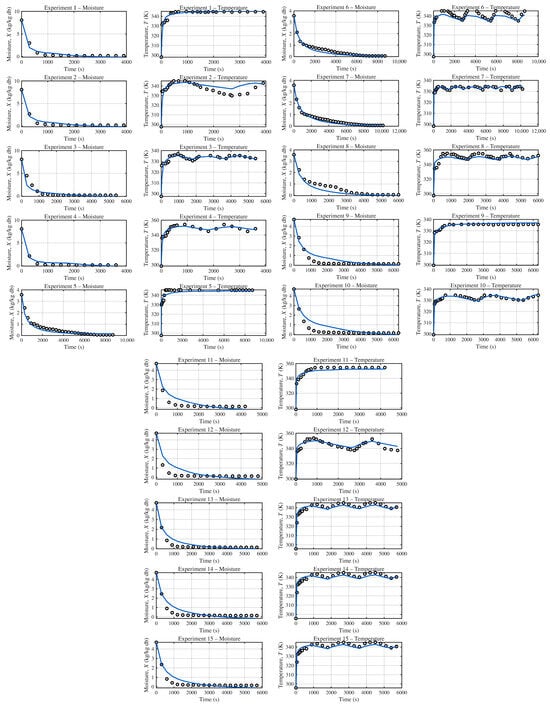
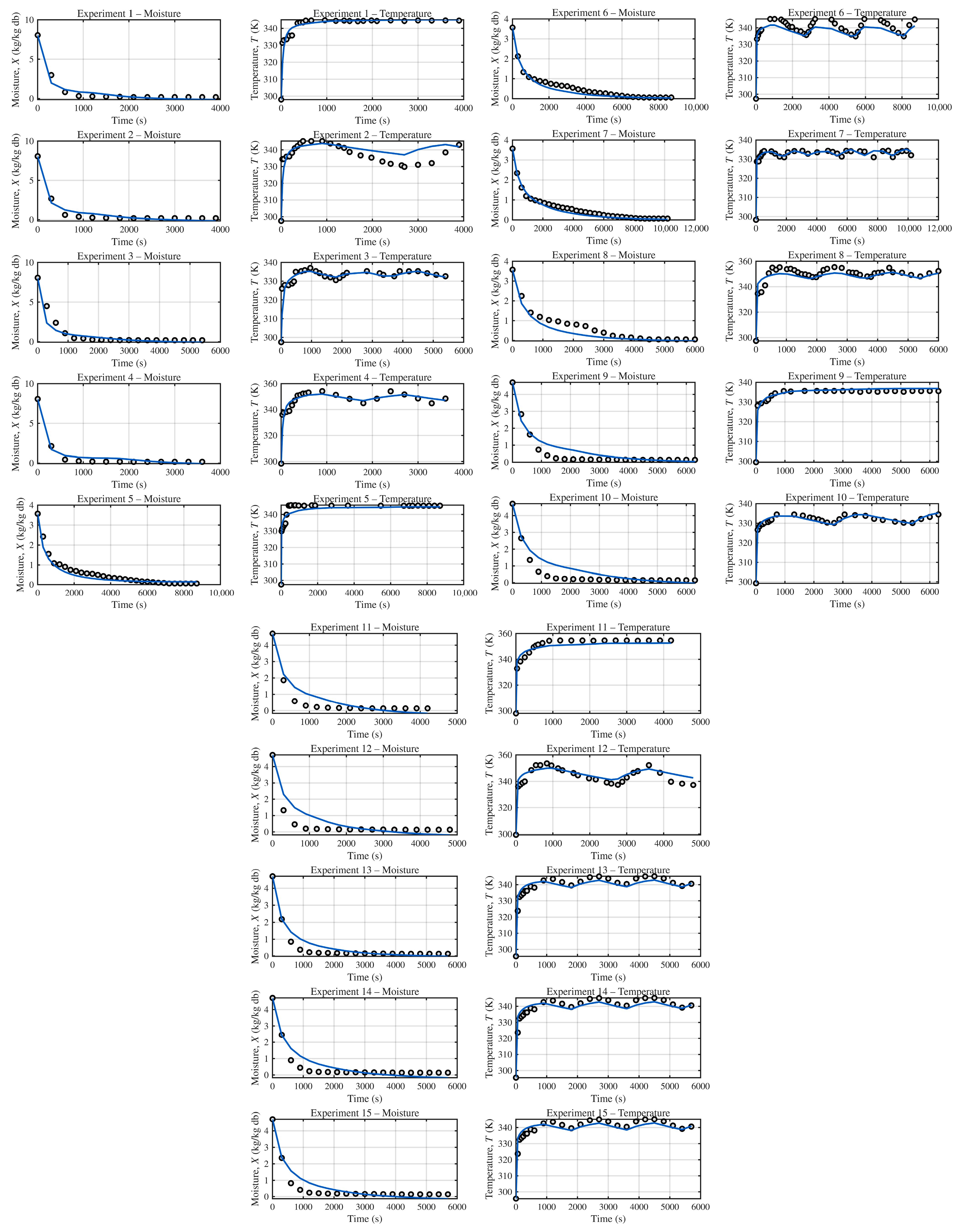
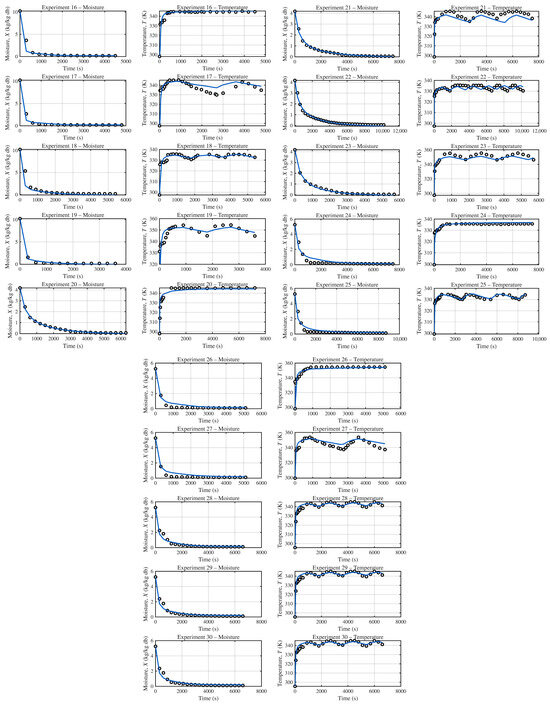
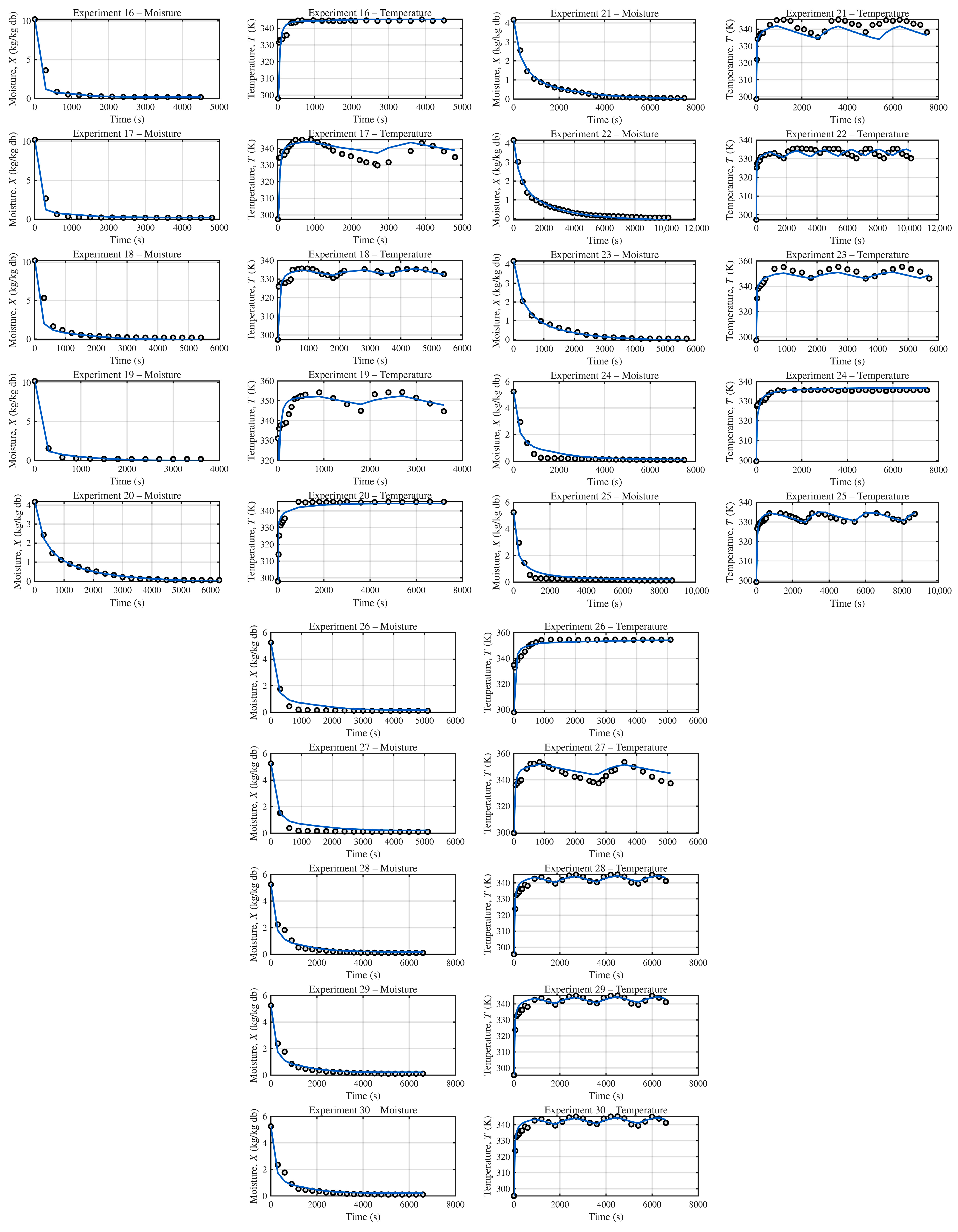
The variation in moisture content and temperature behavior of chili pastes during drying is shown in Figure 2 and Figure 3, where black circles represent the experimental data and the blue line represents the predictions of the REA model.
Figure 2.
Modeled moisture and temperature behaviors of cayenne pepper paste as a function of drying time (direct validation).
Figure 3.
Modeled moisture and temperature behaviors of jalapeño chili paste as a function of drying time (direct validation).
Figure 2 and Figure 3 compare the experimental values with predictions obtained from the modified REA model, revealing a high level of agreement for both key process variables: moisture content and temperature. The differences between the experimental data and simulations were minimal, indicating that the mathematical formulation successfully captured the main dynamics of the system. The global determination coefficients (R2 = 0.9463 for moisture and R2 = 0.8820 for temperature) provide quantitative confirmation of the ability of the model to describe system behavior different operating conditions. This outcome is particularly significant given the inherent complexity of drying semi-solid food matrices, where coupled phenomena of mass transfer, heat transfer, and structural transformations interact. The model reproduced the kinetics of moisture loss and the thermal evolution of the product with high accuracy, including transient processes driven by on/off heating cycles that are characteristic of intermittent operation.
3.2. Sensitivity Analysis
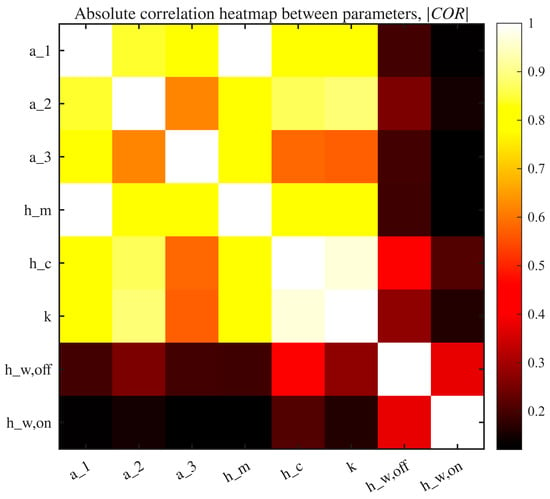
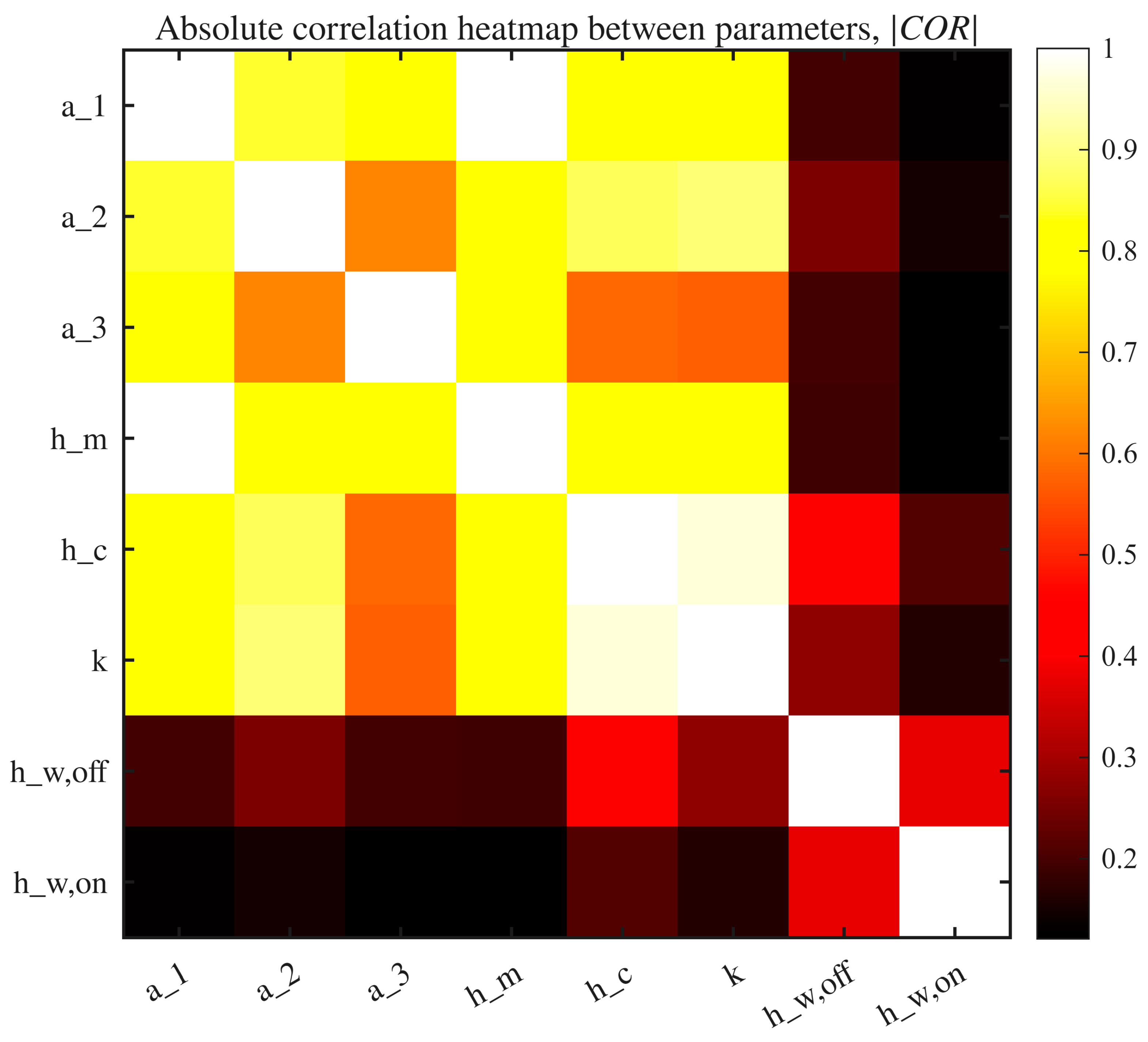
The confidence intervals obtained for the estimated parameters are presented in Table 6. A heat map representation of the absolute values of the correlation coefficients is shown in Figure 4. Additionally, the numerical values of the correlation matrix are provided in the Supplementary Materials (Table S3).
Table 6.
Confidence intervals for the estimated parameters.
Figure 4.
Absolute correlation heat map between model parameters.
Figure 4 shows the heat map representation of the absolute values of the parameter correlation matrix, illustrating the degree of linear dependence among the estimated parameters.
3.3. Direct and Cross-Validation
The accuracy of the model was examined through direct and cross-validation. In direct validation, parameter estimation was performed with the full dataset of 30 experiments. Cross-validation alternated between the cayenne and jalapeño datasets to predict the other variety (the modeled behaviors are provided in the Supplementary Material Figures S3 and S4). The results of both validation procedures are presented in Table 7.
Table 7.
Parameter values (θ = 8) identified through direct validation (all experiments) and cross-validation between cayenne and jalapeño varieties.
4. Discussion
4.1. Behavior of the Modified REA Formulation and Comparison with Previous REA Studies
The modified REA formulation developed in this study incorporates independent differential equations to describe the heating and cooling phases of the water bath. This contrasts with previous approaches in intermittent drying, where oscillatory changes in air temperature or humidity were imposed using predefined periodic functions (e.g., sinusoidal or square-wave profiles) [12,22]. The proposed model incorporates water mass, heat capacity, and instantaneous heat exchange with the product, thereby avoiding simplified assumptions that do not represent fluid dynamics or the thermal inertia of the system.
This capability is particularly relevant when compared with REA studies applied to intermittent convective drying under externally imposed variations. For example, Putranto [14] demonstrated that REA can effectively reproduce moisture and temperature profiles under time-varying humidity and temperature, although the drying medium was controlled externally rather than arising from coupled water–sample interactions. Similarly, Kowalski & Pawłowski [13] reported that the internal temperature of kaolin cylinders remained practically uniform during drying, meaning that no significant temperature gradients developed inside the material. This behavior indicates that heat was redistributed quickly within the sample compared with the rate at which it was exchanged with the environment. Under these conditions, the product can be treated as a thermally homogeneous body, which permits the use of simplified models based on a single spatially averaged temperature. Their work also benchmarked REA predictions against diffusion-based models, showing comparable or even superior accuracy for moisture evolution.
In contrast with these systems, chili pastes introduce substantial challenges due to structural complexity, compositional variability, and non-uniform layer thickness [23]. Even under these conditions, the modified REA model maintains a predictive capacity comparable to that reported for simpler matrices such as mineral systems, starch-based gels, or thin food tissues [21,24]. These results indicate that coupling the REA framework with dynamic boundary conditions extends its applicability to a broader range of semi-solid food materials.
4.2. Parameter Identification, Variance Analysis and Global Sensitivity Interpretation
The estimated parameters showed coherent mechanistic behavior when evaluated collectively. The activation–energy parameters , , and capture the combined influences of moisture availability, vapor driving force, and salt concentration. The narrow confidence intervals of and indicate that the dataset strongly constrains the mechanisms associated with removal of free water and reduction in vapor gradients, consistent with classical profiles of the transition between constant- and falling-rate periods in drying [24,25]. Comparable trends have been reported in other REA applications, where moisture mobility dominates the activation–energy behavior during the falling-rate regime [14].
On the other hand, the broader uncertainty observed in aligns with evidence showing that compositional variables such as solute concentration have intertwined effects with moisture-related phenomena, making their individual estimation more difficult in lumped models [21,26]. This indicates that formulation-specific effects, while influential, require targeted experimentation to be decoupled from moisture-driven mechanisms.
The strong correlation between and confirms their shared influence on the surface flux, a behavior commonly observed in conductive and convective REA implementations [27,28]. Despite this correlation, variance analysis indicated narrow uncertainty bounds for both coefficients, showing that their combined effect is well captured by the simultaneous fitting of temperature and moisture profiles. Meanwhile, the composite thermal conductivity behaved as a stable parameter, though its lower magnitude, compared with reported multilayer systems [27,29], suggests that it may compensate for moisture-dependent thermal properties not explicitly included in the model.
The water-side coefficients and presented broader confidence intervals, consistent with the limited independent observability of water temperature transients. Nonetheless, their influence on the global sensitivity indices was moderate, confirming that internal moisture and energy dynamics dominate system behavior, while water-side heat transfer modulates the amplitude and timing of thermal oscillations [27].
4.3. Cross-Validation and Implications for Model Robustness
Direct validation across 30 experiments showed coherent parameter estimates and high predictive performance, with moisture and temperature profiles reproduced within typical ranges reported for conductive drying systems [27,28]. The goodness-of-fit indicators confirmed this robustness: R2 for moisture reached 0.946, while R2 for temperature was 0.882, indicating that the model effectively captured both moisture kinetics and temperature evolution. The SSE value (11,277.230) indicated a good agreement between predictions and experimental data.
Cross-validation introduced a more stringent scenario by confronting the model with varietal differences in composition, pigment distribution, solid content, and physical structure. The observed shift in parameters such as and the reduction in highlight the sensitivity of thermal behavior to variety. This outcome is consistent with research showing that thermal properties such as conductivity and heat capacity vary markedly with composition and moisture content in pastes and gels [21,24,25,26,30]. In REA studies on kaolin and polymer gels, comparable decreases in temperature predictive accuracy have been reported when the physical structure differed between calibration and validation conditions [14].
The decline in for temperature under cross-validation thus reflects inherent structural and compositional variability between chili varieties rather than deficiencies of the REA framework. This suggests that future calibrations should incorporate multi-variety datasets to ensure generalization in heterogeneous food matrices.
4.4. Model Limitations and Opportunities for Improvement
Several structural limitations emerged during the analysis. Sensitivity to chili variety highlights the influence of compositional and structural differences on heat transfer, consistent with observations in heterogeneous matrices such as starch-based gels and mineral pastes [14,26]. Possible heterogeneity in layer thickness introduces additional variability in conduction pathways that a macroscopic representation cannot represent explicitly. The assumption of constant thermal conductivity prevents the model from representing known moisture-dependent thermophysical changes, particularly during early heating and late cooling stages [24,25]. This assumption may also affect temperature prediction accuracy, particularly during early heating and late drying stages. At the beginning of the process, when moisture content remains high, heat-transfer conditions change rapidly and the effective thermal behavior of the matrix may differ from the constant value assumed in the model. During late drying, the progressive reduction in moisture content alters thermophysical properties and increases internal resistance to heat and mass transfer. Under both conditions, the use of a constant conductivity term may smooth transient thermal responses and partially explain deviations between predicted and experimental temperature profiles. Additionally, the behavior of bound water is represented implicitly in the activation–energy formulation but may require explicit modeling to capture the sharp increase in resistance at low moisture contents.
Although chili paste was used as the case study, the proposed framework can be extended to other semi-solid food matrices processed by conductive hydro-drying, such as pastes, purees, and gels. The transferable components include the coupled moisture–temperature balance, the conductive heat-transfer term through the plastic film, and the use of independent equations for heating and cooling phases under intermittent operation. In contrast, matrix-specific elements require re-parameterization, including the activation–energy relationship, equilibrium moisture behavior, thermophysical properties, and formulation-dependent terms. In this study, represents NaCl concentration as a descriptor of formulation effects; in other semi-solid matrices, this term should be replaced by the corresponding compositional variable governing water mobility and evaporation resistance.
An additional limitation emerges from the absence of experimental replication for each drying condition. Operational constraints associated with the intermittent conductive hydro-drying system limited repeated runs under identical conditions. Although model robustness was evaluated through simultaneous multi-response fitting of moisture and temperature profiles using the least squares criterion, as well as through bidirectional cross-validation between cayenne and jalapeño pastes, the lack of replication prevents direct estimation of experimental variability and uncertainty. This limitation should be considered when interpreting the reported fitting metrics and the quantitative assessment of model performance.
These limitations align with known constraints of REA in complex materials, but they also provide a clear direction for improvement. Incorporating moisture-dependent thermal properties, correcting for spatial variability, or coupling REA with simplified diffusion terms could further enhance model fidelity. Such extensions would broaden the applicability of REA to a wider range of semi-solid food systems and increase predictive accuracy under realistic processing conditions.
5. Conclusions
The modified REA developed in this study accurately represented the coupled moisture and temperature behavior of chili pastes during conductive hydro-drying under continuous and intermittent conditions. The model achieved strong agreement with experimental data in both direct validation and cross-validation across two chili varieties, confirming its robustness under structural and compositional variability. The sensitivity analysis showed that parameters associated with moisture availability and vapor driving force were the dominant contributors to model behavior, while coefficients linked to salt effects and water-side heat transfer exhibited greater uncertainty. These findings highlight the central role of moisture-dependent energetic mechanisms in hydro-drying and indicate which parameters require improved experimental resolution. Limitations remained in the assumption of constant thermophysical properties, the lack of explicit representation of variations in sample thickness, and the indirect treatment of bound-water effects. Addressing these aspects—together with experiments designed to isolate compositional influences—would further enhance model generalization. Future extensions may integrate moisture-dependent thermal properties or simplified spatial corrections to broaden the applicability of REA-based models in complex semi-solid foods.
Supplementary Materials
The following supporting information can be downloaded at: https://www.mdpi.com/article/10.3390/agriengineering8040139/s1, Figure S1: Experimental behavior of moisture and temperature in cayenne pepper paste as a function of drying time; Figure S2: Experimental behavior of moisture and temperature in jalapeño pepper paste as a function of drying time; Table S1: Equilibrium moisture content values and sample mass used in the mathematical model; Table S2: Equilibrium temperature and equilibrium relative humidity values of the air above the sample used in the mathematical model; Table S3: Correlation matrix between the estimated parameters; Figure S3: Modeled humidity and temperature behaviors in cross validation (experiments 1–15); Figure S4: Modeled humidity and temperature behaviors in cross validation (experiments 16–30).
Author Contributions
Conceptualization, G.J.-M., C.I.O.-M. and J.L.P.-D.; methodology, G.J.-M. and J.L.P.-D.; software, G.J.-M. and J.L.P.-D.; validation, G.J.-M. and J.L.P.-D.; formal analysis, G.J.-M. and J.L.P.-D.; investigation, G.J.-M.; resources, C.I.O.-M. and J.L.P.-D.; data curation, G.J.-M.; writing—original draft preparation, G.J.-M.; writing—review and editing, G.J.-M., C.I.O.-M. and J.L.P.-D.; visualization, G.J.-M.; supervision, C.I.O.-M. and J.L.P.-D.; project administration, C.I.O.-M. and J.L.P.-D.; funding acquisition, C.I.O.-M. and J.L.P.-D. All authors have read and agreed to the published version of the manuscript.
Funding
Support for doctoral student, project: Effect of intermittent hydro-conductive drying on the quality of dehydrated chili peppers and energy consumption of the process, CI21188, Universidad del Valle.
Institutional Review Board Statement
Not applicable.
Informed Consent Statement
Not applicable.
Data Availability Statement
All data supporting the findings of this study are available within this paper and its Supplementary Materials.
Acknowledgments
The authors would like to thank Hugo Restrepo and Cia S.A. for supplying the chili paste and the Universidad del Valle for funding this research through an internal call for proposals.
Conflicts of Interest
The authors declare no conflicts of interest.
References
- Tan, J.; Li, M.F.; Li, R.; Jiang, Z.T.; Tang, S.H.; Wang, Y. Front-Face Synchronous Fluorescence Spectroscopy for Rapid and Non-Destructive Determination of Free Capsanthin, the Predominant Carotenoid in Chili (Capsicum annuum L.) Powders Based on Aggregation-Induced Emission. Spectrochim. Acta Part A Mol. Biomol. Spectrosc. 2021, 255, 119696. [Google Scholar] [CrossRef] [Scilit]
- Getahun, E.; Gabbiye, N.; Delele, M.A.; Fanta, S.W.; Gebrehiwot, M.G.; Vanierschot, M. Effect of Maturity on the Moisture Sorption Isotherm of Chili Pepper (Mareko Fana Variety). Heliyon 2020, 6, e04608. [Google Scholar] [CrossRef] [Scilit]
- Verma, D.K.; Thakur, M.; Srivastav, P.P.; Karizaki, V.M.; Suleria, H.A.R. Effects of Drying Technology on Physiochemical and Nutritional Quality of Fruits and Vegetables. In Emerging Thermal and Nonthermal Technologies in Food Processing; Apple Academic Press: Palm Bay, FL, USA, 2020; pp. 69–116. [Google Scholar]
- Rajoriya, D.; Shewale, S.R.; Hebbar, H.U. Refractance Window Drying of Apple Slices: Mass Transfer Phenomena and Quality Parameters. Food Bioprocess Technol. 2019, 12, 1646–1658. [Google Scholar] [CrossRef] [Scilit]
- Khan, M.I.H.; Welsh, Z.; Gu, Y.; Karim, M.A.; Bhandari, B. Modelling of Simultaneous Heat and Mass Transfer Considering the Spatial Distribution of Air Velocity during Intermittent Microwave Convective Drying. Int. J. Heat Mass Transf. 2020, 153, 119668. [Google Scholar] [CrossRef] [Scilit]
- Arpaci, E.; Atayılmaz, Ş.Ö.; Gemici, Z. Exploring Mathematical Modeling and CFD in Convective Drying of Fruits and Vegetables: A Review. Food Bioprocess Technol. 2025, 18, 3195–3222. [Google Scholar] [CrossRef] [Scilit]
- Waghmare, R. Refractance Window Drying: A Cohort Review on Quality Characteristics. Trends Food Sci. Technol. 2021, 110, 652–662. [Google Scholar] [CrossRef] [Scilit]
- Ortiz-Jerez, M.J.; Ochoa-Martínez, C.I. Heat Transfer Mechanisms in Conductive Hydro-Drying of Pumpkin (Cucurbita maxima) Pieces. Dry. Technol. 2015, 33, 965–972. [Google Scholar] [CrossRef] [Scilit]
- Ortiz, M.J.; Ochoa Martínez, C.I. Efecto de Las Condiciones Del Hidrosecado Sobre El Encogimiento de Trozos de Zapallo (Cucurbita maxima). Ing. Compet. 2018, 20, 37–44. [Google Scholar] [CrossRef] [Scilit]
- Zhu, H.K.; Yang, L.; Fang, X.F.; Wang, Y.; Li, D.; Wang, L.J. Effects of Intermittent Radio Frequency Drying on Structure and Gelatinization Properties of Native Potato Flour. Food Res. Int. 2021, 139, 109807. [Google Scholar] [CrossRef] [Scilit] [PubMed]
- Zotti-Sperotto, N.C.; de Ávila, M.B.R.; de Souza, R.A.; de Melo, E.C.; Governici, J.L.; Gonzaga, D.A.; Fonseca, M.C.M.; Carneiro, A.P.d.S.; Demuner, A.J.; Pinheiro, P.F.; et al. Intermittent Drying of Lippia Origanoides H.B.K. Leaves and Schinus terebinthifolius Raddi Fruits. Ind. Crops Prod. 2021, 161, 113152. [Google Scholar] [CrossRef] [Scilit]
- Kumar, C.; Karim, M.A.; Joardder, M.U.H. Intermittent Drying of Food Products: A Critical Review. J. Food Eng. 2014, 121, 48–57. [Google Scholar] [CrossRef] [Scilit]
- Kowalski, S.J.; Pawłowski, A. Modeling of Kinetics in Stationary and Intermittent Drying. Dry. Technol. 2010, 28, 1023–1031. [Google Scholar] [CrossRef] [Scilit]
- Putranto, A.; Chen, X.D.; Devahastin, S.; Xiao, Z.; Webley, P.A. Application of the Reaction Engineering Approach (REA) for Modeling Intermittent Drying under Time-Varying Humidity and Temperature. Chem. Eng. Sci. 2011, 66, 2149–2156. [Google Scholar] [CrossRef] [Scilit]
- AOAC. Official Methods of Analysis of AOAC International, 21st ed.; Method 934.01; AOAC International: Rockville, MD, USA, 2019. [Google Scholar]
- Chen, X.D.; Chen, N.X. Preliminary Introduction to a Unified Approach to Modeling Drying and Equilibrium Isotherms of Moist Porous Solids. In Proceedings of the Chemeca 1997 Conference, Rotorua, New Zealand, 28–30 September 1997. [Google Scholar]
- Ambrose, D.; Walton, J. Vapour Pressures up to Their Critical Temperatures of Normal Alkanes and 1-Alkanols. Pure Appl. Chem. 1989, 61, 1395–1403. [Google Scholar] [CrossRef] [Scilit]
- Barbosa-Cánovas, G.V.; Fontana, A.J., Jr.; Schmidt, S.J.; Labuza, T.P. (Eds.) Water Activity in Foods: Fundamentals and Applications; Blackwell Publishing: Ames, IA, USA, 2007. [Google Scholar] [CrossRef] [Scilit]
- Chirife, J.; Resnik, S.L. Unsaturated Solutions of Sodium Chloride as Reference Sources of Water Activity at Various Temperatures. J. Food Sci. 1984, 49, 982–984. [Google Scholar] [CrossRef] [Scilit]
- Chirife, J.; Ferro Fontan, C. Prediction of water activity of aqueous solutions in connection with intermediate moisture foods: Experimental investigation of the aw lowering behavior of sodium lactate and some related compounds. J. Food Sci. 1980, 45, 802–804. [Google Scholar] [CrossRef] [Scilit]
- Moreira, R.; Chenlo, F.; Chaguri, L.; Vázquez, G. Air drying and colour characteristics of chestnuts pre-submitted to osmotic dehydration with sodium chloride. Food Bioprod. Process. 2011, 89, 109–115. [Google Scholar] [CrossRef] [Scilit]
- Chua, K.J.; Chou, S.K.; Ho, J.C.; Mujumdar, A.S.; Hawlader, M.N.A. Cyclic Air Temperature Drying of Guava Pieces: Effects on Moisture and Ascorbic Acid Contents. Food Bioprod. Process. 2000, 78, 72–78. [Google Scholar] [CrossRef] [Scilit]
- Zhang, R.; Chen, G.; Yang, B.; Wu, Y.; Du, M.; Kan, J. Insights into the Stability of Carotenoids and Capsaicinoids in Water-Based or Oil-Based Chili Systems at Different Processing Treatments. Food Chem. 2021, 342, 128308. [Google Scholar] [CrossRef] [Scilit]
- Abdullah, Z.; Taip, F.S.; Kamal, S.M.M.; Rahman, R.Z.A. Nonlinear Model-Based Inferential Control of Moisture Content of Spray Dried Coconut Milk. Foods 2020, 9, 1177. [Google Scholar] [CrossRef] [Scilit]
- Parikh, D.M. Solids Drying: Basics and Applications. Available online: https://www.chemengonline.com/solids-drying-basics-and-applications/?printmode=1 (accessed on 7 October 2025).
- Haque, M.A.; Oliver, M.M.H.; Putranto, A.; Adhikari, B. Drying and Denaturation Kinetics of Beta-Lactoglobulin during Convective Drying. J. Food Eng. 2018, 237, 9–17. [Google Scholar] [CrossRef] [Scilit]
- Cengel, Y.A.; Ghajar, A.J. Heat and Mass Transfer; Mcgraw-Hill Education-Europe: London, UK, 2014; ISBN 9814595276. [Google Scholar]
- Geankoplis, C. Transport Processes and Separation Process Principles (Includes Unit Operations); Prentice Hall Press: Saddle River, NJ, USA, 2003; ISBN 013101367X. [Google Scholar]
- Choi, Y.; Okos, M.R. Effects of Temperature and Composition on the Thermal Properties of Foods. Transp. Phenom. Food Process. 1986, 1, 99–101. [Google Scholar]
- Rajoriya, D.; Bhavya, M.L.; Hebbar, H.U. Impact of Process Parameters on Drying Behaviour, Mass Transfer and Quality Profile of Refractance Window Dried Banana Puree. LWT 2021, 145, 111330. [Google Scholar] [CrossRef] [Scilit]

Disclaimer/Publisher’s Note: The statements, opinions and data contained in all publications are solely those of the individual author(s) and contributor(s) and not of MDPI and/or the editor(s). MDPI and/or the editor(s) disclaim responsibility for any injury to people or property resulting from any ideas, methods, instructions or products referred to in the content. |
© 2026 by the authors. Licensee MDPI, Basel, Switzerland. This article is an open access article distributed under the terms and conditions of the Creative Commons Attribution (CC BY) license.