
Inactivation of Weedy Rice Using 915 MHz Microwaves with Soil Physicochemical Property and Microbiome Retention


Abstract
1. Introduction
2. Materials and Methods
2.1. Soil Sampling
2.2. Microwave Heating and Soil Temperature Measurement
2.3. Experimental Design
- (i)
- Microwave power × soil depth (fixed exposure duration of 30 s) for temperature and germination analyses;
- (ii)
- Microwave power × soil depth (fixed exposure duration of 30 s) for soil physicochemical analyses;
- (iii)
- Microwave power × exposure duration (fixed soil depth of 15.2 cm) for soil microbial quantification.
2.4. Greenhouse for Germination Analyses
2.5. Soil Physiochemical Properties and Microbial Quantification
2.6. Data Analysis
3. Results
3.1. Impact of Microwave Energy on Soil Temperature
3.2. Impact of Microwave Energy on Total Germinability Index (TGI)
3.3. Impact of Microwave Energy on Soil Physicochemical Properties
3.4. Impact of Microwave Energy on Soil Microbes
4. Discussion
Author Contributions
Funding
Institutional Review Board Statement
Informed Consent Statement
Data Availability Statement
Acknowledgments
Conflicts of Interest
References
- Shahbandeh, M. Grain Production Worldwide 2022/23, by Type. Statista. 2023. Available online: https://www.statista.com/statistics/263977/ (accessed on 28 September 2023).
- Shahbandeh, M. Rice—Statistics & Facts. Statista. 2023. Available online: https://www.statista.com/topics/1443/rice/#topicOverview// (accessed on 28 September 2023).
- UAEX University of Arkansas Division of Agriculture, Cooperative Extension Service. 2023. Available online: https://www.uaex.uada.edu/farm-ranch/crops-commercial-horticulture/rice/ (accessed on 28 September 2023).
- Chauhan, B.S. Grand challenges in weed management. Front. Agron. 2020, 1, 3. [Google Scholar] [CrossRef] [Scilit]
- Kraehmer, H.; Jabran, K.; Mennan, H.; Chauhan, B.S. Global distribution of rice weeds–a review. Crop Prot. 2016, 80, 73–86. [Google Scholar] [CrossRef] [Scilit]
- Durand-Morat, A.; Nalley, L.L.; Thoma, G. The implications of red rice on food security. Glob. Food Secur. 2018, 18, 62–75. [Google Scholar] [CrossRef] [Scilit]
- Roma-Burgos, N.; Norman, R.J.; Gealy, D.R.; Black, H. Competitive N uptake between rice and weedy rice. Field Crops Res. 2006, 99, 96–105. [Google Scholar] [CrossRef] [Scilit]
- Roma-Burgos, N.; Butts, T.R.; Werle, I.S.; Bottoms, S.; Mauromoustakos, A. Weedy rice update in Arkansas, USA, and adjacent locales. Weed Sci. 2021, 69, 514–525. [Google Scholar] [CrossRef] [Scilit]
- Roma-Burgos, N.; Heap, I.M.; Rouse, C.E.; Lawton-Rauh, A.L. Evolution of Herbicide-Resistant Weeds; Korres, N.E., Burgos, N.R., Duke, S.O., Eds.; CRC Press: Boca Raton, FL, USA; Taylor & Francis Group: Oxford, UK, 2019; Chapter 6; pp. 92–132. [Google Scholar]
- Ziska, L.H.; Gealy, D.R.; Burgos, N.; Caicedo, A.L.; Gressel, J.; Lawton-Rauh, A.L.; Avila, L.A.; Theisen, G.; Norsworthy, J.; Ferrero, A.; et al. Weedy (red) rice: An emerging constraint to global rice production. Adv. Agron. 2015, 129, 181–228. [Google Scholar]
- Nelson, S.O. A review and assessment of microwave energy for soil treatment to control pests. Trans. ASAE 1996, 39, 281–289. [Google Scholar] [CrossRef] [Scilit]
- Sartorato, I.; Zanin, G.; Baldoin, C.; De Zanche, C. Observations on the potential of microwaves for weed control. Weed Res. 2006, 46, 1–9. [Google Scholar] [CrossRef] [Scilit]
- Brodie, G.; Ryan, C.; Lancaster, C. The effect of microwave radiation on prickly paddy melon (Cucumis myriocarpus). Int. J. Agron. 2012, 2012, 287608. [Google Scholar] [CrossRef] [Scilit]
- Brodie, G.; Khan, M.J.; Gupta, D.; Foletta, S.; Bootes, N. Microwave weed and soil treatment in agricultural systems. AMPERE Newsl. 2017, 93, 9–17. [Google Scholar]
- Khan, M.J.; Brodie, G.I. Microwave weed and soil treatment in rice production. Rice Crop Curr. Dev. 2018, 99–127. [Google Scholar] [CrossRef] [Scilit]
- Mavrogianopoulos, G.N.; Frangoudakis, A.; Pandelakis, J. Energy efficient soil disinfestation by microwaves. J. Agric. Eng. Res. 2000, 75, 149–153. [Google Scholar] [CrossRef] [Scilit]
- Ulaby, F.T.; Batlivala, P.P.; Dobson, M.C. Microwave backscatter dependence on surface roughness, soil moisture, and soil texture: Part I. Bare soil. IEEE Trans. Geosci. Electron. 1978, 16, 286–295. [Google Scholar] [CrossRef] [Scilit]
- Dobson, M.C.; Ulaby, F.T.; Hallikainen, M.T.; El-Rayes, M.A. Microwave dielectric behavior of wet soil-Part II: Dielectric mixing models. IEEE Trans. Geosci. Remote Sens. 1985, GE-23, 35–46. [Google Scholar] [CrossRef] [Scilit]
- O’Neill, P.E.; Jackson, T.J. Observed effects of soil organic matter content on the microwave emissivity of soils. Remote Sens. Environ. 1990, 31, 175–182. [Google Scholar] [CrossRef] [Scilit]
- Brodie, G.; Ryan, C.; Lancaster, C. Microwave technologies as part of an integrated weed management strategy: A review. Int. J. Agron. 2012, 2012, 636905. [Google Scholar] [CrossRef] [Scilit]
- Brodie, G.; Hamilton, S.; Woodworth, J. An assessment of microwave soil pasteurization for killing seeds and weeds. Plant Prot. Q. 2007, 22, 143–149. [Google Scholar]
- Wayland, J.R.; Davis, F.S.; Merkle, M.G. Toxicity of an UHF device to plant seeds in soil. Weed Sci. 1973, 21, 161–162. [Google Scholar] [CrossRef] [Scilit]
- Menges, R.M.; Wayland, J.R. UHF electromagnetic energy for weed control in vegetables. Weed Sci. 1974, 22, 584–590. [Google Scholar] [CrossRef] [Scilit]
- Barker, A.V.; Craker, L.E. Inhibition of weed seed germination by microwaves. Agron. J. 1991, 83, 302–305. [Google Scholar] [CrossRef] [Scilit]
- ASTM Standard D2216-19; Standard Test Methods for Laboratory Determination of Water (Moisture) Content of Soil and Rock by Mass. ASTM International: West Conshohocken, PA, USA, 2019.
- Bruce, R.M. Application of Microwave-Assisted Technology for Single-Pass Drying of Rough Rice. Doctoral Dissertation, University of Arkansas, Fayetteville, AR, USA, 2022. [Google Scholar]
- Metaxas, A.C.; Meredith, R.J. Industrial Microwave Heating; Peter Peregrinus: London, UK, 1974. [Google Scholar]
- Bojko, O.; Kabala, C. Transformation of physicochemical soil properties along a mountain slope due to land management and climate changes—A case study from the Karkonosze Mountains, SW Poland. Catena 2016, 140, 43–54. [Google Scholar] [CrossRef] [Scilit]
- Auyeung, D.N.; Martiny, J.B.; Dukes, J.S. Nitrification kinetics and ammonia-oxidizing community respond to warming and altered precipitation. Ecosphere 2015, 6, 1–17. [Google Scholar] [CrossRef] [Scilit]
- Waghmode, T.R.; Chen, S.; Li, J.; Sun, R.; Liu, B.; Hu, C. Response of nitrifier and denitrifier abundance and microbial community structure to experimental warming in an agricultural ecosystem. Front. Microbiol. 2018, 9, 474. [Google Scholar] [CrossRef] [Scilit]
- Guo, J.; Ling, N.; Chen, H.; Zhu, C.; Kong, Y.; Wang, M.; Shen, Q.; Guo, S. Distinct drivers of activity, abundance, diversity and composition of ammonia-oxidizers: Evidence from a long-term field experiment. Soil Biol. Biochem. 2017, 115, 403–414. [Google Scholar] [CrossRef] [Scilit]
- Khan, M.J.; Jurburg, S.D.; He, J.; Brodie, G.; Gupta, D. Impact of microwave disinfestation treatments on the bacterial communities of no-till agricultural soils. Eur. J. Soil Sci. 2020, 71, 1006–1017. [Google Scholar] [CrossRef] [Scilit]
- Scarlett, K.; Denman, S.; Clark, D.R.; Forster, J.; Vanguelova, E.; Brown, N.; Whitby, C. Relationships between nitrogen cycling microbial community abundance and composition reveal the indirect effect of soil pH on oak decline. ISME J. 2021, 15, 623–635. [Google Scholar] [CrossRef] [Scilit] [PubMed]
- Niu, Y.; Yang, X.; Hao, S.; Hei, Z.; Chen, B.; Hu, H.; Wan, S.; Chen, Y. Temperate grassland soil nitrifiers are more sensitive to nitrogen addition than simulated warming. Appl. Soil Ecol. 2024, 195, 105214. [Google Scholar] [CrossRef] [Scilit]


| Properties | Soil Sample |
|---|---|
| pH | 6.7 |
| EC (μmhos/cm) | 529.0 |
| P (mg/kg) | 31.2 |
| K (mg/kg) | 275.3 |
| Ca (mg/kg) | 3810.2 |
| Mg (mg/kg) | 977.6 |
| S (mg/kg) | 36.2 |
| Na (mg/kg) | 123.4 |
| Fe (mg/kg) | 335.5 |
| Mn (mg/kg) | 366.2 |
| Zn (mg/kg) | 3.0 |
| Cu (mg/kg) | 2.7 |
| B (mg/kg) | 1.4 |
| Percentage Loss on Ignition | 5.8 |
| Total Nitrogen (%) | 0.2 |
| Total Carbon (%) | 2.9 |
| Experiments | Factors | Constants |
|---|---|---|
| Germination/temperature analyses | Microwave power (10, 20 and 30 kW), and soil depth (2.5, 8.9 and 15.2 cm) | Exposure duration of 30 s |
| Soil physicochemical analyses | Microwave power (10, 20 and 30 kW), and soil depth (2.5, 8.9 and 15.2 cm) | Exposure duration of 30 s |
| Soil microbial quantification | Microwave power (10, 20 and 30 kW), and exposure duration (30, 60, and 90 s) | Soil depth of 15.2 cm |
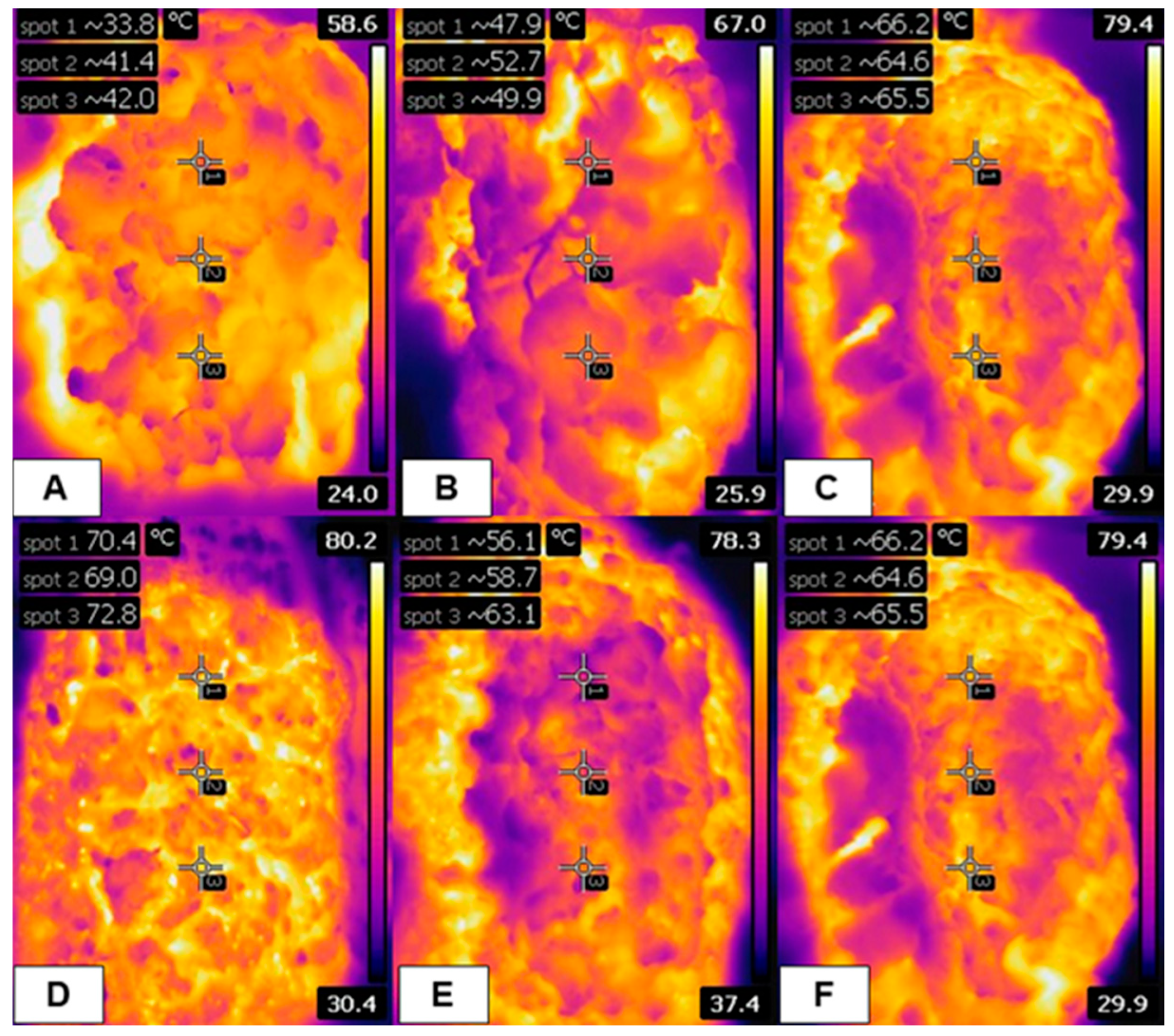
| Microwave Power (kW) | Soil Depth (cm) | Soil Volume (cm3) | Soil Mass (kg) | Specific Energy (kJ/kg Soil) | Soil Temperature (°C) * |
|---|---|---|---|---|---|
| 10 | 2.5 | 500 | 1.5 | 200 | 77.5 |
| 10 | 8.9 | 1780 | 3.4 | 88 | 40.9 |
| 10 | 15.2 | 3040 | 4.8 | 63 | 38.6 |
| 20 | 2.5 | 500 | 1.5 | 400 | 92.3 |
| 20 | 8.9 | 1780 | 3.4 | 176 | 53.6 |
| 20 | 15.2 | 3040 | 4.8 | 125 | 41.3 |
| 30 | 2.5 | 500 | 1.5 | 600 | 95.5 |
| 30 | 8.9 | 1780 | 3.4 | 265 | 70.0 |
| 30 | 15.2 | 3040 | 4.8 | 188 | 58.3 |
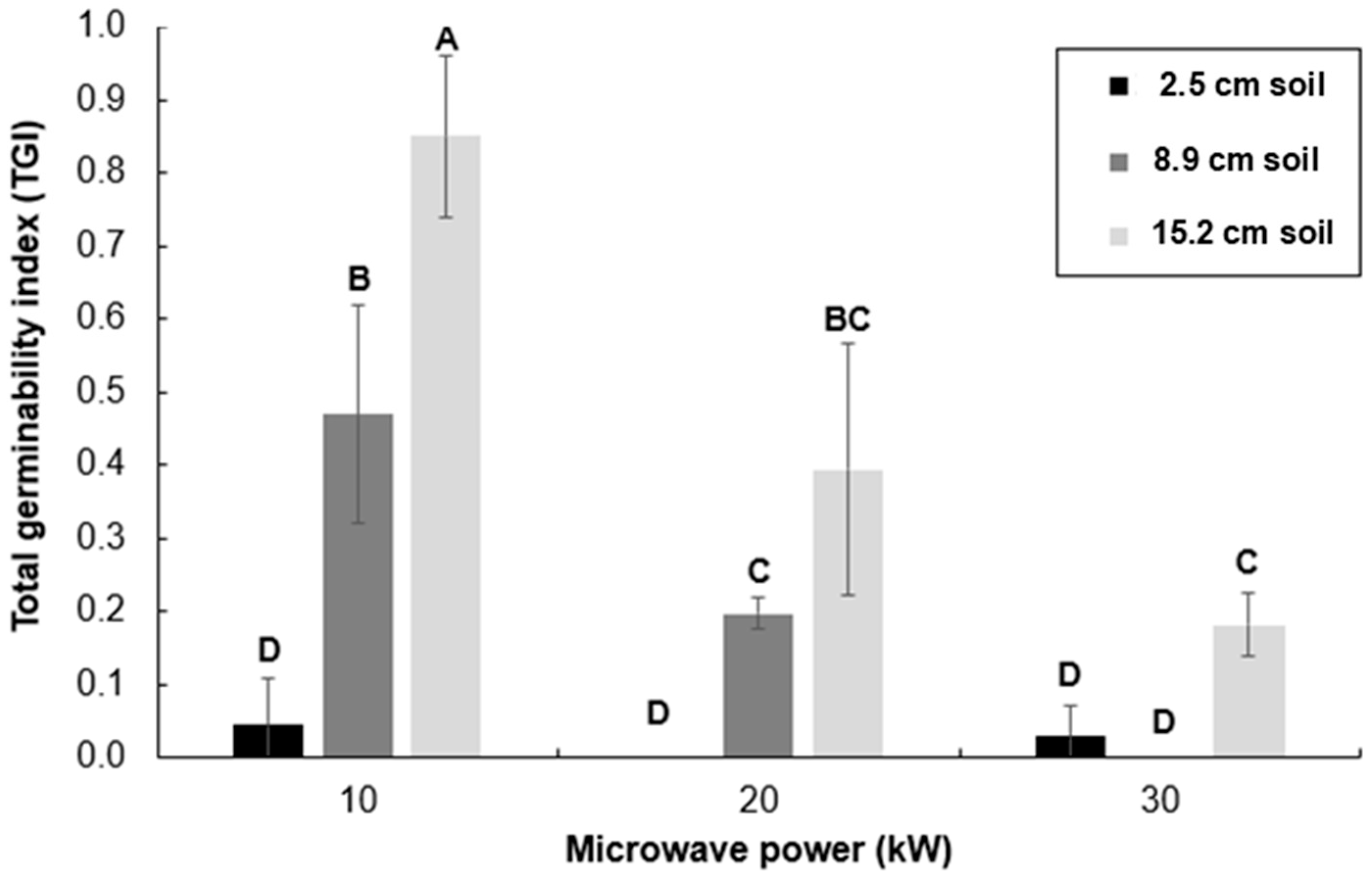
| Factors | Levels | p-Value |
|---|---|---|
| Microwave power (kW) | 10, 20 and 30 | 0.0009 * |
| Soil depth (cm) | 2.5, 8.9, 15.2 | 0.0003 * |
| Replication | 1 and 2 | 0.3533 |
| Soil Physicochemical Properties | p-Value * | Mean Values of Soil Physicochemical Properties for Treated Soil (MW Power-Soil Depth) | ||||||||||
|---|---|---|---|---|---|---|---|---|---|---|---|---|
| MW Power | Soil Depth | 10 kW-2.5 cm | 10 kW-8.9 cm | 10 kW-15.2 cm | 20 kW-2.5 cm | 20 kW-8.9 cm | 20 kW-15.2 cm | 30 kW-2.5 cm | 30 kW-8.9 cm | 30 kW-15.2 cm | Control # | |
| Soil pH | 0.0083 * | 0.8148 | 6.6 b | 6.6 b | 6.6 b | 6.5 b | 6.7 ab | 6.7 ab | 6.8 a | 6.8 a | 6.8 a | 6.7 ab |
| Electrical Conductivity (μmhos/cm) | 0.0873 | 0.0307 * | 465.0 b | 500.0 ab | 516.0 ab | 497.5 ab | 519.5 ab | 567.0 a | 510.5 ab | 498.0 ab | 517.5 ab | 529.0 ab |
| Phosphorus (mg/kg) | 0.2354 | 0.6804 | 31.8 b | 34.0 ab | 33.7 ab | 35.0 a | 34.6 ab | 32.8 b | 34.8 ab | 34.0 ab | 34.2 ab | 31.2 b |
| Potassium (mg/kg) | 0.0459 * | 0.0138 * | 263.8 b | 292.7 ab | 296.0 ab | 264.1 b | 262.9 b | 315.1 a | 259.3 b | 258.5 b | 266.0 b | 275.3 b |
| Calcium (mg/kg) | 0.6229 | 0.3466 | 3724.5 a | 3909.9 a | 3854.5 a | 3807.2 a | 3753.2 a | 4071.3 a | 3969.2 a | 3852.4 a | 3921.1 a | 3810.2 a |
| Magnesium (mg/kg) | 0.7329 | 0.4565 | 969.5 a | 1054.9 a | 989.5 a | 951.0 a | 936.1 a | 1062.4 a | 1023.4 a | 982.8 a | 1023.8 a | 977.6 a |
| Sulphur (mg/kg) | 0.5758 | 0.4557 | 30.6 a | 37.4 a | 34.4 a | 39.5 a | 35.5 a | 41.0 a | 50.4 a | 31.9 a | 30.9 a | 36.2 a |
| Sodium (mg/kg) | 0.7734 | 0.5843 | 121.8 a | 132.2 a | 123.6 a | 126.1 a | 119.1 a | 136.7 a | 134.4 a | 123.6 a | 130.5 a | 123.4 a |
| Iron (mg/kg) | 0.5742 | 0.5728 | 371.9 a | 312.0 b | 349.0 b | 336.0 b | 342.8 b | 323.9 b | 316.4 b | 324.6 b | 344.5 b | 335.5 b |
| Manganese (mg/kg) | 0.1021 | 0.0151 * | 168.6 ab | 287.8 a | 349.6 a | 63.0 b | 246.2 ab | 181.0 ab | 123.1 | 187.3 ab | 274.7 a | 366.2 a |
| Zinc (mg/kg) | 0.4121 | 0.7018 | 3.0 a | 3.2 a | 3.2 a | 3.0 a | 3.1 a | 2.9 a | 3.3 a | 3.1 a | 3.0 a | 3.0 a |
| Copper (mg/kg) | 0.6767 | 0.3384 | 2.1 a | 3.4 a | 2.8 a | 2.4 a | 2.7 a | 2.9 a | 3.1 a | 3.0 a | 2.8 a | 2.7 a |
| Boron (mg/kg) | 0.7832 | 0.1711 | 1.8 a | 1.5 a | 1.5 a | 1.7 a | 1.6 a | 1.7 a | 1.6 a | 1.7 a | 1.6 a | 1.4 a |
| Percentage Loss on Ignition | 0.4149 | 0.2857 | 6.1 a | 5.4 a | 6.2 a | 6.3 a | 5.9 a | 5.9 a | 5.6 a | 5.5 a | 5.9 a | 5.8 a |
| Total Nitrogen (%) | 0.6445 | 0.5574 | 0.3 a | 0.2 a | 0.3 a | 0.3 a | 0.2 a | 0.3 a | 0.2 a | 0.2 a | 0.2 a | 0.2 a |
| Total Carbon (%) | 0.4922 | 0.5354 | 3.0 a | 2.6 a | 3.0 a | 3.2 a | 2.9 a | 2.9 a | 2.7 a | 2.7 a | 2.8 a | 2.9 a |
| Soil Microbes | p-Value * | Mean Values of Soil Microbes for Treated Soil (MW Power-Duration) | |||||||||
|---|---|---|---|---|---|---|---|---|---|---|---|
| Treatment (MW Power-Duration) | 10 kW-30 s | 10 kW-60 s | 10 kW-90 s | 20 kW-30 s | 20 kW-60 s | 20 kW-90 s | 30 kW-30 s | 30 kW-60 s | 30 kW-90 s | Control # | |
| Total bacteria (copies per g of soil) | 0.0767 | 4.1 × 10⁸ a | 3.5 × 10⁸ ab | 2.7 × 10⁸ abc | 0.7 × 10⁸ c | 1.7 × 10⁸ bc | 2.1 × 10⁸ abc | 2.6 × 10⁸ abc | 2.0 × 10⁸ abc | 0.8 × 10⁸ c | 1.4 × 10⁸ bc |
| AOA (copies per g of soil) | 0.1313 | 2.7 × 10⁷ ± ab | 2.4 × 10⁶ ± bc | 4.2 × 10⁵ c | 1.1 × 10⁴ c | 1.7 × 10⁴ c | 8.9 × 10⁴ c | 4.4 × 10⁴ c | 4.1 × 10⁵ c | 2.9 × 10⁵ c | 3.0 × 10⁷ a |
| AOB (copies per g of soil) | <0.0001 * | 1.7 × 10⁸ b | 3.5 × 10⁷ b | 3.7 × 10⁷ b | 4.2 × 10⁷ ± b | 2.4 × 10⁷ b | 2.0 × 10⁷ b | 2.7 × 10⁷ b | 1.8 × 10⁷ b | 9.7 × 10⁶ b | 9.1 × 10⁸ a |
Disclaimer/Publisher’s Note: The statements, opinions and data contained in all publications are solely those of the individual author(s) and contributor(s) and not of MDPI and/or the editor(s). MDPI and/or the editor(s) disclaim responsibility for any injury to people or property resulting from any ideas, methods, instructions or products referred to in the content. |
© 2026 by the authors. Licensee MDPI, Basel, Switzerland. This article is an open access article distributed under the terms and conditions of the Creative Commons Attribution (CC BY) license.
Share and Cite
Luthra, K.; Chukkapalli, D.; Regonda, B.; Isbell, C.; Mishra, A.; Atungulu, G. Inactivation of Weedy Rice Using 915 MHz Microwaves with Soil Physicochemical Property and Microbiome Retention. AgriEngineering 2026, 8, 140. https://doi.org/10.3390/agriengineering8040140
Luthra K, Chukkapalli D, Regonda B, Isbell C, Mishra A, Atungulu G. Inactivation of Weedy Rice Using 915 MHz Microwaves with Soil Physicochemical Property and Microbiome Retention. AgriEngineering. 2026; 8(4):140. https://doi.org/10.3390/agriengineering8040140
Chicago/Turabian StyleLuthra, Kaushik, Devisree Chukkapalli, Bindu Regonda, Chris Isbell, Akshita Mishra, and Griffiths Atungulu. 2026. "Inactivation of Weedy Rice Using 915 MHz Microwaves with Soil Physicochemical Property and Microbiome Retention" AgriEngineering 8, no. 4: 140. https://doi.org/10.3390/agriengineering8040140
APA StyleLuthra, K., Chukkapalli, D., Regonda, B., Isbell, C., Mishra, A., & Atungulu, G. (2026). Inactivation of Weedy Rice Using 915 MHz Microwaves with Soil Physicochemical Property and Microbiome Retention. AgriEngineering, 8(4), 140. https://doi.org/10.3390/agriengineering8040140