


Abstract
Goats are important livestock species in most rural households and were amongst the first species to be domesticated. Despite this, their production is based on extensive systems, exposing them to numerous challenges affecting their productivity. This review examines the applications of precision livestock farming (PLF) and AI-driven technologies in goat management, focusing on their impacts on productivity, welfare, genetic potential, health monitoring, feeding efficiency and sustainability outcomes and identifying challenges for their adoption in smallholder and extensive systems. Unlike previous reviews that focus mainly on cattle raised under intensive systems, this review synthesizes their use in goat production and highlights technological, socio-economic and infrastructural constraints. A conventional literature review approach is used, with studies retrieved from major databases using relevant keywords. The selected studies are evaluated to assess technological applications, benefits and adoption challenges, followed by a SWOT analysis. Engineering aspects of precision livestock farming—including sensors, data connectivity, system integration, automation and scalability—are also discussed. Ideally, these technologies operate as integrated decision-support systems that jointly improve productivity, animal welfare and sustainability, rather than performing isolated tasks. However, many PLF solutions remain at low technology-readiness levels and are constrained by infrastructure gaps, sensor reliability and compatibility issues, which collectively limit adoption in smallholder systems. Future research should focus on the development of cost-effective, reliable PLF systems for smallholder producers, while policy and capacity-building initiatives are needed to enhance infrastructure, training and technology adoption for scalable implementation.
1. Introduction
Global demand for animal-source protein is rising and is projected to continue to increase, driven by population growth and shifting dietary preferences. Therefore, livestock farming should be tailored towards meeting this demand while safeguarding animal welfare and remaining feasible for resource-constrained households [1]. Goats (Capra hircus) were among the first livestock species to be domesticated by humans and they hold a profound historical and cultural significance for many societies [2]. Currently, there are more than 1335 million goats worldwide, with Asia producing the largest population of goats, at 388 million heads (28.9% of the global total), followed by Africa, with about 348 million heads (26.1%), and the USA, Europe and Oceania, reporting 278 million (20.8%), 232 million (17.4%) and 12.5 million heads (0.9%), respectively [3].
Despite their large population, especially in developing countries, goats are still predominantly raised under traditional management systems, mainly extensive systems in which animals move freely in search of pasture and water [4,5]. From an engineering perspective, this creates a major technological gap because free movement complicates monitoring and is associated with multiple production constraints, including the risk of genetic erosion, harsh environmental conditions, diseases, poor feed and water availability/quality, limited breeding and genetic improvement activities and restricted access to veterinary services [4,5,6]. Although these systems are widely applied and culturally preferred, based on the claim that goats are adaptable to these harsh conditions, automation challenges and system scalability limitations persist, affecting these systems’ productivity and sustainability. Furthermore, these farming systems also expose animals to predation, leading to economic losses due to a significant reduction in flock size [7]. In addition, inaccurate and inadequate record keeping on most farms makes it difficult to monitor animal health, breeding history, herd management effectiveness and performance [8,9].
Extensive systems present specific engineering challenges: pastoral movement in search of feed and water complicates the monitoring of individual animal welfare [9]. Most PLF solutions have been developed for housed or intensive systems and do not translate well to pastoral contexts, where scalable multi-sensor platforms for large grazing areas are still lacking. In addition, the use of manual observations has been seen to yield 30% error rates as compared to continuous PLF data streams [10]. Genetic potential also often remains unquantified because genomic and phenotypic data are not integrated [8]. As a result, evaluating individual genetic merit and optimizing management are difficult, increasing the risk of losing valuable genetic resources. In many systems, decisions still rely on visual observation and farmers’ experience, which may not meet the requirements of modern livestock production because these approaches are time-consuming, labor-intensive and prone to substantial error [9]. Although PLF/AI has revolutionized intensive livestock systems by increasing feed efficiency by 25% and improving disease detection by 95% [10], its application in small ruminants, specifically goats, within extensive systems lags significantly behind. Therefore, with the current development of improved PLF technologies driven by AI, farmers are encouraged to adopt digital solutions for their livestock production, as these tools have been shown to improve efficiency in many livestock species [11].
The use of AI through computers was first documented in the 1950s [11], and the term AI was defined by Tripathi [12] as the imitation of human intelligence in machines which encode and reason like humans. Currently, computers can perform self-learning (known as machine learning) [13,14]. In intensive goat systems, AI enables edge-computing for offline rumen pH prediction, LoRaWAN tracking across unpredictable networks and predictive analytics from intermittent rural data capabilities absent in extensive PLF systems. This has recently provided solutions to various challenges encountered in animal farming and veterinary activities. Unlike existing reviews focused on dairy and beef cattle under intensive production systems, this paper fills the engineering gap for the extensive farming of small ruminants, especially goats, through structured objectives. This review therefore aims to assess various PLF and AI technologies used in modern goat farming, evaluate challenges in their application and provide probable solutions to address these challenges with the aim of achieving an effective and efficient sustainable goat husbandry system.
2. Materials and Methods
The conventional literature review methodology was used for this research work due to its adaptability and exploration qualities. The following keywords were used in different combinations, aiming to find relevant information: “small ruminants”, “goats”, “precision livestock farming”, “artificial intelligence”, and “livestock”. Web of Science (WoS), Scopus and Google Scholar were used. No specific timeframe restrictions were employed in filtering the relevant research articles from reputable scholarly journals, and both reviews and original research articles were equally prioritized in the literature selection process. Publications that did not have full-text accessibility or were not published in English were excluded. Strengths, Weaknesses, Opportunities, Threats (SWOT) analysis was performed by reviewing the selected literature and grouping studies into four categories; this analysis was then visualized using Microsoft PowerPoint (Microsoft Corporation, Redmond, WA, USA), while tables were created based on information from the reviewed articles.
3. PLF Concept and Technologies
PLF is enabled by advances in AI and has been shown to modernize goat husbandry. PLF is an interdisciplinary model that integrates information technology, data science and innovative animal management to provide smart livestock management [15]. AI, through the use of machine learning and computer vision, has further improved PLF by automating complex livestock data, thereby improving decision-making. PLF can therefore be defined as a set of real-time processes and tools used to manage livestock activities on farms, without necessarily replacing human labor [16]. These technologies rely on the continuous monitoring of animal health, production, reproduction, welfare and environmental conditions. However, the maturity, validation level and field robustness of PLF tools vary considerably across applications and many are not yet suitable for large-scale farm implementation. PLF systems use a range of technologies, including cameras, sensors, microphones and Internet of Things (IoT) devices such as radio frequency identification (RFID) tags, global positioning system (GPS) trackers, accelerometers and weight sensors [17]. These systems therefore generate large databases from various farm activities, which are then analyzed using data mining and various AI techniques to obtain important information related to livestock for decision-making purposes [18]. Table 1 presents various PLFs used in livestock, specifically in small ruminants. It classifies PLF/AI technologies by their current adoption stage, highlighting gaps where research has not yet been transitioned to industry use, for example UAV-based monitoring and AI fiber analysis. While identification and milking technologies are widely applied in goats and sheep, advanced monitoring tools, including rumen boluses and kidding detection, remain limited to experimental or commercial production systems.
Table 1.
Various precision livestock farming and artificial intelligence technologies used in the management of small ruminants.
4. Applications of Precision Livestock Farming (PLF) Technologies in Goat Husbandry
Goat production occurs in a variety of different agroecological and climatic environments ranging from temperate regions to tropical, rocky or mountainous areas, with both extensive and intensive production systems being employed [8,9]. These production contexts create different challenges, including animal health monitoring, identification and tracking and the optimization of feed use. This section organizes the various PLF solutions employed by decision-making needs, while Table 1 lists all of the PLF technologies used. Traditional goat routine management activities have historically been conducted manually, which becomes labor-intensive and time-consuming, coupled with issues with human error and inconsistencies in data collection [9]. Implementing PLF and other innovative technologies could help in the management or monitoring of all animal activities, minimizing previously identified issues in livestock management.
4.1. Animal Identification and Tracking Technologies
In goat production, PLF technologies such as RFID tags, GPS trackers [30], accelerometers and weight sensors [31,39] enable the collection of real-time data on individual animals. These tools allow farmers to monitor key parameters (e.g., health status, feeding behavior, movement and productivity indicators such as milk yield and growth rate), providing timely information enabling early and appropriate interventions that can improve overall farm profitability. RFID-based identification systems are among the most mature and widely validated PLF tools and are already commercially implemented with high field reliability. In contrast, behavior and activity sensors are more often validated under pilot or experimental conditions [19].
Several studies have reported promising applications of PLF and AI in goat breeding. For example, Castro-Costa et al. [34] evaluated the effects of diet and ambient temperature in nonlactating dairy goats and concluded that the use of wireless bolus sensors is effective in monitoring the pH and temperature of the rumen, which is important for understanding the severity of animal heat stress, especially in the current context of climate change. The data from the bolus sensors were in agreement with the reference measurements, indicating sound technical validation, although the cost of these devices and their calibration requirements may limit their widespread practical adoption. The monitoring of grazing behavior in flocks helps farmers to develop feeding and grazing programs geared towards different groups (e.g., pregnant, lactating, dry and fattening animals), thereby increasing their productivity. For instance, a study by Chebli et al. [30] used GPS collars and leg sensors to monitor the grazing behavior and energy balance of goats browsing in a Mediterranean forest and showed that the sensors captured seasonal changes in the grazing areas and activities of goats in the mountainous region. They concluded that this sensor-derived information can support herders and managers in developing feeding and grazing systems, thus enhancing the performance of goats. This sensor system showed consistent behavioral classification which was accurate across seasons, suggesting good analytical robustness; however, the battery life, device durability and signal challenges, especially in rugged terrain, remained key constraints.
4.2. Feeding and Productivity
Growth rate is a primary performance metric used by breeders and farmers to manage their livestock’s productivity [40]. It is typically assessed through frequent animal weighing, which is a labor-intensive and time-consuming activity, especially for smallholder farmers. PLF helps to address this challenge by providing automated machines that are geared towards monitoring animal weights. For example, IoT-enabled walk-through weighing platforms automatically record body weight and growth rate as goats pass through, without human intervention. In commercial dairy goat production, such a platform has been reported to minimize labor requirements as well as improve feed efficiency by 15% [41]. These automated weighing platforms have been validated in commercial production systems and show high repeatability of measurements; however, their adoption may be constrained by installation costs and infrastructure requirements, which are not met in many rural settings.
Understanding the dry matter intake (DMI) is essential for the effective management of goats, especially when farmers want to improve profitability [42,43,44,45]. Unfortunately, farmers cannot visually predict the daily DMI for their animals, leading to a waste of feed and an increase in the cost of production. To address this, some studies have recommended the use of PLF technologies enhanced by AI to automatically predict the DMI. For example, ANN models have been used to predict DMI in Black Bengal goats through the assessment of body weight (BW), BCS, average daily gain (ADG) and metabolic body weight (MBW), demonstrating accurate recordings. Such models can support data-driven feeding decisions, optimizing feeding strategies, resource utilization and production efficiency [28]. While predictive accuracy is high within the study datasets, the model’s robustness depends on training data variability, and external validation across breeds and management systems is still needed before it is used for routine on-farm operations. Similarly, a study by Araujo et al. [33] reported that an IoT system integrating GNSS trackers and environmental sensors to monitor the extent, intensity and frequency of grazing in sheep and goats showed high performance and accuracy in data capture with significant battery efficiency, making it suitable for field use even in remote areas. Additionally, the use of long-range (LoRa) technology has improved consistent communication, providing a better solution to real-time flock tracking. Field trials indicated strong positional accuracy and communication stability, supporting its technical robustness, although infrastructure setup and maintenance costs may affect its widespread use in smallholder systems.
PLF technologies can also provide information that supports overall farm management decisions by reducing feed waste and lowering costs. In addition, precision feeding technologies guided by sensor data have been reported to reduce nitrogen excretion in goat manure by 20%, thereby lowering environmental pollution [43]. However, many of these reported performance improvements come from controlled or semi-controlled studies, and further validation under diverse farm conditions is still required.
4.3. Animal Health and Welfare Monitoring
In the era of climate change, livestock reproduction and productivity are compromised, particularly those under free-range systems due to constant exposure to high temperatures [44]. Maintaining animal welfare requires continuous monitoring to ensure safety, which can be achieved through systematic observation of behavior. The use of PLF (such as access-control systems, lasers, video systems and video systems combined with GPS and mobile networks) has been widely evaluated for the continuous monitoring of animals at every stage, ranging from grazing to water intake, lying, movement and any other behavior, while automatically recording data for decision-making purposes [45,46]. In general, while many PLF technologies demonstrate a strong experimental performance, levels of commercial readiness differ, and broader multi-farm validation and cost–benefit evaluation are still needed to support their large-scale adoption.
5. Challenges and Limitations of AI and Precision Technologies in Goat Farming
Despite the benefits, important challenges remain in the adoption of AI and precision technologies in goat farming, especially under extensive production systems. These include limited sensor battery life (which can interrupt field operations) and reduced camera performance under challenging conditions (e.g., wind or low light), which may produce blurred or incomplete images [47,48,49,50,51]. Data connectivity is another major constraint because many devices rely on Internet access; in rural settings, unstable connections may cause data loss, errors or interruptions in data collection [52]. Economic barriers are also substantial: high initial investment costs and scalability requirements can hinder adoption, particularly among smallholder farmers [53]. In addition, several studies note that ongoing maintenance costs and technology depreciation further constrain adoption [54,55].
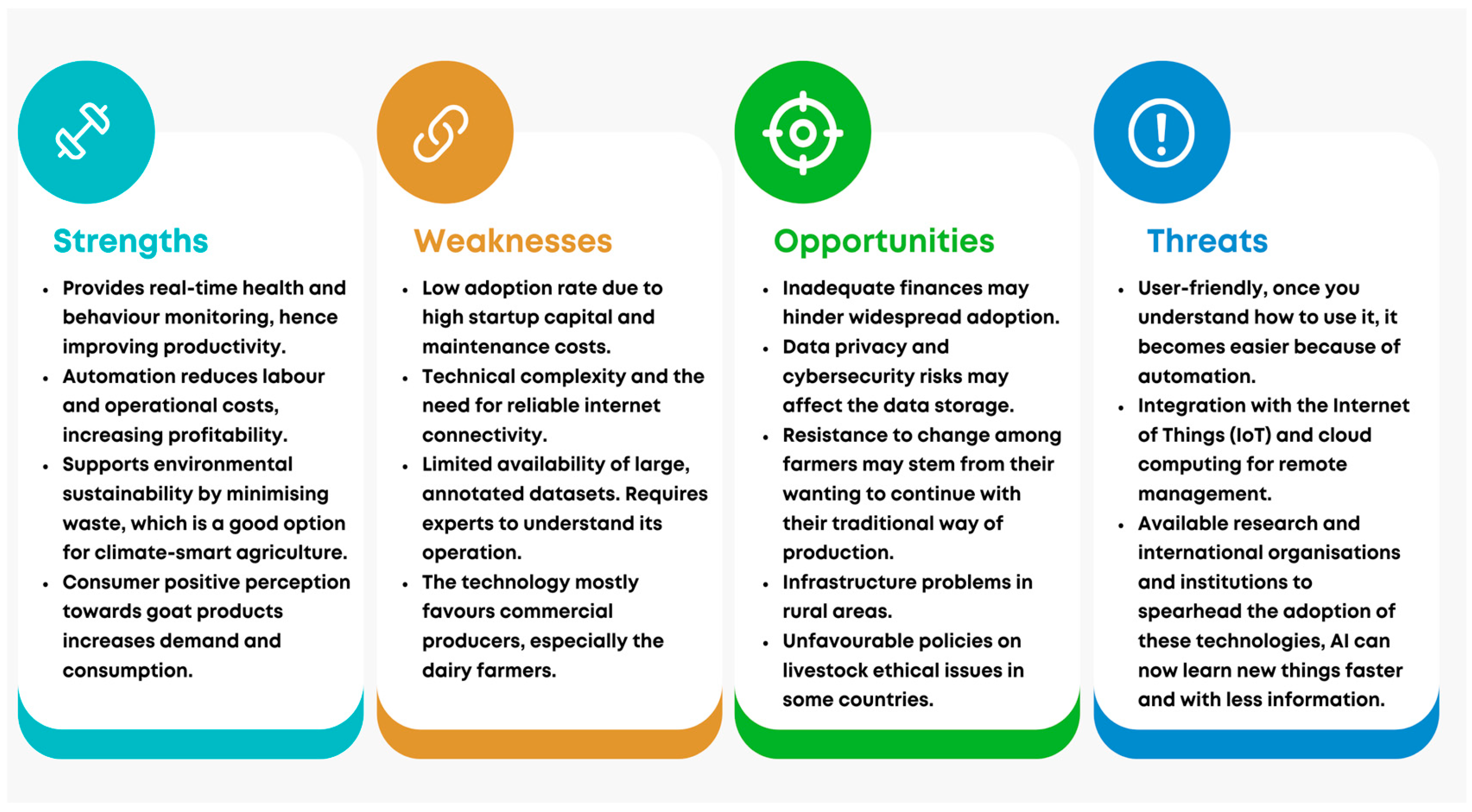
Additionally, a lack of technical know-how may also be a challenge, as the use of this technology requires some level of expertise to understand how to use and interpret the data, as well as to translate it into decision-making [56,57,58]. PLF is a promising enabler of climate-smart agriculture, but effective deployment depends on systematically addressing its strengths and limitations while leveraging context-specific opportunities and mitigating implementation risks. Stakeholders should focus on addressing the threats and weaknesses while capitalizing on the opportunities available. The SWOT analysis, as depicted in Figure 1, helps to organize our findings; it brings together the main challenges that have already been discussed, showcasing how they connect to available opportunities and strengths in the use of PLF in goat husbandry.
Figure 1.
SWOT analysis regarding the use of artificial intelligence and PLF in goats.
An improvement in farmers’ perception of goat products means that there is a need to increase productivity to meet this demand.
Available institutions that could support the spread of the use of PLF include research organizations in various countries, universities, international organizations that deal with livestock productivity, private partners in various sectors, and non-governmental organizations (NGOs).
Case Study on the Effectiveness of PLF in a Resource-Constrained Setting
Araujo et al. [33] examined the use of an advanced IoT framework to evaluate ecosystem services in silvopastoral production systems and monitor the grazing behavior of sheep and goats by mounting a GNSS tracking system with environmental sensors directly on animals. Their results showed that the system successfully captured a high-resolution picture of their movement patterns, grazing intensity and grazing frequency. The system used LoRa communication technology for long-distance data transmission across extensive grazing regions. Reliable connectivity was maintained across open terrain over distances of up to ~6 km with a low-power, solar-assisted system architecture, enabling continuous animal monitoring for up to 37 days. This study showcases the effectiveness of the system across varying terrain and animal behavior conditions, confirming the feasibility of IoT-based livestock monitoring for long-term ecological assessment, unlike commercial livestock trackers that focus on real-time herd positioning. Therefore, this PLF technology offers a low-cost IoT-LoRa solution that can effectively support smallholder goat farmers within extensive production systems.
6. Possible Interventions Likely to Address the Challenges of the Use of PLF
The adoption of PLF technologies could become more attractive to sheep and goat farmers through a collaborative approach involving all stakeholders, including researchers, consultants and extension officers who play a key role in transferring knowledge to end users [59]. In smallholder systems, goats are often managed in mixed herds with cattle and sheep [60], which complicates PLF deployment because species differ in monitoring needs and management targets. This highlights the need for interoperable, multi-species PLF platforms, ideally a single device or system capable of monitoring animals that graze together and are housed together at night. In addition, farmer training and technology literacy are essential for the effective adoption and use of these tools [61].
Effective PLF uptake also requires stronger farmer sensitization and training delivered through practical channels such as field days, on-farm demonstrations and peer-to-peer learning visits to farms already implementing PLF. Achieving this depends on well-resourced extension services that explicitly build PLF literacy and support adoption. Many PLF technologies are designed to monitor a single parameter (e.g., milk automation or behavior monitoring), which increases costs because farmers need to purchase multiple devices to meet different management needs. Therefore, future development should focus on integrated multi-source PLF technologies that can combine genetic, behavioral, environmental, milking and disease-detection functions for more holistic and cost-effective farm management.
In order to bridge the gap between research and farmers’ adoption, there should be favorable policy interventions that address the use of PLF by farmers. In addition, some government incentives, such as subsidies or low-interest loans, could reduce the financial burden on smallholder farmers investing in PLF technologies and encourage their adoption. Additionally, investments in rural digital infrastructure, including reliable Internet and mobile network coverage, are essential to support data transmission and real-time monitoring. Public–private partnerships can facilitate technology customization, affordability, and support that is tailored towards smallholder needs. Finally, clear regulatory frameworks addressing data privacy, ownership and ethical use of PLF-generated data will also build farmer trust and promote their participation.
7. Ethical Issues Regarding the Use of PLF
As PLF technologies present more benefits, it is also important to consider the other side of their social and ethical dimensions too. Multiple studies highlight that the automation of routine farm work may reduce labor requirements, potentially leading to job displacement, especially in rural communities that depend on farm work for livelihoods [61]. Privacy of data and its use is another ethical concern raised regarding the use of PLF, as the collection of extensive farm and animal data raises questions about ownership, security and sharing with third parties [61,62]. Hence, there should be relevant policies and regulations in place to govern the use and sharing of data. Lastly, automation and remote monitoring can minimize direct human–animal interactions, which may affect farmers’ ability to assess animal welfare intuitively [37,63,64]. While PLF can enhance animal welfare through better monitoring, these technologies can unintentionally change the traditional animal husbandry practices and cultural norms of a community. In general, the evidence suggests that while PLF has clear technical and economic benefits, its large-scale use requires careful consideration of its limitations, its socio-economic effects and ethical frameworks. Future research should therefore focus not only on technological performance but also on implementation feasibility, social acceptability and regulatory oversight.
8. Conclusions
This review evaluated a range of PLF-AI technologies, identified barriers to their adoption, especially for smallholder and extensive production systems, and proposed probable integrated engineering solutions for rural smallholder farmers. Goat production is important for livelihoods, food security and cultural practices, particularly in developing countries. Therefore, innovations that improve productivity and support sustainable production are of substantial value to both local communities and national food systems. Evidence summarized in this review indicates that PLF and AI can improve productivity and welfare in goat husbandry, suggesting that these agri-engineering technologies can help to address livestock management challenges in rural areas. This is also relevant to the United Nations Sustainable Development Goals (e.g., SDG 2: Zero Hunger) through improved animal health, productivity and food security.
Multi-sensor fusion platforms (e.g., RFID + GPS + rumen boluses), solar-powered edge computing, and LoRaWAN networks show strong potential for improving monitoring and reducing operational constraints in rural settings. However, adoption remains limited by high initial installation costs, poor and unreliable infrastructure (electricity and Internet connectivity), limited technical skills among non-expert users and cultural perceptions of new technologies. Addressing these barriers requires agri-engineering systems tailored to smallholder needs, including low-cost and low-literacy user interfaces with offline functionality and robust solar-powered edge-AI equipment. Effective and affordable technology transfer can be supported through farmer training and sensitization programs, combined with targeted subsidy frameworks and collaborative partnerships. These measures can strengthen the long-term value of PLF and AI for precision goat farming by improving animal health and welfare, increasing productivity and enhancing climate resilience. Future research should validate these solutions through multi-farm trials in extensive production systems.
Author Contributions
Conceptualization, N.K. and S.K.; methodology, N.K.; writing—original draft preparation, N.K.; writing—review and editing, P.K.A. and S.K.; visualization, P.K.A.; supervision, S.K. All authors have read and agreed to the published version of the manuscript.
Funding
This research received no external funding.
Data Availability Statement
This research did not use any new data.
Acknowledgments
N.K.’s studies were supported by Tempus Public Foundation within the Stipendium Hungaricum Programme and WWF Russell E. Train Education for Nature program project number EF25159, supported by the University of Debrecen Program for Scientific Publication.
Conflicts of Interest
The authors declare no conflicts of interest.
Abbreviations
The following abbreviations were used in this manuscript:
| DNN | Deep neural networks |
| PLF | Precision livestock farming |
| AI | Artificial intelligence |
| IoT | Internet of things |
| RFID | Radio frequency identification |
| GPS | Global positioning system |
| UAV | Unmanned aerial vehicle |
| BCS | Body condition score |
| AVCDs | Automatic vacuum cutting devices |
| e-ID | Electronic identification |
| R-CNN | Region based convolutional neural network |
| ANN | Artificial neural network |
| DMI | Dry matter intake |
| ADG | Average daily gain |
| SVM | Support vector machine |
| pH | Potential of hydrogen |
| MBW | Metabolic body weight |
| AVSO | Automatic vacuum shut off |
| GNSS | Global navigation satellite system |
| UWB | Ultra-wideband |
| NDVI | Normalized difference vegetation index |
References
- Dominiak, K.N.; Pedersen, L.J.; Kristensen, A.R. Spatial modeling of pigs’ drinking patterns as an alarm reducing method I: Developing a multivariate dynamic linear model. Comput. Electron. Agric. 2019, 161, 79–91. [Google Scholar] [CrossRef] [Scilit]
- Dong, Y.; Zhang, X.; Xie, M.; Arefnezhad, B.; Wang, Z.; Wang, W.; Feng, S.; Huang, G.; Guan, R.; Shen, W.; et al. Reference genome of wild goat (Capra aegagrus) and sequencing of goat breeds provide insight into the genic basis of goat domestication. BMC Genom. 2015, 16, 431. [Google Scholar] [CrossRef] [Scilit]
- Food and Agriculture Organization of the United Nations (FAO). FAOSTAT: Livestock Production—Goat Population Preliminary Data. 2024. Available online: https://www.fao.org/faostat/en/#data/QL (accessed on 24 June 2024).
- Mahala, S.; Saini, S.; Kumar, A.; Sharma, R.C.; Gowane, G.R. Genetic trends for the growth rates and Kleiber ratio in Avikalin sheep. Small Rumin. Res. 2020, 189, 106143. [Google Scholar] [CrossRef] [Scilit]
- Nair, M.R.R.; Sejian, V.; Silpa, M.V.; Fonsêca, V.F.C.; de Melo Costa, C.C.; Devaraj, C.; Krishnan, G.; Bagath, M.; Nameer, P.O.; Bhatta, R. Goat as the ideal climate-resilient animal model in tropical environments: Revisiting advantages over other livestock species. Int. J. Biometeorol. 2021, 65, 2229–2240. [Google Scholar] [CrossRef] [Scilit]
- Kichamu, N.; Wanjala, G.; Cziszter, L.T.; Strausz, P.; Astuti, P.K.; Bagi, Z.; Kusza, S. Assessing the population structure and genetic variability of Kenyan native goats under extensive production systems. Sci. Rep. 2024, 14, 16342. [Google Scholar] [CrossRef] [Scilit]
- Morris, S.T. Overview of sheep production systems. In Advances in Sheep Welfare; Woodhead Publishing: Cambridge, UK, 2017; pp. 19–35. [Google Scholar]
- Kichamu, N.; Astuti, P.K.; Wanjala, G.; Strausz, P.; Bagi, Z.; Kusza, S. Indigenous goats of East Africa: A case for conservation and management. Biology 2024, 13, 419. [Google Scholar] [CrossRef] [Scilit] [PubMed]
- Temple, D.; Manteca, X. Animal welfare in extensive production systems is still an area of concern. Front. Sustain. Food Syst. 2020, 4, 545902. [Google Scholar] [CrossRef] [Scilit]
- Fote, F.N.; Mahmoudi, S.; Roukh, A.; Mahmoudi, S.A. Big data storage and analysis for smart farming. In Proceedings of the 5th International Conference on Cloud Computing and Artificial Intelligence Technologies and Applications (CloudTech); IEEE: Piscataway, NJ, USA, 2020; pp. 1–8. [Google Scholar]
- Aquilani, C.; Confessore, A.; Bozzi, R.; Sirtori, F.; Pugliese, C. Precision Livestock Farming technologies in pasture-based livestock systems. Animal 2022, 16, 100429. [Google Scholar] [CrossRef] [Scilit]
- Turing, A.M. Computing machinery and intelligence. In Parsing the Turing Test: Philosophical and Methodological Issues in the Quest for the Thinking Computer; Springer: Dordrecht, The Netherlands, 2007; pp. 23–65. [Google Scholar]
- Tripathi, S. Artificial intelligence: A brief review. In Analyzing Future Applications of AI, Sensors, and Robotics in Society; IGI Global: Hershey, PA, USA, 2021; pp. 1–16. [Google Scholar]
- Kaul, V.; Enslin, S.; Gross, S.A. History of artificial intelligence in medicine. Gastrointest. Endosc. 2020, 92, 807–812. [Google Scholar] [CrossRef] [Scilit]
- Parsons, I.L.; Norman, D.A.; Karisch, B.B.; Webb, S.L.; Stone, A.E.; Proctor, M.D.; Street, G.M. Automated walk-over-weigh system to track daily body mass and growth in grazing steers. Comput. Electron. Agric. 2023, 212, 108113. [Google Scholar] [CrossRef] [Scilit]
- Himu, H.A.; Raihan, A. Precision livestock farming technologies for digitalizing animal husbandry toward sustainability. Glob. Sustain. Res. 2024, 3, 1–14. [Google Scholar] [CrossRef] [Scilit]
- Tzanidakis, C.; Simitzis, P.; Panagakis, P. Precision livestock farming systems: Improving sustainability and efficiency. In Sustainability: Cases and Studies Using Operations Research and Management Science Methods; Springer: Cham, Switzerland, 2023; pp. 285–337. [Google Scholar]
- Berckmans, D. Precision livestock farming technologies for welfare management in intensive livestock systems. Rev. Sci. Tech. 2014, 33, 189–196. [Google Scholar] [CrossRef] [Scilit]
- Michie, C.; Andonovic, I.; Davison, C.; Hamilton, A.; Jonsson, N.; Duthie, C.-A.; Bowen, J.; Gilroy, M. Internet of things enhancing animal welfare and farm efficiency. J. Dairy Res. 2020, 87, 20–27. [Google Scholar] [CrossRef] [Scilit] [PubMed]
- Caja, G.; Carné, S.; Salama, A.A.K.; Ait-Saidi, A.; Rojas-Olivares, M.A.R.; Ovai, M.; Capote, J.; Castro, N.; Argüello, A.; Ayadi, M.; et al. State-of-the-art of electronic identification techniques and applications in goats. Small Rumin. Res. 2014, 121, 42–50. [Google Scholar] [CrossRef] [Scilit]
- Pinna, W.; Sedda, P.; Moniello, G.; Ribó, O. Electronic identification of Sarda goats under extensive conditions. Small Rumin. Res. 2006, 66, 286–290. [Google Scholar] [CrossRef] [Scilit]
- Romero, G.; Bueso-Ródenas, J.; Gascó, M.P.; Díaz, J.R. Automatic cluster removers in Murciano-Granadina goats. Small Rumin. Res. 2015, 128, 54–58. [Google Scholar] [CrossRef] [Scilit]
- Betteridge, K.; Hoogendoorn, C.; Costall, D.; Carter, M.; Griffiths, W. Sensors for detecting urine patches in grazing livestock. Comput. Electron. Agric. 2010, 73, 66–73. [Google Scholar] [CrossRef] [Scilit]
- Alejandro, M. Automation devices in sheep and goat milking. Small Rumin. Res. 2016, 142, 48–50. [Google Scholar] [CrossRef] [Scilit]
- Ait-Saidi, A.; Caja, G.; Salama, A.A.K.; Carné, S.; Ghirardi, J.J. Manual vs. semiautomatic milk recording in dairy goats. J. Dairy Sci. 2008, 91, 1438–1442. [Google Scholar] [CrossRef] [Scilit]
- Ait-Saidi, A.; Caja, G.; Salama, A.A.K.; Carné, S. Electronic identification for performance recording in sheep. J. Dairy Sci. 2014, 97, 7505–7514. [Google Scholar] [CrossRef] [Scilit]
- Al-Thani, N.; Albuainain, A.; Alnaimi, F.; Zorba, N. Drones for sheep monitoring. In Proceedings of the 2020 IEEE 20th Mediterranean Electrotechnical Conference (MELECON); IEEE: Piscataway, NJ, USA, 2020; pp. 672–676. [Google Scholar]
- Xu, B.; Wang, W.; Falzon, G.; Kwan, P.; Guo, L.; Sun, Z.; Li, C. Livestock classification using Mask R-CNN. Int. J. Remote Sens. 2020, 41, 8121–8142. [Google Scholar] [CrossRef] [Scilit]
- Singh, B.; Das, A.; Bhakat, C.; Mishra, B.; Elangbam, S.; Sinver, M.; Ambili, K.S.; Tarafdar, A. Prediction of dry matter intake in goats using ANN. Trop. Anim. Health Prod. 2025, 57, 42. [Google Scholar] [CrossRef] [Scilit] [PubMed]
- Ren, K.; Karlsson, J.; Liuska, M.; Hartikainen, M.; Hansen, I.; Jørgensen, G.H.M. Sensor fusion system for sheep tracking. Int. J. Distrib. Sens. Netw. 2020, 16, 1–10. [Google Scholar] [CrossRef] [Scilit]
- Chebli, Y.; El Otmani, S.; Hornick, J.L.; Keli, A.; Bindelle, J.; Chentouf, M.; Cabaraux, J.F. GPS collars for grazing behavior analysis in goats. Sensors 2022, 22, 781. [Google Scholar] [CrossRef] [Scilit]
- Jahrizal, J.; Dalil, M.; Amri, R.; Yovita, I.; Koto, J.; Faruq, U.; Junaedi, A.T.; Tendra, G.; Renaldo, N.; Mammadova, U. Enhancing Goat and Sheep Farm Management with IoT-Enabled Weighing Devices. Seroja J. Empower. Community Serv. 2025, 1, 23–27. [Google Scholar]
- Belanche, A.; Fernández-Álvarez, J.; Martín García, A.I.; Yáñez Ruiz, D.R. Eskardillo: A platform based on individual animal data collection to improve decision making in dairy goat farms. In Innovation for Sustainability in Sheep and Goats; Ruiz, R., López-Francos, A., López Marco, L., Eds.; Options Méditerranéennes: Série A. Séminaires Méditerranéens; No. 123; CIHEAM: Zaragoza, Spain, 2019; pp. 323–329. [Google Scholar]
- Araujo, M.; Leitão, P.; Castro, M.; Castro, J.; Bernuy, M. Development of an IoT-Based Device for Data Collection on Sheep and Goat Herding in Silvopastoral Systems. Sensors 2024, 24, 5528. [Google Scholar] [CrossRef] [Scilit] [PubMed]
- Quispe, M.; Trigo, J.D.; Serrano-Arriezu, L.; Huere, J.; Quispe, E.; Beruete, M. Classification of South American Camelid and goat fiber samples based on fourier transform infrared spectroscopy and machine learning. J. Text. Inst. 2025, 116, 198–207. [Google Scholar] [CrossRef] [Scilit]
- Castro-Costa, A.; Salama, A.A.K.; Moll, X.; Aguiló, J.; Caja, G. Using wireless rumen sensors for evaluating the effects of diet and ambient temperature in nonlactating dairy goats. J. Dairy Sci. 2015, 98, 4646–4658. [Google Scholar] [CrossRef] [Scilit]
- Morrone, S.; Dimauro, C.; Gambella, F.; Cappai, M.G. Industry 4.0 and precision livestock farming (PLF): An up-to-date overview across animal productions. Sensors 2022, 22, 4319. [Google Scholar] [CrossRef] [Scilit]
- Silva, S.R.; Sacarrão-Birrento, L.; Almeida, M.; Ribeiro, D.M.; Guedes, C.; González Montaña, J.R.; Pereira, A.F.; Zaralis, K.; Geraldo, A.; Tzamaloukas, O.; et al. Extensive sheep and goat production: The role of novel technologies towards sustainability and animal welfare technologies. Animals 2022, 12, 885. [Google Scholar] [CrossRef] [Scilit]
- Tangorra, F.M.; Costa, A.; Guidobono Cavalchini, A. Preliminary results of a field study on goats’ milk yield and lactation persistency as affected by automatic cluster removals. In Proceedings of the International Conference Ragusa SHWA2010—Work Safety and Risk Prevention in Agro-Food and Forest Systems, Ragusa, Italy, 16–18 September 2010; CIGR (International Commission of Agricultural and Biosystems Engineering): Gainesville, FL, USA; pp. 592–598.
- Morgan-Davies, C.; Lambe, N.; Wishart, H.; Waterhouse, T.; Kenyon, F.; McBean, D.; McCracken, D. Impacts of using a Precision livestock systems targeted approach in mountain sheep flocks. Livest. Sci. 2018, 208, 67–76. [Google Scholar] [CrossRef] [Scilit]
- Gebre, K.T.; Agegnehu, F.; Teweldemedhn, T.G.; Bariagabre, S.A.; Hagos, T.H. Breeding objectives and economic value of important traits of Abergelle goats kept under a smallholder production system in Tigray, Ethiopia. Anim. Prod. Sci. 2024, 64, AN23298. [Google Scholar] [CrossRef] [Scilit]
- González-García, E.; Alhamada, M.; Pradel, J.; Douls, S.; Parisot, S.; Bocquier, F.; González, L.A. A mobile and automated walk-over-weighing system for close and remote monitoring of liveweight in sheep. Comput. Electron. Agric. 2018, 153, 226–238. [Google Scholar] [CrossRef] [Scilit]
- Nirmalkumar, S.S.; Krishna, M.; Archangel, J.A. Precision livestock farming techniques. In Smart Technologies for Sustainable Livestock Systems; CRC Press: Boca Raton, FL, USA, 2025; pp. 124–142. [Google Scholar]
- Nunes, L.A.A.; Queiroz, M.A.A.; Menezes, D.R.; Sant’ana, A.S.; Silva, A.P.R.; Araújo, E.J.B.; Lima, A.G.V.O.; Cruz, C.H.; Silva, C.S.; Nunes, T.S.S.; et al. Yield and composition of milk in goats fed Pornunça hay and cactus pear. Obs. Econ. Latinoam. 2025, 23, e9502. [Google Scholar] [CrossRef] [Scilit]
- Ma’sum, H.; Hendriyati, H.; Septiana, I.; Embatau, G.G. Analysis of factors affecting consumer behavior and marketing performance in the livestock industry. Indones. J. Bus. Entrep. Res. 2024, 2, 167–174. [Google Scholar] [CrossRef] [Scilit]
- Moorby, J.M.; Fraser, M.D. New feeds and new feeding systems in intensive and semi-intensive forage-fed ruminant livestock systems. Animal 2021, 15, 100297. [Google Scholar] [CrossRef] [Scilit] [PubMed]
- Sanderson, M.A.; Rotz, C.A.; Fultz, S.W.; Rayburn, E.B. Estimating forage mass with capacitance meters and pasture rulers. Agron. J. 2001, 93, 1281–1286. [Google Scholar] [CrossRef] [Scilit]
- Weiss, M.; Jacob, F.; Duveiller, G. Remote sensing for agricultural applications: A meta-review. Remote Sens. Environ. 2020, 236, 111402. [Google Scholar] [CrossRef] [Scilit]
- Edwards, J.P.; Qasim, M.; Bryant, R.H.; Thomas, C.; Wright-Watson, C.; Zobel, G.; Neal, M.B.; Eastwood, C.R. On-animal sensors for predicting paddock-level pasture mass in rotationally grazed dairy systems. Comput. Electron. Agric. 2024, 219, 108779. [Google Scholar] [CrossRef] [Scilit]
- Defalque, G.; Santos, R.; Bungenstab, D.; Echeverria, D.; Dias, A.; Defalque, C. Machine learning models for dry matter and biomass estimates on cattle grazing systems. Comput. Electron. Agric. 2024, 216, 108520. [Google Scholar] [CrossRef] [Scilit]
- Barbedo, J.G.A.; Koenigkan, L.V.; Santos, T.T.; Santos, P.M. A study on the detection of cattle in UAV images using deep learning. Sensors 2019, 19, 5436. [Google Scholar] [CrossRef] [Scilit]
- Zhang, J.; Khoshbakht, M.; Liu, J.; Gou, Z.; Xiong, J.; Jiang, M. A clustering review of vegetation-indicating parameters in urban thermal environment studies towards various factors. J. Therm. Biol. 2022, 110, 103340. [Google Scholar] [CrossRef] [Scilit]
- Astuti, P.K.; Sárkány, P.; Wanjala, G.; Bagi, Z.; Kusza, S. A systematic review on the trend of transcriptomic study in livestock: An effort to unwind the complexity of adaptation in a climate change environment. Heliyon 2024, 11, e41090. [Google Scholar] [CrossRef] [Scilit] [PubMed]
- Si, Q. Advancements in Precision Livestock Farming: Technologies and Applications. Anim. Mol. Breed. 2024, 14, 130–140. [Google Scholar]
- Papakonstantinou, G.I.; Voulgarakis, N.; Terzidou, G.; Fotos, L.; Giamouri, E.; Papatsiros, V.G. Precision livestock farming technology: Applications and challenges of animal welfare and climate change. Agriculture 2024, 14, 620. [Google Scholar] [CrossRef] [Scilit]
- Murphy, D.J.; Murphy, M.D.; O’Brien, B.; O’Donovan, M. Precision technologies for optimizing pasture measurement on Irish grasslands. Agriculture 2021, 11, 600. [Google Scholar]
- Pardo, G.; del Prado, A.; Fernández-Álvarez, J.; Yáñez-Ruiz, D.R.; Belanche, A. Influence of precision livestock farming on environmental performance of intensive dairy goat farms. J. Clean. Prod. 2022, 351, 131518. [Google Scholar] [CrossRef] [Scilit]
- Schillings, J.; Bennett, R.; Rose, D.C. Animal welfare and other ethical implications of Precision Livestock Farming technology. CABI Agric. Biosci. 2021, 2, 17. [Google Scholar] [CrossRef] [Scilit]
- Akinyemi, B.E.; Vigors, B.; Turner, S.P.; Akaichi, F.; Benjamin, M.; Johnson, A.K.; Pairis-Garcia, M.D.; Rozeboom, D.W.; Steibel, J.P.; Thompson, D.P.; et al. Precision Livestock Farming: A Qualitative Exploration of Swine Industry Stakeholders. Front. Anim. Sci. 2023, 4, 1150528. [Google Scholar] [CrossRef] [Scilit]
- Guo, C.; He, Z.; Niu, M.; Liu, K. Navigating AI deployment in precision livestock farming: Current trends and future prospects. Anim. Front. 2025, vfaf050. [Google Scholar] [CrossRef] [Scilit]
- Morgan-Davies, C.; Tesnière, G.; Gautier, J.M.; Jørgensen, G.H.M.; González-García, E.; Patsios, S.I.; Sossidou, E.N.; Keady, T.W.; McClearn, B.; Kenyon, F.; et al. Exploring the use of precision livestock farming for small ruminant welfare management. Animal 2024, 18, 101233. [Google Scholar] [CrossRef] [Scilit] [PubMed]
- Werkheiser, I. Precision livestock farming and farmers’ duties to livestock. J. Agric. Environ. Ethics 2018, 31, 181–195. [Google Scholar] [CrossRef] [Scilit]
- Elliott, K.C.; Werkheiser, I. A framework for transparency in precision livestock farming. Animals 2023, 13, 3358. [Google Scholar] [CrossRef] [Scilit]
- Neethirajan, S.; Kemp, B. Digital livestock farming. Sens. Bio-Sens. Res. 2021, 32, 100408. [Google Scholar] [CrossRef] [Scilit]

Disclaimer/Publisher’s Note: The statements, opinions and data contained in all publications are solely those of the individual author(s) and contributor(s) and not of MDPI and/or the editor(s). MDPI and/or the editor(s) disclaim responsibility for any injury to people or property resulting from any ideas, methods, instructions or products referred to in the content. |
© 2026 by the authors. Licensee MDPI, Basel, Switzerland. This article is an open access article distributed under the terms and conditions of the Creative Commons Attribution (CC BY) license.