1. Introduction
Efficient irrigation under mounting water and food security pressures depends not only on when water is applied but also on how uniformly it is distributed across the field surface [
1,
2]. Nonuniform application reduces crop performance and wastes water, energy, and nutrients, thereby lowering economic returns and amplifying environmental impacts [
1,
3]. For traveling gun systems, long throws and elevated jets increase exposure to wind-induced drift, range shortening, centroid shifts, and anisotropic, lobe-like patterns that complicate towpath spacing decisions [
4,
5]. Wind speed and direction thus distort the radial pattern, displace the application centroid downwind, and reduce uniformity coefficients as wind intensity increases, creating under- and over-irrigated zones along the irrigated strip [
4,
6]. By contrast, stationary solid-set layouts can maintain high uniformity with relatively small drift losses under favorable conditions, underscoring the need to account for site-specific wind behavior when designing and scheduling traveler operations [
7,
8]. Recent reviews further emphasize efficiency gains from tighter coupling between operation and local meteorology, including model-based “digital twin” approaches for sprinkler systems [
2,
9,
10].
Field and modeling studies indicate that both wind speed and wind incidence relative to the towpath (φ; φ = 0° for winds parallel to the towpath and φ = 90° for perpendicular winds) shape cross-track application profiles and the sensitivity of Christiansen’s uniformity coefficient (UC) to towpath spacing [
6]. When winds blow nearly parallel to the towpath (φ ≈ 0°), the effective swath tends to narrow, and UC becomes more sensitive to spacing, so tighter lane spacing is typically required to maintain acceptable uniformity [
5]. Threshold analyses further suggest that mean wind speeds (WS) of ~2 m s
−1 can already cause noticeable reductions in sprinkler-application uniformity and may translate into yield penalties under field conditions [
3]. Because nighttime conditions are often characterized by lower, less variable winds, sprinkler operation at night has been reported to improve uniformity and reduce wind drift and evaporation losses compared with daytime irrigation [
7,
11]. Consistently, higher performance and more minor yield penalties under nighttime sprinkler irrigation have been documented in comparison with daytime operation [
8,
12].
Because controlled field trials with prescribed wind speeds and directions are tough to conduct for gun sprinklers, physically based simulation offers a practical means to explore towpath spacing, alignment, and scheduling under realistic wind scenarios [
1]. Digital simulations have been used to evaluate nozzle configurations, operating pressure, and wetted sector angles for traveler machines, reducing field effort while delineating feasible operating envelopes [
13,
14]. In parallel, recent reviews highlight the evolution of sprinkler modeling toward integrated, field-scale decision-support tools that couple local meteorology with system and management settings to test “what-if” strategies under diurnal wind variability [
9,
15]. Foundational aerodynamic–ballistic formulations and more recent refinements reproduce key wind-induced phenomena such as range shortening and two-dimensional pattern asymmetry, enabling profile-based evaluation, spatial mapping of applied depth, and centroid-based diagnostics [
4,
16,
17].
Previous field and modelling studies on traveling gun irrigation have often examined the effects of wind speed and wind direction on application patterns and uniformity, but typically not in a way that jointly resolves WS, φ, and day–night wind regimes into spacing guidance [
3,
4,
6]. Nighttime operation has been reported to improve sprinkler performance under milder winds [
7,
8], and early traveler assessments highlighted the importance of travel-axis alignment [
5]. However, few studies have systematically quantified the combined influence of WS, φ, and day–night wind regimes on UC and the resulting towpath spacing recommendations for traveling guns systems [
11,
12]. Accordingly, the present study addresses this gap by combining class-based simulations with local daytime and nighttime wind-frequency data to drive traveler simulations across practical spacings expressed as a fraction of the wetted diameter (WD) and representative WS and φ. The specific objectives were to: (i) quantify the contrast between daytime and nighttime UC as a function of towpath spacing under realistic diurnal wind regimes; and (ii) assess the relative influence of WS and φ on UC–spacing responses.
2. Materials and Methods
Fifty-three one-hour field tests assessed spatial water distribution under variable wind conditions (
Table 1) using a Plona RL250 slow-reverse gun sprinkler. The sprinkler’s operational characteristics (nozzle diameters and operational pressures) were defined based on manufacturer specifications and previous field validations. The sprinkler had a conical brass main nozzle with diameters of 14, 16, 18, 20, and 22 mm. An auxiliary conical plastic nozzle, with diameters of 5, 6, and 7 mm, was also used, or absent. The operational pressures (OP) applied during the tests were 392 and 490 kPa. OP at the sprinkler nozzle height was measured with a manometer (range: 0–785 kPa; accuracy: ±5 kPa), and pressure was controlled using a gate valve.
Water application was measured using catch cans (diameter: 83.5 mm, height: 190 mm) arranged in a 14 × 14 grid with a spacing of 6 m, covering an area of 84 × 84 m, to obtain observed water distribution patterns. The cans were placed 0.5 m above the soil surface, with the sprinkler positioned at the center of the grid. The sprinkler nozzles were set 1.25 m above the soil surface, resulting in a 0.75 m height difference between the nozzle and the catch can openings. Wind speed and direction were recorded at 5 min intervals using an anemometer (Weather Monitor II, Davis Instruments, Hayward, CA, USA) installed at a height of 2 m above the soil surface. Five reference catch cans were placed 20 m from the test area to account for evaporation. These cans were filled with water, and their volume was measured before and after each test. The collected water volumes were then corrected by adding half of the observed evaporation to the recorded values, so that the combined effects of air temperature and relative humidity on evaporation were implicitly accounted for. Although the catch-can procedure is subject to reading and placement uncertainties (and wind-related disturbances), these uncertainties were not formally quantified in this study; however, the same equipment and protocol were applied consistently across all field tests, so any residual measurement uncertainty is expected to affect the absolute depths similarly and not alter the comparative conclusions.
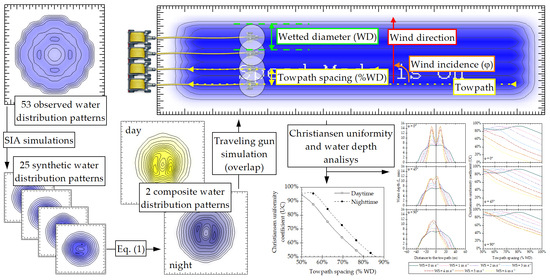
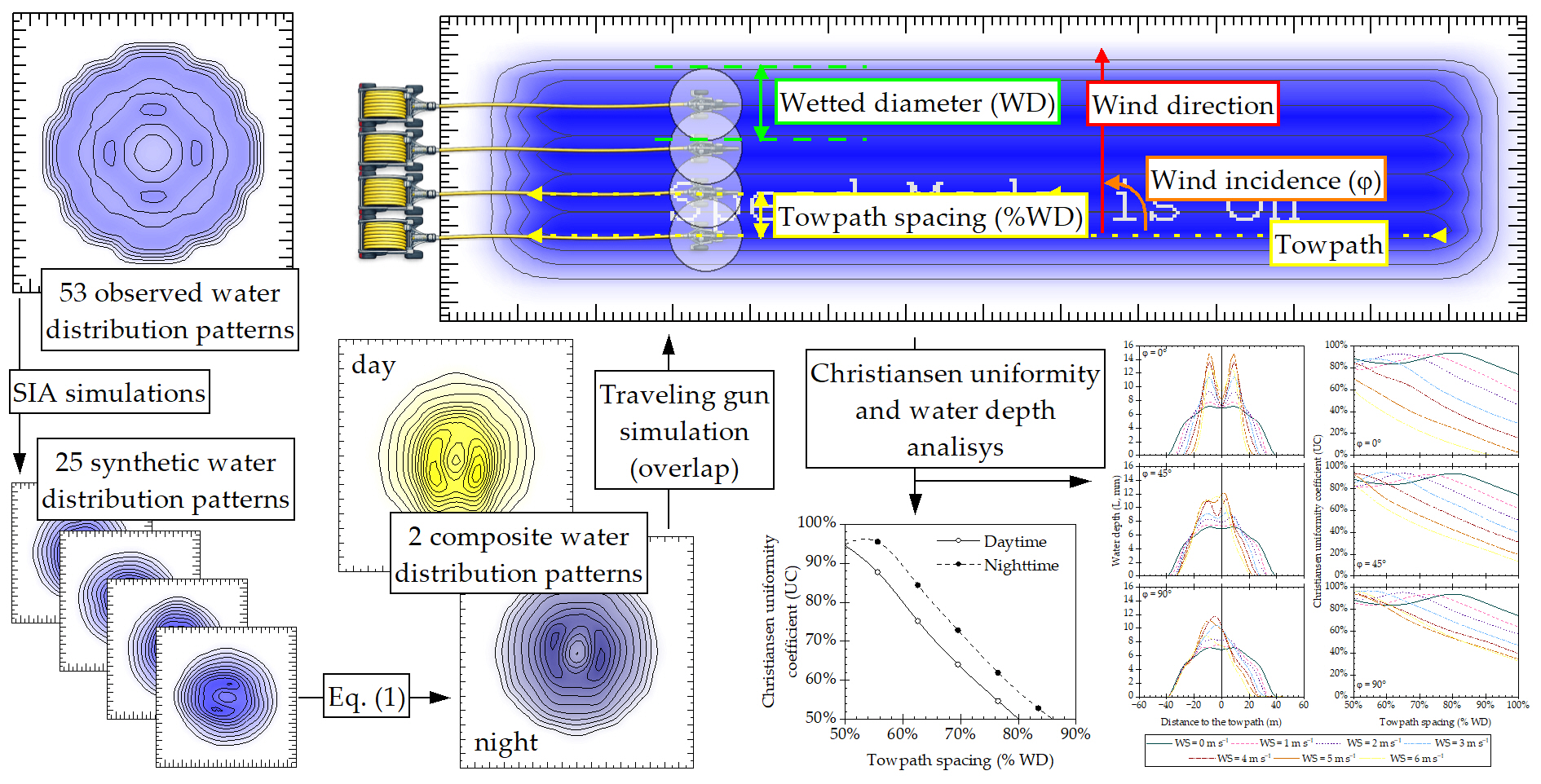
Using the observed water distribution patterns, the Simulation Model for Sprinkler Irrigation (Simulação da Irrigação por Aspersão—SIA; [
13]) was employed to generate synthetic water distribution patterns on the same 14 × 14 grid (6 m spacing) used in the field tests. The SIA model was previously calibrated and validated against sprinkler application-depth profiles and Christiansen’s uniformity coefficients (UC) derived from field catch-can tests under diverse operating and wind conditions, showing high agreement between simulated and observed water distributions [
13]. In SIA, the Richards & Weatherhead approach accounts for wind effects on the pattern by adjusting the calm radial distribution to shorten the throw against the wind, extend it downwind, and redistribute application intensity azimuthally as a function of wind speed and direction [
4]. This formulation assumes steady, horizontally uniform winds and does not explicitly resolve small-scale gustiness or detailed droplet-size dynamics, which constitute limitations of the simulations. Therefore, the reported UC values should be interpreted as model-based estimates under the stated assumptions, and no formal uncertainty propagation or confidence intervals were derived for the simulated outputs
Wind conditions were discretized into 25 classes (j) by combining eight wind directions (N, NE, E, SE, S, SW, W, NW) with three wind speed bins (0–2, 2–4, 4–6 m s
−1), plus a calm (no-wind) category. For each class j, SIA was used to simulate a synthetic water application rate (i
jk) on the 14 × 14 grid, where index k denotes a grid point of the single-sprinkler pattern (196 nodes at 6 m spacing in both directions). These 25 class-specific synthetic water distribution patterns served as the basis for constructing composite daytime and nighttime water distribution patterns. To compose class-specific simulations into representative daytime (07:00–18:59) and nighttime (19:00–06:59) water distribution patterns, the composite application rate (i
k) at each grid point was computed using a frequency-weighted sum (Equation 1).
where i
k is the composite application rate (mm h
−1) at grid point k; i
jk is the synthetic application rate under class j (direction × wind-speed bin, including calm) at grid point k; p
j is the frequency (decimal) of class j; and n is the number of j classes (n = 25).
Wind frequencies (p
j) were derived from the Brazilian National Institute for Space Research (INPE) automatic weather station at the Goiano Federal Institute, Ceres campus (15°20′52″ S, 49°36′06″ W). Hourly records were tallied separately for daytime and nighttime to obtain the relative frequency of each class (
Table 2). Frequencies are expressed in decimals and, within each window, sum to unity.
To characterize the composite water distribution patterns before the traveler simulations, four diagnostics were computed on the same 6 m × 6 m grid used for i(x,y) (mm h−1). The wetted domain was defined as the set of grid cells with i(x,y) > 0. Peak and mean were the maximum and the arithmetic mean of i over the wetted domain, and the peak-to-mean ratio (P/M) was peak/mean. The anisotropy index (AI) was derived from the 50%-of-peak isorate: cells with i ≥ 0.5 × peak formed a binary mask; the spans along x and y (Δx50 and Δy50) were computed as max(x) − min(x) and max(y) − min(y) within that mask, and AI was max(Δx50, Δy50)/min(Δx50, Δy50). AI is used here as a relative numerical indicator of pattern anisotropy to compare composite patterns, rather than as an absolute performance threshold; values close to 1.0 indicate nearly circular patterns, whereas higher values reflect increasing elongation of the 50%-peak isorate ellipse. The centroid shift used the intensity-weighted centroid (x_c, y_c), with x_c = Σ(i·x)/Σi and y_c = Σ(i·y)/Σi; the shift was the distance r_c = √(x_c2 + y_c2) from the sprinkler at the origin. The high-rate area was defined as the percentage of wetted cells with i ≥ 1.25 × the mean.
These composite water distribution patterns provided the input for the uniformity analysis under traveler operation. To assess the performance of travelling guns under varying towpath spacings, a cross-track water-depth profile was obtained from each composite pattern by integrating the application rate along the travel direction under a fixed pass time [
1]. The depth at cross-track position u (L
u) was computed as in Equation (2), using the composite pattern on the same grid and the travel speed (v). In Equation (2), indices (u,q) refer to the two-dimensional grid used in the traveler simulation, with u denoting the cross-track position (perpendicular to the travel direction) and q denoting the position along the travel direction.
where L
u is the water depth (mm) at cross-track position u; i
(u,q) is the application rate (mm h
−1) at grid node (u,q) of the composite pattern; Δx is the grid spacing in the along-track direction (m); v is the linear travel speed (m h
−1); and n
along is the number of grid nodes summed along the travel direction.
The travelling gun was simulated by laterally overlapping the cross-track depth profile, perpendicular to the travel direction, and summing copies shifted by the towpath spacing, while preserving the composite grid resolution. The towpath spacing was evaluated both in meters and as a percentage of the wetted diameter (WD). To avoid edge effects, the overlap was computed on a periodically tiled field that was large enough to render border contributions negligible. The uniformity calculation used an interior evaluation window consistent with the overlapped swath. Uniformity was quantified with Christiansen’s coefficient (UC) computed on the overlapped depths within the evaluation window, as in Equation (3).
where UC is the Christiansen uniformity coefficient (%); L
i is the overlapped water depth (mm) at sampling point i within the evaluation window; L
mean is the arithmetic mean of the L
i values; and n is the number of sampling points used in the calculation.
Depths Li were obtained from the lateral overlap of the cross-track profile derived in Equation (2). UC is reported as a percentage; differences in UC between scenarios are expressed in percentage points.
3. Results
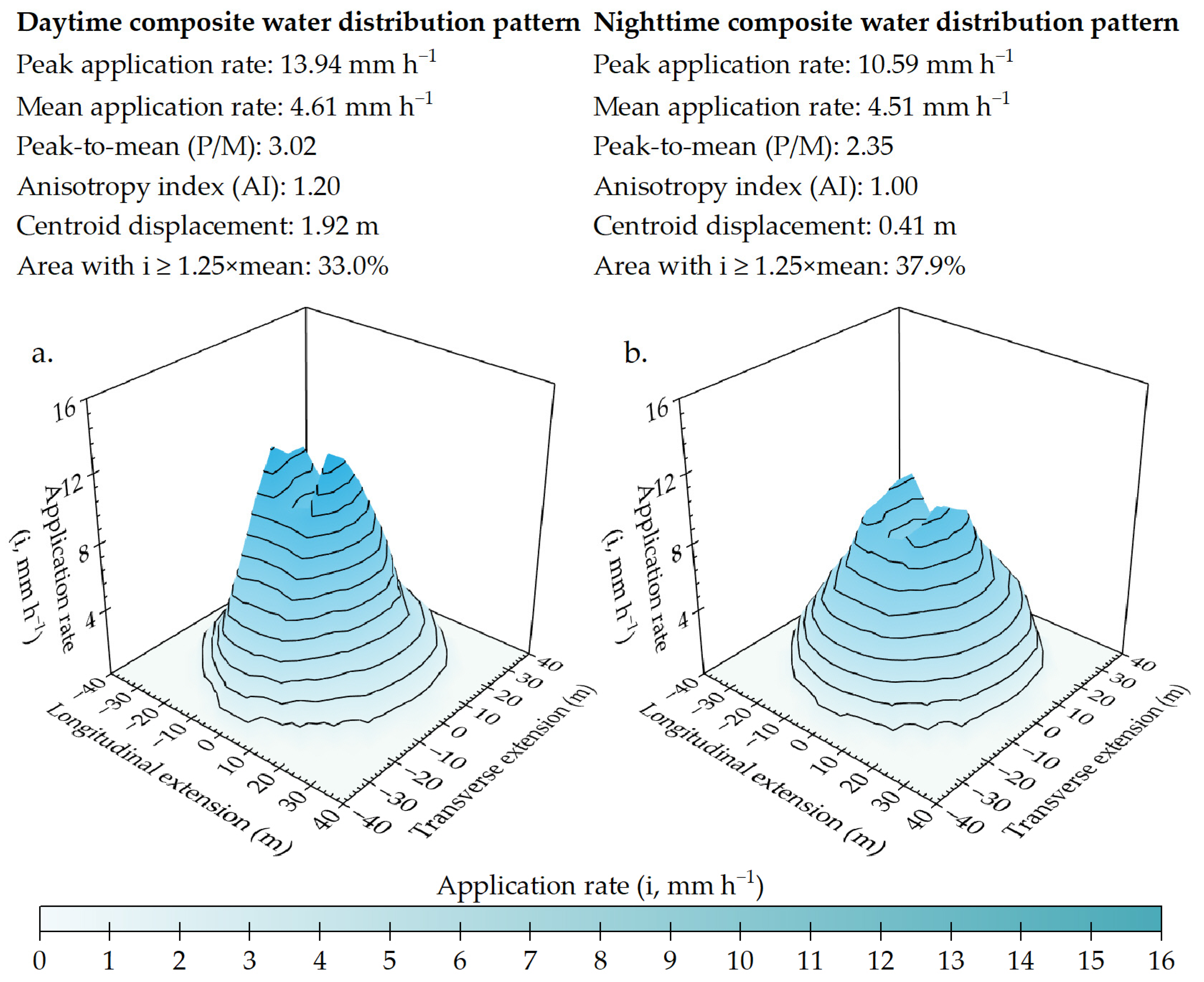
The composite application-rate patterns for daytime and nighttime exhibit the characteristic wind-induced anisotropy (
Figure 1). Compared with the nighttime field, the daytime pattern is more peaked and elongated along-wind: the peak application rate was 13.94 vs. 10.59 mm h
−1, while the mean remained nearly unchanged (4.61 vs. 4.51 mm h
−1). Accordingly, the peak-to-mean ratio (P/M) was higher during the day (3.02 vs. 2.35), and the anisotropy index (AI, major/minor axis at the 50%-of-peak isorate contour) was 1.20 vs. 1.00, indicating a near-circular nighttime field. The centroid shift was also larger by day (1.92 m vs. 0.41 m), consistent with stronger advection. Despite the lower peak at night, the area with rates ≥ 1.25× mean was broader (37.9% vs. 33.0%), indicating a flatter, more isotropic dome. These features are expected to yield higher uniformity for nighttime operation at the same towpath spacing.
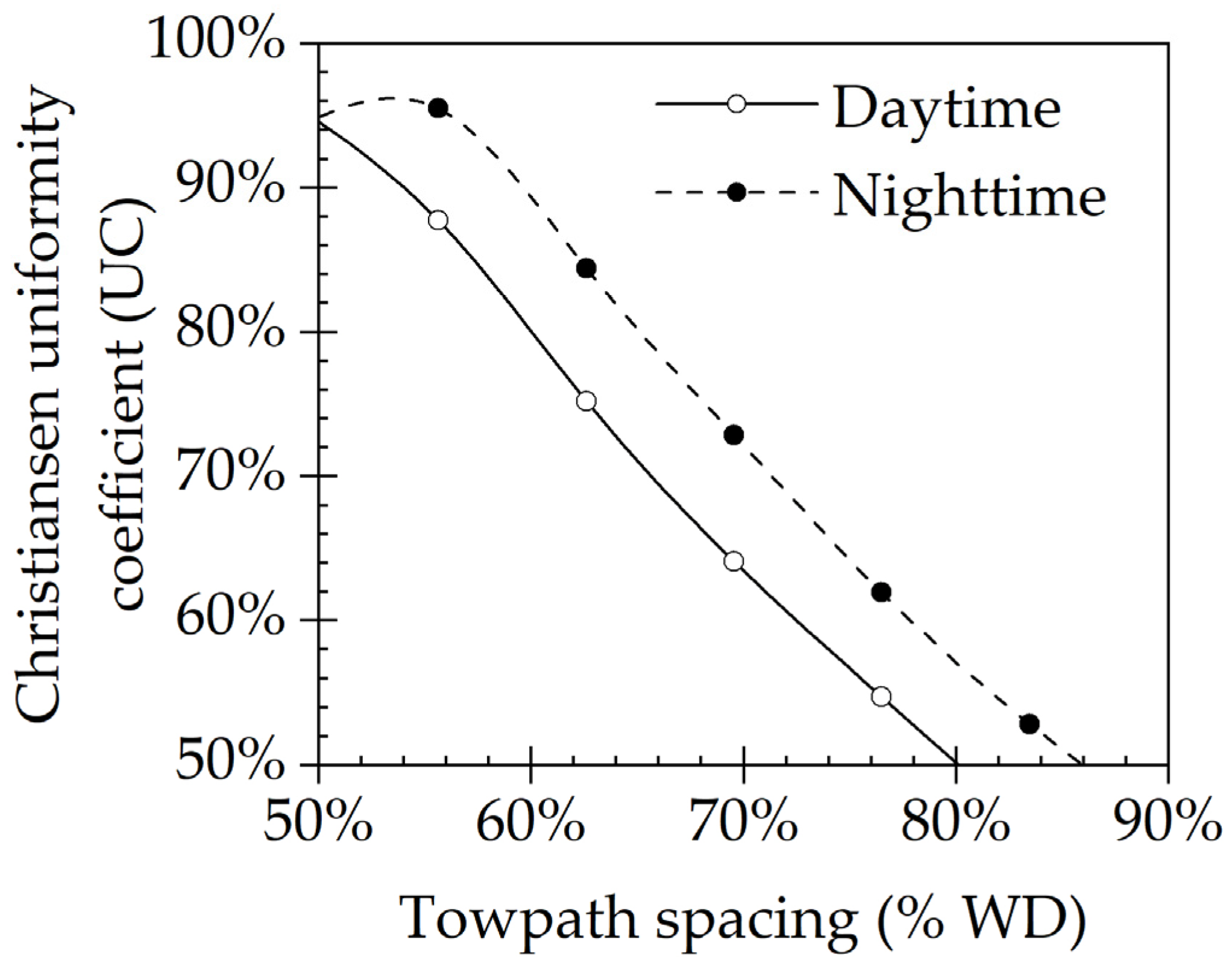
UC decreased monotonically with increasing towpath spacing for both daytime and nighttime operation (
Figure 2). The curves intersect near 50% of WD; beyond this point, nighttime UC remains higher. The nighttime advantage peaks around 62.6% WD (ΔUC ≈ +9.2 percentage points) and typically ranges from +6 to +9 points between 55% and 90% WD. In practical terms, the same UC can be achieved with ~+5–6% WD larger spacing at night: for UC ≈ 80%, the required spacing was ≈59.9% WD (day) vs. ≈65.2% WD (night); for UC ≈ 70%, ≈65.8% vs. ≈71.4% WD; and for UC ≈ 60%, ≈72.6% vs. ≈78.0% WD.
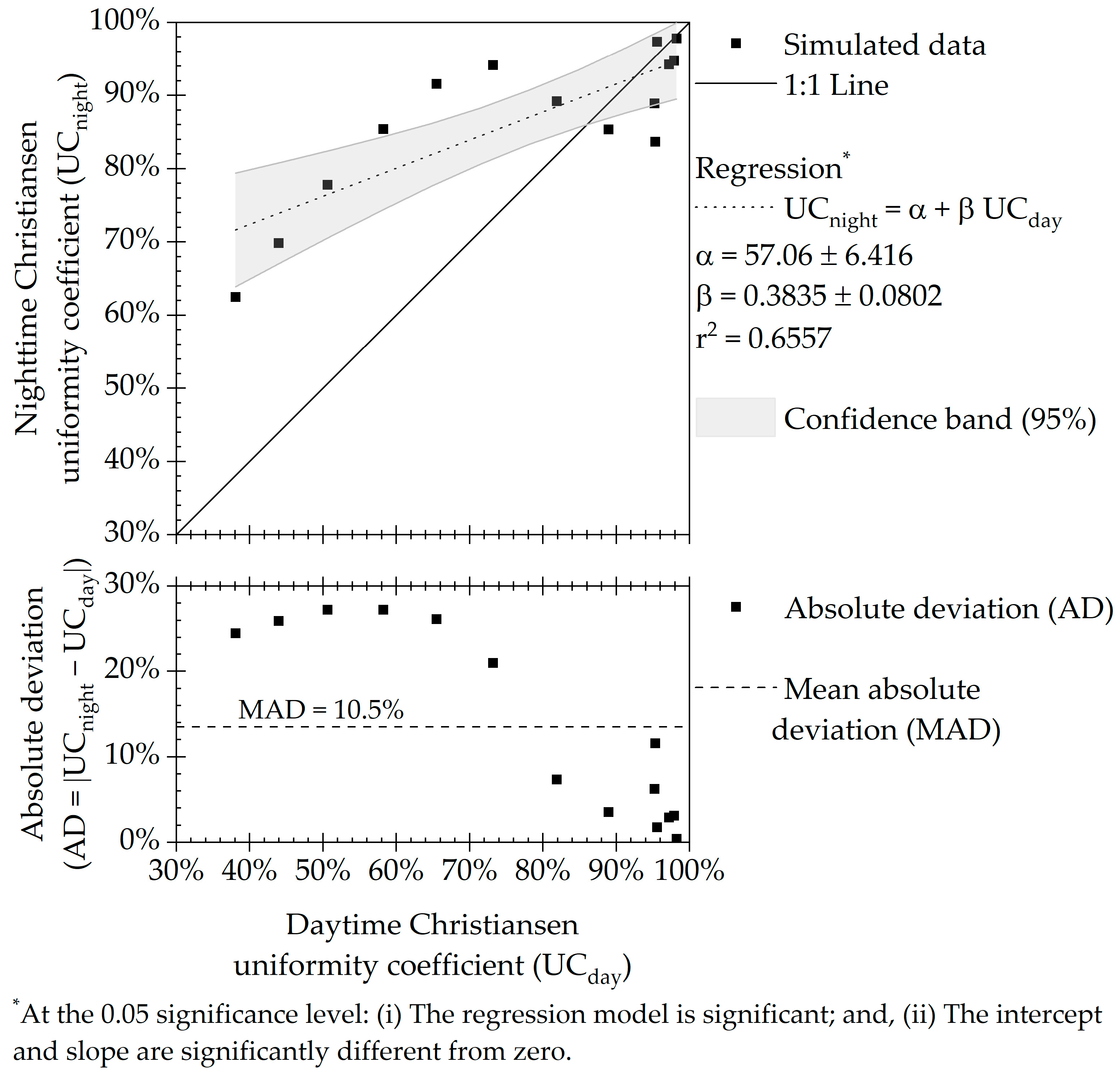
Nighttime UC (UC
night) exceeded daytime UC (UC
day) across the simulated conditions (
Figure 3). The scatter of points lies predominantly above the 1:1 line, and the fitted trend shows a large positive intercept with a slope below one, indicating a nighttime “floor” of uniformity when UC
day is low and a diminishing nighttime advantage as UC
day increases—consistent with
Figure 2. A simple linear regression quantified the relationship: UC
night = 57.06 ± 6.42 + (0.3835 ± 0.0802)·UC
day (r
2 = 0.6557; model, intercept, and slope
p < 0.05). The slope < 1, together with a positive intercept, implies larger nighttime gains at low UC
day that taper as UC
day approaches 100%. For illustration, the model predicts UC
night ≈ 80.1% at UC
day = 60% (Δ ≈ +20.1 percentage points), 87.7% at 80% (Δ ≈ +7.7 p.p.), and 91.6% at 90% (Δ ≈ +1.6 p.p.). Variability is also structured: the absolute deviation between UC
night and UC
day declines as UC
day rises, with a mean absolute deviation of ~10.5 p.p. across spacings. In practical terms, the nighttime gain is largest at moderate UC
day and converges toward zero at high UC
day.
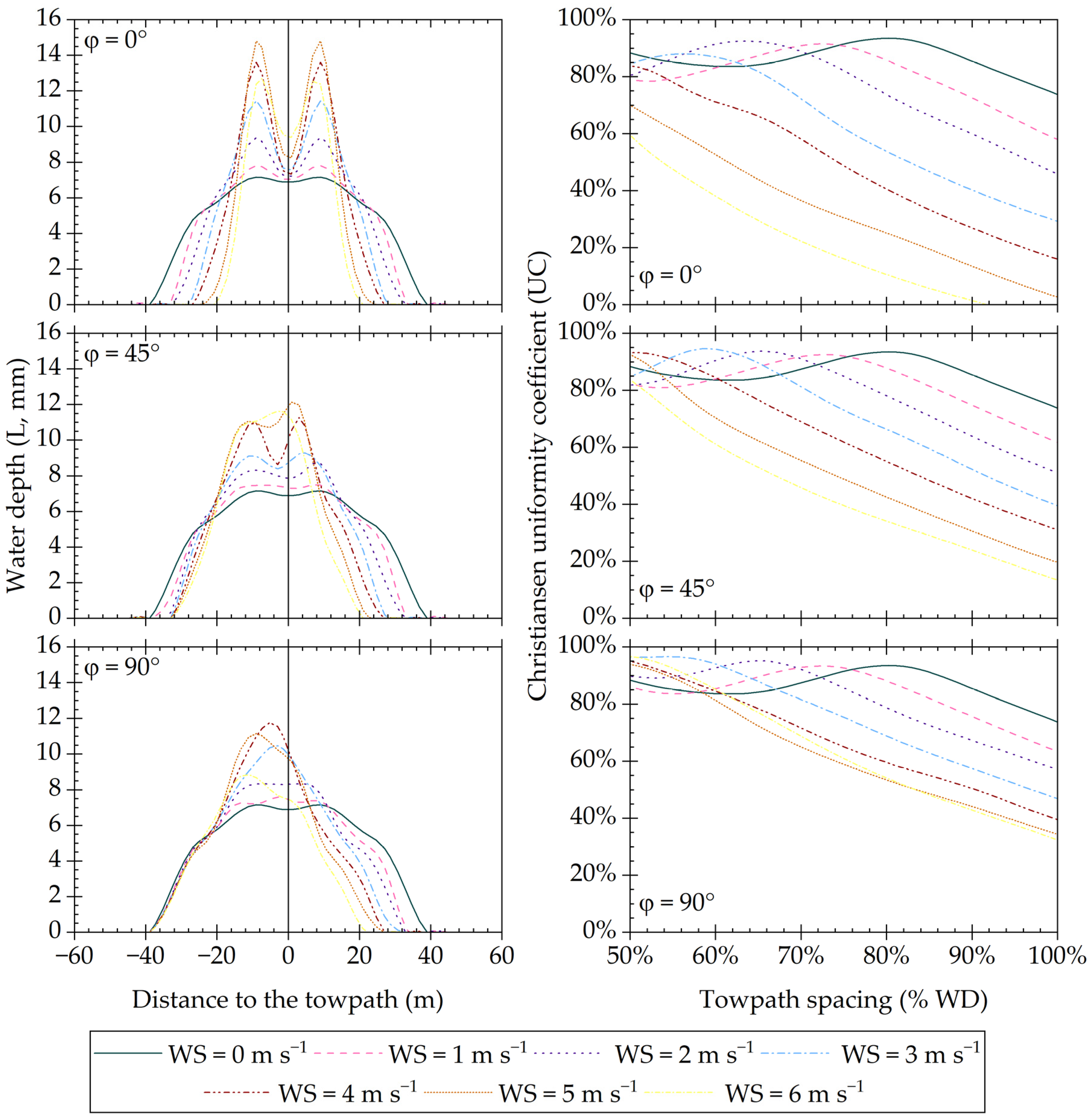
Wind incidence relative to the towpath controls the shape and spread of the cross-track depth profiles (
Figure 4, left). When the wind is parallel to the towpath (φ = 0°), an increase in wind speed narrows the profile. It concentrates depth near the centerline: the tails beyond ±21 m collapse to (near) zero at WS = 6 m s
−1, while the two local maxima around ±9 m roughly double (e.g., 7.16 → 14.81 mm at WS = 5 m s
−1). At 45°, the profile becomes flatter and mildly asymmetric; measurable depths still extend to about ±27 m (≈2–4 mm at WS = 6 m s
−1), while values near ±33 m are only residual. With wind perpendicular to the towpath (φ = 90°), lateral drift redistributes water sideways, producing an apparent upwind/downwind asymmetry yet retaining a broad band of non-zero depths: at WS = 6 m s
−1 the downwind side keeps ≥4 mm out to ~27 m, whereas the upwind side decays below 2 mm by ~21–27 m. Overall, φ = 0° narrows the effective irrigation swath, while φ = 90° broadens it, despite the lateral shift.
These depth patterns translate directly into the UC–spacing response (
Figure 4, right). At 65.6% WD, raising wind speed from 0 to 6 m s
−1 reduced UC from 84.4%→28.6% at φ = 0°, 84.4%→52.0% at 45°, and 84.4%→76.1% at 90°. At 73.8% WD, the corresponding declines were 90.6%→17.5%, 90.6%→40.9%, and 90.6%→62.8%. Thus, wind parallel to the towpath imposes the steepest penalties, oblique winds are intermediate, and perpendicular winds are the least detrimental, especially at higher speeds. In practice, towpath design and irrigation scheduling should prioritize avoiding φ ≈ 0°, or, when unavoidable, using tighter spacings to preserve UC.
4. Discussion
The spatial application patterns derived here align with established descriptions of wind-affected sprinkler behavior: winds contract the pattern crosswind more than they extend it along wind and generate lobe-like regions of high application that increase the risk of localized over- and under-application [
1,
5]. Process-based and semi-empirical models likewise reproduce non-radially symmetric, elongated patterns under wind, including elliptical formulations and wind-driven range shortening and drift [
4,
6]. Although early reports suggested order-of-magnitude local peaks, more recent field and modeling studies generally indicate strong but more moderate distortion—consistent with the peak-to-mean (P/M) ratios and centroid displacements quantified here (daytime vs. nighttime P/M = 3.02 vs. 2.35; centroid shift = 1.92 m vs. 0.41 m;
Figure 1) [
3,
6,
8]. In this context, scalar metrics such as UC may obscure localized extremes, and the composite application-rate fields used here retain spatial structure relevant to spacing decisions [
18]. Prior studies have often treated wind speed, wind direction/incidence, or spacing in isolation [
3,
4,
6], with limited quantification of how φ and diurnal wind regimes jointly translate into spacing guidance for full-scale traveling guns [
1,
14]. In practice, spacing guidance for travelers is frequently expressed primarily as a function of wind speed, with wind incidence considered implicitly or not at all [
1]. Moreover, although the physics of wind-driven pattern distortion is well understood, the practical difficulty of collecting comprehensive field data across a wide range of wind angles and speeds has historically limited the development of integrated decision-support strategies for these machines [
4,
14].
Nighttime operation yielded higher uniformity because lower nocturnal winds reduced pattern distortion, a tendency repeatedly observed in field comparisons between diurnal and nocturnal conditions [
7,
8,
11,
12]. Simulated UC–spacing curves for day and night intersected near ~50% of the wetted diameter (WD). At very tight spacings, the strong overlap between adjacent swaths largely masks wind-induced distortions in the daytime composite pattern, consistent with the well-known compensating effect of overlap on non-uniform single-pattern application [
10,
19]. As spacing increases, the greater anisotropy and centroid shift in the daytime pattern generate under-irrigated regions between towpaths, causing UC
day to deteriorate more rapidly and leaving nighttime UC higher beyond the crossover [
1,
4]. Averaged across spacings, UC
night exceeded UC
day by ~9.52 percentage points (mean absolute deviation ~10.5 p.p.;
Figure 2 and
Figure 3). The variance observed in the UC
night–UC
day relationship (r
2 = 0.6557) reflects partially nonlinear interactions in which wind-speed effects are strongly modulated by wind incidence, with the largest uniformity penalties occurring under wind-parallel operation (φ ≈ 0°), such that comparable mean wind speeds can yield different UC outcomes depending on alignment and spacing [
1,
19]. In addition, unresolved wind variability (e.g., gustiness and short-term direction fluctuations) and time-varying evaporative demand during field tests, together with inherent reading/placement uncertainties in catch-can protocols, may contribute to baseline measurement imprecision and variability around the deterministic trend [
4,
19]. This magnitude of improvement is consistent with findings for tomato crops, where shifting from daytime to nighttime irrigation increased the uniformity coefficient by 9.4 to 14.9 p. p. [
12]. Similarly, field experiments with maize demonstrated that daytime operation reduced the mean uniformity coefficient by 5% to 7% compared to nighttime irrigation, contributing to a 10% reduction in grain yield [
8]. Reported thresholds elsewhere similarly indicate that UC deteriorates as mean wind approaches or exceeds ~2 m s
−1, reinforcing the operational advantage of nocturnal scheduling when uniformity is prioritized [
3]. This nocturnal advantage is also consistent with boundary-layer climatology, as more stable nighttime stratification and local circulations typically depress near-surface winds relative to daytime [
20]. Moreover, the reduced turbulence intensity typically associated with stable nocturnal stratification can lead to more stable and predictable droplet trajectories, thereby reducing random lateral dispersion and improving application uniformity [
11]. This performance gain may be further reinforced by higher nocturnal relative humidity and lower vapor pressure deficits, which suppress droplet evaporation compared with typical daytime conditions [
7,
12].
Wind incidence relative to the towpath (φ) exerted an influence on Christiansen’s uniformity coefficient (UC) comparable to that of wind speed (WS). With wind parallel to travel (φ = 0°), increasing WS narrowed the cross-track depth profiles by effectively reducing the swath width under parallel-wind conditions and caused UC to decline steeply with increasing spacing [
4,
5]. Conversely, with wind perpendicular to travel (φ = 90°), profiles retained a broader non-zero application band and UC decreased least, whereas φ = 45° produced intermediate responses (
Figure 4). At 65.6% of the wetted diameter (WD), raising WS from 0 to 6 m s
−1 reduced UC from 84.41% to 28.59% at φ = 0°, from 84.41% to 52.02% at φ = 45°, and from 84.41% to 76.10% at φ = 90°. For the same spacing at WS = 6 m s
−1, changing φ from 0° to 90° increased UC by 47.51 percentage points, a difference comparable to the 55.82-percentage-point decrease produced by increasing WS from 0 to 6 m s
−1 at φ = 0°. These directional effects are consistent with classic guidance for traveling guns: lane spacing should be tightened as winds increase, particularly when winds align with the travel direction, to preserve acceptable uniformity [
1,
5].
From a design and operations perspective, acceptable uniformity under wind can be maintained with relatively tight spacings—often below ~50–55% WD—when the traveler path minimizes wind influence [
1]; conversely, spacings near 80–90% WD tend to deliver high UC only under favorable, low-wind conditions [
1,
10]. Sprinkler irrigation design guidelines commonly target UC values of ~80% or higher for commercial crops, whereas UC values below ~60–70% are generally regarded as unsatisfactory for standard production [
3,
11]. Therefore, simulated cases with UC near 30% (e.g., UC ≈ 28.6% at 65.6% WD, φ = 0°, WS = 6 m s
−1;
Figure 4) should be interpreted as highly unfavorable, worst-case conditions associated with severe wind distortion rather than viable operating points [
4,
5]. Recent engineering syntheses for traveling gun systems emphasize the systematic evaluation of uniformity across wind speed, incidence, and sectoring, which is consistent with our UC–spacing envelopes and the day–night crossover near ~50% WD (
Figure 2,
Figure 3 and
Figure 4) [
17].
Methodological and contextual limits warrant consideration and suggest avenues for improvement. Our day/night composites were based on local wind frequencies and may vary by site and season. Controlled trials with prescribed winds remain challenging for sprinklers, which is why validated modeling frameworks are increasingly central to design and operation [
9,
10]. Emerging “digital-twin” concepts and integrated simulation–sensing–control pipelines can support real-time decision-making and scenario testing [
9,
15]. In parallel, variable-rate and traveler-control strategies—such as speed modulation—are being developed to mitigate UC losses when φ ≈ 0°, offering actionable extensions of our findings [
21]. Finally, loss-estimation methods are critical: catch-can protocols can report substantially higher WDEL than conductivity- or physics-based approaches, reflecting differences in measurement principles and underlying assumptions [
22]. While data-driven models such as ANN and REPTree are improving WDEL prediction [
23], their accuracy remains highly dependent on the quality and representativeness of calibration data, and predictive skill can degrade when extrapolated beyond the wind regimes, hardware configurations, or management practices used for model development [
10].
Overall, the present analysis strengthens a practical message reflected in recent syntheses: wind is a first-order determinant of traveler performance, so spacing, alignment, and scheduling should be co-designed with the site’s wind regime—giving preference to nocturnal windows and avoiding wind-parallel operation whenever possible [
1,
17]. Operational priority should be given to nighttime windows to improve uniformity and reduce losses under typically milder winds [
7,
12], and wind-parallel operation should be avoided whenever possible—or mitigated through tighter towpath spacing when it cannot be avoided [
5,
17]. However, these recommendations should be viewed as theoretical benchmarks to support decision-making rather than rigid prescriptions. In practice, implementation may be constrained by labor availability and safe access during nighttime operation, by the availability and maintenance of reliable wind-measurement equipment to characterize predominant wind speed and direction, and by field layout and cropping conditions that limit towpath orientation or feasible operating windows.




 ,
,