


Abstract
Sowing represents one of the most critical technological processes in grain production, where seed distribution uniformity directly impacts crop yield by determining plant nutrition area efficiency. Conventional sowing methods with varying row spacings often fail to ensure optimal area utilization. This study enhances subsoil-broadcast sowing quality through a novel trough-profile seed guide that ensures uniform seed distribution across the sweep opener’s working width. The research employed a combined methodology of theoretical analysis, DEM simulation, and experimental studies. Theoretical analysis demonstrated that sowing parameters depend mainly on seeder forward speed and the rotational speed of the seed-metering device’s rollers. DEM simulations visually confirmed the mechanism of ordered seed flow formation within the guide. Experiments simulated drill seeder operation, evaluating forward speed (1.2–2.4 m/s) and fluted roller rotational speed (20–25 rpm) effects on distribution uniformity and sowing instability. The results at 20 rpm with 2.0–3.0 grains per cell showed a standard deviation reaching 0.2–0.5 pcs. (CV: 13.0–24.2%). At 25 rpm, the deviation increased to 0.5–1.0 pcs. (CV: 18.2–39.4%). For total sowing instability at 20 rpm with 10.0–15.0 grains per opener, the standard deviation measured 0.3–3.3 pcs. (CV: 2.8–22.4%), while at 25 rpm, with 15.0–19.0 grains, values reached 0.5–3.9 pcs. (CV: 3.5–19.8%). All parameters conform to agrotechnical requirements, confirming solution effectiveness and addressing the literature gap in uniform seed distribution across the sweep opener’s working width.
1. Introduction
Sowing is a critical operation in grain crop cultivation, with the plant nutrition area playing a leading role in determining final yield. This is governed by a complex of agronomic and agrotechnological factors.
Drill seeders with disc or tyne coulters are widely used for sowing grain crops [1,2,3,4,5]. These drills typically operate with a narrow row spacing of 7.5–15.0 cm. However, in fields with significant stubble and surface plant residue, such drills often face operational challenges. Consequently, seeders equipped with sweep openers are predominantly employed for sowing under stubble conditions [6]. This choice is based on a comparative analysis of opener types. Disc openers provide precise depth control but create a narrow furrow, limiting lateral seed distribution. Tyne openers fracture soil effectively but cause excessive vertical mixing. In contrast, the wide, flat blade of a sweep opener creates a broad, shallow disturbance zone, which is essential for subsoil-broadcasting seeds across the working width. However, a key disadvantage of conventional sweep systems is their inherent tendency to form wide, distinct rows. To enhance maneuverability in stubble, these seeders are designed with wide rows and a dispersed opener arrangement on the frame, increasing the row spacing to 20–30 cm. Studies indicate that sowing with such a wide row spacing fails to ensure optimal plant distribution across the nutrition area, with plants occupying only 26–30% of the field surface [7]. Under standard seeding rates, this leads to overcrowding within rows, causing mutual plant suppression, while the free inter-row space becomes susceptible to weed infestation, which competes with crops for moisture and nutrients [8]. Furthermore, during separate harvesting, the sparsely spaced stubble rows provide poor support for windrows, especially in wet conditions. This causes the windrows to sink, making them difficult for combine harvesters to retrieve and resulting in increased grain losses.
More rational and productive sowing methods for grain crops include strip and subsoil-broadcast sowing [7,8]. In strip sowing, seeds are placed in distinct strips 12–14 cm wide, separated by 8–10 cm gaps. In subsoil-broadcast sowing, seeds are distributed continuously across the field without defined rows and are incorporated into the topsoil layer. The yield of grain crops is significantly influenced by the efficiency of plant nutrition area utilization. A larger and more uniformly occupied area allows cultivated plants to compete more effectively with weeds and utilize available nutrients and moisture more efficiently [8]. This contributes to reduced field contamination and can increase yields by 10–20%.
The works of many scientists have been devoted to the research and development of seed drills for the broadcast method of sowing agricultural crops. He et al. designed a double compression seeder for pre-sowing and seed furrow of wheat in wide-seedling belts to solve the problem of poor sowing quality due to loose soil in the wheat seedbed after land preparation [9]. Cakmak et al. developed a new rotary tiller fitted with a pneumatic unit, soil lifting plate, and soil conveyor with seeding tubes for uniformly spreading seeds [10]. Nukeshev et al. developed a seeding opener of a grain-fertilizer seeder with a scatterer for subsoil scattered sowing of seeds [11,12]. However, despite its apparent advantages, the serial production of specialized seeders for the subsoil-broadcast (rowless) sowing method has not yet been widely adopted by the agricultural industry.
Numerous studies have been devoted to the distribution of seeds of various agricultural crops. Heege et al. presented a method which includes a compensating program for recording the number of seeds passing through the seed tube [13]. Karayel et al. developed a new criterion, seed distribution area, to evaluate seed distribution in a two-dimensional area as calculated by ellipse and integral criteria [14]. Riley et al. used orthogonal projections of seeds to give visual information about seed distribution [15]. Ozmerzi et al. examined the effect of different depths of sowing maize in terms of the vertical and horizontal distribution of seeds [16]. They revealed that among sowing depths of 40, 60, and 80 mm, the horizontal distribution was not different. Liu et al. studied the effects of different travel speeds on seed spacing uniformity and evaluated four different types of seed meters at different travel speeds on a seed meter test bench and in the field [17]. The seeding performance of the horizontal distribution of seeds within a row was described using the coefficient of variation. Their results indicated that different travel speeds have statistically significant effects on seed spacing uniformity. Panning et al. evaluated five planter configurations for seed spacing uniformity at three field speeds using a seed location method in the field and a laboratory method involving an opto-electronic sensor system [18].
An analysis of the existing research confirms the agronomic advantages of the subsoil-broadcast sowing method. A common challenge, however, lies in the disordered seed flow within the “seed-metering device–seed tube–opener” system. In this sowing method, devices such as deflectors or spreading plates are arranged in the opener to scatter seeds into the subsoil, aiming for a rowless distribution across the entire area [19]. This approach concentrates efforts solely on the final component—the opener—to achieve uniform seed distribution.
Numerous studies are aimed at achieving a certain order in the uniform arrangement of seeds in the width and depth of sowing. Wang et al. analyzed the process of seed guiding to ensure smooth sliding of seeds in the seed guide tube and avoid seeds bouncing on the ground [20]. Li et al. developed a belt-type high-speed seed-guiding device’s seed-receiving and conveying system [21]. Karayel et al. developed a novel helicoidal seed tube that regulates the flow of seeds in a seed tube while being dispensed by the seed drill into the ground [22]. Jia et al. proposed a convergent groove-guided seed tube based on the principle of a brachistochrone curve considering friction to address the issue of the rolling and bouncing of seeds upon falling into the furrow, ultimately compromising seeding uniformity [23]. Li et al. presented a novel air-delivery auxiliary seed guide tube for rapeseed, examined its mechanism of seed movement, and identified its crucial structural parameters [24]. Tang et al. designed an airflow-assisted seed-dropping device (the seed drop tube) for an inside-filling air-blowing precision seed-metering device and analyzed the mechanism of movement of the maize seeds in the seed drop tube [25]. Lei et al. designed a centralized seed-metering system for rapeseed comprising a seed box, a centralized seed-metering device, seed tubes, and double disc openers and analyzed the seed distribution uniformity and seed motion characteristics in the centralized seed-metering system [26]. Xi et al. proposed a no-tube seeding method for wheat sowing in order to solve the problem of poor uniformity and low depth stability in traditional tube seeding, and the accuracy and uniformity of seeding quality were optimized with ground clearance [27].
An analysis of the research shows that while certain advancements in achieving uniform seed placement have been made, providing plants with an optimal nutrition area remains a significant challenge.
In this context, we hypothesize that by creating an ordered seed flow within the seed guide itself—prior to the opener—the uniform distribution of seeds across the working width of the sweep opener can be significantly improved.
Hence, the purpose of this research is to design a trough-profile seed guide and to evaluate its efficacy in ensuring the uniform distribution of wheat seeds across the working width of the sweep opener for subsoil-broadcast sowing.
The novelty of this research lies in the innovative design of the trough-profile seed guide, with its ability to (1) create an orderly seed flow prior to the sweep opener and (2) operate effectively across a defined range of operational modes (forward speed and fluted roller rotation speed).
The originality of this design lies in its capacity to ensure uniform seed distribution across the working width of the sweep opener and to reduce instability in total sowing when operating at optimized combinations of forward speed and fluted roller rotation speed.
Research objectives: (1) to design and manufacture a novel trough-profile seed guide for uniform seed distribution across the working width of the sweep opener; (2) to perform a theoretical analysis of seed motion within the trough-profile seed guide; (3) to conduct DEM simulations of seed motion and uniformity within the guide; (4) to conduct experimental studies on the influence of the forward speed and fluted roller rotational speed on the uniformity of seed distribution and the instability of total sowing.
2. Materials and Methods
2.1. Design and Working Principle of Trough-Profile Seed Guide
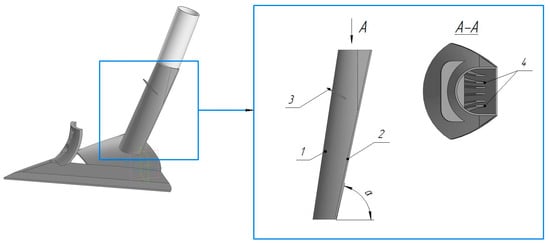
A novel trough-profile seed guide has been designed to ensure uniform distribution of wheat seeds across the working width of a sweep opener for subsoil-broadcast sowing (Figure 1). The assembly comprises a seed delivery tube and a trough-profile distributor attached to the seeder’s opener. The trough-profile seed guide consists of a housing (1), a distribution tray (2), a levelling gate (3), and guide plates (4). The novelty of the proposed design is confirmed by the filling of a patent application for an invention in the Republic of Kazakhstan (Application No. 2025/1092.1 from 7 November 2025).
Figure 1.
Sweep opener with a trough-profile seed guide: 1—housing; 2—distribution tray; 3—levelling gate; 4—guide plates.
The housing (1) has a truncated conical geometry with an inclination angle of the conical (tray) wall α = 77°. The upper and lower sections of the housing’s circumference are truncated by the tray wall on both sides of the axis of symmetry. The levelling gate (3)—a flat metal plate with one rounded edge—is inserted into cutouts in the upper part of the housing at an angle of β = 22° to the horizontal. The gate is adjustable, allowing for control of the seed passage gap onto the distributor tray.
The inner surface of the distribution tray (2) consists of a central plane and several curved guide pates (4) at its base. These plates feature a curvilinear form with a smooth bend at their terminal parts, diverging symmetrically to the sides relative to the center.
In this design, the combination of the distribution tray with guide plates and the levelling gate stabilizes the seed flow and ensures uniform distribution across the working width of the sweep opener during subsoil-broadcast sowing.
The distribution tray is manufactured from a metal sheet fixed to the lower part of the seed guide. It is inclined at an angle β = 22°, selected based on the coefficient of friction between the seeds and the tray material to ensure consistent material flow. The cross-sectional area at the inlet of the distribution tray is smaller than the effective outlet area created by the diverging guide plates. The guide plates are welded vertically onto the tray; their number can be customized based on the dimensional characteristics of the seeds to optimize distribution quality.
The operational principle of the device is as follows. Seeds from the seed-metering device through the seed tube are delivered into the seed guide, impacting directly upon the levelling gate (3), which creates a uniform seed curtain. The seeds then descend onto the distribution tray (2). On the tray, the seeds slide downward under the force of gravity. The guide plates (4) integrated into the distributor divide the bulk seed flow into several discrete streams, facilitating an ordered and uniformly distributed seed movement.
Subsequently, the seeds exiting the seed guide are projected by inertia and distributed within the topsoil layer across the entire working width of the sweep opener.
2.2. Theoretical Analysis of Seed Motion
A central hypothesis of this study is that uniform seed distribution across the working width of the sweep opener can be achieved by establishing an ordered seed flow within the seed guide itself, prior to the seeds reaching the opener.
To establish the theoretical foundation for this hypothesis, it is essential to contrast the proposed design’s flow-ordering principle with that of a conventional seed tube. A traditional seed tube acts as a passive conduit, relying on external deflectors at the opener for lateral distribution, which results in stochastic scattering. In contrast, the proposed through-profile guide functions as an active flow processor. It orders the seed stream internally through a deterministic sequence: (1) vertical impact energy dissipation; (2) controlled acceleration on an inclined tray; (3) active geometric flow division by diverging guide plates. This core innovation—shifting the intervention stage from correcting disorder at the outlet to engineering order at the inlet—defines the principle of “internal flow division” investigated in this study.
To substantiate this hypothesis, we first consider the fundamental physical and mechanical properties of wheat seeds, as these govern their dynamic behavior. Key properties include frictional, elastic, strength, and aerodynamic characteristics.
Morphology and Size: Wheat seeds are primarily ellipsoidal in shape (a < b < l, where a, b, and l represent width, thickness, and length, respectively). They are classified as large, with typical length >4 mm.
Density and Mass: The bulk density p ranges from 730 to 810 kg/m3, with a thousand-kernel wight (TKW) of 20–30 g. The seeds exhibit good flowability, with a typical angle of repose between 40 and 60%.
Friction Properties: The static coefficient of friction against materials like steel, cast iron, and aluminum ranges from 0.35 to 0.42 at standard moisture content, while the dynamic coefficient falls to between 0.15 and 0.37. The coefficient of internal friction f ≥ 0.45–0.7.
Elastic and Strength Properties: Seeds are not perfectly elastic; the coefficient of restitution Kv varies between 0.30 and 0.55. Poisson’s ratio µc is approximately 0.25–0.50, and the modulus of elasticity Ec is 12–20 MPa.
Susceptibility to Damage: The seeds are susceptible to mechanical injury, with a maximum impact force Pмax of less than 0.015 N potentially causing damage.
These properties manifest during the seed’s interaction with various components of the seeding system. Consequently, seeding quality can be expressed as a function of several variables:
Seeding quality = f (seeding machine; seed line; coulter)
This study focuses on the seed guide as the critical variable for optimization.
Model Assumptions and Scope: The theoretical model is based on the following simplifications:
- −
- Seeds are represented as identical spherical particles with uniform size, density, and surface properties.
- −
- The coefficients of restitution and dynamic friction are considered constant.
- −
- Aerodynamic drag and inter-seed collisions during free fall are neglected.
This mechanistic model is valid for dry, non-cohesive wheat seeds within the tested operational speed range (1.2–2.4 m/s) and captures the dominant physics of energy dissipation and momentum-based flow division. Consequently, the predictive accuracy of the derived equations may be affected under conditions of high seed shape variability, elevated moisture content, or significant inter-seed heterogeneity, as these factors alter the effective friction, restitution, and collision dynamics assumed in the model.
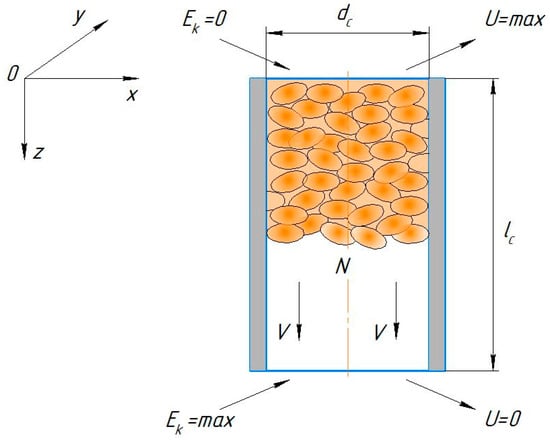
Seeds discharged from the metering device enter the seed guide and move downward under gravity, overcoming air resistance and undergoing mutual collisions. This results in a disordered stream, composed of N seeds with varying physical properties (Figure 2).
Figure 2.
Schematic of seed flow dynamics in the seed guide.
To model this, we consider seed motion an OXYZ coordinate system, where OX is the direction of seeder travel and OZ is aligned with the seed guide axis. The seed stream, with volume V and number N, is treated as a mechanical system of particles obeying statistical mechanics. Its state is defined by a point in a 6N-dimensional phase space:
where ri is the radius vector of the i-th particle in the coordinate space; pi is the radius vector of the i-th particle in the momentum space.
r1, r2…rN u p1, p2…pN
The system’s location in phase space at time t is characterized by a distribution function fN.
The motion of a particle, considered as material point, can be described by the momentum change theorem accounting for gravitational forces and inter-seed collisions:
where pi, mi, Vi are the momentum, mass, and velocity of the i-th particle, respectively; Fi is the external force acting on the i-th particle.
For N seeds,
The system average yields
The seed flow moving along the seed guide can be described by the following expression [28]:
where is the seed velocity along the z axis of the seed guide; is the acceleration; is the relaxation time during which the value of the changed parameter (seed distribution) decreases by a factor of e; is the change in seed distribution.
This linear inhomogeneous partial differential equation with variables and z is solved in classical mechanics by the function:
where is the Maxwell–Boltzmann distribution; and are coefficients determined by the values of the total energy distribution of all seeds; is the kinetic energy; is the potential energy.
Through appropriate transformations, formulas for seed distribution in the seed guide volume V = s lc (where s is the cross-sectional area, lc is the length of the seed guide) have been derived as follows.
For the cross-sectional area:
For the length of the seed guide:
These equations demonstrate that the formation of seed flow along the seed guide depends on the dimensions of the seed guide, the mass and shape of the seeds (particles), and their total energy.
The total energy of the seed flow consists of the potential (U) and kinetic energy Eк (Figure 2). The maximum value of the potential energy occurs in the upper part of the seed guide, while the minimum value is at the bottom. For a single particle and for the system, respectively, the values are as follows:
where α is a coefficient accounting for energy losses during collisions.
U = Esi = migz, U = Es = Nmigzα
The kinetic energy for a particle and for a system of particles, respectively, are as follows:
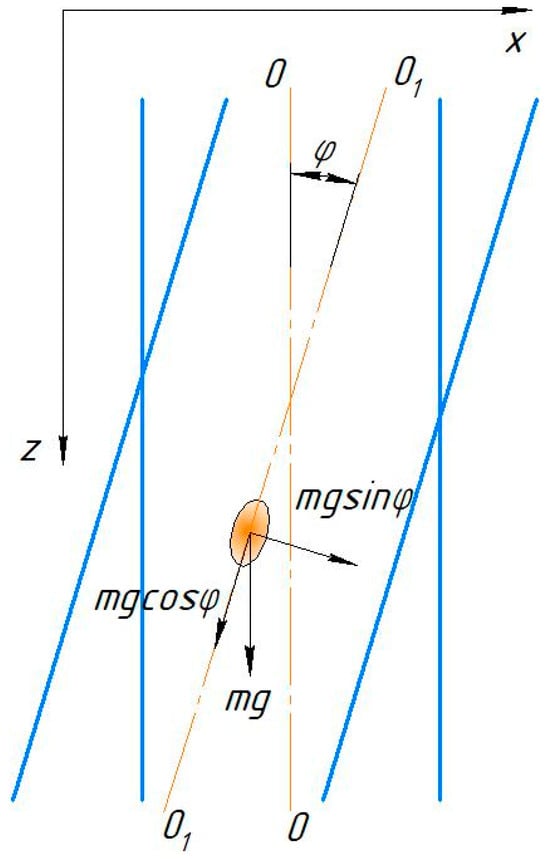
These equations are valid for the vertical position of the seed guide. However, during field operation, due to the heterogeneity of the soil’s physical–mechanical properties, it experiences oscillations that are transmitted to the seed guide. Consequently, the seed guide may deviate from the vertical position by a certain angle φ (Figure 3).
Figure 3.
Angular deviation of the seed guide from the vertical position.
For the potential energy components, the following expressions are derived:
- −
- Along the axis x: U(x) = Ex = xmgsinφ,
- −
- Along the axis z: U(z) = Ez = .
Substituting these potential energy components into Equations (8) and (9) yields the modified distribution functions as follows.
For cross-sectional distribution:
For longitudinal distribution along the seed guide:
Equation (12) demonstrates that at φ = 0°, seed distribution across the cross-section remains uniform. This uniformity is maintained for small angular deviations φ and minimal displacements along the x axis.
Similarly, Equation (13) indicates that increasing the seed guide length preserves distribution uniformity when the angle φ remains small.
Multiple inter-seed collisions during transport through the seed guide result in energy dissipation within the flow. When the energy loss coefficient α < 1, indicating significant energy dissipation, the deviation from a uniform distribution increases. Conversely, when α > 1, characterizing systems with minimal energy loss, distribution uniformity is enhanced.
Agrotechnical requirements demand uniform seed arrangement both along the row length in conventional sowing and across the working width in broadcast sowing to achieve optimal plant nutrition areas. The ideal nutrition area approximates a square or circular configuration, requiring precise seed placement that can only be achieved through controlled seed motion within the seed guide.
Such optimal nutrition areas are achieved through orderly seed placement, which requires controlled seed motion within the seed guide. In our assessment, conventional seed guides with tubular configurations and a vertical orientation fail to meet these essential agrotechnical requirements. While these conventional designs may achieve reasonable seed distribution within the guide itself, seeds subsequently impact various surfaces within the opener assembly (deflectors, spreading plates, etc.). Due to variations in impact locations and differences in individual seed properties, this results in stochastic dispersion within the topsoil layer.
As established, conventional seed guides can achieve a relatively even distribution of seeds within their internal cross-section and length. However, a critical failure occurs at the point of discharge: seeds subsequently impact various components within the opener assembly, such as deflectors or spreading plates. Due to inherent variations in impact locations and the natural dispersion in the physical–mechanical properties of individual seeds, this results in stochastic and random dispersion within the topsoil layer, compromising sowing uniformity.
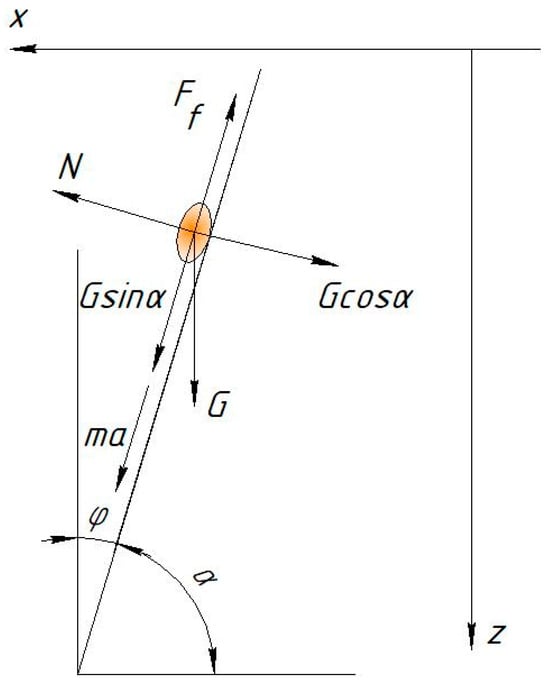
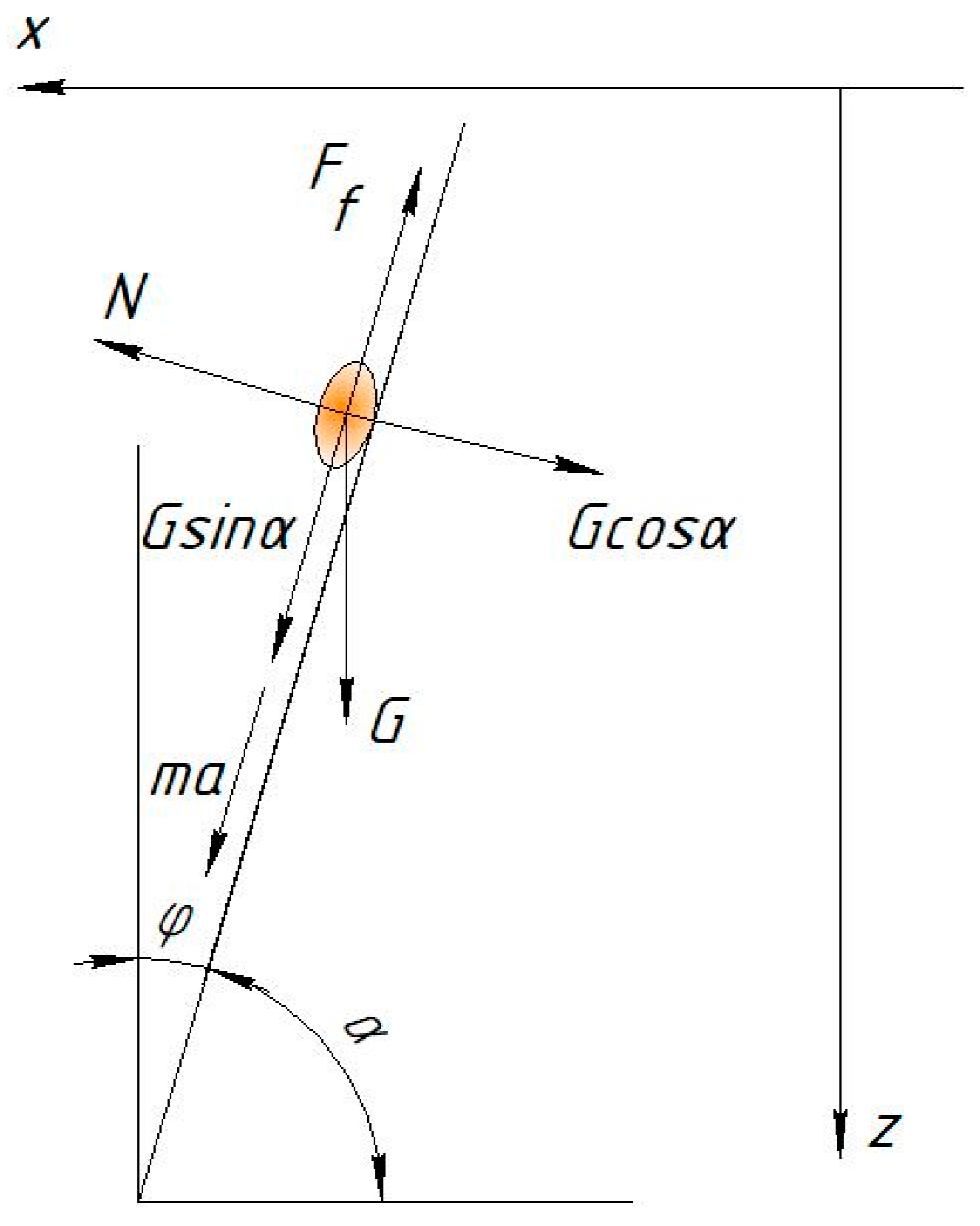
We hypothesize that fundamental redesign of the seed guide geometry is crucial to achieving an orderly seed arrangement in the topsoil layer. The proposed seed guide (Figure 4) is engineered to ensure a uniform and controlled seed motion, which is a prerequisite for precise sowing. Its operational principle is as follows: seeds first encounter a levelling gate, then descend to a distribution tray, and finally slide along its surface. During this transit, guide plates divide the distributed seeds evenly across the working width by inertial forces, depositing seeds uniformly over the sowing area.
Figure 4.
Force analysis of seed motion in the seed guide.
To quantitatively validate this principle, the following section provides a theoretical analysis of seed motion dynamics along the inclined tray of the proposed seed guide (Figure 4).
The motion of a seed particle on the inclined tray was analyzed using D’Alembert’s principle:
where G is the gravitational force acting on the particle; N is the normal force exerted by the tray surface; FTP is the friction force between the particle and tray; a is the linear acceleration of the particle.
The differential equation of motion of a particle along the vertical axis z is derived as
From Equation (12), the acceleration of the particle can be expressed as
where f is the coefficient of friction between the seed and tray material.
The theoretical descent time of a particle along the tray, derived from the equations of motion under constant acceleration, is
where Vв is the vertical component of the seed’s initial velocity from the seed-metering device; lc is the effective length of the seed guide.
The actual descent time accounts for dynamic interactions and is given by
where µ is the empirical correction factor (µ = 1.05…1.15).
td = µt
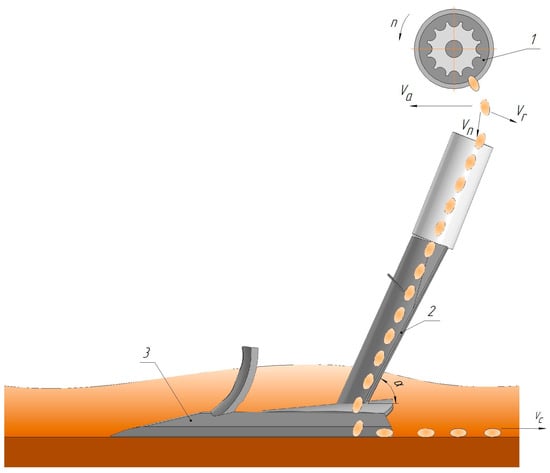
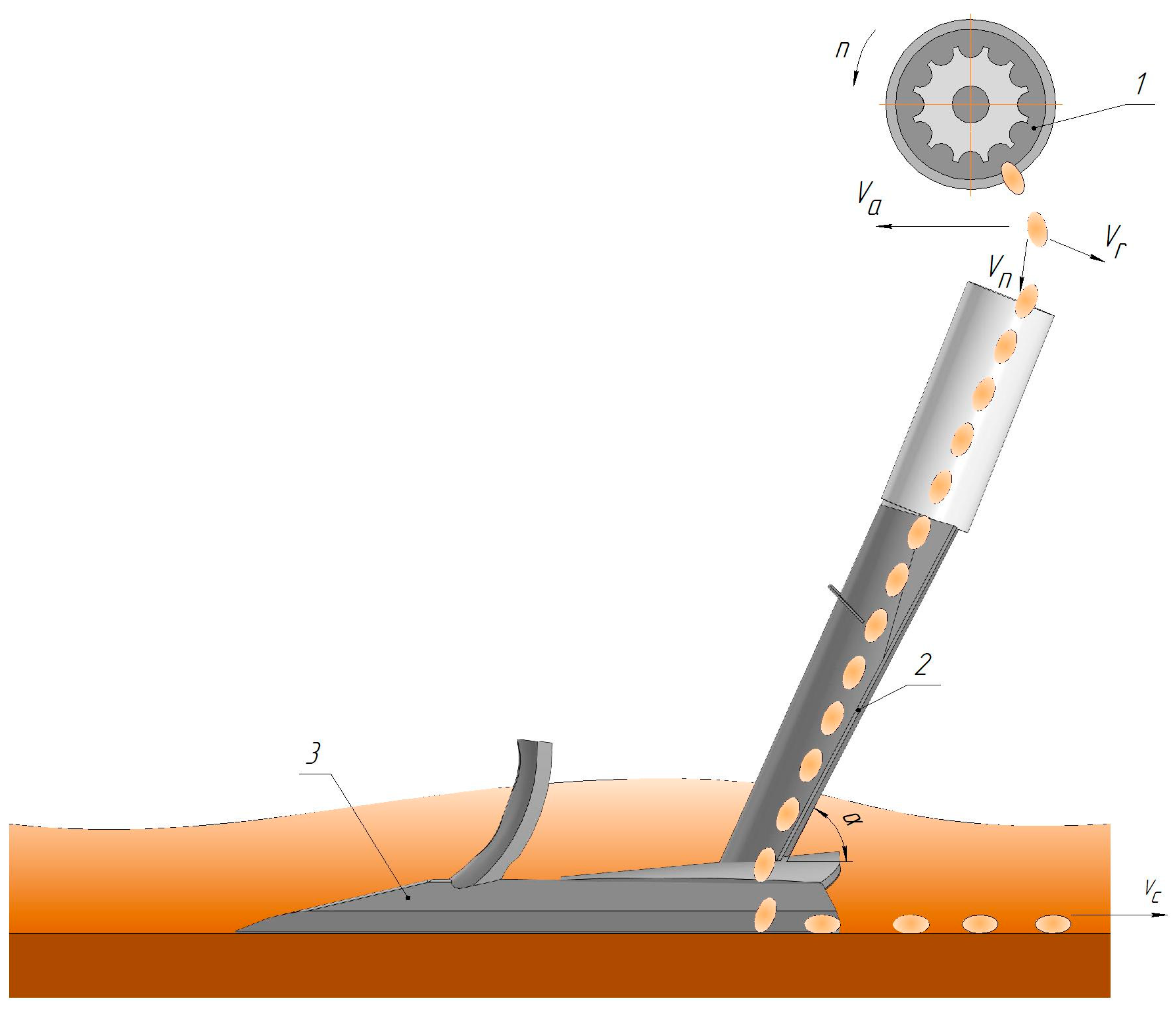
Seeds undergo complex motion comprising two components: translational movement with the sowing unit at velocity Vа and relative motion with velocity Vr (Figure 5). The resultant absolute velocity Vn of the seed flow through the seed guide is determined by the expression
Figure 5.
Technological schematic of seed sowing: 1—fluted roller of the seed-metering device; 2—trough-profile seed guide; 3—sweep opener.
Thus, the initially disordered seed movement at the entrance of the seed guide is transformed into an ordered flow, the functional scheme of which is presented in operator form (Figure 6).
Figure 6.
Flow chart of seed flow transformation: A—operator (seed guide); xH, xК—input and output parameters of seed distribution; f(x)—seed distribution within the topsoil layer; M—mathematical expectation of distribution interval; D—variance of seed distribution random variable.
The physical–mechanical properties of seeds and soil, along with the operational characteristics of the sowing section, exhibit probabilistic behavior, generating a stochastic seed distribution pattern.
The primary objective of the seed guide operator is to deliver seeds into the topsoil layer with the mathematical expectation M{xH} and variance D{xH} at the forward speed Va of the seeding unit. The system must satisfy the agrotechnical requirements M{xK} = [MC] and D{xK} ≤ [DC], where [MC] and [DC] are agronomically acceptable sowing parameters, typically not exceeding 5%.
The correlation models are expressed as
where bn is the seed transfer rate, defined as bn = Va/Vn.
M{xK} = bn.M{xH}
Equation (21) demonstrates that the dispersion of seed distribution is predominantly influenced by the coefficient bn. Consequently, the uniformity of seed distribution exhibits significant dependence on the forward speed Va of the sowing unit.
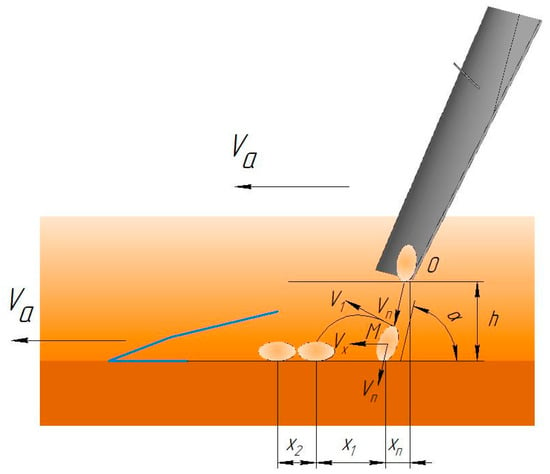
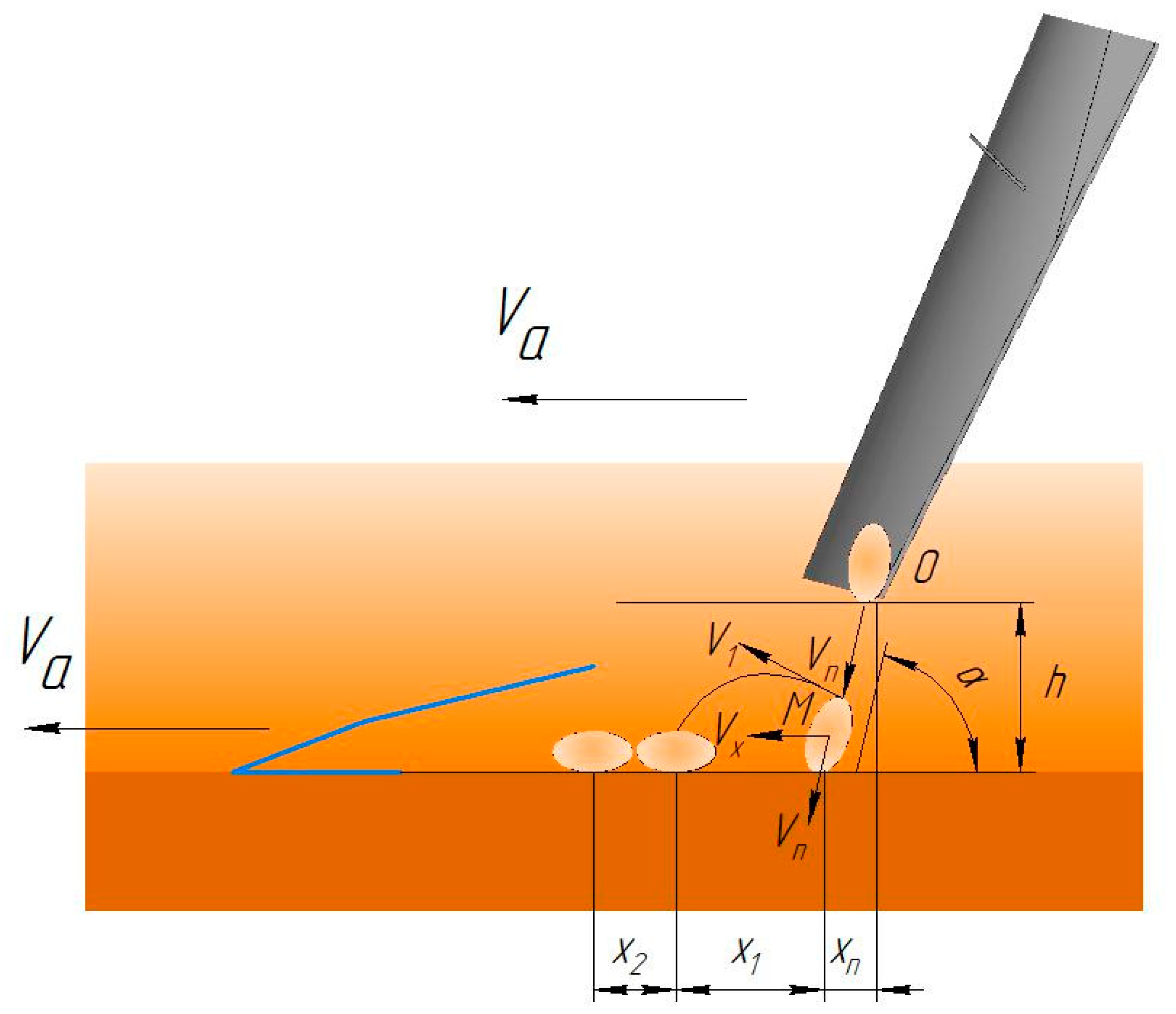
The operational speed of the seeding unit determines the seed trajectory within the topsoil layer, as illustrated in Figure 7.
Figure 7.
Scheme of seed placement.
As previously established, seeds undergo complex motion, with their absolute trajectory denoted as OM. Upon impact with the soil surface, a seed experiences two distinct phases: an initial bounce over distance x1, followed by rolling over distance x2.
The flight range of the seed is determined by
The bounce distance is calculated as
where v1 is the rebound velocity; γ is the angle of reflection.
The subsequent rolling distance is given by
where μa is the coefficient of instantaneous friction; fn is the rolling resistance coefficient.
The derived equations confirm that seed distribution in the topsoil layer exhibits significant dependence on the forward speed of the sowing unit Va and the resultant absolute seed velocity Vn. Since Vn, as follows from Equation (19), is formed by the vector sum of the translational velocity Va and the peripheral speed of roller of the seed-metering device Vᵣ, the resulting sowing uniformity becomes a controllable parameter dependent on the coordinated selection of the seeder’s travel speed and the metering device roller’s rotational speed. These results are in agreement with the findings of Liu et al., Wang et al., Li et al., and Malofeyev [17,20,21,28].
The proposed design of the seed guide fundamentally improves the subsoil-broadcast sowing method, specifically enabling effective subsoil-broadcast sowing. Analysis of the equations demonstrates that the sowing parameters are predominantly governed by the operational speed of the sowing unit and the rotational speed of the metering device’s rollers. Crucially, the described rebound and rolling phenomena occur both parallel and perpendicular to the direction of travel, enabling two-dimensional seed distribution that is essential for optimizing the plant nutrition area.
2.3. DEM Simulation of Seed Motion Within the Trough-Profile Seed Guide
2.3.1. Interaction Properties
The simulation was conducted using the DEM model for preliminary assessment of seed motion behavior and uniformity within the guide. The material properties for the Hertz–Mindlin no-slip numerical model were used in this research. The material properties used in the simulation framework are summarized in Table 1 and Table 2. Time integration was carried out using an explicit Euler scheme with Rayleigh time step control of 30% suitable for accurate resolution of collision events and multi-body motion.
Table 1.
Material mechanical properties [29].
Table 2.
Interaction properties of wheat seeds with various materials [29].
Parameter Justification. The contact parameters for wheat seeds (coefficients of restitution and friction) were adopted directly from a dedicated DEM calibration study for the same crop [29], where they were validated against physical tests (angle of repose and bulk density).
Model Validation. The simulation’s primary goal was the qualitative and mechanistic verification of the flow-division principle. Its predictive capability was then assessed by comparing the simulated lateral seed spread pattern with experimental measurements.
2.3.2. Simulation Procedure
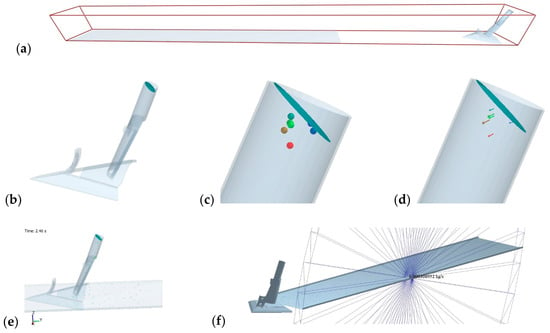
A complete digital geometry of the proposed trough-profile seed guide and sweep opener was imported into the simulation environment. The soil-interaction surface was represented by a horizonal plate with dimensions 300 × 2000 mm (Figure 8a), positioned 1000 mm below the seed guide exit. This configuration enabled full kinematic motion of particles prior to sowing and allowed assessment of seed distribution across the working width. Boundary restrictions outside the working plane were not imposed, as the internal dynamics of seed transport were the primary focus of analysis.
Figure 8.
DEM simulation workflow of the sweep opener and seed distribution: (a) initial position of the sweep opener with a trough-profile seed guide and the soil plate; (b) relative positions of the sweep opener and the particle-generation factory; (c) factory and seeds in the default view; (d) factory and seeds in the vector view; (e) distribution of seed particles onto the soil plate; (f) measurement of seed mass along the soil plate.
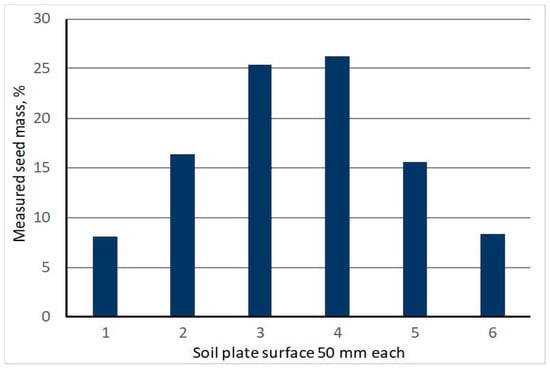
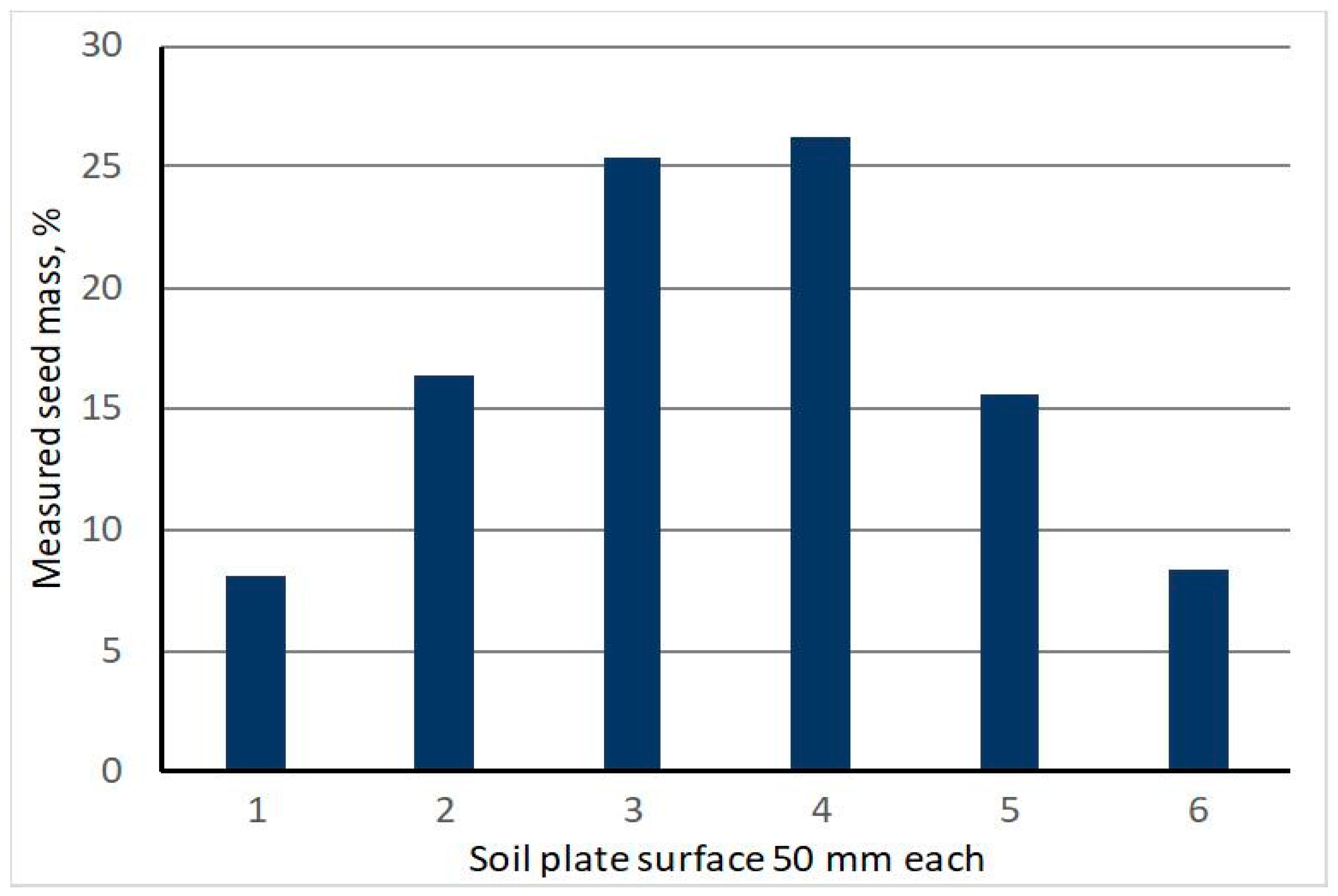
A particle-generation unit was placed inside the delivery tube (Figure 8b–d). It continuously released seed particles and had material properties approximating wheat seed behavior. The particles were emitted at a rate of 200 particles per second, with an initial vertical descent velocity of 0.3 m/s relative to the seeder, while the seeder’s forward velocity was set to 1.2 m/s. Consequently, the resultant absolute velocity of the seeds relative to the ground is directed forward and downward, thereby simulating the relative motion conditions between the seed flow and the moving sowing unit. This setup created a realistic convergence between the particle flow and the forward-moving opener (Figure 8e). The mass of distributed particles on the plate was measured in 50 mm increments to characterize the distribution trend across the working width of the sweep opener (Figure 8f).
In the DEM simulation as well as the theoretical analysis, seeds were modeled as spherical particles. This representation is a conventional approach for analyzing macroscopic seed flow behavior, supported by the sphericity factor methodology that effectively represents the geometric properties of agricultural seeds through equivalent spherical models [30].
The DEM simulation served as an intermediate validation stage following theoretical modeling and preceding laboratory testing. It enabled direct visualization of internal particle interactions, demonstrated the stabilizing effect of the levelling gate and guide plates, and provided a mechanistic understanding of ordered distribution prior to subsoil placement. This approach reduced experimental uncertainty and confirmed that flow ordering occurs entirely within the seed guide, without requiring external spreader components.
2.4. Experimental Studies
2.4.1. Design Description
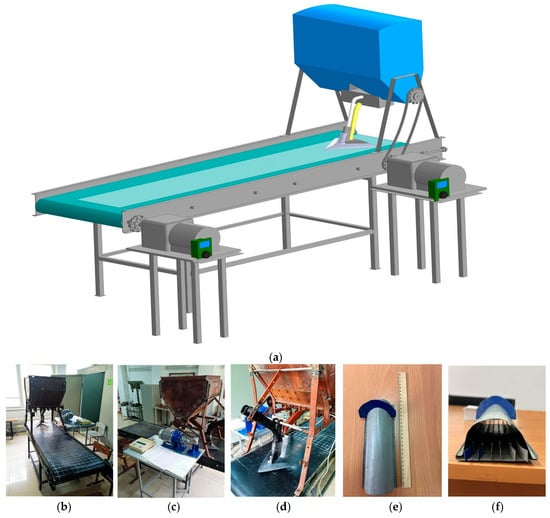
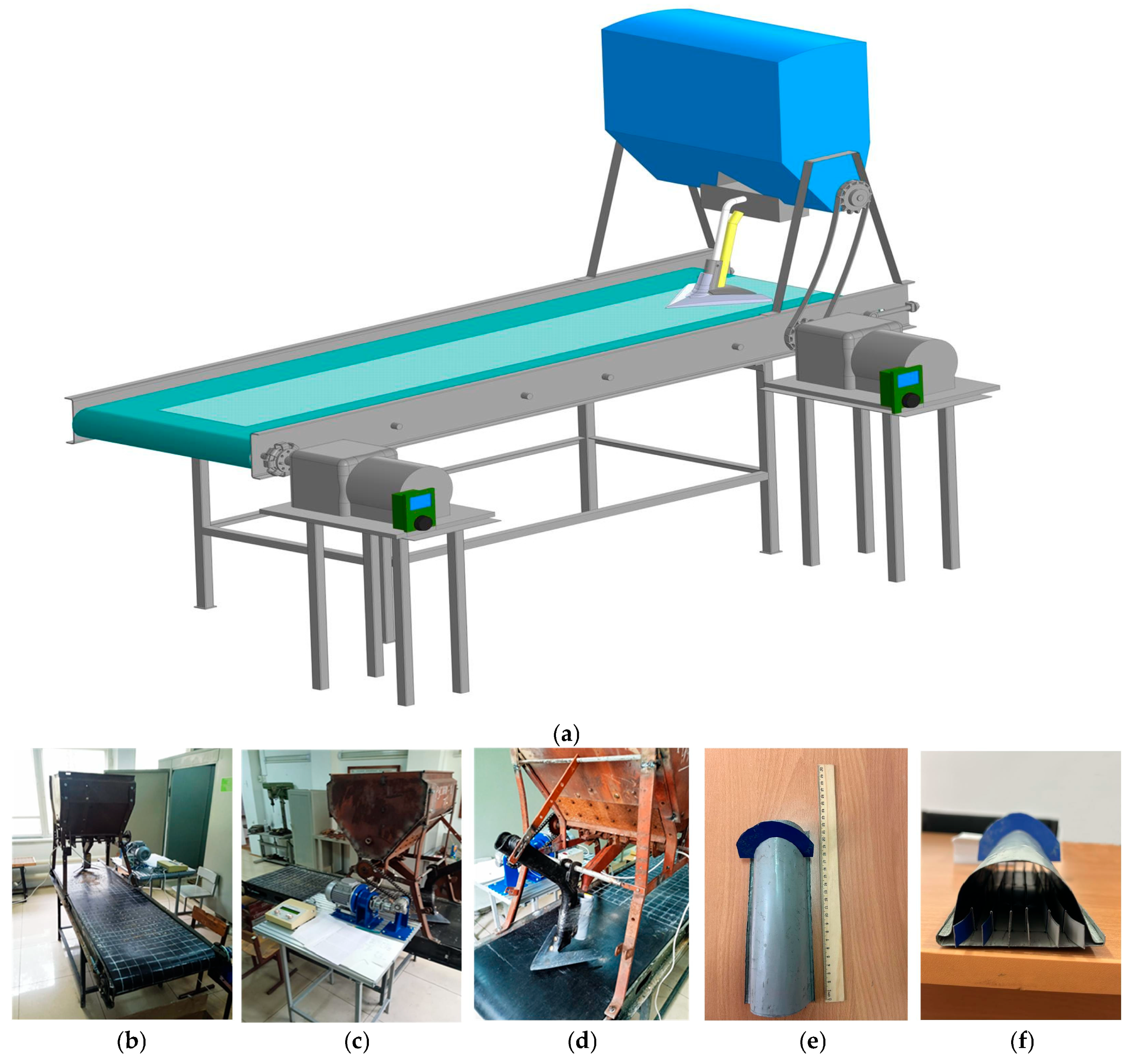
Experimental studies were conducted to verify the theoretical conclusions and analyze the pattern of seed distribution using the trough-profile seed guide. The forward speed and the fluted roller rotational speed were selected as variable modes. For the experiments, the following components were designed and manufactured: (1) a trough-profile seed guide and (2) an experimental simulation stand (Figure 9).
Figure 9.
Experimental simulation stand for studying the distribution of seeds sown by the sweep opener with a trough-profile seed guide: (a) general view in 3D; (b) rubber-coated belt-type seed bed conveyor; (c) seed-metering device drive unit; (d) sweep opener; (e) trough-profile seed guide (top view); (f) guide plates of the trough-profile seed guide (bottom view).
The simulation stand comprised a hopper with a seed-metering device drive unit, a belt-type seed bed conveyor, a sweep opener, and a trough-profile seed guide with a distributor (Figure 10). The surface of the belt-type seed bed conveyor was marked into a 5 × 5 cm cell to facilitate the analysis of seed distribution within the feed area, as described above. To ensure the accuracy of seed distribution measurement, potential errors from seed bouncing were minimized by two design features of the experimental stand: (1) the use of a rubber-coated conveyor belt to dampen the impact and (2) the minimization of the drop height from the opener outlet to the belt surface.
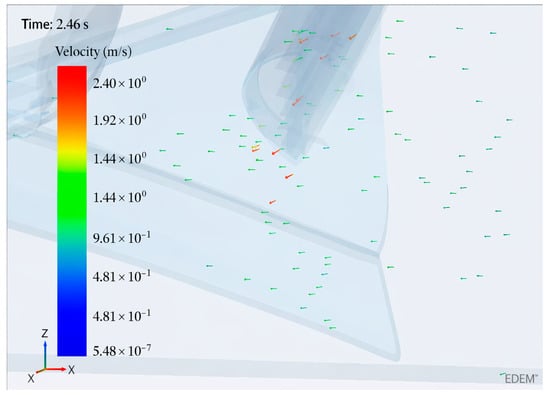
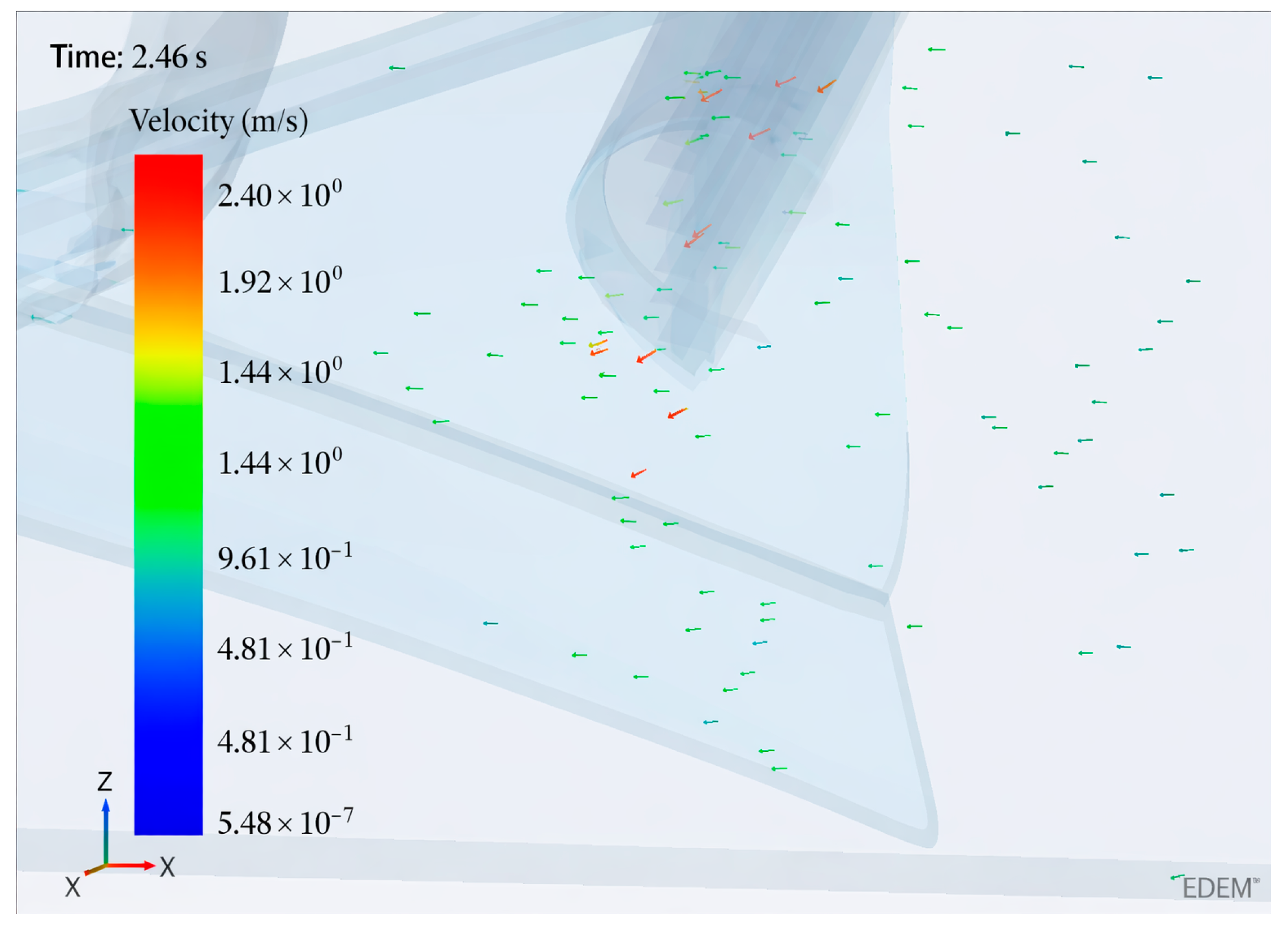
Figure 10.
Simulated seed mass distribution profile across the working width of the sweep opener obtained from DEM analysis.
2.4.2. Test Conditions
Experimental studies were carried out under laboratory conditions using a simulation stand. The key parameters were as follows: a seeding rate of 120 kg/ha; a fluted roller working length of 20 mm; a seeding fluted roller installation height of 420 mm. The experiments were carried out separately at fluted roller rotational speeds of 20 and 25 rpm, combined with different forward speeds of the belt-type seed bed conveyor of 1.2, 1.6, 2.0, and 2.4 m/s (4.32, 5.76, 7.2, and 8.64 km/h) to simulate the operational range of a drill seeder unit. The number of experimental replications was determined in accordance with the principal normative document for testing seeding machinery. Each test run was repeated a minimum of three times in accordance with GOST 31345 [31]. All tests were conducted accounting for the forward motion of the belt-type conveyor and the sowing width. The required seeding rate of 120 kg/ha was maintained by calibrating the seed-metering device and adjusting the gear ratio of the drive mechanism.
2.4.3. Performance Evaluation
Upon completion of the experiments, the results were processed to assess the uniformity of seed distribution across the working width of the sweep opener (on the surface of the belt-type seedbed conveyor) and the instability of the total sowing, in accordance with GOST 31345 [31].
The uniformity of seed distribution across the working width of the sweep opener Hp (coefficient of variation) was calculated as
where σA is the standard deviation of the number of seeds between the cells, g; is the average number of seeds per cell, g.
The average number of seeds per cell (across the working width) was calculated as
where qi is the average number of seeds sown in the i-th cell by working width across all replications, g; nа is the number of cells across the working width of the sweep opener.
The average number of seeds sown in the i-th cell by working width across all replications of qi was calculated as
where qij is the number of seeds sown in the i-th cell for the j-th replication, g; nn is the number of repetitions, pcs.
The standard deviation of the number of seeds between cells σA was determined as
The instability of the total seed sowing HУ (coefficient of variation) was determined as
where σΠ is the standard deviation of the number of seeds between replications, g; is the average number of seeds sown by the opener across all replications, g.
The average number of seeds sown by the opener from all replications was calculated as
The standard deviation of the number of seeds between repetitions σΠ was determined as
where qj is the number of seeds sown by the opener in the j-th replication, g.
The number of seeds sown by the opener in the j-th replication was determined as
3. Results and Discussion
3.1. DEM Simulation Results
To visualize and analyze the internal seed flow dynamics established in the theoretical analysis, a DEM simulation was conducted. The simulation served as an intermediate verification step, providing mechanistic insights into seed ordering and preliminary assessment of distribution uniformity prior to physical manufacturing.
Figure 9 illustrates the sequential stages of the simulation. The process confirms the theoretical operational principle, showing that seeds generated in the tube impact the levelling gate, descend onto the distribution tray, and are divided into discrete streams by the guide plates before their final distribution on the topsoil layer.
The velocity field captured during particle interaction with the soil plate (Figure 10) provides a visual validation of the equations of motion derived in the theoretical analysis. The transition from high-velocity free flight (red/orange color) to low-velocity settling (blue/green color) aligns with the theoretical model of seed trajectory, bounce, and rolling (Equations (22)–(24)). The observed dispersed yet controlled exit pattern directly corroborates the hypothesis that an ordered flow can be established within the guide geometry itself.
Quantitative analysis of the distribution pattern is presented in Figure 11. The simulated mass distribution profile across the 300 mm working width exhibits a multi-peak structure. These peaks correspond directly to the flow channels created by the guide plates. This result provides numerical support for the theoretical concept of flow division. The distribution shows effective coverage across the central 200 mm zone, with a controlled reduction at the edges. The formation of these distinct, ordered seed streams observed in our simulation is consistent with findings of Lei et al. [26], who utilized DEM to study a centralized seed-metering system for rapeseed and reported that flow division is an effective mechanism for managing seed distribution in multi-outlet designs.
Figure 11.
The results of seed distribution on the soil plate surface.
For a preliminary quantitative assessment, the coefficient of variation (CV) for seed distribution uniformity was calculated form the simulated distribution data, yielding a value of approximately 22.0%. This value aligns with the theoretical expectation that the proposed geometry should maintain operational variation within agrotechnical limits (<25–30% for broadcast sowing), as discussed in the context of Equations (20) and (21). Furthermore, this result is in reasonable agreement with the variation ranges (15–35%) reported in other DEM studies of seed guidance systems [22,26], confirming the plausibility of our model’s initial predictions. The simulation confirms that the key design parameters—particularly the tray inclination angle (β = 22°) derived from friction analysis and guide plate geometry—are theoretically sound for creating a stabilized and ordered seed flow.
The simulation crucially visualized and confirmed three key interactions hypothesized in the theoretical analysis:
- Impact with the levelling gate validated the theoretical role of this component in dissipating vertical momentum and creating a seed curtain. This damping effect is a known design strategy to reduce particle velocity, as similarly utilized in air-assisted seed tubes to improve placement accuracy [25].
- Gravitational sliding along the tray occurred as predicted by the force analysis in Figure 5 and Equation (16), with minimal undesirable bouncing.
- Flow separation by guide plates physically manifested the theoretical principle of transforming a single, disordered unlet stream into multiple, parallel ordered trajectories.
In summary, the DEM simulation served as a critical digital prototype that operationalized and confirmed the theoretical models. The consistency of our simulation outcomes with established DEM applications in agricultural machinery design [3] and seed system optimization [26,29] reinforces the validity of the chosen methodological approach. It demonstrated that the conceptual design behaves according the theoretical predictions when translated into a detailed 3D model, thereby reducing technical risk before proceeding to costly manufacturing and laboratory testing. The following experimental section presents the physical validation of this theoretically and numerically substantiated design.
3.2. Results of Experimental Studies
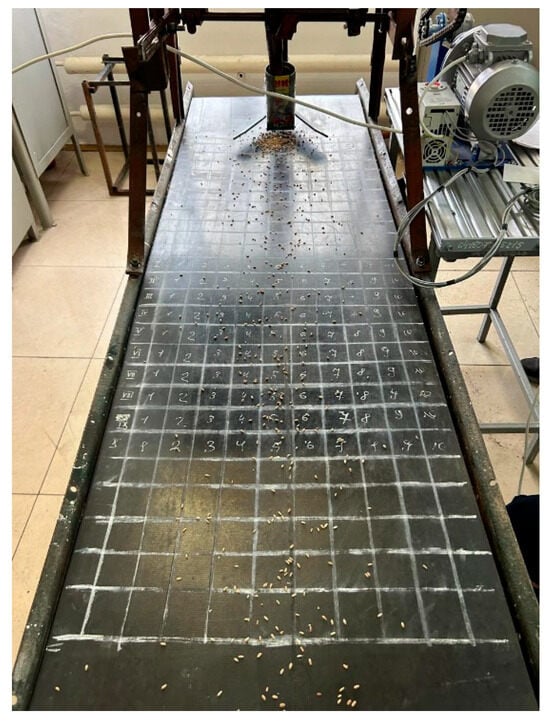
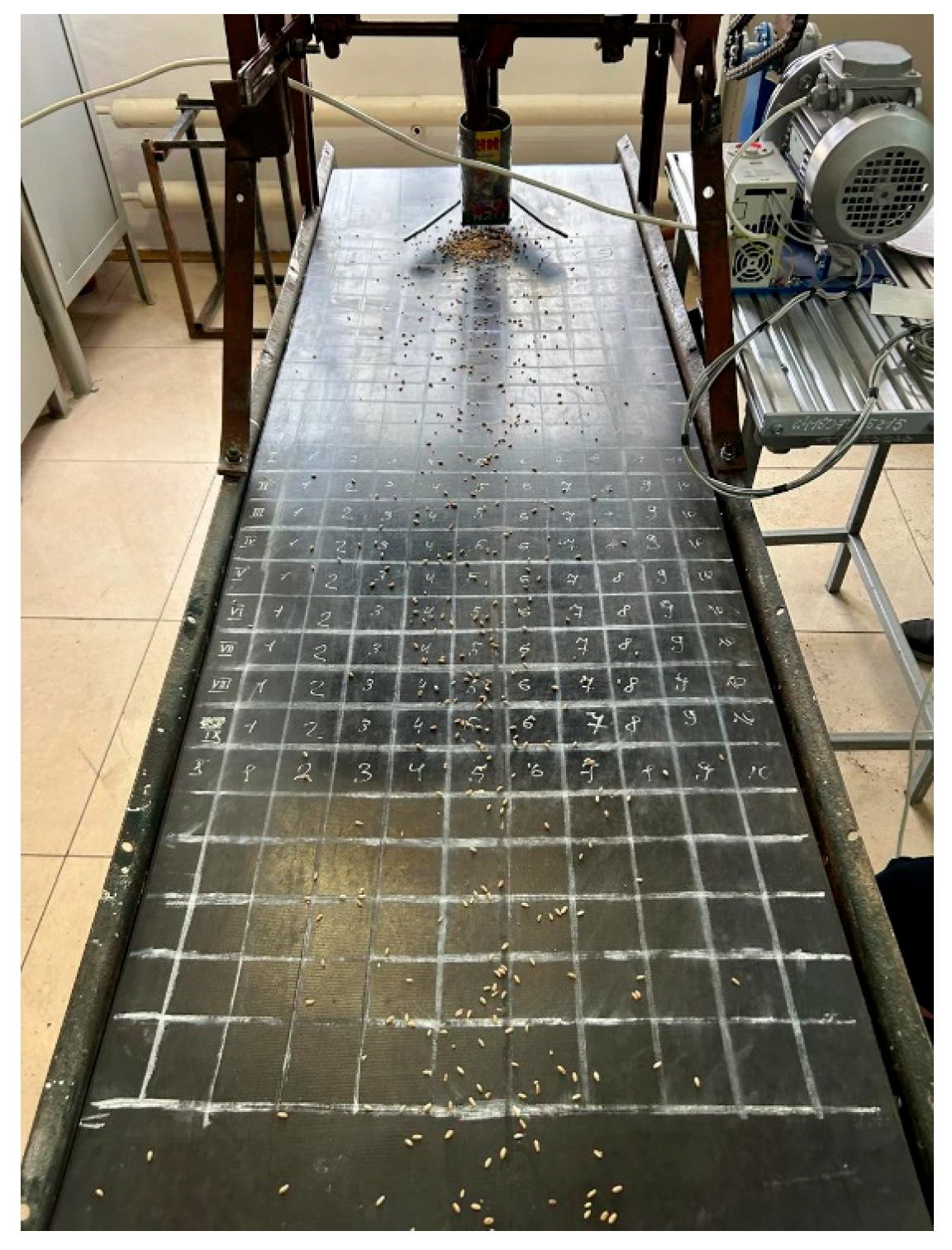
Laboratory experiments were conducted to investigate the effect of the forward speed and fluted roller rotational speed on the uniformity of seed distribution across the working width of the sweep opener. Given that the sweep opener has an increased working width of 30 cm, the trough-profile seed guide with a distributor is designed to ensure even seed distribution across this span, as shown in Figure 12.
Figure 12.
Seed distribution across the grid cells.
For the broadcast sowing method, the ideal seed distribution follows a uniform distribution law. Considering that the seeds are sown on a coordinate grid cell in 5 cm increments, for an opener with a working width of 30 cm, the theoretical uniform distribution would result in 16.7% of seeds falling into each elementary section. The standard deviation from this value characterizes the uniformity of seed distribution. The actual seed distribution pattern across the grid cells is presented in Figure 12.
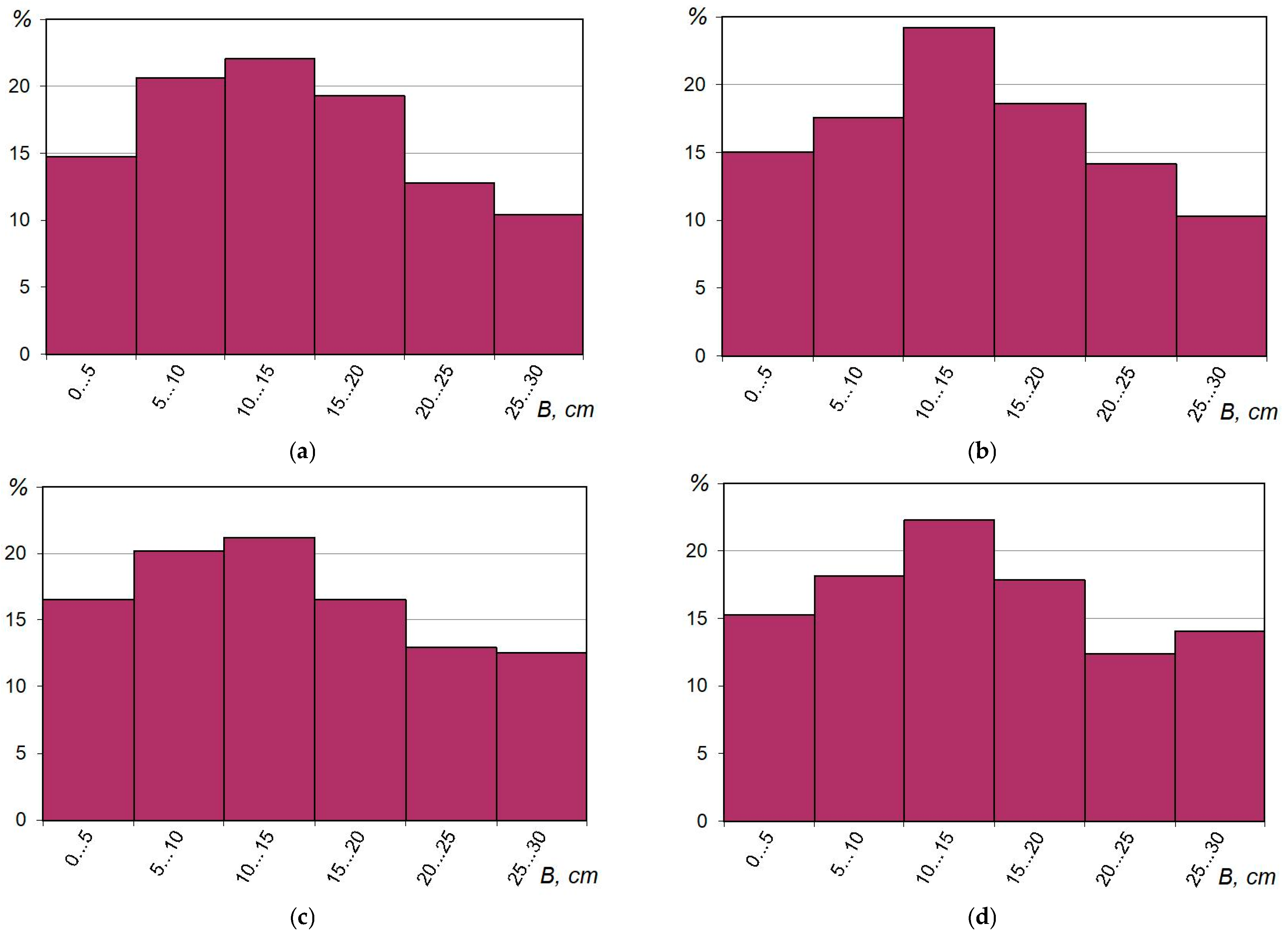
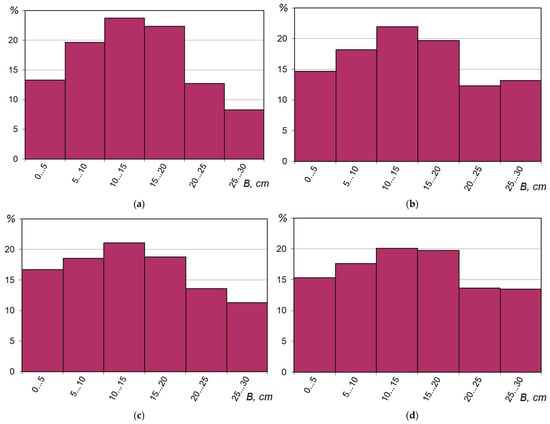
Figure 13 and Figure 14 present histograms of seed distribution across the working width of the sweep opener as a function of the forward speed and the rotational speed of the fluted roller.
Figure 13.
Histograms of seed distribution across the working width of the sweep opener at a fluted roller rotational speed of n = 20 rpm and different forward speeds: (a) V = 1.2 m/s; (b) V = 1.6 m/s; (c) V = 2.0 m/s; (d) V = 2.4 m/s.
Figure 14.
Histograms of seed distribution across the working width of the sweep opener at a fluted roller rotational speed of n = 25 rpm and different forward speeds: (a) V = 1.2 m/s; (b) V = 1.6 m/s; (c) V = 2.0 m/s; (d) V = 2.4 m/s.
Analysis of the histograms reveals that at a forward speed of 1.2 m/s, the seed distribution follows a pronounced normal (Gaussian) pattern, with the highest concentration of seeds (40–45%) located near the center of the opener. This value significantly exceeds the optimal theoretical value of 16.7%. Concurrently, seed density decreases towards the outer edges, indicating insufficient dispersion efficiency at this forward speed.
The most uniform seed distribution was observed within the forward speed range of 1.6–2.0 m/s. Within this range, the seed proportion per cell varied between 15 and 19%, corresponding to an acceptable deviation of ± 3% from the ideal value of 16.7%.
A further increase in forward speed to 2.4 m/s led to a redistribution of seeds across the working width. The proportion of seeds in the central zone decreases to 12–14%, while in the marginal zones it increases to 25%.
Investigation of the fluted roller rotational speed effect demonstrated that an increase from 20 to 25 rpm improved distribution uniformity and expanded the range of effective forward speeds. At a speed of n = 20 rpm, uniformity was achieved only within a narrow range of 1.6–2.0 m/s, whereas at a speed of n = 25 rpm, this range expanded to 1.6–2.2 m/s. Furthermore, at a forward speed of 2.4 m/s with a fluted roller rotational speed of 25 rpm, a favorable shift of seed distribution toward the edges of the opener was observed.
The results of experiments assessing the uniformity of seed distribution across the working width of the sweep opener are presented in Table 3. Analysis indicates that within the forward speed range of V = 1.2–2.4 m/s and fluted roller rotational speed of n = 20–25 rpm, the average number of grains per cell qA varied between 2.0 and 3.0 pcs.
Table 3.
The results of experiments to determine the uniformity of seed distribution.
Table 4 summarizes the experimental results for the instability of total sowing. The data show that within the forward speed range of V = 1.2–2.4 m/s and at a fluted roller rotational speed of n = 20 rpm, the average number of grains sown by the opener qΠ ranged from 10.0 to 15.0 pcs. When the fluted roller rotational speed was increased to n = 25 rpm, the average number of grains sown by the opener qΠ increased to 15.0–19.0 pcs.
Table 4.
The results of experiments to determine the instability of the total sowing.
The value of the average number of grains sown by the opener qΠ depends on the fluted roller rotational speed n. A higher fluted roller rotational speed n corresponds to a larger value of average number of grains qΠ and this difference becomes more pronounced with increasing forward speed V. For instance, at n = 20 rpm and V = 1.2 m/s, the average number of grains of qΠ was 15.0 pcs. At a fluted roller rotational speed of n = 25 rpm and V = 1.2 m/s, this value increased to 17.0 pcs. When V was increased to 2.4 m/s at the respective rotational speed, the qΠ values were 11.0 and 16 pcs, respectively, resulting in a difference of 5.0 pcs.
Based on the obtained data, it can be concluded that an increase in both forward speed and fluted roller rotational speed necessitates a higher seeding rate. This finding is consistent with recommendations from previous research by Collins at al. [7].
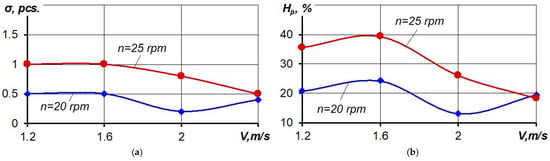
Based on the experimental data, the graphs plotted in Figure 15 show the influence of forward speed and fluted roller rotational speed on the standard deviation and coefficient of variation characterizing the uniformity of seed distribution across the working width of the sweep opener. Within the forward speed range of 1.2–2.4 m/s and at a fluted roller rotational speed of 20 rpm with an average number of grains count of 2.0–3.0 pcs per cell, the standard deviation ranged from 0.2 to 0.5 pcs. At a fluted roller rotational speed of 25 rpm, the standard deviation increased to 0.5–1.0 pcs. The corresponding coefficients of variation varied between 13.0 and 24.2% and between 18.2 and 39.4%, respectively. These values comply with agrotechnical requirements [31]. The obtained results are consistent with previous research by Liu et al. and Xi et al. [17,27]. Notably, the experimentally obtained range of coefficient of variation (CV) values characterizing the uniformity of seed distribution across the working width of the sweep opener at the forward speed of 1.2 m/s (20.7–35.6%) encompasses the preliminary value predicted by the DEM simulation (≈22.0%), providing a direct quantitative validation of the model’s predictive capability.
Figure 15.
The influence of forward speed V and fluted roller rotational speed n on the standard deviation σ (a) and coefficient of variation Hp (b) characterizing the uniformity of seed distribution across the working width of the sweep opener.
Analysis of the uniformity of seed distribution across the working width of the sweep opener revealed that the minimum standard deviation from the normal distribution was achieved at a forward speed of V = 2.0 m/s and fluted roller rotational speed of n = 20 rpm.
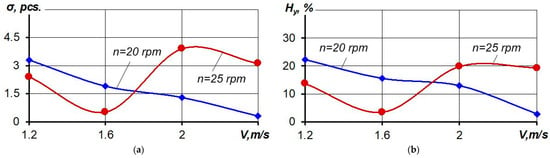
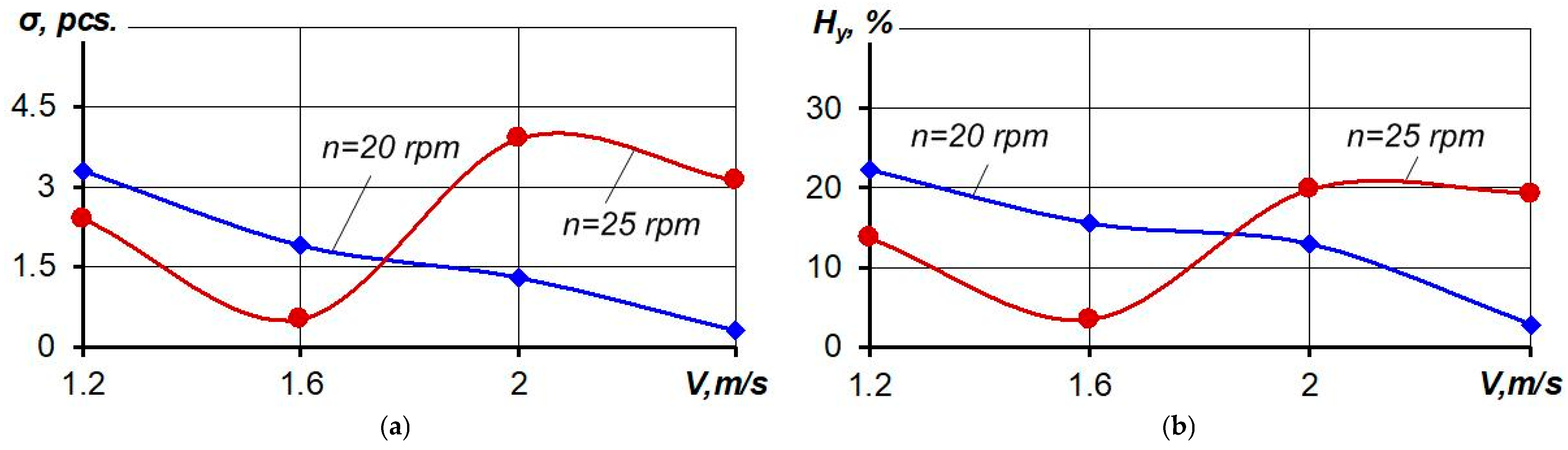
Figure 16 presents graphs showing the influence of forward speed and fluted roller rotational speed on the standard deviation and coefficient of variation for the instability of the total seeding.
Figure 16.
The influence of forward speed V and fluted roller rotational speed n on the standard deviation σ (a) and coefficient of variation Hp (b) characterizing the instability of the total sowing.
The analysis demonstrates that in the forward speed range of 1.2–2.4 m/s with a fluted roller rotational speed of 20 rpm, where the average number of grains sown by the opener was 10.0–15.0 pcs, the standard deviation ranged from 0.3 to 3.3 pcs. At a fluted roller rotational speed of 25 rpm, with an average number of grain count of 15.0–19.0 pcs, the standard deviation increased to 0.5–3.9 pcs. The corresponding coefficients of variation were 2.8–22.4% and 3.5–19.8%, respectively. All obtained values meet agrotechnical requirements [32].
3.3. Statistical Analysis
An analysis of variance (ANOVA) was carried out using the SPSS 23 Statistics software to evaluate the effect of the forward speed and the fluted roller rotational speed on the uniformity of seed distribution across the working width of the sweep opener, measured via the standard deviation (Table 5).
Table 5.
ANOVA results.
The ANOVA results indicate that both the working speed and the fluted roller rotational speed have a statistically significant effect on the uniformity of seed distribution. This is evidenced by the high F-values of 30.482 and 89.786, respectively, and p < 0.05 for both factors.
These findings confirm the results of theoretical studies, which suggest that seed distribution is significantly influenced by the forward speed of the sowing unit. Furthermore, the interaction between these factors is also statistically significant due to the fact that the F-value is 22.367 and p ≥ 0.05. These results align with the studies by Collins et al., Liu et al., and Xi et al. [7,17,27]. This significant interaction indicates that the effect of the forward speed on the uniformity of seed distribution across the working width of the sweep opener, as well as on the instability of the total seed sowing, depends on the operating modes of the seed-metering device, and vice versa.
Thus, it can be concluded that by adjusting the forward speed and fluted roller rotational speed, it is possible to improve the uniformity of seed distribution across the working width of the sweep opener and reduce the instability of the total seed sowing. However, optimal sowing quality is achieved only through specific combinations of these modes, rather than by varying them individually.
4. Discussion
Development of a novel through-profile seed guide addresses a persistent challenge in subsoil-broadcast sowing: achieving uniform seed distribution across the working width of a sweep opener from a single, inherently disordered inlet stream. Conventional seeding systems typically attempt to correct disorder at the final stage using deflectors or spreading plates on the opener, which often results in stochastic and suboptimal seed placement [9,10,11,12,19]. In contrast, the present work demonstrates a paradigm shift by showing that sowing uniformity can be fundamentally improved by engineering an ordered seed flow within the delivery guide itself, prior to seed–soil contact. The proposed through-profile design achieves this through a sequential mechanical process: a levelling gate dissipates vertical impact energy, an inclined tray enables controlled gravitational sliding, and diverging guide plates actively split the flow into discrete, parallel streams. Thus, the core innovation lies in transforming a chaotic seed cloud into organized, pre-distributed laminae across the working width, ensuring orderly deposition.
The methodological approach for investigating this novel through-profile seed guide combines theoretical analysis, DEM simulation, and experimental studies. Theoretical analysis established that the key sowing parameters, including sowing uniformity, are predominantly governed by two operational variables: the seeder’s forward speed and the rotational speed of the seed-metering device’s rollers. This conclusion aligns with the findings of prior research by Liu et al., Wang et al., Li et al., and Malofeyev [17,20,21,28].
The DEM simulation served as a crucial digital prototype, providing visual validation of seed motion principles derived theoretically. It confirmed the operational mechanism, demonstrating the sequential formation of an ordered seed flow by the levelling gate, distribution tray, and guide plates. Most importantly, it enabled the virtual optimization of key geometric parameters, ensuring their functional efficacy prior to the manufacturing of physical prototypes. This approach is consistent with proven DEM applications in agricultural design [3,26,29].
Laboratory experiments provided practical validation of this theoretical foundation. The measured coefficients of variation for the uniformity of seed distribution (13.0–39.4%) and for the instability of the total seeding (2.8–22.4%), obtained under different combinations of the seeder’s forward speed and the fluted roller’s rotational speed, confirm the effectiveness of the novel through-profile seed guide design. These results align with the findings of Liu et al. and Xi et al. [17,27]. Statistical analysis revealed a significant interaction between these factors, a finding that aligns with the studies by Collins et al., Liu et al., and Xi et al. [7,17,27].
Ultimately, the achieved performance complies with agrotechnical requirements for subsoil-broadcast sowing [32].
While direct comparative laboratory experiments with a standard tube guide were not conducted within this study, the results demonstrate the design’s efficacy. They align favorably with the performance ranges reported for other advanced seed-guiding solutions, such as the helicoidal or convergent-groove tubes developed by Karayel et al. and Jia et al. [22,23]. Importantly, the achieved performance in terms of the instability of the total seeding meets with the fundamental agrotechnical requirements that apply to all seed delivery systems, including conventional tube guides [32].
The novel seed guide is designed primarily for subsoil-broadcast sowing applications. Its operation is conceptually independent of the metering device type, which facilitates integration with various existing seeders. It functions as a complementary downstream component, taking the precisely metered seed stream and ensuring its uniform lateral distribution across the working width of the opener. This design positions it as a key enabling technology for future high-precision systems that aim to combine accurate singulation with uniform lateral distribution.
The findings of this study outline clear pathways for future research.
- −
- Field validation: As all validation was performed under controlled laboratory conditions, field trials are essential to evaluate performance under realistic agronomic conditions, including soil variability, crop residue, and dynamic implement movement.
- −
- Adaptation to other crops and regimes: The novel seed guide’s geometry was optimized for wheat at a fixed seeding rate; adaptation to other crops (e.g., rapeseed, maize) or for variable-rate applications would require parametric re-optimization, potentially guided by the established DEM framework [29].
- −
- Durability and reliability factors: The long-term field performance and corrosion resistance of steel components under realistic field conditions require dedicated investigation through accelerated aging tests and material selection studies.
- −
- Commercialization assessment: Practical aspects critical for commercial (market) adoption—such as manufacturing cost analysis, scalability, and an assessment of economic efficiency—warrant a separate study.
In summary, this research provides a validated design principle for active seed flow ordering. It demonstrates that uniform subsoil-broadcast distribution is achievable through internal flow division and offers a comprehensive methodology—combining theoretical analysis, numerical DEM simulation, and experimental testing—for developing and optimizing such systems. Thus, this research advances the fundamental understanding of seed transport dynamics and provides a practical foundation for the next generation of high-uniformity sowing equipment.
5. Conclusions
The purpose of this research is to design a trough-profile seed guide and to evaluate its efficacy in ensuring the uniform distribution of wheat seeds across the working width of the sweep opener for subsoil-broadcast sowing. The study focused on the design principles and the key operational parameters—specifically, the forward speed and the fluted roller rotation speed—to achieve an orderly seed flow and improve distribution uniformity. Experimental studies confirmed the effectiveness of the proposed design, demonstrating compliance with agrotechnical requirements for both uniformity of seed distribution across the working width of the sweep opener and the instability of total sowing. The main findings are summarized as follows:
- The study introduces a novel trough-profile seed guide for a sweep opener used in the subsoil-broadcast sowing method. The novelty of the design lies in its ability to form an ordered seed flow directly within the seed guide itself, prior to the seeds entering the sweep opener. This study demonstrates that the proposed design ensures uniform seed distribution within the subsoil space across the entire working width of the sweep opener.
- A theoretical analysis of seed motion within the trough-profile seed guide was conducted. Equations were obtained to determine the seed flight range, as well as the distance of seed jumping and rolling within the subsoil space after the seeds exit the trough-profile seed guide. The analysis established that seed distribution is significantly dependent on the forward speed of the sowing unit.
- Numerical simulation using the Discrete Element Method (DEM) provided intermediate validation of the seed guide’s operating principle. The simulation visually confirmed the formation of an ordered seed flow through the sequential action of the levelling gate, distribution tray, and guide plates. The resulting multi-peak distribution profile and the calculated coefficient of variation of 22.0% demonstrated that the design parameters—particularly tray angle and plate geometry—are capable of achieving seed distribution uniformity within preliminary, theoretically predicted limits, prior to physical prototyping.
- Experimental studies were carried out to determine the influence of the forward speed and the fluted roller rotation speed on the uniformity of seed distribution across the working width of the sweep opener. The findings indicate that within the speed range of 1.2–2.4 m/s and at a fluted roller rotation speed of 20 rpm with an average grain count per cell of 2.0–3.0 pcs, the standard deviation ranges from 0.2 to 0.5 pcs. At a higher rotation speed of the fluted roller of 25 rpm, the standard deviation increases to 0.5–1.0 pcs. The corresponding coefficients of variation range from 13.0 to 24.2% and from 18.2 to 39.4%, respectively. These values for the uniformity of seed distribution across the working width of the sweep opener fall within the acceptable limits specified by agrotechnical requirements.
- An analysis of the experimental results to determine the effect of forward speed and fluted roller rotational speed on the instability of the total sowing showed that, within the forward speed range of 1.2–2.4 m/s and at a fluted roller rotation speed of 20 rpm, with an average grain count of 10.0–15.0 pcs per opener, the standard deviation ranged from 0.3 to 3.3 pcs. At a fluted roller rotation speed of 25 rpm, with an average grain count of 15.0–19.0 pcs., the standard deviation ranged from 0.5 to 3.9 pcs. The corresponding coefficients of variation varied between 2.8 and 22.4% and between 3.5 and 19.8%, respectively. The obtained values for the instability of the total sowing comply with the relevant agrotechnical requirements.
Author Contributions
Conceptualization, N.K. and K.M.; methodology, N.K. and V.O.; software, T.Z.; validation, V.O. and S.U.; formal analysis, M.A.; investigation, N.K. and K.M.; resources, N.K. and T.Z.; data curation, O.M.; writing—original draft preparation, K.M. and M.A.; writing—review and editing, M.A. and A.S.; visualization, M.A. and A.S.; supervision, N.K. and K.M.; project administration, N.K.; funding acquisition, N.K. and O.M. All authors have read and agreed to the published version of the manuscript.
Funding
This research has been funded by the Science Committee of the Ministry of Science and Higher Education of the Republic of Kazakhstan (Grant No. AP23490415).
Institutional Review Board Statement
Not applicable.
Informed Consent Statement
Not applicable.
Data Availability Statement
The datasets used and/or analyzed during the current study are available from the corresponding author on reasonable request.
Conflicts of Interest
The authors declare no conflicts of interest.
References
- Sugirbay, A.; Zhao, K.; Liu, G.; Hu, G.; Chen, J.; Mustafin, Z.; Iskakov, R.; Kakabayev, N.; Muratkhan, M.; Khan, V.; et al. Double disc colter for a zero-till seeder simultaneously applying granular fertilizers and wheat seeds. Agriculture 2023, 13, 1102. [Google Scholar] [CrossRef] [Scilit]
- Qin, K.; Ding, W.M.; Ahmad, F.; Fang, Z.C. Design and experimental validation of sliding knife notch-type disc opener for a no-till combine harvester cum seed drill. Int. J. Agric. Biol. Eng. 2018, 11, 96–103. [Google Scholar] [CrossRef]
- Ahmad, F.; Qiu, B.J.; Ding, Q.S.; Ding, W.M.; Khan, Z.M.; Shoaib, M.; Chandio, F.A.; Rahim, A.; Khaliq, A. Discrete element method simulation of disc type furrow openers in paddy soil. Int. J. Agric. Biol. Eng. 2020, 13, 103–110. [Google Scholar] [CrossRef] [Scilit]
- Wang, L.J.; Zhou, B.; Wan, C.; Zhou, L. Structural parameter optimization of a furrow opener based on EDEM software. Int. J. Agric. Biol. Eng. 2024, 17, 115–120. [Google Scholar] [CrossRef] [Scilit]
- Zhang, X.C.; Li, H.W.; Du, R.C.; Ma, S.C.; He, J.; Wang, Q.J.; Chen, W.; Zheng, Z.; Zhang, Z.Z. Effects of key design parameters of tine furrow opener on soil seedbed properties. Int. J. Agric. Biol. Eng. 2016, 9, 67–80. [Google Scholar]
- Zolotukhin, Y.; Nukeshev, S.; Amantayev, M.; Rustembayev, A.; Kakabayev, N.; Kravchenko, R. Research test of drill seeder with control and monitoring unit of seed metering device for differentiated dosing of seeds and mineral fertilisers in precision agriculture. Acta Technol. Agric. 2025, 2, 117–123. [Google Scholar] [CrossRef] [Scilit]
- Collins, B.A.; Fowler, D.B. A comparison of broadcast and drill methods for no-till seeding winter wheat. Can. J. Plant Sci. 1992, 72, 1001–1008. [Google Scholar] [CrossRef] [Scilit]
- Eric, B.; Jim, E.; Leap, E. A comparison of drill and broadcast methods for establishing cover crops on beds. HortScience 2014, 49, 441–447. [Google Scholar] [CrossRef] [Scilit]
- He, X.; Zhang, R.; Zhang, J.F.; Zhe, Y.H.; Wang, W.Z.; Zhang, H.M. Design and test of a double compression seeder for pre-sowing and seed furrow of wheat in wide-seeding belts. Int. J. Agric. Biol. Eng. 2024, 17, 136–145. [Google Scholar]
- Cakmak, B.; Aykas, E.; Onal, I.; Cakir, E. The performance of developed rotary tiller fitted with pneumatic seeder. Bulg. J. Agric. Sci. 2010, 16, 801–810. [Google Scholar]
- Nukeshev, S.; Slavov, V.; Kakabayev, N.; Amantayev, M. Mathematical modeling in 3D of opener with scatterer of the grain-fertilizer seeder. Mechanika 2018, 24, 840–844. [Google Scholar] [CrossRef] [Scilit]
- Nukeshev, S.; Eskhozhin, D.; Karaivanov, D.; Eskhizhin, K.; Balabekova, A.; Zhaksylykova, Z.; Zolotukhin, Y. Theoretical investigation of a conic-helical loosener for fertilizer applying machine. Teh. Vjestn. 2017, 24, 79–84. [Google Scholar]
- Heege, H.; Feldhaus, B. Site specific control of seed-numbers per unit area for grain drills. Agric. Eng. Int. CIGR J. 2003, 5, 468. [Google Scholar]
- Karayel, D.; Ozmerzi, A. Comparison of vertical and lateral seed distribution of furrow openers using a new criterion. Soil Tillage Res. 2007, 95, 69–75. [Google Scholar] [CrossRef] [Scilit]
- Riley, T.W.; Shahidi, S.K.; Reeves, T.G.; Cass, A. Effect of design parameters of narrow direct drilling points on their performance in soil bin. Agric. Eng. Aust. 1997, 26, 5–14. [Google Scholar]
- Ozmerzi, A.; Karayel, D.; Topakci, M. Effect of sowing depth on precision seeder uniformity. Biosyst. Eng. 2002, 82, 227–230. [Google Scholar]
- Liu, Q.W.; He, X.T.; Yang, L.; Zhang, D.X.; Cui, T.; Qu, Z.; Yan, B.; Wang, M.; Zhang, T. Effect of travel speed on seed spacing uniformity of corn seed meter. Int. J. Agric. Biol. Eng. 2017, 10, 98–106. [Google Scholar] [CrossRef] [Scilit]
- Panning, W.J.; Kocher, F.M. Laboratory and field testing of seed spacing uniformity for sugarbeet planters. Appl. Eng. Agric. 2000, 16, 7–13. [Google Scholar] [CrossRef] [Scilit]
- Nukeshev, S.; Eskhozhin, K.; Karaivanov, D.; Sankibaev, T.; Kakabayev, N. Theoretical and experimental substantiation of the design of an opener for intrasoil broadcast sowing of grain crops. Bulg. J. Agric. Sci. 2016, 22, 862–868. [Google Scholar]
- Wang, F.Y.; Zhang, W.X.; Jiang, J.T. Seed path planning and parameter optimization for air-suction carrot seed-metering device. Int. J. Agric. Biol. Eng. 2023, 16, 104–112. [Google Scholar] [CrossRef] [Scilit]
- Li, Y.F.; Zhou, W.O.; Ma, C.C.; Feng, Z.H.; Wang, J.W.; Yi, S.J.; Wang, S. Design and optimization of the conveying system for belt-type high-speed corn guiding device. Int. J. Agric. Biol. Eng. 2024, 17, 123–131. [Google Scholar]
- Karayal, D.; Sarauskis, E.; Aktas, A. Design and experiment of a helicoidal seed tube to improve seed distribution uniformity of seed drills. Processes 2022, 10, 1271. [Google Scholar] [CrossRef] [Scilit]
- Jia, X.; Zhu, J.; Guo, G.; Huang, Y.; Gao, X.; Zhang, C. Design and test of a novel converging groove-guided seed tube for precision seeding of maize. Biosyst. Eng. 2024, 245, 36–55. [Google Scholar] [CrossRef] [Scilit]
- Li, Z.; Zhang, H.; Huang, J.; Lou, C.; Chen, Y.; Liu, L.; Zhang, T.; Chen, L. Design and parameter optimization of air-delivery auxiliary seed guide for pneumatic plate precision rapeseed metering device. Comput. Electron. Agric. 2025, 230, 109840. [Google Scholar] [CrossRef] [Scilit]
- Tang, H.; Xu, F.; Xu, C.; Zhao, J.; Wang, Y.-J. The influence of a seed drop tube of the inside-filling air-blowing precision seed-metering device on seeding quality. Comput. Electron. Agric. 2023, 204, 107555. [Google Scholar] [CrossRef] [Scilit]
- Lei, X.; Hu, H.; Wu, W.; Liu, H.; Liu, L.; Yang, W.; Zhou, Z.; Ren, W. Seed motion characteristics and seeding performance of a centralized seed metering system for rapeseed investigated by DEM simulation and bench testing. Biosyst. Eng. 2021, 203, 22–33. [Google Scholar] [CrossRef] [Scilit]
- Xi, X.; Gu, C.; Shi, Y.; Zhao, Y.; Zhang, Y.; Zhang, Q.; Jin, Y.; Zhang, R. Design and experiment of no-tube seeder for wheat sowing. Soil Tillage Res. 2020, 204, 104724. [Google Scholar] [CrossRef] [Scilit]
- Malofeyev, V.Y. Mathematical model of seed motion in the seed tube. Achiev. Sci. Technol. Agric. 2007, 7, 3–6. [Google Scholar]
- Sugirbay, A.; Hu, G.-R.; Chen, J.; Mustafin, Z.; Muratkhan, M.; Iskakov, R.; Chen, Y.; Zhang, Z.; Bu, L.; Dulatbay, Y.; et al. A study on the calibration of wheat seed interaction properties based on the discrete element method. Agriculture 2022, 12, 1497. [Google Scholar] [CrossRef] [Scilit]
- Kaliniewicz, Z.; Biedulska, J.; Jadwisieńczak, B. Assessment of cereal seed shape with the use of sphericity factors. Tech. Sci. 2015, 18, 237–246. [Google Scholar]
- GOST 31345-2007; Tractor Seeders. Test Methods. Standartinform: Moscow, Russia, 2007. (In Russian)
- Elizarov, V.P.; Antyshev, N.M.; Beilis, V.M.; Shvetsov, V.G. Initial requirements of technological operations in crop production. Agric. Mach. Technol. 2011, 5, 11–14. (In Russian) [Google Scholar]



Disclaimer/Publisher’s Note: The statements, opinions and data contained in all publications are solely those of the individual author(s) and contributor(s) and not of MDPI and/or the editor(s). MDPI and/or the editor(s) disclaim responsibility for any injury to people or property resulting from any ideas, methods, instructions or products referred to in the content. |
© 2026 by the authors. Licensee MDPI, Basel, Switzerland. This article is an open access article distributed under the terms and conditions of the Creative Commons Attribution (CC BY) license.