Review

Precision Livestock Farming for Dairy Sheep: A Literature Review of IoT and Decision-Support Systems for Enhanced Management and Welfare


by
Maria Consuelo Mura
*,
Othmane Trimasse
,
Vincenzo Carcangiu
and
Sebastiano Luridiana
Department of Veterinary Medicine, University of Sassari, Via Vienna 2, 07100 Sassari, Italy
*
Author to whom correspondence should be addressed.
AgriEngineering 2026, 8(2), 58; https://doi.org/10.3390/agriengineering8020058
Submission received: 11 December 2025 / Revised: 2 February 2026 / Accepted: 4 February 2026 / Published: 6 February 2026
(This article belongs to the Special Issue New Management Technologies for Precision Livestock Farming)

Abstract

The dairy sheep, vital to the Mediterranean economy, struggles to balance productivity, sustainability, and animal welfare, especially in extensive, small-scale systems. Precision livestock farming (PLF) technologies offer new opportunities by enabling continuous, non-invasive, and data-driven monitoring across diverse farming conditions. Despite rapid progress in sensors, computer vision, wearable devices, and artificial intelligence (AI), a comprehensive synthesis focused on dairy sheep remains limited. This review provides an updated overview of PLF applications in dairy sheep farming, based on a literature review. The 2018–2025 timeframe was chosen to capture recent advances in Internet of Things (IoT), AI, and sensor technologies that have achieved practical relevance only in recent years. The review identifies core technological domains such as automated weight and body condition monitoring, biometric identification, wearable and IoT-based sensors, localization systems, behavioral and thermal monitoring, virtual fencing, drone-assisted herding, and advanced decision-support tools. Innovations including lightweight deep-learning models, multimodal sensing frameworks, and digital twins highlight the growing potential for scalable, real-time applications. While technological progress is substantial, practical adoption is hindered by economic, technical, interoperability, and ethical barriers. This review consolidates current evidence and identifies future priorities to guide the development of integrated, welfare-focused PLF solutions for dairy sheep farming.

1. Introduction

Precision Livestock Farming technologies have the potential to support key management decisions in dairy sheep systems. These include monitoring lactation dynamics and milking processes, early detection of health disorders, reproductive management, including estrus detection and activity monitoring, nutritional supplementation, grazing allocation in extensive systems, and the assessment of animal welfare during handling and milking. Consequently, this review examines PLF technologies in relation to the specific management decisions they are designed to support within dairy sheep production systems.

1.1. The Importance of Sustainable Livestock Management for Dairy Sheep

In the modern agricultural landscape, the dairy sheep sector plays a crucial role in the Mediterranean economy and global food security, contributing significantly to the production of high-value cheeses and the sustenance of rural communities [1,2]. The intensification of production systems, driven by growing demand, has increased the focus on animal welfare, health monitoring, and environmental sustainability [2,3,4]. However, traditional management methods often rely on manual observation and reactive interventions, which can be time-consuming, subjective, and inefficient for detecting early signs of health issues or welfare compromises [5,6,7].
To address these challenges, there is a pressing need to adopt innovative technologies that enable proactive and individualized animal management. This approach ensures optimal health and productivity while safeguarding animal welfare and resource efficiency [1,8,9]. While traditional approaches remain widespread, advanced Precision Livestock Farming (PLF) technologies are increasingly becoming essential tools for enhancing sustainability and efficiency in modern sheep farming [1,8]. The ongoing digital transformation in livestock farming, often discussed within the framework of Industry 4.0 (the fourth industrial revolution characterized by cyber–physical systems, the Internet of Things-IoT-and data-driven automation), is accelerating this adoption by enabling new levels of automation and data integration [10].

1.2. Precision Livestock Farming as a Strategic Approach

PLF represents a management strategy that utilizes continuous, automated monitoring technologies to manage livestock at the individual or group level [8]. Unlike conventional methods, which often apply uniform practices without accounting for individual variability—leading to inefficiencies and potential welfare issues—PLF enables targeted interventions based on real-time data [11,12]. In this context, PLF plays a pivotal role in improving dairy sheep management by enabling early disease detection, optimizing resource use, and enhancing overall welfare, thereby contributing to more sustainable and ethical production systems [1,4,7]. Furthermore, studies have systematically examined the welfare implications of digital tools in pasture-based systems, providing valuable frameworks for implementing PLF technologies in ways that safeguard and potentially enhance animal welfare [13,14].

1.3. Core Technologies in Advancing PLF for Dairy Sheep

Advancements in PLF for dairy sheep include sensor-based systems [9,15], Internet of Things (IoT) platforms [16,17], unmanned aerial vehicles (UAVs) [12,18], and artificial intelligence (AI)-driven decision support tools [11,19,20]. Recent developments in Wearable Internet of Things (W-IoT)—smart electronic devices worn on the body that connect to the internet to collect, transmit, and analyze data—have opened new possibilities for continuous, individual animal monitoring, addressing critical aspects such as biocompatibility and sustainable monitoring systems [21]. The convergence of these technologies with concepts like Digital Twins frameworks—which create dynamic virtual replicas of physical systems—promises to yield high-fidelity virtual models of livestock environments for advanced simulation and management [22]. These technologies offer promising solutions for monitoring key parameters such as health, behavior, and environmental conditions.
Among these, IoT sensors provide critical data for individual animal monitoring and can be deployed as wearable devices (e.g., collars, ear tags) or as stationary systems within the farm infrastructure [15,16,23]. Several studies have demonstrated that accelerometers and GPS sensors can effectively monitor behavior and location, allowing farmers to detect estrus, lameness, and feeding anomalies [7,15,18,24,25]. Advanced sensing modalities such as millimeter-wave radar now enable contactless tracking of untagged animals with high precision, overcoming limitations of optical systems in challenging environmental conditions [26]. Real-time location systems (RTLS), particularly ultra-wideband (UWB) technology, have shown promising accuracy for indoor tracking of sheep, with positional errors as low as 0.39 m [27]. Multi-sensor fusion approaches that combine UWB with infrared and depth cameras are further enhancing tracking reliability and behavioral classification accuracy [28]. For instance, walk-over-weighing (WoW) systems enable automated collection of individual body weight data during routine animal movement, which is crucial for assessing nutritional status and early disease detection [5].
Computer vision and AI have recently gained significant traction with deep learning approaches revolutionizing behavioral recognition and individual identification [29]. Research has shown that deep learning models, such as convolutional neural networks (CNNs) and Vision Transformers (ViT), can achieve high accuracy in sheep facial recognition for individual identification [19,20,30]. Optimizing these models using techniques such as model compression and parameter reduction makes them increasingly suitable for implementation in farm environments where hardware resources are limited [31]. Machine learning approaches for behavior classification have demonstrated high accuracy (87.8%) in continuous monitoring of grazing sheep using inertial measurement units (IMUs), electronic devices that track motion and orientation through accelerometers and gyroscopes [25]. Specialized algorithms like improved YOLOv5 variants now deliver robust performance in challenging pasture conditions, achieving mean average precision exceeding 90% for fundamental behaviors such as walking, standing, and lying [32]. Furthermore, the integration of these technologies into Decision-Support Systems (DSS) and semantic data warehouses allows for the transformation of raw data into actionable insights, facilitating timely and informed management decisions [11,16,33,34]. The emergence of hybrid intelligent systems that combine mechanistic models with artificial intelligence represents a promising frontier for capturing both the physiological principles and data-driven patterns of animal production [35]. Mobile applications incorporating machine learning are now bringing decision-support capabilities directly to farmers, facilitating image-based diagnostic support for various health conditions [36].

1.4. Research Gaps and Review Objective

Although previous studies have explored specific PLF technologies for ruminants, the literature published between 2018 and 2025 remains largely fragmented, with most contributions focusing on individual sensing solutions or isolated management aspects. Consequently, these studies often lack a comprehensive synthesis that integrates heterogeneous technological approaches within a coherent decision-making framework specifically tailored to dairy sheep farming. Recent reviews have addressed artificial intelligence in animal farming [37], and deep learning for livestock behavior recognition [29,38]. However, within the scope of the primary studies considered here, technological applications are frequently technology-driven, while their implications for on-farm management decisions—particularly in dairy sheep systems—remain implicit or context-specific. To date, no review has provided an integrated perspective that simultaneously considers IoT architectures, sensing technologies, and decision-support systems explicitly linked to key management decisions in dairy sheep production, across both intensive and extensive systems. Therefore, the main objective of this review is to synthesize and structure the available evidence by explicitly framing PLF technologies in relation to their decision-support potential for dairy sheep farming. Specifically, this review addresses the following research questions:
RQ1: What are the main IoT and sensor-based technologies currently available for monitoring health, welfare, and productivity in dairy sheep?
RQ2: How are these technologies integrated into Decision-Support Systems to improve management practices in both intensive and extensive production systems?
RQ3: What are the principal barriers (technological, economic, social) to the adoption of these technologies in commercial dairy sheep farms?
RQ4: What are the future research directions for developing more effective and accessible PLF solutions for the dairy sheep sector?
This review article follows a transparent approach to investigate the domain of PLF technologies for dairy sheep. Section 1 introduces the background, emphasizing the importance of adopting these technologies. Section 2 describes the materials and methods used to identify and select relevant literature, including the search strategy and selection criteria. Section 3 presents and synthesizes the main findings, organized according to technological domains and application areas. Finally, Section 4 discusses the implications of the reviewed evidence for management decision-making and outlines future research directions.

2. Materials and Methods

2.1. Review Design and Protocol

This study is conceived as a narrative and exploratory literature review. The search and synthesis were inspired by key principles of the PRISMA 2020 statement [39,40], to enhance rigor, but the methodology prioritized flexibility and iterative discovery appropriate for mapping a broad, interdisciplinary, and rapidly evolving technological field. This approach guided the definition of search terms, screening criteria, and data extraction procedures, enhancing transparency and methodological consistency in identifying relevant studies addressing PLF technologies applied to dairy sheep systems. Unlike a full systematic review, this methodology prioritized a comprehensive and integrative perspective, enabling the inclusion of both primary research and review articles to capture technological advances across diverse domains. The final synthesis combined evidence from multiple sources to characterize current developments, emerging trends, and future directions in PLF technologies for dairy sheep management.

2.2. Search Strategy and Data Sources

A comprehensive literature search was conducted between 1 and 20 August 2025 across three major academic databases: PubMed, Scopus and Web of Science (WoS). These databases were selected for their extensive coverage of high-quality, peer-reviewed literature in agricultural engineering, veterinary sciences, and computer science [41,42,43].
The search strategy utilized a combination of keywords grouped into conceptual categories (PLF concepts, target species, core technologies), employing Boolean operators (AND, OR) to optimize retrieval. The search was designed to query the core metadata fields (Title, Abstract, Keywords) relevant to each database’s default search interface. In PubMed, the search leveraged both natural language terms and controlled vocabulary where intuitively applicable (e.g., considering the scope of “precision agriculture” as a MeSH term).
Core Search String (conceptual):
(“precision livestock farming” OR “PLF” OR “smart farming” OR “digital livestock” OR “precision agriculture”) AND (“dairy sheep” OR “ewe” OR “milking sheep” OR “Ovis Aries”) AND (“sensor” OR “internet of things” OR “IoT” OR “automation” OR “monitoring” OR “wearable” OR “computer vision”)
This conceptual strategy was pragmatically adapted to the syntax and interface of each database without applying complex field codes beyond the default ‘topic’ or ‘all fields’ search, focusing on practical retrieval.
Additional search parameters included:
Publication period: 2018–2025.
Document type: Journal articles (both primary research and comprehensive reviews).
Language: English.
This search approach supported a broad coverage of emerging PLF technologies while remaining consistent with the narrative scope of the review.

2.3. Study Selection and Eligibility Criteria

Study selection was conducted using clearly defined eligibility criteria aimed at ensuring thematic relevance and coherence with the review’s objectives, rather than formal methodological appraisal. Titles, abstracts, and full texts were screened to identify studies that meaningfully addressed PLF technologies applied to dairy sheep systems.
Inclusion Criteria:
Primary research articles describing functional PLF technologies for dairy sheep.
Review articles synthesizing PLF technologies for small ruminants.
Studies providing empirical data on technology performance, validation or implementation.
Publication focusing on health, welfare, behavior, or productivity monitoring.
Articles published in peer-reviewed journals.
Exclusion Criteria:
Non-peer-reviewed sources (conference proceedings, books, theses).
Studies without original data or technological validation.
Studies on other ruminants without sheep-specific evidence.
Publication addressing genetics, economics, or social aspects without technological components.
This structured yet flexible selection strategy allowed for the inclusion of diverse technological contributions while maintaining thematic coherence across the reviewed literature.

2.4. Iterative Search and Synthesis Process

To ensure comprehensive coverage of the interdisciplinary PLF landscape, the literature identification followed an iterative and exploratory process. An initial search across the selected databases provided a core corpus of relevant literature. Subsequently, the reference lists of key studies and seminal review articles were examined to identify additional significant publications—a ‘snowballing’ technique. This approach allowed for the inclusion of pivotal works that might not have been captured by the initial search strings, particularly those forming the conceptual or technological foundation of the field. All publications, whether identified through the initial search or subsequent iteration, were evaluated against the same eligibility criteria stated above. This flexible, discovery-oriented methodology was chosen to construct a nuanced and holistic synthesis over a strictly quantitative and algorithmically reproducible search.

2.5. Data Extraction and Thematic Analysis

Data extraction was conducted to capture key descriptive and technical information relevant to the objectives of this narrative review. Extracted information included study characteristics, types of PLF technologies, monitored parameters, validation approaches, and reported applications within dairy sheep systems. For primary research articles, this encompassed technical specifications (e.g., sensor types, algorithms, hardware) and performance metrics (e.g., accuracy, validation context). For review articles, the focus was on synthesis frameworks and identified trends.
Given the heterogeneity of the included studies in terms of technological focus, experimental design, and validation level, data extraction was intentionally flexible and adaptive rather than strictly standardized. The collected information was subsequently organized through a thematic analysis approach suitable for synthesizing heterogeneous technological literature.
This process supported an integrative narrative synthesis aimed at identifying recurring themes, technological trends, and knowledge gaps, rather than enabling direct comparison or quantitative aggregation across studies.

2.6. Quality Assessment and Synthesis

In line with the narrative synthesis approach, a formal quality scoring instrument was not employed. Instead, quality considerations were applied in a qualitative and descriptive manner to contextualize the robustness, maturity, and practical relevance of the included studies, rather than to perform a formal critical appraisal or risk-of-bias assessment. For primary research articles, evaluation focused on the clarity of experimental design, transparency of validation procedures, reporting of technical performance, and the applicability of the proposed technologies within real-world dairy sheep farming systems.
For review articles, consideration was given to the breadth of literature coverage, the coherence of the analytical frameworks adopted, and the relevance of the synthesized insights to PLF applications in dairy sheep systems.
The final synthesis therefore integrated findings from both primary research and review articles, in an interpretative and narrative manner, aiming to highlight technological trends, levels of validation maturity, and key research gaps rather than to rank studies according to predefined quality scores.

2.7. Use of Generative Artificial Intelligence (GenAI)

GenAI technology was utilized in the preparation of this manuscript to assist with specific non-decisional aspects of the research process, supporting literature organization and framework development for this review. Specifically:
Literature Organization and Synthesis (early stage): AI-assisted tools (ChatGPT-4 and DeepSeek-V2) were employed to support the preliminary structuring and categorization of the extensive literature corpus, facilitating the development of initial thematic frameworks. These procedures were intended to enhance transparency and completeness in literature organization, while the subsequent synthesis and interpretation were intentionally narrative in nature.
Methodological Framework Development: The same tools helped in formulating standardized data organization and extraction templates, which were later adapted by the authors to support a flexible, narrative synthesis rather than a fully systematic quantitative comparison.
Figure Conceptualization and Generation: Generative AI (ChatGPT) was additionally used to support the graphical rendering of a conceptual figure, based exclusively on a predefined structure, logical hierarchy, and content provided by the authors. The AI contribution was limited to translating the author-defined framework into a visual representation; the scientific rationale, conceptual organization, and final validation of the figure were entirely determined by the authors.
All AI-generated content was rigorously reviewed, validated, and substantially modified by the authors through independent evaluation and direct engagement with the full-text literature. The authors take full responsibility for the intellectual content, scientific accuracy, and final interpretations presented in this manuscript. No AI was used for data collection, experimental design, original data analysis or drafting of the manuscript’s substantive scientific content.

3. Management-Oriented Applications of Precision Livestock Farming Technologies in Dairy Sheep Systems

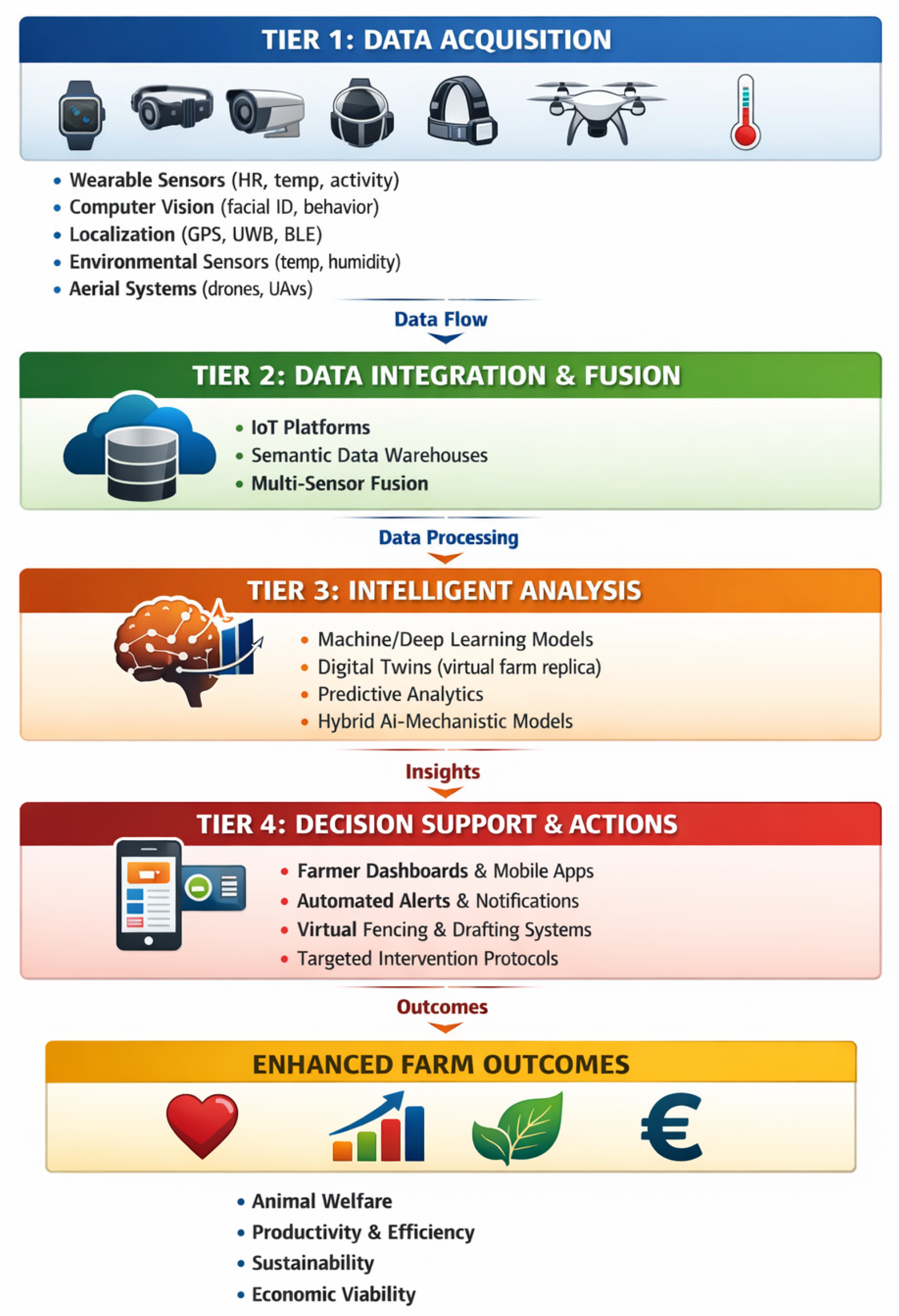
Precision Livestock Farming (PLF) technologies for dairy sheep encompass a wide range of tools and systems designed to monitor, analyze, and manage animal health, welfare, and productivity. These technologies can be conceptualized within a multi-tier decision-support architecture that integrates data acquisition, intelligent analysis, and actionable outputs (Figure 1). This section offers a detailed overview of the main technological domains identified in the literature, structured according to this integrated framework.
Building upon this integrated architecture, the following subsections examine each technological domain in detail.

3.1. Technological Domains for Dairy Sheep Monitoring

To enhance practical relevance, the reviewed technologies are presented in relation to the key management decisions they are intended to support in dairy sheep systems, including nutrition, reproduction, health, welfare, and grazing management.
A summary of the technologies used to monitor key parameters across different application domains is presented in Table 1 at the end of this chapter. To complement this technological overview with an analysis of the underlying research methodologies, Table 2 (provided immediately after Table 1) offers a quantitative breakdown of the validation contexts (field vs. laboratory) for the primary studies reviewed. This analysis provides insight into the nature and practical applicability of the current evidence base in this field.

3.1.1. Monitoring Nutritional Status and Growth

Automated weighing technologies have become an established component of dairy sheep management, offering practical and validated solutions for routine monitoring. Gonzalez-Garcia et al. [5] demonstrated that walk-over-weighing (WoW) systems can reliably capture daily liveweight variations in lactating ewes, achieving strong agreement with static scales while eliminating handling stress. Complementary non-contact approaches are also emerging: Samperio et al. [6] developed a 3D imaging system capable of estimating lamb weight with an error below 6%, presenting a promising alternative for commercial farms. These systems generate essential data to support nutrition planning, early disease detection, and precision management decisions in dairy sheep systems.

3.1.2. Individual Identification and Activity Monitoring for Health and Welfare

Biometric identification and computer vision systems support key management decisions related to individual animal identification, behavioral monitoring, and automated welfare assessment without physical handling. Computer vision has become one of the most dynamic areas of technological innovation in precision sheep farming, enabling contactless identification and monitoring with increasing accuracy. Recent developments illustrate a clear trend toward more efficient, scalable, and farm-ready solutions. For example, Vision Transformer architectures have shown strong potential for extracting detailed facial features, with Zhang et al. [19] reporting recognition accuracies of 97.9% in dairy sheep. Similarly, convolutional neural network (CNN)-based frameworks have been applied to follow animals across different growth stages, although—as noted by Hitelman et al. [30]—performance may decline when facial morphology changes with age.
Parallel to accuracy improvements, significant effort has been directed toward creating lightweight models suitable for deployment on commercial farms. Pruning-enhanced YOLOv3 variants, for instance, have demonstrated high performance while substantially reducing model size, thereby lowering computational requirements and facilitating real-time use [31]. Building on these advancements, Zang et al. [44] introduced a model specifically designed for sheep face recognition. By integrating attention mechanisms, depthwise separable convolutions, and knowledge distillation, the authors achieved a strong balance between accuracy, speed, and model compactness. Notably, the creation of a 22,000-image dataset represents a substantial contribution to the field, addressing the longstanding limitation of publicly available, species-specific training resources.
Beyond research prototypes, computer vision solutions are beginning to reach commercial applications. Alon et al. [45] developed a practical platform capable of identifying lambs and monitoring drinking behavior with 93% accuracy, demonstrating that vision-based technologies can support routine management tasks. More complex challenges, such as segmenting animals in crowded pens or irregular group formations, have been addressed through specialized models like SheepInst [20], which were explicitly designed to manage clustered bodies and overlapping contours.
Collectively, these developments reflect the broader trend identified by Rohan et al. [29]: the field is rapidly evolving toward advanced, high-performance deep learning systems increasingly tailored to the specific morphology, behavior, and production environments of sheep. This growing specialization indicates that computer vision will play an increasingly central role in automated, individualized monitoring within dairy sheep PLF systems.

3.1.3. Continuous Physiological and Environmental Monitoring

Wearable sensors and IoT platforms underpin a wide range of management decisions in dairy sheep systems, including health monitoring, nutritional management, and welfare assessment. They have become essential components of continuous, individual animal monitoring in precision sheep farming, enabling the collection of real-time physiological and behavioral data directly from the animal. Zhang et al. [21] introduced a comprehensive conceptual framework for Wearable IoT (W-IoT) systems in livestock, emphasizing key design principles such as measurement precision, biocompatibility, durability under farm conditions, and long-term sustainability—factors critical for successful commercial deployment.
Several applied systems demonstrate the practical potential of these technologies. For example, Efendi et al. [16] developed an IoT-based growth monitoring platform that achieved exceptionally high predictive accuracy (R2 > 99%) using simple linear regression models, illustrating how even lightweight analytics can produce valuable management information when supported by reliable sensor data. Complementing external wearables, implantable sensors validated by Fuchs et al. [15] have shown robust performance in measuring core physiological parameters such as heart rate and body temperature in free-grazing sheep, offering opportunities for early health issue detection without handling stress.
The integration of data from multiple sensing modalities is leading to increasingly advanced decision-support systems. Multi-sensor platforms—combining animal-mounted accelerometers, GPS units, and ambient environmental sensors—enable comprehensive assessments of thermal comfort and behavioral adaptation under variable conditions [46]. As the amount and diversity of sensor data expands, machine-learning approaches are being used to unlock new predictive capabilities. Notably, models developed by Suparwito et al. [47] have demonstrated the ability to estimate metabolizable energy intake directly from wearable sensor outputs, highlighting the potential for automated nutritional management with minimal human intervention.
Overall, the convergence of wearable sensing technologies, IoT connectivity, and advanced analytics is transforming traditional monitoring practices in dairy sheep systems, supporting a transition toward more proactive, individualized, and data-driven flock management.

3.1.4. Precision Tracking and Spatial Management

Technologies for real-time localization have progressed considerably, supporting both indoor and extensive farming scenarios. Ultra-wideband (UWB) systems, validated by Woods and Adcock [27], provide high positional accuracy for indoor sheep tracking. For open-grazing contexts, Walker et al. [18] demonstrated the feasibility of Bluetooth Low Energy (BLE) technologies for proximity and movement monitoring. More sophisticated systems combine multiple sensor types to enhance reliability and contextual interpretation. Gelasakis et al. [28], for example, integrated UWB positioning with infrared imaging and 3D vision to detect posture-related behaviors, achieving over 98% sensitivity for standing detection and perfect accuracy for lying behavior. These approaches illustrate how localization technologies are evolving beyond simple positional tracking to support richer behavioral analytics. Contactless sensing technologies are also gaining traction, with millimeter-wave radar emerging as a robust alternative capable of tracking untagged animals with fewer light-dependent errors compared to traditional video systems [26]. This reduces the risk of data loss in challenging visual conditions and is especially useful in shaded paddocks, nighttime monitoring, or dusty barn environments. Hybrid IoT solutions offer additional flexibility for farms with varying technological needs and budgets. For instance, the system proposed by Maroto-Molina et al. [48] combines GPS collars for large-scale positioning with BLE tags for fine-scale proximity data, creating a scalable architecture that farms can adopt gradually according to their economic constraints and management objectives.
Taken together, these developments demonstrate a clear trend toward integrated, multi-sensor localization frameworks capable of supporting precise, continuous monitoring across diverse dairy sheep production environments.

3.1.5. Automated Behavior Analysis for Early Problem Detection

Behavioral monitoring has become one of the most active research areas in precision sheep farming, largely driven by advances in wearable sensing technologies and machine learning. Accelerometers and inertial measurement units (IMUs) remain the foundation of many systems. Jin et al. [25], for instance, successfully used IMU-derived features in stacking models to classify grazing behaviors, showing how environmental factors—such as sward height—shape behavioral expression and influence model performance.
Deep learning has further expanded the possibilities for automated behavior recognition, particularly in outdoor and pasture-based systems [32]. Building on these approaches, Wang et al. [49] introduced a lightweight behavior recognition model specifically optimized for crowded housing environments.
Other studies have highlighted methodological aspects that support model development and field scalability. Cheng et al. [50] showed that relatively modest image datasets can be sufficient when collected under uniform conditions, an important finding for farms or research groups with limited annotation resources. Accelerometer-based research has also contributed valuable insights into diel activity patterns in sheep [24], while early studies demonstrated the potential of motion sensors in detecting lameness through characteristic gait alterations [7].
Beyond locomotion and posture, researchers have also begun to explore other sensing modalities. Acoustic monitoring represents a promising avenue: recent models have been able to predict feed intake with high precision across a range of feeding and forage conditions [51], suggesting that audio-based behavioral analytics may complement existing wearable and vision-based systems.
Collectively, these advances reveal a rapidly evolving scientific landscape in which sensor technologies and machine learning methods are converging to provide increasingly accurate, real-time, and context-aware assessments of sheep behavior in both housed and extensive production systems.

3.1.6. Health Screening and Heat Stress Management

Thermal and physiological monitoring technologies support management decisions related to heat stress mitigation, early disease detection, and welfare monitoring. Infrared thermography and physiological sensors provide valuable non-invasive indicators of animal health and welfare. Infrared thermography has been applied to detect thermoregulatory patterns in newborn lambs [52] and to identify footrot lesions in dairy sheep based on heel temperature differentials, with reported sensitivity of 83.3% [28]. Reviews of thermal monitoring technologies highlight substantial progress in heat stress detection while recognizing remaining challenges in achieving fully automated, real-time interpretation [53]. Baseline physiological metrics provided by Fuchs et al. [15]—including core body temperature and heart rate—offer foundational references for systems aimed at early disease detection and continuous welfare assessment.

3.1.7. Optimized Pasture Utilization and Grazing Management

Pasture-based dairy sheep systems face inherent management challenges, particularly in controlling grazing patterns over extensive areas. Automated grazing technologies have emerged as innovative solutions, offering precise and flexible livestock management. Virtual fencing systems have shown considerable promise in maintaining herd containment while minimizing human intervention. Campbell et al. [54] demonstrated that modified cattle eShepherd® (a commercial GPS-based virtual fencing platform originally developed for cattle) virtual fencing neckbands can be effectively adapted for sheep, with most cues delivered as non-invasive audio signals successfully guiding animal movement without reliance on electrical stimulation. These findings highlight the potential of virtual fencing to enhance animal welfare and optimize pasture utilization in extensive sheep production systems.
Complementing ground-based systems, aerial herding approaches have advanced through “sky shepherding” protocols using drones. Yaxley et al. [55] identified optimal drone approach parameters that minimize stress while effectively motivating flock movement, offering a sophisticated alternative to traditional herding methods. These technologies operate within broader frameworks for extensive system management, as comprehensively reviewed by Aquilani et al. [12], who documented applications of GPS, accelerometers, and virtual fencing across pasture-based operations.
The integration of these technologies enables more dynamic and precise pasture management. Silva et al. [2] examined the role of novel technologies in extensive sheep production, emphasizing their potential for enhancing both sustainability and animal welfare. Further advancing this integration, di Virgilio et al. [56] developed a multi-dimensional PLF approach that combines animal-attached multi-sensor tags with landscape layers from geographical information systems, creating comprehensive management solutions for sustainable rangeland utilization. Together, these technologies represent a paradigm shift from static physical fencing to adaptive, welfare-focused grazing management systems.

3.1.8. Integrated Data Platforms for Proactive Decision Support

The integration of diverse data streams into actionable management insights represents an emerging frontier in precision livestock farming. Schuetz et al. [34] developed a semantic data warehouse to tackle the challenges of heterogeneous data integration and business intelligence, while Thomann et al. [33] applied machine learning to integrated agricultural databases to assess livestock health and welfare. Vázquez-Diosdado et al. [57] addressed the issue of “concept drift” in long-term monitoring systems using combined offline and online learning algorithms for sheep behavior classification. The field is increasingly moving toward hybrid intelligent systems that combine mechanistic models with artificial intelligence, enabling the simultaneous capture of physiological principles and data-driven patterns [35]. Practical applications have already reached farm level, including mobile apps for targeted selective treatment of haemonchosis in sheep, which demonstrated high accuracy in classifying anemic animals using ocular conjunctiva images [52]. Cockburn [58] provided a comprehensive review of machine learning applications across dairy farming, highlighting both the potential and the challenges of translating algorithms into practical decision-support tools. Furthermore, emerging technologies such as Digital Twins hold promise for creating virtual replicas of farming operations, enabling continuous monitoring and management with reported high effectiveness across multiple parameters [22].

3.1.9. Animal Welfare and Ethical Consideration

The ethical dimensions of digital livestock farming have received dedicated scholarly attention as technologies become more pervasive. Neethirajan [14] comprehensively examined the significance and ethics of digital livestock farming, highlighting concerns about the digital divide, potential objectification of animals as data points, and the importance of maintaining human–animal connections. Complementing ethical considerations, Fuentes et al. [59] provided a comprehensive review of AI and computer vision applications for livestock welfare assessment. They highlighted the use of biometric techniques for health monitoring, identification for traceability, and machine/deep learning for complex problem-solving. The authors noted that most studies focus on model development without deployment in commercial farms and that inconsistencies in reported accuracy and validation hinder practical adoption. This underscores the need for reliable, non-contact, and standardized welfare assessment frameworks to support effective implementation in precision livestock systems. This ethical framework provides crucial context for the responsible development and implementation of PLF technologies, emphasizing the need for standards and codes of conduct that prioritize animal welfare alongside technological advancement. This ethical discourse naturally converges with the emerging paradigm of “welfare-by-design”, which calls for the proactive integration of animal welfare science into technology development. Rather than treating welfare as an external concern, this approach embeds it from the outset, urging developers to adopt validated welfare indicators as measurable benchmarks and to critically assess potential device-related impacts—such as behavioral disruption or wearing comfort—during the design phase. This foundational shift from retrospective ethics to preventive design establishes a crucial link between principle and practice, a connection further elaborated in the discussion on welfare-centered development (Section 4.4).

3.1.10. From Industry 4.0 to Smart Livestock Systems: Integrating Technologies Across Domains

These integrative frameworks provide the technological backbone for decision-support across multiple management domains in dairy sheep systems. The integration of PLF within the broader context of Industry 4.0 has been systematically examined, revealing how IoT-enabled systems are transforming animal production through enhanced monitoring, automation, and data-driven management [10]. Comprehensive reviews of AI in animal farming have mapped the extensive applications across multiple species, identifying key focus areas including behavior detection, disease monitoring, and environmental management while highlighting technical challenges in accuracy and cost that need addressing before widespread commercial adoption [37]. Within this digital transformation, artificial intelligence emerges as a unifying element across technological domains. Recent analyses highlight the growing convergence of IoT platforms, sensor technologies, and AI algorithms, enabling increasingly sophisticated decision-support systems that convert raw data into actionable insights [15,25,60]. Concrete examples include the expansion of machine learning to predict genetic merit in sheep—where random forest models have achieved correlations of 0.917 between true and predicted breeding values [61]—and the development of real-time operational applications such as YOLOv5-based sheep counting systems that automate flock monitoring through accurate bidirectional detection [62]. These cross-cutting frameworks collectively contextualize sheep-specific innovations within the larger digital evolution of agriculture, positioning PLF as a core component of sustainable and intelligent animal production systems.
Table 1. Technological Domains in Precision Dairy Sheep Farming.
Area of Interest/DomainTechnologies InvolvedApplications in Dairy Sheep SystemsKey References
Monitoring Nutritional Status and GrowthWalk-over-weighing; 3D imaging; optical sensorsDaily weight tracking; nutrition planning; early disease detection[5,6]
Individual Identification and Activity Monitoring for Health and WelfareCNNs; Vision Transformers; YOLO variants; segmentation models (SheepInst)Facial recognition; biometric ID; lamb identification; group segmentation[19,20,29,30,31,44]
Continuous Physiological and Environmental MonitoringAccelerometers; IMUs; implantable biosensors; W-IoT architecturesMonitoring heart rate and temperature; growth monitoring; ML-based nutritional prediction[15,16,21,46,47]
Precision Tracking and Spatial ManagementUWB; BLE; GPS collars; infrared sensors; mm-wave radar; hybrid IoT systemsIndoor/outdoor tracking; movement mapping; precision behavior detection[18,26,27,28,48]
Automated Behavior Analysis for Early Problem DetectionAccelerometry; IMUs; deep learning (YOLOv5); acoustic sensorsGrazing classification; lameness detection; diel activity patterns; feed intake prediction[7,24,25,32,49,50,51]
Health Screening and Heat Stress ManagementInfrared thermography; thermal cameras; physiological biosensorsHeat stress assessment; footrot detection; neonatal thermoregulation[15,28,52,53]
Optimized Pasture Utilization and Grazing ManagementVirtual fencing neckbands; GPS-enabled cues; drone herdingNon-physical containment; low-stress herding; dynamic pasture management; rangeland sustainability[2,12,54,55,56]
Integrated Data Platforms for Proactive Decision SupportSemantic warehouses; ML/AI models; digital twins; diagnostic appsHealth/welfare assessment; metabolic prediction; monitoring; automated decision-making[22,33,34,35,36,57,58]
Animal Welfare & Ethical ConsiderationsEthical frameworks; data governance toolsResponsible implementation; digital divide mitigation; support to human–animal interactions[14]
Integrated Smart Livestock Systems (Industry 4.0)IoT; AI; cloud systems; real-time ML; sensor fusion; genetic prediction modelsCross-domain integration; flock counting; breeding value prediction; advanced PLF ecosystems[10,15,25,37,60,61,62]
Abbreviations used in this table: CNN (Convolutional Neural Network); YOLO (You Only Look Once); IMUs (Inertial Measurement Unit); W-IoT (Wearable Internet of Things); UWB (Ultra-Wideband); BLE (Bluetooth Low Energy); GPS (Global Positioning System); ML (Machine Learning).
Table 2. Summary of the validation context for the research studies reviewed, highlighting the methodological emphasis across the field.
Primary Validation Context 1,2% of Reviewed StudiesPrimary Purpose & CharacteristicsTypical Domains (Examples)
Field/Farm Condition80.4%Ecological Validity: Testing under real-world farming conditions (pastures, barns). Focus on practical applicability, robustness to environmental variables, and integration into farm routines.Behavioral Monitoring, Grazing Management, Weight Monitoring, Localization
Laboratory/Controlled Conditions14.3%Mechanistic Validity: Isolating specific variables for foundational research. Focus on sensor calibration, algorithm development, and establish proof-of-concept in controlled settings.Sensor Development, Algorithm Training, Controlled Physiology
Conceptual/Simulated/Mixed Methods5.3%Theoretical & Framework Validity: Proposing architectures, frameworks, or ethical analyses. May combine literature synthesis with preliminary data.Welfare Ethics, System Architectures
1 Some studies included components of both laboratory testing and field validation; they are categorized by their primary experimental focus. 2 This analysis includes primary research studies. Broad review articles are excluded from this methodological classification.

3.2. Synthesis of Results Addressing Research Questions

The systematic analysis of the literature allowed us to synthesize key findings that directly address the research questions guiding this review.
RQ1: What are the main IoT and sensor-based technologies currently available for monitoring health, welfare, and productivity in dairy sheep?
The review identified a diverse range of technologies and categorized the main ones into eight core domains, as summarized in Table 1. The most prominent and validated include:
Automated Weight and Body Condition Monitoring: Walk-over-weighing (WoW) systems and 3D imaging for non-contact assessment.
Biometric Identification and Computer Vision: Deep learning models (CNNs, Vision Transformers, YOLO variants) for individual recognition and behavior analysis.
Wearable Sensors and IoT Platforms: Accelerometers, IMUs, and implantable biosensors for continuous physiological and activity monitoring.
Localization and Proximity Systems: Ultra-Wideband (UWB), Bluetooth Low Energy (BLE), and millimeter-wave radar for precise indoor/outdoor tracking.
Behavioral Monitoring: Sensor fusion and machine learning for classifying grazing, resting, and feeding behaviors, as well as detecting lameness.
Thermal and Physiological Monitoring: Infrared thermography for non-invasive health screening and heat stress detection.
Automated Grazing Management: Virtual fencing systems and drone-assisted herding for extensive pasture management.
Decision-Support Systems (DSS) and Data Integration: Semantic data warehouses, hybrid AI models, and mobile applications that transform raw data into actionable insights for farmers.
RQ2: How are these technologies integrated into Decision-Support Systems to improve management practices?
Integration occurs through a multi-layer architecture:
Data Acquisition and Fusion: heterogeneous data from the domains listed above (e.g., location from UWB, activity from IMUs, images from cameras) are collected and fused using IoT platforms and semantic data warehouses to create a unified animal status profile.
Intelligent Analysis: Machine learning and hybrid AI models analyze this integrated data stream to detect patterns, predict events (e.g., estrus, illness), and generate alerts. This step addresses challenges like long-term “concept drift” in behavior.
Actionable Output: Insights are delivered to farmers via user-friendly interfaces, primarily mobile and web applications, enabling timely interventions such as targeted selective treatment. Emerging frameworks like Digital Twins represent the frontier of this integration, aiming to create dynamic virtual replicas of the farming system for simulation and optimization.
RQ3: What are the principal barriers to the adoption of these technologies in commercial dairy sheep farms?
Despite technical advances, adoption faces significant hurdles:
Economic: high upfront costs and uncertain financial benefits, making it hard for farmers, especially on small farms, to justify the investment.
Technical and Infrastructural: limited connectivity and power in extensive systems, system complexity, and lack of interoperability between devices.
Social and Knowledge-Based: Farmer conservatism, steep learning curves, and a lack of tailored training and support networks.
Validation Gaps: Many models are developed in controlled research settings but lack validation for robustness across diverse commercial farm conditions.
RQ4: What are the future research directions for developing more effective and accessible PLF solutions?
Key future directions should focus on:
Interoperability and Standardization: Developing open protocols to enable plug-and-play integration of technologies from different vendors.
Edge Computing and Lightweight AI: Creating optimized, energy-efficient algorithms that can run on local devices to overcome connectivity issues.
Participatory Design and Economic Studies: Involving farmers in the design process and conducting rigorous cost–benefit analyses for different production systems.
Welfare-by-Design: Proactively embedding animal welfare and ethical considerations into the technology development lifecycle.
The following section provides a detailed, domain-by-domain analysis that underpins these synthesized answers.

4. Synthesis of PLF Applications and Implications

A key contribution of this review lies in its explicit shift from a technology-centered to a decision-oriented synthesis. While the primary studies published between 2018 and 2025 provide valuable insights into individual technologies, their fragmentation often limits direct applicability at farm level. By integrating these findings within a management-decision framework tailored to dairy sheep systems, this review aims to bridge the gap between technological development and practical on-farm implementation.

4.1. From Single-Point Solutions to Integrated Monitoring Ecosystems

The evolution from standalone technologies toward interconnected monitoring ecosystems represents a pivotal shift in PLF development. Early systems focused on single parameters—such as automated weighing [5,6] or basic activity monitoring [24]—have progressively evolved into multi-sensor platforms that capture complementary data streams. This integration is particularly evident in systems combining localization technologies like UWB [8,10,13,27,63] with behavioral classification algorithms [32] and environmental sensors [46], creating comprehensive digital representations of animal status and environmental conditions.
The emergence of sensor fusion approaches [28] marks a significant advancement in monitoring capabilities. By combining diverse sensing modalities—including radar for contactless tracking [26], infrared thermography for health assessment [28], and acoustic analysis for feeding monitoring [51]—these systems overcome limitations inherent to individual technologies. This multi-modal approach enables more robust monitoring in challenging farming environments where single-technology solutions often fail due to occlusion, weather conditions, or animal density.
However, this integration introduces new complexities in data interoperability and system architecture. The transition toward semantic data warehouses [34] and hybrid intelligent systems [35] represents a critical response to these challenges, yet substantial work remains in developing standardized protocols that enable seamless data exchange between different PLF components. The evolution toward integrated ecosystems also brings to the forefront the critical issue of interoperability and data standards. Currently, many PLF solutions operate as proprietary “silos,” hindering data exchange and unified analysis. To address this, several IoT and system integration standards are relevant. At the architectural level, ISO/IEC 30141 [64] provides a common IoT reference model. For integrating operational technology on the farm with enterprise-level management, the ISA-95/IEC 62264 standard series [65] defines models and terminology for enterprise-control system integration. Within the agricultural domain, sector-specific initiatives and data models are emerging to promote interoperability. Examples include data exchange platforms like Agrirouter [66] and the development of open data models and APIs within research consortia and by major agricultural technology providers [67]. In parallel, horizontal IoT frameworks such as FIWARE [68] and oneM2M, as well as serverless computing approaches (e.g., OpenFaaS), have been increasingly adopted in smart agriculture and livestock-related applications to support heterogeneous data integration, scalable data processing, and interoperability, although their direct application in dairy sheep farming remains limited [69]. Nevertheless, the adoption of such standards and open frameworks represents a prerequisite for the development of modular, scalable, and future-proof PLF ecosystems for small ruminants. The promise of Digital Twin technology [22] for creating virtual replicas of farming operations further emphasizes the need for integrated data frameworks that can support sophisticated simulation and prediction capabilities.

4.2. Artificial Intelligence: From Pattern Recognition to Predictive Analytics

The role of artificial intelligence in dairy sheep management has expanded dramatically, evolving from basic pattern recognition to sophisticated predictive analytics. Early applications focused primarily on behavioral classification using relatively simple machine learning algorithms [34,49], while contemporary approaches employ deep learning architectures [29,32] that achieve remarkable accuracy in complex recognition tasks. This progression is particularly evident in computer vision applications, where model optimization techniques like pruning and compression [31] are making advanced algorithms deployable in resource-constrained farm environments.
The application of machine learning has diversified beyond behavioral analysis to encompass predictive modeling of physiological states and production outcomes. Algorithms can now predict metabolizable energy intake from sensor data [47], estimate genetic merit [61], and even automate veterinary assessments through mobile applications [36]. This expansion from descriptive to predictive capabilities represents a fundamental shift in how technology supports management decisions, moving from retrospective analysis to proactive intervention. As illustrated in Table 3 integrated PLF systems translate continuous data streams into actionable insights by mapping specific farm decisions—from health and welfare monitoring to nutritional and environmental management—to measurable triggers, data sources and feasible interventions. These examples demonstrate how predictive analytics enable timely responses directly within operational workflows, moving beyond mere reporting toward automated decision-support.
Nevertheless, significant challenges persist in model generalization and robustness. As noted by Cockburn [58], many machine learning algorithms demonstrate insufficient performance for reliable commercial implementation, often due to limitations in training data diversity and quality. The findings of Cheng et al. [50] regarding the critical importance of consistent data characteristics between training and deployment environments highlight the context-dependent nature of many AI solutions. Future development must prioritize the creation of more adaptable algorithms that can maintain performance across varying farm conditions and animal populations.
A critical insight from synthesizing validation studies is the identification of common factors that degrade PLF system performance in real-world settings. For vision-based systems, these include occlusion in group housing, variable lighting conditions, and morphological changes due to shearing or aging [20,30,44]. For wearable sensors, attachment issues, dirt accumulation, and limited battery life compromise long-term reliability [12,21]. Environmental factors like dust, rain, and extreme temperatures further challenge both sensor integrity and data transmission [26,48]. Crucially, external validation—testing a model developed in one farm or condition on completely independent data from another—remains exceptionally rare, making true robustness difficult to assess [29,50].
These limitations must inform future research. Observed challenges, such as performance decline in facial recognition with aging, should drive specific methodological recommendations: developing continuous learning or domain adaptation algorithms to cope with changing animal features, employing data augmentation techniques that simulate environmental variability, and prioritizing multi-farm, longitudinal validation studies to test system resilience and adaptability under real-world ‘concept drift’.

4.3. Extensive System Technologies: Balancing Precision and Practicality

The development of technologies for extensive grazing systems presents unique challenges that demand a careful balance between precision capabilities and practical implementation constraints. Virtual fencing systems [54] and aerial herding technologies [55] represent groundbreaking approaches to managing animals across large areas, offering potential solutions to time-consuming traditional methods. However, these technologies must overcome significant hurdles related to power management, communication reliability, and animal acceptance before achieving widespread adoption.
Comprehensive reviews of extensive system technologies [12,18,24] reveal a consistent emphasis on scalability and cost-effectiveness as critical factors for successful implementation. While sophisticated monitoring systems can generate valuable data, their practical utility diminishes if they cannot be deployed across entire flocks or require excessive infrastructure investment. This reality has spurred interest in technologies like Bluetooth Low Energy tracking [18] and simplified monitoring approaches that prioritize operational feasibility over maximal data collection.
The integration of animal-mounted sensors with landscape-level data [24] represents a particularly promising direction for extensive systems. By contextualizing individual animal information within broader environmental conditions, these integrated approaches support more nuanced management decisions that account for pasture quality, weather patterns, and seasonal variations. This holistic perspective aligns with the principles of sustainable rangeland management while leveraging technological capabilities to optimize resource utilization.

4.4. Welfare-Centered Technology Development: Ethical Dimensions and Implementation Considerations

The ethical dimensions of digital livestock farming [14] have emerged as a critical consideration in technology development and implementation. As monitoring capabilities become increasingly pervasive, questions regarding animal privacy, behavioural normalization, and appropriate human intervention thresholds demand careful attention. The welfare implications of continuous surveillance systems extend beyond immediate physical effects to encompass potential impacts on natural behavioural expressions and psychological well-being.
The comprehensive review by Herlin et al. [13] highlights how welfare considerations must be integrated throughout the technology development lifecycle, from initial design to field implementation. This requires balancing the benefits of detailed monitoring against the potential stresses introduced by the monitoring technologies themselves. Technologies like virtual fencing [54] demonstrate this balance, where system design prioritizes learning-based adaptation and minimal aversive stimulation.
The human–animal relationship represents another crucial dimension often overlooked in technological development. As automated systems assume more management functions, the risk of reduced human engagement with animals must be consciously addressed. Technologies should be designed to enhance rather than replace thoughtful human oversight, preserving the farmer’s role as a skilled caregiver while augmenting their capabilities with data-driven insights. Implementing this ethical commitment requires concrete methodologies, most notably the welfare-by-design framework introduced earlier. This framework operationalizes welfare by embedding it into the engineering lifecycle: it mandates the use of validated behavioural and physiological indicators as key performance parameters, institutes prospective studies to mitigate device-related risks before deployment and integrates continuous welfare validation into pilot and commercial use. By making animal wellbeing a measurable and non-negotiable design criterion—co-equal with accuracy, cost, and durability—this approach ensures that technological advancement progresses in lockstep with ethical responsibility and tangible welfare outcomes.

4.5. Implementation Barriers and Adoption Challenges

Despite significant technological advancements, substantial barriers to widespread adoption persist across the dairy sheep sector. The economic accessibility of PLF technologies remains a primary concern, particularly for the small-scale operations that characterize much of the dairy sheep industry. Beyond high upfront investment costs and uncertain returns, a critical and overarching barrier is the limited availability of robust, standardized economic studies (e.g., Total Cost of Ownership—TCO—analyses and detailed cost–benefit analyses—CBA) specifically focused on dairy sheep systems. The existing literature predominantly provides qualitative discussions of cost as an adoption barrier [1,10] or broad economic estimates, but rarely reports consistent quantitative indicators—such as incremental profit per ewe, clearly defined payback periods, or net present value calculations under different management scenarios. This lack of standardized economic evidence, a challenge also noted in broader assessments of digital technology adoption in agriculture [70], constrains the development of solid business cases and scalable financial models. Consequently, farmers are often required to rely on fragmented or non-standardized sources of information when evaluating the economic value of PLF technologies. As noted by Odintsov Vaintrub et al. [1], sheep farmers often represent “conservative technology consumers” whose adoption decisions are influenced by complex factors beyond technical performance, including reliability, operational simplicity, and clear return on investment. Furthermore, these barriers manifest differently across intensive and extensive production systems. In intensive systems, the primary adoption hurdles are typically high upfront costs, system complexity, and the need for specialized technical skills, compounded by uncertain returns on investment. In contrast, extensive systems face additional challenges related to limited connectivity, power supply constraints, logistical difficulties in maintaining distributed sensor networks, and often higher per-animal costs due to lower stocking densities. This divergence highlights the need for tailored implementation strategies and context-specific business models that address the distinct economic, technical, and operational realities of each system type.
The technical infrastructure requirements for many advanced systems present another significant barrier, especially in extensive operations where connectivity and power availability may be limited. Systems requiring continuous internet connectivity [22] or substantial computational resources [31] face practical implementation challenges in remote farming environments. This reality underscores the importance of developing appropriately complex solutions that match the operational contexts of target farming systems.
The knowledge and training requirements for effective technology utilization represent a further adoption barrier. As systems become more sophisticated, the gap between technological capabilities and farmer capacity to interpret and act on generated insights may widen. Successful implementation requires not only robust technology but also supportive ecosystems that facilitate skill development, technical support, and knowledge sharing among adopting farmers.

4.6. Sustainability Integration: Environmental and Economic Dimensions

The potential for PLF technologies to enhance both environmental and economic sustainability represents a compelling value proposition that merits increased attention. Technologies enabling optimized resource utilization—such as precise feeding management [51], targeted veterinary interventions [36], and dynamic pasture management [53]—contribute to reduced environmental impact while improving economic efficiency. However, the environmental costs of technology production, operation, and disposal must be conscientiously evaluated within broader sustainability assessments.
The economic sustainability of PLF implementations requires more rigorous analysis across different farming contexts. While several studies demonstrate technical feasibility and potential benefits, comprehensive cost–benefit analyses accounting for implementation costs, operational expenses, and expected returns remain limited. Future research should prioritize economic validation across diverse operational scales and production systems to provide clearer guidance for investment decisions.
The integration of sustainability metrics within PLF systems represents an important development direction. By explicitly tracking environmental indicators alongside production parameters, these systems could support more holistic management decisions that balance productivity with environmental stewardship. This approach aligns with increasing consumer and regulatory focus on sustainable production practices while creating value for farmers through improved efficiency.

5. Conclusions and Future Directions

This review demonstrates that PLF technologies for dairy sheep have progressed from conceptual proposals to functionally validated systems across multiple domains. However, the transition from technological validation to widespread agricultural practice requires addressing several critical challenges through focused research and development. Among these, the lack of economic transparency and validation stands out as a major impediment to adoption, necessitating a concerted research effort parallel to technological development.
Priority research directions emerging from our analysis include:
  • Integration Standards and Interoperability: Developing open standards and modular architectures that enable seamless data exchange between different PLF components, facilitating the creation of integrated farm management ecosystems.
  • Context-Adaptive Algorithms: Creating AI systems that maintain robustness across varying farm conditions, animal populations, and management practices, reducing the performance degradation often observed when moving from research to commercial environments.
  • Economic Validation and Business Models: Conducting rigorous, transparent, and standardized economic assessments across diverse farming contexts is paramount. Future work must move beyond qualitative cost discussions to provide quantitative Total Cost of Ownership (TCO) analyses and cost–benefit models that account for hidden costs (e.g., integration, training, maintenance) and contextual benefits (e.g., labor savings, improved health outcomes, premium product certification). Studies should report key metrics such as payback period, return on investment (ROI), and cost per monitored data point. Developing innovative business models (e.g., Technology-as-a-Service, cooperative-based sharing) is also essential to improve accessibility for small-scale producers.
  • Welfare-Centered Design: Establishing frameworks for evaluating and optimizing the welfare implications of monitoring technologies throughout their lifecycle, ensuring that technological advancements genuinely enhance animal well-being.
  • Sustainability Integration: Explicitly incorporating environmental and sustainability metrics within PLF systems, enabling management decisions that balance productivity with environmental stewardship.
  • Farmer-Centric Development: Adopting participatory design approaches that actively incorporate farmer perspectives and workflow requirements into technology development, improving adoption likelihood and implementation success.
The convergence of sensing technologies, artificial intelligence, and decision-support systems holds significant promise for enhancing the sustainability, efficiency, and welfare standards of dairy sheep production. By addressing the identified challenges through collaborative, multidisciplinary efforts, the PLF community can transform this potential into practical solutions that deliver meaningful benefits for farmers, animals, and the broader agricultural ecosystem.

Author Contributions

Conceptualization, M.C.M. and V.C.; methodology, M.C.M. and V.C.; software, S.L.; validation, M.C.M. and V.C.; formal analysis, M.C.M., V.C., S.L. and O.T.; data curation, M.C.M., V.C., S.L. and O.T.; writing—original draft preparation, M.C.M.; writing—review and editing, M.C.M., V.C., S.L. and O.T. All authors have read and agreed to the published version of the manuscript.

Funding

This research received no external funding.

Data Availability Statement

No new data were created or analyzed in this study. Data sharing is not applicable to this article.

Conflicts of Interest

The authors declare no conflicts of interest.

Abbreviations

The following abbreviations are used in this manuscript (in alphabetical order):
AIArtificial Intelligence
BLEBluetooth Low Energy
CNNConvolutional Neural Network
DSSDecision Support-Systems
GenAIGenerative Artificial Intelligence
GPSGlobal Positioning System
IMUInertial Measurement Unit
IoTInternet of Things
MLMachine Learning
PLFPrecision Livestock Farming
PRISMAPreferred Reporting Items for Systematic Reviews
RQResearch Question
RTLSReal-Time Location System
UAVUnmanned Aerial Vehicle
UWBUltra-Wideband
ViTVision Transformer
W-IoTWearable Internet of Things
WoWWalk-Over-Weighing
YOLOYou Only Look Once

References

  1. Odintsov Vaintrub, M.; Levit, H.; Chincarini, M.; Fusaro, I.; Giammarco, M.; Vignola, G. Review: Precision Livestock Farming, Automats and New Technologies: Possible Applications in Extensive Dairy Sheep Farming. Animal 2021, 15, 100143. [Google Scholar] [CrossRef]
  2. Silva, S.R.; Sacarrão-Birrento, L.; Almeida, M.; Ribeiro, D.M.; Guedes, C.; Montaña, J.R.G.; Pereira, A.F.; Zaralis, K.; Geraldo, A.; Tzamaloukas, O.; et al. Extensive Sheep and Goat Production: The Role of Novel Technologies towards Sustainability and Animal Welfare. Animals 2022, 12, 885. [Google Scholar] [CrossRef]
  3. Groher, T.; Heitkämper, K.; Umstätter, C. Digital Technology Adoption in Livestock Production with a Special Focus on Ruminant Farming. Animal 2020, 14, 2404–2413. [Google Scholar] [CrossRef] [PubMed]
  4. Morgan-Davies, C.; Tesnière, G.; Gautier, J.M.; Jørgensen, G.H.M.; González-García, E.; Patsios, S.I.; Sossidou, E.N.; Keady, T.W.J.; McClearn, B.; Kenyon, F.; et al. Review: Exploring the Use of Precision Livestock Farming for Small Ruminant Welfare Management. Animal 2024, 18, 101233. [Google Scholar] [CrossRef] [PubMed]
  5. González-García, E.; Alhamada, M.; Nascimento, H.; Portes, D.; Bonnafe, G.; Allain, C.; Llach, I.; Hassoun, P.; Gautier, J.M.; Parisot, S. Measuring Liveweight Changes in Lactating Dairy Ewes with an Automated Walk-over-Weighing System. J. Dairy Sci. 2021, 104, 5675–5688. [Google Scholar] [CrossRef] [PubMed]
  6. Samperio, E.; Lidón, I.; Rebollar, R.; Castejón-Limas, M.; Álvarez-Aparicio, C. Lambs’ Live Weight Estimation Using 3D Images. Animal 2021, 15, 100212. [Google Scholar] [CrossRef]
  7. Kaler, J.; Mitsch, J.; Vázquez-Diosdado, J.A.; Bollard, N.; Dottorini, T.; Ellis, K.A. Automated Detection of Lameness in Sheep Using Machine Learning Approaches: Novel Insights into Behavioural Differences among Lame and Non-Lame Sheep. R. Soc. Open Sci. 2020, 7, 190824. [Google Scholar] [CrossRef]
  8. Halachmi, I.; Guarino, M.; Bewley, J.; Pastell, M. Smart Animal Agriculture: Application of Real-Time Sensors to Improve Animal Well-Being and Production. Annu. Rev. Anim. Biosci. 2019, 7, 403–425. [Google Scholar] [CrossRef]
  9. Caja, G.; Castro-Costa, A.; Salama, A.A.K.; Oliver, J.; Baratta, M.; Ferrer, C.; Knight, C.H. Sensing Solutions for Improving the Performance, Health and Wellbeing of Small Ruminants. J. Dairy Res. 2020, 87, 34–46. [Google Scholar] [CrossRef]
  10. Morrone, S.; Dimauro, C.; Gambella, F.; Cappai, M.G. Industry 4.0 and Precision Livestock Farming (PLF): An up to Date Overview across Animal Productions. Sensors 2022, 22, 4319. [Google Scholar] [CrossRef]
  11. Arshad, M.F.; Burrai, G.P.; Varcasia, A.; Sini, M.F.; Ahmed, F.; Lai, G.; Polinas, M.; Antuofermo, E.; Tamponi, C.; Cocco, R.; et al. The Groundbreaking Impact of Digitalization and Artificial Intelligence in Sheep Farming. Res. Vet. Sci. 2024, 170, 105197. [Google Scholar] [CrossRef]
  12. Aquilani, C.; Confessore, A.; Bozzi, R.; Sirtori, F.; Pugliese, C. Review: Precision Livestock Farming Technologies in Pasture-Based Livestock Systems. Animal 2022, 16, 100429. [Google Scholar] [CrossRef] [PubMed]
  13. Herlin, A.; Brunberg, E.; Hultgren, J.; Högberg, N.; Rydberg, A.; Skarin, A. Animal Welfare Implications of Digital Tools for Monitoring and Management of Cattle and Sheep on Pasture. Animals 2021, 11, 829. [Google Scholar] [CrossRef] [PubMed]
  14. Neethirajan, S. The Significance and Ethics of Digital Livestock Farming. AgriEngineering 2023, 5, 488–505. [Google Scholar] [CrossRef]
  15. Fuchs, B.; Sørheim, K.M.; Chincarini, M.; Brunberg, E.; Stubsjøen, S.M.; Bratbergsengen, K.; Hvasshovd, S.O.; Zimmermann, B.; Lande, U.S.; Grøva, L. Heart Rate Sensor Validation and Seasonal and Diurnal Variation of Body Temperature and Heart Rate in Domestic Sheep. Vet. Anim. Sci. 2019, 8, 100075. [Google Scholar] [CrossRef]
  16. Efendi, S.; Sihombing, P.; Mawengkang, H.; Turnip, A.; Weber, G.W. An IoT-Enabled Smart System Utilizing Linear Regression for Sheep Growth and Health Monitoring. J. Appl. Data Sci. 2025, 6, 2056–2072. [Google Scholar] [CrossRef]
  17. Modak, M.; Pritom, M.M.; Banik, S.C.; Rabbi, M.S. Internet of Things-Based Health Surveillance Systems for Livestock: A Review of Recent Advances and Challenges. IET Wirel. Sens. Syst. 2025, 15, e70013. [Google Scholar] [CrossRef]
  18. Walker, A.M.; Jonsson, N.N.; Waterhouse, A.; McDougall, H.; Kenyon, F.; McLaren, A.; Morgan-Davies, C. Development of a Novel Bluetooth Low Energy Device for Proximity and Location Monitoring in Grazing Sheep. Animal 2024, 18, 101276. [Google Scholar] [CrossRef]
  19. Zhang, X.; Xuan, C.; Ma, Y.; Su, H. A High-Precision Facial Recognition Method for Small-Tailed Han Sheep Based on an Optimised Vision Transformer. Animal 2023, 17, 100886. [Google Scholar] [CrossRef]
  20. Zhao, H.; Mao, R.; Li, M.; Li, B.; Wang, M. SheepInst: A High-Performance Instance Segmentation of Sheep Images Based on Deep Learning. Animals 2023, 13, 1338. [Google Scholar] [CrossRef]
  21. Zhang, M.; Wang, X.; Feng, H.; Huang, Q.; Xiao, X.; Zhang, X. Wearable Internet of Things Enabled Precision Livestock Farming in Smart Farms: A Review of Technical Solutions for Precise Perception, Biocompatibility, and Sustainability Monitoring. J. Clean. Prod. 2021, 312, 127712. [Google Scholar] [CrossRef]
  22. Mishra, S.; Sharma, S.K. Advanced Contribution of IoT in Agricultural Production for the Development of Smart Livestock Environments. Internet Things 2023, 22, 100724. [Google Scholar] [CrossRef]
  23. Knoepfel, A.; Liu, N.; Hou, Y.; Sujani, S.; dos Reis, B.R.; White, R.; Wang, K.; Poudel, B.; Gupta, S.; Priya, S. Development of Tetrapod Zinc Oxide-Based UV Sensor for Precision Livestock Farming and Productivity. Biosensors 2022, 12, 837. [Google Scholar] [CrossRef] [PubMed]
  24. Ikurior, S.J.; Marquetoux, N.; Leu, S.T.; Corner-thomas, R.A.; Scott, I.; Pomroy, W.E. What Are Sheep Doing? Tri-axial Accelerometer Sensor Data Identify the Diel Activity Pattern of Ewe Lambs on Pasture. Sensors 2021, 21, 6816. [Google Scholar] [CrossRef]
  25. Jin, Z.; Guo, L.; Shu, H.; Qi, J.; Li, Y.; Xu, B.; Zhang, W.; Wang, K.; Wang, W. Behavior Classification and Analysis of Grazing Sheep on Pasture with Different Sward Surface Heights Using Machine Learning. Animals 2022, 12, 1744. [Google Scholar] [CrossRef]
  26. Dore, A.; Pasquaretta, C.; Henry, D.; Ricard, E.; Bompa, J.F.; Bonneau, M.; Boissy, A.; Hazard, D.; Lihoreau, M.; Aubert, H. A Non-Invasive Millimetre-Wave Radar Sensor for Automated Behavioural Tracking in Precision Farming—Application to Sheep Husbandry. Sensors 2021, 21, 8140. [Google Scholar] [CrossRef]
  27. Woods, J.M.; Adcock, S.J.J. Validation of an Indoor Real-Time Location System for Tracking Sheep. Comput. Electron. Agric. 2024, 227, 109535. [Google Scholar] [CrossRef]
  28. Gelasakis, A.I.; Kalogianni, A.I.; Moschovas, M.; Tsimpouri, E.; Pnevmatikos, T.; Bossis, I.; Arsenos, G.; Simitzis, P. Evaluation of Infrared Thermography for the Detection of Footrot and White Line Disease Lesions in Dairy Sheep. Vet. Sci. 2021, 8, 219. [Google Scholar] [CrossRef]
  29. Rohan, A.; Rafaq, M.S.; Hasan, M.J.; Asghar, F.; Bashir, A.K.; Dottorini, T. Application of Deep Learning for Livestock Behaviour Recognition: A Systematic Literature Review. Comput. Electron. Agric. 2024, 224, 109115. [Google Scholar] [CrossRef]
  30. Hitelman, A.; Edan, Y.; Godo, A.; Berenstein, R.; Lepar, J.; Halachmi, I. Short Communication: The Effect of Age on Young Sheep Biometric Identification. Animal 2022, 16, 100452. [Google Scholar] [CrossRef]
  31. Song, S.; Liu, T.; Wang, H.; Hasi, B.; Yuan, C.; Gao, F.; Shi, H. Using Pruning-Based YOLO v3 Deep Learning Algorithm for Accurate Detection of Sheep Face. Animals 2022, 12, 1465. [Google Scholar] [CrossRef]
  32. Hu, T.; Yan, R.; Jiang, C.; Chand, N.V.; Bai, T.; Guo, L.; Qi, J. Grazing Sheep Behaviour Recognition Based on Improved YOLOV5. Sensors 2023, 23, 4752. [Google Scholar] [CrossRef] [PubMed]
  33. Thomann, B.; Würbel, H.; Kuntzer, T.; Umstätter, C.; Wechsler, B.; Meylan, M.; on behalf of SAH Consortium; Schüpbach-Regula, G. Development of a Data-Driven Method for Assessing Health and Welfare in the Most Common Livestock Species in Switzerland: The Smart Animal Health Project. Front. Vet. Sci. 2023, 10, 1125806. [Google Scholar] [CrossRef] [PubMed]
  34. Schuetz, C.G.; Schausberger, S.; Schrefl, M. Building an Active Semantic Data Warehouse for Precision Dairy Farming. J. Organ. Comput. Electron. Commer. 2018, 28, 122–141. [Google Scholar] [CrossRef]
  35. Tedeschi, L.O.; Greenwood, P.L.; Halachmi, I. Advancements in Sensor Technology and Decision Support Intelligent Tools to Assist Smart Livestock Farming. J. Anim. Sci. 2021, 99, skab038. [Google Scholar] [CrossRef]
  36. de Souza, L.F.; Costa, M.H.; Riet-Correa, B. Mobile App for Targeted Selective Treatment of Haemonchosis in Sheep. Vet. Parasitol. 2023, 316, 109902. [Google Scholar] [CrossRef]
  37. Bao, J.; Xie, Q. Artificial Intelligence in Animal Farming: A Systematic Literature Review. J. Clean. Prod. 2022, 331, 129956. [Google Scholar] [CrossRef]
  38. Hlimi, A.; El Otmani, S.; Elame, F.; Chentouf, M.; El Halimi, R.; Chebli, Y. Application of Precision Technologies to Characterize Animal Behavior: A Review. Animals 2024, 14, 416. [Google Scholar] [CrossRef]
  39. Page, M.J.; McKenzie, J.E.; Bossuyt, P.M.; Boutron, I.; Hoffmann, T.C.; Mulrow, C.D.; Shamseer, L.; Tetzlaff, J.M.; Akl, E.A.; Brennan, S.E.; et al. The PRISMA 2020 Statement: An Updated Guideline for Reporting Systematic Reviews. BMJ 2021, 372, n71. [Google Scholar] [CrossRef]
  40. Page, M.J.; Moher, D.; Bossuyt, P.M.; Boutron, I.; Hoffmann, T.C.; Mulrow, C.D.; Shamseer, L.; Tetzlaff, J.M.; Akl, E.A.; Brennan, S.E.; et al. PRISMA 2020 Explanation and Elaboration: Updated Guidance and Exemplars for Reporting Systematic Reviews. BMJ 2021, 372, n160. [Google Scholar] [CrossRef]
  41. Birkle, C.; Pendlebury, D.A.; Schnell, J.; Adams, J. Web of Science as a Data Source for Research on Scientific and Scholarly Activity. Quant. Sci. Stud. 2020, 1, 363–376. [Google Scholar] [CrossRef]
  42. Baas, J.; Schotten, M.; Plume, A.; Côté, G.; Karimi, R. Scopus as a Curated, High-Quality Bibliometric Data Source for Academic Research in Quantitative Science Studies. Quant. Sci. Stud. 2020, 1, 377–386. [Google Scholar] [CrossRef]
  43. Canese, K.; Weis, S. PubMed: The Bibliographic Database. In The NCBI Handbook, 2nd ed.; National Center for Biotechnology Information: Bethesda, MD, USA, 2013. [Google Scholar]
  44. Zhang, X.; Xuan, C.; Ma, Y.; Liu, H.; Xue, J. Lightweight Model-Based Sheep Face Recognition via Face Image Recording Channel. J. Anim. Sci. 2024, 102, skae066. [Google Scholar] [CrossRef] [PubMed]
  45. Alon, A.; Shimshoni, I.; Godo, A.; Berenstein, R.; Lepar, J.; Bergman, N.; Halachmi, I. Machine Vision-Based Automatic Lamb Identification and Drinking Activity in a Commercial Farm. Animal 2023, 17, 100923. [Google Scholar] [CrossRef]
  46. Wang, L.; Zhang, M.; Li, Y.; Xia, J.; Ma, R. Wearable Multi-Sensor Enabled Decision Support System for Environmental Comfort Evaluation of Mutton Sheep Farming. Comput. Electron. Agric. 2021, 187, 106302. [Google Scholar] [CrossRef]
  47. Suparwito, H.; Thomas, D.T.; Wong, K.W.; Xie, H.; Rai, S. The Use of Animal Sensor Data for Predicting Sheep Metabolisable Energy Intake Using Machine Learning. Inf. Process. Agric. 2021, 8, 494–504. [Google Scholar] [CrossRef]
  48. Maroto-Molina, F.; Navarro-García, J.; Príncipe-Aguirre, K.; Gómez-Maqueda, I.; Guerrero-Ginel, J.E.; Garrido-Varo, A.; Pérez-Marín, D.C. A Low-Cost IOT-Based System to Monitor the Location of a Whole Herd. Sensors 2019, 19, 2298. [Google Scholar] [CrossRef]
  49. Wang, J.; Zhai, Y.; Zhu, L.; Xu, L.; Yuan, H. PD-YOLO: A Study of Daily Behavioural Detection in Housed Sheep. PLoS ONE 2024, 19, e0313412. [Google Scholar] [CrossRef]
  50. Cheng, M.; Yuan, H.; Wang, Q.; Cai, Z.; Liu, Y.; Zhang, Y. Application of Deep Learning in Sheep Behaviors Recognition and Influence Analysis of Training Data Characteristics on the Recognition Effect. Comput. Electron. Agric. 2022, 198, 107010. [Google Scholar] [CrossRef]
  51. Wang, K.; Xuan, C.; Wu, P.; Liu, F.; Fan, X. Feeding Intake Estimation in Sheep Based on Ingestive Chewing Sounds. Comput. Electron. Agric. 2022, 194, 106698. [Google Scholar] [CrossRef]
  52. de Sousa, M.A.P.; Esteves, S.N.; e Silva, A.G.M.; Brandão, F.Z.; Daher, L.C.C.; Pezzopane, J.R.M.; Volante, C.A.; do Nascimento Baretto, A.; Garcia, A.R. Major Differences between Single or Twin Hair Lambs in the Immediate Postpartum Period: Metabolic and Thermodynamic Patterns Detected by Infrared Thermography. J. Therm. Biol. 2022, 107, 103258. [Google Scholar] [CrossRef] [PubMed]
  53. Baida, B.E.L.; Swinbourne, A.M.; Barwick, J.; Leu, S.T.; van Wettere, W.H.E.J. Technologies for the Automated Collection of Heat Stress Data in Sheep. Anim. Biotelem. 2021, 9, 4. [Google Scholar] [CrossRef]
  54. Campbell, D.L.M.; Belson, S.; Lea, J.M.; Ouzman, J.; Lee, C.; Kalinowski, T.; Mowat, D.; Llewellyn, R.S. Automated Virtual Fencing Can Effectively Contain Sheep: Field Trials and Prospects. Animals 2023, 13, 619. [Google Scholar] [CrossRef] [PubMed]
  55. Yaxley, K.J.; Joiner, K.F.; Abbass, H. Drone Approach Parameters Leading to Lower Stress Sheep Flocking and Movement: Sky Shepherding. Sci. Rep. 2021, 11, 7803. [Google Scholar] [CrossRef]
  56. di Virgilio, A.; Morales, J.M.; Lambertucci, S.A.; Shepard, E.L.C.; Wilson, R.P. Multi-Dimensional Precision Livestock Farming: A Potential Toolbox for Sustainable Rangeland Management. PeerJ 2018, 6, e4867. [Google Scholar] [CrossRef]
  57. Vázquez-Diosdado, J.A.; Paul, V.; Ellis, K.A.; Coates, D.; Loomba, R.; Kaler, J. A Combined Offline and Online Algorithm for Real-Time and Long-Term Classification of Sheep Behaviour: Novel Approach for Precision Livestock Farming. Sensors 2019, 19, 3201. [Google Scholar] [CrossRef]
  58. Cockburn, M. Review: Application and Prospective Discussion of Machine Learning for the Management of Dairy Farms. Animals 2020, 10, 1690. [Google Scholar] [CrossRef]
  59. Fuentes, S.; Gonzalez Viejo, C.; Tongson, E.; Dunshea, F.R. The Livestock Farming Digital Transformation: Implementation of New and Emerging Technologies Using Artificial Intelligence. Anim. Health Res. Rev. 2022, 23, 59–71. [Google Scholar] [CrossRef]
  60. Benos, L.; Tagarakis, A.C.; Dolias, G.; Berruto, R.; Kateris, D.; Bochtis, D. Machine Learning in Agriculture: A Comprehensive Updated Review. Sensors 2021, 21, 3758. [Google Scholar] [CrossRef]
  61. Hamadani, A.; Ganai, N.A.; Mudasir, S.; Shanaz, S.; Alam, S.; Hussain, I. Comparison of Artificial Intelligence Algorithms and Their Ranking for the Prediction of Genetic Merit in Sheep. Sci. Rep. 2022, 12, 18726. [Google Scholar] [CrossRef]
  62. Deng, X.; Zhang, S.; Shao, Y.; Yan, X. A Real-Time Sheep Counting Detection System Based on Machine Learning. INMATEH Agric. Eng. 2022, 67, 85–94. [Google Scholar] [CrossRef]
  63. Ren, K.; Karlsson, J.; Liuska, M.; Hartikainen, M.; Hansen, I.; Jørgensen, G.H.M. A Sensor-Fusion-System for Tracking Sheep Location and Behaviour. Int. J. Distrib. Sens. Netw. 2020, 16, 1–10. [Google Scholar] [CrossRef]
  64. ISO/IEC 21122-2:2024; Information Technology — JPEG XS Low-Latency Lightweight Image Coding System. Part 2: Profiles and Buffer Models. International Organization for Standardization: Geneva, Switzerland. Available online: https://www.iso.org/standard/85250.html (accessed on 14 January 2026).
  65. ANSI/ISA-95.00.01-2025 (IEC 62264-1 Mod); Enterprise-Control System Integration—Part 1: Models and Terminology. International Society of Automation: Durham, NC, USA, 2025. Available online: https://www.isa.org/products/ansi-isa-95-00-01-2025-iec-62264-1-mod-enterprise (accessed on 14 January 2026).
  66. Agrirouter. Cross-Manufacturer Data Exchange for Agriculture. Available online: https://agrirouter.com/en (accessed on 14 January 2026).
  67. Amiri-Zarandi, M.; Fard, M.H.; Yousefinaghani, S.; Kaviani, M.; Dara, R. A Platform Approach to Smart Farm Information Processing. Agriculture 2022, 12, 838. [Google Scholar] [CrossRef]
  68. FIWARE Foundation Open Source Platform. Smart Agrifood. Available online: https://www.fiware.org/community/smart-agrifood/ (accessed on 14 January 2026).
  69. Merlino, G.; Tricomi, G.; D’Agati, L.; Benomar, Z.; Longo, F.; Puliafito, A. FaaS for IoT: Evolving Serverless towards Deviceless in I/Oclouds. Future Gener. Comput. Syst. 2024, 154, 189–205. [Google Scholar] [CrossRef]
  70. Rotz, S.; Duncan, E.; Small, M.; Botschner, J.; Dara, R.; Mosby, I.; Reed, M.; Fraser, E.D.G. The Politics of Digital Agricultural Technologies: A Preliminary Review. Sociol. Rural. 2019, 59, 203–229. [Google Scholar] [CrossRef]
Figure 1. Conceptual architecture of a multi-tier Precision Livestock Farming Decision-Support System (PLF-DSS) for dairy sheep. The framework illustrates the integrated flow from heterogeneous data acquisition (Tier 1) through data fusion (Tier 2) and intelligent analytics (Tier 3) to decision-support interfaces and actionable interventions (Tier 4), ultimately targeting enhanced farm outcomes in welfare, productivity, sustainability, and economics.
Agriengineering 08 00058 g001
Table 3. Concrete decision-support applications, triggers, and interventions in dairy sheep farming enabled by PLF technologies.
Management DecisionPrimary Data SourcesTrigger/ThresholdRealistic InterventionReferences
Early lameness detectionAccelerometer/IMU (gait), video (posture)Gait asymmetry > 0.35; lying time increase > 20%Alert to farmer via app; automatic drafting to sick pen[7,25,32]
Estrus identificationAccelerometer (activity), proximity sensorsRestlessness index > 85%; increased ram proximitySMS notification; marking for artificial insemination[15,18,24]
Subclinical mastitis detectionThermal camera (udder), milk sensors (conductivity)Udder temperature difference > 1.5 °C; milk conductivity change > 15%Flag for manual check; automate drafting for treatment[28,52]
Heat stress mitigationEnvironmental sensors (temperature-humidity index), panting detection (video/audio)Temperature-humidity index > 78 for 2 h; observed panting score ≥ 2Activate sprinklers/fans; provide shade access[46,53]
Targeted selective dewormingOcular conjunctiva imaging (anemia score), activity sensorsAnemia score ≥ 3; reduced activity + pale mucosaMobile app alert; automate drafting for anthelmintic treatment[36,52]
Nutritional adjustmentWalk-over-weighing, accelerometer (rumination)Weight loss > 5% in 7 days; rumination < 350 min/dayAdjust concentrate via automated feeder; revise pasture allocation[5,25,47]
Prediction of lambing timeAccelerometer (restlessness), vocalization analysisIncreased positional changes + specific vocal patterns 12–24 h prepartumAlert for supervision; move ewe to lambing pen[15,24,51]
Virtual fencing complianceGPS collar, accelerometerAnimal approaches virtual boundaryAudio cue followed by mild electric stimulus (if needed)[12,54,56]
Detection of feeding anomaliesElectronic identification tags + feed weigh cells, accelerometer (head movement)Deviation from individual feeding pattern > 30%; missed mealsAlert for health check; isolation for observation[25,45,51]
Disclaimer/Publisher’s Note: The statements, opinions and data contained in all publications are solely those of the individual author(s) and contributor(s) and not of MDPI and/or the editor(s). MDPI and/or the editor(s) disclaim responsibility for any injury to people or property resulting from any ideas, methods, instructions or products referred to in the content.