


Abstract
This paper presents a surrogate-based uncertainty quantification (UQ) framework for coupled structural–acoustic systems subject to material and geometric variability. The proposed methodology integrates the Finite Element Method (FEM) with two metamodeling techniques—the Quadratic Response Surface (QRS) and Kriging—and Monte Carlo Simulations (MCS), to efficiently characterize the probabilistic behavior of the acoustic response. Two accuracy metrics (cross-validation error and prediction error) are used to validate the surrogate models. Numerical experiments demonstrate that the Kriging metamodel trained with 30 Latin Hypercube Sampling (LHS) points achieves superior predictive accuracy, with a Relative Maximum Error of 4.125 × 10⁻⁷. Monte Carlo Simulations conducted via the Kriging surrogate reduce the computational cost by more than six orders of magnitude compared to direct FEM-based MCS, while maintaining high accuracy. The proposed framework is validated on a rectangular cavity coupled with two flexible aluminum plates, and provides an efficient and accurate tool for vibro-acoustic UQ in complex engineering systems.
1. Introduction
Researchers in a variety of domains, including car compartments, airplane cabins, etc., have been devoted to solving the complex coupled physics problem of vibrating elastic structures interacting with confined acoustic cavities. An excellent review was given by the authors of [1,2], which examined the interacting vibration–acoustic mechanisms within these systems, including the modal coupling mechanisms between interconnected structural and acoustic domains. In [3], the authors suggested a sophisticated technique for numerically simulating intricate noise problems, dubbed the acoustic hybrid approach. An approximate resolution to the coupled systems’ response can be achieved by exploiting the Finite Element Method (FEM), which is a very effective technique [4,5].
The Finite Element Method (FEM) has been widely employed for the numerical analysis of coupled structural–acoustic systems, owing to its versatility and well-established accuracy [4,5,6,7,8]. Alternative simulation strategies have also been proposed in the literature, including the Boundary Element Method (BEM) [9,10], Isogeometric Analysis (IGA) [11,12], and high-order hp-FEM formulations [13]. In the present study, standard FEM is retained as it provides an effective balance between accuracy and computational tractability for the bounded cavity problem considered.
Numerical analysis of the vibration–acoustic field’s frequency response has garnered a lot of attention, without taking into account the uncertainty related to various parameters, as is generally known. However, in order to guarantee the robustness and dependability of the findings, this study incorporated several sources of uncertainty, including manufacturing defects, material properties, boundary conditions, etc. [14,15]. From the literature, we were able to categorize uncertainty analysis approaches into two primary groups: probabilistic approaches [16,17,18] and non-probabilistic approaches [19,20]. Of all the probabilistic methods, statistical methods or sampling strategies, such as Monte Carlo Simulations (MCSs) [21,22], are the most commonly utilized. For these methods to achieve a respectable level of accuracy, several samples of the entered variables are needed. For every realization, the issue is then resolved. Nonetheless, there should be a sufficient number of realizations, i.e., or deterministic FEM must be used in order to obtain precise findings.
In general, it becomes impractical to run numerous simulations for quantifying uncertainty [23,24] or design optimization [25] when employing computationally costly simulation codes in complicated engineering issues. A superior substitute is found in the application of original model approximations, commonly referred to as meta-models (or surrogate models). These models seek to define the relationship between certain system inputs and outputs by using mathematical models [26,27,28]. Kriging [22,29] and Response Surface Methodology (RSM) [30,31] are the two most widely used meta-modeling techniques.
This study conducts a frequency-domain analysis of coupled structural–acoustic systems, incorporating uncertainties in both geometric dimensions and material properties. Two surrogate modeling approaches—Response Surface Methodology and Gaussian Process Regression (Kriging)—are comparatively evaluated for their ability to capture input–output relationships in high-fidelity simulations. The research further implements Monte Carlo Simulation through the Kriging surrogate to statistically assess vibro-acoustic performance under parametric variability.
2. Uncertainty Quantification Analysis Using Surrogate Models
The MCS technique incorporates uncertain parameters specified by random variables into consecutive resolutions of a deterministic system. It creates random samples for any unclear parameter. The fundamental benefit of this method is that it may be used on systems of varying scales and complexity (linear, non-linear, etc.). Many points are needed to provide a good level of precision in the results.
Surrogate Modeling Techniques
Surrogate modeling techniques are increasingly employed in contemporary engineering practice across various disciplines. These computational methods create efficient approximations of complex finite element analyses, capturing the functional relationships between system inputs and performance outputs.
For an m-dimensional design issue, we define as the design variable vector, as the experimental design matrix containing n sample points, and as the corresponding system responses. The dataset (X, y) forms the basis for constructing a predictive model capable of estimating responses ŷ(x) at unsampled locations. Surrogate model development follows a systematic workflow: design space exploration via sampling techniques; high-fidelity model evaluations at sample points; surrogate model construction; and predictive accuracy validation. Latin Hypercube Sampling (LHS), introduced by [27], provides an efficient space-filling sampling strategy, after which appropriate surrogate models are fitted to the acquired data [22,28].
3. Design Optimization Under Reliability
The eventual purpose of the design under uncertainty is to maximize the overall cost. In theory, it is necessary to achieve an ideal compromise between the reliability of the structural system and other, sometimes conflicting, societal goals. This is a tough mission. Usually, the resolution of the Reliability-Based Design Optimization (RBDO) model is attained by combining optimization repetitions and reliability [18,32]. This method produces poor numerical effectiveness, which is inconvenient for engineering utilization on actual structures. For the purpose of evading this complication, hybrid RBDO methods are suggested [33,34]. Similarly, in this study, we suggest the dynamic hybrid method [35,36]. The effectiveness of this approach is indicated in [16,22].
3.1. Dynamic Hybrid Method
The resolution of the over-nesting issue requires an extremely long computation time, primarily for extensive structures. To enhance numerical efficiency, the hybrid method minimizes a reformulated objective function , combining deterministic x and random y variables as follows:
This method is constrained by the following limit state constraint:
and the deterministic and reliability constraints:
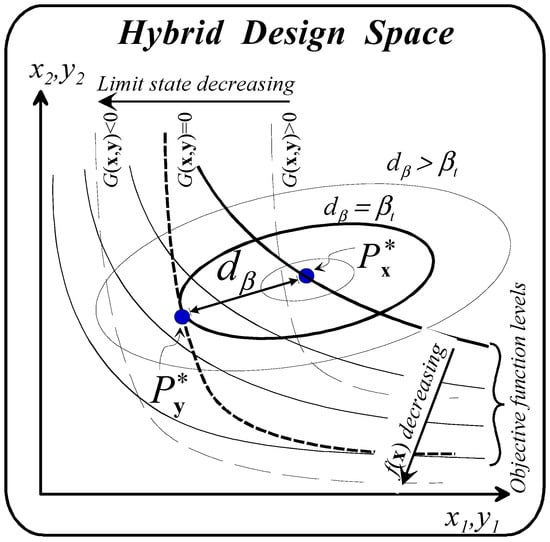
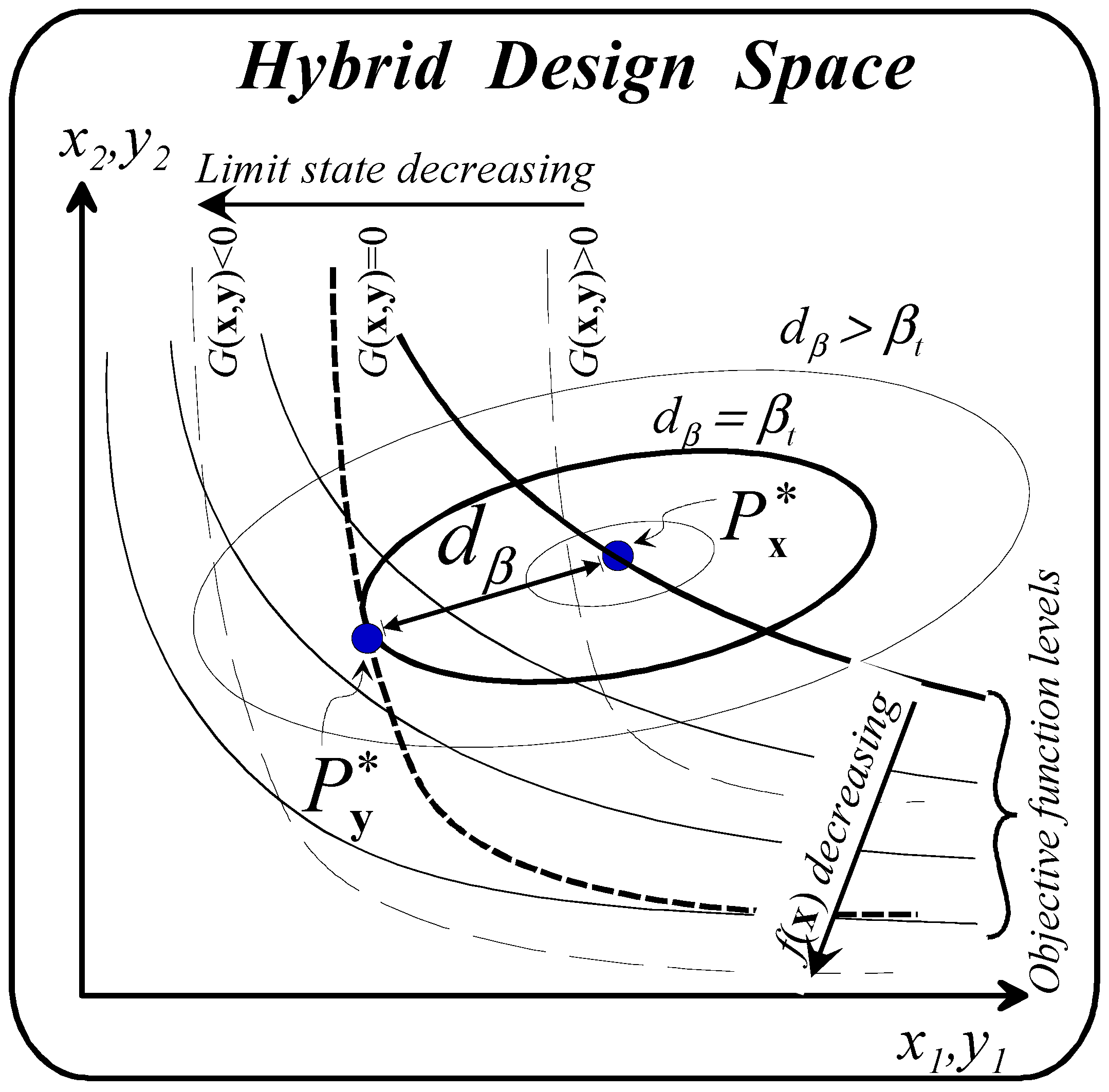
For the static problem case (t = 0), dβ({x},{y}) denotes the shortest distance, measured in the normalized hybrid design space (HDS), from the current point ({x},{y}) to the limit-state surface G({x},{y}) = 0. The reliability constraint dβ({x},{y}) ≤ β_t ensures that the design operates within the feasible region corresponding to the target reliability index β_t. When the random variables follow a normal distribution, this distance equals the Hasofer–Lind reliability index, and the iso-reliability contours take the form of ellipses in the HDS, as illustrated in Figure 1.
Figure 1.
HDS illustration in the case t = 0. Solid curves: objective function levels f(x); dashed lines: limit state functions G(x,y); elliptical contours: iso-reliability curves (critical contour at dβ = βt); Px: deterministic optimal point (dβ < βt); Py: reliability design point on G(x,y) = 0 and dβ = βt; superscript * denotes optimality.
Figure 1 illustrates this HDS through an example, integrating both types of variables. When variables follow a normal distribution, the reliability thresholds can be represented as elliptical contours. The solid curves correspond to the objective function’s levels, whereas the dashed lines depict the limit state functions (except for ). Two critical resolutions emerge from this representation, namely the optimal resolution and the reliability resolution , the latter being the design point located on the and curves.
3.2. Particle Swarm Optimization
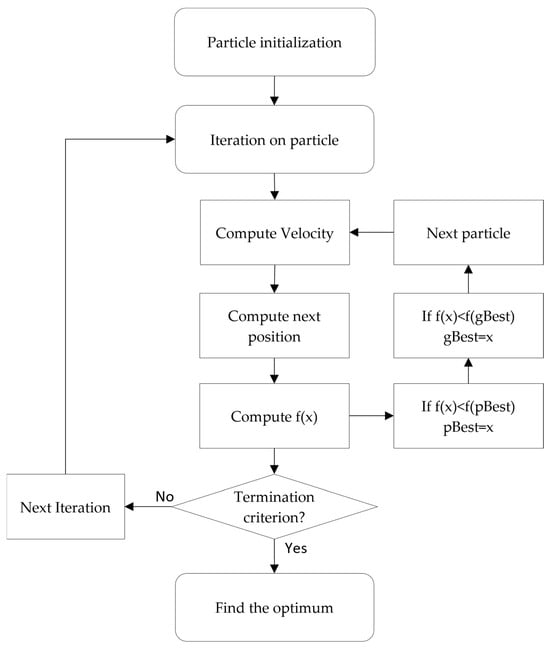
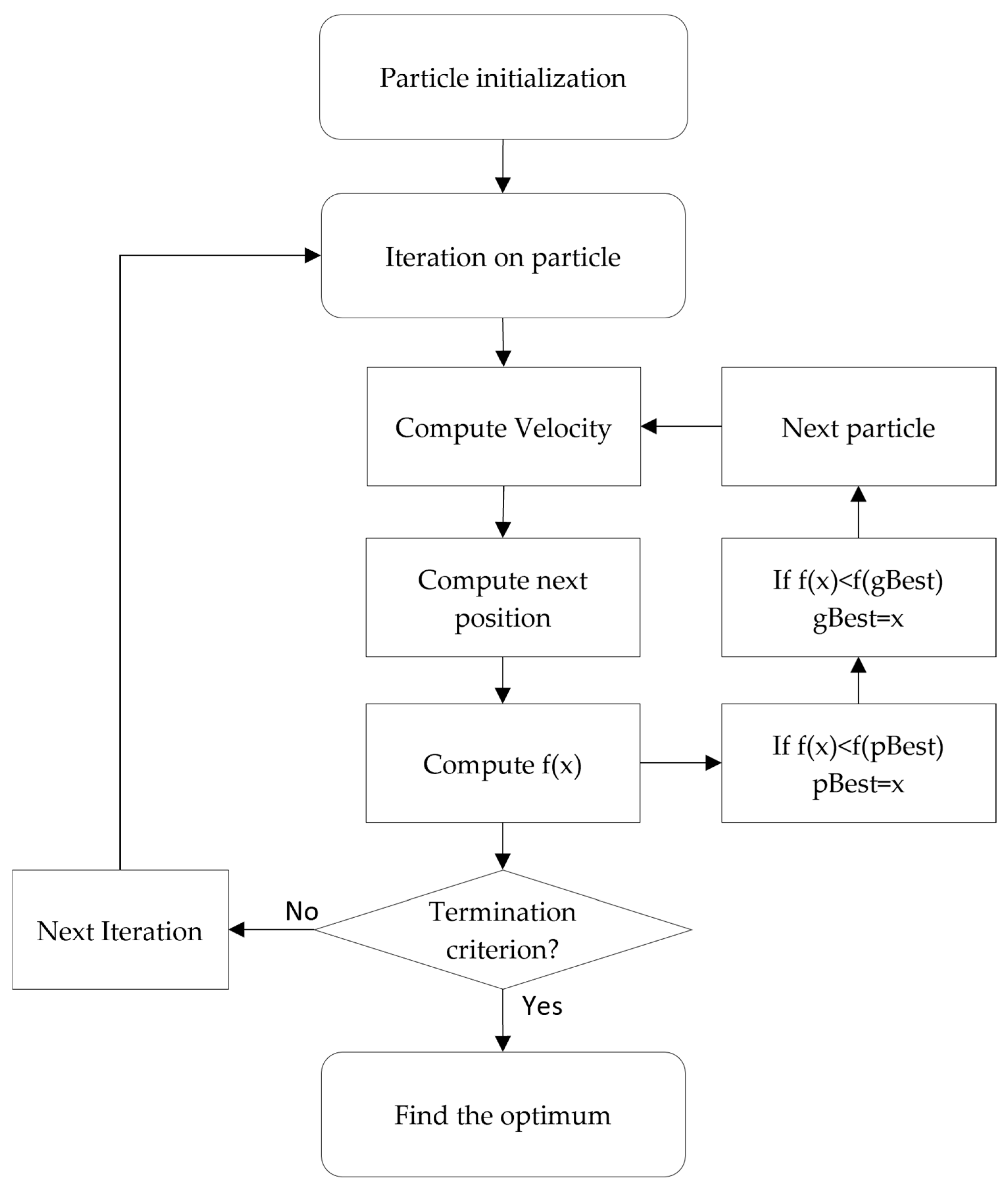
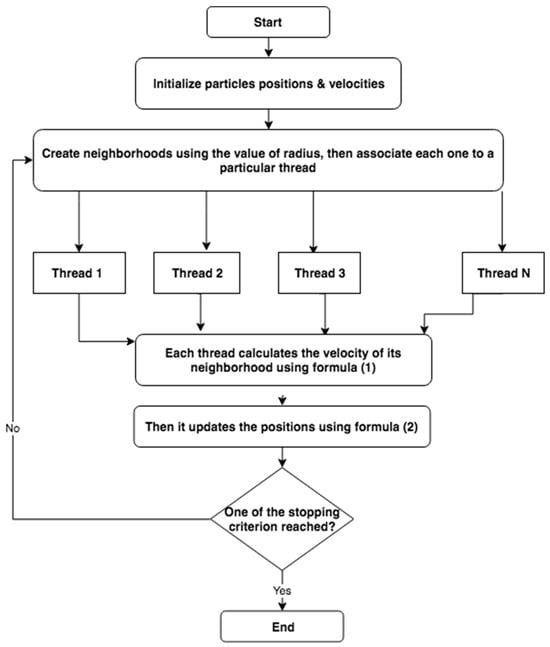
Particle Swarm Optimization (PSO) was first introduced in 1995 by James Kennedy and Russell C. Eberhart. This method is inspired by the social behavior of swarms, where individual agents, referred to as particles, interact within a collective group (or swarm) to achieve a common goal in a shared search space. Each particle possesses memory and information-processing capabilities [37,38]. PSO is the optimization engine envisioned for the RBDO phase of this research study. Each particle updates its position based on three components: inertia (tendency to continue in the current direction), cognitive influence (attraction to the particle’s personal best), and social influence (attraction to the global best found by the swarm) [39]. A flowchart of the PSO algorithm is illustrated in Figure 2.
Figure 2.
Flowchart of the classical PSO algorithm.
Over time, PSO techniques have undergone significant advancements, with modern variants bearing little resemblance to the original algorithm. In this work, we opt for a Parallel PSO (PPSO) model, an enhanced version of the standard PSO algorithm. The PPSO integrates an adaptive neighborhood mechanism combined with parallel computing to improve performance.
3.3. Parallel Particle Swarm Optimization
PSO has emerged as one of the most effective metaheuristic algorithms for solving complex optimization problems. Despite its widespread adoption and robustness, PSO suffers from notable limitations, including high computational costs and a tendency toward premature convergence.
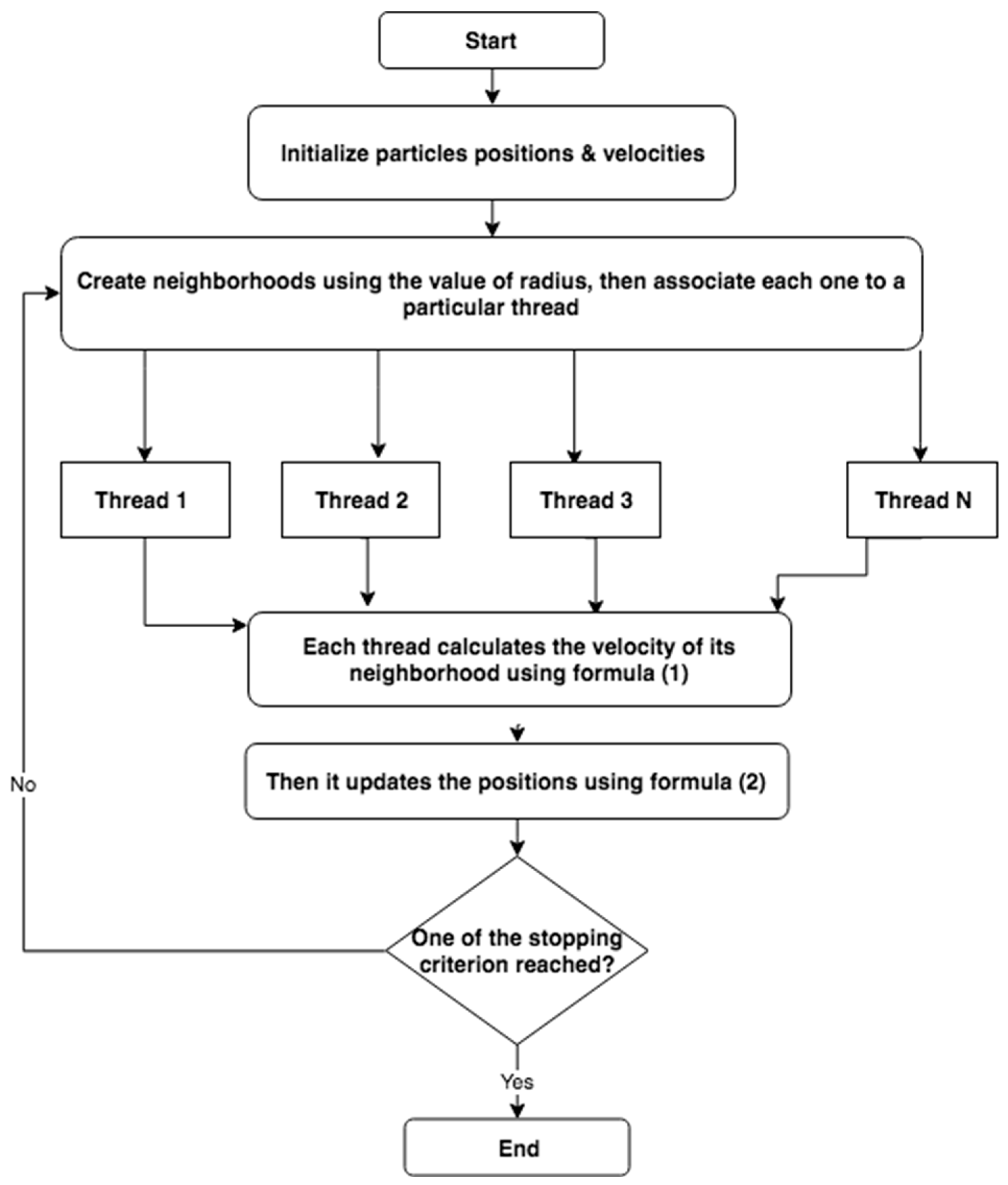
To address these challenges, the Parallel PSO (PPSO) model was developed as an advanced variant of the standard PSO algorithm. PPSO introduces an adaptive neighborhood mechanism, which enhances search diversity and improves exploration of the solution space. This innovation reduces the risk of premature convergence while maintaining the ability to reach globally optimal solutions [39].
However, neighborhood-based approaches can still be computationally expensive, particularly for large-scale or complex optimization problems. To mitigate this, PPSO leverages parallel computing to accelerate processing and deliver optimal solutions within a reduced timeframe. By parallelizing the entire PSO workflow, computational efficiency is significantly improved. Figure 3 illustrates the flowchart of the proposed PPSO model.
Figure 3.
Schematic diagram of the parallel PSO algorithm.
The integration of PPSO with the Kriging surrogate for full RBDO application will be presented in a follow-up publication; the present manuscript focuses exclusively on the surrogate-based UQ framework.
4. Numerical Results
The method employs the deterministic FEM to compute responses at training points (generated via Latin Hypercube Sampling (LHS)), followed by MCS-based uncertainty analysis using a Kriging surrogate model.
4.1. Deterministic Analysis Using Finite Elements
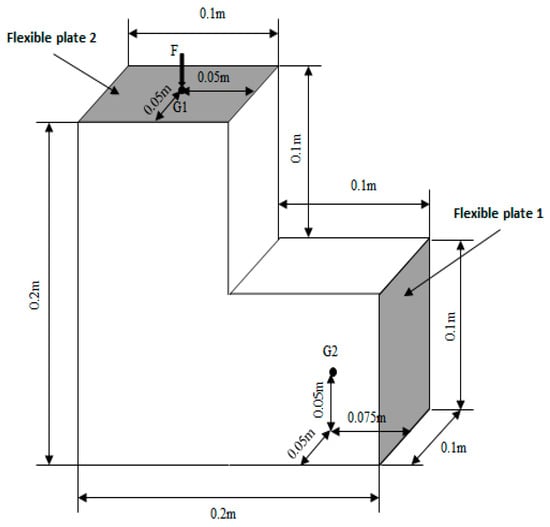
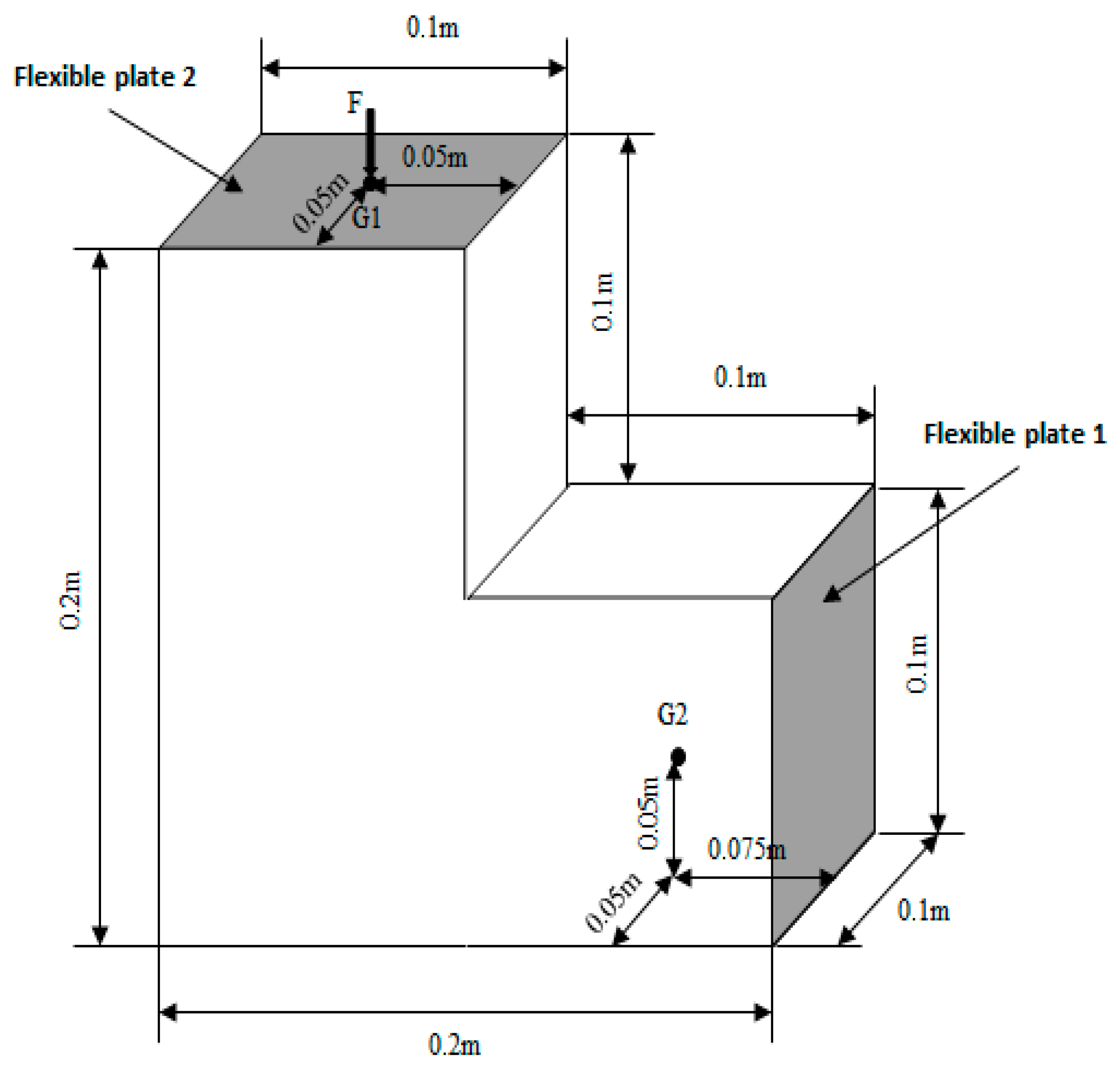
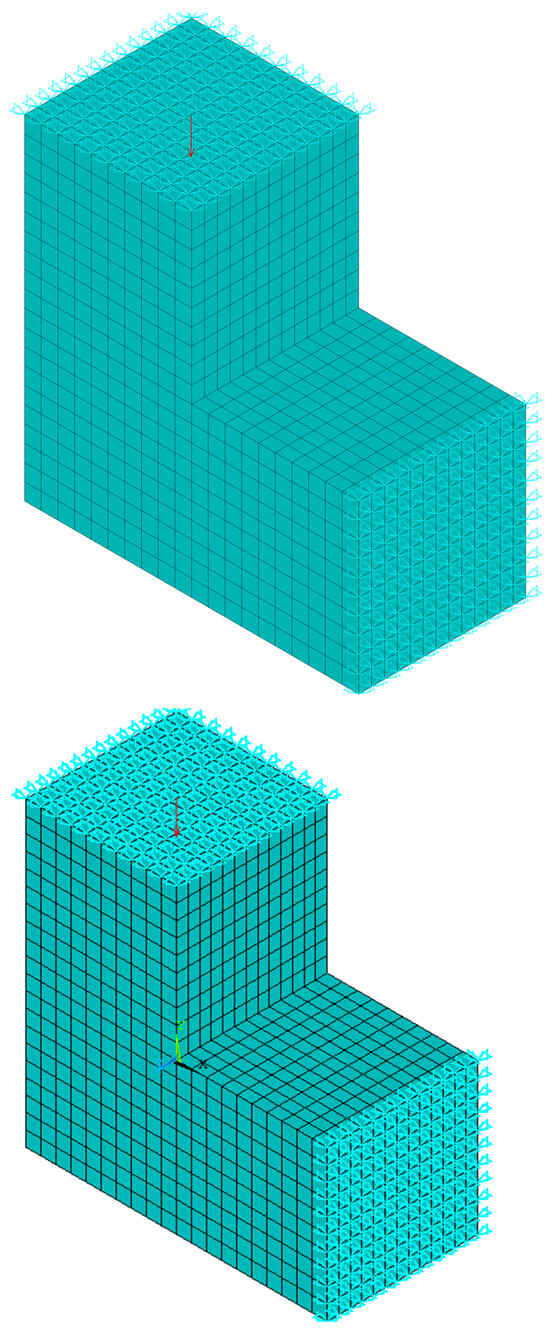
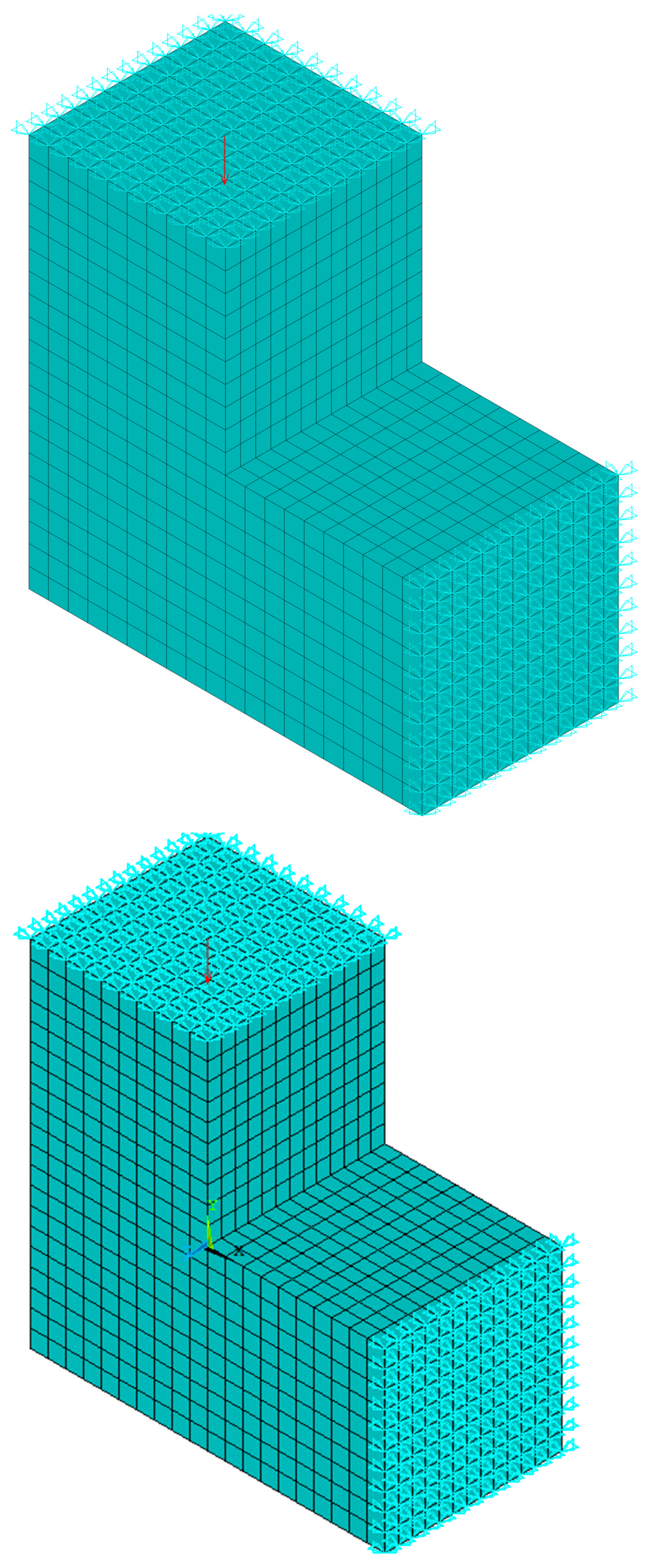
The system under study consists of two flexible aluminum plates (Plate 1: thickness 2 mm; Plate 2: thickness 4 mm), shown in Figure 4 [15]. The acoustic environment features a rigid-walled cavity, creating a coupled structural–acoustic interaction problem. Numerical modeling was performed using ANSYS-APDL 17.2 with the fluid domain discretized into 3000 elements (eight-node Fluid30 elements with acoustic pressure as a single degree of freedom) and plate structures meshed with 200 elements (four-node Shell181 elements featuring six DOFs per node: translations and rotations about x, y, z axes) (see Figure 5). The mesh density was selected to ensure a minimum of six elements per acoustic wavelength at the maximum analysis frequency of 1000 Hz (corresponding to a wavelength of approximately 0.34 m in air). This criterion, standard in FEM acoustics, is satisfied by the 3000-element Fluid30 mesh. For the plate structures, the 200-element Shell181 mesh captures at least the first ten structural modes within the frequency range of interest. Boundary conditions include full clamping constraints along all plate edges. The aluminum plates are modeled with Young’s modulus E = 70 GPa, density ρ = 2700 kg/m3, and Poisson’s ratio ν = 0.33.
Figure 4.
An acoustic–structural model.
Figure 5.
Ansys FEM model. The red arrow indicates the applied unit harmonic force at excitation point F, located at the center of Flexible Plate 2.
Harmonic analysis covers the frequency range from 0 to 1000 Hz with a step of 1 Hz. A unit harmonic force (1 N) is applied at point F at the center of Flexible Plate 2. Structural damping is modeled using a constant hysteretic loss factor η = 0.01 applied to both aluminum plates; fluid damping is neglected, consistent with the rigid-wall cavity assumption. Fluid–structure coupling is enforced at all plate free-face nodes via the ANSYS APDL coupled-field formulation (FLUID30–SHELL181 interface). The monitoring point G2 is located at specific coordinates (0.05 m, 0.05 m, 0) along the bottom wall of the acoustic cavity, corresponding to the geometric center of the cavity base plane.
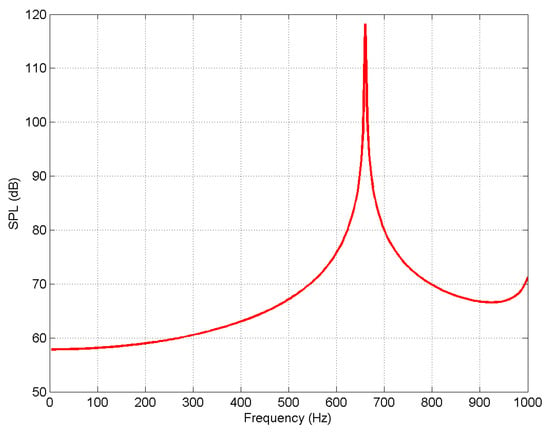
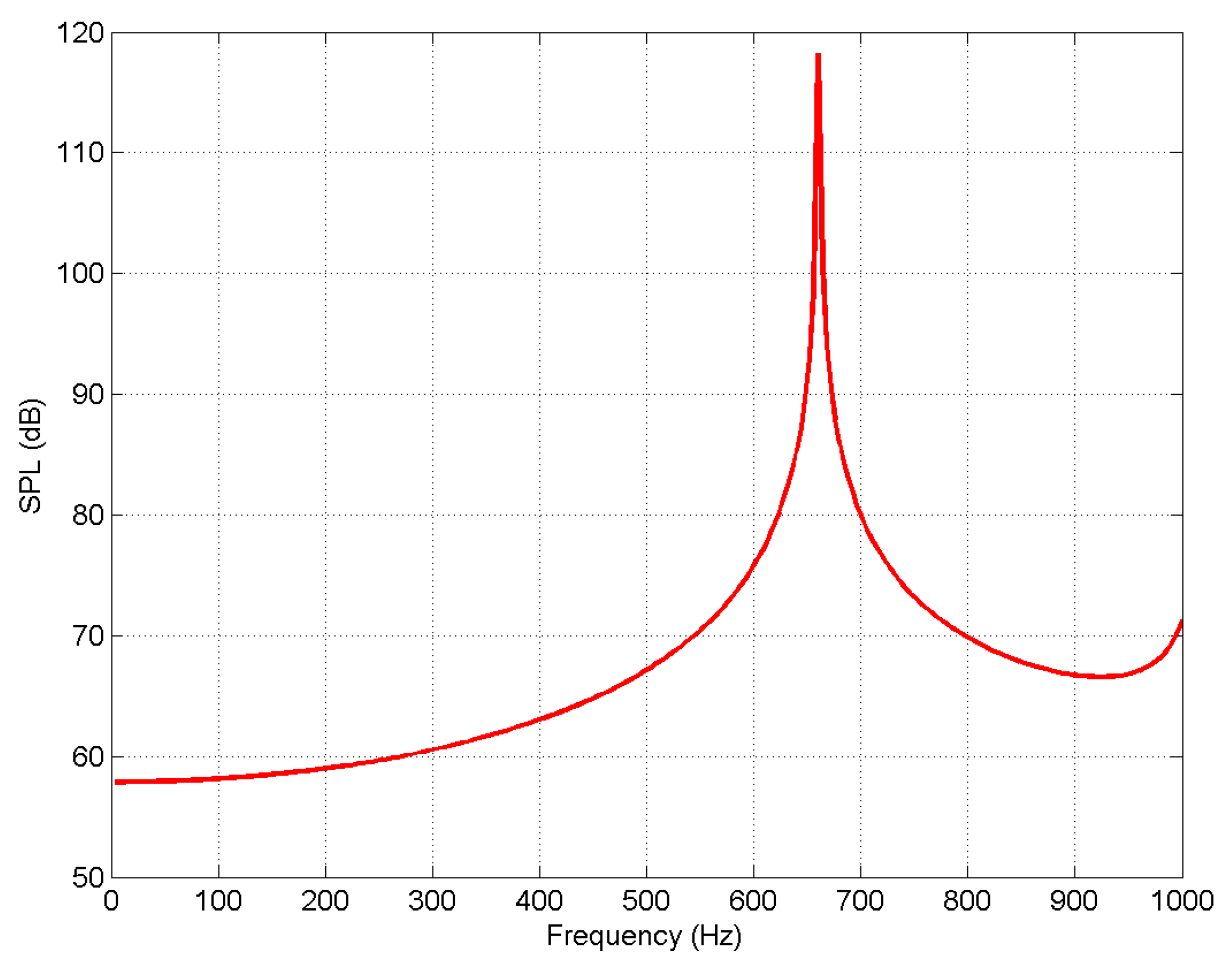
The FEM is utilized to analyze and compute the acoustic pressure distribution, with particular focus on the Sound Pressure Level (SPL) at monitoring location G2, as illustrated in Figure 6.
Figure 6.
Internal acoustic cavity sound pressure level. The red line represents the Sound Pressure Level (SPL) frequency response computed at monitoring point G2 using the deterministic FEM analysis.
4.2. Proposed Surrogate-Based Uncertainty Analysis
This study treats the aluminum plates’ material properties (elastic modulus and density), along with their thickness dimensions, as probabilistic variables. The statistical characteristics of these four uncertain parameters are detailed in Table 1.
Table 1.
Characteristics of random variables.
The probability distributions assigned to the uncertain parameters reflect standard engineering assumptions. Material properties (E, ρ) are modeled as normal random variables with a coefficient of variation (COV) of 5%, which is consistent with the reported manufacturing variability for structural aluminum alloys. Plate thicknesses (t1, t2) are modeled as uniform random variables with a tighter COV of 2%, reflecting the bounded dimensional tolerances of sheet metal forming (ISO 2768-1 standard [40]), where values within the tolerance band are equally probable. All four random variables are assumed to be statistically independent, as no empirical correlation data between material and geometric parameters were available for this study.
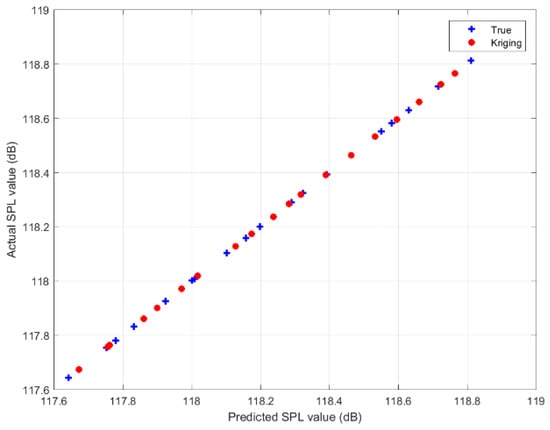
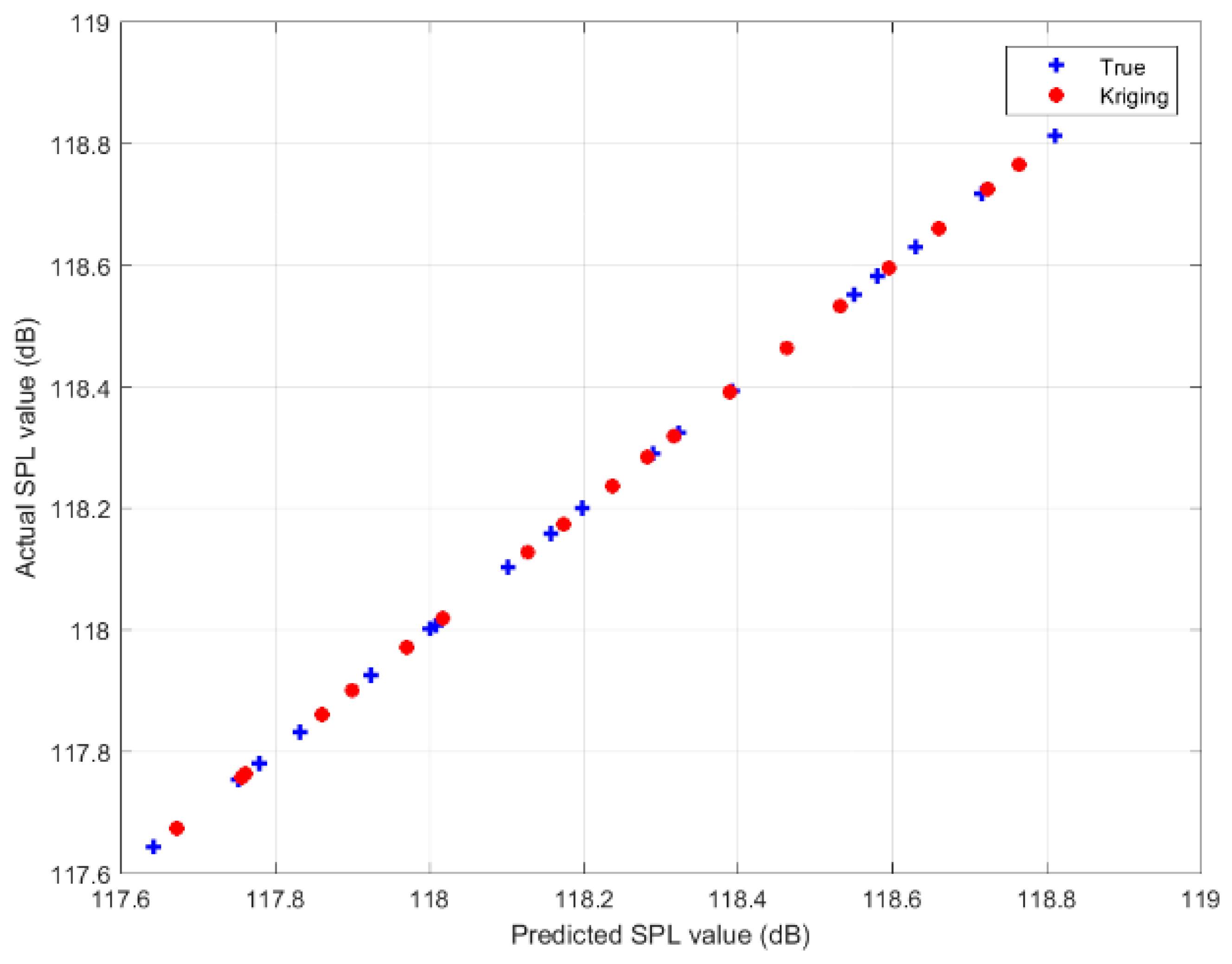
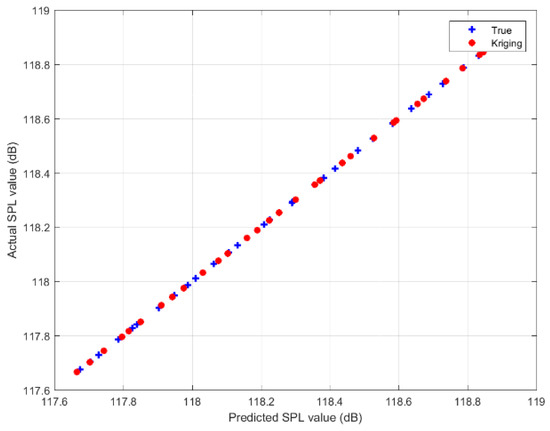
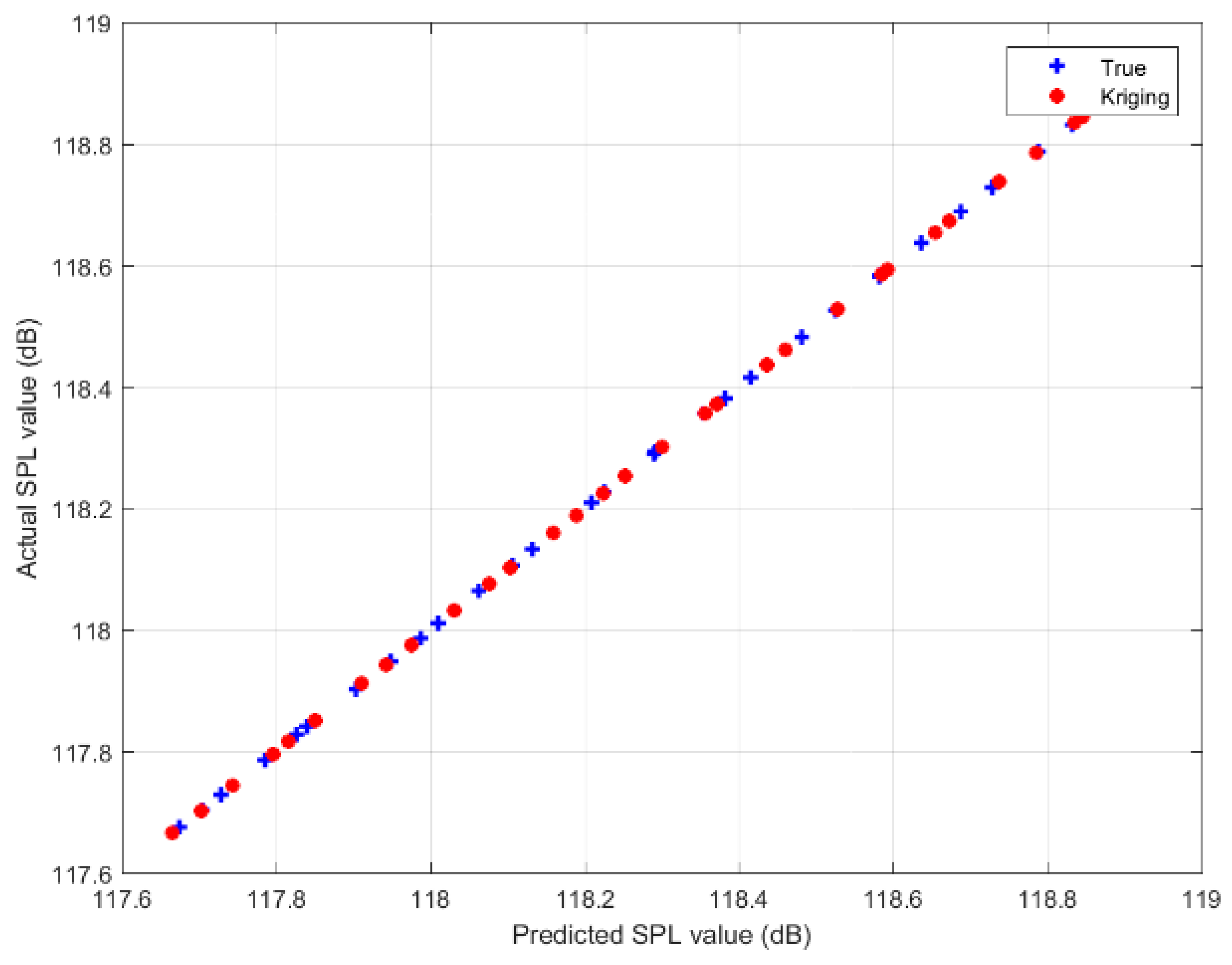
The peak sound pressure level within the acoustic cavity is computed through two distinct surrogate modeling techniques: QRS and Kriging interpolation. Kriging implementation employs MATLAB R2019a’s DACE toolbox [41], configured with a quadratic global trend component that has been paired with an exponential covariance kernel for spatial correlation. Separate Latin Hypercube Sampling points generate independent training data for each surrogate model to assess their predictive capabilities, while additional validation points evaluate model fidelity. Finite Element Method simulations are iteratively conducted using the training dataset specified in Table 1. Model accuracy is rigorously quantified through three standard metrics—Mean Absolute Error (MAE), Relative Maximum Error (RME), and Root Mean Square Error (RMSE)—as presented in Table 2. The cross-validation results comparing 20-point and 30-point LHS designs are visualized in Figure 7 and Figure 8, respectively, demonstrating the influence of sampling density on model performance. The LOO cross-validation procedure withholds each training point in turn, retrains the Kriging model on the remaining n-1 points, and records both the predicted value and the Kriging predictive standard deviation at the withheld point. For the 30-point design, the mean LOO predictive standard deviation is 8.93 × 10⁻³ dB, confirming that the surrogate’s local uncertainty is negligible relative to the SPL range.
Table 2.
Accuracy comparison of surrogate methods.
Figure 7.
Cross-validation outcomes of SPL using 20-point LHS.
Figure 8.
Cross-validation outcomes of SPL using 30-point LHS.
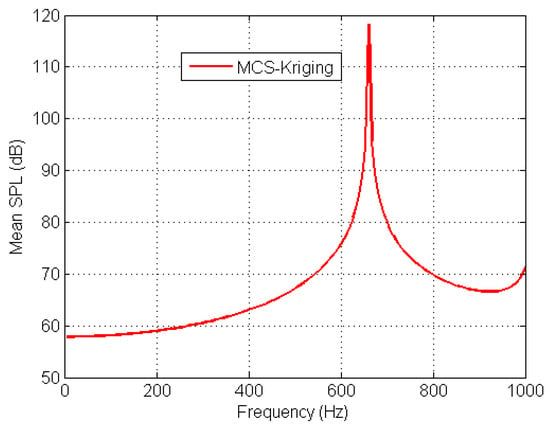
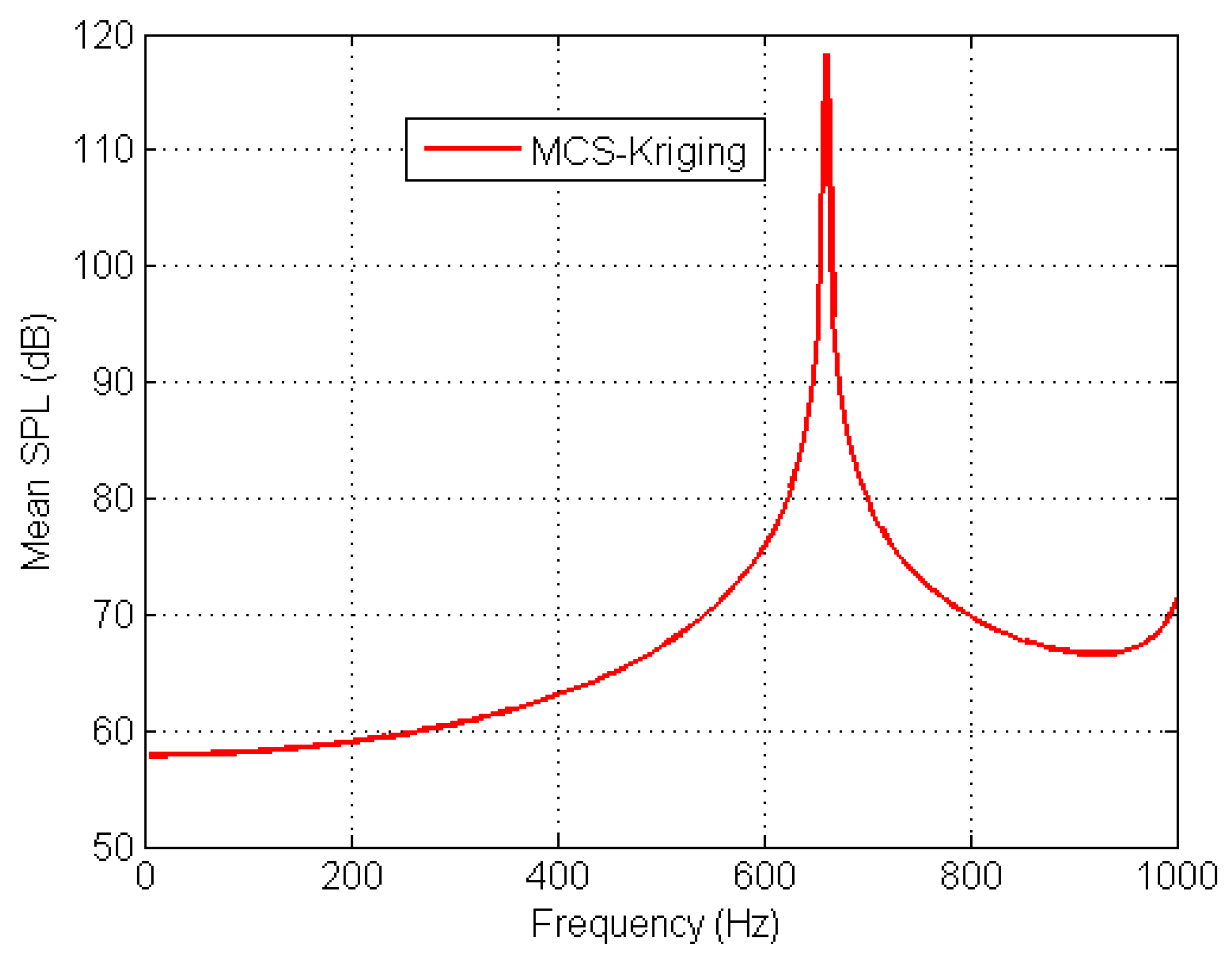
The comparative analysis in Table 2 demonstrates the superior performance of the Kriging surrogate model compared to the QRS approach. Cross-validation analysis reveals enhanced predictive accuracy when using the 30-point LHS with the Kriging method. Based on these favorable outcomes, the Kriging model has been selected for subsequent Monte Carlo uncertainty quantification. For this analysis, a sample size of was generated for the random variables (Table 1 parameters), with MCS executed through the Kriging surrogate. The resulting mean sound pressure level distribution is illustrated in Figure 9.
Figure 9.
Mean value of the SPL obtained using the Kriging-based MCS approach (N = 106 samples).
The dominant source of output variability in a coupled structural–acoustic system near resonance is the sensitivity of the natural frequency fₙ to material and geometric uncertainties. First-order uncertainty propagation was used as follows:
This yields σ(fₙ) ≈ 25 Hz for the present parameter set. Since the resonance half-bandwidth is Δf ≈ 6.8 Hz, the standard deviation of the resonance frequency substantially exceeds the half-bandwidth. Each MCS realization therefore places the resonance peak at a different frequency, producing a very wide SPL distribution near resonance and near-zero variance off resonance. The MCS output is characterized by a high-variance region in the resonance band (~640–720 Hz), where the 5th–95th percentile band spans approximately 70–115 dB, and negligible variance at off-resonance frequencies. With N = 106 samples, the mean estimator error scales as , confirming full statistical convergence.
The computational requirements merit special consideration. A single deterministic FEM simulation requires approximately 3 min of processing time. For the training phase involving 30 sample points, this translates to 90 min of total computation (30 × 3 min). Notably, a full Monte Carlo Simulation using direct FEM would demand approximately 3 million minutes () for complete uncertainty analysis.
In contrast, the Kriging-based MCS approach demonstrates remarkable efficiency, completing the analysis in just 27 s. This substantial reduction in computational expense—from millions of minutes to mere seconds—clearly establishes the superior efficiency of the surrogate model approach compared to conventional FEM-based Monte Carlo methods.
5. Conclusions
This study demonstrates the effectiveness of surrogate-based uncertainty quantification for coupled structural–acoustic systems. The principal findings are as follows: (1) Accuracy: Among the two surrogate families evaluated, Kriging consistently outperforms QRS. With 30 LHS training points, Kriging achieves a Relative Maximum Error of 4.125 × 10⁻⁷ and an RMSE of 8.926 × 10⁻⁶, representing a reduction of approximately three orders of magnitude compared to QRS. (2) Training set size: Cross-validation results for this specific four-dimensional benchmark problem show that 30-point LHS provides better predictive accuracy than 20-point LHS. This suggests that 30-point LHS represents a reasonable starting point for problems of similar dimensionality and smoothness. (3) Computational efficiency: The surrogate-based MCS (N = 106 samples) is completed in 27 s, compared to an estimated 3 × 10⁶ min for direct FEM-MCS—an increase exceeding 6 × 10⁶. The total computational budget, including FEM training simulations, amounts to 90 min. (4) Scope and limitations: The present study is validated on a single benchmark case. Generalization of the proposed framework to industrial problems with higher dimensionality, multiple response quantities, or non-stationary responses should be approached with appropriate validation. An extension to such cases is proposed as future work.
For vibro-acoustic problems with sharp resonance peaks, Kriging is recommended over polynomial surrogates due to its local interpolation property and built-in predictive uncertainty. The proposed framework provides a validated methodological basis for vibro-acoustic UQ, with extension to more complex industrial configurations as a recommended next step.
Author Contributions
Conceptualization, A.E.H. and N.E.H.; methodology, A.E.H., Y.K. and N.E.H.; software, A.E.H., Y.K. and N.E.H.; validation, A.E.H., Y.K., N.E.H., H.R. and N.H.; formal analysis, A.E.H., N.E.H. and N.H.; investigation, A.E.H. and N.E.H.; methodology, A.E.H., Y.K. and N.E.H.; resources, A.E.H., Y.K. and H.R.; data curation, A.E.H., Y.K. and H.R.; writing—original draft preparation, A.E.H. and Y.K.; writing—review and editing, H.R.; visualization, Y.K. and H.R.; supervision, A.E.H., N.E.H. and N.H.; project administration, A.E.H., Y.K. and H.R. All authors have read and agreed to the published version of the manuscript.
Funding
This research received no external funding.
Data Availability Statement
The data presented in this study are available on request from the corresponding author due to privacy restrictions related to ongoing research.
Conflicts of Interest
The authors declare no conflict of interest.
Abbreviations
The following abbreviations are used in this manuscript:
| RBDO | Reliability-Based Design Optimization |
| FEM | Finite Element Method |
| MCS | Monte Carlo Simulations |
| LHS | Latin Hypercube Sampling |
| RSM | Response Surface Methodology |
| QRS | Quadratic Response Surfaces |
| HDS | Hybrid Design Space |
| PSO | Particle Swarm Optimization |
| PPSO | Parallel Particle Swarm Optimization |
| SPL | Sound Pressure Level |
| MAE | Mean Absolute Error |
| RME | Relative Maximum Error |
| RMSE | Root Mean Square Error |
References
- Peretti, L.F.; Dowell, E.H. Asymptotic modal analysis of a rectangular acoustic cavity excited by wall vibration. AIAA J. 1992, 30, 1191–1198. [Google Scholar] [CrossRef] [Scilit]
- Sum, K.S.; Pan, J. On acoustic and structural modal cross-couplings in plate-cavity systems. J. Acoust. Soc. Am. 2000, 107, 2021–2038. [Google Scholar] [CrossRef] [Scilit]
- Redonnet, S.; Cunha, G. An advanced hybrid method for the acoustic prediction. Adv. Eng. Softw. 2015, 88, 30–52. [Google Scholar] [CrossRef] [Scilit]
- Wang, C.; Qiu, Z.; Wang, X.; Wu, D. Interval finite element analysis and reliability-based optimization of coupled structural-acoustic system with uncertain parameters. Finite Elem. Anal. Des. 2014, 91, 108–114. [Google Scholar] [CrossRef] [Scilit]
- Wang, C.; Qiu, Z.; Li, Y. Hybrid uncertainty propagation of coupled structural–acoustic system with large fuzzy and interval parameters. Appl. Acoust. 2016, 102, 62–70. [Google Scholar] [CrossRef] [Scilit]
- Vasques, C.M.A.; Rodrigues, J.D. (Eds.) Vibration and Structural Acoustics Analysis: Current Research and Related Technologies; Springer: Dordrecht, The Netherlands, 2011. [Google Scholar]
- Marburg, S.; Shepherd, M.; Hambric, S.A. Structural–acoustic optimization. In Engineering Vibroacoustic Analysis: Methods and Applications; John Wiley & Sons: Hoboken, NJ, USA, 2016; pp. 268–304. [Google Scholar]
- Dash, B.; Mahapatra, T.R.; Mishra, P.; Mishra, D.; Mahmoud, S.R. A review of computational methods for vibroacoustic analysis of advanced material structures. Arch. Comput. Methods Eng. 2025, 32, 2187–2211. [Google Scholar] [CrossRef] [Scilit]
- Massah, S.R.; Hajihassani, M.; Haghighat, A.E. Investigating the interactions of acoustic waves with underground structures via the boundary element method. Appl. Acoust. 2021, 177, 107926. [Google Scholar] [CrossRef] [Scilit]
- Kim, N.H.; Dong, J. Shape sensitivity analysis of sequential structural–acoustic problems using FEM and BEM. J. Sound Vib. 2006, 290, 192–208. [Google Scholar] [CrossRef] [Scilit]
- Wu, H.; Ye, W.; Jiang, W. Isogeometric finite element analysis of interior acoustic problems. Appl. Acoust. 2015, 100, 63–73. [Google Scholar] [CrossRef] [Scilit]
- Chen, C.; Wang, C.; Zhao, Y.; Guo, R.; Chen, M.; Yu, W. An isogeometric modeling and vibro-acoustic characteristics analysis of a double panel-acoustic cavity coupling system with in-plane functionally graded materials. Sci. Rep. 2025, 15, 6554. [Google Scholar] [CrossRef] [Scilit] [PubMed]
- Dey, S.; Datta, D.K. A parallel hp-FEM infrastructure for three-dimensional structural acoustics. Int. J. Numer. Methods Eng. 2006, 68, 583–603. [Google Scholar] [CrossRef] [Scilit]
- Abo Al-Kheer, A.; Eid, M.; Aoues, Y.; El-Hami, A.; Kharmanda, M.G.; Mouazen, A.M. Theoretical analysis of the spatial variability in tillage forces for fatigue analysis of tillage machines. J. Terramech. 2011, 48, 285–295. [Google Scholar] [CrossRef] [Scilit]
- Al-Kheer, A.A.; Kharmanda, M.G.; ELHami, A.; Mouazen, A.M. Estimating the variability of tillage forces on a chisel plough shank by modeling the variability of tillage system parameters. Comput. Electron. Agric. 2011, 78, 61–70. [Google Scholar] [CrossRef] [Scilit]
- Guerine, A.; El Hami, A.; Walha, L.; Fakhfakh, T.; Haddar, M. Dynamic response of a Spur gear system with uncertain friction coefficient. Adv. Eng. Softw. 2018, 120, 45–54. [Google Scholar] [CrossRef] [Scilit]
- Dammak, K.; El Hami, A.; Koubaa, S.; Walha, L.; Haddar, M. Numerical modeling of uncertainty in acoustic propagation via generalized Polynomial Chaos. J. Theor. Appl. Mech. 2019, 57, 3–15. [Google Scholar] [CrossRef] [Scilit]
- Al-Kheer, A.A.; El-Hami, A.; Kharmanda, M.G.; Mouazen, A.M. Reliability-based design for soil tillage machines. J. Terramech. 2011, 48, 57–64. [Google Scholar] [CrossRef] [Scilit]
- Dey, S.; Mukhopadhyay, T.; Adhikari, S. Metamodel based high-fidelity stochastic analysis of composite laminates: A concise review with critical comparative assessment. Compos. Struct. 2017, 171, 227–250. [Google Scholar] [CrossRef] [Scilit]
- Laurent, L.; Boucard, P.A.; Soulier, B. Generation of a cokriging metamodel using a multiparametric strategy. Comput. Mech. 2013, 51, 151–169. [Google Scholar] [CrossRef] [Scilit]
- Hu, X.; Chen, X.; Parks, G.T.; Yao, W. Review of improved Monte Carlo methods in uncertainty-based design optimization for aerospace vehicles. Prog. Aerosp. Sci. 2016, 86, 20–27. [Google Scholar] [CrossRef] [Scilit]
- Mukhopadhyay, T.; Chakraborty, S.; Dey, S.; Adhikari, S.; Chowdhury, R. A critical assessment of Kriging model variants for high-fidelity uncertainty quantification in dynamics of composite shells. Arch. Comput. Methods Eng. 2017, 24, 495–518. [Google Scholar] [CrossRef] [Scilit]
- Shi, Y.; Lu, Z.; Xu, L.; Chen, S. An adaptive multiple-Kriging-surrogate method for time-dependent reliability analysis. Appl. Math. Model. 2019, 70, 545–571. [Google Scholar] [CrossRef] [Scilit]
- Lizotte, D.J.; Greiner, R.; Schuurmans, D. An experimental methodology for response surface optimization methods. J. Glob. Optim. 2012, 53, 699–736. [Google Scholar] [CrossRef] [Scilit]
- Immonen, E. 2D shape optimization under proximity constraints by CFD and response surface methodology. Appl. Math. Model. 2017, 41, 508–529. [Google Scholar] [CrossRef] [Scilit]
- Forrester, A.; Sobester, A.; Keane, A. Engineering Design via Surrogate Modelling: A Practical Guide; John Wiley & Sons: New York, NY, USA, 2008. [Google Scholar]
- McKay, M.D.; Beckman, R.J.; Conover, W.J. A comparison of three methods for selecting values of input variables in the analysis of output from a computer code. Technometrics 2000, 42, 55–61. [Google Scholar] [CrossRef]
- Ryberg, A.B.; Domeij, B.R.; Nilsson, L. Metamodel-Based Multidisciplinary Design Optimization for Automotive Applications; Linköping University Electronic Press: Linköping, Sweden, 2012. [Google Scholar]
- Hamdani, H.; Radi, B.; El Hami, A. Optimization of solder joints in embedded mechatronic systems via Kriging-assisted CMA-ES algorithm. Int. J. Simul. Multidiscip. Des. Optim. 2019, 10, A3. [Google Scholar] [CrossRef] [Scilit]
- Reddad, H.; Abouelmajd, M.; Zemzami, M.; Hami, N.E.; Hmina, N.; Nguyen, N.Q. Combining FEM and Machine Learning Algorithms for Reliability Prediction of Solder Ball Joints in BGA Packages. In 2024 Sixth International Conference on Intelligent Computing in Data Sciences (ICDS); IEEE: Piscataway, NJ, USA, 2024; pp. 1–6. [Google Scholar]
- Abouelmajd, M.; Reddad, H.; El Khadiri, I.; Ezzaraa, I.; Zemzami, M.; Arroub, I.; Bahlaoui, A.; Lagache, M.; Belhouideg, S. Enhancing the Prediction of Mechanical Properties of 3D-Printed Parts Through Machine Learning. In 2024 Sixth International Conference on Intelligent Computing in Data Sciences (ICDS); IEEE: Piscataway, NJ, USA, 2024; pp. 1–7. [Google Scholar]
- Moro, T.; El Hami, A.; El Moudni, A. Reliability analysis of a mechanical contact between deformable solids. Probabilistic Eng. Mech. 2002, 17, 227–232. [Google Scholar] [CrossRef] [Scilit]
- Elhami, N.; Itmi, M.; Ellaia, R. Reliability-based design and heuristic optimization MPSO-SA of structures. Adv. Mater. Res. 2011, 274, 91–100. [Google Scholar] [CrossRef] [Scilit]
- Xia, B.; Yu, D. Optimization based on reliability and confidence interval design for the structural-acoustic system with interval probabilistic variables. J. Sound Vib. 2015, 336, 1–15. [Google Scholar] [CrossRef] [Scilit]
- Guerine, A.; El Hami, A.; Walha, L.; Fakhfakh, T.; Haddar, M. Approach for the dynamic analysis of one stage gear system with uncertain parameters. Mech. Mach. Theory 2015, 92, 113–126. [Google Scholar] [CrossRef] [Scilit]
- Guerine, A.; El Hami, A.; Fakhfakh, T.; Haddar, M. A polynomial chaos method to the analysis of the dynamic behavior of spur gear system. Struct. Eng. Mech. 2015, 53, 819–831. [Google Scholar] [CrossRef] [Scilit]
- Zemzami, M.; Elhami, N.; Itmi, M.; Hmina, N. A modified particle swarm optimization algorithm linking dynamic neighborhood topology to parallel computation. Int. J. Adv. Trends Comput. Sci. Eng. 2019, 8, 112–118. [Google Scholar] [CrossRef] [Scilit]
- Hakima, R.; Maria, Z.; Norelislam, E.H.; Nabil, H. A comparative study of several metaheuristic algorithms for optimization problems. In Proceedings of the 8th International Conference on Optimization and Applications (ICOA 2022), Sestri Levante, Italy, 6–7 October 2022. [Google Scholar]
- Zemzami, M.; Makhloufi, A.; Elhami, N.; Itmi, M.; Hmina, N. Applying a new parallelized version of PSO algorithm for electrical power transmission. IOP Conf. Ser. Mater. Sci. Eng. 2017, 205, 012032. [Google Scholar] [CrossRef] [Scilit]
- ISO 2768-1; General Tolerances—Part 1: Tolerances for Linear and Angular Dimensions Without Individual Tolerance Indications. ISO: Geneva, Switzerland, 1989.
- Lophaven, S.N.; Nielsen, H.B.; Sondergaard, J.; Dace, A. A Matlab Kriging Toolbox; Technical Report; Technical University of Denmark: Lundtofte, Denmark, 2002. [Google Scholar]

Disclaimer/Publisher’s Note: The statements, opinions and data contained in all publications are solely those of the individual author(s) and contributor(s) and not of MDPI and/or the editor(s). MDPI and/or the editor(s) disclaim responsibility for any injury to people or property resulting from any ideas, methods, instructions or products referred to in the content. |
© 2026 by the authors. Licensee MDPI, Basel, Switzerland. This article is an open access article distributed under the terms and conditions of the Creative Commons Attribution (CC BY) license.