


Abstract
The study of bubble pulsation from underwater explosions is critical for applications in marine resource exploration, underwater demolition, and offshore engineering. However, the existing research methods have significant limitations: Laboratory experiments struggle to replicate the dynamic decompression during the process of bubble rising. Field experiments in seas or lakes find it difficult to systematically cover complex parameter ranges. Furthermore, theoretical calculations face the problems of accurately coupling the bubble pulsation with its buoyancy-driven ascent. Therefore, this paper proposes a novel method for calculating the bubble pulsation period of underwater explosions. This method accurately simulates the pulsation and buoyancy-driven ascent of an underwater explosion bubble. Based on the bubble’s energy attenuation characteristics, it establishes the relationship between the pulsation period, TNT equivalent, and ambient hydrostatic pressure. To verify the accuracy of the method, we conducted underwater explosion experiments in the South China Sea with varying TNT equivalents and detonation depths. Abundant bubble pulsation period data of underwater explosions were obtained spatially by deploying hydrophone arrays at various depths. The close agreement between the theoretical predictions and the experimental results confirms the accuracy of the proposed method. By matching the measured values of the first pulsation period and the ratio of the second pulsation period to the first against a database of theoretical curves, a combination of depth and charge equivalent that satisfies both values can be identified, thereby enabling the inversion of the explosion parameters.
1. Introduction
Upon the detonation of an underwater explosion, a substantial amount of energy is released within an extremely short period, generating high-temperature and high-pressure gas products. These gases expand rapidly and compress the surrounding water medium to form an initial shock wave. Following the propagation of the shock wave, the explosion product continues to expand, giving rise to cavitation bubbles, and the bubbles undergo a complex pulsation process of expansion–contraction–re-expansion, driven by the ambient pressure [1].
Each pulsation is accompanied by the radiation of the pressure wave, which has a delayed damaging effect on ship structures, and its destructive force may even exceed the initial shock wave. In the military domain, accurately predicting the pulsation characteristics of underwater explosion bubbles is crucial for assessing weapon damage effectiveness [2]. In civil engineering, this research also has important application value in the fields of deep-sea resource development, underwater blasting demolition and acoustic detection [3,4]. Current research methods for studying the pulsation characteristics of underwater explosion bubbles mainly include laboratory simulation, experimental observation, and theoretical calculation.
Ma et al. [5] designed a pressurized water tank system to simulate the deep-water hydrostatic pressure conditions by increasing the gas pressure above the water surface. This setup captured the image of the entire bubble pulsation process, facilitating the research on the relationships among the first bubble pulsation period, the maximum bubble radius and the explosion depth. Rong et al. [6] captured the secondary reaction phenomenon of an RDX-based aluminized explosive using an outdoor pool and a high-speed camera. Hu et al. [7] investigated the expansion, merging and collapse process of multiple underwater explosion bubbles through water tank experiments and numerical methods, and analyzed the influence of the amount and spacing of explosives on the bubble pulsation behavior.
Cole [8] first proposed the variation law of the bubble pulsation period with explosion depth and equivalent at a depth of 260 m. To investigate bubble pulsation characteristics under different boundary conditions, Zhang et al. [9] conducted experiments on TNT explosions near the seabed and near the free surface. The results indicate that the pulsation period was longer under the condition of near-bottom than under the condition of the free field.
Zhang et al. [10] investigated the pulsed sound propagation characteristics of the source near the deep-sea sound channel axis, which was achieved through an experiment conducted in the South China Sea. The signals were obtained from an explosive source with a 1 kg TNT equivalent at a depth of 1000 m, and the experimental results were validated against simulations based on normal mode theory. Shahid et al. [11] employed the numerical method based on the Riemann problem and Godunov scheme to simulate the shock wave, bubble pulse pressure and bubble expansion and contraction, and the method was compared with the experimental results to prove its accuracy.
Laboratory simulations provide fixed pressure boundary conditions, which have limited applicability because they cannot replicate the dynamic environment generated by an actual explosion bubble as it ascends while expanding and contracting [12,13]. Existing field experiments are often constrained by a limited combination of equivalent and depth, which makes it difficult to encompass the complex range of explosion parameters in practical applications. Consequently, the data acquired may be insufficient to support the verification of the model [14,15]. Theoretical calculation methods, meanwhile, face the challenge of accurately simulating both the bubble’s pulsation dynamics and its buoyancy-driven ascent [16,17]. Therefore, this study proposes a refined dynamic-coupling method for calculating the bubble pulsation periods. Unlike classical models that assume a constant hydrostatic pressure [18], the core of this method is the integration of bubble pulsation dynamics with a buoyancy-driven ascent model. By coupling the bubble’s changing depth, due to its rise during the first cycle, with its energy attenuation, a self-consistent framework is established to predict both the first and second pulsation periods. To validate the effectiveness and reliability of the method, this study conducted a series of underwater explosion tests in the South China Sea, incorporating multiple equivalents and depths. By comparing the theoretical results with the experimental measurements under various explosion conditions, the correctness of the proposed theoretical model was verified, and its effective range of application was clarified. The purpose of this study is to provide a more accurate and applicable theoretical method for predicting the dynamic behavior of underwater explosion bubbles.
2. Bubble Pulsation Theory of Underwater Explosion
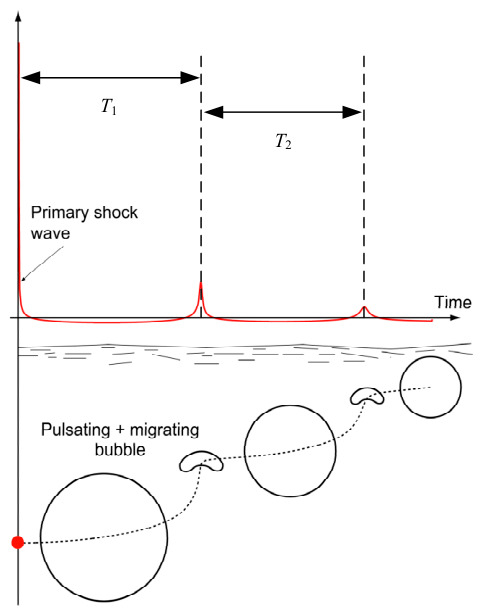
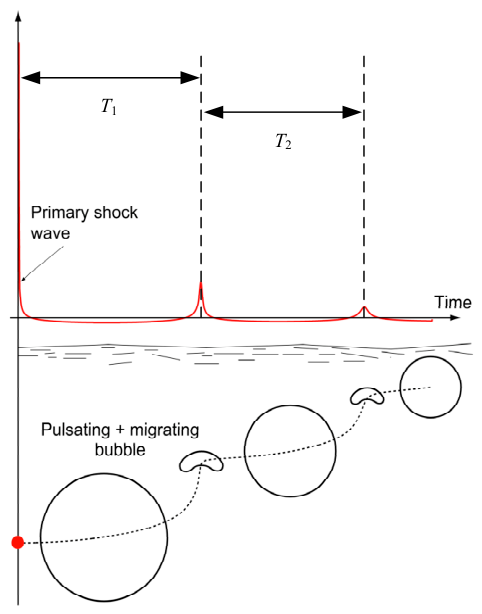
Regarding the signal processing methodology, we identified and manually picked the bubble pulse arrivals directly in the time-domain waveforms. Owing to the high signal-to-noise ratio of the recorded data, the shock wave and the two subsequent bubble pulses could be clearly distinguished without any filtering, as shown in Figure 1. By appropriately designing the experimental configuration—including charge depths and the spatial distances from the receivers to both the sea surface and the seabed—the direct-path shock wave, bubble pulsation signals, and surface- and bottom-reflected arrivals were well separated in arrival time. The acoustic energy from an underwater explosion mainly comes from the shock wave and bubble pulsation [19,20]. Bubble pulsation mainly involves processes such as bubble formation and expansion, contraction, and subsequent collapse, as illustrated in the schematic diagram [18]. This process will be repeated several times, generating a series of bubble pulsation signals separated by distinct time intervals, denoted as T1, T2, T3, etc.
Figure 1.
Schematic diagram of underwater explosion bubble pulsation.
2.1. First Bubble Pulsation
The bubble pulsation following an underwater explosion is typically modeled under the adiabatic assumption, which neglects thermal exchange with the surrounding water. For the first bubble pulsation, the period is extremely short; therefore, heat exchange between the hot gas and the surrounding water can be neglected. The adiabatic model is a classical and widely accepted approach. Consequently, the bubble dynamics can be described by the Rayleigh–Plesset equation.
In the above equation, is the density of seawater, R represents the bubble radius, and and denote the velocity and acceleration of bubble expansion, respectively. is the internal pressure of the bubble, and is the ambient hydrostatic pressure. Based on the law of conservation of energy, the total energy is given by Equation (2).
where is the internal energy of the gas, is the gas volume, and is the specific heat ratio. The term represents the kinetic energy of the surrounding water. Under the initial explosion conditions, the bubble volume is small, and the ambient hydrostatic pressure is significantly lower than the initial bubble internal pressure . Therefore, Equation (2) can be simplified as:
where is the initial gas volume. Consequently, the initial internal pressure can be expressed as follows.
The entire bubble pulsation process is adiabatic. Therefore, according to the adiabatic law,
Here, is the internal pressure when the bubble expands to its maximum size, and is the corresponding gas volume. The maximum internal pressure is similarly expressed by the relation
At this point, , therefore, the kinetic energy is zero. Based on Equation (2), the total energy expression when the bubble radius reaches its maximum can be obtained as
By substituting Equation (6) into (7) and simplifying, we obtain
Since and , this term is negligible. The maximum bubble radius is
is the initial gas radius; during the gas expansion process, the internal pressure is
According to the law of conservation of energy, for any point R during the expansion process, the following relation holds:
When multiplying both sides of the equation by
And rearranging the two sides separately, the left-hand side is
For the right-hand side, if there is a function , and , then according to the chain rule:
Integrating both sides of the equation,
Substituting Equation (10) into the right-hand side of the above equation,
And simplifying the integral on the right-hand side gives
Thus, the bubble expansion velocity is
Since , and the time elapsed as the bubble radius increases from to can be regarded as half of the entire bubble pulsation period, then
At the point of maximum bubble radius , . By substituting this condition into Equation (18), the expression for the far-field hydrostatic pressure results in
Then, substituting Equation (20) into Equation (19) and simplifying yields
In Cole’s work, the bubble pulsation period is given as . While Cole’s derivation primarily relies on the equations of motion and energy conservation, this paper primarily employs the ideal gas law and the Rayleigh–Plesset equation. Despite the different approaches, the results are basically consistent. By incorporating corrections from experimental data, an empirical formula for the first bubble pulsation period is obtained as follows:
where = 2.11 [8], is the TNT equivalent, and is the detonation depth. During the first pulsation cycle, the dynamic ascent velocity of the bubble continuously varies due to factors such as buoyancy and drag. Therefore, this study incorporates an average ascent velocity to model the bubble’s buoyant rise. It can be considered that the average ascent velocity is primarily determined by the buoyancy force and the drag force .
For seawater, the drag coefficient is = 0.44 [21]. When buoyancy and drag are in equilibrium, the average ascent velocity is
In the case of this study, the rise velocity is small compared with the expansion velocity, and the bubble remains nearly spherical.
Therefore, the ascent height of the bubble during its first pulsation period is
2.2. Second Bubble Pulsation
The second pulsation period is defined as the time interval from the end of the first bubble contraction to the end of the second bubble contraction. During this period, driven by the pressure difference between the bubble interior and the surrounding water, the bubble re-expands to its maximum radius and then collapses to its minimum radius. Throughout this process, the bubble ascends due to buoyancy, leading to a reduction in its depth. Assuming the bubble rises by a height during the first pulsation and the energy decays to 1/ of its initial value, the initial depth of the second pulsation is d = h − . Taking into account the energy attenuation, the period of the second bubble pulsation can be expressed as:
In this study, the attenuation factor is defined as the energy efficiency factor, representing the fraction of the total initial explosion energy that remains inside the bubble after the first pulsation cycle and is available to drive the second pulsation. The value of this factor is not an arbitrary mathematical fit but possesses a clear physical basis; it quantifies all the irreversible energy dissipation mechanisms occurring during the first pulsation cycle.
To determine the value of , a rigorous statistical inversion procedure was implemented using the deep-water experimental data acquired in the South China Sea. For each independent test at the same detonation depth, the measured first pulsation period, the second pulsation period, the charge weight, and the depth were substituted into the theoretical relationship of Equation (27) to inversely calculate the energy attenuation factor for that individual event. Subsequently, all the values obtained at the same depth were averaged and taken as the characteristic attenuation factor for that condition. Based on the experimental data obtained in this study, the averaged attenuation factors are 0.3991, 0.3897, 0.3538, and 0.3355 for the depths of 100 m, 300 m, 800 m, and 1000 m, respectively. These results demonstrate that is not a universal constant; rather, it exhibits a monotonically decreasing trend with increasing depth.
Although the fundamental dynamics of a single pulsation cycle are governed by the Rayleigh–Plesset equation and the principle of energy conservation, as described by Cole, the novelty of the present approach lies in its coupled treatment of multi-cycle pulsations. Classical formulations typically treat each pulsation as an independent event occurring at a fixed depth. The present study advances beyond this simplification by simultaneously considering the dynamic evolution of both the bubble radius and its vertical position. The key theoretical developments are as follows: (i) an average ascent velocity is derived (Equation (25)), which yields a depth correction between successive pulsations (Equation (26)); and (ii) an energy attenuation factor is introduced to characterize the significant heat transfer and viscous dissipation that arise from extreme pressure and temperature gradients. In the proposed model, is calibrated against experimental data and can be regarded as a lumped parameter that collectively accounts for these complex non-adiabatic losses, which also constitutes its physical origin.
3. Calculation Results and Experimental Validation
To validate the method for determining the bubble pulsation period proposed in this paper and to investigate the effects of charge mass and detonation depth on acoustic signals, we conducted a long-range underwater acoustic propagation experiment in the South China Sea.
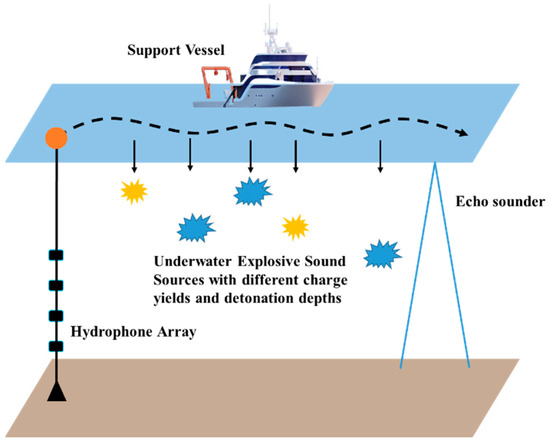
The experiment employed TNT charges of 100 g and 1 kg, detonated at depths of 100, 300, 800, and 1000 m. Acoustic signals were received by a vertical hydrophone array spanning depths from 1000 to 1700 m, with a sampling frequency of 16 kHz. The test site had a total water depth of 1782 m, with the sound channel axis at approximately 1100 m. The experimental arrangement is shown in Figure 2.
Figure 2.
Schematic of the experimental setup.
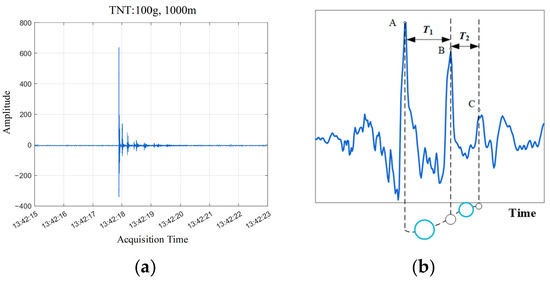
The hydrophone at 1101 m depth was selected for analysis of the data with the optimal signal-to-noise ratio. This hydrophone detected a bubble pulsation signal generated by an underwater explosion of 100 g of TNT, at a depth of 1000 m, with a horizontal range of 35,583 m. The measured acoustic signals are presented in Figure 3, which reveals key features such as the shock wave arrival and subsequent bubble pulses.
Figure 3.
The waveform of the time domain and two bubble pulsations: (a) time-domain waveform; (b) bubble pulsations.
The arrival times corresponding to points A, B and C in the diagram are 0.9329 s, 0.9359 s and 0.9379 s, respectively. The measured time intervals T1 and T2 between pulsations under this condition are 0.0030 s and 0.0020 s, respectively. The corresponding theoretical solutions for T1 and T2 are 0.0031 s and 0.0022 s, respectively. The comparison between the experimental and theoretical results validates the reliability of the attenuation factor. The experimental and theoretical results of other explosion conditions are solved at a horizontal receiving distance of about 35 km. Comparisons between theoretical and experimental values of the first and second bubble pulsation periods in all conditions are presented below.
Table 1 and Table 2 present a comparison between theoretical and experimental values of the first and second bubble pulsation periods for 100 g and 1 kg TNT charges, respectively, at various detonation depths. Overall, the theoretical predictions show good agreement with experimental measurements at all depths except 100 m, confirming the model’s reliability in deeper water. For the 100 m depth, particularly with the 1 kg charge, discrepancies between theoretical and experimental values are more pronounced. This can be attributed to stronger boundary effects in shallow water—such as surface reflections and wave disturbances—as well as more significant energy dissipation and bubble shape deformation during ascent. Although the theoretical model incorporates average ascent velocity and an energy attenuation factor to partly account for these dynamics, it may not fully capture the complexity of shallow-water bubble behavior. In contrast, at depths of 300 m and below, the environment more closely approximates a free field, boundary interference is reduced, and the assumptions of quasi-static ambient pressure and adiabatic expansion become more valid, leading to higher prediction accuracy.
Table 1.
Theoretical and experimental results of the first bubble and second pulsation period with a charge equivalent of 100 g.
Table 2.
Theoretical and experimental results of the first bubble and second pulsation period with a charge equivalent of 1 kg.
To further validate the applicability and robustness of the proposed theoretical formulas at different reception ranges, this study supplemented the experimental data with comparisons at horizontal distances of 9 km and 50 km between the source and receivers. For these two ranges, bubble pulsation signals were collected and analyzed for various combinations of detonation depth and charge mass, and the measured pulsation periods were systematically compared with theoretical predictions. A comparison of theoretical and experimental results at different horizontal ranges is presented in the Table 3, Table 4, Table 5 and Table 6.
Table 3.
Theoretical and experimental results of the first and second bubble pulsation period at a horizontal range of 9 km with a charge equivalent of 100 g.
Table 4.
Theoretical and experimental results of the first and second bubble pulsation period at a horizontal range of 9 km with a charge equivalent of 1 kg.
Table 5.
Theoretical and experimental results of the first and second bubble pulsation period at a horizontal range of 50 km with a charge equivalent of 100 g.
Table 6.
Theoretical and experimental results of the first and second bubble pulsation period at a horizontal range of 50 km with a charge equivalent of 1 kg.
The comparison results show that at both 9 km and 50 km ranges, the theoretically calculated pulsation periods remain in close agreement with the experimental measurements, with deviations comparable to those observed at the 35 km range. This indicates that the theoretical model developed herein effectively captures the temporal structure of bubble pulsation signals even after long-distance propagation, without significant loss of predictive accuracy due to increased range.
Notably, at the 50 km range—a considerable distance—despite the acoustic signals undergoing longer propagation paths with associated medium attenuation and multipath effects, the identified bubble pulsation periods still match the theoretical values well. This is largely attributable to the “focusing effect” and low attenuation characteristics of sound propagation near the deep-sea sound channel axis, which help preserve the timing information of the pulse train. This outcome clearly demonstrates that the proposed theoretical method maintains high accuracy and practical applicability for detection ranges up to at least 50 km, providing a reliable basis for long-range inversion of underwater explosion parameters.
It should also be noted that not all experimental data are as ideal as those presented in the above tables. In addition to the bubble pulse period data for different charge equivalent, depths, and horizontal distances given in the tables, the experimental underwater explosion bubble pulse periods at some of the remaining bubble pulsation periods in the present experiment, together with their errors relative to the theoretical results, are listed below.
Using the experimental first and second bubble pulsation periods given in Table 7, Table 8, Table 9 and Table 10 and the relative error defined as , where and denote the theoretical results and the experimental data, respectively, the error statistics were computed for charges of 100 g and 1 kg at various detonation depths. The mean error , and sample standard deviation are listed in Table 11 and Table 12.
Table 7.
Theoretical results and errors of the first and second bubble pulsation periods at different explosive equivalents with a detonation depth of 100 m.
Table 8.
Theoretical results and errors of the first and second bubble pulsation periods at different explosive equivalents with a detonation depth of 300 m.
Table 9.
Theoretical results and errors of the first and second bubble pulsation periods at different explosive equivalents with a detonation depth of 800 m.
Table 10.
Theoretical results and errors of the first and second bubble pulsation periods at different explosive equivalents with a detonation depth of 1000 m.
Table 11.
Mean and standard deviation of the relative error of bubble pulsation periods at different explosive equivalents with detonation depth of 100 m and 300 m.
Table 12.
Mean and standard deviation of the relative error of bubble pulsation periods at different explosive equivalents with detonation depth of 800 m and 1000 m.
The discrepancies arise from two main sources: (1) experimental uncertainties—including deviations of the actual charge mass from the nominal value, inaccuracies in detonation depth placement (especially critical for 100 g), and the finite precision of sensors and data acquisition systems; and (2) environmental boundary effects—the experiments were conducted in seawater with a total depth of 1782 m and a receiver depth of 1100 m. The theoretical model assumes spherical bubble pulsation in an unbounded fluid, whereas the free surface acts through the image bubble, introducing Bjerknes forces, migration, and shape oscillations that may weakly perturb pulsations.
As shown in Table 11, at 100 m depth the mean relative error of T1 is substantially larger than at deeper depths: for 100 g and 0.120 for 1 kg, which are 2–7 times and 1.5–2 times those at 300 m and below, respectively. This is consistent with free-surface proximity: the upward Bjerknes force causes the bubble to migrate toward the surface, reducing the effective hydrostatic pressure and stiffening, thereby shortening the pulsation period. As the detonation depth increases, the free-surface influence decays rapidly, and the error converges to a smaller, nearly constant bias governed mainly by experimental uncertainties and inherent model approximations. In conclusion, the larger error at 100 m depth stems fundamentally from the free-surface-induced bubble dynamics not captured by the theoretical model.
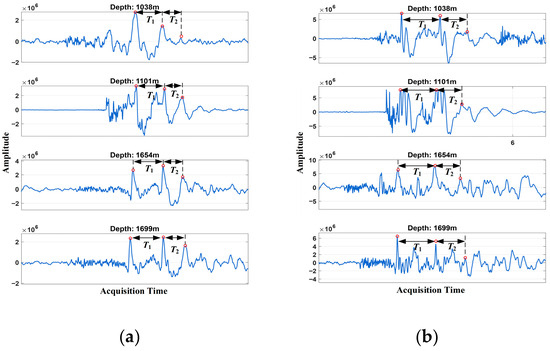
The complex marine hydrological environment and non-flat seabed topography significantly affect underwater acoustic signals through reflection, refraction, and attenuation. Consequently, the selection of the receiving depth is critical for the judgment of the bubble pulsation period. Therefore, to investigate the influence of receiving depth, we analyzed signals from 100 g and 1 kg TNT detonated at a depth of 300 m. The signals were recorded at horizontal distances of 16,675 m and 16,307 m by hydrophones deployed at depths of 1038 m, 1101 m, 1654 m, and 1699 m. The pulsation period results are presented in the following figure.
As shown in Figure 4, in some cases, the amplitude of the shock wave signal received at depths near the seabed is smaller than that of the first bubble, mainly because the shock wave is a broadband signal, and its amplitude is significantly reduced by spherical spreading and attenuation within the seawater medium and seabed during propagation. In contrast, the bubble pulsation is a low-frequency signal, which is less affected by the same medium in the propagation. This phenomenon also facilitates the identification of the bubble pulsation period. A comparison of the first and second bubble pulsation periods under different charge masses and receiving depths is provided in Table 13.
Figure 4.
Bubble pulse waveform: (a) explosion equivalent 100 g; (b) explosion equivalent 1 kg.
Table 13.
Explosion depth of 300 m; bubble pulsation period test results under different explosion equivalents.
A comparison between experimental measurements and theoretical predictions of the first and second bubble pulsation periods at different receiving depths leads to the following conclusions.
For the pulsation signals received at depths of 1038 m and 1011 m, near the acoustic axis, the experimental and theoretical results of the two pulsation periods show excellent agreement, and the pulsation waveforms are distinctly clear. This high signal quality is attributed to the deep-sea sound channel, which focuses acoustic energy and reduces propagation loss. Furthermore, the deep-water environment in this area results in low attenuation, weak boundary effects and high signal-to-noise ratio. These conditions collectively preserve the fundamental information of bubble pulsation.
The signals received at near-seabed depths such as 1654 m and 1699 m will have deviations from the experimental and theoretical predictions. These differences are primarily caused by reflection, refraction, and absorption at the seabed boundary. Although multipath interference will not change the actual arrival times of the bubble pressure pulses, it increases the difficulty of accurately identifying the bubble pulsation periods.
To clarify the physical mechanism by which near-seabed reception complicates the identification of bubble pulsation arrival times, we model the superposition of the direct arrival and the dominant bottom reflection. Let the emitted pulse waveform be with an envelope duration of . At a hydrophone placed close to the seafloor, the received pressure is the sum of the direct and bottom-reflected signals:
Here, is the travel time along the direct ray; is the additional delay of the bottom-reflected path; and and are the amplitudes incorporating spreading loss and bottom reflectivity. When , the two replicas overlap strongly. The envelope of the combined signal is
with denoting the pulse envelope. This superposition distorts the envelope in two critical ways: (i) the shock wave peak becomes indistinct and the rising-edge slope decreases; and (ii) the envelope peak shifts and multiple local maxima may appear. Consequently, for arrival-time extraction methods based on threshold triggering or peak picking, deviations exist in both the recorded peak time and the true arrival time. This mechanism directly explains the excellent experimental–theoretical agreement for signals acquired near the deep sound-channel axis (where multipath is weak) and the systematic deviations observed for near-seabed recordings, where the bottom-interference is small enough to corrupt the pulse envelope.
Therefore, to obtain the ideal experimental results of the bubble pulsation period, hydrophones should be preferentially positioned at the depth of the sound channel axis, and avoid receiving signals near the surface and the seabed.
4. Discussion
The theoretical model established in this study provides a robust framework for inverting explosion source parameters—namely, charge weight and detonation depth—based on measured bubble pulsation periods. A key insight lies in the distinct sensitivity of the first and second pulsation periods to these parameters. As derived from Equation (22), the first pulsation period T1 exhibits a strong dependence on depth and a weaker dependence on charge weight. In contrast, the ratio T2/T1 is primarily governed by the bubble’s buoyant ascent during the first cycle, which introduces a depth correction h1 that scales as ω1/2 (Equation (26)). This ascent alters the ambient pressure for the second pulsation, making the ratio sensitive to charge weight while partially canceling the direct depth dependence. Consequently, T1 serves as a reliable indicator of depth when the charge weight is known, whereas T2/T1 acts as a sensitive indicator for charge weight, especially in shallow-water or high-yield scenarios where h1 becomes non-negligible.
This differential sensitivity enables a three-step inversion strategy:
Case I: Known charge weight, unknown depth. Depth can be uniquely determined from T1 using Equation (22).
Case II: Known depth, unknown charge weight. An estimate of charge weight can be obtained from T1, then refined using T2/T1 via Equation (27).
Case III: Both parameters unknown. The system of equations formed by T1 and T2/T1 can be solved numerically within physically feasible ranges.
The feasibility of such inversion is strongly supported by the experimental data presented in Table 1, Table 2, Table 3, Table 4, Table 5 and Table 6, where the model predictions closely match measured periods across a wide range of depths (100–1000 m), charge weights (100 g and 1 kg), and reception ranges (up to 50 km). The preservation of pulse timing information, even after long-range propagation near the deep-sea sound channel axis, further enhances the practical applicability of this method for remote source characterization.
The results of this study demonstrate that the proposed theoretical model effectively integrates bubble pulsation dynamics with buoyancy-driven ascent, offering a refined prediction of the first and second pulsation periods across various charge weights and detonation depths. The close agreement between theoretical and experimental values, particularly for small-charge, deep-water explosions near the sound channel axis, validates the model’s reliability under real oceanic conditions. The notably larger deviations at 100 m depth arise primarily from free surfaces: the upward Bjerknes migration lowers the effective hydrostatic pressure and shortens the pulsation period. This surface effect decays rapidly as depth increases, leaving the residual error to be dominated by experimental uncertainties such as charge mass and depth.
Compared with prior works, this research advances beyond traditional fixed-boundary laboratory simulations and limited-parameter field tests by explicitly coupling bubble motion with time-varying ambient pressure and energy attenuation. While Cole’s classical formulation provides a foundational period–depth relationship, our model introduces an energy attenuation factor that is determined from the experimental data by a statistical inversion. The resulting values decrease systematically with depth—from 0.3991 at 100 m to 0.3355 at 1000 m—thus acting as a lumped parameter for depth-dependent non-adiabatic losses and improving second-pulsation accuracy. Furthermore, unlike studies focusing solely on pulsation in static environments, our approach accounts for the bubble’s ascent during pulsation—a critical factor in shallow-water or high-yield scenarios. Notably, to examine the robustness of the theoretical formula across different propagation distances, this study supplemented the experimental comparison with data at horizontal ranges of 9 km and 50 km. The results indicate that even under the long-range condition of 50 km, the theoretical predictions agree well with the experimental data, demonstrating the method’s good applicability for far-field detection. This is primarily because of the low attenuation and high signal fidelity of acoustic propagation near the deep-sea sound channel axis.
The study also highlights the significance of receiver depth for signal fidelity. Signals received near the sound channel axis exhibit minimal distortion due to low propagation loss and reduced boundary interference, whereas reception near the seabed introduces multipath effects that complicate period identification. When the bottom-reflection delay is comparable to the bubble pulse envelope, the superposition of the direct and reflected arrivals distorts the shock wave envelope, suppresses the peak, and shifts the apparent arrival time, thereby causing systematic timing deviations. This insight underscores the importance of hydrophone placement in future experimental designs.
In a broader context, this work enhances the predictive capability for underwater explosion bubble behavior, with implications for naval engineering, underwater demolition, and acoustic detection. Future research could extend the model to more complex scenarios, such as multi-bubble interactions, varied oceanographic conditions, or near-boundary explosions.
5. Conclusions
In this paper, we address the key limitations of existing research on underwater explosion bubble dynamics, notably the incomplete treatment of the coupling between bubble pulsation and buoyancy-driven ascent, and the restricted parameter ranges of offshore tests.
To overcome these challenges, we propose a method that combines bubble pulsation, buoyancy-driven rise, varying ambient pressure and pulsation energy attenuation, which has been rigorously validated by a multi-scenario underwater explosion test in the South China Sea. The main conclusions are as follows.
The energy attenuation factor was obtained through a statistical inversion of the experimental data and exhibits a monotonic decrease with depth, including the depth-dependent non-adiabatic losses. Incorporating into the theoretical framework yields accurate formulas for the first and second pulsation periods. The validity and applicability of this method are confirmed through the underwater explosion tests in the South China Sea, which incorporated multiple depths and charge equivalents. The analysis reveals the significant impact of receiver depth on both pulsation periods. The deep-sea sound channel establishes a unique acoustic environment near the sound channel axis, which is characterized by low propagation loss, minimal boundary interference, and a high signal-to-noise ratio, and it preserves the original time-domain structure of the bubble pulsation. However, signals received near the seabed are strongly degraded by bottom reflections. When the bottom-reflection delay lies within the bubble pulse envelope, the direct and reflected arrivals overlap. This superposition distorts the envelope and shifts the apparent arrival time, complicating the identification of the pulsation period.
In summary, the theoretical model established in this study can effectively predict bubble pulsation periods under various water depths and charge weights. Its accuracy and reliability in deep-water environments and for long-range detection have been validated through multi-scenario experiments. The research also indicates that shallow-water explosions are strongly influenced by the free surface, which induces bubble migration and affects the first pulsation period, while near-boundary reception, especially at the seabed, causes envelope distortion via multipath superposition. Future models could be extended by incorporating boundary-coupling mechanisms to broaden their applicability.
Furthermore, the distinct sensitivities of T1 and T2/T1 to depth and charge weight enable a practical inversion framework: when one parameter is known, the other can be uniquely determined; when both are unknown, the system of equations formed by T1 and T2/T1 yields solution within physically feasible ranges. This provides a valuable tool for estimating explosion source parameters from passively recorded acoustic signals.
Author Contributions
Conceptualization, F.Y., Y.L. and X.P.; methodology, F.Y. and Y.L.; validation, F.Y.; formal analysis, F.Y. and X.P.; investigation, F.Y., Y.L. and X.P.; data curation, F.Y. and Y.L.; writing—original draft preparation, F.Y. and X.P.; writing—review and editing, F.Y., H.Y., Y.L., X.L. and X.P.; visualization, F.Y.; supervision, Y.L. and X.P. All authors have read and agreed to the published version of the manuscript.
Funding
This research received no external funding.
Institutional Review Board Statement
Not applicable.
Informed Consent Statement
Not applicable.
Data Availability Statement
The original contributions presented in this study are included in the article. Further inquiries can be directed to the corresponding authors.
Dual Use Research Statement
The current research is limited to basic fluid dynamics and underwater explosion physics, which helps to enhance the scientific understanding of bubble pulsation phenomena and supports civilian applications such as ocean engineering, underwater acoustic detection, and offshore structural safety assessment, without posing a threat to public health or national security. The author recognizes the dual potential of studying the dynamics of underwater explosion bubbles and confirms that all necessary precautions have been taken to prevent potential misuse. As an ethical responsibility, the author strictly adheres to national and international laws related to DURC. The author advocates for responsible deployment, ethical considerations, regulatory compliance, and transparent reporting to reduce the risk of abuse and promote beneficial outcomes.
Conflicts of Interest
The authors declare no conflicts of interest.
References
- Xiao, C.; Song, P.; Liang, A. Research Development of Underwater Explosion Mechanism. Chin. J. Explos. Propellants 2006, 29, 19–22. [Google Scholar]
- Li, G.; Shi, D.; Wang, L.; Zhao, K. Measurement technology of underwater explosion load: A review. Ocean Eng. 2022, 254, 111383. [Google Scholar] [CrossRef] [Scilit]
- Zhang, Y. Study of Acoustic Pulse Propagation in the Deep Water. Master’s Thesis, University of Chinese Academy of Sciences, Beijing, China, 25 May 2017. [Google Scholar]
- Salomons, E.; Tuitman, J.; Benda-Beckmann, A.; Dourado, G. Numerical study of sound of underwater explosions in deep water and shallow water. J. Acoust. Soc. Am. 2025, 158, 135–153. [Google Scholar] [CrossRef] [Scilit] [PubMed]
- Ma, K.; Chu, Z.; Wang, K.; Li, Z.; Zhou, G. Simulation Experiment of Bubble Pulsation for Small-Equivalent Explosive Charges in Deep Water. Explos. Shock Waves 2015, 35, 6. [Google Scholar]
- Rong, J.; Zhao, Z.; Feng, Z.; Wei, H.; Pan, H.; Xu, H.; Xin, P. Experimental Study of Underwater Explosion Performance of RDX-based Aluminized Explosive. Acta Armamentarii 2019, 40, 2177–2183. [Google Scholar]
- Hu, H.; Li, D.; Zheng, J.; Duan, C.; Zhang, Z. Experimental and numerical study on bubble pulsation characteristics of underwater explosions with multiple charges. Phys. Fluids 2024, 36, 13. [Google Scholar] [CrossRef] [Scilit]
- Cole, R.H. Underwater Explosions; Princeton University Press: Princeton, NJ, USA, 1948. [Google Scholar]
- Zhang, S.; Zhou, H.; Quan, L.; Jin, H. Experimental Study for Bubble Impulsion in Underwater Explosion. Blasting 2014, 31, 106–109. [Google Scholar]
- Zhang, Y.; Li, Z.; Gan, W.; Li, W. Study of acoustic pulse propagation in deep water. In Proceedings of the 2016 National Conference on Acoustics, Wuhan, China, 28 October 2016. [Google Scholar]
- Shahid, U.; Munir, M.R.; Shah, S.J. Numerical investigation of pulsating bubble dynamics in shallow and deep-sea underwater explosions. J. Ocean Eng. Mar. Energy 2025, 11, 307–326. [Google Scholar] [CrossRef] [Scilit]
- Bagocius, D.; Narscius, A. Underwater noise level predictions of ammunition explosions in the shallow area of Lithuanian Baltic Sea. Environ. Pollut. 2019, 252, 1311–1317. [Google Scholar] [CrossRef] [Scilit] [PubMed]
- Tatlısuluoğlu, A.; Beji, S. Blast pressure measurements of an underwater detonation in the sea. J. Mar. Sci. Appl. 2021, 20, 706–713. [Google Scholar] [CrossRef] [Scilit]
- Hu, H.W.; Song, P.; Guo, S.F.; Feng, H.Y.; Li, D.k. Shock wave and bubble characteristics of underwater array explosion of charges. Def. Technol. 2022, 18, 1445–1453. [Google Scholar] [CrossRef] [Scilit]
- Nguyen, A.T. The Application of CEL Technique to Simulate the Behavior of an Underwater Explosion Bubble in the Vicinity of a Rigid Wall. Appl. Mech. Mater. 2020, 4796, 126–139. [Google Scholar] [CrossRef] [Scilit]
- Zhang, Z.F.; Wang, C.; Zhang, A.M.; Silberschmidt, V.V.; Wang, L.K. SPH-BEM simulation of underwater explosion and bubble dynamics near rigid wall. Sci. China Technol. Sci. 2019, 62, 1082–1093. [Google Scholar] [CrossRef] [Scilit]
- Hsu, C.Y.; Liang, C.C.; Nguyen, A.T.; Teng, T.L. A numerical study on the underwater explosion bubble pulsation and the collapse process. Ocean Eng. 2014, 81, 29–38. [Google Scholar] [CrossRef] [Scilit]
- Barras, G.; Souli, M.; Aquelet, N.; Couty, N. Numerical simulation of underwater explosions using an ALE method. The pulsating bubble phenomena. Ocean Eng. 2012, 41, 53–66. [Google Scholar] [CrossRef] [Scilit]
- Liang, H.; Zhang, Q.; Long, R.; Ren, S. Pulsation behavior of a bubble generated by a deep underwater explosion. AIP Adv. 2019, 9, 025108. [Google Scholar] [CrossRef] [Scilit]
- Zhang, A.M.; Wang, S.P.; Huang, C.; Wang, B. Influences of initial and boundary conditions on underwater explosion bubble dynamics. Eur. J. Mech. B Fluids 2013, 42, 69–91. [Google Scholar] [CrossRef] [Scilit]
- Zhang, Z.; Jin, L.; Yuan, Z.; He, S. The rising bubble motion characteristics in consideration of seawater salinity. Sci. Technol. Eng. 2017, 17, 334–338. [Google Scholar]




Disclaimer/Publisher’s Note: The statements, opinions and data contained in all publications are solely those of the individual author(s) and contributor(s) and not of MDPI and/or the editor(s). MDPI and/or the editor(s) disclaim responsibility for any injury to people or property resulting from any ideas, methods, instructions or products referred to in the content. |
© 2026 by the authors. Licensee MDPI, Basel, Switzerland. This article is an open access article distributed under the terms and conditions of the Creative Commons Attribution (CC BY) license.