


Abstract
Background: Crohn’s disease (CD) is a multifactorial inflammatory bowel disease (IBD) arising from interactions among genetic susceptibility, immune dysregulation, intestinal microbiota, and environmental factors. However, genetic and environmental determinants of IBD in Djibouti remain poorly characterized. Objectives: This study aimed to characterize the demographic and clinical profile of IBD and investigate the distribution and association of major (Caspase Recruitment Domain-Containing Protein 15/Nucleotide-Binding Oligomerization Domain-Containing Protein 2) CARD15/NOD2 variants with CD in a Djiboutian population. Methods: A total of 150 participants aged 18–30 years were enrolled, including 50 CD patients, 50 ulcerative colitis (UC) patients, and 50 healthy controls. Demographic, clinical, familial, lifestyle, and environmental characteristics were recorded. Genomic DNA isolated from intestinal mucosal biopsies was analyzed by PCR followed by Sanger sequencing for R702W, G908R, and 1007fs variants. Carrier and allele frequencies were assessed using odds ratios (ORs), 95% confidence intervals (CIs), and categorical statistical tests. Results: CD patients showed higher carrier frequencies of R702W (24.0%), G908R (16.0%), and 1007fs (20.0%) than controls (10.0%, 6.0%, and 8.0%, respectively). Allele-level analysis indicated increased odds for R702W (OR = 2.55), G908R (OR = 2.67), and 1007fs (OR = 2.59), although associations were not statistically significant. Abdominal pain and chronic diarrhoea predominated clinically, with greater weight loss in CD and rectal bleeding in UC. Notably, all CD participants reported a history of khat consumption before disease onset; however, the absence of an appropriate non-exposed comparison group and quantitative exposure assessment precludes inference regarding its association with CD risk. Conclusions: These findings suggest potential genetic susceptibility to CD and identify khat consumption as a hypothesis-generating environmental factor requiring further investigation.
1. Introduction
Inflammatory bowel diseases (IBD), principally comprising Crohn’s disease (CD) and ulcerative colitis (UC), are chronic, relapsing, and multifactorial disorders characterized by persistent inflammation of the gastrointestinal [1,2]. Although their precise etiology remains incompletely understood, IBD is widely considered to arise from a complex interplay among genetic susceptibility, dysregulated intestinal immune responses, gut microbiota, and environmental factors [3,4]. In genetically susceptible individuals, inappropriate or sustained immune responses to intestinal microbial components may disrupt mucosal homeostasis and contribute to the initiation and progression of intestinal inflammation [5,6].
The genetic contribution to IBD has been extensively investigated, and numerous susceptibility loci have been identified through genome-wide association and candidate-gene studies. Among these, (Caspase Recruitment Domain-Containing Protein 15/Nucleotide-Binding Oligomerization Domain-Containing Protein 2) CARD15/NOD2 is one of the most extensively characterized genetic determinants of susceptibility to CD [7,8]. The NOD2 protein is an intracellular pattern-recognition receptor that recognizes bacterial muramyl dipeptide and contributes to innate immune signalling and maintenance of intestinal homeostasis [9,10].
Alterations in NOD2-mediated microbial sensing may influence interactions between intestinal microorganisms and the host immune system, potentially affecting epithelial barrier integrity, microbial homeostasis, and inflammatory signalling. Thus, genetic variation within CARD15/NOD2 represents an important mechanism through which host susceptibility may influence CD development [11,12].
Three major NOD2 (formerly CARD15) variants, R702W (p.Arg702Trp), G908R (p.Gly908Arg), and 1007fs (3020insC; p.Leu1007fs), have been extensively investigated in relation to CD susceptibility. These variants may alter NOD2 function and consequently affect host responses to intestinal microorganisms [13]. However, the frequency and clinical relevance of these variants differ considerably among populations. Such population-specific variation highlights the importance of investigating established susceptibility variants within geographically and genetically distinct populations rather than extrapolating findings from well-studied populations to understudied regions [14,15].
Djibouti represents an important but relatively underexplored population in this context. Information regarding the epidemiological, clinical, and genetic characteristics of IBD in Djiboutian patients remains limited. Characterizing the demographic and clinical features of CD and UC alongside the distribution of CARD15/NOD2 variants may therefore provide useful insight into the potential contribution of host genetic susceptibility to IBD in this population. In addition, assessment of lifestyle and environmental characteristics may help identify exposures that warrant further investigation as potential modifiers of disease risk.
Another aspect emerging from the present investigation is khat consumption among the CD participants before disease onset. Khat is an environmental exposure of particular interest in the Djiboutian setting, and its potential relationship with intestinal inflammatory disorders has not been adequately characterized within the study population [16]. Because IBD is multifactorial, environmental exposures may potentially interact with genetic susceptibility and intestinal microbial or immune pathways [17]. Nevertheless, a history of exposure preceding disease onset alone cannot establish causality and should be considered a hypothesis-generating observation requiring confirmation through appropriately designed epidemiological studies.
The novelty of the present study lies in its integrated assessment of demographic, clinical, lifestyle, environmental, and CARD15/NOD2 genetic characteristics of IBD in a young Djiboutian population, for which population-specific genetic and epidemiological data remain limited. In particular, the study evaluates the distribution of the three established CARD15/NOD2 variants R702W, G908R, and 1007fs in CD, UC, and healthy controls. Although the observed enrichment of these variants among CD patients did not reach statistical significance, the consistent direction of the observed odds ratios provides preliminary population-specific evidence that warrants validation in larger cohorts. The study therefore provides an initial genetic and epidemiological framework for future investigations of CARD15/NOD2 variation, disease phenotype, and environmental exposures in Djibouti.
Accordingly, the present study aimed to characterize the demographic and clinical profile of IBD in Djibouti and investigate the distribution and potential association of major CARD15/NOD2 variants with CD. Specifically, the study evaluated R702W, G908R, and 1007fs using PCR and Sanger sequencing and compared their genotype, carrier, and allele distributions among CD, UC, and control participants. In addition, the study assessed demographic, familial, lifestyle, and environmental characteristics to provide broader epidemiological context for disease presentation. By integrating these molecular and clinical approaches, the study seeks to contribute to the understanding of genetic susceptibility and potential environmental influences on IBD in the Djiboutian population, while identifying observations that can be evaluated in future adequately powered studies.
2. Results
2.1. Demographic and Epidemiological Characteristics
The study included 150 participants, comprising 50 healthy controls, 50 patients with CD, and 50 patients with UC. Demographic characteristics included age, sex, region of residence, urban/rural residence, and family history of IBD.
Most participants were aged 21–25 years (42.0%), and females represented 54.0% of the total study population. Most participants resided in Djibouti city (66.7%) and in urban areas (78.7%). A family history of IBD was reported in 9.3% of participants. Table 1 presents the demographic and epidemiological characteristics of the study population.
Table 1.
Demographic and epidemiological characteristics of the study population. Data are presented as n (%). The study population comprised 50 healthy controls, 50 patients with Crohn’s disease (CD), and 50 patients with ulcerative colitis (UC), for a total of 150 participants. IBD, inflammatory bowel disease; CD, Crohn’s disease; UC, ulcerative colitis.
2.2. Clinical Characteristics of IBD Patients
Among the 100 patients with IBD, 50 had CD, and 50 had UC. The clinical characteristics included age at diagnosis, disease duration, major symptoms, disease severity, complications, previous hospitalisation, and IBD-related surgery. Abdominal pain and chronic diarrhoea were among the most frequently reported symptoms, while rectal bleeding was more frequent among patients with UC, and weight loss was more frequent among patients with CD. Disease severity was categorized as mild, moderate, or severe, and complications such as fistula, stricture/stenosis, abscess, and intestinal obstruction were documented. Table 2 presents the detailed clinical characteristics of patients with CD and UC.
Table 2.
Clinical characteristics of patients with inflammatory bowel disease. Data are presented as frequency and percentage [n (%)]. The table provides a descriptive summary of age at diagnosis, disease duration, major clinical symptoms, disease severity, complications, previous hospitalization, and IBD-related surgery among patients with CD and UC.
2.3. Treatment, Familial, Lifestyle, and Environmental Characteristics of IBD Patients
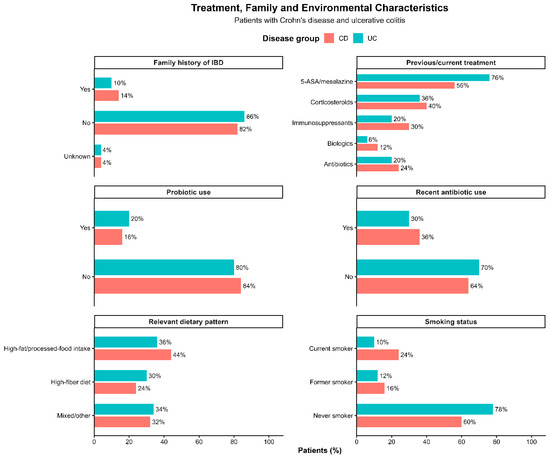
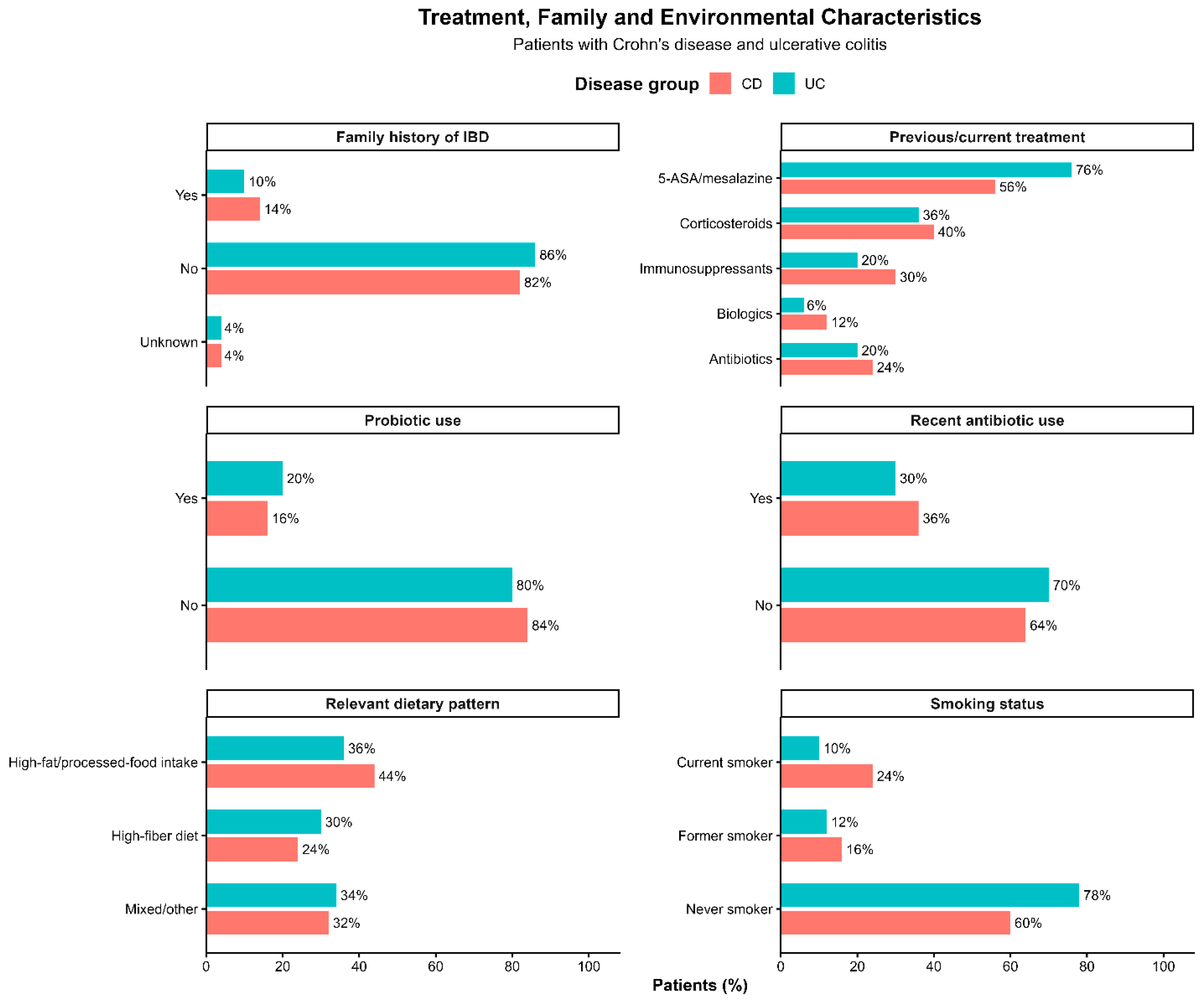
Among the 100 patients with IBD, familial, treatment-related, and lifestyle characteristics differed descriptively between patients with CD and UC (Figure 1). A family history of IBD was reported in 14.0% of CD patients and 10.0% of UC patients, while most patients reported no family history (82.0% and 86.0%, respectively).
Figure 1.
Treatment, familial, lifestyle, and environmental characteristics of patients with Crohn’s disease and ulcerative colitis. The figure presents the percentage distribution of family history of IBD, previous/current treatment, recent antibiotic use, probiotic use, smoking status, and dietary patterns among patients with CD (n = 50) and UC (n = 50). Data are presented as percentages [n (%)]. Treatment categories were not mutually exclusive because patients could have received more than one treatment, whereas family history, smoking status, and dietary pattern categories were treated as mutually exclusive within their respective variables.
Regarding previous or current treatment, 5-ASA/mesalazine was the most frequently reported therapy, particularly among UC patients (76.0%) compared with CD patients (56.0%). Corticosteroid use was reported in 40.0% of CD and 36.0% of UC patients, whereas immunosuppressant use was higher among CD patients (30.0%) than UC patients (20.0%). Biologic therapy was reported in 12.0% of CD and 6.0% of UC patients. Antibiotic treatment was reported in 24.0% of CD and 20.0% of UC patients.
Recent antibiotic use was reported by 36.0% of CD patients and 30.0% of UC patients, while probiotic use was reported by 16.0% and 20.0%, respectively. Concerning smoking, current smoking was more frequently reported among CD patients (24.0%) than UC patients (10.0%), whereas never-smoking was reported by 60.0% of CD and 78.0% of UC patients.
Dietary patterns also differed between the two disease groups. High-fat/processed-food intake was reported by 44.0% of CD and 36.0% of UC patients, while a high-fibre diet was reported by 24.0% and 30.0%, respectively. Mixed or other dietary patterns were reported in 32.0% of CD and 34.0% of UC patients.
2.4. CARD15/NOD2 Genotype and Allele Distribution
Sanger sequencing identified three CARD15/NOD2 variants, R702W, G908R, and 1007fs, in the study population. Table 3A presents the genotype and allele distributions across the CD, UC, and control groups. The wild-type genotype was predominant for all three variants across the study groups.
Table 3.
(A). Genotype and allele distribution of CARD15/NOD2 variants among Crohn’s disease, ulcerative colitis, and control groups. Values are presented as n (%). Percentages for genotype categories are calculated using the total number of individuals in each group (n = 50), whereas allele frequencies are calculated from 100 alleles per group. † Variant carriers include individuals who were heterozygous or homozygous for the respective CARD15/NOD2 variant. (B). Association of CARD15/NOD2 variants with Crohn’s disease and ulcerative colitis. OR, odds ratio; CI, confidence interval; WT, wild type. For carrier-level comparisons, variant carriers were defined as heterozygous + homozygous individuals and were compared with wild-type individuals using 2 × 2 contingency tables. We calculated p-values for carrier comparisons using two-sided Fisher’s exact test, which is appropriate for comparisons with small expected cell counts. For allele-level comparisons, we compared variant and reference allele counts using Pearson’s chi-square test without continuity correction, consistent with the p-values provided. ORs were calculated from the corresponding 2 × 2 tables, and 95% CIs were estimated using the log-odds-ratio (Wald/Woolf) method. Statistical significance was considered at p < 0.05.
For R702W, the wild-type genotype was observed in 76.0% of CD patients, 86.0% of UC patients, and 90.0% of controls. Heterozygous genotypes were present in 20.0%, 12.0%, and 8.0%, respectively, whereas homozygous genotypes occurred in 4.0%, 2.0%, and 2.0%. Accordingly, the proportion of R702W variant carriers was higher in CD (24.0%) than in UC (14.0%) and controls (10.0%). The corresponding variant allele frequencies were 14.0%, 8.0%, and 6.0%, respectively.
For G908R, the wild-type genotype frequencies were 84.0% in CD, 90.0% in UC, and 94.0% in controls. Heterozygous genotypes were observed in 12.0%, 8.0%, and 4.0%, respectively, while homozygous genotypes occurred in 4.0%, 2.0%, and 2.0%. Consequently, the frequency of G908R variant carriers was higher in CD (16.0%) than in UC (10.0%) and controls (6.0%). The variant allele frequencies were 10.0%, 6.0%, and 4.0%, respectively.
A comparable distribution was observed for 1007fs, with wild-type genotypes occurring in 80.0% of CD, 88.0% of UC, and 92.0% of control participants. Heterozygous genotypes were detected in 16.0%, 10.0%, and 6.0%, respectively, and homozygous genotypes in 4.0%, 2.0%, and 2.0%. Variant carrier frequencies were 20.0% in CD, 12.0% in UC, and 8.0% in controls, while the corresponding variant allele frequencies were 12.0%, 7.0%, and 5.0%.
Variant carrier and allele frequencies were consistently higher in CD than in UC and control groups for all three CARD15/NOD2 variants. The greatest difference between CD and controls was observed for R702W, followed by 1007fs and G908R. However, we further evaluated these descriptive differences using comparative association analysis with odds ratios (ORs), 95% confidence intervals (CIs), and p-values (Table 3B).
In the CD versus control comparison, carrier-level analysis yielded ORs of 2.84 for R702W, 2.98 for G908R, and 2.88 for 1007fs. Despite the elevated ORs, none of these associations reached statistical significance (p = 0.108, 0.200, and 0.148, respectively). Similarly, at the allele level, the variant alleles showed higher odds in CD than in controls, with ORs of 2.55 for R702W, 2.67 for G908R, and 2.59 for 1007fs; however, the corresponding associations were not statistically significant (p = 0.059, 0.096, and 0.076, respectively). Among these comparisons, R702W showed the strongest evidence of association, with an allele-level OR of 2.55 (95% CI: 0.94–6.93; p = 0.059), although this did not meet the predefined significance threshold of p < 0.05.
Comparisons between CD and UC, and between UC and controls, similarly did not show statistically significant associations for any of the three variants. Thus, although the present data demonstrate a consistent enrichment of CARD15/NOD2 variant carriers and variant alleles among CD patients, particularly relative to healthy controls, the observed differences do not provide statistically significant evidence of association in this study population. The relatively small sample size and low frequency of variant alleles may have limited the statistical power to detect associations.
Importantly, ORs greater than 1 should be interpreted as indicating increased odds rather than evidence of a statistically confirmed association. The corresponding 95% CIs encompassed 1.0 for all comparisons, consistent with the non-significant p-values. These findings therefore suggest a possible trend toward increased CARD15/NOD2 variant frequency in CD that warrants evaluation in larger, adequately powered cohorts.
2.5. Association of CARD15/NOD2 Variants with Clinical Characteristics
The association between the three CARD15/NOD2 variants (R702W, G908R, and 1007fs) and the clinical characteristics of Crohn’s disease patients was further evaluated. Variant-carrier status was compared according to disease severity, weight loss, disease-related complications, hospitalization, and history of IBD-related surgery. Overall, we found no statistically significant association between individual CARD15/NOD2 variants and the evaluated clinical characteristics. However, variant carrier distributions differed numerically across clinical subgroups, suggesting these variants may contribute to inter-individual variation in disease presentation. The absence of statistically significant associations should be interpreted cautiously because each clinical subgroup had relatively few variant carriers.
2.6. Population-Based Comparison of CARD15/NOD2 Variant Frequencies
We observed marked population-specific differences when we compared the CARD15/NOD2 allele frequencies identified in the present study with those reported in other populations. In the present Djiboutian CD cohort, the variant allele frequencies of R702W, G908R, and 1007fs were 14.0%, 10.0%, and 12.0%, respectively. These frequencies appear higher than those reported in several European cohorts, including Spanish and Scottish CD populations, although substantial heterogeneity has been documented across Europe. In African American cohorts, the three classical CARD15/NOD2 variants have generally been reported at lower frequencies than in populations of European ancestry, with variation partly attributable to European admixture. In contrast, studies from India and Malaysia have reported an absence of the three classical variants among CD patients. Collectively, these findings emphasize the considerable ethnic and geographic heterogeneity of CARD15/NOD2 variation and support the need for population-specific genetic characterization of Crohn’s disease rather than direct extrapolation from predominantly European cohorts Table 4.
Table 4.
Comparison of CARD15/NOD2 variant allele frequencies in Crohn’s disease patients across selected populations.
3. Discussion
The present study provides a combined epidemiological, clinical, and molecular characterization of IBD in a Djiboutian population, with particular emphasis on CD and CARD15/NOD2 genetic variation. The study included 150 participants, comprising 50 patients with CD, 50 patients with UC, and 50 healthy controls. The investigation focused on three established CARD15/NOD2 variants, R702W, G908R, and 1007fs and evaluated their distribution in relation to disease status. The study population was predominantly young, with the largest proportion of participants belonging to the 21–25-year age group (42.0%). Females represented 54.0% of the overall population. Most participants were residents of Djibouti City (66.7%) and urban areas (78.7%). A family history of IBD was reported in 9.3% of participants, including 14.0% of CD patients and 10.0% of UC patients.
From a population-specific perspective, the present study is important because genetic susceptibility to CD may vary substantially across ancestral and geographic populations. The identification and characterization of established CARD15/NOD2 variants in Djiboutian patients therefore provide baseline information for future genetic epidemiological studies. Although the present sample does not provide statistically conclusive evidence of association, the consistent enrichment of all three investigated variants among CD patients suggests a direction that should be evaluated in larger and adequately powered Djiboutian cohorts.
The clinical profile demonstrated overlapping but distinguishable manifestations of CD and UC. Chronic diarrhoea and abdominal pain were common in both groups, occurring in 84.0% and 80.0% of CD patients and 76.0% and 82.0% of UC patients, respectively. Rectal bleeding was substantially more frequent among UC patients (86.0%) than CD patients (50.0%), whereas weight loss was more frequent in CD (70.0%) than UC (40.0%). This pattern is compatible with the different clinical manifestations of the two IBD phenotypes and supports the clinical classification of participants [23].
Disease severity was predominantly moderate in both groups, affecting 44.0% of CD and 40.0% of UC patients. Severe disease was observed in 26.0% of CD and 24.0% of UC patients. Complications were more prominent among CD patients, particularly stricture/stenosis, fistula, abscess, and intestinal obstruction. IBD-related surgery was also more frequent in CD (24.0%) than UC (12.0%). These findings suggest a substantial clinical burden among the affected participants and are consistent with the more structurally complicated disease phenotype commonly encountered in CD [24].
A family history of IBD was reported in 14.0% of CD patients and 10.0% of UC patients. Although this difference was descriptive, the observation is compatible with the established contribution of familial and genetic susceptibility to IBD. Treatment patterns also differed between disease groups, with 5-ASA/mesalamine use being more frequent among UC patients, whereas immunosuppressant and biologic use was somewhat more frequent among CD patients [25].
Lifestyle characteristics showed several notable differences. Current smoking was reported by 24.0% of CD patients compared with 10.0% of UC patients, while high-fat/processed-food intake was reported by 44.0% of CD and 36.0% of UC patients. These findings are potentially relevant because environmental and lifestyle factors may interact with host genetic susceptibility and intestinal microbial composition [26]. However, the present study was descriptive and did not perform inferential analysis of these factors.
Sanger sequencing identified R702W, G908R, and 1007fs in the study population. Wild-type genotypes predominated across CD, UC, and control groups, but variant carrier frequency was consistently higher in CD. R702W carrier frequency was 24.0% in CD compared with 14.0% in UC and 10.0% in controls. Similarly, G908R carriers accounted for 16.0% of CD, 10.0% of UC, and 6.0% of controls, while 1007fs carriers represented 20.0%, 12.0%, and 8.0%, respectively.
The allele-level findings showed the same direction of effect. R702W, G908R, and 1007fs allele frequencies were 14.0%, 10.0%, and 12.0%, respectively, in CD, compared with 6.0%, 4.0%, and 5.0% in controls. Thus, all three variants demonstrated a consistent pattern of higher frequency among CD patients.
Despite the consistent enrichment of variants in CD, none of the carrier-level comparisons reached statistical significance. Compared with controls, the ORs for variant carriers were 2.84 for R702W, 2.98 for G908R, and 2.88 for 1007fs, with corresponding p-values of 0.108, 0.200, and 0.148. At the allele level, the ORs were 2.55, 2.67, and 2.59, with p-values of 0.059, 0.096, and 0.076, respectively.
The results therefore indicate directionally increased odds but insufficient statistical evidence to confirm an association in this sample. The R702W allele showed the strongest evidence, with an OR of 2.55 (95% CI: 0.94–6.93; p = 0.059). Nevertheless, the confidence interval included 1.0 and the p-value exceeded the predefined significance threshold. The lack of statistical significance may partly reflect the relatively small sample size and the low number of variant alleles, which reduce statistical power and produce wider confidence intervals.
The present study also examined whether the three common CARD15/NOD2 variants were associated with clinical characteristics among patients with Crohn’s disease. Although we found no statistically significant associations with disease severity or the evaluated clinical characteristics, we observed differences in variant-carrier distributions across clinical subgroups. These findings suggest that CARD15/NOD2 variation may influence disease heterogeneity, but the current sample size and relatively low number of variant carriers limit statistical power to detect modest genotype–phenotype effects. Previous studies have similarly reported population-dependent differences in the clinical significance of CARD15/NOD2 variants, suggesting that genetic background and environmental factors may influence the relationship between these variants and disease phenotype. Therefore, larger studies involving more variant carriers and detailed clinical phenotyping are required to clarify whether CARD15/NOD2 variants influence disease severity or specific clinical manifestations in the Djiboutian population.
An important epidemiological observation emerging from the present study was the reported history of khat consumption among the CD participants before disease onset. This observation deserves attention because CD is considered a multifactorial disease in which environmental exposures may interact with genetic susceptibility, intestinal microbiota, and immune responses.
Future studies should investigate khat exposure using a case–control or prospective design, including matched khat-exposed and non-exposed controls and quantitative exposure assessment. Such studies could also examine whether khat exposure modifies the effect of CARD15/NOD2 variants or is associated with alterations in intestinal microbiota and inflammatory pathways. This would be particularly relevant in populations where khat consumption is prevalent.
This study has limitations, including a relatively small sample size, a young age range (18–30 years), and single-centre recruitment, which may limit statistical power and generalizability. The low frequency of CARD15/NOD2 variants resulted in few variant carriers and wide confidence intervals; therefore, the observed trends should be considered preliminary and hypothesis-generating. Lifestyle and environmental exposures, including khat consumption, were assessed descriptively, limiting causal inference and highlighting the need for larger multicenter studies with quantitative exposure assessment and multivariable genetic–environmental analyses.
4. Materials and Methods
4.1. Ethical Approval
This study was conducted in accordance with the fundamental ethical principles, the Declaration of Helsinki, and applicable clinical research standards. The ethics committee approved the study before data collection at the Medicinal Research Institute, Centre for Studies and Research of Djibouti (IRM/CERD/DJI-281/2025). All participants were informed of the study objectives and procedures, the confidentiality of their information, and their right to anonymity, and we obtained written informed consent before sample collection.
4.2. Sample Collection
We collected 150 participant samples from participants aged 18 to 30. We recruited controls (n = 50) as healthy participants without a documented history of inflammatory bowel disease or other chronic gastrointestinal inflammatory disease. Control specimens were collected using the same specimen-collection procedure as that used for the Crohn’s disease and ulcerative colitis groups. Case (n = 100) samples with inflammatory bowel disease (IBD) (Crohn’s disease (CD) (n = 50) and ulcerative colitis (UC) (n = 50)) were collected at CHU Hospital, Djibouti City, under the supervision of the respective doctor and nurse. We selected the 18–30 age range to focus on a relatively young adult population and reduce potential heterogeneity related to age-associated differences in disease presentation, lifestyle exposures, and clinical characteristics. This predefined age range was applied consistently across the CD, UC, and control groups.
All participants were recruited from CHU Hospital, Djibouti City. Participant inclusion and exclusion criteria are as follows: Participants were eligible if they were adults aged 18–30 years, were recruited from the study hospital, provided written informed consent, and had sufficient clinical information and biological material for the planned analyses. Patients assigned to the CD group had a documented clinical diagnosis of Crohn’s disease, whereas patients assigned to the UC group had a documented diagnosis of ulcerative colitis based on the diagnostic criteria described below. Healthy controls were participants who had no documented history of inflammatory bowel disease or other chronic gastrointestinal inflammatory disease, based on the available medical records and clinical history at the time of recruitment.
Participants were excluded if they did not meet the age eligibility criteria, had insufficient or poor-quality biological material for molecular analysis, had incomplete diagnostic or clinical records preventing reliable classification, or declined participation or withdrew informed consent.
Patients with confirmed inflammatory bowel disease (IBD) were identified based on established clinical diagnoses supported by relevant clinical and diagnostic records. Demographic and epidemiological data, including age, sex, region of residence, place of residence, and family history of IBD, were collected using a standardized data-collection form. Clinical and disease-related information, including IBD subtype, age at diagnosis, disease duration, clinical symptoms, disease severity, major complications, previous hospitalization, and IBD-related surgery, was also recorded.
Intestinal mucosal biopsy specimens were the sole source of genomic DNA for the molecular analysis. Genomic DNA was extracted from these biopsy specimens and used for PCR amplification of the selected CARD15/NOD2 target regions. We then submitted the PCR products for Sanger sequencing to investigate the R702W, G908R, and 1007fs variants.
For demographic, clinical, lifestyle, environmental, and familial variables, we retained responses recorded as unknown as a separate category where applicable. We excluded participants with incomplete diagnostic or clinical information that prevented reliable group classification. No statistical imputation was performed. Genetic analyses were based on successfully obtained sequence/genotype data.
4.3. Diagnostic Criteria for Inflammatory Bowel Disease
We based IBD diagnosis and classification on the treating gastroenterology/medical team’s documented clinical diagnosis, supported by available clinical and diagnostic records. Crohn’s disease was classified based on a compatible clinical presentation together with the available endoscopic, histopathological, radiological, and/or laboratory findings documented in the medical record. We classified ulcerative colitis based on a compatible clinical presentation and available endoscopic and histopathological findings documenting continuous colonic mucosal inflammation consistent with UC.
We based the final disease classification on the established clinical diagnosis recorded in the hospital records. Patients with an uncertain or unclassified IBD diagnosis were not assigned to either the CD or UC group.
4.4. Genomic DNA Isolation
Genomic DNA was isolated from intestinal mucosal biopsy specimens using the QIAamp Fast DNA Tissue Kit, according to the manufacturer’s instructions (Qiagen, Hilden, Germany). We measured genomic DNA purity using a NanoDrop (Thermo Fisher Scientific Inc., Waltham, MA, USA). We stored the DNA samples at −20 °C until further use.
4.5. PCR Amplification and Sanger Sequencing of CARD15/NOD2
We performed PCR amplification using genomic DNA isolated from intestinal mucosal biopsy specimens. We used the PCR products for subsequent Sanger sequencing of the selected CARD15/NOD2 target regions. We performed PCR amplification using EmeraldAmp GT PCR Master Mix (Takara Bio Inc., Kusatsu, Shiga, Japan) in a final reaction volume of 10 µL. Each reaction contained 1 µL of genomic DNA (10 ng/µL), 5 µL of EmeraldAmp GT PCR Master Mix, 1 µL each of 10 µM forward and reverse primers, and 2 µL of nuclease-free water (NFW). The primer sequences used for amplification were: forward primer, 5′-GCACTGATGCTGGCAAAGAACG-3′; and reverse primer, 5′-CTTCAGTCCTTCTGCGAGAGAAC-3′. The primers generated an expected amplicon of approximately 99 bp.
PCR amplification was performed using a QIAquant 96 5 Plex Real-Time PCR System (QIAGEN) under the following conditions: initial denaturation at 95 °C for 3 min; followed by 35 cycles of denaturation at 95 °C for 30 s, annealing at 60 °C for 30 s, and extension at 70 °C for 1 min; followed by a final extension at 72 °C for 5 min. We included a no-template control (NTC), containing all PCR components except genomic DNA, in each amplification run to monitor potential contamination.
4.6. Agarose Gel Electrophoresis
PCR products obtained from the intestinal mucosal biopsy-derived genomic DNA were evaluated by agarose gel electrophoresis. We selected clear, single PCR bands for subsequent Sanger sequencing. We checked the quality of PCR products on a 2% agarose gel prepared in 1× Tris-acetate-EDTA (TAE) buffer containing ethidium bromide solution (10 mg/mL; HiMedia Laboratories, Thane, MH, India). A 100 bp DNA molecular-weight marker (HiMedia Laboratories, SKU: MBT049, Thane, MH, India) was loaded alongside the PCR products to estimate fragment size. Electrophoresis was performed at 70 V for approximately 30 min using a Horizontal Electrophoresis System (Servicebio, Wuhan, China). DNA bands were visualized using a (ZENITH Gel.SURE Gel Documentation System, Agra, India). PCR products displaying a clear, single band at the expected size were selected for downstream Sanger sequencing.
4.7. Sanger Sequencing and CARD15/NOD2 Variant Identification
PCR products showing a clear, single band of the expected size (99 bp) were considered suitable for Sanger sequencing. All 150 participants yielded suitable PCR products and were successfully genotyped. We submitted the amplified PCR products to an external commercial sequencing laboratory (Barcode Biosciences Sequencing) for purification and Sanger sequencing. Before sequencing, the sequencing service provider purified the PCR products to remove residual primers, nucleotides, and other PCR components. We performed Sanger sequencing using standard dye-terminator sequencing chemistry followed by capillary electrophoresis. We used the corresponding PCR primers to generate sequence reads for the amplified CARD15/NOD2 region.
We obtained the resulting chromatogram files in AB1 format and examined them for sequence quality and ambiguous base calls. When available, we assessed and aligned forward and reverse reads to generate a consensus sequence for each sample. We compared the consensus sequences with the corresponding reference CARD15/NOD2 sequence from the NCBI RefSeq/GenBank database to identify nucleotide substitutions and insertion/deletion variants.
We evaluated potential variants by inspecting the corresponding chromatogram peaks. Heterozygous variants were identified by the presence of overlapping nucleotide peaks at the relevant position, whereas homozygous variants were identified by a single predominant nucleotide peak corresponding to the variant allele. For insertion/deletion variants, the chromatogram pattern surrounding and downstream of the variant position was examined for confirmation. We reviewed variant calls against the reference sequence and, where available, confirmed them using the opposite-direction sequencing read.
We classified the identified CARD15/NOD2 genotypes as wild-type, heterozygous, or homozygous variant for each investigated locus. We then used genotype data to compare Crohn’s disease (CD), ulcerative colitis (UC), and control groups and to evaluate potential associations between CARD15/NOD2 variants and demographic and clinical characteristics.
4.8. Statistical Analysis
Statistical analyses were performed using R version 4.6.1. Continuous variables were summarized using mean ± standard deviation or median and interquartile range, as appropriate, whereas categorical variables were summarized as frequencies and percentages.
Differences in categorical variables between study groups were evaluated using Pearson’s chi-square test when the expected cell counts were adequate. We used Fisher’s exact test when small expected cell counts made the chi-square approximation inappropriate.
For CARD15/NOD2 variants, genotype distributions were categorized as wild-type, heterozygous, and homozygous variant. Carrier analysis combined heterozygous and homozygous variant individuals and compared carriers with wild-type individuals. Allele-level comparisons were performed using variant and reference allele counts.
ORs with 95% CIs were calculated to estimate the relative odds of CD, UC, or the corresponding comparison associated with each variant. All tests were two-sided, and we defined statistical significance as p < 0.05.
5. Conclusions
This study provides an initial molecular and epidemiological characterization of CD and UC in a young Djiboutian population. It demonstrates a consistent enrichment of the CARD15/NOD2 R702W, G908R, and 1007fs variants among CD patients compared with UC patients and healthy controls. Although the carrier- and allele-level analyses yielded ORs greater than 1 for CD versus controls, none of the associations reached statistical significance, suggesting that the present sample provides evidence of a possible genetic susceptibility trend rather than a statistically confirmed association. The findings also highlight the clinical differences between CD and UC, particularly the greater frequency of weight loss and complications among CD patients and rectal bleeding among UC patients.
The reported history of khat consumption before disease onset among CD participants could be an environmental observation that warrants further investigation. Given the multifactorial nature of IBD, environmental exposures such as khat could plausibly interact with host genetic susceptibility and intestinal microbial or immune pathways. However, the current study cannot establish khat as a causal factor because it lacks a suitable exposure-comparison group and quantitative exposure assessment. Therefore, khat should be considered a potential environmental exposure warranting further investigation, rather than a demonstrated cause of CD. Larger multicenter studies incorporating detailed khat exposure histories, unexposed controls, microbiome analyses, and genetic interaction models will be necessary to determine whether khat consumption contributes independently to CD risk or modifies susceptibility among individuals carrying CARD15/NOD2 variants.
Author Contributions
Conceptualisation, F.M.A.-L., A.M.A. and R.K.; methodology, F.M.A.-L., R.K. and A.M.A.; software, A.M.A. and R.K.; validation, F.M.A.-L., A.M.A., F.O.A. and O.K.O.; formal analysis, F.M.A.-L.; investigation, F.M.A.-L., R.K. and A.M.A.; resources, F.M.A.-L., F.O.A. and O.K.O.; data curation, F.M.A.-L., A.M.A. and R.K.; writing—original draft preparation, F.M.A.-L., A.M.A. and R.K.; writing—review and editing, F.M.A.-L., A.M.A., R.K., F.O.A. and O.K.O.; visualization, F.M.A.-L. and A.M.A.; supervision, F.M.A.-L.; project administration, F.M.A.-L.; funding acquisition, F.M.A.-L. All authors have read and agreed to the published version of the manuscript.
Funding
This research was funded by the International Centre for Genetic Engineering and Biotechnology (ICGEB), grant number CRP_DJI22-01.
Institutional Review Board Statement
The study was conducted in accordance with the Declaration of Helsinki, and approved by the ethics committee at the Medicinal Research Institute, Centre for Studies and Research of Djibouti (IRM/CERD/DJI-281/2025, date of approval 5 February 2025).
Informed Consent Statement
Informed consent was obtained from all subjects involved in the study.
Data Availability Statement
The data are confidential and will be provided upon request, with the corresponding author’s permission.
Conflicts of Interest
The authors declare no conflicts of interest.
References
- Abdoul-Latif, F.M.; Okieh, A.A.; Ali, A.M.; Elmi, A.; Mohamed, H.; Aboubaker, I.H.; Ainane, A.; Cacciatore, S.; Ainane, T. Epidemiology of chronic inflammatory bowel diseases in Djibouti: A cross-sectional study and analysis of immunopathological mechanisms. J. Adv. Pharm. Educ. Res. 2025, 15, 110–119. [Google Scholar] [CrossRef] [Scilit]
- Saez, A.; Herrero-Fernandez, B.; Gomez-Bris, R.; Sánchez-Martinez, H.; Gonzalez-Granado, J.M. Pathophysiology of Inflammatory Bowel Disease: Innate Immune System. Int. J. Mol. Sci. 2023, 24, 1526. [Google Scholar] [CrossRef] [Scilit]
- Knights, D.; Lassen, K.G.; Xavier, R.J. Advances in inflammatory bowel disease pathogenesis: Linking host genetics and the microbiome. Gut 2013, 62, 1505–1510. [Google Scholar] [CrossRef] [Scilit]
- Chhibba, T.; Gros, B.; King, J.A.; Windsor, J.W.; Gorospe, J.; Leibovitzh, H.; Xue, M.; Turpin, W.; Croitoru, K.; Ananthakrishnan, A.N.; et al. Environmental risk factors of inflammatory bowel disease: Toward a strategy of preventative health. J. Crohn’s Colitis 2025, 19, jjaf042. [Google Scholar] [CrossRef] [Scilit]
- Bretto, E.; Urpì-Ferreruela, M.; Casanova, G.R.; González-Suárez, B. The Role of Gut Microbiota in Gastrointestinal Immune Homeostasis and Inflammation: Implications for Inflammatory Bowel Disease. Biomedicines 2025, 13, 1807. [Google Scholar] [CrossRef] [Scilit]
- Toor, D.; Wasson, M.K.; Kumar, P.; Karthikeyan, G.; Kaushik, N.K.; Goel, C.; Singh, S.; Kumar, A.; Prakash, H. Dysbiosis disrupts gut immune homeostasis and promotes gastric diseases. Int. J. Mol. Sci. 2019, 20, 2432. [Google Scholar] [CrossRef] [Scilit]
- Park, S.C.; Jeen, Y.T. Genetic studies of inflammatory bowel disease-focusing on Asian patients. Cells 2019, 8, 404. [Google Scholar] [CrossRef] [Scilit]
- Kayali, S.; Fantasia, S.; Gaiani, F.; Cavallaro, L.G.; De’angelis, G.L.; Laghi, L. NOD2 and Crohn’s Disease Clinical Practice: From Epidemiology to Diagnosis and Therapy, Rewired. Inflamm. Bowel Dis. 2025, 31, 552–562. [Google Scholar] [CrossRef] [Scilit]
- Weichart, D.; Gobom, J.; Klopfleisch, S.; Häsler, R.; Gustavsson, N.; Billmann, S.; Lehrach, H.; Seegert, D.; Schreiber, S.; Rosenstiel, P. Analysis of NOD2-mediated proteome response to muramyl dipeptide in HEK293 cells. J. Biol. Chem. 2006, 281, 2380–2389. [Google Scholar] [CrossRef] [Scilit]
- Wang, Y.; Mi, Z.; Liu, H.; Zhang, F. Nucleotide-Binding Oligomerization Domain 2 in Signaling, Immunity, and Mycobacterial Infection. Immun. Inflamm. Dis. 2025, 13, e70272. [Google Scholar] [CrossRef] [Scilit]
- Balasubramanian, I.; Gao, N. MINI-REVIEW Microbiome and Host Interactions from sensing to shaping microbiota: Insights into the role of NOD2 in intestinal homeostasis and progression of Crohn’s disease. Am. J. Physiol. Gastrointest. Liver Physiol. 2017, 313, 7–13. [Google Scholar] [CrossRef] [Scilit]
- Cario, E. Bacterial interactions with cells of the intestinal mucosa: Toll-like receptors and NOD2. Gut 2005, 54, 1182–1193. [Google Scholar] [CrossRef] [Scilit]
- Heliö, T.; Halme, L.; Lappalainen, M.; Fodstad, H.; Paavola-Sakki, P.; Turunen, U.; Färkkilä, M.; Krusius, T.; Kontula, K. CARD15/NOD2 gene variants are associated with familially occurring and complicated forms of Crohn’s disease. Gut 2003, 52, 558–562. [Google Scholar] [CrossRef] [Scilit]
- Fournier, T.; Saada, O.A.; Hou, J.; Peter, J.; Caudal, E.; Schacherer, J. Extensive impact of low-frequency variants on the phenotypic landscape at population-scale. eLife 2019, 8, e49258. [Google Scholar] [CrossRef] [Scilit]
- The International HapMap 3 Consortium. Integrating common and rare genetic variation in diverse human populations. Nature 2010, 467, 52–58. [Google Scholar] [CrossRef] [Scilit]
- Abdoul-Latif, F.M.; Ainane, A.; Merito, A.; Aboubaker, I.H.; Mohamed, H.; Cherroud, S.; Ainane, T. The Effects of Khat Chewing among Djiboutians: Dental Chemical Studies, Gingival Histopathological Analyses and Bioinformatics Approaches. Bioengineering 2024, 11, 716. [Google Scholar] [CrossRef] [Scilit]
- Abegunde, A.T.; Muhammad, B.H.; Bhatti, O.; Ali, T. Environmental risk factors for inflammatory bowel diseases: Evidence based literature review. World J. Gastroenterol. 2016, 22, 6296. [Google Scholar] [CrossRef] [Scilit]
- Diego, C.D.; Alcántara, M.; Valle, J.; Pérez-Grueso, M.J.; Muñoz-Rosas, C.; Carrobles, J.M.; Martínez-Castro, P. Frequency of CARD15 Polymorphisms in Patients with Crohn’s Disease from Toledo; Genotype-Phenotype Correlation: Barcelona, Spain, 2006. [Google Scholar]
- Azzam, N.; Nounou, H.; Alharbi, O.; Aljebreen, A.; Shalaby, M. CARD15/NOD2, CD14 and toll-like 4 receptor gene polymorphisms in saudi patients with crohn’s disease. Int. J. Mol. Sci. 2012, 13, 4268–4280. [Google Scholar] [CrossRef] [Scilit]
- Dassopoulos, T.; Nguyen, G.C.; Talor, M.V.; Datta, L.W.; Isaacs, K.L.; Lewis, J.D.; Gold, M.S.; Valentine, J.F.; Smoot, D.T.; Harris, M.L.; et al. NOD2 mutations and anti-saccharomyces cerevisiae antibodies are risk factors for crohn’s disease in African Americans. Am. J. Gastroenterol. 2010, 105, 378–386. [Google Scholar] [CrossRef] [Scilit]
- Adeyanju, O.; Okou, D.T.; Huang, C.; Kumar, A.; Sauer, C.; Galloway, C.; Prasad, M.; Waters, J.; Cutler, D.J.; Zwick, M.E.; et al. Common NOD2 risk variants in African Americans with Crohn’s disease are due exclusively to recent Caucasian admixture. Inflamm. Bowel Dis. 2012, 18, 2357–2359. [Google Scholar] [CrossRef] [Scilit]
- Chua, K.H.; Hilmi, I.; Ng, C.C.; Eng, T.L.; Palaniappan, S.; Lee, W.S.; Goh, K.L. Identification of NOD2/CARD15 mutations in Malaysian patients with Crohn’s disease. J. Dig. Dis. 2009, 10, 124–130. [Google Scholar] [CrossRef] [Scilit]
- Seyedian, S.S.; Nokhostin, F.; Malamir, M.D. A review of the diagnosis, prevention, and treatment methods of inflammatory bowel disease. J. Med. Life 2019, 12, 113–122. [Google Scholar] [CrossRef] [Scilit]
- D’aMico, F.; Gomollón, F.; Bamias, G.; Magro, F.; Targownik, L.; Leitner, C.; Heatta-Speicher, T.; Michelena, N.; Kolterer, S.; Lapthorn, J.; et al. Proportion of inflammatory bowel diseases patients with suboptimal disease control in daily clinical practice—Real-world evidence from the inflammatory bowel diseases-podcast study. United Eur. Gastroenterol. J. 2024, 12, 705–716. [Google Scholar] [CrossRef] [Scilit]
- Kim, H.J.; Shah, S.C.; Hann, H.J.; Kazmi, S.Z.; Kang, T.; Lee, J.H.; Kim, K.-B.; Kang, M.J.; Ahn, H.S. Familial Risk of Inflammatory Bowel Disease: A Population-Based Cohort Study in South Korea. Clin. Gastroenterol. Hepatol. 2021, 19, 2128–2137.e15. [Google Scholar] [CrossRef] [Scilit]
- Hua, X.; Lopes, E.W.; Burke, K.E.; Ananthakrishnan, A.N.; Richter, J.M.; Lo, C.-H.; Lochhead, P.; Chan, A.T.; Khalili, H. Smoking Behaviour Changes After Diagnosis of Inflammatory Bowel Disease and Risk of All-cause Mortality. J. Crohns Colitis 2022, 16, 1030–1038. [Google Scholar] [CrossRef] [Scilit]

Disclaimer/Publisher’s Note: The statements, opinions and data contained in all publications are solely those of the individual author(s) and contributor(s) and not of MDPI and/or the editor(s). MDPI and/or the editor(s) disclaim responsibility for any injury to people or property resulting from any ideas, methods, instructions or products referred to in the content. |
© 2026 by the authors. Licensee MDPI, Basel, Switzerland. This article is an open access article distributed under the terms and conditions of the Creative Commons Attribution (CC BY) license.