


Abstract
Pyrite is one of the most common sulfide minerals in polymetallic sulfide ores, and its flotation behavior directly affects the selective separation efficiency of valuable minerals. This study investigated the effects of collector type, pulp pH, pH regulator, and combined collector ratio on pyrite flotation using sodium butyl xanthate (SBX), diethyl dithiocarbamate (DDTC), ammonium dibutyl dithiophosphate (ADDP), and Aerophine 3418A (3418A), together with cyclic voltammetry (CV) and DFTB analyses. The results showed that DDTC and SBX exhibited stronger collecting ability than 3418A and ADDP at natural pH. Increasing pH significantly depressed pyrite flotation, with CaO exerting stronger inhibition than NaOH. Combined collectors displayed pronounced component dependence and ratio sensitivity. CV results indicated that collector adsorption on pyrite is an irreversible electrochemical process, and that calcium-bearing species in the CaO system passivate surface active sites, thereby inhibiting collector adsorption. DFTB calculations revealed that collecting performance is governed by the coordination stability of double-bonded S atoms with surface Fe sites and resistance to hydration. The research results can provide a theoretical basis for regulating pyrite flotation behavior and optimizing reagent regimes in the flotation separation process of complex sulfide ores.
1. Introduction
Pyrite (FeS2) is a widely distributed sulfide mineral in nature and commonly occurs in association with valuable minerals such as chalcopyrite, galena, and sphalerite [1,2,3]. During flotation separation, pyrite can be recovered and utilized as a raw material for sulfuric acid production; however, owing to its good natural floatability, it often affects the selective separation of target minerals [4,5]. In particular, in polymetallic sulfide ore systems, pyrite exhibits surface properties similar to those of various sulfide minerals, and it tends to float together with the target minerals, thereby reducing concentrate grade and increasing the pressure associated with subsequent smelting and environmental management [6,7,8]. Therefore, how to precisely regulate the flotation behavior of pyrite has been a key research issue for the efficient separation of complex sulfide ores.
Collectors are a key factor in regulating the flotation behavior of pyrite. Common sulfide mineral collectors, such as xanthates, dithiophosphates, and dithiocarbamates, can interact with the surface Fe active sites of pyrite through their active atoms [9,10,11], thereby altering the mineral surface properties and affecting its flotation behavior. However, different types of collectors differ significantly in molecular structure, active functional groups, and electronic properties, resulting in differences in their collecting ability and selectivity toward pyrite. For instance, dithiophosphinate collectors, such as Aerophine 3418A (3418A), exhibit relatively weak collecting ability toward iron sulfide minerals but high selectivity for target minerals such as copper, lead, and precious metals, and therefore have attracted considerable attention in the flotation separation of complex sulfide ores [12,13]. In practical production, a single collector often fails to simultaneously achieve both collecting ability and selectivity, and problems such as high reagent dosage or poor adaptability are frequently encountered [14]. To improve flotation performance, combined collectors are widely applied in sulfide mineral flotation practice. However, the effect of combined collectors on pyrite is not a simple superposition of the effects of individual components. Synergistic adsorption, mutual interference, or even competitive adsorption may occur among different collectors, and their interaction patterns under different flotation conditions remain to be further investigated.
Furthermore, pulp pH and its regulation method are also important factors affecting pyrite flotation. Pulp pH not only influences the surface properties of pyrite but also alters the adsorption state of collectors [15,16]. In industrial practice, lime (CaO) is commonly used to increase pulp alkalinity to depress pyrite flotation. Unlike purely alkaline regulators such as sodium hydroxide (NaOH), CaO may not only regulate pulp pH but also participate in interfacial reactions through calcium-bearing species [17,18,19], thereby exerting a more complex influence on the adsorption behavior of collectors on the pyrite surface.
At present, many studies have been conducted on the effects of single collectors on the flotation behavior of pyrite. However, a systematic understanding is still lacking regarding the action patterns and mechanisms of different types of collectors and their mixed systems in pyrite flotation under different alkaline conditions. Based on this, pyrite was selected as the research object, and four representative sulfide mineral collectors were investigated: sodium butyl xanthate (SBX), diethyl dithiocarbamate (DDTC), ammonium dibutyl dithiophosphate (ADDP), and Aerophine 3418A (3418A), representing xanthate, dithiocarbamate, dithiophosphate, and dithiophosphinate collectors, respectively. Their distinct functional groups and coordination characteristics provide a suitable basis for systematically comparing how collector chemistry influences pyrite flotation under unified experimental conditions. Microflotation experiments were conducted to systematically investigate the effects of collector type, pulp pH, pH regulator type, and combined collector ratio on the flotation behavior of pyrite. On this basis, cyclic voltammetry (CV) was used to analyze the electrochemical interaction characteristics between the collectors and the pyrite surface under different pH regulation systems. In addition, DFTB calculations were employed to simulate the adsorption behavior of the collectors on the pyrite surface under anhydrous and hydrated conditions, thereby revealing the intrinsic reasons for the differences in the collecting performance of different collectors at the molecular scale. Compared with previous studies focusing primarily on individual collector–pyrite interactions, the present study correlates the microflotation responses under different pH regulation conditions with electrochemical behavior and molecular-scale adsorption characteristics, while also examining the component- and ratio-dependent flotation responses of combined collector systems. At the molecular level, particular attention was paid to the coordination interactions between the sulfur atoms of the collectors and surface Fe sites of pyrite, as well as the stability of these interactions in the presence of water, thereby providing further insight into their relationship with the differences in pyrite collecting performance. This study is expected to provide a theoretical basis for the effective regulation of pyrite flotation behavior, reagent regime optimization, and selective separation in complex sulfide ore flotation systems.
2. Materials and Methods
2.1. Materials and Reagents
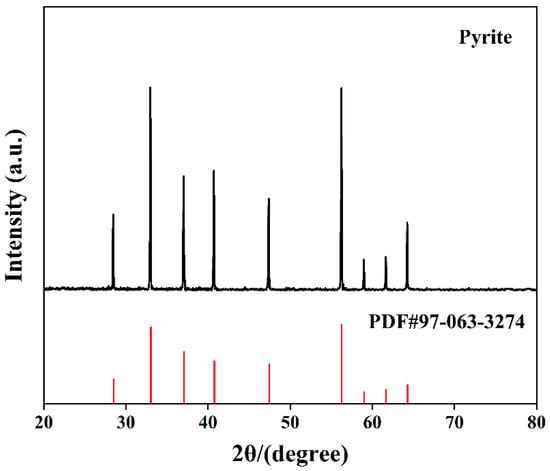
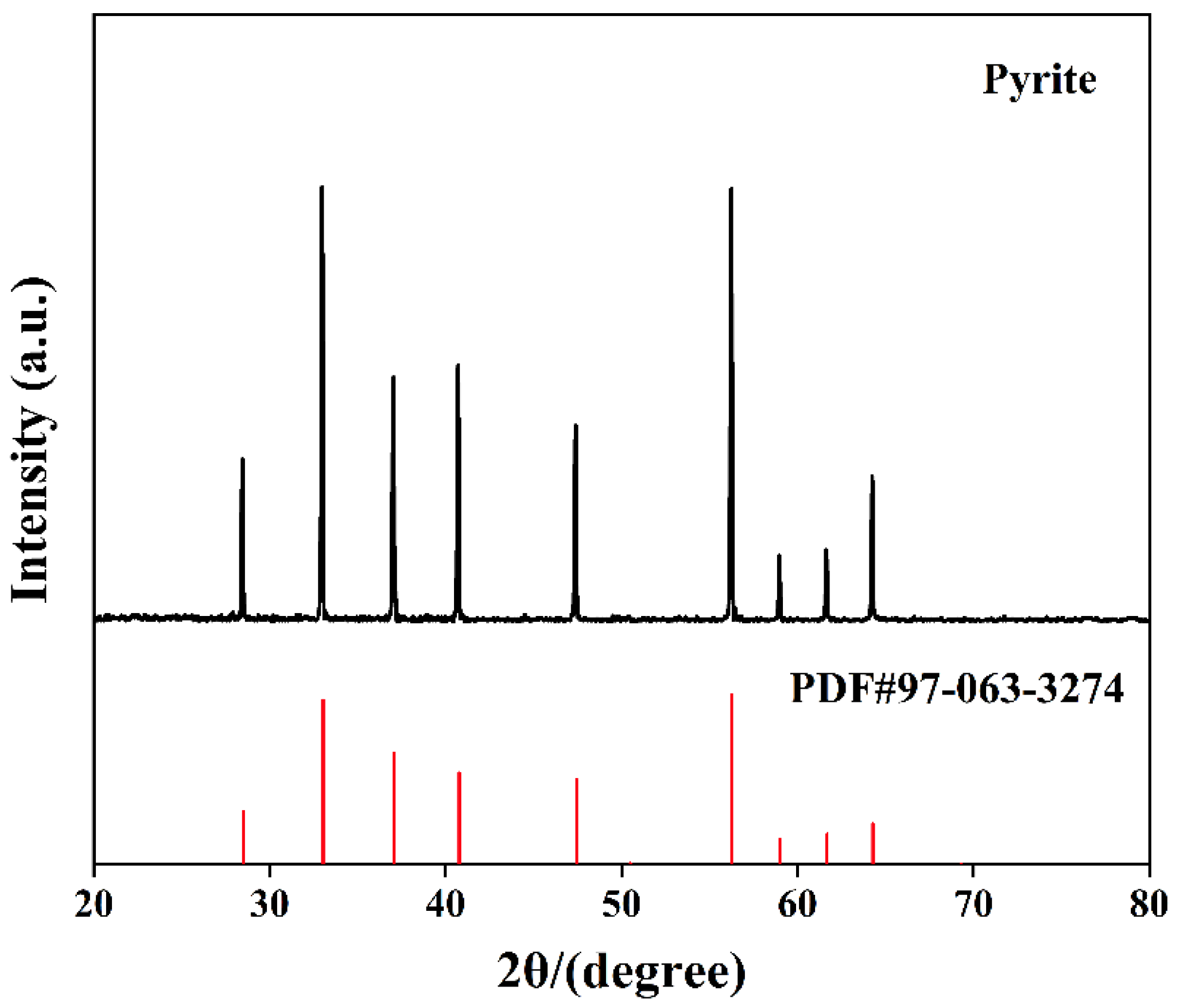
The high-purity pyrite lump samples used in this study were obtained from Guilin City, Guangxi, China. The ore sample was physically crushed, hand-picked, ground, and sieved. The prepared samples were subsequently stored in sealed containers before use to minimize further surface alteration during storage. The microflotation experiments were conducted within a relatively short period after sample preparation to reduce the possible influence of prolonged storage on the pyrite surface state. The sample with a particle size fraction of −74 + 45 μm was used for microflotation experiments, whereas the sample with a particle size of less than 45 μm was further ground to −5 μm for X-ray diffraction (XRD) analysis using a Bruker D8 Advance diffractometer (BRUKER AXS GmbH, Karlsruhe, Germany), X-ray fluorescence spectroscopy (XRF) analysis using an S8 TIGER XRF analyzer (BRUKER AXS GmbH, Karlsruhe, Germany), and electrochemical analyses. The XRD pattern (Figure 1) showed that the diffraction peaks of the sample were consistent with those of pyrite, with no obvious impurity phases detected. XRF analysis (Table 1) showed Fe and S contents of 45.70 and 51.81 wt.%, respectively, corresponding to a total Fe + S content of 97.51 wt.%. Based on the combined XRD and XRF results, the purity of the pyrite sample was estimated to be greater than 95%.
Figure 1.
XRD pattern of the pyrite sample.
Table 1.
Multi-element analysis of the pyrite sample (wt.%).
The collectors used in the experiments included SBX, ADDP, DDTC, and 3418A, all of which were purchased from Yantai Aotong Chemical Co., Ltd. (Yantai, China). Methyl isobutyl carbinol (MIBC), used as the frother; sulfuric acid (H2SO4), NaOH, and CaO, used as pH regulators; and chitosan and acetic acid, used for electrode preparation in the subsequent electrochemical measurements, were all purchased from Shanghai Aladdin Bio-Chem Technology Co., Ltd. (Shanghai, China). Deionized water was used in all experiments.
2.2. Microflotation Experiments
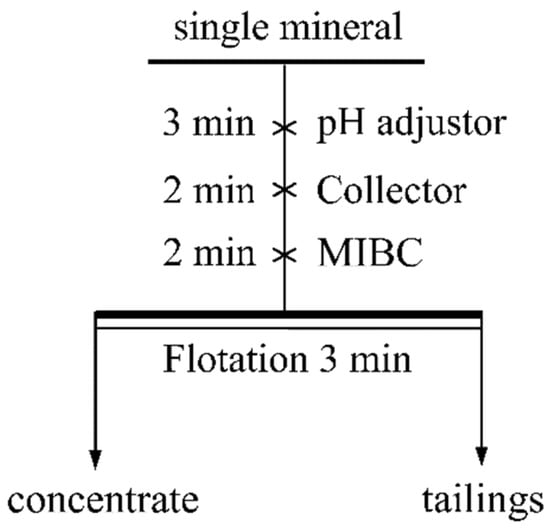
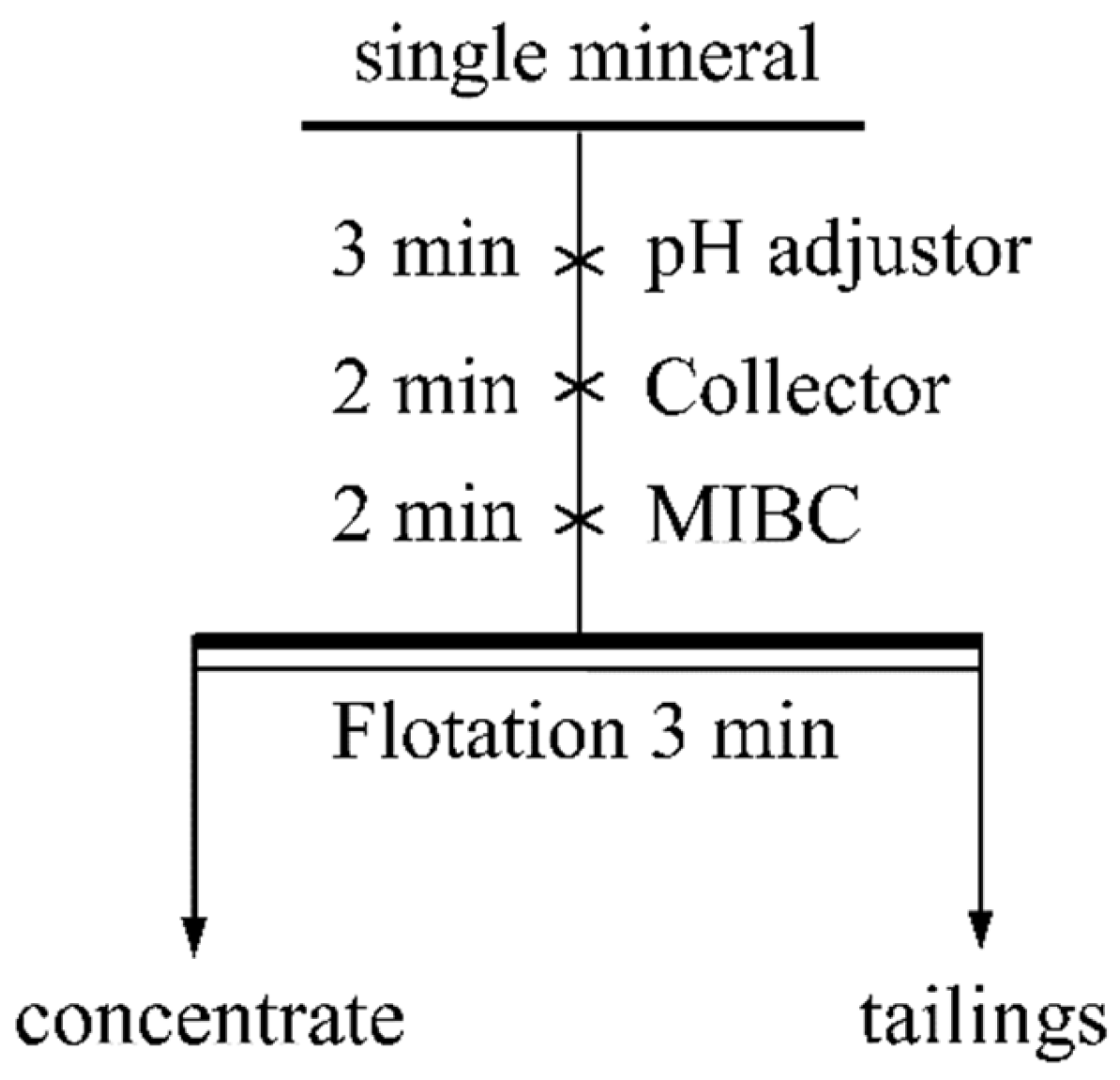
Microflotation experiments were conducted using an XFG-type hanging-cell flotation machine (Jilin Province Exploration Machinery Factory, Changchun, China) operated at a fixed impeller speed of 1740 r/min. Immediately before the microflotation experiments, the pyrite samples were ultrasonically cleaned using an ultrasonic cleaner (Kunshan Ultrasonic Instruments Co., Ltd., Kunshan, China) and deslimed to remove fine particles and loosely attached surface contaminants or products. Subsequently, 2.0 g of mineral sample was transferred into a 40 mL flotation cell and conditioned sequentially with pH regulators, collectors, and MIBC frother under constant agitation. Froth was collected for 3 min after conditioning. The froth product (concentrate) and the remaining pulp product (tailings) were separately collected, dried in a drying oven (Guangdong Hongzhan Technology Co., Ltd., Dongguan, China), and weighed using an analytical balance (Changzhou Wantai Balance Instrument Co., Ltd., Changzhou, China). The flotation recovery (R, %) was calculated according to Equation (1):
where is the mass of the froth product (g), and is the mass of the tailings (g). Each experiment was repeated three times, and the average value was reported as the final result. The flotation flowsheet is shown in Figure 2.
Figure 2.
Flowsheet of the microflotation experiments.
Although sealed storage, a relatively short interval between sample preparation and flotation, and ultrasonic cleaning before flotation were used to minimize changes in the pyrite surface state, complete prevention of natural surface oxidation cannot be guaranteed. Therefore, the experimental results should be interpreted as reflecting the behavior of pyrite under the controlled preparation and storage conditions used in this study.
2.3. Electrochemical Measurements
CV measurements were performed using a CHI760D electrochemical workstation with a three-electrode system, consisting of a platinum wire counter electrode, an Ag/AgCl reference electrode, and a pyrite powder microelectrode as the working electrode. The CHI760D electrochemical workstation, platinum wire counter electrode, Ag/AgCl reference electrode, glassy carbon electrode, and Al2O3 polishing powders used in this study were all purchased from Shanghai Chenhua Instrument Co., Ltd. (Shanghai, China). The pyrite powder electrodes were prepared as follows. First, 0.5 g of chitosan was dissolved in 100 mL of 0.05 mol/L acetic acid solution, ultrasonicated for 1 h, and then allowed to stand for 12 h to obtain the chitosan solution. Subsequently, 0.01 g of pyrite powder was dispersed in 4 mL of the chitosan solution and ultrasonicated for 15 min to obtain a homogeneous suspension. The glassy carbon electrode (3 mm in diameter) was sequentially polished with 0.3 and 0.05 μm Al2O3 powders and thoroughly cleaned. Then, 10 μL of the suspension was drop-cast onto the polished glassy carbon electrode surface and dried under an infrared lamp (Tianjin Hengchuang Lida Technology Development Co., Ltd., Tianjin, China) before electrochemical measurements. Chitosan was used as a binder to immobilize the pyrite particles and maintain the mechanical stability of the powder electrode. Nevertheless, the presence of chitosan may introduce additional interfacial resistance and may, to some extent, hinder the contact between the reagents and active sites on the pyrite surface. Because all working electrodes were prepared using the same procedure, the influence of chitosan was similar among the different experimental systems. Therefore, the CV results were mainly used to compare the electrochemical behavior of pyrite under different collector and pH conditions, rather than to quantitatively analyze the charge transfer process of pyrite.
The CV measurements were conducted over a potential range from −1.0 to 1.0 V at a scan rate of 20 mV/s, with a sensitivity of 10−5 A/V. The collector concentration was fixed at 1 × 10⁻⁴ mol/L.
2.4. DFTB Calculations
The density functional-based tight-binding (DFTB) method offers significant advantages in terms of computational efficiency and low computational cost [20]. Therefore, the adsorption behavior of collectors on pyrite surfaces before and after hydration was simulated using the DFTB+ module in Materials Studio (MS) 2019 (BIOVIA, Dassault Systèmes, San Diego, CA, USA). The simulation parameter library required for the calculations was constructed by our research group [21], and the effects of dispersion correction and spin polarization were taken into account. Brillouin zone integration was performed using a 2 × 2 × 1 Monkhorst–Pack k-point mesh. The convergence criteria for geometry optimization and energy calculation were set to 0.05 kcal/mol for the energy tolerance, 0.5 kcal/mol/Å for the maximum force tolerance and 0.01 Å for the maximum displacement tolerance. The self-consistent charges (SCC) were used with SCC tolerance set to medium and eigensolver set to divide and conquer.
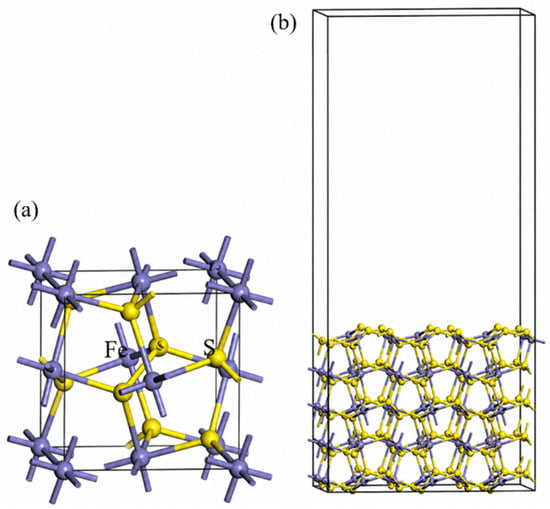
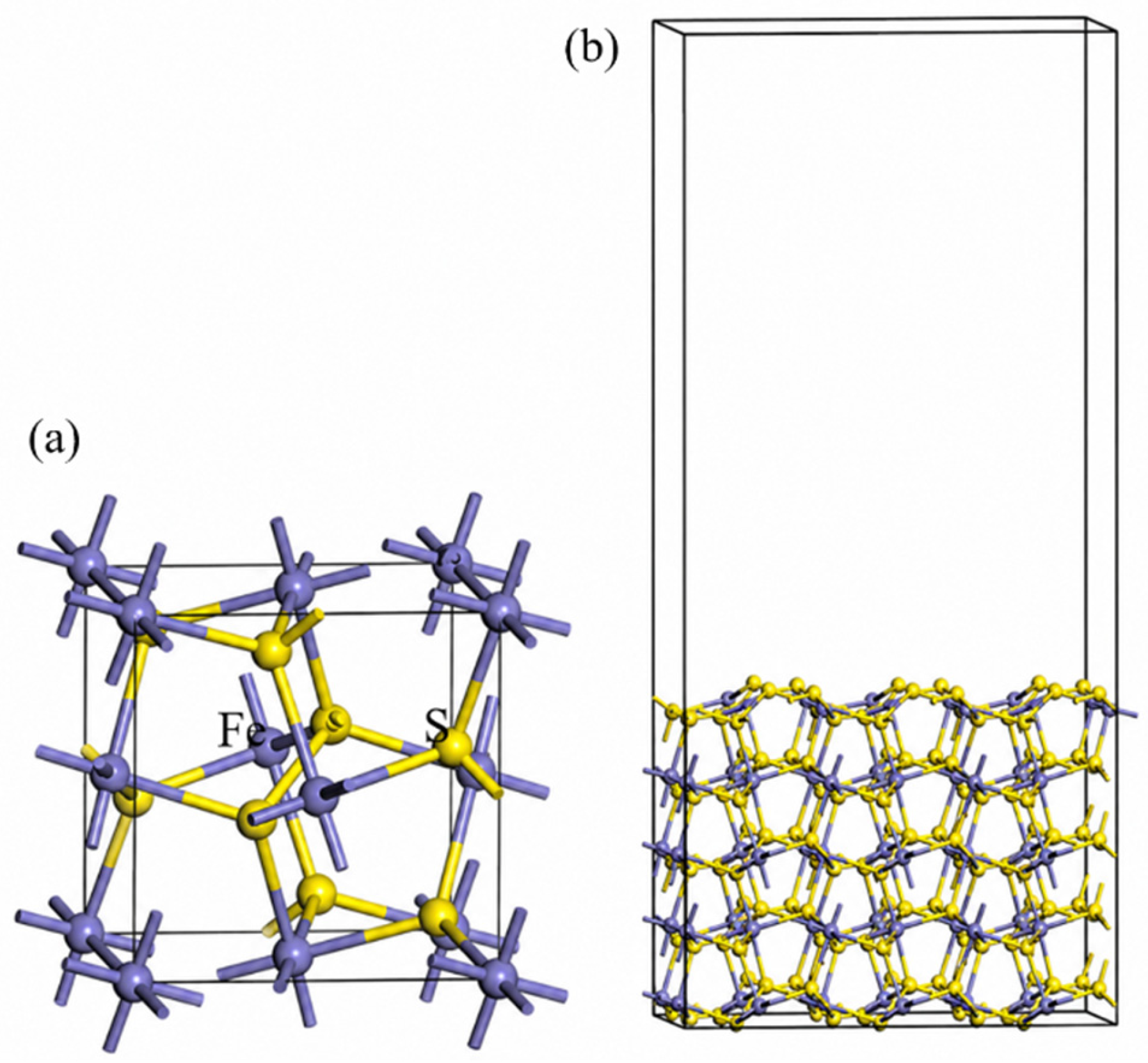
The lattice parameters of the optimized pyrite unit cell (Figure 3a) were a = b = c = 5.557 Å, showing a deviation of 2.58% from the experimental value of a = b = c = 5.417 Å [22], indicating that the computational results obtained using this parameter set are reasonably reliable. Previous studies have shown that the pyrite (100) surface is the most stable cleavage surface; therefore, the (100) surface was selected for subsequent investigation [23,24]. After testing the slab thickness, a 3 × 2 × 1 supercell surface model containing five atomic layers was finally constructed (Figure 3b), with a vacuum layer of 20 Å. The clean pyrite (100) surface was adopted as an idealized and consistent reference model to compare the intrinsic interactions of different individual collectors with the pyrite surface under the same surface conditions. It should be noted that the actual pyrite surface under flotation conditions may be more complex than this idealized model. Therefore, the calculated adsorption properties mainly describe the intrinsic interactions between individual collectors and the idealized pyrite surface and should not be regarded as a comprehensive representation of the interfacial chemistry under actual flotation conditions. Molecular models of BX, ADDP, DDTC, and 3418A were established, and the optimized molecular structures are shown in Figure 4.
Figure 3.
Geometrically optimized structures of (a) the pyrite unit cell and (b) the pyrite (100) surface model.
Figure 4.
Optimized molecular structure models of collectors: (a) DDTC, (b) SBX, (c) 3418A, (d) ADDP.
Adsorption energy reflects the interaction strength between a collector and a mineral; a lower adsorption energy indicates a stronger interaction. The adsorption energy of a collector molecule on the mineral surface was calculated as follows:
where Eads is the adsorption energy, Eadsorbates/surface is the total energy of the collector-mineral adsorption system after adsorption, Esurface is the energy of the mineral surface, and Eadsorbates is the energy of the collector molecule.
3. Results and Discussion
3.1. Flotation Results
3.1.1. Effect of Individual Collectors on the Flotation Behavior of Pyrite
To investigate the flotation behavior of pyrite in single-collector systems, this section systematically examines the effects of collector type and dosage, pulp pH, and pH adjustment using NaOH and CaO on the flotation recovery of pyrite.
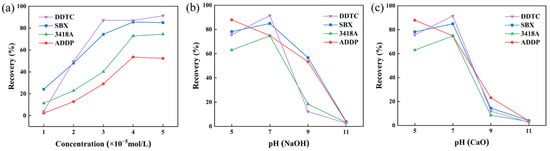
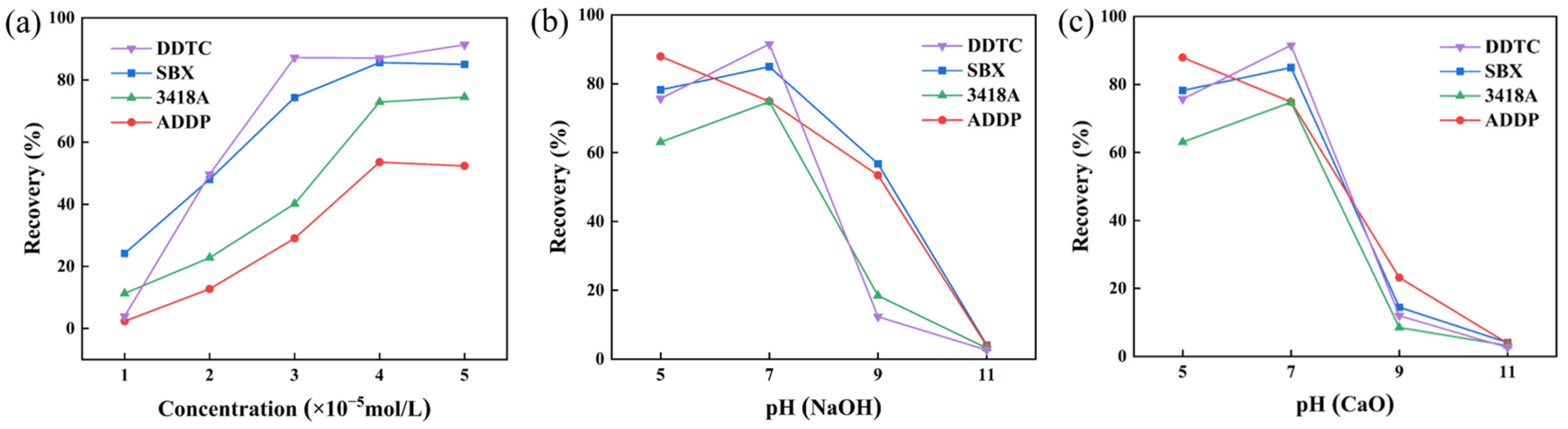
Figure 5a shows the effect of different collector dosages on the flotation behavior of pyrite under natural pH conditions. The collector concentration range of 1~5 × 10⁻⁵ mol/L corresponds to equivalent dosages of 34.45~172.24 g/t for SBX, 45.06~225.30 g/t for DDTC, 51.87~259.36 g/t for ADDP, and 46.46~232.32 g/t for 3418A. As the collector dosage increased, the pyrite recovery increased rapidly. When the collector dosage reached 4 × 10⁻⁵ mol/L, the recovery nearly reached its maximum value and then tended to remain stable. Comparison of the experimental results showed that, at higher dosages, DDTC and SBX exhibited stronger collecting ability for pyrite, whereas 3418A showed weaker collecting ability, and ADDP exhibited the weakest collecting ability toward pyrite.
Figure 5.
Effects of different conditions on the flotation behavior of pyrite: (a) collector dosage under natural pH, (b) pH with NaOH as the alkaline regulator, and (c) pH with CaO as the alkaline regulator.
Figure 5b and c show the effects of different pH values on the flotation behavior of pyrite at a fixed collector concentration of 4 × 10⁻⁵ mol/L, corresponding to equivalent dosages of 137.79, 180.24, 207.49, and 185.86 g/t for SBX, DDTC, ADDP, and 3418A, respectively. Overall, within the pH range of 5–11, except for ADDP, the recovery of pyrite first increased and then decreased with increasing pH. Pyrite exhibited the best floatability at pH 7. However, when the pH increased from 7 to 9, the pyrite recovery decreased rapidly, and pyrite showed almost no floatability at pH 11. When ADDP was used as the collector, the pyrite recovery gradually decreased with increasing pH. These results indicate that a strongly alkaline environment significantly weakens the floatability of pyrite.
Further comparison of the two alkaline regulators revealed that although the alkaline pulp environments adjusted by NaOH and CaO exhibited generally similar effects on pyrite flotation, the CaO system exerted a stronger depressing effect on pyrite flotation. In terms of collector performance, all collectors exhibited certain collecting ability in the weakly acidic to neutral range. However, under strongly alkaline conditions, the differences among the collectors were markedly narrowed, suggesting that the depression effect of high pH on pyrite floatability was stronger than the influence of collector type itself.
3.1.2. Effect of Combined Collectors on the Flotation Behavior of Pyrite
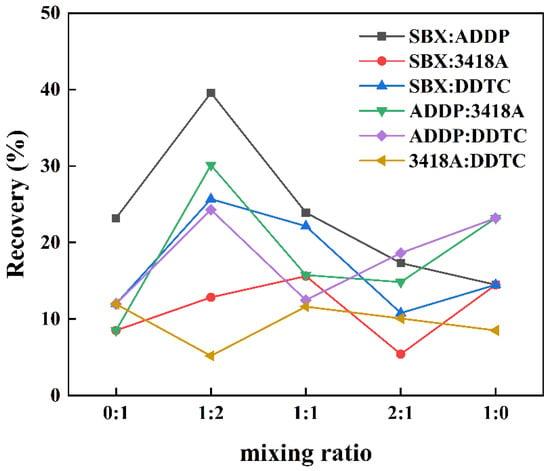
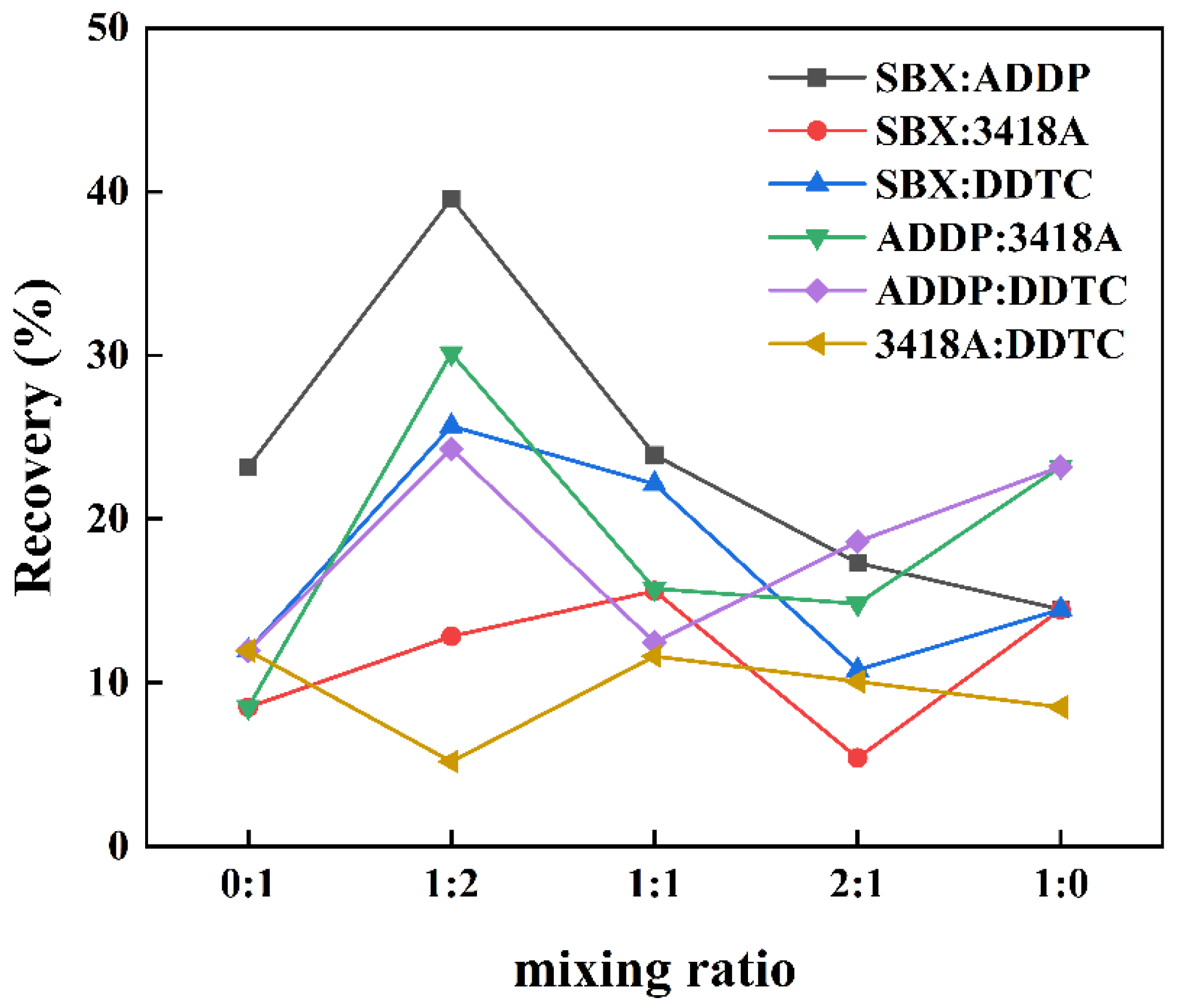
According to the results in Section 3.1.1, pyrite exhibited relatively poor floatability in the CaO system. Moreover, in practical industrial production, for the flotation separation of pyrite-containing ores, lime is commonly used to adjust the pulp to form a strongly alkaline environment, together with combined collectors to enhance the recovery of valuable minerals and depress the flotation of pyrite. Based on this, CaO was selected as the pH regulator in this section. Under the conditions of pH 9 and a fixed total collector dosage of 4 × 10⁻⁵ mol/L, the effects of different combined collector ratios on the flotation behavior of pyrite were systematically investigated.
Figure 6 illustrates the effects of different combined collectors on the flotation behavior of pyrite at ratios of 0:1, 1:2, 1:1, 2:1, and 1:0. As shown in the figure, the pyrite recovery in different combined collector systems varied significantly with the collector ratio, exhibiting a strong dependence on collector components and a high sensitivity to their proportions. In general, for most combined collector systems, as the collector composition shifted from a single component to a mixed component, the recovery increased to a certain extent and reached a maximum at a particular ratio, after which it declined with a further increase in the proportion of one component. This indicates that, under the present alkaline conditions, the flotation behavior of pyrite in combined collector systems is not a simple superposition of the effects of the individual collectors. When the proportion of one component becomes excessively high, the enhancement of pyrite flotation may weaken or the recovery may decrease. In the present study, the terms synergistic and competitive are used only to describe the flotation behavior inferred from the changes in pyrite recovery relative to the corresponding individual collector systems. Because co-adsorption of two collector molecules was not considered in the present calculations, the molecular origin of these effects remains to be further investigated.
Figure 6.
Effect of combined collector ratio on pyrite flotation recovery at pH 9.
In terms of the individual combined systems, the SBX/ADDP system exerted the most pronounced influence on pyrite flotation. The recovery first increased and then decreased with the increasing proportion of SBX, reaching the maximum value at a ratio of 1:2, close to 40%. Thereafter, the recovery began to decline, but still remained at a relatively high level overall. This suggests that a strong synergistic effect existed between SBX and ADDP within a certain ratio range, and pyrite flotation was particularly favored when ADDP was the dominant component. In the SBX/3418A system, the overall pyrite recovery was relatively low, and the variation trend was comparatively moderate. When SBX accounted for a larger proportion, the recovery decreased to the lowest level. Subsequently, it increased slightly with the increasing proportion of 3418A, but never reached a high level. This result suggests that an effective synergistic interaction between 3418A and SBX was lacking, and that mutual interference may even have occurred. The SBX/DDTC system, however, displayed moderate collecting ability. When the SBX to DDTC ratio was either 1:2 or 1:1, the pyrite recovery was higher than that obtained using SBX or DDTC alone, indicating a certain synergistic effect between the two collectors. However, as the proportion of SBX further increased, antagonistic effects began to emerge. Overall, the collecting ability of the SBX/DDTC system for pyrite was weaker than that of the SBX/ADDP system, but stronger than that of the SBX/3418A system.
Further comparison of the ADDP/3418A and ADDP/DDTC combined collector systems revealed that their effects on the flotation behavior of pyrite were characterized by both similarities and specific differences. As the proportion of ADDP decreased, the pyrite recovery exhibited an overall downward trend, indicating that ADDP played a dominant collecting role in both systems. However, when the ADDP proportion was relatively low (at a ratio of 1:2), the pyrite recovery in both systems reached its maximum value. This suggests that, under this ratio, the other collector component can synergize with ADDP to improve the hydrophobic state of the mineral surface, thereby enhancing the collecting performance. The difference was that when ADDP gradually became dominant (as the ratio changed from 1:2 to 2:1), the synergistic effect in the ADDP/3418A system weakened, whereas in the ADDP/DDTC system, the synergy first weakened and then strengthened to some extent. These flotation results indicate that both systems exhibit clear synergistic behavior at specific mixing ratios, whereas competitive behavior may occur as the collector ratio changes. The dominant effect within the combined collector system may shift depending on the component ratio, thereby leading to unstable flotation behavior.
Among all combined collector systems, the 3418A/DDTC system exhibited the lowest overall pyrite recovery, which remained mostly around 10% and fluctuated little with the change in ratio, reaching a minimum at a ratio of 1:2. This result indicates that this system exhibits little or no synergistic flotation behavior and may show a competitive effect, as reflected by its relatively low pyrite recovery.
The above flotation results suggest that the floatability of pyrite may be jointly governed by pulp alkalinity, the type of pH regulator, and the adsorption characteristics of the collectors. The pronounced decrease in pyrite recovery at high pH may be associated with weakened collector adsorption and increased hydrophilicity of the pyrite surface. The stronger depression observed in the CaO-regulated system than in the NaOH-regulated system further suggests that, in addition to pulp alkalinity, certain surface reaction products may be formed in the CaO system. These species may occupy active sites on the pyrite surface or increase surface hydrophilicity, thereby hindering collector adsorption. For the combined collector systems, the pronounced dependence of pyrite flotation on collector composition and mixing ratio suggests that differences in the relative affinity of the collector components for surface active sites and their occupation of these sites may alter the degree of surface hydrophobization. Therefore, collector combinations containing components with a stronger affinity for pyrite may partially counteract the depression under alkaline conditions, whereas combinations dominated by collectors with a weaker collecting ability toward pyrite are less likely to overcome such depression.
3.2. Electrochemical Measurements
Pyrite is a sulfide mineral with semiconducting properties, and its flotation is essentially an electrochemical process [25]. Therefore, to elucidate the interaction mechanism between collectors and the pyrite surface, CV was used in this section to systematically analyze the electrochemical behavior of pyrite in different collector systems under different pH values and pH adjustment methods.
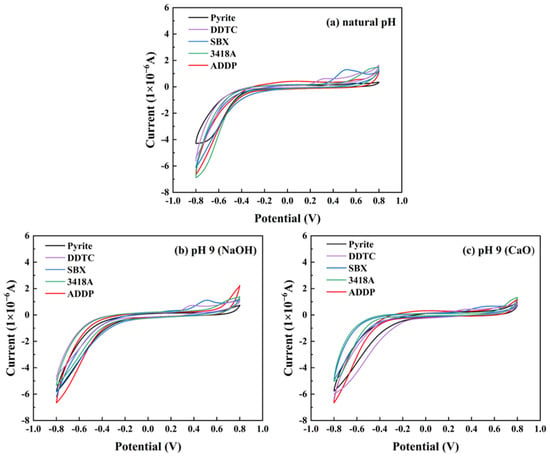
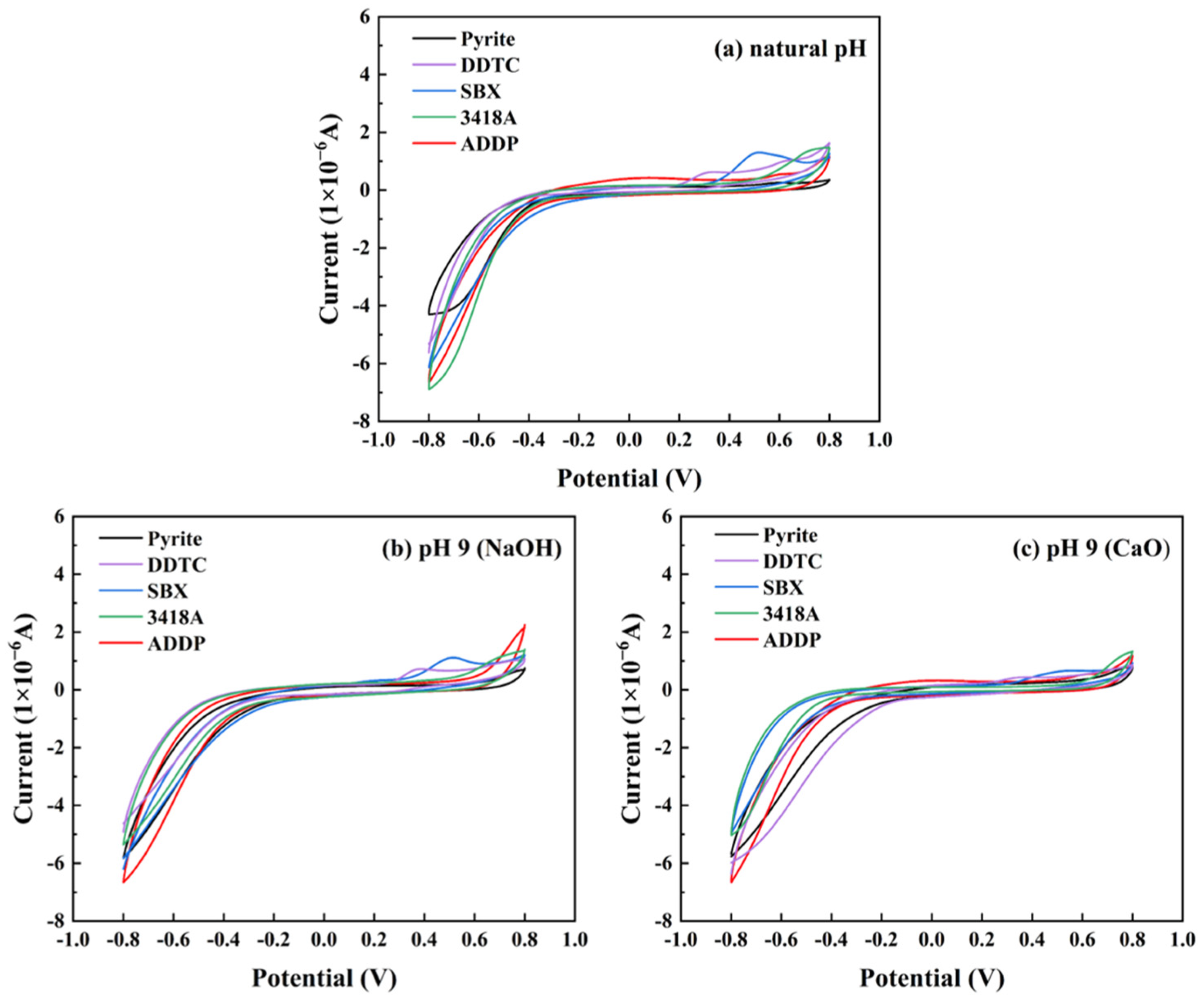
Figure 7 presents the CV curves of pyrite in different collector systems under different pH conditions. Under natural pH conditions (Figure 7a), in the absence of collectors, the pyrite electrode showed no obvious oxidation or reduction peaks over the entire scanned potential range, indicating low electrochemical reactivity of the pyrite surface. After the addition of collectors, oxidation peaks appeared in all systems within the potential range from 0.3 to 0.8 V, whereas no corresponding reduction peaks were observed during the reverse scan. This indicates that the adsorption of collectors on the pyrite surface is an irreversible electrochemical process. Among these systems, the SBX system exhibited a strong oxidation peak at approximately 0.5 V, while in the DDTC system, one oxidation peak appeared near 0.3 V and another near 0.6 V, with the oxidation process initiating at a relatively low potential. These results suggest that both SBX and DDTC are prone to pronounced oxidative adsorption on the pyrite surface. In the 3418A system, a relatively pronounced anodic current peak appeared in the high potential region from 0.65 to 0.8 V, indicating that 3418A is also capable of undergoing an oxidation reaction with pyrite. For the ADDP system, the current intensity corresponding to the oxidation peak was lower, and the onset potential was also higher, suggesting a weaker electrochemical interaction between ADDP and pyrite.
Figure 7.
CV curves of pyrite electrodes in different collector systems under (a) natural pH, (b) pH 9 adjusted with NaOH, and (c) pH 9 adjusted with CaO.
When the solution was adjusted to pH 9 with NaOH (Figure 7b), the anodic current of the pyrite electrode in the blank system remained low, but was slightly higher than that under natural pH conditions. This result suggests that increasing pH can promote the oxidation of pyrite itself. Compared with the blank system, the addition of collectors still increased the anodic current of pyrite to varying degrees, suggesting that certain interactions between the collectors and pyrite still existed under weakly alkaline conditions. During the forward scan, the ADDP system exhibited a strong increase in anodic current in the high potential region, whereas the other collector systems displayed oxidation reaction characteristics in the positive potential region similar to those observed under natural pH conditions, although the anodic peak currents were generally weakened. These results suggest that the mildly alkaline environment adjusted with NaOH favors the interaction between ADDP and pyrite, but weakens the oxidative adsorption of the other collectors on the pyrite surface.
In contrast, when the solution was adjusted to pH 9 with CaO (Figure 7c), the anodic current decreased in all collector systems, and the oxidation peaks were significantly weakened. This phenomenon may be attributed to the adsorption or deposition of calcium species, such as Ca2+ and CaOH+ generated after lime dissolution, on the pyrite surface. These species cover the surface active sites and form a hydrophilic passivation layer, thereby hindering the adsorption of collectors on the pyrite surface [25]. However, in the system without collectors, the anodic current of the pyrite electrode further increased. This indicated that pyrite underwent an intense self-oxidation reaction in the alkaline environment adjusted with CaO.
The CV results demonstrate that the electrochemical interactions between the collectors and pyrite are strongly influenced by pulp pH and the type of pH regulator. Under natural pH conditions, SBX and DDTC exhibited relatively strong electrochemical interactions with pyrite, followed by 3418A, whereas ADDP showed the weakest interaction. This trend is generally consistent with the differences in collecting performance observed in the microflotation experiments, indicating that stronger electrochemical interactions between the collectors and the pyrite surface favor collector adsorption and consequently enhance pyrite floatability. When the pH was increased to 9, the oxidative adsorption of most collectors on the pyrite surface was weakened. Moreover, compared with the NaOH-regulated system, the anodic current associated with collector adsorption decreased more markedly in the CaO-regulated system. Considering the possible adsorption or deposition of calcium-bearing species on the pyrite surface, these results suggest that, in addition to increasing pulp alkalinity, CaO may reduce the number of surface active sites available for collector adsorption and promote the formation of a hydrophilic passivation layer, thereby restricting collector adsorption. These interfacial changes provide a possible electrochemical explanation for the low floatability of pyrite observed in the CaO-regulated system.
It should be noted that the electrochemical analysis in the present study is primarily based on the comparative trends observed in the CV measurements. Future studies should incorporate more comprehensive electrochemical characterization, such as electrochemical impedance spectroscopy (EIS) and open-circuit potential (OCP) measurements, to further substantiate and refine the mechanistic understanding of the interfacial processes involved in collector–pyrite interactions.
3.3. DFTB Analysis
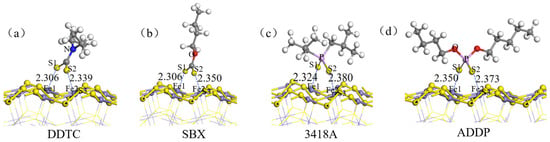
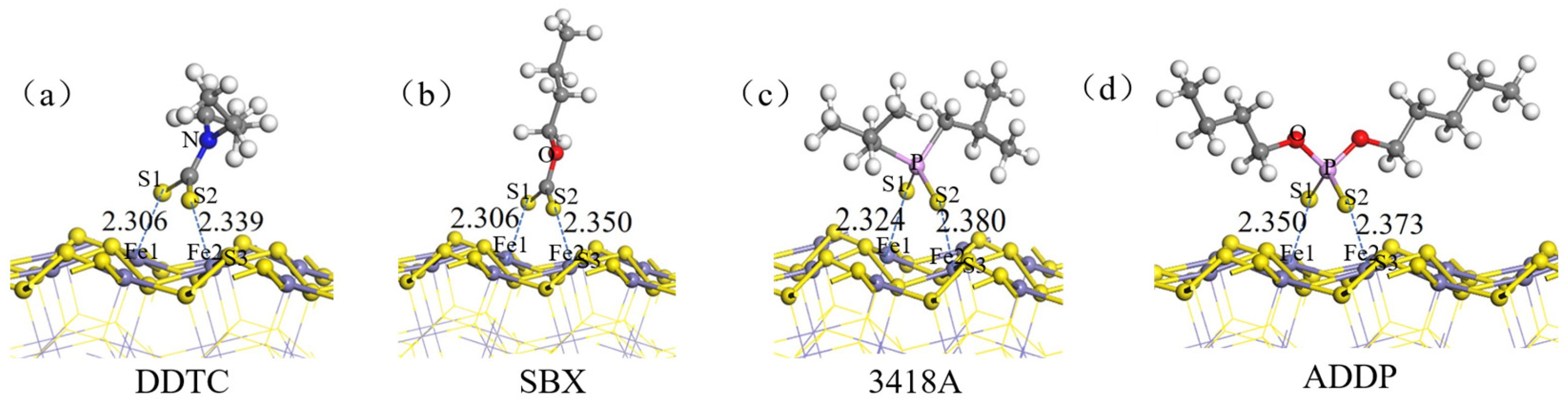
To further elucidate the intrinsic reasons for the differences in the collecting performance of different collectors toward pyrite at the molecular scale, DFTB simulations were performed in this section to investigate the adsorption of collectors on the pyrite surface, focusing on the interaction characteristics between the collectors and pyrite under anhydrous and aqueous conditions. Figure 8 shows the stable adsorption configurations of different collector molecules on the pyrite surface, and the values marked in the figure represent the adsorption bond lengths (Å).
Figure 8.
Adsorption configurations of collector molecules on the pyrite surface: (a) DDTC, (b) SBX, (c) 3418A, and (d) ADDP.
As observed from Figure 8, the collector molecules could interact with Fe atoms on the pyrite surface through the double-bonded S atom (S1) and the single-bonded S atom (S2), but the corresponding interaction distances differed markedly. After adsorption of 3418A on the pyrite surface, the bond lengths between S1 and Fe1 and between S2 and Fe2 were 2.324 Å and 2.380 Å, respectively. For ADDP, the corresponding adsorption bond lengths were 2.350 Å and 2.373 Å, respectively. The overall bond lengths were comparatively long, indicating that the interactions between these two collectors and the pyrite surface were relatively weak. In comparison, the adsorption distances of DDTC and SBX on the pyrite surface were clearly shorter. For DDTC, the bond lengths between S1 and Fe1 and between S2 and Fe2 were 2.306 Å and 2.339 Å, respectively, while those for SBX were 2.306 Å and 2.350 Å, respectively. These results indicate that their S atoms, especially the double-bonded S atoms, can form stronger adsorption interactions with surface Fe sites. Generally, shorter adsorption bond lengths signify stronger interactions between the main active groups of the collector and the metal sites on the mineral surface, which makes the interfacial complexation more stable and thereby facilitates the formation of surface hydrophobicity. To further evaluate the adsorption stability from an energetic perspective, the adsorption energies of DDTC, SBX, 3418A, and ADDP on the pyrite (100) surface were calculated to be −288.726, −277.752, −273.867, and −273.261 kJ/mol, respectively. The adsorption stability order was therefore DDTC > SBX > 3418A > ADDP. The more negative adsorption energies of DDTC and SBX indicate greater energetic stability on the pyrite surface, whereas 3418A and ADDP exhibit relatively weaker adsorption. This energetic trend is generally consistent with the microflotation results. Therefore, the bond length analysis of the adsorption configurations, together with the adsorption energy calculation results, indicates that DDTC and SBX exhibit stronger collecting ability toward pyrite, whereas 3418A and ADDP show relatively weaker collecting ability.
To further analyze the electronic changes occurring when the collectors adsorb on the pyrite surface, the atomic charges of the relevant atoms before and after adsorption were compared, as shown in Table 2. Under anhydrous conditions, DDTC, SBX, and ADDP exhibited similar charge redistribution characteristics. After adsorption, the active S atoms of these three collectors became less negatively charged, indicating that the S atoms mainly lost electrons. Meanwhile, the central C atoms of DDTC and SBX and the P atom of ADDP gained some electrons, indicating that electron redistribution also occurred within the polar groups of the collectors. The total charges of DDTC, SBX, and ADDP changed from approximately 0.000 to +0.163, +0.063, and +0.121 e, respectively, indicating net electron transfer from these collectors to the pyrite surface. In contrast, 3418A showed a different charge transfer behavior. After adsorption, both active S atoms became more negatively charged, while the P atom also gained a small amount of electrons. Consequently, the total charge of 3418A changed from approximately 0.000 to −0.066 e, indicating a small net electron transfer from the pyrite surface to 3418A.
Table 2.
Charge distribution of relevant atoms before and after collector adsorption on the pyrite surface under anhydrous conditions.
The surface atoms also showed clear charge changes after adsorption. In all four systems, the directly interacting Fe1 and Fe2 atoms became less negatively charged. In contrast, the charge of the neighboring surface S3 atom decreased from +0.244 e before adsorption to +0.203, +0.204, +0.216, and +0.201 e after adsorption in the DDTC, SBX, 3418A, and ADDP systems, respectively, indicating that S3 gained electrons. These results show that the charge redistribution during adsorption involves not only the collector molecules and the directly interacting Fe atoms, but also the neighboring surface S atoms. Therefore, although all four collectors interact with the pyrite surface through their S-containing polar groups, their specific charge transfer characteristics are different and are related to the molecular structures of the collectors.
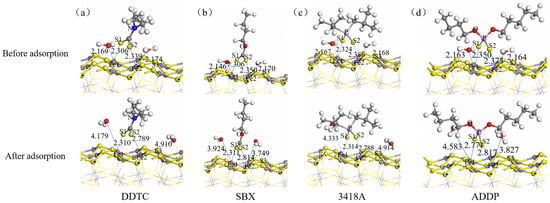
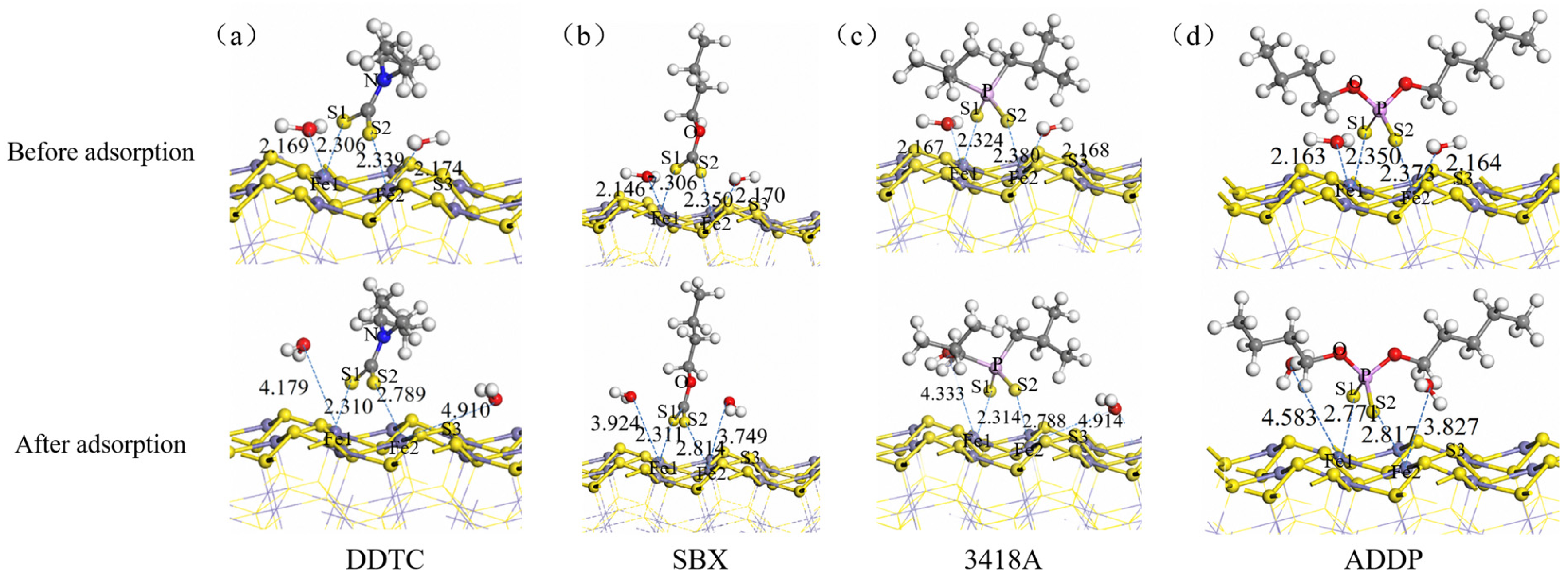
Given that flotation occurs in an aqueous solution system, the presence of water molecules may affect the adsorption behavior of collectors on mineral surfaces. Therefore, competitive adsorption models of four collectors and water molecules on the pyrite surface were further constructed (Figure 9) to systematically investigate the adsorption characteristics and variation patterns of different collectors on the pyrite surface after the introduction of water molecules. This is of great significance for gaining a deeper understanding of the adsorption and interaction mechanisms of collectors on the pyrite surface in practical flotation systems.
Figure 9.
Competitive adsorption configurations of water molecules and collectors on the pyrite surface: (a) DDTC, (b) SBX, (c) 3418A, and (d) ADDP.
As shown in Figure 9a, compared with the adsorption configuration in the absence of water molecules (Figure 8a), the double-bonded S atom in the DDTC molecule still maintained a relatively strong interaction with the Fe active site on the pyrite surface under competitive adsorption with water molecules, and the corresponding bond length changed only slightly, indicating that the introduction of water molecules did not significantly weaken the adsorption stability of DDTC on the pyrite surface. Meanwhile, the water molecules originally located near the surface moved markedly away from the mineral surface after optimization, with their distance from the surface increasing to approximately 4–5 Å, suggesting that DDTC had an advantage over water molecules during competitive adsorption and was capable of displacing them and preferentially adsorbing onto the pyrite surface.
Similarly, by comparing the adsorption configurations in the absence and presence of water molecules (Figure 8b and Figure 9b), it can be seen that after SBX adsorption, the interaction distance between its double-bonded S atom and the surface Fe atom changed only slightly and remained within the range of strong coordination interaction. By contrast, the adsorption distance between the O atom of the water molecule and the surface Fe atom of pyrite increased to approximately 4 Å, suggesting weak interaction between water molecules and the mineral surface and making it difficult for water molecules to compete effectively with SBX for adsorption. These results indicate that SBX has strong affinity for the surface Fe active sites of pyrite and can maintain high adsorption stability in the presence of water, which is one of the reasons for its strong collecting performance.
It is noteworthy that after the introduction of water molecules, the adsorption configuration of 3418A on the pyrite surface underwent some changes. As shown in Figure 9c, the S1-Fe1 distance slightly decreased from 2.324 Å under anhydrous conditions to 2.314 Å, whereas the S2-Fe2 distance increased from 2.380 Å to 2.788 Å. These changes indicate that the two S-Fe interaction sites were affected differently by the presence of water, resulting in a more asymmetric adsorption configuration. In addition, the water molecules initially located near the mineral surface were displaced away from the surface after competitive adsorption with 3418A. Considering the adsorption characteristics of the four collectors together with the adsorption energy and microflotation results, it can be inferred that the key factor governing collecting performance is not the interaction strength between the single-bonded S atom (S2) and the Fe site, but is more likely associated with the interaction distance between the double-bonded S atom (S1) and the surface-active Fe atom, as well as the corresponding coordination stability.
As shown in Figure 9d, in the presence of water molecules, the S1-Fe1 and S2-Fe2 bond lengths of ADDP adsorbed on the pyrite surface increased from 2.350 Å and 2.373 Å to 2.771 Å and 2.817 Å, respectively. The pronounced increase in bond lengths implies a reduced degree of orbital overlap between the interacting atoms, suggesting that the coordination interaction between ADDP and the mineral surface was weakened. Compared with the other three collectors, the S-Fe interaction distances in the ADDP system were larger as a whole, suggesting that ADDP intrinsically has weaker adsorption ability toward pyrite, and the introduction of water molecules further accentuated this difference. Although the water molecules were eventually displaced after competitive adsorption, the interaction between ADDP and the pyrite surface was evidently more susceptible to the influence of water molecules. Therefore, the limited collecting performance of ADDP can be primarily attributed to its weaker bonding strength with the pyrite surface and its poorer resistance to hydration interference. To further evaluate the adsorption stability in the presence of water, the adsorption energies of DDTC, SBX, 3418A, and ADDP were calculated to be −359.185, −334.027, −315.478, and −310.199 kJ/mol, respectively. The adsorption stability order remained DDTC > SBX > 3418A > ADDP. The more negative adsorption energies of DDTC and SBX indicate that they maintain higher adsorption stability on the pyrite surface in the presence of water, whereas 3418A and ADDP exhibit relatively weaker adsorption stability.
In the presence of water, the charge changes associated with collector adsorption on the pyrite surface are shown in Table 3. After adsorption, the total charges of DDTC, SBX, 3418A, and ADDP were +0.109, +0.113, +0.052, and +0.087 e, respectively, indicating that all four collectors underwent net electron transfer to the hydrated pyrite interface. DDTC and SBX retained charge transfer characteristics similar to those under anhydrous conditions. Their two active S atoms mainly lost electrons, while the central C atoms gained some electrons, indicating that electron redistribution also occurred within the polar groups. In contrast, the two active S atoms of 3418A and ADDP showed different charge changes. For 3418A, S1 lost electrons whereas S2 gained electrons; for ADDP, S1 gained electrons whereas S2 lost electrons. This indicates that the presence of water altered the electron distribution between the two active S sites, resulting in a more pronounced asymmetry in their charge changes.
Table 3.
Charge distribution of relevant atoms before and after collector adsorption on the pyrite surface in the presence of water molecules.
The Fe atoms, water O atoms, and neighboring surface S atoms also underwent clear charge changes. The directly interacting Fe1 and Fe2 atoms became less negatively charged in all four systems. The O1 and O2 atoms of the water molecules also generally became less negatively charged, indicating electron loss. In contrast, the neighboring surface S3 atom gained electrons, with its charge decreasing from +0.093 e before adsorption to +0.035, +0.024, +0.053, and +0.028 e in the DDTC, SBX, 3418A, and ADDP systems, respectively. These results indicate that both water molecules and the neighboring surface S atoms participate in the interfacial charge redistribution during adsorption.
It is noteworthy that the total charge of 3418A changed from −0.066 e under anhydrous conditions to +0.052 e in the presence of water, indicating a reversal in the direction of its net charge transfer. This result shows that the charge transfer behavior between 3418A and the pyrite surface is more sensitive to the presence of water. Overall, the charge analysis indicates that collector adsorption involves both electron redistribution within the polar groups and charge transfer at the collector–pyrite interface, while the presence of water further changes the electron distribution among the different interfacial atoms.
Based on the above computational results, DDTC and SBX exhibited relatively strong interactions with pyrite, followed by 3418A, whereas ADDP showed the weakest interaction. This trend is generally consistent with that observed in the microflotation experiments. The adsorption configurations and adsorption energies indicate that DDTC and SBX exhibit relatively high adsorption stability on the pyrite surface under both anhydrous and aqueous conditions, whereas the adsorption of 3418A and ADDP is comparatively weaker. This suggests that the stronger collecting performance of DDTC and SBX is closely associated with their ability to form and maintain relatively stable interactions with surface Fe sites on pyrite, thereby favoring the retention of surface hydrophobicity. Charge analysis further shows that collector adsorption is accompanied by electron redistribution across the collector–pyrite interface, while the presence of water further affects interfacial charge transfer behavior. Further analysis indicates that, under anhydrous conditions, both the single-bonded and double-bonded S atoms in the collector molecules contribute to adsorption bonding to some extent. In the presence of water, however, the interaction between the double-bonded S atoms and surface Fe sites plays a more important role in maintaining stable adsorption, whereas the contribution of the single-bonded S atoms becomes relatively limited. This implies that differences in collector performance depend not only on the strength of their interactions with the pyrite surface, but also on whether these interactions can remain stable in an aqueous environment. Therefore, under aqueous conditions that more closely resemble practical flotation systems, the stability of the coordination interaction between the double-bonded S atoms and surface Fe sites, together with its resistance to interference from water molecules, may be an important factor governing collector performance.
4. Conclusions
- (1)
- Pyrite flotation is strongly affected by collector type and pulp alkalinity. DDTC and SBX show stronger collecting ability than 3418A and ADDP, while CaO depresses pyrite more effectively than NaOH. Combined collectors exhibit clear component- and ratio-dependent effects.
- (2)
- CV results indicate that collector adsorption on pyrite is an irreversible electrochemical process. The stronger depression by CaO is mainly associated with calcium-containing species passivating surface active sites and hindering collector adsorption.
- (3)
- DFTB calculations show that collector performance is closely related to the stability of S-Fe coordination on the pyrite surface. DDTC and SBX form more stable interactions and show stronger resistance to hydration interference than 3418A and ADDP, among which the coordination between the double-bonded S atoms and surface Fe sites is particularly important.
Author Contributions
Conceptualization, M.J. and H.H.; methodology, M.J., Y.X. and Y.L.; formal analysis, H.H., L.Z., Y.G. and S.X.; investigation, M.J., L.Z., Y.G. and Y.L.; data curation, W.Z., L.Z., Y.X. and S.X.; writing—original draft preparation, M.J. and H.H.; writing—review and editing, H.H., W.Z. and Y.L.; visualization, W.Z., L.Z., Y.G. and Y.X.; supervision, W.Z., Y.G., Y.X. and S.X.; project administration, S.X. and Y.L. All authors have read and agreed to the published version of the manuscript.
Funding
The authors are grateful for the financial support provided by the National Natural Science Foundation of China (grant number 52364023) and Guangxi Natural Science Foundation (2025GXNSFAA069648).
Data Availability Statement
All data generated or analyzed during this study are included in this published article.
Conflicts of Interest
Authors Meiguang Jiang, Wenjie Zhang, Lin Zhang, Yunshan Guo, Youming Xiao and Shijie Xiao were employed by Kunming Metallurgical Research Institute Co., Ltd. The remaining authors declare that the research was conducted in the absence of any commercial or financial relationships that could be construed as a potential conflict of interest.
References
- Molaei, N.; Hoseinian, F.S.; Rezai, B. A study on the effect of active pyrite on flotation of porphyry copper ores. Physicochem. Probl. Miner. Process. 2018, 54, 922–933. [Google Scholar] [CrossRef]
- Du, Y.; Tong, X.; Xie, X.; Lu, Y.; Hua, Z.; Zhang, W. Effects of pyrite on the flotation behavior and electrochemical interaction of different particle sizes of galena in the presence of diethyldithiocarbamate. Sep. Sci. Technol. 2021, 56, 2467–2474. [Google Scholar] [CrossRef] [Scilit]
- Yang, B.; Tong, X.; Lan, Z.; Cui, Y.; Xie, X. Influence of the interaction between sphalerite and pyrite on the copper activation of sphalerite. Minerals 2018, 8, 16. [Google Scholar] [CrossRef] [Scilit]
- Yang, Y.; Kostović, M.; Deng, R.; Liao, Y. Study on the inhibition and activation of pyrite under low alkalinity conditions created by hydrogen peroxide and lime. Minerals 2025, 15, 1177. [Google Scholar] [CrossRef] [Scilit]
- Derycke, V.; Kongolo, M.; Benzaazoua, M.; Mallet, M.; Barrès, O.; De Donato, P.; Bussière, B.; Mermillod-Blondin, R. Surface chemical characterization of different pyrite size fractions for flotation purposes. Int. J. Miner. Process. 2013, 118, 1–14. [Google Scholar] [CrossRef] [Scilit]
- Finch, J.A. Iron Control in Mineral Processing; Canadian Institute of Mining, Metallurgy and Petroleum: Montreal, QC, Canada, 2006. [Google Scholar]
- Mu, Y.; Peng, Y.; Lauten, R.A. The depression of pyrite in selective flotation by different reagent systems–A Literature review. Miner. Eng. 2016, 96–97, 143–156. [Google Scholar] [CrossRef] [Scilit]
- Dold, B. Sustainability in metal mining: From exploration, over processing to mine waste management. Rev. Environ. Sci. Bio/Technol. 2008, 7, 275–285. [Google Scholar] [CrossRef] [Scilit]
- Chen, J.H.; Li, Y.Q.; Lan, L.H.; Guo, J. Interactions of xanthate with pyrite and galena surfaces in the presence and absence of oxygen. J. Ind. Eng. Chem. 2014, 20, 268–273. [Google Scholar] [CrossRef] [Scilit]
- Liu, H.; He, J.; Luo, T.; Dai, J.; Cao, S.; Yang, S.; Tang, C.; Wang, C.; Chen, Y. Interfacial adsorption mechanism of diethyldithiocarbamate in high-sulfur residue flotation. Processes 2023, 11, 1568. [Google Scholar] [CrossRef] [Scilit]
- Chen, J.H.; Lan, L.H.; Chen, Y. Computational simulation of adsorption and thermodynamic study of xanthate, dithiophosphate and dithiocarbamate on galena and pyrite surfaces. Miner. Eng. 2013, 46–47, 136–143. [Google Scholar] [CrossRef] [Scilit]
- Guitard, E.; Bruce, T.; Bruey, F.; Nagaraj, D.R.; Riccio, P.; Thomas, W. Aerophine® 3418A Promoter—The Canadian Collector—50 Years of Improved Metallurgy in Various Applications; Canadian Institute of Mining, Metallurgy and Petroleum: Montreal, QC, Canada, 2015. [Google Scholar]
- Tercero, N.; Nagaraj, D.R.; Farinato, R. A critical overview of dithiophosphinate and dithiophosphate interactions with base metal sulfides and precious metals. Min. Metall. Explor. 2019, 36, 99–110. [Google Scholar] [CrossRef] [Scilit]
- Miao, Y.; Chen, Q.G.; Wang, M.J.; Wu, W.X. Research Progress of Copper-sulfur Flotation Separation Technology. Conserv. Util. Miner. Resour. 2020, 40, 152–158. [Google Scholar] [CrossRef]
- Bulut, G.; Sirkeci, A.A.; Ari, B. Comparison of anionic, cationic and amphoteric collectors used in pyrite flotation. Physicochem. Probl. Miner. Process. 2021, 57, 15–22. [Google Scholar] [CrossRef] [Scilit]
- Niu, X.; Chen, J.; Li, Y.; Xia, L.; Li, L.; Sun, H.; Ruan, R. Correlation of surface oxidation with xanthate adsorption and pyrite flotation. Appl. Surf. Sci. 2019, 495, 143411. [Google Scholar] [CrossRef] [Scilit]
- Li, Y.; Chen, J.; Kang, D.; Guo, J. Depression of pyrite in alkaline medium and its subsequent activation by copper. Miner. Eng. 2012, 26, 64–69. [Google Scholar] [CrossRef] [Scilit]
- Hu, Y.H.; Zhang, S.L.; Qiu, G.Z. Surface chemistry of activation of lime-depressed pyrite in flotation. Trans. Nonferrous Met. Soc. China 2000, 10, 798–803. [Google Scholar]
- Niu, X.; Ruan, R.; Xia, L.; Li, L.; Sun, H.; Jia, Y.; Tan, Q. Correlation of surface adsorption and oxidation with a floatability difference of galena and pyrite in high-alkaline lime systems. Langmuir 2018, 34, 2716–2724. [Google Scholar] [CrossRef] [Scilit]
- Frenzel, J.; Oliveira, A.F.; Jardillier, N.; Heine, T.; Seifert, G. Semi-Relativistic, Self-Consistent Charge Slater-Koster Tables for Density-functional Based Tight-Binding (DFTB) for Materials Science Simulations; TU-Dresden: Dresden, Germany, 2009. [Google Scholar]
- Chen, J.H.; Zhang, Y.B. Large system study of chalcopyrite and pyrite flotation surfaces based on SCC-DFTB parameterization method. Int. J. Min. Sci. Technol. 2025, 35, 1037–1055. [Google Scholar] [CrossRef] [Scilit]
- Bayliss, P. Crystal structure refinement of a weakly anisotropic pyrite. Am. Mineral. 1977, 62, 1168–1172. [Google Scholar]
- De Leeuw, N.H.; Parker, S.C.; Sithole, H.M.; Ngoepe, P.E. Modeling the surface structure and reactivity of pyrite: Introducing a potential model for FeS2. J. Phys. Chem. B 2000, 104, 7969–7976. [Google Scholar] [CrossRef] [Scilit]
- Arrouvel, C.; Eon, J.G. Understanding the surfaces and crystal growth of pyrite FeS2. Mater. Res. 2019, 22, e20171140. [Google Scholar] [CrossRef] [Scilit]
- Moslemi, H.; Gharabaghi, M. A review on electrochemical behavior of pyrite in the froth flotation process. J. Ind. Eng. Chem. 2017, 47, 1–18. [Google Scholar] [CrossRef] [Scilit]



Disclaimer/Publisher’s Note: The statements, opinions and data contained in all publications are solely those of the individual author(s) and contributor(s) and not of MDPI and/or the editor(s). MDPI and/or the editor(s) disclaim responsibility for any injury to people or property resulting from any ideas, methods, instructions or products referred to in the content. |
© 2026 by the authors. Licensee MDPI, Basel, Switzerland. This article is an open access article distributed under the terms and conditions of the Creative Commons Attribution (CC BY) license.