


Abstract
In this study, an ultrasonic surface rolling process (USRP) was employed to enhance the surface performance of a GW63K-T6 magnesium alloy. The results show that the USRP induces a gradient-distributed {10–12} deformation twin structure in the surface layer, with twin density decreasing progressively from the surface inward. Following USRP treatment, surface microhardness increased by approximately 40%, yield strength (YS) by about 26%, and ultimate tensile strength (UTS) by roughly 11%. Corrosion resistance was also significantly improved, as evidenced primarily by a weight loss reduction of approximately 50% after 120 h of immersion corrosion and further supported by polarization curves with a positive shift in corrosion potential and a decrease in current density for the USRP-treated samples. The observed improvements in mechanical properties and corrosion resistance are closely associated with the gradient twin structure. These findings suggest that the USRP is a promising technique for the simultaneous enhancement in mechanical and corrosion properties of Mg-RE alloys, although further investigation is needed to fully elucidate the underlying mechanisms.
1. Introduction
The demand for high-strength lightweight structural materials in navigation, aviation, and aerospace applications has grown rapidly in recent years. Magnesium alloys have attracted significant research interest due to their low density and high specific strength [1,2]. However, the inherent chemical reactivity and limited mechanical properties of Mg alloys at ambient temperature restrict their widespread application [3,4].
Alloying with rare earth (RE) elements has proven effective in enhancing Mg alloy performance. Numerous studies have demonstrated that RE-containing Mg alloys exhibit superior tensile strength at both room and elevated temperatures, along with improved corrosion resistance compared to conventional commercial Mg alloys [5,6,7,8,9,10,11,12,13]. For instance, artificially aged GW63K (Mg-6Gd-3Y-Zr, wt.%) alloy achieves a room-temperature tensile strength exceeding 300 MPa, significantly higher than the average 250 MPa of AZ91 alloy, one of the most widely used commercial Mg alloys. Previous research confirms that appropriate heat treatment can substantially improve both strength and corrosion resistance of GW63K alloy [7,8,9,14], making it particularly promising for the aforementioned high-tech sectors. Nevertheless, magnesium alloys’ susceptibility to corrosion-induced mechanical degradation remains a concern, driving current research toward novel processing solutions.
The ultrasonic surface rolling process (USRP) has emerged as an effective surface modification technique for metallic materials. Through combined static pressure and ultrasonic vibration, the USRP induces severe plastic deformation in the material’s surface layer, resulting in gradient structures with varying thickness. These microstructural changes significantly enhance yield strength and microhardness while improving corrosion resistance through grain refinement and residual compressive stress fields [15,16,17,18,19]. Recent investigations have demonstrated the USRP’s efficacy in enhancing Mg alloys. Ye et al. [19] reported that the USRP generated a gradient nanostructure in rolled AZ31B alloy, with a nanocrystalline surface layer (average grain size < 1 μm) that improved tensile strength, surface microhardness, and corrosion resistance through reduced surface roughness and compressive residual stress. Geng et al. [20,21] observed extensive tensile twinning and increased Schmid factors in USRP-treated AZ31B, explaining the enhanced deformability in treated regions despite some elongation loss. Dou et al. [22] further improved AZ31’s surface friction and corrosion resistance by combining the USRP with ion implantation.
Research on USRP-treated RE-Mg alloys has also advanced considerably. Zhou et al. [23,24] enhanced the tensile strength and microhardness of USRP-pretreated GZ151K (Mg-15Gd-1Zn-0.4Zr, wt.%) alloy through subsequent aging treatment, noting that USRP-induced twin gradient structures served both as strengthening mechanisms and nucleation sites for precipitates during T6 treatment. Xu et al. [25] reported a remarkable 99% reduction in corrosion current density for GZ151K alloy after the USRP, attributing this to surface grain refinement and twinning. Chen et al. [26] observed that the USRP introduced gradient nanostructures with residual compressive stress in Mg-Y-Nd-Zr alloy, significantly improving tensile strength and microhardness. Liu et al. [27] further noted that the USRP modified the basal texture in Mg-Y-Nd-Zr alloy, contributing to mechanical property enhancement. Additional studies by Chen et al. [28] and Wang et al. [29] on Mg-Y-Nd-Gd-Zr alloy confirmed substantial improvements in surface microhardness and tensile strength after the USRP, though with reduced elongation, where stacking faults were identified as primary influencing factors.
The above findings indicate that the USRP can markedly improve the overall performance of magnesium alloys. However, its mechanistic effects appear to vary across different Mg alloy systems and remain incompletely understood. Given that GW63K is a promising Mg-RE alloy with potential for further performance enhancement, a systematic investigation into the influence of USRP on its properties is warranted. Such research would not only advance the performance of this specific alloy but also help clarify the underlying mechanisms of the USRP in Mg-RE alloys more broadly.
Accordingly, this study aims to enhance both corrosion resistance and mechanical properties of GW63K alloy through the USRP. The property evolution before and after USRP treatment was systematically evaluated, with particular emphasis on correlating processing parameters with the resulting performance.
Unlike the previous work [30], which focused on the corrosion-induced degradation of residual strength in heat-treated GW63K alloy, the present study investigates the synergistic enhancement in mechanical properties and corrosion resistance through the USRP, using a different set of specimens, experimental methods, and mechanistic analyses. No experimental data is shared between the two studies.
2. Materials and Methods
2.1. Sample Preparation
The material used in this study was a semi-continuously cast GW63K (Mg-6.07Gd-2.89Y-0.78Zr, wt.%) alloy provided by the Shanghai Spaceflight Precision Machinery Institute (Shanghai, China). Specimens were subjected to heat treatment prior to preparation. The heat treatment protocol consisted of T4 followed by T6 processing. The T4 treatment involved solution annealing at 525 °C for 8 h. The T6 treatment comprised artificial aging at 200 °C for 80 h, concluding with furnace cooling to achieve the peak-aged condition. They were then sectioned by wire electrical discharge machining, ground using Al2O3 waterproof abrasive paper, and polished to remove all surface scratches. Finally, the specimens were ultrasonically cleaned in ethanol and air-dried.
2.2. Ultrasonic Surface Rolling Process
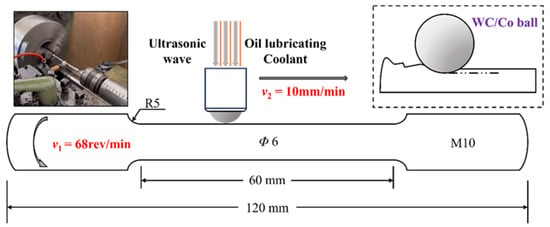
The dimensions of the samples used in the USRP and a schematic diagram of the workflow with relevant parameters are shown in Figure 1. As illustrated in the figure, the setup primarily consists of a workbench and a pressing head. During the process, the sample, clamped at both ends on the workbench, rotates about its axis. The pressing head is positioned perpendicular to and in contact with the cylindrical surface of the sample’s parallel section. The tip of the pressing head is an ultra-hard WC/Co ball, which is driven by ultrasonic vibrations at a frequency of 30 kHz to generate high-frequency impacts. Additionally, the working head is equipped with a lubricating coolant nozzle to reduce heat generation caused by friction. Simultaneously, the pressing head moves uniformly along the axis of the specimen. The standard processing area for the USRP treatment covers the entire parallel section of the specimens.
Figure 1.
Schematic of USRP device and specimen.
Based on preliminary tests and orthogonal experimental results, the USRP parameters were optimized to prevent surface spalling. The selected parameters were as follows: a static pressure of 10 MPa, a spindle rotation speed of 68 rev/min, and an axial feed rate of the pressing head of 10 mm/min, and an ultrasonic amplitude of 8 μm. Samples were subjected to USRP treatment for 0 and 4 passes.
2.3. Tensile Sample and Tensile Test
Tensile tests were conducted using a UTM 5105 electronic universal testing machine (SUNS, Shenzhen, China). The specimens which were the ones subjected to the USRP (as shown in Figure 1, Section 2.2) were cleaned using ethanol and dried in air prior to the tensile test. Each test was repeated three times to ensure the reliability of the experimental data.
2.4. Immersion Test
The 3.5 wt.% NaCl solution was prepared using analytical reagent-grade chemicals and distilled water, and its pH was adjusted to 7.0. Corrosion experiments were carried out at room temperature (25 °C). Short cylindrical segments of 10 mm in length were cut from the USRP-treated and untreated specimens (Section 2.2). Both end faces were sealed with epoxy resin to ensure that only the USRP-treated surface layer was exposed to the corrosive medium. Prior to immersion testing, the specimens were cleaned with ethanol and air-dried. After immersion, the specimens were cleaned with aqueous solutions of 1 wt.% AgNO3 and 10 wt.% CrO3 to completely remove corrosion products, followed by rinsing with water and ethanol and then air-drying. The specimens were weighed both before and after immersion. Mass measurements were performed using an analytical balance with a precision of ±0.0001 g. Each test was performed three times to ensure the reliability of the experimental data.
2.5. Electrochemical Corrosion Test
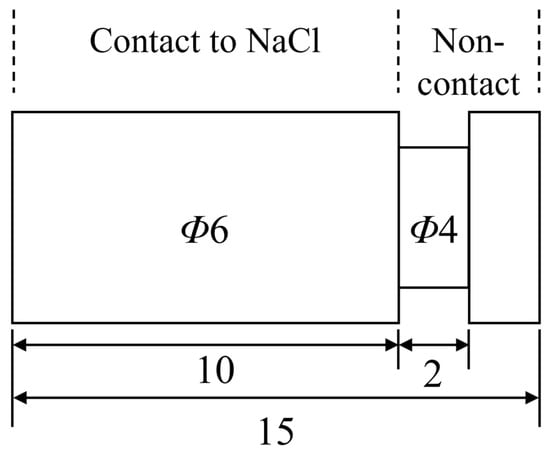
A three-electrode system connected to an RST5000 electrochemical workstation was used for the electrochemical corrosion tests. The system consisted of a platinum plate as the counter electrode, a saturated calomel electrode (SCE) as the reference electrode, and the test sample as the working electrode. Sample with dimensions as in Figure 2 were cut from the USRP-treated and untreated specimens (Section 2.2). Both ends were sealed with epoxy resin to ensure that only the USRP-treated surface layer was exposed to the corrosive medium. The specimens were cleaned with ethanol and air-dried prior to the test. The test was carried out in a 3.5 wt.% NaCl solution at room temperature (25 °C). The experiment began with monitoring the open circuit potential (OCP). Once a stable OCP was obtained, potentiodynamic polarization (PDP) tests were conducted. The scanning potential range was set from −0.5 V to +0.5 V relative to the OCP, with a scan rate of 1 mV/s. Each test was repeated three times to ensure the reliability of the experimental data.
Figure 2.
Schematic diagram of the specimen dimensions for electrochemical corrosion testing. (The extended platform is designed solely to facilitate wire connection and remains out of contact with the electrolyte.)
2.6. Analysis
Microstructure was examined by an optical microscope (OM, Axio Imager A2m, Carl Zeiss, Oberkochen, Germany), and a field-emission scanning electron microscope (SEM, Auriga, Carl Zeiss, Oberkochen, Germany) equipped with an electron backscatter diffraction (EBSD) detector. Specimens were etched in a 3% nitric acid solution for 10 s prior to OM and SEM observation. Microhardness was measured by a digital microhardness tester (HXS-1000A, SOIF, Shanghai, China). Each microhardness test was performed three times to ensure the reliability of the experimental data.
3. Results and Discussion
3.1. Apparent Morphology
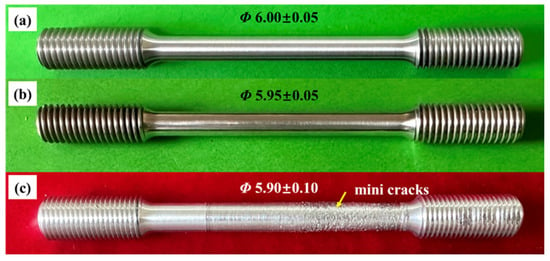
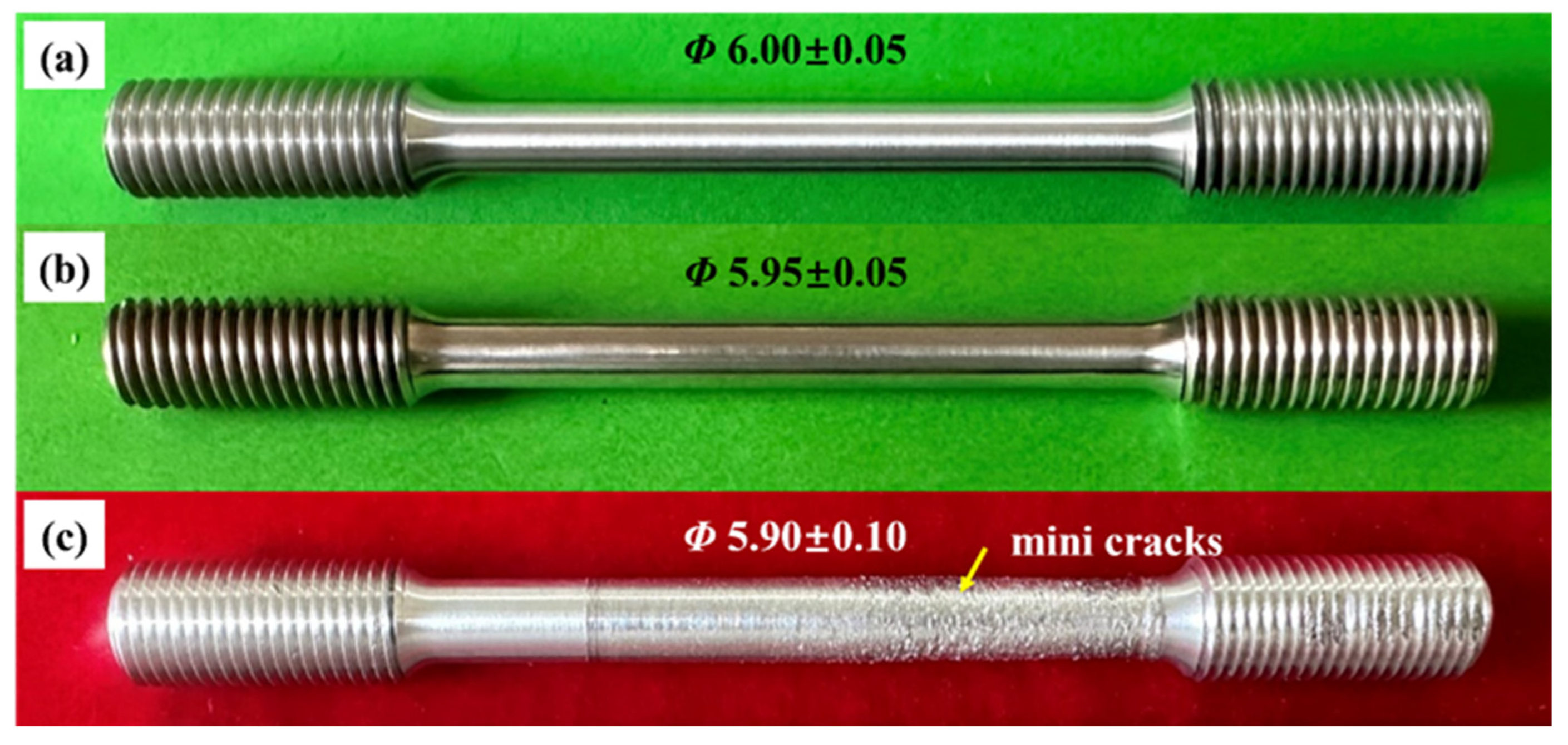
After USRP treatment, the length of the GW63K-T6 alloy specimens showed negligible change (≤0.1 mm) compared to the untreated condition, which is attributed to the ends being constrained by the clamping heads during processing. In contrast, the diameter decreased slightly from an initial 6.00 ± 0.05 mm to 5.95 ± 0.05 mm under the rolling action (Figure 3a,b). From a macroscopic perspective, after four processing passes, the surface roughness and finish remained largely unaffected, and surface integrity was preserved.
Figure 3.
Appearance of the sample: (a) untreated, (b) 4th USRP pass, and (c) 8th USRP pass.
The effect of increasing the number of processing passes was also explored, as shown in Figure 3c. After eight USRP passes, the length again showed almost no change, while the diameter further decreased to 5.90 ± 0.10 mm. Notably, surface integrity was significantly compromised, with visible cracks observed. The reason the eight-pass specimen appeared asymmetric is that the process was terminated in advance near the end of the parallel section due to safety concerns. Although detailed morphological characterization was not performed, established materials science principles indicate that such defects act as stress concentrators under mechanical loading, promoting crack initiation. Similarly, they can serve as preferential sites for corrosion initiation, thereby negatively affecting both mechanical properties and corrosion resistance.
These results indicate that the effect of the USRP on GW63K-T6 alloy intensifies with an increasing number of processing passes and that the material has a finite tolerance for such treatment. Beyond this limit, the material undergoes substantial deterioration. To avoid the adverse effects of over-processing, the number of processing passes was set to four in subsequent experiments.
3.2. Microstructure Analysis
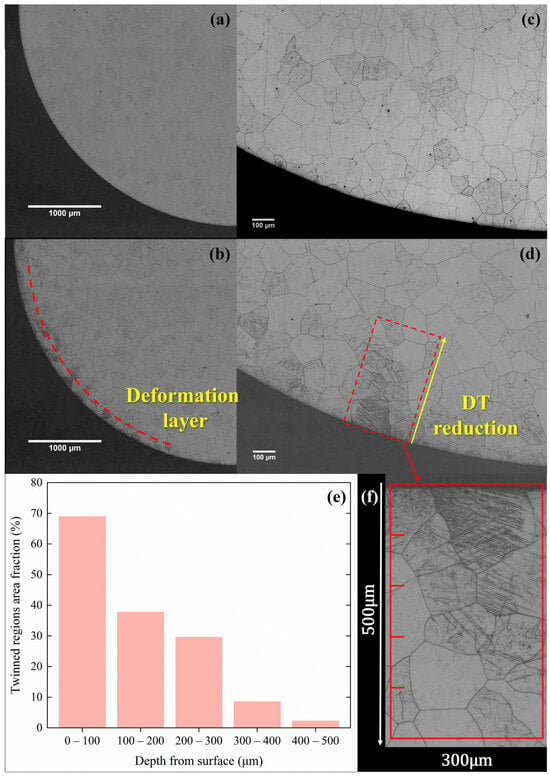
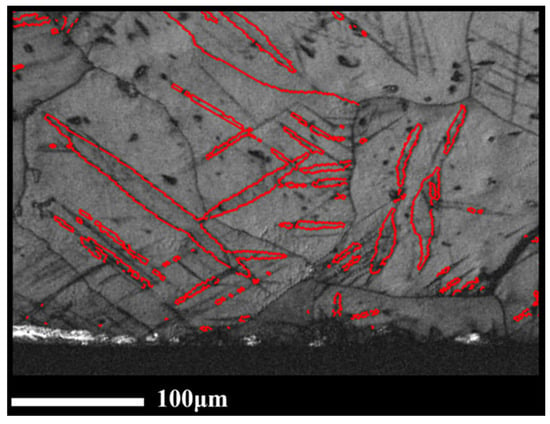
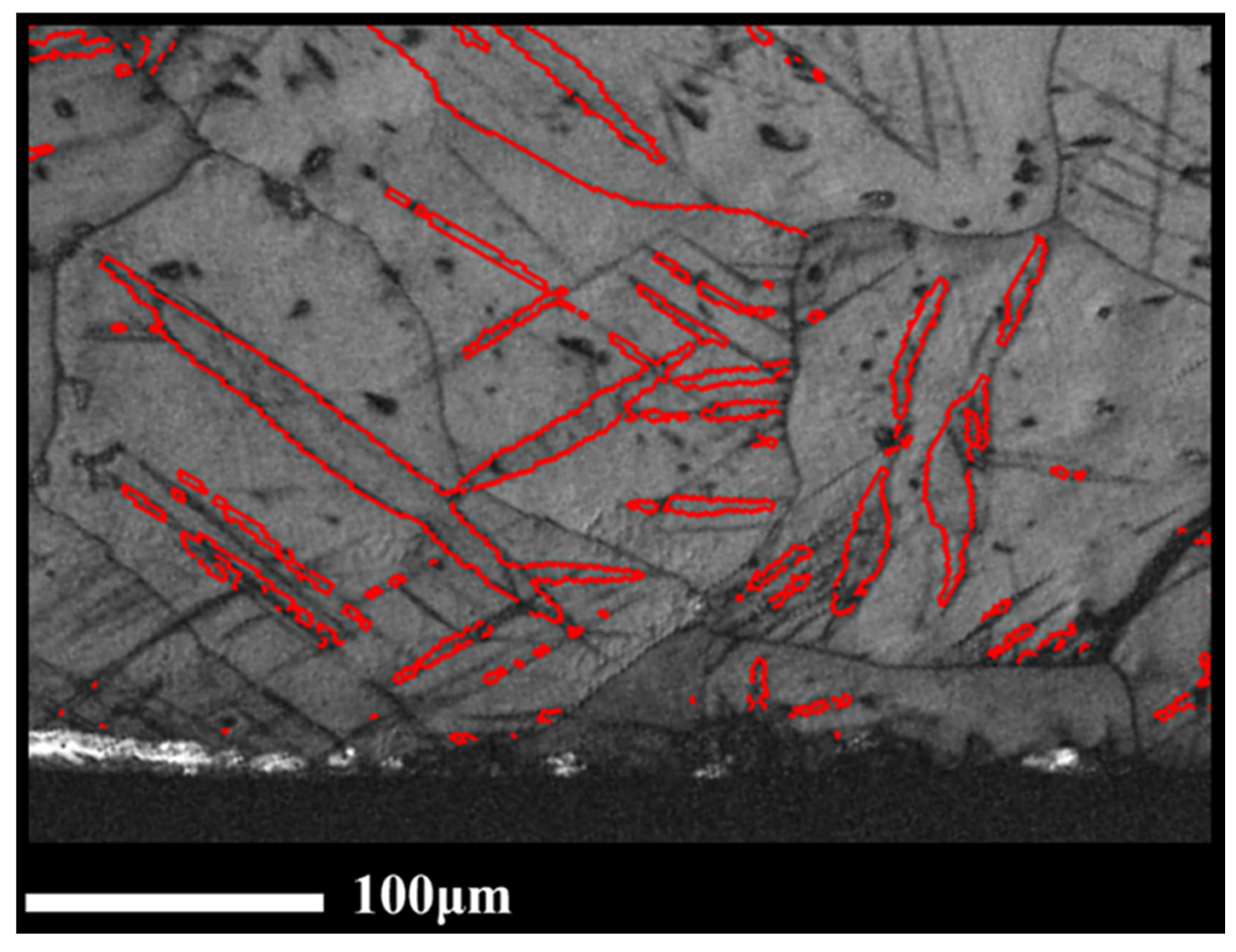
Figure 4 presents cross-sectional optical micrographs of the GW63K-T6 magnesium alloy before and after the USRP. The untreated alloy exhibits a uniform equiaxed grain structure with an average grain size of 80–120 μm (Figure 4a,c). Following the USRP, a high density of deformation twins (DTs) forms within the surface layer, while the underlying matrix remains largely unaffected. The depth of the deformation layer, defined by the extent of twinning, reaches approximately 450 μm (Figure 4b). The density and quantity of twins decrease with increasing depth in the radial direction (Figure 4d). EBSD analysis (Figure 5) confirms that the majority of these twins correspond to {10–12} extension twins [31], exhibiting both parallel and intersecting arrangements.
Figure 4.
Cross-sectional optical micrographs of the GW63K-T6 alloy before (a,c) and after (b,d) USRP treatment, along with (e) the estimated twin density as a function of depth and (f) the region used for twin density estimation.
Figure 5.
EBSD map of {10–12} extension twin boundaries (highlighted in red) in the surface layer of the GW63K-T6 Mg alloy after USRP.
A semi-quantitative estimation of twin density was performed using image-based area fraction analysis on cross-sectional OM images (Figure 4e). The results (Figure 4f) indicate a gradual decrease in twin density from the surface inward, consistent with the qualitative description of a gradient twin structure. However, this estimation should be considered as approximate, as it is based on 2D image analysis rather than comprehensive EBSD statistics.
The above results indicate that USRP treatment generates a gradient-distributed {10–12} twin structure in the surface layer of the GW63K-T6 alloy, with the twin density decreasing progressively with increasing distance from the surface.
This gradient distribution arises because, during the USRP, the specimen remains in continuous contact with a processing ball that vibrates at ultrasonic frequency, applying a constant static pressure to the sample and inducing severe plastic deformation through high-speed shear (Section 2.2, Figure 1). Following contact, the material undergoes both plastic deformation and elastic recovery, resulting in a complex stress state characterized by localized tensile stress maxima. Plastic deformation is the most pronounced at the surface and attenuates with depth.
Magnesium alloys possess a hexagonal close-packed (HCP) structure and readily undergo basal slip and twinning due to their low critical resolved shear stress (CRSS). Although twinning requires a slightly higher CRSS than basal slip, it initiates preferentially because basal slip alone cannot accommodate the imposed deformation. Consequently, accumulated and entangled twins form at the surface during the USRP. Beneath the top layer, reduced plastic deformation continues to produce twins through dislocation interactions. As depth increases and stress levels decrease, the density of DTs gradually declines (Figure 4). This phenomenon has also been reported in the literature concerning other magnesium alloys treated by the USRP [19,20,23,24,26,27,28,29] or by other surface treatment techniques [32].
3.3. Mechanical Properties
3.3.1. Microhardness
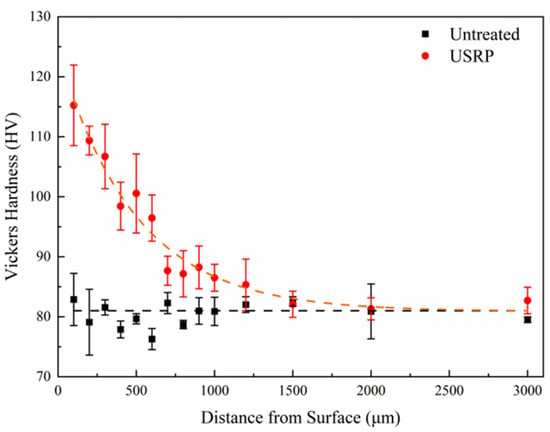
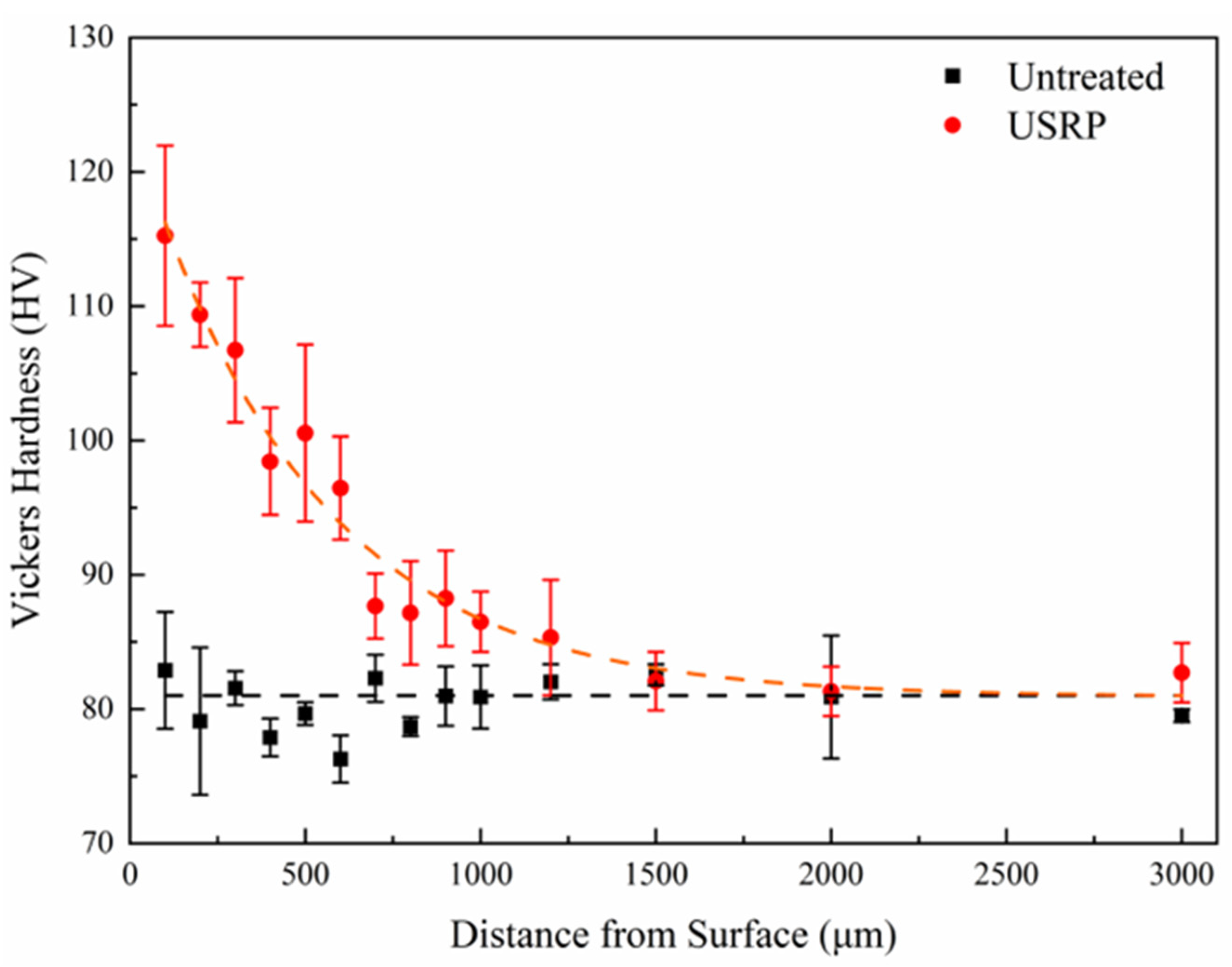
The microhardness distribution across the cross-section of the GW63K-T6 sample before and after the USRP is presented in Figure 6. The surface microhardness of the USRP-treated sample increases significantly to 115.24 ± 6.72 HV, which is approximately 40% higher than that of the untreated sample (~80 HV). The hardness exhibits a distinct gradient, decreasing progressively from the outer surface toward the matrix. The hardened layer extends to a depth of about 1500 µm. These results indicate that the USRP enhances the surface hardness of the GW63K-T6 alloy, likely due to the gradient structure of deformation twins formed in the surface region (Section 3.2, Figure 4).
Figure 6.
Hardness distribution in untreated and USRP-treated GW63K-T6 specimens.
3.3.2. Tensile Properties
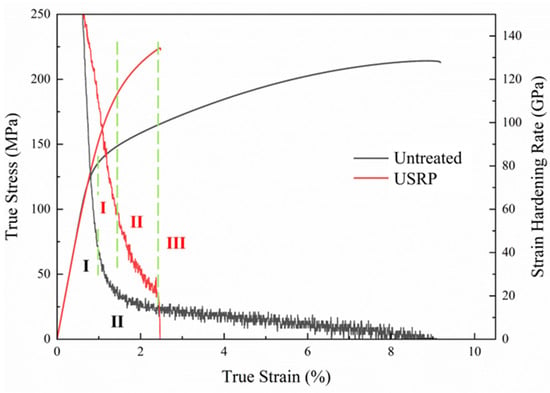
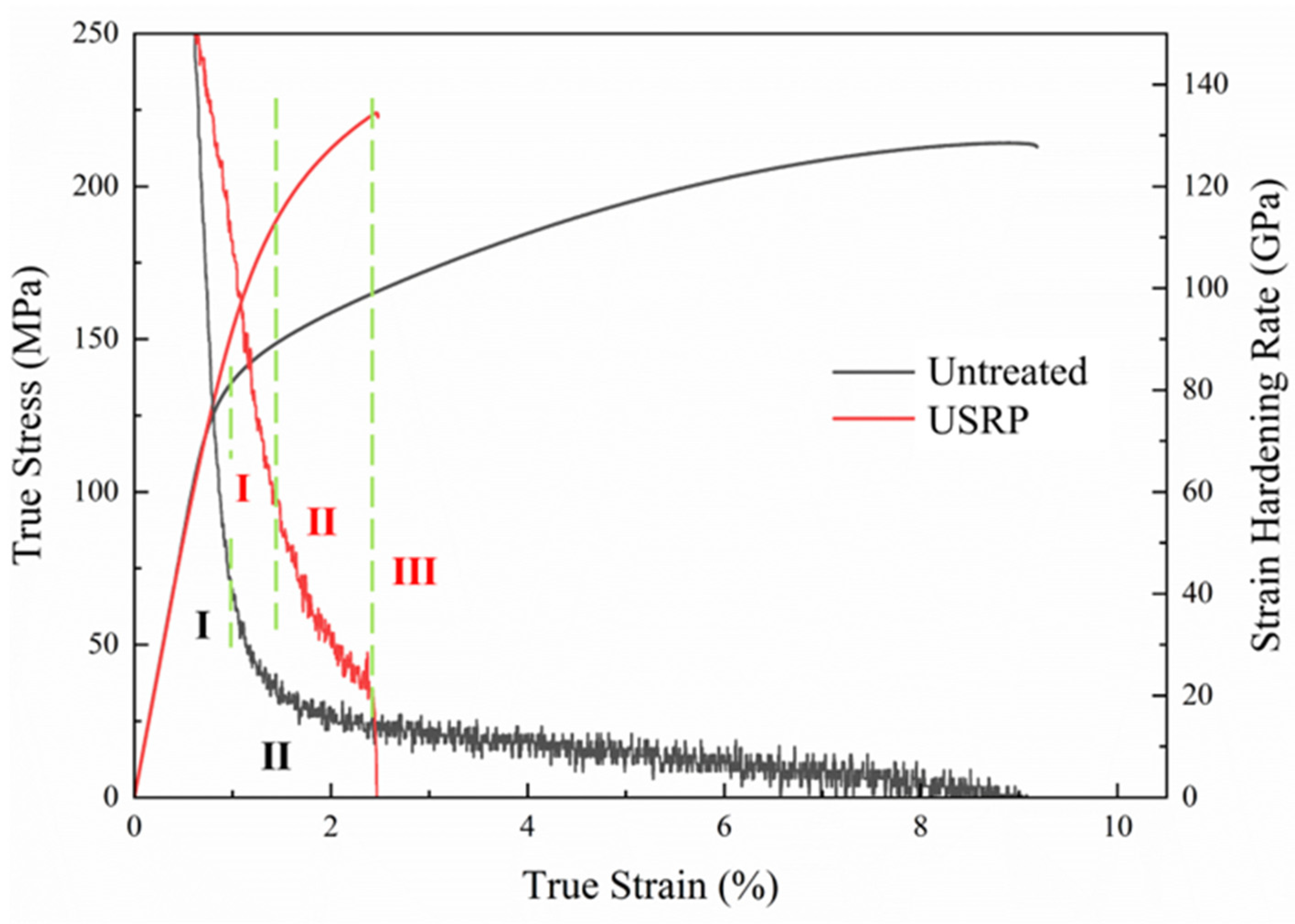
Figure 7 shows true stress–strain curves and corresponding strain-hardening rates for untreated and USRP-treated GW63K-T6 alloy, revealing pronounced differences in mechanical response. The untreated sample exhibits stable plastic deformation with sustained work hardening. In contrast, the USRP-treated sample displays a higher initial flow stress and a steeper stress rise at low strains, reaching a stress level comparable to the maximum of the untreated condition at only ~2% true strain. This enhancement is accompanied by significantly reduced uniform elongation and earlier plastic instability, indicating a trade-off between strength and ductility.
Figure 7.
Work hardening rate and true stress–strain curves for the untreated and USRP-treated GW63K-T6 magnesium alloy.
After the USRP, yield strength increases from 134.5 MPa to 169.7 MPa (a 26.2% improvement), while ultimate tensile strength rises from 196.4 MPa to 218.5 MPa (an 11.3% increase), confirming the notable strengthening effect of the process.
The strain-hardening behavior further clarifies the underlying deformation mechanisms. For the as-received sample, the strain-hardening rate gradually declines, reflecting a balance between dislocation accumulation and dynamic recovery. The USRP-treated sample, however, shows an exceptionally high strain-hardening rate in early deformation (Stage I, marked in red), exceeding 100 GPa. This rate drops sharply in Stage II, suggesting accelerated dynamic recovery and dislocation rearrangement, and approaches zero in Stage III, indicating exhaustion of strain-hardening capacity and onset of plastic instability. These results indicate that USRP treatment fundamentally alters the strain-hardening pathway of the GW63K-T6 alloy, transforming the original continuous and gradual hardening process into one characterized by intense variation.
According to the classical Taylor hardening relationship [21] and subsequent models incorporating deformation twinning [33], the work-hardening rate can be expressed as a simplified form:
where θI is the Stage I work-hardening rate, ftwin is the twin volume fraction or twin boundary density, and k is a material-dependent constant related to the Hall–Petch effect of twin boundaries. According to this relationship, an increase in twin density directly contributes to a higher work-hardening rate. In the present study, the USRP introduces a high density of deformation twins in the surface layer. Therefore, the observed exceptionally high Stage I hardening rate can be reasonably attributed to the increased twin density.
θI = θ0 + k · ftwin
3.3.3. Strengthen Mechanisms
In this experiment, the USRP significantly enhanced the tensile strength of the GW63K-T6 alloy at the cost of reduced elongation. Moreover, the USRP dramatically altered the strain-hardening behavior of the alloy, shifting it from a gradual process to an intensified three-stage pathway.
The distinct deformation behavior induced by the USRP can thus be attributed to microstructural pre-hardening, primarily driven by the formation of a high density of deformation twins in the surface layer (Figure 4). These DTs may enhance strain-hardening through multiple mechanisms: (1) potentially grain refinement and shortened dislocation-slip paths (Hall–Petch effect); (2) lattice reorientation into more resistant crystallographic directions; and (3) localized strengthening via the Basinski mechanism, wherein twinned regions are intrinsically stronger than the surrounding untwined matrix under strain.
During tensile deformation, cracks typically initiate at the surface due to stress concentration and the presence of surface defects. The USRP-modified surface layer, although occupying a small volume fraction, plays a critical role in suppressing surface crack initiation through the high density of twins and dislocations, which act as barriers to dislocation motion. Once crack initiation is delayed, the overall yield strength increases significantly, even if the modified layer is thin. This mechanism is well documented in surface-strengthened materials [34].
Furthermore, the gradient structure generated by the USRP improves yield strength through synergistic coupling between the deformation-twin-enriched surface and the softer interior. During tensile deformation, strain incompatibility at the interface between the hardened surface and the yielding matrix promotes the formation of geometrically necessary dislocations, resulting in back-stress strengthening. Consequently, the overall yield strength exceeds predictions based on the rule of mixtures, suggesting that the DT-mediated gradient structure may enhance mechanical properties beyond conventional composite models [28,29,31,35,36].
Similarly, the USRP enhances surface hardness through the formation of a DT-rich layer (Figure 6). The resulting hardness exhibits a distinct gradient that closely corresponds to the spatial distribution of the twins, further illustrating the role of deformation twins in governing surface-mechanical properties.
The deformation twin layer (~450 μm) likely corresponds to the region where the plastic strain exceeds the critical resolved shear stress for {10–12} twin nucleation. The much deeper hardened layer (~1500 μm) may include not only the twin-bearing zone but also a dislocation-dominated zone (450–1500 μm), where basal and prismatic slip could occur without twinning, and possibly an elastic residual stress zone that extends further. Both dislocation slip and residual compressive stress may contribute to the measured hardness increase without producing observable twins. This interpretation appears to be consistent with the gradient hardening behavior reported in surface-mechanical-treated Mg alloys [20,26,29].
3.4. Corrosion-Resistance
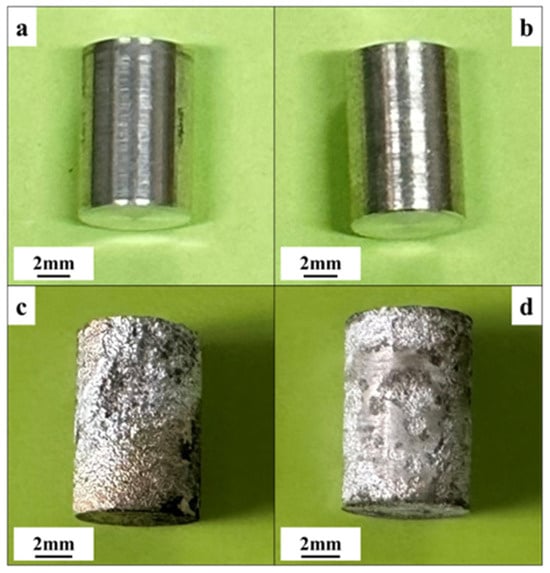
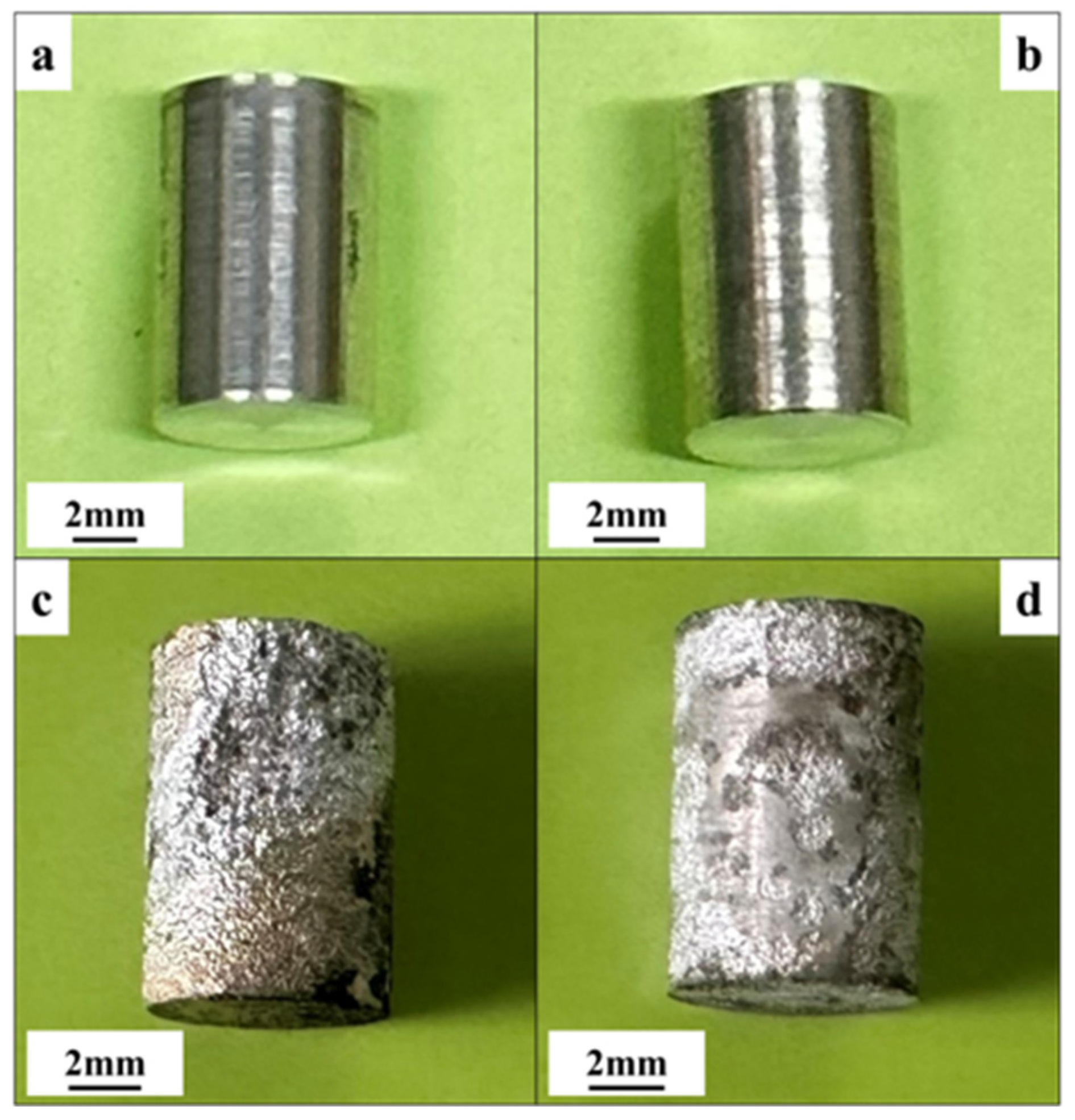
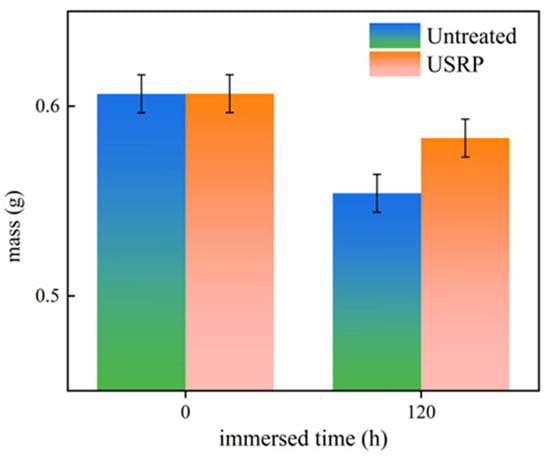
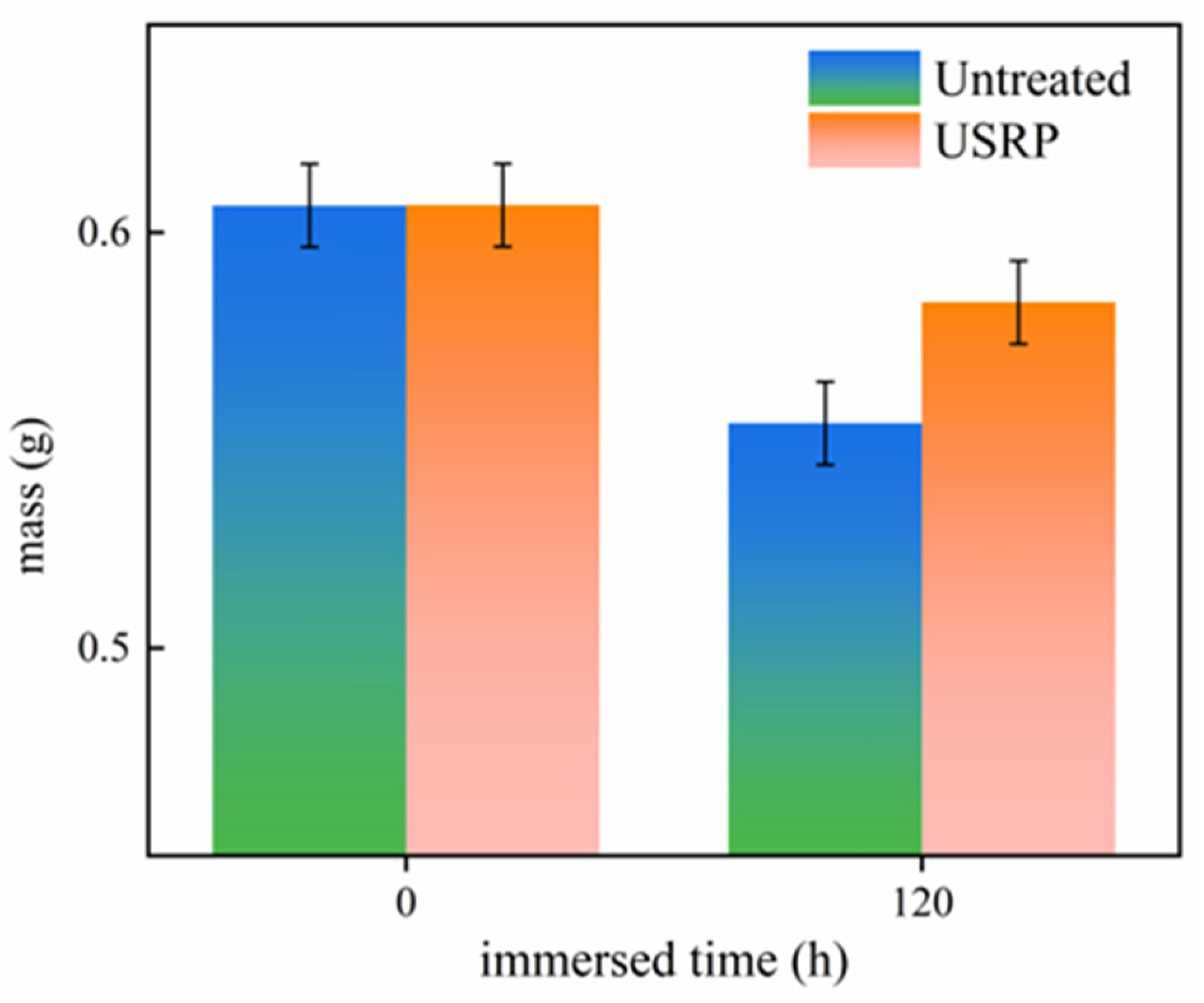
Figure 8 compares the surface morphology of the GW63K-T6 magnesium alloy before and after USRP treatment, following 120 h of immersion corrosion in a 3.5 wt.% NaCl solution. It can be observed that after 120 h of corrosion, the alloy surface exhibits obvious corrosion, primarily in the form of pitting, and the USRP-treated specimen (Figure 8d) appears to show a lower degree of corrosion than the untreated one (Figure 8c). Further gravimetric analysis (Figure 9) indicates that after USRP treatment, the mass loss of the GW63K-T6 magnesium alloy due to 120 h of corrosion in 3.5 wt.% NaCl solution is reduced. The residual mass after corrosion increased from 0.554 ± 0.01 g (initial mass: 0.606 ± 0.01 g) to 0.583 ± 0.01 g. These results demonstrate that USRP treatment improves the corrosion resistance of the GW63K-T6 magnesium alloy.
Figure 8.
Surface morphology of GW63K-T6 specimens before and after 120 h of immersion corrosion: (a) untreated, prior to corrosion; (b) USRP-treated, prior to corrosion; (c) untreated, after corrosion; (d) USRP-treated, after corrosion.
Figure 9.
Comparison of mass change in GW63K-T6 alloy before and after USRP treatment, following 120 h of immersion corrosion in a 3.5 wt.% NaCl solution.
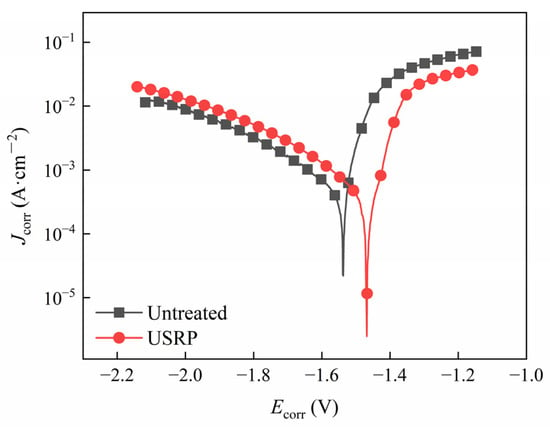
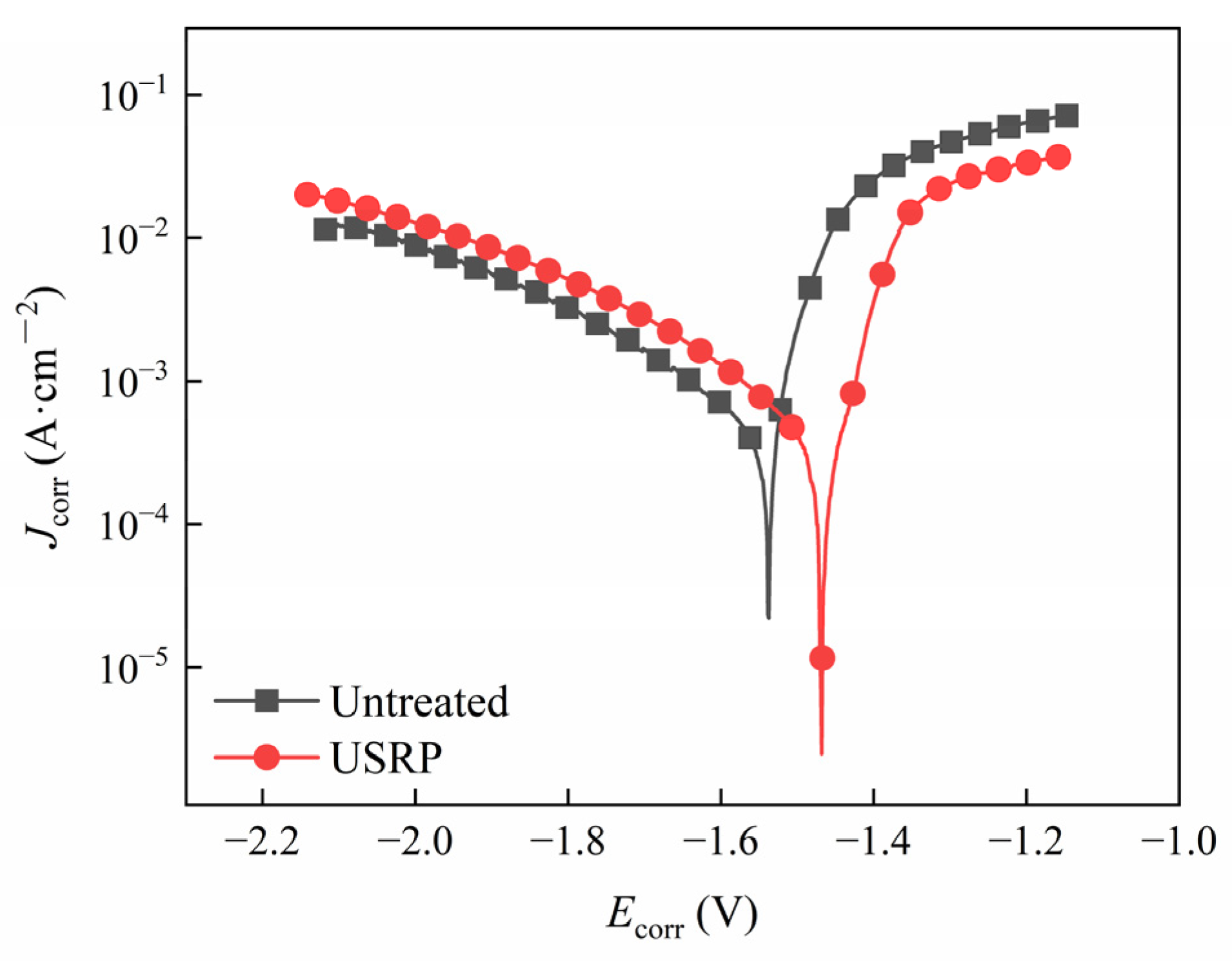
PDP curves for USRP-treated and untreated GW63K-T6 alloy samples are presented in Figure 10. Following USRP treatment, the polarization curve exhibits a positive shift in corrosion potential and a decrease in current density, suggesting improved corrosion resistance. This observation is consistent with the gravimetric results (Figure 9), which show a significant reduction in weight loss after 120 h of immersion corrosion.
Figure 10.
Potentiodynamic polarization curves for the untreated and USRP-treated GW63K-T6 alloy samples.
Conventional understanding holds that twinning, particularly deformation twinning, generally degrades corrosion resistance in magnesium alloys [32]. This is because magnesium atoms at twin boundaries possess higher potential energy than those in the matrix, making them more prone to losing electrons during corrosion reactions, thereby serving as initiation sites and accelerating the corrosion process. In contrast, experimental results show that after USRP treatment, the GW63K-T6 magnesium alloy develops a gradient deformation twin structure on the surface and exhibits improved corrosion resistance. In the following section, the corrosion process is analyzed to elucidate the underlying reasons for this outcome.
During the corrosion of the GW63K magnesium alloy, magnesium loses electrons to form ions. The free electrons combine with water to generate OH− and hydrogen gas, while OH− further reacts with Mg2+ to form Mg(OH)2 corrosion products on the alloy surface. This process can be described by Equations (2)–(4):
Mg → Mg2+ + 2e−
2H2O + 2e− → H2 + 2OH−
Mg2+ + 2OH− → Mg (OH)2
It should be acknowledged that the corrosion chemistry of Mg is more complex than the simplified reactions shown in Equations (2)–(4). The roles of Gd and Y alloying elements, particularly their influence on surface film formation and micro-galvanic effects, are important aspects that deserve further investigation.
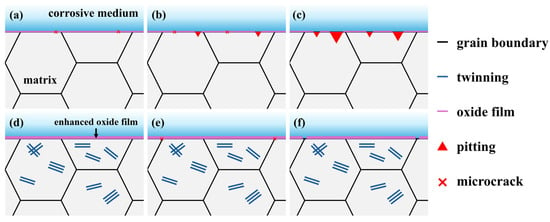
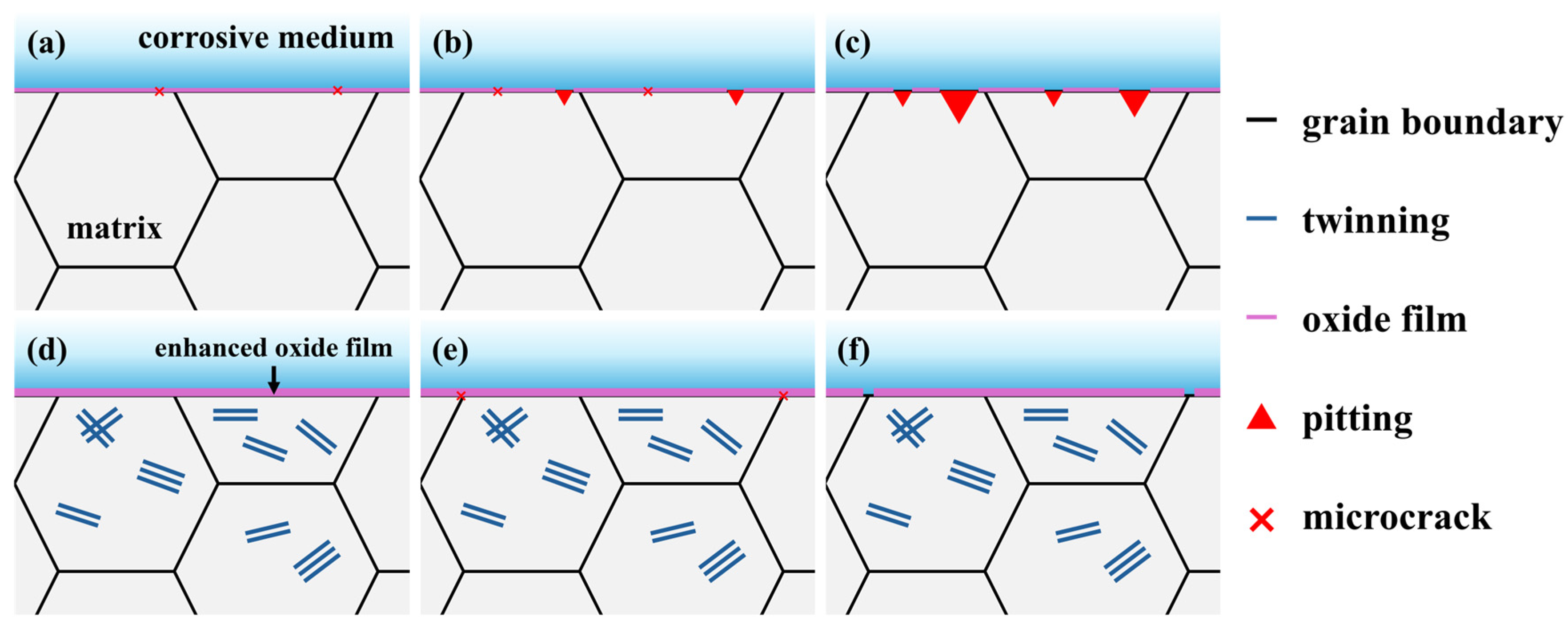
In addition, magnesium exposed to air undergoes slow oxidation. Collectively, these surface oxides and corrosion products are collectively referred to as an oxide film, which provides a certain degree of protection to the magnesium matrix. However, this protective effect is limited. As corrosion progresses, the oxide film ruptures under surface tension (Figure 11a), allowing the matrix to further contact the corrosive medium (in this case, NaCl solution), leading to the formation of corrosion pits and microcracks (Figure 11b). As corrosion continues, the pits enlarge (Figure 11c), further accelerating the corrosion process.
Figure 11.
Schematic illustration of the corrosion process of the GW63K alloy: (a–c) untreated; (d–f) USRP-treated.
It is hypothesized that the higher oxidation activity of atoms on twin planes [37] may facilitate the formation of a more protective oxide film during the initial corrosion stage, potentially increasing charge-transfer resistance and helping to suppress pitting initiation (Figure 11d). However, direct experimental verification of this mechanism (e.g., by XPS or TEM) was not performed in the present study and should be addressed in future work.
Furthermore, fully coherent twin boundaries possess measurably lower interfacial energy than incoherent grain boundaries [38]. For example, {10–12} extension twin boundaries in pure magnesium have energies between 0.11 and 0.20 J·m−2 [39], whereas general grain boundaries exhibit substantially higher energies of 0.41–0.60 J·m−2 [40]. As the oxide film thickens, microcracks induced by orientation-stress inhomogeneity thus tend to nucleate and propagate preferentially along grain boundaries rather than twin interfaces (Figure 11e). Additionally, GW63K magnesium alloy exhibits negligible susceptibility to intergranular corrosion, which is to some extent beneficial for its corrosion resistance. These observations suggest that while twin boundaries do not actively promote crack initiation, their lower interfacial energy redirects crack propagation away from twin interfaces, thereby delaying failure.
This difference in interfacial stability likely contributes to the corrosion resistance enhancement observed in twinned microstructures, consistent with earlier work by Zou et al. [41], who reported reduced corrosion tendency and rate in extruded Mg-Y alloys containing extension twins.
3.5. Limitations and Perspectives
While the present study provides valuable experimental evidence for the simultaneous enhancement of mechanical properties and corrosion resistance in GW63K-T6 magnesium alloy via the USRP, several limitations should be acknowledged.
1. Quantitative characterization of the twin structure was not fully achieved. Although a semi-quantitative estimation of twin density was performed using image-based area fraction analysis on cross-sectional OM images (Figure 4e,f), this method is based on 2D image analysis rather than comprehensive EBSD-based twin statistics. The results should therefore be considered as approximate and indicative of a trend rather than a rigorous quantitative measurement.
2. Direct measurements of residual stress, dislocation density, and texture evolution were not performed in this study. These factors are known to play important roles in the mechanical behavior of surface-strengthened materials and may also contribute to the observed strengthening and corrosion resistance improvements. In particular, residual compressive stress is widely recognized as a major contributor to the enhanced yield strength in USRP-treated materials, and texture evolution is known to significantly influence both mechanical properties and corrosion behavior in Mg alloys. Their potential contributions cannot be excluded based on the current data.
3. Surface roughness was not quantitatively assessed. Although macroscopic observation did not reveal significant surface quality deterioration after four passes of USRP treatment, roughness variations may still influence corrosion performance and should be considered when interpreting the corrosion results.
4. The proposed mechanism that twins promote the formation of a more protective oxide film remains a hypothesis based on literature reports and indirect experimental observations. Direct characterization of oxide film composition and thickness (e.g., by XPS or TEM) was not performed, and further experimental verification is needed to confirm this mechanism.
Given these limitations, the conclusion that deformation twins are the primary controlling factor for the observed property enhancements should be interpreted with caution. The current evidence supports a correlation between twin density and property improvement rather than direct proof of causation. Future work incorporating quantitative twin characterization, residual stress measurements, texture analysis, dislocation characterization, and oxide film analysis is needed to fully validate the proposed mechanisms and to distinguish the individual contributions of twins, dislocations, residual stresses, and texture to the overall performance enhancement.
Despite these limitations, the present study provides a clear and consistent set of experimental observations—including gradient twin distribution, improved microhardness and tensile strength, reduced corrosion weight loss, and nobler electrochemical parameters—that collectively support the beneficial role of the USRP in enhancing the surface performance of GW63K-T6 magnesium alloy. The findings offer a useful foundation for further mechanistic studies and practical applications of the USRP in Mg-RE alloys.
4. Conclusions
In this study, an ultrasonic surface rolling process was employed to enhance the surface performance of a GW63K-T6 magnesium alloy, leading to simultaneous improvements in both mechanical properties and corrosion resistance. The principal findings are as follows:
1. The USRP produced a deformation layer approximately 450 μm thick, characterized by a gradient microstructure comprising deformation twins with a density that decreases progressively from the surface inward.
2. Mechanical properties of the GW63K-T6 alloy were significantly enhanced after USRP treatment. Surface microhardness increased by approximately 40%, yield strength by about 26%, and ultimate tensile strength by roughly 11%. These improvements are suggested to be associated with the high density of DTs, which may strengthen the surface through dislocation-slip hindrance and strain-hardening effects, supported by the Basinski hardening mechanism. Meanwhile, plasticity was notably reduced, which is likely related to strain localization promoted by dislocation accumulation and limited dislocation storage capacity in the surface layer.
3. Following USRP treatment, the corrosion resistance of the alloy was significantly improved, as evidenced primarily by a weight loss reduction of approximately 50% after 120 h of immersion corrosion. This enhancement is further supported by the polarization curves, which show a positive shift in corrosion potential and a decrease in current density for the USRP-treated samples. This enhancement is correlated with the formation of a protective oxide film, possibly facilitated by the high oxidation activity of DT planes and the lower interfacial energy of coherent twin boundaries, which may mitigate crack initiation along boundaries.
4. The simultaneous enhancement in both mechanical and corrosion properties is closely associated with the gradient-distributed DTs introduced by the USRP. These DTs may contribute to surface strengthening through microstructural refinement and back-stress effects and may also promote the formation of a stable surface oxide, suggesting a potential twin-mediated synergy between mechanical performance and corrosion resistance.
5. It should be acknowledged that direct measurements of residual stress, dislocation density, texture evolution, and oxide film composition were not performed in this study. Therefore, the interpretation that deformation twins are the primary controlling factor remains a hypothesis based on observed correlations. Future work incorporating these measurements is needed to fully validate the proposed mechanisms.
Author Contributions
Conceptualization, T.L. and F.Y.; methodology, T.L. and B.L.; formal analysis, T.L., F.Y. and H.D.; investigation, T.L., L.C. and X.W.; resources, H.D. and F.Y.; writing—original draft preparation, T.L. and X.W.; writing—review and editing, T.L., F.Y. and H.D.; project administration, H.D. and F.Y.; funding acquisition, B.L. and F.Y. All authors have read and agreed to the published version of the manuscript.
Funding
This research was funded by National Natural Science Foundation of China, grant number 52371130.
Data Availability Statement
The data presented in this study is available on request from the corresponding author.
Conflicts of Interest
Author Lun Cui and Haoyang Du were employed by the Company of Jilin Electric Power Research Institute Co., Ltd. The remaining authors declare that the research was conducted in the absence of any commercial or financial relationships that could be construed as potential conflicts of interest.
References
- Hirsch, J.; Al-Samman, T. Superior light metals by texture engineering: Optimized aluminum and magnesium alloys for automotive applications. Acta Mater. 2013, 61, 818–843. [Google Scholar] [CrossRef] [Scilit]
- Song, J.; She, J.; Chen, D.; Pan, F. Latest research advances on magnesium and magnesium alloys worldwide. J. Magnes. Alloys 2020, 8, 1–41. [Google Scholar] [CrossRef] [Scilit]
- Woodtli, J.; Kieselbach, R. Damage due to hydrogen embrittlement and stress corrosion cracking. Eng. Fail. Anal. 2000, 7, 427–450. [Google Scholar] [CrossRef] [Scilit]
- Song, B.; Xin, R.; Guo, N.; Xu, J.; Sun, L.; Liu, Q. Dependence of tensile and compressive deformation behavior on aging precipitation in rolled ZK60 alloys. Mater. Sci. Eng. A 2015, 639, 724–731. [Google Scholar] [CrossRef] [Scilit]
- He, S.M.; Zeng, X.Q.; Peng, L.M.; Gao, X.; Nie, J.F.; Ding, W.J. Precipitation in a Mg–10Gd–3Y–0.4Zr (wt.%) alloy during isothermal ageing at 250 °C. J. Alloys Compd. 2006, 421, 309–313. [Google Scholar] [CrossRef] [Scilit]
- Guo, X.-W.; Chang, J.-W.; He, S.-M.; Ding, W.-J.; Wang, X. Investigation of corrosion behaviors of Mg–6Gd–3Y–0.4Zr alloy in NaCl aqueous solutions. Electrochim. Acta 2007, 52, 2570–2579. [Google Scholar] [CrossRef] [Scilit]
- Chang, J.; Guo, X.; He, S.; Fu, P.; Peng, L.; Ding, W. Investigation of the corrosion for Mg–xGd–3Y–0.4Zr (x=6,8,10,12wt%) alloys in a peak-aged condition. Corros. Sci. 2008, 50, 166–177. [Google Scholar] [CrossRef] [Scilit]
- Liang, S.; Guan, D.; Tan, X. The relation between heat treatment and corrosion behavior of Mg–Gd–Y–Zr alloy. Mater. Des. 2011, 32, 1194–1199. [Google Scholar] [CrossRef] [Scilit]
- Li, S.-Y.; Li, D.-J.; Zeng, X.-Q.; Ding, W.-J. Microstructure and mechanical properties of Mg–6Gd–3Y–0.5Zr alloy processed by high-vacuum die-casting. Trans. Nonferrous Met. Soc. China 2014, 24, 3769–3776. [Google Scholar] [CrossRef] [Scilit]
- Song, G.; StJohn, D. The effect of zirconium grain refinement on the corrosion behaviour of magnesium-rare earth alloy MEZ. J. Light Met. 2002, 2, 1–16. [Google Scholar] [CrossRef] [Scilit]
- Sudholz, A.D.; Gusieva, K.; Chen, X.B.; Muddle, B.C.; Gibson, M.A.; Birbilis, N. Electrochemical behaviour and corrosion of Mg–Y alloys. Corros. Sci. 2011, 53, 2277–2282. [Google Scholar] [CrossRef] [Scilit]
- Cao, F.; Shi, Z.; Song, G.-L.; Liu, M.; Atrens, A. Corrosion behaviour in salt spray and in 3.5% NaCl solution saturated with Mg(OH)2 of as-cast and solution heat-treated binary Mg–X alloys: X=Mn, Sn, Ca, Zn, Al, Zr, Si, Sr. Corros. Sci. 2013, 76, 60–97. [Google Scholar] [CrossRef] [Scilit]
- Shi, Z.; Cao, F.; Song, G.-L.; Liu, M.; Atrens, A. Corrosion behaviour in salt spray and in 3.5% NaCl solution saturated with Mg(OH)2 of as-cast and solution heat-treated binary Mg–RE alloys: RE=Ce, La, Nd, Y, Gd. Corros. Sci. 2013, 76, 98–118. [Google Scholar] [CrossRef] [Scilit]
- Wang, J.; Yang, Y.-S.; Tong, W.-H. Effect of purification treatment on corrosion resistance of Mg-Gd-Y-Zr alloy. Trans. Nonferrous Met. Soc. China 2011, 21, 949–954. [Google Scholar] [CrossRef] [Scilit]
- Wang, H.; Song, G.; Tang, G. Enhanced surface properties of austenitic stainless steel by electropulsing-assisted ultrasonic surface rolling process. Surf. Coat. Technol. 2015, 282, 149–154. [Google Scholar] [CrossRef] [Scilit]
- Han, X.; Li, C.; Chen, C.; Zhang, X.; Zhang, H. Fabrication of Low Roughness Gradient Nanostructured Inner Surface on an AISI 304 Stainless Steel Pipe via Ultra-Sonic Rolling Treatment (USRT). Nanomaterials 2021, 11, 1769. [Google Scholar] [CrossRef] [Scilit] [PubMed]
- Li, H.; Zhang, J.; Ao, N.; Xu, J.; Ji, D. Influence of residual stress and its relaxation on the corrosion bending fatigue resistance of EA4T axle steel treated by ultrasonic surface rolling. Int. J. Fatigue 2023, 170, 107561. [Google Scholar] [CrossRef] [Scilit]
- Yang, M.; Lei, L.; Jiang, Y.; Xu, F.; Yin, C. Simultaneously improving tensile properties and stress corrosion cracking resistance of 7075-T6 aluminum alloy by USRP treatment. Corros. Sci. 2023, 218, 111211. [Google Scholar] [CrossRef] [Scilit]
- Ye, H.; Sun, X.; Liu, Y.; Rao, X.-X.; Gu, Q. Effect of ultrasonic surface rolling process on mechanical properties and corrosion resistance of AZ31B Mg alloy. Surf. Coat. Technol. 2019, 372, 288–298. [Google Scholar] [CrossRef] [Scilit]
- Geng, J.; Yan, Z.; Zhang, H.; Liu, Y.; Dong, P.; Yuan, S.; Wang, W. Microstructure and Mechanical Properties of AZ31B Magnesium Alloy via Ultrasonic Surface Rolling Process. Adv. Eng. Mater. 2021, 23, 2100076. [Google Scholar] [CrossRef] [Scilit]
- Barnett, M.R. Twinning and the ductility of magnesium alloys: Part I: “Tension” twins. Mater. Sci. Eng. A 2007, 464, 1–7. [Google Scholar] [CrossRef] [Scilit]
- Dou, Z.; Jiang, H.; Ao, R.; Luo, T.; Zhang, D. Improving the Surface Friction and Corrosion Resistance of Magnesium Alloy AZ31 by Ion Implantation and Ultrasonic Rolling. Coatings 2022, 12, 899. [Google Scholar] [CrossRef] [Scilit]
- Zhou, M.; Xu, Y.; Liu, Y.; Duan, M.; Xia, Z.; Huang, L.; Zhu, R.; Ye, H.; Peng, L.; Wu, Y.; et al. Microstructures and mechanical properties of Mg-15Gd-1Zn-0.4Zr alloys treated by ultrasonic surface rolling process. Mater. Sci. Eng. A 2021, 828, 141881. [Google Scholar] [CrossRef] [Scilit]
- Zhou, M.; Cheng, H.; Wang, J.; Zhu, L. Effect of twin assisted precipitation on the microstructure and mechanical properties of gradient structure Mg-Gd-Zn-Zr alloy. Vacuum 2023, 213, 112162. [Google Scholar] [CrossRef] [Scilit]
- Xu, F.; Huang, L.; Liu, G. Effect of ultrasonic surface rolling process on the surface properties of Mg-Gd-Zn-Zr alloy. Mater. Lett. 2024, 365, 136398. [Google Scholar] [CrossRef] [Scilit]
- Chen, L.; Li, W.; Sun, Y.; Luo, M. Effect of microstructure evolution on the mechanical properties of a Mg–Y–Nd–Zr alloy with a gradient nanostructure produced via ultrasonic surface rolling processing. J. Alloys Compd. 2022, 923, 166495. [Google Scholar] [CrossRef] [Scilit]
- Liu, Y.; Li, W.; Sun, Y.; Chen, L.; Chang, G.; Deng, G. Effect of ultrasonic surface rolling process on microstructure and properties of rolled Mg-Y-Nd-Zr alloy. J. Mater. Sci. 2023, 58, 9362–9381. [Google Scholar] [CrossRef] [Scilit]
- Chen, L.; Li, W.; Luo, M. Effect of stacking faults in nanograins on the tensile properties of Mg–Y–Nd–Gd–Zr alloys subjected to ultrasonic surface rolling processing. Surf. Coat. Technol. 2022, 436, 128305. [Google Scholar] [CrossRef] [Scilit]
- Wang, S.; Li, W.; Chen, L.; Luo, L.; Meng, G.; Chang, G.; Liu, Q. Formation mechanism of surface gradient microstructure and mechanical properties evolution of Mg–Y-Nd-Gd-Zr alloy by ultrasonic rolling. J. Mater. Res. Technol. 2024, 30, 6482–6497. [Google Scholar] [CrossRef] [Scilit]
- Lan, T.; Ye, F.; Liu, B.; Du, H. Study on the Effect of Corrosion on Tensile Properties of GW63K Magnesium Alloy. Materials 2025, 18, 2244. [Google Scholar] [CrossRef] [Scilit] [PubMed]
- Lu, S.H.; Wu, D.; Chen, R.S.; Han, E.-H. Microstructure and texture optimization by static recrystallization originating from {10–12} extension twins in a Mg-Gd-Y alloy. J. Mater. Sci. Technol. 2020, 59, 44–60. [Google Scholar] [CrossRef] [Scilit]
- Wang, G.-Q.; Wang, S.-R.; Yang, X.-F.; Wen, D.-S.; Guo, Y. Microstructure, mechanical properties and fretting corrosion wear behavior of biomedical ZK60 Mg alloy treated by laser shock peening. Trans. Nonferrous Met. Soc. China 2023, 33, 1715–1728. [Google Scholar] [CrossRef] [Scilit]
- Kalidindi, S.R. Incorporation of deformation twinning in crystal plasticity models. J. Mech. Phys. Solids 1998, 46, 267–290. [Google Scholar] [CrossRef] [Scilit]
- Nagumo, M. Lattice Deterioration Precursory to Damage Evolution: Complementary Aspect on Fracture ~Overview~. ISIJ Int. 2026, 66, 429–451. [Google Scholar] [CrossRef] [Scilit]
- Li, L.; Liu, W.; Qi, F.; Wu, D.; Zhang, Z. Effects of deformation twins on microstructure evolution, mechanical properties and corrosion behaviors in magnesium alloys—A review. J. Magnes. Alloys 2022, 10, 2334–2353. [Google Scholar] [CrossRef] [Scilit]
- Zhu, S.Q.; Ringer, S.P. On the role of twinning and stacking faults on the crystal plasticity and grain refinement in magnesium alloys. Acta Mater. 2018, 144, 365–375. [Google Scholar] [CrossRef] [Scilit]
- Chen, K.-C.; Wu, W.-W.; Liao, C.-N.; Chen, L.-J.; Tu, K.N. Observation of Atomic Diffusion at Twin-Modified Grain Boundaries in Copper. Science 2008, 321, 1066–1069. [Google Scholar] [CrossRef] [Scilit] [PubMed]
- Nie, J.F.; Zhu, Y.M.; Liu, J.Z.; Fang, X.Y. Periodic Segregation of Solute Atoms in Fully Coherent Twin Boundaries. Science 2013, 340, 957–960. [Google Scholar] [CrossRef] [Scilit] [PubMed]
- Wang, Y.; Chen, L.Q.; Liu, Z.K.; Mathaudhu, S.N. First-principles calculations of twin-boundary and stacking-fault energies in magnesium. Scr. Mater. 2010, 62, 646–649. [Google Scholar] [CrossRef] [Scilit]
- Somekawa, H.; Mukai, T. Effect of grain boundary structures on grain boundary sliding in magnesium. Mater. Lett. 2012, 76, 32–35. [Google Scholar] [CrossRef] [Scilit]
- Zou, G.; Peng, Q.; Wang, Y.; Liu, B. The effect of extension twinning on the electrochemical corrosion properties of Mg–Y alloys. J. Alloys Compd. 2015, 618, 44–48. [Google Scholar] [CrossRef] [Scilit]
Disclaimer/Publisher’s Note: The statements, opinions and data contained in all publications are solely those of the individual author(s) and contributor(s) and not of MDPI and/or the editor(s). MDPI and/or the editor(s) disclaim responsibility for any injury to people or property resulting from any ideas, methods, instructions or products referred to in the content. |
© 2026 by the authors. Licensee MDPI, Basel, Switzerland. This article is an open access article distributed under the terms and conditions of the Creative Commons Attribution (CC BY) license.