


Abstract
This study investigates the influence of PFAS-free superhydrophobic treatment on the performance of NYCO (50% Nylon 50% Cotton) fabric. The primary focus is to assess how these treatments influence key performance attributes, including water repellency, weight gain, air permeability, and color stability. The treatments were formulated using a silica/epoxy diluted with isopropanol (IPA), with the goal of achieving minimal weight gain (<10%) and high water repellency (AATCC22 rating of 80 or above) with a minimal impact on breathability and visual appearance. A series of formulations were prepared with a a constant silica to epoxy ratio (3:7) while varying the solids content of the suspension (1.8 to 5.2 wt.%). Treated fabrics were evaluated through water spray tests (AATCC TM 22), air permeability (ASTM D737), spectrophotometric color analysis, and SEM surface morphology. Samples treated with a formulation containing 2.0 wt.% solids content demonstrated the best performance characteristics: low weight gain, minimal breathability reduction, low color change, and water repellency. The findings reveal the potential for a PFAS-free treatment to achieve high water repellency while maintaining other key fabric performance characteristics. The results contribute to the advancement of sustainable, high-performance protective textiles for military applications.
1. Introduction
Durable water repellent (DWR) treatments are essential for protective textiles [1] particularly military uniforms [2] where the fabric must reliably repel water, hazardous liquids, and environmental contaminants while simultaneously preserving wearer comfort and operational performance during prolonged deployments [2,3]. Historically, fluorocarbon-based chemistries, specifically long-chain per- and polyfluoroalkyl substances (PFAS), have been the undisputed gold standard for DWR treatments due to their exceptionally low surface energy and robust chemical stability [3]. These treatments can simultaneously achieve high water repellency and maintain the fabric’s inherent breathability with minimal weight gain and negligible color change [3]. This performance contrasts sharply with impermeable films, such as PVC-coated rainwear, in which a continuous polymer film completely seals the fabric surface, reducing air permeability and moisture vapor transmission rates (MVTR) to near zero [4]. However, PFAS are notoriously persistent environmental contaminants characterized by their bioaccumulation. They have been strongly linked to severe health issues, including immune suppression, thyroid disruption, and various forms of cancer [4]. Consequently, regulatory agencies worldwide have imposed increasingly stringent restrictions and outright bans on fluorinated chemistries, creating an urgent, industry-wide need for PFAS-free alternatives that can match this complex, multi-metric performance profile.
The primary objective of this work is to address this critical gap by leveraging fluorine-free, superhydrophobic surface treatment formulations, successfully developed in our previous research efforts for flat, rigid substrates such as glass and steel, and systematically evaluate their application on flexible textile surfaces. Transitioning surface treatments from uniform rigid substrates to fabrics presents significant morphological and mechanical challenges. This difficulty is largely due to the inherent hierarchical roughness of woven yarns and interfiber capillary networks, as well as the critical need to maintain the textile’s foundational physical characteristics. Achieving a viable textile treatment requires forming a uniform, thin, conformal surface treatment around individual textile fibers rather than depositing a continuous film across the weave. Only through this localized, fiber-level modification can the fabric’s original weight, air permeability, mechanical drape, and visual color be successfully maintained.
While various PFAS-free alternatives—including silica/organosilane systems [4], atomization-sprayed silica coatings [5], molecularly assembled superhydrophobic shells [6], and silicone-, wax-, or nanoparticle-based chemistries [7]—have successfully demonstrated high water repellency and even superhydrophobicity on textiles [8,9]; a fundamental challenge remains largely unaddressed in the current literature [10]: dynamically controlling the balance between liquid repellency and fabric properties (e.g., breathability, weight, color, etc.). Typically, increasing the amount of active material deposited via conventional spray, dip, or pad-dry-cure methods [11] improves water repellency by increasing surface roughness [7]. However, this excess material simultaneously degrades breathability by clogging interstitial pores in the fabric, adds undesirable weight, increases fabric stiffness, and severely alters the visual appearance [12]. Despite these intrinsic physical trade-offs, most studies optimize water repellency in isolation without systematically quantifying the detrimental impacts on breathability, weight gain, or color stability. Maintaining high air permeability and moisture vapor transmission is essential for thermoregulatory comfort and heat-stress mitigation during prolonged physical exertion [13]. Furthermore, minimizing weight gain is a critical parameter for tactical gear, as every additional gram contributes directly to soldier fatigue, increases metabolic load, and reduces overall operational mobility [13].
Our team has rigorously investigated superhydrophobic surface treatments for over a decade, systematically progressing from legacy PFAS-containing networks to highly effective PFAS-free formulations. Previous studies conducted on flat, rigid substrates established a comprehensive understanding of how silica/epoxy formulation parameters govern structural surface morphology [14,15], distinct wetting states [16,17], ice adhesion mitigation [18], hydrodynamic drag reduction [19], corrosion protection [20], and complex wetting dynamics [21]. Most recently, Turkoglu et al. [22] demonstrated that robust superhydrophobicity can be achieved entirely without fluorinated additives by carefully optimizing the binder system, specifically utilizing a silica-to-epoxy ratio of approximately 30 wt.%. This optimized ratio produced the necessary hierarchical roughness and low surface energy, yielding a critical finding that forms the foundation of the present work.
In this study, fluorine-free formulations are applied to a NYCO (nylon-cotton blend) fabric, expanding our focus to understand how the solids content in a surface treatment controls not only the resulting water repellency but also the breathability, weight gain, and color stability. By maintaining a constant, optimized silica-to-epoxy ratio (30 wt.% silica in the dry formulation) and systematically varying the solids content in the application bath, we aim to isolate the explicit effect of the deposited surface treatment on these four interconnected performance metrics (water repellency, breathability, weight, and color).
2. Experimental
2.1. Materials
The substrate used in this study was an untreated 50/50 Nylon/Cotton blend (NYCO) fabric conforming to MIL-DTL-44436 (Class 12, Operational Camouflage Pattern, pure, no finish) [13]. The fabric was provided by the US Army Combat Capabilities Development Command-Soldier Center (DEVCOM SC) Natick, MA, USA in both Class 12 OCP print (unfinished) and unfinished greige goods (Tan). The air permeability of the unfinished fabric is specified at a maximum of 10.0 cu. ft./min./sq. ft., which serves as an indicator of fabric porosity. Hydrophobic fumed silica nanoparticles (CAB-O-SIL TS-720-a PDMS-treated amorphous silica) were purchased from Cabot Corporation, Billerica, MA, USA. A two-component epoxy binder (EPO-TEK 301) was sourced from Epoxy Technology Inc., Billerica, MA, USA, and isopropanol (IPA) (ACS reagent, 99.5%) was purchased from VWR Chemicals, Radnor, PA, USA.
2.2. Methods
2.2.1. Treatment Preparation
Epoxy parts A and B (EPO-TEK 301, Epoxy Technology Inc.) were premixed with a magnetic stirrer at a 4:1 weight ratio for 10 min at 450 rpm. In separate beakers, hydrophobic fumed silica nanoparticles (CAB-O-SIL TS-720, Cabot Corporation), isopropanol, and the premixed epoxy were mixed and stirred on a magnetic stirrer at 800 rpm for 1 h at room temperature. The resulting suspension was then sonicated for 5 min (Branson Ultrasonics Corporation, Brookfield, CT, USA) to achieve uniform dispersion. Prior to treatment, the fabric samples were cleaned with acetone, rinsed with isopropanol, and dried with pressurized air. The treatment was applied to the pre-cleaned NYCO fabric using a spray gun (DeVilbiss 802342 StartingLine HVLP Gravity Spray Gun, from DeVilbiss Automotive Refinishing, Swanton, OH, USA) at a pressure of 30 psi and a distance of 20 cm. The treated samples were subsequently cured at 110 °C for 2 h.
2.2.2. Treatment Formulations
Samples labeled F-1 through F-8 were systematically formulated by varying the isopropanol (IPA) content in the mixture from 94.8 wt.% to 98.2 wt.%. The silica to epoxy weight ratio was fixed at a 3:7 weight ratio (30 wt.% silica) in the dry surface formulation as established from our previous study [22]. The change in IPA levels was designed to investigate the influence of solids content (the content of silica and epoxy in suspension) on the properties of the treated fabric. A detailed overview of the specific compositions for each sample is provided in Table 1.
Table 1.
Surface Treatment Formulations.
2.3. Characterization
2.3.1. Weight Gain
Fabric specimens were weighed before and after treatment using a Mettler Toledo AB54-S/FACT analytical balance (readability 0.1 mg, Mettler Toledo, Greifensee, Switzerland). The percent weight gain after treatment was calculated as [(Wtreated − Wuntreated)/Wuntreated] × 100, where Wtreated and Wuntreated are the masses of the treated and untreated fabric specimens, respectively. All weight gain values reported are the average of three measurements.
2.3.2. Water Repellency (Modified AATCC TM 22)
The water repellency of the finished fabrics was evaluated using a modified AATCC TM 22 spray testing method [23], in which 250 mL of water was manually poured onto each sample for 60 s to simulate prolonged water exposure.
2.3.3. Surface Morphology (SEM)
Scanning Electron Microscope (SEM) images were taken on a field-emission scanning electron microscope (JSM 7401F, JEOL Inc., Peabody, MA, USA) at an electron energy of 5 kV.
2.3.4. Air Permeability (ASTM D737)
The air permeability of the finished fabrics was measured using the SDL Atlas MO21A Air Permeability Tester in accordance with ASTM D737.
2.3.5. Color Change
Color measurements were performed using an X-Rite Ci64UV spectrophotometer with d/8° sphere geometry, specular component included (SCI), CIE 1964 10° standard observer, and illuminant D65, in accordance with AATCC Evaluation Procedure 6. The corresponding AATCC Gray Scale grades were estimated by comparing the measured ΔE76 values to the nearest grade using the color difference thresholds defined in ISO 105-A02, with Grade 5 indicating no visible change and Grade 1 indicating severe change.
3. Results and Discussion
The objective of this study was to identify a formulation window that achieves an AATCC TM22 spray rating of 100 while maintaining air permeability within 10% of MIL-DTL-44436, weight gain below 10%, and color change below ΔE = 1.
3.1. Effect of Solids Content on Water Repellency
To evaluate water repellency, treatments were first applied to glass substrates and then to fabrics. Water contact angles measured on treated glass are listed in Table 2, which shows that superhydrophobicity has been achieved on treated glass regardless of the solids content.
Table 2.
Effect of solids content on water contact angle on treated glass.
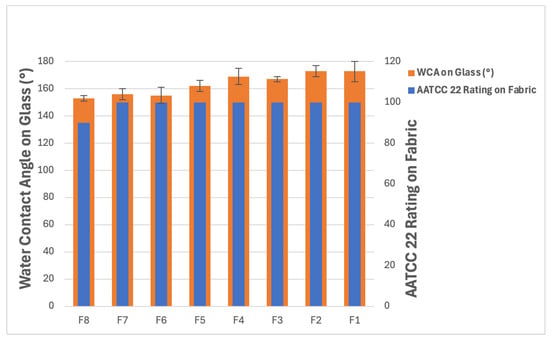
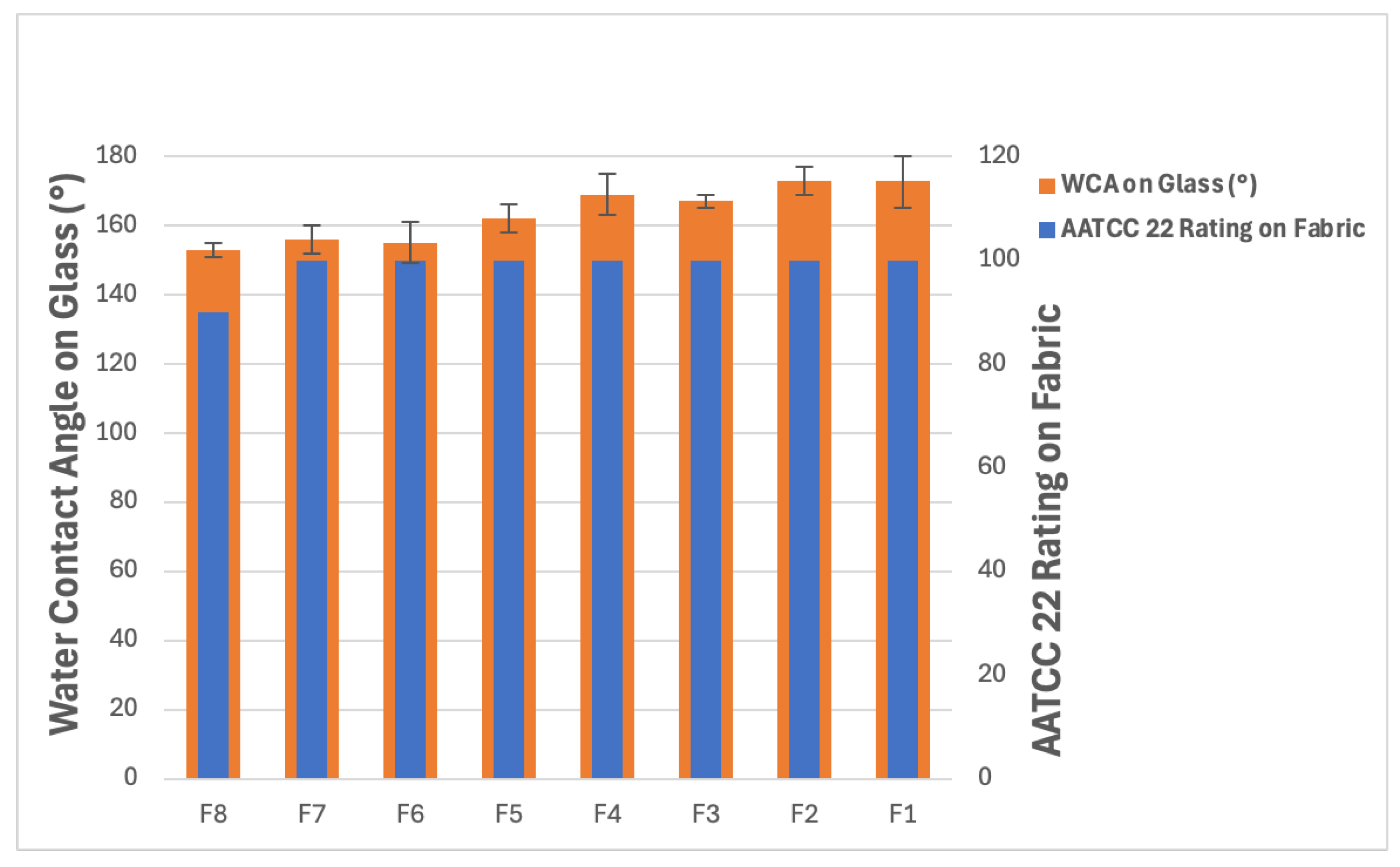
In addition, the water spray test results on treated fabrics (Figure 1) demonstrated that excellent water repellency was maintained across a wide range of solids content levels. Formulations with solids content ranging from 5.2 wt.% down to 2.0 wt.% all achieved an excellent spray rating (100), indicating complete resistance to water surface wetting. This is a significant finding that shows that the water repellency of fabric is governed primarily by the micro and nanoscale surface texture created by the silica particles, not by the total mass of the surface treatment deposited. Sample F7, with solids content as low as 2.0 wt.%, still maintained a spray rating of 100, indicating that the nanoparticle layer was sufficient to establish and sustain a Cassie–Baxter wetting state [24,25].
Figure 1.
AATCC TM 22 Water repellency performance of treated (F-1 to F-8) NYCO fabrics with corresponding water contact angle measured on glass.
At the lowest solids content tested (1.8 wt.%, F-8), the spray rating decreased to 90, still indicating acceptable water repellency with only slight surface sticking of water droplets, indicating the onset of reduced nanoparticle coverage. While a rating of 90 remains within acceptable water repellency limits, the departure from the rating of 100 maintained by all other formulations suggests that the solids content was approaching the lower boundary at which the Cassie–Baxter wetting state begins to weaken.
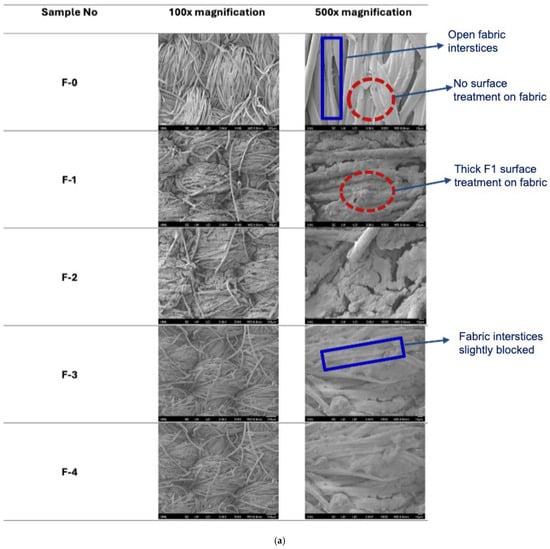
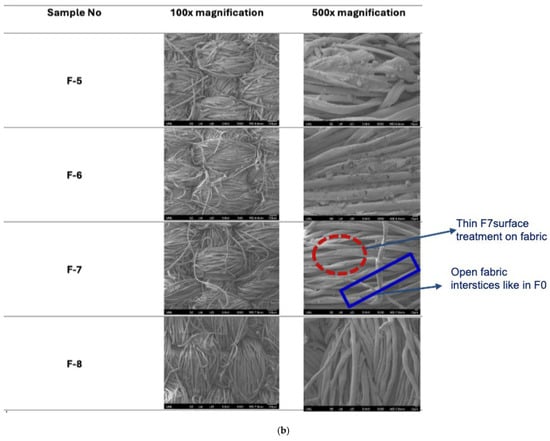
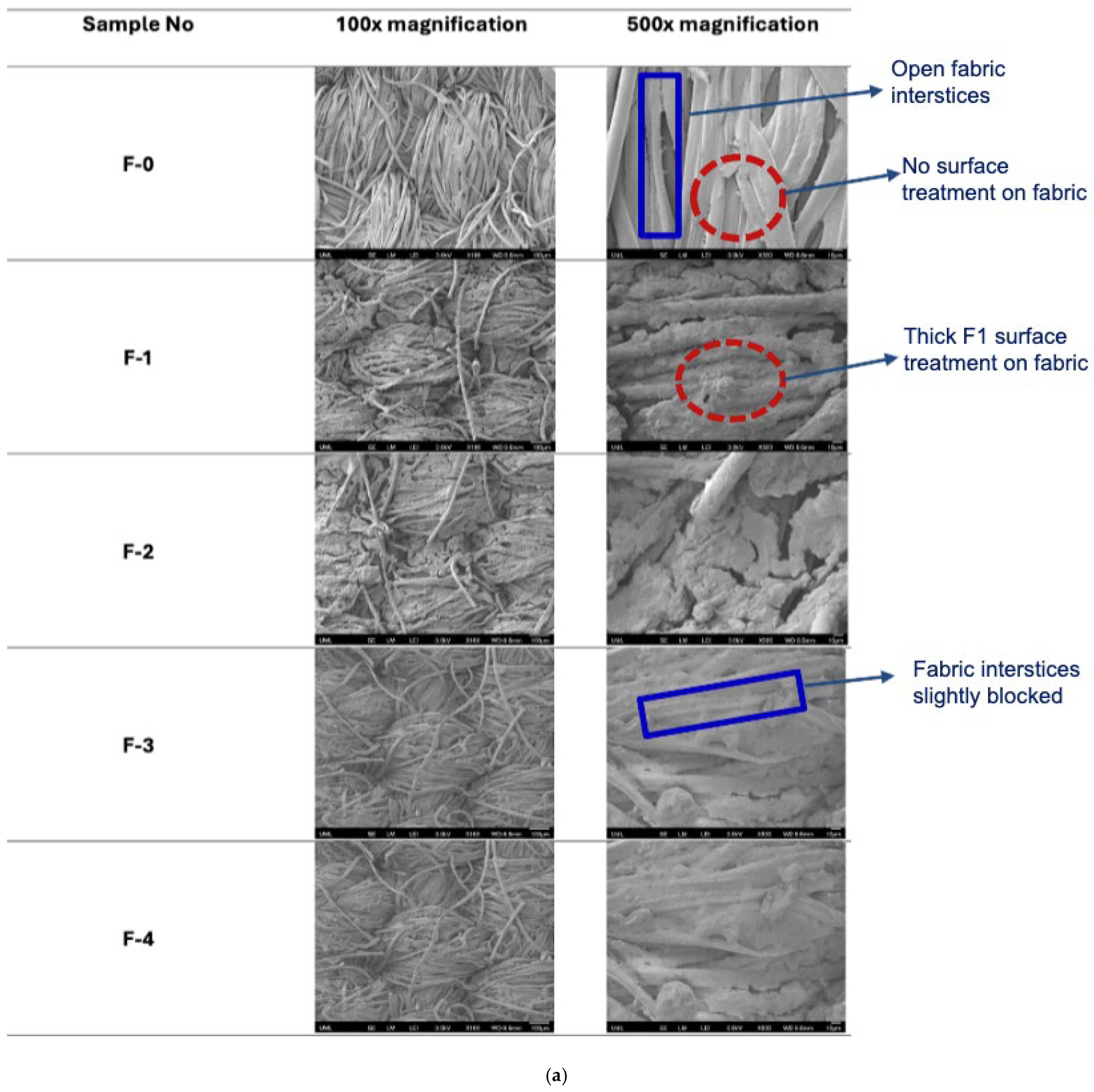
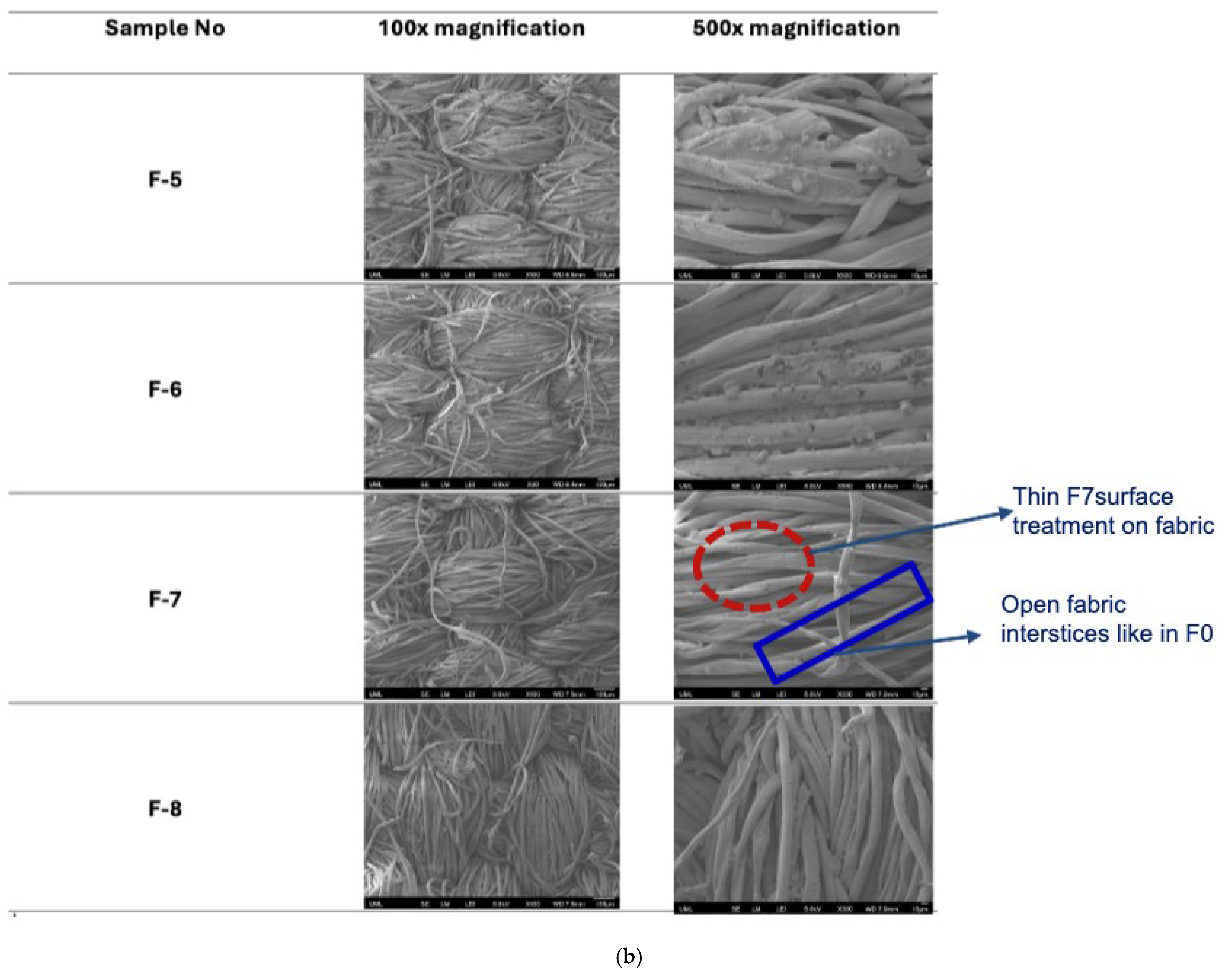
SEM images in Figure 2a,b confirmed increased surface roughness on treated fabrics compared to the surface of untreated NYCO (F-0). This rough morphology, induced by the silica nanoparticles, is essential for promoting the Cassie–Baxter wetting regime, a key mechanism promoting high water repellency [24]. This further supports the interpretation that it is the micro/nanoscale texture from the surface treatment that drives superhydrophobic performance in these fibers.
Figure 2.
(a) SEM images of untreated NYCO (F-0) and treated NYCO samples F-1 to F-4; (b) SEM images of treated NYCO samples F-5 to F-8.
3.2. Weight Gain Optimization
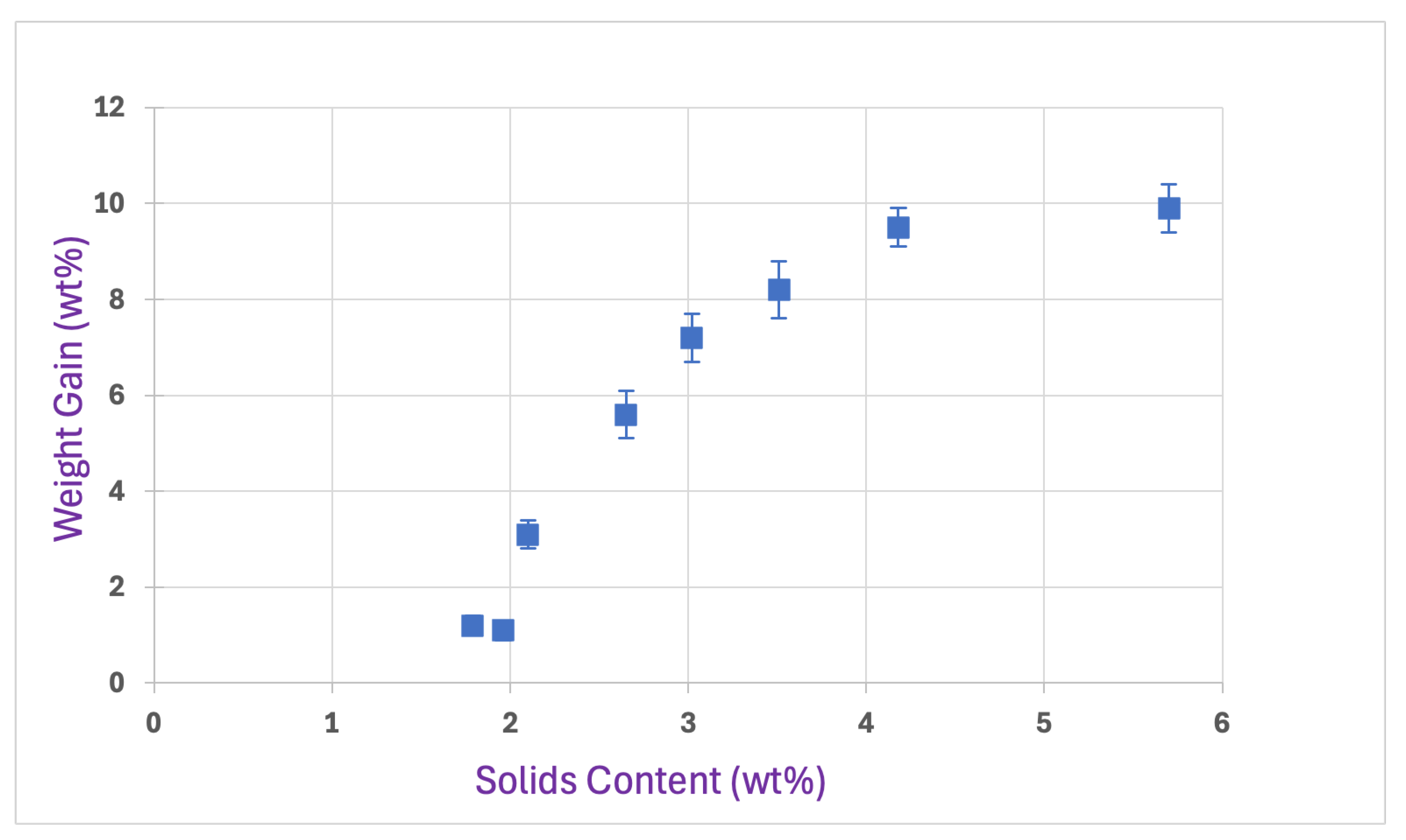
As shown in Table 3, the weight gain of treated NYCO fabric was directly controlled by the solids content of the surface treatment suspension. This relationship is clearly illustrated in Figure 3, which plots weight gain (wt.%) as a function of solids content (wt.%). The solids content was calculated using Equation (1) [26]:
Solids Content (wt.%) = (Mass of Solids/Total mass of formulation ingredients) × 100
Table 3.
Weight gain on NYCO fabric.
Figure 3.
Relationship between solids content in suspension (%) and weight gain (wt.%) of treated NYCO fabrics after 72 h.
The data revealed a monotonical but non-linear trend that can be divided into three regimes. In the first regime, when solids content was in the range of 2 wt.% to 4 wt.%, the weight gain of treated fabrics increased in a relatively linear manner. This relatively linear correlation suggests that as solids content increases over this range, the deposited surface treatment transitions to a thin, more conformal surface treatment that primarily covers individual fiber surfaces without blocking the inter-yarn spaces. This range is a desirable outcome for functional textiles, where the goal was to modify surface energy and roughness without blocking the fabric’s inherent porosity.
When the solids content was above 4 wt.%, the weight gain reached an upper plateau, indicating a regime in which the sprayed suspension carries enough material to build up relatively thick layers that fill the inter-fiber spaces and accumulate on fiber surfaces. Above this point, adding more solids content to the treatment suspension does not appear to increase the weight gain of treated fabrics to the same extent.
In the third regime, when the solids content was below 2.0 wt. %, Figure 3 indicates that further dilution beyond this point contributes little to reducing the mass uptake, likely because the surface treatment has reached a minimum retention level controlled by the spray deposition process and fiber–suspension interaction [27].
The critical observation from Figure 3 is that the formulation at 2.0 wt.% solids content (F-7) sits at the onset of this plateau: it represents the lowest achievable weight gain (1.1 wt.%), while still maintaining a spray rating of 100 (Figure 1). By contrast, the formulation at 1.8 wt.% solids (F-8), despite its similarly low weight gain (1.2 wt.%), crossed below the minimum particle coverage threshold and dropped to a spray rating of 90. This demonstrates that the optimal solids content for this surface treatment system is approximately 2.0 wt.%, where the deposited mass is minimized while the nanoparticle surface coverage remains sufficient to sustain superhydrophobic performance.
3.3. Air Permeability
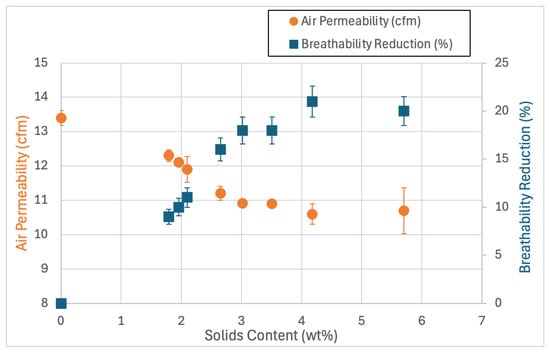
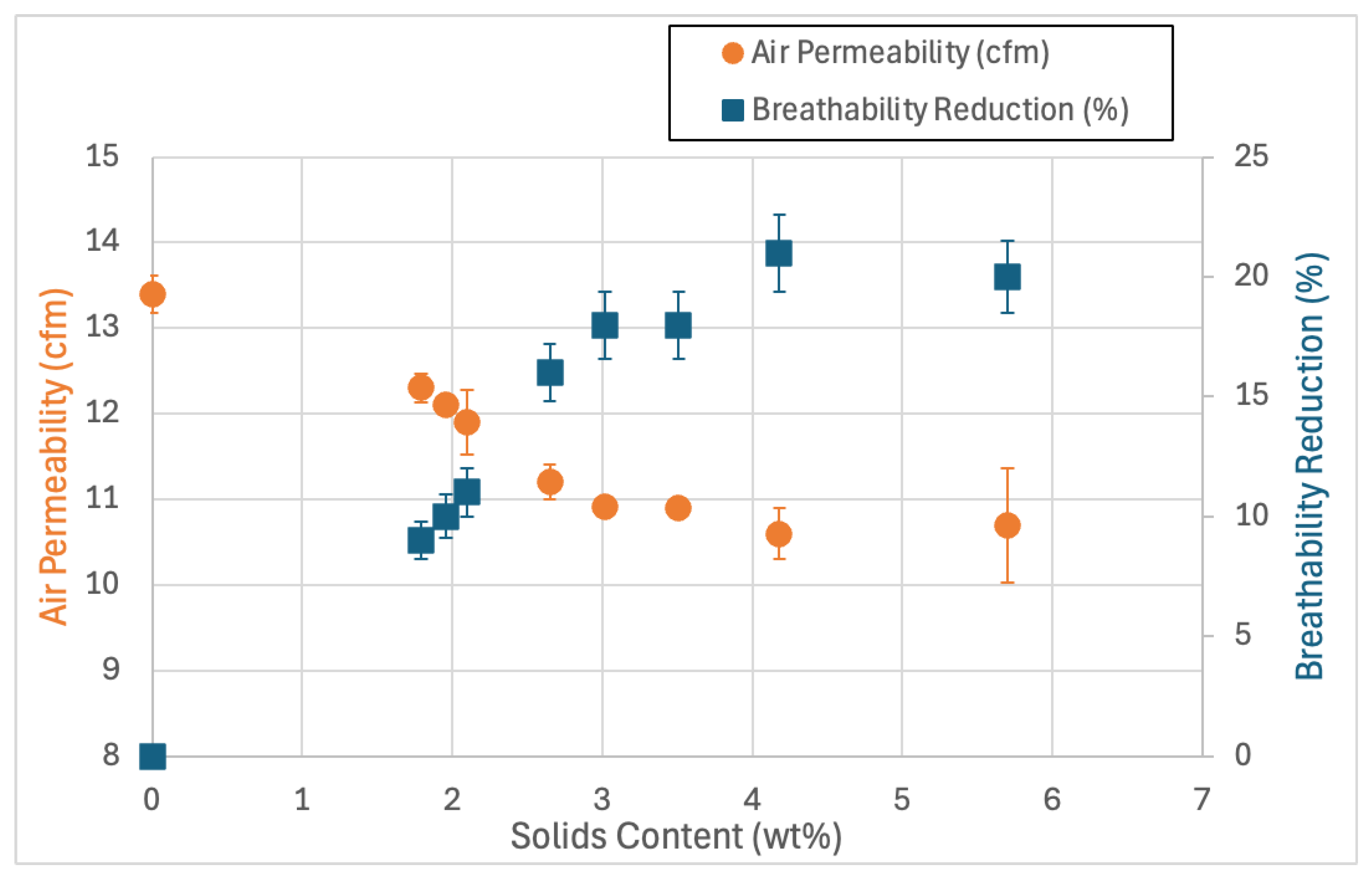
Quantitatively, Figure 4 shows that the air permeability of the treated fabric is a function of solids content. When the solids content was below 3 wt.%, the permeability of the treated fabric decreased linearly from around 13 cfm (untreated fabrics) to around 11 cfm as the solids content increased. After 3 wt.%, further increasing the solids content caused little change in the air permeability of treated fabrics. Compared to untreated fabrics, the air permeability reduction (breathability reduction) gradually increased from 9% (1.8 wt.% solids content) to around 18% (3.0 wt.%). This correspondence is not coincidental; both weight gain and breathability loss are driven by the same physical mechanism where the deposited surface treatment fills and obstructs the interstices in the fabrics (see Figure 2a,b). Formulations with higher solids content produced thicker deposited layers that blocked fabric interstices, resulting in greater breathability loss. Conversely, as solids content decreased, the surface treatment became thinner and more conformal to individual fibers, leaving more of the inter-yarn spacing open and maintaining airflow. This emphasizes the importance of optimizing solids content to control treatment thickness to maintain fabric air permeability, crucial for user comfort in garment applications.
Figure 4.
Air permeability (cfm) and breathability reduction (%) of treated NYCO fabrics relative to untreated NYCO.
The formulation at 2.0 wt.% solids content achieved the best balance: a maximum spray rating of 100 with a breathability reduction of only 10%, as well as only 1% weight gain. This balance between water repellency, breathability, and weight gain is critical for operational military fabrics, where thermal comfort and moisture management are as important as protection from liquid penetration [28].
3.4. Color Change
The effect of the treatment on the visual appearance of the NYCO fabric was evaluated by measuring the CIE Color Change ΔE76, calculated using Equation (2) [29].
where ΔL*, Δa*, and Δb* represent the differences in lightness, the red-green axis, and the yellow-blue axis, respectively, between the treated specimen and the untreated control (F-0). Color measurements were performed in accordance with AATCC Evaluation Procedure 6 [30,31].
CIE Color Change ΔE = [ΔL*2 + Δa*2 + Δb*2]½
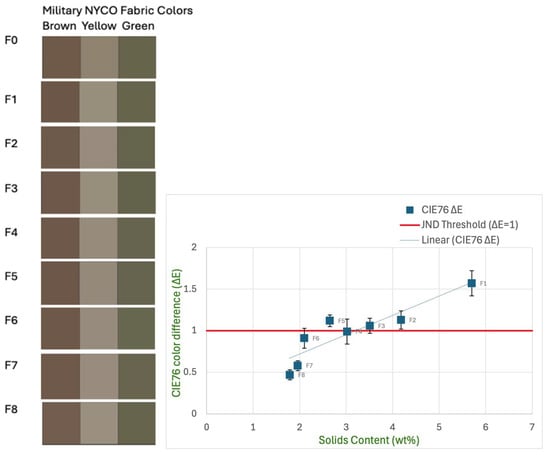
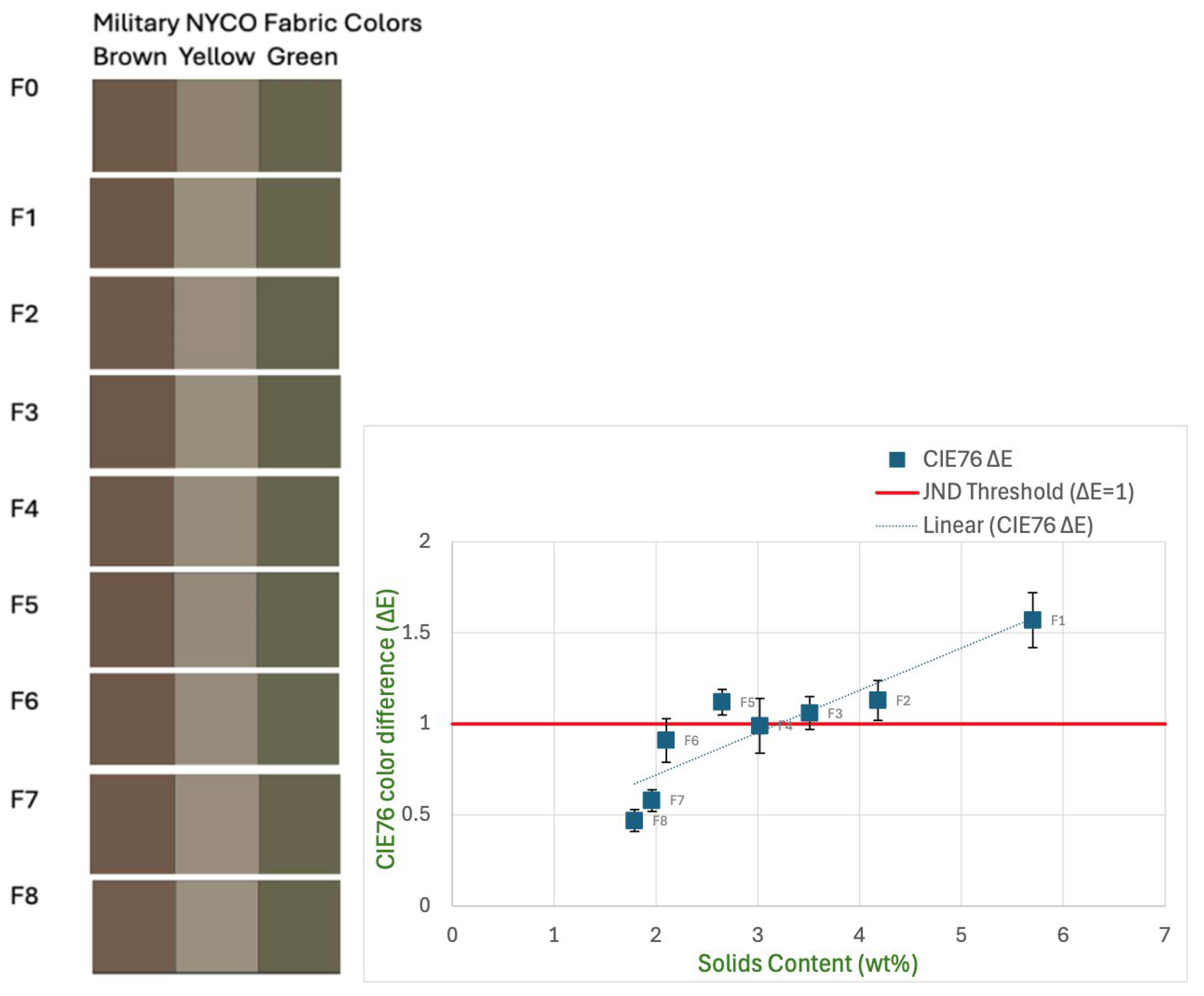
The CIE76 ΔE values for all treated samples are presented in Figure 5. A difference (JND) threshold of ΔE = 1.0 is widely recognized as the minimum color difference perceptible to the average human observer [32]. This is included as a reference line in Figure 5. Values below this threshold indicate that the color change introduced by the surface treatment is imperceptible under normal viewing conditions.
Figure 5.
Color change results for untreated NYCO (control) and treated NYCO.
In Figure 5 samples F-7 (ΔE = 0.5 ± 0.1) and F-8 (ΔE = 0.4 ± 0.1) exhibited the lowest color change, with ΔE values well below the JND threshold, indicating that the surface treatment at these lower solids content levels (2.0 wt.% and 1.8 wt.%, respectively) produced no visually detectable alteration to the fabric’s appearance. Samples F-4 (ΔE = 0.9 ± 0.2) and F-6 (ΔE = 0.9 ± 0.1) fell near the JND threshold, representing a borderline perceptible color change. In contrast, samples with a higher solids content, F-1 (ΔE = 1.5 ± 0.2), F-2 (ΔE = 1.2 ± 0.1), and F-5 (ΔE = 1.1 ± 0.1) exceeded the JND threshold, suggesting that the thicker surface treatments produced measurable/perceptible discoloration, likely due to the formation of a more opaque surface treatment.
When rated in accordance with the AATCC Gray Scale for Color Change, all samples achieved a rating of Grade 4–5, corresponding to a negligible color change. These ratings satisfied the colorfastness requirements typically specified for military textiles [10], which uses the AATCC Gray Scale as the standard assessment method for visual appearance evaluation.
Overall, the color change data demonstrates a clear relationship between solids content and visual impact: as solids content decreased, ΔE decreased. Sample F-7 (2 wt.% solids content), with a ΔE76 of just 0.5, consistently exhibited the most favorable balance of properties, maintaining near-indistinguishable appearance from the untreated fabric while providing excellent water repellency, and limited breathability reduction and weight gain.
Table 4 presents all the properties of the treated fabric across all formulations. Bold and italic values indicate the optimum formulation (F-7).
Table 4.
Effects of surface treatment on NYCO fabric properties.
4. Conclusions
This work demonstrates the development and optimization of a PFAS-free superhydrophobic surface treatment for NYCO fabric, using solids content as the primary formulation variable. By systematically varying the solids content from 5.2 wt.% to 1.8 wt.% while maintaining a constant 30 wt.% silica-to-epoxy ratio, clear correlations were established between solids content and four critical performance properties: weight gain, water repellency, air permeability, and color stability. The solids content, that is the percentage of nanoparticles used in the surface treatment and deposited onto the fabric surface, governed all measured properties. A critical threshold of 2.0 wt.% solids content was identified, below which insufficient nanoparticle surface coverage led to a loss of the Cassie–Baxter wetting state. The optimal formulation was determined to contain 2.0 wt.% solids content, which demonstrated the lowest weight gain (1.1%), a spray rating of 100, a 10% reduction in air permeability (breathability), and an imperceptible color change (ΔE = 0.5). These results satisfy the requirements of MIL-DTL-44436, demonstrating that PFAS-free alternatives can meet operational performance standards. Future research will focus on evaluating durability through laundering cycles, and other performance characteristics such as stiffness (flexibility), tensile and tear strength, and abrasion resistance.
Author Contributions
Conceptualization, F.A. and J.Z.; methodology, F.A., N.D. and S.T.; investigation, F.A. and S.T.; resources, J.M., H.D., S.K., M.A. and R.S.; data curation, F.A.; writing—original draft preparation, F.A.; writing—review and editing, J.M., S.K., J.Z. and S.T.; supervision, J.M.; project administration, J.M.; funding acquisition, J.M. All authors have read and agreed to the published version of the manuscript.
Funding
This research was funded by the Safer Alternatives for Readiness (SAFER) office under TEX 23-01 through the U.S. Army Combat Capabilities Development Command Soldier Center (DEVCOM SC). Award ID: W911QY23P0019, UML Project Number: S51310000056881.
Data Availability Statement
The data presented in this study are available on request from the corresponding author.
Acknowledgments
The authors gratefully acknowledge the support of the SAFR office. Additional gratitude is extended to the Core Research Facilities (CRF) at the University of Massachusetts Lowell, in particular Miguel A. Matos of the Microscopy Core Lab and Mark Keene of the Fabric Discovery Center (FDC), for their technical assistance.
Conflicts of Interest
The authors declare no conflicts of interest.
References
- Holmquist, H.; Schellenberger, S.; van der Veen, I.; Peters, G.M.; Leonards, P.E.G.; Cousins, I.T. Properties, performance and associated hazards of state-of-the-art durable water repellent (DWR) chemistry for textile finishing. Environ. Int. 2016, 91, 251–264. [Google Scholar] [CrossRef] [Scilit]
- Cardello, A.V.; Winterhalter, C.; Schutz, H.G. The sensory properties and comfort of military fabrics and clothing. In Military Textiles; Wilusz, E., Ed.; Woodhead Publishing: Cambridge, UK, 2008; pp. 4.1–4.32. [Google Scholar]
- Gibson, P.W. Multiphase heat and mass transfer through hygroscopic porous media with applications to clothing materials. Text. Res. J. 1993, 63, 749–764. [Google Scholar] [CrossRef] [Scilit]
- Rawat, M.; Ahuja, S. Design of water-based polyvinyl alcohol coatings using a drying modifier to minimize the residual solvent and coating defects. Iran. Polym. J. 2022, 31, 441–453. [Google Scholar] [CrossRef] [Scilit]
- Qingdao University Research Group. Fluorine-free multi-durable superhydrophobic cotton fabrics prepared by an atomization spraying method for self-cleaning and oil–water separation. Langmuir 2025, 41, 4154–4164. [Google Scholar] [CrossRef] [Scilit]
- Wang, Y.; Zhang, J.; Dodiuk, H.; Kenig, S.; Ratto, J.A.; Barry, C.; Turkoglu, S.; Mead, J. The effect of superhydrophobic coating composition on the topography and ice adhesion. Cold Reg. Sci. Technol. 2022, 201, 103623. [Google Scholar] [CrossRef] [Scilit]
- Verbič, A.; Golja, B.; Stres, B.; Likozar, B.; Novak, U. Unveiling PFAS-free solutions for Hydrophobic and Oleophobic textile coatings. Proc. Socratic Lect. 2024, 10, 148–156. [Google Scholar]
- Acha, F.; Egbebunmi, D.; Ahmadu, S.; Ojuolape, A.; Egbosiuba, T. Recent advances in bio-inspired superhydrophobic coatings utilizing hierarchical nanostructures for self-cleaning and anti-icing surfaces. Physchem 2025, 5, 48. [Google Scholar] [CrossRef] [Scilit]
- Li, C.; Liu, H.; Luo, X.; Wang, Q.; Deng, M.; Sun, H. Up to date review of nature-inspired superhydrophobic textiles: Fabrication and applications. Materials 2023, 16, 7015. [Google Scholar] [CrossRef] [Scilit]
- Jeevahan, J.; Chandrasekaran, M.; Joseph, G.B.; Durairaj, R.B.; Mageshwaran, G. Superhydrophobic surfaces: A review on fundamentals, applications, and challenges. J. Coat. Technol. Res. 2018, 15, 231–250. [Google Scholar] [CrossRef] [Scilit]
- Chang, Y.; Liu, F. Review of waterproof breathable membranes: Preparation, performance and applications in the textile field. Polymers 2023, 15, 3771. [Google Scholar] [CrossRef] [Scilit]
- Kumar, K.; Babu, B.S.; Davim, J.P. Coatings: Materials, Processes, Characterization and Optimization; Springer: Cham, Switzerland, 2021. [Google Scholar]
- U.S. Department of Defense. Detail Specification: Cloth, Wind Resistant Poplin, Nylon/Cotton Blend (MIL-DTL-44436D); Defense Logistics Agency: Philadelphia, PA, USA, 2020.
- U.S. Army Combat Capabilities Development Command Soldier Center. Environmentally Friendly Superhydrophobic Coatings (SAGE 20-03); DEVCOM Soldier Center: Natick, MA, USA, 2020.
- Wang, Y.; Zhang, B.; Dodiuk, H.; Kenig, S.; Barry, C.; Ratto, J.A.; Mead, J.; Jia, Z.; Turkoglu, S.; Zhang, J. Effect of protein adsorption on air plastron behavior of a superhydrophobic surface. ACS Appl. Mater. Interfaces 2021, 13, 58096–58103. [Google Scholar] [CrossRef] [Scilit]
- Wang, Y.; Zhang, J.; Dodiuk, H.; Kenig, S.; Ratto, J.A.; Barry, C.; Mead, J. The reduction in ice adhesion using controlled topography superhydrophobic coatings. J. Coat. Technol. Res. 2023, 20, 469–483. [Google Scholar] [CrossRef] [Scilit]
- Zheng, K.; Zhang, J.; Dodiuk, H.; Kenig, S.; Barry, C.; Sun, H.; Mead, J. Effect of superhydrophobic composite coatings on drag reduction in laminar flow. ACS Appl. Polym. Mater. 2020, 2, 1614–1622. [Google Scholar] [CrossRef] [Scilit]
- Zheng, K.; Zhang, J.; Dodiuk, H.; Kenig, S.; Barry, C.; Iezzi, E.B.; Mead, J. The effect of composite interface morphology on wetting states for nanocomposite superhydrophobic coating. Surf. Coat. Technol. 2020, 387, 125457. [Google Scholar] [CrossRef] [Scilit]
- Zheng, K.; Zhang, J.; Keaney, E.; Dodiuk, H.; Kenig, S.; Barry, C.; Mead, J. The effect of superhydrophobic surface topography on underwater corrosion resistance of steel. J. Coat. Technol. Res. 2021, 18, 685–693. [Google Scholar] [CrossRef] [Scilit]
- Turkoglu, S.; Zhang, J.; Dodiuk, H.; Kenig, S.; Ratto, J.A.; Mead, J. Wetting characteristics of nanosilica–poly(acrylic acid) transparent anti-fog coatings. Polymers 2022, 14, 4663. [Google Scholar] [CrossRef] [Scilit]
- Turkoglu, S.; Zhang, J.; Dodiuk, H.; Kenig, S.; Ratto, J.A.; Mead, J. Dynamic wetting properties of silica–poly(acrylic acid) superhydrophilic coatings. Polymers 2023, 15, 1242. [Google Scholar] [CrossRef] [Scilit] [PubMed]
- Turkoglu, S.; Zhang, J.; Dodiuk, H.; Kenig, S.; Ratto Ross, J.A.; Karande, S.A.; Wang, Y.; Diaz Armas, N.; Auerbach, M.; Mead, J. Structure–Property Relationships for Fluorinated and Fluorine-Free Superhydrophobic Crack-Free Coatings. Polymers 2024, 16, 885. [Google Scholar] [CrossRef] [Scilit]
- TM22-2017e; Test Method for Water Repellency: Spray Test. American Association of Textile Chemists and Colorists: Research Triangle Park, NC, USA, 2017.
- Wenzel, R.N. Resistance of solid surfaces to wetting by water. Ind. Eng. Chem. 1936, 28, 988–994. [Google Scholar] [CrossRef] [Scilit]
- Scheff, T.; Acha, F.; Diaz Armas, N.; Mead, J.L.; Zhang, J. Tuning wetting properties through surface geometry in the Cassie–Baxter state. Biomimetics 2025, 10, 20. [Google Scholar] [CrossRef] [Scilit] [PubMed]
- Ohio Environmental Protection Agency, Division of Air Pollution Control. Engineering Guide #48—Determining Compliance for Coating Lines; Ohio Environmental Protection Agency: Columbus, OH, USA, 2017.
- Meng, X.; Tian, M.; He, Z.; Li, Y.; Li, H.; Li, L. Highly permeable and liquid-repellent textiles with micro/nano-networks. Nat. Commun. 2022, 13, 5274. [Google Scholar]
- CIE (Commission Internationale de l’Éclairage). Colorimetry, 3rd ed.; CIE Central Bureau: Vienna, Austria, 2004. [Google Scholar]
- EP6-2021; Evaluation Procedure for Instrumental Color Measurement. American Association of Textile Chemists and Colorists: Research Triangle Park, NC, USA, 2021.
- ISO 105-A02; Textiles—Tests for Colour Fastness—Part A02: Grey Scale for Assessing Change in Colour. International Organization for Standardization: Geneva, Switzerland, 1993.
- Sharma, G. The CIEDE2000 color-difference formula: Implementation notes, supplementary test data, and mathematical observations. Color Res. Appl. 2004, 30, 21–30. [Google Scholar] [CrossRef] [Scilit]
- Kuehni, R.G.; Marcus, R.T. An experiment in visual scaling of small color differences. Color Res. Appl. 2012, 37, 15–24. [Google Scholar] [CrossRef] [Scilit]

Disclaimer/Publisher’s Note: The statements, opinions and data contained in all publications are solely those of the individual author(s) and contributor(s) and not of MDPI and/or the editor(s). MDPI and/or the editor(s) disclaim responsibility for any injury to people or property resulting from any ideas, methods, instructions or products referred to in the content. |
© 2026 by the authors. Licensee MDPI, Basel, Switzerland. This article is an open access article distributed under the terms and conditions of the Creative Commons Attribution (CC BY) license.