


Abstract
Biomolecular and multi-omics approaches have transformed archaeology and heritage science, yet they are still widely conceptualized as ancillary techniques that refine narratives built on artifacts, architecture, and texts. This Perspective argues instead for treating molecules as primary archaeological evidence with their own epistemic status, temporalities, and bias structure. Drawing on a corpus of multi-omics case studies from the central and eastern Mediterranean (chiefly Sicily, Malta, and Egypt), together with comparative material from the lower Danube, Polynesia, and the Andes, and engaging directly with the philosophy of science, we adopt a critical entity realism grounded in the practice of physical intervention on molecular entities, and we develop evidential reasoning chains that connect instrumental data to historical phenomena. From this grounding, we propose a six-dimensional epistemic framework: (1) redefinition of archaeological evidence; (2) molecular counter-archive against preservation bias; (3) polytemporality of molecular signals; (4) ethics and conservation as internal epistemic variables; (5) identity, boundaries, and connectivity in a molecular key; and (6) methodological pluralism and interpretive convergence. The framework has concrete implications for curatorial policies, sampling strategy, and data governance, and opens a productive dialogue between biomolecular heritage science and archaeological theory.
1. Introduction
1.1. From Artifacts to Molecules: Multi-Omics and Archaeological Inference
Over the last two decades, archaeological research has witnessed the rapid expansion of biomolecular approaches, especially ancient DNA, proteomics, lipidomics, metabolomics, and isotopic analyses, applied to human remains, animal bones, plant macro- and microremains, artifacts, and ecofacts. These techniques have reshaped questions about mobility, diet, technology, health, ritual, and trade from largely indirect reconstructions based on form and context into interpretations grounded in the molecular composition of materials themselves [1,2,3,4].
The methodological scaffolding of this expansion is now well established across several distinct lines of work. Lipid residue analysis on ceramics has matured into a major subfield over three decades through the biomarker and compound-specific isotope protocols developed by Evershed and colleagues at Bristol [5]. Dental-calculus proteomics, inaugurated for archaeological matrices by Warinner and co-workers [6], has become an increasingly established approach for reconstructing diet, oral microbiome, and pathogen exposure, even if it is not yet routine across all laboratories. Population-scale ancient genomics synthesized by Skoglund and Mathieson [7] has reframed long-standing questions about migration, admixture, and demographic history. The methodological literature on contamination control and authentication [8] has co-evolved as a precondition for reliable inference. Strontium-isotope provenance studies depend, in turn, on the construction of regional and continental bioavailable Sr baselines [9], without which mobility claims cannot be quantitatively grounded. Synthetic treatments of these developments are now available and frame the present contribution: the textbook overview of biomolecular archaeology by Brown and Brown [10], the field-defining primer on ancient-DNA analysis by Orlando and colleagues [11], and the comprehensive review of paleoproteomics by Warinner, Korzow Richter, and Collins [12] together document both the classic foundations and the most recent methodological progress of the discipline. What matters for the present argument is less the breadth of this toolkit than a feature shared by its most mature strands: in each, the biomolecular signal has moved from corroborating artifact-based narratives to generating first-order historical claims of its own, and it is the epistemological consequences of that shift, rather than the inventory of methods, that the following sections address.
Within this expansion, a coherent body of multi-omics case studies has explored how different molecular classes can be jointly mobilized to interrogate prehistoric and historic societies. The case studies drawn upon in this article span the central and eastern Mediterranean, including Eneolithic funerary contexts in the lower Danube [1], Early Bronze Age to Late Antique sites across Sicily [13,14,15,16,17], proto-urban Malta [18], Ramesside and Ptolemaic Egypt [19,20], and the Greek colonial cemetery of San Giorgio Extra at Rhegion [21], together with comparative material from the Andes [22] and Polynesia [23], and a methodological contribution on minimally destructive enamel sampling [24]. The analytical details and evidential contributions of each case study are presented in Section 2; Section 3 then draws on these cases to develop the six dimensions of the account.
1.2. Limits of Artifact-Centered Archaeology and Preservation Bias
Despite these advances, in many areas of archaeology—especially those organized around typology, style, and material culture—the dominant inferential regime remains artifact-centered. Artifacts, architecture, and funerary structures are treated as the primary carriers of historical information, while biomolecular data are, in these same areas, frequently cast as technical auxiliaries whose role is to confirm or mildly adjust narratives framed at the level of typology, style, or spatial patterning. This perspective underestimates both the autonomy and the specificity of molecular evidence and is increasingly challenged within archaeological theory itself [25,26,27].
This diagnosis should not be over-generalized. The balance between artifactual and biomolecular authority varies markedly across sub-disciplines, and in archaeogenetics, the criticism has more often run in the opposite direction—that genetic results are granted undue primacy over contextual, typological, and stratigraphic evidence, and that archaeological ‘cultures’ are read off genetic clusters too readily [28,29,30]. The claim defended here is therefore not that molecular evidence is subordinated everywhere, but that its epistemic status remains unsettled and undertheorized, oscillating between neglect and over-extension according to subfield.
Artifact-centered approaches are particularly vulnerable to preservation and visibility biases. In many contexts, key aspects of daily practice, use of perishable materials, specific foodstuffs, forms of mobility, leave faint or no trace at macro scale, yet may be richly recorded by proteins, lipids, metabolites, or isotopic signatures. At Castelluccio (Noto), typological interpretations of the large pithos and septate basins in Hut 8 as generic storage or processing containers were radically refined once 1H NMR, 1H–1H 2D TOCSY, and GC-MS analyses demonstrated the presence of olive oil, making them the earliest chemically attested olive oil containers in Italian prehistory [14]. At Qlejġa tal-Baḥrija, macroremains were insufficient to reconstruct storage practices, but shotgun proteomics identified wheat, Hordeum vulgare, and related cereal proteins in coarse-ware storage jars, and milk-derived proteins in tableware cups and strainers, revealing cereal storage and dairy processing activities otherwise inaccessible [18]. In the Bes-mug from the Tampa Museum of Art, neither form nor iconography alone could have established the presence of a complex psychoactive, medicinal, and biological concoction. Only the combination of SR-μFTIR, high-resolution Orbitrap metabolomics, proteomics, and chloroplast aDNA barcoding made this ritual mixture visible [20].
These examples highlight that molecules do not simply corroborate artifact-based narratives. They often provide the only direct evidence for behaviors, substances, and pathologies, calling for a re-evaluation of evidentiary hierarchies in archaeology and heritage science [14,18,19,20].
1.3. Aims and Scope
The central aim of this article is to articulate an epistemic framework for molecular archaeology and biomolecular heritage science that recognizes molecules as primary archaeological evidence and delineates the specific ways in which molecular datasets transform inference, bias, temporality, and ethics in archaeological practice. Rather than offering a methodological manual, we propose a theory of evidence grounded in the practical experience of multi-omics case studies spanning funerary, domestic, industrial, ritual, and museum contexts. Three contributions define the specific value of this Perspective and locate it with respect to existing scholarship. First, it addresses a genuine gap: although biomolecular and multi-omics methods are now routine, their epistemological status has rarely been theorized as a whole, and the principal statements of archaeological epistemology—from Wylie’s analysis of evidential reasoning [31] and its development by Chapman and Wylie [32] to the synthetic histories of archaeological thought by Trigger [33] and Johnson [34]—largely predate, or do not directly engage, the multi-omics turn. This is not to claim that the terrain is untouched: a substantial body of epistemological reflection already exists, concentrated on ancient DNA—on the framing of interdisciplinarity and inference [29], on the nature/culture binaries embedded in genetic categories [35], and on the mapping of genetic clusters onto archaeological cultures [30]—alongside broader diagnoses of the ‘third science revolution’ and its interpretive stakes [28]. What has not yet been attempted is a synthetic account that treats the full multi-omics range—proteins, lipids, metabolites, isotopes, and DNA together—as primary evidence sharing a common epistemic structure, and that reconnects it to the discipline’s own tradition of evidential reasoning. Second, its theoretical contribution is to bring these traditions together with the philosophy of the historical sciences—Currie’s account of historical scientists as “methodological omnivores” [36] and Cleland’s analysis of the evidential asymmetry between historical and experimental science [37]—in a single six-dimensional framework that treats molecules as primary evidence rather than as ancillary technique. Third, its practical value is concrete: the framework yields operational guidance for sampling strategy, conservation and curation policy, reporting standards, and data governance, as developed in Section 3 and Section 4. These domains—sampling strategy, conservation and curation policy, reporting standards, and data governance—are already the object of extensive guidance and debate [38,39,40,41]; the contribution intended here is not to originate that guidance but to supply a unifying epistemic rationale that connects it to the evidential status of molecules. So framed, the account is neither a rejection of artefact-based reasoning nor a technocratic replacement of it, but an extension of the discipline’s own evidential-reasoning tradition into the molecular domain.
Doing so requires first clarifying what it means for something to constitute evidence in an archaeological context. Drawing on the philosophy of science, we distinguish between data, the raw instrumental outputs of molecular analyses (mass spectra, isotopic ratios, NMR signals, peptide identifications), and phenomena, the historically significant regularities and events that data are taken to support [42]. This distinction is not merely terminological: it captures the inferential gap that separates a chromatographic peak from a claim about olive oil production, or a deamidated casein peptide from a reconstruction of Bronze Age dairy economies. Crucially, molecular archaeology operates across this gap through abductive inference, reasoning to the best explanation of a set of molecular traces, rather than through deduction or simple pattern-matching [43,44]. Abductive conclusions are always revisable, comparative, and sensitive to the quality of competing explanations. The framework developed here accordingly positions molecular evidence not as a ground truth that overrides artifact-based inference, but as an independent and often complementary inferential pathway whose strength derives from the convergence of multiple abductive chains grounded in independent datasets [45].
Ontologically, the framework adopts a position we describe as critical entity realism. It is anchored in Hacking’s experimentalist realism [46], according to which we are warranted in believing in entities we can manipulate to produce predictable effects. That criterion fits a subset of molecular archaeological practice—enrichment, digestion, derivatization, and chromatographic separation—in which the analyte is genuinely intervened upon. The inferential core of identification, however, proceeds differently: we do not manipulate a known protein to detect it; we match an observed fragmentation pattern, isotopic ratio, or peptide sequence to reference data and conclude that the analyte is the protein in question. For this latter step, the realism more directly licensed by practice is the semirealism articulated by Chakravartty [47], which restricts realist commitment to the detection properties of an entity, that is, the causal features through which it is reliably individuated and tracked, rather than to the entity in its full ontological richness. In molecular archaeology, what we have warrant to assert is that a specific causal profile (a peptide of given mass, sequence, and deamidation pattern; a fatty acid of given chain length and isotopic composition) is present in the matrix and is the trace of a specific class of past process. The full historical entity, the cheese in the Ramesside jar, the libation in the Bes-mug, the herd at Polizzello, is then reconstructed by abductive inference from these detection properties. This formulation acknowledges the constructive dimensions of molecular identification (database coverage, instrumental sensitivity, interpretive convention) without collapsing into a constructivism that would render molecular evidential claims indistinguishable from narrative choices. Readers who prefer not to take on this metaphysical commitment can reach the same practical conclusion by a simpler, pragmatist route, in the sense of Dewey [48]: we are entitled to treat molecules as primary evidence simply because doing so works—because it reliably produces new and testable knowledge about the past. The same conclusion can also be put in Friedman’s [49] terms, as the adoption of a relativized framework of constitutive principles—instrumental, computational, and theoretical—without which the molecular phenomena under investigation would not count as evidence at all.
The framework is structured around six interrelated dimensions (Figure 1): (1) redefining what counts as archaeological evidence; (2) conceptualizing molecular data as a molecular counter-archive that complements and partially counterbalances conventional preservation biases; (3) theorizing molecular evidence as inherently polytemporal; (4) integrating ethical and conservation constraints function as enabling features of molecular evidence production rather than exogenous restrictions on it; (5) rethinking identity, boundaries, and connectivity through multi-layered molecular signatures; and (6) embracing methodological pluralism and interpretive convergence as conditions for robust inference. Section 3.1, Section 3.2, Section 3.3, Section 3.4, Section 3.5 and Section 3.6 develop these dimensions in dialogue with the case studies. Section 4 situates the framework within current debates in heritage science and archaeological theory.
Figure 1.
Six interdependent dimensions of the epistemic framework for molecular archaeology. Each node stands for one dimension (Section 3.1, Section 3.2, Section 3.3, Section 3.4, Section 3.5 and Section 3.6). The central node marks the unifying thesis. The mesh of connections indicates that dimensions are activated jointly in concrete case studies. Table 1 maps the activations for the corpus reviewed here.
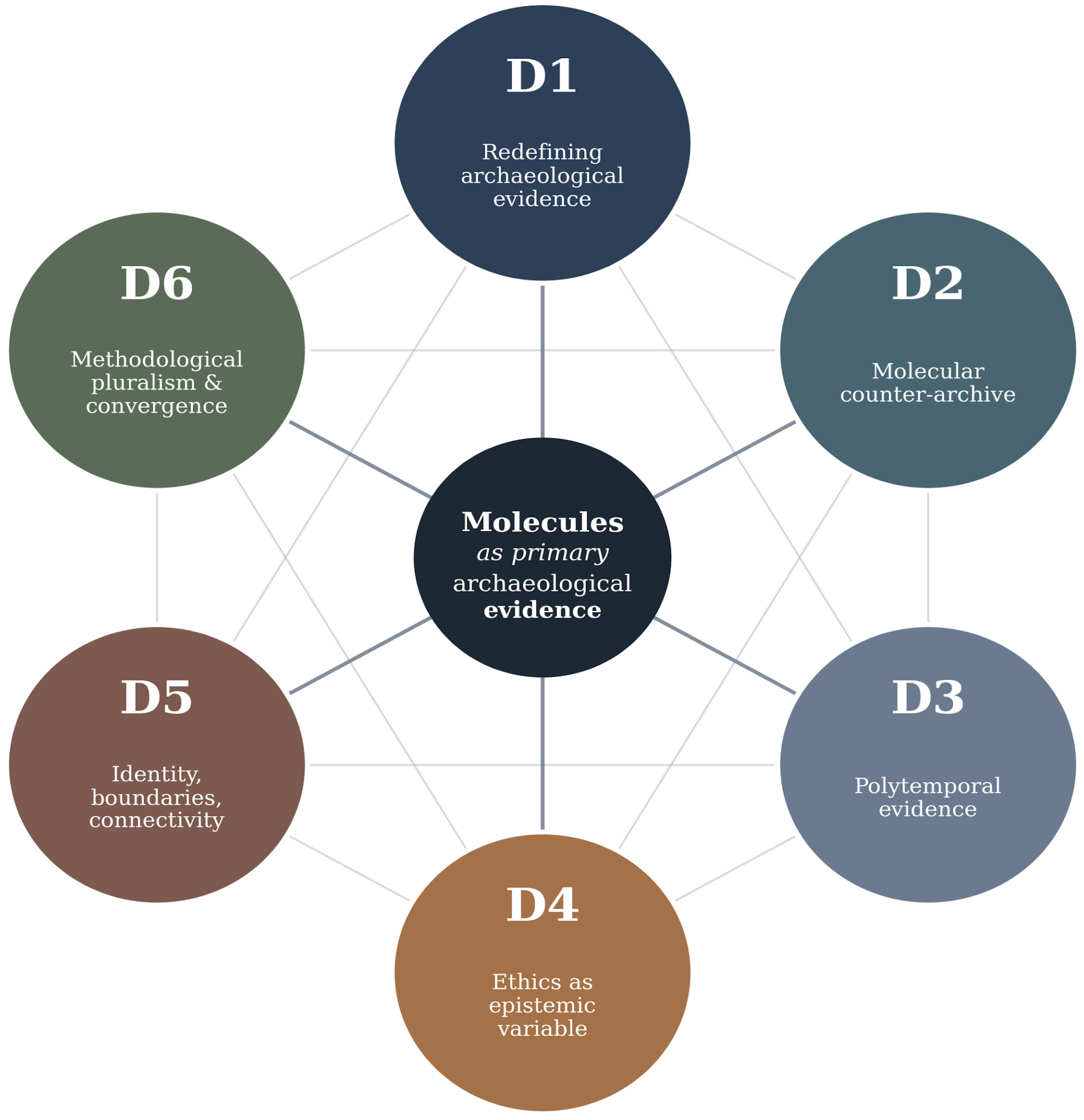
Table 1.
Activation matrix of the six epistemic dimensions (D1–D6, cf. Figure 1 and Section 3.1, Section 3.2, Section 3.3, Section 3.4, Section 3.5 and Section 3.6) across the case studies of the corpus. A filled cell (●) indicates that the case study in that row materially exemplifies the dimension in that column, as developed in Section 3.1, Section 3.2, Section 3.3, Section 3.4, Section 3.5 and Section 3.6.
2. Empirical Basis: The Multi-Omics Case-Study Corpus
The proposed framework is not a deductive philosophical construct imposed on data: it is inductively abstracted from repeated patterns observed across a corpus of multi-omics case studies sharing an explicitly multi-scalar design. Because this Perspective is a conceptual contribution rather than a primary report, this section does not reproduce analytical details, which are available in the cited publications, but states what each case study contributes to the framework and the inferential problem it exposes. The corpus is programmatic rather than representative. Most of the studies reviewed below were conducted by the present authors or in close collaboration and reflect a connected research trajectory across Mediterranean prehistory and adjacent contexts; they do not constitute an arbitrary cross-section of multi-omics archaeology at large. We retain this composition deliberately. The conceptual claims developed in Section 3 are inductively abstracted from cases whose method, sampling decisions, and interpretive choices we know in detail, and the framework should accordingly be read as the articulated theory of evidence implicit in a connected research program, rather than as a generalization over the field. Readers persuaded by the framework are invited to test its purchase against case studies from other laboratories and traditions. The case studies group into three partially overlapping clusters. As a Perspective rather than a systematic review, the article deliberately privileges depth of methodological self-knowledge over breadth of coverage: by drawing chiefly on studies in which we ourselves carried out the sampling, analysis, and interpretation, the epistemological claims can be tested against decisions we are able to document in full, including those we would now make differently. The recurrent appearance of our own work is therefore intrinsic to the genre and to the argument, not an attempt at exhaustive review; we state this scope openly so that readers can calibrate the framework’s generality, and we deliberately probe the framework in Section 4.1 against independent research programmes, notably those of Warinner and colleagues [6] and Evershed and colleagues [5].
2.1. Human Remains, Mobility, and Biological Identity
A first cluster addresses the molecular characterization of human remains in funerary contexts. At Eneolithic Gumelnița (Romania), 87Sr/86Sr analyses were combined with enamel proteomics to reconstruct childhood mobility, local versus non-local status, and biological sex for a Chalcolithic funerary sample [1]. At the Greek cemetery of San Giorgio Extra (Reggio Calabria, ancient Rhegion), enamel proteomic sexing based on AMELX/AMELY peptides and Raman spectroscopy of enamel and dentine crystallinity produced a reliable sex- and age-estimation protocol validated double-blind with anthropological data [21]. In the Late Antique catacombs of Santa Lucia in Siracusa (Sicily), stable carbon, nitrogen, and oxygen isotope analyses of 25 individuals revealed substantial dietary variability and high oxygen-isotopic mobility across three chronological groups spanning the 5th–8th centuries CE [17]. The methodological arc of the cluster is closed by the development and validation of a minimally destructive sampling method (PVA-based HVPD) for in situ enamel proteomics on teeth still embedded in skeletal remains [24].
2.2. Food Residues, Containers, and Economic Networks
A second cluster applies multi-omics reasoning to food residues, containers, and trade networks. Proteomic analysis of a solid residue from a jar in the tomb of Ptahmes at Saqqara identified the material as a mixed sheep/goat and cow cheese and detected peptides from Brucella melitensis, offering direct evidence for both dairy technology and infectious disease in the Ramesside period [19]. At Qlejġa tal-Baḥrija (Malta), shotgun proteomics of ceramic residues identified milk-derived proteins in a subset of tableware (a cup, a strainer, a spouted jug) and extensive wheat- and barley-derived proteins in large coarse-ware storage jars, documenting both dairy processing and cereal storage in a proto-urban Baḥrija-period settlement [18]. At Castelluccio (Noto, Sicily), 1H NMR, 1H–1H 2D TOCSY, and GC-MS analyses of residues in an Early Bronze Age pithos and two septate basins identified olive oil as the vessel content, establishing these as the earliest chemically attested olive oil containers in Italian prehistory [14], as earlier attestations are documented only for Early and Middle Bronze Age Aegean, Cypriot, and Levantine contexts [50]. At Polizzello Mountain (Caltanissetta), proteomics and lipidomics of Castelluccian pottery identified equine serum albumin in multiple samples, providing the first biomolecular evidence for horse-product consumption in Early Bronze Age Sicily [13]. We adopt “horse-product” rather than the “horse meat” of the original publication title because equine serum albumin, a blood-fraction protein, documents the processing of horse-derived materials without distinguishing among meat, blood, and milk preparations; the proteomic evidence alone cannot resolve this distinction. At Monte Kronio and Sant’Ippolito, 1H–1H 2D TOCSY NMR coupled with ATR FT-IR and SEM-EDX characterized organic residues on prehistoric pottery, refining interpretations of vessel function and dietary practices [15]. Chemical characterization of Late Roman and Late Antique amphorae from shipwrecks off Marsala identified plant-oil biomarkers (including olive oil) in seven specimens and Pinaceae pitch in one, reassessing container function beyond the traditional olive oil/wine/garum trichotomy of North African amphorae [16]. A methodological note is warranted here. Several of these studies relied on nuclear magnetic resonance (NMR) spectroscopy alongside, or instead of, the mass-spectrometric and chromatographic methods that today dominate organic-residue analysis, and the rationale should be made explicit. We accept the well-founded point that gas- and liquid-chromatography coupled to mass spectrometry (GC-MS, LC-MS) generally offer higher sensitivity and finer compound-by-compound resolution than NMR, and that two-dimensional experiments such as 1H–1H TOCSY are designed to resolve the structure of a purified analyte rather than to identify the components of a complex mixture. NMR was adopted in the Castelluccio and Monte Kronio studies [14,15] for complementary reasons: it is non-destructive of the extract, requires no derivatization, and reports class-level structural information on the intact mixture; crucially, the identification there did not rest on NMR alone but on its convergence with GC-MS profiles and authentic reference oils. We also accept a genuine limitation: neither NMR nor a fatty-acid GC-MS profile can, on its own, securely distinguish olive oil from other plant or vegetable oils—including nut oils—because the major triacylglycerols and fatty acids overlap. Resolving that specific question requires targeted markers accessible to high-resolution and tandem mass spectrometry, such as triterpenic acids (e.g., maslinic acid), secoiridoids, and characteristic oxidation products, as recent archaeological and food-authentication studies using HPLC- and GC-MS have demonstrated [51,52]. We therefore present these cases not as evidence that NMR is the method of choice, but as instances of the framework’s own thesis (Section 3.6): a molecular identification is only as strong as the convergence of independent methods that supports it, and a claim that outruns what a given platform can resolve is precisely the inferential over-reach the framework cautions against.
2.3. Ritual, Ethnographic, and Heritage Contexts
A third cluster expands the geographical and thematic scope to ritual and ethnographic heritage. The Ptolemaic Bes-mug from the Tampa Museum of Art was analyzed by SR-μFTIR, high-resolution Orbitrap metabolomics, shotgun proteomics, and chloroplast aDNA metabarcoding, revealing alkaloids from Peganum harmala and Nymphaea nouchali var. caerulea, DNA evidence of a plant of the Cleome genus, tartaric salts consistent with fermented fruit beverages, honey- or royal-jelly markers, cereal and sesame proteins, yeast species, and multiple human bodily fluids [20]. A critical review of the analytical detection of ayahuasca in Andean archaeological contexts examined published claims about harmine and harmaline in mummies and artifacts, concluding that the archaeological evidence does not yet convincingly prove ancient ayahuasca use and exposing the risks of over-interpretation in complex matrices [22]. Finally, a multi-analytical study of a Polynesian Tapa barkcloth from Wallis used SEM-EDX, ATR-FTIR, Raman/SERS, solid-state 13C NMR, and 1H HR-MAS to characterize fibers (Broussonetia papyrifera/Morus-like cellulose and lignin), condensed tannins, anthraquinone-based Morinda dyes, and degradation products including metal carboxylates and calcium oxalates, feeding directly into conservation strategy [23].
2.4. From Cases to Categories
Across these clusters, recurring problems and opportunities define what is at stake epistemologically: the re-evaluation of preservation bias; the emergence of new temporalities of evidence; the shifting epistemic status of ethics and conservation; the multiplication of identity layers; and the centrality of methodological pluralism. These convergences were abstracted into mid-level epistemic categories that we term the six dimensions of the framework: molecule-centered evidence, molecular counter-archive, polytemporal evidence, ethics as an epistemic variable, multi-layered identity and connectivity, and interpretive convergence. Table 1 summarizes how each case study in the corpus activates the six dimensions. Section 3.1, Section 3.2, Section 3.3, Section 3.4, Section 3.5 and Section 3.6 develop each dimension in turn, weaving the case studies throughout rather than treating them as illustrative afterthoughts.
3. An Epistemic Framework in Six Dimensions
3.1. From Artefacts to Molecules: Redefining Archaeological Evidence
A first dimension concerns the definition of archaeological evidence. Traditional practice treats artifacts, ecofacts, architecture, and texts as primary evidence, while laboratory-generated measurements (radiocarbon dates, isotopic ratios, biomolecular identifications) are regarded as secondary or derivative. A terminological clarification is in order, since our use of the word ‘artifact’ is deliberately broad. Except where the context signals the narrow sense of a deliberately manufactured object, ‘artifact-based’ and ‘the material record’ here encompass not only manufactured objects but also ecofacts, biofacts, human and faunal remains, and the residues, encrustations, and absorbed compounds bound up with them—the full range of durable materials from which archaeological inference has conventionally proceeded, and from which much of the molecular evidence discussed below is in fact recovered. In many case studies reviewed here, however, molecular data are not refinements of artifact-based interpretations but the primary, and sometimes the only, source of information about specific behaviors, substances, or biological conditions.
In the Ptahmes cheese, the archaeological context (broken jars in a storage area of a New Kingdom tomb) suggested the presence of stored food, but the identification of the material as a mixed-ruminant cheese, and the detection of pathogen peptides indicative of brucellosis, lay beyond what typology could establish and required molecular analysis—here supplied by proteomics, though lipidomic and genomic approaches could in principle contribute convergent signals [19]. At Qlejġa tal-Baḥrija, ceramic typology and stratigraphy indicated cups, strainers, and storage jars in a proto-urban settlement, but the functional partitioning of these categories was recoverable only through molecular analysis—in this instance shotgun proteomics: milk-derived proteins in a subset of tableware (a cup and strainers), and wheat and barley proteins dominating the coarse-ware storage jars [18]. At Castelluccio, typological interpretation of the Hut 8 pithos and septate basins as generic storage or processing vessels was substantially strengthened, and chronologically re-situated, once NMR and GC-MS identified olive oil as content, establishing them as the earliest chemically attested olive oil containers in Italian prehistory [14]. We note that earlier chemical attestations of olive oil in the Mediterranean are documented for Early and Middle Bronze Age Aegean, Cypriot, and Levantine contexts [50]. The Castelluccio finding refines the chronology of olive oil use in the central Mediterranean rather than the broader Mediterranean picture. At Polizzello Mountain, zooarchaeological data on horse consumption in Early Bronze Age Sicily were indirect and ambiguous, but proteomics identified equine serum albumin in multiple Castelluccian pottery samples, providing the first unambiguous biomolecular confirmation of the practice [13]. This identification enters a wider conversation on horse domestication and use, framed by Outram et al. on the earliest evidence for horse harnessing and milking in the Botai culture [53] and by Librado et al.’s recent population-genomic reconstruction of the spread of domestic horses from the western Eurasian steppes [54]; the question of how horse-product consumption developed within or reached the central Mediterranean is one on which the Polizzello proteomic data are suggestive but not yet conclusive on their own.
In the Bes-mug, neither Bes iconography nor typological comparisons could establish the presence of a psychoactive, medicinal, biologically charged beverage. Only the combined detection of Peganum harmala alkaloids (harmine, harmaline, vasicine and metabolites), Nymphaea-associated alkaloids, DNA reads assigned to the Cleome genus, tartaric and citric acids, flavonoids, honey-related markers, yeast and cereal and sesame proteins, and human proteins including markers of breast milk, blood, and mucosal fluids, provided the evidential basis for reconstructing a specific ritual mixture [20]. These molecules are not simply attributes of the artifact; they constitute the core of what is historically significant about the object.
The framework thus proposes a shift from an artifact-centered to a molecule-centered conception of evidence. The shift concerns inferential reach, not ontological priority: molecules are not more real than pots or bones, but molecular data open evidential pathways that typological and stratigraphic analysis structurally cannot. The data/phenomena distinction [42] clarifies this point: molecular instruments generate data whose phenomenal interpretation—what substance was stored, which pathogen was present, whose childhood is recorded in an isotopic signal—requires explicit inferential work that is itself subject to scrutiny, replication, and revision. Treating molecules as primary evidence therefore implies a commitment to making this inferential work transparent rather than epistemic deference to the instrument, in the tradition of evidential reasoning in the philosophy of archaeology [31,55]. It also resonates with Bennett’s [56] vibrant matter: not in the sense of attributing intentional agency to molecules, but in recognizing that material substrates carry historical efficacy that is irreducible to human meaning-making, while remaining knowable through the inferential machinery of the analytical sciences. Molecular archaeology’s claim to epistemic authority rests precisely on its capacity to construct and defend such chains.
3.2. Preservation Bias and the Molecular Counter-Archive
A second dimension concerns preservation bias and the notion of a molecular counter-archive. The conventional archaeological archive, structured around durable materials, monumental architecture, inscriptions, and culturally valorized artifacts, reflects the past as filtered through the survival strategies of durable substances and the recording practices of literate, architecturally active, or materially rich social groups. Archives, in this sense, as Derrida argued in Archive Fever [57], are not neutral repositories but institutions of conservation and exclusion in the same gesture, governed by what he called a mal d’archive, the simultaneous drive to preserve and the structural impossibility of preserving everything; the macro-archive of archaeology is no exception.
Molecular data disrupt this logic in a philosophically significant way. In Ricoeur’s typology of historical traces [58], molecules in archaeological matrices belong to the category of the vestige, an involuntary imprint of a past event in the physical world, as opposed to the intentional document. A casein peptide in a Ramesside jar, a harmaline alkaloid in a Ptolemaic vessel, a strontium ratio in an Eneolithic tooth: none was deposited in order to communicate with a future reader. This involuntary character is not unique to molecules—most of the archaeological record, from knapping debris to discarded food waste, is likewise an unintended by-product of past action rather than a message addressed to posterity, and some biomolecules derive from materials (grave goods, decorated or inscribed vessels) that were themselves deposited deliberately, even if not for us. The contrast we draw is therefore specifically with the intentional, curated document of the textual archive, not with the material record as a whole; within that contrast, molecular traces occupy the extreme involuntary end, and precisely because they carry no communicative intent they escape the rhetorical and political filters that shape document-based archives. This is close to what Ginzburg [59] identified as the evidential paradigm: knowledge built from minute, involuntary, apparently negligible traces, the method of the hunter, the physician, and the detective, whose interpretive power lies precisely in their inadvertence. Molecular evidence is the evidential paradigm extended to the scale of biochemistry.
Classical archaeological archives are shaped by the survival of durable materials, stone, ceramics, metals, charred seeds, durable bones, leaving major gaps for perishable substances, soft tissues, and many organic products. Molecular archives are subject to their own biases, but these differ significantly from those governing macro-remain preservation, and in some cases partially compensate for them. In the Maltese case, macroremains from Qlejġa tal-Baḥrija offered limited insight into cereal storage and dairy processing, yet calcified deposits and absorbed residues in ceramic walls preserved proteins from wheat, barley, and bovine and caprine milk, revealing a storage and processing infrastructure that would otherwise remain archaeologically silent [18]. In the Castelluccio pithos and basins, visible residues were limited, but lipids absorbed in the ceramic matrix retained diagnostic signatures of olive oil [14]. In the Ptahmes cheese, fats were largely saponified under highly alkaline, sodium-carbonate-rich desert conditions, but casein and pathogen proteins survived, turning what appeared to be an amorphous whitish mass into a historically charged molecular archive of dairy technology and disease [19]. At Polizzello, where zooarchaeological remains of horses are virtually absent, equine albumin peptides in absorbed pottery residues demonstrated horse-product processing [13].
The Bes-mug demonstrates that even highly heterogeneous and diagenetically altered residues can preserve a dense molecular archive of ritual practice. Despite the complexity of the matrix, SR-μFTIR and HRMS revealed harmala alkaloids and their metabolites, aporphine-type alkaloids likely from water lilies, tartaric salts indicative of fermented fruit beverages, flavonoids consistent with honey and plant phenolic sources, oxidized fatty acids, and tannins; proteomics and aDNA added yeast, cereal, sesame, honey-related, and human proteins, as well as plant taxa at the family level including Cleome [20]. These molecules document a combination of psychoactive, medicinal, alimentary, and bodily substances that would otherwise leave few or no macro-scale traces.
The argument proposes the term molecular counter-archive for this ensemble of involuntary traces that partially compensate for the selective logic of conventional preservation. The term itself does not imply a complete or bias-free alternative to the macro-archive. Molecular archives carry their own selectivities, governed by diagenetic chemistry, database coverage, and laboratory practice. Some of these selectivities, moreover, are not independent of those that shape the macro-record: survival is still governed by depositional environment, and molecular preservation has its own well-documented taphonomy, in which protein and lipid survival is strongly conditioned by temperature, hydrology, and mineralogy [60]. We therefore advance the weaker but still consequential claim that the two bias structures are only partially coincident rather than orthogonal, which is what makes triangulation informative. What the counter-archive offers is a differently biased evidential register whose gaps do not fully coincide with those of the material archive, making triangulation possible.
This does not imply that molecular archives are complete or unbiased: on the contrary, they are shaped by their own chemistry, depositional contexts, database coverage, and laboratory practices. The identification of harmine and harmaline in the Bes-mug depended not only on their chemical preservation but on the existence of adequate spectral libraries; the attribution of brucellosis in the Ptahmes cheese relied on the availability of pathogen proteomes in public repositories. These are archival conditions of possibility and should not be read as purely technical prerequisites. Recognizing this dual structure, the counter-archive as both epistemically emancipatory and itself subject to archival biases, is essential for a mature and self-critical practice of molecular archaeology. Precisely because the bias structures of molecular and material archives differ, their strategic combination can triangulate toward a more complete, if never total, account of the past.
3.3. Scale, Temporality, and Polytemporal Evidence
The temporal structure of molecular evidence requires careful differentiation from existing notions of temporal complexity in archaeology and taphonomy. The concept of time-averaging in paleontology and taphonomy [61] describes the loss of chronological resolution caused by physical mixing processes, bioturbation, colluviation, and redeposition that conflate assemblages from different periods into a single stratigraphic unit. Time-averaging is fundamentally a problem of resolution degradation: distinct temporal signals are blended into an indistinguishable composite.
Molecular polytemporality is structurally different and, we argue, epistemically richer. A ceramic residue does not lose the distinction between the temporality of its original production, its use sequences, and its post-depositional chemical transformation: it encodes all three at once, as overlapping but analytically distinguishable registers. This is closer to what Bailey [62] terms time-perspectivism, the recognition that different classes of evidence operate at different temporal scales, each capturing a distinct dimension of the past, than to taphonomic averaging. Molecular polytemporality is also distinct from Braudel’s [63] longue durée, which orders historical time hierarchically by the speed of the underlying processes (geographical time, social time, événementiel). Braudel’s stratification is a heuristic ordering of separate temporal regimes, whereas molecular polytemporality concerns the co-presence of multiple regimes within a single physical sample. Molecular polytemporality is therefore best understood as a specific instance of time-perspectivism applied at the intra-sample scale, where the different temporal perspectives coexist physically rather than being distributed across separate classes of evidence. The challenge for molecular archaeology is not to recover a lost single time from a blurred signal, but to develop interpretive frameworks capable of reading a palimpsest of superimposed temporal records (Figure 2).
Figure 2.
The three temporal scales of molecular polytemporality, in the time-perspectivist sense of [62]. Each horizontal band collects processes and case-study anchors that sit predominantly at that scale. Single samples typically encode signals from all three scales simultaneously. Disentangling them is one of the distinctive interpretive tasks of molecular archaeology.
Enamel proteomics and strontium isotopes illustrate this polytemporality at the level of human individuals. Enamel forms during childhood and does not remodel, so enamel proteins and 87Sr/86Sr values record childhood diet and mobility rather than adult residence or moment of death [1,24]. When combined with funerary context, grave goods, and spatial patterning, these molecular childhood signatures can reveal discrepancies between biological origin and social identity, such as non-local individuals buried with local-style grave goods or local individuals occupying marginal positions in burial layouts. In the Santa Lucia catacombs of Siracusa, oxygen and carbon/nitrogen isotope data from 25 individuals encoded dietary history and mobility over multiple phases of life, producing a diachronic portrait of a highly mobile Late Antique community [17], precisely the kind of layered biographical reading that molecular evidence makes possible.
The polytemporal structure of molecular evidence is most precisely read through Bailey’s time-perspectivism [62], which holds that different classes of evidence resolve different temporal scales of past activity, and that the appropriate historical question depends on which scale a given trace can address. Three scales operate within most molecular samples and can in principle be separated analytically (Figure 2). At the slowest scale, post-depositional chemical transformations (diagenesis, hydrolysis, oxidation, racemization) proceed over pedological and geological timescales that exceed any human lifetime. This scale is informative about the conditions under which the evidence has reached us rather than about past behavior, and it is the scale at which authentication and preservation arguments operate. At an intermediate scale, residues record repeated cycles of vessel use, reuse, and storage: filling, decanting, seasonal practice, redistributive flows. At the finest scale, tissues that do not remodel (enamel above all) record the childhood diet, mobility, and biological identity of a single person. The three scales coexist in the same physical sample and require different analytical strategies to disentangle, and a set of quantitative tools is now available to do so. For paleoproteomic samples, glutamine and asparagine deamidation rates [64] supply a kinetic index that, properly calibrated against burial environment, distinguishes diagenetic alteration from antemortem signal. For lipid residues, oxidation indices and the relative abundance of secondary oxidation products provide a comparable discriminator between original composition and post-depositional transformation. For ancient DNA, post-mortem damage profiling via mapDamage [65] separates authentic ancient reads from modern contamination at the single-molecule level. Linking these kinetic tools, designed to operate at the diagenetic scale, to the use-cycle and biological-formation scales of polytemporal evidence is one of the open methodological frontiers of the field. Conflating the three scales, or treating diagenetic markers as if they spoke directly to past behavior, is one of the recurring inferential errors of molecular archaeology, and is repeatedly flagged in the methodological literature on residue interpretation and biomolecular authentication [64,65,66].
What molecular traces supply, more precisely, is a causal continuity with a past event of the kind Peirce called the index [67]: a casein peptide in a Ramesside jar is a physical residue causally connected to the production and consumption of the cheese, not a representation of it. This causal indexicality is what distinguishes molecular evidence from documentary or iconographic evidence and grounds its specific epistemic value.
Organic residue analyses on ceramics capture different temporalities, though the register recovered is not fixed: it depends on a vessel’s use-life—single-use containers approximate an event, whereas curated or repeatedly reused vessels integrate many episodes—just as, symmetrically, the temporal depth of a tissue signal depends on which tissue and method are analyzed. At Castelluccio, lipid residues in the pithos and basins reflect the long-term accumulation of olive oil use and storage, integrating repeated episodes of filling, decanting, and possible reuse of the vessels [14]. In Malta, protein residues in storage jars and cups integrate multiple cycles of cereal storage and consumption, and potential reuse of containers for different products [18]. In the Bes-mug, the presence of fermentation-related yeasts, tartaric salts, and oxidized fatty acids suggests a temporality that includes brewing or maceration periods, storage, and possibly repeated ritual events, before burial and long post-depositional histories characterized by further chemical transformation [20]. In the Marsala amphorae, the identification of plant-oil biomarkers together with Pinaceae pitch records both the primary functional use of the vessels for olive oil transport and the technological choice of pitch-lining, fossilizing an economic practice otherwise attested only in written sources [16].
The Polynesian Tapa case foregrounds yet another temporal regime: the slow transformation of organic supports and dyes in museum environments. Here, molecular signals capture both original manufacturing choices (tree species, fiber processing, dye recipes) and subsequent chemical alterations such as the formation of metal carboxylates and calcium oxalates driven by environmental conditions and past treatments [23]. These temporal layers are essential for conservation decisions and for interpreting the current material state of the object.
Operationally, polytemporal evidence demands that interpretive reports explicitly assign each molecular signal to its most probable temporal register, biological formation, cultural use, or post-depositional transformation, and acknowledge where assignment is ambiguous or contested. This requirement is not a limitation but a discipline: it forces a precision in temporal reasoning that stratigraphic interpretation alone rarely achieves, and it transforms the molecular report from a list of identified compounds into a structured account of layered historical time.
3.4. Ethics as an Epistemic Variable
A fourth dimension concerns the role of ethics and conservation in shaping molecular evidence. The relationship between ethics and epistemology in molecular archaeology runs deeper than the pragmatic observation that ethical constraints can be turned into methodological opportunities. It is useful to distinguish two roles a constraint can play in inquiry. Regulative constraint orients research toward an external goal, minimizes harm, and maximizes representativeness, while leaving the logic of knowledge production unchanged. A constitutive constraint, by contrast, is a condition without which a particular form of knowledge would not exist at all. Many ethical and conservation imperatives in molecular archaeology occupy the second category, not the first.
The argument of this section is that ethical and conservation imperatives in molecular archaeology function, in the most significant cases, as enabling epistemic conditions rather than merely regulative ones. The obligation to preserve unique, non-renewable objects does not only limit sampling: it is the condition under which minimally destructive methods are developed, under which multi-technique maximization of information per unit of material becomes a research priority, and under which authentication criteria are refined to the point of genuine scientific robustness. Remove the ethical constraint, and the epistemic innovation it generated would not exist. This view echoes Barad’s [68] account of ethics as inseparable from the apparatuses through which knowledge is produced: ethical and conservation choices are not added on top of an already formed object of inquiry but participate in the intra-action through which the molecular evidence is brought into being.
The HVPD protocol exemplifies this dynamic. By deploying a PVA-based hydrogel that performs acidic digestion and in situ extraction of amelogenin peptides directly on the enamel surface, without tooth extraction, with negligible visible alteration to the specimen, the method achieves sex determination comparable with destructive acid-etch protocols while respecting the integrity of curated human remains [24]. Ethical imperatives to minimize damage thus become drivers of methodological innovation that enhance, rather than diminish, the epistemic quality of molecular datasets.
Similar dynamics appear in other case studies. The Ptahmes cheese, the Maltese ceramics, and the Sicilian prehistoric residues were sampled under stringent contamination-control protocols, including dedicated clean rooms, procedural blanks, and careful selection of sampling areas, given that the artifacts are unique and non-renewable [15,18,19]. In the Bes-mug and ayahuasca studies, the recognition that residues encode irreplaceable information about ritual practices motivated micro-sampling and multi-technique approaches, while elaborate authentication criteria and deamidation-based indices were used to distinguish ancient proteins from modern contaminants [20,22].
In the Tapa barkcloth study, conservation questions explicitly shaped the analytical design: micro-samples were chosen to balance representativity of painted and unpainted areas with minimal visual impact, and analytical outputs on fiber composition, dyes, and alteration products fed directly into restoration decisions regarding cleaning, consolidation, and environmental control [23]. Here, ethics and epistemology are intertwined: the obligation to preserve the object constrains analytical options, while molecular knowledge about degradation pathways informs ethical choices about future interventions.
A complementary perspective comes from Science and Technology Studies. Star and Griesemer’s boundary object [69] describes artifacts, representations, or concepts shared across communities with divergent practices and values, yet plastic enough to serve the local needs of each community while remaining robust enough to sustain coordination between them. The archaeological object subjected to molecular analysis is a paradigmatic boundary object: simultaneously a conservation asset (for curators and heritage managers), an analytical substrate (for chemists and biologists), a historical document (for archaeologists and historians), and, in many cases, an element of cultural identity (for descendant communities). The protocols that govern molecular sampling, what can be taken, how much, from where, under what conditions, with what oversight, are not merely administrative procedures but epistemically constitutive negotiations: they determine which questions can be asked, which analytical strategies are feasible, and ultimately which forms of knowledge about the past are producible. Ethical governance and knowledge production overlap rather than running on separate tracks.
Indigenous-led scholarship on the ethics of biomolecular research develops a parallel argument. TallBear’s analysis of the disjunction between genomic categories of identity and tribal-political belonging [70], the framework for ethical genomic research with Indigenous communities articulated by Claw and colleagues out of the SING (Summer Internship for Indigenous Peoples in Genomics) tradition [71], and the agenda of indigenous genomic data sovereignty advanced by Tsosie, Yracheta and collaborators [72] together establish that consent, governance, and benefit-sharing are constitutive of which questions can legitimately be posed and which datasets can legitimately exist, rather than procedural overlays on the science. Bardill et al. extend the same arguments to ancient samples [73]. The Mediterranean and Egyptian contexts of the present corpus do not raise these issues in the form they take in North American or Pacific archaeology, but the underlying logic, that descendant communities and source nations have substantive epistemic standing in shaping what counts as a legitimate molecular archive, applies broadly, including to museum collections of human remains, mummies, and culturally sensitive ritual objects.
The framework therefore posits that ethical and conservation constraints are not merely exogenous restrictions but enabling features of molecular evidence production. A practical corollary follows: the documentation of ethical and curatorial decisions, which objects were sampled, how access was negotiated, which communities were consulted, what sampling limits were imposed, should be treated not as administrative metadata but as primary epistemological information, essential for evaluating the representativeness, scope, and limitations of any molecular dataset. A molecular archaeological study is epistemically incomplete without an explicit account of the ethical architecture that shaped its evidential base.
3.5. Identity, Boundaries, and Connectivity in a Molecular Perspective
A fifth dimension addresses how molecular data reshape notions of identity, boundaries, and connectivity. Molecular data do not simply add new layers to existing archaeological categories: they force a re-examination of the epistemological foundations on which those categories rest. Archaeological discourse has long operated with culturally defined units, cultures, ethnicities, polities, and gender roles, whose boundaries are inferred from material style, architecture, and textual sources. Wylie [31] and others have shown that the apparent correspondence between material assemblages and social groups involves assumptions about the stability and boundedness of identities that are rarely made explicit. Molecular data do not resolve this problem by providing more direct access to real identities beneath the cultural surface; they introduce a new set of categories—biological sex, isotopic origin, dietary affiliation, pharmacological practice—whose relationship to social identities is itself complex, historically variable, and in need of explicit theorization.
This intersection raises a philosophically significant question about the ontological status of the identities that molecular methods produce. Following Hacking’s distinction between interactive and indifferent kinds [74], biological categories such as sex-as-determined-by-amelogenin-isoforms are indifferent in a specific sense: the enamel does not respond to how we classify it, and its proteomic composition is unaffected by our interpretive choices. Yet the social and historical significance of that biological classification is deeply interactive: an individual whom enamel proteomics assigns to a biologically female category may have occupied a male social role, a non-binary ritual status, or a gender category for which our binary ontologies have no adequate representation. This does not invalidate the proteomic identification; it contextualizes it. In drawing this distinction, we build on a substantial body of work in the archaeology and bioarchaeology of sex and gender, which has long insisted that skeletal or molecular sex estimation and socially lived gender are non-identical and must be theorized separately [75,76], as well as on critical discussion of how genetic and osteological categories of identity are constructed and applied [35]. Molecular archaeology’s contribution to identity studies is most powerful when it explicitly maintains this distinction: biological molecular classifications are secure but partial determinations that specify one dimension of a multidimensional identity space, not transparent windows onto social personhood. Discrepancies between molecular and archaeological identity indicators are primary evidence of the gap between biological and social identity.
At Gumelnița, enamel-based sexing and strontium signatures allow the identification of non-local individuals and patterns of exogamy or mobility, which can be compared with grave goods, burial position, and spatial clustering to interrogate how biological and social identities intersect [1]. At San Giorgio Extra, enamel proteomics resolved the biological sex of four individuals whose morphological estimation was inconclusive, including one previously labeled undetermined, enabling systematic comparison between molecular sexing and grave-good-based gender attribution [21]. At Santa Lucia, stable-isotope profiles revealed significant dietary and mobility heterogeneity within a community bound by a shared Christian funerary ideology, demonstrating that religious and biographical identities operate on distinct axes and that both may be visible in the molecular record [17].
In Malta, proteomic evidence of dairy processing in cups and strainers and cereal storage in coarse-ware jars, combined with typological and stratigraphic data, supports interpretations of a proto-urban community with organized food redistribution, linked to wider Sicilian and Aegean networks [18]. At Polizzello, equine albumin peptides in Castelluccian ceramics place horse-product consumption on the map of Early Bronze Age Sicilian ritual and dietary practice, challenging long-standing assumptions about the absence of horse in the island’s prehistoric economy [13]. At Castelluccio and in the Marsala amphorae, lipid and residue analyses of storage and transport vessels ground discussions of emerging agricultural regimes and commercial circuits in specific products, olive oil above all, and the practice of pitch-lining attested in the Marsala Africana II sample, rather than in generic notions of exchange [14,16]. The Bes-mug and ayahuasca case studies highlight molecularly defined ritual communities that cut across traditional geographic and cultural boundaries [20,22].
A parallel reframing applies to molecular connectivity. The identification of Peganum harmala alkaloids in a Ptolemaic vessel or tartaric acid in an Early Bronze Age pithos is often presented as evidence of trade routes, exchange networks, or cultural connections, as if the molecules were arrows on a pre-existing map of Mediterranean commerce. A more accurate formulation recognizes that these molecules were not transported along pre-existing routes so much as constitutive of the routes themselves. The circulation of psychoactive plants across the eastern Mediterranean, olive oil from Sicily, or dairy products across proto-urban Maltese networks depended not only on human agents and commercial infrastructure but on the specific material properties of the substances: chemical stability, palatability, and capacity to survive transport and storage. The circulation, the substance, and the route are the same fact described at three scales. This account is consonant with Latour’s [77] actor-network framing, in which non-human entities, here, alkaloids, lipids, and proteins, participate in the assembly of social and economic networks rather than being mere passive markers of pre-existing human relations.
The epistemological implication is that molecular identity and molecular connectivity should always be reported with explicit acknowledgment of the interpretive layer they occupy: biological determination, social inference, or network reconstruction. These are not synonymous, and conflating them, treating a proteomic sex assignment as a social gender, or a chemical similarity as evidence of direct contact, replicates at the molecular level the same inferential shortcuts that archaeological theory has spent decades identifying and correcting in artifact-based analysis.
3.6. Methodological Pluralism and Interpretive Convergence
A sixth and final dimension concerns methodological pluralism and the role of interpretive convergence. The epistemological concept underlying what the framework terms interpretive convergence has been formally analyzed in the philosophy of science under the rubric of robustness analysis [78]. A result is epistemically robust when it is obtained through multiple independent procedures, each subject to different error sources and bias structures, such that the probability of all procedures yielding the same false result by coincidence is vanishingly small. Wimsatt identified three conditions for genuine robustness: procedural independence (methods must have different error mechanisms, not merely different instruments); concordance at the level of the interpreted phenomenon rather than raw data; and explicability of convergence (there must be a coherent explanation of why independent methods agree, typically that they are all tracking the same real feature of the world).
The multi-omics strategies deployed across the case studies satisfy these conditions to differing degrees, and it is worth being explicit about that gradient rather than asserting uniform robustness. At Castelluccio, the attribution of residues to olive oil did not rest solely on GC-MS identification of fatty-acid profiles, but on convergence between 1H NMR, 1H–1H 2D TOCSY, GC-MS data, and reference standards of fresh olive oil [14]. In Maltese ceramics, the identification of milk and cereal proteins relied on shotgun proteomics, but authentication depended on deamidation patterns, assessment of non-enzymatic cleavages, comparison with modern controls, and contextual archaeological information about vessel forms and depositional histories [18]. At Polizzello, proteomic identification of equine serum albumin (P35747) with multiple unique peptides and 21–32% deamidation was cross-validated against lipidomic profiles indicating animal fats, satisfying the common-cause criterion: the co-occurrence of independent biomolecular signals is best explained by horse-product processing [13]. At San Giorgio Extra, proteomic sex estimation was validated in a double-blind comparison against anthropological estimation and Raman enamel/dentine crystallinity, producing a genuinely robust multi-method protocol [21].
Not every case in the corpus reaches this standard, and we do not claim otherwise. The strongest—Polizzello, where proteomic identification was cross-validated against independent lipidomic profiles [13]; San Giorgio Extra, with double-blind proteomic and spectroscopic sexing [21]; and the Tapa barkcloth, with five mutually independent spectroscopic platforms [23]—satisfy Wimsatt’s independence and concordance conditions in full. Others rest on fewer independent axes: the Santa Lucia isotopic study [17] and the Marsala amphorae [16], for example, yield robust results within their respective methods but draw on a narrower range of independent platforms, and we flag them as convergent only in this weaker sense.
The Bes-mug is a useful case for examining the limits as well as the strength of multi-platform convergence. As a museum object with a documented but extended handling history, it presents contamination risks that are not equally pressing in stratified excavation samples: modern human proteins, environmental microbial input, and laboratory cross-contamination of plant DNA are all live possibilities. The published analysis [20] addresses these through procedural blanks, deamidation profiling for proteomic authentication, and the use of chloroplast rather than nuclear DNA barcoding, which limits the impact of modern human and microbial reads. With these controls in place, four platforms, SR-μFTIR, Orbitrap HRMS, shotgun proteomics, and chloroplast aDNA metabarcoding, operating on different physicochemical principles and different error profiles, converged on a coherent interpretation of the Ptolemaic concoction. The case earns its evidential weight not by ignoring the contamination problem but by absorbing it into the inferential design. The ayahuasca review [22] provides the necessary counterweight by demonstrating the interpretive costs of insufficient convergence: where chromatographic data, ion ratios, chain-of-custody, and matrix effects are not adequately controlled, the identification of harmala alkaloids in ancient mummies cannot support strong claims about ancient ayahuasca use. The Polynesian Tapa study [23] exemplifies robustness in a heritage-science register: identification of metal carboxylates and calcium oxalates as degradation products converged across SEM-EDX, ATR-FTIR, Raman/SERS, solid-state 13C NMR, and 1H HR-MAS, five independent spectroscopic platforms, producing conservation-relevant conclusions that no single technique could have supported.
The robustness conditions enumerated above presuppose, however, that each platform was operated within its own performance envelope. Convergence at the level of the interpreted phenomenon is informative only if the underlying analytical performance is itself controlled: PSM-level false-discovery-rate control and deamidation-based authentication for shotgun proteomics, sub-ppm mass-accuracy and chromatographic resolution thresholds for high-resolution mass spectrometry, internal standardization and analytical precision benchmarks for stable-isotope ratio mass spectrometry, post-mortem damage profiling for ancient DNA. These performance-envelope criteria are not pre-analytical formalities but constitutive parts of the evidential chain: a “convergent” identification produced by a platform operated outside its envelope is not robust but spuriously concordant. The epistemic lesson is that pluralism in this sense is more than redundancy. Running three spectrometers that differ only in brand is not robustness. Running proteomics, metabolomics, and isotopic analysis, three distinct molecular registers, with distinct diagenetic dependencies and database ecologies, is. Interpretive convergence has to be earned through the design of the evidential chain.
4. Discussion
4.1. Situating the Framework in Archaeological Theory
The framework presented here engages a long-standing debate in archaeological theory about the relationship between scientific methods and interpretive frameworks [25,26,27]. We take a specific position within that debate: molecular data do not settle interpretive questions by replacing archaeological judgment, and they do not reduce to technical auxiliaries of typological analysis. They constitute an independent evidential register whose integration with artifact-based reasoning must be articulated, not assumed. We hold this claim consistently throughout the article: to call molecules primary evidence is to accord them independent, first-order evidential standing, not to rank them above artifacts on a single scale of reliability. The greater caution of our later sections is thus a clarification of that claim, not a retreat from it. Following Wylie [31], the strength of an archaeological inference derives not from the prestige of a technique but from the quality of the logical chain connecting data to interpreted phenomena, a chain that, in the case of molecular evidence, now runs through chromatography, spectrometry, and bioinformatics as well as through typology, stratigraphy, and historical context. Read against the broader literature of archaeological epistemology, this position is continuous with the discipline’s mainstream rather than a departure from it. It also connects to more recent theoretical work that postdates those syntheses—the relational and posthumanist turn in archaeological theory [79] and the explicit re-theorization of biomolecular categories within it [35]—with which our treatment of molecules as efficacious yet interpretively mediated entities is broadly aligned. The processual and post-processual debates surveyed by Trigger [33] and Johnson [34] established that material assemblages underdetermine social interpretation; Chapman and Wylie [32] recast that lesson as a positive account of how archaeologists build and secure evidential claims. Our argument carries this evidential-reasoning tradition into the molecular register and connects it to the philosophy of the historical sciences: Currie’s [36] characterization of historical scientists as methodological omnivores anticipates the multi-omics pluralism of Section 3.6, while Cleland’s [37] analysis of how historical inference exploits the asymmetry of overdetermination—many independent present-day traces converging on a single past cause—supplies a precise epistemic rationale for the interpretive-convergence criterion adopted here.
Within current debates in science-based archaeology, this framework resists two symmetric errors. The first is the hegemonic error, in which molecular identifications are treated as self-interpreting verdicts that override archaeological interpretation [26]. The second is the ornamental error, in which molecular data are relegated to appendices that decorate pre-existing narratives without genuinely reconfiguring them [27]. Our position is that molecular evidence reconfigures the inferential architecture of archaeological knowledge, sometimes in ways that require relinquishing prior interpretive commitments, while remaining accountable to the full epistemological machinery of archaeological reasoning.
The framework’s six dimensions can be probed against case studies from independent research programs (Table 2). The purpose of this exercise is to test the framework’s external validity: if the six dimensions are genuinely general, they should be legible in prominent studies designed wholly independently of them, and their pattern of activation should vary from case to case rather than being imposed uniformly. Warinner et al.’s dental-calculus proteomics and metagenomics of medieval populations [6] activates D1 (molecules as primary evidence of diet, disease, and oral microbiome otherwise invisible at the morphological level), D2 (calculus as a counter-archive of microbial and dietary information absent from the macro-archaeological record), D3 (calculus as a polytemporal archive encoding years of accumulated dietary and microbial signals), D4 (minimally destructive sampling of calculus relative to bone), and D6 (convergence of proteomics, metagenomics, and microscopy). Evershed and colleagues’ continent-scale lipid residue analyses of over 6500 Neolithic pottery samples [5] activates D1, D2 (revealing dairying in regions where faunal evidence was ambiguous), D3 (lipid residues integrating repeated vessel use-cycles), D5 (mapping the geographic spread of dairy economies as both substance and network), and D6 (convergence of lipid biomarkers, compound-specific isotopes, and ancient genomics). A third, methodologically distinct programme points the same way. The continent-scale synthesis of organic-residue datasets by Roffet-Salque and colleagues [66] activates D1 and D2 (recovering dairying, plant-processing, and beekeeping practices largely invisible in the macro-record), D3 (residues integrating repeated vessel use-cycles), and D6 (convergence of lipid biomarkers with compound-specific isotopes), while remaining silent on D4—once again showing the dimensions to be independently variable. None of these programmes was designed with the present framework in mind, yet all are legible through its categories. That the activation patterns differ, Warinner engaging D4 where Evershed does not, confirms that the dimensions are independently variable rather than jointly entailed, which is a structural feature of the framework rather than a limitation.
Table 2.
Summary of the six dimensions of the epistemic framework for molecular archaeology.
4.2. Implications for Heritage Science and Conservation Practice
The framework has immediate implications for heritage science and the management of museum collections. First, recognizing molecules as primary evidence suggests that collections, whether human remains, pottery, textiles, or organic artifacts, should be conceptualized as potential molecular archives whose informational value extends beyond visible attributes. This supports proactive policies on sampling, storage, documentation, and data sharing, including the creation of molecular inventories linked to collection databases.
Second, the molecular counter-archive highlights the importance of preserving and, where appropriate, deliberately leaving untouched encrustations, residues, and accretions on artifacts, rather than routinely cleaning them for aesthetic reasons. The Bes-mug and Tapa cases show that residues and surface layers can hold crucial information about rituals, materials, and degradation pathways, and that their removal without documentation constitutes a loss of evidence [20,23].
Third, the integration of ethics as an epistemic variable calls for institutional frameworks that explicitly balance destructive analysis with long-term preservation. Minimally destructive methods such as HVPD for enamel, micro-sampling protocols for ceramics and textiles, and rigorous contamination-control regimes should be recognized as investments in the epistemic and ethical rigor of heritage science, not optional technical add-ons [24].
Finally, methodological pluralism and interpretive convergence imply that heritage institutions should facilitate collaborative, multi-disciplinary projects that combine different analytical platforms and expertise. The Bes-mug and Tapa studies demonstrate that only teams integrating chemists, proteomics specialists, isotopic analysts, geneticists, conservators, and archaeologists can fully exploit the molecular potential of complex objects, while ensuring that interpretive claims remain grounded and accountable [20,23].
4.3. Limitations, Risks, and Future Directions
Despite its promise, molecular archaeology faces significant limitations and risks that must be explicitly acknowledged. Diagenesis, contamination, database incompleteness, and uncertainty in assigning molecular markers to specific behaviors—or to specific preparation practices, such as the particular combination of ingredients in a compound food or beverage—all constrain what can be reliably inferred. Over-reliance on single classes of molecules or single analytical platforms can lead to false positives or inflated claims, especially in high-profile domains such as ritual beverages, psychoactive substances, or pathogen detection.
The ayahuasca review [22] offers a cautionary example: complex mixtures, long post-depositional histories, and matrix effects can generate ambiguous signals that resist straightforward interpretation, underscoring the need for multi-proxy validation and conservative inferential strategies. Deamidation-based authentication in proteomics, while powerful, is influenced by environmental conditions and protein sequence context, and cannot be treated as a simple chronological index without careful calibration [18,19]. Two of the case studies that anchor the present framework, the Polizzello horse-product identification [13] and the Ptolemaic Bes-mug concoction [20], were published recently and have not yet been the object of independent replication in other laboratories. We treat the framework’s claims as correspondingly provisional in those particulars, while retaining confidence in the broader epistemic argument, which does not depend on the unreviewability of any single result.
More generally, biomolecular archaeology has not yet converged on a shared standard for what counts as an independently replicated result. In ancient DNA, authentication conventions developed since the late 1990s, post-mortem damage profiles, contamination estimates, and control workflows function as a partial substitute for direct replication. In organic residue analysis and paleoproteomics, standards are less codified, and a published identification typically enters the literature without independent confirmation from a second laboratory. The thorough analysis articulated in Section 3.6, that is, convergence of multiple analytical platforms operating on the same sample, addresses error correlation within a single study. It is not, in fact, a substitute for inter-laboratory replication, which remains rare and which the field would benefit from formalizing.
It is useful to distinguish three levels of evidential support. Intra-study robustness, achieved when multiple analytical platforms converge on the same sample, controls for platform-specific error but not for systematic biases shared across platforms operating in the same laboratory. Inter-laboratory replication, in which the same sample or split is analyzed independently in a different facility, controls for laboratory-specific systematic error but remains rare in paleoproteomics and organic residue analysis. Independent confirmation, in which the same substance or taxon is identified in a different sample from a comparable archaeological context, provides the strongest evidential warrant because it controls for both laboratory and sample-specific artifacts. The framework developed here operates primarily at the first level. The field would benefit from formalizing expectations at the second and third levels.
Future directions should prioritize: (i) systematic experimental work on molecular preservation and diagenesis across substrates and environments; (ii) expansion and curation of reference databases for ancient proteins, metabolites, and lipids, including understudied taxa and regional products; (iii) development of shared authentication and reporting standards, including explicit norms for inter-laboratory replication of high-stakes identifications such as pathogens, psychoactive substances, and species attributions where the historical claim is sensitive to a single biomolecular result, to enhance comparability and reproducibility; and (iv) integration of molecular datasets with quantitative models of mobility, diet, and trade that carry platform-specific uncertainty forward to the historical claim, rather than discarding it at the boundary between data and interpretation.
At a theoretical level, the call for a Bayesian or abductive calculus for weighing convergent molecular evidence requires qualification, since probabilistic tools already exist within each subfield. For stable-isotope paleodiet, the FRUITS Bayesian mixing framework [80] produces posterior distributions over source contributions rather than point estimates. For paleoproteomic work, glutamine deamidation indices [64] provide a quantitative measure of post-mortem degradation usable for both sample screening and the authentication of ancient peptide identifications. For ancient DNA, post-mortem damage profiling (mapDamage [65]) is now a standard authentication metric. What does not yet exist is a unified probabilistic framework that propagates the uncertainties from each platform through to a joint posterior over a specific historical claim. The robustness analysis articulated in Section 3.6 specifies the qualitative conditions under which such a joint inference is licensed. Converting those conditions into a quantitative cross-platform calculus is, in our view, the most productive theoretical direction at the intersection of molecular archaeology and the philosophy of science. A second direction is the extension of the boundary-object concept [69] to digital molecular datasets and open-access repositories, where questions of governance, access, and epistemic authority are increasingly acute.
5. Conclusions
The central claim of this Perspective is that molecules constitute primary archaeological evidence whose inferential reach, temporal structure, and bias profile differ from those of artifacts, and that this difference has consequences for how archaeologists design research, manage collections, and make ethical decisions about sampling. Drawing on multi-omics case studies from the central and eastern Mediterranean (chiefly Sicily, Malta, and Egypt), with comparative material from the lower Danube, Polynesia, and the Andes, it has proposed a six-dimensional framework focused on evidence redefinition, molecular counter-archives, polytemporal evidence, ethics as an epistemic variable, multi-layered identity and connectivity, and methodological pluralism grounded in interpretive convergence.
The case studies reviewed, ranging from Eneolithic mobility [1] and Early Bronze Age olive oil production [14] and horse-product consumption [13], through Maltese cereal storage and dairy processing [18], Egyptian cheeses [19] and Ptolemaic ritual beverages [20], Late Roman Mediterranean trade in amphorae [16], Late Antique mobility and diet in Sicilian catacombs [17], Greek-cemetery proteomic sex estimation [21], minimally destructive enamel sampling [24], and Polynesian barkcloth conservation [23], to the critical analysis of ayahuasca in Andean contexts [22] and of organic residues on prehistoric Sicilian pottery [15], demonstrate that molecular data frequently provide the only direct traces of practices and substances that are otherwise archaeological blind spots.
Recognizing this fact has direct implications for how archaeologists and heritage professionals conceptualize evidence, design research questions, manage collections, and make ethical decisions about destructive analysis. By foregrounding the epistemic contributions of molecular data and their entanglement with ethics and conservation, the framework seeks to provide both a theoretical vocabulary and a practical orientation for future work at the intersection of archaeology, chemistry, biology, and heritage science. Its ultimate ambition is not to elevate molecules above artifacts, but to integrate them into a more reflexive, pluralistic, and temporally layered archaeology capable of engaging with the full complexity of past and present material worlds.
Author Contributions
Conceptualization, E.G. and E.M. methodology, E.G. validation, D.T. and E.M. formal analysis, E.G., D.T. and E.M. resources, D.T. and E.M. writing, original draft preparation, E.G. writing, review and editing, E.G., D.T. and E.M. visualization, E.G. supervision, E.G. project administration, E.G. All authors have read and agreed to the published version of the manuscript.
Funding
This research received no external funding.
Data Availability Statement
No new data were created or analyzed in this study. Data sharing is not applicable to this article.
Acknowledgments
I (E.G.) would like to dedicate this work to the memory of my grandfather Alfio Spitaleri, a philosopher and a man of profound humanity, who understood that thinking and believing are not opposites but companions, that the life of the mind, when lived with honesty, opens rather than closes the horizon of meaning. Long before I encountered philosophy and science, he had already taught me, through the quiet example of his days, that the most serious questions are those we ask not despite our humanity, but because of it. He carried within him the tradition of those who have sought, across centuries, to reconcile reason with the depth of human experience, and he passed something of that search to me. He left more than twenty years ago, before I had learned to ask the questions that now occupy these pages. The molecules we study here are vestiges, involuntary traces of lives that did not intend to be remembered yet persist in matter with a fidelity that no document can match. There is, perhaps, something of his teaching in that image: that what is most real does not always announce itself, and that the work of thought is to learn to read what has been silently left behind. During the preparation of this manuscript, the authors used Generative AI tools (Claude Opus 4.8, Anthropic) for the mere purposes of prose editing and structural feedback. The authors have reviewed and edited the output and take full responsibility for the content of this publication. All scientific content, interpretive arguments, and analytical judgments are the authors’ own.
Conflicts of Interest
The authors declare no conflicts of interest.
Correction Statement
This article has been republished with a minor correction to an author’s ORCID. This change does not affect the scientific content of the article.
Glossary of Key Terms
Data vs. phenomena—after Bogen and Woodward [42]: “data” are the raw instrumental outputs of an analysis (a mass spectrum, an isotope ratio, an NMR signal), while “phenomena” are the stable, historically meaningful facts (a cheese, a dairy economy) that the data are taken to support. Most interpretive work lies in the gap between the two. Artifact (broad and narrow senses)—in its narrow sense, a deliberately manufactured object; in the broad sense used here (except where noted), the whole material record from which archaeological inference conventionally proceeds, including ecofacts, biofacts, human and faunal remains, and the residues and accretions attached to them. Much molecular evidence is recovered from this expanded category. Abduction/inference to the best explanation—reasoning from a set of traces to the hypothesis that best explains them [43,44]; such conclusions are always provisional, comparative, and revisable, never logically forced. Evidential reasoning chain—the explicit, step-by-step argument linking instrumental data to a historical claim, each link of which can be inspected, criticised, and revised. Critical entity realism—the position adopted here that we are warranted in treating a molecule as real when we can either manipulate it experimentally [46] or reliably detect it through its characteristic causal “fingerprint” [47], while staying critical about the limits of that warrant. Detection properties—the measurable causal features (e.g., a peptide’s mass and sequence) by which an entity is reliably identified, even when the entity itself is not directly manipulated [47]. Molecular counter-archive—the body of involuntary molecular traces (proteins, lipids, DNA, isotopes) that records practices and substances which the conventional, durable-object-biased archaeological record tends to lose. It is a “counter”-archive because its gaps differ from those of the material record, not because it is unbiased. Preservation (visibility) bias—the systematic tendency of the archaeological record to over-represent durable materials and under-represent perishable ones, skewing what we can know about the past. Polytemporality (multi-temporality)—the co-presence, within a single sample, of several distinct time-scales—biological formation, cultural use, and post-depositional alteration. It is built on Bailey’s [62] time-perspectivism and is distinct from “time-averaging” (loss of resolution through physical mixing). Vestige/index—an involuntary physical trace causally connected to a past event—in Ricoeur’s [58] and Peirce’s [67] senses—as opposed to an intentional document or representation. Ethics as an internal (epistemic) variable—the claim that ethical and conservation constraints are not merely external rules but conditions that shape what molecular knowledge can be produced at all—for example by driving the development of minimally destructive methods. Boundary object—an object (here, an analysed artifact) that simultaneously serves several communities—curators, chemists, archaeologists, descendant communities—while coordinating their work [69]. Interactive vs. indifferent kinds—Hacking’s [74] distinction between categories unaffected by how we classify them (e.g., enamel chemistry) and categories whose members respond to classification (e.g., social identities). Methodological pluralism—the deliberate combination of several independent analytical methods that have different error sources, rather than reliance on a single technique. Interpretive convergence/robustness—the principle that a conclusion is trustworthy when independent methods with different error profiles agree on it [78]; running near-identical instruments is redundancy, not robustness. Molecular signal—any measurable molecular feature (a peptide, a lipid biomarker, an isotope ratio) treated as evidence of a past process. Narrative—the connected historical account (of diet, trade, ritual, identity) that archaeologists construct; this Perspective argues that molecules should help build such narratives, not merely decorate them. Data governance—the rules and infrastructure for storing, documenting, sharing, and controlling access to molecular datasets and to the reference databases on which their interpretation depends.
Abbreviations
NMR—Nuclear Magnetic Resonance spectroscopy; identifies molecular structure from the magnetic behaviour of atomic nuclei. Non-destructive and requires no derivatization. 1H NMR—proton (hydrogen-nucleus) NMR. 1H–1H 2D TOCSY—Total Correlation Spectroscopy; a two-dimensional 1H NMR experiment that maps couplings within a molecule. Suited to elucidating the structure of a (semi-)purified analyte rather than to identifying the components of a complex mixture. HR-MAS NMR—High-Resolution Magic-Angle Spinning NMR. “MAS” denotes a sample-spinning technique that sharpens signals from semi-solid samples; it is an NMR method, not mass spectrometry. solid-state 13C NMR—carbon-13 NMR of solid samples, used to characterise polymers such as cellulose and lignin. GC-MS—Gas Chromatography–Mass Spectrometry; separates volatile or derivatized compounds (GC) and identifies them by mass (MS). Generally requires chemical derivatization of the analyte. LC-MS/HPLC-MS—Liquid (High-Performance) Chromatography–Mass Spectrometry; separates and identifies non-volatile compounds, in general without derivatization. HRMS—High-Resolution Mass Spectrometry; measures molecular masses with high accuracy, aiding compound identification in complex mixtures. Orbitrap—a high-resolution mass analyser, used here because it delivers high mass accuracy on complex archaeological residues. SR-µFTIR—Synchrotron-Radiation micro-Fourier-Transform Infrared spectroscopy; maps molecular functional groups at micrometre scale using an intense synchrotron source. ATR-FTIR—Attenuated Total Reflectance FTIR; a rapid, minimally invasive surface infrared technique. Raman/SERS—Raman spectroscopy and its Surface-Enhanced variant; vibrational techniques complementary to FTIR for molecular identification. SEM-EDX—Scanning Electron Microscopy with Energy-Dispersive X-ray spectroscopy; images surfaces and measures their elemental composition. aDNA—ancient DNA. 87Sr/86Sr—strontium isotope ratio, used to reconstruct geographic origin and mobility. HVPD—the polyvinyl-alcohol (PVA)-based hydrogel sampling method [24] for in situ, minimally destructive extraction of enamel peptides without tooth removal. FDR/PSM—False-Discovery Rate/Peptide-Spectrum Match; quality-control metrics used to authenticate protein identifications in proteomics. FRUITS—Food Reconstruction Using Isotopic Transferred Signals; a Bayesian statistical model [80] for reconstructing diet from isotopic data.
References
- Tafani, A.; Greco, E.; Tykot, R.H.; Barbieri, P.; Gaspari, M.; Gabriele, C.; Toma, A.; Culea, M.; Manea, B.; Darie, A.; et al. Tracing Chalcolithic population mobility using strontium isotopes and proteomics at Gumelnița site, Romania. Sci. Rep. 2025, 15, 23002. [Google Scholar] [CrossRef] [Scilit] [PubMed]
- Hendy, J.; Welker, F.; Demarchi, B.; Speller, C.; Warinner, C.; Collins, M.J. A guide to ancient protein studies. Nat. Ecol. Evol. 2018, 2, 791–799. [Google Scholar] [CrossRef] [Scilit] [PubMed]
- Cappellini, E.; Prohaska, A.; Racimo, F.; Welker, F.; Pedersen, M.W.; Allentoft, M.E.; Damgaard, P.B.; Gutenbrunner, P.; Dunne, J.; Hammann, S.; et al. Ancient biomolecules and evolutionary inference. Annu. Rev. Biochem. 2018, 87, 1029–1060. [Google Scholar] [CrossRef] [Scilit] [PubMed]
- Hendy, J. Ancient protein analysis in archaeology. Sci. Adv. 2021, 7, eabb9314. [Google Scholar] [CrossRef] [Scilit] [PubMed]
- Evershed, R.P. Organic residue analysis in archaeology: The archaeological biomarker revolution. Archaeometry 2008, 50, 895–924. [Google Scholar] [CrossRef] [Scilit]
- Warinner, C.; Rodrigues, J.F.M.; Vyas, R.; Trachsel, C.; Shved, N.; Grossmann, J.; Radini, A.; Hancock, Y.; Tito, R.Y.; Fiddyment, S.; et al. Pathogens and host immunity in the ancient human oral cavity. Nat. Genet. 2014, 46, 336–344. [Google Scholar] [CrossRef] [Scilit] [PubMed]
- Skoglund, P.; Mathieson, I. Ancient genomics of modern humans: The first decade. Annu. Rev. Genom. Hum. Genet. 2018, 19, 381–404. [Google Scholar] [CrossRef] [Scilit] [PubMed]
- Llamas, B.; Valverde, G.; Fehren-Schmitz, L.; Weyrich, L.S.; Cooper, A.; Haak, W. From the field to the laboratory: Controlling DNA contamination in human ancient DNA research in the high-throughput sequencing era. STAR Sci. Technol. Archaeol. Res. 2017, 3, 1–14. [Google Scholar] [CrossRef] [Scilit]
- Bentley, R.A. Strontium isotopes from the earth to the archaeological skeleton: A review. J. Archaeol. Method Theory 2006, 13, 135–187. [Google Scholar] [CrossRef] [Scilit]
- Brown, T.A.; Brown, K. Biomolecular Archaeology: An Introduction; Wiley-Blackwell: Chichester, UK, 2011. [Google Scholar]
- Orlando, L.; Allaby, R.; Skoglund, P.; Der Sarkissian, C.; Stockhammer, P.W.; Ávila-Arcos, M.C.; Fu, Q.; Krause, J.; Willerslev, E.; Stone, A.C.; et al. Ancient DNA analysis. Nat. Rev. Methods Primers 2021, 1, 14. [Google Scholar] [CrossRef] [Scilit]
- Warinner, C.; Korzow Richter, K.; Collins, M.J. Paleoproteomics. Chem. Rev. 2022, 122, 13401–13446. [Google Scholar] [CrossRef] [Scilit] [PubMed]
- Tanasi, D.; Micciché, R.; Tykot, R.H.; Busetti, L.; Barbieri, P.; Di Maida, G.; Ardesia, V.; Miani, A.; Marin, E.; Greco, E. Unearthing prehistoric diets: First evidence of horse meat consumption in Early Bronze Age Sicily. PLoS ONE 2025, 20, e0330772. [Google Scholar] [CrossRef] [Scilit] [PubMed]
- Tanasi, D.; Greco, E.; Noor, R.E.; Feola, S.; Kumar, V.; Crispino, A.; Gelis, I. 1H NMR, 1H–1H 2D TOCSY and GC-MS analyses for the identification of olive oil in Early Bronze Age pottery from Castelluccio (Noto, Italy). Anal. Methods 2018, 10, 2756–2763. [Google Scholar] [CrossRef] [Scilit]
- Tanasi, D.; Greco, E.; Di Tullio, V.; Capitani, D.; Gullì, D.; Ciliberto, E. 1H–1H NMR 2D-TOCSY, ATR FT-IR and SEM-EDX for the identification of organic residues on Sicilian prehistoric pottery. Microchem. J. 2017, 135, 140–147. [Google Scholar] [CrossRef] [Scilit]
- Tanasi, D.; Greco, E.; Pisciotta, F.; Hassam, S. Chemical characterization of organic residues on Late Roman amphorae from shipwrecks off the coast of Marsala (Trapani, Italy). J. Archaeol. Sci. Rep. 2021, 40, 103241. [Google Scholar] [CrossRef] [Scilit]
- Tanasi, D.; Tykot, R.H.; Vianello, A.; Bethard, J.D.; Gradante, I.; Hassam, S.; Trapani, P.; Ricciardi, G.T.; Greco, E. Diet and mobility in Late Antique Sicily: Isotopic data from the catacombs of Santa Lucia, Siracusa (Italy). J. Archaeol. Sci. Rep. 2023, 50, 104096. [Google Scholar] [CrossRef] [Scilit]
- Tanasi, D.; Cucina, A.; Cunsolo, V.; Saletti, R.; Di Francesco, A.; Greco, E.; Foti, S. Paleoproteomic profiling of organic residues on prehistoric pottery from Malta. Amino Acids 2021, 53, 295–312. [Google Scholar] [CrossRef] [Scilit] [PubMed]
- Greco, E.; El-Aguizy, O.; Ali, M.F.; Foti, S.; Cunsolo, V.; Saletti, R.; Ciliberto, E. Proteomic analyses on an ancient Egyptian cheese and biomolecular evidence of brucellosis. Anal. Chem. 2018, 90, 9673–9676. [Google Scholar] [CrossRef] [Scilit] [PubMed]
- Tanasi, D.; van Oppen de Ruiter, B.F.; Florian, F.; Pavlovic, R.; Chiesa, L.M.; Fochi, I.; Stani, C.; Vaccari, L.; Chaput, D.; Samorini, G.; et al. Multianalytical investigation reveals psychotropic substances in a Ptolemaic Egyptian vase. Sci. Rep. 2024, 14, 27891. [Google Scholar] [CrossRef] [Scilit] [PubMed]
- Greco, E.; Gennaro, A.M.; Piombino-Mascali, D.; Costanzo, D.; Accardo, S.; Licen, S.; Barbieri, P.; Fornasaro, S.; Semeraro, S.; Marin, E.; et al. Dental proteomic analyses and Raman spectroscopy for the estimation of the biological sex and age of human remains from the Greek cemetery of San Giorgio Extra, Reggio Calabria (Italy). Microchem. J. 2023, 195, 109472. [Google Scholar] [CrossRef] [Scilit]
- Greco, E.; Rivier, L.; Samorini, G.; D’Arienzo, A. Archaeology of psychotropic substances: The problem of analytical detection of ayahuasca. Archaeometry 2024, 66, 1328–1342. [Google Scholar] [CrossRef] [Scilit]
- Di Tullio, V.; Doherty, B.; Capitani, D.; Miliani, C.; Greco, E.; Ciliberto, E.; Rossi, L.; Proietti, N. NMR spectroscopy and micro-analytical techniques for studying the constitutive materials and the state of conservation of an ancient Tapa barkcloth from Polynesia, Is. Wallis. J. Cult. Herit. 2020, 45, 379–388. [Google Scholar] [CrossRef] [Scilit]
- Greco, E.; Battistella, M.; Marin, E.; Casini, A.; Bellandi, L.; Gabriele, C.; Miani, A.; Piscitelli, P.; Lazăr, C.A.; Barbieri, P.; et al. In-situ digestion and micro-destructive sampling for dental proteomic sex determination analysis using polyvinylalcohol-based gel. J. Cult. Herit. 2026, 78, 79–88. [Google Scholar] [CrossRef] [Scilit]
- Jones, A. Archaeological Theory and Scientific Practice; Cambridge University Press: Cambridge, UK, 2002. [Google Scholar]
- Pollard, A.M.; Bray, P. A bicycle made for two? The integration of scientific techniques into archaeological interpretation. Annu. Rev. Anthropol. 2007, 36, 245–259. [Google Scholar] [CrossRef] [Scilit]
- Killick, D. The awkward adolescence of archaeological science. J. Archaeol. Sci. 2015, 56, 242–247. [Google Scholar] [CrossRef] [Scilit]
- Furholt, M. Mobility and social change: Understanding the European Neolithic period after the archaeogenetic revolution. J. Archaeol. Res. 2021, 29, 481–535. [Google Scholar] [CrossRef] [Scilit]
- Ion, A. How interdisciplinary is interdisciplinarity? Revisiting the impact of aDNA research for the archaeology of human remains. Curr. Swed. Archaeol. 2017, 25, 177–198. [Google Scholar] [CrossRef] [Scilit]
- Eisenmann, S.; Bánffy, E.; van Dommelen, P.; Hofmann, K.P.; Maran, J.; Lazaridis, I.; Mittnik, A.; McCormick, M.; Krause, J.; Reich, D.; et al. Reconciling material cultures in archaeology with genetic data: The nomenclature of clusters emerging from archaeogenomic analysis. Sci. Rep. 2018, 8, 13003. [Google Scholar] [CrossRef] [Scilit] [PubMed]
- Wylie, A. Thinking from Things: Essays in the Philosophy of Archaeology; University of California Press: Berkeley, CA, USA, 2002. [Google Scholar]
- Chapman, R.; Wylie, A. Evidential Reasoning in Archaeology; Bloomsbury Academic: London, UK, 2016. [Google Scholar]
- Trigger, B.G. A History of Archaeological Thought, 2nd ed.; Cambridge University Press: Cambridge, UK, 2006. [Google Scholar]
- Johnson, M. Archaeological Theory: An Introduction, 2nd ed.; Wiley-Blackwell: Chichester, UK, 2010. [Google Scholar]
- Crellin, R.J.; Harris, O.J.T. Beyond binaries. Interrogating ancient DNA. Archaeol. Dialogues 2020, 27, 37–56. [Google Scholar] [CrossRef] [Scilit]
- Currie, A. Rock, Bone, and Ruin: An Optimist’s Guide to the Historical Sciences; MIT Press: Cambridge, MA, USA, 2018. [Google Scholar]
- Cleland, C.E. Methodological and epistemic differences between historical science and experimental science. Philos. Sci. 2002, 69, 474–496. [Google Scholar] [CrossRef] [Scilit]
- Alpaslan-Roodenberg, S.; Anthony, D.; Babiker, H.; Bánffy, E.; Booth, T.; Capone, P.; Deshpande-Mukherjee, A.; Eisenmann, S.; Fehren-Schmitz, L.; Frachetti, M.; et al. Ethics of DNA research on human remains: Five globally applicable guidelines. Nature 2021, 599, 41–46. [Google Scholar] [CrossRef] [Scilit] [PubMed]
- Prendergast, M.E.; Sawchuk, E. Boots on the ground in Africa’s ancient DNA ‘revolution’: Archaeological perspectives on ethics and best practices. Antiquity 2018, 92, 803–815. [Google Scholar] [CrossRef] [Scilit]
- Sirak, K.A.; Sedig, J.W. Balancing analytical goals and anthropological stewardship in the midst of the paleogenomics revolution. World Archaeol. 2019, 51, 560–573. [Google Scholar] [CrossRef] [Scilit]
- Wilkinson, M.D.; Dumontier, M.; Aalbersberg, I.J.; Appleton, G.; Axton, M.; Baak, A.; Blomberg, N.; Boiten, J.-W.; da Silva Santos, L.B.; Bourne, P.E.; et al. The FAIR Guiding Principles for scientific data management and stewardship. Sci. Data 2016, 3, 160018. [Google Scholar] [CrossRef] [Scilit] [PubMed]
- Bogen, J.; Woodward, J. Saving the phenomena. Philos. Rev. 1988, 97, 303–352. [Google Scholar] [CrossRef] [Scilit]
- Peirce, C.S. A theory of probable inference. In Studies in Logic by Members of the Johns Hopkins University; Little, Brown and Company: Boston, MA, USA, 1883; pp. 126–181. [Google Scholar]
- Lipton, P. Inference to the Best Explanation, 2nd ed.; Routledge: London, UK, 2004. [Google Scholar]
- Kosso, P. Knowing the Past: Philosophical Issues of History and Archaeology; Humanity Books: Amherst, NY, USA, 2001. [Google Scholar]
- Hacking, I. Representing and Intervening: Introductory Topics in the Philosophy of Natural Science; Cambridge University Press: Cambridge, UK, 1983. [Google Scholar]
- Chakravartty, A. A Metaphysics for Scientific Realism: Knowing the Unobservable; Cambridge University Press: Cambridge, UK, 2007. [Google Scholar]
- Dewey, J. The Quest for Certainty: A Study of the Relation of Knowledge and Action; Minton, Balch & Co.: New York, NY, USA, 1929. [Google Scholar]
- Friedman, M. Dynamics of Reason; CSLI Publications: Stanford, CA, USA, 2001. [Google Scholar]
- Hadjisavvas, S. Olive Oil Processing in Cyprus from the Bronze Age to the Byzantine Period; Studies in Mediterranean Archaeology XCIX; Paul Åströms Förlag: Nicosia, Cyprus, 1992. [Google Scholar]
- Chiaia, V.; Micalizzi, G.; Donnarumma, D.; Irto, A.; Bretti, C.; Venuti, M.; Lando, G.; Mondello, L.; Cardiano, P. Study of oxidation products in aged olive oils by GC and HPLC techniques coupled to mass spectrometry to discriminate olive oil lipid substances in archaeological artifacts from ancient Taormina (Italy). J. Chromatogr. A 2024, 1731, 465154. [Google Scholar] [CrossRef] [Scilit] [PubMed]
- Geana, E.-I.; Ciucure, C.T.; Apetrei, I.M.; Clodoveo, M.L.; Apetrei, C. Discrimination of olive oil and extra-virgin olive oil from other vegetable oils by targeted and untargeted HRMS profiling of phenolic and triterpenic compounds combined with chemometrics. Int. J. Mol. Sci. 2023, 24, 5292. [Google Scholar] [CrossRef] [Scilit] [PubMed]
- Outram, A.K.; Stear, N.A.; Bendrey, R.; Olsen, S.; Kasparov, A.; Zaibert, V.; Thorpe, N.; Evershed, R.P. The earliest horse harnessing and milking. Science 2009, 323, 1332–1335. [Google Scholar] [CrossRef] [Scilit] [PubMed]
- Librado, P.; Khan, N.; Fages, A.; Kusliy, M.A.; Suchan, T.; Tonasso-Calvière, L.; Schiavinato, S.; Alioglu, D.; Fromentier, A.; Perdereau, A.; et al. The origins and spread of domestic horses from the Western Eurasian steppes. Nature 2021, 598, 634–640. [Google Scholar] [CrossRef] [Scilit] [PubMed]
- Bhaskar, R. A Realist Theory of Science; Leeds Books: Leeds, UK, 1975. [Google Scholar]
- Bennett, J. Vibrant Matter: A Political Ecology of Things; Duke University Press: Durham, NC, USA, 2010. [Google Scholar]
- Derrida, J. Archive Fever: A Freudian Impression (Mal D’archive); Prenowitz, E., Translator; University of Chicago Press: Chicago, IL, USA, 1996; (French original 1995). [Google Scholar]
- Ricoeur, P. Memory, History, Forgetting (La Mémoire, L’histoire, L’oubli); Blamey, K.; Pellauer, D., Translators; University of Chicago Press: Chicago, IL, USA, 2004; (French original 2000). [Google Scholar]
- Ginzburg, C. Clues, Myths, and the Historical Method; Johns Hopkins University Press: Baltimore, MD, USA, 1989; Italian Original: Miti emblemi spie; Einaudi: Turin, Italy, 1986. [Google Scholar]
- Collins, M.J.; Nielsen-Marsh, C.M.; Hiller, J.; Smith, C.I.; Roberts, J.P.; Prigodich, R.V.; Wess, T.J.; Csapò, J.; Millard, A.R.; Turner-Walker, G. The survival of organic matter in bone: A review. Archaeometry 2002, 44, 383–394. [Google Scholar] [CrossRef] [Scilit]
- Behrensmeyer, A.K. Time resolution in fluvial vertebrate assemblages. Paleobiology 1982, 8, 211–227. [Google Scholar] [CrossRef] [Scilit]
- Bailey, G. Time perspectives, palimpsests and the archaeology of time. J. Anthropol. Archaeol. 2007, 26, 198–223. [Google Scholar] [CrossRef] [Scilit]
- Braudel, F. The Mediterranean and the Mediterranean World in the Age of Philip II; Reynolds, S., Translator; Collins: London, UK, 1972; French Original: La Méditerranée et le Monde méditerranéen à l’époque de Philippe II; Armand Colin: Paris, France, 1949. [Google Scholar]
- Wilson, J.; van Doorn, N.L.; Collins, M.J. Assessing the extent of bone degradation using glutamine deamidation in collagen. Anal. Chem. 2012, 84, 9041–9048. [Google Scholar] [CrossRef] [Scilit] [PubMed]
- Jónsson, H.; Ginolhac, A.; Schubert, M.; Johnson, P.L.F.; Orlando, L. mapDamage2.0: Fast approximate Bayesian estimates of ancient DNA damage parameters. Bioinformatics 2013, 29, 1682–1684. [Google Scholar] [CrossRef] [Scilit] [PubMed]
- Roffet-Salque, M.; Dunne, J.; Altoft, D.T.; Casanova, E.; Cramp, L.J.E.; Smyth, J.; Whelton, H.L.; Evershed, R.P. From the inside out: Upscaling organic residue analyses of archaeological ceramics. J. Archaeol. Sci. Rep. 2017, 16, 627–640. [Google Scholar] [CrossRef] [Scilit]
- Peirce, C.S. Logic as semiotic: The theory of signs. In Philosophical Writings of Peirce; Buchler, J., Ed.; Dover: New York, NY, USA, 1955; pp. 98–119. [Google Scholar]
- Barad, K. Meeting the Universe Halfway: Quantum Physics and the Entanglement of Matter and Meaning; Duke University Press: Durham, NC, USA, 2007. [Google Scholar]
- Star, S.L.; Griesemer, J.R. Institutional ecology, ‘translations’ and boundary objects: Amateurs and professionals in Berkeley’s Museum of Vertebrate Zoology, 1907–1939. Soc. Stud. Sci. 1989, 19, 387–420. [Google Scholar] [CrossRef] [Scilit]
- TallBear, K. Native American DNA: Tribal Belonging and the False Promise of Genetic Science; University of Minnesota Press: Minneapolis, MN, USA, 2013. [Google Scholar]
- Claw, K.G.; Anderson, M.Z.; Begay, R.L.; Tsosie, K.S.; Fox, K.; Garrison, N.A.; Summer Internship for INdigenous Peoples in Genomics (SING) Consortium. A framework for enhancing ethical genomic research with Indigenous communities. Nat. Commun. 2018, 9, 2957. [Google Scholar] [CrossRef] [Scilit] [PubMed]
- Tsosie, K.S.; Yracheta, J.M.; Kolopenuk, J.A.; Geary, J. We have “gifted” enough: Indigenous genomic data sovereignty in precision medicine. Am. J. Bioeth. 2021, 21, 72–75. [Google Scholar] [CrossRef] [Scilit] [PubMed]
- Bardill, J.; Bader, A.C.; Garrison, N.A.; Bolnick, D.A.; Raff, J.A.; Walker, A.; Malhi, R.S.; Summer Internship for INdigenous Peoples in Genomics (SING) Consortium. Advancing the ethics of paleogenomics. Science 2018, 360, 384–385. [Google Scholar] [CrossRef] [Scilit] [PubMed]
- Hacking, I. The Social Construction of What? Harvard University Press: Cambridge, MA, USA, 1999. [Google Scholar]
- Sofaer, J.R. The Body as Material Culture: A Theoretical Osteoarchaeology; Cambridge University Press: Cambridge, UK, 2006. [Google Scholar]
- Agarwal, S.C.; Wesp, J.K. (Eds.) Exploring Sex and Gender in Bioarchaeology; University of New Mexico Press: Albuquerque, NM, USA, 2017. [Google Scholar]
- Latour, B. Reassembling the Social: An Introduction to Actor-Network-Theory; Oxford University Press: Oxford, UK, 2005. [Google Scholar]
- Wimsatt, W.C. Robustness, reliability, and overdetermination. In Scientific Inquiry and the Social Sciences; Brewer, M.B., Collins, B.E., Eds.; Jossey-Bass: San Francisco, CA, USA, 1981; pp. 124–163. [Google Scholar]
- Harris, O.J.T.; Cipolla, C.N. Archaeological Theory in the New Millennium: Introducing Current Perspectives; Routledge: Abingdon, UK, 2017. [Google Scholar]
- Fernandes, R.; Millard, A.R.; Brabec, M.; Nadeau, M.-J.; Grootes, P. Food Reconstruction Using Isotopic Transferred Signals (FRUITS): A Bayesian model for diet reconstruction. PLoS ONE 2014, 9, e87436. [Google Scholar] [CrossRef] [Scilit] [PubMed]
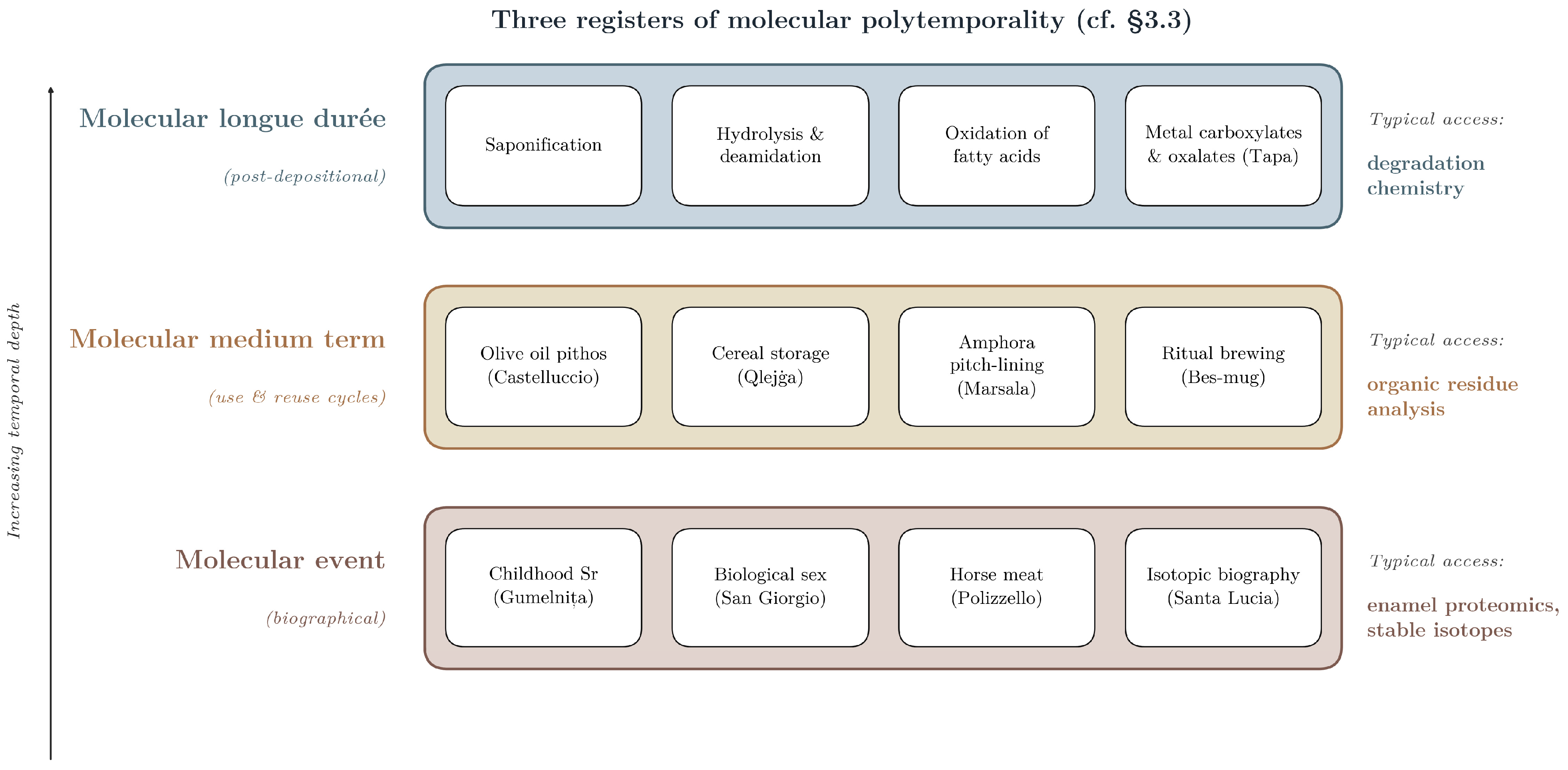

Disclaimer/Publisher’s Note: The statements, opinions and data contained in all publications are solely those of the individual author(s) and contributor(s) and not of MDPI and/or the editor(s). MDPI and/or the editor(s) disclaim responsibility for any injury to people or property resulting from any ideas, methods, instructions or products referred to in the content. |
© 2026 by the authors. Licensee MDPI, Basel, Switzerland. This article is an open access article distributed under the terms and conditions of the Creative Commons Attribution (CC BY) license.