


Abstract
Language tourism combines language learning with cultural exploration and offers new opportunities for engaging visitors with local linguistic heritage. Recent advances in Augmented Reality (AR) and Artificial Intelligence (AI) have enabled the development of immersive tourism experiences; however, their application to low-resource dialects remains limited. This paper proposes TalkCorfiota, a conceptual framework that integrates AR, conversational AI, geolocation services, and cultural storytelling to support language tourism experiences centered on the Corfiot dialect. Drawing upon situated learning, experiential learning, and digital heritage perspectives, the framework conceptualizes dialect learning as a form of heritage interpretation through which visitors engage with local identity, collective memory, and place-based cultural narratives. The proposed architecture combines location-aware cultural exploration, AR-enhanced contextual interaction, and AI-supported conversational engagement within a unified tourism ecosystem. The framework is supported by a structured linguistic resource developed during the course of this study from publicly available repositories of the Corfiot dialect. The primary contribution of this research is the conceptual design of the TalkCorfiota architectural framework, which is the foundation for future development and evaluation on AR- and AI-supported language tourism applications for low-resource dialects.
1. Introduction
Language tourism has increasingly developed as a form of cultural and experiential tourism that combines language learning with direct engagement in local communities, cultural practices and everyday communication [1,2]. Unlike conventional tourism models focused primarily on sightseeing, language tourism encourages visitors to interact with local linguistic landscapes, cultural narratives and place-based identities. As a result, it contributes not only to intercultural communication and experiential learning but also to the preservation and dissemination of intangible cultural heritage.
In recent years, digital technologies have significantly transformed tourism and cultural heritage experiences. Among these technologies, Augmented Reality (AR) and Artificial Intelligence (AI) have attracted growing attention due to their ability to create immersive, interactive and personalized environments [3,4]. AR technologies enable the superimposition of digital information onto physical environments, facilitating situated learning and contextual interpretation within real-world settings [5]. In tourism and heritage contexts, AR has been widely used to support multimodal storytelling, interactive visualization and contextual cultural interpretation [6]. Recent research further indicates that AR-supported environments can enhance vocabulary acquisition, learner immersion and contextual engagement in language learning activities [7,8,9]. Similarly, domain-specific applications in tourism contexts illustrate how AR can enhance engagement and support practical language use through the integration of digital content with real-world environments [10,11].
At the same time, developments in Natural Language Processing (NLP), conversational agents and Large Language Models (LLMs) have accelerated the use of AI in educational and tourism environments. Conversational AI systems can support adaptive language learning, interactive dialogue and intercultural communication through personalized user interaction [12,13]. Recent studies integrating conversational AI with immersive technologies also demonstrate the potential of AI–AR ecosystems for tourism and educational applications [14]. Together, these developments suggest that immersive digital technologies may facilitate more engaging and context-sensitive forms of cultural and linguistic interaction. Beyond these technological advances, digital heritage scholarship recognizes that digital technologies are not neutral vehicles for documenting or disseminating heritage. Rather, they actively shape how heritage is interpreted and experienced. As argued by Smith [15], heritage is a process of interpretation rather than the passive transmission of the past, while digital mediation inevitably involves the selection and framing of cultural narratives that may influence perceptions of authenticity, representation, and cultural significance [16]. Consequently, the application of AR and AI to language tourism should be considered not only for its capacity to enhance visitor engagement but also for the ways in which it may reframe the interpretation of linguistic heritage.
Despite this progress, relatively limited attention has been given to the use of AI and AR technologies for the preservation and dissemination of low-resource languages and regional dialects. Systematic efforts to promote regions’ dialectal diversity as a marker of cultural identity are recorded in Spain, where governmental agencies promote minority languages/dialects through tourism [17,18]. However, regional dialects frequently rely on oral transmission and possess limited digital representation, imposing additional challenges for computational processing and technology-supported learning applications [19]. This issue is particularly important from a cultural sustainability perspective, since regional dialects constitute valuable elements of intangible cultural heritage that are increasingly threatened by globalization, linguistic homogenization and declining intergenerational transmission [20]. Recent advances in transfer learning, synthetic data generation, and small language models have begun to address some limitations associated with low-resource language processing [21]. However, their application within sustainable tourism and digital heritage contexts remains underexplored. Existing tourism applications tend to prioritize entertainment, usability and visitor engagement, while comparatively less emphasis is placed on safeguarding local linguistic identity and oral cultural memory. Consequently, there is a growing need for integrated frameworks that combine immersive technologies with sustainable cultural tourism and heritage preservation objectives.
In response to this gap, the present study proposes the conceptual design of TalkCorfiota, a location-based language tourism application that integrates AR and AI technologies to support the learning and promotion of the Corfiot dialect.
The conceptual development of TalkCorfiota is informed by four complementary theoretical perspectives: situated learning, experiential learning, cultural storytelling, and digital heritage preservation. Situated Learning Theory argues that learning is most effective when it occurs within authentic social and environmental contexts rather than through abstract or decontextualized instruction [22]. Within language tourism environments, visitors encounter linguistic expressions in the locations where they are historically and culturally embedded, allowing language acquisition to occur through direct interaction with places, communities, and cultural artifacts. The geolocation and augmented reality components of TalkCorfiota are therefore designed to support context-dependent learning experiences by linking dialectal content to specific cultural landmarks.
Experiential Learning Theory [23] further emphasizes the importance of active participation, reflection, and engagement in the learning process. Rather than passively receiving information, visitors are encouraged to interact with dialectal vocabulary, cultural narratives, and conversational scenarios situated within the urban environment of Corfu. Through these interactions, language learning becomes integrated with cultural exploration and personal experience. The framework additionally draws upon cultural storytelling approaches [24,25] frequently employed in heritage interpretation. Storytelling facilitates the communication of cultural meanings by connecting historical information with personal, emotional, and place-based narratives. In the context of TalkCorfiota, language functions not only as a communication tool but also as a medium through which local history, traditions, customs, and collective memory are interpreted and experienced.
Finally, the framework is situated within the broader field of digital heritage preservation. Contemporary heritage research increasingly recognizes that digital technologies can contribute to the visibility, accessibility, and dissemination of intangible cultural heritage. Regional dialects constitute important carriers of cultural identity and collective memory, yet many remain digitally underrepresented due to limited linguistic resources and declining intergenerational transmission. Within this perspective, immersive technologies may serve as mechanisms for supporting public engagement with linguistic heritage while simultaneously enhancing tourism experiences. Taken together, these theoretical perspectives suggest that language learning can function as a form of heritage interpretation. Rather than treating dialect acquisition as an isolated educational activity, the proposed framework conceptualizes language as a gateway through which visitors engage with local culture, identity, and historical narratives. Although substantial progress has been made in the application of AR and AI technologies within tourism and cultural heritage environments, several conceptual and practical challenges remain insufficiently explored.
First, existing studies [3,4,6] primarily focus on visitor engagement, usability enhancement, and entertainment-oriented experiences, while comparatively limited attention has been devoted to understanding how immersive technologies may contribute to the interpretation and dissemination of linguistic heritage. In particular, little research has examined whether language-learning applications can function simultaneously as heritage interpretation tools.
Second, the current literature [15,16] offers limited understanding of how digital mediation influences perceptions of linguistic authenticity and local cultural identity. While immersive technologies enable the presentation of heritage content through novel forms of interaction, questions remain regarding how digitally mediated experiences shape users’ understanding of language, culture, and place.
Third, most tourism-oriented AI applications prioritize widely spoken languages supported by extensive digital resources [26]. Low-resource dialects and regional linguistic varieties remain substantially underrepresented in technology-enhanced tourism systems due to challenges associated with limited corpora, lack of standardization, and scarce computational resources.
Finally, the integration of conversational AI, augmented reality, geolocation services, and cultural storytelling has rarely been examined within a unified framework specifically designed to support both language tourism and dialect preservation objectives. These gaps highlight the need for conceptual frameworks that move beyond technological enhancement alone and explore how immersive digital environments may facilitate heritage interpretation through language-mediated cultural engagement.
In response to these challenges, this paper proposes TalkCorfiota, a conceptual framework for a location-aware language tourism application that combines AR, conversational AI, geolocation services, and cultural storytelling to support engagement with the Corfiot dialect. Rather than presenting an implemented and empirically validated system, the study develops a theoretically informed design framework illustrating how immersive technologies may be utilized to connect language learning, heritage interpretation, and cultural tourism.
Accordingly, the study pursues three interrelated research objectives. First, it aims to conceptualize how language learning may function as a mechanism of heritage interpretation within tourism environments, thereby extending existing discussions in language tourism and digital heritage research. Second, it seeks to develop a theoretically informed framework that integrates conversational AI, AR, geolocation services, and cultural storytelling to support engagement with a low-resource regional dialect. Third, it aims to explore how immersive technologies may contribute to the visibility, accessibility, and contemporary interpretation of dialect-based intangible cultural heritage. Through these objectives, the study addresses both conceptual and technological gaps in the literature and provides a foundation for future implementation and empirical evaluation.
The contribution of this work is both conceptual and technological. At the conceptual level, the framework advances the notion of language-mediated heritage interpretation, whereby dialect learning becomes a mechanism through which visitors engage with local cultural identity, oral traditions, and place-based narratives. This perspective extends existing discussions within digital heritage and language tourism by positioning language not merely as educational content but as an active component of heritage experience.
At the technological level, the framework demonstrates how conversational AI, AR, geolocation services, and multimodal linguistic resources may be integrated into a unified tourism ecosystem designed specifically for a low-resource regional dialect. The study further contributes by outlining the development of a multimodal linguistic resource that combines lexical, semantic, and potentially audio-based representations of the Corfiot dialect to support future interactive applications.
By focusing on the Corfiot dialect as an element of intangible cultural heritage, the paper provides an original case study illustrating how emerging technologies may support the visibility and contemporary interpretation of regionally distinctive linguistic traditions within sustainable tourism contexts.
The remainder of the paper is structured as follows. Section 2 develops the conceptual framework and describes the methodological design process. Section 3 presents the conceptual prototype and illustrative user scenarios. Section 4 discusses the conceptual implications, limitations and practical considerations, while Section 5 concludes and outlines future research directions.
2. Conceptual Framework Development
2.1. Study Area, Location Selection and Dialect Description
The case study focuses on the island of Corfu, which was selected based on its high tourism activity and cultural richness. According to tourism data provided by the Hellenic Statistical Authority [27], the Bank of Greece [28] and the Municipality of Central Corfu and Diapontia Islands [29], Corfu remains one of the most visited cultural tourism destinations in Greece. Due to the island’s strong tourism activity and distinctive cultural history, the Corfiot dialect constitutes an especially relevant case study for our application.
The Corfiot dialect is spoken on the island of Corfu and belongs to the Heptanesian dialect [30]. Due to the long occupation of the island by the Venetians (1386–1797 AD), the dialect was strongly influenced by the Italian variety of Veneto. The Corfiot dialect blends Greek grammar and syntax with Venetian vocabulary, creating a unique form of expression that differs from Standard Modern Greek. This hybrid linguistic character distinguishes the Corfiot dialect from many other regional Greek varieties and renders it a valuable example of historical linguistic contact in the Eastern Mediterranean [30,31].
Beyond its linguistic dimension, the dialect also functions as a vehicle of collective memory, local identity, oral tradition, and intergenerational cultural transmission. Therefore, the Corfiot dialect constitutes an important element of the island’s intangible cultural heritage. Previous studies on the Corfiot dialect focus on the dialect’s influences, its varieties [31], vocabulary [32] and intonation [33]. This study proposes a framework intended to support the promotion of the Corfiot dialect as a part of Corfu’s historical culture and a sign of the Corfiot identity.
The selection of specific locations within the island of Corfu that are utilized within our framework, was based on visitor traffic, prioritizing well-established landmarks and areas of high tourist engagement [6,29]. For the purposes of demonstrating the conceptual functionality of the TalkCorfiota application, the Old Fortress of Corfu was selected as a representative point of interest due to its historical significance, cultural visibility and high tourist activity. The selection was also supported by tourism statistics and visitor data provided by the Hellenic Statistical Authority [34].
2.2. Approach
The architecture of the TalkCorfiota framework follows a design-oriented conceptual approach aimed at exploring how emerging digital technologies may support language tourism and the interpretation of linguistic heritage. Rather than developing and evaluating a fully operational system, the objective of this study was to construct a theoretically informed framework illustrating the potential integration of AR, conversational AI, geolocation services and cultural storytelling within a unified tourism environment.
The framework design was guided by the theoretical perspectives discussed in Section 1. Situated learning informed the integration of location-aware content linked to authentic cultural settings, while experiential learning principles motivated the inclusion of interactive and exploratory user activities. Cultural storytelling provided the basis for embedding linguistic content within historical and cultural narratives, whereas digital heritage perspectives informed the treatment of the Corfiot dialect as an element of intangible cultural heritage rather than merely as linguistic data.
The development process consisted of four interconnected stages. First, a review of the relevant literature was conducted to identify existing applications of AR, AI, and language-learning technologies within tourism and heritage contexts. Second, linguistic and cultural resources relating to the Corfiot dialect were collected and consolidated from publicly accessible repositories. Third, a conceptual system architecture was designed to define the interactions between geolocation services, AR visualization, conversational AI, and content management components. Finally, representative user interaction scenarios and interface mockups were developed to illustrate the operation of the framework in realistic tourism settings.
This design-oriented process does not aim to validate system effectiveness or user outcomes. Instead, it seeks to establish a conceptual foundation that may guide future implementation, evaluation, and empirical investigation of technology-supported language tourism applications. The overall conceptual architecture and data flow of the TalkCorfiota application are illustrated in Figure 1.
Figure 1.
System architecture and data flow of the TalkCorfiota application. The framework consists of a mobile frontend that supports location-based exploration, AR-enhanced learning and conversational AI interactions. User requests are processed through backend services, including location, content, AI and AR modules, which retrieve and manage linguistic, cultural and multimedia resources stored in the central repository. The architecture also integrates third-party services, such as mapping, translation and cloud storage APIs, to support geolocation, content delivery and contextual language-learning experiences. The bidirectional data flow enables context-aware interactions between users, linguistic resources and cultural heritage content.
2.3. Materials
The materials used in this study consist of both technological components and cultural–linguistic resources. Specifically, for geolocation detection, we intend to exploit Google Maps Platform (Google LLC, Mountain View, CA, USA) and GPS-based location services for spatial positioning and point-of-interest identification. Moreover, the AR interaction layer is designed around mobile AR development frameworks such as ARCore and ARKit, enabling the superimposition of digital cultural content onto physical environments. For conversational interaction, the framework considers the use of transformer-based LLMs integrated through NLP technologies, including speech-to-text processing tools such as Whisper and dialogue-generation models based on GPT architectures. These technologies are selected due to their demonstrated effectiveness in supporting interactive tourism applications, contextual learning and multimodal user engagement within cultural heritage environments [3,6,13].
The linguistic and cultural materials focusing on the Corfiot dialect include local vocabulary, common expressions and cultural narratives and they are collected from three publicly available online resources.
The first source consisted of the Corfiot Dialect Vocabulary [32] repository maintained by CLARIN, which contains lexical entries and idiomatic expressions documented within the framework of the National Infrastructure for Language Resources and Technologies in Greece. The second source was the AtCorfu repository [35], an online collection of dialectal words and expressions curated specifically for the Corfiot linguistic tradition. The third source consisted of the Corfiot Lexicon [36] distributed through the Greek Open Library initiative.
2.4. Linguistic Resource Construction
The collected resources were aggregated into a unified machine-readable dataset. Since the three repositories exhibited differences in spelling conventions, transliteration practices, and lexical duplication, a normalization process was performed. This process involved duplicate removal, harmonization of orthographic variations, standardization of transliteration conventions, and verification of Modern Greek equivalents. Following normalization, the resulting resource contained 4549 unique lexical items and 352 dialectal expressions.
To facilitate their use within tourism and heritage contexts, the lexical material was organized into thematic categories. The categorization process was conducted manually by the authors and guided by principles of cultural relevance and tourism applicability. Five thematic domains were identified: gastronomy, folklore, music and songs, local customs, and everyday communication. These domains were selected because they represent central dimensions of intangible cultural heritage frequently encountered within cultural tourism experiences. Vocabulary related to food, beverages, and culinary practices was assigned to gastronomy, terms associated with traditional songs and musical practices to music and songs, expressions referring to customs, celebrations, and everyday social practices to local customs, and words connected with legends, beliefs, or oral traditions to folklore. General expressions commonly used in daily interactions, such as greetings or conversational phrases, were grouped under everyday communication.
To improve consistency, the thematic classification was independently reviewed by two members of the research team with expertise in cultural heritage and educational technologies. Where a lexical item could reasonably be associated with more than one thematic category, it was assigned to the category that best reflected its predominant cultural meaning in the original source material and its intended interpretive context within the proposed application. Because the thematic organization was intended to support a conceptual application prototype rather than quantitative content analysis, intercoder reliability statistics were not calculated. Instead, disagreements were resolved through discussion until consensus was reached.
Finally, each lexical item was enriched with English-language translations to support multilingual interaction within tourism environments. English translations were derived from the Modern Greek equivalents available in the original repositories and cross-checked across the three publicly available sources used in the study. Where differences were identified, the final wording was selected following discussion among the authors to best preserve the intended cultural meaning. Because the resulting dataset was developed as a supporting linguistic resource for a conceptual prototype rather than as a formally validated bilingual lexicon, the translations should be regarded as functional aids for multilingual interaction and will require further linguistic validation by dialect experts and native speakers during future system implementation.
To facilitate conversational interaction, selected expressions, idioms and vocabulary items will be organized into dialogue-oriented datasets that can be utilized by AI-based chatbot systems. These datasets could include question–answer pairs, situational dialogues and culturally contextualized prompts associated with specific landmarks in the Old Town of Corfu. In addition, audio representations of selected words and expressions may be incorporated in future implementations in order to preserve pronunciation patterns and prosodic characteristics of the Corfiot dialect, which are strongly connected to oral cultural transmission. The integration of textual, semantic and audio information contributes to the creation of a multimodal linguistic resource that may support the visibility of the dialect and immersive cultural tourism experiences.
The resulting linguistic resource should be viewed as an initial infrastructure for future system development rather than a finalized linguistic corpus. Future implementations may further expand dialectal datasets through linguistic fieldwork, oral recordings and consultation with native speakers.
2.5. AI Governance, Dialect Accuracy and Content Validation
The use of conversational artificial intelligence within low-resource linguistic environments presents important challenges relating to linguistic accuracy, cultural authenticity, and content reliability. Because the Corfiot dialect lacks large-scale annotated corpora suitable for training dedicated language models, the TalkCorfiota framework does not assume unrestricted generative AI capabilities. Instead, the framework adopts a retrieval-supported conversational approach designed to prioritize verified linguistic content.
More specifically, conversational responses are conceptualized as being grounded in the curated dialect repository through Retrieval-Augmented Generation (RAG) mechanisms [37]. Rather than relying exclusively on free-text generation, the conversational system retrieves relevant lexical entries, expressions, translations, and cultural information from validated resources before generating responses. Such an approach may reduce hallucination risks and improve consistency with documented dialectal forms.
Furthermore, conversational outputs could be subjected to a multi-stage validation workflow. Initially, generated responses would be automatically checked against the curated dialect repository to verify lexical consistency. Subsequently, a sample of generated interactions would be periodically reviewed by native dialect speakers and cultural experts. Validation criteria would include linguistic accuracy, cultural appropriateness, historical consistency and preservation of dialectal characteristics. This procedure would provide an additional safeguard against factual inaccuracies and culturally inappropriate content.
Moreover, to address the risk of AI-generated inaccuracies and hallucinations, generated content should be supported by verified linguistic and historical sources whenever possible. In addition, human oversight would play a central role in the validation process. Local dialect speakers, educators, historians, and cultural organizations could periodically review generated outputs to identify linguistic errors, factual inconsistencies, or culturally inappropriate representations. A community-centered validation approach would further strengthen the reliability of the TalkCorfiota platform. User feedback mechanisms could allow community members to report inaccuracies, suggest corrections, and contribute additional linguistic material. This participatory process would not only improve the quality of AI-generated content but also ensure that the preservation and representation of the Corfiot dialect remain aligned with the knowledge and experiences of the local community. Through the combination of curated linguistic resources, expert review, and community participation, TalkCorfiota could enhance both the authenticity and trustworthiness of AI-supported dialect preservation initiatives.
2.6. System Design and Functionality
The design of the TalkCorfiota framework follows a modular client–server architecture in which the individual components interoperate to support location-based cultural exploration, AR-enhanced interaction and conversational language learning. The framework combines geolocation services, contextual AR visualization and AI-driven dialogue management in order to provide adaptive and immersive tourism experiences.
The geolocation module uses Global Positioning System (GPS) functionality and mobile mapping services to identify the user’s position and dynamically retrieve location-specific linguistic and cultural content. Geographic coordinates are linked to predefined points of interest (POIs) within Corfu, including historical landmarks, museums, cafés, marketplaces, and public spaces. A geospatial database stores metadata associated with each POI, including vocabulary items, dialectal expressions, historical descriptions, audio recordings, and multimedia assets. When users enter a predefined spatial radius around a location, the application triggers the delivery of contextualized learning material.
The AR subsystem is structured through mobile AR frameworks namely ARCore (Android) and/or ARKit (iOS), enabling real-time overlay of digital information onto physical environments via the smartphone camera. Markerless AR techniques based on simultaneous localization and mapping (SLAM) are utilized to anchor digital objects within the user’s surroundings without requiring physical markers. The AR layer displays interactive vocabulary labels, translations, pronunciation guides, historical annotations, and 3D cultural visualizations associated with nearby locations or objects. Multimedia elements, including audio narration and image-based storytelling, are integrated to enhance immersion and multimodal learning. This is in line with prior studies that have shown that AR-supported contextual visualization can improve engagement, memory retention, and cultural interpretation in educational and heritage applications [5,7,8].
The conversational AI module is designed to facilitate interactive language practice through natural language interaction. The system combines speech recognition, natural language understanding (NLU), and dialogue management technologies to simulate authentic communication scenarios encountered in tourism contexts. Speech-to-text processing may be implemented through cloud-based APIs such as Whisper-based models, while dialogue generation may utilize transformer-based LLMs adapted for educational interaction. The conversational AI module supports scenario-based exchanges, including restaurant ordering, asking for directions, purchasing goods, and participating in culturally situated conversations.
To preserve regional linguistic identity, the conversational system incorporates curated lexical, phonological, and idiomatic features of the Corfiot dialect. Dialectal datasets are constructed through linguistic fieldwork, oral recordings, local archival material, and consultation with native speakers. These resources are integrated into the conversational model through prompt engineering, retrieval-augmented generation (RAG), or fine-tuning techniques that enable the system to produce contextually appropriate dialectal expressions alongside standardized Modern Greek and English equivalents when necessary. Collectively, the interoperability of the proposed modules is designed to facilitate a context-aware and multimodal tourism environment that combines situated language learning, cultural storytelling, and adaptive digital interaction.
3. Conceptual Prototype
The framework architecture represents a conceptual design model derived from the theoretical foundations and framework development process described in the previous sections. The interface mockups, workflows, and user scenarios presented below should therefore be interpreted as design artefacts intended to demonstrate functionality and potential application rather than validated system outputs.
3.1. Conceptual Prototype and Interface Design
From a design perspective, the application was conceptually informed by established human-centered design principles emphasizing usability, accessibility, contextual relevance, and cultural authenticity [38]. These principles served as design guidelines during the conceptual development of the framework and have not yet been empirically evaluated through user studies or formal usability testing. Interface design prioritizes intuitive navigation, reduced cognitive load, and multimodal interaction suitable for users with varying levels of digital literacy and language proficiency. Particular attention is given to lightweight computational architecture and efficient data handling in order to support deployment in low-resource language environments where annotated linguistic corpora and technical infrastructure may be limited [17,19]. Linguistic content is embedded within broader cultural and historical narratives to support cultural storytelling and intangible heritage dissemination.
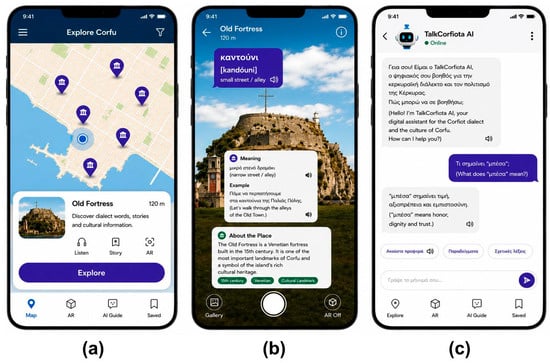
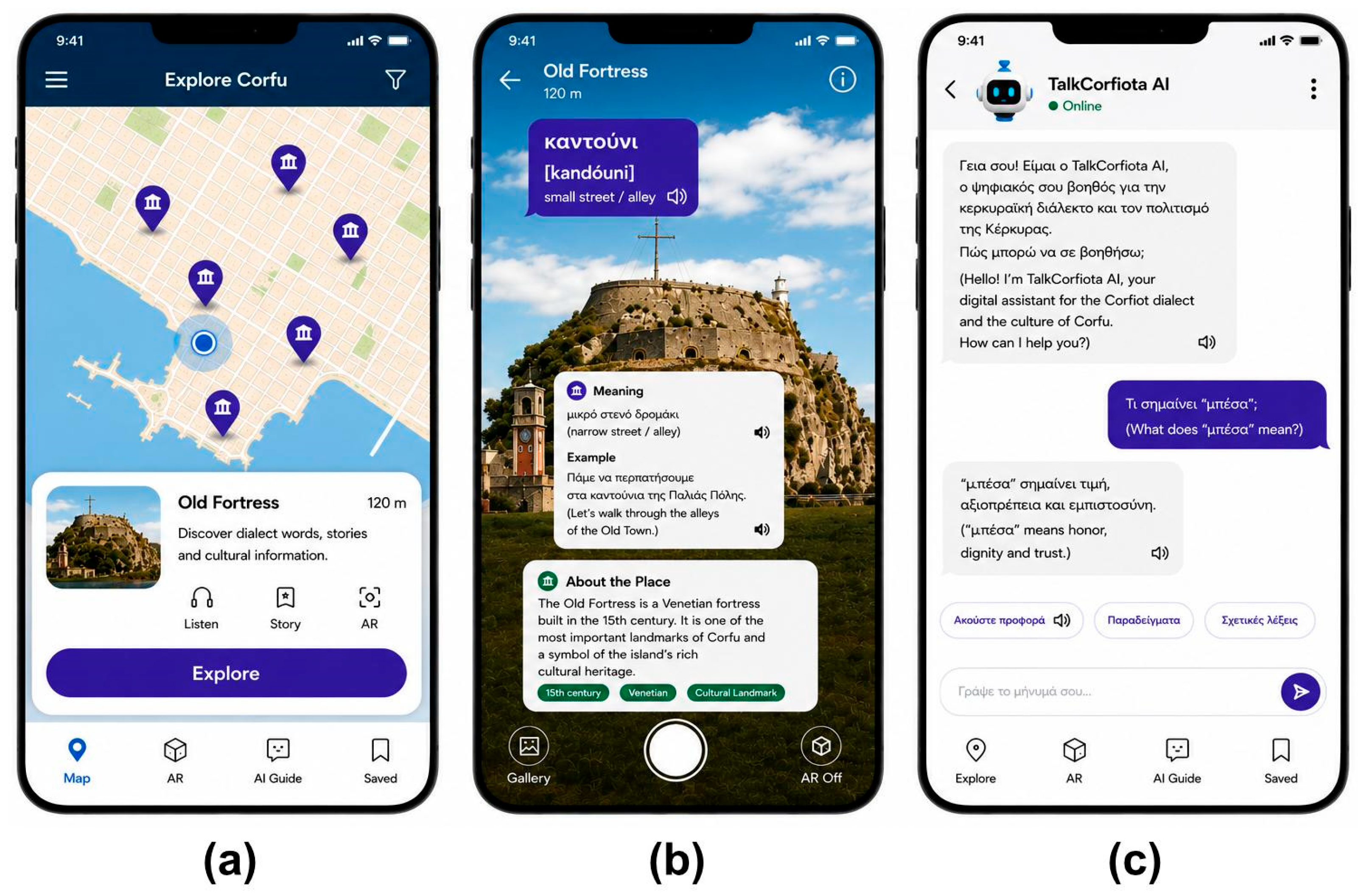
To illustrate the conceptual user experience of the proposed framework, a set of interface mockups was developed to represent the main functional modules of the TalkCorfiota application. The interface design emphasizes usability, multimodal interaction, and contextual learning support. Figure 2 illustrates representative application screens, including the map-based exploration interface, the AR-enhanced contextual learning environment, and the assistant AI interaction module.
Figure 2.
Illustrative conceptual interface mockups of the proposed TalkCorfiota application: (a) map-based exploration interface, (b) AR-enhanced contextual learning environment, and (c) conversational AI interaction module. The interfaces are intended to demonstrate the proposed functionality and user workflow and do not represent a fully implemented or empirically evaluated system.
3.2. Adaptive System Workflow
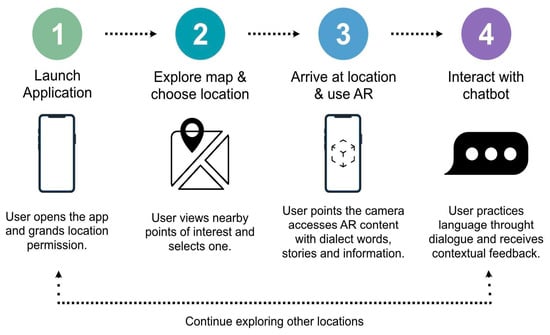
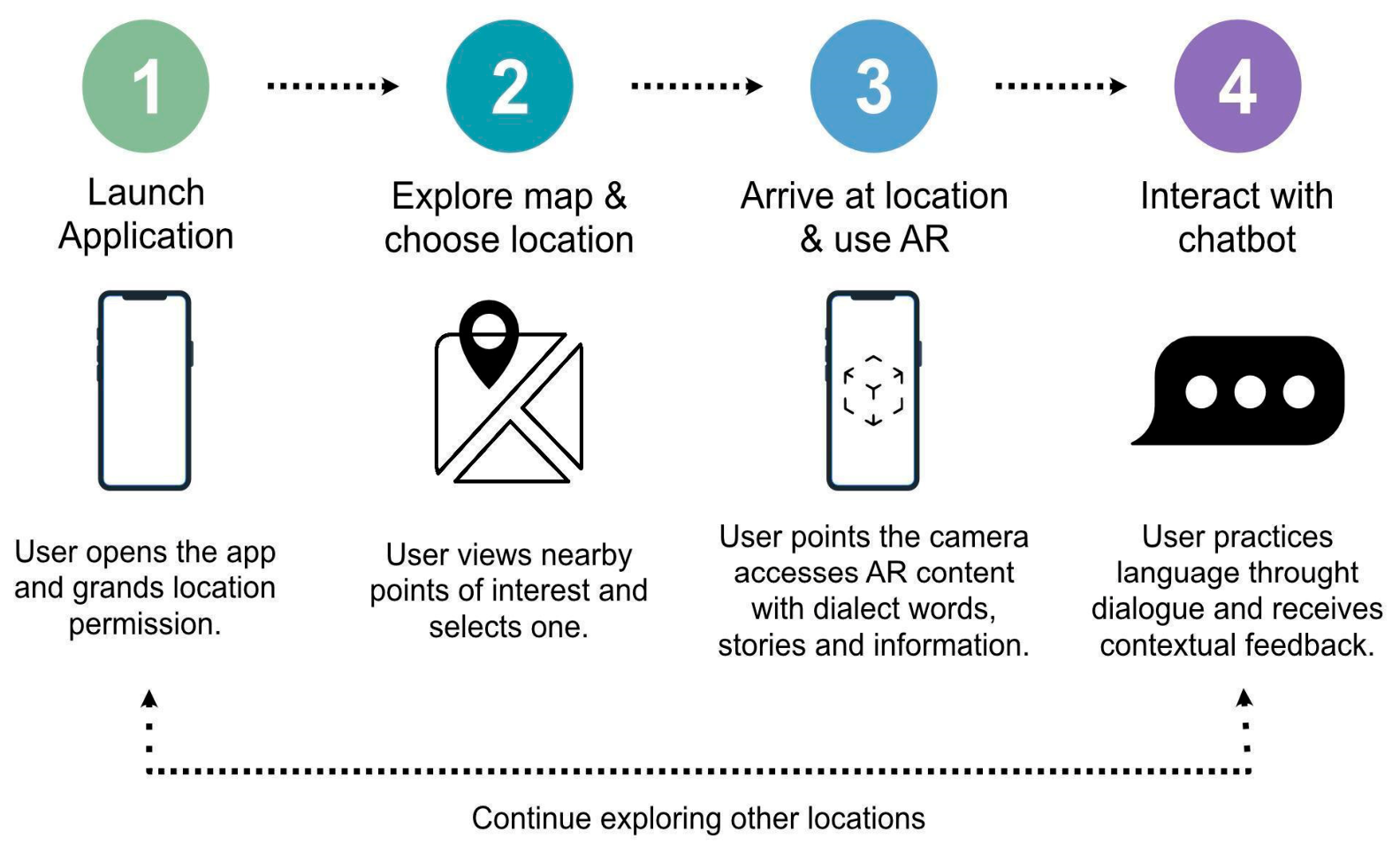
The TalkCorfiota framework operates through the interaction of interconnected modules that collectively support location-based cultural exploration, situated language learning and adaptive user interaction. Figure 3 illustrates the overall system workflow and communication between the individual components.
Figure 3.
Illustrative workflow of the proposed TalkCorfiota application, showing the conceptual interaction between the geolocation, AR, conversational AI, and content management modules. The workflow represents the intended operation of the framework and has not been empirically validated. Dashed arrows indicate the sequence of the conceptual user workflow, while the returning dashed arrow indicates that users may continue exploring additional locations.
Initially, the geolocation module identifies the user’s position through GPS-based mobile services and retrieves nearby points of interest (POIs) from the geospatial database. Each POI is associated with dialectal vocabulary, idiomatic expressions, multimedia elements and contextual cultural narratives related to the history and identity of Corfu. The retrieved information is subsequently processed by the AR subsystem, which overlays digital linguistic and cultural content onto the physical environment through the mobile device camera. AR visualizations include vocabulary annotations, pronunciation prompts, historical descriptions and interactive multimedia elements that facilitate contextualized and situated learning experiences, as supported by previous studies on AR-assisted language learning and cultural heritage interpretation [7]. The conversational AI module enables users to engage in interactive dialogue scenarios associated with specific tourism contexts, such as ordering food, asking for directions or participating in culturally situated conversations. The system combines speech recognition, natural language understanding and dialogue-generation technologies to provide contextual feedback and conversational support.
Additionally, the framework incorporates adaptive interaction mechanisms that personalize content delivery according to the user’s location, interaction history, thematic preferences and estimated language proficiency. Based on user engagement patterns, the system dynamically adjusts vocabulary difficulty, dialogue complexity and cultural recommendations in order to support personalized and context-aware learning experiences. The proposed framework operationalizes the theoretical perspectives discussed in Section 2. The geolocation module supports situated learning by enabling visitors to engage with dialectal expressions in authentic cultural settings [29]. The AR layer facilitates contextual heritage interpretation by integrating linguistic and cultural information with physical locations [3,4,5,6]. The conversational AI module supports experiential language learning through interactive dialogue and contextual feedback [12,13,23]. Finally, the cultural storytelling and content management components contribute to the preservation and transmission of collective memory and cultural heritage through structured digital resources [15,20,23].
3.3. User Interaction Scenario
To demonstrate the potential operation of the framework, an illustrative user scenario is presented involving a visitor exploring the Old Fortress of Corfu. Upon opening the application, the visitor accesses the interactive map interface and receives recommendations regarding nearby points of cultural and linguistic interest. After selecting the Old Fortress, the visitor navigates to the site and activates the augmented reality mode.
As the device camera is directed toward the surrounding environment, digital overlays appear displaying selected Corfiot dialect terms associated with the fortress and its historical context. Alongside each term, users may access translations, pronunciation guidance, and short cultural narratives explaining the linguistic and historical significance of the expression.
The visitor may subsequently activate the conversational AI assistant and engage in a dialogue concerning the history of the fortress, local traditions, or everyday expressions used by Corfiot residents. Rather than simply presenting isolated vocabulary items, the system contextualizes language within broader cultural narratives, thereby supporting both language learning and heritage interpretation.
For example, a user interested in local customs may ask the conversational assistant about traditional celebrations associated with the Old Town. The system may then retrieve relevant dialect expressions, provide explanations of their cultural significance, and suggest nearby locations where related traditions continue to be practiced.
This illustrative scenario demonstrates how the proposed framework may facilitate interactions that combine place-based exploration, language learning, and cultural storytelling. The scenario should not be interpreted as evidence of actual user behavior or learning outcomes but rather as an example of the types of experiences that future implementations could support.
3.4. Conceptual Contribution of the Framework
Beyond the integration of existing technologies, the primary contribution of TalkCorfiota lies in its conceptualization of language learning as a mechanism for heritage interpretation. Existing tourism technologies frequently utilize language as a support service facilitating communication between visitors and destinations. In contrast, the proposed framework positions the dialect itself as a central cultural artifact through which visitors encounter local identity, collective memory, and place-based narratives.
The framework therefore introduces a language-mediated heritage interpretation approach in which linguistic engagement becomes an integral component of cultural exploration. Within this perspective, dialectal expressions are not treated merely as vocabulary to be learned but as cultural carriers connecting visitors to local traditions, historical experiences, and community identity.
This conceptual shift contributes to ongoing discussions within digital heritage and language tourism research concerning the role of immersive technologies in supporting culturally meaningful visitor experiences. It further highlights the potential of low-resource dialects to function as active elements of heritage interpretation rather than passive objects of preservation.
4. Discussion
4.1. Discussion of the Proposed Framework
The TalkCorfiota framework may be perceived as a conceptual response to growing interest in the intersection of language tourism, digital heritage, and immersive technologies. Rather than evaluating a deployed system, the present study explores how conversational AI, AR and geolocation services can be integrated to support engagement with low-resource dialects within tourism environments. Consequently, the discussion focuses on the conceptual implications and future potential of the framework rather than on validated user outcomes.
One of the principal contributions of the framework lies in its reconceptualization of language learning as a vehicle of heritage interpretation. Existing tourism technologies frequently employ language as a practical tool for facilitating communication between visitors and destinations. In contrast, TalkCorfiota positions the Corfiot dialect itself as an object of cultural engagement, which aligns with international frameworks such as the UNESCO Convention for the Safeguarding of Intangible Cultural Heritage [18]. This perspective extends current discussions within language tourism and digital heritage by suggesting that dialect learning may function as a pathway through which visitors encounter local history, collective memory, and place-based identity.
The framework additionally contributes to ongoing debates regarding the role of immersive technologies in heritage interpretation. Previous research has primarily examined how AR and AI technologies enhance visitor engagement, information delivery, and experiential immersion. Comparatively less attention has been devoted to understanding how such technologies may shape interpretations of linguistic heritage. By embedding dialectal expressions within location-specific cultural narratives, TalkCorfiota proposes a model in which language becomes integrated into broader heritage experiences rather than being treated as an isolated educational activity. At the same time, the framework raises important conceptual questions concerning the relationship between digital mediation and cultural authenticity. Heritage experiences delivered through technological platforms are necessarily curated, structured, and mediated. Therefore, immersive technologies should not be regarded as neutral vehicles for heritage transmission but as interpretive media that actively participate in constructing cultural meaning and visitor understanding. While immersive technologies may increase accessibility and engagement, they also influence how users perceive and interpret cultural content. The presentation of dialectal expressions through digital interfaces may inevitably simplify complex linguistic realities or privilege particular interpretations of local culture. Consequently, future implementations should carefully balance accessibility and educational objectives with the preservation of linguistic and cultural nuance. The framework also contributes to discussions surrounding the preservation of low-resource linguistic varieties. Regional dialects frequently face challenges associated with declining use, limited digital representation, and restricted availability of linguistic resources. Although the proposed framework cannot itself preserve the Corfiot dialect, it may provide additional opportunities for public visibility, cultural engagement, and educational dissemination.
The Corfiot dialect constitutes an important element of the island’s linguistic and cultural heritage and continues to contribute to the expression of local identity. As with other forms of intangible cultural heritage, its continuity depends on transmission within the community and on opportunities for successive generations to engage with local linguistic traditions. Within this context, digital technologies may complement existing heritage practices by increasing the visibility and accessibility of dialectal expressions and their associated cultural narratives. However, such technologies should be understood as supporting rather than replacing the social processes through which linguistic heritage is experienced, transmitted, and maintained.
At the same time, incorporating regional dialects into tourism experiences requires careful consideration. Although digital applications can increase public awareness of local linguistic heritage, they also shape how language and culture are represented to visitors. The selection of dialectal expressions, cultural narratives, and historical interpretations inevitably reflects interpretive choices that may influence how heritage is understood. Consequently, digital heritage applications should seek to present linguistic content within its broader historical and cultural context, recognizing that dialect represents a living expression of community identity rather than simply a tourism resource. These considerations further emphasize the importance of meaningful community participation throughout the development of AI-supported heritage applications. Local communities should not be regarded solely as validators of linguistic content but as active participants in decisions concerning content selection, cultural interpretation, and the ongoing development of the platform. Their involvement contributes to ensuring that digital representations remain aligned with local knowledge, cultural values, and community perspectives. Any contribution to dialect preservation should therefore be understood as indirect and contingent upon sustained community participation, institutional support, and long-term maintenance of linguistic resources.
Furthermore, the study highlights the potential role of multimodal linguistic resources within digital heritage ecosystems. By integrating lexical entries, cultural narratives, geospatial information, and future audio representations, the framework illustrates how linguistic heritage may be documented and interpreted through interconnected digital infrastructures. Such an approach may be particularly valuable for regional dialects whose cultural significance extends beyond vocabulary to include pronunciation patterns, oral traditions, and local storytelling practices.
Importantly, the framework should not be interpreted as evidence that immersive technologies automatically generate positive educational or heritage outcomes. The actual effectiveness of AR-enhanced language learning, AI-supported cultural interpretation, and location-based heritage storytelling remains an empirical question requiring systematic investigation. Future research should therefore evaluate how users interact with such systems, how dialect learning influences cultural understanding, and whether digitally mediated experiences contribute to meaningful engagement with local heritage.
4.2. Limitations and Critical Considerations
Several limitations and critical considerations should be acknowledged when evaluating the proposed framework. First, the study remains conceptual and does not include the implementation or empirical evaluation of a functional system. Consequently, no conclusions can be drawn regarding usability, learning effectiveness, visitor satisfaction, behavioral outcomes, or heritage impacts. The framework should therefore be viewed as a theoretical and design-oriented contribution intended to guide future development and research.
Second, the framework relies on linguistic resources that may not fully capture the diversity and variability of the Corfiot dialect. As with many regional linguistic varieties, dialect usage may differ across generations, communities, and social contexts. Future implementations should therefore incorporate broader community participation and continuous content review processes.
Third, the use of immersive technologies raises questions regarding the potential commodification of intangible cultural heritage. When dialects are incorporated into tourism products, there is a risk that complex cultural practices may be simplified or transformed into consumable experiences primarily designed for visitors. Although such approaches may increase visibility, they may also unintentionally reduce linguistic heritage to a marketable attraction detached from its social and historical context.
Fourth, the framework raises issues concerning technological mediation and authenticity. Users interact with curated representations of language and culture rather than with heritage in its entirety. Consequently, digital systems inevitably influence the narratives that are presented, the expressions that are highlighted, and the meanings that users derive from cultural experiences.
Fifth, digital inclusion represents an additional challenge. Effective participation requires access to compatible mobile devices, internet connectivity, and a certain degree of technological literacy. Older visitors, individuals with disabilities, and users with limited digital experience may encounter barriers that reduce accessibility and participation. Finally, the increasing use of AI technologies raises environmental and ethical concerns. LLMs and cloud-based AI infrastructures require substantial computational resources and energy consumption.
These limitations also define the next stage of the research. Future work will focus on implementing a functional prototype and conducting a pilot study involving visitors, local community members, and cultural heritage experts. The evaluation will assess usability, user experience, perceived learning, cultural engagement, and the linguistic and cultural accuracy of the system, providing empirical evidence to further refine the proposed framework.
4.3. Managerial and Policy Implications
The TalkCorfiota framework also provides several practical implications for tourism organizations, municipalities, cultural institutions, and heritage stakeholders interested in promoting linguistic heritage through digital technologies. For destination management organizations, the framework illustrates how language-based experiences may diversify tourism offerings by moving beyond traditional sightseeing activities toward more participatory and educational forms of cultural engagement. Integrating dialect-focused experiences into destination strategies may strengthen local distinctiveness while supporting cultural storytelling initiatives. Municipal authorities and regional tourism agencies may play an important role in supporting the development and long-term sustainability of such initiatives. Their involvement may include facilitating access to cultural resources, supporting content development, providing financial assistance for system maintenance, and coordinating collaborations among stakeholders.
Cultural institutions, museums, archives, and heritage organizations can contribute by validating historical and linguistic content, ensuring cultural accuracy, and supporting the documentation of oral traditions. Their participation is particularly important for maintaining authenticity and ensuring that heritage interpretation remains aligned with community values. Universities and research institutions may further contribute by developing linguistic resources, conducting usability evaluations, and supporting technological innovation. In the context of low-resource dialects, academic institutions can play a critical role in the creation and maintenance of digital language repositories required for AI-supported applications.
The long-term sustainability of such platforms also requires clear governance mechanisms. Responsibilities relating to content moderation, linguistic validation, system updates, and data management should be explicitly assigned among participating stakeholders. A collaborative governance model involving municipalities, universities, cultural institutions, and local communities may therefore represent a suitable approach for ensuring the long-term viability and credibility of language-tourism initiatives.
Finally, financial sustainability should be considered from the earliest stages of implementation. Beyond initial development costs, long-term operation requires continuous content maintenance, technological updates, infrastructure management, and community engagement activities. Sustainable funding models may therefore be necessary to ensure that heritage-oriented digital platforms remain functional and culturally relevant over time.
Overall, effective governance would require collaboration among municipalities, universities, cultural institutions, technology developers and representatives of the local community, each contributing their respective expertise in funding, linguistic documentation, cultural validation, technological development and long-term maintenance.
5. Conclusions
This paper proposed TalkCorfiota, a conceptual framework that integrates augmented reality, conversational artificial intelligence, geolocation services, and cultural storytelling to conceptualize language tourism experiences centered on the Corfiot dialect. The framework was developed in response to the limited representation of low-resource dialects within contemporary tourism technologies and the growing interest in the potential of leveraging immersive digital environments for cultural heritage interpretation.
Rather than presenting an implemented and empirically evaluated system, the study contributes a theoretically informed design framework illustrating how language learning, heritage interpretation, and tourism experiences could be conceptually interconnected through emerging technologies. Drawing upon situated learning, experiential learning, cultural storytelling, and digital heritage perspectives, the framework conceptualizes dialect learning not simply as an educational activity but as a mechanism through which visitors may engage with local identity, collective memory, and place-based cultural narratives.
The principal conceptual contribution of the study is the proposal of a language-mediated heritage interpretation perspective. Within this approach, linguistic engagement is conceptualized as an integral component of cultural exploration, suggesting that regional dialects could be framed as active elements of heritage interpretation rather than solely as objects of preservation. In addition, the framework outlines how multimodal linguistic resources, location-aware technologies, and conversational interfaces could be combined within a unified ecosystem designed to support low-resource linguistic heritage.
The paper also contributes to ongoing discussions concerning the opportunities and challenges associated with the digital mediation of intangible cultural heritage. While immersive technologies could provide new possibilities for visibility, accessibility, and public engagement, their use also raises important questions regarding authenticity, representation, digital inclusion, governance, and sustainability. Addressing these issues will be essential for ensuring that future implementations remain culturally meaningful and socially responsible.
Several limitations should be acknowledged. The proposed framework remains conceptual and has not yet been implemented or evaluated in real-world tourism environments. Consequently, no conclusions can be drawn regarding usability, visitor engagement, learning outcomes, or heritage impacts, including any preservation-related effects. Furthermore, the linguistic resources utilized in the framework represent an initial infrastructure that would require continuous enrichment, validation, and community participation to support operational deployment.
Future research is expected to focus on the implementation and empirical evaluation of the proposed framework. Particular attention should be given to user experience assessment, learning effectiveness, perceptions of cultural authenticity, stakeholder participation, and the governance of AI-supported heritage applications. Additional studies may also explore the transferability of the framework to other low-resource dialects and linguistic communities facing similar challenges of digital underrepresentation.
Overall, TalkCorfiota proposes a conceptual way in which immersive technologies may be used to connect language tourism, cultural storytelling, and digital heritage. By positioning dialect learning within broader processes of heritage interpretation and cultural engagement, the framework offers a foundation for future research and development at the intersection of tourism, language preservation, and digital innovation. Beyond language learning, the proposed framework contributes to the design of multimodal and interactive digital heritage experiences by combining audiovisual, spatial, and conversational interaction within a unified cultural interpretation environment.
Author Contributions
Conceptualization, M.L.; methodology, M.L., M.K. and S.S.; software, M.K.; formal analysis, M.K.; investigation, M.L., M.K. and S.S.; resources, S.S.; data curation, M.L., M.K. and S.S.; writing—original draft preparation, M.K.; writing—review and editing, M.L., M.K. and S.S.; visualization, M.K.; supervision, M.K. All authors have read and agreed to the published version of the manuscript.
Funding
This research received no external funding.
Data Availability Statement
The datasets used in this study are publicly available repositories of the Corfiot dialect and all links to their hosting webpages are given both in the text and in the references’ list. The merged CSV file of Corfiot words and expressions along with the Modern Greek and English translations are available by the authors, upon request.
Acknowledgments
OpenAI ChatGPT-4.0 was used exclusively for language editing to improve grammar, wording and readability. The authors take full responsibility for the scientific content of the manuscript.
Conflicts of Interest
The authors declare no conflicts of interest.
References
- Richards, G. Cultural tourism: A review of recent research and trends. J. Hosp. Tour. Manag. 2018, 36, 12–21. [Google Scholar] [CrossRef] [Scilit]
- Lonardi, A. Minority languages and tourism: A literature review. J. Herit. Tour. 2022, 17, 341–357. [Google Scholar]
- Dieck, T.M.C.; Jung, T. Value of augmented reality at cultural heritage sites: A stakeholder approach. J. Destin. Mark. Manag. 2017, 6, 110–117. [Google Scholar] [CrossRef] [Scilit]
- Chatsiopoulou, A.; Michailidis, P.D. Augmented reality in cultural heritage: A narrative review of design, development and evaluation approaches. Heritage 2025, 8, 421. [Google Scholar] [CrossRef] [Scilit]
- Yovcheva, Z.; Buhalis, D.; Gatzidis, C. Overview of smartphone augmented reality applications for tourism. In Proceedings of the International Conference on Industrial Technology, Athens, Greece, 19–21 March 2012. [Google Scholar]
- Kleftodimos, A.; Evagelou, A.; Triantafyllidou, A.; Grigoriou, M.; Lappas, G. Location-based augmented reality for cultural heritage communication and education: The Doltso district application. Sensors 2023, 23, 4963. [Google Scholar] [CrossRef] [Scilit] [PubMed]
- Christou, E.; Vassiliou, P.; Parmaxi, A. Augmented reality in language learning: A systematic literature review of state-of-the-art and task design considerations. Innov. Lang. Learn. Teach. 2025, 1–28. [Google Scholar] [CrossRef] [Scilit]
- Schorr, I.; Plecher, D.A.; Eichhorn, C.; Klinker, G. Foreign language learning using augmented reality environments: A systematic review. Front. Virtual Real. 2024, 5, 1288824. [Google Scholar] [CrossRef] [Scilit]
- Direkci, B.; Aydemir, N.E. Augmented reality technology in language learning: A meta-analysis of experimental studies (2015–2025). Int. J. Learn. Teach. Educ. Res. 2025, 3, 25. [Google Scholar] [CrossRef] [Scilit]
- Hsu, K.-C.; Barrett, N.E.; Liu, G.-Z. English for tourism and AR-assisted context-aware ubiquitous learning: A preliminary design-based research. Comput. Assist. Lang. Learn. 2025, 38, 521–549. [Google Scholar] [CrossRef] [Scilit]
- Caetano, A.; Lawson, A.; Liu, Y.; Sra, M. ARLang: An augmented reality application for vocabulary learning in real-world environments. arXiv 2024, arXiv:2411.05211. [Google Scholar] [CrossRef] [Scilit]
- Wiboolyasarin, W. AI-driven chatbots in second language education: A systematic review of their efficacy and pedagogical implications. Ampersand 2025, 14, 100224. [Google Scholar] [CrossRef] [Scilit]
- Winkler, R.; Söllner, M. Unleashing the Potential of Chatbots in Education: A State-of-the-Art Analysis. In Proceedings of the Academy of Management Annual Meeting, Chicago, IL, USA, 10–14 August 2018. [Google Scholar]
- Bendarkawi, J.; Ponce, A.; Mata, S.; Aliu, A.; Liu, Y.; Zhang, L.; Liaqat, A.; Rao, V.N.; Monroy-Hernández, A. ConversAR: Augmented reality with conversational agents for immersive language learning. arXiv 2025, arXiv:2505.24000. [Google Scholar]
- Smith, L. Uses of Heritage; Routledge: London, UK, 2006. [Google Scholar] [CrossRef] [Scilit]
- Manlee, N.; Kasemsarn, K. The Authenticity Challenge in Digital and Social Media in Cultural Tourism: A Systematic Literature Review. Heritage 2025, 8, 478. [Google Scholar] [CrossRef] [Scilit]
- Mei, Z. Dialect inheritance and youth identity: An online ethnography study on dialect enthusiasts community on the new media platforms. Front. Commun. 2024, 9, 1464284. [Google Scholar] [CrossRef] [Scilit]
- García-Henche, B.; Yang, M. The Spanish language as a cultural and touristic resource for the Chinese market to develop quality education. Front. Psychol. 2022, 12, 815350. [Google Scholar] [CrossRef] [Scilit] [PubMed]
- Besacier, L.; Barnard, E.; Karpov, A.; Schultz, T. Automatic speech recognition for under-resourced languages: A survey. Speech Commun. 2014, 56, 85–100. [Google Scholar] [CrossRef] [Scilit]
- UNESCO. Convention for the Safeguarding of the Intangible Cultural Heritage. Available online: https://ich.unesco.org/en/convention (accessed on 10 May 2026).
- Kadyrbek, N.; Tuimebayev, Z.; Mansurova, M.; Viegas, V. The Development of Small-Scale Language Models for Low-Resource Languages, with a Focus on Kazakh and Direct Preference Optimization. Big Data Cogn. Comput. 2025, 9, 137. [Google Scholar] [CrossRef] [Scilit]
- Lave, J.; Wenger, E. Situated Learning: Legitimate Peripheral Participation; Cambridge University Press: Cambridge, UK, 1991. [Google Scholar]
- Kolb, D.A. Experiential Learning: Experience as the Source of Learning and Development; Prentice Hall: Englewood Cliffs, NJ, USA, 1984. [Google Scholar]
- Kasemsarn, K.; Nickpour, F. Digital Storytelling in Cultural and Heritage Tourism: A Review of Social Media Integration and Youth Engagement Frameworks. Heritage 2025, 8, 200. [Google Scholar] [CrossRef] [Scilit]
- Chan, C.S.; Shek, K.F.; Lu, Y.; Wong, S.Y. Narratives come alive: Enhancing cultural heritage experiences through sensorial narrative-based guiding tours. J. Herit. Tour. 2025, 20, 487–507. [Google Scholar] [CrossRef] [Scilit]
- Kontogianni, A.; Alepis, E. Empowering Smart Tourism with Large Language Models. In Human-Smart City Interactions and User-Citizen Experiences; Tsihrintzis, G.A., Virvou, M., Marinakis, V., Jain, L.C., Eds.; Springer: Cham, Switzerland, 2026. [Google Scholar] [CrossRef] [Scilit]
- ELSTAT. Arrivals and Nights Spent in Tourist Accommodation Establishments; Hellenic Statistical Authority: Piraeus, Greece, 2025; Available online: https://www.statistics.gr/en/statistics/-/publication/STO04 (accessed on 10 May 2026).
- Bank of Greece. Travel Services Balance of Payments; Bank of Greece: Athens, Greece, 2024; Available online: https://www.bankofgreece.gr/en/statistics/external-sector/balance-of-payments/travel-services (accessed on 10 May 2026).
- Visit Corfu. Available online: https://visit.corfu.gr/ (accessed on 2 May 2026).
- Kontossopoulos, N. Dialektoi kai Idiomata tis Neas Ellinikis, 4th ed.; Gregoris Publications: Athens, Greece, 2006. [Google Scholar]
- Laskari, N. Kerkira: Mia Matia Mesa ston Xrono; Sideris: Athens, Greece, 1998. [Google Scholar]
- Drakopoulou, A. Vocabulary of the Corfiot Dialect. Version 1.0.0. CLARIN:EL. 2021. Available online: http://hdl.handle.net/11500/CLARIN-EL-0000-0000-6A12-5 (accessed on 30 April 2026).
- Giakoumelou, M.; Papazachariou, D. Asking Questions in Corfu: An Intonational Analysis. In Proceedings of the 5th International Conference on Modern Greek Dialects and Linguistic Theory, Ghent, Belgium, 20–22 September 2012; Janse, M., Joseph, B.D., Ralli, A., Bagriacik, M., Eds.; University of Patras: Patras, Greece, 2013; pp. 89–100. [Google Scholar] [CrossRef]
- ELSTAT. Available online: https://www.statistics.gr/el/statistics?p_p_id=documents_WAR_publicationsportlet_INSTANCE_VBZOni0vs5VJ&p_p_lifecycle=2&p_p_state=normal&p_p_mode=view&p_p_cacheability=cacheLevelPage&p_p_col_id=column-2&p_p_col_count=4&p_p_col_pos=2&_documents_WAR_publicationsportlet_INSTANCE_VBZOni0vs5VJ_javax.faces.resource=document&_documents_WAR_publicationsportlet_INSTANCE_VBZOni0vs5VJ_ln=downloadResources&_documents_WAR_publicationsportlet_INSTANCE_VBZOni0vs5VJ_documentID=579503&_documents_WAR_publicationsportlet_INSTANCE_VBZOni0vs5VJ_locale=e (accessed on 10 May 2026).
- Interactive Corfiot Dialect Application—AtCorfu. Available online: https://atcorfu.com/el/kerkyraiki-dialektos/ (accessed on 30 April 2026).
- Greek Open Library. Corfiot Lexicon. Available online: https://www.openbook.gr/ (accessed on 30 April 2026).
- Lewis, P.; Perez, E.; Piktus, A.; Petroni, F.; Karpukhin, V.; Goyal, N.; Küttler, H.; Lewis, M.; Yih, W.-T.; Rocktäschel, T.; et al. Retrieval-Augmented Generation for Knowledge-Intensive NLP Tasks. Adv. Neural Inf. Process. Syst. 2020, 33, 9459–9474. [Google Scholar]
- Nielsen, J. Usability Engineering; Morgan Kaufmann: San Francisco, CA, USA, 1994. [Google Scholar]


Disclaimer/Publisher’s Note: The statements, opinions and data contained in all publications are solely those of the individual author(s) and contributor(s) and not of MDPI and/or the editor(s). MDPI and/or the editor(s) disclaim responsibility for any injury to people or property resulting from any ideas, methods, instructions or products referred to in the content. |
© 2026 by the authors. Licensee MDPI, Basel, Switzerland. This article is an open access article distributed under the terms and conditions of the Creative Commons Attribution (CC BY) license.