


Abstract
The authors provide further elements in support of the hypothesized use at Pompeii of an advanced repeating dart-thrower. This article primarily emphasizes the strong formal analogy between Philo of Byzantium’s description (3rd century BC) of the damage produced by the polybolos and the distinctive configurations of quadrangular cavities arranged at short intervals along a curved line, identified and documented during the 2024 digital survey and metric documentation campaigns. The processed trace models, selected as emblematic case studies, constitute the starting point of the workflows developed in collaboration with the interdisciplinary team participating in the SCORPiò-NIDI project (PRIN22). The resulting hypotheses were formulated with awareness of fundamental polemological knowledge, as well as of the historical and technological development of Roman artillery, whose functional principles are now largely clarified. The originality of the study lies in the possibility of “certifying” the dimensional module on which the entire weapon is proportioned, once the terminal ballistic parameters are assessed within a dedicated digital analytical environment. This activity is intended to be further developed, in the hope of fostering broader and more participatory interdisciplinary collaboration within the archeological area of Pompeii. At present, the article reconstructs the research experience acquired so far, highlighting connections between previous publications and proposing both a starting point for further research and a methodological tool for further investigations required to verify the hypothesis and reconstruct the polybolos. The historical relationship between Rhodes and the military decisions preceding the siege of Pompeii provides additional contextual background for the proposed scenario.
1. Introduction
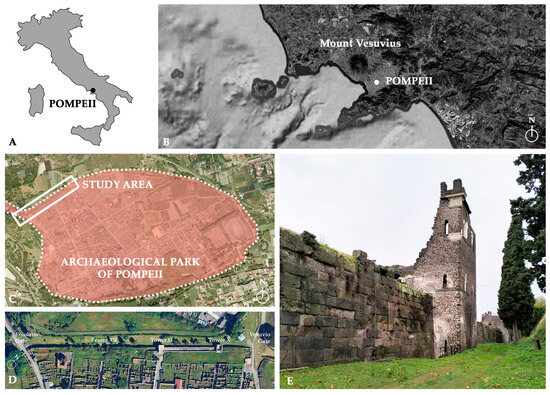
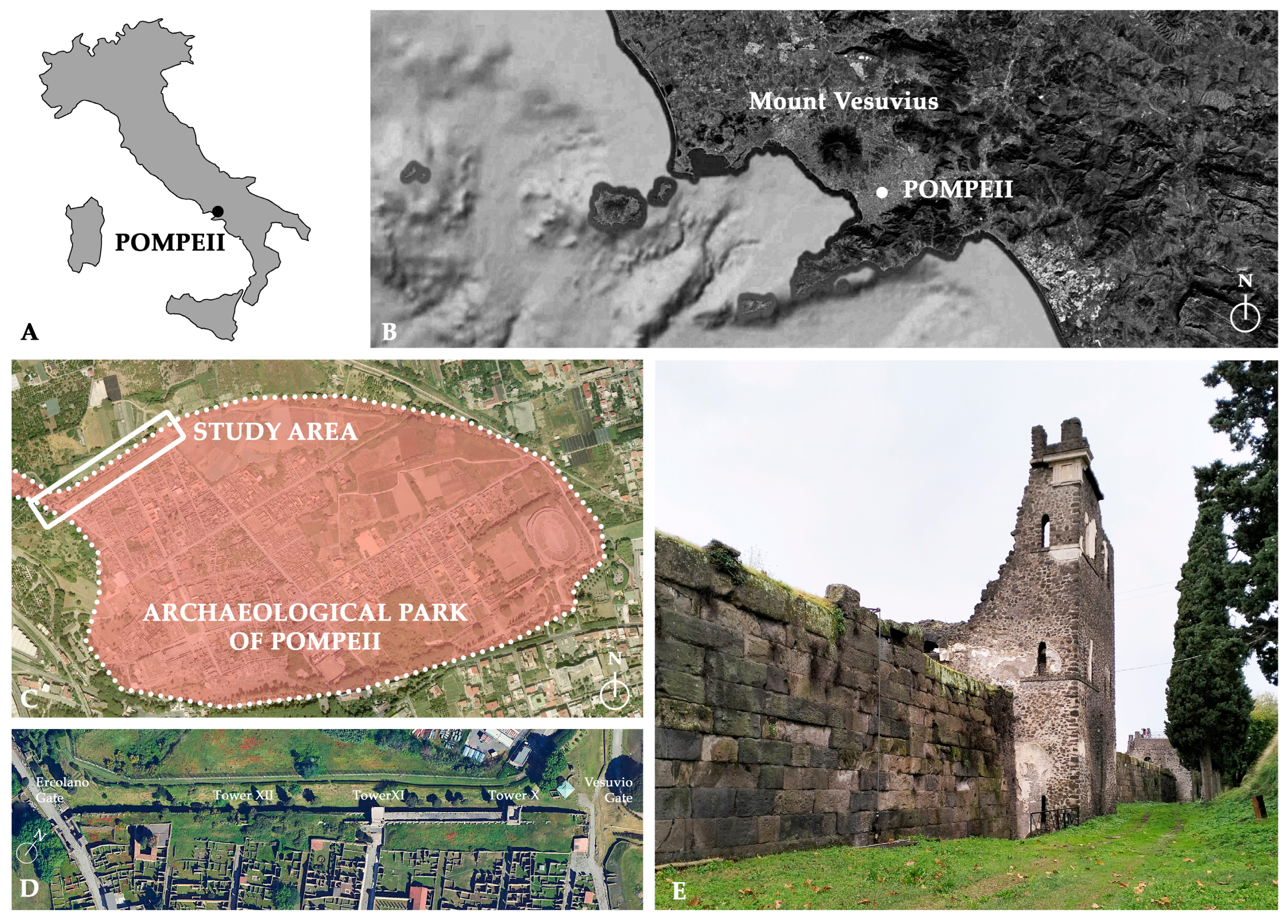
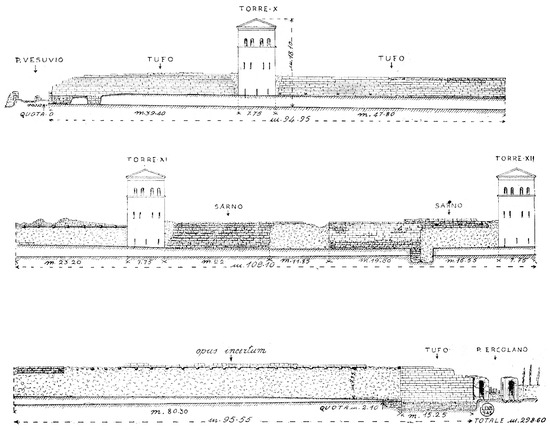
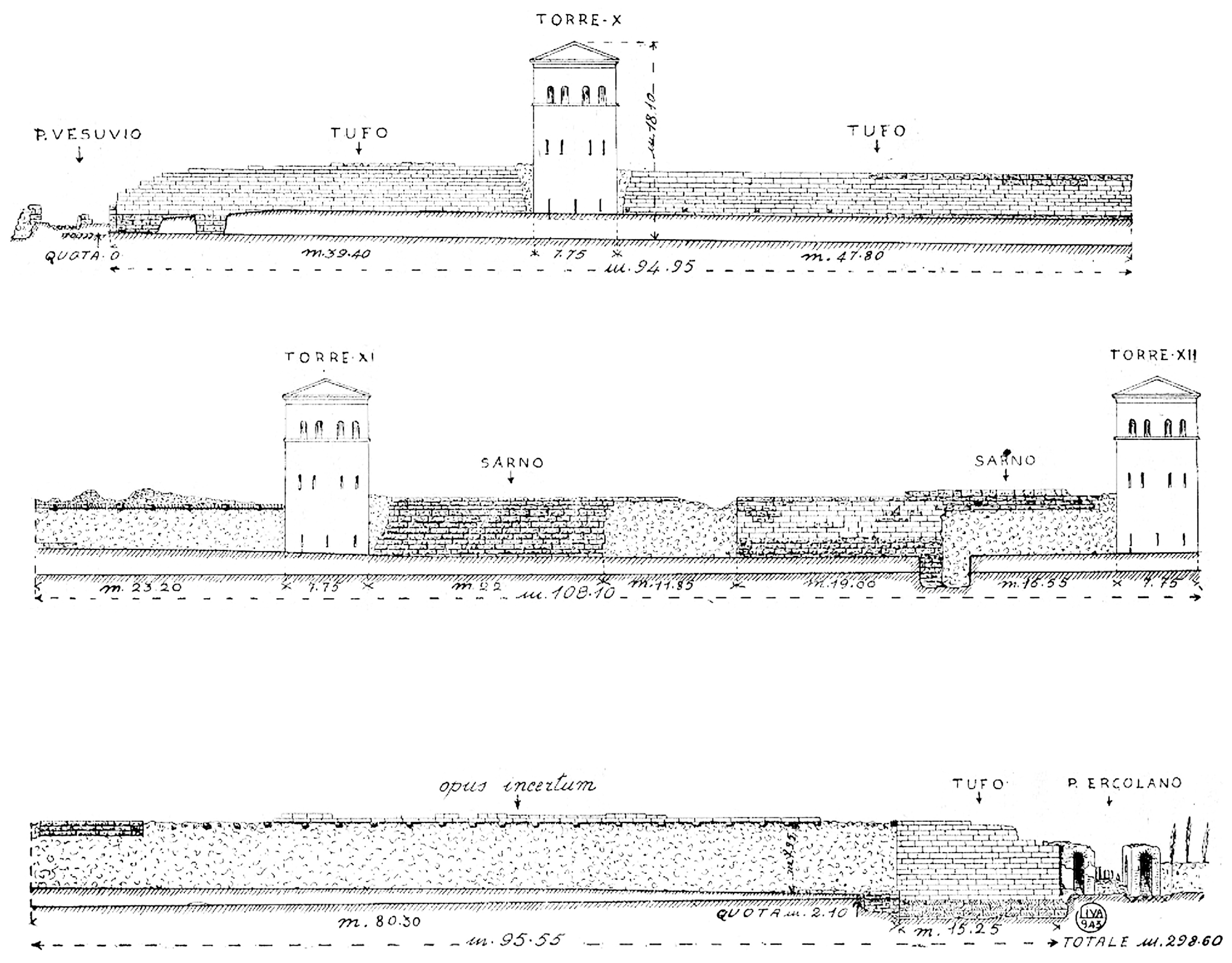
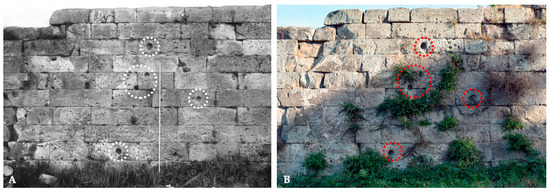
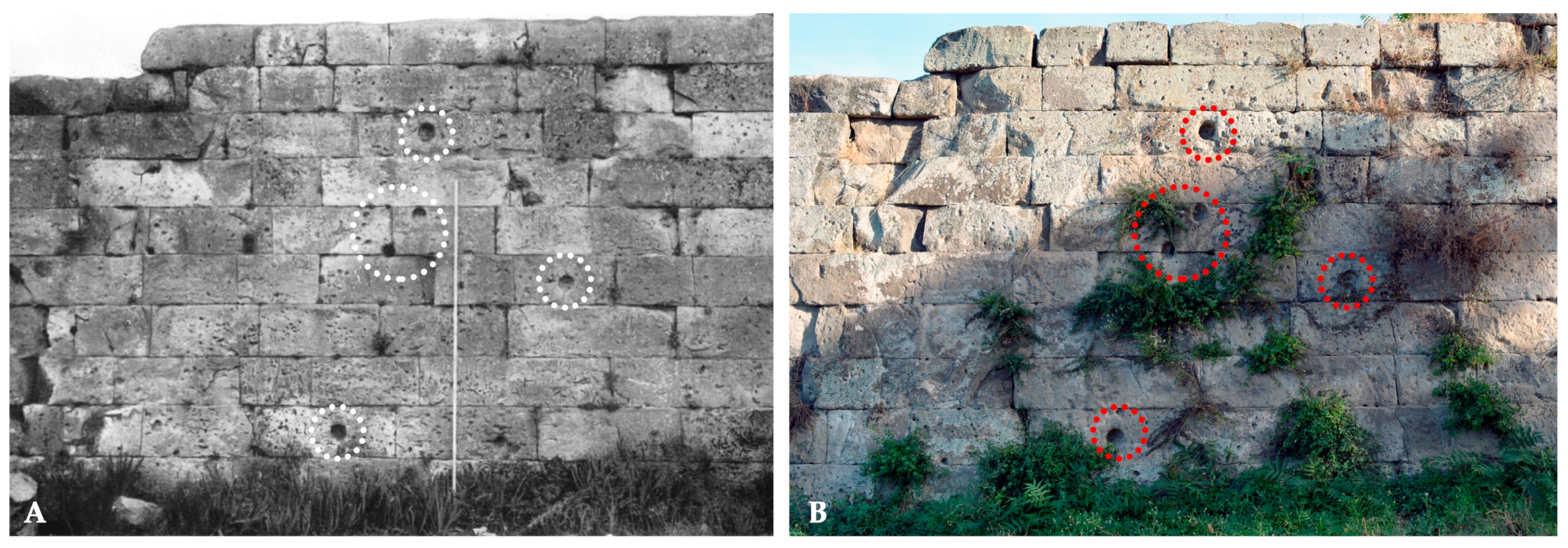
The unique historical context of Pompeii (Naples, Italy)—conquered by the Roman troops of Lucius Cornelius Sulla during the siege of the city in 89 BC, buried by the catastrophic eruption of Mount Vesuvius in AD 79, partially unearthed and still under excavation in the first decades of the twentieth century [1,2] in the northern stretch of the fortified walls (Figure 1)—ensures the chronological authenticity of the anthropic indentations, the main subject of this paper [3]. These original traces have miraculously survived Roman restorations, natural disasters, the bombings of the Second World War, weathering processes, and twentieth-century interventions that were not always aware of the historical value of the evidence represented by the marks on the defensive walls [4] (Figure 2). Several of these cavities were immediately attributed to Republican-era ballistic impacts [5] (p. 148) (Figure 3), but were later neglected as the so-called “short twentieth century” turned away from the study of warfare [6].
Figure 1.
Location of the study area: (A) location of Pompeii within the Italian Peninsula; (B) satellite view of the area (Google Earth Pro 7.3.6.10441); (C) SIT orthoimage of the Pompeii Archaeological Park, with the city walls between the northern gates highlighted; (D) detail of the aerial image showing the wall circuit (Google Maps 2025); (E) view of the extrados of the northern wall towards Tower X (photo by S.B., December 2023).
Figure 2.
Drawing by Amedeo Maiuri (1943) of the north side of the fortifications between the Vesuvio and Ercolano Gates, detailing the various types of materials used in the defensive masonry [7] (p. 12), corresponding to different periods of development of the defensive structure. The ballistic imprints caused by projectiles are mostly concentrated next to the Gates (Vesuvio and Ercolano), where the tufa ashlars allow clearer identification of the marks, which is not possible in sections of the walls built or restored in opus incertum (using irregularly shaped and randomly placed lava stones).
Figure 3.
Comparison between a photo from the beginning of the 20th century (on the left, (A) photo by Van Buren, ca. 1925) [8] (Plate 60.1: Marks of the Sullan bombardment, Pompeii) and a current photo (on the right, (B) photo by S.B., September 2024), highlighting some circular ballistic marks. The measuring rod leaning against the wall, visible in the historical photograph (A), can be estimated at approximately 3 m in length based on comparison with the current survey and masonry dimensions, given that the wall height in this section is approximately 4.5 m.
The northern sector of the city walls between the Vesuvio and Ercolano Gates was in fact more exposed than the southern side, which was naturally protected by a steep slope toward the sea; by contrast, the gently sloping terrain on the northern side could facilitate enemy assault [5] (pp. 148–149) [9]. This vulnerability was also reflected over time in the closer spacing of towers added along this stretch of the fortifications with respect to the others and may explain why this sector was chosen by the Romans to launch the attack. At present, large portions of the surrounding terrain remain buried beneath volcanic deposits, and only a narrow strip adjacent to the walls is currently accessible, revealing the ancient ballistic imprints.
Among the marks attributed to the troops of Lucius Cornelius Sulla (138–78 BC), archeologist Van Buren proposed a classification of impacts based on the diameter of sandstone balls found at the site [8] (pp. 110–111) [10] (pp. 15–16). These rounded and smoothed stones appear to correspond to standardized calibers known for their ballistic effects [11] (p. 1). These traces are commonly associated with the military operations conducted during Sulla’s siege of Pompeii in 89 BC, within the broader context of the Social War [12]. The artillery deployed during the assault was primarily intended for anti-personnel purposes, targeting defenders positioned along the ramparts and between the merlons, rather than to demolish the fortifications themselves.
Recent evidence of post-eruption residential use discovered in August 2025 [13] does not undermine this interpretation. It is indeed unlikely that individuals temporarily settled in the southern part of the ancient city, driven by the hope of finding valuable objects, would have spent time and effort digging and damaging the northern walls near the pomerium—the once-sacred and inviolable area that, after the earthquake of AD 62, had become a dumping ground for collapsed or accumulated debris [14] (p. 174). Moreover, it is confirmed that the area was definitively abandoned in the fifth century, probably as a result of another major eruption in AD 472 [13].
In recent years, the renewed availability of digital, non-contact survey techniques for metric documentation has made it possible to record such traces with a level of accuracy and geometric detail that was previously unattainable through traditional surveying methods for reality-based measurement of material traces [15,16]. High-resolution three-dimensional surveying allows the direct measurement of the physical effects preserved on the tufa ashlars, enabling the analysis of impact geometry through reverse modeling, spatial distribution, and volumetric characteristics as a basis for subsequent interpretive reasoning [17].
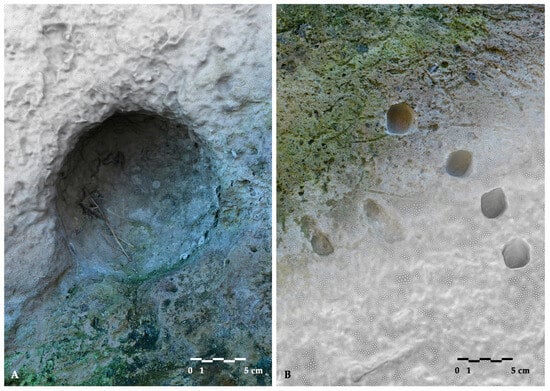
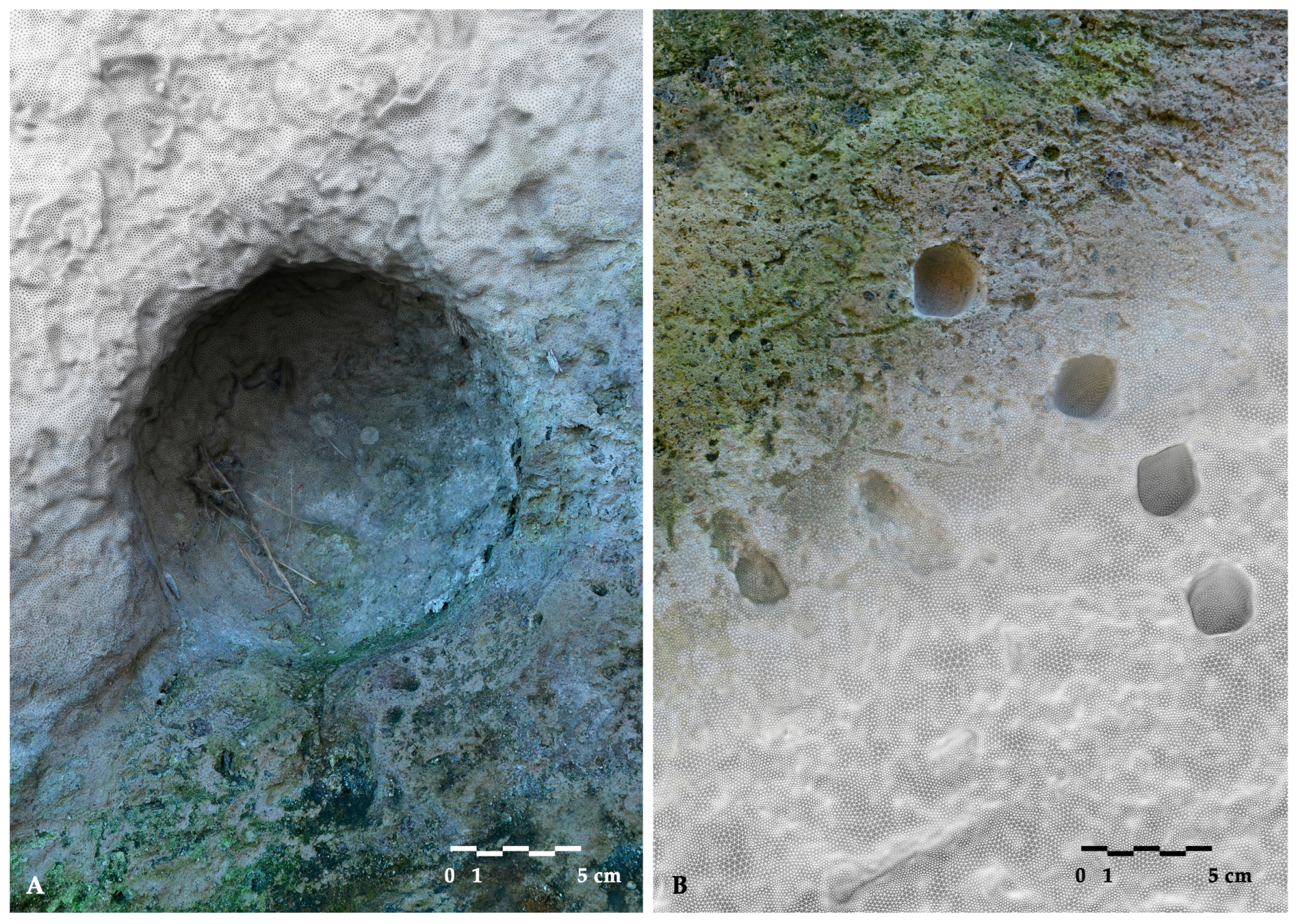
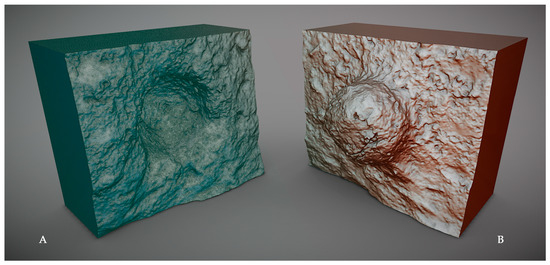
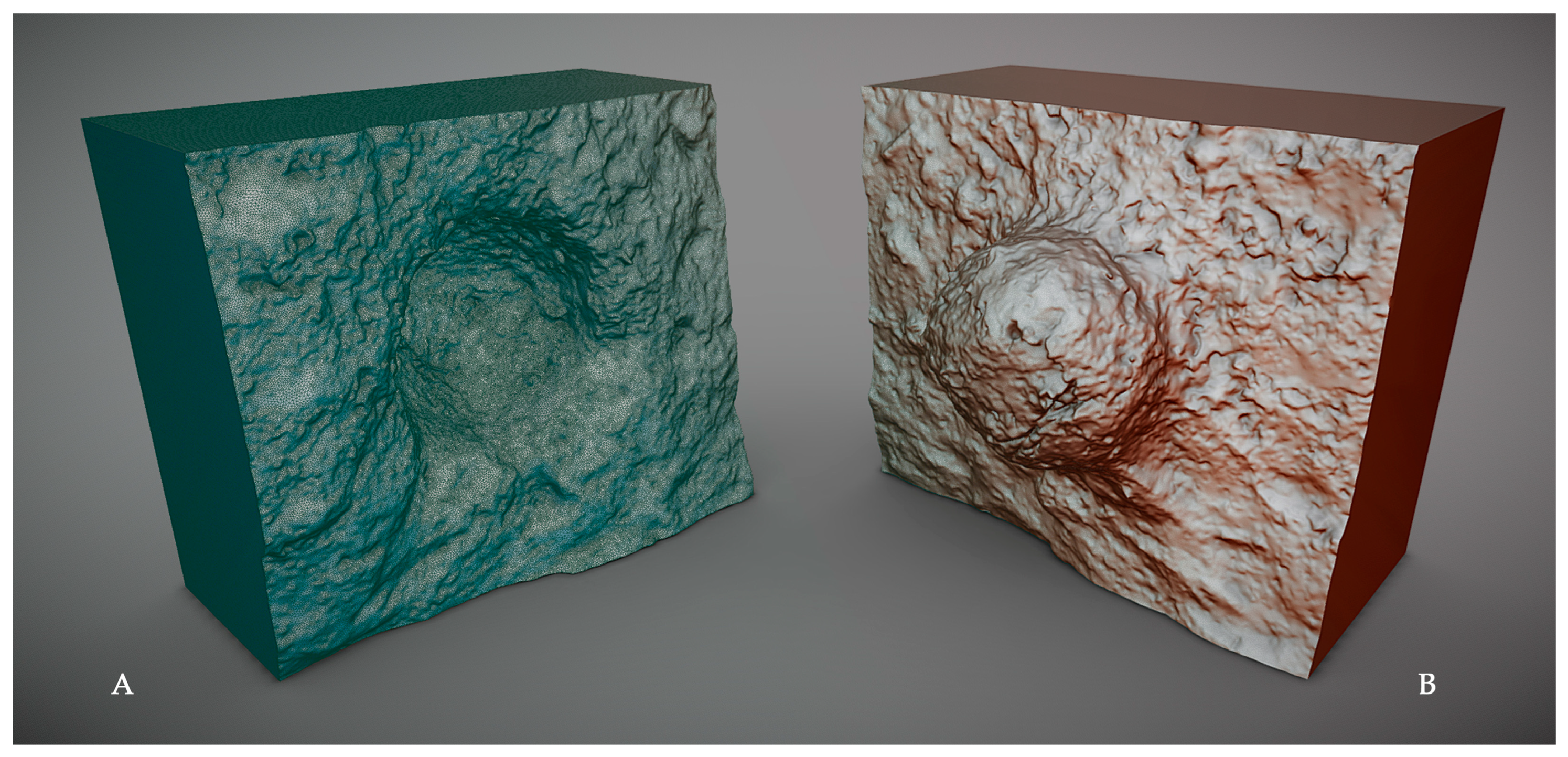
In light of these premises, the unusual clusters of small depressions identified by the authors between the Vesuvio and Ercolano Gates have drawn renewed interest in the siege dynamics of the ancient city [18] (pp. 47–62). The indentations—clearly of anthropic origin by number and morphology—bear no resemblance to the circular marks caused by spheroidal projectiles launched by ballistae or skilled slingers (Figure 4). The fan-shaped groups described by the authors are distinguished not only by their markedly quadrangular surface outline, compared to the pseudo-circular small-caliber (4–8 cm) impacts [11] (p. 7, Figure 14), but also by their radial arrangement at short, regular intervals and by the excavated volumes, which are comparable in size and in the amount of stone pulverized and removed upon impact.
Figure 4.
Scale comparison of two detailed textured mesh models: on the left, (A) ballistic impact of a spherical stone projectile; on the right, (B) fan-shaped groups of smaller quadrangular impacts. Survey, 3D models, and rendering by S.B.
On the basis of these converging observations, and in the absence of direct material remains of the weaponry, the following interpretation is advanced as a working hypothesis. Given the defensive structure of the walls and the nature of the projectiles involved, such traces are interpreted as the result of missed trajectories, since neither stone balls nor bolts were intended to breach masonry backed by substantial earthen embankments.
The present investigation therefore moves from the documentation of material evidence toward its interpretation, combining measured data derived from digital survey with comparative analysis of ancient technical sources [19].
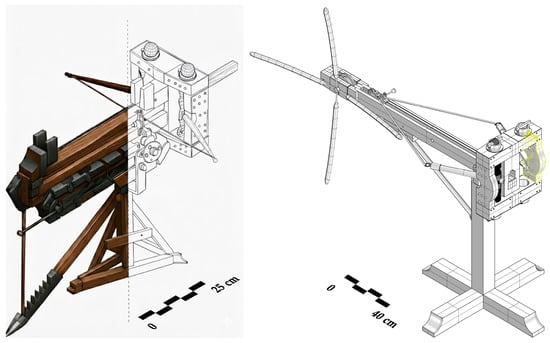
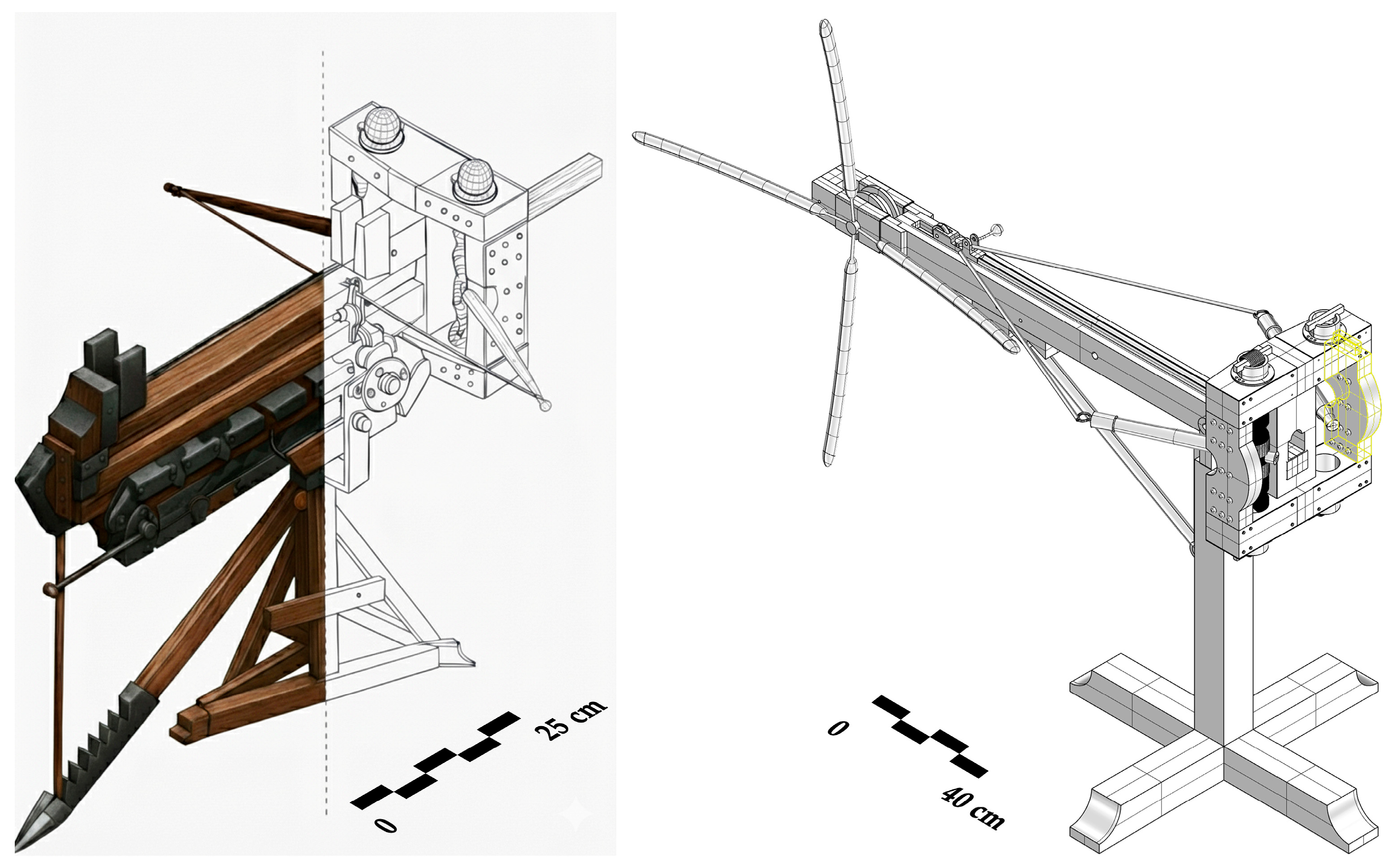
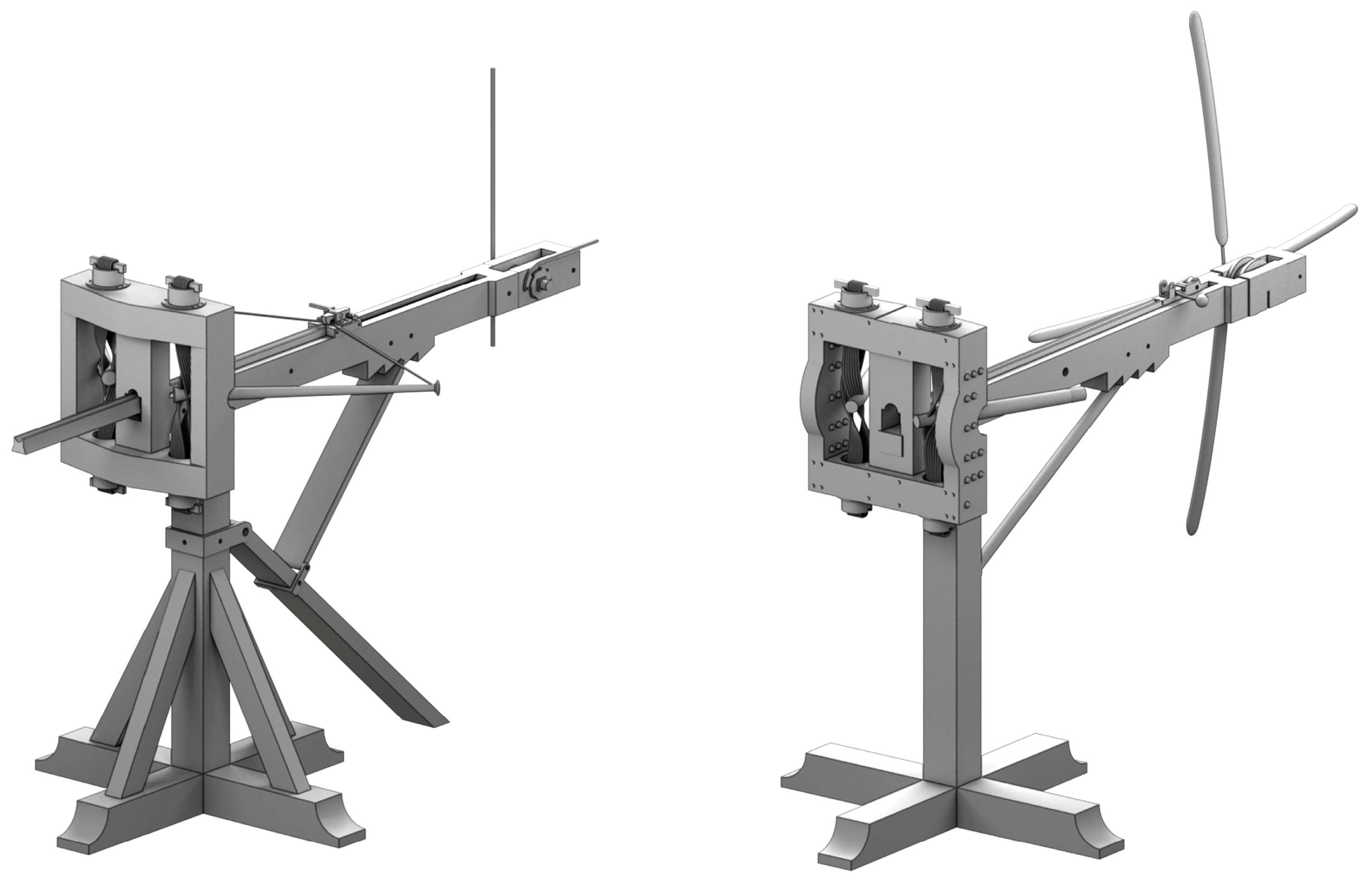
Considering the observations made following the digital surveying activities and their subsequent analysis by means of finite-element methods [20,21], the following sections present well-grounded arguments supporting the hypothesis of the use of the polybolos in the siege of Pompeii—a repeating dart-throwing weapon [22] whose invention is attributed to Dionysius of Alexandria (Realencyclopädie RE s.v. ‘Dionysius (156)’, col. 999) and whose mechanisms are described in detail by Philo of Byzantium (c. 280–220 BC) in the Belopoeica (Βελοποιικά) (Figure 5). Although no physical remains of the weapon have been found, the formal and functional compatibility between the damage observed along the northern stretch of Pompeii’s city walls and ancient textual descriptions provides inferential support for the hypothesis. The temporal coincidence between the military operations preceding Sulla’s siege of Pompeii in 89 BC and the history of Rhodes adds contextual plausibility to the proposed scenario. Within this framework, references to the Rhodian context are introduced as a technological point of comparison, reflecting its well-documented role as a center of expertise in the design and construction of elastic-torsion artillery [23,24], rather than as a direct spatial or archeological parallel to Pompeii. Poliorcetic considerations support an interpretive framework that concludes with a preliminary draft of an interactive reconstruction of the siege scenario.
Figure 5.
(Left), the axonometric hand drawing of the polybolos, by A.R., was partially colored by V.C. using the graphic post-production software GIMP 3.0.4.; (right), the 3D model by C. Formicola based on the surviving module of the Scorpion of Ampurias (highlighted in yellow, corresponding to an element of the propulsion system of the engine).
2. State of the Art
The uniqueness of the Republican-era ballistic imprints was brought back to scholarly attention in the new millennium by Flavio Russo (b. 1947), who served for several years as Historical Consultant to the Italian Army General Staff. His extensive body of work on ancient Roman artillery (e.g., see [25,26]) documents not only the military techniques and war machines of the period but also the visible damage still observable at Pompeii [27,28] (pp. 186–187). However, his scientific analysis focused exclusively on large-scale circular traces found along the northern stretch of the city walls. For these cases, he alerted the relevant authorities, who, in February 2002, under his supervision, carried out a survey of several cavities with circular openings using traditional contact-based documentation methods [29] (pp. 178–181). The silicone casts produced during that campaign are now on display at the archeological site of Saepinum (Campobasso, Italy).
This form of documentation presents evident long-term limitations, including the degradation of the casting material, surface deformation, and the general inadequacy of conventional photographic records, which fail to properly contextualize the evidence. More appropriate methodologies for recording and preserving traces that could one day be lost forever through human negligence or catastrophic events are now available, thanks to more reliable and enduring forms of digital non-contact documentation.
Other forms of damage related to Sulla’s siege were later reconsidered after Van Buren’s classification [8]. Near the Ercolano Gate, several elongated indentations were analyzed and attributed by Mike Burns [11] to lead sling bullets of varying calibers, fired rapidly and imprecisely by Sullan slingers. These weapons, while lacking accuracy, were nevertheless effective in causing casualties. Some deeper impacts—measuring up to fifteen centimeters—have also been associated with the work of dart-throwers. Alan Wilkins [30] (p. 17) agrees that only catapult bolts, equipped with iron heads, could have reached such depth. However, the wall surface displays numerous smaller marks that may have been left by arrows. Despite repeated observations and the physical presence of these traces, the damage potentially caused by metal-tipped projectiles remains entirely unexamined from an analytical perspective.
Further investigations were initiated under the SCORPiò-NIDI project [31], a research program funded by the Italian Ministry of University and Research (MUR-PRIN22), which builds upon objectives originally defined in 2017 under the proposal Ingegna Romana (Code ARS01_01125; P.I. A. Rossi, Notice No. 1735/2017 “Cultural Heritage”). The project was subsequently deemed eligible for funding and received institutional support and expressions of interest from several public bodies and research institutions, including the Ministry of Defence, the Superintendence for Archaeological Heritage, the Municipality of Pompeii, and academic and industrial partners. Within this framework, officials of the Pompeii Archaeological Park were informed of the project’s objectives and of the ongoing excavations directed by Marco Fabbri (University of Rome Tor Vergata). The results concerning the urban layout of the city and the construction phases of the city walls—extended to the most reliable reconstruction of the early Roman colony—have since been made public [32], including references to imprints left by Roman stone-throwing artillery balls found in the surrounding area [33] (p. 13).
More than five years have elapsed since the initial project proposal. The funding granted to SCORPiò-NIDI, ranked first in the ERC SH5 sector (P.I. A. Rossi), enabled the non-contact acquisition of the extrados of the northern stretch of the city walls between the Vesuvio and Ercolano Gates. At the request of the Technical Office of the Pompeii Archaeological Park—which kindly authorized multiple on-site investigations—the processed digital survey outputs were delivered in February 2025 in the required technical formats (Figure 6).
Figure 6.
Some outputs of 3D digital documentation of the ballistic imprints: (A) positive cast of the ballistic crater (wireframe view); (B) negative mold (Matcap-render visualization). Models by S.B. [18] (p. 135).
The subsequent analysis was conducted using non-invasive methodologies and focused specifically on the selected case studies described below. The workflow combines close-range photogrammetry (Structure-from-Motion), structured-light scanning, mesh processing, and reverse modeling, enabling metric inspection and comparative morphometric analysis. The data acquired and related outputs were progressively published and discussed in a collegial setting, where all the details about the surveying activities and other research activities were examined in depth [18].
The workflows established with project partners—mechanical engineers from the Polytechnic University of Milan and computer scientists from the Alma Mater Studiorum—University of Bologna, specialized in cultural heritage documentation—are currently focused on developing an information system designed to offer participatory experiences to future visitors of the Pompeii Archaeological Park [18] (pp. 141–150). Whether accessed on-site or remotely, the system aims to provide users with essential historical and military context, enabling a more informed understanding of the exceptional nature of these ancient traces.
The need to construct a meaningful interpretive framework for cultural heritage has been central to the field since the establishment of digital best practices defined in the London Charter for the Computer-Based Visualization of Cultural Heritage [34] and the Seville Principles [35], which emerged from the International Forums on Virtual Archaeology. This approach is now widely adopted and shared [36,37].
In light of the variety of expertise involved and the differing nature of the results achieved so far, future integration of approaches and skill sets appears highly desirable for further development. Such integration may strengthen autonomous research efforts while encouraging their convergence toward shared interpretive frameworks.
While previous studies have successfully established the historical and technological framework of Roman siege warfare at Pompeii, the material traces preserved on the city walls have rarely been approached as measurable physical evidence suitable for quantitative analysis. This methodological gap becomes particularly evident in the case of small-scale impacts, whose interpretation requires levels of geometric precision unattainable through traditional documentation techniques.
Even though many scholars have analyzed in depth the city walls perimeter [7,38,39], only a few of them have dealt ballistic impacts on ashlars by recognizing the value of this evidence [40,41]. To date, however, this contribution represents the first attempt to investigate ballistic imprints through an integrated approach combining digital surveying and reverse-modeling techniques applied to siege warfare [18] (pp. 25–35). Moreover, previous studies have mainly focused on large-scale spheroidal projectiles and stone-throwing artillery [17], while systematic morphometric analyses of small metal-tip impact patterns and their interpretation remain largely unexplored. The present study addresses this gap by combining high-resolution digital survey, reverse modeling, and ballistic reasoning to investigate a class of evidence that has so far received limited analytical attention.
3. Materials and Methods
The critical investigation developed in this article builds upon the findings of the previous survey and is limited to groups of small “fan-shaped” cavities documented during 2024–2025 by the members of the coordination team of the SCORPiò-NIDI project [18] (pp. 1–21) (see Figures in Section 4.3, Case studies). For a detailed discussion of the surveying workflow, instrumentation, accuracy, and uncertainty assessment procedures related to the digital acquisition activities conducted since 2024, the reader is referred to dedicated publications [3] (pp. 260–265). In the present contribution, only the parameters directly relevant to the morphometric interpretation are summarized, while the full technical validation of instruments, calibration procedures, and accuracy assessment is documented in the referenced methodological studies.
Despite the use of different instruments and advanced techniques—including a terrestrial laser scanner Leica ScanStation P30 (Leica Geosystems AG, Heerbrugg, Switzerland) for the general context, and close-range photogrammetry and a structured-light 3D scanner NextEngine 2020i Desktop Scanner (NextEngine Inc., Santa Monica, CA, USA) based on fringe projection for high-resolution documentation of small-scale features—these indentations are difficult to analyze because the wall impressions are rather small: the largest measure approximately 25–30 mm in both depth and diameter (Figure 7). The acquisition scale and resolution were selected to be consistent with the millimetric dimensions of the analyzed cavities; quantitative measurements were extracted from high-resolution meshes prior to any decimation applied for visualization purposes. Their internal surfaces are rough and irregular, characterized by recesses and protrusions, and are often filled with dust, micro-vegetation, or weeds. These factors can affect the reliability of morphometric data acquisition, resulting in an approximate reconstructed surface that does not accurately correspond to the original depression caused by the impact—an event that likely produced fracturing followed by gradual loss of stone material over time. The attribution of the impacts is therefore not based on morphology alone, but on the combined analysis of geometry, spatial distribution, volumetric consistency, and compatibility with documented firing mechanisms. Dimensional values are interpreted within tolerance ranges compatible with the acquisition accuracy and the irregular condition of the stone surface in order to avoid overinterpretation of micro-scale variations.
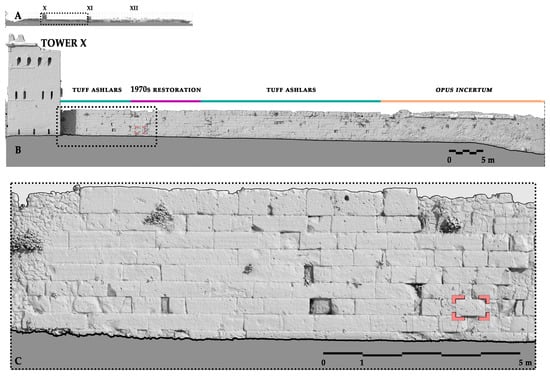
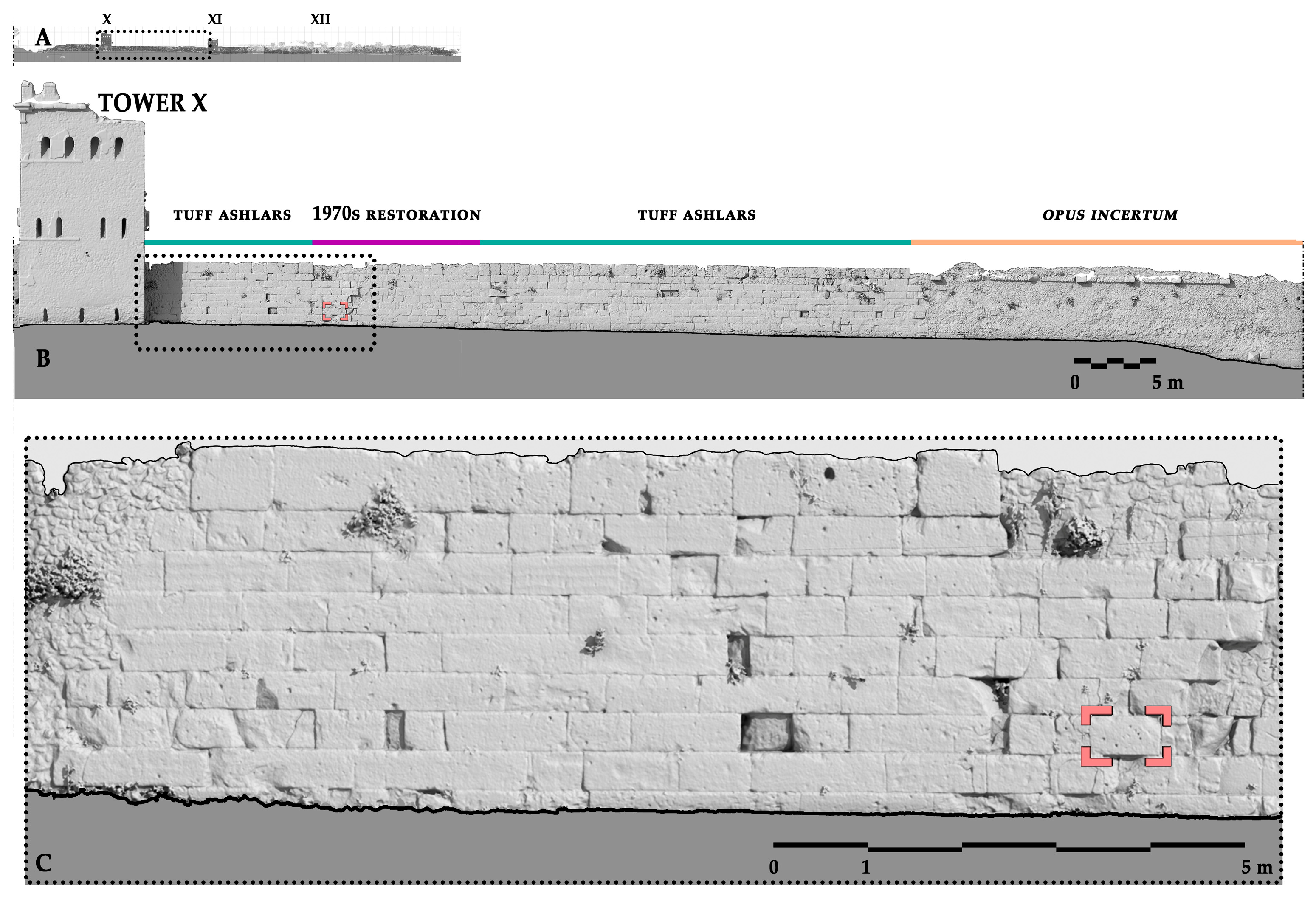
Figure 7.
Digital model of the surveyed wall section between the Vesuvio and Ercolano Gates, processed to locate the fan-shaped quadrangular ballistic traces (in the red frame in (B,C)). (A) General reference for location between the two gates (dotted black frame indicating the enlargement area in (B)); (B) wall section between Towers X and XI, with masonry-pattern specifications (dotted black frame indicating the enlargement area in (C)); (C) detailed view of the highlighted section with the fan-shaped marks in the red frame [18] (p. 131).
Other factors must therefore be taken into consideration, such as:
- (i)
- the fracture dynamics of the stone material. The pressure generated by the penetration of a metal tip produces destructive effects that differ significantly from those caused by the impact of spheroidal projectiles, particularly those with a larger diameter (>16 cm) [20] (Figures 3 and 5) [21] (p. 1496). This effect is further amplified by the physical properties of the stones (tuff, limestone, lava) used in the construction of the city walls [20] (Section 3.1. Material Characterization) [42];
- (ii)
- Roman-era repairs to the wall—partially covered with plaster, still visible in surviving fragments within some cavities as well as on the towers—have altered the geometry of the original damage;
- (iii)
- pyroclastic materials erupted at high temperatures struck the outer wall and filled the cavities;
- (iv)
- two centuries of exposure to atmospheric agents and decay of the wall surface, affected by natural and anthropogenic factors, in addition to cleaning and restoration work carried out after the northern stretch’s discovery.
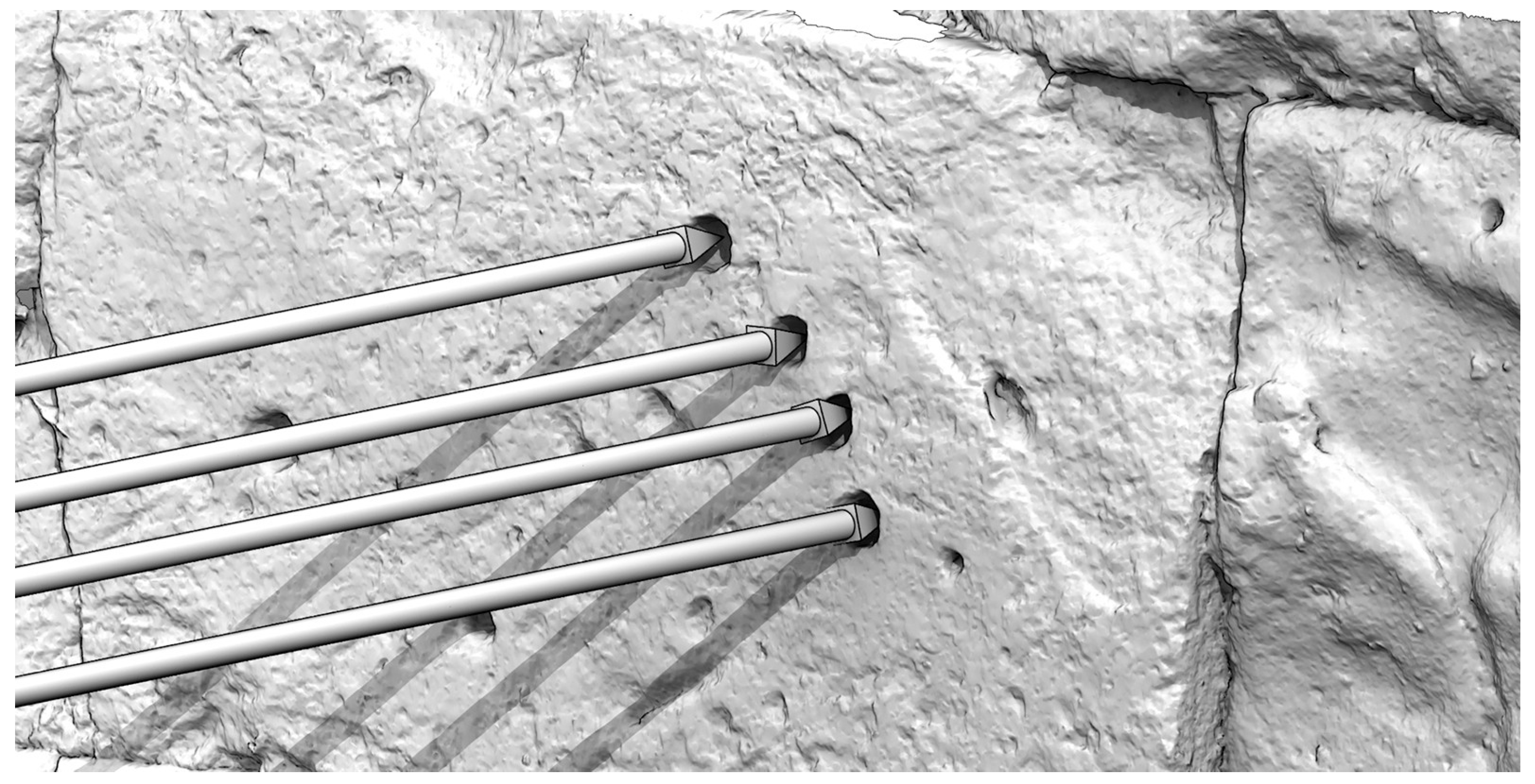
Taking all these factors into account, the study proceeds by integrating reconstructions based on passive and active sensors to generate negative molds and produce reliable and accurate replicas of the positive casts. The analysis of the reconstructed models aims to infer the most suitable morphology of the impacting object within a reasonable dimensional range, as discussed in depth in the first results of the project [17,18] (pp. 36–62) (Figure 8).
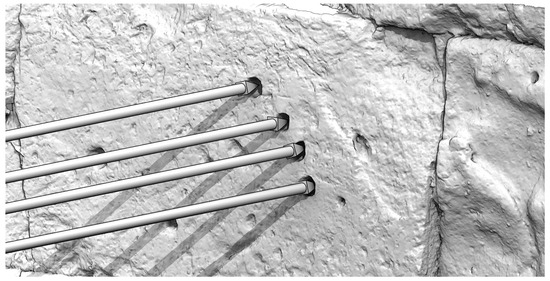
Figure 8.
Digitally surveyed surface of the stone ashlar and hypothesis of impacting objects (metallic tips). Survey, 3D models, and rendering by S.B.
It should also be noted that, unlike the impact damage on the walls attributed to stone spheroidal projectiles—of which several examples have been found both on site and within the excavated urban area—no physical evidence of arrowheads has so far been recovered. Over time, most metal tips likely corroded or disintegrated, and any fragments still embedded in the masonry are extremely difficult to distinguish from the clasts lodged within the cavities, unless specialized analyses and high-magnification instrumental examinations are applied.
These new investigations, initiated following field inspections and comparisons with archival materials, have been entrusted to Monica Piochi, Senior Researcher at the Istituto Nazionale di Geofisica e Vulcanologia—Osservatorio Vesuviano, Italy, and Roberto Moretti, Department of Engineering, University of Campania “Luigi Vanvitelli”. At present, the results are not yet available, apart from those published in the literature, including studies conducted by the Deutsches Archäologisches Institut in Berlin (DAI), aimed at reconstructing the paleo-environments of the Sarno Plain [42] or other specific contributions [43].
Despite these uncertainties, the uniqueness of the documentary evidence found at Pompeii invites a re-examination of established interpretative frameworks, beginning with a careful critical reading of the treatise by Philo of Byzantium, written when elastic-torsion artillery had already been in use for more than a century [44]. A further two centuries separate the Greek world from the Republican and Imperial periods: the Romans appropriated torsion technology by seizing these weapons from the defeated Carthaginians. Their proverbial pragmatic and engineering abilities enabled them to enhance the performance of these propulsion systems, and the damage observed along the northern stretch of Pompeii’s ancient walls demonstrates their lethality during the so-called Social War.
With the fall of the Roman Empire and of the organizational structures that had made it possible to equip and sustain its once-invincible army, the knowledge required to construct elastic-torsion artillery also disappeared [45]. After centuries of neglect—due in part to the lack of images and the rarity of surviving texts—interest in this sophisticated technology was revived by the first archeological recognitions [46].
Setting aside the rare, fragmentary, and imprecise transcriptions from antiquity—always transmitted without their original iconographic apparatus and sometimes replaced with approximate copies—the subject reappeared in the conclusions of two German scholars writing in the mid-nineteenth century, Hermann Köchly and Wilhelm Rüstow [47]. Years later, Erwin Schramm constructed a full-scale prototype of the automatic catapult (polybolos), made possible by his German translation of the ancient Greek text by Philo.
In 1971, Erwin Marsden offered modern scholars a selection of annotated ancient texts, removing anything he considered redundant to his interpretation. His Technical Treatises [48] remain an unparalleled reference work for anyone wishing to explore the subject in depth. The authors of the present study draw upon this text but take a completely new approach: starting from the objectively observed evidence, they search within it for elements and arguments that may support the hypothesis of the use of the polybolos at Pompeii (Figure 9).
Figure 9.
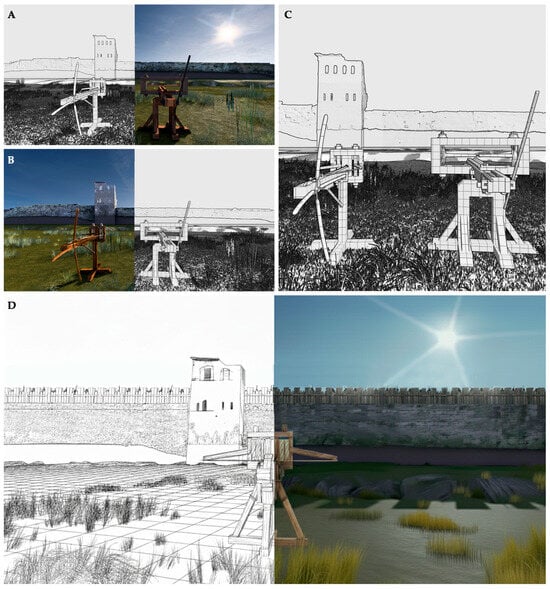
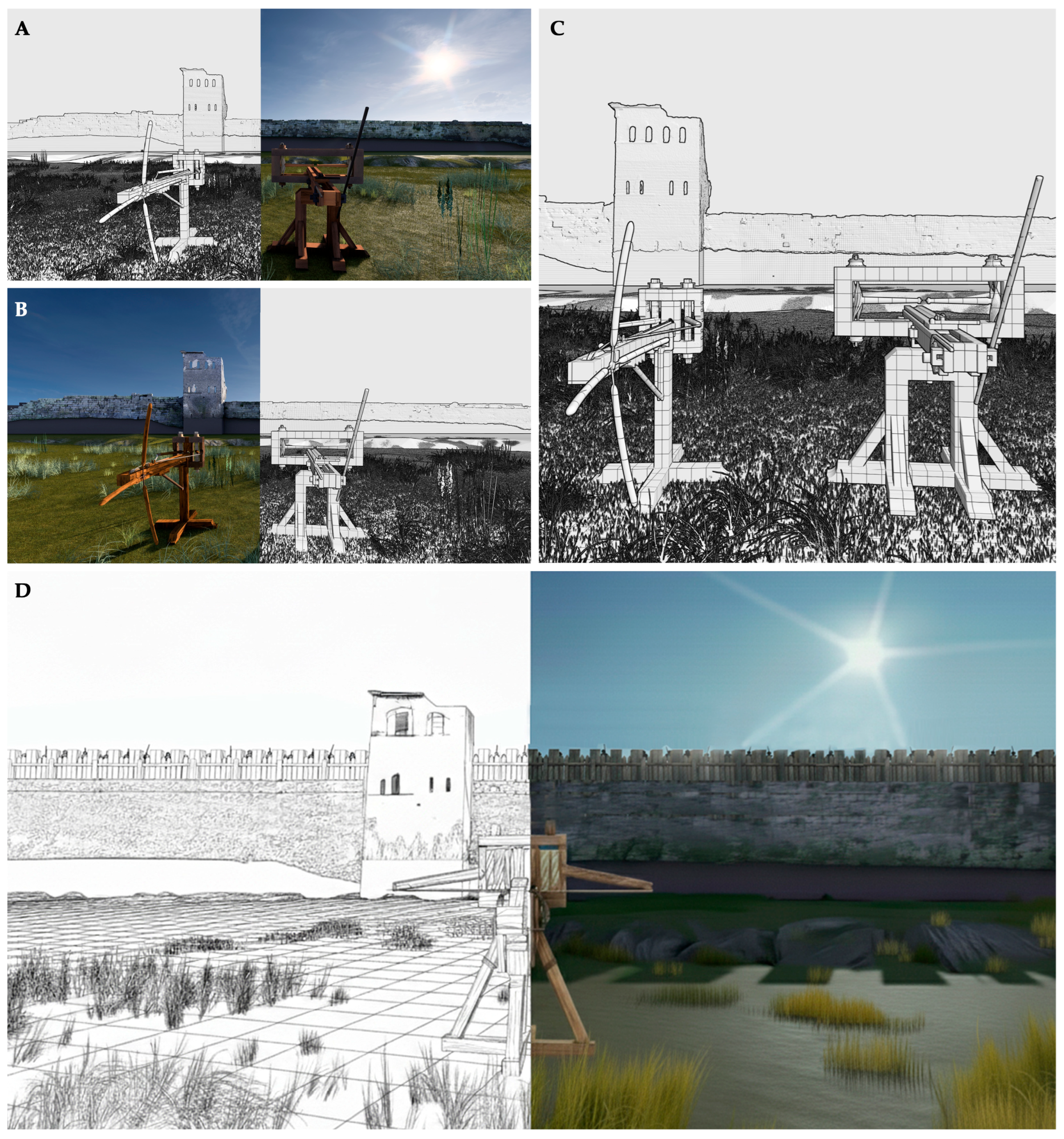
Simulation of the siege scenario by V.C. (A,B) wireframe and rendered views of the scene; (C) models of the Roman artillery (stone- and dart-throwers by C. Formicola); (D) the polybolos aiming at the soldiers behind wooden defensive structures. The scene was created using Lumion Pro Student 2024 rendering software and then post-processed with GIMP 3.0.4.
4. Premises for Advancing Research
4.1. Material Data Considered
- The vaguely quadrangular outline of the indentations makes it possible to distinguish damage generated by darts from that produced by the impact of small-diameter stone balls. Although conical-headed darts are known, pyramid-shaped points were by far the most widespread, as they were easier to manufacture by hot-forging iron—more rarely, bronze.
- The polygonal meshes derived from 3D image-based and range-based acquisitions made it possible to produce hypothetical solid reconstructions of the projectiles (Figure 10). The digitally reconstructed meshes were further processed to generate virtual negative models of the impact cavities, allowing a detailed inspection of their geometry and a direct comparison with the expected dimensions and morphology of Republican-era projectiles. Based on comparisons with truncated-pyramidal dart heads preserved in museum collections—some of which can be dated to the Republican period—those sufficiently sharp and elongated were selected and then scaled according to the measurement units in use at the time, namely the dactylos (finger), estimated by Marsden at 19.3 mm [49] (p. XIV). From the same museum specimens, the types of socketing for wooden shafts were also identified; the shafts have diameters not exceeding 3 cm.
- The “fan-shaped” arrangement was considered the most suitable for reducing the uncertainty typically associated with small-diameter impact marks. The radial configuration of the holes at short intervals makes evident not only the anthropic origin of the indentations but also the plausibility that these strikes were delivered by automatic repeating weapons. The development of the present argument builds upon this premise (see Figures in Section 4.3, Case studies).
Figure 10.
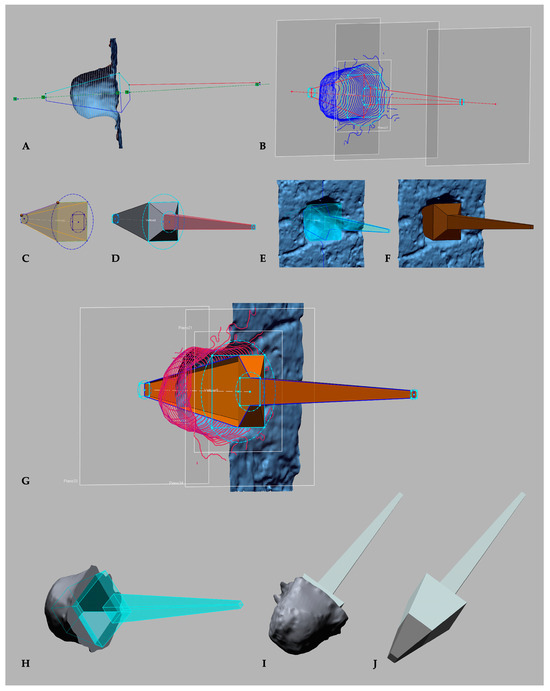
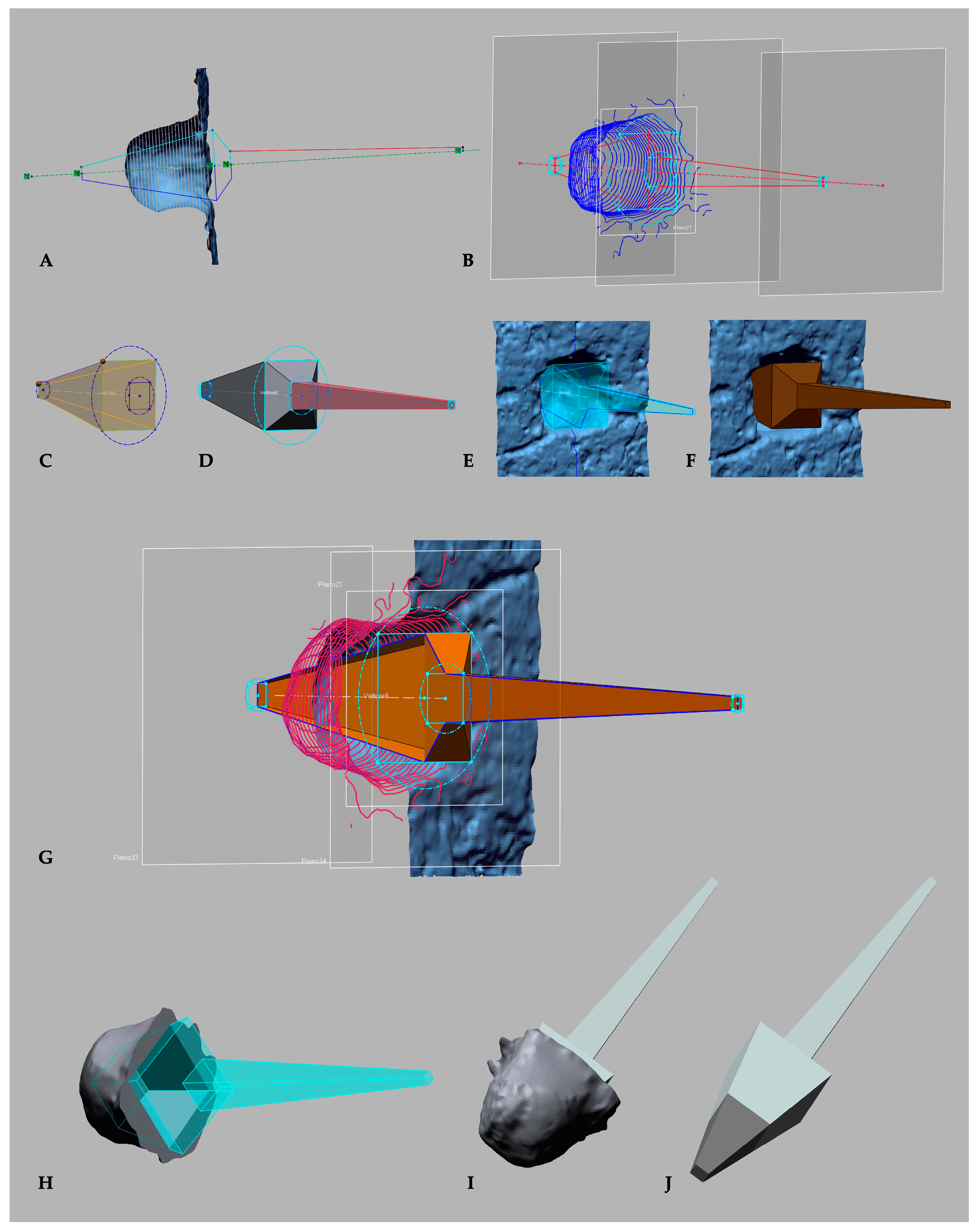
(A,B) Two-dimensional sketches of the arrowhead drawn on main reference planes; (C–F) creation of the solid geometry by extruding or lofting the base sketches; (G) comparison of the modeled object with reference profiles to match the proportions and dimensions of existing samples; (H–J) solid 3D model of the bolt and negative mold of the ballistic mark for prototyping [18] (p. 57).
4.2. Polemological Inferences
To produce a sequence of closely spaced and well-aligned impacts such as those documented, the weapon would have needed to be firmly secured to the ground—a challenging condition, yet not impossible to achieve. According to in-depth studies carried out by Archeotecnica [50]—a group of scholars, professional enthusiasts, and skilled craftsmen dedicated to the reconstruction of Roman artillery—the idea that a single operator could achieve such precision is unlikely. The weight and size of the machines—up to approximately 100 kg and occupying more than 1.5 m2—would have made it impractical to realign the weapon after the first missed shot. Moreover, it is highly improbable that the torsion bundles could be reloaded with identical tension for three or four successive shots.
The mechanism responsible for the accumulation of energy, released at the moment of firing, operated through the twisting of natural-fiber bundles, as described by Philo (Belopoeica 111.10) [48] (p. 39). It follows that it would have been difficult, if not impossible, to calibrate the power output with the level of precision suggested by the curved trajectory connecting the recorded impact marks.
For the same reason, the hypothesis that multiple artillerymen—each operating an independent dart-throwing device—could simultaneously and precisely target the same point is equally implausible. There is also the tactical question of how to justify deploying four or five large and costly machines to eliminate a single enemy target.
4.3. Case Studies
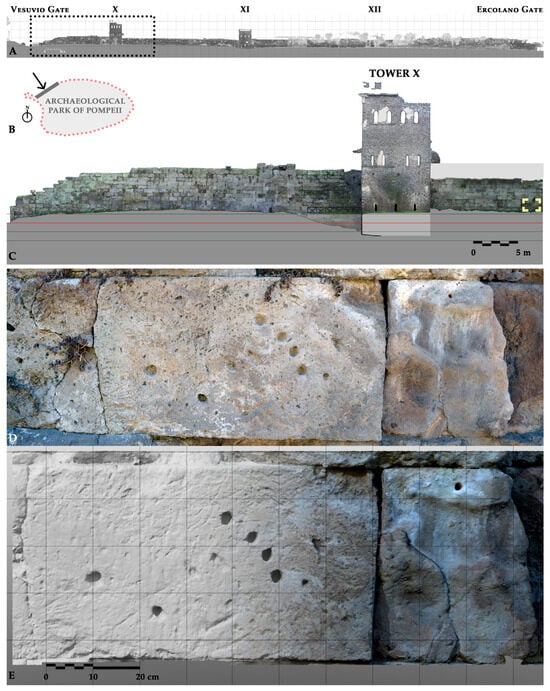
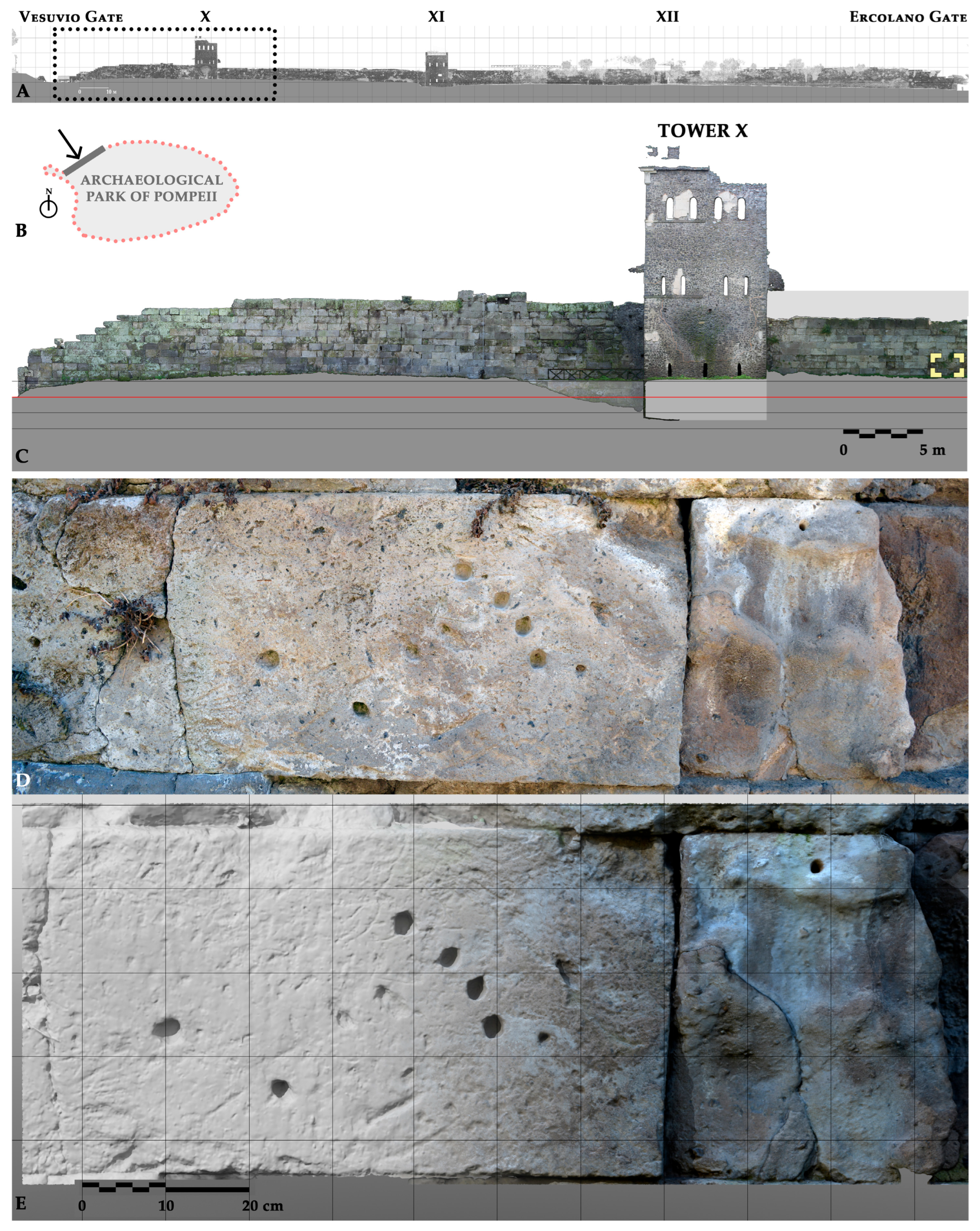
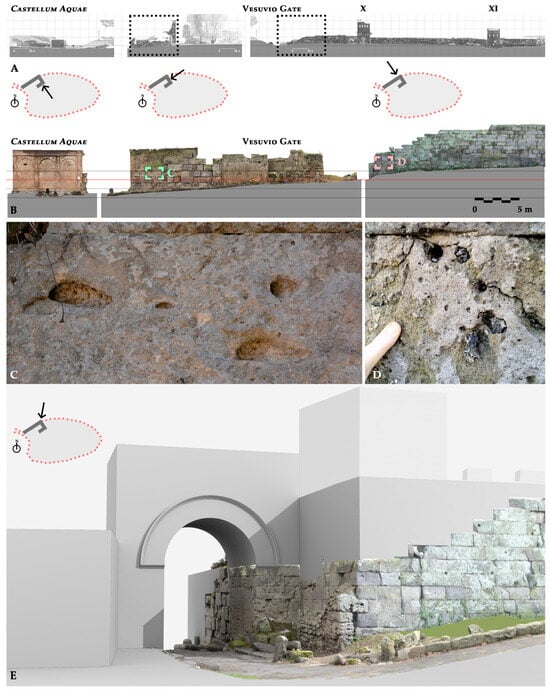
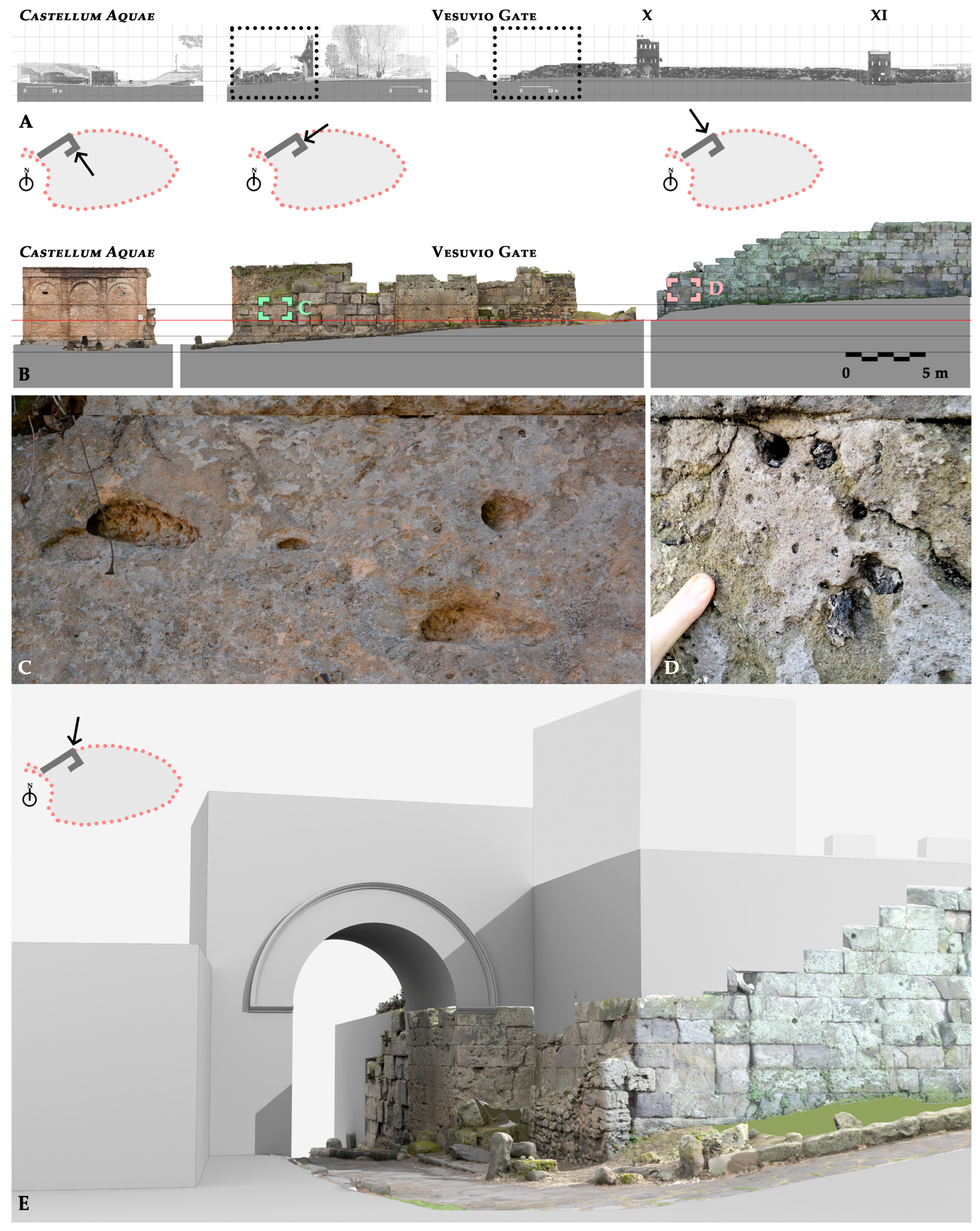
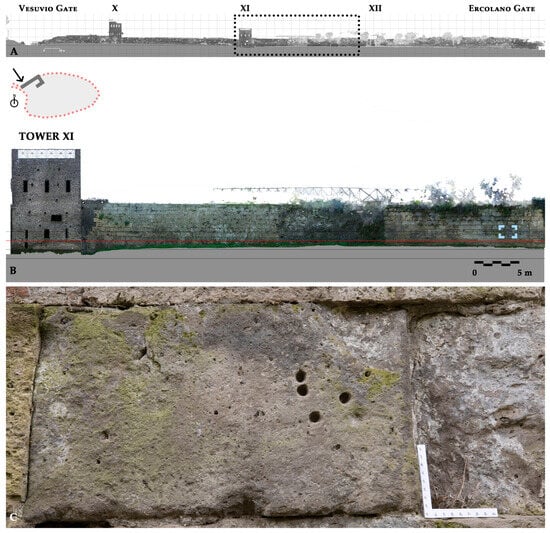
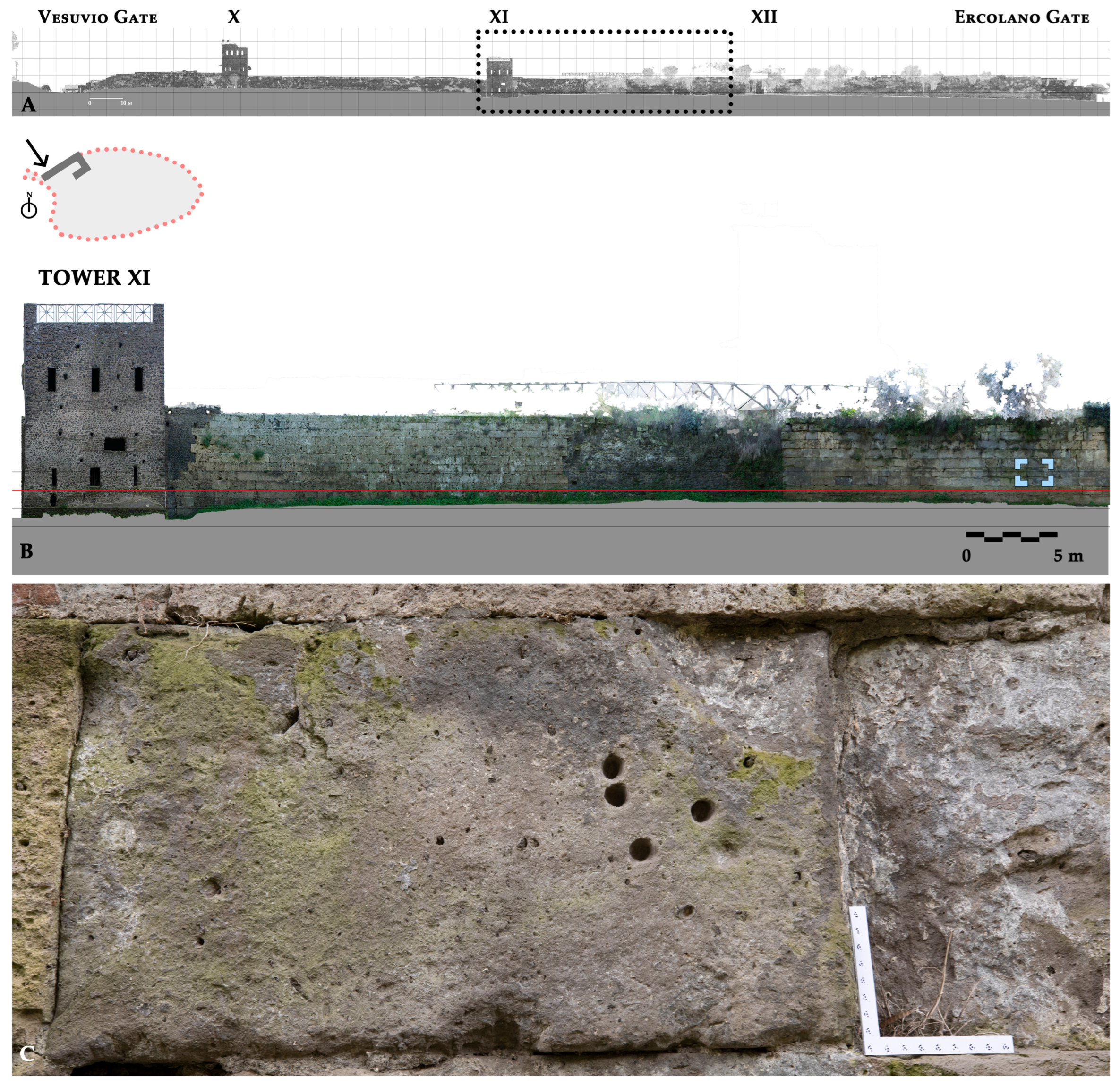
Three groups of indentations are discussed and illustrated in Figure 11, Figure 12 and Figure 13. The selection—made among those with comparable identifying characteristics—was determined not only by operational accessibility, which was a necessary condition for safe and repeatable non-contact surveying, but also by the clarity, preservation, and internal consistency of the impact patterns. The selected case studies therefore represent well-preserved and representative samples of a recurring type of fan-shaped indentation, suitable for comparative analysis.
Figure 11.
(A) Reference location of the case study in the general wall section (dotted black frame indicating the enlargement area shown in (C)), (B) location in the master plan of the site (black arrow indicating the related elevation view in (C)) and (C) the textured model of the walls between the Vesuvio Gate and Tower X (colored frame indicating the impact marks analyzed in (D,E)); (D) photo of the case study 1; (E) detailed 3D model with texture. Point cloud processing, orthoimage and mesh models by S.B.
Figure 12.
(A) Reference location of the case study in the general wall section (dotted black frames indicating the enlargement areas shown in (B)) and in the master plan (black arrows indicating the related elevation views in (B)), and (B) the textured model of the elevation views; below: right (D), photo of the case study 2 (November 2023), and left (C), some other traces in the Vesuvio Gate; (E) render of the reconstructive textured 3D model of the possible volumes of the ancient gate based on the study of the area by Adam and Varène [51]. Orthoimages and 3D models rendered by S.B.
Figure 13.
(A) Reference location of the case study in the general wall section and in the master plan (dotted black frame indicating the enlargement area; black arrow indicating the related elevation view in (B)), and (B) textured model (colored frame indicating the impact marks analyzed in (C)); (C) photo of the case study 3 (February 2024). Orthoimages by S.B., photo by A.R.
The case studies are interpreted as missed shots: impacts that successfully struck their intended target would have left no trace, or at most traces far less visible on the stone blocks.
Case 1—Fan-Shaped Traces near Tower X.
The first group of fan-shaped traces, probably the most significant in terms of clarity, number, and state of preservation (Figure 11), is located west of Tower X, approximately 82 cm above the current ground level. It is hypothesized that these shots were intended to intercept defenders exiting through the posterns located at the base of the tower, which now appear open roughly 2.3 m below the present surface. This context would justify the use of a rapid-fire weapon such as Dionysius’s repeating scorpio: the defenders’ swift movements would have rendered traditional aiming ineffective.
The trajectory of the shots is clearly too high: adding 80 cm to the 2 m vertical drop, the impacts strike the stone block directly, without any possibility of intercepting defenders. A deviation of a few tens of centimeters is unsurprising, considering the known limits of horizontal rotation and vertical elevation in such machines. If the surrounding terrain were excavated, additional impact marks might plausibly be found.
Case 2—Impacts near the Vesuvio Gate.
A second case, perhaps also intended to strike archers in defensive positions, was identified near the Vesuvio Gate (Figure 12), where the ground now rises steeply. The impact marks of Case 2 are located about 1.75 m above the actual ground level, approximately matching the height of the previous group. Once again, the intact cavities arranged along an ideal circular arc suggest that the projectiles did not reach their target.
The cluster of marks, if correlated with other signs of damage preserved within the remaining structure of the gate, may provide tactical insight into the dynamics of the siege. The intensity of the assault between the two barricades implies a level of resistance that may warrant renewed emphasis in future reconstructions of Sulla’s siege.
Case 3—High-placed trace above Tower XI.
The third trace was identified west of Tower XI, about 1.74 m above the current ground level, corresponding to approximately 3.40 m above the original level (Figure 13).
This height approximates the estimated walkway elevation at the time of the siege—about 6.30 m from the ground, including the battlements [52]. The most plausible interpretation is that this mark resulted from a missed shot aimed at groups of archers positioned on the rampart walkway, no longer protected by temporary wooden structures [29].
The error is readily explained by a fundamental mechanical principle: the rotation of the arms around the catapult’s pivot generates a torque proportional to the product of the force and the length of the lever arm. Even a slight elevation in the arm produces a considerable aiming error.
5. Results and Observations
5.1. Literary Sources
The fundamental textual reference, as introduced above, consists of the transcriptions of Philo of Byzantium’s Belopoeica, interpreted from an engineering perspective by twentieth-century scholars.
Within these brief notes, it suffices to recall that in Chapter IV of Marsden’s The Artillery Manual of Philon [48] (V, pp. 105–156), the kinematic system of elastic-torsion artillery is described in detail (Philon, Bel. 59, 75–76). The same underlying principle is then applied to a catapult: “what is called a repeating catapult, which has a unique and very intricate arrangement” (Belopoeica 73.20) [48] (p. 147), which Philo attributes to “a certain Dionysius of Alexandria constructed in Rhodes” [48] (p. 147; 73.20, note 106, p. 177).
From a critical reading of this treatise, useful observations can be drawn for the interpretation of the siege scenario—the final objective of this study. For this reason, we extract what Philo notes regarding the effects produced by Dionysius’ repeating scorpion, equipped—as he states—with a dart magazine and a cam-driven mechanism (Philon, Bel. 54): “In the first place the target is not stationary, but liable to move out of the way. Who, then, would want to shoot off several missiles to no purpose?”
Recasting Philo’s thought in interrogative form, Marsden underscores the futility of the weapon if used to strike more than one target (Belopoeica 76–77), providing for our purposes an exact documentary description of the resulting impact pattern:
“Perhaps the argument that it is useful for firing into a group would persuade many people; but this, too, will be found untenable. The missiles will not have a spread, since the aperture has been laid on a single target and produces a trajectory more or less along one segment of a circle; nor will they have a very elongated dropping zone. With engines shooting single shots, we are to pull the trigger whenever we think we have accurately laid on the target; thus, we shall make effective use of most missiles. If, on the other hand, we waste many missiles at random and to no purpose, we shall be voluntarily providing the enemy with them.” [48] (p. 151).
Philo continues—with a measure of irony—on the matter of projectile recovery [48] (note 122, pp. 183–184):
“Someone will observe, of course, that the enemy will not be able to use them because they are unnotched; notching is certainly a major operation, requiring a deal of work.” [48] (p. 152).
Before Marsden, Erwin Schramm had already highlighted the inability of the polybolos to disperse its projectiles [53] (pp. 63–64). Conversely, Marsden later emphasized how surprisingly precise the burst of shots was when all were directed at the same target [48] (note 122, pp. 183–184).
In the German translation of the same passage (Belopoeica 76–77), the army major describes the effect in a way perhaps even more pertinent to our aims. Translating freely from German, he states that the arrows shot by the polybolos “(…) rather than spreading out, fall close to one another, tracing a narrow curved trajectory focused on a single point.” [53] (pp. 63–64).
The unequivocally radial configuration of the closely spaced impacts observed at Pompeii—and documented in the selected case studies—makes it reasonable to hypothesize the use of an automatic scorpion intended to strike archers emerging in succession from the lateral posterns of the towers or, higher up, defenders who briefly exposed themselves between the merlons once the provisional wooden parapets had been severely compromised [54].
Such functionality is consistent both with Philo’s criticism regarding the uselessness of attempting to hit multiple targets and with the detailed effects he describes. In the Imperial period, the use of this weapon in river-patrol operations further enhanced its strategic value. In the absence of the strong rolling and pitching typical of open-sea conditions, the polybolos was well suited to escorting supply vessels serving the camps stationed along the Rhine. One of the five reconstructed boats at the Mainz Museum (Germany)—based on the archeological findings recovered there—displays on its bow a reconstruction of Dionysius’ scorpion, the weapon most suited to striking the same moving target [25] (p. 63).
5.2. Reconstructive Hypotheses for the Siege Scenario
The remarkable palimpsest of information brought to light by the investigations conducted by Amedeo Maiuri between 1927 and 1929 [55] was later enriched by the more recent discoveries of Marco Fabbri’s team in 2009 and in the following years [56]. The precise identification of the various building phases and construction techniques has significantly contributed to reconstructing not only the urban history but also the military history of the Roman colony, thereby improving our understanding of the evolution and social organization of this ancient settlement.
Among the most relevant discoveries is the identification of ruts along the wall-walk, attributed—as stated in the official announcement of the Archaeological Park (22 December 2022) [57]—to the passage of “war machines used for defense during Sulla’s attack in 89 BC.” The perspectives opened by these studies introduce new elements into the present discussion.
In this respect, it is worth recalling that centuries earlier Philo [58] recommended that the stretches of curtain wall lying between towers along the fortification line should be dimensioned according to the isometries and effective ranges of the artillery deployed. Vitruvius, drawing on the Greek tradition, specifies that the distance between towers should be “no greater than a bowshot” (Vitruvius I, V) or a dart-shot [59] (p. 96).
In the western sector—the most vulnerable and therefore the most heavily reinforced [60]—three towers are positioned between the Vesuvio and Ercolano Gates. The average inter-axial spacing, measured by François Mazois [61] (I, 2), is given as 240 feet [62] (p. 26, note 10). Assuming a Roman foot of 0.2956 m [63], the theoretical distance would be approximately 70.9 m; this value will be compared with the measurements obtained through digital survey (February 2024) and with those reported in the literature. The distances recorded between the projecting edges of Towers X–XI (71.18 m equal to 240.8 Roman feet) and XI–XII (a similar distance, but not precisely measurable on the edges of the towers, since tower XII is in ruins and only the lower vaulted space remains) nonetheless appear compatible with the logic of crossfire.
The so-called mesopyrgoi (from Gk. mesos, middle; pyrgos, tower), as Philo explains in the Syntaxe [58], ensured reciprocal support between the sides of adjacent towers before they joined orthogonally to the foundation perimeter. The lateral loopholes are splayed outward to maximize the effectiveness of the shot [45] (p. 155): the dart, even if it missed the first target, could, along its trajectory (approximately 30–90 m), intercept other attackers within the advancing group.
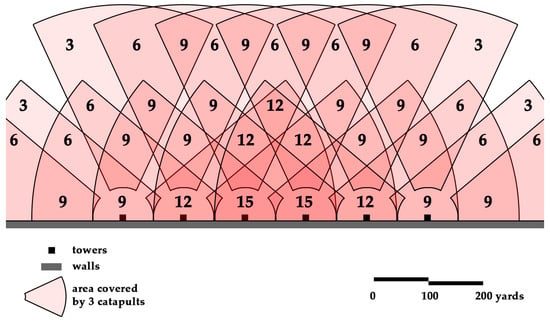
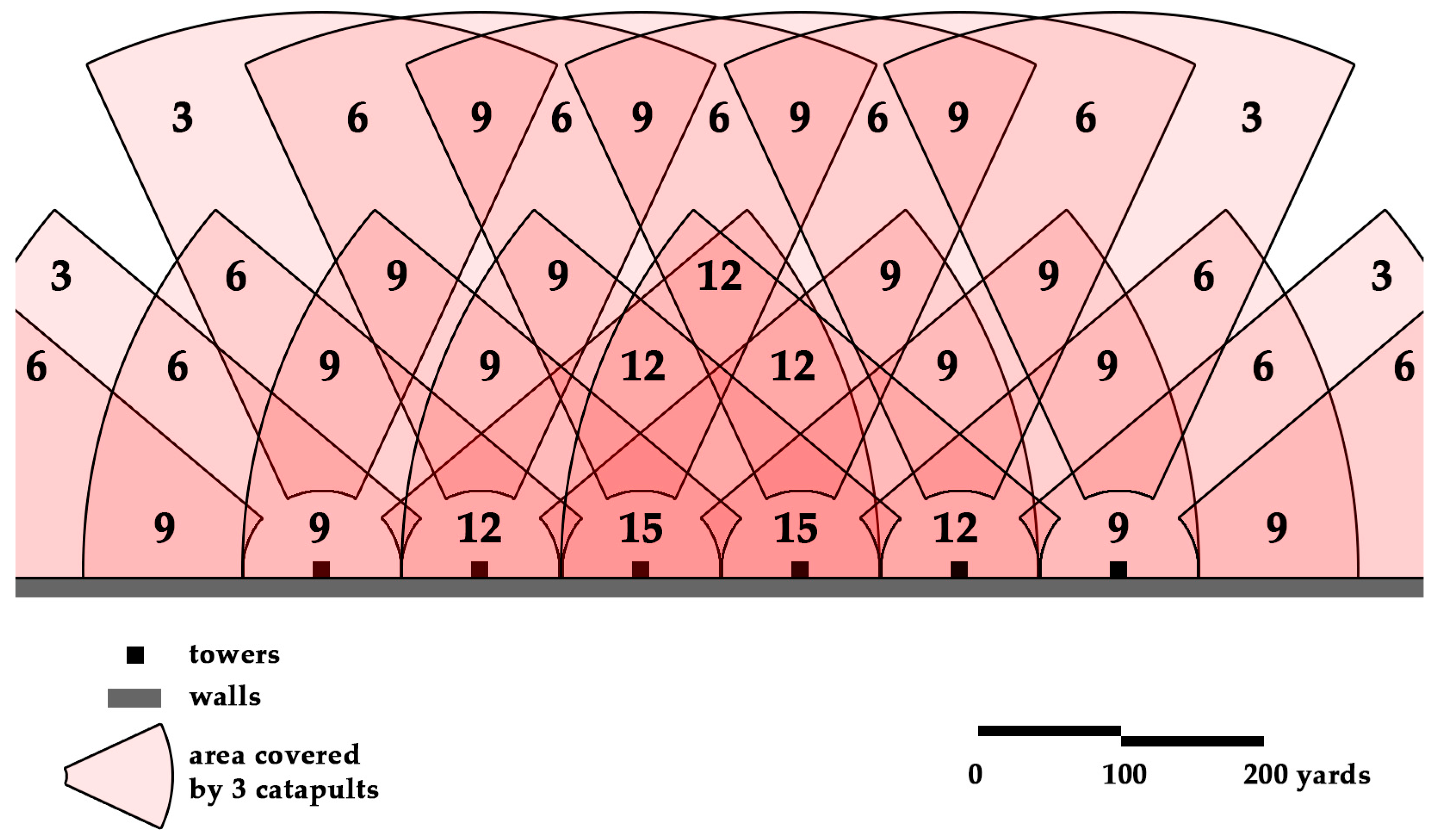
It is instead the weapons positioned behind the frontal loopholes that saturate the ground in front of the curtain wall—that is, the battlefield—with projectiles. In this case, the embrasures, flared on both sides, cover an angle of 30° to 50°, thereby eliminating the need to reposition the weapon and significantly reducing the dead time between successive shots (Figure 14).
Figure 14.
Coverage provided by catapults mounted in six towers 100 yards apart (equal to 91.4 m) in a straight wall; nine catapults per tower, three in each outer wall; fifty-four engines in all. Each segment represents the area covered by three catapults. The figures in the larger spaces formed by the interlocking segments represent the number of engines that can be brought to bear on each particular space. Image by S.B. on the basis of the diagram by Marsden [45] (p. 155).
Seen in this light, the limited number of lateral loopholes in Towers X–XII becomes understandable: only one on the right and one on the left, both placed near the forward façade. As a consequence, the rampart walk below was scarcely protected, leading some scholars to suggest the presence of a continuous wooden covering along the entire length of the wall-walk [29] (p. 67). This solution finds parallels in the few surviving examples of Hellenistic fortifications examined by Yvon Garlan in his commentary on Philo’s work [58,64].
The use of protective wooden structures erected between the merlons to shield archers—also described by Flavius Josephus [54]—is well known. Nevertheless, even considering the presence of upper-hinged wooden shutters on battlements, it is difficult to imagine the installation of large and clearly visible war machines along the wall-walk, especially in a defensive system as dense as that provided by the closely spaced towers and their loopholes.
An alternative hypothesis worthy of consideration is that of hoisting devices intended for lifting materials and tools required for raising the city walls, which were approximately 12 m thick, inclduing the embankment.
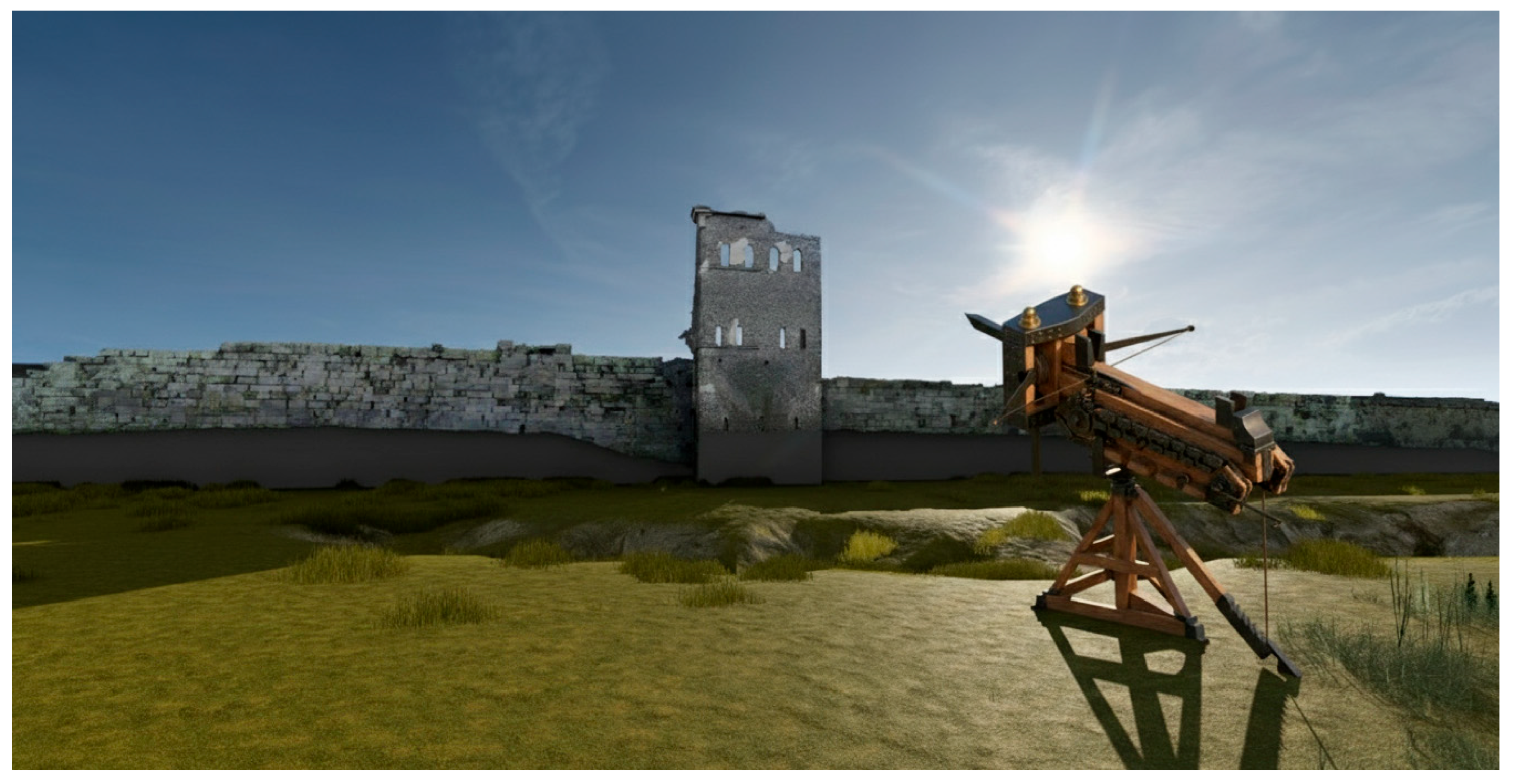
The reflections derived from the analyzed data and from comparison with the literary sources have guided the preliminary outline of the siege scenario (Figure 15). The construction of an independent space—namely the 3D virtual environment—enables dynamic explorations, expandable through apps and open-source software, capable of supporting further analyses by means of integrated digital content. Future work by the authors will focus on these immersive experiences.
Figure 15.
Rendering of a reconstructed polybolos within a virtual environment derived from reality-based documentation of the city walls. Digital survey and 3D model by S.B.; rendering and animation by V.C. with Lumion Pro Student 2024.
To date, the models have been employed to highlight altitude differences between the present ground level and that inferred from the position of the posterns. The scenario assumes a defensive layout and an offensive strategy consistent with a well-attested succession of actions: the trajectories of the large spheroidal projectiles launched by the ballistae, descending from above along a lofted trajectory, were intended to damage the temporary wooden defenses, forcing the defenders to take cover behind the merlons; dart-throwers, in turn, targeted archers who exposed themselves between the merlons to return fire. In this phase, the use of the polybolos would have been particularly advantageous against moving targets. Strategic considerations concerning the deployment of onagers are discussed elsewhere [65].
The documentation will soon be made available through a digital platform (or Digital Library—DL), built around 3D models and designed to reproduce each war machine together with its associated documentary materials (images, videos, and texts). The platform will offer different levels of access and will organize these resources through distinct phases of data management—storing, harvesting, and retrieving—according to a systemic approach that supports the full integration of knowledge.
Although the use of ICT platforms for data management is not new, the need for thematic systems capable of supporting the entire workflow of production, preservation, and dissemination of cultural heritage data has become increasingly evident. Such an approach has significant implications for the long-term effectiveness of the platform, including ensuring the system’s ability to store cultural-heritage information, to guarantee its preservation, and to maintain its accessibility throughout the entire life cycle of the data.
This system will be refined following the integration of the reconstructed polybolos, inserted according to the verified firing parameters. Such reconstructions encourage reflection on the dynamics of the siege, fostering self-correction and the comparison of alternative hypotheses.
6. Discussion
Following Philo’s indications, Schramm constructed a full-scale working prototype of Dionysius’ repeater [53] (Ch. 51, p. 58 (52), Table 7, “Mehrlader nach Philon”) [66] (pp. 60–62, Plate 7, p. 23 Figure 6, p. 61 Figure 27). To overcome the technical difficulties associated with wooden sprockets (Belopoeica 75.32), he replaced the transmission system described by Philo with a bicycle chain. With this modification, as Marsden notes, “(…) the machine worked splendidly. It was so astonishingly accurate that, in a burst of shooting in the presence of the Kaiser, one of its bolts obligingly split another. Schramm justifiably criticized its failure to disperse its missiles” [48] (note 122, p. 184).
The difficulties encountered during the reconstruction did not lead Schramm to conclude that Philo’s pull-back mechanism was ineffective: “being apparently unaware of Schöne’s simple elucidation of the text at Philon 75.32, [he] thought that Philon agreed with him that Dionysius’ pull-back arrangement was useless. Schramm then tried using ordinary bicycle chains and sprockets” [48] (p. 183).
These technical debates are consistent with a key hypothesis advanced here: the impact marks documented on the northern wall of Pompeii suggest a level of force that cannot be fully explained by the direct-transmission system described by Philo, in which tension is applied along a relatively short firing channel. Basic mechanical considerations indicate the likely presence of an intermediate component—a gear-reduction system or mechanical reducer similar to the low gears of a bicycle—capable of delivering the torsional energy required for effective siege-range shooting (70–100 m), while keeping operators out of enemy range. It is therefore plausible that later developments of the machine incorporated such a reduction system, possibly concealed within the main structure of the engine, likely in the H-shaped propulsion unit.
The hypothesis of an integrated component finds indirect support in Marsden’s observation: “one would have to take Philon’s description with a pinch of salt. For instance, one is exceedingly suspicious about the pentagonal sprockets; decapentagons would be more like it. Also, the design of the wooden links of the chain would require a good deal of experiment” [48] (n. 122, pp. 183–184).
This proposed optimization—functionally consistent with the power inferred from digitally quantified damage—appears to align with Philo’s repeated insistence (Belopoeica 56–59) [48] (pp. 75–76) that engineering efforts should focus on shooting range and on “the exploration of all matters concerning arrow power” [53] (p. 63).
An empirical assessment of the weapon’s potential was conducted by calculating the volume of pulverized stone. Knowing the density of the material, the mechanical work—that is, the energy required to remove the mass of stone corresponding to the measured cavities—was computed using the empirical formula provided by Philo [48] (p. 154; Belop. 55–57) and reiterated by Heron of Alexandria [67] (p. 202). The procedure mirrors the method applied by Russo and further developed in Rossi [41] (pp. 317–320) for spheroidal projectiles. Ballistic parameters and energy ranges derive from earlier investigations on stone projectiles and from survey-based calculations on dart impacts [3] (pp. 258–260), currently under further verification by the project’s mechanical engineering team.
Philo’s calculation relates the dimensioning of the modiolus (spring-bundle socket) to the length of the missile shaft, measured in digits, according to the formula D = 1/9 L [48] (p. 162, nn. 33–34; pp. 115–119; p. 147, 73.20, n. 106).
The resulting values [18] (pp. 25–35) are consistent with other published estimates [20,68] and are compatible with the observed level of damage, confirmed through reverse-modeling of the digital models. This is compatible with an advanced artillery system refined over two centuries.
A further verification will be conducted by testing the reconstructed polybolos using the propulsion dimensions provided by Philo (Belopoeica 73.20–74.5). Philo states:
“The little scorpion, introduced by him, was not much larger than a one-cubit engine, and not much smaller than a three-span engine, and it fired a missile one cubit one dactyl long.”
From this passage, it follows that the propulsion unit fell between that of two-span darts and three-span darts, with square frames of approximately 460 mm and 690 mm per side, and corresponding modiolus diameters of ca. 51 mm and 78 mm (the latter being the most frequent). Although Philo does not specify this, reconstructions (Archeotecnica) show that, in a catapult, the string at maximum draw formed a V whose apex lay nine modules behind the rest position—approximately 700 mm—matching the standard dart length. In an automatic catapult, the dart must fall ahead of the string before maximum draw is reached and thus must be shorter than the standard nine modules.
This strong consistency with known standards may allow, with reasonable certainty, the derivation of the limited range permitted by direct loading and, in turn, the adaptations needed to make the weapon suitable for siege dynamics (see the ongoing doctoral dissertation by Claudio Formicola and recent publications) [65] (Figure 16).
Figure 16.
Rendering of virtually reconstructed Roman catapults. 3D models of weapons by C. Formicola.
As for the technical improvements that might have occurred between the composition of Philo’s treatise and the hypothetical use of the polybolos during the Sullan siege, an important contextual clue should be noted: in 96 BC, Sulla served as governor of Cilicia—a province that included Rhodes [69]—while also advising the Roman government during the Social War.
The fame of Rhodes as a center of engineering excellence—especially in metalworking, artillery construction, and naval arsenals—is well documented. The possibility that Philo of Byzantium had close contact with master craftsmen during his time at the Greek city’s arsenal is confirmed by Marsden [48] (p. 109, note 8), who attributes to it the differentiated terminology for the same mechanical parts described. Given the consistency found between the writings of Heron, Philo, and Vitruvius [70], he justifies the terminology as being by no means random. Dissociating himself from the opinion of Schramm [66] (p. 16), Marsden emphasizes that differences in ancient technical terminology reflect the distinct traditions of various Hellenistic engineering schools, quoting:
“different engineering schools in separate regions of the Hellenistic world (Alexandria, Rhodes, Pergamum) would each develop their own peculiarities with regard to both technique and terminology” [48] (p. 157, note 8). Consistencies among Philo, Heron and Vitruvius confirm that such terminology is far from arbitrary.
It is therefore plausible that Sulla—a politically astute and technically informed commander—could have acquired or encouraged Rhodian innovations, deploying an enhanced multi-shot engine during the siege of Pompeii between the summer of 89 and the winter of 88 BC.
7. Conclusions
The possibility of interactively controlling three-dimensional virtual replicas of “certified” machines—that is, models whose proportions correspond to the accurately documented physical effects—provides a framework for multiple analytical approaches.
Among the most promising future directions is the integration of high-resolution digital data with the functional reconstruction of the artillery used during the Sullan siege. Assembling the components of the polybolos in accordance with Philo’s treatise will enable a more in-depth exploration of its technical specifications in relation to the hypotheses discussed in this study. Rapid prototyping of CAD-based 3D components will allow real-time and low-cost experimentation with mechanical refinements, potentially overcoming the limitations of previous reconstructions and fostering a more substantial scholarly debate on the possible enhanced use of the polybolos—and, more broadly, of automatic artillery—in Roman warfare.
At the same time, advanced digital technologies—such as extended reality (XR), virtual reality (VR), affective computing and machine learning—may be implemented to enhance interactive and customizable user engagement. The entire workflow, from surveying to project development, from feasibility hypotheses to the validation of digital and physical twins, can be integrated into coordinated platforms designed for educational, museological, touristic and economic purposes.
As cultural heritage is preserved only insofar as communities recognize and value it, these technologies can serve as powerful tools for deepening public understanding and fostering participation. We welcome contributions exploring how artificial intelligence and digital modeling can be leveraged to create personalized cultural experiences—particularly within museums, archeological sites and heritage-rich environments—thereby demonstrating their potential to enrich both digital and physical interactions with cultural assets.
Author Contributions
Conceptualization, A.R.; methodology, all authors; formal analysis and investigation, A.R.; supervision, A.R.; funding acquisition, A.R.; writing—original draft preparation, A.R.; editing and translation, S.B.; laser scanner survey, meshing and 3D model elaboration: S.B.; figures: S.B. and V.C.; rendering in Lumion Pro Student 2024 software and animation: V.C. All authors have read and agreed to the published version of the manuscript.
Funding
This research was supported by the project “SCORPiò-NIDI”, CUP B53D23022100006 (DD n. 1012/2023), funded by the Italian Ministry of Research under the PRIN (call DD n. 104/2022) funding initiative.
Data Availability Statement
Contact the corresponding author for data requests, that will be available upon reasonable request with the permission of the competent authorities.
Acknowledgments
The authors wish to express their gratitude to the staff of the Engineering Department Library for their efforts in locating Technical Treatises, a now-out-of-print volume whose study proved essential for reorganizing the critical framework presented in this work. The authors also renew their deep appreciation for those who introduced them to the study of ancient artillery, generously sharing their expertise and facilitating repeated access to the study area over the past year. The authors additionally thank the management and appointed officials of the Pompeii Archaeological Park for granting the required authorizations for site access and survey operations.
Conflicts of Interest
The authors declare no conflicts of interest. The funders had no role in the design of the study; in the collection, analyses, or interpretation of data; in the writing of the manuscript; or in the decision to publish the results.
References
- Fiorelli, G. Gli Scavi di Pompei dal 1861 al 1872 Relazione al Ministro Della Istruzione Pubblica di Giuseppe Fiorelli; Tipografia Italiana nel Liceo V. Emanuele: Napoli, Italy, 1873. [Google Scholar]
- Van Buren, A.W. Studies in the Archaeology of the Forum at Pompeii. Mem. Am. Acad. Rome 1918, 2, 67–76. [Google Scholar] [CrossRef] [Scilit]
- Rossi, A.; Gonizzi Barsanti, S.; Bertacchi, S. Use of Polybolos on the City Walls of Ancient Pompeii: Assessment on the Anthropic Cavities. Nexus Netw. J. 2024, 27, 243–272. [Google Scholar] [CrossRef] [Scilit]
- Jacobelli, L. Pompei fuori le mura: Note sulla gestione e l’organizzazione dello spazio pubblico e privato. In Proceedings of the Pompei tra Sorrento e Sarno; Senatore, F., Ed.; Bardi Editore: Roma, Italy, 2001; pp. 29–61. [Google Scholar]
- Maiuri, A. Introduzione Allo Studio di Pompei, a Cura di G. Oscar Onorato, Corso di Antichità Pompeiane ed Ercolanesi 1942-43; GUF: Napoli, Italy, 1943. [Google Scholar]
- Hobsbawm, E. Age of Extremes. The Short Twentieth Century (1914–1991); Abacus: London, UK, 1994; ISBN 0-349-10671-1. [Google Scholar]
- van der Graaff, I. The Fortifications of Pompeii and Ancient Italy; Routledge: New York, NY, USA, 2019; ISBN 978-0-429-46200-9. [Google Scholar]
- Van Buren, A.W. Further Studies in Pompeian Archaeology. Mem. Am. Acad. Rome 1925, 5, 103–113. [Google Scholar] [CrossRef] [Scilit]
- Maiuri, A.P. Isolamento della cinta murale tra la Porta Vesuvio e la Porta Ercolano. Not. Degli Scavi Antich. 1943, 7, 275–314. [Google Scholar]
- Van Buren, A.W. Further Pompeian Studies. MAAR 1932, 10, 7–54. [Google Scholar] [CrossRef] [Scilit]
- Burns, M. Pompeii under Siege: A Missile Assemblage from the Social War. J. Rom. Mil. Equip. Stud. 2004, 14, 1–9. [Google Scholar]
- Giglio, M.; Pesando, F. La Guerra sociale, l’assedio e la fine di Pompei sannitica. In Pompei 79 d.C. Una Storia Romana. Roma, Colosseo 6.11.2020–31.1.2021; Torelli, M., Ed.; Electa: Milano, Italy, 2020; pp. 144–151. ISBN 978-88-9282-011-1. [Google Scholar]
- Zuchtriegel, G.; Borsa, L.; Onesti, A.; Salvatori, L.; Scarpati, G. La rioccupazione nell’Insula meridionalis di Pompei dopo il 79 d.C. Riflessioni a margine dell’“inconscio archeologico”. E-J. Scavi Di Pompei 2025, 7, 1–48. Available online: https://pompeiisites.org/e-journal-degli-scavi-di-pompei/la-rioccupazione-nellinsula-meridionalis-di-pompei-dopo-il-79-d-c-riflessioni-a-margine-dellinconscio-archeologico/ (accessed on 8 August 2025).
- Maiuri, A. Pompei. Sterro dei cumuli e isolamento della cinta murale. Contribuito all’urbanistica della città dissepolta. Boll. D’arte Minist. Della Pubblica Istr. 1960, 1–2, 166–179. [Google Scholar]
- Adembri, B.; Cipriani, L.; Fantini, F.; Bertacchi, S. Reverse Designing: An Integrated Method for Interpreting Ancient Architecture. SCIRES-IT—Sci. Res. Inf. Technol. 2015, 5, 15–32. [Google Scholar] [CrossRef] [Scilit]
- Adembri, B.; Cipriani, L.; Bertacchi, G. Guidelines for a Digital Reinterpretation of Architectural Restoration Work: Reality-Based Models and Reverse Modelling Techniques Applied to the Architectural Decoration of the Teatro Marittimo, Villa Adriana. ISPRS—Int. Arch. Photogramm. Remote Sens. Spat. Inf. Sci. 2017, XLII-5/W1, 599–606. [Google Scholar] [CrossRef] [Scilit]
- Bertacchi, S.; Gonizzi Barsanti, S.; Rossi, A. Geometry of Wall Degradation: Measuring and Visualising Impact Craters in the Northern Walls of Pompeii. SCIRES-IT—Sci. Res. Inf. Technol. 2024, 14, 111–128. [Google Scholar] [CrossRef] [Scilit]
- Discovering Pompeii: From Effects to Causes—From Surveying to the Reconstructions of Ballistae and Scorpiones; Rossi, A., Ed.; MDPI—Multidisciplinary Digital Publishing Institute: Basel, Switzerland, 2025; ISBN 978-3-7258-4640-5. [Google Scholar]
- Gille, B. Storia Delle Tecniche; Editori Riuniti: Roma, Italy, 1985; ISBN 978-88-359-2903-1. [Google Scholar]
- Thakkar, M.M.; Ardeshiri Lordejani, A.; Guagliano, M. Structural Integrity Assessment of Pompeii’s City Wall Under Roman Artillery Fire: A Finite Element Approach. Eng. Proc. 2025, 96, 7. [Google Scholar] [CrossRef] [Scilit]
- Thakkar, M.M.; Ardeshiri Lordejani, A.; Guagliano, M.; Bertacchi, S.; Gonizzi Barsanti, S.; Rossi, A. FEM Simulation of Ballistic Impacts on Pompeii Walls for the Reconstruction of Roman Throwers War Machine. Int. Arch. Photogramm. Remote Sens. Spat. Inf. Sci. 2025, XLVIII-M-9–2025, 1491–1497. [Google Scholar] [CrossRef] [Scilit]
- Rossi, C.; Russo, F. A Reconstruction of the Greek–Roman Repeating Catapult. Mech. Mach. Theory 2010, 45, 36–45. [Google Scholar] [CrossRef] [Scilit]
- Campbell, D.B. Greek and Roman Artillery 399 BC-AD 363; New Vanguard series 89; Osprey Publishing Ltd.: Oxford, UK, 2003; ISBN 1-84176-634-8. [Google Scholar]
- Campbell, D.B. ANCIENT CATAPULTS: Some Hypotheses Reexamined. Hesperia J. Am. Sch. Class. Stud. Athens 2011, 80, 677–700. [Google Scholar]
- Russo, F. Tormenta: Venti Secoli di Artiglieria Meccanica; Stato Maggiore Dell’esercito-Ufficio Storico: Roma, Italy, 2002; ISBN 88-87940-48-7. [Google Scholar]
- Rossi, C.; Russo, F. Ancient Engineers’ Inventions; History of Mechanism and Machine Science; Springer International Publishing: Cham, Switzerland, 2017; Volume 33, ISBN 978-3-319-44475-8. [Google Scholar]
- Russo, F. L’artiglieria Delle Legioni Romane. Le Macchine da Guerra che Resero Invincibile L’esercito Romano; Istituto Poligrafico e Zecca Dello Stato: Roma, Italy, 2004; ISBN 978-88-240-3444-9. [Google Scholar]
- Russo, F.; Russo, F. Gli Scorpioni Della Repubblica. Cenni Storici, Reperti, Tavole Ricostruttive. La Catapulta di Ampurias; ESA: Torre del Greco, Italy, 2008; ISBN 978-88-95430-09-6. [Google Scholar]
- Russo, F.; Russo, F. 89 a.C. Assedio a Pompei: La Dinamica e Le Tecnologie Belliche Della Conquista Sillana Di Pompei; Edizioni Flavius: Pompei, Italy, 2005; ISBN 88-88419-32-2. [Google Scholar]
- Wilkins, A. Roman Imperial Artillery: Outranging the Enemies of the Empire, 3rd ed.; Archaeopress Roman Archaeology; Archaeopress Publishing: Oxford, UK, 2024; ISBN 978-1-80327-784-4. [Google Scholar]
- SCORPiò-NIDI. PRIN 2022 D.D. n.104 Del 02/02/2022, B53D23022100006, Prot. 20222RJE32, ERC SH5 2022. Available online: https://pnrr.inaf.it/prin-2022/#:~:text=Il%20programma%20PRIN%20%28Progetti%20di%20ricerca%20di%20Rilevante,Programma%20Quadro%20di%20ricerca%20e%20innovazione%20dell%E2%80%99Unione%20Europea (accessed on 8 August 2025).
- Fabbri, M. Nuove ricerche per una rilettura delle mura di Pompei. SIRIS Studi E Ric. Della Sc. Spec. Beni Archeol. Matera 2016, 15, 29–47. [Google Scholar] [CrossRef]
- Fabbri, M. The City-Wall in the Roman Age: The Case Study of Pompeii. Constr. Hist. 2021, 36, 1–20. [Google Scholar]
- The London Charter for the Computer-Based Visualisation of Cultural Heritage 2.1. Available online: https://londoncharter.org/index.html (accessed on 24 September 2025).
- The Seville Principles. International Principles of Virtual Archaeology. Available online: http://sevilleprinciples.com/ (accessed on 24 September 2025).
- Brusaporci, S.; Maiezza, P.; Tata, A. Advanced Heritage. From the Virtual Copy to a Virtuous Image of Reality Advanced Heritage. Dalla Copia Virtuale a Un’immagine Virtuosa Della Realtà. In Proceedings of the IMG2019-GRÀFICHE/-GRAPHICS. Book of Abstracts; PUBLICA: Alghero, Italy, 2019; p. 227. [Google Scholar]
- Banfi, F. Virtual Heritage Dalla Modellazione 3D all’HBIM e Realtà Estesa; Maggioli Editore: Santarcangelo di Romagna, Italy, 2023; ISBN 978-88-916-6193-7. [Google Scholar]
- Chiaramonte Treré, C. The Walls and Gates. In The World of Pompeii; Dobbins, J.J., Foss, P.W., Eds.; Taylor & Francis e-Library: London, UK, 2009; Volume 2, pp. 140–149. ISBN 978-0-203-86619-1. [Google Scholar]
- Anniboletti, L. Le fasi delle fortificazioni di Pompei. Stato della conoscenza. SIRIS Studi E Ric. Della Sc. Spec. Beni Archeol. Matera 2016, 2015, 49–70. [Google Scholar]
- Russo, F. Sotto L’insegna Dell’aquila: Storia Dell’esercito Romano Dalla Repubblica All’impero; Ufficio Storico SME: Roma, Italy, 2009; ISBN 88-87940-96-7. [Google Scholar]
- Rossi, A. The Survey of the Ballistic Imprints for a Renewed Image of Unearthed Pompeii. Nexus Netw. J. 2024, 26, 307–324. [Google Scholar] [CrossRef] [Scilit]
- Kastenmeier, P.; Di Maio, G.; Balassone, G.; Boni, M.; Joachimski, M.; Mondillo, N. The Source of Stone Building Materials from the Pompeii Archaeological Area and Its Surroundings. Period. Mineral. 2018, 87, 38–58. [Google Scholar] [CrossRef] [Scilit]
- Imbriale, P. I Travertini Quaternari Della Campania: Caratteri Sedimentologici, Geochimici e Ipotesi Genetica. Ph.D. Thesis, Università Degli Studi di Napoli Federico II, Napoli, Italy, 2014. [Google Scholar]
- Soedel, W.; Foley, V. Ancient Catapults. Sci. Am. 1979, 240, 150–161. [Google Scholar] [CrossRef] [Scilit]
- Marsden, E.W. Greek and Roman Artillery. Historical Development; Oxford University Press: London, UK, 1969; ISBN 978-0-19-814268-3. [Google Scholar]
- Vicente Redón, J.D.; Punter Gómez, M.P.; Ezquerra Lebrón, B. La Catapulta Tardo-Republicana y Otro Equipamiento Militar de La Caridad (Caminreal, Teruel). J. Rom. Mil. Equip. Stud. 1997, 8, 167–199. [Google Scholar]
- Köchly, H.; Rüstow, W. Griechische Kriegsschriftsteller: Griechisch und Deutsch mit Kritischen und Erklärenden Anmerkungen; Verlag von Wilhelm Engelmann: Leipzig, Germany, 1853. [Google Scholar]
- Marsden, E.W. Greek and Roman Artillery: Technical Treatises; Clarendon Press: Oxford, UK, 1971. [Google Scholar]
- Marsden, E.W. The Artillery Manual of Philon. In Greek and Roman Artillery: Technical Treatises; Clarendon Press: Oxford, UK, 1971. [Google Scholar]
- Archeotecnica. Available online: https://www.archeotecnica.it/ (accessed on 8 August 2025).
- Adam, J.-P.; Varène, P. Le castellum aquae de Pompéi, étude architecturale. Rev. Archéologique 2008, 45, 37–72. [Google Scholar] [CrossRef] [Scilit]
- Avella, A.; Argenziano, P. L’approccio Digitale Integrato al Rilievo ed Alla Modellazione Geometrica dei Manufatti Archeologici. Il Caso Studio Della ‘Torre di Mercurio’ nel Sito Archeologico di Pompei. Progetto Campus Pompei. Available online: http://www.campuspompei.it/2015/12/05/lapproccio-digitale-integrato-al-rilievo-ed-alla-modellazione-geometrica-dei-manufatti-archeologici-il-caso-studio-della-torre-di-mercurio-nel-sito-archeologico-di-pompei/ (accessed on 29 November 2023).
- Diels, H.; Schramm, E.A. Philons Belopoiika, Viertes Buch der Mechanik; Akademie der Wissenschaften; Kommission bei G. Reimer: Berlin, Germany, 1919. [Google Scholar]
- Flavio, G. La Guerra Giudaica; Vitucci, G., Ed.; Mondadori: Milano, Italy, 1989; ISBN 88-04-32627-1. [Google Scholar]
- Maiuri, A. Studi e ricerche sulla fortificazione di Pompei. Monum. Antichi Pubblicati Per Cura Della R Accad. Dei Lincei 1930, 33, 114–286. [Google Scholar]
- Fabbri, M.; Ducatelli, V.; Zabotti, F. Le fortificazioni di Pompei. Nuove indagini in prossimità della Torre XI detta di Mercurio. In Studi e Ricerche del Parco Archeologico di Pompei. Ricerche e Scoperte a Pompei: In Ricordo di Enzo Lippolis; Osanna, M., Ed.; L’Erma di Bretschneider: Roma, Italy, 2021; Volume 45, pp. 73–92. ISBN 978-88-913-2117-6. [Google Scholar]
- Pompeii Sites Press Release 2022/12/22: Uno Sguardo Sulla Città Antica Dalla Torre di Mercurio. Available online: https://pompeiisites.org/comunicati/uno-sguardo-sulla-citta-antica-dalla-torre-di-mercurio/ (accessed on 21 December 2025).
- Garlan, Y. Le livre “V” de la “Syntaxe mécanique” de Philon de Byzance. In Recherches de Poliorcétique Grecque; École Française d’Athènes: Atene, Greece, 1974; Volume 223, pp. 279–290. [Google Scholar]
- Santoro, L. Fortificazione Della Campania Antica: Contributo Alla Conoscenza Dei Beni Culturali Della Regione; Palladio: Salerno, Italy, 1979. [Google Scholar]
- AA, V. Studi e Ricerche Della Scuola di Specializzazione in Beni Archeologici di Matera; SIRIS; Edipuglia: Bari, Italy, 2016; Volume 2015, ISBN 978-88-7228-782-8. [Google Scholar]
- Mazois, F. Les Ruines de Pompéi; Imprimerie et Libraire de Firmin Didot: Paris, France, 1824; Volume 1. [Google Scholar]
- Marini, L. L’architettura Di Vitruvio Esposta in Italiana Favella Ed Illustrata Con Comenti e Tavole Cento Quaranta in Tre Volumi; Dai Tipi Appostamente Preparati nel suo Domicilio: Roma, Italy, 1836. [Google Scholar]
- Duncan-Jones, R.P. Length-Units in Roman Town Planning: The Pes Monetalis and the Pes Drusianus. Britannia 1980, 11, 127–133. [Google Scholar] [CrossRef] [Scilit]
- Garlan, Y. La Guerre Dans L’Antiquité; Fernand Nathan: Paris, France, 1972; ISBN 2-09-190308-6. [Google Scholar]
- Rossi, A.; Formicola, C.; Gonizzi Barsanti, S. Ingegna Romana. Dalle fonti ai modelli, dai reperti alle ricostruzioni. Diségno 2024, 14, 229–238. [Google Scholar] [CrossRef]
- Schramm, E. Die Antiken Geschütze der Saalburg. Bemerkungen zu Ihrer Rekonstruktion; Weidmann: Berlin, Germany, 1918. [Google Scholar]
- Baatz, D.; Feugère, M. Éléments d’une Catapulte Romaine Trouvée à Lyon. Gall.—Fouill. Monum. Archéologiques Fr. Métropolitaine 1981, 39, 201–210. [Google Scholar] [CrossRef] [Scilit]
- Palladino, S.; Zona, R.; Minutolo, V. Ancient Projectile Identification Through Inverse Analysis: Case Studies from Pompeii. Eng. Proc. 2025, 96, 8. [Google Scholar] [CrossRef] [Scilit]
- Piganiol, A. Le Conquiste Dei Romani. Fondazione e Ascesa Di Una Grande Civiltà; Il Saggiatore: Milano, Italy, 2010; ISBN 978-88-565-0162-9. [Google Scholar]
- Baatz, D. Recent Finds of Ancient Artillery. Britannia 1978, 9, 1–17. [Google Scholar] [CrossRef] [Scilit]
Disclaimer/Publisher’s Note: The statements, opinions and data contained in all publications are solely those of the individual author(s) and contributor(s) and not of MDPI and/or the editor(s). MDPI and/or the editor(s) disclaim responsibility for any injury to people or property resulting from any ideas, methods, instructions or products referred to in the content. |
© 2026 by the authors. Licensee MDPI, Basel, Switzerland. This article is an open access article distributed under the terms and conditions of the Creative Commons Attribution (CC BY) license.