1. Introduction
Higher education is undergoing significant transformations driven by the convergence of cultural heritage, digital technologies, and participatory pedagogical approaches. Within this landscape, university museums are evolving from their traditional role as static repositories of historical knowledge to become active spaces for learning, cultural mediation, and pedagogical experimentation.
The Museum of the History of Pharmacy at the University of Seville—integrated within the Faculty of Pharmacy—embodies this shift. The museum recreates a late-19th- and early-20th-century pharmacy and is divided into four sections (dispensary, laboratory, back room, and historical medicines), complemented by an extensive rare book and archival collection. Its physical proximity to teaching spaces and its regular use in courses related to pharmaceutical history, legislation, and professional practice make it a valuable environment for exploring innovative forms of engagement between heritage, education, and digital culture.
The Bachelor’s Degree in Pharmacy at the University of Seville admits a cohort in which approximately 80% of students are women. The programme combines lectures, laboratory practice, collaborative assignments, and digital learning resources. Students also undertake external internships in community pharmacies, hospitals, industry, and laboratories, as well as national and international mobility programmes. This diverse and professionally oriented academic context provides fertile ground for the development of heritage-based learning initiatives in which students adopt active roles as interpreters and communicators of scientific heritage.
This article examines three educational innovation projects implemented in the Museum of the History of Pharmacy: (1) Historical Documentary Production, in which students create short documentaries as complementary learning resources; (2) Alumnas Guía, a museum-mediated learning experience formally recognised with ECTS credits; and (3) #VocesQueEmpoderan, a digital storytelling initiative highlighting historical and contemporary women in science. Although each project follows its own pedagogical strategy, all three share a participatory approach and rely on digital technologies to connect pharmaceutical heritage with diverse audiences.
To guide the analysis, this study addresses the following research questions:
RQ1. What outputs (activities and products) were generated through these initiatives, and how do they relate to their intended educational purposes?
RQ2. What qualitative evidence suggests potential learning gains or performance indicators related to communicative, interpretative, or digital competences?
RQ3. How do institutional characteristics (degree structure, student profile, museum resources) influence the implementation of these projects?
RQ4. What considerations emerge regarding gender participation across the activities examined?
These questions provide a clear analytical framework, incorporate the contextual information necessary to assess the transferability of the study, and help ensure that interpretations remain aligned with the available evidence.
2. Materials and Methods
The methodological approach adopted in this study is grounded in an applied, heritage-based educational framework developed within the Museum of the History of Pharmacy at the University of Seville. The Museum functions simultaneously as a pedagogical resource, a scientific–cultural setting, and a site for digital experimentation, enabling the convergence of historical knowledge, audiovisual production, and public engagement.
To improve methodological transparency and align the manuscript with the standards of heritage education case studies, this section distinguishes between:
(a) The implementation of the three educational innovation projects;
(b) The procedures used to document, analyse, and interpret the outcomes.
2.1. Implementation of the Educational Innovation Projects
The three projects examined in this study share a common learning environment—the museum’s permanent exhibition—which recreates a late-19th-/early-20th-century pharmacy. Its collection of historical objects, raw materials, scientific instruments, and archival sources provides an authentic setting for experiential learning activities. All projects were integrated into subjects related to the History of Pharmacy and Pharmaceutical Legislation, aligning pedagogical aims with heritage interpretation and public communication.
Phase 1: Heritage Context and Educational Framework
The museum’s exhibition served as the central context for video documentary production, guided tours, and digital storytelling activities. Each project linked its educational objectives to the valorisation of the museum’s heritage assets and to the dissemination of pharmaceutical history.
Phase 2: Student Selection and Training
Participants included undergraduate students from the Faculty of Pharmacy, either enrolled in Chemoinformatics, Research and History of Pharmacy or involved as student guides. Training sessions combined theoretical instruction in history of science, museology, scientific communication, audiovisual production, or gender-sensitive storytelling, depending on the project. This ensured that students developed both subject-specific and transversal competencies.
Phase 3: Collaborative Content Development and Audiovisual Production
Students and faculty co-created scripts, guided-tour narratives, and digital storytelling materials. Outputs included documentary videos, interpretative texts, and short audiovisual pieces for social media. These processes required analysing primary and secondary sources, examining gender representation in science, and adapting historical content into accessible digital formats. Filming was carried out inside the museum to reinforce authenticity and strengthen connections between heritage objects and interpretive narratives.
Phase 4: ICT-Based Dissemination
Digital dissemination constituted a central pillar of the methodology. Documentary videos were published on TvUS and YouTube, while storytelling content was shared on TikTok and Instagram via the @farma.mus account. The systematic use of hashtags amplified visibility and engagement, extending the reach of pharmaceutical heritage to wider and younger public audiences.
Phase 5: Evaluation, Recognition, and Social Impact
Evaluation throughout the projects was based on continuous faculty supervision, peer feedback, and digital–audience interaction metrics. In the student guide programme, formal recognition was granted through ECTS credits, acknowledging student commitment to heritage communication. Impact assessment combined descriptive digital indicators (views, engagement rates) with qualitative appraisal of narrative quality and representation.
These five phases describe the implementation of the projects. The following section clarifies how these activities were documented and analysed for research purposes.
2.2. Research Design and Analytic Procedures
Although descriptive in nature, the study follows an analytical case study design commonly used in heritage education research. The overarching aim was to document how the three projects operated within the museum context and to examine the forms of learning, participation, and engagement that emerged.
Data Sources
The analysis draws on:
Student-generated materials (scripts, summaries, guided-tour dossiers, audiovisual productions);
Observational notes recorded by faculty during training and guided tours;
Students’ reflective comments (where available);
Digital dissemination metrics reported by the platforms;
Public-facing content produced in each project.
These sources allow for a qualitative interpretation of student participation, communicative performance, heritage understanding, and digital engagement.
Analytic Approach
A qualitative interpretive analysis was conducted, focusing on:
Alignment between project objectives and outputs;
Evidence of communicative, interpretative, or digital media skills in student products;
Students’ roles as heritage mediators;
The ways gender representation and scientific heritage were articulated.
Rather than seeking causal claims or pre-/post-test comparisons—which were not part of the project design—the analysis examines performance indicators observable in student work and project implementation.
Assessment Criteria
Evaluation considered the following qualitative dimensions:
Clarity and accuracy of historical and scientific content;
Coherence and accessibility of interpretative narratives;
Ability to adapt heritage materials to diverse audiences;
Critical engagement with gender perspectives (in the “Voices that Empower” project),
Communicative effectiveness during guided tours.
Limitations
In line with your suggestion, methodological limitations are now explicitly stated:
No standardised pre-/post-assessment tools were used;
No independent evaluator ratings were applied;
Inter-rater reliability measures were not feasible, as faculty supervision followed an informal pedagogical model;
Sample size corresponds to a small cohort typical of university museum projects;
Social media analytics provide descriptive but not inferential insights.
These limitations are inherent to early-stage, practice-based heritage education interventions, and have been acknowledged accordingly.
2.3. Ethical Considerations
All students participated voluntarily and granted permission for the use of anonymized materials. Video recordings were produced within the institutional framework of the University of Seville and disseminated through official channels. The methodology implemented across the three educational innovation projects is based on the integration of cultural heritage, digital technologies, and active learning strategies within the framework of the Museum of the History of Pharmacy at the University of Seville. Conceived as both a pedagogical and research resource, the Museum operates as a living laboratory that facilitates the convergence of historical knowledge, digital literacy, and public engagement through interdisciplinary and participatory approaches.
3. Results
3.1. Historical Video Documentaries
Faculty members from the History of Pharmacy and Pharmaceutical Legislation area have developed a series of historical and legislative video documentaries as complementary instructional resources. All productions share the Museum of the History of Pharmacy in Seville as their primary setting, reinforcing the connection between academic content and material heritage. These audiovisual materials, published on TvUS and YouTube, have become valuable tools for both university teaching and science communication.
Among these productions,
Pioneras de la Farmacia Española: Encuentro en el Museo de Historia de la Farmacia [
1] stands out (
Figure 1). The 17 min documentary highlights the trajectories of four pioneering women in Spanish pharmacy and is structured into three segments:
- 1.
A theatrical introduction featuring Hygea, goddess of Pharmacy.
- 2.
Four interviews with students and professors, scripted using the book Rompiendo Moldes [
2], which analyses women’s university education and professional practice before the Spanish Civil War [
3].
- 3.
A closing sketch reclaiming the link between pharmacy and witchcraft, reframing “witches” as early custodians of medicinal knowledge.
Figure 1.
Cover image of the “Pioneras de la Farmacia Española”. YouTube, Link: Pioneras de la Farmacia Española: Encuentro en el Museo de Historia de la Farmacia [
4].
Figure 1.
Cover image of the “Pioneras de la Farmacia Española”. YouTube, Link: Pioneras de la Farmacia Española: Encuentro en el Museo de Historia de la Farmacia [
4].
This includes Farmacia, arte y bienestar, which showcases the Museum’s historical–artistic collection and pharmaceutical instruments, and explains part of the equipment used for the preparation of pharmaceutical dosage forms currently displayed in the Museum
Figure 2.
Cover image of the video, “Farmacia, arte y bienestar. Museo de Historia de la Farmacia de Sevilla”. TvUS,
Link: FARMACIA, ARTE Y BIENESTAR. MUSEO DE HISTORIA DE LA FARMACIA DE SEVILLA-TV US. Plataforma de Vídeo Streaming Institucional de la Universidad de Sevilla [
5].
Figure 2.
Cover image of the video, “Farmacia, arte y bienestar. Museo de Historia de la Farmacia de Sevilla”. TvUS,
Link: FARMACIA, ARTE Y BIENESTAR. MUSEO DE HISTORIA DE LA FARMACIA DE SEVILLA-TV US. Plataforma de Vídeo Streaming Institucional de la Universidad de Sevilla [
5].
Another example is Plantas y medicamentos: Una apasionante visión histórica, produced during the International Year of Plant Health, highlighting phytotherapy in pharmacy history.
Figure 3.
Cover image of the video,
“Plantas y medicamentos. Una apasionante visión histórica”. YouTube, Link: Plantas y medicamentos. Una apasionante visión histórica [
6].
Figure 3.
Cover image of the video,
“Plantas y medicamentos. Una apasionante visión histórica”. YouTube, Link: Plantas y medicamentos. Una apasionante visión histórica [
6].
Finally, there is
Farmacéuticos y América entre la Ciencia y el Comercio Between Science and Trade, inspired by research on medicines exchanged during Spanish expeditions to the New World, combining interviews and theatrical scenes filmed in the museum and across the historical locations of Seville [
7,
8,
9,
10].
These outputs illustrate the variety of narrative formats used to communicate pharmaceutical heritage and the role of students and faculty as co-creators of scientifically grounded historical content.
3.2. Student Guides Programme
3.2.1. Student Recruitment and Participation
The “student guide” initiative was developed to involve undergraduate students in heritage interpretation through guided tours. A small group of volunteers was selected following announcements made through the Virtual Teaching Platform and during the Research Initiation Days at the Faculty of Pharmacy. Five students joined during the 2024–2025 academic year, and participation continued in 2025–2026 with similar levels of engagement. All volunteers to date have been women.
3.2.2. Competency Development
Students undertook several preparatory tasks, including studying the museum’s collection, preparing scripts, and rehearsing with faculty members. These activities required selecting key historical elements, organising content into clear interpretative sequences, and adapting language for diverse audiences.
3.2.3. Active Learning and Guided Tours
During the first semester, students prepared personal dossiers based largely on information from the museum’s official website [
11] and supplemented them with notes from faculty-led tours. Initially, students attended visits as observers and progressively assumed interpretative roles once they demonstrated sufficient knowledge and preparedness.
Fifteen guided tours were organised during the 2024–2025 academic year as part of the Faculty’s Orientation and Tutorial Action Plan (POAT). Students participated either as observers or as presenters. For the current academic year, eight tours have been scheduled through January, with additional sessions planned for spring.
Tours typically last 30–50 min and cover the museum’s collections, including historical objects, books, raw materials, and pharmaceutical instruments. Through repeated practice, students developed greater fluency in presenting historical content and engaging with visitors. Faculty members were present at all sessions to provide support, ensure historical accuracy, and guide reflective learning.
3.2.4. Outcomes of Participation
Students reported increased interest in the history of pharmacy and demonstrated enhanced autonomy in preparing and delivering guided tours. Faculty notes describe greater confidence, clearer structure in oral explanations, and improved audience interaction over time. While these findings are qualitative, they align with the model of active, humanistic, museum-based learning promoted in heritage education.
3.3. Voices That Empower
3.3.1. Digital Storytelling Production
Voces que Empoderan integrates pharmaceutical heritage, gender perspectives, and digital media through TikTok (
Table 1) and Instagram (@farma.mus). Students created short videos highlighting women in science and pharmacy, combining text, images, and voice-over.
The first video presented key indicators on women’s participation in research and STEM fields [
12], including the fact that only 22 women have received the Nobel Prize in scientific categories [
13]. Building on gender gap studies [
14,
15] and research documenting biases in scientific evaluation [
16], the content was designed to be both informative and accessible.
A second video focused on Nuria Oliver [
17], an internationally recognised AI researcher [
18], using digital storytelling strategies to promote identification with contemporary female role models.
3.3.2. Museum-Based Content and Outreach
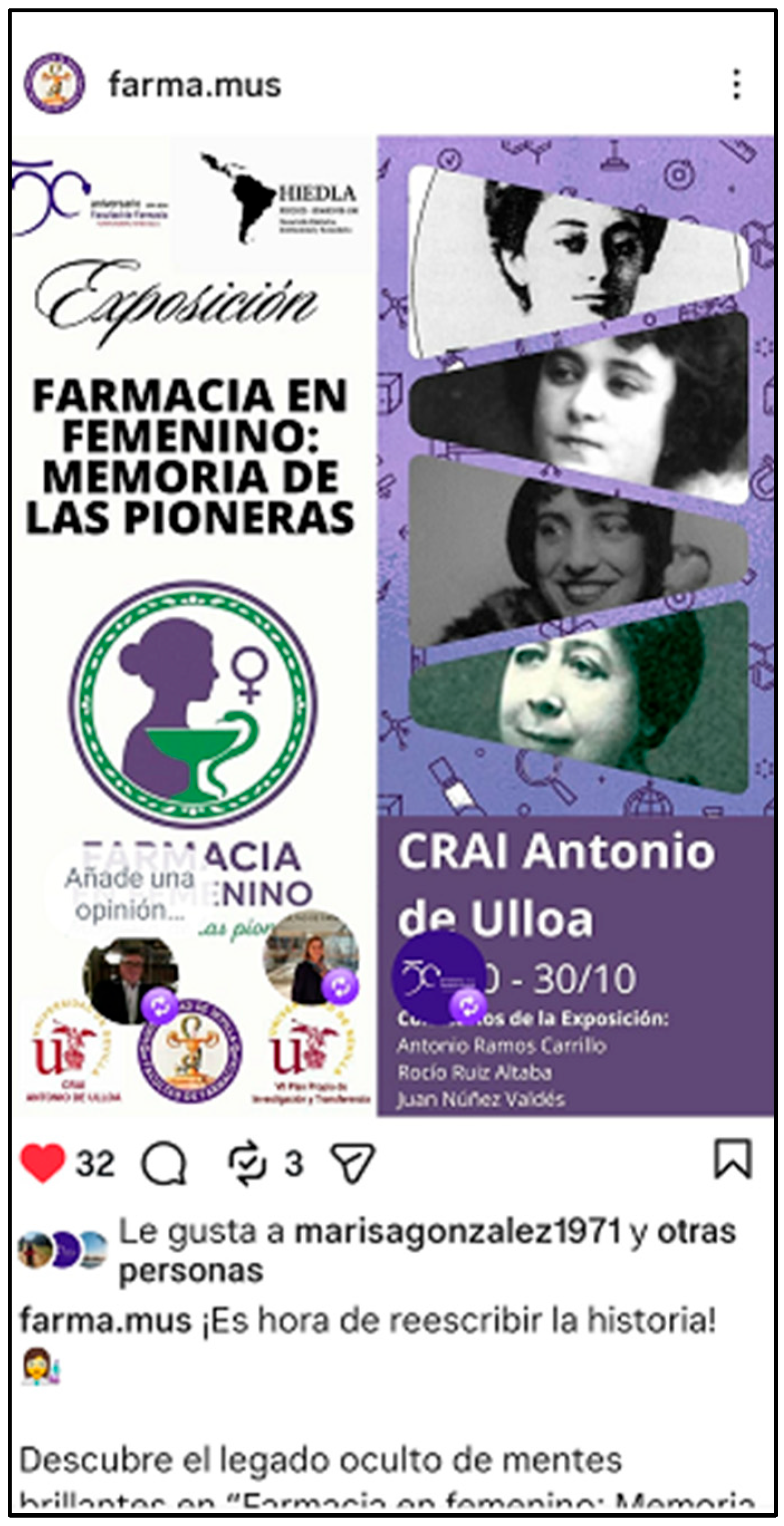
The project has also contributed to museum outreach initiatives. Students collaborated with the University Library (CRAI Antonio de Ulloa) on a temporary exhibition dedicated to women in pharmacy (
Figure 5). Posters created by student guides were incorporated into the exhibition and disseminated via social media.
3.3.3. Dissemination Metrics
During the first months of implementation, the project significantly increased the museum’s digital visibility. Instagram metrics for a 30-day period show:
A total of 2662 total views;
A total of 1442 accounts reached (+1150%);
Reels representing 75.7% of total engagement.
Top-performing posts featured museum objects such as albarelos, apothecary jars, and historical instruments, each reaching 1500–3000 views. Demographic data indicate a predominantly young audience (25–34 years: 31.7%; 18–24 years: 12.1%) with strong engagement from the Seville metropolitan area.
TikTok results show similar trends, with high engagement in short videos filmed inside the museum and a predominantly young, female audience profile.
3.3.4. Audience Profile and Behaviour
The audience is predominantly young:
Aged 25–34 years (31.7%);
Aged 18–24 years (12.1%)
3.3.5. Student Participation and Skill Development
Students involved in the project assumed responsibilities including scriptwriting, filming, editing, publication, and basic analytics interpretation. These activities required decision-making and content adaptation, positioning students as active creators of digital heritage narratives rather than passive consumers. Individual metrics indicate an average of 825 views per post and typical audience retention values for short educational videos.
3.4. Summary of Impact
Across the three projects, qualitative evidence suggests that involving students in heritage-based activities—whether through documentary production, guided tours, or digital storytelling—strengthened their engagement with pharmaceutical history, enhanced their communicative performance, and fostered a deeper appreciation of the museum as a platform for learning and public outreach. These outcomes, while based on interpretive analysis and descriptive indicators, are consistent with heritage education approaches that emphasise experiential, humanistic, and socially engaged learning.
4. Discussion
The results of this study suggest the potential of scientific university heritage, specifically the Museum of the History of Pharmacy in Seville, as a setting for teaching innovation, public engagement, and the development of scientific citizenship. Initiatives such as video documentaries, the student guide programme, and the “Voices that Empower” project illustrate how the intersection of teaching, research, and outreach can create learning environments in which historical pharmacy knowledge is reinterpreted through contemporary perspectives, including heritage education, competency-based training, and gender equality in science.
Using heritage as a pedagogical tool has become a well-established approach in higher education, particularly in disciplines related to the history of science and health. Rather than claiming direct improvement, our findings are consistent with studies showing that heritage-based activities can generate meaningful cognitive and emotional connections with the past [
19]. In this sense, the Museum of the History of Pharmacy offers a context in which observation, analysis, and narrative construction provide opportunities for experiential learning. This aligns with Falk and Dierking’s work [
20], which highlights the role of museum environments in fostering personal and social meaning-making.
The educational potential of the documentaries lies not only in their outreach dimension but also in the opportunities they create for students to engage in research, scriptwriting, and synthesis processes aligned with Kolb’s experiential learning model [
21]. These practices reflect forms of cultural mediation that have been described in the literature as redefining the relationship between museums, universities, and communities [
22]. In particular,
Pioneers of Spanish Pharmacy combines historical reconstruction with gender perspectives, illustrating how audiovisual resources may help make otherwise overlooked narratives more visible [
23].
Student participation in guided-tour activities aligns with service-learning principles [
24], merging academic learning with community-oriented communication. Rather than asserting measurable skill acquisition, our qualitative observations indicate that students engaged in tasks that required communication, critical thinking, and synthesis—abilities that are frequently discussed in heritage education models such as “applied heritage education” [
25].
Engagement with the museum’s collections provided occasions for historical interpretation and cultural empathy, echoing findings that heritage can strengthen understandings of identity, memory, and citizenship [
26]. Students acted as mediators between the university and society, a role that resonates with calls for humanistic perspectives in scientific training [
27].
The service-learning model developed around the Museum of the History of Pharmacy has enabled an alternative assessment approach to traditional exams. Awarding ECTS credits to students actively participating in guided visits represents institutional recognition of effort and autonomous learning. This formative evaluation responds to the need to assess processes rather than outcomes, aligning with authentic assessment strategies [
28]. Active learning in the museum thus yields a dual benefit: strengthening students’ communicative and heritage competencies while projecting university knowledge toward society through accessible scientific outreach.
The synergy between science and humanities, evident in the student guide programme, embodies educational transversality. Heritage education in university contexts should foster dialogue across disciplines, acknowledging scientific and technical heritage as cultural products [
19]. Pharmacy, as a health science, carries historical–artistic components that the museum makes visible and reinterprets. Using historical objects, instruments, and documents as teaching resources enables a holistic understanding of pharmaceutical practice and reinforces professional identity.
Similarly, the
“Voices that Empower” project extends heritage education practices into the digital realm. Instead of suggesting causal impact, our data illustrate patterns of interaction aligned with “participatory digital museology” [
29], where students become creators of heritage content and develop forms of digital literacy that integrate identity, narrative, and communication [
30].
The gender perspective incorporated in the project adds an interpretative layer widely supported in educational research. The student-created narratives reflect engagement with gender perspectives [
31] and answer calls from international frameworks for greater visibility of women in STEM [
32]. These practices align with contemporary analyses of gender bias [
33] and with critical approaches within digital feminist activism [
34].
Taken together, the qualitative patterns observed across the projects support the interpretation that engaging students in heritage communication can contribute to reflective, humanistic, and socially oriented dimensions of scientific education. These interpretations must remain within the contextual limits of the study.
From a heritage perspective, using the museum as a backdrop for audiovisual and digital productions reinforces its symbolic value as a site of memory and meaning-making. Heritage is not static but a social process of constructing meanings [
35]. Here, the museum becomes a performative space where past dialogues with present, expanding museography toward hybrid, digital formats that prioritise authenticity, participation, and emotional engagement [
25,
36].
Qualitative results also show that student involvement in heritage communication projects fosters critical thinking and understanding of science’s social role. Active interpretation of scientific objects helps students grasp how knowledge is constructed and its ethical and cultural implications [
37]. Thus, the Museum of the History of Pharmacy project not only contributes to technical training but also strengthens civic dimensions, promoting a vision of pharmacy linked to public service and social responsibility.
Institutionally, these experiences underscore university museums’ role as strategic agents for educational innovation and cultural transfer. University science museums can act as partners in teaching, research, and social engagement, fully integrating into universities’ missions of internationalisation and educational innovation [
15]. The Museum of the History of Pharmacy in Seville emerges as a hub articulating the university’s three missions: teaching, research, and outreach. Its ability to attract external audiences—schools, visitors, local communities—reinforces the social function of university heritage as a common good and a resource for cultural sustainability [
17].
Nevertheless, some limitations arise from the emerging nature of these projects. For “Voices that Empower”, available social media metrics do not yet allow exhaustive quantitative impact assessment, hindering objective reach measurement. Long-term sustainability depends on institutional support, continued funding, and renewal of faculty and student teams. Future phases should incorporate systematic evaluation tools—perception surveys, competency analyses, and longitudinal studies—to assess the impact on training and public perception of scientific heritage more accurately.
Overall, these findings demonstrate that combining heritage, teaching, and social communication can constitute a replicable model of university innovation. The Museum of the History of Pharmacy experience shows that heritage is not merely an object of study but a dynamic pedagogical resource capable of articulating memory, identity, and social engagement. The humanistic dimension of pharmacy, often overshadowed by its technical side, emerges here as a core axis of integral education and as a bridge between science and culture. Likewise, the gender perspective and digital expansion illustrate how heritage education can adapt to contemporary languages without losing academic rigour or critical depth. Integrating audiovisual, museological, and digital strategies strengthens the university–society connection, consolidating the museum as a living space for learning, research, and empowerment.
5. Conclusions
Educational Impact
Based on the qualitative evidence analysed, pharmaceutical historical heritage, particularly the Museum of the History of Pharmacy in Seville, appears to offer valuable opportunities for innovation in university teaching. The initiatives examined illustrate how university museums, when used as pedagogical and communication spaces, can complement traditional instruction and support student engagement with historical and humanistic dimensions of pharmacy.
Professional Identity and Humanistic Dimension
Student involvement in heritage-related activities provided occasions for reflection on professional identity and for recognising the cultural significance of pharmaceutical knowledge. The student guides programme, in particular, shows how direct interaction with heritage objects may support the development of a sense of belonging and social responsibility, consistent with calls for integrating humanistic components into health-science degrees.
Institutional Role
Findings from the three initiatives are compatible with the idea that university museums can contribute to the broader mission of higher education, particularly in the areas of scientific outreach, heritage literacy, and community engagement. While these observations reflect the specific conditions of the University of Seville, they suggest potential avenues for other institutions with comparable resources.
Gender Perspective and Digital Innovation
From a gender perspective, “Voices that Empower” demonstrates how digital storytelling can be used to highlight women in science and expand the visibility of scientific heritage across younger audiences. Although impact cannot be quantified at this stage, the patterns observed indicate that combining gender perspectives with digital media represents a promising direction for inclusive science communication.
Limitations and Future Directions
The early stage of some initiatives and the descriptive nature of social media metrics limit the scope of the conclusions. Future work should incorporate mixed-method evaluations to examine educational and social impact in greater depth. Expanding collaboration with other faculties and exploring the applicability of this model in different university contexts are important next steps.
Final Remarks
Overall, the experiences presented in this article outline a potentially transferable approach to teaching innovation based on heritage, digital media, and public engagement. While context-dependent, these initiatives illustrate how heritage can function as a dynamic pedagogical resource capable of supporting cultural, educational, and civic dimensions of university training.