


Abstract
The origins of sound spatiality practices in the arts remain largely unexplored, particularly regarding their creative and dramaturgical potential beyond physical properties. This study investigates how spatial aspects of sound were employed—intentionally or otherwise—in ancient Greek dramaturgy, through close textual analysis of four fully preserved plays by Aristophanes. A novel analytical framework is introduced, comprising four axes that categorize instances of sound spatiality: (1) dialogue between the Chorus and main actors, (2) use of stage machinery for elevated appearances, (3) division of the Chorus into semi-Choruses, and (4) entrance and exit movements of the Chorus. Each play was examined for examples corresponding to these axes, based on textual references and inferred stage directions. The analysis reveals recurring instances of spatial sound across all four plays, suggesting that spatiality played a significant role in shaping the inferred performance soundscape. While the question of intentionality remains open, the recurrence of these patterns within the selected plays suggests that spatial organization contributed meaningfully to the audience’s auditory experience, serving as a vital component of intangible cultural heritage. This work lays the groundwork for further research into sound design in classical theatre and offers a methodology for identifying spatial audio practices in historical performance texts.
1. Introduction
Ancient Greek theatre was experienced as a spatial performance in which voices, music, and movement unfolded across the theatrical space. Actors and members of the Chorus occupied different positions, entered and exited the performance area, moved through it, and at times formed distinct or vertically separated sound sources. Although the original events were ephemeral and no acoustic recordings survive, dramatic texts document patterns of action, speech, movement, and sound that allow aspects of this heritage to be identified and researched.
Artists have long taken advantage of people’s ability to interpret spatial sound information for creative purposes. Modern literature traces the first intentional exploration of sound spatialization in music either to the early Christian period, with the use of counterpoint melodies in religious music, or more commonly to the Renaissance, when the first musical compositions for double choirs emerged [1]. This study investigates evidence of sound spatiality in ancient Greek drama, centuries before its documented and theorized use in later artistic traditions. Rather than assuming a fully intentional or conscious design, sound spatiality is approached as a feature that may emerge either directly or indirectly from dramaturgical choices, stage directions, and the content of the texts. Here, “sound spatiality” refers to the presence and movement of sound sources through three-dimensional space. “Sound spatialization,” by contrast, means deliberately placing or moving sounds to create a dramatic or communicative effect. This distinction lets us examine how sound occupied the performance space without suggesting that ancient artists followed a modern, formal design practice.
This text-based exploration of performance soundscapes builds on, and complements, existing work in digital archaeoacoustics and acoustic heritage. In this field, scholars have argued that the digitization of cultural heritage should also include acoustic heritage. Researching the sound of historical places can improve our understanding of past building practices, while also showing the need for clearer guidelines on how acoustic heritage can be digitized and presented through auralization [2]. Much of this work uses digital technology and virtual acoustics to examine the relationship between auditory experience and acoustic space. Through three-dimensional modelling, ancient performance venues are approached as sensory and embodied spaces, where sound propagation shaped social interaction in the past [3]. Related studies further show that the architecture of Greek and Roman theatres was not shaped only by geometric rules, but also by the social and communicative needs of music, dance, and public speech across generations [4].
Together, these studies show the strong value of architectural and digital methods for acoustic heritage research. At the same time, Bellia argues that this interdisciplinary field also needs new theoretical paths that connect digital heritage with the lived experience of ancient spaces, so that historical acoustemology and soundscape archaeology can better explain how everyday life took place within these environments [3]. Although existing research has been highly effective in showing how architectural monuments respond to sound, less attention has been given to how these performance practices were organized acoustically. The present study addresses this gap through a complementary, text-driven approach. Instead of beginning with the physical acoustic properties of a surviving site, it begins with the dramatic script and examines how choreographed movements, multiple choral sound sources, and vertical stage actions may have shaped the inferred performance soundscape.
This text-based approach also draws on classical performance scholarship. Theatre historians and philologists have long examined staging, spatial conventions, and choral movement in classical drama. Studies by Pickard-Cambridge [5], Webster [6], Taplin [7], and Dover [8] describe how performers moved through the orchestra, used stage doors, and operated theatrical machinery. Research on dramatic form also shows how metre and choral odes shaped ensemble movement [9]. These studies provide detailed accounts of performance, but generally focus on its literary, visual, or social dimensions. The acoustic effects of stage movement have received less attention. Here, we read dramatic scripts not only as poetry or records of visual action, but also as evidence of where sound sources may have been located, how they moved, and how distinct voices may have answered one another in the open-air theatre.
Such an approach is particularly relevant to ancient theatre, where the surviving text may preserve information about a performance whose original auditory realization can no longer be directly accessed. The framework developed in this study therefore treats the dramatic script not only as a literary text, but also as evidence of possible performance practice. The type of evidence examined here is textual and performative. It concerns how voices, movements, choral formations, entrances and exits, and stage mechanisms may have shaped the position and direction of sound during performance. The aim is not to reconstruct the full acoustics of a particular venue, but to identify how spatial sound may have been organized within the dramaturgy itself.
This approach also evaluates these early practices through two key concepts of heritage science: soundscape and intangible cultural heritage. The first concept, soundscape, requires a distinction between the sounds present in a space and how people experience them. ISO 12913-1:2014 defines soundscape as the acoustic environment as people perceive, experience, and understand it in context. The acoustic environment, by contrast, concerns the sound sources in a space, their distribution, and how sound travels through it [10]. The surviving texts cannot tell us exactly what ancient audiences heard or how they experienced it, and they do not record the physical acoustics of a theatre. They do, however, offer clues about how sound was staged: where vocal sources were located, how they moved, and how they interacted. Accordingly, this study uses “performance soundscape” to mean the arrangement of sound inferred from the staging described in the texts—a likely part of the audience’s auditory experience, not a reconstruction of that experience or of a theatre’s acoustics.
The relevance of intangible cultural heritage lies in the performative nature of the material under study. According to the 2003 UNESCO Convention, intangible cultural heritage includes practices, representations, expressions, knowledge, and skills transmitted through communities and manifested, among other domains, in oral traditions and expressions, language, and the performing arts [11]. Ancient dramatic performance belongs to this broader field because it preserves traces of living theatrical traditions: spoken and sung language, choral movement, musical action, spatial organization, and shared conventions of performance.
Ancient Greek dramaturgy can be traced back to the era of Epic Singers (Aoidoi) and Rhapsodists, both narrators of heroic tales, whose performances were most likely relatively static. The interaction between music and movement around a physical space is first attested in the Dithyramb, a cultic hymn to Dionysus performed by a chorus singing and dancing in a circular formation [12]. It remains unclear when the first singer separated from the chorus. The commonly cited date 534 BCE, which is associated with the time Thespis is said to have introduced a single performer on stage, remains disputed [13]. This transition from comparatively static narration to performances combining voice and movement provides an important historical context for the development of Classical Greek theatre.
Theater in classical era Greece was a fundamental aspect of ancient Greek civilization. It was traditionally divided into three main dramatic genres: Tragedy, Satyr play, and Comedy [14]. The present study focuses on ancient Greek comedy and, specifically, on the surviving plays of Aristophanes. Although numerous comedies are known, the only fully preserved plays are those of Aristophanes (c. 446–c. 386 BCE). Aristophanes composed nearly 40 plays, 11 of which survive nowadays in their entirety [8,15]. These surviving works contain numerous textual and performative cues concerning the spatial organization of the performance soundscape. The historical question addressed here is therefore not whether Aristophanes employed “sound spatialization” in its modern technical sense, but whether recurring forms of spatially organized sound can be identified systematically within the surviving evidence. In doing so, the aim is to contribute to the broader understanding of how spatial aspects of sound—whether deliberate or incidental—play a creative role in shaping the audience’s experience.
The analysis examines implicit and explicit textual indications of how sound may have been spatially realized in performance, focusing particularly on the interactions between the main characters and the Chorus. To examine these phenomena systematically, the study develops an analytical framework organized around four recurring forms of spatial sound: dialogue between the Chorus and main actors, elevated appearances involving stage machinery, division of the Chorus into semi-Choruses or supplementary choral groups, and the spatial movement associated with choral entrances and exits.
By applying this framework systematically, this work positions Aristophanic comedies as primary textual documents of intangible sonic heritage, demonstrating how the script itself can function as a repository of performance data. This method offers an alternative for recovering heritage knowledge in cases where archaeological performance spaces are too physically degraded for reliable acoustic measurement, or where the original venues have not survived at all. Shifting the analytical focus from a site’s material remains to the dramaturgical guidelines embedded in the text allows aspects of ancient theatrical sound that were inherently live and temporary to be investigated.
Recent work in other heritage contexts demonstrates the range of applications that historically informed digital acoustic reconstruction can support. Studies associated with the multi-era reconstruction of Notre-Dame de Paris have combined room acoustic modelling of audibility and speech intelligibility for historical sermon delivery [16], geolocated binaural audio and embodied storytelling for engagement with reconstructed sonic histories [17], and calibrated geometric acoustic models for multi-era auralization and virtual performance applications [18]. The proposed text-driven method may similarly provide historically informed information about the location, movement, and interaction of sound sources that can complement future archaeoacoustic modelling and auralization.
The following sections outline the methodological approach and analytical framework developed to identify instances of sound spatiality in ancient Greek comedy. Section 2 introduces the four analytical components used to categorize spatial sound phenomena based on textual and performative cues and details the utilized data selection strategy, justifying the focus on four of Aristophanes’ eleven fully preserved comedies. Section 3 applies this framework to the selected plays, examining how textual references and implied stage practices contribute to the spatial arrangement of sound sources on stage. Finally, Section 4 summarizes the main findings and suggests directions for future research on the role of spatial acoustics in ancient dramaturgy.
2. Methodology
The framework developed in this study treats the dramatic script not only as a literary text, but also as evidence of possible performance practice. The type of evidence examined here is textual and performative, concerning how voices, movements, choral formations, entrances and exits, and stage mechanisms may have shaped the position and direction of sound during performance. Accordingly, the methodology focuses on identifying and classifying these spatial cues in the surviving texts, while recognizing that textual analysis cannot determine the precise acoustic behavior of a specific theatre.
2.1. Framework Components for Spatial Sound Analysis in Ancient Greek Dramaturgy
This work is part of a broader investigation into early examples of sound spatiality in performance, as evidenced in the preserved texts of ancient Greek drama. The analysis distinguishes between explicit textual evidence, in which spatial relationships, movements, or positions are directly indicated, and implicit or inferred evidence, in which spatial organization is reconstructed from dialogue, dramaturgical action, or performative context. This distinction describes how directly spatiality is supported by the surviving text, while leaving the question of intentionality open.
The framework considers sound in two ways. First, it identifies where sound sources are located on stage and how they move. Evidence is explicit when the text or stage action states a position, movement, or sound event—for example, a direction to wheel out machinery or dialogue referring to an offstage noise. Evidence is inferred when placement must be reconstructed from the dramatic action, the speaker, or conventions of fifth-century BCE theatre. Second, the framework relates these physical source configurations to the auditory conditions they created on stage. Because the subjective perception of the ancient audience cannot be measured directly, our analysis models the kinematic trajectories and interactions of the sound sources themselves, providing the physical input required for subsequent archaeoacoustic simulations and perceptual interpretations.
The analysis is structured around four key axes representing recurring spatial configurations of vocal sound within the dramatic action. These configurations are identified through the positions, movements, and interactions of performers, with evidence ranging from explicit textual indications to spatial relationships inferred from dramaturgical and performative context. The four axes are defined as follows:
- On-stage dialogue between the Chorus and Main Actors (Horizontal Separation and Angular Antiphony): This axis concerns all instances of dramatic verbal exchange between the Chorus (a group of performers acting as a single unified sound source) and the main actor(s), each standing at different positions on stage. Such exchanges create spatially differentiated vocal sources whose relationship may be explicitly indicated by the text or inferred from the staging required by the dramatic action. Beyond extended dialogue, this axis encompasses rapid line-by-line and half-line exchanges, as well as shared lyric exchanges between an actor and the Chorus, which generate alternating lateral sound localization.
- Elevation and Spatial Differentiation through Stage Equipment and Machinery (Vertical Elevation/Z-axis): This axis comprises instances in which performers are positioned at a different spatial or vertical level through stage action or theatrical equipment, creating a spatially differentiated vocal source along the vertical (Z) axis. Performers may be elevated above the primary acting plane using stage machinery such as the crane (mechane), positioned on the roof of the skene (theologeion), framed in high upper-story openings, or wheeled outward on a platform (eccyclema). The performer’s position or movement may be explicitly indicated in the text, while the specific stage mechanism used to realize it may remain inferred. Textual cues under this axis also reflect transitions between offstage and onstage delivery and source visibility, as when characters are heard speaking from within before emerging.
- Simultaneous use of a Supplementary Chorus/Chorus Division into Semi-Choruses (Source Multiplicity and Spatial Distribution): The dramatic function of the Chorus in ancient Greek drama was sometimes enhanced by its division into two semi-Choruses, each functioning as a distinct unit, or by the appearance of a secondary, auxiliary chorus on stage. This axis examines the co-presence and interaction of these two autonomously functioning sound sources during a play. Acoustically, this configuration introduces source multiplicity and distributed emitters, creating spatial counterpoint, acoustic masking, and antiphonal call-and-response patterns across the performance space. The division into distinct choral groups may be explicitly indicated in the text or inferred from the dramaturgical and performative context.
- Parodos and Exodos of the Chorus (Radial Trajectory and Motion Dynamics): This axis concerns sound sources that approach, retreat, or change direction as they move around the performance space. Its application is primarily observed during the Parodoi (entrances) and Exodoi (exits) of the Chorus along the lateral pathways (eisodoi/parodoi). Acoustically, this dynamic motion produces distance modulation, changing angles of incidence, and looming or receding auditory cues as the ensemble advances toward or withdraws from the orchestra. The spatial movement of the Chorus may be explicitly indicated in the text or inferred from the dramaturgical and performative context.
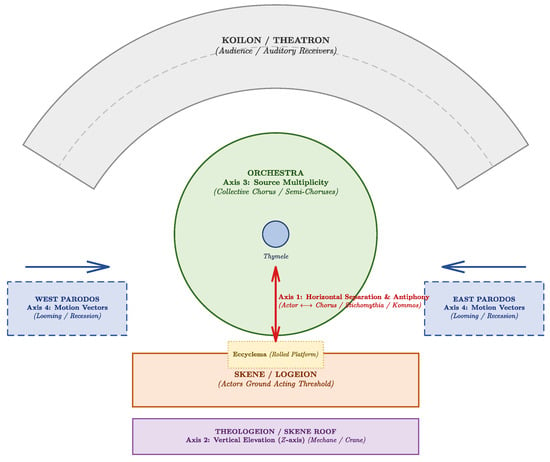
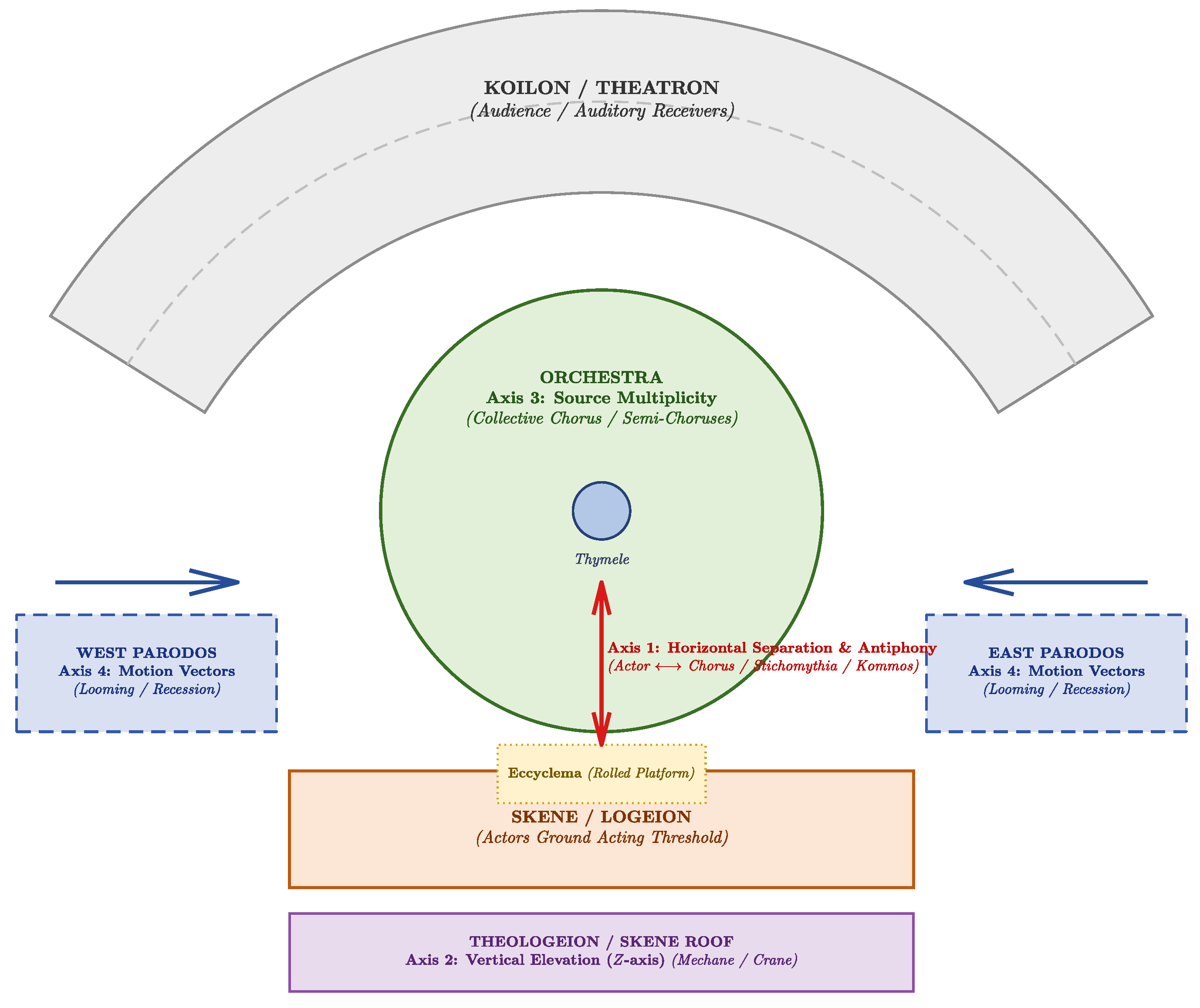
Figure 1 places the four axes in a representative late fifth-century BCE theatre. It shows the parodoi, where the Chorus enters and exits (Axis 4); the orchestra, where the Chorus performs and may divide into semi-choruses (Axis 3); and the space between the orchestra and the skene, where actors and the Chorus exchange lines (Axis 1). It also shows elevated positions associated with the mechane and the theologeion, as well as the eccyclema, a platform used to bring actors into view at stage level (Axis 2).
Figure 1.
Schematic layout of a typical late fifth-century BCE theatre, indicating the key architectural zones and their correspondence to the four spatial sound axes: (1) Actor–Chorus horizontal dialogue axis; (2) Vertical elevation via mechane, theologeion, or eccyclema; (3) Choral splitting and semi-choral directivity in the orchestra; (4) Dynamic movement trajectories along the parodoi/eisodoi.
2.2. Qualitative Coding Protocol and Reproducibility
To support consistent and reproducible analysis, we followed a structured coding protocol. We coded the original ancient Greek texts in the Oxford Classical Texts (OCT) edition of Aristophanis Comoediae, edited by F. W. Hall and W. M. Geldart [19]. We checked line references, metrical divisions, and staging interpretations against modern commentaries and critical editions, including those by K. J. Dover [8] and A. H. Sommerstein, as well as the Loeb Classical Library. Each play was read in full, noting dialogue, deictic expressions, choral entrances and exits, and movements implied by the action.
Our primary unit of analysis was a clearly defined dramatic section, such as an episode, stichomythic exchange, lyric passage, parodos, exodos, or parabasis. Within each section, we identified an “instance” as a continuous passage in which the voices form a coherent spatial arrangement. A passage could be coded under more than one axis when it combined spatial patterns—for example, when a chorus entered along the side passages and then split into opposing groups.
We classified each passage as explicit or inferred. Evidence was explicit when the dialogue, speaker cues, or acoustic references clearly indicated movement, elevation, or the use of stage machinery. Examples include references to bringing out the eccyclema, descending by rope, or hearing thunder or singing from offstage. Evidence was inferred when the text did not state a performer’s position or movement directly, but entrances, exits, speaker changes, or conventions of the fifth-century BCE theatre made it likely. One example is the distinction between speech delivered from the orchestra and speech delivered from the stage building.
Two researchers independently extracted and coded the passages, then compared their records. They revisited disagreements—mainly about subtle choral movements and the degree of separation between groups—alongside performance scholarship until they reached consensus.
2.3. Corpus Selection
In this work, ancient Greek comedy is regarded as an appropriate starting point for collecting evidence of sound spatiality in ancient Greek drama. The eleven fully preserved comedies authored by Aristophanes were considered in this study. Plays were examined for textual and performative evidence potentially corresponding to the four axes of the analytical framework described in Section 2.1. The evidence of spatiality emerges from dramaturgical choices, stage directions, and the text, and may be either explicitly indicated or implicitly inferred according to the distinction established above.
Such evidence tends to be dispersed and does not necessarily correspond consistently with all four axes of the analytical framework within each play. The initial examination was therefore used as a qualitative screening stage, intended to identify plays containing sufficiently rich and varied material for more detailed analysis rather than to quantify the prevalence of spatial sound phenomena across the complete Aristophanic corpus. Therefore, four plays were purposively selected as case studies on the basis of clear textual and performative evidence corresponding to at least three of the framework’s four axes. This selection allowed the analytical framework to be applied to plays presenting multiple and contrasting forms of spatial sound, while avoiding the implication that the four selected works constitute a statistically representative sample of Aristophanic comedy.
- The Acharnians (425 BCE): The play was first performed during the Peloponnesian War between Athens and Sparta. The plot follows Dicaeopolis, an ordinary Athenian citizen frustrated with the ongoing war and the failures of Athenian diplomacy. Taking matters into his own hands, he negotiates a private peace treaty with the Spartans for his household. His actions provoke the Chorus of Acharnians, who are divided in their views. One half is persuaded by his arguments for peace, while the other remains hostile and calls for help from the General Lamachus. The play ends with a comic contrast between Dicaeopolis enjoying a peaceful life and Lamachus struggling with the hardships of war. Using political humor and exaggerated situations, the play highlights the foolishness of war.
- The Clouds (original 423 BCE): The surviving text is the second version and a revision of the play that was originally performed at the Great Dionysia in 423 BCE. The original text is lost, and its ending remains unknown [19]. In the revised text, the plot follows Strepsiades, an Athenian burdened by debts, due to his son Pheidippides’ costly passion for horse racing. To find a way out, Strepsiades enrolls in “The Thinkery”, a school led by Socrates, where students study philosophy and engage in clever arguments. Strepsiades’ aim is to acquire the necessary rhetorical skills to evade his creditors. However, he struggles with the complexity of the arguments and concepts and persuades his son to join, instead. Pheidippides excels in sophistry, eventually using his skills to justify beating his father. Disillusioned, Strepsiades burns down The Thinkery, condemning the corrupting influence of such education. The play satirizes contemporary intellectual trends and critiques the moral implications of persuasive rhetoric.
- The Wasps (422 BCE): The play satirizes the Athenian legal system and the growing influence of populist politicians. The story follows Philocleon, an elderly citizen obsessed with serving as a juror, and his son Bdelycleon, who tries to cure him of this fixation. To keep his father from the courts, Bdelycleon confines him at home, even staging a mock trial with household items to satisfy his father’s urges. The Chorus, made up of old jurors portrayed as wasp-like figures, supports Philocleon and adds to the tension. Although Bdelycleon eventually steers his father away from the courts, Philocleon’s behavior becomes unpredictable in social settings, highlighting the complexities of reforming entrenched habits through absurd and humorous scenes.
- The Birds (414 BCE): The comedy was first performed during the Peloponnesian War. It follows two Athenians, Pisthetaerus and Euelpides, who, disillusioned with life in Athens, set out in search of a better place to live. They encounter Tereus, a former king transformed into a bird, and persuade him and the other birds to help them establish a utopian city in the sky, named Cloudcuckooland. Their aim is to block communication between humans and the gods, forcing the Olympians to negotiate. Pisthetaerus gradually emerges as the dominant figure, confronting divine emissaries such as Iris, Poseidon, and Heracles. Through persuasion and cunning, he seizes power and places himself at the center of the new order. The Chorus of birds plays an active role throughout the play, initially resisting but eventually supporting his plan. The comedy offers a humorous critique of Athenian politics, imperial ambition, and escapism, set against a fantastical backdrop of human-bird-god interactions.
3. Analysis
This section presents evidence of sound spatiality in each of the four selected plays. The analysis is organized by play, and relies on a detailed presentation of the relevant material structured according to the components of the analytical framework described in Section 2.1. Examples are identified as explicit where spatial relationships, positions, or movements are directly supported by the textual evidence, and as implicit or inferred where their spatial realization depends on dramaturgical or performative interpretation.
3.1. The Acharnians
Examples of sound spatiality involving all four components of the analytical framework are evident in this play. More specifically, there are two instances in which the Chorus engages in a direct dialogue with the leading actor on-stage, once with the main play character Dicaeopolis, and towards the end of the play with Nicarchus, the informer. Both constitute explicit textual examples of the verbal interaction underlying the first axis (on-stage dialogue between the Chorus and Main Actors). It should also be noted that soon after the argument between Dicaeopolis and the Chorus starts, the latter breaks into two sub-groups. The division itself is explicitly represented in the dramatic exchange, although the precise spatial positioning of the resulting groups is not specified. The three distinct ensembles intertwine and obscure each other creating an example that, as discussed later, falls under the third axis paradigm.
In the same play, one may also find a clear example of the second axis (elevation and spatial differentiation through stage equipment and machinery), involving the use of equipment to spatially differentiate a character’s appearance on stage. More specifically, Dicaeopolis calls upon the famous tragedian Euripides, who appears on stage using a piece of theatrical machinery known as the eccyclema—a rolling platform typically used to reveal scenes or characters, often those associated with divine or elevated status. A corresponding text excerpt from the dialogue that explicitly marks Euripides’ entrance follows, containing reference to dramaturgical realizations and stage directions that support the classification of this part of the play under this axis [8].
“DICAEOPOLIS: […] My little Euripides, my darling Euripides, listen; never had man greater right to your pity. It is Dicaeopolis of the Chollidan Deme who calls you. Do you hear?EURIPIDES from within: I have no time to waste.DICAEOPOLIS: Very well, have yourself wheeled out here.EURIPIDES: Impossible.EURIPIDES: Well, let them roll me out; as to coming down, I have not the time. (The eccyclema turns and presents the interior of the house. EURIPIDES is lying on a bed, his slave beside him. On the back wall are hung up tragic costumes of every sort and a multitude of accessories is piled up on the floor.)” [20].
As stated earlier, the Acharnians is a good example of dramaturgical choices that provide evidence for the third axis (Chorus division into semi-Choruses). More specifically, during the argument between Dicaeopolis and the Chorus, the latter is divided into two groups, each represented by its own leader, one opposing and the other supporting Dicaeopolis. At a later instance the Chorus splits again during the on-stage appearance of General Lamachus, as illustrated in the following excerpt. The distinction between the first and second semi-Choruses provides explicit evidence of choral division, their exact physical positions relative to one another, however, remain unspecified.
“CHORUS: What do you purport doing? what are you going to say? What an impudent fellow! what a brazen heart! to dare to stake his head and uphold an opinion contrary to that of us all! And he does not tremble to face this peril. Come, it is you who desired it, speak! […]Leader of FIRST SEMI-CHORUS: Oh! wretch! oh! infamous man! You are naught but a beggar and yet you dare to talk to us like this! you insult their worships the informers!Leader of SECOND SEMI-CHORUS: By Posidon! he speaks the truth; he has not lied in a single detail.Leader of FIRST SEMI-CHORUS: But though it be true, need he say it? But you’ll have no great cause to be proud of your insolence!Leader of SECOND SEMI-CHORUS: Where are you running to? Don’t you move; if you strike this man, I shall be at you.Leader of FIRST SEMI-CHORUS: Lamachus, whose glance flashes lightning, whose plume petrifies thy foes, help! Oh! Lamachus, my friend, the hero of my tribe and all of you, both officers and soldiers, defenders of our walls, come to my aid; else is it all over with me!LAMACHUS: Whence comes this cry of battle? where must I bring my aid? where must I sow dread? […]Leader of the CHORUS: This man, Lamachus, incessantly abuses Athens.LAMACHUS: You are but a mendicant and you dare to use language of this sort?” [20].
Regarding the fourth axis (Parodos and Exodos of the Chorus), in this play the Chorus, representing the citizens of Acharnae, enters the stage to pursue Amphitheus, who claims to be immortal and acts as a messenger of the gods arranging peace between Athens and Sparta (lines 557–570). Later in the play, General Lamachus exits the stage to have his wounds treated after being injured in battle, while the Chorus departs from the opposite side, singing and celebrating Dicaeopolis, who has won the prize for wine drinking. These passages provide explicit evidence of movement, entrance, and departure, even though the precise trajectories followed by the actors cannot be reconstructed from the text.
Overall, The Acharnians provides explicit textual and performative evidence for all four evaluation axes, making it one of the clearest examples of spatial sound organization within the selected corpus. The consistent presence of a Koryphaios (leader of the Chorus) throughout the performance, a nuance not necessarily so strongly present in other plays of that era, is also worth acknowledging. Every time the narrative requires the division of the Chorus, Aristophanes ensures that a dominant voice emerges, according to the dramatic context.
3.2. The Clouds
In The Clouds, as in The Acharnians, examples of sound spatiality are present across all four components of the analytical framework. Regarding the second axis (on-stage dialogue between the Chorus and Main Actors), the Chorus engages in direct verbal interaction with the central character, Strepsiades, his son, Pheidippides, as well as with two personified concepts: the Just Argument, who represents traditional values and morality, and the Unjust Argument, who advocates moral relativism and the use of deceptive rhetorical techniques (lines 510–626). These exchanges provide explicit textual evidence for the vocal interactions considered under the first axis.
A clear instance of the second axis (elevation and spatial differentiation through stage equipment and machinery) is evident when Aristophanes presents Socrates, the great philosopher, as suspended in the air when he calls upon the Clouds (lines 224–235). Socrates’ elevated position is explicitly indicated in the dialogue, while the specific means by which this elevation was realized in performance is inferred from the dramaturgical requirements of the scene. Socrates is depicted as observing the heavens from a basket suspended above the stage, symbolizing his philosophical detachment from earthly concerns:
“STREPSIADES: Socrates! My little Socrates!SOCRATES: Why callest thou me, thou creature of a day?STREPSIADES: First tell me, I beseech you, what are you doing.SOCRATES: I am walking in the air, and speculating about the sun.STREPSIADES: And so you look down upon the gods from your basket, and not from the earth?SOCRATES: For I should not have rightly discovered things celestial if I had not suspended the intellect, and mixed the thought in a subtle form with its kindred air. But if, being on the ground, I speculated from below on things above, I should never have discovered them. For the earth forcibly attracts to itself the meditative moisture. Water-cresses also suffer the very same thing.STREPSIADES: What do you say? Does meditation attract the moisture to the water-cresses? Come then, my little Socrates, descend to me, that you may teach me those things, for the sake of which I have come.(Socrates lowers himself and gets out of the basket.)” [21].
Later in the play, the appearance of the god Hermes similarly suggests a second use of stage machinery for lifting the god above the mortals, offering an additional inferred example supporting the second axis.
In The Clouds, Socrates’ students are represented by the Chorus, which is divided into two distinct groups—first and second semi-Choruses—as exemplified in lines 563–626. This division constitutes an explicit instance of the third axis (simultaneous use of a supplementary Chorus or division of the Chorus into semi-Choruses).
Aristophanes draws the audience’s attention to the spatial dynamics of the Chorus’ entrance and exit—an instance of the fourth axis (Parodos and Exodos of the Chorus). Here, spatiality is supported by explicit auditory cues: the Chorus is still offstage and accompanied by sound cues that suggest distance, their forthcoming entrance is perceived both by the onstage characters and, by extension, the audience (line 275):
“(The following song is heard at a distance, accompanied by loud claps of thunder.)CHORUS: Eternal Clouds! Let us arise to view with our dewy, clear-bright nature, from loud-sounding Father Ocean to the wood-crowned summits of the lofty mountains, in order that we may behold clearly the far-seen watch-towers, and the fruits, and the fostering, sacred earth, and the rushing sounds of the divine rivers, and the roaring, loud-sounding sea; for the unwearied eye of Aether sparkles with glittering rays. Come, let us shake off the watery cloud from our immortal forms and survey the earth with far-seeing eye.” [21].
Shortly after, at the moment of the Chorus’ full entrance, Socrates prompts Strepsiades to attend to the distant yet powerful sounds that herald their arrival. The dialogue therefore provides further explicit evidence that the distance and approach of the sound sources form part of the dramatic action. This interaction further reinforces the spatial and acoustic awareness built into the performance (line 293):
“SOCRATES: O ye greatly venerable Clouds, ye have clearly heard me when I called. (Turning to Strepsiades.) Did you hear the voice, and the thunder which bellowed at the same time, feared as a god?” [21].
The above examples from The Clouds demonstrate how spatial sound elements are embedded in both the structure and staging of the play, reinforcing the relevance of all four components of the analytical framework. They also illustrate how explicit spatial information in the dialogue can coexist with inferred aspects of its practical staging.
It should also be noted that, according to Dover [8], the play, in its surviving form nowadays, could not have been performed in antiquity for several reasons. First, several scenes would have required a fourth actor in a more permanent and extensive role, something that was not common practice at that time. Moreover, even if an additional actor had been available, character changes in several episodes are so rapid that it would have been difficult for on-stage actors to exit, change costumes, and convincingly return as different characters. Finally, there is strong debate among Classical scholars regarding the attribution of specific passages to individual characters, further complicating the reconstruction of the play’s staging and performance practice. These issues are particularly relevant to the present analysis, since the surviving form of the play may not correspond directly to the conditions of its original performance. All the above imply that this play and, as a result, its distinct sound spatiality characteristics could be typical of a later era.
3.3. The Wasps
Similarly to The Clouds, The Wasps centers on domestic themes, portraying the conflict between father and son. The Chorus, represented by its Leader, often engages in direct dialogues with both Philocleon (the father) and Bdelycleon (the son), providing explicit textual examples of the second axis (on-stage dialogue between the Chorus and Main Actors). The play does not contain any explicit references to the use of theatrical machinery, as seen in other plays. For example, there is no mention of a god or (semi)-divine figure being elevated over the stage that would suggest asecond axis (elevation and spatial differentiation through stage equipment and machinery) case. However, there is a scene that implies vertical staging and the possible use of lifting equipment, in which Philocleon appears at a high window (referred to in the ancient text as a thyra or opening) and is instructed to descend using a rope (line 379):
“CHORUS: But fasten a rope to the window, tie it around your body and let yourself down to the ground.” [22].
Although no machinery is directly mentioned, the scene provides explicit evidence of vertical spatial separation through Philocleon’s elevated position and instructed descent. The use of additional lifting equipment, however, remains inferred rather than directly documented. The scene therefore reflects an explicit example of verticality and movement, but only an inferred example of the machinery component of the second axis.
In this play, the Chorus primarily functions as a unified group of elderly men dressed as wasps. However, there is a reference to a group of boys tasked with guiding the old jurors to Philocleon’s house before dawn (lines 396–420). Their brief appearance as a coordinated group on stage loosely resembles the presence of a second semi-Chorus. While the division is not structurally emphasized or sustained, it may be regarded as implicit or inferred evidence of the third axis (simultaneous use of a supplementary Chorus or division of the Chorus into semi-Choruses), though its presence in this play remains somewhat ambiguous.
Regarding the fourth axis (Parodos and Exodos of the Chorus), The Wasps contains several notable examples of spatially expressive entrances and exits. Early in the play, the Chorus Leader urges the group forward with the command, “March on, advance boldly and bravely!” [22] (line 230), providing explicit textual evidence of coordinated movement and entrance, although its precise spatial trajectory is not specified. More significantly, the final scene of the play offers a vivid example of a sound-rich and choreographed exit. The Chorus divides into two parts and surrounds the frenzied dancing of Philocleon and the sons of Carcinus at the center of the orchestra. The following excerpt illustrates the dynamic nature of this exit, with strong auditory and kinetic cues indicating moving sound sources (lines 1518–1535):
“CHORUS:(It divides in two and accompanies with its song the wild dancing of Philocleon and the sons of Carcinus in the centre of the Orchestra.)Come, illustrious children of this inhabitant of the brine, brothers of the shrimps, skip on the sand and the shore of the barren sea; show us the lightning whirls and twirls of your nimble limbs. Glorious offspring of Phrynichus, let fly your kicks, so that the spectators may be overjoyed at seeing your legs so high in air. Twist, twirl, tap your bellies, kick your legs to the sky. Here comes your famous father, the ruler of the sea, delighted to see his three lecherous kinglets. Go on with your dancing, if it pleases you, but as for us, we shall not join you. Lead us promptly off the stage, for never a comedy yet was seen where the Chorus finished off with a dance.” [22].
This richly choreographed and sonically animated exit exemplifies the spatial and performative complexity associated with the fourth axis, combining explicit movement cues with a performative realization of the Chorus as a moving sound source.
3.4. The Birds
In The Birds, the Chorus—composed of birds—engages in direct dialogue not only with the leading characters (protagonists), Pisthetaerus and Euelpides, but also with various supporting roles involved in the construction of Cloudcuckooland (the utopian city in the sky founded by the protagonists). This interaction provides several explicit textual instances of the second axis (on-stage dialogue between the Chorus and Main Actors).
Regarding the second axis (elevation and spatial differentiation through stage equipment and machinery), the play includes two notable appearances that likely employed theatrical machinery. Iris arrives on stage, presumably via the eccyclema (lines 1202–1271), engaging in a confrontational exchange with Pisthetaerus. Later on, Poseidon appears alongside Heracles and the Triballian god (lines 1565–1705). While Iris interacts exclusively with Pisthetaerus, Poseidon speaks with multiple characters, highlighting a multilayered spatial dynamic that supports this axis. The appearances themselves are textually supported, whereas the use and precise identity of the theatrical machinery constitute inferred aspects of their spatial realization.
For the third axis (simultaneous use of a supplementary Chorus or division into semi-Choruses), the text implies a subtle dramatic split of the Chorus as follows: Initially, the birds are hostile toward the two protagonists and react with aggression to their proposal for building a new city. However, Pisthetaerus gradually persuades them through an extended speech, which appears in two distinct parts. Although this division is not literal or physical on stage, it reflects a rhetorical and thematic segmentation of the Chorus’ stance, representing, at most, implicit or inferred evidence for the third axis. No additional group functioning as a secondary Chorus is explicitly present.
The fourth axis (Parodos and Exodos of the Chorus) is vividly illustrated in The Birds. The Parodos is among the most elaborate in Aristophanes’ works and stands out as a striking example of a crowd scene with strong spatial character. The Chorus of birds enters in a chaotic and forceful manner, reinforcing the sense of disordered movement and building acoustic tension on stage. As they arrive (lines 329–335), they accuse a fellow bird of betrayal, crying out that he “has violated our ancient laws” and “handed us over to the attacks of that impious race” [23], referring to humans. Their movement and vocal interaction provide explicit evidence of the spatial character of the entrance, while its broader acoustic effect is inferred from the associated vocal and dramaturgical cues.
This moment is prepared by a lyrical invocation from the Hoopoe (Epops), who calls upon various bird species with song, initiating the Chorus’s gathering. The scene is rich in auditory cues, including onomatopoeic vocalizations and references to natural habitats, creating a layered spatial and acoustic atmosphere (lines 227–261):
“EPOPS:(In the thicket, singing.)Epopopoi popoi popopopoi popoi, here, here, quick, quick, quick, my comrades in the air; all you who pillage the fertile lands of the husbandmen […] And you whose gentle twitter resounds through the fields with the little cry of tiotiotiotiotiotiotiotio; […] hurry to come at my call, trioto, trioto, totobrix; […] come hither to hear the tidings; let all the tribes of long-necked birds assemble here […] Torotorotorotorotix, kikkabau, kikkabau, torotorotorolililix” [23].
Such moments demonstrate the spatial dynamism and acoustic richness of the Chorus’s movement and presence on stage, firmly supporting the fourth axis of the analytical framework. Here, the movement and gathering of the Chorus are textually supported, while the precise spatial distribution of the individuals on stage remains performatively inferred.
In summary, The Birds demonstrates instances of three out of the four analytical axes—on-stage dialogue, appearances potentially involving use of stage machinery, and spatial entrances and exits—while evidence for the third axis, involving a literal or sustained division of the Chorus, remains implicit, suggestive, and ultimately inconclusive.
Overall, the Aristophanic comedies under discussion provide evidence across the four established axes of spatiality exploration, although the evidential strength varies between explicit textual indications and implicit or performatively inferred spatial realizations. Nevertheless, as already discussed, axes 2 and 3 appear somewhat more subtly embedded in The Birds and The Wasps, especially when compared to The Clouds and The Acharnians.
3.5. Cross-Play Synthesis and Comparative Spatial Analysis
The four comedies use spatial sound in different ways, reflecting their dramatic and comic aims. Table 1 compares the examples across the plays. For each, it lists the spatial axis, its acoustic dimension, and the performance area within a fifth-century BCE theatre (see Figure 1), along with the relevant line references and whether the evidence is explicit or inferred.
Table 1.
Summary and comparative matrix of sound spatiality configurations across the four analyzed Aristophanic comedies.
Table 1 suggests that, among the four plays, The Acharnians provides the clearest textual evidence across all four axes. The play marks both the use of the eccyclema and the division of the Chorus into two semi-choruses. The Birds, by contrast, includes a vivid choral entrance (Axis 4) and elevated appearances by the gods (Axis 2), although the mechanism for these appearances is inferred. Its Chorus remains a single group in its exchanges with Pisthetaerus, with no clear example of physical division (Axis 3). This contrast suggests that semi-choral division was one staging option, not a feature required in every comedy.
The comparison also points to ways Aristophanes adapted familiar staging effects for comic purposes. Tragic productions used the theologeion and the crane (mechane) primarily for awe-inspiring divine epiphanies. In comedy, Socrates appears suspended in a basket in The Clouds, Euripides is wheeled out among his tragic rags on an eccyclema in The Acharnians, and Philocleon tries to escape through an upper window in The Wasps. These moments use height or mechanical staging to create comic contrast, whether displacing the actor along the vertical (Z) axis or, as with the eccyclema, rolling an interior tableau outward onto the stage plane.
The table also distinguishes what the text states from what must be inferred about staging. Dialogue and sound cues can indicate exchanges between actors and the Chorus or signal choral movement. By contrast, a text may establish that a character appears at an elevated level without naming the machinery used. Whether a crane, rope, or another device was involved must therefore be inferred from the dramatic context and the theatre’s architecture.
4. Conclusions
This study, inspired by the shift from static single-actor narrations to vibrant plays involving multiple actors, music, on-stage movement, costumes and stage sets, has taken a novel approach by examining how sound spatiality—both directly described and indirectly implied—was explored and realized in classical Greek comedy. The goal was to identify evidence of sound spatiality in ancient Greek drama, centuries before the Renaissance, which is widely accepted as the era of the first intentional explorations of sound spatialization in music [1].
The eleven fully preserved comedies of Aristophanes were initially considered using the analytical framework, from which four information-rich plays were purposively selected for detailed analysis. The aim was twofold: first, to identify and present clear examples of spatial sound phenomena embedded in the texts and dramaturgical practices; and second, to propose a structured analytical framework through which future researchers can trace similar evidence of spatiality in other dramatic works.
Findings show that in three out of the four selected plays, all four axes are clearly present. The Birds, while lacking examples for the third axis (division or supplementation of the Chorus), still offers vivid illustrations of the other three. Aristophanes’ creativity should be acknowledged. The analysis has shown that the same axes appear in numerous variations across the selected comedies. Depending on the flexibility of the criteria, additional examples or distinctive combinations beyond those currently provided could emerge. The analyzed examples suggest that spatial sound elements—whether emerging from stage directions, character dialogue, or Chorus choreography—contribute meaningfully to the overall soundscape of the performance. These elements shape the auditory experience of the audience, giving spatiality a functional and expressive role in ancient theatrical soundscape.
Throughout the analysis, attention was given primarily on vocal sound as the core sonic element of performance. The ways in which voices functioned in grouped formations (as in the Chorus), the ways they moved through the performance space (entrances and exits), the ways they were divided or opposed to create spatial contrast (as in semi-Choruses), and the ways vertical or spatial differentiation may have been realized through stage action and theatrical equipment were all examined. Instances of spatial antiphony, where separate vocal sources engage in dialogue were also explored. Collectively, the analyzed examples suggest that spatiality was a perceptible and recurrent feature of these performances, regardless of whether it was intentionally designed as such. The extent to which this spatiality was consciously or systematically employed remains an open question and represents an important direction for future research.
Overall, tracing these early examples of sound spatiality through the four analytical axes allows aspects of the performative soundscape of the selected Aristophanic comedies to be systematically identified and interpreted. The analysis suggests that voices, movement, choral formations, and stage action all contributed to the acoustic environment experienced by the audience. In this sense, ancient performance practices can be approached as an important form of intangible cultural heritage: a set of expressive practices that were live and temporary, but that left important traces in the surviving texts. Reading dramatic texts as evidence for sonic and spatial practice allows part of this lost performance world to be studied, interpreted, and connected to the broader history of theatrical sound.
The recurrence of these spatial patterns across the studied comedies further demonstrates the value of dramatic texts as evidence of intangible cultural heritage. The findings suggest that sound spatiality was not only a byproduct of open-air performance spaces, but also part of how dramatic action was organized and experienced. Voices, choral movement, and stage positioning appear to have worked together with visual staging to shape the audience’s perception of the performance. For this reason, dramatic texts can be studied not only as literary or historical sources, but also as documents that preserve traces of live and temporary theatrical soundscapes.
The framework proposed here may also support future work in archaeoacoustic modelling and auralization. Digital simulations can estimate how a theatre space responds to sound, but they also need historically informed information about where sound sources were located, how they moved, and how they interacted. The textual analysis carried out in this study can help provide such information by identifying actor–Chorus relations, semi-Chorus divisions, entrances and exits, and vertical movements produced through stage mechanisms. In this way, the present study can serve as a qualitative first step toward future digital reconstructions of Aristophanic performance, linking literary dramaturgy with heritage science and acoustic modelling.
The findings point to three priorities for future research. First, test and refine the framework using fifth-century BCE tragedies by Aeschylus, Sophocles, and Euripides. Tragic kommoi, divine appearances (including the deus ex machina), choral departures (metastasis), and double entrances (epiparodos) may involve spatial patterns not captured by the comedies studied here. Second, extend the analysis beyond the human voice to examine how musical instruments, such as the, accompanied moving vocal sources and shaped the performance sound. Finally, use textual evidence about source positions, movements, and groupings to inform calibrated 3D geometric-acoustic and wave-based simulations. These models could support historically informed binaural auralizations and help researchers explore how ancient performances may have sounded.
Looking forward, as this study extends to include a wider range of plays across all dramatic genres, the definitions of the four analytical axes will be revisited and refined-potentially rephrased or expanded according to future findings. This approach is expected to shed further light on early forms of spatial sound organization and their role in the performing arts.
Author Contributions
Conceptualization, S.Z. and A.A.; methodology, S.Z., K.B., Y.M. and A.A.; formal analysis, S.Z.; investigation, S.Z.; data curation, S.Z. and K.B.; writing—original draft preparation, K.B.; writing—review and editing, Y.M. and A.A.; supervision, K.B. and A.A.; funding acquisition, A.A. All authors have read and agreed to the published version of the manuscript.
Funding
This research received no external funding.
Data Availability Statement
The data presented in this study are derived from public-domain resources and published classical editions. The analyzed dramatic texts and translations are cited in references [20,21,22,23] of the manuscript. All textual excerpts and qualitative categorizations supporting the findings are contained within the article.
Conflicts of Interest
The authors declare no conflicts of interest.
References
- Roginska, A.; Geluso, P. Immersive Sound; Focal Press: Waltham, MA, USA, 2017. [Google Scholar]
- Đorđević, Z.; Dragišić, M.; Manzetti, M.C.; Novković, D. Digitization of Acoustic Heritage in a Service of Protection, Research and Promotion of European Cultural Heritage. In Digital Cultural Heritage; Kremers, H., Ed.; Springer International Publishing: Cham, Switzerland, 2020; pp. 433–447. [Google Scholar] [CrossRef] [Scilit]
- Bellia, A. Towards a Digital Approach to the Listening to Ancient Places. Heritage 2021, 4, 2470–2480. [Google Scholar] [CrossRef] [Scilit]
- Bellia, A.; Bevilacqua, A. Rediscovering the Intangible Heritage of Past Performative Spaces: Interaction between Acoustics, Performance, and Architecture. Heritage 2023, 6, 319–332. [Google Scholar] [CrossRef] [Scilit]
- Pickard-Cambridge, A.W. Dithyramb, Tragedy and Comedy; Clarendon Press: Oxford, UK, 1927. [Google Scholar]
- Webster, T.B.L. The Greek Chorus; Methuen: London, UK, 1970. [Google Scholar]
- Taplin, O. The Stagecraft of Aeschylus: The Dramatic Use of Exits and Entrances in Greek Tragedy; Clarendon Press: Oxford, UK, 1977. [Google Scholar]
- Dover, K.J. Aristophanic Comedy; University of California Press: Berkeley, CA, USA, 1972; Volume 77. [Google Scholar]
- Zimmermann, B. Die Griechische Komödie; Verlag Antike: Frankfurt, Germany, 2006. [Google Scholar]
- ISO 12913-1:2014; Acoustics—Soundscape—Part 1: Definition and Conceptual Framework. International Organization for Standardization: Geneva, Switzerland, 2014.
- UNESCO. Basic Texts of the 2003 Convention for the Safeguarding of the Intangible Cultural Heritage, 2024th ed.; UNESCO, Culture Sector, Living Heritage Entity: Paris, France, 2024; Available online: https://ich.unesco.org/en/convention (accessed on 8 July 2026).
- Schechner, R. Performance Theory; Routledge: London, UK, 1988. [Google Scholar] [CrossRef] [Scilit]
- Lesky, A. Die Tragische Dichtung der Hellenen; Vandenhoeck & Ruprecht: Göttingen, Germany, 1972. [Google Scholar]
- Hanink, J. Crossing genres: Comedy, tragedy, and satyr play. In The Oxford Handbook of Greek and Roman Comedy; Oxford University Press: Oxford, UK, 2014; pp. 258–277. [Google Scholar]
- Fontaine, M.; Scafuro, A.C. The Oxford Handbook of Greek and Roman Comedy; Oxford University Press: Oxford, UK, 2014. [Google Scholar]
- Canfield-Dafilou, E.K.; Katz, B.F.G.; Caseau Chevallier, B. History and Acoustics of Preaching in Notre-Dame de Paris. Heritage 2024, 7, 6614–6628. [Google Scholar] [CrossRef] [Scilit]
- Muynke, J.D.; Peichert, S.; Katz, B.F.G. Public Evaluation of Notre-Dame Whispers, a Geolocated Outdoor Audio-Guided Tour of Notre-Dame’s Sonic History. Heritage 2026, 9, 19. [Google Scholar] [CrossRef] [Scilit]
- Poirier-Quinot, D.; Lyzwa, J.M.; Mouscadet, J.; Katz, B.F.G. Vaulted Harmonies: Archaeoacoustic Concert in Notre-Dame de Paris. Acoustics 2025, 7, 66. [Google Scholar] [CrossRef] [Scilit]
- Hall, F.W.; Geldart, W. Aristophanis Comoediae; Oxford Classical Texts: Oxford, UK, 1967. [Google Scholar]
- Aristophanes. Acharnians. In the Internet Classics Archive. Available online: https://classics.mit.edu/Aristophanes/acharnians.html (accessed on 30 May 2025).
- Aristophanes. Clouds. In The Comedies of Aristophanes; Hickie, W.J., Translator; 1853; Available online: https://www.perseus.tufts.edu/hopper/text?doc=Perseus%3Atext%3A1999.01.0241%3Acard%3D221 (accessed on 30 May 2025).
- Aristophanes. Wasps. In The Complete Greek Drama; Oates, W.J., O’Neill, E., Jr., Eds.; Random House: New York, NY, USA, 1938; Volume 2, Available online: https://www.perseus.tufts.edu/hopper/text?doc=Perseus%3Atext%3A1999.01.0044%3Acard%3D342 (accessed on 30 May 2025).
- Aristophanes. Birds. In The Complete Greek Drama; Oates, W.J., O’Neill, E., Jr., Eds.; Random House: New York, NY, USA, 1938; Volume 2, Available online: https://www.perseus.tufts.edu/hopper/text?doc=Perseus%3atext%3a1999.01.0026 (accessed on 30 May 2025).

Disclaimer/Publisher’s Note: The statements, opinions and data contained in all publications are solely those of the individual author(s) and contributor(s) and not of MDPI and/or the editor(s). MDPI and/or the editor(s) disclaim responsibility for any injury to people or property resulting from any ideas, methods, instructions or products referred to in the content. |
© 2026 by the authors. Licensee MDPI, Basel, Switzerland. This article is an open access article distributed under the terms and conditions of the Creative Commons Attribution (CC BY) license.