


Abstract
Generative AI has opened new possibilities for reinterpreting Chinese visual and literary traditions in digital art. However, in installation settings, generative AI is frequently embedded in conventional animation and sensor-based interaction, making it difficult to determine which aspects of a work can be attributed to generative processes. This qualitative study examines two AI-related installations, Youming Jian (幽明鉴) and Sublimation: Night-Shining White (升华·照夜白), and three interactive works, Paper Kite (纸鸢漫游), Yaojian Heshi (妖间何事), and Yingge Dance (英歌潮舞), whose use of generative AI has not been established. The analysis also draws on published studies of Shanshui Journey (2024) and Walking Through Shanshui (2019) to examine the relationship between bodily movement, computational image production, and visual presentation. The comparison reveals important differences in how these installations produce and organize visual narratives. In Youming Jian, AI-assisted image production and sensor-controlled interaction operate at different stages, while Sublimation: Night-Shining White is reported to connect audience participation with the generation of new ink-style images. The three interactive works further demonstrate how movement and changes in visual presentation can be achieved without verified generative AI. These findings inform a three-level understanding of narrative temporality, comprising production time, display time, and participation time. By distinguishing when images are generated, how they are presented, and when viewers influence their appearance, the study clarifies the respective contributions of generative AI and interactive technologies to contemporary interpretations of Chinese cultural heritage.
1. Introduction
AI image generation has expanded the visual resources available to artists working with historical and culturally specific material. In installation environments, however, generated imagery is often combined with animation, sensors, projection, and forms of audience participation that predate generative AI. Identifying which part of an experience derives from a generative model is therefore central to evaluating claims that AI transforms visual narrative. An interactive image may change because a visitor triggers a previously authored sequence, because a model produces a new visual output, or because both processes occur within one artwork. These configurations should not be treated as interchangeable.
This distinction matters in the reinterpretation of Chinese visual and literary traditions. Ink landscape painting, pictorial stone reliefs, folklore and supernatural narratives contain established ways of organising figures, movement and cultural meaning. When these materials enter contemporary installations, they may be animated, spatialised, or made responsive to viewers. Such transformation can generate new aesthetic interpretations, but it cannot by itself demonstrate the preservation of historical techniques, social practices, or community knowledge. An account of heritage-related installation art must therefore be precise both about technical agency and about the cultural outcomes that available sources can support.
Moving-image experience adds a further analytical complication. The temporality of an installation is not reducible to the animation of a single image. It may involve the order in which scenes become visible, the duration of appearances, the response latency of a system, and the agency granted to participants over what follows. Chinese handscroll viewing provides one relevant historical comparison because images can be encountered progressively through the viewer’s manipulation of the scroll; the analogy is useful without implying that scroll painting and digital video use the same medium or procedures. Accordingly, temporality is examined here as the organisation of visibility and succession rather than as an automatic result of AI image generation.
Existing discussions of AI-assisted art frequently emphasise creative efficiency, participation or immersion. Such descriptions can obscure the separate operations of model-based visual production and rule-based interactive sequencing, especially where the technical documentation of artworks is limited. This article addresses that analytical gap through a small, source-documented comparison of Chinese heritage-related installations. Its contribution is not a comprehensive history of Chinese digital art, nor an empirical measure of audience responses. It is a framework for attributing narrative and cultural effects to the specific components of an installation for which evidence is available.
Three research questions guide the inquiry: (RQ1) What role can reliably be attributed to generative AI within the production and presentation of selected heritage-related installations? (RQ2) How do authored animation, audience-triggered responses and generated images differently organise narrative temporality and spatial viewing? (RQ3) How do these configurations redistribute artistic and spectator agency, and what claims about cultural reinterpretation can be sustained? The primary object-level discussion examines Youming Jian and Sublimation: Night-Shining White alongside the CAFA-related interactive comparison works Paper Kite, Yaojian Heshi and Yingge Dance. Published Shanshui research supplies an external technical and art-historical comparator, not a further CAFA case.
The article first establishes a conceptual distinction between generative production, animation and interactive display, and then sets out the evidence-based case-selection procedure. The case studies describe documented technologies and forms of spectatorship; the discussion compares their temporal and cultural implications while marking the limits of technological attribution. The final sections specify what can and cannot be inferred from publicly available descriptions of artworks.
2. Theoretical Framework
2.1. Generative AI, Moving Images, and the Limits of Technological Attribution
The distinction between generated material and moving-image composition has methodological consequences. A diffusion model may produce an image that is subsequently animated through keyframes, compositing, or conventional editing. The resulting installation contains AI-produced material, yet the timing of its transitions may remain entirely predetermined. Conversely, a rule-based system may reorganize pre-existing footage in response to the audience without synthesizing any new imagery. Both arrangements can yield variability in what the visitor sees, although the source of that variability differs. Describing these processes with the same term obscures the very mechanism the present study seeks to understand. For each work, the analysis therefore asks what is generated, when generation occurs, and which component determines the sequence of events. Where production documentation does not answer these questions, the account distinguishes an observed or documented effect from a proposed explanation of the underlying system.
A technical distinction is necessary here. Text-to-video diffusion models are designed to synthesize temporally extended sequences, while text-to-image systems ordinarily generate individual images; the existence of the former technology cannot establish that a particular installation employs it. The Sora technical report offers a concrete example of video diffusion architectures and image-conditioned video generation, but it provides no evidence about any of the installations examined below [1].
Peer-reviewed video-generation research makes this difference more precise. Ho et al. formulate video diffusion as a problem of generating temporally coherent sequences rather than isolated frames [2]. Blattmann et al. extend latent diffusion techniques with temporal modeling, showing how a model initially trained for images can be adapted to video synthesis [3]. These studies establish what video-generation systems can do at the model level. They do not tell us whether a given museum installation runs such a model during exhibition, relies on previously generated sequences, or simply plays authored animations. Claims about an individual artwork must therefore rest on its production records and documented technical setup.
This distinction also changes how artistic novelty is evaluated. A model’s capacity to produce variations is a technical property; whether those variations matter to the work depends on selection, placement, duration, and the cultural references through which they become legible. An artist may reject most generated outputs and use one carefully selected image within a tightly scripted scene. Another installation may expose visitors to changing outputs whose precise form cannot be fully anticipated by its author. These are different distributions of creative control. Treating generative AI as a single aesthetic condition would miss the decisions made before the image reaches the screen and would make the interaction seem more open-ended than the documented work warrants.
Moving-image installations combine multiple operations that should not be collapsed into a single category of artificial intelligence. Image generation produces visual assets; animation and video synthesis establish changes across successive visual states; interactive sensing detects audience or environmental inputs; and exhibition interfaces organise the spatial conditions of viewing. These operations can coexist, but the use of one does not demonstrate the presence of another. A diffusion model that produces a character image, for example, does not establish that the work generates a continuous video stream or that the model responds to visitors in real time.
The distinction also has an art-historical basis. Manovich locates digital interfaces, databases, and variable media forms within longer histories of cinema and visual culture [4]. Paul surveys installation, film, animation, and software-based art as distinct yet overlapping digital practices [5]. Accordingly, this study treats “AI-generated moving-image installation” as a compound description requiring separate evidence for (a) generative image or video production, (b) motion and temporal sequencing, and (c) installation-based presentation. The analytical question is not whether a work features a moving image, but precisely which part of its production and presentation is attributable to a generative system.
For case comparisons, three levels of technological attribution are distinguished: documented generative production, documented interactive sequencing, and unverified model-level operations. Documentation of an AI-created image supports the first; camera or Kinect triggers support the second; neither justifies the claim that newly generated frames are produced on demand. This evidence-sensitive distinction prevents general claims about interactivity or immersion from becoming claims about AI-specific causal effects.
2.2. Temporal and Spatial Narration
Temporality should be examined at several scales. At the level of the individual image, movement can emerge from morphing, animation, changes in opacity, or the juxtaposition of successive frames. At the level of an installation, a visitor encounters events in a particular order, pauses between them, and may leave before a designed sequence has reached its end. A further scale concerns the technical system: the response may be instantaneous, delayed, probabilistic, or dependent on an accumulation of earlier inputs. These scales overlap in a gallery, but they are analytically distinct. An account of narrative reconfiguration must show which scale changes and what gives that change meaning. A brief disappearance of an apparition, for instance, can reorganize the visitor’s relation to an image even when the animation itself is fixed in advance.
Spatial arrangements similarly shape the limits of participation. Mirrors, screens, sensors, and projection surfaces distribute the positions from which an image becomes visible and the actions that the system recognizes. Their placement may encourage approach, hesitation, bodily alignment, or repeated movement. None of these consequences follows automatically from the presence of a sensor. The installation must be described closely enough to establish how a particular gesture becomes a perceptible event. This approach also prevents a common analytical shortcut: interpreting a visitor’s ability to trigger a response as evidence that visitors control the narrative as a whole. Triggering, selecting, sequencing, and generating are different forms of participation with different implications for authorship.
Temporal narration in an installation may arise through prerecorded linear sequences, looping and branching animations, audience-triggered events, or newly computed visual outputs. These structures differ in the degree to which images are fixed in advance and in the way the audience encounters their order and duration. A viewer-triggered disappearance sequence has a contingent time of activation even if the animation itself is predetermined. A generated image displayed in response to a sensor input demonstrates a different kind of variability, although it does not necessarily amount to generative video.
Grau’s historical analysis of illusion and immersion locates contemporary interactive environments within a longer lineage of spatially organised visual experience [6]. That context helps prevent a technologically deterministic reading of the cases: immersion, bodily positioning, and the apparent animation of images precede recent generative AI. The contribution of AI can therefore only be identified by comparison with the representational and interactive capacities already available to non-generative digital media.
2.3. Handscroll Viewing as a Comparative Model
The handscroll offers a useful comparison precisely because its temporal organization does not depend on electronics. Its composition unfolds through a practice of handling and looking: parts of the image become visible, remain in view, and recede as the viewer proceeds. The material object constrains this process while leaving some latitude for pacing and revisiting. A contemporary interactive installation may create a related relationship between bodily action and visual succession, but resemblance at this level does not establish historical continuity or direct artistic influence. The comparison needs to specify whether an artwork actually invokes handscroll conventions or whether the analogy is being proposed by the researcher. This distinction matters particularly when general claims about ‘Chinese visual temporality’ risk flattening differences among painting genres, theatrical practices, literary narratives, and contemporary installations.
The handscroll’s temporality emerges from an encounter between a continuous painted surface and the viewer’s physical act of unfolding. Delbanco describes how the pace of looking, intervals of attention, and successive disclosure of pictorial scenes belong to the format itself [7]. This account provides a historically specific comparison for digital works whose images are revealed through bodily activity, without implying that a handscroll and an algorithmic display use equivalent media.
Wu Hung’s study of Chinese painted screens provides a further caution against reducing an artwork to its represented image [8]. A screen is also a material and spatial device: its placement separates locations, conditions access to what is seen, and can become an image within another image. This distinction matters for Youming Jian, where the mirror, display and visitor’s viewing position cannot be detached from the supernatural figures shown on screen. The comparison concerns the relation between pictorial representation and viewing apparatus; it does not suggest that the installation reproduces the historical function of Chinese screens.
The animated presentation of Along the River During the Qingming Festival at the 2010 Shanghai Expo provides a further historical boundary for this argument. Digital animation could already animate a familiar pictorial world and extend its display across time before the recent spread of text-to-image models. That precedent is significant because it locates the novelty of present AI work more precisely. The question is not whether technology can make a traditional picture move, but whether a generative process changes the production or selection of visual content and how that content enters an experienced sequence. The Expo display is therefore treated as a contextual comparison rather than evidence of generative AI. A contemporaneous government notice documents moving figures and a four-minute day–night animation cycle [9]; it does not measure visitor responses.
The Expo display is used here as a historical control: temporal unfolding and large-scale digital projection predated current generative image systems, so these features alone cannot establish an AI-specific narrative contribution.
2.4. Human–AI Agency and Cultural Mediation
The language of distributed agency is productive only if the distribution can be described. In a generative workflow, one person may select the cultural archive, another may train or configure the model, and an artist may decide which outputs enter the finished installation. Exhibition designers can then assign those images to screens and spaces, while programmers determine the actions that activate a sequence. These roles may be combined in a single production team, and their precise division may remain undocumented. The analysis consequently avoids speaking of ‘the AI’ as an undifferentiated collaborator. Instead, it identifies the stages at which decisions are known to have been made and examines how decisions at one stage constrain those available at another. The model contributes possibilities conditioned by its training and configuration, while interpretation and responsibility remain situated within human practices and institutions.
This perspective makes selection as important as generation. The decision to retain a ghostly figure, stylize a landscape, or associate a movement with a cultural motif can determine how audiences understand an image. A generated figure is not self-evidently representative of the literary tradition from which its prompt was drawn. The cultural reading depends on the work’s framing, the relation among its elements, and what the audience can plausibly recognize. It is therefore necessary to ask whose account of a tradition the installation presents and which ambiguities are suppressed by a visually coherent output. Such questions do not require assuming that every work causes demonstrable harm. They establish a critical vocabulary for evaluating choices that are often concealed when the finished image is treated as the whole creative process.
Generative systems can shift part of image production from direct drawing or filming toward dataset or reference selection, prompting, configuration, selection, and editing. This shift should not be confused with complete machine autonomy. Mazzone and Elgammal analyse how machine-produced works complicate received categories of creativity and artistic authorship [10], while Zylinska argues for attention to the wider conditions of AI production rather than an exclusively aesthetic judgement of outputs [11]. Together, these perspectives support an inquiry into which creative decisions remain attributable to artists, what a model contributes, and what the exhibition system allows the visitor to do.
Lyu and colleagues examine how participants interpret images produced through text-to-image collaboration, offering a useful account of the communication and judgement involved in human–AI co-creation [12]. Their study addresses generated paintings, however, and is not evidence that interactive installations generate animation in response to bodily movement.
In a heritage-related work, mediation involves more than the replication of iconographic elements. Source materials are selected, abstracted, transformed, and exhibited in a new context; the process can foreground some cultural meanings while omitting others. A generative interpretation of a supernatural literary figure is therefore a contemporary artistic reconstruction, not direct evidence of preservation of an original text, historical practice, or collective memory.
Earlier research on artistic agency draws attention to the artist’s changing relationship with visual production. That concern remains useful, provided agency is traced through observable decisions rather than attributed to a model in general. A maker may select the literary or pictorial references, establish the parameters of generation, reject or edit outputs, and decide how those outputs will appear within a display sequence. These choices shape the work before an audience encounters it. Audience input can then affect when a prepared image becomes visible or how an interactive sequence unfolds. The distinction matters in Youming Jian, where the available sources identify diffusion-based image production and bodily triggered changes in the installation while leaving the precise relationship between the two technical processes unresolved.
2.5. Preservation, Dissemination, and Reinterpretation
A work based on a historical painting or a supernatural tale can contribute to contemporary awareness of that source without preserving its material or social conditions. The distinction becomes clearer if the object of preservation is specified. Preserving a surviving manuscript may involve conservation, documentation, provenance, and access to the text. Sustaining an embodied performance tradition involves practitioners, learning relationships, occasions for performance, and the social contexts in which the practice carries meaning. A digital artwork may draw attention to either tradition, yet that alone does not establish an effect on those preservation processes. The present study therefore examines how selected works represent and recontextualize inherited materials. It addresses possible implications for heritage dissemination while withholding claims about long-term preservation outcomes that the available evidence cannot support.
The issue is particularly salient when images travel between media. A motif recognizable in a stone relief becomes part of a different representational system when redrawn for a responsive display. A figure derived from supernatural literature acquires a new body, visual style, and mode of encounter when rendered by a diffusion model. Those changes need not be evaluated against a simplistic opposition between faithful reproduction and creative freedom. The more useful questions concern which features of a source are retained, which are transformed, what contextual information accompanies the result, and how the artwork accounts for its own interpretive choices. The answers will differ across the works considered here; a shared national label cannot substitute for analysis of their distinct cultural materials.
The distinction also follows the 2003 UNESCO Convention for the Safeguarding of the Intangible Cultural Heritage, which describes safeguarding in terms of the continuing viability of knowledge, practices and their transmission [13]. A visually convincing digital rendering may help introduce a tradition to new viewers, yet the rendering alone cannot establish whether related knowledge is being passed between practitioners or communities. In this article, claims of preservation are therefore reserved for documented safeguarding activities; the artwork analyses concern mediation and reinterpretation.
Research on Chinese paper-cutting generated with Stable Diffusion and LoRA illustrates how a recognisable visual tradition can be reworked through a trained image-generation system [14]. The study concerns paper-cutting imagery rather than the transmission of craft practice itself; a resulting image should therefore not be treated as proof that embodied skills or community traditions have been preserved.
For analytical precision, this study separates three outcomes. Preservation concerns the continued safeguarding and documentation of cultural forms, knowledge, or practices; dissemination concerns their presentation and accessibility; reinterpretation concerns the construction of new aesthetic meanings through contemporary media. An installation may contribute to dissemination and reinterpretation without demonstrating preservation outcomes. Claims concerning audience learning, community transmission, historical accuracy, or long-term safeguarding would require evidence beyond the exhibition descriptions and publicly documented technical processes used here.
Research on paper-cutting, calligraphy, and ink painting highlights a central concern in interpreting cultural representation: cultural meaning cannot be inferred from visual resemblance alone. Motifs have histories of use, rules of composition, social associations, and forms of embodied knowledge. An installation may make such motifs visible to a new audience while changing the conditions under which they are encountered. For this reason, the analysis asks what source material an artist selected, which characteristics were retained or changed, and whether the exhibition record documents any connection to practitioners or communities. The available cases support claims about mediated interpretation more readily than claims about the safeguarding of practices.
3. Methodology
3.1. Research Design
This study adopts a critical, literature-informed qualitative comparative case approach to examine the relationship between generative image production, moving-image presentation, embodied interaction, and the reinterpretation of Chinese visual and literary heritage. Rather than treating all digitally responsive installations as instances of generative artificial intelligence, it distinguishes (i) algorithmic generation of visual material, (ii) animation or temporal presentation of that material, and (iii) audience-responsive interaction. These processes can coexist in a single artwork but need not rely on the same technologies. The research aims to identify the specific contribution of AI to each documented work and the limits of any claim about narrative transformation. It does not measure audience outcomes or claim statistical representativeness.
The review component is structured as a critical synthesis of selected relevant scholarship, rather than a systematic review. Snyder’s account of literature-review methodologies and Grant and Booth’s typology guide the distinction between a transparent narrative selection and an exhaustive search protocol [15,16]. This manuscript does not report a reproducible database search count, so no claim of systematic coverage is made.
3.2. Source Identification and Eligibility
The evidentiary corpus combines scholarly publications with publicly accessible artwork documentation, including artists’ statements, graduation-exhibition catalogues, institutional reports, and exhibition descriptions. Scholarly sources are used to develop and assess concepts of narrative temporality, digital media, artistic agency, cultural mediation, and heritage reinterpretation. Artwork documentation is used for claims concerning authorship, dates, exhibition contexts, technical configuration, and visitor interaction. A case is eligible for close analysis where (a) it materially references identifiable Chinese cultural or artistic traditions; (b) it involves a time-based or audience-responsive visual installation; (c) the work, artist, and technical or experiential arrangement can be described from traceable sources; and (d) its generative-AI status can be stated precisely. Works without substantiated generative-AI use may be retained only as explicitly labeled comparative references, not as evidence that AI caused a particular effect. The selection is purposive and source-dependent. It does not claim to capture all relevant exhibitions or publications. Because a complete contemporaneous search log is unavailable, no database coverage, screening count, or reproducibility claim is reported. This limitation matters when interpreting the representativeness of the selected works.
Source identification proceeded by following the bibliographic connections between moving-image theory, generative-model research, and the named artwork records. Published, peer-reviewed sources were prioritised for technical and historical propositions; contemporary institutional or artist documentation was consulted to attribute installations, interfaces, and exhibition circumstances. The working corpus was narrowed by the four eligibility conditions stated above. Records offering only broad publicity language, with no identifiable work or technical details, were not used to verify generative procedures. Because a complete retrospective search log is unavailable, this transparent account of the types and purposes of sources should not be mistaken for a reproducible database search strategy.
The selected works were retained for different evidentiary reasons. Youming Jian is the most detailed CAFA installation for examining an AI-assisted visual source within two documented response conditions. Night-Shining White provides an institutionally documented contrast in which AI-responsive ink imagery is discussed alongside composed CG animation. Paper Kite, Yaojian Heshi, and Yingge Dance remain boundary cases because their reported interfaces permit observation of contingent animation without sufficient evidence of image synthesis. The two published shanshui systems are external comparisons, not substitutes for the CAFA artworks or evidence of their unreported technical workflows. Alternative examples without a traceable artist, installation arrangement, and attributable interaction were not elevated to close case studies. This is an explicit purposive selection rationale; no unrecorded database search dates, exclusion totals, or source screening counts are claimed.
3.3. Case Corpus and Comparative Logic
The corpus is organised by the strength and relevance of documented mechanisms rather than by a presumed shared technology. Youming Jian provides evidence of diffusion-assisted supernatural imagery and separately described bodily triggered apparition sequences; Sublimation: Night-Shining White brings together institutional reports of AI-generated ink images, authored CG and drumming interaction. Three CAFA-related works—Paper Kite, Yaojian Heshi and Yingge Dance—function as carefully delimited interface and temporal comparisons, since the available records do not establish that their responsive imagery was generated by AI. The shanshui projects discussed in Section 4.3 form a separate literature-based technical comparator. They were introduced to clarify the relation of bodily movement to image synthesis and handscroll spectatorship and are not part of the original CAFA exhibition corpus.
The close AI-attributed cases are Youming Jian [17], for which supplied exhibition material identifies diffusion-assisted ghost imagery and public project descriptions document Kinect- or camera-triggered encounters [17,18], and Sublimation: Night-Shining White (Wang Lei’s team, exhibited 2025), whose institutional account describes CG animation and AI-responsive ink imagery associated with percussion input [19]. Paper Kite, Yaojian Heshi and Yingge Dance are examined at the level of documented physical interfaces and exhibition presentation [20,21]. The study separately considers the published descriptions of Shanshui Journey (Aven Le Zhou and Kang Zhang, 2024) [22] and Walking Through Shanshui (Aven Le Zhou, 2019) [23]. The publications share an author and a broad research question, but their images, model specifications, exhibitions and chronological details are not automatically interchangeable.
3.4. Analytical Procedure
Each main case is examined using the same six dimensions: (1) provenance and specificity of the Chinese cultural reference; (2) documented generative-AI function and its position in the production or exhibition process; (3) organization of motion, sequence, duration, and appearance/disappearance; (4) spatial arrangement and viewing position; (5) audience inputs and observable or documented feedback; and (6) distribution of creative decisions among artist, computational system, and audience (Table 1). The analysis distinguishes established technical processes from interpretations based on the artworks’ reported visual and interactive features. Generative AI is attributed to individual works where the available sources identify its role in image production. Other works are examined through their documented animation and interaction mechanisms. Cross-case comparison then asks which forms of temporality and participation arise from interactive display systems generally and which specifically depend on AI-based generation.
The documentary reading draws on Rose’s distinction between the image, its production, and the setting of its reception [24]. For each case, available descriptions of installation components and reported display arrangements are separated from institutional assertions about cultural effects. Direct visual inspection is not claimed where the available sources offer textual descriptions rather than reproducible moving-image records.
Table 1.
Evidence and analysis matrix applied to each case.
3.5. Visual Evidence, Attribution, and Reproduction
Visual material is treated as research evidence only when its relationship to a named artwork, date, artist, and installation setting can be established. The comparative analysis uses documented hardware configurations, interaction descriptions, and published artwork accounts to examine the organisation of sequence and spectatorship. These descriptions do not substitute for a frame-by-frame analysis of video documentation, which has not been systematically assembled for the full corpus.
The analysis uses two comparative tables and four visual illustrations: an exhibition presentation panel for Youming Jian (Figure 1) and three photographs of the interactive installations (Figure 2, Figure 3 and Figure 4). These materials provide visual evidence of the artworks’ display arrangements, physical interfaces, and spatial settings.
Figure 1.
Exhibition presentation panel for Youming Jian (幽明鉴; Liu Yuzhen, 2024), including an installation photograph and project description. Source: Second Digital Image Art Festival of the Central Academy of Fine Arts, 2024 [17]. See Supplementary Figure S1.
Figure 2.
Paper Kite (纸鸢漫游; Chen Hailan, 2024). Exhibition photograph showing the kite-string interface and the projected visual environment. Source: image supplied for this study from graduation-exhibition reporting; artwork and interaction documented in CAFA Art Museum’s exhibition review [20].
Figure 3.
Yaojian Heshi (Shi Yuan, 2023). Exhibition photograph showing a visitor directing a handheld light toward the pictorial-stone-inspired display. Source: image supplied for this study from artwork reporting; project documentation is available at https://www.shejijingsai.com/2023/08/999398.html (accessed on 5 November 2026), and a subsequent account appears in [21].
Figure 4.
Yingge Dance (英歌潮舞; Li Hao, 2024). Exhibition photograph depicting drumming interaction in front of animated Yingge performers. Source: image supplied for this study from graduation-exhibition reporting; artwork documented in CAFA Art Museum’s review [20].
Figure-level assessment proceeds in two passes: first, the photograph is read for directly visible interfaces, materials, projection surfaces, and the relative placement of viewer and screen; second, independent written documentation is consulted for claims about sensor detection, generated outputs, and conditional changes that cannot be inferred from a still image. The figure captions identify the artworks and distinguish the reproduced exhibition presentation panel from the installation photographs. A published article or exhibition web page establishes an attributable source but does not establish that the photograph may be sublicensed for an open access publication.
The analysis of Youming Jian draws on two sources. The exhibition presentation panel describes the use of diffusion-assisted imagery, while the published graduation-project account documents the installation’s hardware and interaction mechanisms [17,18]. Together, they provide evidence of AI-assisted visual production and sensor-based interaction as distinct components of the work. This attribution is therefore qualified rather than an independent verification of a particular model architecture or real-time inference.
Figure 1 reproduces an exhibition presentation panel for Youming Jian (Liu Yuzhen, 2024), containing an installation photograph and explanatory project text. The supplied exhibition material provides documentary evidence of the work’s presentation and its reported use of diffusion-model-assisted imagery. The publicly accessible graduation-project record [18] separately documents the installation’s hardware configuration and interaction mechanisms. These sources support different aspects of the analysis and do not establish real-time diffusion inference during audience interaction. Figure 2, Figure 3 and Figure 4 reproduce supplied photographs associated with published exhibition reporting; their visible interfaces are analysed.
3.6. Scope and Evidentiary Limits
This research is an interpretive comparison of selected works and does not establish the prevalence of any practice within Chinese digital art as a whole. Descriptions of mechanisms derive from published scholarship, institutional or exhibition documentation, and supplied visual materials; they are not equivalent to independent verification of source code or model architectures. Claims about real-time AI execution are made only when directly supported. No primary audience interviews, systematic reception study, or longitudinal cultural-heritage evaluation is reported. Consequently, arguments about audience experience and cultural mediation concern the opportunities and constraints structured by the artworks rather than demonstrated long-term preservation outcomes.
4. Case Studies: Generative Image Production and Interactive Heritage Narratives
The following cases are examined as differentiated configurations of AI-assisted image creation, algorithmically generated visual output, and audience-responsive display. They should not be treated as instances of an identical generative-video technology. The analysis distinguishes (a) content generation, (b) temporal presentation, (c) sensor-based interaction, and (d) cultural reinterpretation. Evidence about documented mechanisms is separated from interpretive claims about narrative experience. Three conventional interactive artworks are used as bounded comparisons, not as evidence of generative AI.
4.1. Youming Jian (幽明鉴): Diffusion-Generated Figures and the Mirror as Narrative Interface
Liu Yuzhen’s Youming Jian (2024), created in the interactive-media research direction of the Central Academy of Fine Arts (CAFA), takes supernatural narratives from Youming Lu as the cultural basis for an interactive installation. The graduate-work description identifies two component settings and specifies their hardware and triggering conditions. The exhibition presentation panel describes the use of a diffusion model to generate supernatural imagery based on the literary text [17]. The published graduation-project account provides further details of the installation’s hardware and interactive sequences [18]. Figure 1 presents the exhibition material, which is also reproduced in Supplementary Figure S1.
The installation’s two settings offer a useful comparison of modes of appearing. In the first, the semi-transparent mirror and display organize a transformation in which the visitor becomes implicated in the apparition. Entering the activation zone changes the conditions of visibility: the viewer sees a spectral representation and may become the figure on whom the supernatural image is imposed. The reported random selection of a visitor introduces uncertainty into the event from the audience’s perspective. Yet uncertainty of selection should not be conflated with generative synthesis. The available documentation does not establish that a new image is produced when the visitor enters. The significance of the setting lies in its redistribution of the positions of observer and observed, with the mirror functioning as an interface through which the familiar reflected body becomes temporarily strange.
The second setting reverses the relation between intention and visibility. The visitor’s position in front of the camera permits a ghost animation to appear on a screen; turning to look directly at it triggers its disappearance. As described in the published installation documentation, this rule makes the act of looking consequential to the event. The apparition is structured as something that withdraws when pursued. This is a specific interpretive proposition grounded in the work’s trigger logic, rather than evidence of audience responses measured through fieldwork. The narrative can be understood through recurrent short events—anticipation, appearance, turn, disappearance—whose duration depends partly on the visitor’s actions. The exhibition poster attributes production of supernatural imagery to a diffusion model; publicly documented real-time gesture detection constitutes a separate stage of this configuration.
In the first setting, a display, a pale-gold semi-transparent mirror, and Kinect form an encounter in which entering an activation area changes the apparent optical condition of the mirror. Visitors appear as spectral silhouettes; one is selected to appear in the guise of a supernatural figure before disappearing and returning to a translucent representation. The documented event sequence is therefore entry, revelation, transformation, disappearance, and return. It is an audience-triggered temporal arrangement, although the available description does not establish that its successive frames are generated by the diffusion model during exhibition [18].
The second setting combines a projector, mirrored acrylic, camera, and screen. Visitors who face the camera can see a supernatural animation indirectly in the mirror. Turning to view the projected figure directly prompts camera-based recognition and a disappearance animation. The work thus embeds an asymmetry in the act of looking: the apparition can be perceived indirectly yet withdraws under direct scrutiny. This reading is an interpretation grounded in the reported interaction logic, not evidence about viewers’ measured experiences [18].
For the first documented interaction, the event can be decomposed into (1) the visitor entering a sensing area, (2) a sensor-linked change in mirror visibility or displayed content, and (3) an apparition becoming visible before receding. For the second setting, (1) the visitor faces the camera, (2) an animated figure becomes indirectly visible in the mirrored arrangement, and (3) a turn toward the figure is associated with its disappearance. These are reconstructions of the reported interaction rules, not observations of measured response latency or continuously generated video. Their narrative effect depends on conditional revelation and withdrawal, while diffusion-based visual production is supported separately by the exhibition poster.
The case is analytically useful precisely because distinct layers can be identified. AI-supported visual creation supplies a vocabulary of supernatural figures; sensing and programmed display conditions govern the unfolding encounter; literary heritage provides the conceptual frame. Thus, Youming Jian supports a claim about the integration of generative imagery and responsive moving-image installation, but not a claim that diffusion inference itself dynamically reorganizes the narrative in real time.
Figure 1 presents the installation within its exhibition context, combining a photograph of the mirror-based display with an accompanying description of the work. The photograph shows the relationship between the display surface and the visitor’s position, while the project description provides information about the interaction mechanisms. The temporal sequence of the installation is examined through the documented responses to visitors’ movements and changes in viewing direction [18].
4.2. Sublimation: Night-Shining White: Real-Time Ink Generation Within a Composite Installation
Sublimation: Night-Shining White, developed by Professor Wang Lei’s team at the Communication University of China and presented at the Digital Art Special Exhibition of the 10th Beijing International Art Biennale, draws on Han Gan’s Tang-dynasty painting Night-Shining White. A 2026 university report describes the work as combining CG animation with real-time AI-interactive imaging. It reports that a curated collection of historical Chinese paintings was used to train a dedicated interactive generation model and that visitors’ drum strikes trigger newly generated digital ink-wash paintings [19].
The combination of prepared computer-generated animation with AI-driven image generation requires a layered reading of the artwork. An animated sequence can provide a recognizable visual setting or continuity, while a generative component introduces variation linked to a visitor’s action. The university’s account describes the two as parts of a composite presentation, but it does not settle every question about the internal arrangement of frames, the persistence of generated images, or the degree of human post-selection during exhibition. These gaps matter because a changing projected image is not, by itself, evidence of an unconstrained narrative. The safest interpretation identifies what the public documentation establishes—an interaction connecting drum input with AI-generated ink imagery—and limits further observations to the visual record actually available.
The reference to Han Gan’s Night-Shining White gives the project a particular art-historical anchor. The question raised by this point of departure is how a historically situated representation of a horse is recast as an event in which a visitor’s action produces a new visual state. Rhythm and bodily input make the spectator’s contribution perceptible, but the cultural significance of that participation cannot be inferred solely from its responsiveness. A careful analysis must compare the cited pictorial reference with the generated imagery and with the installation’s explanation of its source. Without direct evidence of audience interpretation, the paper can discuss an offered mode of encounter rather than claim that visitors acquire a deeper understanding of Tang painting.
This account establishes a closer connection between audience input and AI-produced visual output than the currently available documentation for Youming Jian. Here, the viewer’s action is described as initiating fresh images, instead of selecting a pre-existing animation. Nevertheless, the university’s report does not specify the model architecture, inference latency, frame-by-frame synthesis, or precise division of labor between the CG animation and the AI generation component. These technical details should not be inferred [19].
The drum operates simultaneously as a physical input interface and a reference to performative cultural expression. In temporal terms, the installation can be interpreted as coupling rhythmic bodily action with the appearance of newly generated images. It is more precise to call this a responsive sequence of generative visual events within a mixed-media installation than to claim, without further documentation, that it produces continuous text-to-video or image-to-video sequences. The work provides a contrasting example of AI generation visibly connected to audience action, subject to the evidence limitations noted above.
The institutional account supports a three-stage description of the installation: Han Gan’s historical painting provides the pictorial reference; visitors contribute rhythmic input through percussion; and AI-responsive ink imagery appears within a composite CG environment [19]. This sequence describes the reported relationship among cultural source, participation, and visual presentation without reconstructing an undocumented software pipeline.
4.3. Published Shanshui Systems as External Technical and Temporal Comparators
The published shanshui systems are used here as external comparisons, rather than as primary visual case studies of the CAFA works. Their value lies in describing an explicit relation between bodily motion, computational painting and the temporal encounter with Chinese literati landscape imagery. They provide a technical counterpoint to installations in which an audience action activates a previously prepared animation. The available 2024 publication abstract, however, cannot substitute for independent close viewing of the exhibition, and the 2019 illustrations should not be presented as photographs of the 2024 work.
Its comparative value lies in the tension between recognizable landscape conventions and the visitor’s particular path. Traditional shanshui painting carries compositional, philosophical, and historical associations that are not exhausted by the appearance of mountains or water. The work draws on that visual language, while the generative procedure makes the visitor’s movement one condition of the resulting images. Analysis should therefore attend to both the cultural framing of the generated landscape and the limits of the claimed analogy to handscroll viewing. The published project documentation provides a stronger basis for these observations than generic assertions that AI makes visual narratives flexible. Even here, however, conclusions about how viewers interpret the experience must be distinguished from claims about how the system operates.
Zhou and Zhang describe Shanshui Journey (2024) as a digitally mediated encounter with Chinese literati ink painting. The published account reports that a participant’s movement becomes a line sketch, that a custom neural network transforms that sketch into an ink-style painting, and that new paintings appear alongside previous images as Shanshui Memories [22]. These details support discussion of cumulative display and handscroll-related spectatorship; they do not demonstrate the generation of continuous AI video. In a distinct earlier conference paper, Le Zhou documented Walking Through Shanshui (2019), using real-time position tracking and a GAN-based sketch-to-shanshui translation system [23]. That conference report contains photographs and diagrams of its own installation. It offers direct evidence for the 2019 implementation but cannot be used to verify the physical apparatus, displayed frames, or exhibition history of the later project.
This case is valuable for connecting spatial action to pictorial temporality without conflating the creation of individual images with continuous AI video synthesis. Temporal organization emerges from the sequence and accumulation of generated pictures, the preservation of earlier traces, and participants’ movement through space. Unlike a single fixed-frame representation, the overall presentation links multiple situated acts of participation to a revisitable visual sequence. The published abstract supports these mechanisms; further formal analysis of composition, transition, and display duration should rely on the full article and any available installation footage [22].
The reference to handscroll viewing should be developed as a historically informed analogy, not an assertion that digital display reproduces all social, material, and bodily dimensions of traditional literati practice. The authors themselves frame the work as reproducing aspects of the literati painting experience and raising awareness of heritage, which is distinct from demonstrating cultural preservation outcomes [22].
The two projects illustrate related approaches to translating bodily movement into Chinese landscape imagery. Walking Through Shanshui (2019) employs real-time position tracking and GAN-based image translation, while Shanshui Journey (2024) develops a cumulative presentation in which new ink-style paintings appear alongside earlier images [22,23]. Their comparison highlights different relationships between spatial movement, computational painting, and the temporal experience of landscape representation.
4.4. Comparative Boundary Cases: Interactive Motion Without Verified Generative AI
The importance of the comparative cases is methodological rather than merely historical. In Paper Kite, physical manipulation of a line changes the flight of a digital kite and the manner in which patterned forms are encountered. In Yaojian Heshi, the flashlight-like interface allows visitors to reveal and animate regions of a composition drawing on Han pictorial stones. Both works connect bodily movement with cultural imagery and produce variability in a viewer’s experience. Their documented mechanisms illustrate the capacity of interactive design to achieve these effects without an established generative image component. This provides a necessary check on claims that movement, immersion, or visitor choice can be attributed to AI as such.
The cultural materials also differ substantially. Kite patterns operate within a craft and recreational tradition, whereas the imagery associated with Han pictorial stones has its own material history and iconographic conventions. A comparison that treated both simply as examples of ‘traditional Chinese motifs’ would lose the interpretive stakes of each project. The relevant commonality is the way an interface invites a visitor to activate a visual transformation. The cases therefore mark the boundary of the present study’s causal claims: they allow an examination of interactive temporal organization, but cannot independently substantiate claims about diffusion models, neural image synthesis, or AI-generated moving-image production.
Three CAFA-associated works provide bounded comparisons. In Chen Hailan’s Paper Kite (纸鸢漫游, 2024), visitors manipulate a physical kite string that changes the movement of a projected kite. Shi Yuan’s Yaojian Heshi (妖间何事, 2023) reworks motifs from Han pictorial stones into a multi-storey supernatural banquet, encountered through a directed handheld light interface. Li Hao’s Yingge Dance (英歌潮舞, 2024) responds to drum or vocal input through animated representations of the Chaoshan performance tradition. Their documented interfaces establish forms of contingent visual sequencing, while generative image synthesis remains unverified [20,21].
They are conceptual counterexamples to the proposition that responsive motion, changing viewing order, or digital heritage reinterpretation necessarily depends on generative AI. The argument should therefore identify generative image production as a distinguishable mechanism while accepting that the narrative experience of any particular installation may derive from several combined media techniques.
The primary visual comparisons concern different relations between input and display. In Youming Jian, proximity and redirected looking govern the appearance or withdrawal of supernatural imagery; in Night-Shining White, percussion is associated with AI-responsive ink imagery within a composite animation installation. Paper Kite, Yaojian Heshi and Yingge Dance provide corresponding examples of string manipulation, directed illumination and drum-triggered performance where generative image production has not been established. The published shanshui systems provide an external benchmark for a further configuration: tracked movement used as material for new painterly output [22,23]. This distinction prevents the discussion from treating every responsive image as generative moving video.
Figure 2 places the kite-string apparatus and projected field in one frame. The physical string establishes a tangible point at which the participant’s gesture may affect a digital representation; the photograph alone, however, cannot show the full path or speed of the kite during interaction. Figure 3 identifies a different viewing arrangement: a directed handheld light singles out part of the Han-relief-derived visual environment. Its narrative logic is selective discovery rather than the unrestricted generation of new imagery. Figure 4 makes the physical percussion interface visible in relation to the screen-based Yingge performers. These three photographs support comparison of visitor position and input devices. The interaction rules and temporal effects attributed to each work remain grounded in the cited exhibition accounts [20,21].
The three boundary works also permit event-level comparison without claiming unseen computation. In Paper Kite, handling a string is the input, kite motion on the projection is the reported response, and ongoing visual tracking constitutes the experienced change. In Yaojian Heshi, pointing the light source selects or reveals a visual region, with the visitor’s gesture determining the order of encounter. In Yingge Dance, a drumbeat or vocal signal is mapped to animated performers, but the available account does not substantiate model-generated figures. The contrast shows that changes in temporal presentation can be sensor-driven even where generative-AI production is unverified.
The addition of Yingge Dance makes the boundary comparison more discriminating. Physical percussion can be mapped to the movement of a digitally animated performance without published evidence that the figures are generated through an image-synthesis model. Unlike Night-Shining White, whose institutional account specifically reports AI-responsive ink creation [19], the available CAFA description of Yingge Dance establishes responsive performance presentation but does not sufficiently specify a generative pipeline [20]. These works should therefore be compared at the interface level, while keeping their different evidence statuses explicit.
For the primary cases, the relevant unit is an input–transformation–display event: entry or redirected gaze followed by apparition and withdrawal, percussion associated with an ink-image response, or a physical interface governing visual display. Published accounts of Shanshui Journey and Walking Through Shanshui offer external comparisons in which trajectory traces are translated into separate ink-style paintings [22,23]. Since no comparable frame-by-frame measurements were available, the analysis concerns documented event type and order, not quantified latency or continuous video synthesis.
4.5. Cross-Case Interpretation
The primary cases show a contingent reveal of prepared effects, an institutionally reported link between percussion and generated ink imagery, and responsive movement of digital performers or graphics without verified AI generation. These are different sources of temporal variation. The shanshui publications describe an additional, separately documented arrangement in which tracked bodily movement feeds image synthesis and images are encountered sequentially [22,23]. The distinction is conceptual and evidentiary: it does not establish that AI alone produces immersion, artistic agency, or heritage safeguarding [4,6] (Table 2).
Table 2.
Comparative analysis of the selected installations across six analytical dimensions.
5. Discussion
5.1. Where Generative AI Makes a Distinct Contribution
The distinct contribution of generative computation concerns the production of new or previously generated visual material, rather than every temporal change in the exhibition. Youming Jian is reported to use diffusion-assisted imagery while relying on separately described sensing and mirrored display. Night-Shining White is described by its institution as combining real-time AI-responsive ink creation with authored animation. Paper Kite, Yaojian Heshi and Yingge Dance make the counterpoint: bodily interaction and visible change can be documented without proof of image synthesis. As an external technical comparator, the two published shanshui systems illustrate the translation of movement traces into painterly outputs while retaining separate source attribution for 2019 and 2024 [22,23].
These cases should not be arranged as a progression toward a single, increasingly sophisticated AI medium. The artwork documentation supports diffusion-assisted source imagery for Youming Jian [17], and the institutional report attributes AI-interactive ink images to Night-Shining White [19]. The published shanshui papers describe their respective neural or GAN-based movement-to-painting workflows [22,23] but are not evidence of the technical systems used in the CAFA-related installations. None of these records warrants a general claim of real-time AI-generated cinematic video across the sample.
The comparison with Paper Kite and Yaojian Heshi sharpens the distinction. Physical string control and camera-based position sensing can alter motion and viewing order in the absence of verified generative image production [20,21]. Such works are not failed AI cases; they are useful counterexamples to any claim that contingent temporal experiences necessarily originate in generative AI. The specific potential of generative methods instead lies in the production of visual outputs whose forms are not exhaustively specified as prerecorded assets, where project documentation confirms that operation.
5.2. Three Different Forms of Temporality
First, a narrative can be activated contingently: visitors enter a sensing zone or change their line of sight, causing an image or animation to appear or disappear. Youming Jian is particularly legible at this level. Second, temporal experience can be structured by a visitor’s movement through a changing spatial visual field, as in the relation between embodied trajectories and ink-painting presentation described for Shanshui Journey. Third, the visible composition itself can be generated in response to audience input, as reported for Night-Shining White. These are analytic differences in documented display mechanisms, not experimentally measured differences in audience reception.
The comparison suggests three levels of narrative temporality. Production time concerns when visual material is generated, either during the preparation of an artwork or in response to events during its exhibition. Display time refers to the sequence and duration of visual events, including the appearance, transformation, and disappearance of images. Participation time concerns when and how viewers influence these events through their actions. The three levels are closely related, although they do not necessarily operate together. In Youming Jian, sensor-based interaction determines when supernatural figures appear or disappear, while the available evidence attributes image production to a separate generative process. In Sublimation: Night-Shining White, percussion is reported to initiate the generation of new ink-style images within a composite animated environment. These differences help explain how generative AI and interactive systems contribute to narrative experience in distinct ways.
5.3. Spatial Spectatorship and Artistic Agency
The mirror interface of Youming Jian is more than a projection surface for supernatural imagery. Its two installations distribute visibility and concealment across visitors’ proximity and direction of attention. In the documented first setting, a sensor-triggered change in the semi-transparent mirror exposes ghostly images; in the second, turning toward a projected apparition triggers its disappearance. These conditional relations allow the artist to operationalise the thematic divide between visible and unseen worlds. They do not prove that the AI model itself determines the timing of each event.
Across the corpus, agency remains distributed but unequal. Artists choose cultural sources, design the installation and its conditions, and curate available images or outputs. Computational systems transform inputs according to specified architectures. Audience members may select a path through possibilities or influence presentation. The precise distribution varies by case and should not be generalised as an autonomous AI co-author without artist testimony or technical evidence.
5.4. Cultural Reinterpretation and Ethical Restraint
A further ethical difference separates identifying a cultural source from presenting newly generated imagery as an authoritative historical reconstruction. These works are considered contemporary interpretations. A persuasive atmosphere or recognizable motif cannot substitute for documentary evidence about the source tradition, its reception, or its continuing practice.
The cases engage different cultural forms: Southern Dynasties supernatural literature, Chinese ink painting and historic landscape conventions, Han pictorial stones, and kite traditions. These materials are not interchangeable examples of a homogeneous “Chinese tradition”. Their meanings depend on different historical contexts, iconographic systems, and social practices. The cultural contribution of the installations lies principally in producing new interpretations and forms of visibility, rather than in demonstrating that heritage has been institutionally preserved.
Martín Prada’s examination of AI-generated historical visual narratives helps frame a further question: what happens when an apparently historical visual style becomes plausible without documenting the historical source from which it was derived [25]? This issue is pertinent to ghostly figures inspired by classical fiction and to newly generated ink painting. It requires evaluation of cultural framing and provenance rather than an assumption that stylistic resemblance constitutes faithful historical representation.
A responsible account of AI-mediated heritage should identify both the source of the cultural imagery and the distance between the source and the newly generated representation. Questions of training-data rights, attribution, visual stereotyping, and curatorial responsibility are relevant where generative models transform historical materials. However, the available record does not establish specific rights violations, culturally harmful audience effects, or collection of identifiable visitor data in these cases. Such issues must be framed as research and governance questions rather than alleged facts about the artists.
Questions of artistic credit and responsibility arise at different stages of AI-assisted production. The selection of cultural references, preparation of training materials, editing of generated images, and design of interaction rules may involve different contributors. Understanding these decisions is important for examining how cultural imagery is transformed and presented to audiences. The choice of training references, the selection of generated images, the design of interaction rules, and the attribution of individual collaborators are distinct decisions. They may involve different people and institutions. Ethical assessment therefore requires attention to the provenance of cultural material and to the responsibilities attached to each stage of production. None of the examined exhibition descriptions alone establishes how training data were licensed or whether visitors’ sensor data were retained; those questions remain open rather than serving as findings.
Research on digital cultural heritage offers a useful perspective on the relationship between technological representation and cultural interpretation. Cameron and Kenderdine [26] examine how digital technologies reshape the ways cultural heritage is represented, interpreted, and experienced. Kenderdine’s study of Pure Land, an immersive installation based on the Mogao Caves at Dunhuang, further illustrates how digital environments can provide new forms of access to historical and cultural material [27]. These studies help situate the installations examined here within a broader discussion of digital heritage. While the selected artworks draw on literary narratives, paintings, and performance traditions to create new visual experiences, their contributions to cultural interpretation should be distinguished from the documentation and conservation of historical sites or practices.
5.5. Implications and Evidentiary Limits
Taken together, the cases warrant a qualified conclusion: generative techniques can expand the repertoire of visual materials used in installations about Chinese cultural subjects, while sensors, interfaces, and spatial display continue to play independent roles in temporal and participatory narration. The combination may create an expressive cultural encounter, but the available sources do not justify claims about improved long-term heritage preservation, measured audience engagement, or universal transformations across Chinese digital art. The paper’s contribution is a differentiated interpretive framework and source-grounded comparison, not an empirical demonstration of audience outcomes.
The implications for heritage safeguarding also differ by cultural form. Transforming Southern Dynasties supernatural writing into an apparition reframes a literary archive; transforming the pictorial conventions of literati painting into generated landscapes reframes artistic seeing; animating Yingge performers through a drum interface references a living performance tradition. The last case especially demonstrates why the display of a recognizable movement vocabulary should not be reported as safeguarding a community practice without evidence of practitioner participation, transmission or institutional preservation activity [13,20]. This specificity is more defensible than treating the cases as interchangeable instances of national cultural heritage.
6. Limitations and Future Research
The first limitation concerns the available documentation. The analysis draws primarily on published research, institutional reports, exhibition materials, and artists’ descriptions. These sources provide varying levels of detail about image generation, animation, sensing technologies, and interaction mechanisms. In several cases, the precise relationship between computational processes and the resulting visual sequences remains unclear.
A second limitation concerns the visual evidence. The available photographs document installation arrangements and selected moments of display, but they cannot establish the complete sequence or duration of an interactive event. The analysis of temporal organisation therefore relies on published descriptions of how the works operate. This is particularly relevant to Shanshui Journey, which is discussed through scholarly publications rather than direct observation of its exhibition.
Third, the selected works constitute a purposive sample rather than a representative survey of Chinese digital installation art. The two principal AI-related installations and three interactive comparison works were chosen for their relevance to the research questions and the availability of supporting documentation. Shanshui Journey and Walking Through Shanshui provide additional comparisons from published research. The findings identify differences among these configurations but cannot establish how widely they occur in contemporary artistic practice.
Finally, the study does not include interviews with artists or developers, source-code analysis, or systematic observation of audience responses. Its discussion of artistic agency and cultural interpretation is based on documented production and interaction processes rather than measured visitor experiences. Further research involving technical documentation, exhibition recordings, and audience studies could examine how these different configurations influence narrative engagement and the understanding of cultural heritage.
7. Conclusions
This study has examined the relationship between generated visual materials, responsive display, and cultural reinterpretation through Chinese heritage-related installations. The primary works remain Youming Jian and Sublimation: Night-Shining White, interpreted alongside documented CAFA-related comparisons in Paper Kite, Yaojian Heshi and Yingge Dance. The first associates diffusion-assisted supernatural imagery with a mirror and bodily sensing; the second is described institutionally as linking percussion to AI-responsive ink images in an installation also using CG animation. The other works demonstrate distinct forms of participation without established generative image synthesis. Shanshui Journey (2024) and Walking Through Shanshui (2019) serve as independently cited scholarly comparators for motion-trace-based generation and handscroll-related spectatorship, rather than replacements for the original works [22,23].
The comparison answers the first research question by locating the distinctive documented contribution of AI in image production, without assuming that every moving or responsive effect is generated. Regarding the second question, temporal and spatial narration emerge from relationships among generated content, the designed conditions of its presentation, and participant-controlled triggers. These relations can include appearance, disappearance, accumulation or sequencing, but their precise technical implementation differs across artworks and should not be generalised without supporting records.
With respect to the third research question, the examined practices distribute creative decisions across artists’ selection and framing of cultural material, computational image generation, authored interaction rules and viewers’ embodied actions. The cases demonstrate modes of cultural reinterpretation, not proof of the preservation of traditions or their reception by particular communities. Separating these claims allows the article to identify what is specifically enabled by generative models while recognising continuities with earlier digital-media practices.
The distinction between production time, display time, and participation time provides a way to examine these relationships across different installation practices. It allows the temporal effects of generative image production to be considered separately from those of animation, spatial display, and audience interaction while recognising that these processes may operate together within the same work.
The central contribution is therefore an evidence-conscious account of moving-image installation as a layered process: generated visual material, designed temporal and spatial presentation, and situated spectatorship together shape narrative experience. This account offers a basis for more precise comparisons of AI-related heritage art while leaving broader claims about cultural impact and long-term transmission to future empirical research.
Supplementary Materials
The following supporting information can be downloaded at: https://www.mdpi.com/article/10.3390/heritage9110490/s1, Figure S1. Exhibition Presentation Panel for Youming Jian (幽明鉴), 2024.
Author Contributions
Conceptualization, Y.M.; methodology, Y.M.; formal analysis, Y.M.; investigation, Y.M.; resources, Y.M.; data curation, Y.M.; writing—original draft preparation, Y.M.; writing—review and editing, Y.M. and J.S.G.S.; visualization, Y.M.; supervision, J.S.G.S.; project administration, Y.M. All authors have read and agreed to the published version of the manuscript.
Funding
This research received no external funding.
Data Availability Statement
This study is based on published academic literature, institutional reports, and artwork documentation. The sources used in the analysis are identified in the reference list. No original empirical dataset was generated.
Conflicts of Interest
The authors declare no conflicts of interest.
References
- Brooks, T.; Peebles, B.; Holmes, C.; DePue, W.; Guo, Y.; Jing, L.; Schnurr, D.; Taylor, J.; Luhman, T.; Luhman, E.; et al. Video Generation Models as World Simulators. Technical Report. 2024. Available online: https://openai.com/index/video-generation-models-as-world-simulators/ (accessed on 30 October 2026).
- Ho, J.; Salimans, T.; Gritsenko, A.; Chan, W.; Norouzi, M.; Fleet, D.J. Video Diffusion Models. In Advances in Neural Information Processing Systems; Neural Information Processing Systems Foundation: San Diego, CA, USA, 2022; Volume 35, Available online: https://papers.neurips.cc/paper_files/paper/2022/hash/39235c56aef13fb05a6adc95eb9d8d66-Abstract-Conference.html (accessed on 30 October 2026).
- Blattmann, A.; Rombach, R.; Ling, H.; Dockhorn, T.; Kim, S.W.; Fidler, S.; Kreis, K. Align Your Latents: High-Resolution Video Synthesis with Latent Diffusion Models. In Proceedings of the IEEE/CVF Conference on Computer Vision and Pattern Recognition (CVPR), Vancouver, BC, Canada, 17–24 June 2023; pp. 22563–22575. [Google Scholar] [CrossRef] [Scilit]
- Manovich, L. The Language of New Media; MIT Press: Cambridge, MA, USA, 2001; Available online: https://mitpress.mit.edu/9780262133746/the-language-of-new-media/ (accessed on 30 October 2026).
- Paul, C. Digital Art, 4th ed.; Thames & Hudson: London, UK, 2023. [Google Scholar]
- Grau, O. Virtual Art: From Illusion to Immersion; MIT Press: Cambridge, MA, USA, 2003. [Google Scholar] [CrossRef] [Scilit]
- Delbanco, D. Chinese Handscrolls. The Metropolitan Museum of Art. 1 April 2008. Available online: https://www.metmuseum.org/essays/chinese-handscrolls (accessed on 30 October 2026).
- Wu, H. The Double Screen: Medium and Representation in Chinese Painting; University of Chicago Press: Chicago, IL, USA, 1996. [Google Scholar]
- Hong Kong Special Administrative Region Government. Digital Masterpiece Heading to HK. 2010. Available online: https://www.news.gov.hk/en/categories/health/html/2010/10/20101011_170209.shtml (accessed on 30 October 2026).
- Mazzone, M.; Elgammal, A. Art, Creativity, and the Potential of Artificial Intelligence. Arts 2019, 8, 26. [Google Scholar] [CrossRef] [Scilit]
- Zylinska, J. AI Art: Machine Visions and Warped Dreams; Open Humanities Press: London, UK, 2020; Available online: https://www.openhumanitiespress.org/books/titles/ai-art/.
- Lyu, Y.; Wang, X.; Lin, R.; Wu, J. Communication in Human–AI Co-Creation: Perceptual Analysis of Paintings Generated by Text-to-Image System. Appl. Sci. 2022, 12, 11312. [Google Scholar] [CrossRef] [Scilit]
- UNESCO. Convention for the Safeguarding of the Intangible Cultural Heritage; UNESCO: Paris, France, 2003; Available online: https://ich.unesco.org/convention (accessed on 30 October 2026).
- Dai, M.; Feng, Y.; Wang, R.; Jung, J. Enhancing the Digital Inheritance and Development of Chinese Intangible Cultural Heritage Paper-Cutting Through Stable Diffusion LoRA Models. Appl. Sci. 2024, 14, 11032. [Google Scholar] [CrossRef] [Scilit]
- Snyder, H. Literature review as a research methodology: An overview and guidelines. J. Bus. Res. 2019, 104, 333–339. [Google Scholar] [CrossRef] [Scilit]
- Grant, M.J.; Booth, A. A typology of reviews: An analysis of 14 review types and associated methodologies. Health Inf. Libr. J. 2009, 26, 91–108. [Google Scholar] [CrossRef] [Scilit] [PubMed]
- Youming Jian (幽明鉴; Liu Yuzhen). Exhibition Presentation Panel. Second Digital Image Art Festival of the Central Academy of Fine Arts, 2024. Exhibition Documentation. Reproduced in Supplementary Figure S1. Available online: https://www.shejijingsai.com/2024/05/1127775.html (accessed on 30 October 2026).
- Central Academy of Fine Arts, School of Urban Design. Graduate Works of the 2024 Cohort, Interactive Media Research [中央美术学院城市设计学院2024届研究生毕业作品:交互媒体研究方向]. Reproduced on Shejijingsai. 19 May 2024. Available online: https://www.shejijingsai.com/2024/05/1127775.html (accessed on 30 October 2026).
- Ye, Z.; Tang, H. Where Tradition Meets AI: CUC’s Digital Art Dazzles at Beijing International Art Biennale. Communication University of China. 1 May 2026. Available online: https://en.cuc.edu.cn/EnglishNews/2026/0501/c10201a269798/page.htm (accessed on 30 October 2026).
- Central Academy of Fine Arts Art Museum. Works Review: Public Art and Experience Design Studio (I). 6 June 2024. Available online: https://www.sohu.com/a/784142796_422774 (accessed on 30 October 2026).
- China Youth Writers’ Newspaper. 妖间何事 [Yaojian Heshi]. p. 11. 30 January 2024. Available online: https://qnzj.cyol.com/html/2024-01/30/nw.D110000qnzjb_20240130_1-11.htm (accessed on 30 October 2026).
- Zhou, A.L.; Zhang, K. Shanshui Journey: Using AI to Reproduce the Experience of Chinese Literati Ink Paintings. Leonardo 2024, 57, 370–378. [Google Scholar] [CrossRef] [Scilit]
- Le Zhou, A. Walking Through Shanshui: Generating Chinese Shanshui Paintings via Real-Time Tracking of Human Position. In Proceedings of the IEEE/CVF International Conference on Computer Vision Workshops (ICCVW), Seoul, Republic of Korea, 27–28 October 2019; pp. 3185–3188. [Google Scholar] [CrossRef] [Scilit]
- Rose, G. Visual Methodologies: An Introduction to Researching with Visual Materials, 4th ed.; SAGE: London, UK, 2016. [Google Scholar]
- Martín Prada, J. AI-based generative image production systems in the artistic problematisation of the past: The thematisation of memory and temporality in “AI art”. AI Soc. 2025, 40, 3271–3282. [Google Scholar] [CrossRef] [Scilit]
- Cameron, F.; Kenderdine, S. (Eds.) Theorizing Digital Cultural Heritage: A Critical Discourse; MIT Press: Cambridge, MA, USA, 2007. [Google Scholar]
- Kenderdine, S. “Pure Land”: Inhabiting the Mogao Caves at Dunhuang. Curator Mus. J. 2013, 56, 199–218. [Google Scholar] [CrossRef] [Scilit]
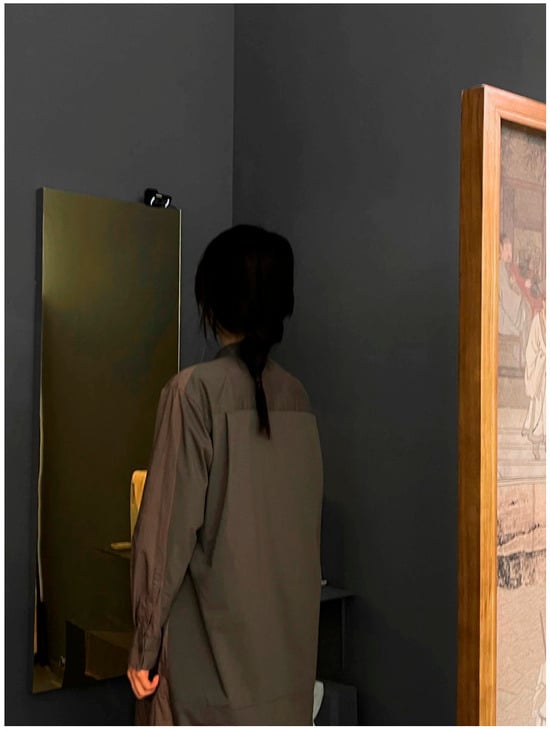
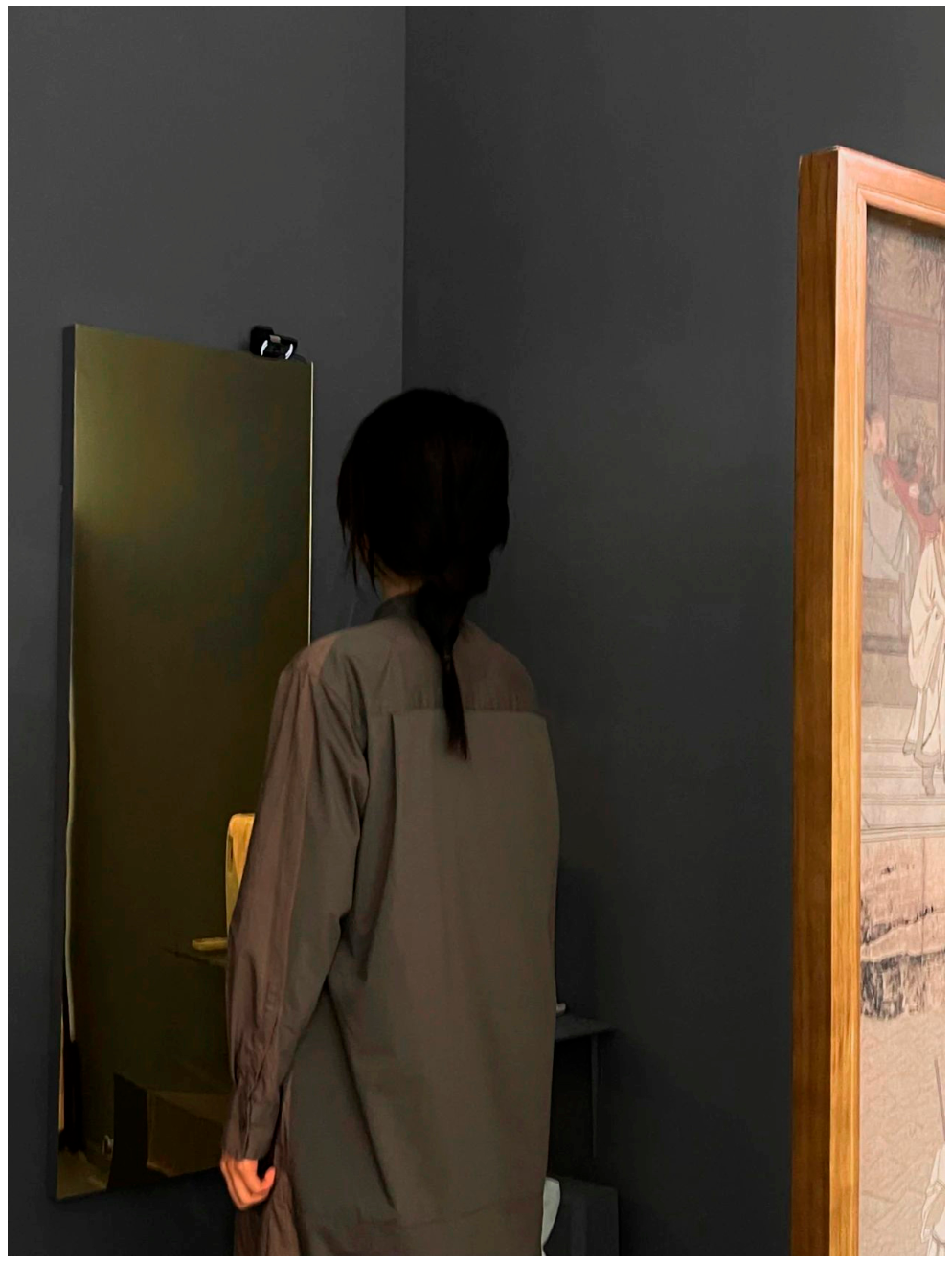
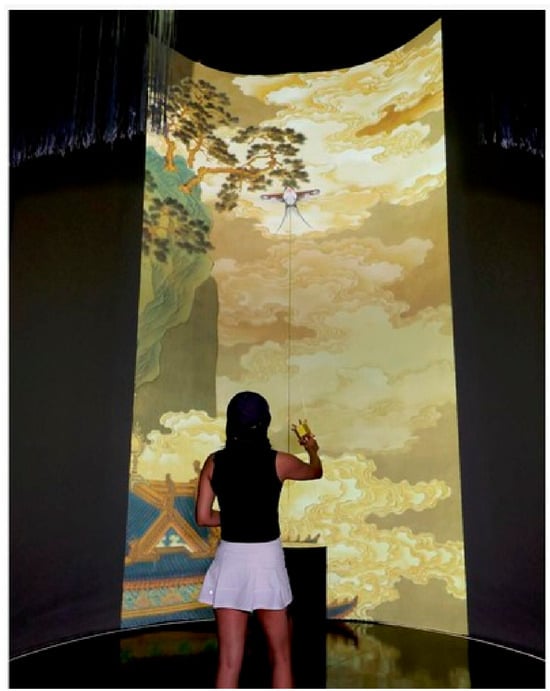
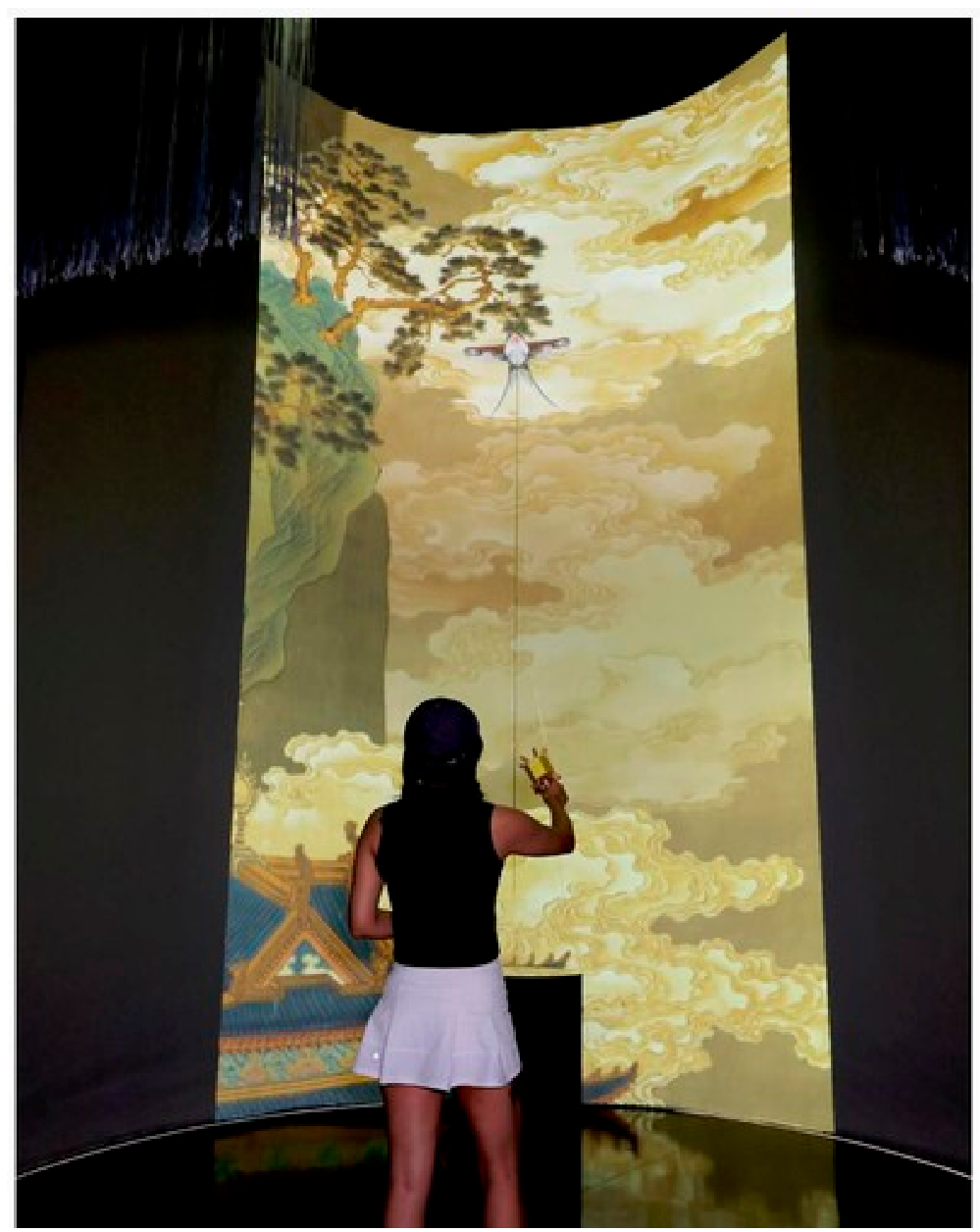
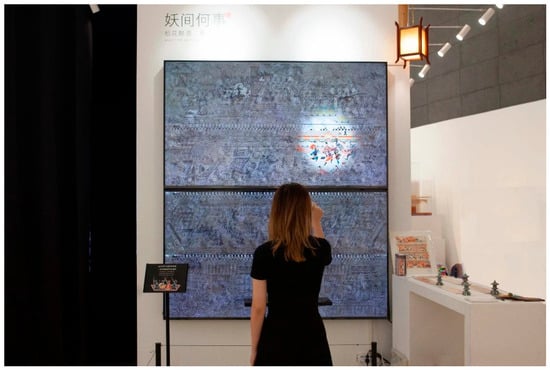
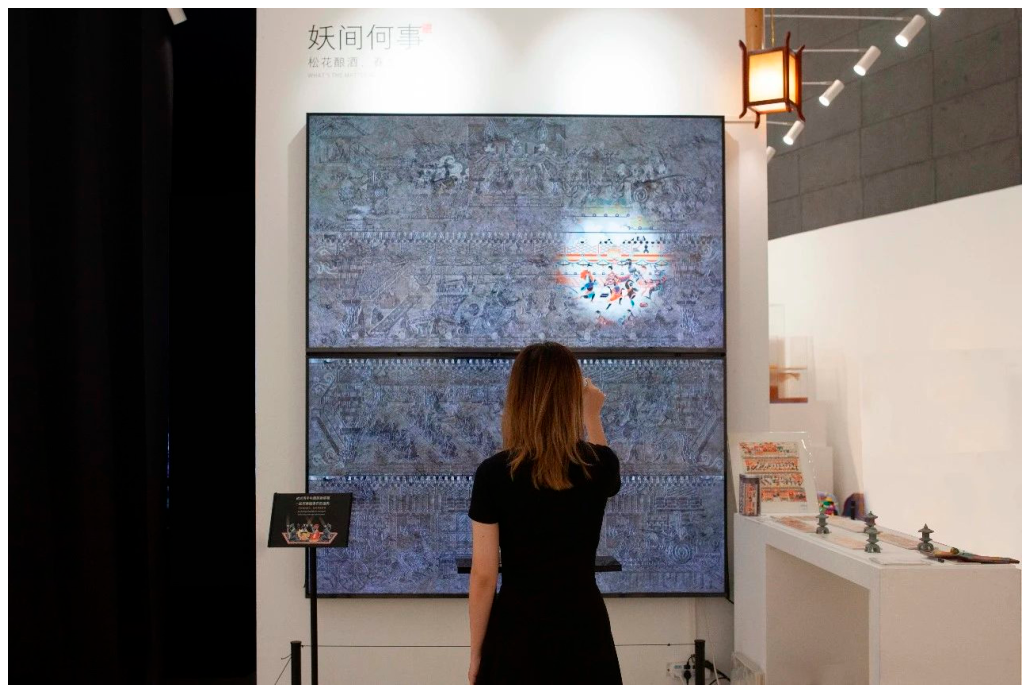
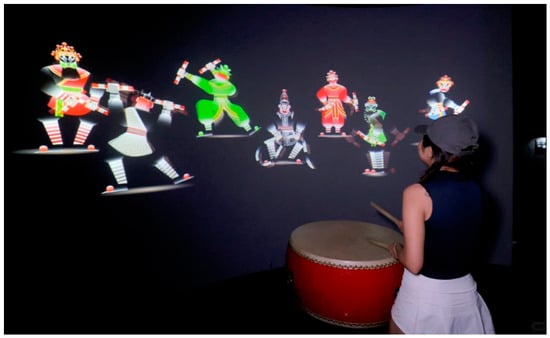
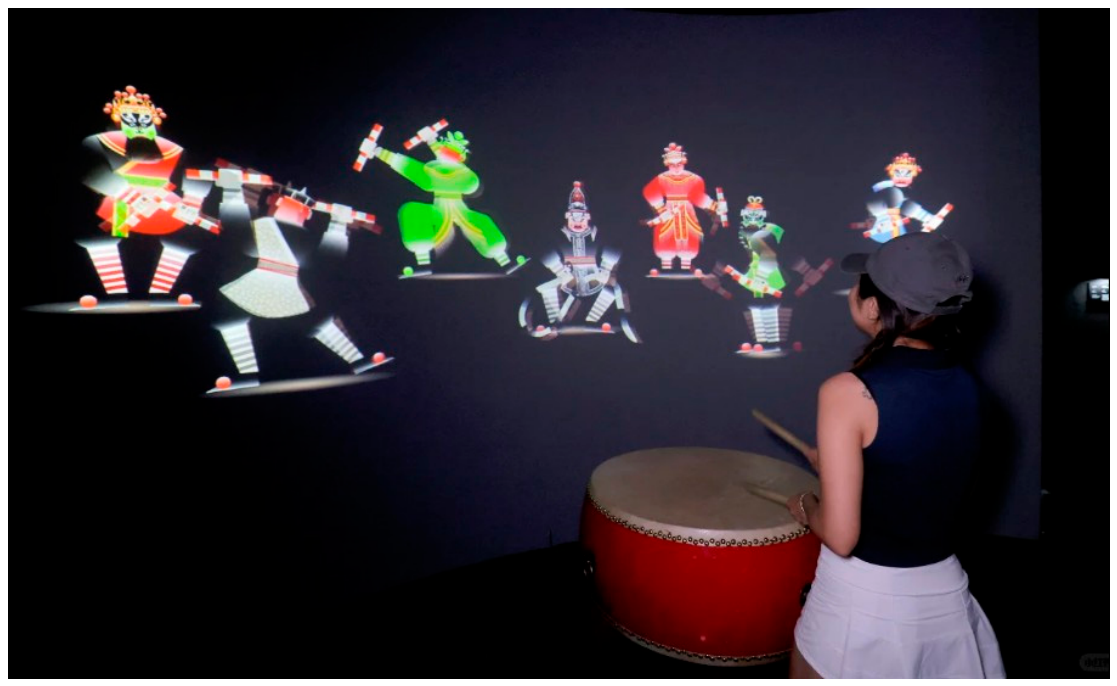
Disclaimer/Publisher’s Note: The statements, opinions and data contained in all publications are solely those of the individual author(s) and contributor(s) and not of MDPI and/or the editor(s). MDPI and/or the editor(s) disclaim responsibility for any injury to people or property resulting from any ideas, methods, instructions or products referred to in the content. |
© 2026 by the authors. Licensee MDPI, Basel, Switzerland. This article is an open access article distributed under the terms and conditions of the Creative Commons Attribution (CC BY) license.