


Abstract
Ethnographic sources from Finland and Estonia in the 18th to early 20th centuries often mention alder bark as a dye source. The bark of grey alder (Alnus incana) and black alder (Alnus glutinosa) was used to dye wool and linen yarns reddish, paint leather red, and darken linen fishing nets. These recipes were simple folk craft and are not represented in dye books. Combining various sources, a selection of ethnographic and historical recipes was reconstructed through dyeing experiments to deepen the knowledge of alder bark dyeing practices and to recreate a colour palette based on past recipes. To understand the properties of the alder bark dye, the dyed textile samples were tested according to the ISO standards for washing, rubbing, and light fastness, and colour was recorded with the CIELab values. Our results show that it was possible to obtain different shades of brown, reddish brown, and dark brown. The colour fastness of dyed wool samples was moderate or good. Slight colour changes in the washed samples compared to the untreated ones were observed, which can be due to the standard’s heavily alkaline detergent.
1. Introduction
Ethnographic sources from Finland in the 18th to early 20th centuries mention alder bark as a source for red, brown, and black colour for wool, cotton, and linen. Bark was collected from grey alder (Alnus incana) and black alder (Alnus glutinosa).Of these two species, grey alder grows all over Finland except the highest fells. It is the only alder species growing in Lapland. Black alder grows in milder climates in central and southern Finland. Hydrolysable tannins, flavones, flavonoids, proanthocyanidins (i.e., condensed tannins), and derivatives of diarylheptanoids have been detected in alder bark, cones, and leaves [1,2].
In Finland, only the ethnographic data mention dyeing textiles red and reddish brown with alder bark and knowledge about how to dye plant-fibre fishing nets. Alder bark dyeing was mostly a craft of rural people with long traditions [3,4,5]. Alder bark is not mentioned as a dye source in the first dye books available in Finnish. These books contained recipes for imported dyes such as indigo, madder, logwood, and sandalwood [6,7,8,9,10]. Dyeing with alder bark was first mentioned in 1905 in four recipes for wool yarns in a dye book written by weaver Alina Hellén and based on the Norwegian dyeing tradition [11,12]. However, these recipes were aimed at textile and rug designers.
To understand the old rural dyeing practices with alder bark, we reconstructed 12 ethnographic alder dye recipes. Of these, eleven recipes were used to dye textile material with alder bark, and one recipe was used to examine how alder bark dye behaved on leather. The properties of the dyed materials were tested for washing and light fastness to understand the dye’s durability and behaviour more deeply. Accordingly, the alder bark-dyed wool yarns and fabrics, as well as cotton and linen yarns, were tested for their colourfastness according to the ISO standards (The International Organization for Standardization) for rubbing, laundering and light. The colour was measured according to the CIELab method. Previously, ethnographic alder bark recipes have not been examined with this intensity.
2. Materials and Methods
2.1. Ethnographic Recipes
Twelve ethnographic alder bark recipes were selected for this study. These recipes are based on our archival research focusing on Finnish and Estonian ethnographic survey data from the 1920s to the 1940s that are currently available as handwritten notes in the collections of The Institute for the Languages of Finland (KOTUS), the Finnish Literature Society (SKS), and The Archive of the Estonian Dialects and Finno-Ugric Languages at the Institute of the Estonian Language (EMSUKA). We also used ethnographic publications [13,14,15,16] from Finnish and Swedish Lapland. Because many of the recipes are incomplete, we carried out practical dyeing experiments to recreate and examine the colour palette of the alder bark hues that had been available in the past.
The Finnish recipes do not distinguish clearly between black and grey alder, although occasionally when the species was mentioned, it was black alder. In recipes from Finnish and Swedish Lapland, grey alder was mentioned as a source of red dye for leather [15]. In the first Finnish herbarium Flora Fennica, published in 1866, black alder was mentioned as being suitable for dyeing red and black [17] (p. 305). In the Estonian sources, only black alder bark was mentioned as being suitable for dyeing red [18]. Grey and black alder were understood amongst rural people in Finland as two different species, and they had distinct names for these two, but the names varied and occasionally were used interchangeably in different villages. In the ethnographic records, often only the generic word ‘alder’ is provided, without any specification of accurate species, so we assumed that the properties of black and grey alder are close to each other.
The ethnographic survey data collected from Finland and amongst the Finnish speaking Forest Finns of Sweden, describing how to darken fishing nets, included several recipes, but exact knowledge for dyeing red with alder bark was almost forgotten. Thus, Finnish recipes were supplemented with archival research data from Estonia. As no ethnographic recipe contained an accurate ratio of bark and liquid or boiling times or instructions for making wood ash lye, we recreated some recipes using knowledge from Finnish dye books [12,19,20]. Details of our experiments and their historical sources are presented in Table 1 and transcriptions and translations in Appendix A.
Wool, cotton, and linen yarns were used for dyeing, and painting was performed on elk and sheep leather. Wool fabric was Huvi tabby that was woven of Schöller Sport Loden Nm28/2 yarn by TaTe Team, Finland; linen yarn was undyed Veera from Lankava, Finland; wool yarn was organic Finnsheep yarn of Kalliomäki farm, Finland; cotton yarn was Aura of Novita, Finland. Alum, cream of tartar, and iron sulphate were from Tetri Design, Finland.
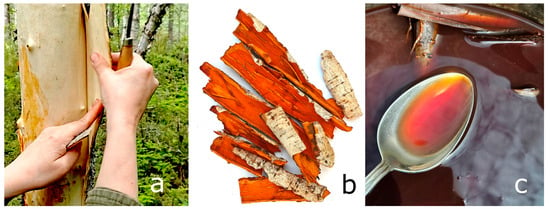
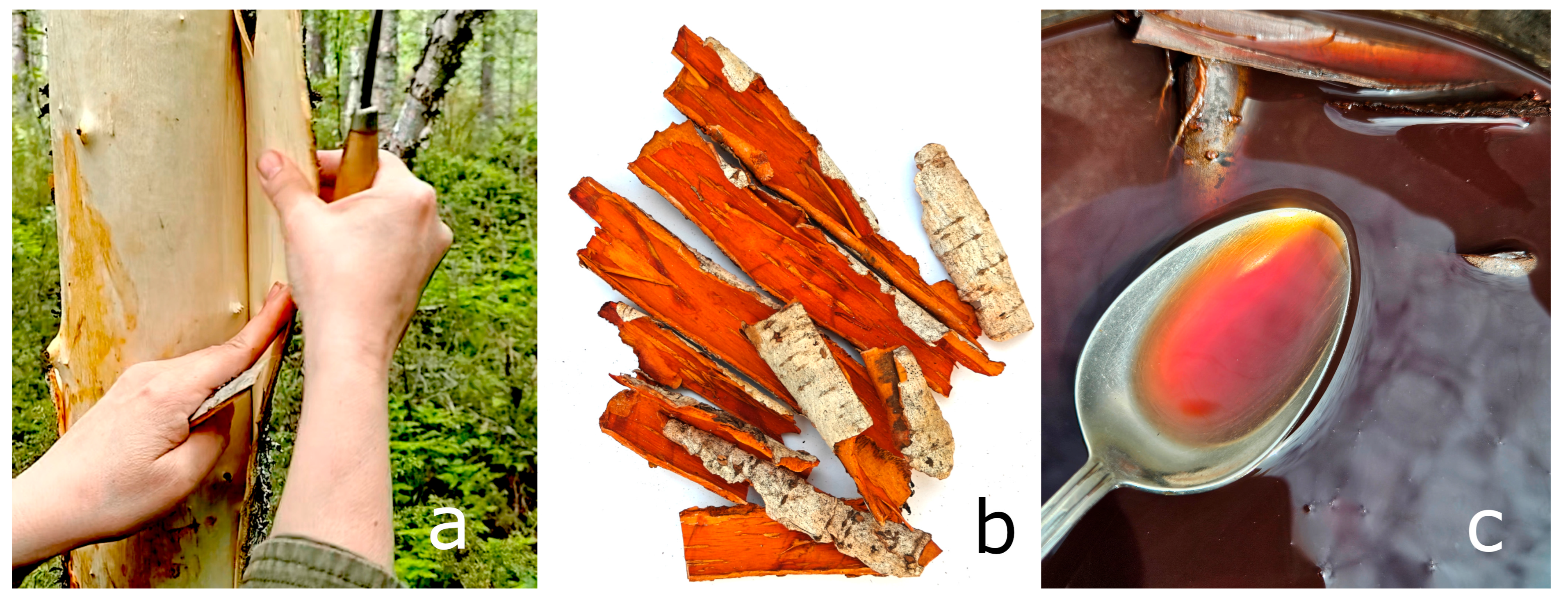
Experiments were performed in Ivalo, in northern Finland, where grey alder was the only species available. For recipes 1–6, grey alder bark was collected in April 2023 by whittling, and then it was dried and stored in paper bags. For recipes 7–12, grey alder bark was collected and dye baths prepared in early June on a sunny day, when the tree sap was running and the bark was easy to peel (Figure 1a–c). In a Finnish ethnographic source from this time, this was known as “leppä piimii” [21], which could be translated as the alder tree is with milk. This alder bark was used as fresh for dyeing directly during the harvest day.
Figure 1.
Alder bark dyeing preparations. (a) Peeling grey alder. (b) Grey alder bark turns reddish after peeling. (c) Grey alder bath.
Birch ash lye used in the experiments was prepared by placing 300 g of birch ash in a plastic bucket and pouring 8 litres (L) of boiling water over it [19]. After 24 h, the birch ash lye was sieved into a container. The pH value of the liquid was 13. To summarise the dyeing experiments, alder bark was either soaked in birch ash lye for weeks or boiled in water as fresh or after drying. The Finnish ethnographic sources do not reveal what kind of pots were used for alder bark dyeing, but darkening fishing net in a wooden vessel with hot stones is mentioned in a Finnish source [22], and a wooden tub has also been described in the Estonian sources [18] (Recipe 8). In our experiments, Recipes 1–7 were carried out in plastic buckets and a stainless-steel kettle, while Recipes 8–11 were carried out in stainless-steel kettles only. The colour achieved was modified either during or after dyeing using birch ash lye, birch ash, iron sulphate, soot from a sauna, or direct sunlight. For producing alder paint for Recipe 12, fresh chips of grey alder bark were chewed.
Table 1.
Experiments for alder bark (owf, of weight of fibre).
2.2. Colour Testing
The colour fastness to laundering was carried out according to standard ISO 105-C06:2010 [33] using an Original Hanau Linitest machine (Hanau, Germany), following the A1S procedure (10 steel balls, 40 °C for 30 min). The dyed fabric (40 mm × 100 mm in size) was attached to a multifibre adjacent fabric (which included wool, cellulose acetate, polyester, polyamide, cotton, and cellulose diacetate) by sewing together one of the short sides. The washing liquid was prepared from the AATCC WOB washing detergent by dissolving 4 g of the detergent into 1 L of water (pH 9). The relative atmospheric humidity of the laboratory was 62%, and the temperature was 20 °C during the testing.
In the washing fastness test, both staining and colour change were evaluated. The amount of staining of the multifibre fabric was assessed with a 9-step grey/white scale with a numeric rating according to standard ISO 105-A03:2019 [34] (values 1–5, with 5 indicating no staining). To assess the amount of colour change, the sample fabrics were rated with a 9-step grey/grey scale according to standard ISO 105-A02:1993 [35] (values 1–5, with 5 indicating no colour change). This rating was performed by comparing the non-washed and washed fabrics side to side. The CIE L*, a*, and b* colour values were measured before and after washing using a Konica Minolta (Tokyo, Japan) spectrophotometer (illuminant D65, CIE 10° observer) and recording the SCI (Specular Component Included) values. This type of colour evaluation measures the total appearance independent of the surface conditions. The colour change (ΔE) values were calculated with Spectra Magic NX software (version NX2 1.50; Konica Minolta). The colour measurement of a folded wool fabric was taken once.
The rubbing fastness test was conducted according to standard ISO 105-X12:2016 [36]. The cylindrical finger of the test device used was 16 mm in diameter, and the force used was 9 N. An exception to the standard was that only dry rubbing was performed. The relative atmospheric humidity of the laboratory was 64%, and the temperature was 20 °C during the testing. The rubbing fabrics were given a numerical rating for staining using a 9-step grey/white scale according to standard ISO 105-A03 [34] (values 1–5, with 5 indicating no colour on test fabric).
The ISO 105-B02:2014 [37] standard was used for the light fastness test following method 2. Samples of the dyed yarns were wrapped around a non-optically brightened white card. Parts of the specimens were masked, and the remaining parts were exposed to the light of a Xenon arc lamp (2200W) using a James Heal Trufade light-fastness tester (James Heal, Halifax, UK). The Xenon arc lamp has an emission profile closely matching the D65 standard light source and mimics well exposure to natural light. Temperature and relative atmospheric humidity were controlled during the test, at 36 °C and 45%. The cover of the sample was removed after specific periods (8, 16, 32, 64, 128 h).
Light fastness was evaluated with a reference 8-step blue scale exposed with the samples. The blue scale value 1 indicated very low colour fastness, while the value 8 indicated very high colour fastness. The colour of each sample was measured by CIELab readings taken on a VeriVide DigiEye (D65 light source, 10° angle) using Digi Production software of VeriVide, Leicaster, UK. In the CIELab colour system, the L* indicates lightness and can obtain values from 100 (white) to 0 (black); a* indicates redness as a positive value and greenness as a negative value; and b* yellowness as positive value and blueness as a negative value [38]. Near 0, a* and b* values indicate the colour grey. The CIE L*, a*, and b* values were converted to RGB-HEX values using Nix Free Colour Converter of Nix Sensor Ltd., Hamilton, ON, Canada.
3. Results
3.1. Dye Palette of Alder Bark Dyes
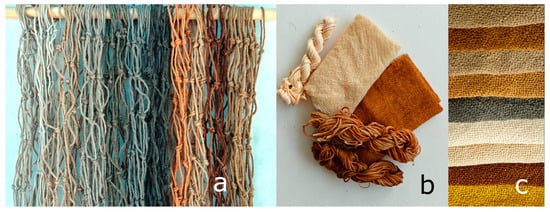
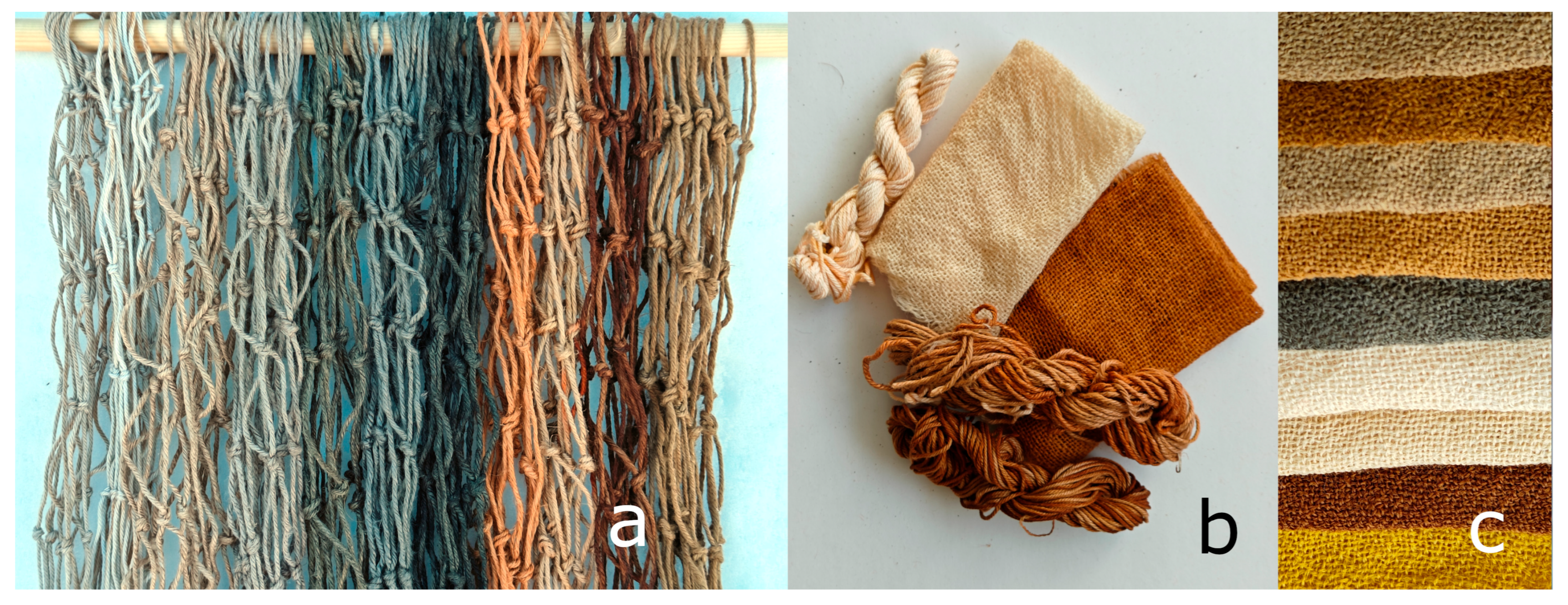
Our colour palette of alder bark dyes is presented as CIELab values and RGB colour swatches in Table 2 (Figure 2a–c).
Table 2.
Obtained colours on wool, cotton, and linen as CIELab values and visualised as RGB hues.
Figure 2.
Obtained colours. (a) Alder dyes on small hand-knotted linen and cotton fishing nets, Recipes 1–11 left to right. (b) Recipe 9 resulted in pale orange, while modifying with birch ash lye turned hues reddish brown. (c) Colour hues obtained on wool with Recipes 1, 2, 3, 5, 6, 8, 9, 10, 11 from top to bottom.
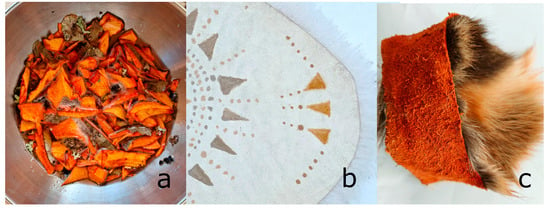
On wool, linen, and cotton, a variety of shades were achieved with grey alder bark, i.e., brownish red (Recipe 10), orange tones (e.g., Recipes 8, 9, 11), brown colours (e.g., Recipes 1, 3, 5), as well as greyish and blackish brown colours (e.g., Recipes 6, 7). On leather, we achieved strong reddish orange hues with Recipe 12 (Figure 3a–c).
Figure 3.
Chewed alder bark dye. (a) Chewed bark. (b) Alder bark dyes on sheepskin: orange on right painted with chewed bark paint, greenish patterns painted with fermented bath, reddish patterns painted with fresh bark in birch ash lye. (c) Elk fur piece dyed with grey alder dye.
It is interesting to note that wool and cellulose fibres, i.e., cotton and linen, had different colour hues. In many cases, the colour in the cellulose fibres is stronger and darker than that obtained in wool. In Recipe 1, the colour hue of wool is stronger and darker, indicated by the lower L* values, but in Recipes 2, 3, 5, and 8–11, linen yarns are darker. The darkest blackish colours were obtained with Recipes 6 and 7, which included use of iron sulphate and soot (carbon black). The linen treated with soot obtained the lowest L* value (30.62) of all samples and the a* and b* values approached zero (2.96 and 3.88, respectively), confirming hues near grey, all supporting the black result. The colour of Recipe 6 on both wool and linen was dark (low L* 39.13 and 49.33, respectively); a* was near zero, indicating grey (−0.66 and 0.54); and b* revealed a yellowish tint (6.07 and 5.60), thus supporting total colour more on dark grey and linen having an even slightly lighter hue than wool.
There were several reddish colours, the darkest being the ones obtained for linen with Recipes 8 and 10, indicated by the high a* value (15.76 and 9.72, respectively) and b* clearly indicating yellow (32.65 and 19.55). Interestingly, both recipes included exposure to sunlight. For wool, the tones were nearly the same as for linen but were lighter, especially for Recipe 8 (L* 71.29 for wool vs. 52.37 for linen).
The brightest orange colour was obtained on wool with Recipe 11, which included the use of alum, obviously resulting in more brilliance in colour. This orange was bright, indicated by the L* value 62.60, whereas the a* value of 12.07 reveals a clear red hue and the b* value of 53.28 a strong yellow. The colour for linen in the same dye bath resulted in a quite greyish orange, as indicated by the value of a* of 4.01 and a clearly lower b* of 26.97 vs. the 53.28 of wool, while the L* values were almost the same.
3.2. Colour Fastness
Colour fastness to washing was evaluated as staining and colour change, the results of which are presented in Table 3 and Table 4. To summarise, in the ISO standard washing test, staining the multifibre adjacent test fabrics was minor with the lowest value being 4/5 (scale 1–5).
Table 3.
CIELab values and colour change (ΔE) of dyed and washed wool samples.
Table 4.
Ratings of dyed samples for washing fastness, rubbing fastness, and light fastness.
Colour changes due to washing received values of 1/2 to 4/5, with minor fading or slight darkening and reddening in the colour hues after the washing procedure (Table 3). The reddening in washing is revealed by the greater value of a* of the washed sample compared to the non-washed one (e.g., samples of Recipes 5, 8, 11).
The dry rubbing test resulted in slight to moderate staining of the test fabric, obtaining values from 3 to 4/5.
Nearly all alder bark-dyed samples received light fastness of moderate (3) or even higher. The wool dyed in the Recipe 9 dye bath obtained even, good light fastness (LF 6) for both wool and linen (Table 4). This recipe included using fresh bark and exposing the dyed material to sunlight. The fading slips in Appendix B show the fading rates and the fastness grade of different dyed materials due to light exposure. The colour change after different exposure times is presented as CIELab values and colour swatches.
4. Discussion
4.1. Alder Bark Red
In our experiments, the most reddish hues were obtained when following Recipes 8, 9, and 10. The hues achieved could be described as reddish brown and orangish reddish, but there is no specific colour name for these hues. It is possible that when the ethnographic data were collected in the 1930s and 1940s, the reported red, reddish, and brown colour hues mentioned by the informants meant only one colour hue that was just named differently in different villages. Indeed, in different Finnish dialects, the word for red meant sometimes red or brown colour hues, and the word brown had a meaning as brown or red colour hues [39] (pp. 82–90). For example, the fox (Vulpes vulpes) was considered red, but nowadays, its colour could be described as reddish brown [40] (pp. 640–641).
Direct sunlight was used in Recipes 8, 9, and 10 (Figure 2a–c). The exact recipes are from Estonia, but according to ethnographic sources from rural Finland, the importance of sunlight was also known in Finland in the early decades of the 20th century. In western Finland, it was known that when dyeing with alder bark, a clear and sunny sky was mandatory for bright colours, while cloudy weather gave dark hues [24]. In eastern Finland, it was known that red must be dyed with fresh alder bark collected in early summer when the tree sap was running and it was easy to peel the bark from trees [41] (p. 229). In south-eastern Finland, it was reported that alder bark can give red or brown hues, but no exact recipe was written down [23]. From the same area, there are data that alder bark dyeing for reddish brown and black with iron had almost vanished in the 1930s [36].
It is likely that, in Finland, alder bark red was dyed in the same way as in Estonia, where the bark of the black alder was peeled off trees on a sunny spring or summer day when the tree sap was running; the bark collected was then boiled in wood ash lye or water, or boiling water was poured on the bark to free its dyestuffs [18]. Yarns were then dipped in the dye bath quickly and exposed to direct sunlight to become reddish. When the yarns were dry, dipping was repeated. The hue of the dyed yarns that was achieved has been described as “not yellow, not red, but like the colour of the fox” [18]. According to the ethnographic data collected in Latvia, some dyes were “burned” in sunlight, and this term was applied to alder bark dyeing too [42] (pp. 118, 137, 139, 154).
A similar sunlight-using recipe was published in Finland in 1942 during World War II, in a book with instructions on how to use domestic plants as medicines, food, spices, fodder, and for carpentry, as well as for dyeing [43]. Accordingly, there were instructions for dyeing linen yarns yellow with a strong bath boiled with fresh alder leaves, and after dipping into a dye bath, yarns were dried in direct sunlight to obtain the yellow colour; by allowing fresh alder bark to rot for a long time, it was possible to obtain orange red by boiling the bark [43] (p. 161). Also, in Olonets on the Karelian Isthmus, fishing nets made of plant fibres were dyed with freshly collected alder bark in a bath that was heated up with hot stones and by adding wood ash to the bath. The nets were dyed by dipping and drying them in the direct sunlight [several times] [44] (p. 259). In Japan and Korea, textiles have been exposed to direct sunlight when dyeing with unripe peels of persimmon fruits [45]. It seems that the knowledge of good dyeing practices was discovered in several places.
A warm brownish hue came with Recipe 2, in which the brown colour hue was modified by treating dyed materials with birch ash lye. Our experiment was based on a recipe from 1745 [3] that describes how Finns peeled alder bark, dried it, ground it, and boiled it into a thick concoction that could be used to dye fabrics brown; if the colour was not dark enough, the fabric could be dried and treated with wood ash lye [3]. No sunlight was mentioned, and it remains unclear which liquid the bark was boiled in, but otherwise the recipe reminds us of the Estonian sources used for Recipes 8, 9, and 10. Treating these further with birch ash lye resulted in strongly reddish brownish hues (Recipes 9b, 10b), and these became intense brownish red (Figure 2b). Concerning Recipe 2, alder bark was possibly collected at the wrong time and stored wrongly; repeating the experiment with fresh bark and in direct sunlight might produce a redder hue.
When we experimented with colouring leather with alder bark in Recipe 12, we were able to produce reddish orange by following the old knowledge (Figure 3b,c). The bark tasted quite bitter and produced a lot of saliva, which also became an ingredient of the paint, with some amount of added water. In practice, it was difficult to depict leather because the paint that attached immediately to the leather made it impossible to fix any errors. Brushing paint on leather was easier and resulted in quite an even colour, as did dipping the leather into the paint.
It seems that dyeing leather reddish with alder bark has been known in a wide geographical area for a long time. The Sámi people of Swedish Lapland painted figures on the sacred shaman drums with boiled and mashed alder bark paint [16] (p. 119), while leather garments, such as belts, were coloured with alder bark that was first chewed [15] (pp. 78–79). The same was known in Inari in Finnish Lapland and amongst the Skolt Sámi, where both leather and bark were chewed; sometimes, skin was soaked in the alder bark bath for days or weeks with added birch ash [13] (pp. 317, 319, 510) and [14] (p. 338). In Siberia, among the Ob-Ugric, i.e., Khanty and Mansi areas, the leather sides of furs and fish skins were coloured with a paint that was boiled from alder bark and the bark of Siberian larch (Larix sibirica) to achieve reddish-brownish hues [46] (p. 89). The Native Americans, too, prepared red dye by chewing, macerating, and boiling alder bark [1] (pp. 425–426).
4.2. Brown, Grey, and Black Hues with Alder Bark
In our experiments, Recipe 6 was an attempt to dye fishing nets black with alder bark and added iron, but the result was more grey than black. The result can be close to the ethnographic dyes, as it was described that if copper sulphate or iron sulphate was added to alder bark baths, fishing nets became dark, black, or grey [47,48]. A recipe instructed users first to dry the alder bark and branches of bearberry in an oven, then boil them for 3–4 h and add some copper sulphate, linen yarns, and fishing nets to obtain a blackish blue [28]. Also, darkening nets as net black was made by first boiling alder bark in a pot, and when the dye came out from the bark, the nets and iron sulphate were added—but it was important to avoid dyeing during a north wind [24].
Dyeing black and darkening colours with alder bark has been known for centuries in areas where alders grow [1] (p. 426). In 18th century Sweden and Finland, rural people dyed things black with alder bark and iron-rich soil [3,49,50]. In 1789, alder bark was listed as a useful material that the rural people of Finland could have collected for professional dyers, who then could dye black with oak galls and iron sulphate [51].
Dyeing plant-fibre fishing nets was needed to make plant fibre nets blend in with the colour of the water of the lakes. Before World War I, imported dyes such as catechu were cheap and were used to dye fishing nets [52]. During the time of war, dyeing nets with domestic plants was highly recommended due to the increased prices of imported dyestuffs [53,54,55]. Dye baths were prepared of alder bark and iron baths and enriched with only a small amount of imported logwood or catechu, as well as domestic birch bark, pine bark, oak bark, or bearberry branches to obtain blackish hues [24,54,55,56]. Alder bark was still commonly used to darken cotton, linen, and hemp fishing nets in the 1930s [22,24,57].
In some areas of Finland, as well as amongst the Forest Finns, sludge produced when sharpening iron tools with a grindstone was used to dye nets black with alder bark [26,29,30]. This was accomplished by first dipping the plant-fibre fishing nets into the grindstone sludge and then drying them; after that, the yarns were boiled in an alder bark bath that was prepared by boiling bark in salt water [26,27] (Table 1). Instead of boiling, alder bark baths were sometimes just warmed in a sauna for a long time [28]. Some fermented alder bark liquid was in a warm sauna for weeks with iron substrate, and then this bath was poured on fishing equipment; if needed, extra darkness could be obtained by wiping soot on the nets from the walls of a sauna [32] (p. 229). In our experiments, Recipe 7 produced an almost-black hue on linen yarn with fermented alder bark and sauna soot. Modifying the colour of the dyed yarn with birch ash in Recipe 3 produced a brownish hue on linen, as did adding salt to the dye bath as in Recipe 4. Fermented alder bark, in Recipe 5, without any added iron, also produced a brownish shade.
4.3. Beliefs About Alder’s Magical and Healing Properties
Alder bark turns reddish soon after peeling, and alder wood gains a similar reddish hue after cutting. Because of this behaviour, many magical and spiritual aspects were attributed to alder trees. Alder trees were sacred for ancient Finns and created by Lemmes, a minor forest god [58] (p. 48). Items made of alder wood were considered to be magical. For example, according to an ethnographic description, maidens longing for love placed an alder branch in their bed overnight, then pulled the branch to a spring with a sledge made of a single-trunk alder tree [59] (p. 249). Also, it was known that if a snake was beaten with an alder tree stick, the snake would be killed [60]. In addition, it was believed that if chips of alder wood were put into butter or drinks, they were preserved for longer [5].
As the Finnish word for blood, veri, was a taboo word in some dialects, the name for alder tree, leppä, was used instead [61] (p. 288). Taking these beliefs into consideration, it is also possible that dyeing things reddish with alder bark might have had some spiritual or taboo aspects, and this might have had an effect on the craft vanishing. In 1737, it was described that in Swedish Lapland, alder bark dye represented the blood of a bear (Ursus arctos). After a successful hunt, women chewed alder bark and prepared red paint, which was spurted on men’s faces during the hunting feast. The aim was to make the men look heroic, as if smeared with the bear’s blood [16] (pp. 201–202). The bear’s body was painted with alder bark dye before skinning, and a birch-bark cup filled with alder bark dye was placed under its nose [16,62]. A connection between alder dye and blood is understandable, as in our dyeing experiments, we found that alder bark baths have an intense red colour, and they look like blood (Figure 1c).
Alder had medicinal properties, too. It was known that mashed black alder leaves cured a wasp sting [24], and alder catkins were used as medicine for piglets if they had stomach problems [25]. Amongst the Skolt Sámi, if a child contracted chicken pox, alder bark was boiled, and the child was washed in a dye bath prepared of the alder bark [14] (p. 468). In Norwegian Lapland, if a baptised baby was ill frequently, the baby had to be bathed in alder bark dye and renamed [63] (p. 469). Nowadays, the role the alder bark bath played in this renaming ritual is still unknown. Based on our alder bark experiments, we can suggest an explanation. Human skin turns strongly reddish in direct contact with the alder bark dye, and alder bark dye baths also look like blood. Based on this, it seems possible that bathing a child in an alder bark bath coloured the child’s skin and made the baby look like a newborn.
4.4. Dye Properties
Our research showed that it is possible to obtain a great variety of brown, reddish-brown, and even dark blackish colours with alder bark (Figure 2a–c). Alder bark dyes obviously work well both for wool and cellulose fibres, depending on the recipe used (, which agrees with ethnographic knowledge. When sunlight exposure was applied (Recipes 8, 9, 9b, 10, 10b), reddish colours were obtained for linen and wool. The yellowish orange hue on wool (Recipe 11) is probably the result of flavonoids, while a brownish hue on linen might indicate a small level of tannins in the bath. Moreover, it seems likely that darkening fishing nets was not only performed to obtain some specific colours but also to protect the fibres. Accordingly, using soot from a sauna for dyeing black (Recipe 7) was possibly performed not only to obtain a black net but also to increase light fastness properties by creating a thick opaque layer all over the yarns.
Colour fastness values in our experiments varied from moderate to good, which can explain the long-lasting tradition of alder bark dyes. Moreover, most of our dyed materials would fulfil the criteria for moderate to good colour fastness desired for contemporary textile garments. The challenge of alder bark dyes in contemporary use appeared in the washing fastness test where the ISO standard washing powder caused colour changes in washed materials. This phenomenon is due to ionisation of the numerous OH-groups in the natural dye structure, causing a shift in its absorption spectrum, thus affecting the perceived visible colour [64] (p. 213). Challenges in changing colour in washing could be avoided by using neutral washing detergents. In future, a detailed HPLC analysis is planned for alder bark samples, dye baths, and dyed materials to gain a deeper understanding of their dye composition.
5. Conclusions
Our study revealed that past dyers had knowledge of procedures and steps for several colour hues from brown, reddish brown, and almost black, which all can be produced with alder bark. It can be assumed that there was a knowledge of best practices amongst rural people, such as the best time for bark collecting, using direct sunlight, or modifying the hues that were achieved with wood ash lye, an iron substrate, soot, or salt spread because these recipes were not available in dye books. Depending on the recipe used, the dye properties were moderate or relatively good. Probably similar recipes were also invented in places where alder grew and bark was available, since similar procedures can be found in cultures near and far. In future, a detailed HPLC analysis is planned for alder bark samples, dye baths and dyed materials to get deeper understanding of the dye composition.
Author Contributions
Conceptualisation, K.W. and L.L.; methodology, K.W. and L.L.; validation, K.W., D.B., S.T. and R.R. (Riikka Räisänen); formal analysis, K.W., D.B., S.T. and R.R. (Riikka Räisänen); investigation, K.W.; resources, K.W., L.L. and R.R. (Riikka Räisänen); data curation, K.W., D.B. and S.T.; writing—original draft preparation, K.W.; writing—review and editing, K.W., L.L., D.B., R.R. (Riina Rammo), S.T. and R.R. (Riikka Räisänen); visualisation, K.W.; supervision, R.R. (Riikka Räisänen) and K.W.; project administration, R.R. (Riikka Räisänen); funding acquisition, R.R. (Riikka Räisänen). All authors have read and agreed to the published version of the manuscript.
Funding
This research was funded by the European Union’s ‘Research and Innovation Action’ Horizon-CL2-2022 Heritage-01-04 program for the Colour4CRAFTS project, no. 101094809.
Data Availability Statement
No data available.
Acknowledgments
We would like to thank Päivi Hintsanen and the Coloriasto internet archive of dye publications.
Conflicts of Interest
The authors declare no conflicts of interest.
Abbreviations
The following abbreviations are used in this manuscript:
| SKS | Finnish Literature Society |
| KOTUS | The Institute for the Languages of Finland |
| EMSUMA | The Archive of the Estonian Dialects and Finno-Ugric Languages at the Institute of the Estonian Language |
Appendix A
Table A1.
Transcriptions and translations of the Recipes 1–11.
Appendix B
Table A2.
Fading rates of alder bark-dyed materials towards light exposure, and the light fastness value according to the ISO 105-B02 standard [37].
References
- Cardon, D. Natural Dyes. Sources, Tradition, Technology and Science; Archetype Publications: London, UK, 2007; p. 425. [Google Scholar]
- Jurkšiené, G.; Sirgedaité-Šéžiené, V.; Juškauskaité, A.; Baliuckas, W. Identification of Alnus incana (L.) Moenx. × Alnus glutinosa (L.) Gaertn. Hybrids Using Metabolic Compounds as Chemotaxonomic Markers. Forests 2023, 14, 150. [Google Scholar] [CrossRef] [Scilit]
- Kalm, P. Förtekning på Någre Inhemska Färge-Gräs; Kongliga Vetenskaps-Academiens Handlingar, Lorenz Ludvig Grefing: Stockholm, Sweden, 1745. [Google Scholar]
- Sanomia Turusta. Muutama sana Suomen maan puista. Sanomia Turusta, 18 March 1851, pp. 4–6. Volume 6.
- Oulun Wiikko-Sanomia. Leppä. Oulun Wiikko-Sanomia, 6 June 1857, pp. 2–3. Volume 18.
- Salmberg, A. Yxi Selkie Ja Päälle Luotettawa Paino-Kirja. Jonga-Jälken Jokainen Huonen-Haldia Taitaa Painaa Caicki Hänen Tarppensa/Willaisisa Lijnaisisa Nijn Myös Puunwillaisisa Langaisa; Frecknell: Turku, Finland, 1769. [Google Scholar]
- Weiss, T. Moniaita Osoituksia, Kuinka Willaa, Pumpulia, Silkkiä Ja Liinaa Wärjätään Eli Painetaan; Karlssonin Kirjapaino: Oulu, Finland, 1854. [Google Scholar]
- Barck, Chr. Ev. Älykäs Emäntä eli, Neuwoja Koto-Lääkkeisiin, Henttojen Vaatteitten Pesemiseen, Niinkuin Sametin ja Hattujen, Monenmoisen Tahron Poisottamiseen Waatteista, Rottain ja Muitten Syöpäläisten Poisahdistamiseen j. p. m., ynnä Lisäyksen Kanssa, Sisältäwä Wähäisen, Mutta Päälleluotettawan Wärikirjan, Jossa Neuwotaan 20 Erinäistä Wäriä Painamaan; Chr. Ev. Bard’s Press: Oulu, Finland, 1855. [Google Scholar]
- Rabe, K.A. Kotiwärjäri. Neuwoja Uusimmilla Tawoilla Painamaan Willaista, Pumpulia Ja Silkkiä; Walkaisemisesta Ja Pesusta Ynnä Wäriaineiden Tuntomerkit; A. Ramstedt’in kirjapaino: Savonlinna, Finland, 1876. [Google Scholar]
- Anonymous. Todenperäinen Wäri-Kirja. Ohjeita Ja Neuwoja Kotiwärjyyn; Suomalaisen Kirjallisuuden Seuran kirjapaino: Helsinki, Finland, 1888. [Google Scholar]
- Hufvudstadsbladet. Finska Handarbetets Vänner sammanträddetill årsmöte i går. Hufvudstadsbladet, 26 April 1903, p. 5. Volume 108A.
- Hellén, A. Kotivärjäyskirja. Neuvoja Korivärjäykseen Kasviaineilla, 4th ed.; Suomen käsityön Ystävät; Raittiusseuran Kirjapaino: Helsinki, Finland, 1919. [Google Scholar]
- Itkonen, T.I. Suomen Lappalaiset Vuoteen 1945; WSOY: Porvoo, Finland, 1948; Volume 1. [Google Scholar]
- Itkonen, T.I. Suomen Lappalaiset Vuoteen 1945; WSOY: Porvoo, Finland, 1948; Volume 2. [Google Scholar]
- Von Linné, C. Lapin Kasveja. Carl Von Linné: Flora Lapponica, 1737; Itkonen-Kaila, M., Ed.; Suomalaisen Kirjallisuuden Seura: Helsinki, Finland, 1991. [Google Scholar]
- Schefferus, J. Johannes Schefferus: Lapponia, 1674; Itkonen, T., Ed.; Karisto: Hämeenlinna, Finland, 1979. [Google Scholar]
- Linnilä, K.; Savikko, S.; Lempiäinen, T. Elias Lönnrotin Flora Fennica I–III; Karisto: Hämeenlinna, Finland, 2002. [Google Scholar]
- EMSUKA. Slips keyword “park” from Kodavere parish 1941, Estonia.
- Hassi, T. Luonnonväreillä Värjääminen; WSOY: Helsinki, Finland, 1977. [Google Scholar]
- Kontturi, H. Luonnonväreillä Värjäämisesestä, 2nd ed.; Pellervo-seura; Yhteiskirjapaino Osakeyhtiö: Helsinki, Finland, 1945. [Google Scholar]
- KOTUS Erämetsä: 1934, Karstula, Finland.
- KOTUS Erämetsä: 1935, Säkkijärvi, Finland.
- KOTUS Erämetsä: 1935, Virolahti, Finland.
- KOTUS Erämetsä: 1936, Hartola, Finland.
- SKS/KRA 1936, Laitakari. b:481. 1936.
- KOTUS Erämetsä: 1932, Forest Finns, Vermland, Sweden.
- SKS/KRA 1938 Kirvu, Pärssinen. E 142: 14–16. 1938.
- Hyvärinen, A. Kasviväreillä värjääminen. Kotitaide, 1 December 1902, pp. 6–10. Volume 6.
- KOTUS Erämetsä: 1932, Muolaa, Finland.
- KOTUS Erämetsä: 1935, Puumala, Finland.
- KOTUS Erämetsä 1935, Luhanka, Finland.
- Itkonen, I. Naisten käsityöt. Langat ja kankaat. Kirjonta, värjäys. Pellavan ja liinan muokkaaminen, valmistus rihmaksi ja rihman pesu. In Kansatieteellisiä Muistiinpanoja Ilomantsin Itäkylistä; Teppo, H., Vilkuna, K., Eds.; Mit deutschen Referaten. Kansatieteellinen arkisto 111. Suomen muinaismuistoyhdistys; Forssan kirjapaino Oy: Forssa, Finland, 1939; pp. 217–234. [Google Scholar]
- ISO 105-C06:2010; Textiles: Tests for Colour Fastness, Part C06: Colour Fastness to Domestic and Commercial Laundering. International Organization for Standardization: Geneva, Switzerland, 2020.
- ISO 105-A03:2019; Textiles: Tests for Colour Fastness. Part A03: Grey Scale for Assessing Staining. International Organization for Standardization: Geneva, Switzerland, 2019.
- ISO 105-A02:1993; Textiles: Tests for Colour Fastness, Part A02: Grey Scale for Assessing Change in Colour. The International Organization for Standardization: Geneva, Switzerland, 1993.
- ISO 105-X12:2016; Textiles: Tests for Colour Fastness, Part X12: Colour Fastness to Rubbing. The International Organization for Standardization: Geneva, Switzerland, 2016.
- ISO 105-B02:2014; Textiles: Tests for Colour Fastness, Part B02: Colour Fastness to Artificial Light: Xenon Arc Fading Lamp Test. The International Organization for Standardization: Geneva, Switzerland, 2014.
- Smith, K.J. Colour–Order Systems, Colour Spaces, Colour Difference and Colour Scales, 2nd ed.; McDonald, R., Ed.; Colour Physics for Industry; Society of Dyers and Colourists: Bradford, UK, 1997. [Google Scholar]
- Koski, M. Värien Nimitykset Suomessa Ja Lähisukukielissä; Suomalaisen Kirjallisuuden Seuran toimituksia 391; Savonlinnan kirjapaino Oy: Helsinki, Finland, 1983. [Google Scholar]
- Toivonen, Y.H.; Itkonen, E.; Joki, A.J. Suomen Kielen Etymologinen Sanakirja III; Suomalaisen Kirjallisuuden Seuran Kirjapaino Oy: Helsinki, Finland, 1962. [Google Scholar]
- Salo, A. Lemin Naisten Käsityöt; Kansantieteellisiä kuvauksia I; Suomalaisen Kirjallisuuden Seuran Toimituksia 186: Helsinki, Finland, 1930. [Google Scholar]
- Bielenstein, M. Die Altlettischen Färbmethoden: Studien Zur Idg. Altertumskunde; Veröffentlichungen Der Volkskundlichen Forschungsstelle Am Herderinstitut Zu Riga: Riga, Latvia, 1935. [Google Scholar]
- Rautavaara, T. Mihin Kasvimme Kelpaavat: Luonnonkasviemme Käyttömahdollisuudet Leivän Lisänä Ja Ruoan Aineksina, Mausteina, Kahvin Ja Teen Korvikkeina, Lääkkeinä, Rehuna Sekä Teknillisiin Tarkoituksiin. 1 Osa, Kevään Ja Alkukesän Kasvit; WSOY: Porvoo, Finland, 1942. [Google Scholar]
- Virtaranta, P. Lyydiläisiä Tekstejä II; Lüdische texte 2. Suomalais-ugrilaisen seuran toimituksia 130; Suomalais—Ugrilainen Seura: Helsinki, Finland, 1963. [Google Scholar]
- Park, S.J. Comparative Study on the Manufacturing Process of Persimmon Juice, Persimmon Dyeing Method, and Transfiguration of Persimmon-dyed Items in Korea and Japan. Korean J. Community Living Sci. 2011, 22, 77–94. [Google Scholar] [CrossRef] [Scilit]
- Vahter, T. Obinugrilaisten Kansojen Koristekuosit—Ornamentik Der Ob-Ugrier; Kansatieteellisiä julkaisuja IX; Suomalais-Ugrilainen Seura: Helsinki, Finland, 1953. [Google Scholar]
- SKS/KRA. Laurila. E 138, 757:1. 1917.
- SKS/KRA. Ollikainen. PK 24:4314. 1938.
- Linnæus, C. Förtekning, af de färgegräs, som brukas på Gotland ock Öland, III. Linnés uppsatser i Kungliga Vetenskapsakademiens Handlingar 1739–1768, 1742, pp. 20–28.
- Fischerström, J. Anmärkningar om Södra Halland, Senare Stycket; Kongliga Vetenskaps Academiens Handlingar: Stockholm, Sweden, 1761. [Google Scholar]
- Mellenius, S.G. Ängskötseln I Länet, Och På Hvilka Medicinal växter Och Färgestofter I Denna Landsort, Finnes Tilgång. Undersökning, Om Nyland Och Tavastehus Län, I Anseende Til Dess, Läge, Vidd, Climat, Våhr-Floder, Sjöar Och Vatuleder, Naturs Förmåner Och Brister, Näringar, Folkrikhet, Politie Och Cameral Författningar; Frenckell: Turku, Finland, 1789. [Google Scholar]
- Snellman, J.A. Verkkojen väritys kateku-väriaineena. Suom. Kalastuslehti, 1 October 1908, pp. 30–32. Volume 8–9.
- Tyrvään Sanomat. Kaswien käyttäminen wärjäämiseen. Tyrvään Sanomat, 17 August 1916, p. 3. Volume 33.
- Käsiteollisuus. Sota-ajan värejä. Käsiteollisuus—Suom. Käsityönopettajaliiton Ulosantama, 1 August 1918, p. 15. Volume 7–8.
- Hakala, T.P. Sianpuolukan varsien ja lepän kuoren käyttämisestä verkkojen värjäyksessä. Suom. Kalastuslehti, 1 April 1919, pp. 14–15. Volume 3–4.
- Hakola, T.P. Kalanpyydysten värittäminen ja hoito. Aamulehti, 10 October 1924, pp. 7–8. Volume 236.
- KOTUS Erämetsä: 1935, Mäntlahti, Finland.
- Ganander, C. Mythologia Fennica, 3rd ed.; Suomalaisen Kirjallisuuden Seura: Helsinki, Finland, 1960. [Google Scholar]
- Harva, U. Suomalaisten Muinaisusko, 6th ed.; Suomalaisen Kirjallisuuden Seura: Helsinki, Finland, 2020. [Google Scholar]
- KOTUS Erämetsä: 1934, Korpilahti, Finland.
- Toivonen, Y.H.; Itkonen, E.; Joki, A.J. Suomen Kielen Etymologinen Sanakirja II; Suomalaisen Kirjallisuuden Seuran Kirjapaino Oy: Helsinki, Finland, 1958. [Google Scholar]
- Fjellström, P. Kort Berättelse om Lapparnas Björna-Fänge. Samt Deras der Wid Brukade Wideskeppelser; Wildiska tryckeriet: Stockholm, Sweden, 1755. [Google Scholar]
- Leem, K. Beskrivelse over Finmarkens Lapper, Deres Tungemaal, Levemaade og Forrige Afgudsdyrkelse, Oplyst ved Mange Kaabberstykker: Med J. E. Gunneri… Anmærkninger; og E. J. Jessen-S… Afhandling om de Norske Finners og Lappers Hedenske Religion; Kongl. Wäysenhuses Bogtrykkerie: Kiøbenhavn, Denmark, 1767. [Google Scholar]
- Räisänen, R.; Primetta, A.; Niinimäki, K. Luonnonväriaineet; Maahenki Oy: Helsinki, Finland, 2015. [Google Scholar]

Disclaimer/Publisher’s Note: The statements, opinions and data contained in all publications are solely those of the individual author(s) and contributor(s) and not of MDPI and/or the editor(s). MDPI and/or the editor(s) disclaim responsibility for any injury to people or property resulting from any ideas, methods, instructions or products referred to in the content. |
© 2025 by the authors. Licensee MDPI, Basel, Switzerland. This article is an open access article distributed under the terms and conditions of the Creative Commons Attribution (CC BY) license (https://creativecommons.org/licenses/by/4.0/).