


Highlights
What are the main findings?
- Acid washing of calcined ashes from the solid fraction of digestate (SFD) produced solid CO2 sorbents for PSA applications (ambient temperature, 5–9 bara).
- Zeolitization—via alkali fusion followed by hydrothermal treatment—of acid-washed SFD ashes were brought to partial transformation in analcime, which did not substantially improve CO2 adsorption.
- The valorization of digestate-derived ashes as sorbent materials offers a possible route for converting this by-product into a value-added material.
- The limited improvement obtained through zeolitization suggests that acid washing alone could be investigated as a simpler alternative, while future zeolitization strategies could explore ways to promote zeolitic structures more suitable for CO2 adsorption, e.g., the addition of Al sources to SFD ashes.
Abstract
The quantity of the solid fraction of digestate (SFD) from anaerobic digestion is expected to reach 177 million tons of dry material in the EU by 2050, and therefore requires sustainable management aligned with circular economy principles. Thermochemical valorization is a possible solution, even though it produces ashes as a by-product. This work experimentally investigates the reuse of SFD ashes to obtain recovered sorbents for CO2 capture in biogas upgrading via pressure swing adsorption (PSA). Five ash-based sorbent materials were synthesized: (i) SFD ash calcinated at 700 °C (ASFD700); (ii) SFD ash calcinated at 900 °C (ASFD900); (iii) ASFD700 washed with an HCl solution (AWSFD700); (iv) ASFD900 washed with an HCl solution (AWSFD900); (v) AWSFD900 modified by zeolitization (ZSFD900). These materials were tested for CO2/CH4 separation by PSA. XRF, XRD, BET-BJH, PSD, SEM-EDS, and FT-IR were used to characterize the solid samples. PSA experiments were performed at industrially relevant pressures (5–9 bara) and room temperature. AWSFD700, AWSFD900, and ZSFD900 had the highest CO2 sorption capacities, reaching up to 1.06 ± 0.25 mmolCO2 g−1 at 9 bara for AWSFD900, while comparable performances were observed for AWSFD700 and ZSFD900; CO2/CH4 selectivity decreased with increasing pressure from approximately 1.4–1.8 mmolCO2 mmolCH4−1 at 5 bara to approximately 0.9–1.0 mmolCO2 mmolCH4−1 at 9 bara, due to competitive adsorption effects. The obtained zeolitic phase in ZSFD900 was analcime, which has a narrow pore size, a key limitation for its application in PSA. Overall, SFD-derived ashes showed potential to form alternative sorbents for biogas upgrading.
1. Introduction
The combustion of fossil fuels and associated industrial activities contribute to approximately 80% of global greenhouse gas (GHG) emissions [1,2,3]. In 2024, CO2 emissions from energy consumption increased by 0.8%, reaching a record of 37.8 Gt, and the atmospheric CO2 concentration reached 422.5 ppm (about 3 ppm higher than in 2023 and 50% above pre-industrial levels) [4]. These trends highlight the pressing need to transition to renewable energy sources and implement strategies for greenhouse gas mitigation. Biogas and biomethane have emerged as clean, renewable, alternative energy vectors generated from waste managing [5,6]. Anaerobic digestion (AD) is a biological process that converts putrescible organic matter into biogas—i.e., predominantly CH4 and CO2—and a wet solid residue known as digestate [7,8]. With the expansion of AD facilities, digestate production is expected to increase substantially. Across Europe, potential biomethane production could reach 44 billion m3 by 2030, 111 billion m3 by 2040, and 165 billion m3 by 2050, with a corresponding solid fraction of digestate (SFD) of 75 million tons in 2030 and 177 million tons in 2050 (on a dry basis) [9,10]. Digestate contains significant amounts of nutrients, including nitrogen, phosphorous, and potassium, which support its use as a soil conditioner. Its application enhances soil organic content, increases pH, and partially replaces mineral fertilizers [11]. Nevertheless, the presence of heavy metals and potential pathogenic contaminants may restrict regulatory compliance [12,13]. Digestate management involves distinct operational challenges, such as seasonal limitations of agricultural land, storage and transport logistics, and the critical mandate to prevent ammonia and methane emissions [11,12,13].
To address these challenges, alternative valorization pathways have been increasingly explored within the circular economy framework. The thermochemical treatment of the SFD is a promising approach [14,15]. SFD might be used as fuel in incineration or gasification processes, generating valuable outputs such as energy and syngas, and less valuable by-products such as ashes (rich in Si, Al, Ca and K) [16]. Globally, ash production from biomass gasification amounts to about 500 million tons per year, with agricultural residues contributing around 0.75 million tons annually in Europe [16,17]. The high Si and Al content in ashes makes them attractive precursors for zeolites, enabling the production of green, circular solids [16,18,19].
Within the AD framework, issues and opportunities related to SFD can be reconciled for valorization purposes, by coupling SFD management with biogas upgrading by adsorption (i.e., the separation of high-purity biomethane from raw biogas). They might be coupled with the development of sorbent materials from SFD ashes. Biogas upgrading technologies include physical adsorption [20,21,22], chemical absorption [23,24,25], adsorption [26,27,28] and membrane-based separation [29,30,31]. Pressure swing adsorption (PSA) has gained interest due to its moderate energy requirements, avoidance of hazardous chemicals, and relative scale-flexibility [32,33]. PSA operates by feeding compressed dry biogas through packed-bed columns that operate adsorption between 4 and 10 bar, typically [34]. In the case of biogas upgrading, CO2 and other impurities should be selectively adsorbed, while CH4 should pass—ideally unadsorbed—through the adsorbent packed-bed. The sold adsorbents are regenerated by depressurization and purging, with cycle duration ranging from 2 to 10 min [35]. The performance of PSA systems strongly depends on the properties of the adsorbent material, such as CO2 and CH4 sorption capacity, selectivity, and stability over repeated adsorption/regeneration cycles [36,37].
Zeolites [38,39] and carbon molecular sieves (CMS) [38,39] are conventional sorbents that exhibit high separation performances, despite often incurring relatively high production costs and environmental impacts [40,41]. Biochar and biomass ashes may represent alternative, low-cost, waste-derived materials. Despite the growing interest in these alternative materials, studies concerning their application in PSA systems under realistic operating conditions remain limited. The potential use of ashes derived from the SFD as an adsorbent for CO2/CH4 separation has not yet been the subject of systematic investigations.
This study investigates SFD ashes and materials derived from them as solid sorbents for biogas upgrading via PSA. Five ash-based sorbent materials were synthesized: (i) SFD ash calcinated at 700 °C (ASFD700); (ii) SFD ash calcinated at 900 °C (ASFD900); (iii) ASFD700 washed with an HCl solution (AWSFD700); (iv) ASFD900 washed with an HCl solution (AWSFD900) [18,42]; (v) AWSFD900 modified by zeolitization (ZSFD900). The application of the adopted zeolitization method [19,43] to the SFD ash was unprecedented; therefore, the determination of the type of zeolite obtained was a result of the experimental procedure (not known a priori), as well as the assessment of the suitability of the formed zeolite for the PSA application. Sorbents were characterized by X-ray fluorescence (XRF), X-ray diffraction (XRD), N2 adsorption (BET-BJH), particle size distribution (PSD), scanning electron microscopy with energy dispersive spectroscopy (SEM-EDS), and Fourier-transform infrared spectroscopy (FT-IR), to investigate their compositional, structural, morphological, and textural properties. CO2 and CH4 sorption capacities and CO2/CH4 selectivity were evaluated using a laboratory-scale PSA system under operating conditions relevant for industrial biogas upgrading (5, 7, and 9 bara at room temperature) [34].
Overall, this work has demonstrated the applicability of SFD ashes as a feedstock for producing alternative adsorbent materials for biogas upgrading. Among the treatments of SFD ash, zeolitization proved unnecessary, since it led to the formation of analcime, a zeolitic phase unsuitable for upgrading by PSA. On the other hand, acid-washed SFD ashes showed promising performances. By linking waste-derived material synthesis to gas separation performance, this study explores a potential pathway for the valorization of digestate residues within the circular management of resources in the context of anaerobic digestion.
2. Materials and Methods
2.1. Materials
The BARTIN Distillery (Mottola, Italy) supplied SFD pellets, obtained from the AD of a mixture of pomace, lees, and residues from the agri-food supply chain.
Hydrochloric acid (HCl, 37 wt%, 12.03 M) from VWR Chemicals (Lutterworth, UK) was used for acid washing. Sodium hydroxide in pearls (NaOH, ≥97%), supplied by Lancaster (Morecambe, UK), was used for the alkali fusion step in zeolitization. Distilled water was used in all washing and neutralization stages.
Biogas in cylinder (simulated mixture—CO2 at 46.50 vol% and CH4 at 53.50 vol%) and high-purity nitrogen (N2, grade 5.5) from Nippon Gases (Milan, Italy) were used in the PSA tests. Polished glass beads (particle size range—106–355 μm) were used as an inert packing material in the packed-bed rig during both blank and capture tests. Steel powder “m4p” 316L was employed as the inert bed material for the blank tests.
2.2. Synthesis of Ash-Derived Sorbent
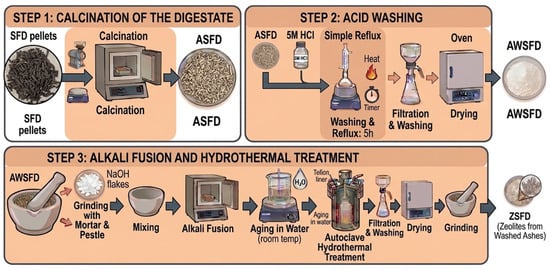
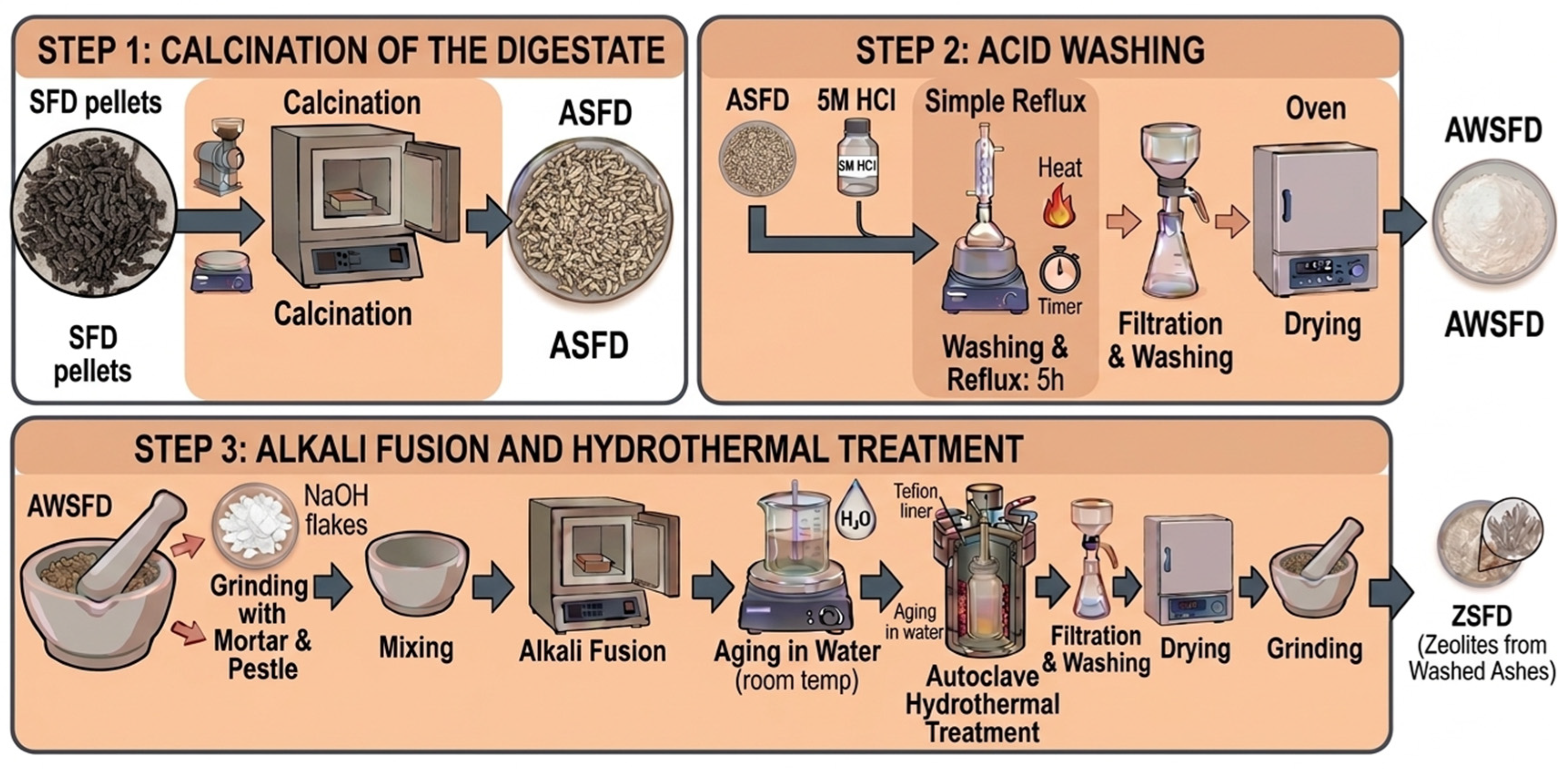
Figure 1 summarizes the synthesis steps of solid adsorbent samples tested in this work.
Figure 1.
Synthesis procedures of SFD ash-based sorbents.
Ash samples were produced by calcinating SFD pellets under static air in a muffle furnace, using a heating rate of 20 °C min−1 up to 700 or 900 °C, and keeping the furnace at this final temperature for 12 h, to ensure complete calcination of the biomass (Figure 1). The same calcination protocol was adopted in our previous study [18], achieving the almost complete removal of residual carbon (approximately 98.5%), thus confirming the effectiveness of thermal treatment. The ash sample calcined at 700 °C was named ASFD700; the one calcined at 900 °C was named ASFD900.
The obtained ashes underwent an acid-washing procedure (Figure 1): (i) 30 g of ash were treated with 500 cm3 of 5 M HCl under continuous stirring at reflux for 5 h; (ii) the resulting suspension was then filtered, and the solid residue was thoroughly washed with distilled water until near neutral pH was reached; (iii) the washed material was dried at 105 °C for 4 h [18,42]. The acid-washed samples were labeled AWSFD700 and AWSFD900, respectively deriving from ASFD700 and ASFD900.
The AWSFD900 sample was selected as the precursor for zeolitization via alkali fusion followed by hydrothermal treatment (Figure 1) [19,43]: (i) AWSFD900 was finely ground by mortar and pestle and mixed with NaOH (ash:NaOH mass ratio of 1:1.2); (ii) the solid mixture was calcined under static air at 550 °C for 1 h in a muffle furnace; (iii) the fused product was dispersed in distilled water (solid:liquid mass ratio of 1:10) and aged in a Teflon liner at room temperature for 24 h; (iv) the liner was sealed in a stainless-steel autoclave and treated hydrothermally at 120 °C for 24 h; (v) the resulting solid was recovered by filtration, washed with distilled water until pH ≈ 7, dried at 105 °C, and finely ground.
2.3. Characterization of Sorbent Materials
The elemental semi-quantitative composition of ASFD700, ASFD900, AWSFD700 and AWSFD900 samples was determined using X-ray fluorescence (XRF) analysis (Spectro, Xepos, Kleve, Germany).
The phase composition and crystallinity degree of the produced samples were analyzed by means of the X-ray diffraction technique (XRD) using a PANanalytical X’Pert PRO diffractometer (PANanalytical, Almelo, The Netherlands) equipped with a Ni filter (CuKα radiation) in the exploration range 10–70° 2θ. The diffraction patterns were collected using a solid-state detector (PIXcel, PANalytical, Almelo, The Netherlands), with the detected X-ray photons binned into 0.026° 2θ constant steps and 10 s per step. The XRD patterns were elaborated by means of the Profile Fit software (HighScorePlus software package, version 4.6a, PANalytical Inc., Almelo, The Netherlands) and the phase identification was carried out by comparison with the ICDD (ICDD, Philadelphia, PA, USA) and ICSD (FIZ Karlsruhe GmbH, Eggenstein-Leopoldshafen, Germany) reference databases.
The specific surface area (SBET) and pore structure of the powder samples were estimated by N2 adsorption–desorption measurements. N2 physisorption measurements were carried out using an Anton Paar Nova 800 BET surface area analyzer (Anton Paar, Graz, Austria). Before analysis, the samples were degassed under vacuum at 150 °C for 16 h to remove physisorbed species. The adsorption–desorption isotherms were recorded at 77 K. The specific surface area was determined using the Brunauer–Emmett–Teller (BET) theory (SBET); the cumulative mesopore volume and modal pore diameter were estimated with the Barrett–Joyner–Halenda (BJH) model applied to the desorption branch.
The particle size distribution (PSD) of the powder samples was measured using laser diffraction with a Malvern Mastersizer 2000 analyzer (Malvern Instruments, Malvern, UK).
Microstructural and morphological analyses were performed using scanning electron microscopy (SEM) with a Zeiss GeminiSEM 500 instrument (Carl Zeiss Microscopy GmbH, Oberkochen, Germany). Local elemental distribution was qualitatively determined by energy-dispersive X-ray spectroscopy (EDS), employing an OXFORD Aztec Energy system equipped with an INCA X-ACT Peltier-cooled detector (OXFORD Instruments, High Wycombe, UK).
Fourier-transform infrared (FT-IR) spectroscopy was carried out using a PerkinElmer Spectrum 3 spectrometer (PerkinElmer, Waltham, MA, USA) equipped with an attenuated total reflectance (ATR) accessory. Spectra were recorded in the range 4000–650 cm−1, averaging 16 with a spectral resolution of 4 cm−1.
2.4. Experimental PSA Rig and Procedure
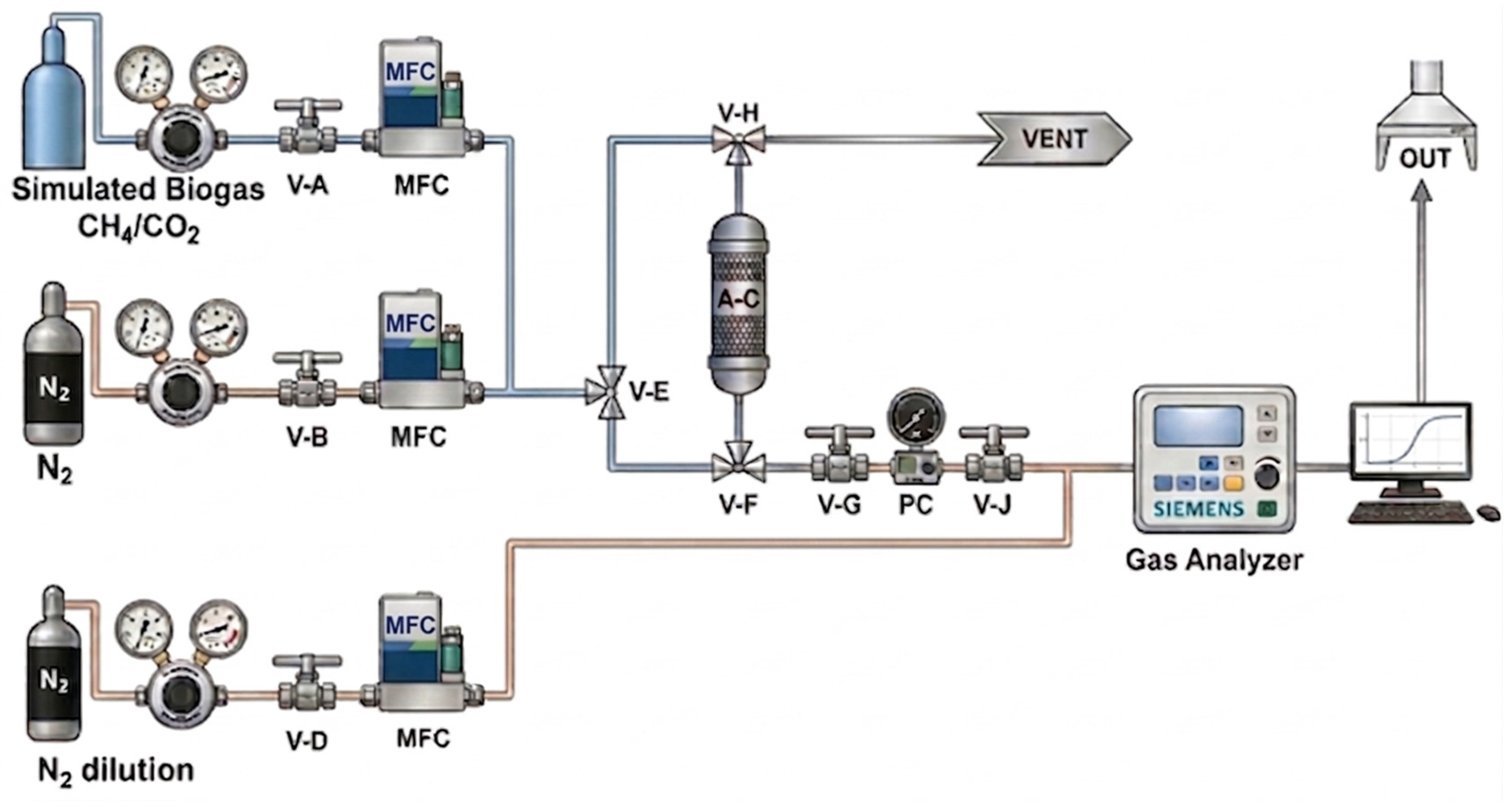
PSA experiments were performed in a laboratory-scale packed-bed rig (Figure 2). An AISI 316L stainless-steel tube (internal diameter 1 cm, length 55 cm) constituted the reactor, which hosted a packed-bed (named “active column” A-C, in Figure 2). The fed flow rates of N2 and synthetic biogas were controlled upstream of the column using BRONKHORST mass flow controllers (Bronkhorst High-Tech B.V., Ruurlo, The Netherlands) (MFCs, Figure 2). The synthetic biogas mixture contained 46.5 vol% CO2 and 53.5 vol% CH4, reflecting the main composition of an industrial biogas [36,40].
Figure 2.
Layout of the laboratory-scale setup for PSA tests (inspired by [36]).
The rig pressure was regulated downstream of the column via use of a BRONKHORST pressure controller (PC, Figure 2). The outlet concentrations of CO2 and CH4 were continuously measured by a SIEMENS ULTRAMAT 23 gas analyzer (Siemens AG, Karlsruhe, Germany) with a 2 s sampling period, which provided sufficient temporal resolution to frame the dynamic behavior of the system. A constant N2 stream of 650 NmL/min was fed directly between the PC and the inlet of the gas analyzer, to ensure the minimum operating flow required by the analyzer.
PSA tests were carried out at three pressure levels (5, 7 and 9 bara) and room temperature—conditions representative of industrial biogas upgrading [34]. The column was packed with 0.5–0.7 g of sorbent.
Each dynamic PSA experiment consisted of four sequential steps, as follows: (i) pressurization—250 NmL/min of N2 filled column A-C up to the target pressure; (ii) adsorption:—100 NmL/min of synthetic biogas were fed downward to A-C, until the outlet CO2 and CH4 composition corresponded to unaltered biogas inlet flow rate; (iii) blowdown:—rapid depressurization of A-C to atmospheric pressure; and (iv) purge—250 NmL/min of N2 were fed upward to regenerate A-C. For each pressure (5, 7, and 9 bara), five consecutive PSA cycles were performed for each sorbent sample, as well as for blank experiments. Blank experiments were performed under identical operating conditions, using an inert packed-bed of AISI316L powder (with particle size range compatible with those of the sorbent materials). Glass beads were always used as the external inert packing layers of the column, sandwiching the bed made of either the AISI316L powder (blank material) or the ash-derived samples, to ensure appropriate column packing and homogeneous gas distribution.
2.5. Data Elaboration
Molar balances applied to the adsorption stage of the dynamic PSA experiments allowed for estimating the instantaneous molar flow rates of CO2 and CH4 at the column outlet (FCO2,out(t) and FCH4,out(t)). N2 was used as the internal standard in those balances [36]. The measured FCO2,out(t) and FCH4,out(t) were then normalized with respect to the inlet flow rates of i = CO2, CH4 by Equation (1) [44], where Fi(t) represents the normalized outlet molar flow rate of component i, Fi,max(t) corresponds to the measured molar flow rate of i at saturation, and Fi,in is the molar flow rate of i fed to the system.
The quantification of the adsorbed amounts of CO2 and CH4 relied on the assumptions of the first order with dead time model (FOWDTM) to describe the gas-mixing behavior [19,36,45,46]. Specifically, the profiles of outlet molar flow rates obtained from blank experiments, at each operating pressure, were employed to determine the total holdup of the experimental rig in the absence of adsorbent materials. For each component i = CO2, CH4, the delay of the outlet concentration curve from an experiment, relative to the curve of a blank under identical test conditions, is proportional to the moles of species i adsorbed by the solid sorbent [36].
The following key performance indicators were calculated for each PSA cycle and for each sorbent sample: the i sorption capacity (Yi, Equation (2)), defined as the total amount of component i adsorbed per unit mass of sorbent up to the end of the adsorption step (tf); the CO2/CH4 selectivity (SCO2/CH4, Equation (3)), defined as the ratio between YCO2 and YCH4.
3. Results
3.1. Characterization of Solid Samples
3.1.1. XRF and XRD Analysis
Table 1 summarizes XRF results, which identify the main elements of the ash-based samples and evidence the effects of the washing treatment.
Table 1.
XRF semiquantitative results (expressed in wt%).
No substantial differences emerged in the inorganic compositions of ashes attributable to the two incineration temperatures (700 and 900 °C) (ASFD700 vs. ASFD900, Table 1). The acid washing treatment led to a significant removal of Mg, Ca, Fe, Na, and P, together with a less pronounced decrease in Al content (ASFD700 vs. AWSFD700, or ASFD900 vs. AWSFD900, Table 1). This leaching was accompanied by a marked increase in the Si fraction (from 6.84 to 36.48 wt% for AWSFD700 and from 5.95 to 32.59 wt% for AWSFD900, Table 1); this corresponded to a substantial increase in the Si/Al ratio, a key parameter for zeolite synthesis [47]. Overall, these findings are consistent with those reported by Joseph et al. [42]. Interestingly, the decrease in P after washing (from approximately 6 wt% in ASFD700 or ASFD900 to about 0.1 wt% in AWSFD700 or AWSFD900, Table 1) suggests that the ash washing carried out in this work may have the additional potential for use in phosphorous recovery [48,49].
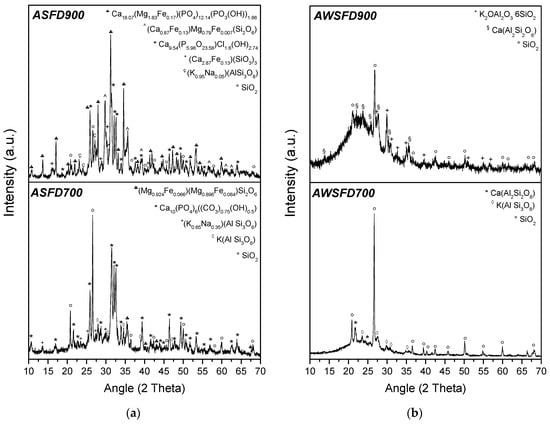
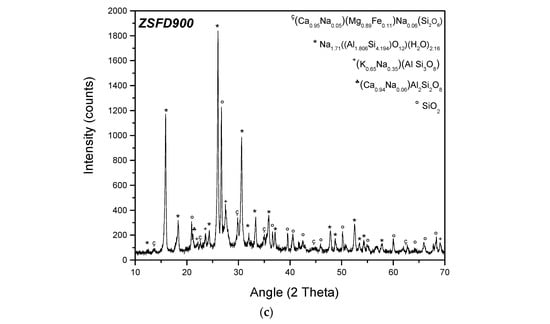
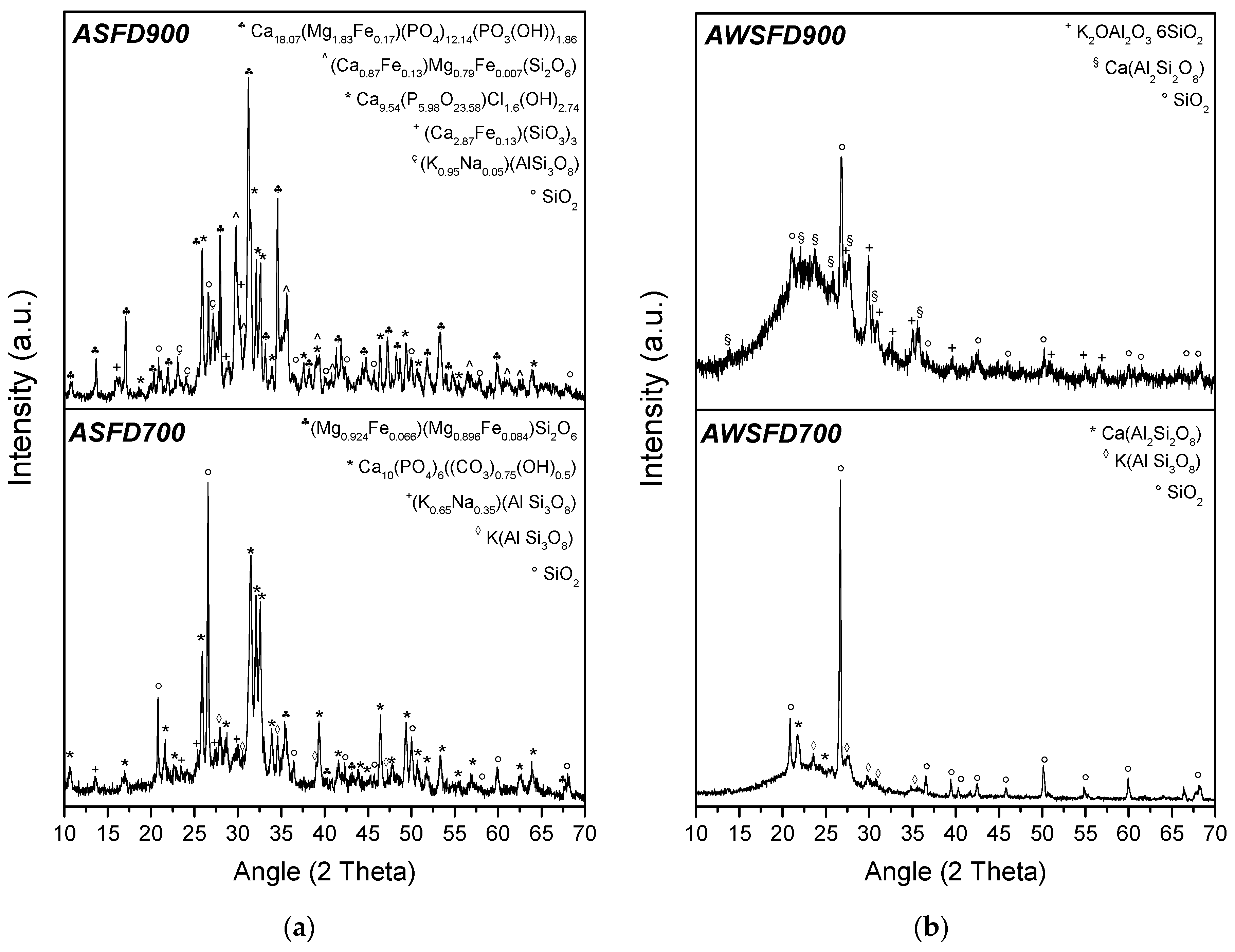
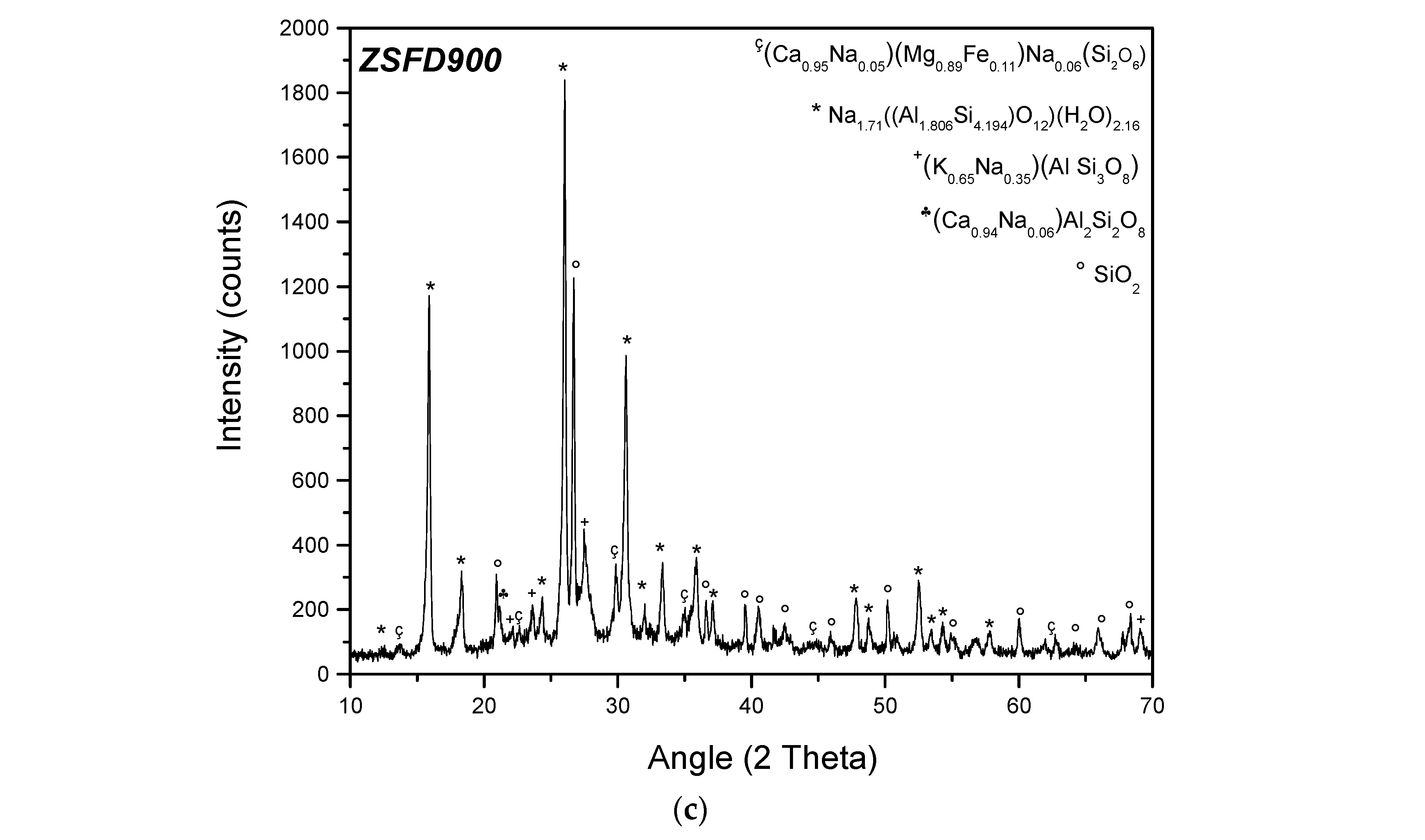
Figure 3 shows XRD patterns. The ash samples (ASFD700 and ASFD900, Figure 3a) exhibited a complex inorganic matrix of crystalline phases, consistent with the literature on biomass ashes [50]. XRD identified crystalline phases corresponding to silicates, phosphates and pyroxene in both ASFD700 and ASFD900 samples (Figure 3a); these constituents are typical of ashes derived from lignocellulosic biomass [50,51]. Specifically, the crystalline phases identified in ASFD700 (Figure 3a) included silicates such as quartz (SiO2) [50,52], microcline K(AlSi3O8) [52,53], sanidine (K0.65Na0.35)(AlSi3O8) [54] and orthopyroxene (Mg0.924Fe0.066)(Mg0.896Fe0.084)Si2O6, together with phosphates (apatite, Ca10(PO4)6((CO3)0.75(OH)0.5) [50,55]. Similarly, in the ASFD900 sample (Figure 3a), the silicate phases included quartz (SiO2) [50,52], microcline (K0.95Na0.05) (AlSi3O8) [52,53] and clinopyroxene (Ca2.87Fe0.13)(SiO3)3 [51], and the phosphate phases included whitlockite (Ca18.07(Mg1.83Fe0.17)(PO4)12.14(PO3(OH))1.86) and apatite (Ca9.54(P5.98O23.58)Cl1.6(OH)2.74) [50,55]. The crystalline phases of the washed ash samples (AWSFD700 and AWSFD900, Figure 3b) included only the silicates quartz and microcline, and Ca aluminosilicate, in agreement with the significant removal of Mg, Fe, Na and P highlighted by the XRF results (Table 1). The XRD of the ZSFD900 sample (Figure 3c) confirms the effectiveness of the zeolitization procedure, as the zeolite “analcime” (Na1.71((Al1.806Si4.194)O12)(H2O)2.16) was the main crystalline phase, with planes peaking at around 16°, 26° and 30° (2θ, Figure 3c). The other identified crystalline phases of ZSFD900 (Figure 3c) were assigned to unreacted quartz, silicates (clinopyroxene), and feldspar (anorthite, sanidine) [56,57], suggesting that zeolitization did not concern the whole treated mass of washed ashes.
Figure 3.
XRD patterns of ASFD700 and ASFD900 (a); AWSFD700 and AWSFD900 (b); ZSFD900 (c).
3.1.2. BET-BJH Analysis
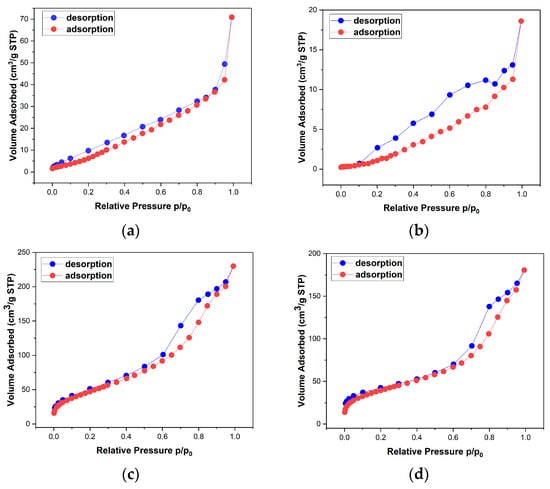
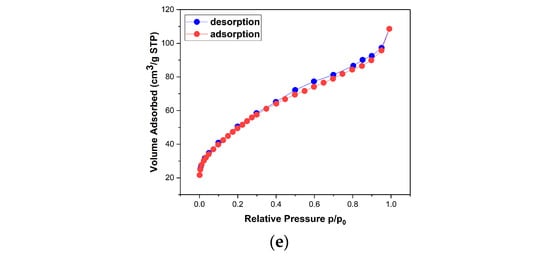
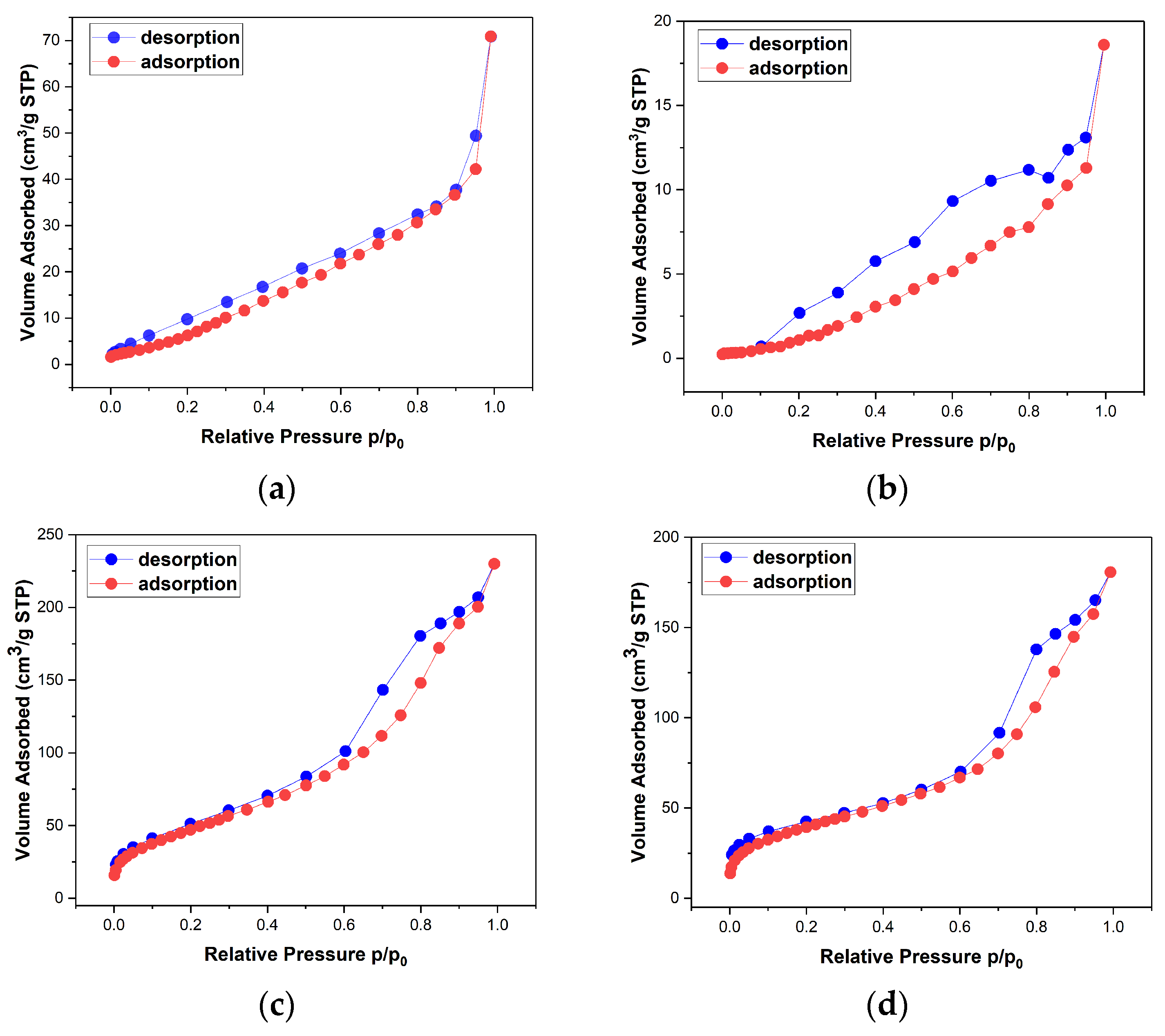
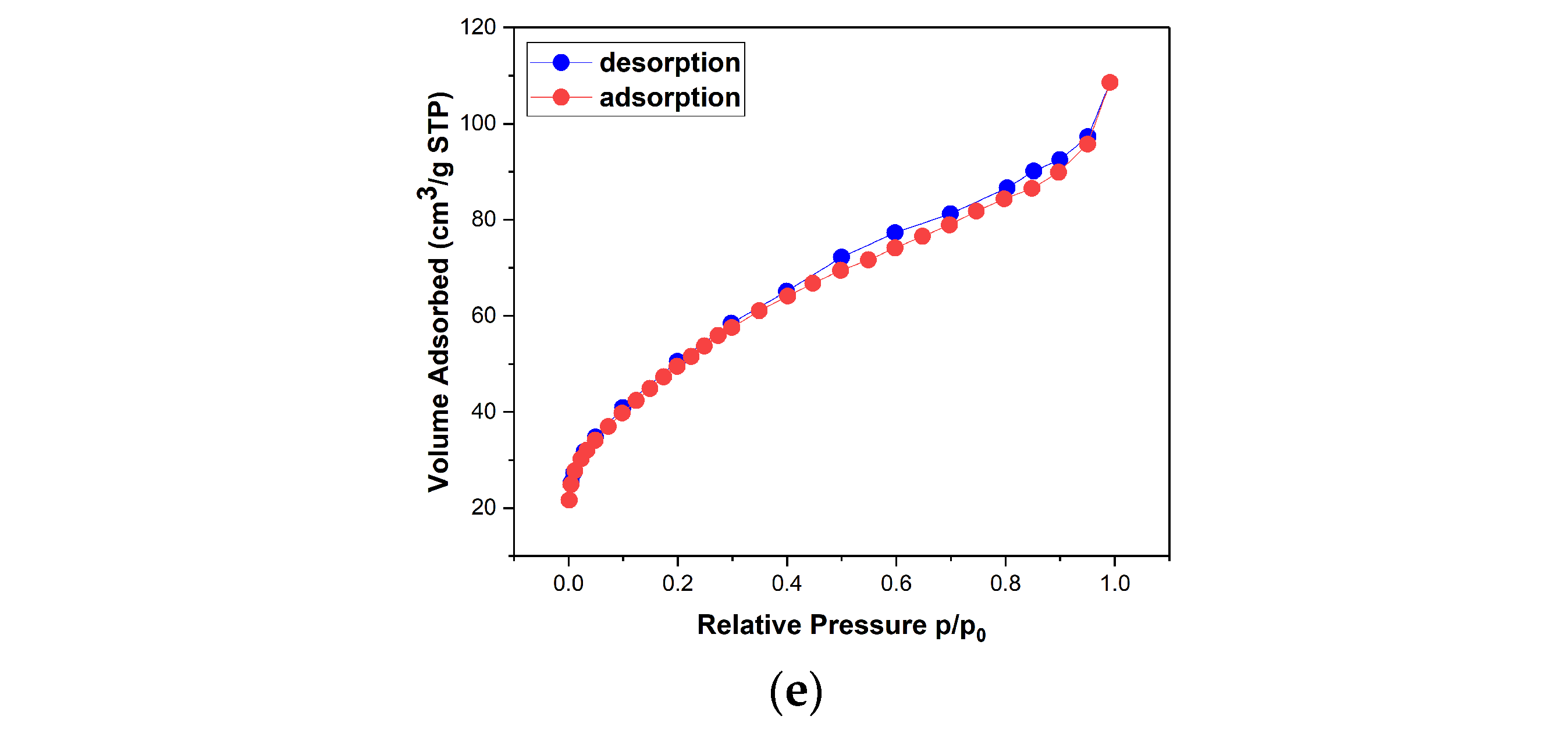
Figure 4 shows the N2 adsorption–desorption isotherms. Table 2 gathers the corresponding textural parameters.
Figure 4.
N2 adsorption–desorption isotherms of the investigated samples recorded at 77 K: (a) ASFD700, (b) ASFD900, (c) AWSFD700, (d) AWSFD900, (e) ZSFD900.
Table 2.
Textural properties of the investigated samples, including BET-specific surface area (SBET), BJH pore volume (VBJH), and BJH modal pore diameter (DBJH) derived from N2 physisorption measurements.
ASFD700 (Figure 4a) and ASFD900 (Figure 4b) exhibited type II/III isotherms, indicative of the limited porosity and adsorption mainly associated with external surface area and/or interparticle voids, thus consistent with very low BET surface areas of 28.0 and 4.0 m2 g−1, respectively (Table 2) [58].
After acid washing, AWSFD700 (Figure 4c) and AWSFD900 (Figure 4d) displayed type IV isotherms with H2(b)-like hysteresis loops [59], attributable to percolation and pore blocking phenomena. Acid washing led to a marked increase in surface area (SBET of 185.1 for AWSFD700 m2 g−1 and 145.6 m2 g−1 for AWSFD900, Table 2) [60]. This change of SBET after washing was accompanied by higher mesopore volumes (VBJH of 0.30 and 0.23 cm3 g−1, Table 2) and an almost twofold increase in BJH modal pore diameter compared to the untreated ashes (DBJH, Table 2), reflecting a possible acid-etching modification of the ash matrix. Samples treated at 900 °C showed the smallest surface areas compared with the corresponding samples treated at 700 °C; this was ascribable to thermally induced sintering in the ashes, resulting in partial pore collapse [61].
ZSFD900 (Figure 4e) exhibited a predominant type I isotherm with a minor type IV contribution, characteristic of a mainly microporous structure. Consistently, ZSFD900 exhibited a high SBET (187.2 m2 g−1, Table 2) and a relatively low VBJH (0.07 cm3 g−1, Table 2), highlighting the dominant contribution of microporosity associated with the zeolitic framework. The SBET of ZSFD900 was relatively higher than that of the analcime sample reported in the literature [62,63]; this can be attributed to the different nature of the ash-derived precursor and the synthesis approach adopted in this study. ZSFD900 consists of analcime mixed with residual unreacted silicate phases, as confirmed by the XRD analyses (Figure 3). Moreover, the acid washing pre-treatment significantly modified the chemical composition and surface characteristics, thereby enhancing surface accessibility prior to zeolitization.
3.1.3. Particle Size Distribution
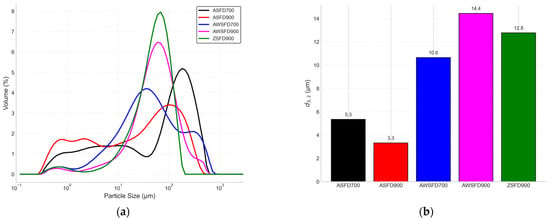
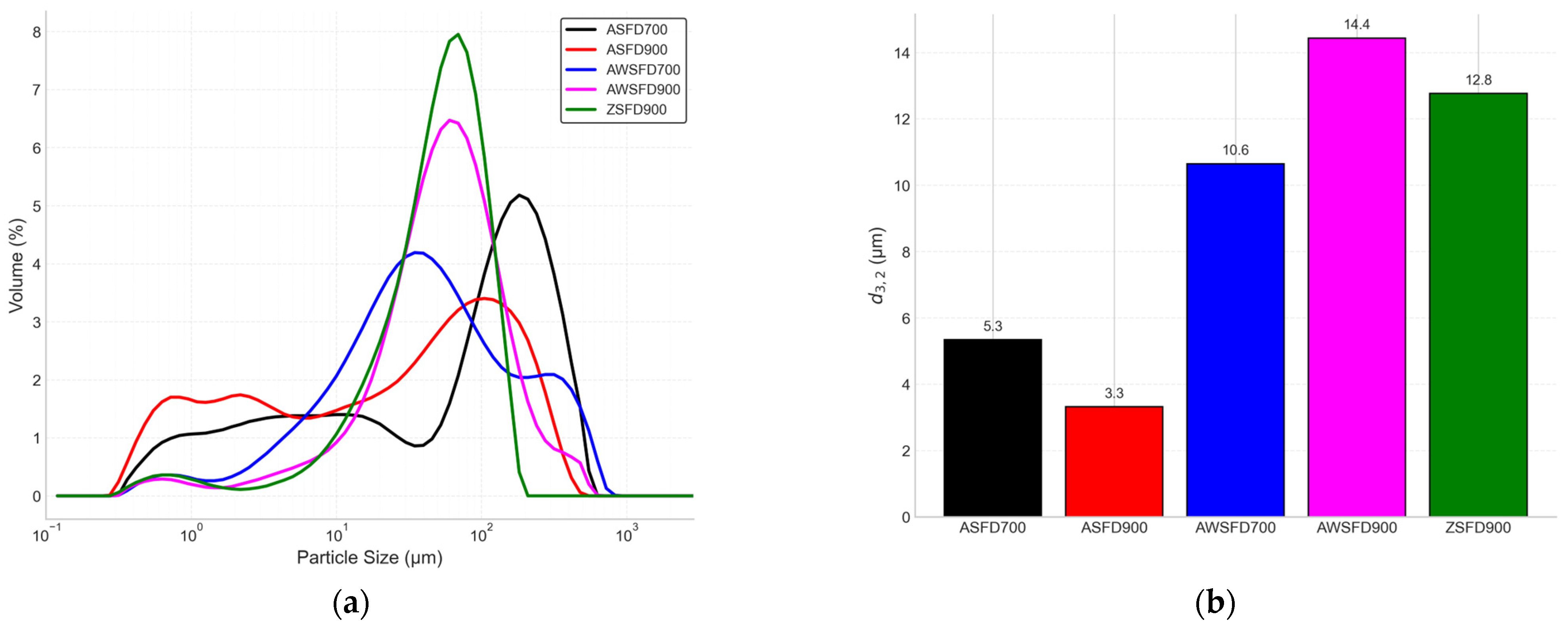
Figure 5 presents the particle size distributions (PSDs) of the tested sorbents. Ashes ASFD700 and ASFD900 had a polymodal distribution, with a significant fraction of fine material (Figure 5a); this contributed to the low Sauter mean diameter (d3,2) of these samples, in the order of 100 μm. The treated ash samples (AWSFD700, AWSFD900 and ZSFD900) had higher d3,2 values, on the order of 101 μm, likely due to the synthesis steps of acid washing and zeolitization. The PSD analysis guided the selection of the appropriate blank material. In addition, the results in Figure 5 indicate that the particle sizes of the samples were sufficient to minimize intraparticle mass transfer limitations.
Figure 5.
Particle size distribution (a) and Sauter mean diameter (b).
3.1.4. SEM-EDS
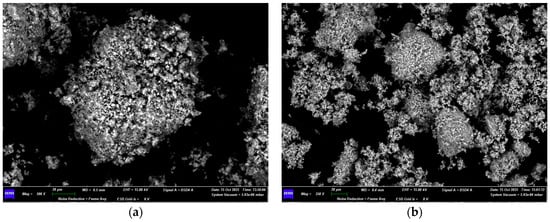
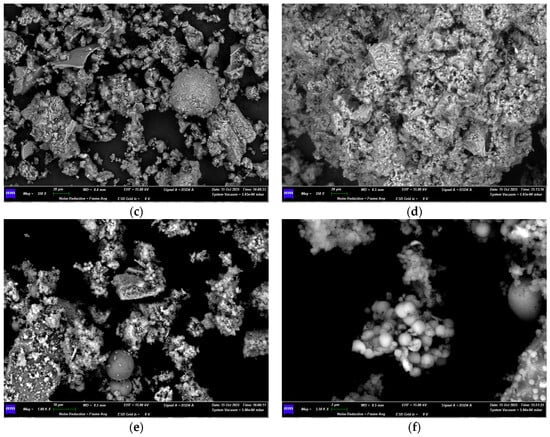
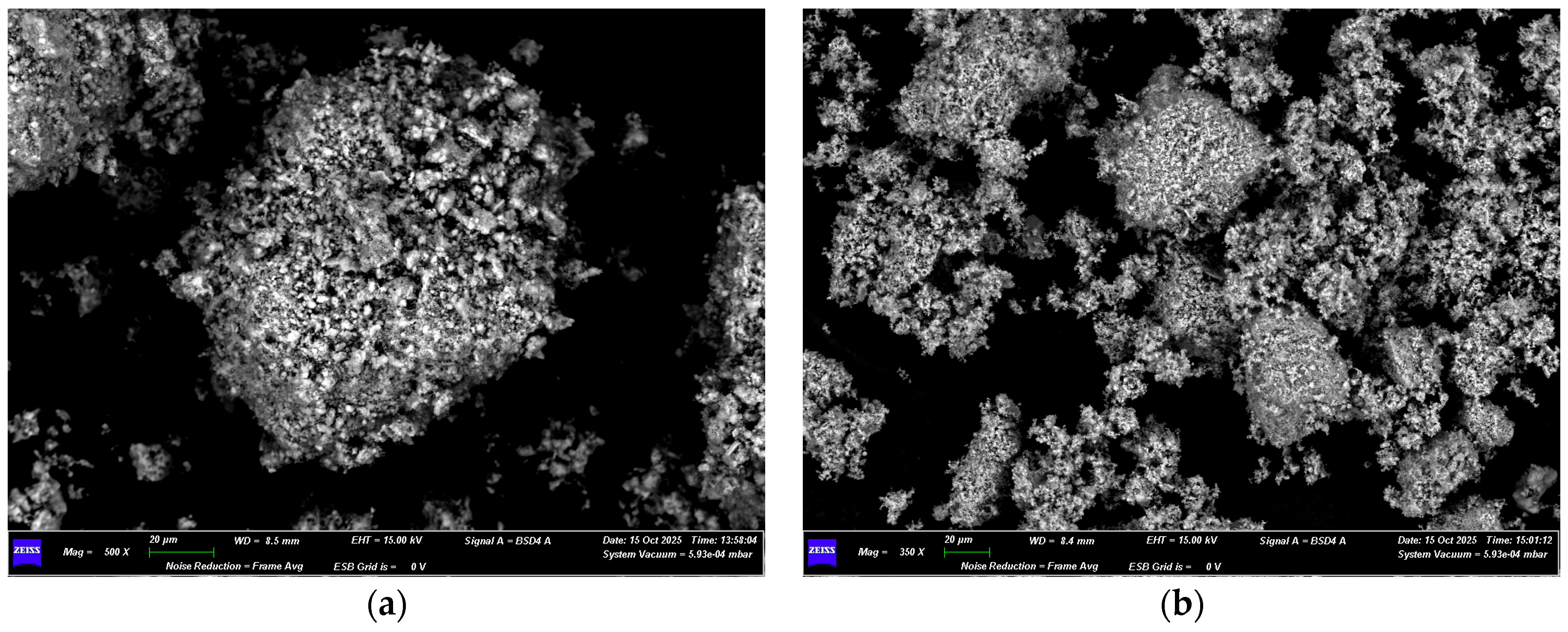
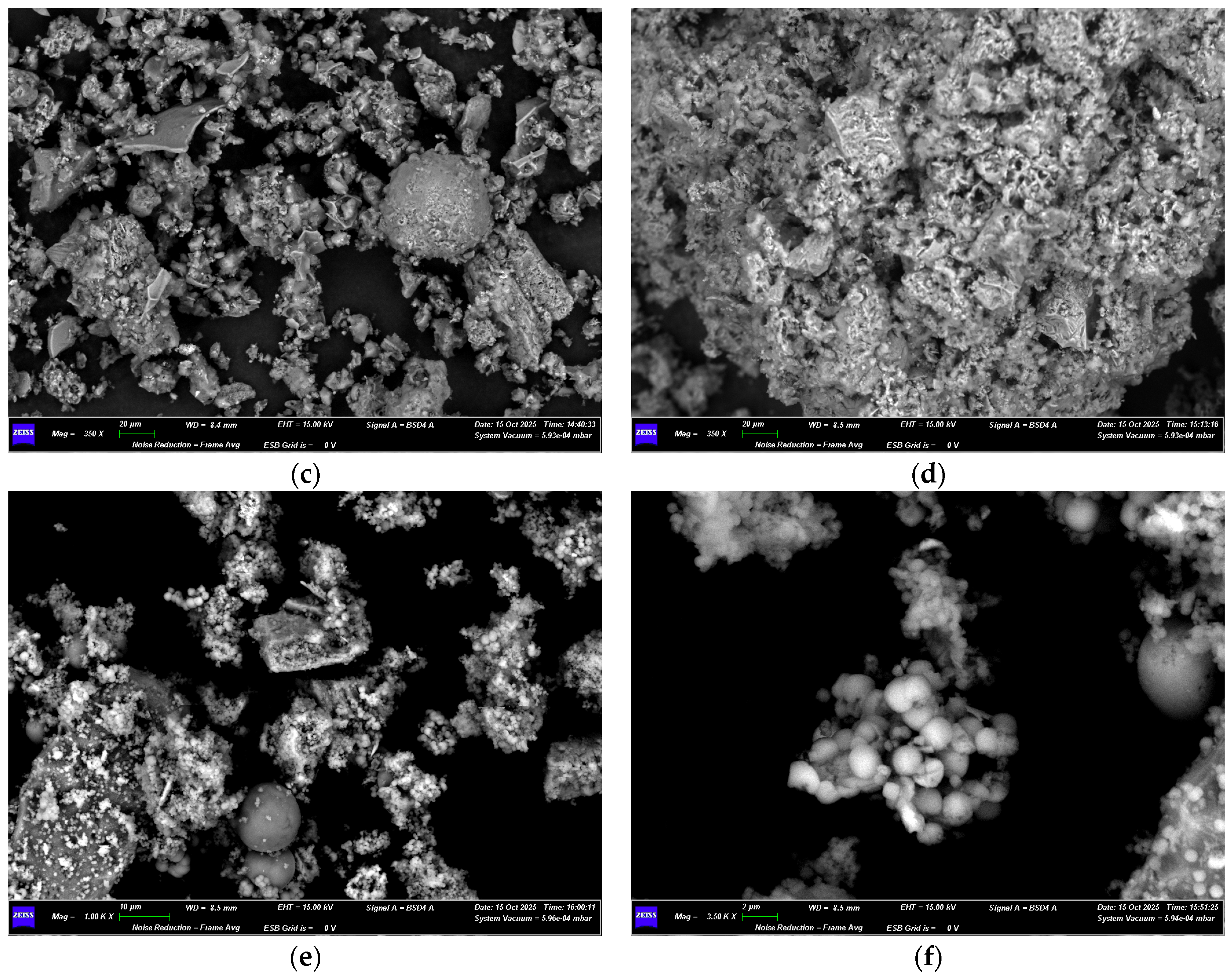
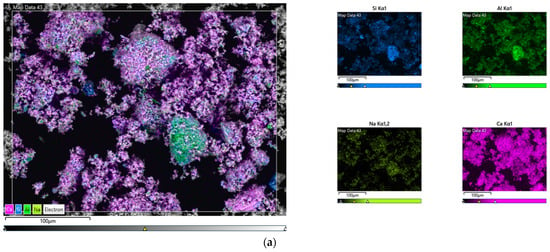
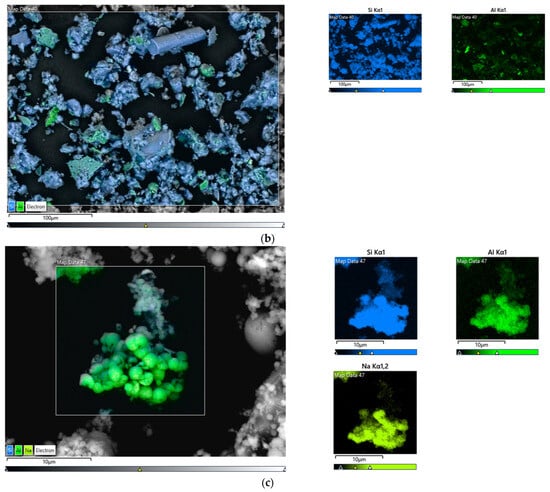
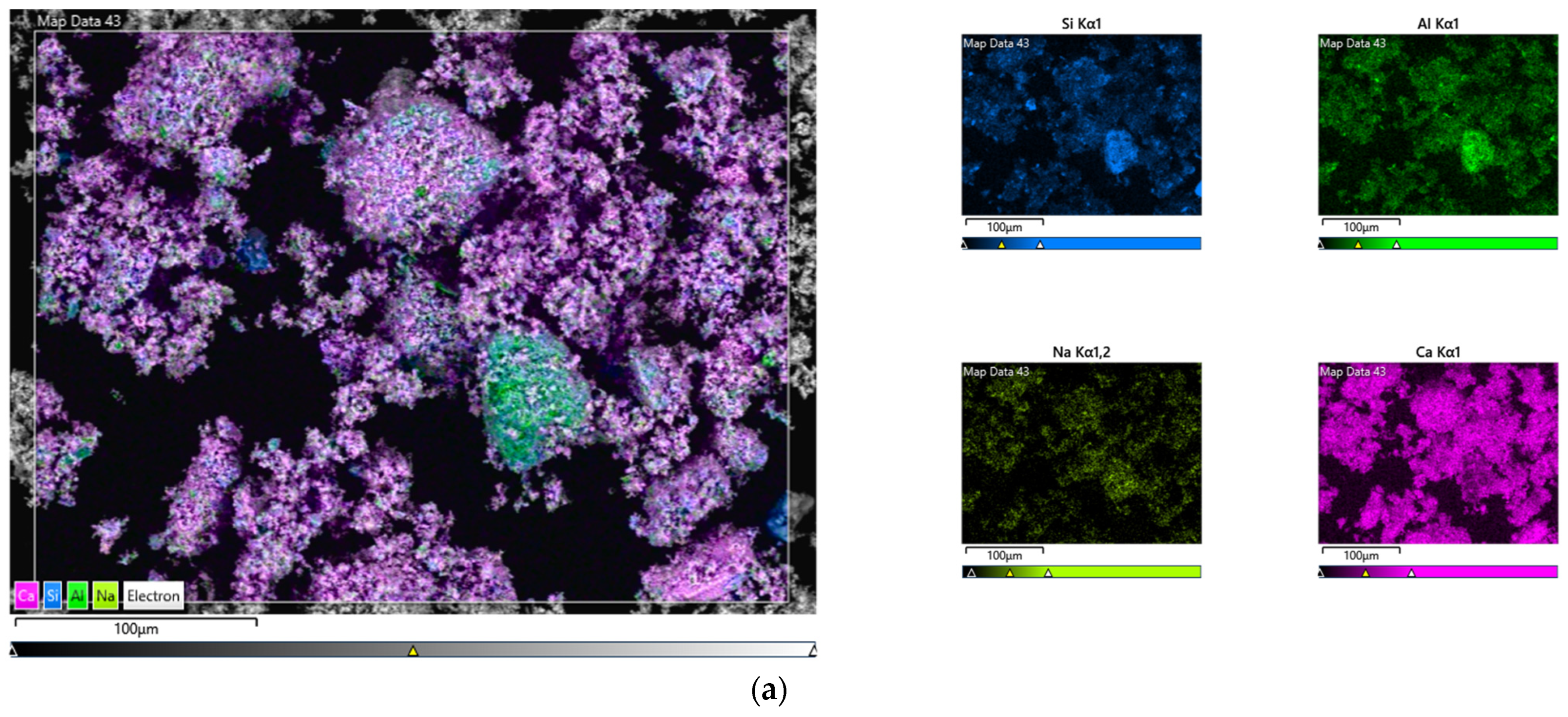
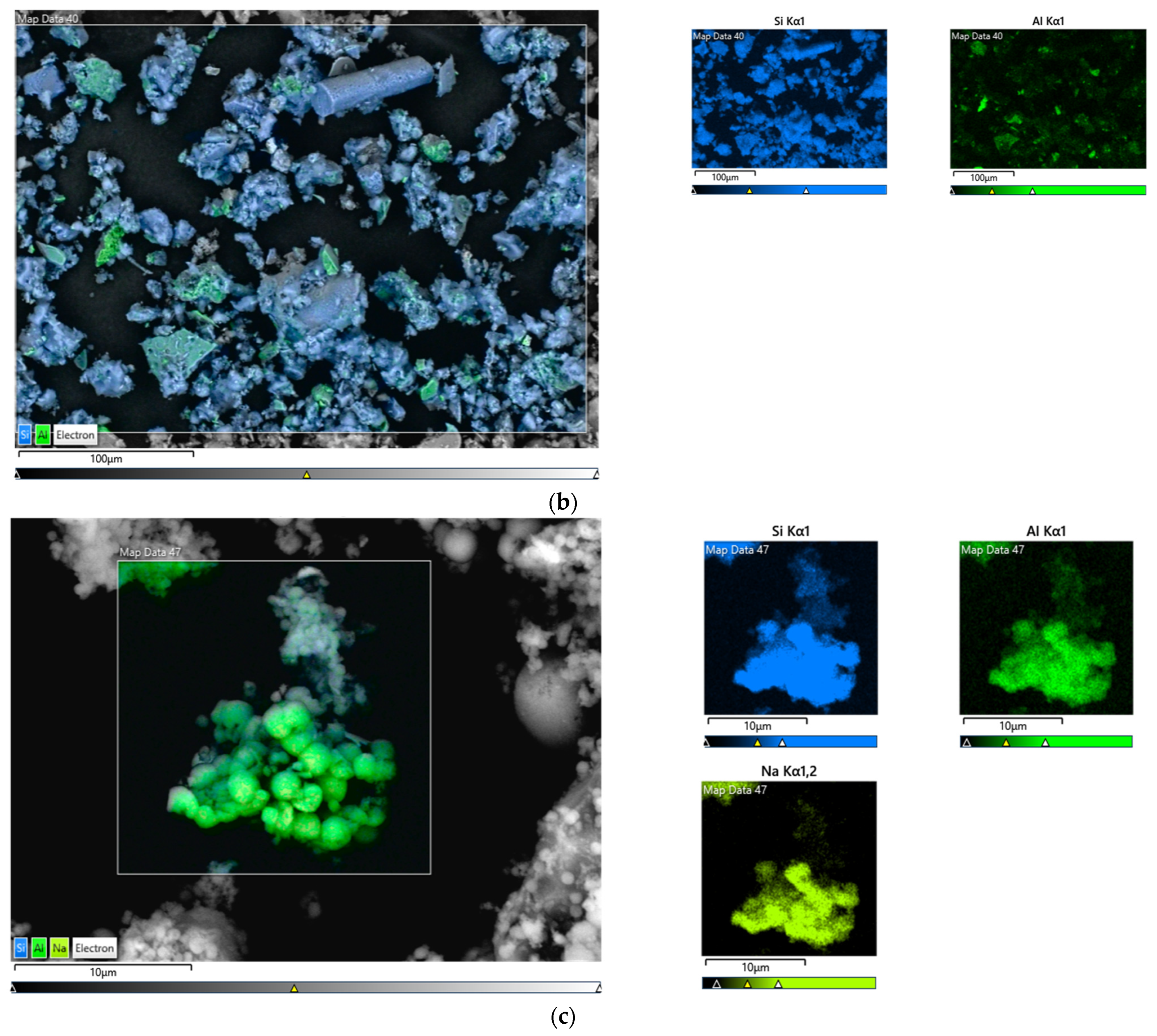
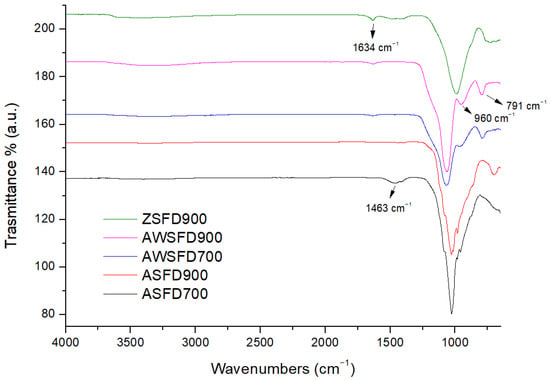
Figure 6 shows SEM micrographs and Figure 7 collects the SEM-EDS mapping, performed to investigate the local distribution of the main elements.
Figure 6.
SEM micrographs of synthesized ash-based sorbent samples: (a) ASFD700 (magnification at 500×); (b) ASFD900 (magnification at 350×); (c) AWSFD700 (magnification at 350×); (d) AWSFD900 (magnification at 350×); (e,f) ZSFD900 (magnification at 1000× and 3500×, respectively).
Figure 7.
SEM-EDS maps of ash-based sorbent samples: (a) ASFD900 (scale bar, 100 μm; magnification, 350×); (b) AWSFD700 (scale bar, 100 μm; magnification, 350×); (c) ZSFD900 (scale bar, 10 μm; magnification, 3500×).
The ashes ASFD700 (Figure 6a) and ASFD900 (Figure 6b) had similar morphologies, with irregularly shaped particles, in agreement with similar cases [64]; EDS of ASFD900 (Figure 7a) highlighted the presence of Ca, Si and Al with minor traces of Na (in agreement with elements found in XRD crystalline phases, Figure 3a).
Figure 6c and Figure 6d respectively show the morphology of washed ashes AWSFD700 and AWSFD900. The EDS map of AWSFD700 (Figure 7b) confirms the removal of Ca by the acid washing treatment, in favor of Si’s relative abundance (compare with XRF analysis, Table 1); this Si was distributed among the silica and aluminosilicates identified by XRD analysis (Figure 3b).
Figure 6e,f show the SEM micrographs of ZSFD900, appearing as aggregates of spherical particles, attributed to analcime in the literature [65,66,67]. This attribution is supported by the SEM-EDS map of ZSFD900 (Figure 7c), which shows the presence of Si, Al and Na within the spherical particles, consistent with the composition of the analcime phase Na1.71((Al1.806Si4.194)O12)(H2O)2.16 identified by XRD analysis (Figure 3c).
3.1.5. FT-IR
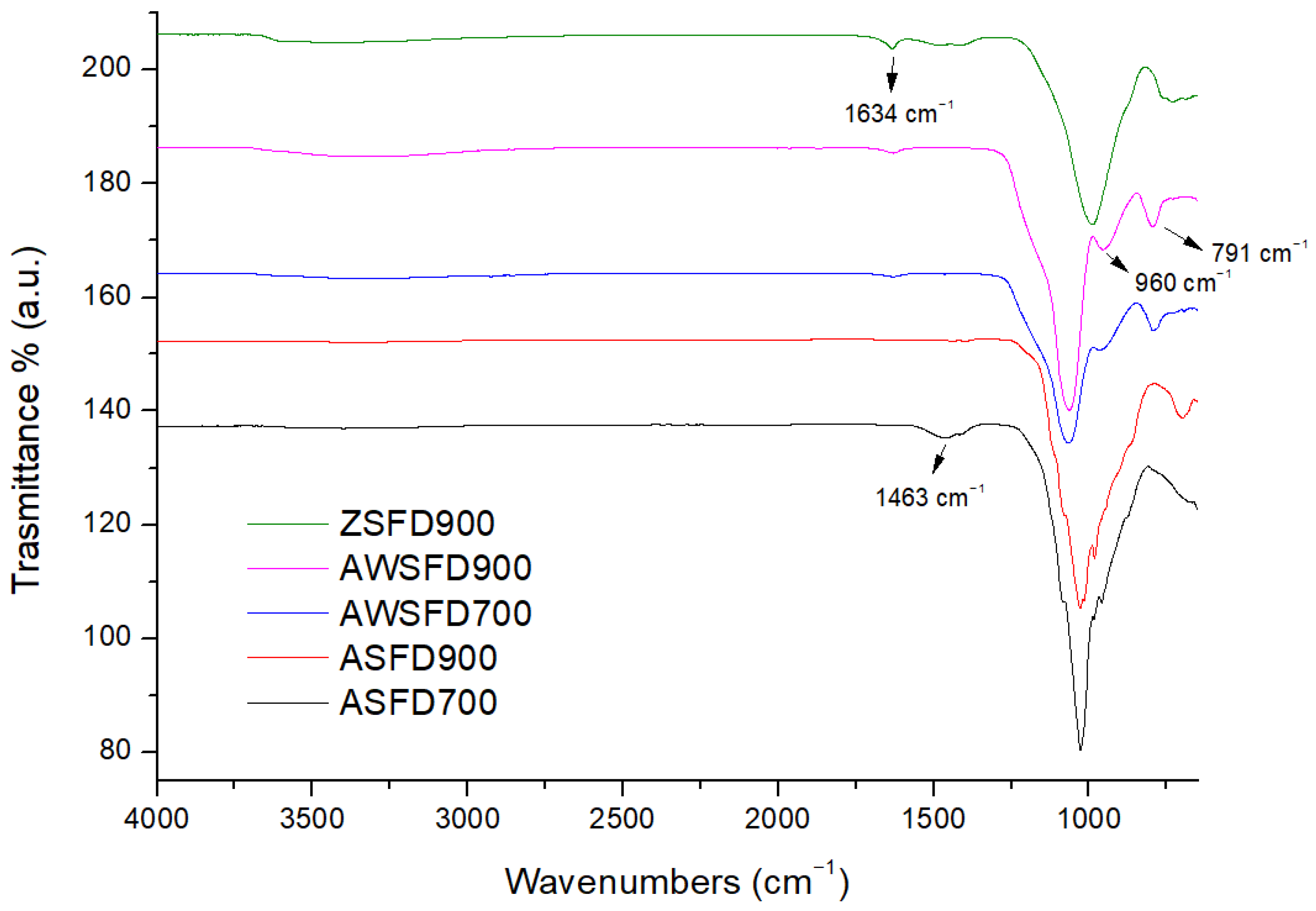
Figure 8 shows the FT-IR spectra of the five materials. ASFD700 and ASFD900 were very similar, except for the band centered at 1463 cm−1, which disappeared in ASFD900. This band was assigned to carbonate groups (CO32−) [68].
Figure 8.
FT-IR spectra of the samples studied before PSA upgrading tests.
The absence of this signal in ASFD900 suggests that a higher calcination temperature promoted carbonate decomposition or the transformation of carbonate-containing species.
The 1200–800 cm−1 region contained the most relevant features, mainly associated with the overlapping of Si–O–Si and Si–O–Al stretching vibrations of silicate and aluminosilicate phases [68,69]. In this region, no significant differences were observed between the ASFD samples. However, clearer differences were observed after acid treatment. In AWSFD samples, two additional bands at approximately 960 and 791 cm−1 became visible, whereas they were not distinguishable in ASFD samples. The band centered at 960 cm−1 was assigned to Si–O stretching mode and the band near 791 cm−1 was compatible with Si–O–Si vibrations of quartz or silica-rich silicate phases [68,69]. These observations suggest that acid treatment removed acid-sensitive species, increasing the relative contribution of Si-rich silicate/aluminosilicate phases, in agreement with XRF and XRD analyses.
A more pronounced change was observed when comparing AWSFD900 with ZSFD900. In ZSFD900, the main band in the T–O–T region (T = Si or Al) shifted toward lower wavenumbers (around 980–1000 cm−1), indicating a modification of the aluminosilicate framework after alkaline fusion and hydrothermal treatment. This shift was consistent with the formation of a zeolitic aluminosilicate material and the increased contribution of Si–O–Al linkages compared with Si–O–Si [70].
Finally, unlike the ASFD samples, AWSFD and ZSFD spectra showed bands around 3300 cm−1 (O–H stretching) and 1634 cm−1 (H–O–H bending) of adsorbed or retained water. In AWSFD, this was consistent with surface rehydration after acid treatment; in ZSFD, it might also reflect the higher water affinity of the zeolitic aluminosilicate structure.
3.2. PSA Tests
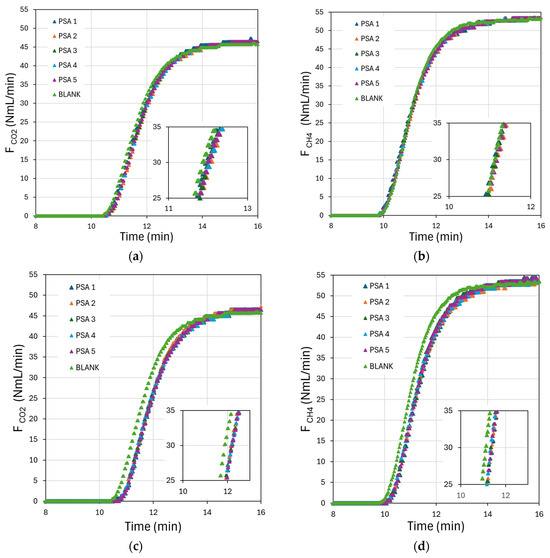
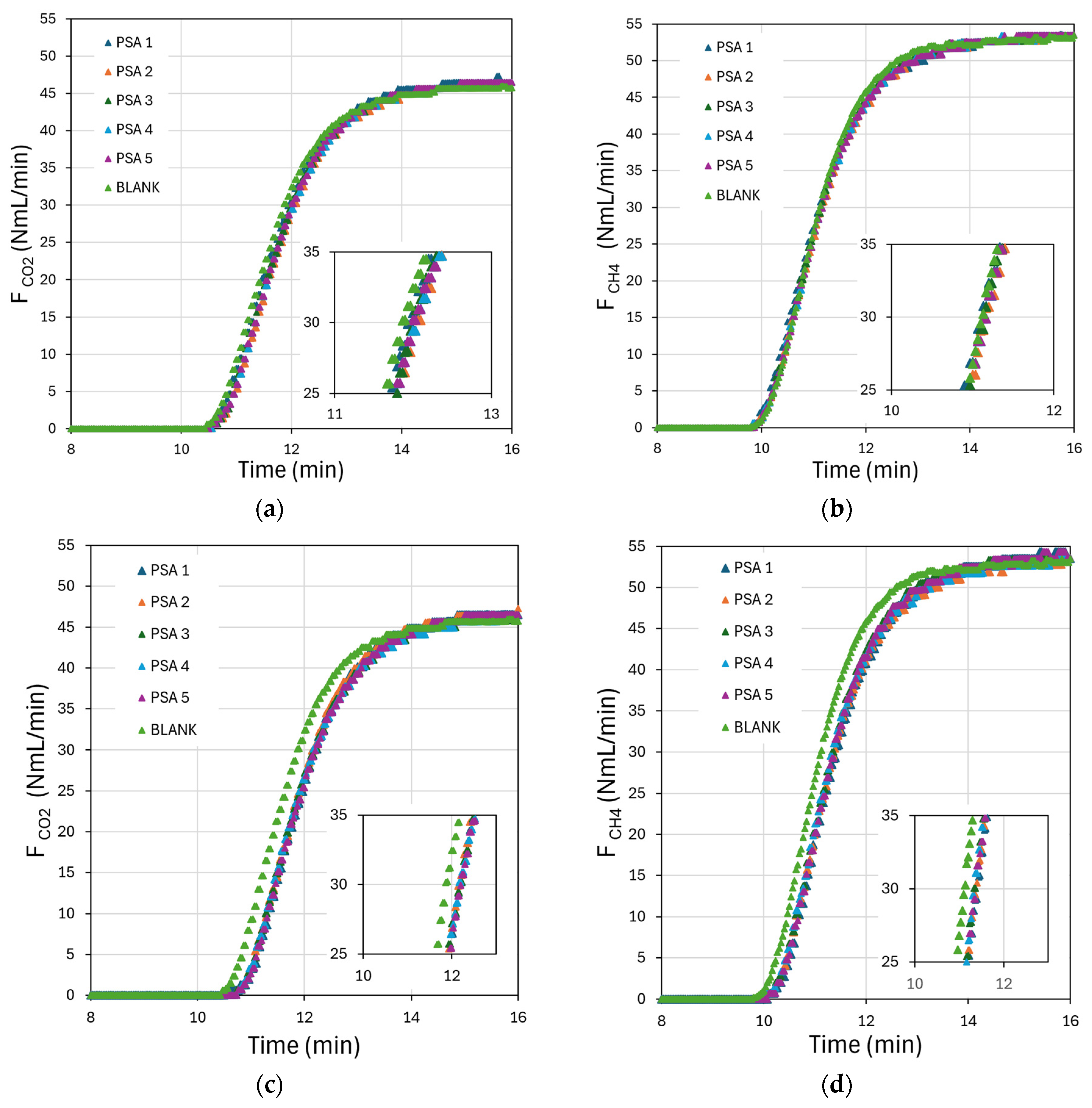
Figure 9 shows the normalized FCO2(t) (Figure 9a) and FCH4(t) (Figure 9b) from tests with ASFD700 at 9 bara, chosen as an example of the behavior observed for the ashes ASFD700 and ASFD900. Figure 9c,d do the same for AWSFD700, chosen as an example to show the behavior observed for AWSFD700, AWSFD900 and ZSFD900. Regardless of sample type, both CO2 and CH4 curves exhibited the typical sigmoidal trend reported for dynamic adsorption systems [36,40,71].
Figure 9.
Example of response curves for the tests performed with ASFD700 and AWSFD700 at 9 bara (PSAn, nth PSA adsorption cycle with n = 1,…,5) and the corresponding blank test under the same operating conditions. CO2 outlet flow rate (a) and CH4 outlet flow rate (b) for ASFD700; CO2 outlet flow rate (c) and CH4 outlet flow rate (d) for AWSFD700.
As to ASFD700 and ASFD900, the PSA responses of FCO2(t) and FCH4(t) were always extremely close to or overlapped with those obtained from the blank tests (Figure 9a,b). This result indicates that the CO2- and CH4-sorption capacities of untreated ashes were negligible or so low as to be undetectable by the adopted experimental method, at any pressure operated in this work.
AWSFD700, AWSFD900 and ZSFD900 exhibited a clear separation between blank and PSA curves of FCO2(t) and FCH4(t), as exemplified in Figure 9c,d. In other words, the treated ashes actually adsorbed CO2 and CH4. AWSFD700, AWSFD900 and ZSFD900 always showed an almost complete overlap of curves from the consecutive adsorption steps (PSAn, n = 1,…,5, examples in Figure 9c,d), without any drift related to progressive cycle number. This observation confirms the complete regeneration and stable adsorptive behavior of AWSFD700, AWSFD900 and ZSFD900 sorbents. All this considered, the PSAn cycles were treated as statistical replications of the same phenomenon, so sorption capacities were estimated as the averages over five cycles.
Pressure significantly affected the average sorption capacities YCO2 and YCH4 (Table 3). They increased with increasing pressure for AWSFD700, AWSFD900, and ZSFD900. This behavior was attributable to the increase in partial pressures, which made the driving force of adsorption grow [37]. decreased with increasing pressure for AWSFD700, AWSFD900, and ZSFD900 (Table 3), indicating that the extent of CH4 adsorption became progressively more significant along with pressure, in agreement with the findings of Peredo-Mancilla et al. [72].
Table 3.
Average experimental CO2 sorption capacity (YCO2), CH4 sorption capacity (YCH4), CO2/CH4 selectivity (SCO2/CH4) out of five cycles as functions of pressure (P); average values with 95% confidence intervals from the five replications.
The AWSFD700, AWSFD900, and ZSFD900 sorbents exhibited appreciable CO2 sorption capacities (Table 3), reaching average values of 1.06 mmolCO2 g−1 (for AWSFD900), 1.00 mmolCO2 g−1 (for AWSFD700) and 0.97 mmolCO2 g−1 (for ZSFD900) at 9 bara; ASFD700 and ASFD900 did not show appreciable uptakes under the same conditions (Table 3). This marked difference could be partially attributed to the substantially higher SBET of washed or zeolitized ashes; 185, 146 and 187 m2 g−1 were measured for AWSFD700, AWSFD900, and ZSFD900, respectively, compared to 4 and 28 m2 g−1 for ASFD700 and ASFD900, respectively (Table 2). However, the differences in CO2 uptake among the treated materials indicate that adsorption was not governed exclusively by BET surface area, but might also depend on the chemical nature of the adsorption sites and the pore structure; e.g., Table 3 shows that CO2 uptake at the lower pressure of AWSFD700 was slightly higher than that of AWSFD900, and Table 1 shows that AWSFD700 had a higher content of K (probably bringing higher basicity).
The comparison of the upgrade performance among AWSFD700, AWSFD900 and ZSFD900 (Table 3) reveals no substantial differences. This similarity was attributed to the incomplete conversion of the washed ash into a zeolitic material. XRD analysis (Figure 3) shows that, besides the zeolitic phase, unreacted quartz and aluminosilicates were still present after the zeolitization. Furthermore, Querol et al. [73] reported that analcime (i.e., the zeolite in ZSFD900, Figure 3) has very small pore openings, which are unable to effectively trap gas molecules such as CO2, SO2 and NH3. Therefore, it is reasonable to assume that the observed sorption performance of ZSFD900 was mainly governed by compounds derived from the acid-washing treatment, including those remaining after the partial zeolitization, rather than by the zeolitic framework itself.
The materials in this work showed lower biogas upgrading performances than waste-derived sorbents reported in the literature [19,36]. The activated biochar produced from vineyard pruning pellet [36,40,71] showed a YCO2 of 3.3–5.3 mmolCO2 g−1 at 5 bara, considerably higher than the capacities obtained in the present study; those biochar samples had larger specific surface areas (SBET ~600–750 m2 g−1 [71]). The same family of biochar samples [36,40] exhibited a SCO2/CH4 of approximately 1.9 and 2.5 mmolCO2 mmolCH4−1 [36,40]. Ferella et al. [19] synthesized three fly-ash-derived zeolites, with zeolitic phases 13X and 4A distributed with different 13X/4A ratios: at 5 bara, these materials ensured YCO2 of 0.34, 0.33 and 0.25 mmolCO2 g−1, and SCO2/CH4 of 6.5, 6.6 and 2.3 mmolCO2 mmolCH4−1. Although the CO2 adsorption capacities in Ferella et al. [19] were comparable to those obtained for the materials investigated in the present study (Table 3), the significantly higher SCO2/CH4 highlights the key role of zeolite type in determining gas separation performance.
The similarity of the performances of AWSFD700, AWSFD900 and ZSFD900 suggests that zeolitization may be avoided for the SFD ashes used in biogas upgrading. Avoiding this step is an advantage in terms of synthesis costs and sustainability, given that the applied zeolitization involved additional chemical and thermal treatments. Overall, ash-derived materials demonstrated promising potential for use in the development of sorbents for CO2 capture and biogas upgrading, at least in those cases when SCO2/CH4 > 1 (Table 3).
Overall, the current study provides useful insights into the hydrothermal conversion of SFD ash into zeolitic materials. Under the adopted synthesis conditions, the analyses confirm the formation of a zeolitic phase, indicating that biomass ash can be successfully converted into a crystalline zeolite without the addition of external silica or alumina sources. However, the adsorption results suggest that the zeolite framework obtained under these conditions (i.e., analcime) was not the most suitable for CO2/CH4 separation. Furthermore, the study by Ferella et al. [19] reported the synthesis of zeolite 13X from fly ash using the same zeolitization procedure as in the present work. This demonstrates that the same synthesis route could yield different zeolitic products depending on the features of the starting feedstock. In the synthesis of zeolites from biomass ashes, the chemical and mineralogical composition of the precursor (including the Si/Al ratio, the nature of the crystalline phases, and the presence of impurities) plays a key role in determining which zeolite phase forms under a given set of synthesis conditions. Since the acid-washed precursor of the current study exhibited a high Si/Al ratio, future investigations should focus on the incorporation of sustainable Al-rich waste-derived sources [74,75]. This could tailor the precursor composition and direct the crystallization towards alternative zeolite frameworks, such as zeolite A, X or Y, which are known for their larger pore openings and their suitability for CO2 capture and biogas upgrading.
4. Conclusions
This study has demonstrated the potential valorization of ashes from the solid fraction of digestate to produce recovered sorbents that are exploitable for biogas upgrading by pressure swing adsorption.
No substantial differences emerged in the inorganic composition or adsorption performances, attributable to the different calcination temperatures of 700 °C or 900 °C employed in this work.
Acid-washing effectively removed Mg-, Ca-, Fe-, Na-, and P-containing phases, increasing the Si/Al ratio and surface area. Interestingly, phosphorous content decreased from approximately 6 wt% (in ashes from the solid fraction of digestate) to about 0.1 wt% after washing. This suggests that the acid-washing might have the additional potential for phosphorous recovery during the ash treatment, in line with the circular economy approach. The washed ashes exhibited significantly higher CO2 and CH4 sorption capacities than untreated ashes.
The zeolitization of acid-washed ash promoted the partial formation of analcime (as observed by XRD analysis) and improved BET surface area (187 m2 g−1). However, the adsorption performance was similar to that of the acid-washed ashes, likely due to the persistence of unreacted crystalline phases and the limited pore size of analcime, which limits selective CO2 adsorption. Notably, this similarity of performances strongly suggests that the zeolitization offers no substantial advantages for biogas upgrading by PSA. However, it should be noted that this conclusion is based exclusively on the AWSFD900 precursor, as zeolitization was not evaluated for the AWSFD700 sample (due to ashes shortage). Therefore, further studies involving additional precursors and synthesis pathways are required to confirm whether this observation can be extended to other ash-derived sorbents. Removing this step could represent a more efficient and greener strategy for SFD ash valorization, reducing processing complexity, chemical consumption, synthesis costs, and environmental impact.
Overall, the potential of using treated digestate-derived ashes as sorbents for CO2 capture was demonstrated by the result of performances comparable to those reported for other ash-derived sorbents. Nevertheless, the further optimization of the synthesis procedure and a comprehensive cost and resource analysis of the synthesis steps are required to fully evaluate their practical applicability. Future work should focus on (i) developing wide-pore zeolitic structures (such as zeolites A, X, or Y) through the incorporation of suitable sustainable aluminum sources to tune the Si/Al ratio; (ii) bypassing the zeolitization step entirely when acceptable adsorption performances can be achieved with acid-washed ashes, thereby reducing processing complexity, chemical consumption, and synthesis costs.
The solid fraction of digestate may be inherently heterogeneous as a feedstock; therefore, industrial exploitation should involve careful preliminary characterizations of this feedstock.
Author Contributions
Conceptualization, D.M., K.G., L.R. and A.D.G.; methodology, D.M., V.D., P.C., G.D.V.N., K.G., L.R. and A.D.G.; software, D.M., V.D., P.C. and G.D.V.N.; validation, K.G. and A.D.G.; formal analysis, D.M., K.G. and A.D.G.; investigation, D.M., V.D., P.C. and G.D.V.N.; resources, K.G., L.R. and A.D.G.; data curation, D.M., V.D., P.C., G.D.V.N., K.G. and A.D.G.; writing—original draft preparation, D.M., V.D., P.C., G.D.V.N., K.G., L.R. and A.D.G.; writing—review and editing, D.M., V.D., P.C., G.D.V.N., K.G., L.R. and A.D.G.; visualization, D.M., V.D., P.C., G.D.V.N., K.G. and A.D.G.; supervision, K.G., L.R. and A.D.G.; project administration, K.G., L.R. and A.D.G.; funding acquisition, K.G., L.R. and A.D.G. All authors have read and agreed to the published version of the manuscript.
Funding
The APC was funded by Italian Project PERCIVAL (ARS01_00869 (Processi di EstRazione di bioprodotti da sCarti agroIndustriali e VALorizzazione in cascata), funded by the PNR 2015-2020 Italian program).
Data Availability Statement
The raw data supporting the conclusions of this article will be made available by the authors on request.
Acknowledgments
The authors thank Fabio Salcuni, Fabiola Ferrante, Giampaolo Antonelli and Maria Giammatteo for their technical support. The authors thank the trainee Fabio Salcuni for assisting with the experimental tests. Generative artificial intelligence (GenAI, Google Gemini, Gemini 2.5 Flash) was used to improve the quality of some figures included in the manuscript, never to substitute for the author‘s research contributions.
Conflicts of Interest
The authors declare no conflicts of interest.
Abbreviations
| A-C | Active column |
| AD | Anaerobic digestion |
| ASFD | Ash from solid fraction digestate |
| AWSFD | Washed ash from solid fraction digestate |
| BET | Brunauer–Emmet–Teller |
| BJH | Barret–Joyner–Halenda |
| CMS | Carbon molecular sieve |
| FOWDTM | First order with dead time model |
| FT-IR | Fourier-transform infrared spectroscopy |
| GHG | Greenhouse gas emissions |
| MFCs | Mass flow controllers |
| PC | Pressure controller |
| PSA | Pressure swing adsorption |
| PSD | Particle size distribution |
| SEM-EDS | Scanning electron microscopy–energy dispersive X-ray spectroscopy |
| SFD | Solid fraction digestate |
| XRD | X-ray diffraction |
| XRF | X-ray fluorescence |
| ZSFD | Zeolites from washed ashes solid fraction digestate |
References
- Ritchie, H. Sector by Sector: Where Do Global Greenhouse Gas Emissions Come from? 2020. Published Online at OurWorldinData.Org. Available online: https://ourworldindata.org/ghg-emissions-by-sector (accessed on 20 April 2026).
- Ritchie, H.; Rosado, P.; Roser, M. CO2 Emissions by Fuel. 2020. Published Online at OurWorldinData.Org. Available online: https://ourworldindata.org/emissions-by-fuel (accessed on 20 April 2026).
- IEA. CO2 Emissions in 2022; IEA: Paris, France, 2022; Available online: https://www.iea.org/reports/co2-emissions-in-2022 (accessed on 20 April 2026).
- IEA. Global Energy Review 2025; IEA: Paris, France, 2025; Available online: https://www.iea.org/reports/global-energy-review-2025 (accessed on 20 April 2026).
- Primmer, N. Biogas: Pathways to 2030, World Biogas Association. 2021. Available online: https://www.worldbiogasassociation.org/Biogas-Pathways-to-2030-Report/ (accessed on 20 April 2026).
- IEA. Renewables 2023; IEA: Paris, France, 2024; Available online: https://www.iea.org/reports/renewables-2023 (accessed on 20 April 2026).
- Viancelli, A.; Schneider, T.M.; Demczuk, T.; Delmoral, A.P.G.; Petry, B.; Collato, M.M.; Michelon, W. Unlocking the Value of Biomass: Exploring Microbial Strategies for Biogas and Volatile Fatty Acids Generation. Bioresour. Technol. Rep. 2023, 23, 101552. [Google Scholar] [CrossRef] [Scilit]
- Ward, A.J.; Hobbs, P.J.; Holliman, P.J.; Jones, D.L. Optimisation of the Anaerobic Digestion of Agricultural Resources. Bioresour. Technol. 2008, 99, 7928–7940. [Google Scholar] [CrossRef] [Scilit]
- European Biogas Association. Biogases Towards 2040 and Beyond; European Biogas Association: Etterbeek, Belgium, 2024. [Google Scholar]
- European Biogas Association. Exploring Digestate’s Contribution to Healthy Soils; European Biogas Association: Etterbeek, Belgium, 2024. [Google Scholar]
- Koszel, M.; Lorencowicz, E. Agricultural Use of Biogas Digestate as a Replacement Fertilizers. Agric. Agric. Sci. Procedia 2015, 7, 119–124. [Google Scholar] [CrossRef] [Scilit]
- Guan, D.; Zhao, J.; Wang, Y.; Fu, Z.; Zhang, D.; Zhang, H.; Xie, J.; Sun, Y.; Zhu, J.; Wang, D. A Critical Review on Sustainable Management and Resource Utilization of Digestate. Process Saf. Environ. Prot. 2024, 183, 339–354. [Google Scholar] [CrossRef] [Scilit]
- Plana, P.V.; Noche, B. A Review of the Current Digestate Distribution Models: Storage and Transport; WIT Press: Southampton, UK, 2016; pp. 345–357. [Google Scholar]
- Freda, C.; Nanna, F.; Villone, A.; Barisano, D.; Brandani, S.; Cornacchia, G. Air Gasification of Digestate and Its Co-Gasification with Residual Biomass in a Pilot Scale Rotary Kiln. Int. J. Energy Environ. Eng. 2019, 10, 335–346. [Google Scholar] [CrossRef] [Scilit]
- Giuliano, A.; Catizzone, E.; Freda, C.; Cornacchia, G. Valorization of OFMSW Digestate-Derived Syngas toward Methanol, Hydrogen, or Electricity: Process Simulation and Carbon Footprint Calculation. Processes 2020, 8, 526. [Google Scholar] [CrossRef] [Scilit]
- Mammarella, D.; Di Giuliano, A.; Gallucci, K. Reuse and Valorization of Solid Digestate Ashes from Biogas Production. Energies 2024, 17, 751. [Google Scholar] [CrossRef] [Scilit]
- Guo, Q.; Yan, B.; Hu, Y.; Guo, X.; Wu, W.; Cheng, Z.; Chen, G.; Hou, L. A Novel Reutilization of Ash from Biomass Gasification Process: Feasibility and Products Improvement Analysis. Fuel 2023, 339, 127386. [Google Scholar] [CrossRef] [Scilit]
- Mammarella, D.; Di Giuliano, A.; Nolfi, G.D.V.; Nespeca, F.; Gallucci, K.; Passadoro, M.; Daniele, V.; Ferrante, F.; Campitelli, P.; Rossi, L. Reuse of Ashes from Digestate Solid Fraction as a Catalytic Support for the Conversion of Vegetable Oils in Biofuels. Chem. Eng. Trans. 2025, 119, 205–210. [Google Scholar] [CrossRef]
- Ferella, F.; Puca, A.; Taglieri, G.; Rossi, L.; Gallucci, K. Separation of Carbon Dioxide for Biogas Upgrading to Biomethane. J. Clean. Prod. 2017, 164, 1205–1218. [Google Scholar] [CrossRef] [Scilit]
- Chiesa, P.; Consonni, S. Shift Reactors and Physical Absorption for Low-CO2 Emission IGCCs. J. Eng. Gas Turbine. Power 1999, 121, 295–305. [Google Scholar] [CrossRef] [Scilit]
- Palomar, J.; Gonzalez-Miquel, M.; Polo, A.; Rodriguez, F. Understanding the Physical Absorption of CO2 in Ionic Liquids Using the COSMO-RS Method. Ind. Eng. Chem. Res. 2011, 50, 3452–3463. [Google Scholar] [CrossRef] [Scilit]
- Ban, Z.H.; Keong, L.K.; Mohd Shariff, A. Physical Absorption of CO2 Capture: A Review. Adv. Mater. Res. 2014, 917, 134–143. [Google Scholar] [CrossRef] [Scilit]
- Wang, M.; Lawal, A.; Stephenson, P.; Sidders, J.; Ramshaw, C. Post-Combustion CO2 Capture with Chemical Absorption: A State-of-the-Art Review. Chem. Eng. Res. Des. 2011, 89, 1609–1624. [Google Scholar] [CrossRef] [Scilit]
- Koronaki, I.P.; Prentza, L.; Papaefthimiou, V. Modeling of CO2 Capture via Chemical Absorption Processes—An Extensive Literature Review. Renew. Sustain. Energy Rev. 2015, 50, 547–566. [Google Scholar] [CrossRef] [Scilit]
- Vega, F.; Baena-Moreno, F.M.; Gallego Fernández, L.M.; Portillo, E.; Navarrete, B.; Zhang, Z. Current Status of CO2 Chemical Absorption Research Applied to CCS: Towards Full Deployment at Industrial Scale. Appl. Energy 2020, 260, 114313. [Google Scholar] [CrossRef] [Scilit]
- Liu, Z.; Wang, L.; Kong, X.; Li, P.; Yu, J.; Rodrigues, A.E. Onsite CO2 Capture from Flue Gas by an Adsorption Process in a Coal-Fired Power Plant. Ind. Eng. Chem. Res. 2012, 51, 7355–7363. [Google Scholar] [CrossRef] [Scilit]
- Grande, C.A.; Roussanaly, S.; Anantharaman, R.; Lindqvist, K.; Singh, P.; Kemper, J. CO2 Capture in Natural Gas Production by Adsorption Processes. Energy Procedia 2017, 114, 2259–2264. [Google Scholar] [CrossRef] [Scilit]
- Webley, P.A. Adsorption Technology for CO2 Separation and Capture: A Perspective. Adsorption 2014, 20, 225–231. [Google Scholar] [CrossRef] [Scilit]
- Norahim, N.; Yaisanga, P.; Faungnawakij, K.; Charinpanitkul, T.; Klaysom, C. Recent Membrane Developments for CO2 Separation and Capture. Chem. Eng. Technol. 2018, 41, 211–223. [Google Scholar] [CrossRef] [Scilit]
- Kim, S.; Lee, Y.M. High Performance Polymer Membranes for CO2 Separation. Curr. Opin. Chem. Eng. 2013, 2, 238–244. [Google Scholar] [CrossRef] [Scilit]
- Brunetti, A.; Drioli, E.; Lee, Y.M.; Barbieri, G. Engineering Evaluation of CO2 Separation by Membrane Gas Separation Systems. J. Membr. Sci. 2014, 454, 305–315. [Google Scholar] [CrossRef] [Scilit]
- Kapoor, R.; Ghosh, P.; Kumar, M.; Vijay, V.K. Evaluation of Biogas Upgrading Technologies and Future Perspectives: A Review. Environ. Sci. Pollut. Res. 2019, 26, 11631–11661. [Google Scholar] [CrossRef] [Scilit]
- Syakdani, A.; Bow, Y.; Rusdianasari; Taufik, M. Analysis of Cooler Performance in Air Supply Feed for Nitrogen Production Process Using Pressure Swing Adsorption (PSA) Method. J. Phys. Conf. Ser. 2019, 1167, 012055. [Google Scholar] [CrossRef] [Scilit]
- Bauer, F.; Persson, T.; Hulteberg, C.; Tamm, D. Biogas Upgrading-Technology Overview, Comparison and Perspectives for the Future. Biofuels Bioprod. Biorefining 2013, 7, 499–511. [Google Scholar] [CrossRef] [Scilit]
- Grande, C.A. Biogas Upgrading by Pressure Swing Adsorption. In Biofuel’s Engineering Process Technology; McGraw Hill: Columbus, OH, USA, 2011; pp. 65–84. [Google Scholar]
- Mammarella, D.; Gallucci, K.; Di Giuliano, A. Biochar from Waste Vineyard Pruning as a Selective Sorbent for Biogas Upgrading by Pressure Swing Adsorption: Experimental and Modelling Study. Chem. Eng. J. Adv. 2026, 25, 101050. [Google Scholar] [CrossRef] [Scilit]
- Kacem, M.; Pellerano, M.; Delebarre, A. Pressure Swing Adsorption for CO2/N2 and CO2/CH4 Separation: Comparison between Activated Carbons and Zeolites Performances. Fuel Process. Technol. 2015, 138, 271–283. [Google Scholar] [CrossRef] [Scilit]
- Grande, C.A.; Rodrigues, A.E. Biogas to Fuel by Vacuum Pressure Swing Adsorption I. Behavior of Equilibrium and Kinetic-Based Adsorbents. Ind. Eng. Chem. Res. 2007, 46, 4595–4605. [Google Scholar] [CrossRef] [Scilit]
- Bacsik, Z.; Cheung, O.; Vasiliev, P.; Hedin, N. Selective Separation of CO2 and CH4 for Biogas Upgrading on Zeolite NaKA and SAPO-56. Appl. Energy 2016, 162, 613–621. [Google Scholar] [CrossRef] [Scilit]
- Mammarella, D.; Di Giuliano, D.; Freda, A.; Bari, D.; Gallucci, I. Upgrading of Biogas to Biomethane by Using Biochars as CO2 Sorbent in a Pressure Swing Adsorption Device. Chem. Eng. Trans. 2024, 109, 2024. [Google Scholar] [CrossRef]
- Durán, I.; Rubiera, F.; Pevida, C. Modeling a Biogas Upgrading PSA Unit with a Sustainable Activated Carbon Derived from Pine Sawdust. Sensitivity Analysis on the Adsorption of CO2 and CH4 Mixtures. Chem. Eng. J. 2022, 428, 132564. [Google Scholar] [CrossRef] [Scilit]
- Joseph, I.V.; Roncaglia, G.; Tosheva, L.; Doyle, A.M. Waste Peat Ash Mineralogy and Transformation to Microporous Zeolites. Fuel Process. Technol. 2019, 194, 106124. [Google Scholar] [CrossRef] [Scilit]
- Küçük, M.E.; Makarava, I.; Kinnarinen, T.; Häkkinen, A. Simultaneous Adsorption of Cu(II), Zn(II), Cd(II) and Pb(II) from Synthetic Wastewater Using NaP and LTA Zeolites Prepared from Biomass Fly Ash. Heliyon 2023, 9, e20253. [Google Scholar] [CrossRef] [Scilit]
- Malsegna, B.; Di Giuliano, A.; D’Antonio, G.; Gallucci, K. CO2 Capture by Hydrotalcite-Derived Sorbents in Pressure Swing Adsorption for Sorption-Enhancing. Clean Technol. 2026, 8, 31. [Google Scholar] [CrossRef] [Scilit]
- Di Felice, L.; Foscolo, P.U.; Gibilaro, L. CO2 Capture by Calcined Dolomite in a Fluidized Bed: Experimental Data and Numerical Simulations. Int. J. Chem. React. Eng. 2011, 9. [Google Scholar] [CrossRef] [Scilit]
- Gallucci, K.; Taglieri, L.; Papa, A.A.; Di Lauro, F.; Ahmad, Z.; Gallifuoco, A. Non-Energy Valorization of Residual Biomasses via HTC: CO2 Capture onto Activated Hydrochars. Appl. Sci. 2020, 10, 1879. [Google Scholar] [CrossRef] [Scilit]
- Bukhari, S.S.; Behin, J.; Kazemian, H.; Rohani, S. Conversion of Coal Fly Ash to Zeolite Utilizing Microwave and Ultrasound Energies: A Review. Fuel 2015, 140, 250–266. [Google Scholar] [CrossRef] [Scilit]
- Kalmykova, Y.; Karlfeldt Fedje, K. Phosphorus Recovery from Municipal Solid Waste Incineration Fly Ash. Waste Manag. 2013, 33, 1403–1410. [Google Scholar] [CrossRef] [Scilit]
- Petzet, S.; Peplinski, B.; Cornel, P. On Wet Chemical Phosphorus Recovery from Sewage Sludge Ash by Acidic or Alkaline Leaching and an Optimized Combination of Both. Water Res. 2012, 46, 3769–3780. [Google Scholar] [CrossRef] [Scilit]
- Vassilev, S.V.; Baxter, D.; Andersen, L.K.; Vassileva, C.G. An Overview of the Composition and Application of Biomass Ash. Part 1. Phase–Mineral and Chemical Composition and Classification. Fuel 2013, 105, 40–76. [Google Scholar] [CrossRef] [Scilit]
- Hong, Q.H.; Liu, X.; Tang, L.F.; Chen, X.L. Progress in Physicochemical Properties of Ash/Slag from Co-Gasification of Agroforestry Waste Biomass and Coal. Ranliao Huaxue Xuebao/J. Fuel Chem. Technol. 2022, 50, 641–651. [Google Scholar] [CrossRef] [Scilit]
- Umamaheswaran, K.; Batra, V.S. Physico-Chemical Characterisation of Indian Biomass Ashes. Fuel 2008, 87, 628–638. [Google Scholar] [CrossRef] [Scilit]
- Dahl, O.; Nurmesniemi, H.; Pöykiö, R.; Watkins, G. Comparison of the Characteristics of Bottom Ash and Fly Ash from a Medium-Size (32 MW) Municipal District Heating Plant Incinerating Forest Residues and Peat in a Fluidized-Bed Boiler. Fuel Process. Technol. 2009, 90, 871–878. [Google Scholar] [CrossRef] [Scilit]
- Singh, S.; Ram, L.C.; Masto, R.E.; Verma, S.K. A Comparative Evaluation of Minerals and Trace Elements in the Ashes from Lignite, Coal Refuse, and Biomass Fired Power Plants. Int. J. Coal Geol. 2011, 87, 112–120. [Google Scholar] [CrossRef] [Scilit]
- Boström, D.; Skoglund, N.; Grimm, A.; Boman, C.; Öhman, M.; Broström, M.; Backman, R. Ash Transformation Chemistry during Combustion of Biomass. Energy Fuels 2012, 26, 85–93. [Google Scholar] [CrossRef] [Scilit]
- Database of Zeolite Structures. IZA Structure Commission, 2026. Available online: https://www.iza-structure.org/databases/ (accessed on 2 May 2026).
- Lankapati, H.M.; Lathiya, D.R.; Patel, D.M.; Maheria, K.C. Synthesis and Catalytic Applications of Analcime Zeolites Derived from Coal Fly Ash Waste. Appl. Catal. A Gen. 2025, 699, 120251. [Google Scholar] [CrossRef] [Scilit]
- Wdowin, M.; Franus, M.; Panek, R.; Badura, L.; Franus, W. The Conversion Technology of Fly Ash into Zeolites. Clean Technol. Environ. Policy 2014, 16, 1217–1223. [Google Scholar] [CrossRef] [Scilit]
- Thommes, M.; Kaneko, K.; Neimark, A.V.; Olivier, J.P.; Rodriguez-Reinoso, F.; Rouquerol, J.; Sing, K.S.W. Physisorption of Gases, with Special Reference to the Evaluation of Surface Area and Pore Size Distribution (IUPAC Technical Report). Pure Appl. Chem. 2015, 87, 1051–1069. [Google Scholar] [CrossRef] [Scilit]
- Ma, Z.; Zhang, X.; Guo, Y.; Cheng, F. Extraction of Valuable Metals and Preparation of Mesoporous Materials from Circulating Fluidized Bed-Derived Fly Ash via an Acid–Alkali-Based Alternate Method. ACS Omega 2020, 5, 31295–31305. [Google Scholar] [CrossRef] [Scilit]
- Liu, Q.; Bian, C.; Jin, Y.; Pang, L.; Chen, Z.; Li, T. Influence of Calcination Temperature on the Evolution of Fe Species over Fe-SSZ-13 Catalyst for the NH3-SCR of NO. Catal. Today 2022, 388–389, 158–167. [Google Scholar] [CrossRef] [Scilit]
- Novembre, D.; Gimeno, D.; Marinangeli, L.; Tangari, A.C.; Rosatelli, G.; Ciulla, M.; di Profio, P. Rice Husk as Raw Material in the Synthesis of Analcime. Sci. Rep. 2025, 15, 38438. [Google Scholar] [CrossRef] [Scilit]
- Sakizci, M. Investigation of thermal and structural properties of natural and ion-exchanged analcime. Anadolu Univ. J. Sci. Technol. A Appl. Sci. Eng. 2016, 17, 724–734. [Google Scholar] [CrossRef] [Scilit][Green Version]
- Wang, S.; Baxter, L.; Fonseca, F. Biomass Fly Ash in Concrete: SEM, EDX and ESEM Analysis. Fuel 2008, 87, 372–379. [Google Scholar] [CrossRef] [Scilit]
- Hegazy, E.Z.; El Maksod, I.H.A.; El Enin, R.M.M.A. Preparation and Characterization of Ti and V Modified Analcime from Local Kaolin. Appl. Clay Sci. 2010, 49, 149–155. [Google Scholar] [CrossRef] [Scilit]
- Tatlier, M.; Barış Cigizoglu, K.; Tokay, B.; Erdem-Şenatalar, A. Microwave vs. Conventional Synthesis of Analcime from Clear Solutions. J. Cryst. Growth 2007, 306, 146–151. [Google Scholar] [CrossRef] [Scilit]
- Liu, B.S.; Tang, D.C.; Au, C.T. Fabrication of Analcime Zeolite Fibers by Hydrothermal Synthesis. Microporous Mesoporous Mater. 2005, 86, 106–111. [Google Scholar] [CrossRef] [Scilit]
- Mozgawa, W.; Król, M.; Dyczek, J.; Deja, J. Investigation of the Coal Fly Ashes Using IR Spectroscopy. Spectrochim. Acta A Mol. Biomol. Spectrosc. 2014, 132, 889–894. [Google Scholar] [CrossRef] [Scilit]
- Madejová, J. FTIR Techniques in Clay Mineral Studies. Vib. Spectrosc. 2003, 31, 1–10. [Google Scholar] [CrossRef] [Scilit]
- Moisés, M.P.; da Silva, C.T.P.; Meneguin, J.G.; Girotto, E.M.; Radovanovic, E. Synthesis of Zeolite NaA from Sugarcane Bagasse Ash. Mater. Lett. 2013, 108, 243–246. [Google Scholar] [CrossRef] [Scilit]
- Mammarella, D.; Gallucci, K.; Di Giuliano, A. Biochar from Waste Vineyard Pruning as a CO2 Sorbent in Pressure Swing Adsorption: Experimental and Modeling Study. ACS Omega 2025, 10, 25394–25404. [Google Scholar] [CrossRef] [Scilit]
- Peredo-Mancilla, D.; Ghimbeu, C.M.; Ho, B.-N.; Jeguirim, M.; Hort, C.; Bessieres, D. Comparative Study of the CH4/CO2 Adsorption Selectivity of Activated Carbons for Biogas Upgrading. J. Environ. Chem. Eng. 2019, 7, 103368. [Google Scholar] [CrossRef] [Scilit]
- Querol, X.; Moreno, N.; Umaña, J.C.; Alastuey, A.; Hernández, E.; López-Soler, A.; Plana, F. Synthesis of Zeolites from Coal Fly Ash: An Overview. Int. J. Coal Geol. 2002, 50, 413–423. [Google Scholar] [CrossRef] [Scilit]
- Yoldi, M.; Fuentes-Ordoñez, E.G.; Korili, S.A.; Gil, A. Zeolite Synthesis from Aluminum Saline Slag Waste. Powder Technol. 2020, 366, 175–184. [Google Scholar] [CrossRef] [Scilit]
- Belviso, C.; Kharchenko, A.; Agostinelli, E.; Cavalcante, F.; Peddis, D.; Varvaro, G.; Yaacoub, N.; Mintova, S. Red Mud as Aluminium Source for the Synthesis of Magnetic Zeolite. Microporous Mesoporous Mater. 2018, 270, 24–29. [Google Scholar] [CrossRef] [Scilit]

Disclaimer/Publisher’s Note: The statements, opinions and data contained in all publications are solely those of the individual author(s) and contributor(s) and not of MDPI and/or the editor(s). MDPI and/or the editor(s) disclaim responsibility for any injury to people or property resulting from any ideas, methods, instructions or products referred to in the content. |
© 2026 by the authors. Licensee MDPI, Basel, Switzerland. This article is an open access article distributed under the terms and conditions of the Creative Commons Attribution (CC BY) license.