


Highlights
What are the main findings?
- Water resistance of PVA/carnauba wax films was strongly governed by formulation balance, particularly the interactions between carnauba wax–stearic acid and carnauba wax–polysorbate-20.
- D-optimal optimization identified a formulation of 0.44 PVA, 0.2513 carnauba wax, 0.09 glycerol, 0.09 stearic acid, and 0.1287 polysorbate-20, with the experimental water-solubility result showing reasonable agreement with the model prediction.
- Improving water resistance in multicomponent PVA films requires controlling interactions among hydrophilic, hydrophobic, and emulsifying components rather than simply increasing the amount of wax.
- D-optimal mixture design provides an efficient, data-driven alternative to trial and error for developing and optimizing sustainable polymer-film formulations.
Abstract
This study developed and optimized a sustainable polyvinyl alcohol (PVA)/carnauba wax (CW) film formulation with improved water resistance using a D-optimal mixture–process design. PVA, CW, glycerol (GLY), stearic acid (SA), and polysorbate-20 were evaluated as formulation components, while water was considered a process variable. Twenty-three experimental formulations were generated within the predefined design space, and film water solubility was experimentally evaluated. The resulting model adequately described the relationship between formulation composition and water solubility (R2 = 0.887), demonstrating the applicability of statistical mixture design for sustainable polymer formulation. PVA exhibited a positive effect on water solubility, whereas CW reduced solubility through its hydrophobic contribution. Significant interactions between CW–SA and CW–polysorbate-20 further demonstrated the importance of component compatibility in controlling film water resistance. Numerical optimization identified a formulation containing 0.44 PVA, 0.2513 CW, 0.09 GLY, 0.09 SA, and 0.1287 polysorbate-20 with 75 mL of water. Experimental validation yielded a water solubility of 72.21%, compared with the predicted value of 66.72%. The findings demonstrate how mixture-based formulation optimization can support the development of functional sustainable polymer films while reducing reliance on trial-and-error approaches in materials development.
1. Introduction
The growing environmental burden associated with conventional plastics has intensified the search for sustainable polymeric materials that can reduce dependence on fossil resources while maintaining the functional properties required for practical applications [1]. Although plastics provide important benefits because of their versatility, durability, and low cost, their production and disposal contribute to resource consumption, greenhouse-gas emissions, and persistent environmental pollution [2,3]. Consequently, increasing attention has been directed toward biodegradable and bio-based polymeric materials as potential alternatives for applications where environmental compatibility and end-of-life considerations are important. However, sustainability cannot be based solely on biodegradability or renewable content; sustainable materials must also provide adequate mechanical, thermal, and barrier properties during use. Therefore, developing sustainable polymer films requires careful control of material composition to achieve an appropriate balance between environmental benefits and functional performance. Biopolymers have consequently attracted considerable interest, although limitations such as poor mechanical properties, moisture sensitivity, and variability in performance remain important challenges for practical applications.
Poly (vinyl alcohol) (PVA) is an attractive film-forming polymer because of its biodegradability, low toxicity, and ability to form flexible films; however, its high hydrophilicity and water solubility limit applications requiring moisture resistance. In our previous study, incorporation of emulsified carnauba wax (CW), stearic acid (SA), and glycerol (GLY) into PVA films was investigated to improve their hydrophobicity and functional properties. The incorporation of these components modified the mechanical, thermal, and surface properties of the films, while glycerol improved film flexibility and structural characteristics [4]. Also, in another study, we evaluated glycerol, sorbitol, glucose, and sucrose as plasticizers and demonstrated that plasticizer type and concentration significantly influenced the mechanical, thermal, morphological, and surface properties of PVA/CW films [5]. These studies established the potential of PVA/CW films as sustainable materials while demonstrating that their properties are strongly dependent on formulation composition.
Despite these advances, a critical formulation gap remains. Previous studies primarily investigated individual components or selected plasticizer concentrations rather than simultaneously optimizing the proportions and interactions of all major constituents in the PVA/CW system. This is important because PVA/CW films contain both hydrophilic and hydrophobic phases, while GLY, SA, and polysorbate-20 can further influence intermolecular interactions, morphology, and water sensitivity. Similarly, plasticizers can increase polymer-chain mobility and flexibility but may also increase hydrophilicity and moisture sensitivity depending on their concentration and compatibility with the polymer matrix. Mixture experimental designs have been increasingly applied to multicomponent film and polymer formulations because material performance depends not only on individual ingredients but also on their relative proportions and interactions. D-optimal mixture designs are particularly useful for constrained formulation spaces in which component proportions are interdependent and conventional factorial designs may be inefficient. Previous studies have applied mixture-design approaches to optimize water solubility, water-vapor permeability, mechanical, optical, and functional properties of film systems. In these studies, comparison of model predictions with experimentally measured responses of optimized formulations has demonstrated the usefulness of mixture designs for systematic formulation development and optimization [6,7,8,9,10]. Our previous work also showed that film solubility did not follow a consistent trend across plasticizer treatments, indicating that water sensitivity may result from complex interactions among formulation components. Therefore, a systematic formulation strategy is needed to evaluate these interactions and identify compositions that provide improved water resistance rather than relying on trial-and-error approaches.
Building on these findings, this study aims to optimize PVA/CW film formulation using a D-optimal mixture–process design. Specifically, the study evaluates the individual and interactive effects of PVA, CW, GLY, SA, and polysorbate-20, with water as a process variable, on film water solubility. The objective is to develop a predictive model and identify an optimized formulation with improved water resistance, thereby providing a systematic approach to the formulation of sustainable PVA/CW films.
2. Materials and Method
2.1. Materials
PVA with a molecular weight of 31,000 g/mol and 98–99% hydrolyzed, with a melting point above 300 °C, was sourced from SigmAa-Aldrich in St. Louis, MO, USA. Carnauba wax powder, with a melting point range of 82–86 °C, was acquired from Thermo Fisher Scientific in Madison, WI, USA. Stearic acid powder, with a formula weight of 284.48 g/mol, came from J.T Baker in Phillipsburg, NJ, USA. Polysorbate 20, with the chemical formula C58H114O26 and a molecular weight of 11,227.53 g/mol, was obtained from VWR chemicals in Solon, OH, USA, along with glycerol (C3H8O3).
2.2. Film Preparation
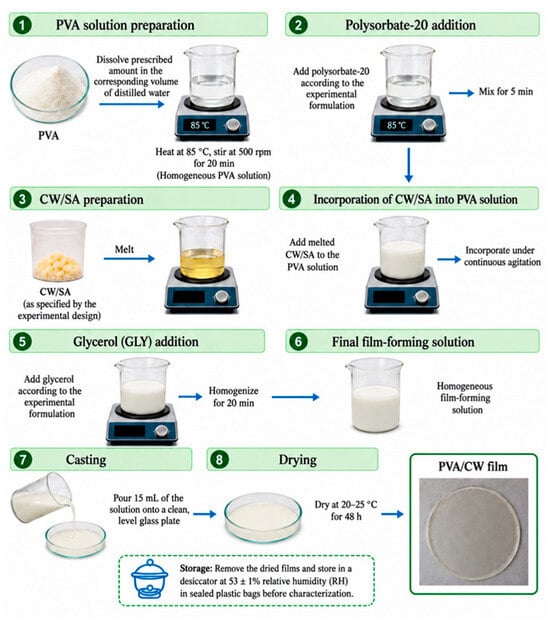
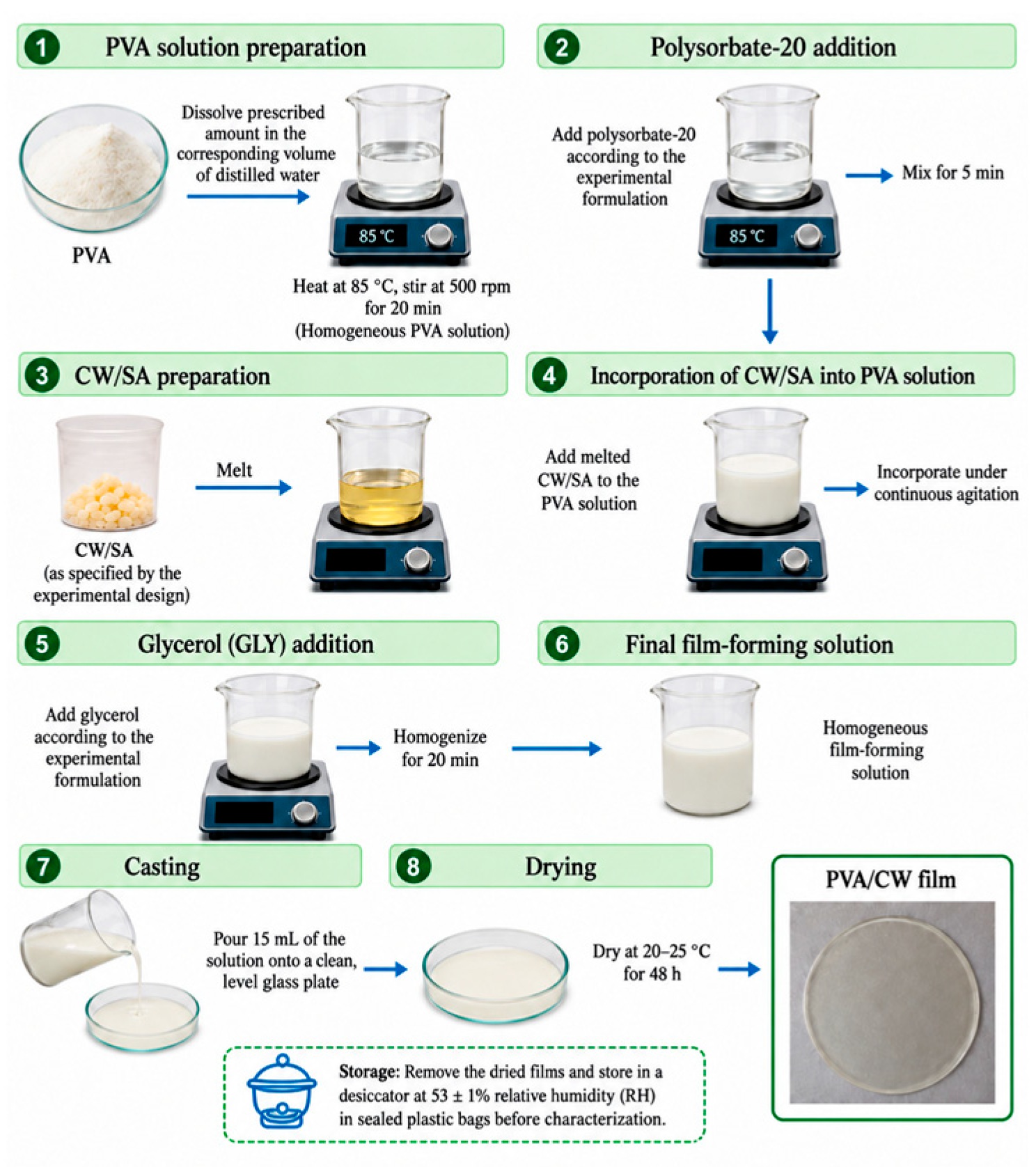
PVA-based films were fabricated through the solution casting method, incorporating minor adjustments from earlier research [5]. The preparation conditions were selected based on our previous studies and preliminary screening experiments to ensure complete PVA dissolution, effective dispersion of the CW/SA lipid phase, and formation of homogeneous and processable films. PVA/CW films were prepared by the solution-casting method using processing conditions adapted from our previous studies. For each experimental run, the proportions of PVA, CW, glycerol (GLY), stearic acid (SA), and polysorbate-20, together with the water content, were determined according to the D-optimal experimental design presented in Table 1. The prescribed amount of PVA was dissolved in the corresponding volume of distilled water at 85 °C under continuous stirring at 500 rpm for 20 min to obtain a homogeneous solution. Polysorbate-20 was then added at the concentration specified for each formulation and mixed for an additional 5 min. Separately, the required amounts of CW and SA specified by the experimental design were melted and gradually incorporated into the heated PVA solution under continuous agitation. Glycerol was subsequently added at the concentration prescribed for each experimental run. The resulting film-forming solution was mixed for 20 min to promote uniform dispersion of the formulation components. After slight cooling, 15 mL of each film-forming solution was cast onto a clean, level glass plate and dried for 48 h at room temperature (20–25 °C). The dried films were carefully removed from the casting plates, placed in sealed plastic bags, and stored in a desiccator at 53 ± 1% relative humidity until further characterization and water-solubility analysis. Figure 1 illustrates the overall film preparation procedure.
Figure 1.
Film preparation scheme.
2.3. D-Optimal Mixture–Process Experimental Design
A D-optimal mixture–process experimental strategy was adopted to comprehensively study the effects of formulation composition and processing parameters on the water solubility of PVA/CW-based films. The five formulation components PVA, CW, GLY, SA, and polysorbate-20 were considered as mixture variables where the quantities of the individual components were limited to the pre-defined design space. The range of the components was chosen considering the results of preliminary screening experiments from earlier investigations [4,5], to ensure film processability, mechanical integrity, and compositional relevance. Water content was included as a continuous process variable to control for the possible effect it could have on film formation and water solubility. By combining mixture and process variables, we could study the impacts of composition and processing effects together in a single experimental setting.
Table 1.
Experimental range of independent variables and their levels.
To efficiently sample the confined experimental space and minimize the number of experimental runs, a D-optimal design was created using JMP Pro (v19.1.2), SAS Institute, Cary, NC, USA). D-optimality was chosen due to the restricted mixed region and water as a continuous process variable. The final design comprised 23 experimental runs that represented varied combinations of the formulation components and water content. The formulations obtained were created experimentally and the water solubility was determined as response variable.
2.4. Film Water Solubility
Samples of 2 cm × 2 cm were obtained from each film (n = 3) and were dried in an oven at 105 °C for 24 h. Samples were weighed to establish the initial dry matter of each film (W1). Each sample was submerged in 30 mL distilled water and maintained at 23 ± 2 °C for 3 h. The sealed beaker was swirled occasionally. The insoluble fraction of the film sample was separated from soluble components in distilled water and dried at 105 °C for 24 h. The dry samples were again weighed to determine the weight of solubilized dry matter (W2). Water solubility of each film was calculated by using Equation (1):
2.5. Statistical Modeling and Optimization
The experimental data were analyzed by employing a Scheffé-type quadratic mixture model with the process variable water. The model was applied to characterize the link between the composition of the formulation, water content, and water solubility of the film. The general form of the model is as follows:
where is the predicted response (%), Xi and Xj represent the mixture components, W represents water content, βi represents the linear mixture coefficients, βij represents the binary interaction coefficients, and γi represents the mixture–process interaction coefficients, δ represents the linear effect of water, and ε represents the experimental error. Model adequacy was assessed by analysis of variance (ANOVA), coefficient of determination (R2), adjusted R2, and root mean square error (RMSE). The statistical significance of individual model terms was assessed at a 95% confidence level (α = 0.05). Model diagnostic plots such as residuals versus projected values and normal probability plots were checked to investigate the assumptions of normality and homoscedasticity. Numerical optimization was then carried out using the fitted model in JMP Pro to determine the formulation that minimizes film water solubility within the specified experimental design space. The optimized formulation was selected based on the specified component constraints and water-content range. The predicted response of the optimized formulation was subsequently compared with experimentally measured water solubility to evaluate the predictive performance of the model.
3. Results and Discussion
3.1. Experimental Formulations
The effect of independent variables (PVA, CW, GLY, SA, and polysorbate-20) on response variables (% Solubility) was studied by applying the response surface D-optimal mixture–process technique design [6]. Table 2 shows the experimental %Solubility determined from five independent variables at 23 experimental runs. The experimental solubility was between 19.66% and 93.32%.
Table 2.
Experimental design with the observed responses and predicted values for the solubility using response surface D-optimal mixture–process method.
3.2. Regression Model for Response Variable
3.2.1. Regression Model for Film Solubility
The data shown in Table 2 were subjected to multiple regression analysis using the Scheffé-type quadratic mixture model for film solubility (Y). Table 3 shows the analysis of variance (ANOVA) of the independent variables for the water-resistant optimization of PVA/CW films.
Table 3.
Analysis of variance summary for the model interactions for film solubility, Y.
The goodness of fit of the constructed mixture–process regression model was evaluated by analysis of variance (Table 3), coefficient of determination (R2), adjusted R2, and lack-of-fit test. The coefficient of determination (R2) is a measure of the fraction of the variability in the response variable that can be explained by the independent variables and their interactions. The model was found to have an R2 value of 0.8877 which implies that around 89% of the variability in solubility was explained by the fitted model. The high value of R2 indicates that there is a strong association between the formulation components, process variable, and the response. However, the adjusted R2 was 0.6470, which considers the number of model terms compared to the sample size (n = 23). The difference between R2 and adjusted R2 shows that the model accounts for a large amount of variability in the response, although some of the terms might have poor explanatory power. Such disparities are prevalent in mixture–process designs with several interaction factors and restricted experimental regions. The total regression model was statistically significant (F = 3.69, p = 0.0441), suggesting that the independent factors had a substantial effect on solubility when taken together. Moreover, the lack-of-fit test was significant (p < 0.05), indicating that the model corresponds well to the experimental data within the design space analyzed. A non-significant lack of fit indicates that the residual variation is mostly attributable to the random experimental errors rather than systematic model inadequacies (Figure S1). To summarize, the statistical diagnostics support the conclusion that the established mixture–process model is competent and reliable in describing the solubility behavior of the PVA-based film formulations within the experimental region examined.
3.2.2. Effects and Interactions of Formulation Components on Film Water Solubility
The regression model equation for film solubility (Y) is shown in Equation (3) as follows:
The regression coefficients (Equation (3)) demonstrate that film water solubility was influenced by both individual formulation components and their interactions. PVA (β1 = 607.55, p = 0.0362) and SA (β4 = 5183.97, p = 0.0173) showed significant positive effects on solubility, whereas CW (β2 = −1272.65, p = 0.0101) and polysorbate-20 (β5 = −6784.84, p = 0.0080) significantly reduced solubility. GLY showed a negative but nonsignificant effect (p = 0.3432). The positive effect of PVA is consistent with its hydrophilic character, whereas the negative effect of CW is consistent with its hydrophobic contribution to the film matrix. The effects of SA and polysorbate-20 indicate that these components also contributed to the overall formulation behavior beyond their individual roles (Table S1). Similarly, Significant interactions were observed between CW × SA (β24 = −10,907.16, p = 0.0442) and CW × polysorbate-20 (β25 = 19,943.07, p = 0.0059), indicating that effect of one component depended on the concentration of another. The GLY × polysorbate-20 interaction showed a positive trend but was not statistically significant at the 5% level (p = 0.0581). These interactions demonstrate that film solubility cannot be adequately explained by individual component effects alone and highlight the importance of formulation compatibility and phase interactions (Table S2). In contrast, the process variable, water, had no significant independent effect on solubility (p = 0.7747), and none of the mixture–process interaction terms were significant (p > 0.05). Thus, within the investigated range, water content did not substantially modify the effects of the formulation components (Table S3). The interaction profile further illustrates the dependence of solubility on component combinations, particularly for CW–SA, CW–polysorbate-20, and GLY–polysorbate-20 (Figure S2). Compared with conventional one-factor-at-a-time studies, the present work provides a systematic approach for simultaneously evaluating formulation components and their interactions, thereby allowing identification of an optimized PVA/CW formulation with reduced water solubility.
Overall, these findings confirm that the water solubility of PVA/CW films is governed primarily by formulation composition and component interactions, supporting the use of a mixture-based optimization approach.
3.3. Surface Plots for Film Solubility (Y)
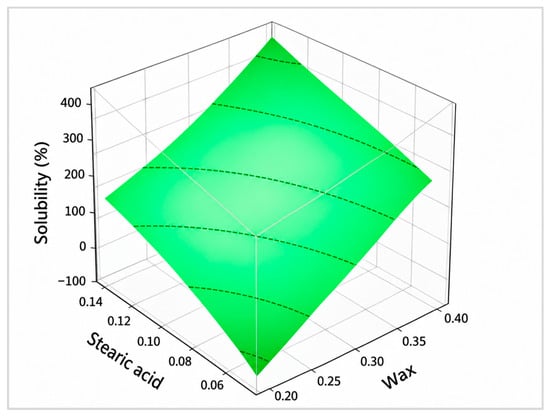
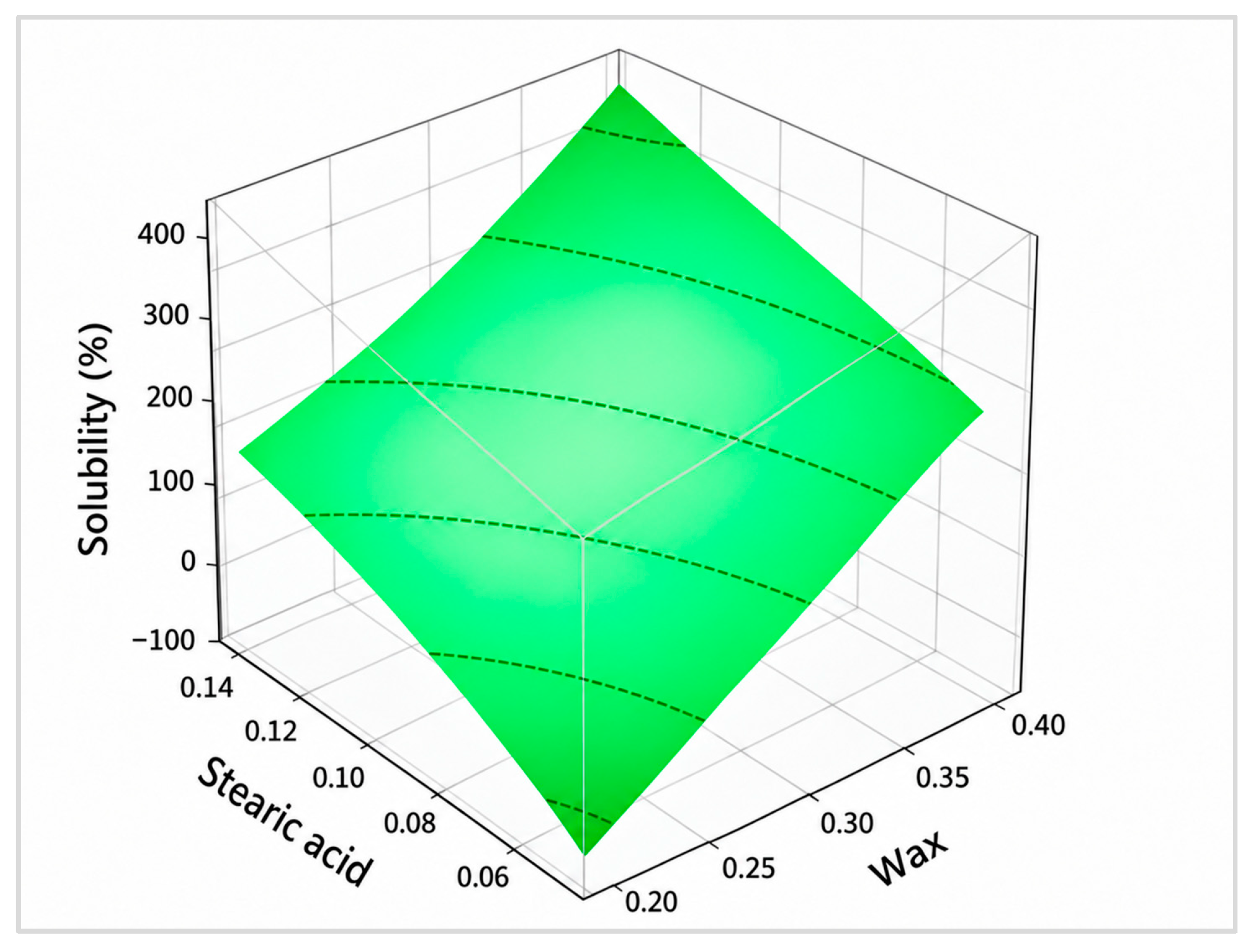
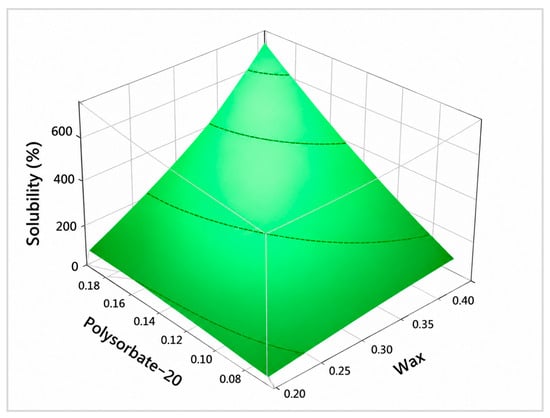
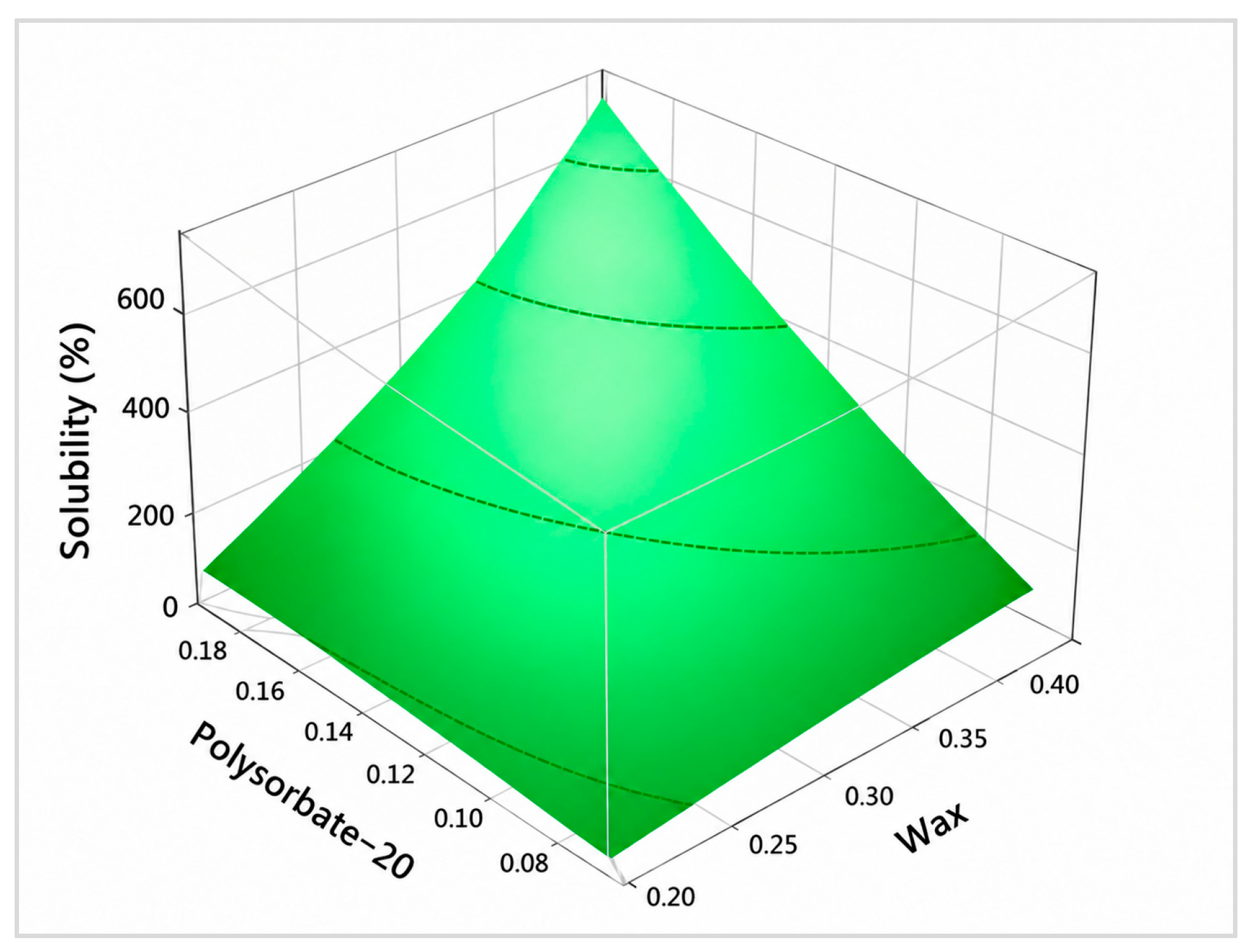
The response surfaces in Figure 2 and Figure 3 demonstrate that film water solubility was governed not only by the individual effects of formulation components but also by their interactions. Representative formulations further illustrate this variation. For example, run 20, containing PVA = 0.40, CW = 0.40, GLY = 0.05, SA = 0.07, polysorbate-20 = 0.08, and 100 mL of water, exhibited a solubility of 19.66%. In comparison, run 23, containing PVA = 0.40, CW = 0.30, GLY = 0.05, SA = 0.05, polysorbate-20 = 0.20, and 100 mL of water, showed a solubility of approximately 50.17%. These representative formulations demonstrate that water solubility varied substantially across the formulation space, supporting the importance of considering the combined effects and interactions of the formulation components rather than evaluating individual components in isolation. The CW × SA interaction (Figure 2) produced a significant negative effect, with increasing levels of both lipid components associated with lower solubility. This behavior suggests that the combined CW/SA phase reduced water affinity within the PVA matrix, likely through increased formation of hydrophobic domains that limited water penetration. This finding is consistent with [11], who demonstrated that the CW:SA ratio significantly influenced the properties of cassava-starch films containing glycerol, CW, and SA, with an optimized CW/SA formulation providing a cohesive film and improved moisture-barrier performance. Importantly, their study also showed that the lipid ratio affected emulsion stability and particle size, supporting the interpretation that the interaction between wax and fatty acid can influence film structure and, consequently, water sensitivity. The CW × polysorbate-20 interaction (Figure 3) exhibited a different response, indicating that the effect of wax on solubility depended on the level of the emulsifier. This interaction is particularly important because polysorbate-20 facilitates dispersion of the hydrophobic CW phase within the hydrophilic PVA matrix, and changes in its concentration can therefore alter the distribution and continuity of lipid domains. Similar behavior has been reported for wax-containing polymer films, where the effect of wax incorporation on water solubility depends on the composition and structure of the surrounding polymer/emulsifier matrix. In sodium-caseinate films, for example, CW generally reduced water solubility, whereas excessive wax incorporation could reverse this trend, a behavior attributed partly to changes in formulation and the hydrophilic contribution of the emulsifier [12]. Thus, the CW × polysorbate-20 surface in the present study suggests that achieving water resistance requires an appropriate balance between wax concentration and emulsifier content rather than simply maximizing the wax fraction. However, the present interaction demonstrates that this plasticizer effect cannot be considered independently of polysorbate-20. Collectively, the two response surfaces, CW × SA and CW × polysorbate-20, demonstrate that water solubility in the PVA/CW system is controlled by the balance and compatibility among hydrophobic, hydrophilic, and amphiphilic components [1,4,5,12,13,14,15]. This finding provides a strong justification for the D-optimal mixture–process approach used in this study, as optimization based solely on individual component effects would overlook these formulation-dependent interactions.
Figure 2.
Response surface plots showing the CW–SA interaction effect.
Figure 3.
Response surface plots showing the CW–polysorbate-20 interaction effect.
3.4. Optimization of PVA/CW Film Formulation
From the numerical optimization findings, the model projected that the best formulation was 0.44 PVA, 0.2513 CW, 0.09 GLY, 0.09 SA and 0.1287 polysorbate-20 with 75% water. To test the correctness of the optimization results, the optimized formulation predicted by the model was then created and empirically evaluated.
3.5. Experimental Validation of the Optimized Formulation
The optimized formulation was experimentally validated to verify the accuracy and the predictive capabilities of the generated regression model. The response surface and mixture design investigations require validation tests to verify that the numerical model predictions of the responses are consistent with experimental data. The anticipated best formulation based on the numerical optimization was 0.44 PVA, 0.2513 CW, 0.09 GLY, 0.09 SA, 0.1287 polysorbate-20 with 75 mL of water. Films with these projected proportions were created according to the same process as above. The optimum formulation was made in triplicate to confirm the results and the film’s solubility was evaluated experimentally. Then, the solubility predicted by the model from the numerical optimization analysis was compared with the solubility values measured experimentally. The anticipated solubility by the model was 66.72% and empirically determined solubility of the optimized formulation was 72.21%. The percentage prediction error between the predicted and actual values was around 8.2%, which indicates a satisfactory agreement between the model prediction and the observed experimental response using Equation (4).
The result validates the regression model.
4. Conclusions
The D-optimal mixture–process model adequately described the relationship between formulation composition and the water solubility of PVA/CW-based films, with a goodness of fit (R2) of 88.7%. Following 23 experimental runs involving PVA, CW, GLY, SA, polysorbate-20, and water, the model identified significant effects of the formulation components and interactions on film solubility. PVA and SA showed positive effects on solubility, whereas CW and polysorbate-20 reduced solubility. Among the interaction terms, CW × SA and CW × polysorbate-20 significantly influenced the response, demonstrating that film water resistance depended on the combined effects of formulation components rather than their individual contributions alone. Numerical optimization identified an optimum formulation containing 0.44 PVA, 0.2513 CW, 0.09 GLY, 0.09 SA, and 0.1287 polysorbate-20 with 75 mL of water. At these conditions, the predicted water solubility was 66.72%, while experimental validation produced a solubility of 72.21%. Although the experimental value was higher than the predicted value, the relatively close agreement between the predicted and experimental responses supports the applicability of the model for formulation optimization within the investigated design space. Although water contact angle and water solubility represent different aspects of water resistance, the reduced solubility associated with CW is consistent with its hydrophobic character, which can limit water penetration into the PVA matrix. Future studies will combine contact-angle, solubility, and water-vapor-permeability measurements for a more comprehensive evaluation of film water resistance.
Overall, the findings demonstrate that D-optimal mixture–process design provides an effective approach for systematically optimizing PVA/CW film formulations and improving control of water resistance, while reducing reliance on conventional trial-and-error formulation strategies.
Supplementary Materials
The following supporting information can be downloaded at https://www.mdpi.com/article/10.3390/cleantechnol8050158/s1. Figure S1: Diagnostic Actual vs Predicted plot; Figure S2: Interaction profile matrix showing the combined effects of mixture components on film solubility. Non-parallel lines indicate significant interaction effects between formulation variables; Table S1: Estimated Regression Coefficients (Main effect) for the D-Optimal Mixture–Process Model Predicting Film Solubility; Table S2: Estimated Regression Coefficients (Interaction effect) for the D-Optimal Mixture–Process Model Predicting Film Solubility; Table S3: Estimated Regression Coefficients (Mixture-Process Interaction effect) for the D-Optimal Mixture–Process Model Predicting Film Solubility.
Author Contributions
Conceptualization, A.H.; methodology, A.T.T. and A.H.; software, A.T.T.; validation, A.H., E.M., C.C., and N.C.S.; formal analysis, A.T.T.; investigation, A.T.T.; resources, A.H.; data curation, A.T.T.; writing—original draft preparation, A.T.T.; writing—review and editing, T.A., T.M., and A.T.T.; visualization, T.M., funding acquisition, A.H., E.M. All authors have read and agreed to the published version of the manuscript.
Funding
This research was funded by the North Dakota Corn Council, ND, U.S.; Grant number FAR0036692.
Data Availability Statement
The original contributions presented in this study are included in the article/Supplementary Materials. Further inquiries can be directed to the corresponding author.
Conflicts of Interest
The authors declare no conflicts of interest.
Abbreviations
The following abbreviations are used in the manuscript:
| PVA | Polyvinyl alcohol |
| CW | Carnauba wax |
| GLY | Glycerol |
| SA | Stearic acid |
| RH | Relative Humidity |
| ANOVA | Analysis of variance |
| RMSE | Root mean square error |
| R2 | Coefficient of determination |
| Adj. R2 | Adjusted coefficient of determination |
References
- Tijani, A.T.; Ayodele, T.; Liadi, M.; Clementson, C.; Hammed, A. Review of bioactive wax emulsified films. J. Appl. Polym. Sci. 2024, 141, e55718. [Google Scholar] [CrossRef] [Scilit]
- OECD. Global Plastics Outlook: Economic Drivers, Environmental Impacts and Policy Options; OECD Publishing: Paris, France, 2022; Available online: https://www.oecd.org/en/publications/global-plastics-outlook_de747aef-en.html (accessed on 13 August 2026).
- Environment UN. Turning off the Tap: How the World Can End Plastic Pollution and Create a Circular Economy|UNEP—UN Environment Programme. 2023. Available online: https://www.unep.org/resources/turning-off-tap-end-plastic-pollution-create-circular-economy (accessed on 13 August 2026).
- Tijani, A.T.; Ayodele, T.; Liadi, M.; Sarker, N.C.; Hammed, A. Mechanical and Thermal Characteristics of Films from Glycerol Mixed Emulsified Carnauba Wax/Polyvinyl Alcohol. Polymers 2024, 16, 3024. [Google Scholar] [CrossRef] [Scilit] [PubMed]
- Tijani, A.T.; Hammed, A.M. Tailoring Polyvinyl Alcohol/Carnauba Wax Film Properties Through Plasticizer Selection: A Pathway to Optimized Biodegradable Materials. Polymers 2026, 18, 626. [Google Scholar] [CrossRef] [Scilit] [PubMed]
- Radfar, R.; Hosseini, H.; Farhoodi, M.; Ghasemi, I.; Średnicka-Tober, D.; Shamloo, E.; Mousavi Khaneghah, A. Optimization of antibacterial and mechanical properties of an active LDPE/starch/nanoclay nanocomposite film incorporated with date palm seed extract using D-optimal mixture design approach. Int. J. Biol. Macromol. 2020, 158, 790–799. [Google Scholar] [CrossRef] [Scilit] [PubMed]
- Ozdemir, M.; Floros, J.D. Optimization of edible whey protein films containing preservatives for mechanical and optical properties. J. Food Eng. 2008, 84, 116–123. [Google Scholar] [CrossRef] [Scilit]
- Ozdemir, M.; Floros, J.D. Optimization of edible whey protein films containing preservatives for water vapor permeability, water solubility and sensory characteristics. J. Food Eng. 2008, 86, 215–224. [Google Scholar] [CrossRef] [Scilit]
- Other Mixture Model Forms. Experiments with Mixtures; John Wiley & Sons, Ltd.: Hoboken, NJ, USA, 2002; pp. 286–353. Available online: https://onlinelibrary.wiley.com/doi/abs/10.1002/9781118204221.ch6 (accessed on 9 September 2026).
- El-Malah, Y.; Nazzal, S. “Real-time” disintegration analysis and D-optimal experimental design for the optimization of diclofenac sodium fast-dissolving films. Pharm. Dev. Technol. 2013, 18, 1355–1360. [Google Scholar] [CrossRef] [Scilit] [PubMed]
- Chiumarelli, M.; Hubinger, M.D. Stability, solubility, mechanical and barrier properties of cassava starch—Carnauba wax edible coatings to preserve fresh-cut apples. Food Hydrocoll. 2012, 28, 59–67. [Google Scholar] [CrossRef] [Scilit]
- Galus, S.; Gaouditz, M.; Kowalska, H.; Debeaufort, F. Effects of Candelilla and Carnauba Wax Incorporation on the Functional Properties of Edible Sodium Caseinate Films. Int. J. Mol. Sci. 2020, 21, 9349. [Google Scholar] [CrossRef] [Scilit] [PubMed]
- Haruna, M.H.; Wang, Y.; Pang, J. Konjac glucomannan-based composite films fabricated in the presence of carnauba wax emulsion: Hydrophobicity, mechanical and microstructural properties evaluation. J. Food Sci. Technol. 2019, 56, 5138–5145. [Google Scholar] [CrossRef] [Scilit] [PubMed]
- Chiumarelli, M.; Hubinger, M.D. Evaluation of edible films and coatings formulated with cassava starch, glycerol, carnauba wax and stearic acid. Food Hydrocoll. 2014, 38, 20–27. [Google Scholar] [CrossRef] [Scilit]
- Mukaila, T.; Adeniyi, A.; Bello, I.; Sarker, N.C.; Monono, E.; Hammed, A. Optimizing film mechanical and water contact angle properties via PLA/starch/lecithin concentrations. Clean. Circ. Bioeconomy 2024, 8, 100095. [Google Scholar] [CrossRef] [Scilit]

Disclaimer/Publisher’s Note: The statements, opinions and data contained in all publications are solely those of the individual author(s) and contributor(s) and not of MDPI and/or the editor(s). MDPI and/or the editor(s) disclaim responsibility for any injury to people or property resulting from any ideas, methods, instructions or products referred to in the content. |
© 2026 by the authors. Licensee MDPI, Basel, Switzerland. This article is an open access article distributed under the terms and conditions of the Creative Commons Attribution (CC BY) license.