


Abstract
The Large Hadron Collider forward (LHCf) experiment studies the production of neutral particles in the very forward region of high-energy hadronic collisions at the LHC. These measurements provide essential calibration data for hadronic interaction models used in simulations of extensive air showers initiated by ultra-high-energy cosmic rays. The LHCf experiment measures forward-produced neutral particles, such as neutrons, photons, , and mesons, which play a key role in the development of extensive air showers. Proton–proton collisions at the LHC reach center-of-mass energies up to 13.6 TeV, corresponding in the fixed-target frame to cosmic-ray interactions at energies close to 1017 eV in the Earth’s atmosphere. LHCf has collected data in proton–proton collisions at several energies, as well as in proton–lead collisions, enabling detailed comparisons between experimental results and predictions of hadronic interaction models. This contribution reviews the most significant LHCf results, with emphasis on Run II proton–proton data at , including measurements of forward neutron, photon, and meson production. Finally, future prospects are discussed, focusing on ongoing analyses of Run III proton–proton data at and on the final LHCf operation in proton-oxygen collisions at , which best reproduces cosmic-ray interactions with nuclei of the Earth’s atmosphere.
1. Introduction
The Large Hadron Collider forward (LHCf) experiment [1] is an experiment at the LHC designed to measure the production rate of neutral particles generated in the forward region of LHC collisions. The main physical motivation of the LHCf experiment is to investigate the forward region of high-energy hadronic collisions and provide unique calibration data for hadronic interaction models. A proper tuning of these models is crucial for accurately simulating the development of extensive air showers (EAS) induced by ultra-high-energy cosmic rays (UHECRs), i.e., cosmic rays with energies above 1018 eV [2]. Large-scale experiments for the indirect detection of UHECRs, such as the Pierre Auger Observatory [3] and the Telescope Array [4], strongly rely on simulations of extensive air showers (EAS) to interpret their data, particularly to determine the average mass composition of UHECRs. At UHECR energies, however, average mass composition measurements are subject to large systematic uncertainties arising from theoretical uncertainties in the hadronic interaction models used to simulate the collisions between cosmic rays and atmospheric nuclei, as well as the resulting development of EAS [5]. These theoretical uncertainties can be reduced thanks to a proper tuning of hadronic interaction models, using calibration data from high-energy hadronic collisions.
Currently, the LHC is the hadronic collider that reaches the highest center-of-mass energy and therefore represents the optimal facility for collecting calibration data for hadronic interaction models. Indeed, the maximum center-of-mass energy in a proton–proton (p-p) collision is 13.6 TeV, which, in the fixed-target frame, corresponds to nearly 1017 eV. Therefore, at the LHC it is possible to study the interaction between two protons, two nuclei or a proton and a nucleus at energies that are close to those of an UHECR colliding with an atmospheric nucleus. There are several quantities measured by experiments at the LHC that have an impact on the development of EAS generated by UHECRs. Some of them, such as the hadronic inelastic cross-section and the multiplicity of secondary particles, can be measured by experiments in the central region (CMS [6] and ATLAS [7] experiments) or by dedicated experiments such as TOTEM [8]. Other measurements and studies are performed in the forward region of the interaction, where the largest fraction of the energy is focused after the primary interaction: the measurement of inelasticity and the forward energy spectrum of the secondary particles produced in primary collisions, tests of the validity of scaling laws that are crucial for the extrapolation of results at energies above 1017 eV, and the measurement of the nuclear modification factor in collisions that involve nuclei.
The LHCf experiment was specifically designed with the aim of performing these measurements in the forward region of a LHC interaction point, in order to provide calibration data for the hadronic interaction models and reduce the theoretical uncertainties of such models at very high energies. The LHCf experiment acquired data from 2009 (Run I) to 2025 (Run III) in different collision configurations, including proton–proton (p-p), proton–lead (p-Pb) and proton–oxygen (p-O). The p-O operation was the last LHCf operation and probably the most significant one, since the p-O interaction best mimics the interaction between a cosmic ray and a nucleus of the Earth’s atmosphere.
2. The LHCf Experiment
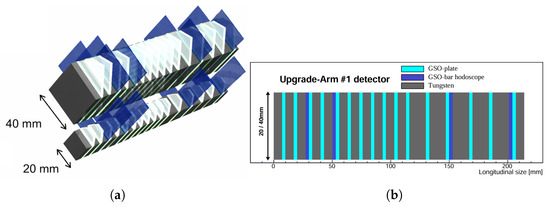
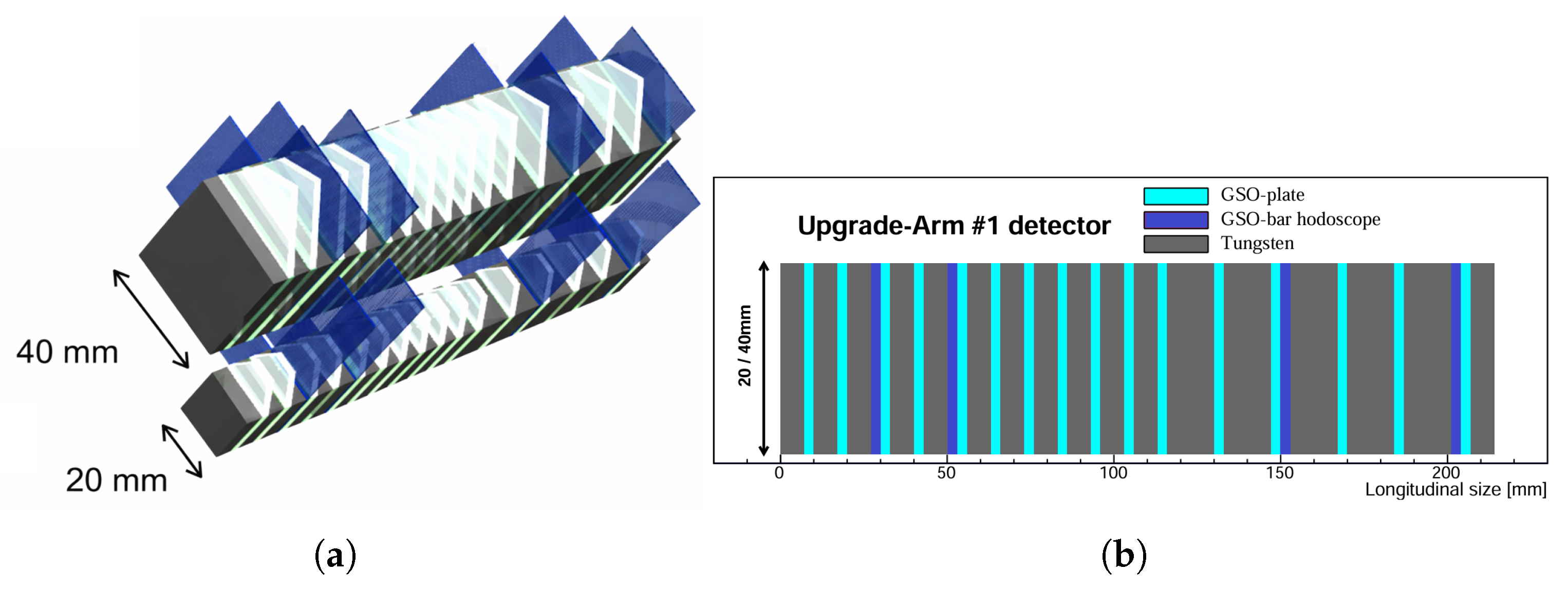
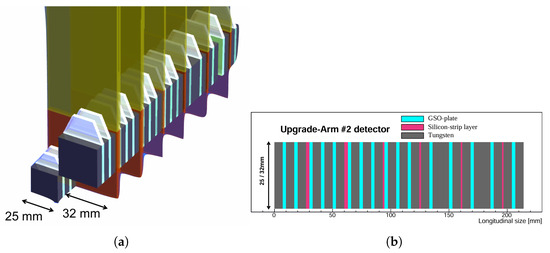
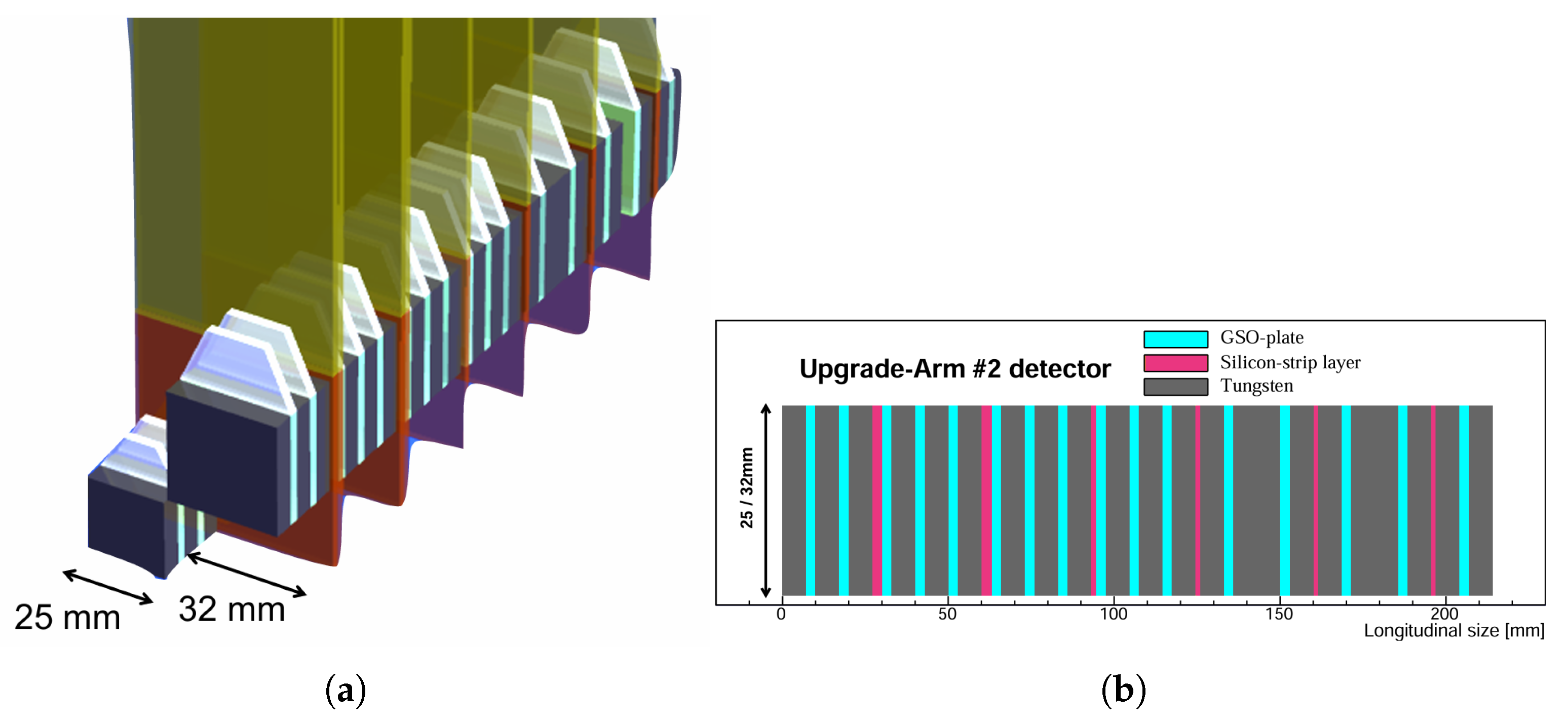
The LHCf experiment consists of two detectors, Arm1 and Arm2, installed inside the Target Neutral Absorber (TAN) regions located 140m from Interaction Point 1 (IP1), the interaction point of the ATLAS experiment. Arm1 is positioned on the IP8 side and Arm2 on the IP2 side. Due to their positions relative to IP1 and the presence of the D1 dipole magnet, the LHCf detectors can detect only neutral particles emitted in the very forward region of LHC collisions—specifically those with pseudorapidities . Arm1 and Arm2 have similar geometry [9], each composed of two sampling and imaging calorimetric towers with square cross-sections. Perspective and longitudinal views of the Arm1 and Arm2 detectors after their upgrades [9] before Run II are shown in Figure 1 and Figure 2, respectively.
Figure 1.
Arm1 perspective view (a) and longitudinal view (b).
Figure 2.
Arm2 perspective view (a) and longitudinal view (b).
The Arm1 (Arm2) calorimetric towers have cross-sectional areas of 20mm × 20mm (25mm × 25mm) for the Small Tower and 40mm × 40mm (32mm × 32mm) for the Large Tower. Each tower consists of 16 layers of GSO scintillators interleaved with 22 tungsten layers, each two radiation lengths () thick. Position-sensitive layers, namely a GSO-bar hodoscope (1 mm wide) in Arm1 and silicon microstrip layers (80 implantation pitch, 160 read-out pitch) in Arm2, are embedded at various depths within the towers. The total length of each tower is approximately 21 cm (as can be seen from Figure 1 and Figure 2), equivalent to and hadronic interaction lengths (). The position-sensitive layers are used to reconstruct the transverse shower profile and, consequently, the impact position of the incident particle. The GSO scintillator layers are used to reconstruct the energy of the incident particle.
The particles detected by Arm1 and Arm2 are mainly single or multiple photons, which can originate from the decay of particles produced in the primary collisions, such as , and mesons, and generate electromagnetic showers in the calorimetric towers, or hadronic particles, mainly neutrons produced in the primary collisions, that generate hadronic showers in the towers. Regarding the reconstruction performance, both Arm1 and Arm2 detectors have an energy resolution of 2–3% for photons with energies above 100 GeV and 30–40% for neutrons, mainly due to the large longitudinal leakage of hadronic showers. The Arm2 silicon microstrip layers can reconstruct the particle impact position with a resolution of less than 40 for photons and a few hundred for neutrons. The Arm1 GSO-bar hodoscope has a position resolution of a few hundred for photons [9].
In Table 1, the LHCf operations are summarized. In the RHICf operation, the Arm1 detector was installed at the Relativistic Heavy Ion Collider (RHIC).
Table 1.
Summary of the LHCf operations. The table specifies the hadronic particles in the two colliding beams, the center-of-mass energy () of the primary p-p interaction, or the center-of-mass energy in the nucleon–nucleon frame () of the primary interaction in the case of p–nucleus collisions, the equivalent energy in the fixed-target frame and the year of the operation. An additional note indicates if only one of the two detectors was installed during the operation. The last row refers to the RHICf operation, during which the Arm1 detector was installed at the Relativistic Heavy Ion Collider (RHIC).
3. LHCf Physics Results
In this section, some of the most significant results of the LHCf experiment are discussed—specifically, the measurements of the cross-sections of forward neutrons [10] and photons [11] produced in p-p collisions and the measurement of the forward meson production rate in p-p collisions at [12]. The details of the datasets used in each analysis are given in the corresponding subsection. The following subsections give a brief description of the experimental results and their interpretations. More details and the full analyses can be found in previously published papers cited here.
3.1. Measurement of the Inclusive Differential Cross-Section of Forward Neutrons Produced in = 13 TeV p-p Collisions
In this section, the measurement of the inclusive neutron production cross-section is presented and the comparison with model predictions is discussed. Only data acquired with the LHCf Arm2 detector are used in this analysis. The experimental dataset used for this analysis is related to p-p collisions at and it was acquired between 12 June and 13 June 2015. This time period corresponds to a special low-luminosity fill (LHC Fill 3855), specifically provided for LHCf operations. The instantaneous luminosity was 3–5 × and the average number of collisions per bunch crossing, , was in the range –. The recorded integrated luminosity, taking into account the LHCf data acquisition live time, was estimated to be 0.194 nb−1. Monte Carlo simulation datasets are used to perform several analysis tasks. The models used to generate these simulation datasets are QGSJET II-04 [13], EPOS-LHC [14], SIBYLL 2.3 [15], DPMJET 3.06 [16] and PYTHIA 8.212 [17]. More details on the experimental and simulation datasets and on the analysis procedure, which includes event reconstruction, estimation of correction factors, spectra unfolding to deconvolute the measurements from the detector response, and estimation of systematic uncertainties, can be found in [10].
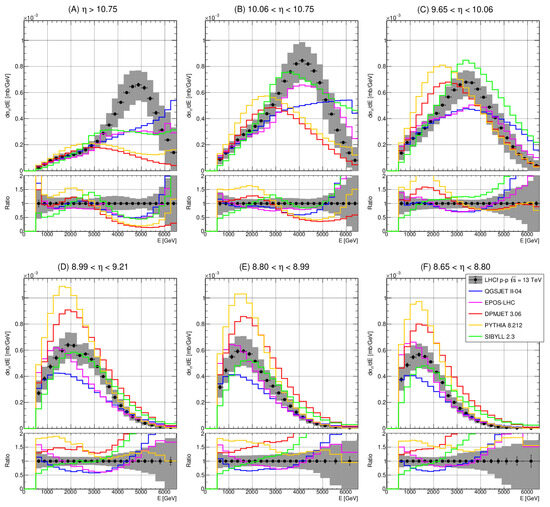
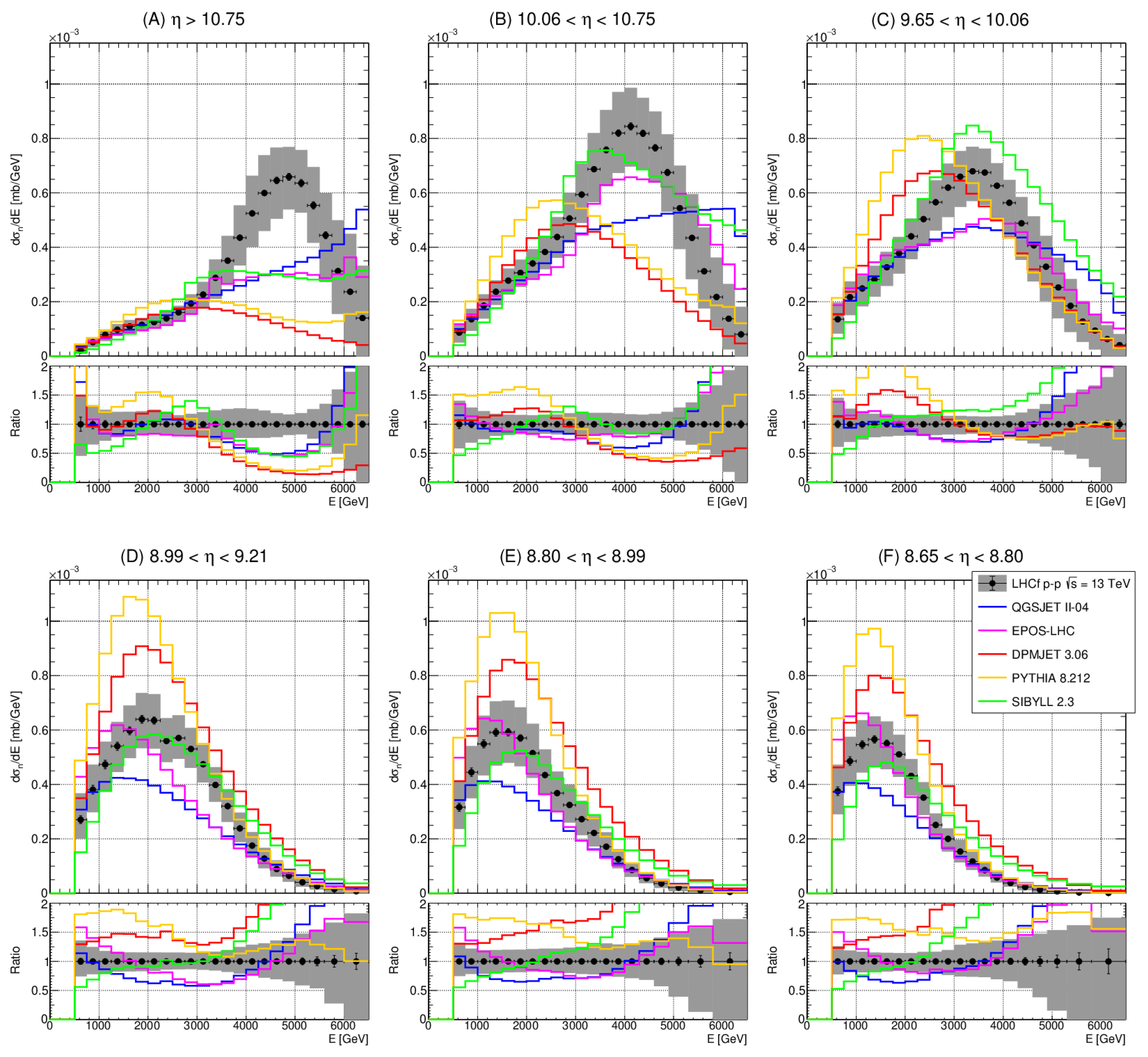
The measurement is performed in six pseudorapidity regions: , , , , , . In Figure 3, the distributions are expressed in terms of the inclusive differential production cross-section for the six pseudorapidity intervals.
Figure 3.
Inclusive differential neutron production cross-section for p-p collisions at , measured using the LHCf Arm2 detector in six pseudorapidity regions: (A), (B), (C), (D), (E), (F). Black markers represent the experimental data with statistical errors, whereas gray bands represent the quadratic sum of statistical and systematic uncertainties. Colored histograms refer to model predictions at the generator level. For each pseudorapidity region, the top plot shows the energy distributions expressed as , and the bottom plot shows the ratios of these distributions to the experimental results. In ratio plots, black markers represent the experimental data with statistical errors, whereas gray bands represent the quadratic sum of statistical and systematic uncertainties [10].
All experimental distributions exhibit a peak structure, whose position progressively moves to lower energy as pseudorapidity decreases, from about 5 TeV for to about 15 TeV for . Considering the data–model comparison, the largest deviation between model distributions and experimental data is observed at . In this region, LHCf measurements indicate a peak structure at around 5 TeV, which is not predicted by any generator and, moreover, all models underestimate the total production cross-section by at least 20% (QGSJET II-04). No model completely reproduces the experimental measurements in any of the other five regions, although deviations are significantly smaller than at . Depending on the pseudorapidity region, the generators showing the best overall agreement with data are either SIBYLL 2.3 or EPOS-LHC. At , EPOS-LHC reproduces well the peak position but still underestimates neutron production; whereas, at , SIBYLL 2.3 reproduces well the peak position but overestimates neutron production. In all the remaining three regions, it is interesting to note that SIBYLL 2.3 is compatible with the experimental measurements in the energy range between 15 TeV and 2.5 TeV, where the production peak is located. However, SIBYLL 2.3 is the model showing the best overall agreement with data only at , whereas EPOS-LHC provides better results at and .
3.2. Measurement of the Inclusive Differential Photon Production Cross-Section in p-p Collisions at = 13 TeV
In this section, the measurement of the inclusive photon production cross-section in p-p collisions at TeV with the Arm1 and Arm2 detectors is discussed. The results refer to the same experimental dataset described in Section 3.1. Further details of the experimental and simulation datasets used, the analysis procedures, and the estimation of systematic uncertainties can be found in [11].
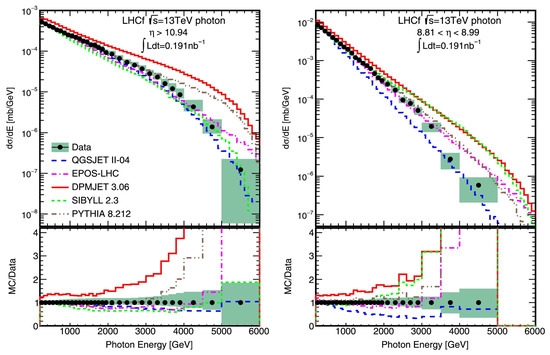
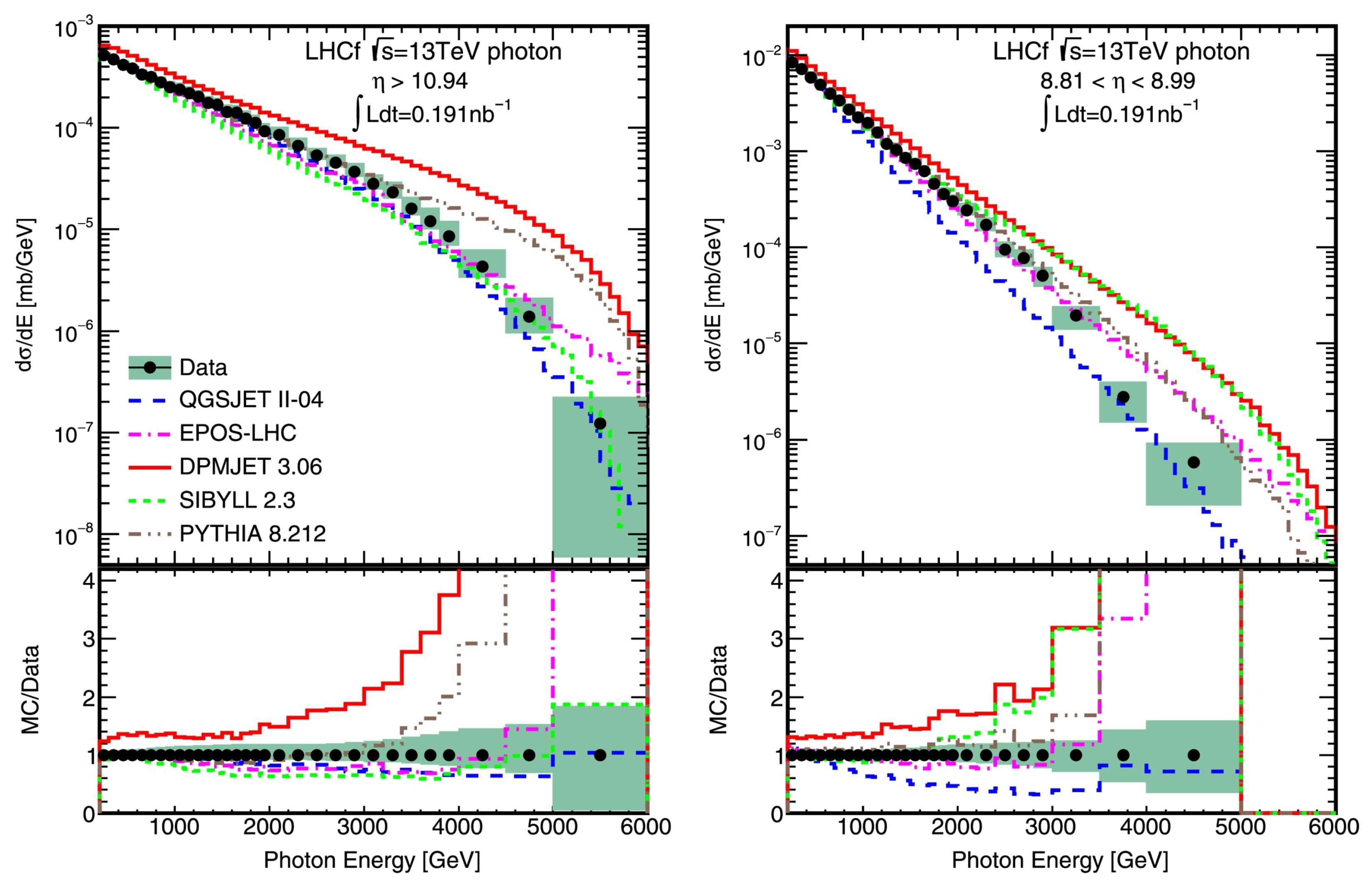
The upper panels of Figure 4 show the photon production cross-section in two pseudorapidity regions, and , compared with the predictions of the hadronic interaction models QGSJET II-04, EPOS-LHC, DPMJET 3.06, SIBYLL 2.3, and PYTHIA 8.212. The bottom panels show the ratio of the MC predictions to the experimental results. In the pseudorapidity region , the QGSJET II-04 and EPOS-LHC models show the best overall agreement with the data. PYTHIA 8.212 shows good agreement with the data from the lowest energy bin up to the 3 TeV bin, although it clearly predicts a higher cross-section than the data in the energy region above 3 TeV. DPMJET 3.06 and SIBYLL 2.3 predict fluxes that are higher and lower, respectively, than the data in most of the energy range. In the pseudorapidity region , results from the EPOS-LHC and PYTHIA 8.212 models show good agreement with the data except at energies above 3 TeV. QGSJET II-04 and DPMJET 3.06 predict fluxes that are lower and higher, respectively, than the data.
Figure 4.
Comparison of the photon production cross-section obtained from the experimental data and the MC predictions. The top panels show the cross-section and the bottom panels show the ratio of the MC predictions to the data. The shaded areas indicate the total uncertainties of the experimental data, including the statistical and systematic uncertainties [11].
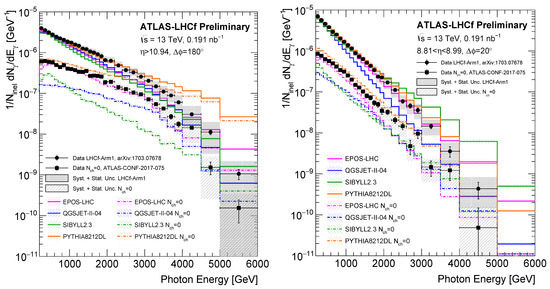
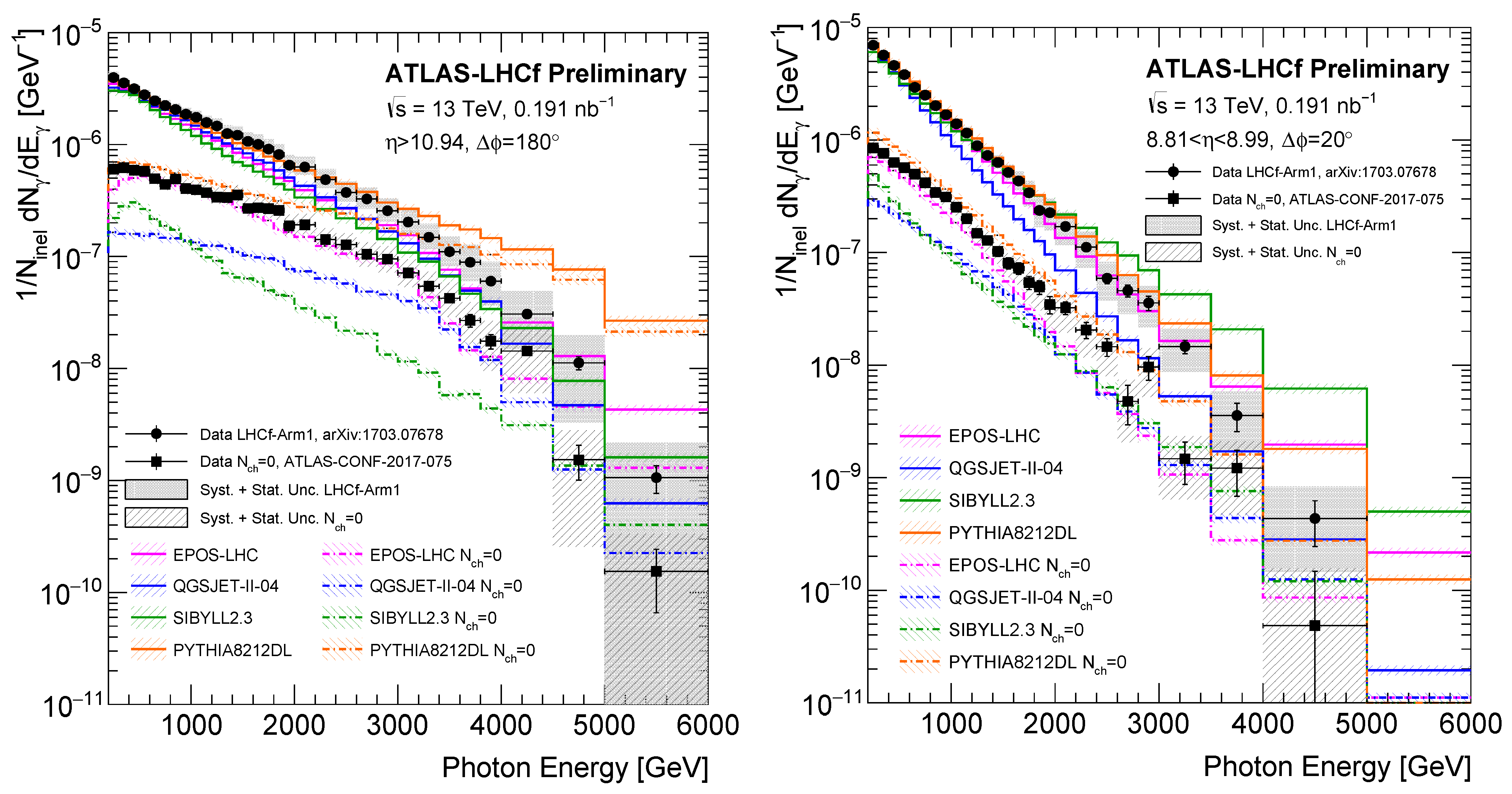
During the LHCf operation in p-p collisions at TeV, common data acquisition with the ATLAS experiment was conducted. Thanks to this common operation, the experimental dataset recorded by the LHCf Arm1 detector was used to perform a measurement of the contributions of diffractive processes to forward photon spectra in p-p collisions at TeV, which is the result of a joint LHCf-ATLAS analysis [18]. This measurement investigates one possible cause of the discrepancies between model predictions and data: the uncertainty in the modeling of diffractive processes in hadronic interaction models. In [19], it was shown that there is a large variation between the predictions of the photon spectra from proton diffractive dissociation by different MC models, particularly at large photon pseudorapidities, , whereas there is only a small variation in the inclusive photon spectra. A method to separate the contributions of diffractive and non-diffractive processes consists of selecting events with no charged particles in the pseudorapidity range and marking them as diffractive events (since a small number of particles is expected in the central detector in the case of diffractive events, characterized by large rapidity gaps). Experimentally, this can be achieved by combined data-taking of the ATLAS and LHCf experiments: while the photon spectra are measured by the LHCf detector, the information from the ATLAS inner tracker system is used to veto central charged-particle activity and suppress non-diffractive events. More details on the common operation and the analysis procedure can be found in [18]. The forward photon energy spectrum is measured in two regions of photon pseudorapidity ( and ) for events with no charged particles () having 100 MeV and . In Figure 5, the forward photon energy spectrum for events with the requirement of no charged particles () having 100 MeV and is compared with the inclusive forward photon energy spectrum in the two regions of photon pseudorapidity. The experimental results are then compared to predictions from several hadronic interaction models.
Figure 5.
Preliminary forward photon energy spectra measured by the LHCf Arm1 detector in the regions (left) and (right). Filled circles show the inclusive photon spectra measured in [11]. Filled squares indicate the spectra for events, where no extra charged particles with 100 MeV and are present. Vertical bars represent the statistical uncertainties of the data sample, while gray bands indicate the quadratic sum of statistical and systematic uncertainties. Colored lines indicate model predictions with (dashed lines) and without (solid lines) the requirement. Hatched areas around the model lines indicate the uncertainty related to the contribution from photons produced in long-lived particle decays (with a mean lifetime greater than 33 ps), which is currently not taken into account in the calculation of the model predictions [18].
In the region, the photon energy spectrum with observed in the data is much harder than the inclusive photon spectrum at photon energies below 3 TeV, whereas the and inclusive photon spectra have similar slopes in the region. Regarding the comparison of experimental results with model predictions, the PYTHIA 8.212 model shows good agreement with data up to photon energies of 2 TeV, in both the inclusive and cases. However, PYTHIA 8.212 predicts a significantly harder photon spectrum in the high-energy region. The EPOS-LHC model shows generally good agreement with data for all photon energies in the region. QGSJET II-04 shows good agreement with data at photon energies above 3 TeV, whereas it predicts lower photon fluxes at lower photon energies. SIBYLL 2.3 predicts significantly lower photon fluxes in the region.
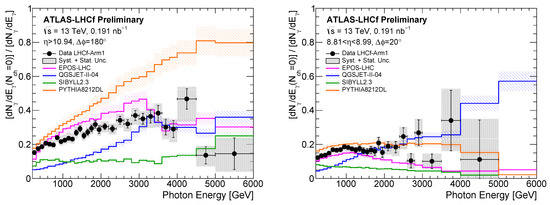
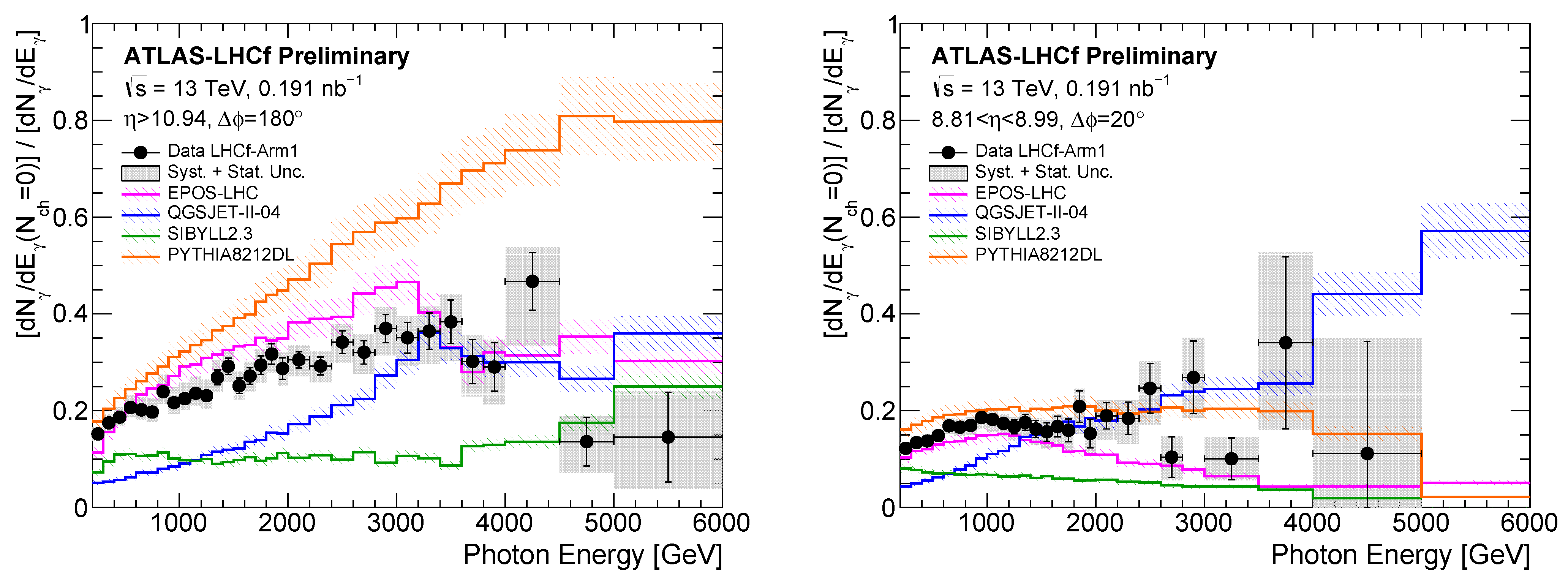
Figure 6 shows the ratio of the photon spectrum to the inclusive photon spectrum.
Figure 6.
Preliminary ratio of the photon energy spectrum with the additional requirement to the inclusive photon energy spectrum for the regions (left) and (right). Vertical bars represent the statistical uncertainties of the data sample, while gray bands indicate the quadratic sum of statistical and systematic uncertainties. Colored lines indicate model predictions. Hatched areas around the model lines indicate the uncertainty related to the contribution from photons produced in long-lived particle decays, which is currently not taken into account in the calculation of the model predictions [18].
In the region, the ratio observed in the data increases from to around with increasing photon energy up to around 4 TeV and decreases to again at higher energies. This increasing trend is also observed for all model predictions, except SIBYLL 2.3. The PYTHIA 8.212 and SIBYLL 2.3 models predict a higher and a lower fraction of events, respectively. This suggests that PYTHIA 8.212 (SIBYLL 2.3) predicts a too large (too small) contribution of low-mass diffractive events to the forward photon energy spectrum. In the region, the ratio in the data is around and is approximately constant over a wide range of photon energies. The SIBYLL 2.3 model predicts an average value of the ratio that is much lower than that observed in data. QGSJET II-04 predicts a lower ratio at photon energies below 15 TeV. The EPOS-LHC and PYTHIA 8.212 generators show reasonable agreement with data.
3.3. Measurement of the Forward Meson Inclusive Production Rate in p-p Collisions at = 13 TeV with the LHCf Arm2 Detector
This section presents the measurement of the inclusive production rate of the meson in , expressed as a function of the Feynman variable . Only data acquired by the LHCf Arm2 detector are used in this analysis. Two experimental datasets are used for this analysis, both relative to p-p collisions at TeV and acquired on 12 June and 13 June 2015. This time period corresponds to a dedicated low-luminosity fill (LHC Fill 3855). For the first dataset, the instantaneous luminosity was × 1028 cm−2s−1 and the average number of collisions per bunch crossing, , was in the range 0.007–0.012. For the second dataset, the instantaneous luminosity was × 1028 cm−2s−1 and the average number of collisions per bunch crossing, , was in the range –. Considering the LHCf data acquisition live time, the integrated luminosities were estimated to be 0.194 nb−1 and 1.938nb−1 for the first and the second datasets, respectively. Monte Carlo simulations are used to perform several analysis tasks, including the final comparison of the results with hadronic interaction model predictions. The models used to generate the simulation datasets are QGSJET II-04, EPOS-LHC, SIBYLL 2.3 and DPMJET 3.06.
The key concept behind LHCf event reconstruction is that the LHCf Arm2 detector can identify mesons by reconstructing the two photons produced in the decay that hit the Arm2 calorimetric towers. Once the energy and position of the selected photon pairs have been reconstructed, the invariant mass is computed according to the following formula:
where and are the energies of the two photons and is the opening angle in the laboratory reference frame. Candidate mesons are selected by looking at the characteristic peak in the di-photon invariant mass spectrum around the rest mass.
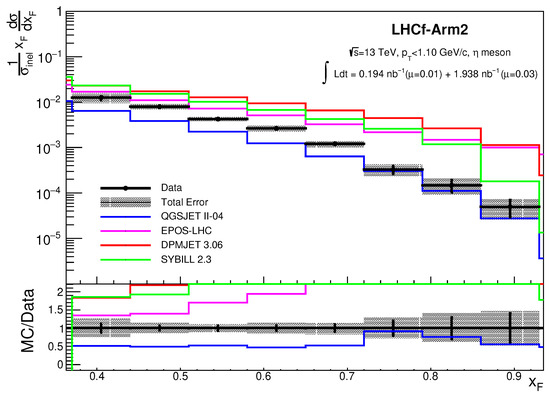
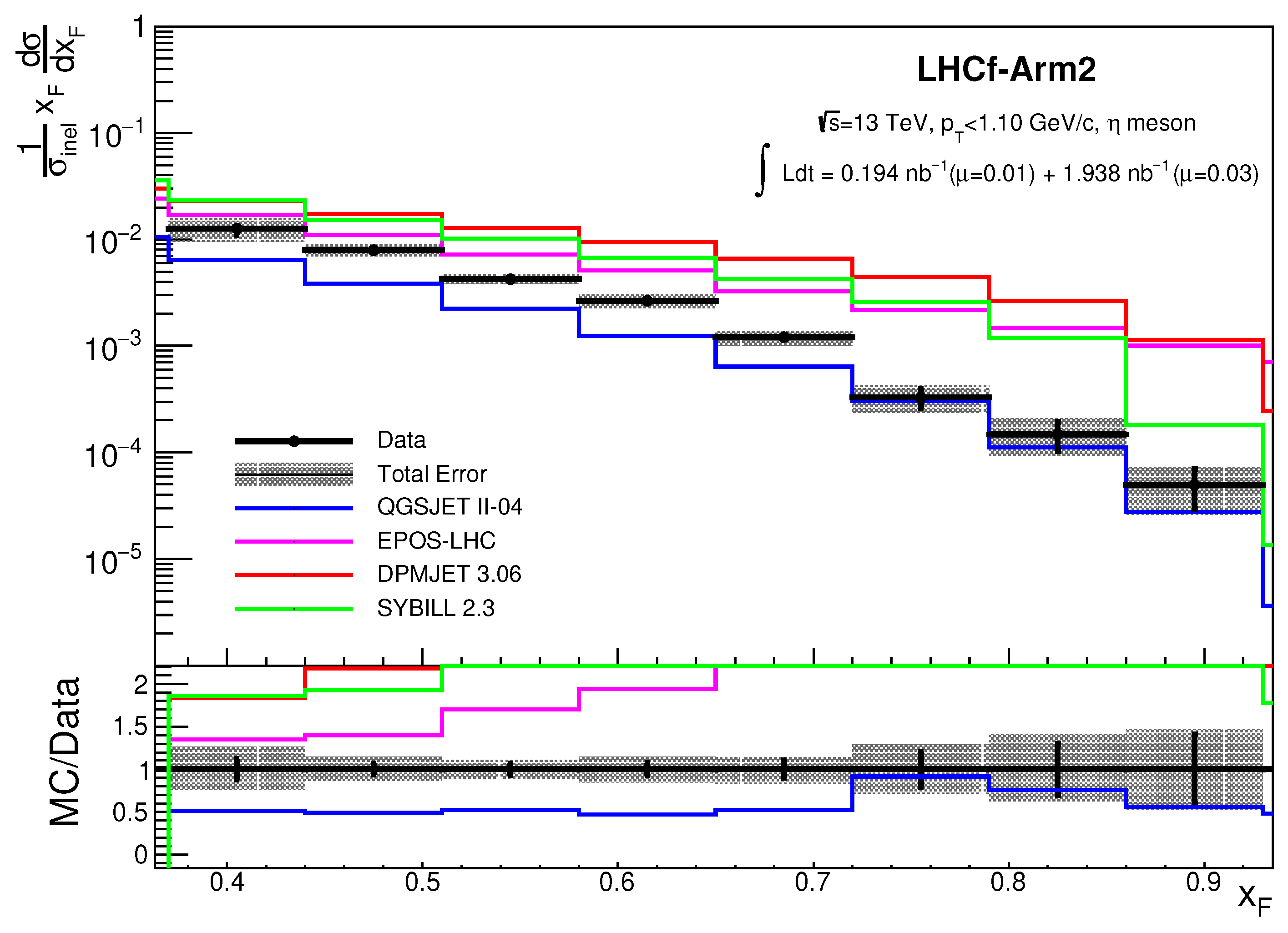
In [12], exhaustive details are provided about data-taking conditions, Monte Carlo simulations, and the entire analysis framework, which includes event reconstruction and selection, the estimation of correction factors, and the estimation of systematic uncertainties. Figure 7 shows the inclusive meson production rate, , as a function of , measured by the LHCf Arm2 detector in . The value of the inelastic cross-section, , for p-p collisions at TeV is [20]. In Figure 7, the predictions of several hadronic interaction models at the generator level, QGSJET II-04, EPOS-LHC, DPMJET 3.06 and SIBYLL 2.3, and their ratios to experimental data are also reported. QGSJET II-04 shows the best agreement with LHCf data among the models tested in this analysis, especially for , but a difference of about a factor of two is found at lower . The other three models, EPOS-LHC, DMPJET 3.06 and SIBYLL 2.3, predict higher production rates and a harder spectrum with respect to the experimental data over the whole range.
Figure 7.
Inclusive production rate as a function of in for p-p collisions at TeV, measured using the LHCf Arm2 detector. Black markers refer to experimental data with statistical errors and gray bands refer to the total uncertainties, obtained by summing in quadrature the statistical and systematic errors. The data points are compared with the predictions, at the generator level, of the hadronic interaction models considered in this analysis, QGSJET II-04 (blue line), EPOS-LHC (magenta line), SIBYLL 2.3 (green line) and DPMJET 3.06 (red line) [12].
4. Discussion and Future Prospects of the LHCf Experiment
- (i)
- The LHCf experiment measured the inclusive differential production cross-section of forward neutrons in TeV p-p collisions. The analysis covers the following six pseudorapidity regions: , , , , , and . The LHCf measurements were compared to the predictions of several hadronic interaction models: QGSJET II-04, EPOS-LHC, SIBYLL 2.3, DPMJET 3.06 and PYTHIA 8.212. All generators differ from the experimental results for , whereas at lower pseudorapidities the data–model agreement is better, but still not satisfactory. The LHCf results are the first measurements of forward neutron production at such a high energy and, given the significant deviation between generators and data, they suggest that all models would benefit from a tuning that takes these results into account. In the latest versions of some hadronic interaction models—EPOS LHC-R [21], QGSJET III [22] and Sibyll* [23]—this LHCf result, in particular the measurement of elasticity that can be extracted from the distributions in Figure 3, has been used to constrain some model parameters, which have a crucial impact on shower development. A further development of this analysis is possible thanks to the fact that the LHCf and ATLAS experiments had common data acquisition during the operations in which the data considered here were recorded. By exploiting the ATLAS information in the central region, it will be possible to investigate the different mechanisms responsible for neutron production in the forward region and the amount of correlation between central and forward hadron production. In [19], the different contributions of non-diffractive and diffractive components to the forward neutral particle cross-sections, including that of forward neutrons, and the differences among models are investigated. The implementations of non-diffractive and diffractive processes in each model are very different. It was found that there is no large difference between models in the neutron total spectra at higher pseudorapidities (). In contrast, a comparison of the individual contributions of non-diffractive and diffractive components shows that the neutron spectra of EPOS-LHC and PYTHIA 8.212 are dominated by diffractive processes at high energies, whereas those of QGSJET II-04 and SIBYLL 2.3 are dominated by non-diffractive processes. This strong model dependence highlights the importance of a LHCf-ATLAS joint analysis of the dataset corresponding to p-p collisions at TeV, aimed at investigating the relative contributions of diffractive and non-diffractive mechanisms in forward neutron production. Furthermore, common data acquisition was also conducted during Run III p-p collisions at 13.6 TeV in 2022. The LHCf-ATLAS joint analysis of this dataset will be extremely interesting thanks to the large statistics collected in this operation (approximately 40 times larger statistics of ATLAS common events with respect to Run II p-p collisions at TeV).
- (ii)
- The LHCf experiment measured the production cross-section of forward photons at and in p-p collisions at TeV. The final result was compared to the MC predictions obtained from several hadronic interaction models: QGSJET II-04, EPOS-LHC, DPMJET 3.06, SIBYLL 2.3, and PYTHIA 8.212. Among these models, EPOS-LHC showed the best agreement with the experimental data. QGSJET II-04 showed good agreement with the data for , but predicted a lower flux than the data for . PYTHIA 8.212 showed a higher cross-section than the data in the energy region above 3 TeV. No MC models matched the experimental data perfectly. The analysis of experimental data from the common operation of LHCf and the ATLAS experiment provides event-by-event information both in the forward and central regions, which leads to a more complete understanding of the soft hadronic photon production processes. In particular, the contributions of diffractive processes to forward photon spectra in p-p collisions at TeV were measured by the ATLAS and LHCf collaborations. The photon energy spectra were measured in two pseudorapidity regions, and , for events with no extra charged particles () having 100 MeV and , classified as diffractive events. The photon spectra for events were compared with the inclusive photon spectra to allow for a comparison of non-diffractive and diffractive particle production processes. The ratio between the and inclusive photon spectra increased from to with increasing photon energy up to 4 TeV at , whereas it was found to be relatively constant (around ) in the region. The results were compared to predictions based on several hadronic interaction models: EPOS-LHC, QGSJET II-04, SIBYLL 2.3, and PYTHIA 8.212. Predictions from EPOS-LHC generally showed the best agreement with data. At photon energies above 2 TeV, PYTHIA 8.212 predicted a significantly higher ratio than that observed in data. This indicates that the large discrepancy between PYTHIA 8.212 and data in the high-energy photon region reported in [11] can be due to an overestimation of the diffractive dissociation process in PYTHIA 8.212. The QGSJET II-04 and SIBYLL 2.3 models predict an average value of the ratio that is much lower than that observed in data in both and regions. This suggests that QGSJET II-04 and SIBYLL 2.3 predict a too small contribution of low-mass diffractive events to the forward photon energy spectrum.
- (iii)
- The LHCf experiment measured the inclusive production rate of mesons in p-p collisions at TeV in . This is both the first measurement of mesons by LHCf and the first time a particle containing strange quarks has been observed in the very forward region in high-energy collisions. The importance of this observation lies in the fact that the meson provides a probe of strangeness production in the hadronization mechanism. Differences in the parametrization of strangeness production among models induce significant discrepancies in the predicted production cross-section [24]. In addition, photons produced in decays constitute the second dominant source of high-energy photons in hadronic interactions after production and therefore play a relevant role in the development of air showers. The result was compared with the predictions of several hadronic interaction models, namely QGSJET II-04, EPOS-LHC, DPMJET 3.06 and SIBYLL 2.3. None of the models reproduce the experimental distribution over the whole range. QGSJET II-04 shows the best agreement, but significant differences are present at low . The other models predict an overall higher production rate than the experimental data. The large experimental uncertainties in this analysis, due to the low accumulated statistics, will be improved by the LHCf data collected during LHC Run III in p-p collisions at 13.6 TeV (2022). A very preliminary analysis shows an increase in meson statistics by about a factor of ten, as expected [24].
After many years of successful operations, the LHCf experiment completed its last and most significant data taking, starting on 1 July 2025 and ending on 3 July 2025. A brief overview of the operation and the physics motivation behind it is reported here. In this operation, with p-O collisions at 9.6 TeV, only the LHCf Arm2 detector was installed in its experimental slot on the IP2 side, which corresponded to the proton remnant side. It acquired data in two different positions in order to have a larger acceptance coverage. The collected datasets refer to three different luminosity conditions: two of them corresponding to average numbers of collisions per bunch crossing, and (low luminosity), and the third one characterized by a much higher luminosity, with head-on collisions. Analyses of the LHCf datasets in p-O collisions are ongoing.
The importance of the LHCf p-O operation is motivated by several points. A detailed description of the interaction of cosmic rays in the Earth’s atmosphere requires precise knowledge of the high-energy interactions between protons and the nuclei of the molecules constituting the atmosphere. The starting point for the generation of the EAS in the atmosphere is, in fact, the hadronic interaction of a single highly energetic primary cosmic ray with a nucleus of the atmosphere, mainly nitrogen and oxygen. The details of this primary interaction (i.e., the cross-section, the inelasticity, and the spectra of the produced secondary particles) are important for a precise description of the development of the EAS. The LHCf p-O operation represents the possibility to directly probe the high-energy collisions that occur in the atmosphere. A direct measurement of the p-O interaction cross-section and particle production will avoid performing large extrapolations from p-p results and, consequently, will allow a significant reduction in systematic uncertainties. An advantage of p-O collisions is that the contribution from ultra-peripheral collisions (UPC) to particle production is negligible with respect to the QCD contribution. Since UPCs are not relevant for EAS simulations, in order to provide results that can be used for the tuning of hadronic interaction models, the UPC contribution must be estimated with MC simulations and subtracted from the data. The subtraction of the UPC contribution can be done only by relying on a simulation because the LHCf detector does not have the ability to discriminate a QCD-induced collision from a UPC-induced one. By doing this, the uncertainty associated with the UPC simulation adds a significant contribution to the systematic uncertainty of the measurement. This happens in p-Pb measurements, where the UPC contribution is of the same order as the QCD contribution, but not in p-O measurements [24]. All of these considerations lead to the conclusion that future analyses of LHCf data from p-O collisions will have a great impact on the tuning of hadronic interaction models used in EAS simulations.
5. Conclusions
The LHCf experiment has provided unique measurements of neutral particle production in the very forward region at the highest available collider energies, significantly contributing to the tuning and validation of hadronic interaction models used in EAS simulations. The results on the inclusive production cross-section of forward neutrons and photons and the forward meson production rate highlight discrepancies between data and model predictions. Future analyses, in particular those based on p-O collisions and on common LHCf-ATLAS data, are expected to have a significant impact on the calibration of hadronic interaction models and to improve the modeling of EAS simulations.
Author Contributions
Writing—original draft preparation, E.G. (Elena Gensini); writing—review and editing, O.A., E.B., P.B., L.B., M.B., R.D., S.D., E.G. (Elena Geraci), M.H., V.H., C.I., Y.I., K.K., H.K., C.L., Y.M. (Yutaka Matsubara), H.M., Y.M. (Yasushi Muraki), A.P., P.P., G.P., S.B.R., T.S., N.S., M.S., Y.S., T.T., A.T. (Alessio Tiberio), S.T., A.T. (Alessia Tricomi), B.T. and K.Y. All authors have read and agreed to the published version of the manuscript.
Funding
This work was partly supported by JSPS KAKENHI Grant Numbers JP26247037, JP23340076, JP20H01917, JP23KK0056, JP24K00660 and the joint research program of the Institute for Cosmic Ray Reasearch (ICRR), University of Tokyo. This work was supported by Istituto Nazionale di Fisica Nucleare (INFN) in Italy. This work was also funded by the Deutsche Forschungsgemeinschaft (DFG, German Research Foundation)–529660446.
Data Availability Statement
No new data were created or analyzed in this study. Data sharing is not applicable to this article.
Acknowledgments
We thank the CERN staff and the ATLAS Collaboration for their essential contributions to the successful operation of LHCf.
Conflicts of Interest
The authors declare no conflicts of interest.
References
- LHCf Collaboration; Adriani, O.; Bonechi, L.; Bongi, M.; Castellini, G.; D’Alessandro, R.; Faus, D.A.; Fukui, K.; Grandi, M.; Haguenauer, M.; et al. The LHCf detector at the CERN large hadron collider. J. Instrum. 2008, 3, S08006. [Google Scholar] [CrossRef] [Scilit]
- Gaisser, T.K. Introduction to Ultrahigh Energy Cosmic Ray Physics; Cambridge University Press: Cambridge, UK, 1992. [Google Scholar]
- Pierre Auger Collaboration. The Pierre Auger Cosmic Ray Observatory. Nucl. Instrum. Meth. Phys. Res. Sect. A 2015, 798, 172–213. [Google Scholar] [CrossRef] [Scilit]
- Fukushima, M. Telescope array project for extremely high energy cosmic rays. Prog. Theor. Phys. Suppl. 2003, 151, 206. [Google Scholar] [CrossRef] [Scilit]
- Ulrich, R.; Engel, R.; Unger, M. Hadronic Multiparticle Production at Ultra-High Energies and Extensive Air Showers. Phys. Rev. D 2011, 83, 054026. [Google Scholar] [CrossRef] [Scilit]
- CMS Collaboration; Adolphi, R.; Hmayakyan, G.; Khachatryan, V.; Sirunyan, A.M.; Adam, W.; Bauer, T.; Bergauer, T.; Bergauer, H.; Dragicevic, M.; et al. The CMS experiment at the CERN LHC. J. Instrum. 2008, 3, S08004. [Google Scholar] [CrossRef] [Scilit]
- Aad, G.; Abat, E.; Abdallah, J.; Abdelalim, A.A.; Abdesselam, A.; Abdinov, O.; Abi, B.A.; Abolins, M.; Abramowicz, H.; Acerbi, E.; et al. The ATLAS experiment at the CERN large hadron collider. J. Instrum. 2008, 3, S08003. [Google Scholar] [CrossRef] [Scilit]
- Anelli, G.; Antchev, G.; Aspell, P.; Avati, V.; Bagliesi, M.G.; Berardi, V.; Berretti, M.; Boccone, V.; Bottigli, U.; Bozzo, M.; et al. The TOTEM experiment at the CERN large hadron collider. J. Instrum. 2008, 3, S08007. [Google Scholar] [CrossRef] [Scilit]
- Makino, Y.; Tiberio, A.; Adriani, O.; Berti, E.; Bonechi, L.; Bongi, M.; Caccia, Z.; D’Alessandro, R.; Prete, M.D.; Detti, S.; et al. Performance study for the photon measurements of the upgraded LHCf calorimeters with Gd2SiO5 (GSO) scintillators. J. Instrum. 2017, 12, P03023. [Google Scholar] [CrossRef] [Scilit]
- Adriani, O.; Berti, E.; Bonechi, L.; Bongi, M.; D’Alessandro, R.; Detti, S.; Haguenauer, M.; Itow, Y.; Kasahara, K.; Menjo, H.; et al. Measurement of energy flow, cross section and average inelasticity of forward neutrons generated in = 13 TeV proton-proton collisions with the LHCf Arm2 detector. J. High Energy Phys. 2020, 2020, 16. [Google Scholar] [CrossRef] [Scilit]
- Adriani, O.; Berti, E.; Bonechi, L.; Bongi, M.; d’Alessandro, R.; Haguenauer, M.; Itow, Y.; Iwata, T.; Kasahara, K.; Makino, Y.; et al. Measurement of forward photon production cross section in proton–proton collisions at = 13 TeV with the LHCf detector. Phys. Lett. B 2018, 780, 233–239. [Google Scholar] [CrossRef] [Scilit]
- Adriani, O.; Berti, E.; Betti, P.; Bonechi, L.; Bongi, M.; D’Alessandro, R.; Detti, S.; Hagenauer, M.; Itow, Y.; Kasahara, K.; et al. Measurement of the forward η meson production rate in p-p collisions at = 13 TeV with the LHCf Arm2 detector. J. High Energ. Phys. 2023, 2023, 169. [Google Scholar] [CrossRef] [Scilit]
- Ostapchenko, S. Monte Carlo treatment of hadronic interactions in enhanced Pomeron scheme: I. QGSJET-II model. Phys. Rev. D 2011, 83, 014018. [Google Scholar] [CrossRef] [Scilit]
- Pierog, T.; Karpenko, I.; Katzy, J.M.; Yatsenko, E.; Werner, K. EPOS LHC: Test of collective hadronization with data measured at the CERN Large Hadron Collider. Phys. Rev. C 2015, 92, 034906. [Google Scholar] [CrossRef] [Scilit]
- Riehn, F.; Engel, R.; Fedynitch, A.; Gaisser, T.K.; Stanev, T. A new version of the event generator Sibyll. arXiv 2015, arXiv:1510.00568. [Google Scholar] [CrossRef] [Scilit]
- Bopp, F.W.; Ranft, J.; Engel, R.; Roesler, S. Antiparticle to Particle Production Ratios in Hadron-Hadron and d-Au Collisions in the DPMJET-III Monte Carlo. Phys. Rev. C 2008, 77, 014904. [Google Scholar] [CrossRef] [Scilit]
- Sjöstrand, T.; Ask, S.; Christiansen, J.R.; Corke, R.; Desai, N.; Ilten, P.; Mrenna, S.; Prestel, S.; Rasmussen, C.O.; Skands, P.Z. An introduction to PYTHIA 8.2. Comput. Phys. Commun. 2015, 191, 159. [Google Scholar] [CrossRef] [Scilit]
- ATLAS; LHCf Collaborations. Measurements of Contributions of Diffractive Processes to Forward Photon Spectra in pp Collisions at = 13 TeV; ATLAS-CONF-2017-075; ATLAS: Geneva, Switzerland, 2017. [Google Scholar]
- Zhou, Q.-D.; Itow, Y.; Menjo, H.; Sako, T. Monte Carlo study of particle production in diffractive proton–proton collisions at = 13 TeV with the very forward detector combined with central information. Eur. Phys. J. 2017, 77, 212. [Google Scholar] [CrossRef] [Scilit]
- Antchev, G.; Hammerbauer, J.; Linhart, R.; Peroutka, Z.; Siroky, J.; Zich, J.; Kašpar, J.; Kundrát, V.; Lokajíček, M.V.; Procházka, J.; et al. First measurement of elastic, inelastic and total cross-section at = 13 TeV by TOTEM and overview of cross-section data at LHC energies. Eur. Phys. J. C 2019, 79, 103. [Google Scholar] [CrossRef] [Scilit]
- Pierog, T.; Werner, K. EPOS.LHC-R: A global approach to solve the muon puzzle. arXiv 2025, arXiv:2508.07105. [Google Scholar] [CrossRef] [Scilit]
- Ostapchenko, S. QGSJET-III model of high energy hadronic interactions: II. Particle production and extensive air shower characteristics. Phys. Rev. D 2024, 109, 094019. [Google Scholar] [CrossRef] [Scilit]
- Riehn, F.; Fedynitch, A.; Engel, R. Sibyll. Astropart. Phys. 2024, 160, 102964. [Google Scholar] [CrossRef] [Scilit]
- Adriani, O.; Bongi, M.; Berti, E.; Tricomi, A.; Bonechi, L.; Tiberio, A.; Itow, Y.; Kasahara, K.; Torii, S.; Ricciarini, S.B.; et al. LHCf—Technical Proposal for the LHC Run3; CERN-LHCC-2019-008; CERN: Geneva, Switzerland, 2019; Available online: https://cds.cern.ch/record/2679323 (accessed on 16 March 2026).

Disclaimer/Publisher’s Note: The statements, opinions and data contained in all publications are solely those of the individual author(s) and contributor(s) and not of MDPI and/or the editor(s). MDPI and/or the editor(s) disclaim responsibility for any injury to people or property resulting from any ideas, methods, instructions or products referred to in the content. |
© 2026 by the authors. Licensee MDPI, Basel, Switzerland. This article is an open access article distributed under the terms and conditions of the Creative Commons Attribution (CC BY) license.