


Abstract
We present state-of-the-art kinetic theory determination of the neutron abundance available for the Big-Bang nucleosynthesis (BBN). This paper is motivated by the study of the neutron lifespan measured in the laboratory and the unknown strength of weak interactions coupling constant at finite temperature in the primordial Universe. We draw attention to the relevant dependence of on the symmetry breaking Weinberg angle , which is a free parameter in the standard model of particle physics. We establish how the value of by way of modification influences the neutron abundance available for BBN and neutron lifetime.
1. Introduction
The primary motivation for this paper is to quantify the primordial neutron abundance available for Big-Bang nucleosynthesis (BBN) using methods of kinetic theory and to study the impact of small weak interaction variation from present day value. There is continued interest in understanding the cosmological variation of natural constants [1] with much of recent interest arising in the context of the Hubble tension [2]. We studied this context before, exploring the dependence of neutrino freeze-out on the variation of natural constants [3] in the primordial Universe. This paper extends these considerations to the temperature domain at the edge of BBN nucleosynthesis physics.
Our motivation to study the neutron primordial abundance derives from a significant dependence of on the Weinberg angle parameter used in the convenient form , . is not as rigidly anchored as is the tree level value [4] ; it is only dependent on the Higgs vacuum expectation value where GeV and . This is the dependence we considered in the prior study of natural constants [3].
Allowing for higher radiative corrections, and thus the relevant weak interaction (WI) reaction rates become dependent on , which is a free parameter of the standard model (SM) of particle physics. We consider in Section 2 how the relevant to nucleosynthesis primordial Universe variation in could originate in a shift of . We apply the same method to study the dependence of the neutron lifetime on this symmetry-breaking parameter of electroweak interactions.
The well-studied radiative vacuum polarization type correction [5,6] to the charged current mediating W-Boson produces a leading order result of [4]
where is the fine-structure constant radiative correction, is the charged current gauge W-boson vacuum polarization correction, and includes sub-leading corrections.
In Section 2.1, we look closer at the Weinberg angle, exploring its potential relevance for this paper’s variation, possibly originating in ambient properties such as temperature and external fields. In Section 2.2 we discuss further the Fermi constant and its electro-weak radiative corrections, highlighting its dependence on the Weinberg angle. We show, somewhat unexpectedly, how a small variation in through its effect on modifies in a noticeable manner WI reaction rates.
We review the theory and experiment on neutron lifetime in Section 3.1. In Section 3.2, we study how the primordial plasma medium in the Universe modifies the neutron lifetime by blocking the decay phase space. Combining this with the thermal model and neutron decay during the 200 s to reach the onset of BBN at , one obtains a first view of the expected neutron abundance in the Universe [7].
The study of Fermi blocking introduced the general method of the approach, allowing the study of neutron and proton reactions on the lepton Universe background; see Section 4.2. The freeze-out of neutron abundance requires a study of the kinetic population equation in order to understand precisely the neutron abundance that we address in Section 4.3. This more refined understanding of the role of electro-weak processes in a kinetic model allows us to quantify the dependence of the neutron abundance on the actual primordial value of the Weinberg angle.
To obtain precise neutron abundance, we need to have a precise understanding of the ratio of weak interaction strength to the Hubble expansion rate H, which we discuss in Appendix A based on our recent work [8]. We show the precise dependence of H on the baryon and entropy content, which is usually stated in form of baryon to photon ratio , and the number of neutrino species , which is near but above the value three, since by definition it comprises an inflow of entropy due to pre-freeze-out neutrino reheating by electron-positron annihilation. We conclude this paper with a discussion of the implications of our results in Section 5.
2. Electroweak Theory Parameters
2.1. Weinberg Angle
In some beyond standard model (BSM) theoretical models, the magnitude of the electro-weak symmetry breaking is predicted and thus the value of is fixed. This is not the case in SM, where is a free parameter. The value may be associated with the lowest vacuum energy configuration. However, such a theoretical determination awaits.
The value of controls the splitting in mass of the gauge Bosons , and yet it appears in the WI, dominating the charged current interactions mediated by W only in beyond the tree level radiative corrections; see Equation (1). Given this situation, we expect that any future dynamic theory determining the value of by seeking the minimum of an effective action includes similar in magnitude effects of both charged and neutral currents contributions to the vacuum energy. At the time of writing, there is nothing in the literature we could find that would offer an evaluation of radiative corrections as the origin of the value of the Weinberg angle, and no reference could be found addressing the temperature dependence. All of the research that followed the foundational (in this context) work of Coleman and Weinberg [9], and the companion papers establishing finite-temperature symmetry behavior [10,11], appear to address unrelated questions.
Since these questions are not yet addressed in the literature, we advance intuitive arguments: Given the radiative dependence of on , the minimum in effective potential as a function of obtained at the radiative level could be governed by a much lower energy scale compared to the usual in the SM. Seeing the required radiative factors , this is so. Therefore, the value of the Weinberg angle and thus would be unusually sensitive to the environmental conditions, including temperature, and external (strong) fields. Viewed from another perspective, symmetry breaking in quantum mechanics is predominantly a function of the environmental conditions. Elementary examples of symmetry breaking in atomic physics by external fields are the Zeeman effect and the Stark effect.
The experimental value of the Weinberg angle is discussed in Refs. [6,12], . This value relates to experimental data obtained in experiments near to the indicated scale with the mass of the Z-gauge meson mediating the neutral current. Yet a somewhat larger value for a lower energy scale is suggested by recent global result analysis [13]. The more recently reported LHCb [14] and CMS [15] results agree. The scale dependence (running) of at low energies is studied in [16]. However, the recommended NIST-CODATA value [17] we adopt in this paper addressing low-energy phenomena is smaller, . The difference between these two low-energy values is nearly 7%. Such value scatter can be interpreted as a combination of several effects, including differences in the renormalization scheme and unresolved experimental systematics. However, it is possible to question whether a small additional dependence of a physical origin that is as of yet unidentified could be present. One such possibility, which we wish to highlight for future study, is that the unconstrained free parameter of the SM, , might exhibit a hidden small residual sensitivity to environmental factors such as external electromagnetic fields. In this context, we note that a much smaller than 7% variance in suffices to explain the disagreement in the measured values of neutron lifetime.
It is possible that the value of the symmetry breaking Weinberg angle can change at the percent level for temperature as low as a fraction of a MeV given the theoretical considerations without contradicting any experimental result. This is so, since, as discussed, the minimum in vacuum energy as a function of the Weinberg angle is probably flat. Therefore, it seems appropriate to explore the sensitivity of neutron abundance at the edge of the BBN to a modest modification of and also to motivate the future study of the SM effective potential as a function of . We emphasize that the arguments offered here are intuitive and therefore only provide motivation; a theoretically complete electro-weak determination of the temperature dependence of remains to be seen. This paper is a phenomenological sensitivity study within the uncertainty range of . We use as an external parameter, vary it within a range bracketing the current experimental scatter, and quantify the resulting impact on the BBN-onset neutron abundance.
More generally, the finite temperature could, in principle, influence the value of the vacuum expectation value v of the Higgs field. This requires temperatures that are above 20 GeV, as we will address in a quantitative manner in the near future. Computation of this effect is possible, since the action of the SM has a well-defined minimum as a function of v. As discussed, we do not know the shape of the minimum in vacuum energy as a function of the Weinberg angle, and a dynamical theory was not developed.
To conclude:
- We believe that the effective electro-weak vacuum energy minimum as a function of is relatively shallow, rendering the value susceptible to modification by environmental factors;
- In the primordial Universe, the effective value of the Weinberg angle can differ from its low-energy laboratory value due to the thermal plasma background effects. As a result, the Fermi constant in this environment could acquire a temperature-dependent shift.
- We consider it possible that the value of the Weinberg angle is different in different experimental environments in the presence of strong electromagnetic fields, which could result in method-dependent neutron lifetime measurement.
2.2. Fermi Constant: Radiative Corrections
In this section, we explore the sensitivity of the effective Fermi constant to variations in the Weinberg angle. We work within the on-shell renormalization scheme set out by Sirlin and collaborators [6,12,18], in which the independent input parameters are taken as , , , and the fermion masses with defined through the on-shell relation . In the parametric exploration that follows, we hold the Higgs vacuum expectation value v, the fine-structure constant , the top-quark coupling , and the top-quark mass fixed, and then we vary as an external parameter. What follows should therefore be read as a phenomenological tool quantifying how would respond if were genuinely shifted from its CODATA value; we do not provide a derivation of environment dependence from first principles. Within the standard model, the most precise value of the Fermi constant (see Equation (1)) was obtained from precisely measured muon lifetime [19] . can be written using measured quantities in the form [12,18]
In the temperature range considered here, MeV, we take the Higgs field vacuum expectation value GeV to be a constant. The radiative corrections are summarized in the quantity . The quantum correction has seen extensive theoretical study. The one-loop correction can be written as [6,20]
where is the correction due to the running of fine-structure constant ; we have
The second term quantifies how neutral-current and charged-current interactions are modified by the loop effect. The leading contribution to arises from the mass splitting between the top and bottom quarks and depends quadratically on the top-quark mass; we have [21]
where we rewrite the top quark mass in terms of vacuum expectation value; we have with top quark coupling constant . The remainder term contains sub-leading contributions, including the dependence on the Higgs-boson mass. Numerically, its impact is small, contributing at the ∼1% level [20].
In the following calculation, the remainder term is negligible; we thus obtain a self-consistent Dyson-like equation for the Fermi constant:
We can solve in a self-consistent manner
However, this is an infinite series and very likely higher order terms are not consistently accounted for. Therefore we will consider the lowest order perturbative modification
From experimental measurements, the experimental Fermi constant value is defined at the measured value of
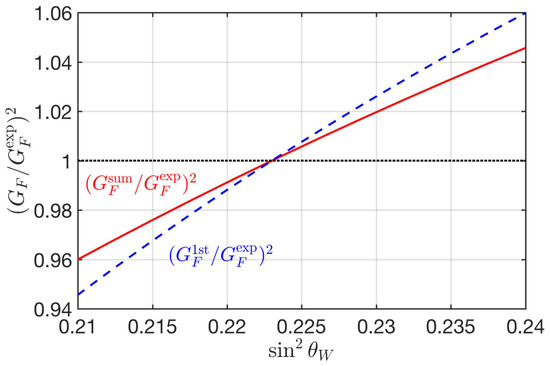
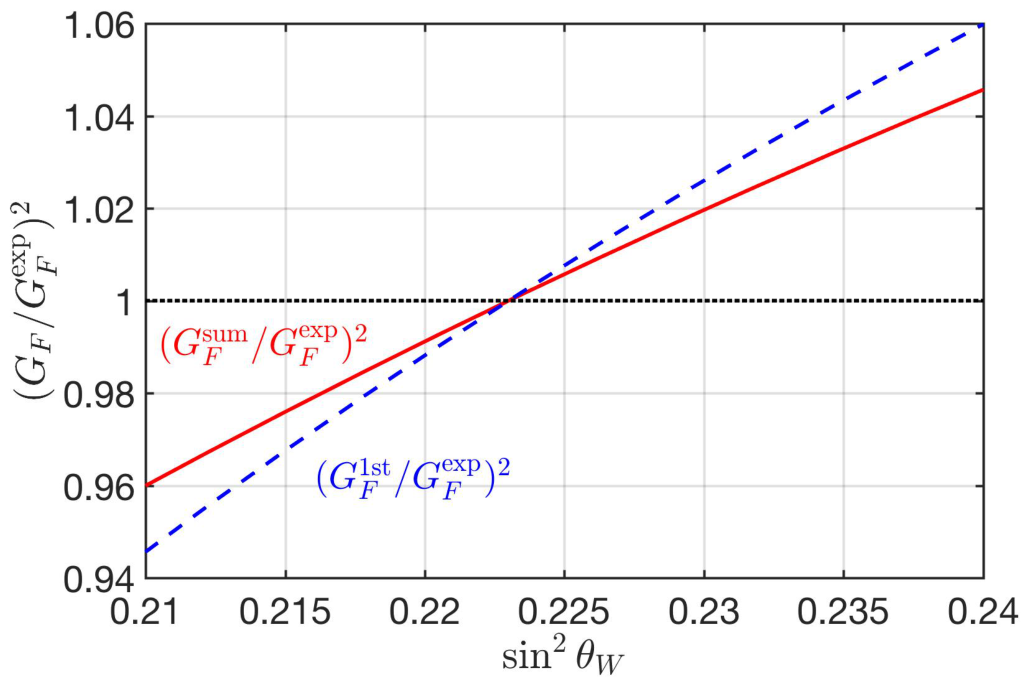
In Figure 1, we quantify the dependence of the normalized Fermi constant on the Weinberg angle in the range . The impact of even small variations in the Weinberg angle on the Fermi constant is non-negligible. We note that the presented range of can account for the observed sub-percent discrepancy in neutron lifetime. This demonstrates that precision measurements of neutron decay are sensitive probes of electro-weak parameters and that even slight shifts in the Weinberg angle could have measurable effects on weak interaction processes.
Figure 1.
The normalized Fermi constant as a function of the Weinberg angle within the range . The horizontal dotted line indicates the standard-model value . The two methods of treating the radiative corrections are discussed in the text.
3. Neutron Decay Rate
3.1. Decay in Vacuum
For the neutron decay channel
the vacuum lifetime of the neutron can be written as
where the invariant matrix element for the neutron decay for non-relativistic neutrons and protons is given by
The neutron lifetime is seen to be proportional to several parameters; the textbook final result is [22,23,24,25]
where the phase space factor f is
This factor f varies from reaction to reaction and in medium; hence, we separated out the reaction strength D appearing here and below in all (thermal) reaction rates, allowing to write
Q is the neutron-proton mass difference
When more than 5 digits precision are needed, the more accurate form reads
The nucleon structure enters Equation (13) in terms of , which is the ratio of transition axial current to transition vector current. The electro-weak structure is encoded in the weak Fermi coupling and ; the Cabibbo–Kobayashi–Maskawa (CKM) flavor mixing between down and up quarks . We further included in Equation (13) the Coulomb correction between the electron and proton, proton recoil, nucleon size correction, etc. achieved by the additional factor [22,25,26] .
In total, the theoretical decay rate compares well to the experimental result. The neutron lifetime has been measured with high precision in laboratory experiments using two approaches: the bottle method and the beam method. In the former, neutrons are trapped and the surviving neutrons are counted with varying storage times. In the beam method, the observed detection rate of the decay products gives the neutron decay rate. The beam method [27] (two experimental results) gives an average lifetime of s, while the trap method (8 experimental results since 1990) gives s [28]. The Particle Data Group [6] (PDG-2024) presents as a reference value the trap value s, disregarding, as it seems, the beam method.
Although this method dependence of may originate from unresolved experimental systematics, we offer a further possibility without claiming any direct evidence: a residual environment dependence of the value of the symmetry breaking Weinberg angle , as discussed in Section 2.1.
3.2. Medium Effects in Neutron Lifespan
In this section, we explore medium effects modifying the neutron decay rate in the primordial Universe. The medium effects we retain are the Fermi blocking factors for all final-state leptons and protons in the in-medium phase-space integrals, the gradual reheating of the photon fluid by annihilation set out in Appendix A, and the consequent modification of the Hubble rate via in the same epoch. We do not include thermal mass shifts of the electron and nucleons, thermal–photon vertex corrections to the matrix element, or recomputation of the short-distance Coulomb-recoil factor in medium nor equally insignificant time dilation originating in particle thermal motion [29]; as in our case, for neutrons with , this effect is negligible. In our evaluation, we by default consider the noticeable plasma influence on the neutron lifetime in the primordial Universe. Dominant omitted corrections have been already addressed in the precision-BBN literature, in particular by Pitrou–Coc–Uzan–Vangioni [30], and they are estimated there at the – level on in the temperature range MeV—which is well below the variation induced by the percent-level shifts we explore in this paper. We do not expect that a full finite-temperature, field-theory-based treatment of rates could influence our results noticeably.
- The decay Fermi blocking factors: In the relevant temperature range after neutron freeze-out , electrons and neutrinos in the background plasma can reduce the neutron decay rate by Fermi blocking the neutron decay products; this can noticeably lengthen the neutron lifetime compared to its vacuum value. The Pauli blocking has been recognized in the literature [7,30,31,32], and the medium dependence of particle decay was recognized by Kuznetsova et al. [29]. We use their method to quantify the ambient cosmic plasma effect on neutron decay, including as a new element the consideration of variation of .
- Gradual reheating by -pair annihilation: We obtain a result for H which accounts for disappearing -pairs in a gradual manner with slowly growing difference in the two different temperatures in cosmic plasma. In our model, the already decoupled (frozen-out) neutrinos remain undisturbed. However, as the temperature decreases, the thermal abundance of -pairs decreases, and the entropy from pair annihilation feeds into photons and charged particles, leading to reheating and gradually growing . Gradual reheating impacts the speed of the expansion of the Universe, see Appendix A, and thus neutron abundance at the edge of the BBN epoch.
In the primordial Universe, the rate of all present neutron decays per volume in medium, at finite temperature, can be written as [29]
where the phase-space factors are Fermi suppression (blocking) factors in the medium.
Considering the nonrelativistic neutron , the thermal neutron decay rate per unit volume, Equation (18), can be written as
This leads to the decay rate of one single neutron in the rest frame of the heat bath; compare Equation (11)
To simplify Equation (20), we insert the form of matrix element Equation (11) in Equation (20); we use for the proton in nonrelativistic limit the three-momentum part of the four-dimensional delta function. The energy-momentum conservation then fixes the antineutrino energy as in the neutron rest frame. The remaining integral is performed in the limit , yielding a factor , while the integral written in spherical coordinates contributes with . Collecting these factors and imposing the kinematic bounds , one recovers the standard vacuum phase-space integral for the neutron decay multiplied by the in-medium Fermi distribution blocking factors for electrons, protons, and antineutrinos. We keep for now the blocking fugacity for the (free-streaming [33]) neutrino background. Separating out the reaction strength D, Equation (15), the reduced decay rate written using dimensionless variable is
This shows how the primordial plasma of the Universe modifies the neutron decay phase space in terms of both the photon temperature T and the neutrino effective temperature , which is presented in Appendix A at the required level of precision. Q is the neutron-proton mass difference seen in Equations (16) and (17). The limit of the decay rate in vacuum is found in Equation (21) ignoring the Fermi function denominators. The use of free-streaming neutrino distribution characterized by the non-reheated temperature is justified by the fact that neutrino kinetic decoupling [3,34,35] occurs at MeV, which is well above the temperature range MeV where the in-medium correction to is computed. The residual non-equilibrium corrections to the neutrino phase-space distribution following decoupling have been quantified in our earlier work [3,33] and reviewed in detail in [8]; they are well below the precision required for the present calculation.
We do not expect that the short-distance Coulomb correction between electrons and protons, the proton recoil, the nucleon size correction, etc. are modified in the cosmic plasma. Thus, we adapt the factor into our calculation at finite T and use the following neutron decay rate in the cosmic plasma
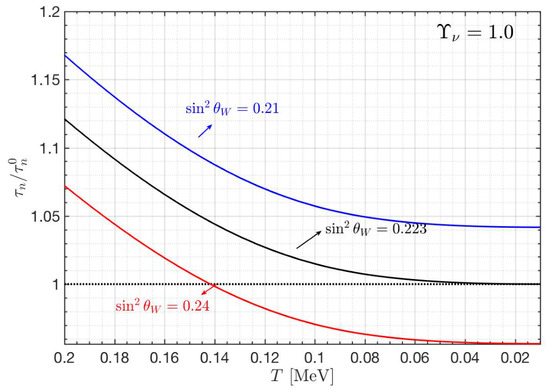
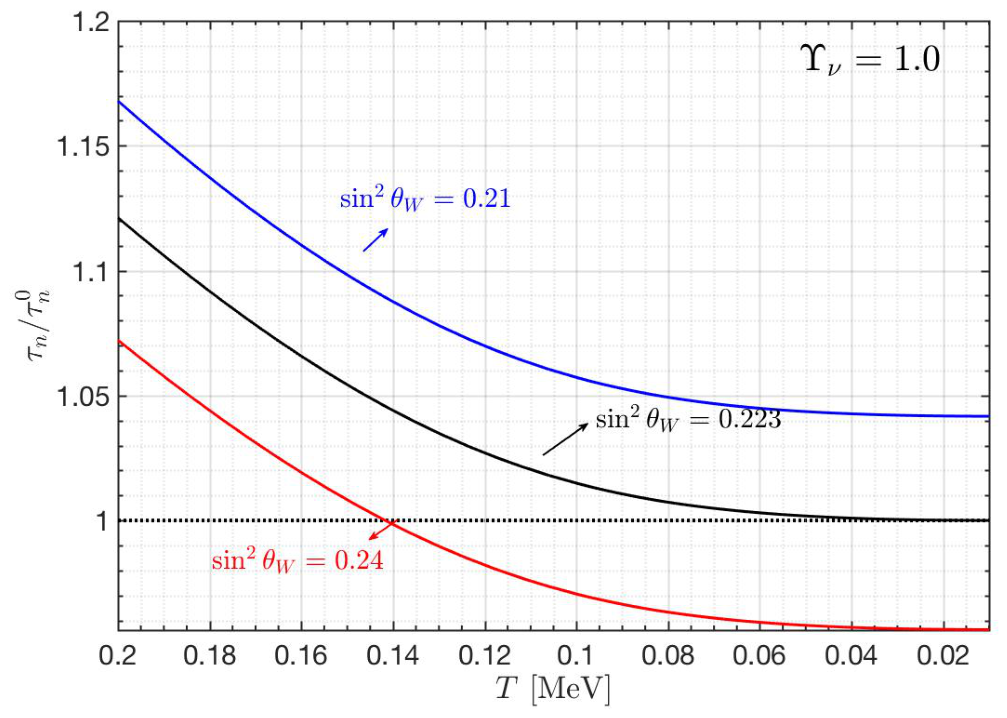
In Figure 2, we show the ratio of the neutron lifetime in a cosmic plasma, , to its vacuum value, , as a function of plasma temperature T for three different values of the Weinberg angle, . The values shown bracket the spread of current experimental determinations of . The curves indicate that at high temperatures, the neutron lifetime increases significantly relative to the vacuum value due to the Fermi blocking effects from the surrounding background. As the temperature decreases toward the edge of the BBN epoch, the ratio approaches a constant value, converging to the respective vacuum lifetime. Larger values of generally correspond to longer neutron lifetimes, while smaller values lead to shorter lifetimes. Within the empirically motivated range shown, the modification of exceeds the beam-bottle discrepancy by a significant factor. This result demonstrates that even a modest variation in the electro-weak mixing angle can substantially influence neutron decay rates in the primordial plasma Universe conditions, exceeding the effect of Pauli blocking.
Figure 2.
Neutron lifetime with respect to vacuum reference value as a function of plasma temperature T for three different values of the Weinberg angle with range 0.21, 0.223, 0.24. The displayed range brackets the current experimental determinations: at the Z scale, the global low-energy value near , and the CODATA recommended value adopted in this paper.
We also note the zero-temperature limits, corresponding to the vacuum lifespan studied in Section 3.1: the near one-percent difference between beam and bottle methods is significantly smaller than the spread shown above. We question, without claiming any direct evidence, the possibility that some part of the laboratory scatter could arise from a small environmental variation of . This is not an established conclusion but provides motivation for further study.
3.3. In Plasma Proton to Neutron Conversion
In the primordial plasma, there is also the inverse to neutron decay back-reaction . Intuitively, one expects this process to be relevant when the temperature is much larger compared to the mass difference between protons and neutrons, and it is negligible in the main temperature domain of interest to us. For this reason, the following is a sideline and can be omitted on first read of this paper.
Replacing in Equation (18) Fermi blocking factor by abundance factor and conversely , we obtain the inverse reaction rate per unit volume
As implied by Equation (23), thermal electrons and antineutrinos hit a nearly resting proton to produce a neutron which is escaping at any energy and momentum that results, which is consistent with the conservation law of energy and momentum, accounting for the energy needed to convert a proton into a neutron. The meaning of nonrelativistic approximation is now not only to set . In addition, when going to the rest frame of the proton which due to its high mass is hardly moving, in the original laboratory rest frame, we keep unchanged the statistical distribution of relativistic electrons and neutrinos.
In the phase space integral Equation (23), we set in the nonrelativistic approximation the denominator , and we keep the statistical distributions in the rest frame of the laboratory, which allows for the multiplicative separation
where we use the subscript p for process
The formulation presented allows us to view the rate as the induced ‘decay rate’ of the proton into a neutron in plasma. The similarity of this result with Equation (20) allows us to separately study the phase space part, removing the intrinsic rate factor D in Equation (15), evaluating
We have omitted the Fermi blocking factor to precision. The range of the integral is the same as in Equation (21); in the argument of the integral, the value of Q is reversed in sign, since this energy is needed rather than gained. Similarly, any excess of neutrinos described by would not block but lead to gain, so the inverse of the power seen in Equation (21) appears in Equation (26).
To evaluate the relation between the forward and backward rates, we cast Equation (26) into a form similar to Equation (21) by multiplying the nominator and denominator of the two Fermi distribution factors by, respectively, and , yielding the same expressions in denominators for both equations Equation (21) and Equation (26) with a multiplicative factor (product of above factors) in the nominator of Equation (26). We then note that when , thus before reheating due to -annihilation, we have the detailed balance relation
The effect of reheating is to make the relatively small ratio slightly larger for MeV. This small breach of detailed balance originating in the non-thermal (free-streaming) neutrino background is, however, of no consequence: in this temperature domain, the two-body conversion reactions and dominate by many orders of magnitude, as is visible in Figure 3. At low temperature, the detailed balance is also very slightly broken by neutron decay competing with the dominant two-body rates; this small effect is what produces the rising ratio visible in the insert of Figure 4, as we discuss in Section 4.3.
4. Primordial Neutron Concentration
4.1. Thermal Model
In the primordial Universe, we study how weak reaction rates impact the neutron abundance with interest to understand precisely their abundance at the onset of BBN. We first look at a naive description: Assuming thermal equilibrium yields of particles, we define the neutron concentration at instantaneous in temperature weak interaction (WI) freeze-out:
where and are freeze-out neutron and proton thermal densities, respectively, obtained at the freeze-out temperature . depends on temperature at which neutrons decouple from the heat bath and the neutron–proton mass difference (in medium) Q.
Following freeze-out, the free-streaming neutron concentration is subject only to decay,
We see that the neutron concentration provides an important probe of the underlying WI reaction rates governing the freeze-out condition and to some extent a probe of neutron lifetime in the primordial plasma. Normally, the neutron lifetime in the vacuum, , is used to calculate the neutron concentration, and the inputs are finessed to obtain the ‘desired’ value . Many textbook presentations of BBN argue in this manner; indeed, a recent study of how neutron lifespan influences BBN also took this line of thought [36], which was also present in our earlier paper [32].
The above considerations require the empirical input of neutron freeze-out condition and treat subsequent evolution without consideration of background scattering effects, thus providing a qualitative estimate of neutron concentration at best. The following full kinetic model study shows that these qualitative arguments do not suffice.
4.2. WI Neutron and Proton Reaction Rates in the Primordial Plasma
We now show how the neutron abundance is governed by the competition between WI reaction rates governing conversion reactions between neutrons and protons and the Hubble expansion rate. Since the Fermi constant governing these rates depends on the Weinberg angle , variations in this angle modify weak rates while the Hubble parameter remains set by the plasma energy density. This is the mechanism causing the neutron abundance to depend on and thus impact the BBN.
The neutron abundance is impacted by the weak interaction reactions between neutrons and protons via the dense thermal cosmic neutrino background:
These are charged current reaction matrix elements mediated by the W-gauge Boson akin to the neutron decay. Therefore, transition amplitudes for these nuclear reactions can be written just like those seen in the neutron decay, paying attention to the momentum four vectors of the respective reacting particles:
Considering the nonrelativistic limit for neutrons and protons, the transition matrix becomes
The Lorentz invariant transition probability per unit time and unit volume corresponding to the process is
where the phase-space factors are Fermi suppression factors in the medium, and the symmetry factor is with for distinguishable particles in the initial states or final states, and for indistinguishable particles.
Substituting the thermal (Fermi) distribution function for the electron, the free streaming neutrino [33], and the nonrelativistic proton and neutron, and integrating over the delta function, the thermal reaction rate per volume takes the form
where the thermal reaction rate integrated in terms of dimensionless variables and , respectively, are
For the reverse reaction, the Lorentz invariant transition probability per unit time and unit volume corresponding to the given reactions can also be written as above
where the reaction rates are given by
Figure 3.
Thermal reaction rates as a function of temperature MeV for processes shown in subscripts. The top axis shows cosmological time t [s] anchored at [8] t(150 MeV) = 25 μs with .
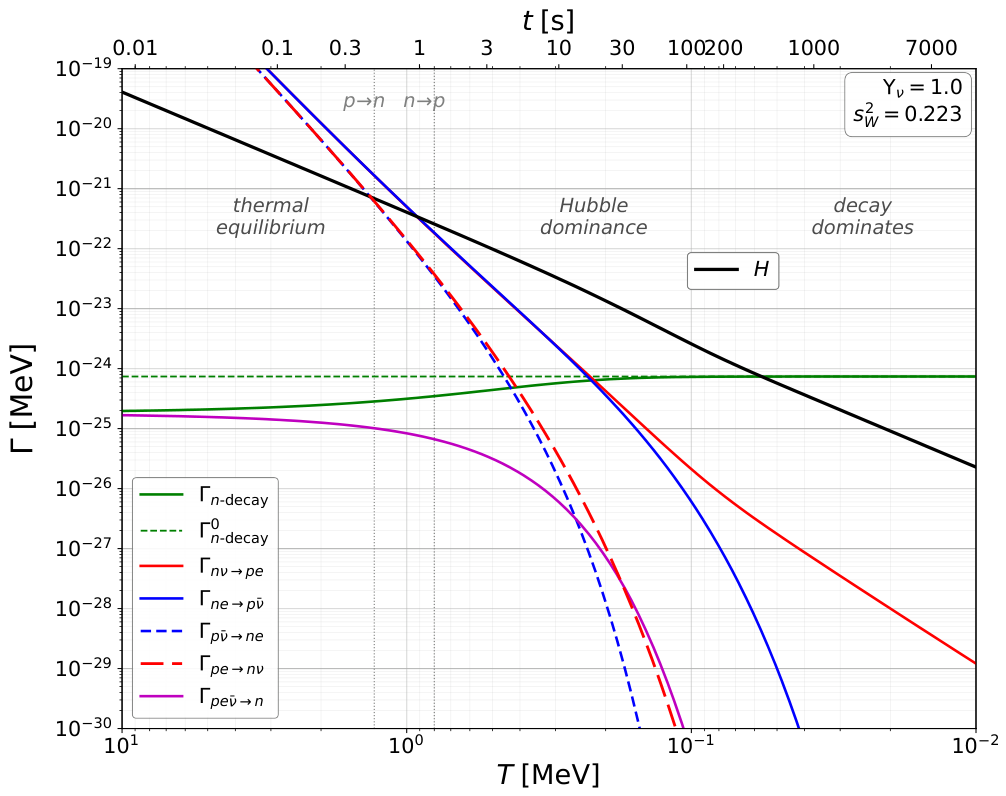
In Figure 3, we show the thermal reaction rates as a function of temperature MeV for the normal strength of WI with Weinberg angle . We observe the following:
- Thermal equilibrium epoch:When MeV, weak interaction rates between neutrons and protons dominate the Hubble rate. Since expansion of the Universe is ‘slow’, the neutron and proton abundances are in thermal equilibrium. Looking closer, we see that the neutron-to-proton conversion decouples (becomes smaller compared to Hubble expansion) at temperature MeV, and the proton-to-neutron conversion decouples at MeV. The magenta curve shows the three-body back-reaction rate, as seen in Equation (25), which is well below all other rates.
- Hubble dominance kinetic epoch:Below the above boundaries, in the range MeV, the dominant rate is the Hubble expansion rate. In this temperature window, we could naively expect that the neutron abundance only dilutes due to Universe expansion, considering that all conversion reactions are smaller than the Hubble expansion rate H. In this regime, attention must be paid to the exact value of H as we encounter the transition between the Hubble parameter being determined by energy density contributions of photons, neutrinos, and electrons/positrons to contributions from only photons and neutrinos driven by the smooth disappearance of -pairs.
- Neutron decay dominated epoch:When MeV (and below), the dominant rate is the neutron decay rate, and the neutron abundance is decreased by neutron decay in the primordial Universe.
In summary, there is a well-defined sequence of dominant (and here relevant) reaction rates as the Universe cools. To accurately understand the evolution of neutron abundance in the primordial Universe, it is essential to analyze the corresponding kinetic evolution equations in detail.
4.3. Kinetic Neutron Population Equation
We now develop a kinetic model for the neutron concentration, i.e., the abundance ratio between neutrons and baryons,
where and are ‘comoving’ in the expanding volume numbers of neutron and protons, respectively. The kinetic equation for the concentration of neutron can be written as
where we consider the comoving number of baryons to be constant after the baryon genesis epoch; comoving means that we study the abundance in cosmologically expanding volumes.
The population of neutrons is governed by gains and losses due to reactions we considered:
Substituting the Lorentz invariant transition probability per unit time and unit volume corresponding to the given reactions, the population equation of neutrons becomes
Inserting into Equation (44), we obtain the kinetic evolution of neutron concentration.
It is convenient to introduce now the following relaxation rates:
Then, the kinetic equation for the neutron concentration can be written as
The first approximation we can make to solve Equation (48) by assuming that the Universe is expanding very slowly and there can be instantaneous kinetic detailed balance equilibrium in the particle yields; this is the ‘adiabatic’ approximate solution found setting in Equation (48); it applies in the domain we called thermal equilibrium above. If neutrons would not decay, would indeed be exactly the thermal result seen in Equation (28). However, solving with decay rate, we obtain the instantaneous detailed balance result
The adiabatic solution arises from the competition between neutron production, weak interaction conversion, and decay rates, yielding the modified equilibrium neutron concentration.
It is important to note that in the ratios of s seen in Equation (49), the strength of weak interactions cancels out exactly, the adiabatic result just like the thermal equilibrium result depends on phase space size of different processes only. This solution is shown as a dashed line in Figure 4, and on a linear scale, it agrees with the thermal equilibrium result also shown as an overlaid green dotted line. Any deviation could be only expected in the low-temperature domain; we see this in the insert in Figure 4 showing . Looking in depth at the reaction rates in Figure 3, we recognize the cause of this tiny detailed balance breaking: (i) the reheating which did not alter free-streaming neutrinos, and (ii) the presence of neutron decay, since the back reaction is already shut off due to the energy threshold. These effects are small and, as it seems, compensatory.
Figure 4.
The neutron concentration as a function of temperature. Dashed line: Result () obtained under assumption that WI dominates Hubble expansion. Green dotted line: Thermal equilibrium ; it is hard to see a difference, but there is on in the ratio seen in the insert for MeV. Blue dotted line: Kinetic correction arising from competition of kinetic neutron abundance processes with Hubble expansion. Solid line: The concentration of neutrons in the Universe . The top axis shows cosmological time t [s] anchored at t(150 MeV) = 25 μs [8]. Results obtained for , for chemically equilibrated (free-streaming) neutrino background [33] with decoupling at and above MeV [3,8].
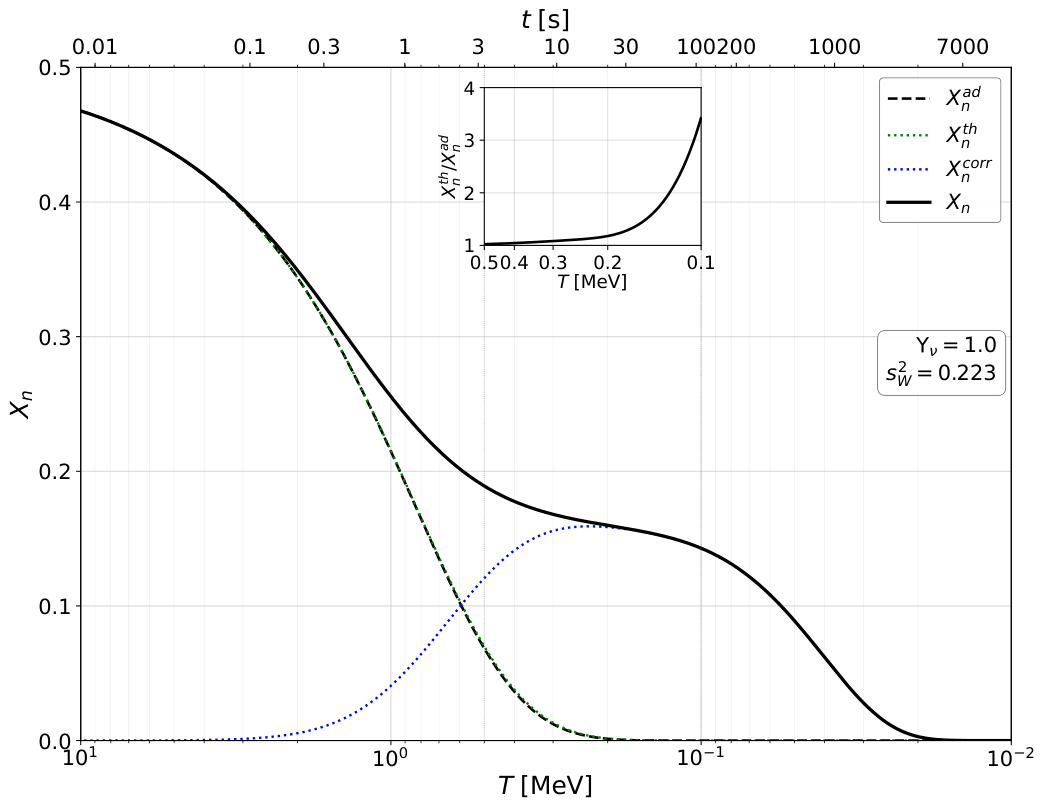
We now obtain the correction to the adiabatic neutron concentration . The kinetic equation of neutron concentration can be used in the format
Adopting the solution method from paper [7], the general solution can be written
where the function is
The Hubble expansion rate competes with the WI reaction rate in the function .
The correction term Equation (51) is seen as a dotted line in Figure 4. The combined result, the neutron concentration as a function of temperature in the primordial Universe, is the solid line. The neutron concentration follows the adiabatic solution for high temperatures where WI reactions remain dominant. As the Hubble expansion rate competes with WI reaction rates, the neutron concentration is dominated by kinetic processes only. In between, there is a domain of transition. Toward the end of the BBN temperature range decreases toward zero, since the neutron decay becomes the dominant process.
Before, and at the onset of the BBN period, the neutron concentration, without here allowing for nuclear fusion reactions that deplete neutrons, is determined by the ratio of the total WI reaction rate to the Hubble expansion rate; see Equation (52). Consequently, via a correction term depends on the magnitude of . It is clear by inspection that the simple freeze-out+lifetime neutron decay model can create an approximation as follows. Taking a high freeze-out condition near MeV in disagreement with the actual values seen in Figure 3, we minimize the correction term. The neutron decay shape (compare the shape at a low T) is then a good fit. However, the yield shoulder below keV will be missed. The results shown in Figure 4 were obtained without allowing for nuclear fusion reactions which deplete neutron concentration as well.
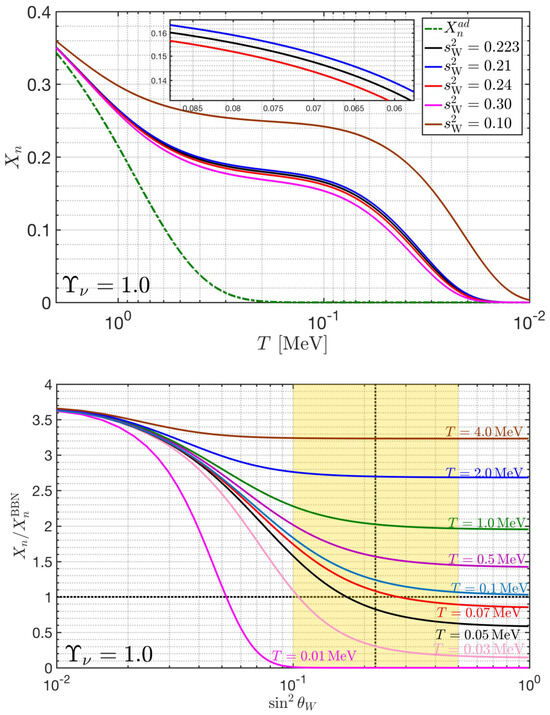
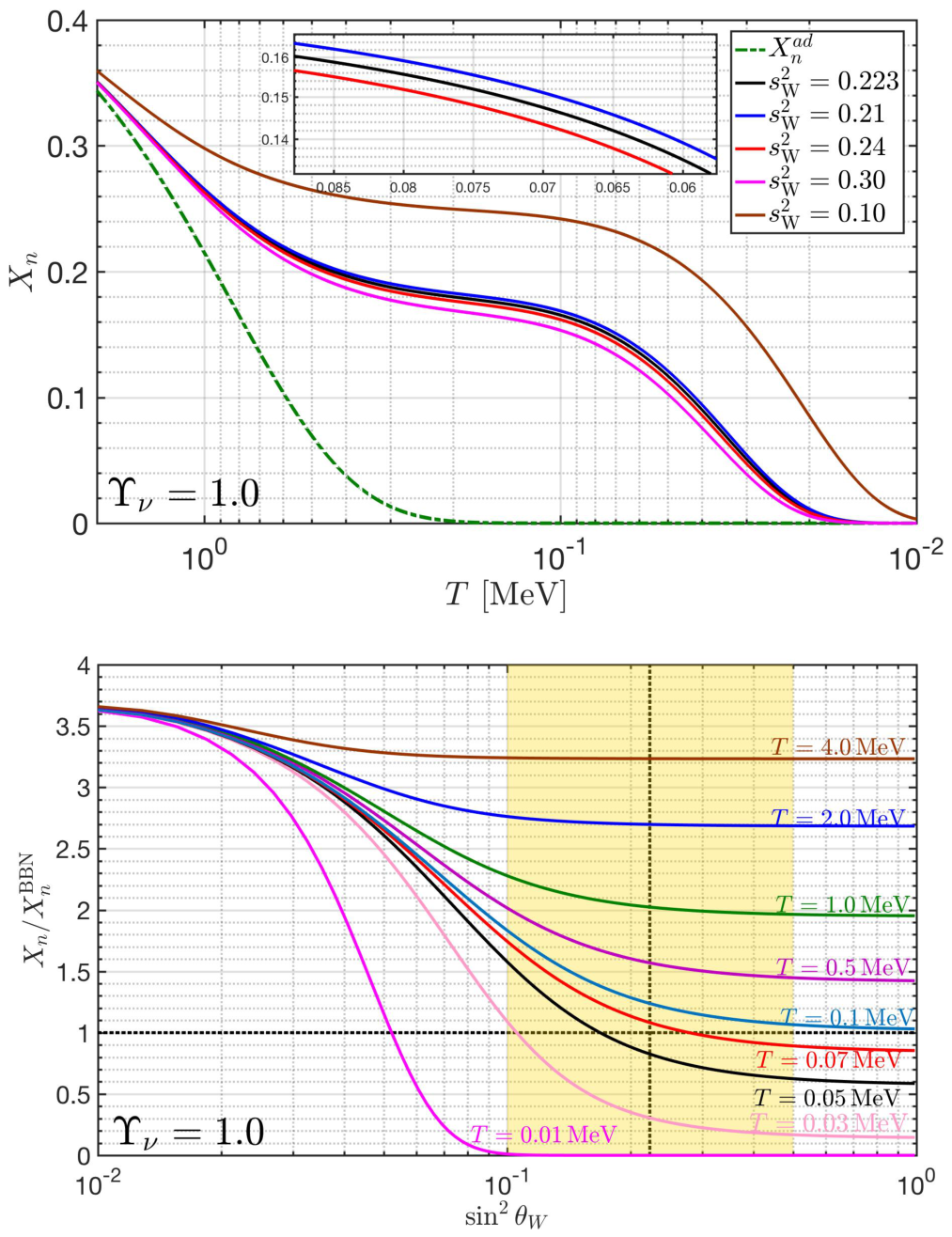
In the top frame of Figure 5, we show neutron concentration as a function of temperature with different values of Weinberg angle . In the bottom frame, we show the ratio of the neutron concentration to the standard BBN value (black dotted line) as a function of the Weinberg angle for different temperatures. At high temperatures, the neutron fraction exhibits only a weak dependence on variations in the weak mixing angle as we expect, since the abundance follows the kinetic detailed balance ‘adiabatic’ result, which does not depend on the strength of . In contrast, at lower temperatures, the neutron concentration becomes strongly sensitive to the value of the Weinberg angle. The neutron concentration decreases as increases. In particular, near the BBN temperature regime, small variations of the Weinberg angle in the range lead to substantial changes in , indicating a strong sensitivity. The yellow shaded region marks the range of for which the resummed form and the first-order form defined below Equation (6) agree to better than 1%, identifying the range over which our parametrization of is reliable. Outside this region, higher-order radiative corrections become important, and a double counting issue could be relevant.
Figure 5.
Top frame: The neutron concentration as a function of temperature T with different values of Weinberg angle and assumed chemical equilibrium of background neutrinos, . The cases and illustrate the range of the Weinberg angle for which the approximation in Equation (6) remains valid. The insert amplifies the variation in neutron concentration for temperature characteristic of temperature at BBN onset with a small variation of from standard value, as we considered before. There is no dependence on in the adiabatic component (dashed line); Bottom frame: The normalized neutron concentration as a function of Weinberg angle for different temperature values with chemical equilibrium neutrino fugacity . We can track as a function of the change in value (horizontal black dotted line). The vertical black dotted line marks the adopted CODATA value . The (yellow) shaded domain of is considered in this work.
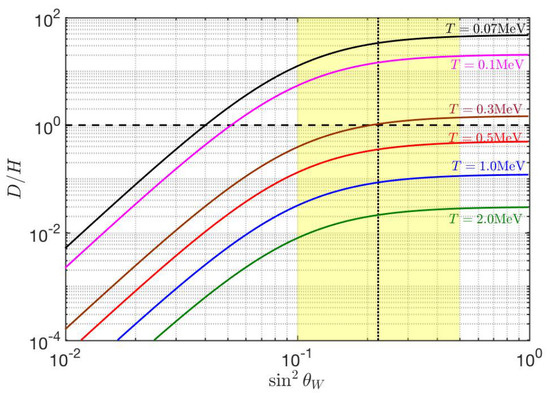
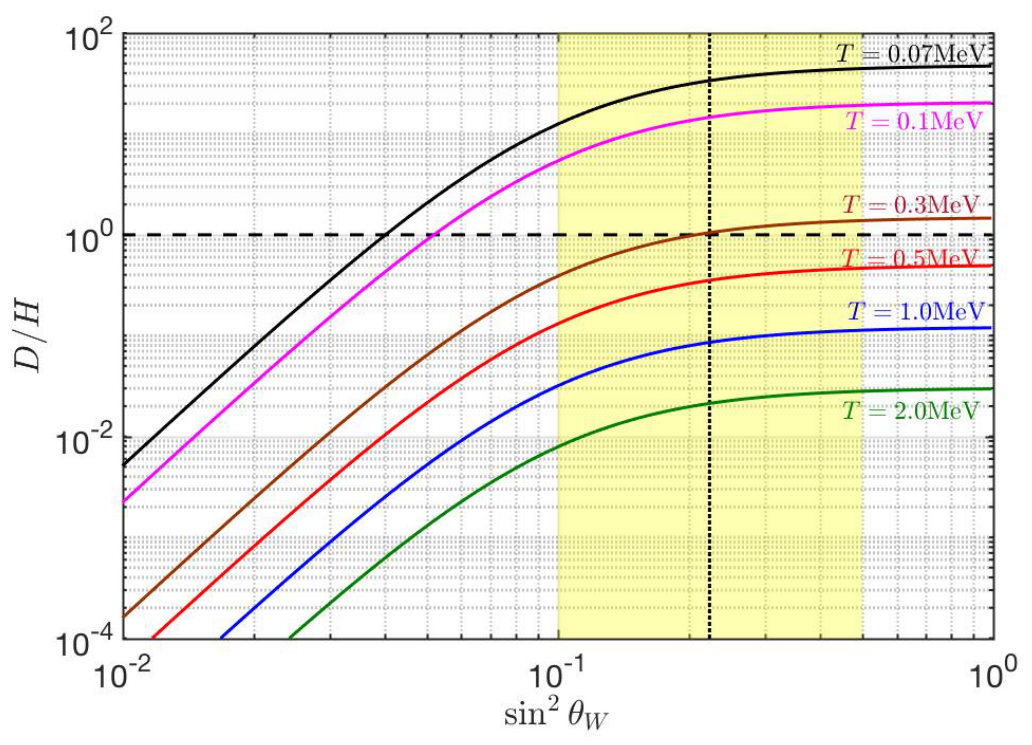
To better explain the sensitivity of the neutron concentration to the value of , we present in Figure 6 the ratio of the WI coupling parameter D to the Hubble parameter as a function of Weinberg angle with different temperature values. The results show that near the weak interaction freeze-out temperature, this ratio is sensitive to variations in , and thus the neutron concentration at edge of BBN epoch is affected. To accurately capture these effects, it is necessary to study the kinetic evolution of the neutron yield for a range of near the reference value we adopted, . The yellow shaded region marks the range as discussed in the prior paragraph.
Figure 6.
The ratio between weak interaction reaction constant D, Equation (15) and the Hubble parameter as a function of the Weinberg angle for temperature values MeV. The horizontal dotted line shows , and the vertical dotted line marks the standard model value . The (yellow) shaded domain of is considered in this work.
5. Conclusions and Discussion
We have described in Section 4 the competition between the Hubble expansion speed and the kinetic reactions processes responsible for the detailed value of the neutron abundance before and at the onset of BBN. The ‘adiabatic limit’ generalizes the thermal approximation. Since the strength of weak interactions, the Fermi constant , cancels in the ratio between different electro-weak rates, the result is solely dependent on phase space size; this is the detailed balance neutron concentration. The detailed balance differs from thermal equilibrium abundance, since we are allowing also for the decay of neutrons.
To obtain the kinetic neutron concentration we note that several of the key WI reaction rates seen in Figure 3 intersect near the T of interest in BBN. This implies that the neutron freeze-out and decay rates are interwoven with the Hubble expansion rate. The outcome of gradual change of is illustrated for the vacuum SM parameters in Figure 4.
We then proceed to discuss and present in quantitative terms the variation of neutron concentration preceding the temperature regime at the edge of BBN as a function of ; see Figure 5. It is in this new context that small changes in weak interaction strength driven by the Weinberg angle can have an impact on the neutron abundance available at the onset of the BBN. We have shown that precision BBN studies that require at the sub-percent level depend on the precise value of , or equivalently—assuming the dominant source of variability is the Weinberg angle—on the value of in the hot primordial plasma at the edge of the BBN epoch.
The results for also depend on precise knowledge of the Hubble expansion parameter. We have been working to develop this understanding for a long time [8]. We present our sophisticated model as a reference for the convenience of the reader in Appendix A. In our approach, following on neutrino decoupling, the transfer of entropy and reheating of photons by -pair annihilation is gradual, and it is obtained from the instantaneous thermal -pair abundance as a function of temperature. Our precise description has non-negligible improvements.
Looking forward to further work and the impact of our results, we highlight the following:
- BBN: In the presence of ongoing BBN nuclear reactions in addition to the neutron loss by decay, neutrons are ‘lost’ to the produced nuclei—for the most part in a net photoproduction of deuterons. Our formulation remains valid in principle, as introducing additional nuclear reaction rate loss (and gain) terms aside from () in Equation (52), we allow for the loss of neutrons due to nuclear reactions such as the photoproduction of deuterons, . The importance of this remark is that the production of neutrons by WI process continues to replenish to some degree such small losses as is implied by the result seen in Figure 4. Our detailed WI reaction rates and the underlying numerical data tables are made available so that BBN-network studies can directly incorporate them, providing pre-network neutron-abundance input at the precision level we have established.
- Outlook—astrophysical neutron-rich environments: The kinetic-theory framework presented here transfers in principle to other settings where weak rates compete with macroscopic timescales, in particular to core-collapse supernova neutrino spheres, neutron-star mergers, and the early phases of accretion-disk outflows. In all these settings, the relevant physics is the competition of in-medium rates with a hydrodynamic timescale with the Hubble rate of this paper replaced by the local expansion rate of the flow. The dominant physics in these environments is energy and lepton-number transport rather than precise neutron abundance [37,38,39,40].
- Weinberg symmetry breaking: We offered results for motivating future study of unexplored phenomena in electro-weak physics addressing the question of whether the value of and thus could be sensitive to environmental factors. In the primordial Universe, we suggested the need for the establishment of the temperature dependence of and thus . This clearly requires considerable theoretical effort that is far beyond the scope of this paper. Without claiming any direct evidence, we have established that within measurement errors of , a small residual environmental component could in principle contribute to the discrepancies observed in laboratory neutron-lifetime measurements. Specifically, the observed scatter of measured values of exceeds by a factor 8 the variation required to understand the measured neutron lifetime disagreements.
Author Contributions
This paper was created in collaboration with both authors contributing equally. All authors have read and agreed to the published version of the manuscript.
Funding
This research received no external funding.
Data Availability Statement
The datasets generated during the current study, i.e., data as seen in manuscript figures, are available as ancillary files at arXiv repository, https://doi.org/10.48550/arXiv.2603.02652.
Acknowledgments
We thank Bernhard Lauss (PSI-Villigen) for valuable comments.
Conflicts of Interest
The authors declare no conflicts of interest.
Appendix A. Hubble Parameter and Photon Reheating
In this section, we summarize the key theoretical background relevant to our analysis and in particular the detailed value of the Hubble parameter H in the primordial Universe. Much of the material is based on the review [8], which discusses the connection between particle physics and the primordial-Universe cosmology.
In the epoch of interest, , the Universe is dominated by radiation and effectively massless matter behaving like radiation. The Hubble parameter can be written as
where is the energy density for . It is convenient to rewrite the sum of energy density of relativistic species in terms of photo energy density; we have
where counts the effective number of ‘energy’ degrees of freedom, we have
The functions B and F are defined as
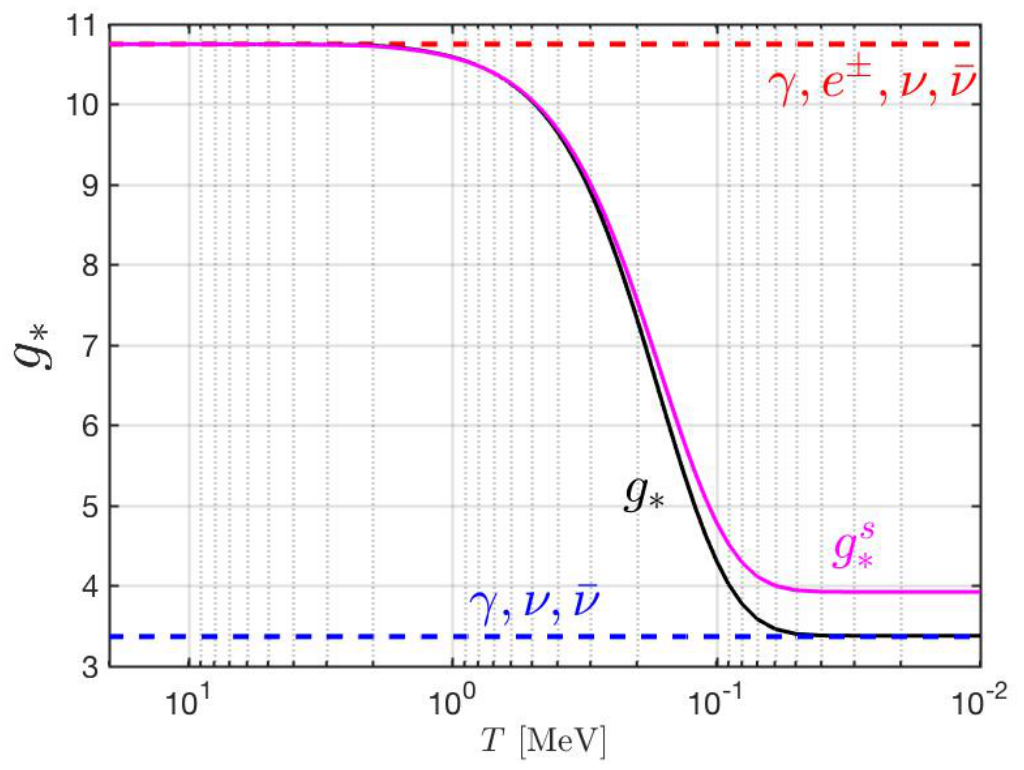
In Figure A1, we show the effective number of energy degrees of freedom as a function of temperature. The red dashed line shows the contribution from photons, neutrinos, and massless electrons/positrons, while the blue dashed line represents the contribution from photons and cold neutrinos.
Figure A1.
The effective number of ‘energy’ degrees of freedom as a function of temperature. The red dashed line represents the degrees of freedom from photon, neutrino, and massless electron/positron. The blue dashed line labels the degree of freedom for photons and cold neutrinos.
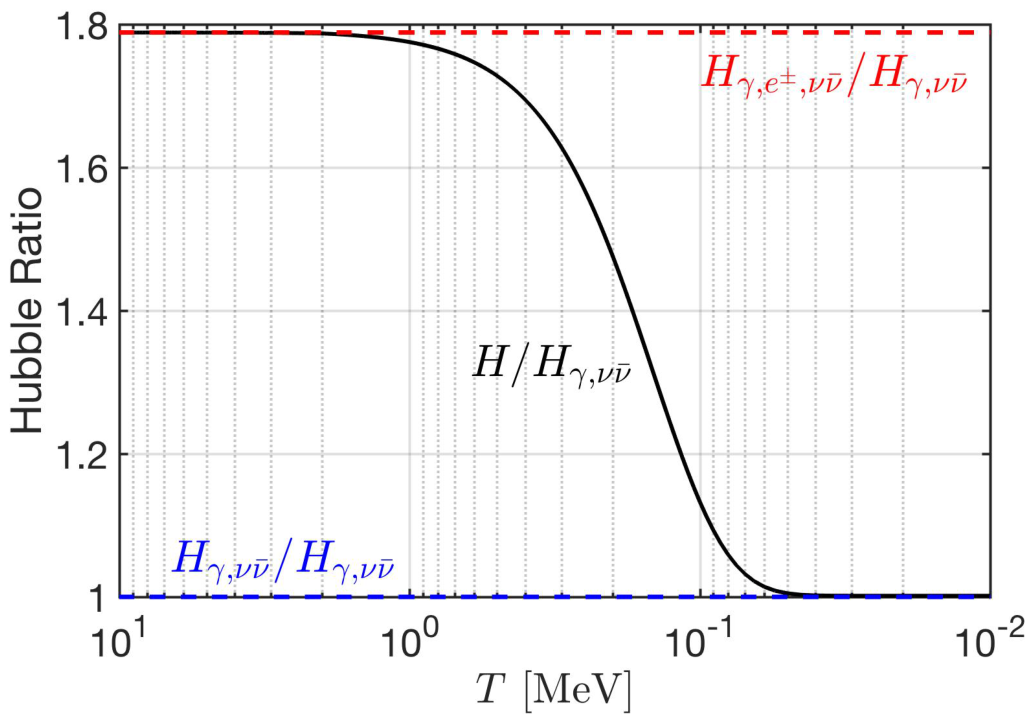
In Figure A2, we plot the Hubble parameter as a function of temperature from MeV in the primordial Universe. It shows that the transition between Hubble parameter from contributions by photons, neutrinos, and massless electrons/positrons to contributions from only photons and neutrinos is driven by the smooth disappearance of nonrelativistic .
Figure A2.
The ratio between Hubble parameter as a function of temperature from MeV in the primordial Universe. It shows that the transition between Hubble parameter from contributions by photons, neutrinos, and massless electrons/positrons to contributions from only photons and neutrinos is driven by the smooth disappearance of nonrelativistic .
After neutrino freeze-out and when , the becomes nonrelativistic and annihilates. In this case, their entropy is transferred to the other relativistic particles still present in the cosmic plasma, i.e., photons, resulting in an increase in photon temperature as compared to the freestreaming neutrinos. From entropy conservation, we have
where we use the subscript k to denote quantities for neutrino freeze-out and counts the degree of freedom for relativistic species in primordial Universe. The effective number of ‘entropy’ degrees of freedom can be written as
where the functions and are defined as
After neutrino freeze-out, their entropy is conserved independently and the temperature can be written as
In this case, from entropy conservation, Equation (A6), we obtain the neutrino temperature
For neutrinos, after neutrino/antineutrino kinetic freeze-out, they become free streaming particles. If we assume that kinetic freeze-out occurs at some time and temperature , then for , the free streaming distribution function can be written as [33]
for antineutrinos. In our calculation, we assume the condition , i.e., we consider the massless neutrino in plasma.
References
- Uzan, J.P. Fundamental constants: From measurement to the universe, a window on gravitation and cosmology. Living Rev. Relativ. 2025, 28, 6. [Google Scholar] [CrossRef] [Scilit]
- Milaković, D.; Webb, J.K. Beyond ΛCDM: Fundamental constants as cosmological observables. arXiv 2026, arXiv:2602.10987. [Google Scholar] [CrossRef] [Scilit]
- Birrell, J.; Yang, C.T.; Rafelski, J. Relic Neutrino Freeze-out: Dependence on Natural Constants. Nucl. Phys. B 2014, 890, 481–517. [Google Scholar] [CrossRef] [Scilit]
- Martin, S.P. Three-loop corrections to the Fermi decay constant in the scheme. Phys. Rev. D 2025, 112, 073002. [Google Scholar] [CrossRef] [Scilit]
- Veltman, M.J.G. Limit on Mass Differences in the Weinberg Model. Nucl. Phys. B 1977, 123, 89–99. [Google Scholar] [CrossRef] [Scilit]
- Navas, S.; Amsler, C.; Gutsche, T.; Hanhart, C.; Hernández-Rey, J.; Lourenço, C.; Masoni, A.; Mikhasenko, M.; Mitchell, R.; Patrignani, C.; et al. Review of particle physics. Phys. Rev. D 2024, 110, 030001. [Google Scholar] [CrossRef] [Scilit]
- Bernstein, J.; Brown, L.S.; Feinberg, G. Cosmological Helium Production Simplified. Rev. Mod. Phys. 1989, 61, 25. [Google Scholar] [CrossRef] [Scilit]
- Rafelski, J.; Birrell, J.; Grayson, C.; Steinmetz, A.; Yang, C.T. Quarks to Cosmos: Particles and Plasma in Cosmological Evolution. Eur. Phys. J. Spec. Top. 2025, 234, 1125–1329. [Google Scholar] [CrossRef] [Scilit]
- Coleman, S.R.; Weinberg, E.J. Radiative Corrections as the Origin of Spontaneous Symmetry Breaking. Phys. Rev. D 1973, 7, 1888–1910. [Google Scholar] [CrossRef] [Scilit]
- Dolan, L.; Jackiw, R. Symmetry Behavior at Finite Temperature. Phys. Rev. D 1974, 9, 3320–3341. [Google Scholar] [CrossRef] [Scilit]
- Weinberg, S. Gauge and Global Symmetries at High Temperature. Phys. Rev. D 1974, 9, 3357–3378. [Google Scholar] [CrossRef] [Scilit]
- Sirlin, A.; Ferroglia, A. Radiative Corrections in Precision Electroweak Physics: A Historical Perspective. Rev. Mod. Phys. 2013, 85, 263–297. [Google Scholar] [CrossRef] [Scilit]
- Gwinner, G.; Orozco, L.A. Studies of the weak interaction in atomic systems: Towards measurements of atomic parity non-conservation in francium. Quantum Sci. Technol. 2022, 7, 024001. [Google Scholar] [CrossRef] [Scilit]
- Aaij, R.; Abdelmotteleb, A.S.W.; Beteta, C.A.; Abudinén, F.; Ackernley, T.; Adefisoye, A.A.; Adeva, B.; Adinolfi, M.; Adlarson, P.; Agapopoulou, C.; et al. Measurement of the effective leptonic weak mixing angle. J. High Energy Phys. 2024, 12, 26. [Google Scholar] [CrossRef] [Scilit]
- Hayrapetyan, A.; Tumasyan, A.; Adam, W.; Andrejkovic, J.W.; Bergauer, T.; Chatterjee, S.; Damanakis, K.; Dragicevic, M.; Hussain, P.S.; Jeitler, M.; et al. Measurement of the Drell–Yan forward-backward asymmetry and of the effective leptonic weak mixing angle in proton-proton collisions at s = 13 TeV. Phys. Lett. B 2025, 866, 139526. [Google Scholar] [CrossRef] [Scilit]
- Erler, J.; Ramsey-Musolf, M.J. The Weak Mixing Angle at Low Energies. Phys. Rev. D 2005, 72, 073003. [Google Scholar] [CrossRef] [Scilit]
- Mohr, P.; Tiesinga, E.; Newell, D.; Taylor, B. Codata Internationally Recommended 2022 Values of the Fundamental Physical Constants. 2024. Available online: https://physics.nist.gov/constants (accessed on 17 February 2026).
- Sirlin, A. Radiative Corrections in the SU(2)-L x U(1) Theory: A Simple Renormalization Framework. Phys. Rev. D 1980, 22, 971–981. [Google Scholar] [CrossRef] [Scilit]
- Tishchenko, V.; Battu, S.; Carey, R.M.; Chitwood, D.B.; Crnkovic, J.; Debevec, P.T.; Dhamija, S.; Earle, W.; Gafarov, A.; Giovanetti, K.; et al. Detailed Report of the MuLan Measurement of the Positive Muon Lifetime and Determination of the Fermi Constant. Phys. Rev. D 2013, 87, 052003. [Google Scholar] [CrossRef] [Scilit]
- Erler, J.; Langacker, P. Electroweak model and constraints on new physics. arXiv 2024, arXiv:hep-ph/0407097. [Google Scholar]
- Consoli, M.; Hollik, W.; Jegerlehner, F. The Effect of the Top Quark on the M(W)-M(Z) Interdependence and Possible Decoupling of Heavy Fermions from Low-Energy Physics. Phys. Lett. B 1989, 227, 167–170. [Google Scholar] [CrossRef] [Scilit]
- Czarnecki, A.; Marciano, W.J.; Sirlin, A. Neutron Lifetime and Axial Coupling Connection. Phys. Rev. Lett. 2018, 120, 202002. [Google Scholar] [CrossRef] [Scilit] [PubMed]
- Marciano, W.J. Fundamental Neutron Physics. Phys. Procedia 2014, 51, 19. [Google Scholar] [CrossRef] [Scilit]
- Marciano, W.J.; Sirlin, A. Improved calculation of electro-weak radiative corrections and the value of V(ud). Phys. Rev. Lett. 2006, 96, 032002. [Google Scholar] [CrossRef] [Scilit] [PubMed]
- Czarnecki, A.; Marciano, W.J.; Sirlin, A. Precision measurements and CKM unitarity. Phys. Rev. D 2004, 70, 093006. [Google Scholar] [CrossRef] [Scilit]
- Wilkinson, D.H. Analysis of Neutron Beta Decay. Nucl. Phys. A 1982, 377, 474. [Google Scholar] [CrossRef] [Scilit]
- Yue, A.T.; Dewey, M.S.; Gilliam, D.M.; Greene, G.L.; Laptev, A.B.; Nico, J.S.; Snow, W.M.; Wietfeldt, F.E. Improved Determination of the Neutron Lifetime. Phys. Rev. Lett. 2013, 111, 222501. [Google Scholar] [CrossRef] [Scilit] [PubMed]
- Wietfeldt, F.E. The Neutron Lifetime Discrepancy and Its Implications for Cosmology and Dark Matter. Symmetry 2024, 16, 956. [Google Scholar] [CrossRef] [Scilit]
- Kuznetsova, I.; Rafelski, J. Unstable Hadrons in Hot Hadron Gas in Laboratory and in the Early Universe. Phys. Rev. C 2010, 82, 035203. [Google Scholar] [CrossRef] [Scilit]
- Pitrou, C.; Coc, A.; Uzan, J.P.; Vangioni, E. Precision big bang nucleosynthesis with improved Helium-4 predictions. Phys. Rep. 2018, 754, 1–66. [Google Scholar] [CrossRef] [Scilit]
- Wagoner, R.V.; Fowler, W.A.; Hoyle, F. On the Synthesis of elements at very high temperatures. Astrophys. J. 1967, 148, 3–49. [Google Scholar] [CrossRef] [Scilit]
- Yang, C.T.; Birrell, J.; Rafelski, J. Temperature Dependence of the Neutron Lifetime. arXiv 2018, arXiv:1805.06543. [Google Scholar]
- Birrell, J.; Yang, C.T.; Chen, P.; Rafelski, J. Relic neutrinos: Physically consistent treatment of effective number of neutrinos and neutrino mass. Phys. Rev. D 2014, 89, 023008. [Google Scholar] [CrossRef] [Scilit]
- Mangano, G.; Miele, G.; Pastor, S.; Pinto, T.; Pisanti, O.; Serpico, P.D. Relic neutrino decoupling including flavour oscillations. Nucl. Phys. B 2005, 729, 221–234. [Google Scholar] [CrossRef] [Scilit]
- Akita, K.; Yamaguchi, M. A precision calculation of relic neutrino decoupling. J. Cosmol. Astropart. Phys. 2020, 08, 012. [Google Scholar] [CrossRef] [Scilit]
- Chowdhury, T.; Ipek, S. Neutron lifetime anomaly and Big Bang nucleosynthesis. Can. J. Phys. 2024, 102, 96–99. [Google Scholar] [CrossRef] [Scilit]
- Haxton, W.C. Neutrino Astrophysics. In Encyclopedia of Applied Physics, 2nd ed.; Wiley OnLine Libaray: Weinheim, Germany, 2014. [Google Scholar] [CrossRef] [Scilit]
- Janka, H.-T. Neutrino emission from supernovae. In Handbook of Supernovae; Springer: Berlin/Heidelberg, Germany, 2017. [Google Scholar]
- Burrows, A.; Vartanyan, D. Core-collapse supernova explosion theory. Nature 2021, 589, 29–39. [Google Scholar] [CrossRef] [Scilit] [PubMed]
- Cowan, J.J.; Sneden, C.; Lawler, J.E.; Aprahamian, A.; Wiescher, M.; Langanke, K.; Martinez-Pinedo, G.; Thielemann, F.-K. Origin of the heaviest elements: The rapid neutron-capture process. Rev. Mod. Phys. 2021, 93, 015002. [Google Scholar] [CrossRef] [Scilit]
Disclaimer/Publisher’s Note: The statements, opinions and data contained in all publications are solely those of the individual author(s) and contributor(s) and not of MDPI and/or the editor(s). MDPI and/or the editor(s) disclaim responsibility for any injury to people or property resulting from any ideas, methods, instructions or products referred to in the content. |
© 2026 by the authors. Licensee MDPI, Basel, Switzerland. This article is an open access article distributed under the terms and conditions of the Creative Commons Attribution (CC BY) license.