


Abstract
After the invention of radioactive nuclear beams, studies on nuclei far from the stability line brought up many new phenomena not expected in nuclei near the stability line. Among them, neutron halos and changes in magic numbers were outstanding discoveries. To understand these phenomena, nuclear structure models needed many new developments such as the treatment of loosely bound systems and proton neutron asymmetry. One important question on the importance of the tensor interactions has been raised recently. In this review, I present evidence of tensor interactions in nucleon momentum distribution and the effects of tensor interactions on the structure of nuclei. In particular, the importance of 2p–2h configurations excited by the tensor interactions will be introduced. I show that the appearance and disappearance (blocking) of the 2p–2h configuration is responsible for the change in shell structure. I also present a recent experimental result that shows the existence of such configurations in 16O nuclei.
1. Preamble
Quantum tunneling is a universal phenomenon in nature. It allows quantum particles to extend into regions of space that are inaccessible under classical mechanics. In this “tunneling region,” the particle density is known to decay exponentially. This behavior is universal across all energy scales, from nuclear physics to chemistry and solid-state systems [1].
A neutron halo is one such phenomenon that occurs in loosely bound, neutron-rich nuclei. Neutron halos have been observed in many light nuclei near the neutron drip line. The search for neutron halo nuclei in heavier systems remains an important research direction. The concept of the halo has also been extended to proton-rich nuclei, leading to efforts to identify and understand proton halos.
The unusual behavior of neutron halo wave functions in 11Li has drawn attention to the role of tensor interactions. Similarly, the change in magic numbers in neutron-rich nuclei has raised the same issue: the importance of tensor interactions.
Before entering into a discussion of the physics of neutron halos and magic numbers, I would like to express my sincere gratitude to my friends who have passed away at young ages. The development of nuclear physics with radioactive beams cannot be discussed without mentioning their contributions.
The late Toshio Kobayashi (Figure 1: former professor at Tohoku University) worked with me from the early days of radioactive beam experiments at the Berkeley BEVATRON/BEVALAC. The neutron halo in 11Li could not have been discovered without him. He built most of the detector system around the large superconducting magnet HISS. After the first experiment indicating the possibility of large radii in 11Li and other drip-line nuclei, the observation of an unexpectedly narrow momentum distribution of 9Li fragments from 11Li provided confirmation of the neutron halo [2]. Furthermore, the unexpectedly large enhancement of the Coulomb dissociation cross-section of 11Li provided the first evidence of a soft dipole mode [3]. I vividly remember how fascinated we were by those data. I recall many discussions with him when we encountered unexpected results, such as extremely large interaction cross-sections of 8He, 11Li, and 14Be in a single experimental run, as well as unexpected events appearing at the edges of detectors that had been made unnecessarily large. These observations eventually led to the first observation of fragmentation of radioactive nuclei. He later designed and built the SAMURAI spectrometer at the RI Beam Factory [4]. Many exciting data have been obtained by this spectrometer and new data are continuously coming from it.
Figure 1.
The late Toshio Kobayashi.
The late Hans Geissel (Figure 2: former professor at the University of Giessen and GSI) worked with me from the early days of the FRS facility at GSI. He designed and constructed the FRS, the first facility specifically built for the use of radioactive beams [5]. His optical design became the prototype for fragment separators worldwide.
Figure 2.
The late Hans Geissel.
We collaborated on many experiments using the FRS, through which radii of many light nuclei were determined. We discovered not only neutron halos but also neutron skins in Na isotopes. The discovery of a new magic number, N = 16, also originated from radii measurements. He was a person who constantly considered how to improve experiments. Among many discussions, I particularly remember one on how to make a wedge degrader—an essential element for the separation of radioactive beams—variable in both thickness and wedge angle. We always found several possible solutions, and he would realize at least one of them.
Although I was not involved in searches for new isotopes, he is known as the scientist who discovered the largest number of isotopes (279). I have always admired this achievement, which could only be realized through his sustained efforts over many years.
Overcoming the sadness of losing friends who made such important contributions, let us continue our research in pursuit of a deeper understanding of nuclear physics.
A Bit of History
Studies of nuclei far from the line of stability began with isotope separators connected to spallation reactions induced by high-energy protons [6]. This made it possible to measure properties of nuclei far from stability. Using the spallation process of high-energy protons or other nuclear reactions, ISOL (isotope separation on-line) facilities were developed in many laboratories.
Another major development followed with the acceleration of high-energy heavy ions like 1 GeV per nucleon [7]. An important discovery is the fragmentation of incident heavy ions [8]. A breakthrough experiment using this reaction was reported by G. D. Westfall et al. [9], in which 14 new isotopes were discovered in a single experiment using a high-energy 48Ca beam. Projectile fragmentation is particularly advantageous for the production and detection of short-lived nuclei, because the fragments retain high kinetic energy after production and are therefore easier to detect and identify. It subsequently became a standard method for exploring nuclei far from the stability line.
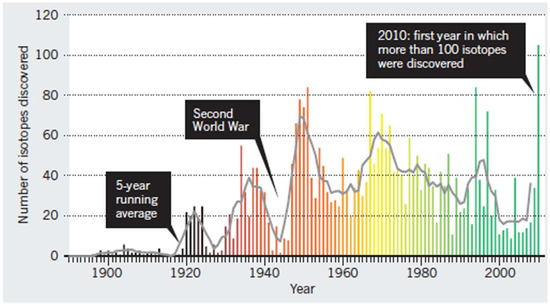
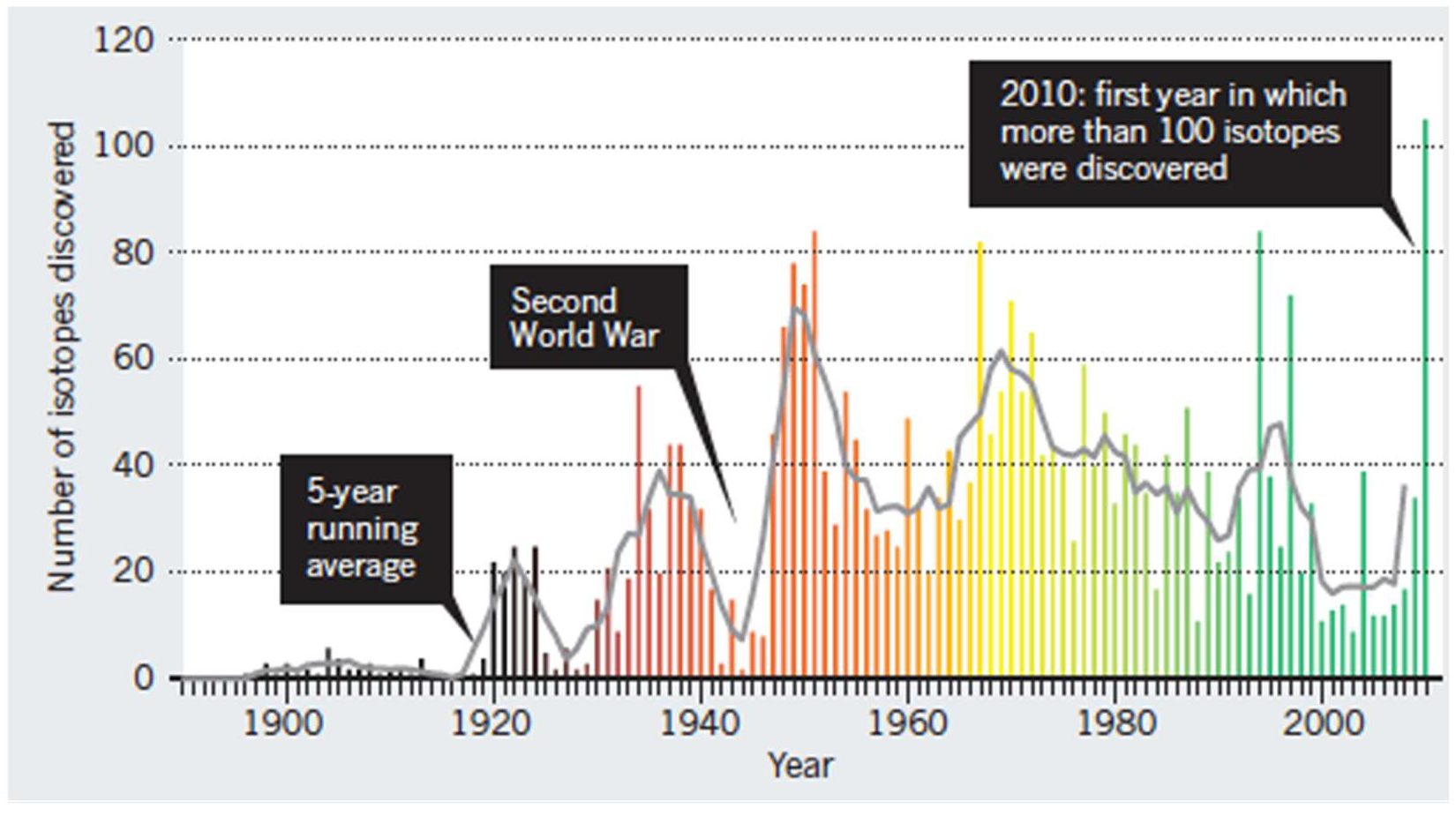
As a related method, in-flight fission of high-energy uranium has also been used to achieve higher production rates of fission products [10]. Discoveries of new nuclides have continued for more than 100 years, as shown in Figure 3.
Figure 3.
Number of nuclides discovered every 5 years. Figures are supplied by B. Jönson.
Projectile fragments are emitted with nearly the same velocity as the incident heavy ions and are therefore easy to separate using magnetic optical system. This property opened the possibility of efficiently producing secondary beams of radioactive nuclei. The development of such beams began in 1983, and the first experimental results were reported in 1985 [11,12].
The observation of an unexpectedly large interaction cross-section of 11Li led to the concept of the neutron halo in 1987 [13]. This idea was further confirmed in 1988 [2], and a new excitation mode via Coulomb dissociation was proposed in 1989 [3]. Thus, interest in neutron-rich nuclei emerged immediately following the development of radioactive nuclear beams. In addition to studies with stopped radioactive nuclei, reactions involving radioactive nuclei became possible, significantly broadening the scope of nuclear physics research.
The use of radioactive nuclei is not limited to fragmentation of high-energy heavy ions but has also been extended to reaccelerated beams at ISOL facilities. These provide low-energy but high-intensity beams of radioactive nuclei. Such studies have raised important questions regarding neutron-rich nuclei such as the following:
- Why are 10He and 28O not bound but 48Ca is bound and magic?
- Why does the drip line suddenly extend very much in F isotopes?
- Why do new magic numbers N = 6, 14, 16, 32, 34 appear?
- Why do magic numbers N = 8 and N = 20 disappear in neutron rich nuclei?
Magic numbers, which form the basis of the shell model, were long considered robust; however, studies of neutron-rich nuclei have shown that they can change far from stability. Those are summarized in Ref. [14].
In addition, peculiar particle configurations have been observed in 11Li, 11Be, and 12Be. A classic example is the inversion of the positive-parity (1/2+) and negative-parity (1/2−) states in 11Be [15]. In the normal ordering of single-particle orbitals, the ground state of 11Be is expected to have Iπ = 1/2−, but the observed ground state has Iπ = 1/2+. In 11Li, the ground state (a two-neutron halo state) consists of nearly equal mixing of (ν1s1/2)2 and (ν0p1/2)2 configurations [16]. These features indicate a lowering of the 1s1/2 orbital along the N = 8 isotones lighter than oxygen. On the other hand, recent studies show the dominance of the (ν0d5/2)2 configuration in 12Be, with much smaller contributions from (ν1s1/2)2 and (ν0p3/2)2 [17]. Each of these phenomena has been extensively studied, and several models have been proposed to explain them individually. However, a unified understanding has not yet been established.
In the following, I discuss these orbital changes in neutron-rich nuclei from the perspective of tensor interactions.
2. Peculiar Behavior of s1/2 and p1/2 Orbitals in Neutron-Rich Nuclei
As mentioned already, one of the peculiar features of orbitals in neutron-rich nuclei is the anomalous spin–parity of the 11Be ground state. It is 1/2+, instead of the expected 1/2−, where the last neutron would occupy the 0p1/2 orbital. I. Talmi and I. Unna pointed out this anomaly and suggested that the relative ordering of the 1/2+ and 1/2− states in the N = 7 isotones (11Be, 12B, and 13C) could be understood within the shell model through single- and two-particle residual interactions [15]. However, no quantitative calculations were presented.
Since then, many quantitative attempts have been made, but the observed behavior could not be reproduced without introducing large deformation. Since the valence neutron in 11Be forms a halo, such large deformation is not expected. Recent calculations using a no-core shell model by C. Forssén et al. [18] were also unable to reproduce the 1/2+ ground state. More recently, “ab initio” calculations using chiral nucleon–nucleon interactions have reported the possibility of inversion for certain choices of interactions, but the effect is much smaller than what is observed experimentally. Thus, this problem remains unresolved within conventional nuclear models [19].
Measurements of fragment momentum distributions of 10Li from 11Li fragmentation [20], beta decay of 11Li [21], and 11Li(p, t) reaction cross-sections [22,23] have shown that the two-neutron halo in 11Li consists of nearly equal mixing of (s1/2)2 and (p1/2)2 configurations. From the normal ordering of single-particle orbitals, the ν0p1/2 component is expected to dominate. This observation also indicates the disappearance of the N = 8 magic number in this region. The unbound nature of 10He follows the same trend.
One of the explanation introduces a low-lying 1s1/2 virtual state in the n + 9Li system [24], which can account for the mixing. However, it does not explain why such a virtual state exists. Later, this mixing was successfully explained by an ab initio-type model, the tensor-optimized shell model (TOSM) [25], which explicitly includes tensor interactions.
In the following section, we introduce this model and the concept of tensor blocking, which provides a mechanism for this anomalous mixing.
3. Importance of Tensor Interaction and Tensor-Optimized Shell Model (TOSM)
It is well known that tensor interactions play an essential role in nuclear binding. Ab initio calculations using Green’s Function Monte Carlo (GFMC) method by the Argonne group have shown that tensor interactions, together with three-body forces, are particularly important for light nuclei [26]. These calculations indicate that about 80% of the potential energy arises from pion-exchange interactions, which include both central and tensor components of comparable strength.
This can be clearly seen in the deuteron [24]. The central interaction contributes only 4.46 MeV to the binding energy, whereas the tensor interaction contributes 16.64 MeV. Other contributions, such as the spin–orbit interaction, are much smaller. This large binding arises from the coupling between the S- and D-wave components, despite the small D-wave probability (~5.8%). The D-wave has a smaller spatial extent than the S-wave, reflecting the fact that tensor interactions favor high-momentum components.
The importance of tensor interactions has also been discussed as an origin of spin–orbit splitting [27], in the understanding of isoscalar magnetic moments of mirror nuclei [28,29], and in explaining changes in magic numbers [30]. However, except for GFMC, most theoretical approaches treat tensor interactions only perturbative, even though they are as strong as central forces.
Two key ingredients are required for the proper treatment of tensor interactions: inclusion of the tensor force itself and inclusion of high-momentum components in the wave function. Most perturbative models restrict the model space to low momenta near the Fermi surface and treat high-momentum component through highly excited states. However, momentum components above ~2 fm−1 are essential to fully capture tensor effects. Even modern chiral interactions often impose momentum cutoffs, thereby limiting tensor contributions.
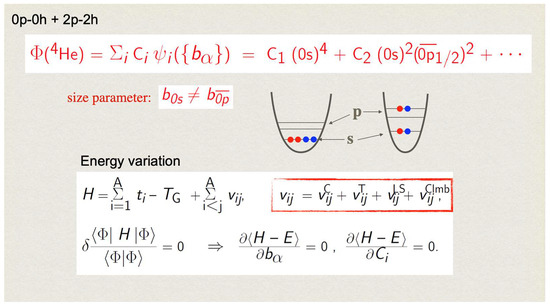
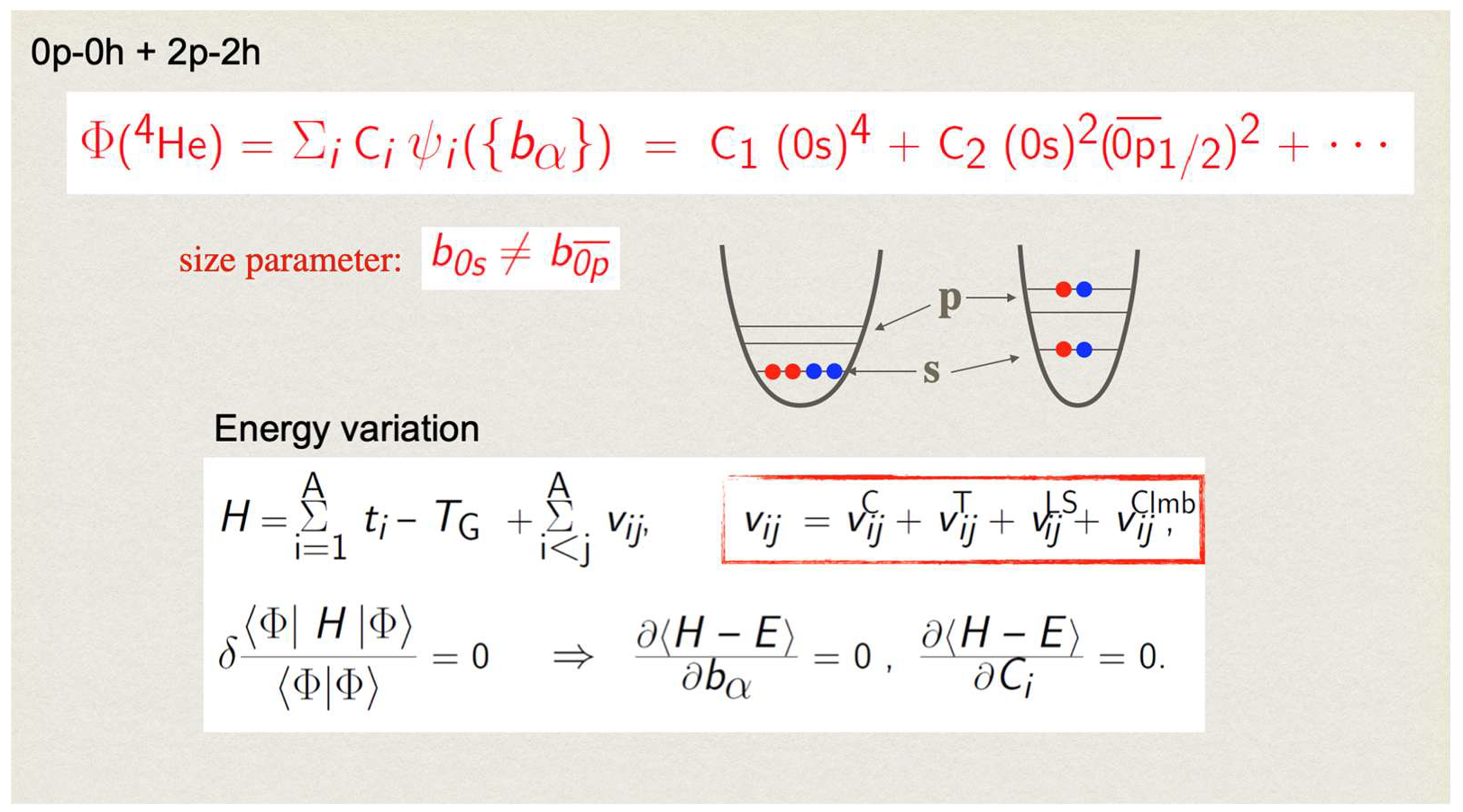
To address this, the tensor-optimized shell model (TOSM) has been developed [31]. In this model, the wave function is expanded on a shell model basis but explicitly includes 2p–2h configurations to incorporate tensor correlations. Figure 4 shows the framework of the TOSM for 4He as an example. The wave functions are expanded by the Harmonic Oscillator shell model space but the sizes of the potential are treated as free parameters. By treating the size parameters bα of single-particle orbitals variationally, high-momentum components are then introduced in low excited configurations. A typical 2p–2h wave function important for the tensor interaction is shown in the inserted figure. In real calculations, all kinds of 2p–2h excitations are included. For details of the equation, readers are encouraged to read the original paper [24].
Figure 4.
Tensor-optimized shell model (TOSM) for 4He. The 4He wave function is expanded with single particle wave function and by 2p–2h wave function to treat the tensor interaction explicitly. The size of the shell model potentiall bα is kept as variational parameters of each orbitals.
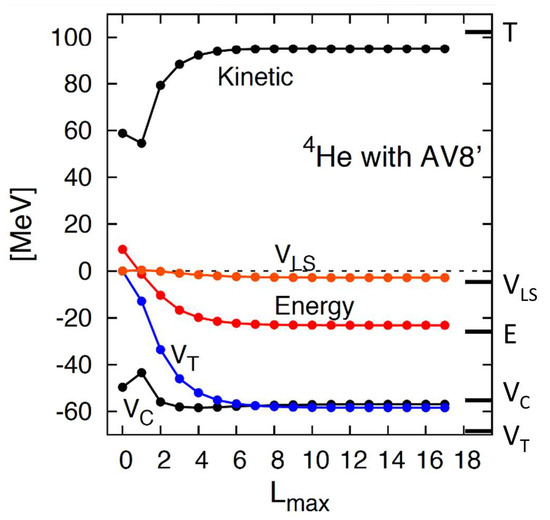
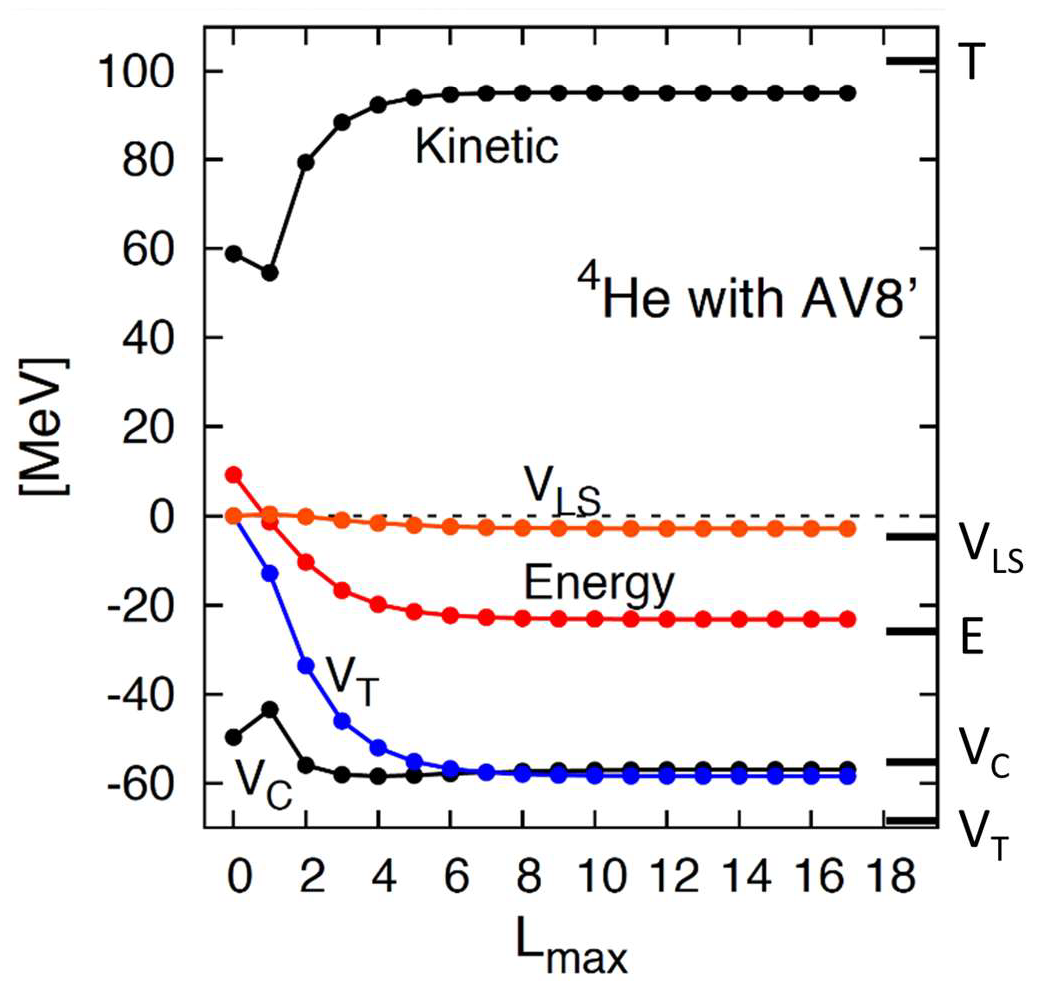
The result of the calculation is shown in Figure 5 for 4He as an example for explanation. Tensor interactions contribute little binding when only low-lying orbitals are included; in fact, no binding is gained with only the lowest s-orbital [31]. This contrasts sharply with central forces in which almost full binding energy is gained with the lowest orbital. Inclusion of higher orbitals leads to a rapid increase in tensor binding energy, converging around Lmax = 4–6. Previous perturbative calculations of 2p–2h treatment by Arima et al. needed up to 12ℏω excitation [28,29]. The TOSM shows much faster convergence clearly. TOSM calculations have been applied to other light nuclei and also reproduce ground and low excited states of those nuclei [32,33,34,35].
Figure 5.
Result of TOSM calculation with AV8′. Binding energy from tensor interaction increases rapidly when higher orbitals are included. Good convergence is seen above Lmax = 5. The Lmax is the maximum value of the orbital angular momentum of the shell model orbitals. It has strong correspondence to the principal quantum numbers of the orbitals. The marks on the right side of the figure show the results of Benchmark test calculation of a four-nucleon system [36].
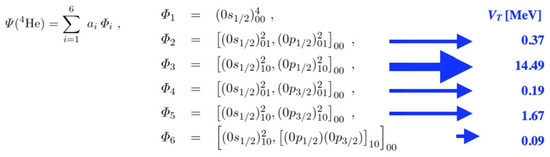
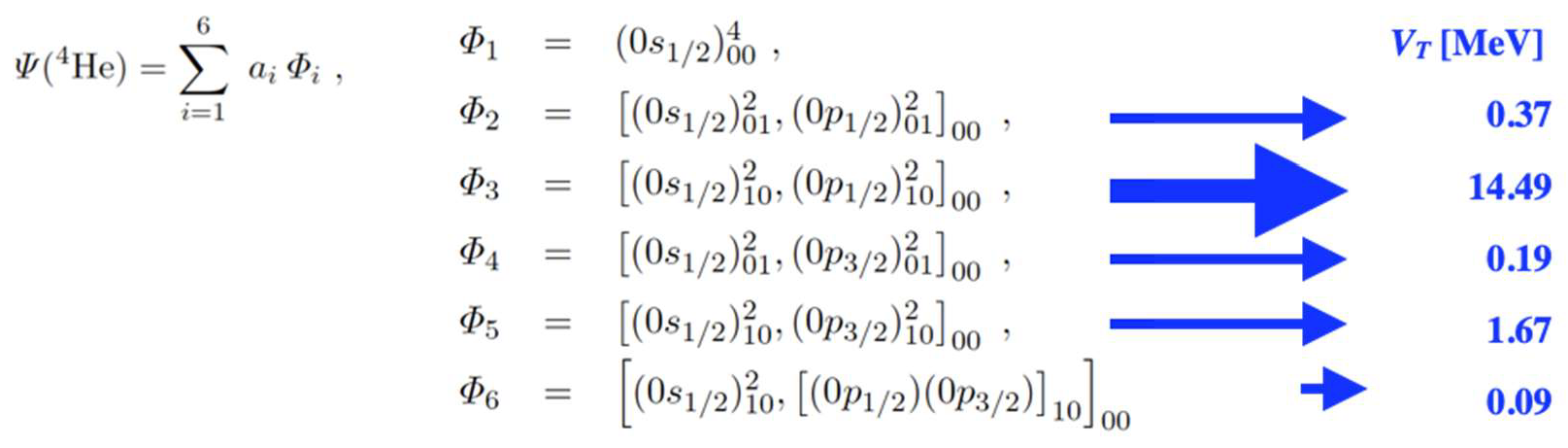
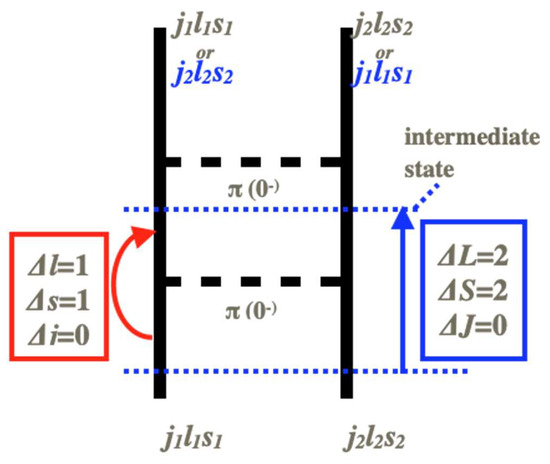
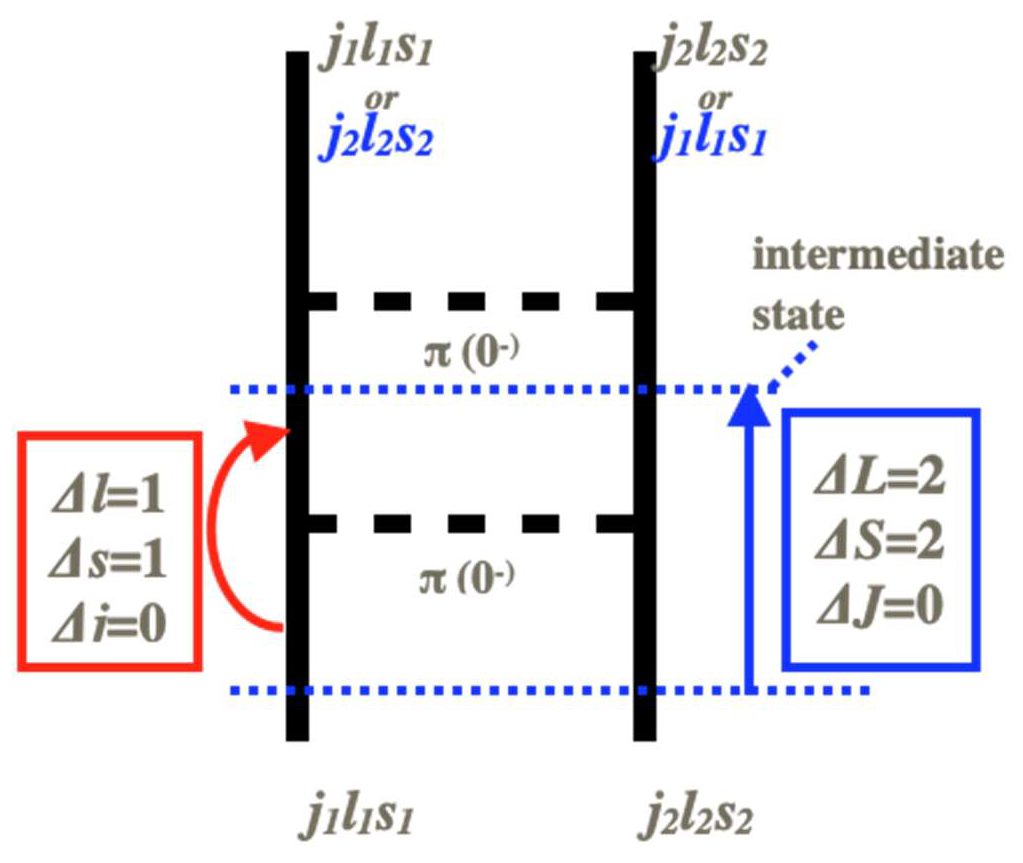
Let us see what wave functions contribute to the tensor interaction. As seen in Figure 5, ΔL ≤ 1 (or one major shell above) mixing already provides ~16 MeV gain in the binding energy. The selection rule for tensor interaction with the 2p–2h state is ΔL = 2, ΔS = 2, ΔJ = 0 and thus, six configurations contribute, as listed in Figure 6. Energies gained by those configurations are shown on the right side of the figure as VT. The configuration Φ3 gives the largest binding energy. This can be understood easily if additional selection rules imposed by pion (0-) exchange are concerned, as shown in Figure 7. The Φ3 is the configuration that satisfies both the tensor and pion selection rule and thus provides a large tensor binding energy. These selection rules are generalized for selecting the important configurations that provide major energy gain, namely, the important configurations excited from (nlj)2 are (n + 1, l ± 1, j)2. In the following, we discuss the changes in binding energy when the occupation of orbitals changes. We consider only the ΔL ≤ 1 effect because most known nuclei have configuration of protons and neutrons either in the same major shell or next major shell. Orbitals of two-major shell difference are not occupied in the basic configurations and thus do not change the contribution of 2p–2h states.
Figure 6.
Contribution of 2p–2h wave functions in ΔL ≤ 1 space. Six configurations are included. Among them, Φ3, which satisfies the selection rule given by the two-pion exchange, gives the largest contribution. Suffixes ij indicate the spin and isospin of combined system. VT on the right of the figure indicate the binding energies obtained by those configurations.
Figure 7.
Selection rule for the 2p–2h configuration under tensor interactions. jnlnsn are quantum numbers of an orbital where a nucleon resides. Important 2p–2h excitations occur due to the pion exchanges between two nucleons in a nucleus. Because a pion is a pseudo-scalar (0−) particle the transition of a particle follows the selection rule shown in the red box on the left side of the diagram. The transition rule of the two-particle state is as shown in the blue box on the right side that is in accordance to the tensor interactions.
Summarizing, the dominant contributions arise from specific 2p–2h configurations selected using tensor interaction rules (ΔL = 2, ΔS = 2, ΔJ = 0). Among these, configurations that are consistent with the pion-exchange mechanism provide the largest energy gain. In general, most important configurations correspond to excitations of the form (nlj)2 → (n + 1, L ± 1, j)2.
Tensor Blocking and Its Role in 11Li
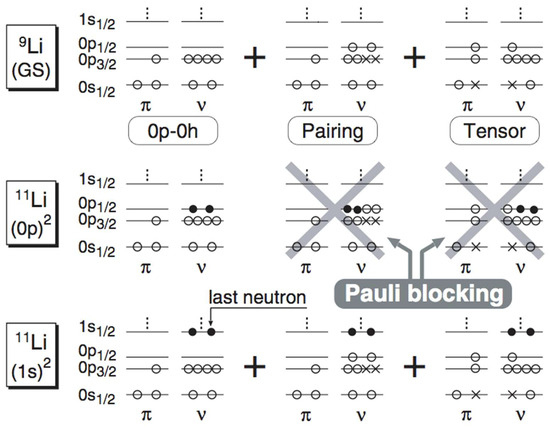
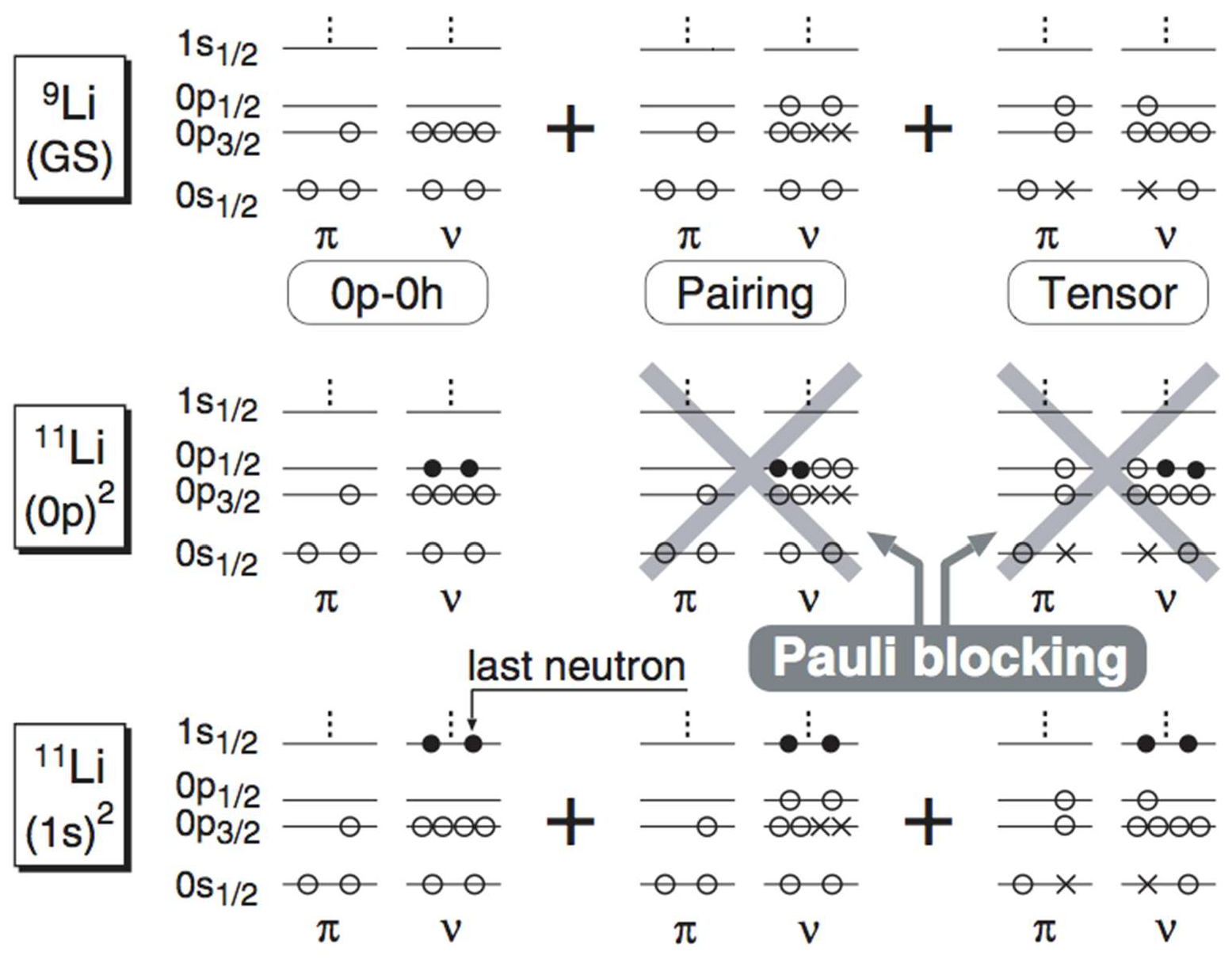
The mixing of (1s1/2)2 and (0p1/2)2 configurations in 11Li is naturally explained within the TOSM [35]. The mechanism of the mixing is expressed in Figure 8. The top line of the figure shows the configuration of 9Li in which 0p–0h and 2p–2h configurations due to paring and tensor interactions are included. The tensor configuration is [(0s1/2)210, (0p1/2)210]00, which is exactly the same configuration in 4He that gives a large tensor binding energy. Single particle orbitals here are in normal order; specifically, 0p1/2 is more bound than 1s1/2. Two configurations can be considered to form 11Li by adding two neutrons. One is to put them in a 0p1/2 orbital and the other is to put them in a 1s1/2 orbital. The low-angular-momentum 1s1/2 orbital is considered because the weak binding of neutrons form a halo and, thus, become lower than the 0d5/2 orbital.
Figure 8.
Explanation of mixing of (s1/2)2 and (p1/2)2 waves in 11Li halo. Figure from Ref. [37]. See text for explanation.
When neutrons are added to the 0p1/2 orbital, the orbital is fully occupied and, thus, no 2p–2h configuration due to either Paring or Tensor is allowed. The large binding energies gained by those interactions is lost in this configuration. In contrast, when neutrons are added to the 1s1/2 orbital, both of the 2p–2h configurations are allowed and thus gain full energy from tensor and paring interactions. As a result, although the 1s1/2 orbital is less bound as a single particle state, the (0p1/2)2 and (1s1/2)2 configurations in 11Li become similar in binding energy. As a result, the two configurations become nearly degenerate and strongly mixed.
This successful mechanism is general in tensor interactions. The binding energy from tensor interactions is gained through the transition to a 2p–2h state but this energy is not obtained if the upper state is filled with nucleons and the 2p–2h state is blocked. In particular, the occupation of nucleons of an orbital that is allowed according to the selection rule of tensor interaction affects the binding. In the 9Li nucleus, the 0p1/2 orbital is allowed for the transition from 0s1/2 but 1s1/2 is not allowed from either of the filled orbitals 0s1/2 and 0p3/2. When such an allowed orbital is occupied by added nucleons, the binding energy gained by tensor interaction is lost. In other words, tensor interaction is blocked by the filling of a specific orbital.
This mechanism—loss of tensor correlation energy due to occupation of specific orbitals—is referred to as tensor blocking. It effectively shifts single-particle energies and plays a crucial role in neutron-rich and proton-rich nuclei.
4. Effects of Tensor Blocking on Nuclear Ground States
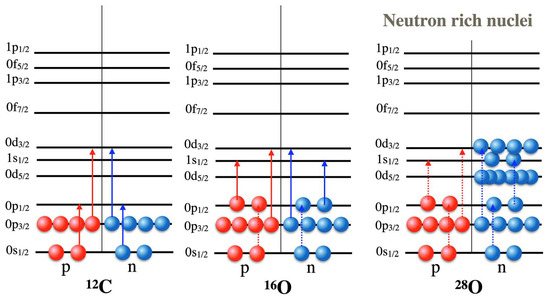
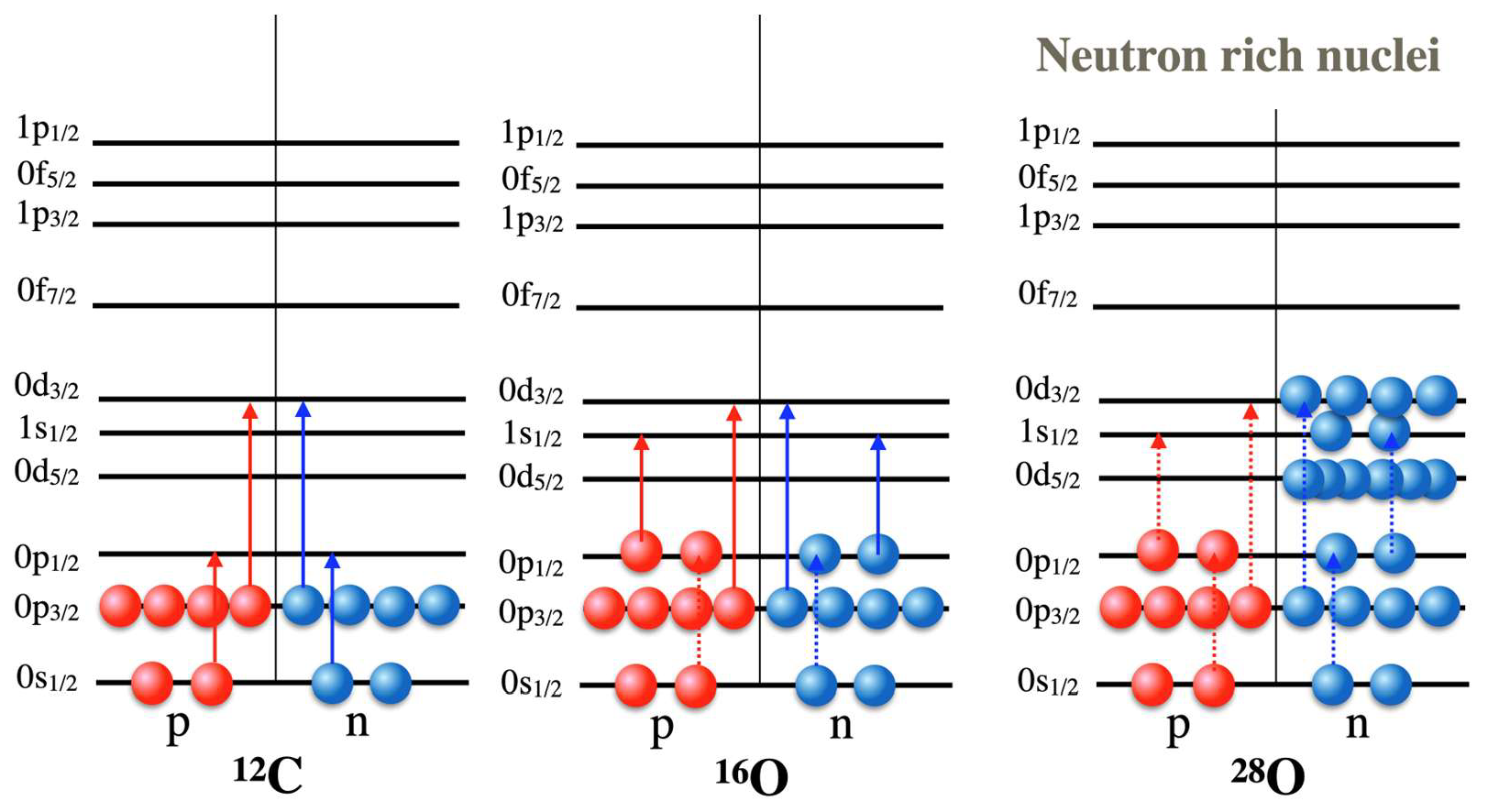
Tensor blocking occurs when orbitals involved in 2p–2h excitations are occupied. In symmetric nuclei such as 12C, all tensor-driven excitations are allowed within one major shell jump as shown in Figure 9. In 16O, however, the configurations (0p1/2)2–(0s1/2)−2 are blocked due to the full occupancy of the 0p1/2 orbital, but at the same time, a new configuration (1s1/2)2–(0p1/2)−2 becomes available. This balance leads to saturation properties of nuclear binding, similar to the mechanism discussed by Bethe [38] for nuclear matter saturation. For nuclei near the stability line, blocking and opening new configurations occur simultaneously.
Figure 9.
Tensor blocking in stable and neutron-rich nuclei. The possible 2p–2h excitations are shown by the set of arrows from one orbital to the other orbital. The solid line shows that this transition is possible because the upper orbital is open and thus nucleons can be excited into the orbital. The dotted line shows the case where the upper orbital is already occupied so that the 2p–2h excitation is blocked. In 12C, all nucleons in both 0s1/2 and 0p3/2 can be excited to the 0p1/2 and 0d3/2 orbitals, respectively. In 16O, the 0p1/2 orbital is occupied so that transition from 0s1/2 is blocked and this leads to the loss of tensor energy. However, the nucleons in 0p1/2 can be excited to 1s1/2 and provide a new tensor energy. In 28O, although only neutron orbitals are occupied, all excitations important for the tensor interactions are blocked. No new excitations like 16O are possible. Therefore, loss of the tensor energy is significant in 28O.
An important fact should be noted here. It is known that structures of 12C and 16O cannot be explained by one set of effective interactions independent from nuclear models like the independent particle model or cluster model [37]. This may be due to the beginning of the blocking.
Another important property of this blocking should be mentioned here. The blocking does not occur in the first appearing j> orbitals. For example, the occupation of the 0d5/2 orbital does not cause any blocking of 2p–2h excitation. This is because those orbitals are not used for 2p–2h excitations because no orbital below it has the same j. The upper orbital 0f7/2 is another such orbital.
In asymmetric nuclei, the situation is different. Since tensor interactions require proton–neutron pairs, blocking can occur even if only one type of nucleon occupies the relevant orbital. For example, in 28O, tensor correlations are almost completely blocked in the ΔL ≤ 1 space, contributing to the weak binding or unbound character of 28O in spite of traditional double-magic nucleon numbers. An extremely important result here is the difference in the effect of tensor interactions for symmetric nuclei and asymmetric nuclei. When nucleons are added, blockings of tensor interactions occur together with the addition of new tensor interactions for symmetric nuclei. In contrast, only tensor blockings occur for asymmetric nuclei. Therefore, additions of nucleons to the same orbital show different behavior between nuclei near the stability line and nuclei far from the stability line.
Under this consideration, the strange behavior of nuclei with N > 6 but with Z < 6 can be understood. It can also be explained easily that 10He is unbound. The excitation of the 0s1/2 proton and neutron to 0p1/2, which gives strong binding energy (~14 MeV) in 4He, is blocked here.
The new magic number N = 14, as another example, is produced because the neutron added to the 1s1/2 orbital makes tensor blocking and the energy gap become larger. In the same way, the addition of neutrons into 0d3/2 produces the N = 16 magic number. It is noted again that filling the 0d5/2 orbital does not lead to tensor blocking. As is easily imagined, N ≥ 14 with Z < 14 nuclei are expected to have contributions from an upper major shell, say, the fp shell. The island of inversion is where important effects of tensor interaction are expected. It is suggested that the island of inversion terminates where protons start to occupy 1s1/2 and 0d3/2 orbitals.
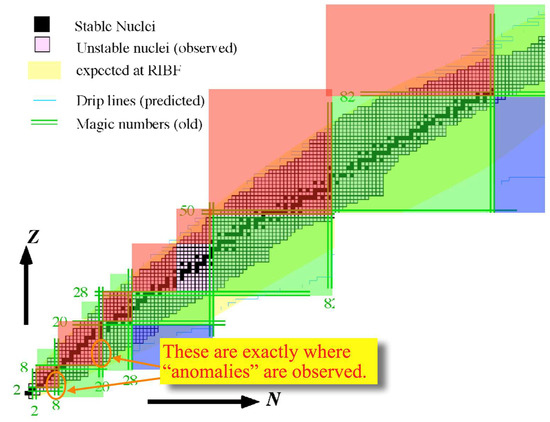
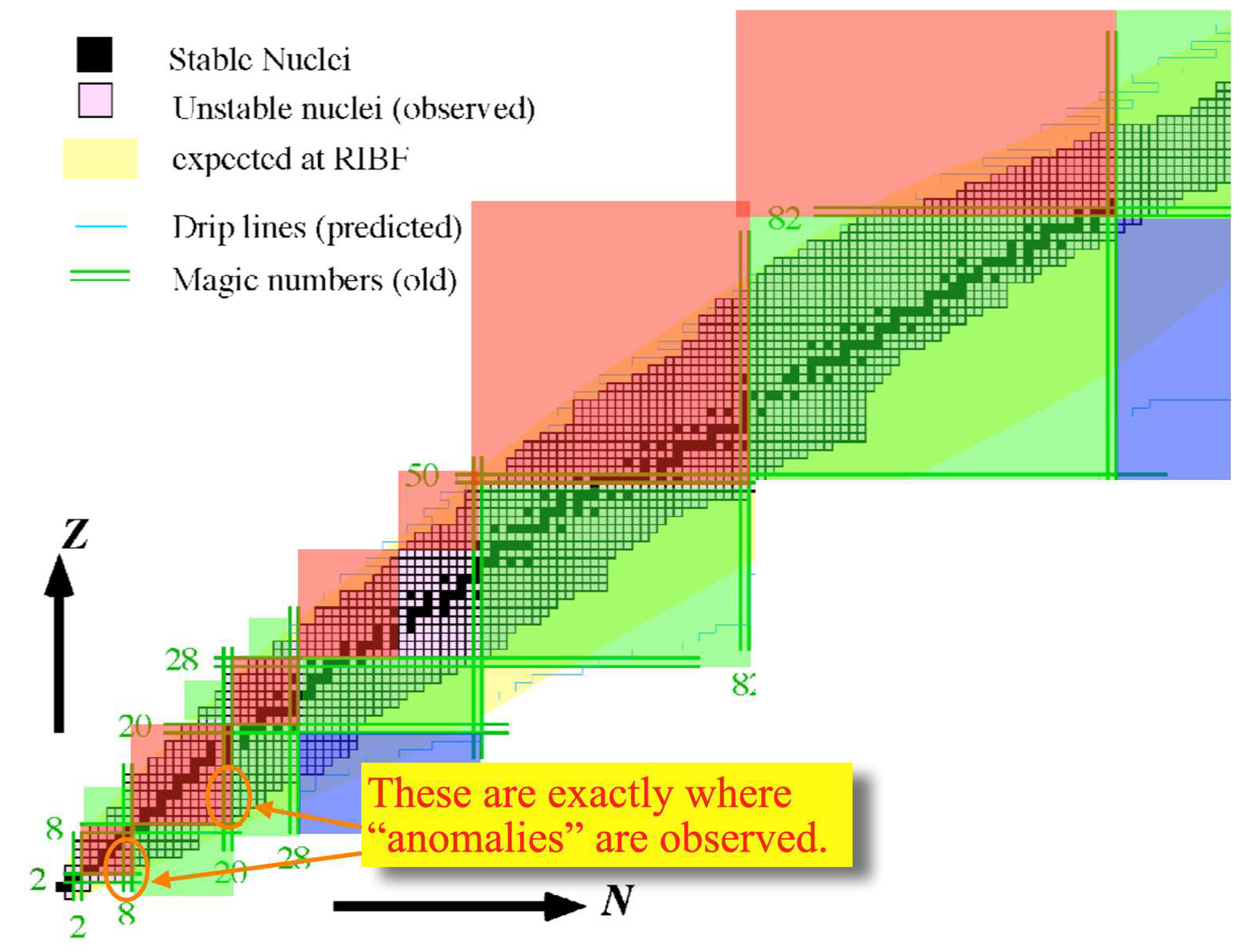
Light stable nuclei lay along the symmetric line and known neutron- and proton-rich nuclei have asymmetry, in which neutrons (or protons) are in orbitals of the next major shell, where tensor blockings may occur. Symmetric major shells are colored in red in Figure 10, regions of asymmetry in one major shell are colored in green, and asymmetry in two major shells is colored in blue. Nuclei with strange behaviors are located in the red ellipsoids shown in the figure. All of them are at the border of the color. This suggests that more interesting phenomena may occur at other borders.
Figure 10.
Nuclear chart in view of nucleon asymmetry. Red-colored region presents protons and neutrons that are in same major shell. Green (blue) region shows where proton and neutron occupations are different by one (two) major shell(s).
Only a few nuclides in the blue region are known at this moment, so the above tensor blocking discussion is restricted only to the one-major-shell difference. However, the tensor interactions contribute to the binding energy largely also for ΔL = 2 transitions. The nuclei in the blue region thus might also show different behaviors. One important fact is that the nuclei along the R-process in the heavy mass region are at the border with the blue-colored region. One possible effect of tensor blocking is the faster reduction in binding energy for neutron-rich nuclei. The effective nuclear interactions would become weaker for neutron-rich nuclei and, thus, the neutron drip line could be closer to the stability line than is expected now.
5. High-Momentum Nucleons in Nuclei
The most important ingredient for gaining energy through tensor interactions is the high-momentum components of the wave function. The tensor interactions by pion exchange are expressed as being proportional to
with the tensor operator S12(q) = [[σ1σ2]2 × Y2(q)]0.
The tensor interaction is stronger when the momentum transfer q becomes larger. It gives almost no energy when the momentum transfer is small. Therefore, the tensor interactions bring the binding energy through the transition to a 2p–2h state that includes high momentum.
The existence of high-momentum nucleons has been observed using electron scattering experiment [39]. Also, correlated high-momentum pairs have been observed in the ground state of nuclei. However, from the view point of nuclear structure, it was considered that these correlated high-momentum pairs affect the low-momentum space just to cut the model space. In other words, these are depletions of spectroscopic factors. However, by knowing the importance of tensor blocking effects, we have to consider that the high-momentum components also affect the low energy structure of nuclei. In other words, do we see high-momentum nucleons in 2p–2h configurations in ground-state nuclei?
Such experiments have been done on 16O nuclei using (p, d) and (p, pd) reactions at high energy [40,41]. In a (p, pd) experiment, the amplitudes of pn pairs with high relative momentum are compared between (Iπ, Τ) = (1+, 0) and (0+, 1) pairs. Because tensor interactions work only on the (1+, 0) pair, the ratio of the cross-section for those two different pairs presents the effect of the tensor interactions. The results of (p, pd) reactions are presented in ref. [41].
In the following, I discuss the (p,d) reaction in some more detail, including a recent finding.
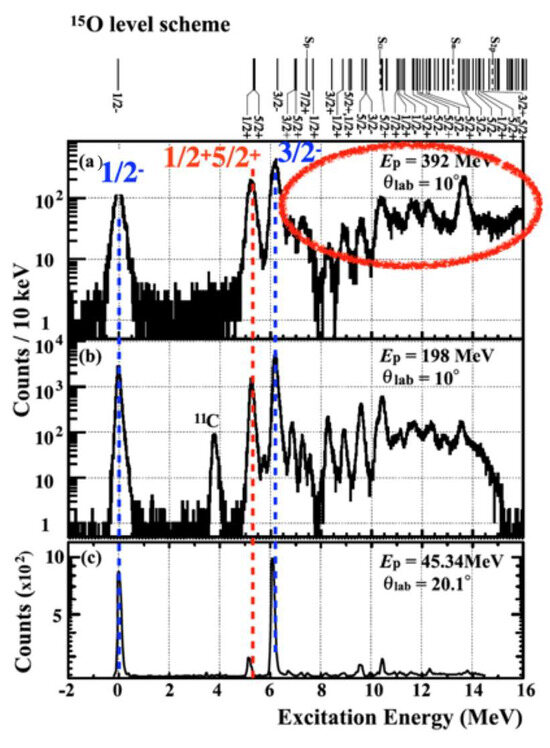
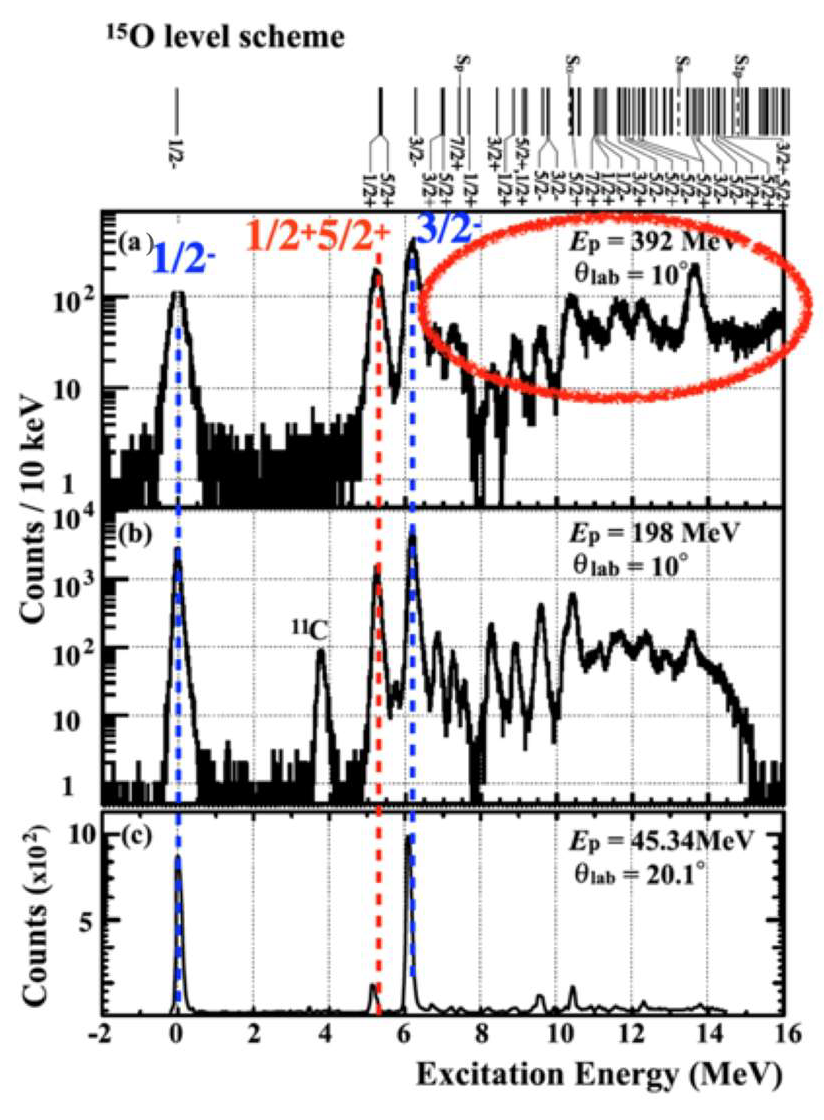
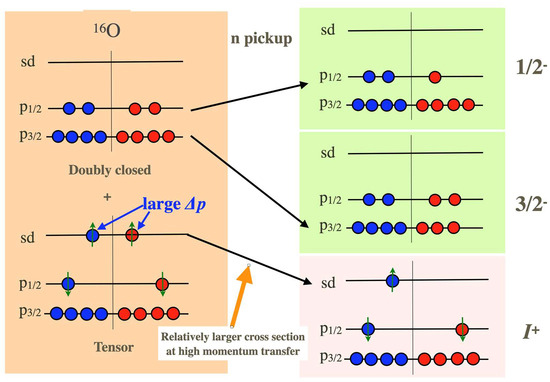
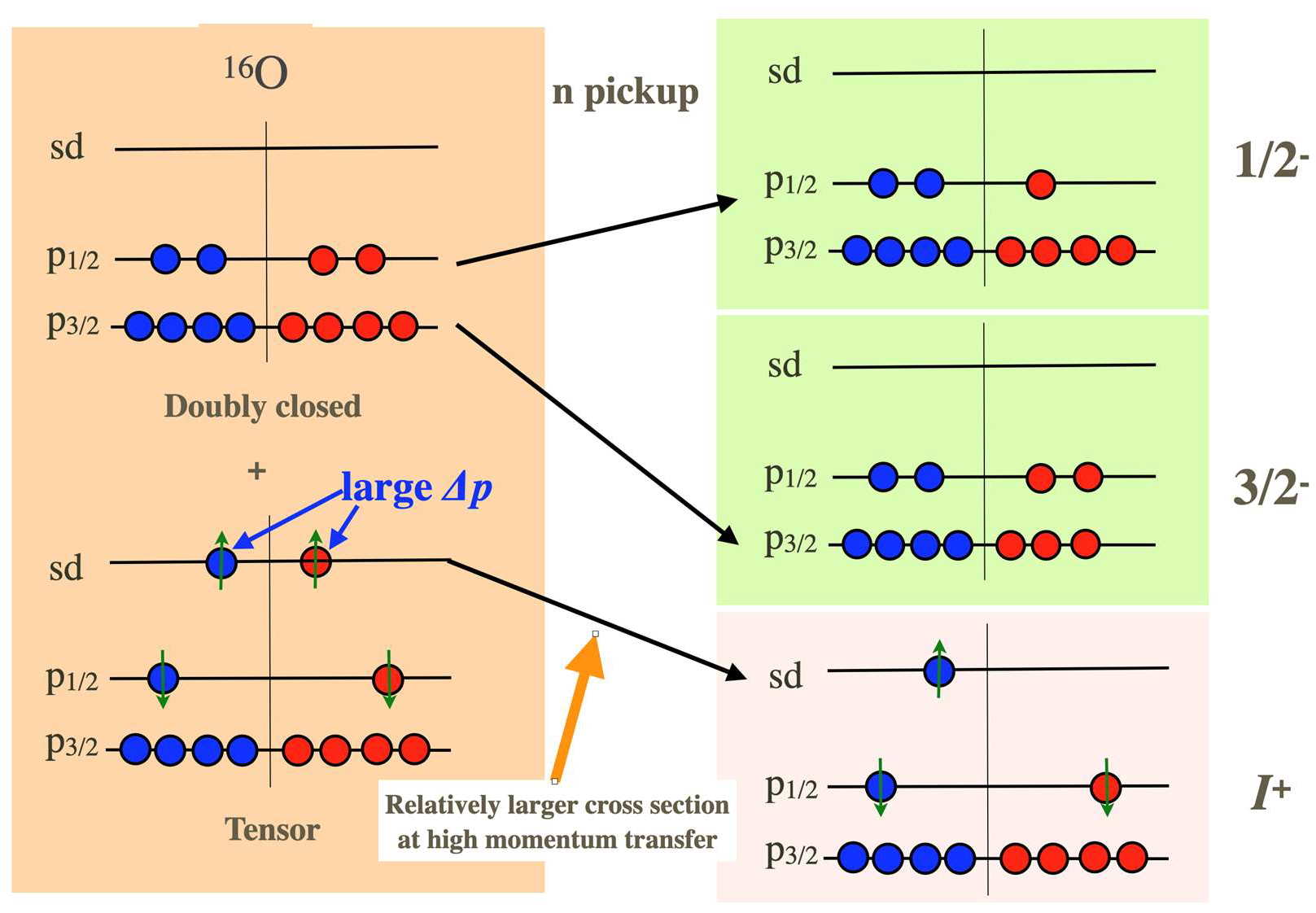
Figure 11 shows the deuteron spectra from 16O(p, d) reactions for several incident energies. At low energy, as shown in panel (c) in the figure, two negative parity states are dominantly excited. These are hole states made by the removal of a neutron from either the 0p1/2 or 0p3/2 orbital. A very weak transition to the positive parity state is seen. However, this transition becomes relatively stronger compared with the negative-parity-state transitions at higher beam energy. At 392 MeV beam energy, the positive parity transitions are stronger than those at the ground state (1/2−) as indicated by red circle. As illustrated in Figure 12, the positive parity state can only be produced by the pickup of a neutron from a mixed sd shell in the ground state. If it is from 2p–2h configurations, according to the tensor interactions, these nucleons have higher-momentum components than the 0p0h configuration. The larger amplitude of the high-momentum component can increase the relative cross-section to positive parity states. As we discussed previously, many 2p–2h excitations contribute to tensor interactions. In fact, many higher excited states in 15O are strongly produced at the highest energy beam, as indicated by the red ellipsoid. They are excited with a comparable cross-section to that at the ground state. This certainly indicates that many states with high-momentum components are mixed in the ground state of 16O. This relative enhancement of the cross-sections of the positive parity states is consistent with the high-momentum component similar to that of 4He and suggests that the same high-momentum neutrons exist in 16O [40].
Figure 11.
16O(p, d) spectra for different energies. Figure modified from a figure from Ref. [41]. Three panels show the data at different incident beam energies, (a) Ep = 392 MeV, (b) Ep = 198 MeV and (c) Ep = 45.34 MeV.
Figure 12.
Mechanism of neutron pickup from different configurations mixed in the ground state of 16O. The removal of p-shell neutrons from the ground state (doubly closed) make negative parity states only. The 2p–2h excitations, important for tensor interactions, include particle excitations to the next major shell. Therefore, the removal of neutrons from this configuration leaves the final state in positive parity.
However, a possible problem in this experiment is the distortion in the scattering process from the initial and final state interactions. It would be best if we could observe the same behavior at the 0° scattering angle, where the distortion effect is minimal.
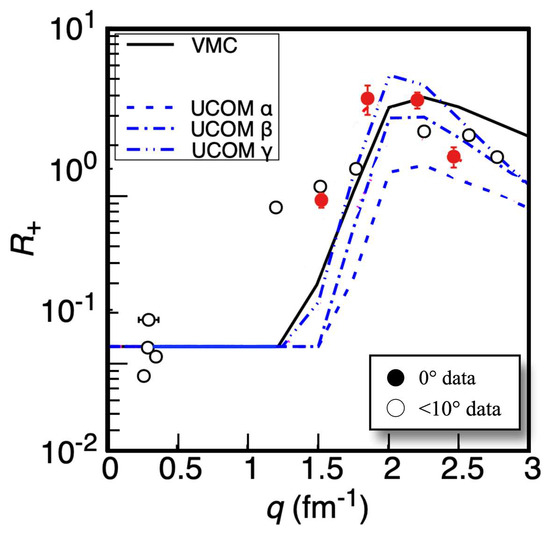
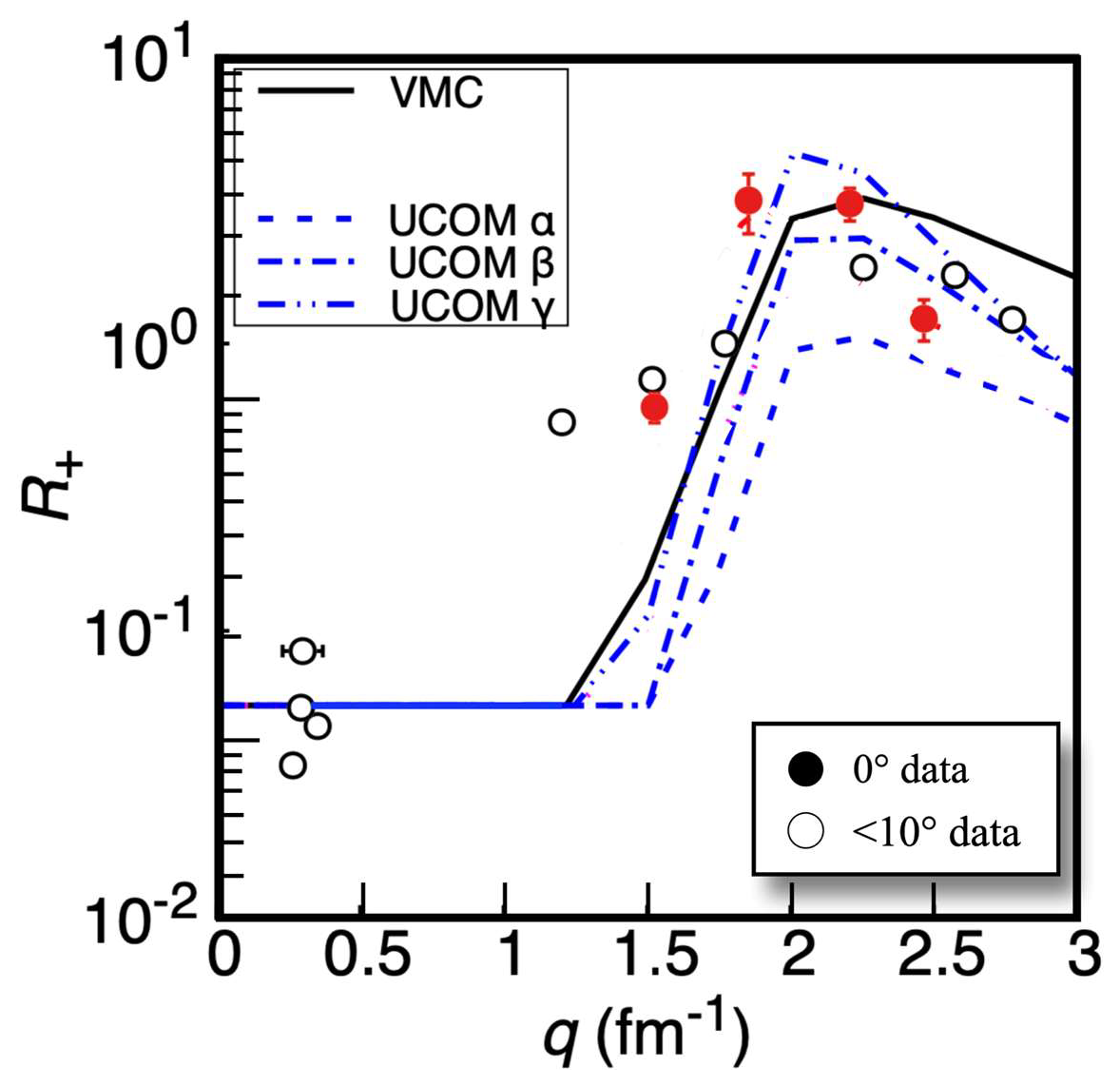
An experiment has been done at GSI using the fragment separator (FRS) as a 0° high-resolution spectrometer [5]. It was clearly found that the positive parity state at around Ex = 5 MeV (two states, 1/2+ and 5/2+, are not separated) is excited relatively stronger than the negative parity states (1/2− and 3/2−) as the beam energy becomes higher. The ratios of cross-sections to the positive parity state and the ground state (1/2−), R+ = σ+/σ−, are shown by filled red circles in Figure 13. The same ratios for the scattering angles less than 10° are shown also in the figure by open black circles. The horizontal axis is the transferred momentum that is equal to the momentum of a picked up neutron. This indicates that the positive parity state is produced from the configuration that has more high-momentum components than neutrons in the 0p–0h configuration.
Figure 13.
Ratio of the positive parity and the negative parity cross-sections at 0° scattering angle (solid red mark). The other selected data for scattering angles less than 10 degrees are shown by open circles. Various theoretical predictions of the ratio are shown by curves. the curves are normalized at lowest momentum transfer and amplitude is adjusted to the data at 2.2 fm−1 for VMC fixing the same scaling for other calculations.
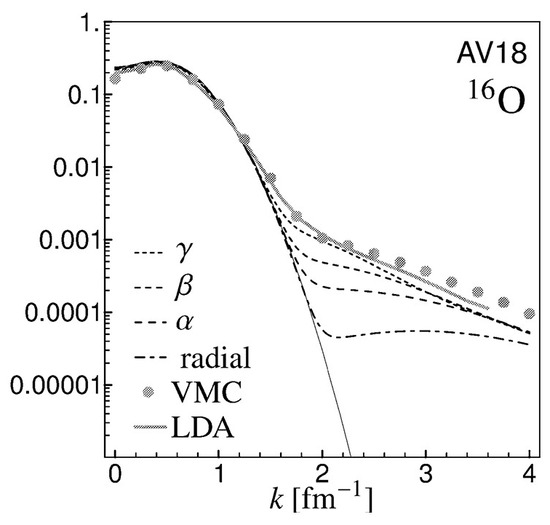
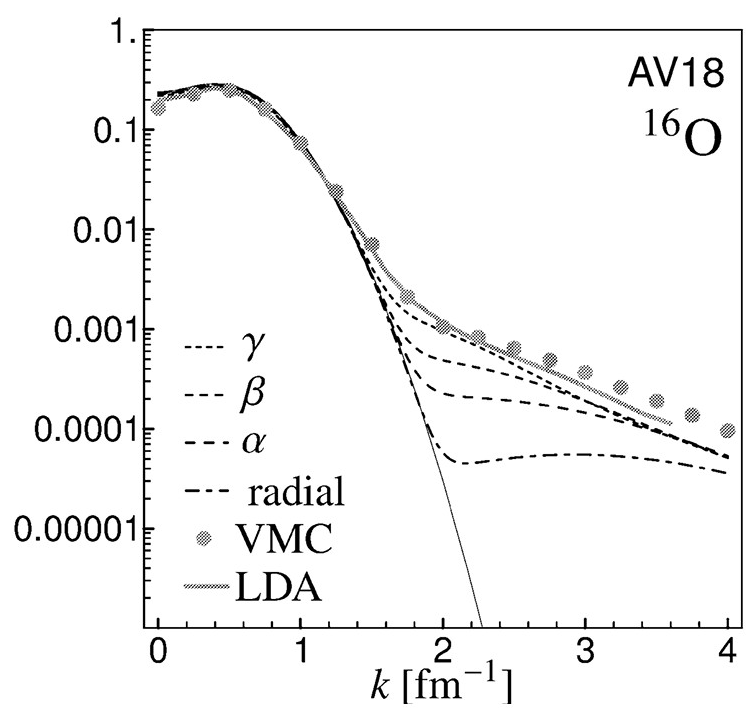
High-momentum nucleons are expected from theoretical calculations of momentum distribution when tensor-correlated nucleons are included. Figure 14 shows examples of UCOM [42] and VMC calculations. The dash-dotted curve in the figure is the momentum distribution of nucleons without tensor correlations. The VMC results with tensor correlations are shown as gray marks and the UCOM results are shown by the dotted curves. Marks α, β, and γ show the results for different range parameters of the tensor interactions. We compare the data assuming that the negative-parity-state cross-sections come from the no-tensor-correlated wave function and the positive parity state cross section comes from correlated wave function.
Figure 14.
Theoretical prediction of the momentum distribution of nucleons in 16O. The curve indicated as radial is the distribution without tensor correlations. α, β, and γ are results of UCOM calculations with different range parameters of tensor interactions. VMC shows the results of Variational Monte Carlo calculations.
The experimental ratio R+ = σ+/σ− is compared with the ratio of the momentum distributions between tensor-correlated and non-correlated wave functions. The absolute value of R+ is difficult to compare directly to the theoretical ratio because the experimental data is from a certain selected configuration only, but the theoretical calculations include all nucleons. To compare the experimental data and theoretical prediction, we fix the ratio at the momentum region, where no tensor effect is expected. Then, the VMC ratio is normalized to the data at the peak (q~2.2 fm−1). This normalization factor is applied for all other model ratios. Therefore, only the shape of the change in the ratio against q can be compared. Comparisons of the value themselves do not have meaning although the relative difference in the models may matter. The agreement of the increasing behavior of the ratio is pretty much consistent with the models and thus supports that we are observing the high-momentum component included in 2p–2h excitation according to the tensor interactions. This supports the discussion in the first half of the present paper.
6. Summary
Tensor interactions play a crucial role in nuclear structure through 2p–2h configurations that introduce high-momentum components and provide substantial binding energy. These configurations are strongly constrained by tensor selection rules and pion-exchange dynamics.
When such orbitals are occupied, these configurations are blocked, leading to a loss of tensor binding energy—a mechanism referred to as tensor blocking. This effect explains many unusual features of neutron-rich nuclei, including changes in shell structure and halo formation.
Recent experimental evidence, such as 16O(p, d) reactions at 0°, supports the presence of high-momentum nucleons associated with tensor correlations in nuclear ground states.
Funding
This research received no external funding.
Data Availability Statement
No new data were created or analyzed in this study. Data sharing is not applicable to this article.
Acknowledgments
I would like to express my gratitude to my colleagues for making the Halo40 meeting both possible and enjoyable. This work is based on my presentation at the meeting, and I sincerely thank all my collaborators for their contributions. Most of the work shown here was carried out while I was working at the School of Physics of Beihang University, and I am very grateful to the university and my colleagues for their hospitality and fruitful collaboration.
Conflicts of Interest
The author declares no conflicts of interest.
References
- Zeller, S.; Kunitski, M.; Voigtsberger, J.; Kalinin, A.; Schottelius, A.; Schober, C.; Waitz, M.; Sann, H.; Hartung, A.; Bauer, T.; et al. Imaging the He2 quantum halo state using a free electron laser. Proc. Natl. Acad. Sci. USA 2016, 113, 14651–14655. [Google Scholar] [PubMed]
- Kobayashi, T.; Yamakawa, O.; Omata, K.; Sugimoto, K.; Shimoda, T.; Takahashi, N.; Tanihata, I. Projectile Fragmentation of the Extremely Neutron-Rich Nucleus 11Li at 0.79 GeV/nucleon. Phys. Rev. Lett. 1988, 60, 2559–2602. [Google Scholar]
- Kobayashi, T.; Shimoura, S.; Tanihata, I.; Katori, K.; Matsuta, K.; Minamisono, T.; Sgimoto, K.; Müller, W.; Olson, D.L.; Symons, T.J.M.; et al. Electromagnetic Dissociation and Soft Giant Dipole Resonance of the Neutron-Dripline Nucleus 11Li. Phys. Lett. B 1989, 232, 51–55. [Google Scholar] [CrossRef] [Scilit]
- Shimizu, Y.; Kobayashi, T.; Kubo, T.; Chiga, N.; Isobe, T.; Kawabata, T.; Kondo, Y.; Kusaka, K.; Matsuda, Y.; Motobayashi, T.; et al. SAMURAI Project at RIBF. J. Phys. Conf. Ser. 2011, 312, 052022. [Google Scholar] [CrossRef] [Scilit]
- Geissel, H.; Ambruster, P.; Behr, K.H.; Brünle, A.; Burkard, K.; Chen, M.; Folger, H.; Franczak, B.; Keller, H.; Klepper, O.; et al. The GSI projectile fragment separator (FRS): A versatile magnetic system for relativistic heavy ions. Nucl. Instr. Meth. Phys. Res. B 1992, 70, 286–297. [Google Scholar] [CrossRef] [Scilit]
- Hansen, P.; Hornshøj, P.; Nielsen, H.; Wilsky, K.; The ISOLDE Collaboration. Neutron-neutron scattering length from a complete experiment on the reaction D(n, 22n)H. Phys. Lett. B 1969, 28, 415–419. [Google Scholar]
- Lothrop, F.; Alonso, J.; Force, R.; Grunder, H.; Lewis, S.; Miller, R. Physics and Medicine: The Bevatron/Bevalac Experience, 1970–1980. IEEE Trans. Nucl. 1981, 28, 2823–2825. [Google Scholar] [CrossRef] [Scilit]
- Heckman, H.H.; Greiner, D.E.; Lindstrom, P.J.; Bieser, F.S. Fragmentation of Nuclei at 29 GeV: Inclusive Isotope Specra at 0°. Phys. Rev. Lett. 1972, 28, 926–929. [Google Scholar]
- Westfall, G.D.; Symons, T.J.M.; Greiner, D.E.; Heckman, H.H.; Lindstrom, P.J.; Mahoney, J.; Shotter, A.C.; Scott, D.K.; Crawford, H.J.; McParland, C.; et al. Production of Neutron-Rich Nuclides by Fragmentation of 212-MeV/amu 48Ca. Phys. Rev. Lett. 1979, 43, 1859–1862. [Google Scholar]
- Benlliure, J.; Schmidt, K.-H.; Cortina-Gil, D.; Enqvist, T.; Farget, F.; Heinz, A. Calculated production cross-sections of neutron-rich nuclei. Nucl. Phys. A 1999, 660, 87–100. [Google Scholar] [CrossRef] [Scilit]
- Tanihata, I.; Hamagaki, H.; Hashimoto, O.; Nagamiya, S.; Shida, Y.; Yshikawa, N.; Yamakawa, O.; Sugimoto, K.; Kobayashi, T.; Greiner, D.E.; et al. Measurement of Interaction Cross Sections and Radii of He Isotoprs. Phys. Lett. 1985, 160Β, 380–384. [Google Scholar]
- Tanihata, I.; Hamagaki, H.; Hashimoto, O.; Shida, Y.; Yoshikawa, N.; Sugimoto, K.; Yamakawa, O.; Kobayashi, T.; Takahashi, N. Measurement of Interaction Cross Sections and Nuclear Radii in the Light p-Shell Region. Phys. Rev. Lett. 1985, 55, 2676–2679. [Google Scholar] [PubMed]
- Hansen, P.G.; Jönson, B. The Neutron Halo of Extremely Neutron-Rich Nuclei. EuroPhys. Lett. 1987, 4, 409–414. [Google Scholar] [CrossRef] [Scilit]
- Tanihata, I. (Ed.) Special issue on research opportunities with accelerated beams of radioactive ions. In Nuclear Physics A; Elsevier: Amsterdam, The Netherlands, 2001; Volume 693. [Google Scholar]
- Talimi, I.; Unna, I. Order of Levels in the Shell Model and Spin of Be-11. Phys. Rev. Lett. 1960, 4, 469–470. [Google Scholar]
- Tanihata, I.; Savajols, H.; Kanungo, R. Recent experimental progresses in nuclear halo structure. Progr. Part. Nucl. Phys. 2013, 68, 215–313. [Google Scholar] [CrossRef] [Scilit]
- Chen, J.; Lou, J.L.; Ye, Y.L.; Li, Z.H.; Pang, D.Y.; Yuan, C.X.; Ge, Y.C.; Li, Q.T.; Hua, H.; Jiang, D.X.; et al. A new measurement of the intruder configuration in 12Be. Phys. Lett. B 2018, 781, 412. [Google Scholar] [CrossRef] [Scilit]
- Foreseen, C.; Navratilova, P.; Ormand, W.E. Large basis ab initio shell model investigation of 9-Be and 11-Be. Phys. Rev. C 2004, 71, 044312. [Google Scholar]
- Calci, A.; Navrátil, P.; Roth, R.; Dohet-Eraly, J.; Quaglione, S.; Hupin, G. Can Ab Initio Theory Explain the Phenomenon of Parity Inversion in 11Be? Phys. Rev. Lett. 2016, 117, 242501. [Google Scholar] [PubMed]
- Simon, H.; Aleksandrov, D.; Aumann, T.; Axelsson, L.; Baumann, T.; Borge, M.J.G.; Chulkov, L.V.; Collaz, R.; Cub, J.; Dostal, W.; et al. Direct Experimental Evidence for Strong Admixture of Different Parity States in 11Li. Phys. Rev. Lett. 1999, 83, 496–499. [Google Scholar]
- Borge, M.J.G.; Grigorenko, L.; Guillemaud-Mueller, D.; Hornshøj, P.; Humbert, F.; Jonson, B.; Leth, T.E.; Martínez Pinedo, G.; Mukha, I.; Nilsson, T.; et al. Probing the 11Li halo structure through β-decay into the 11Be* (18MeV) state. Nucl. Phys. A 1997, 613, 199–208. [Google Scholar]
- Tanihata, I.; Alcorta, M.; Bandyopadhyay, D.; Bieri, R.; Buchmann, L.; Davides, B.; Galinski, N.; Howell, D.; Mills, W.; Mythili, S.; et al. Measurement of the Two-Halo Neutron Transfer Reaction 1H(11Li, 9Li)3H at 3A MeV. Phys. Rev. Lett. 2008, 100, 192502. [Google Scholar] [PubMed]
- Thompson, I.J.; Zhukov, M.V. Effects of 10Li virtual states on the structure of 11Li. Phys. Rev. C 1994, 49, 1904–1907. [Google Scholar]
- Ikeda, K.; Myo, T.; Kato, K.; Toki, H. Di-Neutron Clustering and Deuteron-like Tensor Correlation in Nuclear Structure Focusing on 11Li. Lect. Notes Phys. 2010, 818, 165–221. [Google Scholar]
- Myo, T.; Sugimoto, S.; Kato, K.; Toki, H.; Ikeda, K. Tensor Correlation in 4He with the Tensor Optimized Shell Model. Progr. Theor. Phys. 2007, 117, 257. [Google Scholar] [CrossRef] [Scilit]
- Pieper, C.; Wiringa, R.B. Quantum Monte Carlo Calculations of Ligh Nuclei. Ann. Rev. Nucl. Part. Sci. 2001, 51, 53–90. [Google Scholar]
- Arima, A.; Terasawa, T. Spin-Orbit Splitting and Tensor Force. II. Prog. Theor. Phys. 1960, 23, 115–136. [Google Scholar] [CrossRef] [Scilit]
- Arima, A.; Cheon, T.; Shimizu, K. IsoScalar Magnetic Moments and the Role of the Δ-Hole Excitation. Hyperfine Interact. 1985, 21, 79–83. [Google Scholar] [CrossRef] [Scilit]
- Shimizu, K.; Ichihara, M.; Arima, A. Magnetic Moments and GT-Type β-Decay Matrix Elements in Nuclei with a LS Doubly Closed Shell plus or Minus One Nucleon. Nucle. Phys. A 1974, 226, 282–318. [Google Scholar] [CrossRef] [Scilit]
- Otsuka, T.; Suzuki, T.; Fujimoto, R.; Grawe, H.; Akaishi, Y. Evolution of Nuclear Shells due to the Tensor Force. Phys. Rev. Lett. 2005, 95, 232502. [Google Scholar] [CrossRef] [Scilit] [PubMed]
- Myo, T.; Toki, H.; Ikeda, K. Tensor-Optimized Shell Model with Bare Nucleon-Nucleon Interaction for 4He. Prog. Theor. Phys. 2009, 121, 511–531. [Google Scholar]
- Myo, T.; Umeya, A.; Toki, H.; Ikeda, K. Role of tensor interaction in He isotopes with a tensor-optimized shell model. Phys. Rev. C 2011, 84, 034315. [Google Scholar] [CrossRef] [Scilit]
- Myo, T.; Umeya, A.; Toki, H.; Ikeda, K. Tensor-optimized shell model for the Li isotopes with a bare nucleon-nucleon interaction. Phys. Rev. C 2012, 86, 024318. [Google Scholar]
- Myo, T.; Umeya, A.; Toki, H.; Ikeda, K. Structure in 9,10Be and 10B studied with the tensor-optimize shell model. Prog. Theor. Exp. Phys. 2015, 2015, 063D03. [Google Scholar] [CrossRef] [Scilit]
- Myo, T.; Kato, K.; Toki, H.; Ikeada, K. Role of tensor and paring correlations on halo formation in 11Li. Phys. Rev. C 2007, 76, 024305. [Google Scholar]
- Kamada, H.; Nogga, A.; Glöckie, W.; Hiyama, E.; Kaminuma, M.; Varga, K.; Suzuki, Y.; Viviani, M.; Kievsky, A.; Rosati, S.; et al. Benchmark test calculation of a four-nucleon bound state. Phys. Rev. C 2001, 64, 044001. [Google Scholar] [CrossRef] [Scilit]
- Horiuchi, H.; (RCNP, University of Osaka, Osaka, Japan). Private communication, 2025.
- Bethe, H.A. Theory of Nuclear Matter. Ann. Rev. Nucl. Part. Sci. 1971, 21, 93–244. [Google Scholar] [CrossRef] [Scilit]
- Arrington, J.; Somin, N.; Schmidt, A. Progress in understanding short-range structure in nuclei: An experimental perspective. Ann. Rev. Nucl. Part. Sci. 2022, 72, 307–337. [Google Scholar] [CrossRef] [Scilit]
- Ong, H.J.; Tanihata, I.; Tamii, A.; Myo, T.; Ogata, K.; Fukuda, M.; Hirota, K.; Ikeda, K.; Ishikawa, D.; Kawabata, T.; et al. Probing effect of tensor interactions in 16O via (p, d) reaction. Phys. Lett. B 2013, 725, 277–281. [Google Scholar]
- Terashima, S.; Yu, L.; Ong, H.J.; Tanihata, I.; Adachi, S.; Aoi, N.; Chan, P.Y.; Fujioka, H.; Fukuda, M.; Geissel, H.; et al. Dominanace of Tensor Correlations in High-Momentum Nucleon Pairs Studied by (p,pd) Reaction. Phys. Rev. Lett. 2018, 121, 242501. [Google Scholar] [PubMed]
- Neff, T.; Feldmeier, H. Tensor correlations in the unitary correlation operator method. Nucl. Phys. A 2003, 713, 311–371. [Google Scholar] [CrossRef] [Scilit]




Disclaimer/Publisher’s Note: The statements, opinions and data contained in all publications are solely those of the individual author(s) and contributor(s) and not of MDPI and/or the editor(s). MDPI and/or the editor(s) disclaim responsibility for any injury to people or property resulting from any ideas, methods, instructions or products referred to in the content. |
© 2026 by the author. Licensee MDPI, Basel, Switzerland. This article is an open access article distributed under the terms and conditions of the Creative Commons Attribution (CC BY) license.