


Abstract
The para-positronium system is described by means of specially constructed coherent states (CSs) in the Klauder–Perelomov sense. It is analyzed from the physical point of view and from the geometry underlying the relevant symmetry group establishing the dynamics of the processes. In this new theoretical context, the possibility of a gamma-ray laser emission is investigated within a QFT context, showing explicitly that, in addition to the oscillator solution based only on a Bogoliubov approximation for the condensate, there is a second phase or “squeezed” stage by which physical features beyond the classical ones appear. Explicitly, while the generated photons are in the active medium (e.g., Ps-BEC), the evolution is described by a Heisenberg–Weyl coherent state with displacement operators dependent on the interaction time, which is related to the condensate shape. After the interaction time has elapsed, we explicitly demonstrate that the displacement operator of the is transformed into a squeezed operator of the photonic fields modulated by the matrix element of the Positronium decay . We also show that this squeezed operator (belonging to the Metaplectic group) generates a non-classical radiation state spanning only even (s = 1/4) levels in the number of photons. The implications in astrophysical systems of interest, considering gamma-ray coherent emission and the possibility of an in the context of pulsars, blazars, and quasars, are briefly discussed.
1. Introduction
Recently, interest in the possibility of coherent radio emission [1] has resurfaced, given the large amount of data from different institutions and groups around the world working in observatories with various types of detection. Coherent radio emission has been recorded in various astrophysical settings [2], where emission processes and their relationship with jets have been addressed from a pulsar emission perspective.
Now, with the profound interest in astrophysics and multi-messenger astronomy, it makes sense to investigate other phenomena that exhibit coherence in higher radiation windows (and therefore higher energies). In gamma-ray emission, different AGN and other astrophysical sources (pulsars, blazars, quasars, etc.) have been analyzed.
For example, several gamma-ray flares in M87 [3] have recently been analyzed with some high degree of detail that requires an investigation of the processes underlying the phenomenon. The 2018 flare was observed during a coordinated effort that involved the Event Horizon Telescope, Fermi, H.E.S.S., MAGIC, and VERITAS telescopes. With respect to the coherence patterns of these flares, they can be estimated from the spectra and jet profile at 15 GHz radio frequencies, which present well-defined non-classical radiation intensity profiles. This fact, according to our research (which will be presented in [4]), indicates that the coherence at maser frequencies and when it is non-classical is preserved in higher frequency windows, as in the gamma flare.
Here, we will develop and theoretically analyze the possibility of coherent gamma-ray emission from a positronium condensate, following the interesting work of [5] in a QFT framework showing that, in addition to the oscillator solution obtained in reference [5], a second phase exists after the generation of photons in the condensate (active medium). This second stage is a coherent squeezed state with particular characteristics dependent on the matrix element of the decay of para-positronium from its singlet state to two photons. This fact suggests a quantitative description in creating coherence of gamma rays stemming from astrophysical systems [6].
The organization of the paper is as follows: in Section 2, we provide a description of the full Hamiltonian of the system and all the statements of the problem. Section 3 describes the dynamics (quantum evolution) of the fields and interactions. In Section 4, we analyze the behavior of the photons generated in the active medium (Positronium atom condensate) and in Section 5, we demonstrate that outside the active medium the photons are mostly in a squeezed state with the number of photons in even levels (s = 1/4, Metaplectic splitting of the Hilbert space) and the implications from the point of view of coherence. Finally in Section 6, a discussion and concluding remarks are given.
2. Statement of the Problem
We start with Hamiltonian for the collective annihilation of Ps in BEC, displayed in a usual way
where in (1), the interaction Hamiltonian for the process Positronium→2 is
and
The amplitude for the annihilation of a into two photons is structurally defined via second-order Feynman diagrams and can be derived from the amplitude of annihilation of a free pair with momenta and into two photons with polarizations , and momenta , . Above in (2), is the exact general Ps wave function, namely ((A3) in Appendix A)
where a complete set of excited states was included, where P is the total momentum (which will later be taken as the momentum of the center of mass of the positronium configuration) and J is all the additional quantum numbers that could exist, with the property . The above expressions (and their corresponding energy levels ) allow for defining the two-time two-particle Green function (describing theoretically the positronium states of interest) in the way
(Note that, to simplify this work, we will ultimately work with J = 0 since we are considering para-positronium in the most fundamental level.) The dependence on the position of the electron–positron in the positronium configuration is dropped in Formula (2) for simplicity; is the fine structure constant and are the Dirac gamma matrices. In expression (2), is the spin state of the particles (fermions), and the free spinors u and v are defined as
The and solutions in (4) describe an electron of energy and momentum (i = 1, 2, 3). and in Equation (5) describe a positron of energy and momentum . It is usual to change to the spinors and to describe these positive energy antiparticle states now with These free spinors fulfill
In general, we will use natural units unless the corresponding analysis forced us to restore them. Now let us consider the unitary operators
that obey the following commutation relations:
where we have the spinorial fields corresponding to positron and electron particles in the usual way [7], namely
Consequently from (7), we assume that satisfies canonical commutation relations because for (e.g., equivalently, from a practical viewpoint, to increase the volume V in (7), make the canonical term of bosonic commutation predominant).
The important point now is to define the coherent states [8] of the positronium atoms (composite bosons, e.g., [9,10,11] for the exciton case): despite the complexity of expression (7), we take advantage of the unitarity of (6) to construct the coherent states as
where, after the use of Equation (6), the explicit form of the displacement operator is as follows:
The coherent state must be considered to have a realistic, physically, and mathematically correct description of the complete scenario: Ps-condensation and decay→annihilation emission.
The energy in the singlet is taken as with P as the momentum of the center of mass motion, and is the half of the para-positronium mass with evidently (e.g., is the mass of e (e+) minus the Coulomb attraction (binding)).
We will concentrate in this preliminary work, in the singlet state, namely due to its decay in with a lifetime of 125 ps. Besides some evidence from the astrophysical sources for preferring para-positronium, there is the argument of Mills et al. [12] claiming that it is possible to induce a to Ps transition via ground state hyperfine transition by resonant sub-THz radiation (e.g., 0.2 THz) or strong EM fields (e.g., ≥1.0 T in lab) (Zeeman Effect). Another way could be via an electric field (Starck Effect) but it is not discussed in the literature. Recently, a gyrotron was built to induce direct transitions (203 GHz) [13].
Another point to be analyzed in a forthcoming work [4] and not here is the physics involved in condensate formation in astrophysical contexts (beyond laboratories). However, to provide some context, it is worth noting that Platzman and Mills [14] considered using o-Ps atoms to create a Ps Bose–Einstein condensate (BEC), which has potential applications as a gain medium for a gamma-ray laser [15,16]. In their proposal, the Ps atoms can be created and collected by bombarding a dense positron pulse into a cavity within a silicon wafer. A fraction of the positrons will capture an electron in the silicon to produce Ps. It is estimated that at a temperature of 15 K, an o-Ps BEC will form if the Ps density exceeds 1018 cm−3 [17]. As a corollary, it was observed that by converting the long-lived o-Ps condensate into a p-Ps condensate with a magnetic field, we can generate strong gamma-ray emission as a result of p-Ps annihilation. Currently, it is possible to generate a spin-polarized Ps gas with a phase space density approximately two orders of magnitude lower than the condensation requirement [18]. Further improvements in trapping, cooling, and polarization techniques [19] could enable the formation of a Ps BEC in the future [20].
3. Dynamical Equations
Let us consider the Heisenberg equation of motion (quantum evolution)
consequently, from the proposed Hamiltonian (1) we have
- (i)
- (ii)
- (iii)
- (Dynamical eqs. for in first approximation: pure bosons, canonical commutation relations)
- (iv)
Now, following standard procedures, we can eliminate evolution from Equations (11)–(14) using the the free part to make the following substitution
with
finally obtaining
(analogously for .)
In the following sections, we will conduct an analysis and development starting from the important observation that Equations (20) and (21) clearly indicate that the evolution solution will have a part (can be considered up to some particular time) where the operators can be considered as c-numbers (e.g., Bogoliubov approximation) and a second term which is made up of quadratic operators in the photonic fields ∼ and clearly indicating a squeezed effect never considered before and from which we will draw important conclusions in this work.
4. First Stage: Photons in Active Medium
We will begin by considering the part for a t < characteristic time of , conducting the corresponding analysis as we develop the equations at this stage. Given that it is in the singlet state (lowest energy state with emission of photons in opposite directions), the expressions are reduced by the symmetry of para-positronium with respect to the impulses in its decay. Consequently, in the following, the redundant indices in the respective matrix elements have been eliminated for simplicity. Then, we have the following oscillator type system:
where the tilde operators are from definitions (15)–(17).
Note that in the matrix elements the polarization indices were eliminated because they coincide with those of the field operators in each equation above. From the Equations (22) and (23), we obtain the photon field evolution at the first stage:
where we define
This way, we compute the vacuum expectation of the occupation number as
As we can see, by following the standard analysis [5] in order to compare the results, the discriminant will take a maximum real value with respect to the square of the matrix element when . This will happen when the system is in the central frequency stage, namely in which case the growth factor as a function of time, in the argument of the hyperbolic function, is .
To evaluate g, we must consider, starting with the matrix element which can be seen as independent of , characteristic of the decay [5,21]. Then we will have the gain factor
The field operator for a rough analysis could be treated as a Bogoliubov approximation to consider (-number).
Taking all that into account, expression (25) becomes
So far, we have an exponential isotropic gain because the positronium BEC was considered uniform. Now we will calculate the number of photons while considering the interaction time within the condensate as a boundary condition. For this, the following expression must be considered:
where we take into account the transit of the photons created through the condensate. We assume the condensate to be a prolated spheroid with a semi-major axis much larger than the minor axis. Therefore, it is reasonable to expect an interaction time , where a is the distance from the center of the prolate spheroid to any of its foci, and the real deformation parameter from the spherical symmetry takes values This elongated or axial shape of the BEC would favor directional laser emission.
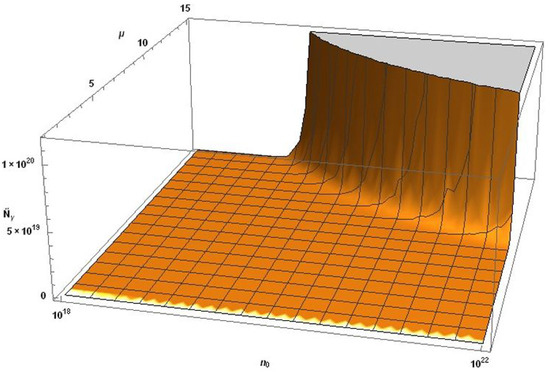
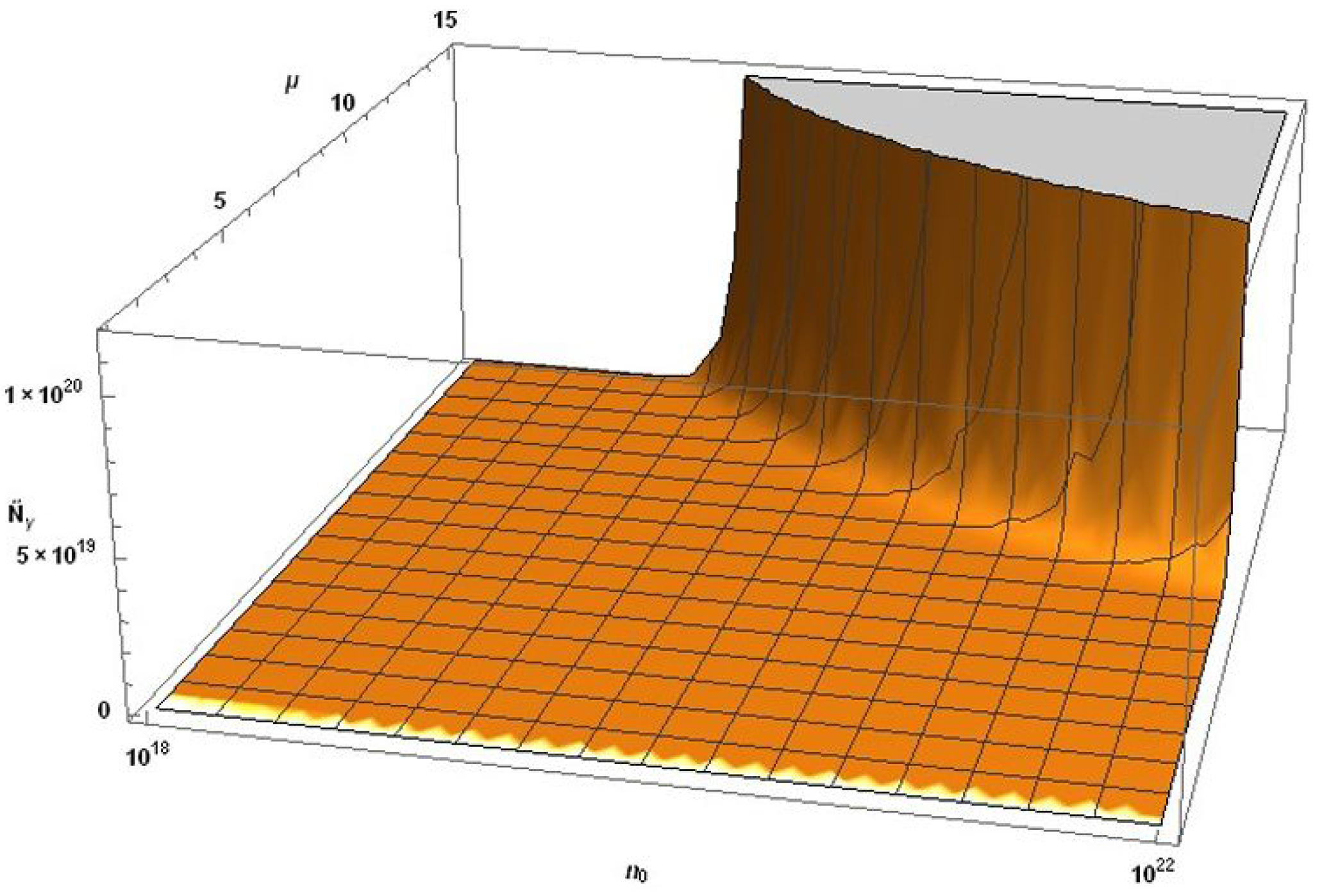
Figure 1 shows the number of photons created through the para-positronium condensate that we assume to be a prolated spheroid with a semi-major axis much larger than the minor axis with a volume and the deformation parameter from the spherical symmetry and an interaction time were considered.
Figure 1.
Number of photons created through the para-positronium condensate that we assume to be a prolated spheroid with a semi-major axis much larger than the minor axis with a volume and a deformation parameter from the spherical symmetry . An interaction time was considered. Note that throughout the diagram, the number of photons is always below the maximum physical limit .
Note that throughout Figure 1, the number of photons is always below the maximum physical limit
5. Second Stage: Beyond the Bogoliubov Approximation and Squeezing
Considering the system (18)–(21), we can see that Equations (20) and (21) tell us that the time evolution of the positronium field operators evolves quadratically as a function of the photonic field operators, modulated by the respective matrix elements as follows:
and similarly
Consequently, if we insert expressions (26) and (27) in Equations (18) and (19), we obtain the following photonic field operators:
where
As we can see from the photonic field operators (28) and (29) outside the active medium region (Ps condensate), the number operator is preserved
and the canonical conditions are also preserved in the corresponding limit. It is clear that photons are generated in the active medium and, once emitted, travel as a coherent squeezed state.
Squeezed States and the Metaplectic Group Splitting
With respect to the average values of the number of photons emitted in the squeezed condition, as we have investigated in previous works [22,23], the operator of the expression (8), taking into account (26) and (27), is evidently an element of the metaplectic group Mp(2) in the simplest case (Appendix B), as the double covering of SU(1,1) has important physical implications because the action of this operator on a reference physical state (e.g., vacuum, fiducial vector) will divide the corresponding Hilbert space into even and odd sectors with respect to the number of photons.
Each sector of the Hilbert space is swept by two coherent coset states, orthonormal to each other and generated under the action of operator (8) on the fundamental states and , respectively, as follows:
labeled by coefficients corresponding to the even sector and for the odd sector.
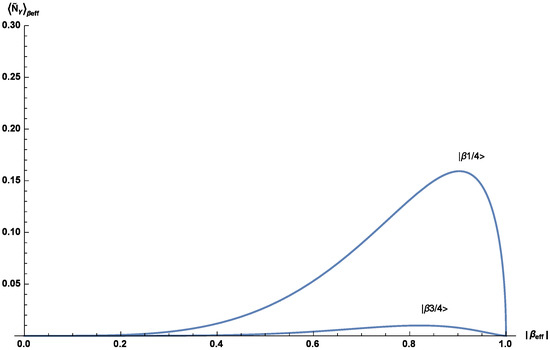
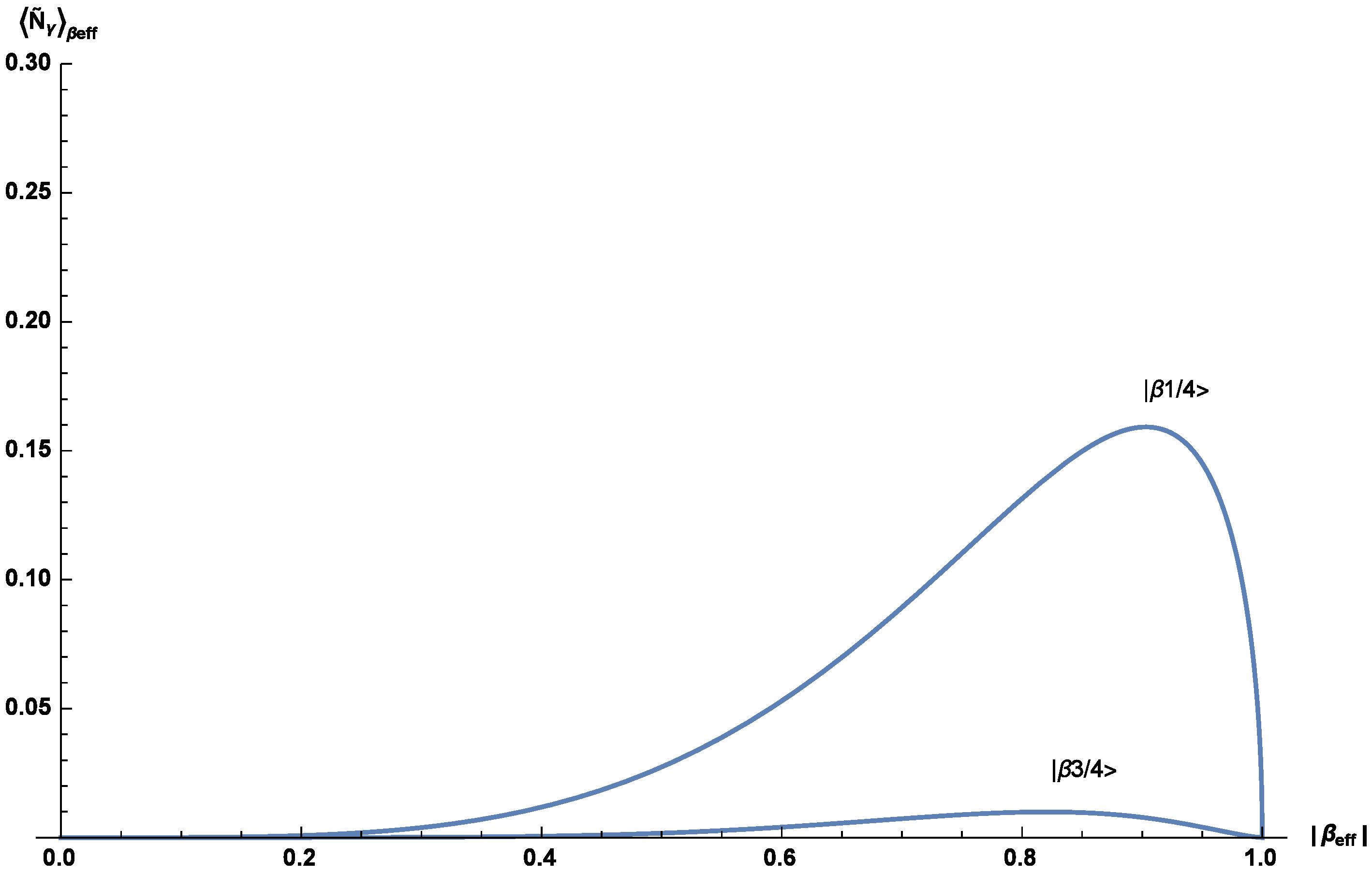
In Figure 2, we can see the average photon number with respect to these even and odd squeezed states vs. with inside the unitary disk (coefficient of the Ps displacement operator (8)): the preponderance of even squeezed states over the average photon number is significant.
Figure 2.
We can see in the figure the expectation value or average value of the number of photons with respect to the basic (squeezed) states vs. with inside the unitary disk (coefficient of the Ps displacement operator (8)). The basic squeezed states (spanning even and odd energy levels, respectively) correspond to the irreducible representations 1/4 and 3/4 of the Hilbert space. Clearly, the mean value of the number of photons in the squeezed even states is predominant.
This fact is clearly visible from the point of view of the flux of energy if one considers the expression [24]
where now the Mp(2) photon occupation numbers are
and
where the probability of a squeezed Mp(2) configuration (even and odd) with N photons are and , respectively.
Another important point to be mentioned (which will be detailed in [4]) is based on the observation of the transformation structure induced by the displacement operators for the CS of Ps (9): if we look at the transformation induced by the displacement operator on the fermionic fields that make up the state structure for positronium, one obtains the following unitary transformation (of a non-compact nature):
These transformations generate the following change on the positronium field operators and (non-unitary in general, depending on the C-character of the pPs wavefunction norm):
Consequently, the operator number of positronium atoms takes the form
whose mean value is clearly different from zero and the transformation is compact with respect to the norm of the function The negative sign in vev would have some implication on , with some topological quantization condition likely to be analyzed in [4], due the fact that the VeV of the number of positrons cannot be negative. This fact needs to be understandable from the point of view of a system composite state with decay, consequently without the number of particle conservation in different stages of the full processes.
Consequently, comparing this research with respect to the work [5], the main difference lies in this second stage, which is crucial for the recognition and structure of the gamma beam, given the non-classical imprint on its nature. This fact corresponds with the clear squeezed character described in this section of these (second stage) states. The first stage in the active medium is not fully described here as in [5], as it also has its complexity, such as the necessary use of a specific interaction time (at least in order of magnitude) to determine the physically realistic dynamics and coherence (condensate shift [25]) in the medium.
6. Concluding Remarks and Discussion
The concept of coherence and condensation has been assumed ad hoc in several previous references [5]. The interpretation considering a true coherent state of positrons (collective behavior) indicates that at time , the operators and represent the condensate and form the active medium where the created photons are propagating (). But for times greater than the interaction time, and evolve, symbolically (subindices dropped for simplicity), as
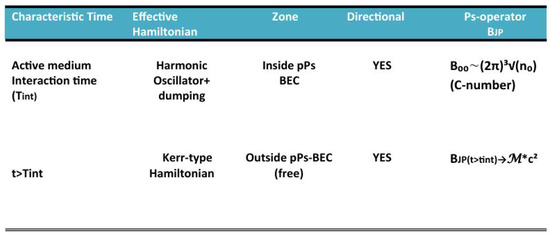
respectively, (20) and (21). Consequently, the displacement operator containing the positronium field operators will be transformed in this case into a standard photonic squeezed operator whose coefficients are the matrix elements of the two-photon decay of para-positronium. We can obviously see from (32) and from (8) that the time-dependent part of the displacement operator for is a squeezing photonic operator with the coefficients now modulated by the matrix elements of the two-photon decay of the para-positronium process given by . Figure 3 contains a table describing the physical scenario treated in this paper.
Figure 3.
General description of the physical system.
Since the emitted photons form a squeezed beam, in the case of gamma-ray laser emission from a natural astrophysical process, this should be detectable by both the intensity and the beam profile, as in the case of a jet. Regarding the condensation mechanism for positronium atoms, this is the most complex point and it can be understood as the superconducting/superfluid behavior of a particular model of boson or axion star, or of some very specific process in magnetospheric or adjacent regions of the AGN or compact object in question.
Funding
This research received no external funding.
Data Availability Statement
The data that support the findings of this study are available within the article.
Acknowledgments
This work is in memory of John R. Klauder, a pioneer in the theory of coherent states, and Luis J. Boya, a great researcher in the foundations of quantum physics and its relation to symmetries. Very important discussions with V.I. Yukalov are greatly appreciated. D.J.C.-L. Acknowledges the Special Astrophysical Observatory of the Russian Academy of Sciences and CONICET of Argentine for Institutional and financial support. This work was carried out within the framework of a state assignment for SAO-RAS, approved by the Ministry of Science and Higher Education of the Russian Federation.
Conflicts of Interest
The author declares no conflicts of interest.
Appendix A. Positronium Wave Function
Due to the composite characteristic of the positronium state, firstly we have particular interest in the 2-fermion 2-times Green functions
where are fermion operators and chronological product [26]. The second important point in a theoretical formulation for the positronium CS is due to the observation that the can be written as
where it is easily seen that
Then, the above expression can be assumed as the basic wave function of the positronium. Fourier transforming (A2), we obtain
Appendix B. Generalities of the Metaplectic Group Mp(2)
, , and are three-dimensional. It is possible to parameterize them in several ways that make the homomorphic relations particularly simple. We use two such parametrizations, both of which are described as
where the angle has the range for , and the range for and .
Let us consider the brief description of the relevant symmetry group to perform the realization of the Hamiltonian operator of the problem. This group specifically is the Metaplectic as well as the groups that are topologically covered by it. The generators of are as follows:
with the commutation relations
being , (alternatively the variables of the standard harmonic oscillator, as usual.
If we rewrite the commutation relations as
we see that the states are eigenstates of
and it is easy to see that
Generators and act on the Hilbert space spanning even and odd n. The irreducible sector of the Hilbert space corresponding to the even states has a spin weight s = 1/4 and the irreducible sector corresponding to the odd n has a spin weight s = 3/4, according to Bargmann’s classification.
Concerning and which are covered by the Mp(2), we have the following properties:
References
- Zhang, B. Coherent inverse compton scattering by bunches in fast radio bursts. ApJ 2022, 925, 53. [Google Scholar] [CrossRef] [Scilit]
- Melrose, D.B. Coherent radio emission from pulsars. Phil. Trans. R. Soc. Lond. A 1992, 341, 105–115. [Google Scholar] [CrossRef] [Scilit]
- Algaba, J.C.; Baloković, M.; Chandra, S.; Cheong, W.-Y.; Cui, Y.-Z.; D’aMmando, F.; Falcone, A.D.; Ford, N.M.; Giroletti, M.; Goddi, C.; et al. Broadband multi-wavelength properties of M87 during the 2018 EHT campaign including a very high energy flaring episode. Astron. Astrophys. 2024, 692, A140. [Google Scholar] [CrossRef] [Scilit]
- Cirilo-Lombardo, D.J. Astrophysical lasers from compact objects and Black holes. Manuscript in preparation.
- Avetissian, H.K.; Avetissian, A.K.; Mkrtchian, G.F. Self-amplified gamma-ray laser on positronium atoms from a Bose-Einstein condensate. Phys. Rev. Lett. 2014, 113, 023904. [Google Scholar]
- Cassidy, D.B.; Mills, A.P., Jr. Physics with dense positronium. Phys. Stat. Sol. 2007, 4, 3419–3428. [Google Scholar]
- Barut, A.O.; Krauss, J. New theory of positronium decay and relativistic wave function corrections. Phys. Lett. A 1976, 58, 361–363. [Google Scholar] [CrossRef] [Scilit]
- Klauder, J.R.; Skagerstam, B.S. Coherent States; World Scientific: Singapore, 1985. [Google Scholar]
- Cirilo-Lombardo, D.J. On coherent states description of exciton systems: NLSE equations and hydrodynamics. Int. J. Geom. Methods Mod. Phys. 2024, 21, 2450064. [Google Scholar] [CrossRef] [Scilit]
- Cirilo-Lombardo, D.J. Excitonic Coherent States: Symmetries and Thermalization. J. Low Temp. Phys. 2015, 179, 55–61. [Google Scholar] [CrossRef] [Scilit]
- Cirilo-Lombardo, D.J. Bounded coherent states and excitonic systems. Phys. Part. Nuclei Lett. 2014, 11, 502–505. [Google Scholar] [CrossRef] [Scilit]
- Chu, S.; Hall, J.L.; Mills, A.P., Jr. Measurement of the Positronium 13S1—23S1 Interval by Doppler-Free Two-Photon Spectroscopy. Phys. Rev. Lett. 1984, 52, 1689. [Google Scholar] [CrossRef] [Scilit]
- Yamazaki, T.; Miyazaki, A.; Suehara, T.; Namba, T.; Asai, S.; Kobayashi, T.; Saito, H.; Ogawa, I.; Idehara, T.; Sabchevski, S. Direct observation of the hyperfine transition of ground-state positronium. Phys. Rev. Lett. 2012, 108, 253401. [Google Scholar] [CrossRef] [Scilit] [PubMed]
- Platzman, P.M.; Mills, A.P. Possibilities for Bose condensation of positronium. Phys. Rev. B 1994, 49, 454. [Google Scholar] [CrossRef] [Scilit]
- Mills, A.P. Positronium molecule formation, Bose–Einstein condensation and stimulated annihilation. Nucl. Instrum. Methods Phys. Res. B 2002, 192, 107–116. [Google Scholar] [CrossRef] [Scilit]
- Mills, A.P.; Cassidy, D.B.; Greeves, R.G. Prospects for making a Bose-Einstein-condensed positronium annihilation gamma ray laser. Mater. Sci. 2004, 424, 445–446. [Google Scholar] [CrossRef] [Scilit]
- Cassidy, D.B.; Meligne, V.E.; Mills, A.P. Production of a fully spin-polarized ensemble of positronium atoms. Phys. Rev. Lett. 2010, 104, 173401. [Google Scholar] [CrossRef] [Scilit]
- Cassidy, D.B.; Mills, A.P. Interactions between positronium atoms in porous silica. Phys. Rev. Lett. 2008, 100, 013401. [Google Scholar] [CrossRef] [Scilit]
- Cassidy, D.B.; Deng, S.H.M.; Mills, A.P. Evidence for positronium molecule formation at a metal surface. Phys. Rev. A 2007, 76, 062511. [Google Scholar] [CrossRef] [Scilit]
- Cassidy, D.B.; Hisakado, T.H.; Tom, H.W.K.; Mills, A.P., Jr. Positronium Hyperfine Interval Measured via Saturated Absorption Spectroscopy. Phys. Rev. Lett. 2012, 109, 073401. [Google Scholar] [CrossRef] [Scilit]
- Crater, H.W. Singlet-positronium decay using a relativistic wave function. Phys. Rev. A 1991, 44, 7065–7070. [Google Scholar] [CrossRef] [Scilit]
- Cirilo-Lombardo, D.J.; Sanchez, N.G. Entanglement and Generalized Berry Geometrical Phases in Quantum Gravity. Symmetry 2024, 16, 1026. [Google Scholar] [CrossRef] [Scilit]
- Cirilo-Lombardo, D.J.; Sanchez, N.G. Quantum-Spacetime Symmetries: A Principle of Minimum Group Representation. Universe 2024, 10, 22. [Google Scholar] [CrossRef] [Scilit]
- Elitzur, M. Astronomical Masers; Kluwer Academic Publishers: Dordrecht, The Netherlands, 1992. [Google Scholar]
- Yukalov, V.I. Nonequivalent operator representations for Bose-condensed systems. Laser Phys. 2006, 16, 511–525. [Google Scholar] [CrossRef] [Scilit]
- Semenoff, G.W.; Umezawa, H. Functional methods in thermofield dynamics: A real-time perturbation theory for quantum statistical mechanics. Nucl. Phys. 1983, B220, 196–212. [Google Scholar] [CrossRef] [Scilit]
Disclaimer/Publisher’s Note: The statements, opinions and data contained in all publications are solely those of the individual author(s) and contributor(s) and not of MDPI and/or the editor(s). MDPI and/or the editor(s) disclaim responsibility for any injury to people or property resulting from any ideas, methods, instructions or products referred to in the content. |
© 2026 by the author. Licensee MDPI, Basel, Switzerland. This article is an open access article distributed under the terms and conditions of the Creative Commons Attribution (CC BY) license.